
Matthew 4:15

Greek (Tischendorf 8th ed.) Matthew 4:15 appears in the Greek New Testament. The text above is from the Tischendorf 8th edition. Each word links to its Strong’s number and a concise gloss. Click any word for its full Thayer’s Greek Lexicon entry.
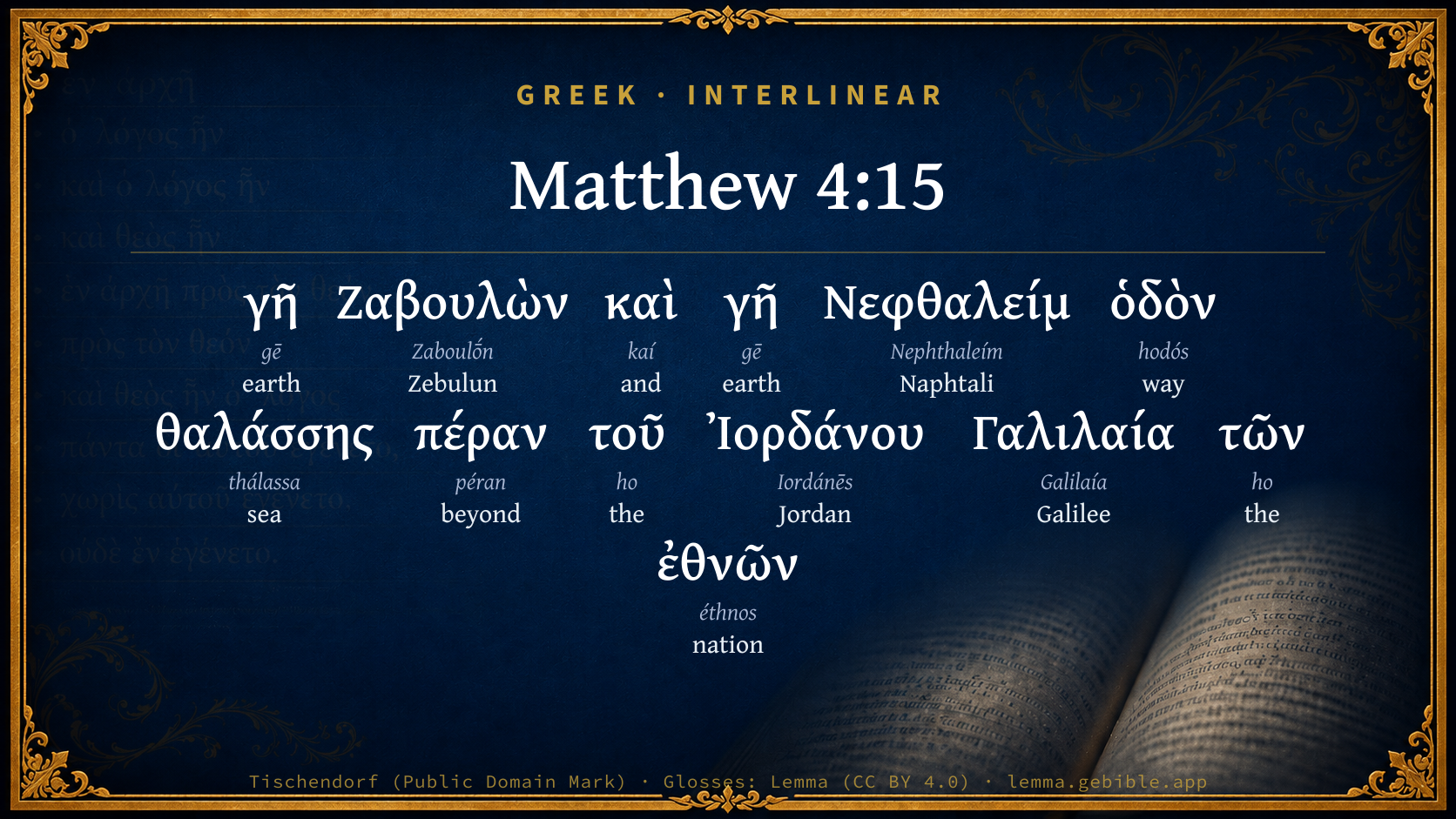
Download image
Cite this verse

Matthew 4:15 (World English Bible). Public Domain. Lemma interlinear Bible study tool, https://lemma.gebible.app/v/matthew/4/15.

Show BibTeX & RIS
BibTeX
RIS
English Translation
"The land of Zebulun and the land of Naphtali, Toward the sea, beyond the Jordan, Galilee of the Gentiles,
World English Bible · Public Domain
Highlights
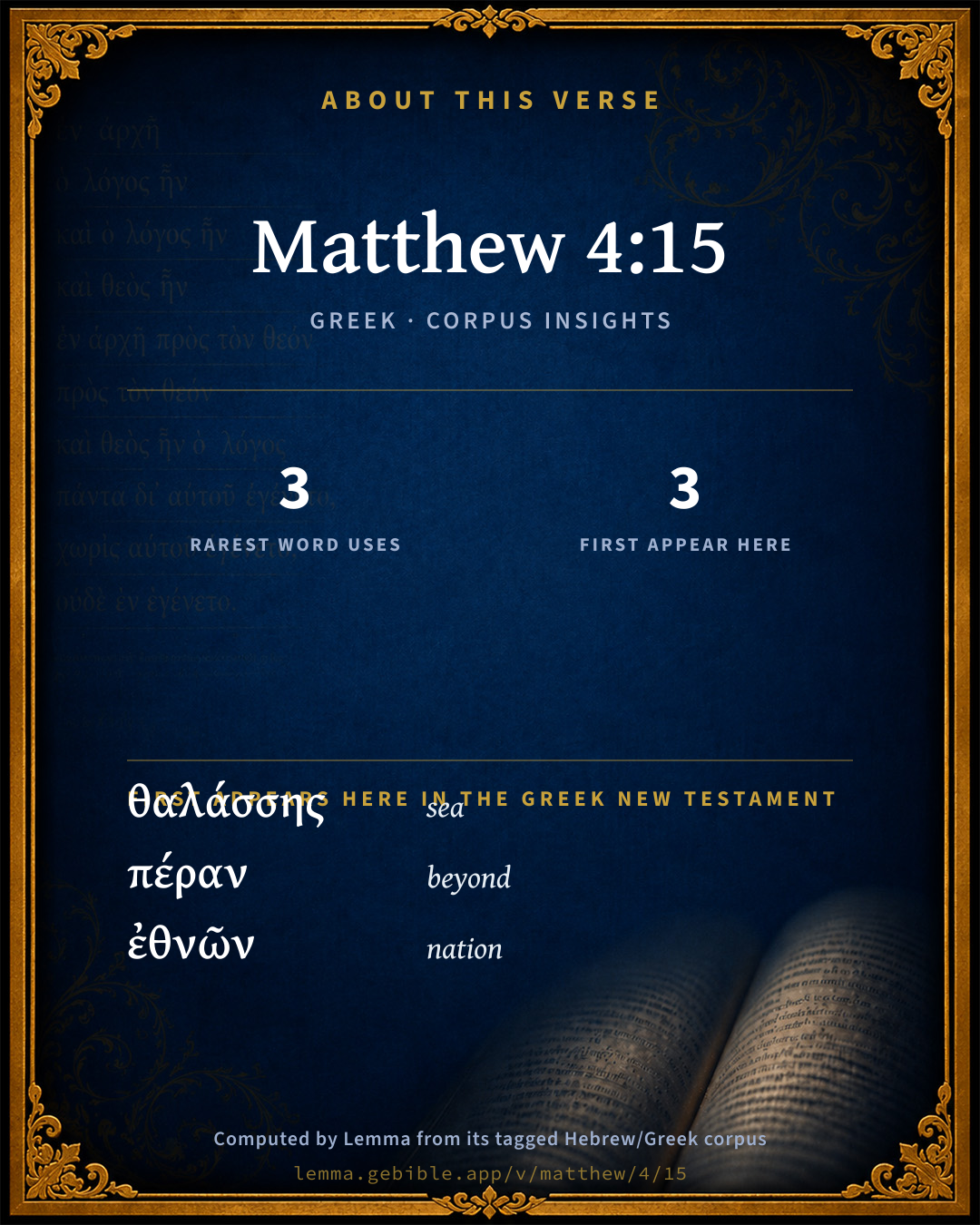
  • 3 first appearances in the Greek New Testament
Full analysis ↓
Download a study sheet

One document with this verse’s original text, its word-by-word gloss line, the meaning frame, cross-references with their text, attributed commentary, and full source and license credits — printable, and it pastes into notes with its structure intact.

This verse Autodidact and up

Study sheet (.html) Plain text (.txt)

A passage Seminary Student

Up to 50 verses in one chapter. A passage sheet keeps up to 6 commentary sources and 12 cross-references per verse, in the order this page ranks them, and says so on the sheet whenever that leaves anything out. Ask for a single verse and you get the Autodidact verse sheet above.

Everything on this page stays free to read, with no account — the sheet is a download of what is already on screen, not access to it.

Want to remove ads? Support Godless Engineer
Compare translations 3

The same verse in 3 English versions, stacked beneath the original-language interlinear above. Click any original word for its lexicon entry.

Each is an independent rendering of the whole verse — the interlinear is not word-aligned to these translations.

Highlighted words mark where these versions differ — a whole-verse word diff, not a word-by-word alignment.

  • World English Bible Public Domain
    "The land of Zebulun and the land of Naphtali, Toward the sea, beyond the Jordan, Galilee of the Gentiles,
  • King James Version Public Domain
    The land of Zabulon, and the land of Nephthalim, by the way of the sea, beyond Jordan, Galilee of the Gentiles;
  • unfoldingWord Literal Text CC BY-SA 4.0
    “The land of Zebulun and the land of Naphtali, way of the sea, beyond the Jordan, Galilee of the Gentiles—

unfoldingWord Literal Text — © unfoldingWord, licensed CC BY-SA 4.0. Word-aligned USFM3 via Door43 (git.door43.org/unfoldingWord/en_ult).

Versions to compare (up to 4)

3 of 4 selected

Show all 19 translations

Every available English version of this verse, each an independent rendering of the whole verse.

  • World English Bible Public Domain
    "The land of Zebulun and the land of Naphtali, Toward the sea, beyond the Jordan, Galilee of the Gentiles,
  • Berean Standard Bible Public Domain
    “Land of Zebulun and land of Naphtali, the Way of the Sea, beyond the Jordan, Galilee of the Gentiles—
  • Majority Standard Bible Public Domain
    “Land of Zebulun and land of Naphtali, the Way of the Sea, beyond the Jordan, Galilee of the Gentiles—
  • King James Version Public Domain
    The land of Zabulon, and the land of Nephthalim, by the way of the sea, beyond Jordan, Galilee of the Gentiles;
  • American Standard Version (1901) Public Domain
    The land of Zebulun and the land of Naphtali, Toward the sea, beyond the Jordan, Galilee of the Gentiles,
  • Revised Version (1885) Public Domain
    The land of Zebulun and the land of Naphtali, Toward the sea, beyond Jordan, Galilee of the Gentiles,
  • Geneva Bible (1599) Public Domain
    The land of Zabulon, and the land of Nephthalim by the way of the sea, beyond Iordan, Galile of the Gentiles:
  • Douay-Rheims (1899) Public Domain
    Land of Zabulon and land of Nephthalim, the way of the sea beyond the Jordan, Galilee of the Gentiles:
  • Young's Literal Translation Public Domain
    `Land of Zebulun and land of Naphtali, way of the sea, beyond the Jordan, Galilee of the nations! --
  • Literal Standard Version CC BY-SA 4.0
    “Land of Zebulun and land of Naphtali, way of the sea, beyond the Jordan, Galilee of the nations!
  • Unlocked Literal Bible CC BY-SA 4.0
    “The land of Zebulun and the land of Naphtali, toward the sea, beyond the Jordan, Galilee of the Gentiles!
  • unfoldingWord Literal Text CC BY-SA 4.0
    “The land of Zebulun and the land of Naphtali, way of the sea, beyond the Jordan, Galilee of the Gentiles—
  • Darby Bible Public Domain
    Land of Zabulon and land of Nepthalim, way of [the] sea beyond the Jordan, Galilee of the nations:
  • World Messianic Bible Public Domain
    “The land of Zebulun and the land of Naphtali, toward the sea, beyond the Jordan, Galilee of the Gentiles,
  • Webster's Bible Public Domain
    The land of Zabulon, and the land of Nephthalim, by the way of the sea, beyond Jordan, Galilee of the Gentiles:
  • Free Bible Version CC BY-SA 4.0
    “In the land of Zebulun and the land of Naphthali, on the road to the sea, across the Jordan River, in Galilee where the foreigners live:
  • Bible in Basic English Public Domain
    The land of Zebulun and the land of Naphtali, by the way of the sea, the other side of Jordan, Galilee of the Gentiles,
  • Text-Critical English NT CC BY 4.0
    “Land of Zebulun and land of Naphtali, way of the sea, beyond the Jordan, Galilee of the Gentiles,
  • Tyndale New Testament (1534) Public Domain
    The londe of zabulon and Neptalim the waye of the see beyonde Iordan Galile of the Gentyls

Literal Standard Version (2020), Covenant Press — licensed CC BY-SA 4.0. Text via the HelloAO Bible API (eBible.org). Unlocked Literal Bible (unfoldingWord) — licensed CC BY-SA 4.0. Text via the HelloAO Bible API (eBible.org). unfoldingWord Literal Text — © unfoldingWord, licensed CC BY-SA 4.0. Word-aligned USFM3 via Door43 (git.door43.org/unfoldingWord/en_ult). Free Bible Version, Dr. Jonathan Gallagher — licensed CC BY-SA 4.0. Text via the HelloAO Bible API (eBible.org).

Word by word

More ways to search: Search by grammar → Find every occurrence → Compare this word →

Practice this passage: Drill this verse → Learn its vocabulary →

About this verse

These counts appear in no published source. They are computed here, from the morphology-tagged text and Lemma’s own curated glosses. What Lemma adds →

13
words
11
distinct lemmas
Gospels
section

Notable vocabulary

The rarest word here is Ζαβουλὼν Zebulun G2194 — appearing just 3 times in the whole Greek New Testament.

First appearance in Scripture

These words make their first canonical appearance in the Greek New Testament here:

  • θαλάσσης sea G2281
  • πέραν beyond G4008
  • ἐθνῶν nation G1484

Shared distinctive vocabulary

Ζαβουλὼν Zebulun G2194 occurs in 3 verses of the Greek New Testament. Also found in:
Repetition

Words recur within this verse:

Cross-references

1

Topical passages linked to Matthew 4:15 in the Treasury of Scripture Knowledge — connected by theme and wording, ordered by reader-vote popularity; previews shown in the World English Bible.

  • Isaiah 9:1 But there shall be no gloom to her who was in anguish. In the former time he brought into contempt the land of Zebulun and the land of Naphtali; but in the latter time has he made it glorious, by the way of the sea, beyond the Jordan, Galilee of the nations.

Cross-references courtesy of OpenBible.info (CC BY 4.0).

Commentary

Notes on Matthew 4:15 from classic Christian and Jewish commentators (each source and its license shown beneath its notes). The classic Christian expositions comment on the surrounding passage and are grouped to its opening verse, so a note may address several verses; the Jewish commentaries on the Tanakh (Rashi and others) are per-verse, so they appear only where the commentator wrote on this verse.

Lemma curates 59 commentaries, every one of them public domain or Creative Commons licensed, each selected and text-cleaned for this edition rather than reprinted as found. About our sources →

Bengel's Gnomon

Johann Albrecht Bengel

Mat 4:15-16. Γῆ Ζαβουλὼν καὶ γῆ Νεφθαλεὶμ, ὁδὸν θαλάσσης πέραν τοῦ Ἰορδάνου Γαλιλαία τῶν ἐθνῶν, ὁ λαὸς ὁ πορευόμενος[148] ἘΝ ΣΚΌΤΕΙ ΕἾΔΕ Φῶς ΜΈΓΑ, ΚΑῚ ΤΟῖς ΚΑΘΗΜΈΝΟΙς ἘΝ ΧΏΡᾼ ΚΑῚ ΣΚΙᾷ ΘΑΝΆΤΟΥ, Φῶς ἈΝΈΤΕΙΛΕΝ ΑὐΤΟῖς, The land of Zabulon, and the land of Nephthalim, by the way of the sea, beyond Jordan, Galilee of the Gentiles; the people which walketh in darkness saw great light; and to them which sat in the region and shadow of death light is sprung up) The LXX. thus render the passage in Isa. 8:23 and Isa 9:1:[149] ΧΏΡΑ ΖΑΒΟΥΛῺΝ, Ἡ Γῆ ΝΕΦΘΑΛΕῚΜ, ΚΑῚ ΟἹ ΛΟΙΠΟῚ ΟἹ ΤῊΝ ΠΑΡΑΛΊΑΝ, ΚΑῚ ΠΈΡΑΝ ΤΟῦ ἸΟΡΔΆΝΟΥ ΓΑΛΙΛΑΊΑ ΤῶΝ ἘΘΝῶΝ. Ὁ ΛΑῸς Ὁ ΠΟΡΕΥΌΜΕΝΟς ἘΝ ΣΚΌΤΕΙ, ἼΔΕΤΕ Φῶς ΜΈΓΑ· ΟἹ ΚΑΤΟΙΚΟῦΝΤΕς ἘΝ ΧΏΡᾼ ΚΑῚ ΣΚΙᾷ ΘΑΝΆΤΟΥ Φῶς ΛΆΜΨΕΙ ἘΦʼ ὙΜᾶς,—Country of Zabulon, the land of Nephthalim, and ye the rest who inhabit the region situated by the sea, and bounded by[150] the Jordan, thou Galilee of the Gentiles! Thou people which walketh in darkness, behold ye a great light: ye who dwell in the country and shadow of death, a light shall shine upon you. The two verses are in Isaiah most closely connected together, on which ground the Evangelist takes part of the topography from the former [to explain the application of the latter]. Many of the apostles were from this region. See Psa 68:28; Act 1:11; Act 2:7.—Γῆ, land, and λαὸς, people, are placed in opposition.—ὉΔῸΝ, the way) The LXX. render דרך (way) by ὉΔῸΝ (way). We must here understand κατά, by. The exactness of the prophetical topography is marvellous, minutely accurate both in latitude and longitude.—ΘΑΛΆΣΣΗς, of the sea[151]) See Mat 4:18.—πέραν τοῦ Ἰορδάνου, beyond the Jordan) The Hebrew עבר,[152] rendered in the present passage by the Greek πέραν (beyond), is used with reference to a boundary considered in reference to, not only the farther side, but the hither side also.—Γαλιλαία τῶν ἐθνῶν, Galilee of the Gentiles) Galilee, though inhabited by Israelites, was conterminous to the Gentiles, especially as far as the tribes of Zabulon and Naphthali were concerned.—See Hiller’s Onomata Sacra, p. 816. Galilee, previously to the time under consideration, was behind Judaea in the cultivation of sacred learning: the citadel of the Levitical worship was at Jerusalem: the Jews therefore ought to have acknowledged our Lord more readily than the Galilaeans, to whom a compensation is now made for their previous disadvantages.

[148] E. M. καθήμενος.—(I. B.)

[149] This is the Hebrew notation. In the LXX., the Vulgate, and the English Version, the extract is contained in Isa 9:1-2.—(I. B.)

[150] I have rendered πέραν bounded by, instead of beyond, in accordance with the remarks which immediately follow on the עבר of the original Hebrew. I may add in illustration, that Liddell and Scott say of πέρα and πέραν, “They are, no doubt, the dative and accusative of an old substantive—ἡ κἐρα = πεῖραρ, πεῖρας, πέρας, end, boundary.”—(I. B.)

[151] Sc. of Galilee.—(I. B)

[152] Commonly, The region beyond.—(I. B)

Bengel's Gnomon of the New Testament — English translation (T&T Clark, Edinburgh, 1860) — public domain. Text from a community e-Sword module.

Meyer's Critical & Exegetical Commentary

Heinrich August Wilhelm Meyer

Mat_4:15-16. As the evangelist, Mat_2:23, found a prophecy in support of the settlement at Nazareth, so also now for the removal to Capernaum, viz. Isa_8:22; Isa_9:1 (quoted from memory, but adhering to the LXX.): The land of Zdbulon and the land of Nephthalim, by the way of the sea, beyond Jordan, Galilee of the Gentiles, the people which sat in darkness, and so on.

γῆ is not the vocative, but the nominative, corresponding to ὁ λαός, etc., Mat_4:16. The article was not required; see Winer, p. 114 f. [E. T. 22]. As, by the ὁδὸν θαλάσσης, the τὴν παραθαλασσίαν expressed of Capernaum in Mat_4:13 is prophetically established, so must θαλάσσης, in the sense of the evangelist, refer to the Sea of Galilee, the Lake of Gennesareth. These words, namely, determine the situation of γῆ Ζαβ. and γῆ Νεφθ., and are to be translated seawards. The absolute accusat. ὁδόν is quite Hebraistic, like רֶּרֶךְ in the sense of versus (Eze_8:5; Eze_40:20; Eze_41:11 f., Eze_42:1 ff.; 1Ki_8:48; 2Ch_6:38; Deu_1:2; Deu_1:19),a usage which is partly retained in the LXX. 1Ki_8:48, ὁδὸν γῆς αὐτων, in the direction of their land; exactly so in 2Ch_6:38, and most probably also in Deu_1:19. In this sense has the evangelist also understood רֶּרֶךְ הַיָם in the original text of the passage before us; so also Aquila and Theodotion, not the LXX., according to B (in A, by an interpolation). No completely corresponding and purely Greek usage is found, as the accusatives of direction, in Bernhardy, p. 144 f., comp. Kühner, II. 1, p. 268 f., do not stand independent of a verb. πέραν τοῦ Ἰορδ. is not, like ὁδὸν θαλ, a determination of the position of γῆ Ζαβ. and γῆ Νεφθ., as these tribes were situated on this side the Jordan, while πέραν (in answer to Bengel, Kuinoel, Linder in the Stud. u. Krit. 1862, p. 553) can never signify on this side (Crome, Beitr. p. 83 ff.); but it designates, after these two lands, a new land as the theatre of the working of Jesus, viz. Peraea (comp. on Mat_4:25), whose customary designation was עבר הירדן, πέραν τοῦ Ἰορδάνουthat is, the land east of Jordan. The evangelist includes this land as well as Γαλιλ. τ. ἐθνῶν, because it stands in the prophetic passage along with the others (not with reference to the Peraean ministry of Jesus, de Wette, Bleek, which has no place here), leaving it, besides, to the reader to decide that it was only in γῆ Ζαβουλὼν … θαλάσσης that the specific element of locality which was to be demonstrated from the prophecies was contained. The citation, moreover, which specially sets forth that Jesus; after He had quitted Nazareth, settled at Capernaum, on the borders of Zebulon and Naphtali, in their telic connection with a divine prediction (ἵνα of the divine determination), shows in this very circumstance the Messianic fulfilment of the historical relation of the prophetic declaration, according to which there was announced to northern Galilee safety and salvation from the oppression of the Assyrians, and consequently theocratical, political salvation.

Γαλ. τ. ἐθνῶν] נְּלִיל הַנּוֹיִם (district of the heathen), that is, in keeping with the originally appellative term גליל, which had become a proper name, Upper Galilee, in the neighbourhood of Phoenicia, inhabited by a mixed population of heathens (Strabo, xvi. p. 760) and Jews. 1Ma_5:15 : Γαλιλ. ἀλλοφύλων. Its geographical limits are defined by Joseph. Bell. iii. 3. 1.

Meyer — Critical and Exegetical Commentary on the New Testament — English translation by Peter Christie, edited by Frederick Crombie (T&T Clark, 1880) — public domain. Text from a community e-Sword module.

Geneva Bible (1599)

Geneva Bible translators

Of Tiberias, or because that country bended toward Tyre, which standeth upon the sea that cutteth the midst of the world.

So called, because it bordered upon Tyre and Sidon, and because Solomon gave the king of Tyre twenty cities in that quarter, 1 Kings 9:11.

Geneva Bible (1599) marginal notes — public domain. Text via Bolls.life.

Jamieson, Fausset & Brown

Robert Jamieson, A. R. Fausset & David Brown

The land of Zabulon, and the land of Nephthalim, by the way of the sea--the coast skirting the Sea of Galilee westward--beyond Jordan--a phrase commonly meaning eastward of Jordan; but here and in several places it means westward of the Jordan. The word seems to have got the general meaning of "the other side"; the nature of the case determining which side that was.

Galilee of the Gentiles--so called from its position, which made it the frontier between the Holy Land and the external world. While Ephraim and Judah, as STANLEY says, were separated from the world by the Jordan valley on one side and the hostile Philistines on another, the northern tribes were in the direct highway of all the invaders from the north, in unbroken communication with the promiscuous races who have always occupied the heights of Lebanon, and in close and peaceful alliance with the most commercial nation of the ancient world, the PhÅ“nicians. Twenty of the cities of Galilee were actually annexed by Solomon to the adjacent kingdom of Tyre, and formed, with their territory, the "boundary" or "offscouring" (Gebul or Cabul) of the two dominions--at a later time still known by the general name of "the boundaries (coasts or borders) of Tyre and Sidon." In the first great transportation of the Jewish population, Naphtali and Galilee suffered the same fate as the trans-jordanic tribes before Ephraim or Judah had been molested (Kg2 15:29). In the time of the Christian era this original disadvantage of their position was still felt; the speech of the Galileans "bewrayed them" by its uncouth pronunciation (Mat 26:73); and their distance from the seats of government and civilization at Jerusalem and Cæsarea gave them their character for turbulence or independence, according as it was viewed by their friends or their enemies.

Jamieson, Fausset & Brown — Commentary Critical and Explanatory on the Whole Bible (1871) — public domain (CC PDM 1.0). Text via the HelloAO Bible API.

Adam Clarke's Commentary

Verse 15. Galilee of the Gentiles] Or of the nations. So called, because it was inhabited by Egyptians, Arabians, and Phoenicians, according to the testimony of Strabo and others. The Hebrew גוים goyim, and the Greek εθνων, signify nations; and, in the Old and New Testaments, mean those people who were not descendants of any of the twelve tribes. The word Gentiles, from gens, a nation, signifies the same. It is worthy of remark, that it was a regular tradition among the ancient Jews, that the Messiah should begin his ministry in Galilee. See the proofs in Schoetgen.

Adam Clarke's Commentary on the Bible (1810–1826) — public domain. Text from a community e-Sword/MySword module.

Ellicott's Commentary for English Readers

(15-16) The citation is remarkable as the only reference in the New Testament to what seems to us the most wonderful and majestic of all Messianic prophecies; and still more remarkable as dwelling, not on the words so familiar to us, “Unto us a Child is born, unto us a Son is given . . . ,” but on the merely local imagery which is a prelude to that great utterance, and on that, in a version which is neither a true rendering of the Hebrew, nor a correct citation from the received Greek version. We have to recognise the fact that the Evangelist did not study prophecy as we study it. Books were scarce, and the publican of Capernaum, though his occupation implied some clerkly knowledge, probably had few, and heard rather than read the Scriptures which he quotes. What strikes a man who learns in this way is the coincidence of single words and phrases with familiar facts. He speaks not of what has been written, but of what has been spoken. He is not careful about the context. When St. Matthew looked back on the change that had come over Capernaum in the arrival of the prophet of Nazareth—a change extending to his own life—these words seemed the only adequate description of it. Here was the very scene of which Isaiah had spoken, the old border country of Zebulon and of Naphthali. To him and to others who had been in the darkness of spiritual ignorance, neglected and uncared for, as sheep gone astray in the dark valley of death, there had sprung up a marvellous Light. Unconsciously he adds his testimony to that of St. John, that the presence of Jesus was felt to be that of the “true Light” that “lighteth every man” (Joh_1:9).

A Bible Commentary for English Readers, edited by Charles John Ellicott (1878–1897) — public domain. Text from a community e-Sword module.

The Cambridge Bible for Schools and Colleges

gen. ed. J. J. S. Perowne

15. Galilee of the Gentiles] See above, Mat_4:12.

The Cambridge Bible for Schools and Colleges (gen. ed. J. J. S. Perowne; Cambridge University Press, 1878–1918) — public domain. Text from a community e-Sword module.

Trapp's Complete Commentary

John Trapp

15 The land of Zabulon, and the land of Nephthalim, by the way of the sea, beyond Jordan, Galilee of the Gentiles;

Ver. 15. The land of Zabulon, and the land of Nephthalim, &c.] In Zabulon were Nazareth, Bethsaida, Tiberias, Cana (where our Saviour turned water into wine), and Nain, where he raised the widow’s son; so that she was twice a mother, yet had but one child, 2Sa 20:18. In Nephthalim were the city of Abel (where they asked counsel of old, and so they ended the matter); Harosheth the city of Sisera, Riblah, Caesarea Philippi, and Capernaum. This borough was the seat of the evangelical kingdom; and it was fitly chosen for such a purpose, as that which by reason of the wonderful wholesomeness of the air, fertility of the soil, nearness to the river Jordan and lake of Gennesareth, neighbourhood of many great towns and famous cities, promised a plentiful increase and income of the evangelical harvest. Here the grain was white unto the harvest (as at Samaria) and solicited labourers. It is a minister’s wisdom to seat himself, as near as may be, where most need is, and greatest likelihood of doing good, as St Paul did often. ("Come ever into Macedonia and help us," Act 16:9; "Thou hast well done that thou art come," Act 10:33) No Church was founded at Athens, no good to be done there among those wits of Greece. The apostle tarried at Ephesus while a door was opened, and then departed to other places. If thou perceive thyself unfit to do more good in any place, though it be not any fault of thine, saith a grave author, away to another. If the commodity of the place prevail more with thee there to abide, than the promoting of Christ’s kingdom, to use thy talent elsewhere, it is to be feared thou wilt either lose thy gifts, or fall into errors and heresies, or, at least, become a frigid and dry doctor among such a people as have once conceived an incurable prejudice against thee. (Rolloc. Com. in Joh 4:44)

Galilee of the Gentiles] So called, either because it bordered upon the Gentiles, or because it was given away by David to Hiram, king of Tyre, or because it was inhabited by the Assyrians, who carried the people captive, and dwelt in their place.

John Trapp, A Commentary or Exposition upon All the Books of the Old and New Testament (1647–1656) — public domain. Text from a community e-Sword module.

Haydock's Catholic Bible Commentary

St. Matthew has omitted in this place part of the prophecy, (Isaias ix.) because it was not to his purpose. He has likewise given us the mystical, though still true, interpretation of the prophecy, which was written in the first instance to foretell the deliverance of Jerusalem from Senacherib, in the time of Ezechias. (1 Kings, xix.) (Jansenius)

George Leo Haydock (1774–1849), Haydock's Catholic Family Bible and Commentary, 1859 edition — public domain. Excludes Psalms (Douay-Rheims chapter numbering differs from Protestant) and Deuterocanonical books (Catholic canon only).

Whedon's Commentary on the Bible

Daniel D. Whedon

15. The land of Zebulun and the land of Nephthalim — The territories of these two tribes were the first to feel the overthrow and captivity of Assyria, at first lightly, and then more grievously. And according to this prophecy, that ancient dimness and darkness should be reversed by a light that should burst upon the people, produced by the coming of the Prince of Peace. The ancient Jews accordingly expected that the coming of the Messiah would be in these regions. One of their books, called the Sohar, has this declaration: “The Messiah shall be revealed in the land of Galilee.”

Grammatically, we may remark that the repeated word land in this verse is in apposition with the people in Mat_4:16. The two lands and the people it is which sat in darkness, and saw the great light.

By the way of the sea — The word way here signifies route or tract of country; and the phrase, by the way of the sea, signifies on the borders of the sea. It describes the situation of the land of these two tribes, as being contiguous to the Sea of Tiberias.

Galilee of the Gentiles — This phrase is commonly understood as a geographical name of a particular part, namely, of northern Galilee. But it is very plain that northern Galilee, which lay far beyond the lake, could not here be meant. Hengstenberg says that it is not a geographical name specifying a particular part, but simply a phrase of description. Galilee is called of the Gentiles because, from various circumstances, a Gentile population had largely intermingled with the Jewish. This had corrupted their religion, debased their character, and produced much of the darkness which had deepened into the shadow of death.

Daniel D. Whedon (gen. ed.), Commentary on the Old and New Testaments (1874–1909) — public domain. Text from a community e-Sword module.

The Pulpit Commentary

The land of Zabulon, etc. From Isa_9:1, Isa_9:2, spoiled in the Authorized Version, but rendered correctly in the Revised Version. Isaiah says that those parts of the land which had borne the first brunt of the Assyrian invasions under Tiglath-Pileser, (2Ki_15:29; el. Zec_10:10) shall be proportionately glorified by the advent of Messiah. Wetstein gives a tradition from the "Pesikt. Zut.," of Messiah ben Joseph first appearing in Galilee; hut the whole passage (quoted in Dalman"s "Der Leidende und der Sterbende Messias," pp. 10-13) clearly points to a knowledge of the New Testament. As to the form of the quotation, observe:

(1) Matthew disregards the Hebrew construction, and gives merely the general sense.

(2) He takes it from the Hebrew, not the LXX

(3) This last point is doubtless to be connected with the fact that the quotation does not occur in the other Gospels, i.e. that it did not belong to the Petrine cycle of teaching, and if it did belong to the "Matthean" cycle, not to that form which was current among Gentile Christians (cf. A. Wright, "Composition of the Four Gospels." p. 104). Zabulon and... Nephthalim, equivalent to the later Upper and Lower Galilee. By the way of the sea; toward the sea (Revised Version); cf. Jer_2:18; i.e. the district on the W. of the Sea of Galilee, as opposed to "the other side of Jordan," and "the circle of the nations," i.e. the frontier districts nearest to Phoenicia, including "the land of Cabul", (1Ki_9:11-13) which formed part of the later Upper Galilee. Via Marls, M. Renan observes, was the name of the high road from Acre to Damascus, as late as the Crusades. "Way," however, here means "region (cf. Isa_58:12Jo Isa_24:4) (Cheyne, on Isa_9:1) Yet hardly so; odon , is adverbial, 1Ki_8:48, (equivalent to 2Ch_6:38) and designates the stretching of the districts of Zebulun and Naphtali towards the sea. The sea is the Sea of Galilee. The close union of this clause in the Authorized Version with the following words, "beyond Jordan," misses its true meaning as explanatory of the position of Zebulun and Naphtali, and rather takes it as describing some special locality east of Jordan. Beyond Jordan; i.e. the eastern side, mentioned in 2Ki_15:29 as having suffered with Naphtali under the Assyrian invasion; see further ver. 25. Galilee of the Gentiles (vide supra, "by the way of the sea").

The Pulpit Commentary (1880–1919), ed. H.D.M. Spence-Jones & Joseph S. Exell — public domain. Text from a community e-Sword module.

John Wesley's Explanatory Notes

Galilee of the Gentiles - That part of Galilee which lay beyond Jordan was so called, because it was in a great measure inhabited by Gentiles, that is, heathens. Isaiah ix, 1, 2.

John Wesley, Explanatory Notes Upon the Whole Bible (1754–1765) — public domain. Text via the GEBible commentary corpus.

The People's New Testament

B. W. Johnson

15. By the way of the sea. The Sea of Galilee is meant.

B. W. Johnson's The People's New Testament with Notes (1889–1891) — public domain. Electronic text from the Christian Classics Ethereal Library (CCEL) ThML edition.

Cambridge Greek Testament for Schools and Colleges

15. Γαλιλαία τῶν ἐθνῶν. See above, Mat 4:12.

ὁδὸν θαλάσσης. The accusative may be explained either by the regimen of the omitted Hebrew words or by taking ὁδὸν as an adverbial accusative influenced by a similar use of the Hebrew derech.

The immediate historical reference of the prophecy was to the invasion of Tiglathpileser, whom Ahaz called in to assist him against Rezin and Pekah. It fell with great severity on the northern tribes (2Ki 15:29). Yet even they are promised a great deliverance [‘As in the former time, he brought into contempt the land of Zebulun and the land of Naphtali, so in the latter time he hath made it glorious,’ Isa 9:1], in the first instance, by the destruction of Sennacherib, from temporal distress (cp. Isa. chs. 10. and 11. with ch. Mat 9:1-6); secondly, by the advent of the Messiah, from spiritual darkness.

Cambridge Greek Testament for Schools and Colleges (Cambridge University Press, 1896; 21 vols, various authors incl. Carr, Maclear, Plummer, Farrar, Lumby, Moule, M. R. James, Simcox) — public domain. Text from a community e-Sword module.

Alford’s Greek Testament

Henry Alford

15.] This prophecy is spoken with direct reference to the days of the Messiah. It is here freely rendered from the Hebrew, without any regard to the LXX, which is wholly different. This, coming so immediately after a string of quotations literally from the LXX, seems to mark the beginning of a new portion of the Gospel, agreeably to what was said before.

ὁδὸν θαλάσσης] the country round the coast of the lake. All the members of this sentence are in apposition with one another: thus πέραν τοῦ Ἰορδ. is not a description of the land before spoken of, which was not thus situated, but of a different tract. The later meaning of מֵעֵבֶר לַיַּרְדֵּן, as signifying the tract to the west of the Jordan, and which naturally sprung up during the captivity, is not to be thought of in Isaiah, who wrote before that event. See 1Ch 26:30 in the Hebrew, where, however, the E. V. renders ‘on this side Jordan westward.’ Meyer [in edd. 1, 2; in edd. 3, 4, 5 he renders ὁδ. θαλ. ‘seawards.’ See Moulton’s Winer, p. 289, note 4] strangely makes ὁδὸν θαλ. the objective after εἶδεν understood, and construes ‘the land of Zabulon and Nepthalim saw the way of the sea on the other side of the Jordan: Galilee of the Gentiles, &c. saw a great light:’ i.e. ‘the light which went forth from Capernaum when Jesus dwelt there, is represented as sending its bright beams over the Galilæan sea, so that Zabulon and Nephthalim by this light could see the way leading along the other side of the sea.’

Γαλ. τ. ἐθν.] Galilee superior, near to Tyre and Sidon, which was inhabited by a variety of nations.

Henry Alford, The Greek Testament (1849–1861) — public domain. Text from a community e-Sword module.

International Critical Commentary

15. Land of Zebulon, land of Naphtali, way of the sea, over Jordan, Galilee of the nations.]

(O)

International Critical Commentary — older volumes (1896–1929), various authors — public domain. Text from a community e-Sword module.

Lesson kit

Teaching starters — assembled from the data on this page, not authored interpretation. Every prompt links to the verse data it draws on. Edit before teaching.

Matthew, in the Gospels, opens this verse with 13 words (11 distinct Greek lemmas). Its most distinctive word is Zaboulṓn (“Zebulun”). A historical commentator’s framing appears above. Read the whole chapter for the surrounding context.

Discussion questions

  1. How does “Zebulun” (Zaboulṓn) shape what this verse is saying?
  2. 3 words here appear for the first time in Scripture. What is being introduced at this debut?
  3. Matthew 4:13 shares the word «Zebulun» with this verse. How do the two illuminate each other?
  4. “earth” occurs 2× in this one verse. What is the effect of the repetition?
  5. The translations on this page render this verse differently — a whole-verse word diff, not a word-by-word alignment. What might account for the different wordings?
  6. Reading how Bengel's Gnomon and Meyer's Critical & Exegetical Commentary read this verse, where do the two commentators agree and where do they part?

Things to notice

  • 3 words make their first canonical appearance in Scripture here.
  • These translations choose different wording for 6 words in this verse.
  • “earth” occurs 2× in this single verse.
  • 11 distinct Greek lemmas span 13 words in this verse.

Reading settings

Reading text

Shown beneath each verse's original-language words.

Old Testament
Old Testament edition

Read the OT as the Masoretic Hebrew (MT) or the Greek Septuagint (LXX).

English shown for the Greek Septuagint (in the Hebrew ↔ Greek comparison).

Comparing translations? Open the Compare panel on any verse page to stack up to four side by side.