Hebrews 11:9

Greek (Tischendorf 8th ed.) Hebrews 11:9 appears in the Greek New Testament. The text above is from the Tischendorf 8th edition. Each word links to its Strong’s number and a concise gloss. Click any word for its full Thayer’s Greek Lexicon entry.
Download image
Cite this verse

Hebrews 11:9 (World English Bible). Public Domain. Lemma interlinear Bible study tool, https://lemma.gebible.app/v/hebrews/11/9.

Show BibTeX & RIS
BibTeX
RIS
English Translation
By faith, he lived as an alien in the land of promise, as in a land not his own, dwelling in tents, with Isaac and Jacob, the heirs with him of the same promise.
World English Bible · Public Domain
Download a study sheet

One document with this verse’s original text, its word-by-word gloss line, the meaning frame, cross-references with their text, attributed commentary, and full source and license credits — printable, and it pastes into notes with its structure intact.

This verse Autodidact and up

Study sheet (.html) Plain text (.txt)

A passage Seminary Student

Up to 50 verses in one chapter. A passage sheet keeps up to 6 commentary sources and 12 cross-references per verse, in the order this page ranks them, and says so on the sheet whenever that leaves anything out. Ask for a single verse and you get the Autodidact verse sheet above.

Everything on this page stays free to read, with no account — the sheet is a download of what is already on screen, not access to it.

Want to remove ads? Support Godless Engineer
Compare translations 3

The same verse in 3 English versions, stacked beneath the original-language interlinear above. Click any original word for its lexicon entry.

Each is an independent rendering of the whole verse — the interlinear is not word-aligned to these translations.

Highlighted words mark where these versions differ — a whole-verse word diff, not a word-by-word alignment.

  • World English Bible Public Domain
    By faith, he lived as an alien in the land of promise, as in a land not his own, dwelling in tents, with Isaac and Jacob, the heirs with him of the same promise.
  • King James Version Public Domain
    By faith he sojourned in the land of promise, as in a strange country, dwelling in tabernacles with Isaac and Jacob, the heirs with him of the same promise:
  • unfoldingWord Literal Text CC BY-SA 4.0
    By faith he lived as a foreigner in the land of the promise, having lived in tents with Isaac and Jacob, the fellow heirs of the same promise,

unfoldingWord Literal Text — © unfoldingWord, licensed CC BY-SA 4.0. Word-aligned USFM3 via Door43 (git.door43.org/unfoldingWord/en_ult).

Versions to compare (up to 4)

3 of 4 selected

Show all 19 translations

Every available English version of this verse, each an independent rendering of the whole verse.

  • World English Bible Public Domain
    By faith, he lived as an alien in the land of promise, as in a land not his own, dwelling in tents, with Isaac and Jacob, the heirs with him of the same promise.
  • Berean Standard Bible Public Domain
    By faith he dwelt in the promised land as a stranger in a foreign country. He lived in tents, as did Isaac and Jacob, who were heirs with him of the same promise.
  • Majority Standard Bible Public Domain
    By faith he dwelt in the promised land as a stranger in a foreign country. He lived in tents, as did Isaac and Jacob, who were heirs with him of the same promise.
  • King James Version Public Domain
    By faith he sojourned in the land of promise, as in a strange country, dwelling in tabernacles with Isaac and Jacob, the heirs with him of the same promise:
  • American Standard Version (1901) Public Domain
    By faith he became a sojourner in the land of promise, as in a `land' not his own, dwelling in tents, with Isaac and Jacob, the heirs with him of the same promise:
  • Revised Version (1885) Public Domain
    By faith he became a sojourner in the land of promise, as in a land not his own, dwelling in tents, with Isaac and Jacob, the heirs with him of the same promise:
  • Geneva Bible (1599) Public Domain
    By faith he abode in the land of promise, as in a strange countrey, as one that dwelt in tents with Isaac and Iacob heires with him of the same promise.
  • Douay-Rheims (1899) Public Domain
    By faith he abode in the land, dwelling in cottages, with Isaac and Jacob, the co-heirs of the same promise.
  • Young's Literal Translation Public Domain
    by faith he did sojourn in the land of the promise as a strange country, in tabernacles having dwelt with Isaac and Jacob, fellow-heirs of the same promise,
  • Literal Standard Version CC BY-SA 4.0
    By faith he sojourned in the land of the promise as a strange country, having dwelt in dwelling places with Isaac and Jacob, fellow-heirs of the same promise,
  • Unlocked Literal Bible CC BY-SA 4.0
    It was by faith that he lived in the land of promise as a foreigner. He lived in tents with Isaac and Jacob, fellow heirs of the same promise.
  • unfoldingWord Literal Text CC BY-SA 4.0
    By faith he lived as a foreigner in the land of the promise, having lived in tents with Isaac and Jacob, the fellow heirs of the same promise,
  • Darby Bible Public Domain
    By faith he sojourned as a stranger in the land of promise as a foreign country, having dwelt in tents with Isaac and Jacob, the heirs with [him] of the same promise;
  • World Messianic Bible Public Domain
    By faith he lived as an alien in the land of promise, as in a land not his own, dwelling in tents with Isaac and Jacob, the heirs with him of the same promise.
  • Webster's Bible Public Domain
    By faith he sojourned in the land of promise, as in a foreign country, dwelling in tabernacles with Isaac and Jacob, the heirs with him of the same promise:
  • Free Bible Version CC BY-SA 4.0
    Trusting in God he lived in the promised land—but as a foreigner, living in tents, together with Isaac and Jacob who shared with him in inheriting the same promise.
  • Bible in Basic English Public Domain
    By faith he was a wanderer in the land of the agreement, as in a strange land, living in tents with Isaac and Jacob, who had a part with him in the same heritage:
  • Text-Critical English NT CC BY 4.0
    By faith he sojourned in the land of promise, as in a foreign land, dwelling in tents with Isaac and Jacob, fellow heirs of the same promise.
  • Tyndale New Testament (1534) Public Domain
    By fayth he removed into the londe that was promysed him as into a straunge countre and dwelt in tabernacles: and so dyd Isaac and Iacob heyres with him of the same promes.

Literal Standard Version (2020), Covenant Press — licensed CC BY-SA 4.0. Text via the HelloAO Bible API (eBible.org). Unlocked Literal Bible (unfoldingWord) — licensed CC BY-SA 4.0. Text via the HelloAO Bible API (eBible.org). unfoldingWord Literal Text — © unfoldingWord, licensed CC BY-SA 4.0. Word-aligned USFM3 via Door43 (git.door43.org/unfoldingWord/en_ult). Free Bible Version, Dr. Jonathan Gallagher — licensed CC BY-SA 4.0. Text via the HelloAO Bible API (eBible.org).

Word by word

More ways to search: Search by grammar → Find every occurrence → Compare this word →

Practice this passage: Drill this verse → Learn its vocabulary →

παρῴκησεν
paroikéō
G3939
“to sojourn”
Verb, Aorist, Active, Indicative, 3rd person, Singular
Part of Speech
Verb
Tense
Aorist
Voice
Active
Mood
Indicative
Person
3rd person
Number
Singular
Full Thayer's Definition

Origin: from G3844 and G3611

TDNT: 19:01,8

1. to dwell beside (one) or in one's neighbourhood, to live near 2. in the NT, to be or dwell in a place as a stranger, to sojourn
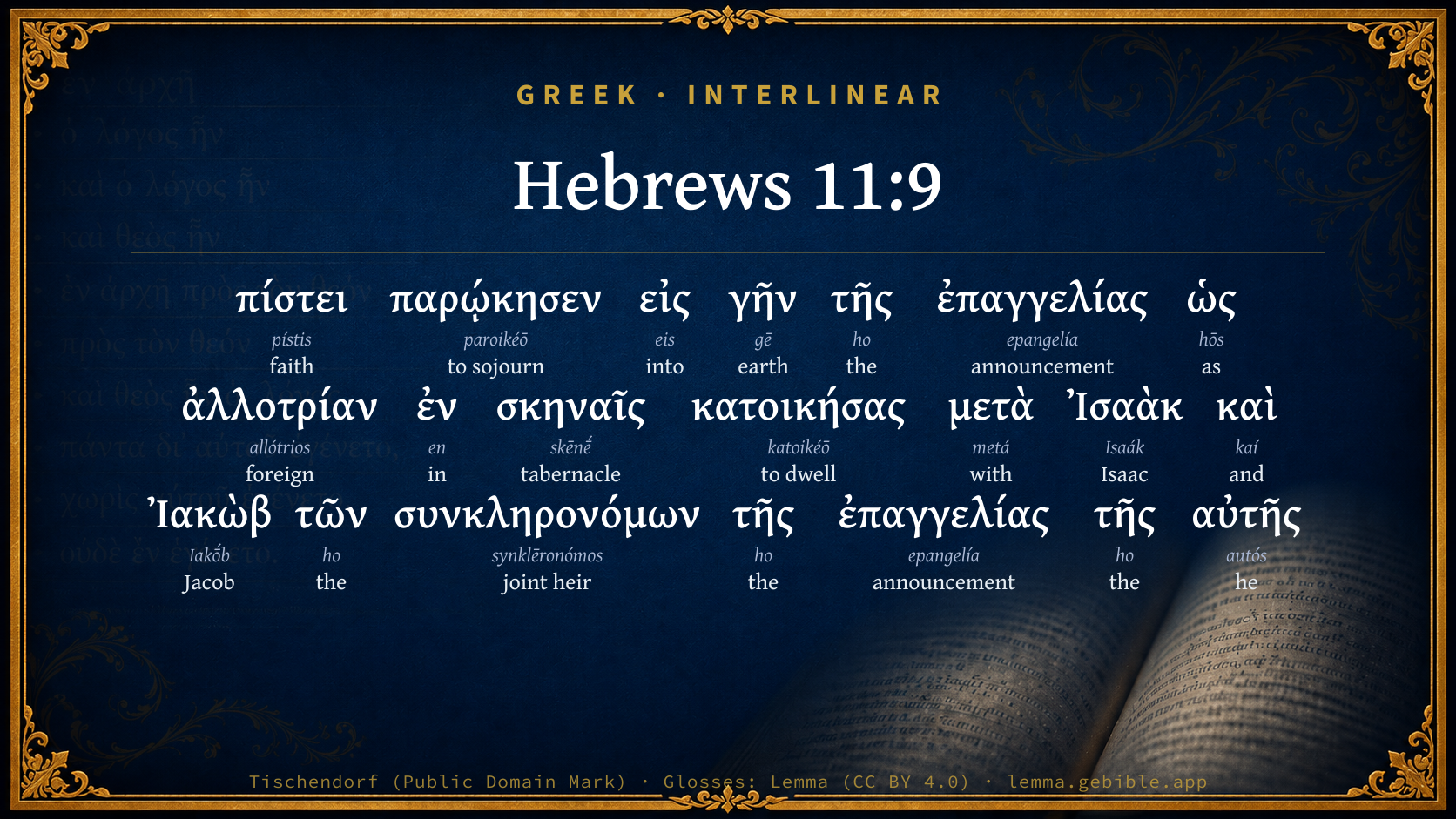
  1. πίστει pístis G4102 “faith” Noun, Dative, Singular, Feminine
  2. εἰς eis G1519 “into” Preposition
  3. γῆν gē G1093 “earth” Noun, Accusative, Singular, Feminine
  4. τῆς ho G3588 “the” Article, Genitive, Singular, Feminine
  5. ἐπαγγελίας epangelía G1860 “announcement” Noun, Genitive, Singular, Feminine
  6. ὡς hōs G5613 “as” Adverb
  7. ἀλλοτρίαν allótrios G245 “foreign” Adjective, Accusative, Singular, Feminine
  8. ἐν en G1722 “in” Preposition
  9. σκηναῖς skēnḗ G4633 “tabernacle” Noun, Dative, Plural, Feminine
  10. κατοικήσας katoikéō G2730 “to dwell” Verb, Aorist, Active, Participle, Nominative, Singular, Masculine
  11. μετὰ metá G3326 “with” Preposition
  12. Ἰσαὰκ Isaák G2464 “Isaac” Noun, Proper, indeclinable
  13. καὶ kaí G2532 “and” Conjunction
  14. Ἰακὼβ Iakṓb G2384 “Jacob” Noun, Proper, indeclinable
  15. τῶν ho G3588 “the” Article, Genitive, Plural, Masculine
  16. συνκληρονόμων synklēronómos G4789 “joint heir” Adjective, Genitive, Plural, Masculine
  17. τῆς ho G3588 “the” Article, Genitive, Singular, Feminine
  18. ἐπαγγελίας epangelía G1860 “announcement” Noun, Genitive, Singular, Feminine
  19. τῆς ho G3588 “the” Article, Genitive, Singular, Feminine
  20. αὐτῆς autós G846 “he” Personal pronoun, Genitive, Singular, Feminine

About this verse

These counts appear in no published source. They are computed here, from the morphology-tagged text and Lemma’s own curated glosses. What Lemma adds →

21
words
17
distinct lemmas
General Epistles
section

Notable vocabulary

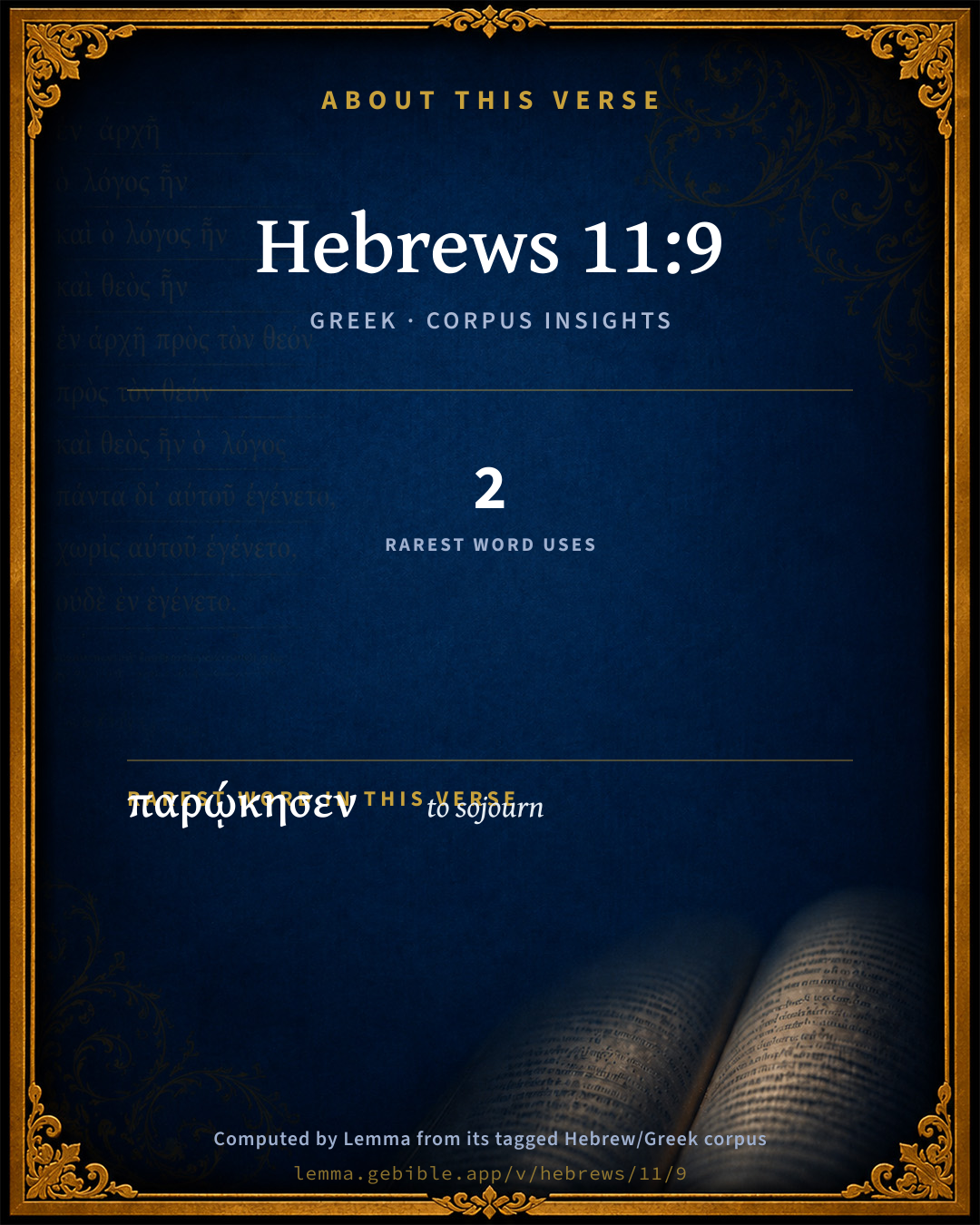
The rarest word here is παρῴκησεν to sojourn G3939 — appearing just 2 times in the whole Greek New Testament.

Shared distinctive vocabulary

παρῴκησεν to sojourn G3939 occurs in 2 verses of the Greek New Testament. Also found in:

Repetition

Words recur within this verse:

  • ἐπαγγελίας announcement G1860 ×2
  • τῆς the G3588 ×4

Cross-references

16

Topical passages linked to Hebrews 11:9 in the Treasury of Scripture Knowledge — connected by theme and wording, ordered by reader-vote popularity; previews shown in the World English Bible.

  • Genesis 12:8 He left from there to the mountain on the east of Bethel, and pitched his tent, having Bethel on the west, and Ai on the east. There he built an altar to Yahweh, and called on the name of Yahweh.
  • Genesis 13:18 Abram moved his tent, and came and lived by the oaks of Mamre, which are in Hebron, and built an altar there to Yahweh.
  • Genesis 13:3 He went on his journeys from the South even to Bethel, to the place where his tent had been at the beginning, between Bethel and Ai,
  • Acts 7:5–6 He gave him no inheritance in it, no, not so much as to set his foot on. He promised that he would give it to him for a possession, and to his seed after him, when he still had no child.
  • Hebrews 6:17 In this way God, being determined to show more abundantly to the heirs of the promise the immutability of his counsel, interposed with an oath;
  • Genesis 18:9 They said to him, "Where is Sarah, your wife? He said, "See, in the tent."
  • Genesis 26:3–4 Sojourn in this land, and I will be with you, and will bless you. For to you, and to your seed, I will give all these lands, and I will establish the oath which I swore to Abraham your father.
  • Genesis 35:27 Jacob came to Isaac his father, to Mamre, to Kiriath Arba (the same is Hebron), where Abraham and Isaac lived as foreigners.
  • Genesis 48:3–4 Jacob said to Joseph, "God Almighty appeared to me at Luz in the land of Canaan, and blessed me,
  • Genesis 28:4 and give you the blessing of Abraham, to you, and to your seed with you, that you may inherit the land where you travel, which God gave to Abraham."
  • Genesis 17:8 I will give to you, and to your seed after you, the land where you are traveling, all the land of Canaan, for an everlasting possession. I will be their God."
  • Genesis 18:1–2 Yahweh appeared to him by the oaks of Mamre, as he sat in the tent door in the heat of the day.
  • Genesis 28:13–14 Behold, Yahweh stood above it, and said, "I am Yahweh, the God of Abraham your father, and the God of Isaac. The land whereon you lie, to you will I give it, and to your seed.
  • Genesis 18:6 Abraham hurried into the tent to Sarah, and said, "Quickly make ready three measures of fine meal, knead it, and make cakes."
  • Genesis 23:4 "I am a stranger and a foreigner living with you. Give me a possession of a burying-place with you, that I may bury my dead out of my sight."
  • Genesis 25:27 The boys grew. Esau was a skillful hunter, a man of the field. Jacob was a quiet man, living in tents.

Cross-references courtesy of OpenBible.info (CC BY 4.0).

Commentary

Notes on Hebrews 11:9 from classic Christian and Jewish commentators (each source and its license shown beneath its notes). The classic Christian expositions comment on the surrounding passage and are grouped to its opening verse, so a note may address several verses; the Jewish commentaries on the Tanakh (Rashi and others) are per-verse, so they appear only where the commentator wrote on this verse.

Lemma curates 59 commentaries, every one of them public domain or Creative Commons licensed, each selected and text-cleaned for this edition rather than reprinted as found. About our sources →

Joseph Benson's Commentary

Heb 11:9-10. By faith, &c. — Believing that Canaan was promised to him and his seed only as a type of a better country, he acquired no possessions therein except a burying-place, and built no houses there; but sojourned in the land of promise as in a strange country — Αλλοτιαν, a country belonging to others, dwelling in tents, as a sojourner; with Isaac and Jacob — Who by the same manner of living showed the same faith. Jacob was born fifteen years before the death of Abraham, as is evident from the account of the lives of the patriarchs given in Genesis. Isaac and Jacob are said to be heirs with Abraham of the same promise, because they all had the same interest therein; and Isaac did not receive this inheritance from Abraham, nor Jacob from Isaac, but all of them from God. In saying that Abraham dwelt in tents with Isaac and Jacob, the apostle does not mean that they all three dwelt together in one family, and one place, while they were in Canaan; for Abraham and Isaac had separate habitations when Jacob was born. But he means that, while in Canaan, they all dwelt in tents; and by applying this observation to the two latter, as well as to Abraham, the apostle praises their faith likewise. For, since Canaan belonged to them as joint heirs with their father, by dwelling there in tents as sojourners, they showed that they also knew the true meaning of the promise, and looked for a better country than Canaan. For he looked for — He expected at length to be led on to; a city which hath foundations — Whereas a tent hath none. Grotius thinks Abraham hoped that his posterity should have, in the land of promise, a city that God would prepare for them, in a special manner, namely, Jerusalem. But such an interpretation Isaiah , 1 st, Expressly contrary to the exposition given by the apostle himself of this expression, Heb 11:16: 2d, It is not suitable to God’s dealing with Abraham, and to the nature and effects of the holy patriarch’s faith, that he should have nothing to encourage him in his pilgrimage but a hope that, after many generations, his posterity should have a city to dwell in, in the land of Canaan, wherein the condition of most of them was not better than his in tents: 3d, To suppose that this was only an earthly city, not to be possessed by his posterity until eight hundred years afterward, and that but for a limited time, is utterly to overthrow his faith, the nature of the covenant of God with him, and his being an example to gospel believers, as he is here proposed to be. This city, therefore, which Abraham looked for, is that heavenly city, that everlasting mansion, which God hath prepared for all true believers with himself after this life; it being the place of their everlasting abode, rest, and refreshment, and that with the expectation of which Abraham and the following patriarchs comforted and supported themselves amidst all the toil and labour of their pilgrimage. Whose builder and maker is God — Of which God is the sole contriver, former, and finisher. “The word τεχνιτης, translated builder, denotes one who constructs any house or machine; an architect. But the other word, δημιουργος, signifies one who forms a people by institutions and laws. The apostle joins this term to the other to show that God is both the Founder and the Ruler of that great community of which the spiritual seed of Abraham is to make a part. From God’s being both the Founder and Ruler of the city which the seed of Abraham are to possess, it may justly be inferred that the glory, security, privileges, and pleasures of their state are such, that in comparison of them, the advantages or security found in any city or commonwealth on earth are nothing, and but of a moment’s duration.” — Macknight.

Joseph Benson's Commentary on the Old and New Testaments (1811–1818) — public domain. Text from a community e-Sword module.

MacLaren's Expositions of Holy Scripture

Alexander MacLaren

Hebrews

THE CITY AND THE TENT

Heb 11:9-10

THE purpose of the great muster-roll of the ancient heroes of Judaism in this chapter is mainly to establish the fact that there has never been but one way to God. However diverse the degrees of knowledge and the externals, the essence of religion has always been the same. So the writer of this Epistle, to the great astonishment, no doubt, of some of the Hebrews to whom it was addressed, puts out his hand, and claims, as Christians before Christ, all the worthies of whom they were nationally so proud. He is speaking here about the three patriarchs. Whether he conceives them to have all lived on the earth at one time or no, does not trouble us at all ‘By faith,’ says he, ‘Abraham sojourned in the land of promise as in a strange country, dwelling in tabernacles with Isaac and Jacob, the heirs with him of the same promise,’ because, ‘he looked for the city which hath the foundations, whom builder’ - or rather Architect - ‘and maker’ - or rather Builder - ‘is God.’

Now, of course, the writer gives a considerable extension of the meaning to the word ‘faith’; and in his use one aspect of it is prominent, though by no means exclusively so - viz., the aspect which looks to the unseen and the future, rather than that which grasps the personal Christ. But this is no essential difference from the ordinary New Testament usage; it is only a variation in point of view, and in the prominence given to an element always present in faith. What he says here, then, is substantially this - that in these patriarched lives we get a picturesque embodiment of the essential substance of all true Christian living, and that mainly in regard of two points, the great object which should fill mind and heart, and the consequent detachment from transitory things which should be cultivated.

‘He looked for a city,’ and so he was contented to dwell in a movable tent. That is an emblem containing the essence of what our lives ought to be, if we are truly to be Christian. Let us, then, deal with these two inseparable and indispensable characteristics of the life of faith.

I. Faith will behold the Unseen City, and the vision will steadfastly fill mind and heart.

As I have remarked, the conception of faith presented in the Epistle is slightly different from that found in other parts of the New Testament. It is but slightly different, for, whether we say that the object of our faith is the Christ, ‘Whom having not seen we love; in whom, though now we see Him not, yet believing we rejoice,’ or whether we say that it is the whole realm and order of things beyond the grave and above the skies where He is and which He has made our native land, makes in reality very little difference. We come at last to the thought of personal reliance on Him by whose word and by whose resurrection and ascension only we apprehend, and by whose grace and power and love only we shall ever possess that unseen futurity. So we may fairly say that whilst, no doubt, it is true that the living Christ Himself - and no heaven apart from Him, nor any future apart from Him, nor any thing of His, apart from Him, though it be a cross, but the living Christ Himself is the true object of faith, yet that conception of its object includes the view of the Epistle to the Hebrews, and the ‘city which has the foundations,’ should, because it is all clustered round Him who is its King, Be the object that fills our minds and hearts.

I am not going to discuss the details of what this writer supposes to have been the animating principle and aim of that ancient patriarch’s life. It matters nothing at all for the power of his example whether we suppose that Abraham looked forward to the realisation of this unseen ideal city in this life or no, for the effect of it upon him would be exactly the same whichever of the two alternatives may have been the case. It matters nothing as to whether Abraham believed in the realisation in that land over which he wandered, of the perfect order of things, or whether he had caught some glimpse, which is very unlikely, of it as reserved for a future beyond the grave. In either case, he lived for and by an unseen and future condition of things. It is beautiful to notice how the writer here, in his picturesque and simple words, puts many blessed ideas as to that future. We may, perhaps, make these a little more clear, but I am afraid we shall make them much more weak, by taking them out of the metaphorical form.

‘The City’ - then there is only one. ‘The City’ - then the object of our hope, ought to be, and is, if we understand it aright, a perfect society, in which the ‘sojourners and pilgrims,’ like the patriarch, and his little band of children and attendants, who wandered lonely up and down the world, will all be gathered together at last; and, instead of the solitude of the march, and the undefended weakness of the frail encampment, there will be the conjoined gladness and security of an innumerable multitude. ‘The City’ is the perfection of society, and all of us who live in the world, alone after all communion, and separated from each other by the awful mystery of personal being, and by many another film beside, may hope to understand, as we never shall do here, what the meaning of the little word ‘together’ is when we get there. ‘He looked for the city.’

‘The city which hath the foundations’ - then the object of faith is a stable thing, which knows no fluctuations, feels no changes, fears no assault, can never be subjected to violence, nor ever crumple into dust. ‘The city which’ hath the foundations’ - here and now we have to build, if we build at all, more or less like the foolish man in the Master’s parable, upon sand. It is the condition of our earthly life. We have to accept, and to make the best of it. But, oh! those who have learned most the agony of change and the misery of uncertainty are those who have been best disciplined to grasp at and lay up in their hearts the large consolation and encouragement hived in that designation, ‘the city which hath the foundations.’

The city, ‘whose Architect’ - for the word rendered ‘Builder’ should be so translated - ‘is God.’ It is the accomplishment of His plan, which, in modern language, is called the realisation of His ideal. I like the old- fashioned Biblical language better - ‘the city whose Architect is God.’ He planned, and, of course, there follows upon that ‘whose Maker or actual Builder is’ - the same as the Planner. Architects put their drawings into the hands of rude workmen, and no completed work of man’s hands corresponds to the fair vision that dawned on its designer when it took definite shape in His mind.

That is another of the laws of our earthly life which we have to make the best of - that we design grand buildings when we begin, and, when we have finished our lives, and look back upon what we have built, it is a mean and incomplete structure at the best. But God’s working drawings get built; His plans are all wrought out in an adequate material; and everything that was in the divine mind once exists in outward fact in that perfect future.

So, inasmuch as the city is a state of perfect society, of stability, is planned by God, and brought about by Him at last, it is to be possessed by us on condition of fellowship with Him. Does it not seem to you to be infinitely unimportant whether this old patriarch thought that what he was looking for was to be builded upon the hills and plains of Canaan or not? That he had the vision is the thing. Where it was to be accomplished was of small moment. We do not know where the vision is to be accomplished any more than Abraham did. We do not know whether here, on this old earth, renovated by some cosmic change, or whether in some region in space, though beyond the stars, perfected spirits shall dwell, and it does not matter. That we should have the vision is the main thing. The where, the when, the how of its fulfilment are of no manner of practical importance, and people who busy themselves about such questions, and think that therefore they are cultivating the spirit that my text suggests, make a woful mistake.

But let me press on you, dear brethren, this one simple thought, that the average type of Christian life and experience to-day is wofully lacking in that clear vision of the future. Partly it comes, I suppose, from certain peculiarities in the trend of thought and way of looking at things that are fashionable in this generation. We hear so much about Christianity as a social system, and about what it is going to do in this world, which perhaps it was necessary should be stated very emphatically, in order to counterpoise the too great silence upon such subjects in past times, that preaching about the future life strikes a hearer as unfamiliar, and probably some Of my audience have been feeling as if I were carrying them into misty regions far away from, and little related to, the realities of life. But, dear brethren, from my heart I believe that one very operative cause of the undeniable feebleness of Christian life, which is so largely manifested round us - and it is for each of us to say whether we participate in it - is due to this, that, somehow or other, there has come in the mind of great masses of Christian people a fading away of that blessed vision of the city, for which we ought to live. You scarcely hear sermons nowadays about the blessedness of a future life. What you hear about it is, how well for this life it is to be a Christian man.

No doubt godliness ‘hath promise of the life that now is,’ and that side of the gospel cannot be too emphatically set forth. But it may be disproportionately presented, as I venture to think that, on the whole, it is being presented now. Therefore there is the more need for consciously endeavouring to cultivate the habit of looking beyond the mists Of the present to the gleaming battlements and spires of the city. Let us polish the glasses of our telescopes, and use them not only for distances on earth’s low levels, but to bring the stars nearer. So shall we realise more of the present good and power of faith, when it is allowed its widest and noblest range.

II. Faith consequently leads to willing detachment from the present order of offerings.

‘He dwelt in tabernacles,’ that is, he lived a nomad life in his tents. He and his son and grandson - three generations of long livers - proved the depth, solidity, and practical power of their faith in the promise of the city by the remarkable persistence of their refusal to be absorbed in the settled population of the land. Recent discoveries have shown us, and discoveries still to be made, I have no doubt, will show still more, what a highly organised and developed civilisation prevailed in Canaan when these wanderers from the East came into it, with their black camels’-hair tents. They were almost as much out of place, and as noticeably unique, by such a life in Canaan then, as gypsies are in England, and the reason why they would not go into Hebron, or any other of the populous cities which were closely studded in the land, was that ‘they looked for the City.’ It was better for them to dwell in tents than in houses.

The clear vision of that great future impresses on us the transiency of the present. We shall know that what we live in is but as a tent that is soon to be struck, even while some of our fellow-lodgers may fancy it to be a house that will last for ever.

The illusion of the permanence of this fleeting show creeps over us all, in spite of our better knowledge, and has to be fought against. The world, though it seems to be at rest, is going faster than any of the objects in it which are known to be in motion. We are deceived by the universality of the movement of which all things partake, and to us it seems rest. If there comes friction, and now and then a collision, we find out how fast we are going. And then there come misery, and melancholy, and lamentations about the brevity of life, and the awfulness of change, and all these other commonplaces that are the stock-in-trade of poetasters, but which cut with such surprise and agony into our own hearts when we experience them. But, brethren, to be convinced of the transiency of life, by reason of the clearness of the vision of the permanence of the heavens, is blessedness and not misery, and is the only way by which a man can bear to say to himself, ‘My days are as a hand-breadth,’ and not fling down his tools and fall into sadness, from feeling that life is as futile as frail. To recognise that nothing continues in one stay, and to see nothing else that is permanent, is the greatest misery that is laid upon man But to feel, ‘Thou art from everlasting to everlasting, and Thy kingdom endureth through all generations and I belong to it,’ makes us regard with equanimity, and sometimes with solemn satisfaction, the passing away of all the transient,’that the things which cannot be shaken may remain.’ ‘He looked for a city’; so, ‘he dwelt in tents.’

There is another side to that thought. The clear vision of that permanent future will detach us from the perishable present.

Now many difficult questions arise as to how far Christians should hold aloof from the order of things in which they dwell: and to a very large extent the application of the principle in detail must be left to each man for himself, in the presence of God. But this I am quite sure of, that in this generation the average Christian has a great deal more need to be warned against too great intermingling with than against too great separation from the present world. Abraham sets us an example beautifully comprehensive. He held cordial relations with the people amongst whom he dwelt. He was honoured by them as a prince; he was recognised by them as a servant of God. They knew his bravery. He did not scruple to draw the sword, and to fight in defence, not only of his kinsmen but of his heathen neighbours in Sodom. And yet nothing would induce him to come down from his tent, beneath the terebinth tree of Mamre, in the-uplands. Everybody knew that his name was Abraham the Hebrew - the man from the other side. He carried out that name in his life.

Now, I am not going to lay down hard and fast rules - conventional regulations are the ruin of principles. But let us ask ourselves, ‘Would anybody call me "the man from the other side," the man who belongs to another set of things altogether than this?’ We have to work in the world; to trade in the world; to try to influence the world; to draw many of our enjoyments from it, in common with those who have no other enjoyments than those drawn from it. Of course, there is a great tract of ground common to the men of faith and the men of sense, and I am not urging false aloofness from any occupation, interest, duty, or enjoyment. But what I say is that, if we have the vision of the city clear before us, there will be no need to tell us not to make our home in Hebron or in Sodom.

Lot went down there when he had his choice - and he got what he wanted, pasturage for his cattle. But he also got what he did not want, destruction, and he lost what he did not care to keep, his share in the city. Abraham stayed on the heights, and up there he kept God, and a good conscience. Probably he did not make so much money as Lot did. Very likely Lot’s flocks and herds were larger than his uncle’s. But the one man from his height, through the clear air, could see far away the sparkling of the turrets of the city; and the other, down in the hot, steaming plains of Sodom, could see nothing but Sodom and the mountains behind it, Better to live on the heights with Abraham and God than down below with Lot, and wealth, and subterranean brimstone, and naphtha fires ready to burst forth. ‘He looked for the city,’ ‘he dwelt in tents.’

Alexander MacLaren, Expositions of Holy Scripture (1904–1910) — public domain. Text from a community e-Sword module.

Tyndale Open Study Notes

Tyndale Open Resources

11:9-10 he lived there by faith: Abraham himself did not experience the inheritance of the land of promise. Rather, he was like a foreigner, living in tents (see Gen 12:10–13:18). • so did Isaac and Jacob: This life of faith was continued in the next two generations: They received the same promise and hoped in God, but did not experience what God had promised. • city with eternal foundations: Abraham did not settle in the Canaanite cities but followed the will of God in faithful obedience, anticipating a heavenly city.

Tyndale Open Study Notes — © Tyndale Open Resources, licensed CC BY-SA 4.0. Text via the HelloAO Bible API.

Bengel's Gnomon

Johann Albrecht Bengel

Heb 11:9. Παρῴκησεν) He went to dwell as a stranger in, Heb 11:13, note.—τῆς ἐπαγγελίας, of the promise) It had been promised immediately, Gen 12:7.—ἐν σκηναῖς, in tabernacles) Gen 12:8: πάροικοι, strangers (new-comers, sojourners) use tents. The antithesis is πόλις, a city, Heb 11:10.—μετὰ, with) The same mode of living, a proof of the same faith. It is construed with παρῴκησεν, was a stranger.—καὶ Ἰακὼβ, and Jacob) He was fifteen years old at the death of Abraham.—τῶν συγκληρονόμων, joint-heirs) In no other place are sons called joint-heirs with their parents, but merely heirs. Isaac did not acknowledge himself indebted for the inheritance to Abraham, nor Jacob to Isaac, but they received it severally from God Himself. This expression, the heirs of the promise, and ἐπέτυχε ΤΗΣ ἐπαγγελίας, he obtained THE promise, Heb 6:17, Heb 12:15, are said of the very thing promised; but both phrases in this chap. Heb 11:9; Heb 11:33, the joint-heirs of the promise, and ἐπέτυχον ἐπαγγελιῶν (without the article τῶν), obtained promises, and in like manner, Heb 11:17, ὁ τὰς ἐπυγγελίας ἀναδεξάμενος, he who received the promises, are said of the promise of something future: and believers are said to receive, to obtain, λαμβάνειν, κομιζεσθαι, the very thing promised, especially in this same chapter, Heb 11:13; Heb 11:39. The difference of expressions is suitable to the different scope of ch. 6 and 9; for in ch. 6 the condition itself of men in former times is commended, and proposed as an example; but in ch. 11 the condition of New Testament believers is celebrated above the other (viz. that of Old Testament believers).

Bengel's Gnomon of the New Testament — English translation (T&T Clark, Edinburgh, 1860) — public domain. Text from a community e-Sword module.

Meyer's Critical & Exegetical Commentary

Heinrich August Wilhelm Meyer

Heb_11:9. A proof of a believing confidence in God was it further that Abraham dwelt as a stranger in the land which was promised him as a possession.

παροικεῖν] in classic Greek of dwelling beside or in the neighbourhood; in Hellenistic, however, ordinarily as here: to dwell as a stranger in a land, without rights of citizenship or possession. Even in Genesis the sojourning of Abraham and his sons in the promised land of Canaan is designated as a παροικεῖν, and they themselves are characterized as πάροικοι in the same; comp. Gen_17:8; Gen_20:1; Gen_21:23; Gen_21:34; Gen_23:4; Gen_24:37; Gen_26:3; Gen_28:4, al.

εἰς] receives into the idea of a permanent dwelling that of a previous migration. Familiar breviloquence. See Winer, Gramm., 7 Aufl. p. 386.

ὡς ἀλλοτρίαν] Comp. Act_7:5-6.

ἐν σκηναῖς κατοικήσας] Theophylact: ὅπερ τῶν ξένων ἐστί, τῶν ἄλλοτε εἰς ἄλλο μέρος μεταβαινόντων διὰ τὸ μὴ ἔχειν τι ἴδιον. Comp. Gen_12:8; Gen_13:3; Gen_18:1 ff; Gen_26:25, al.

μετὰ Ἰσαὰκ καὶ Ἰακὼβ κ.τ.λ.] which Theophylact, Bengel, Böhme, Kuinoel, Tischendorf, and others refer to παρῴκησεν, belongs, as is shown by the singular ἐξεδέχετο with which the author continues at Heb_11:10, to κατοικήσας.

Isaac and Jacob, however, are called heirs with him of the same promise, because the promise was given to Abraham not for himself alone, but at the same time for his seed; comp. Gen_13:15; Gen_17:8.

Meyer — Critical and Exegetical Commentary on the New Testament — English translation by Peter Christie, edited by Frederick Crombie (T&T Clark, 1880) — public domain. Text from a community e-Sword module.

Jamieson, Fausset & Brown

Robert Jamieson, A. R. Fausset & David Brown

sojourned--as a "stranger and pilgrim."

in--Greek, "into," that is, he went into it and sojourned there.

as in a strange country--a country not belonging to him, but to others (so the Greek), Act 7:5-6.

dwelling in tabernacles--tents: as strangers and sojourners do: moving from place to place, as having no fixed possession of their own. In contrast to the abiding "city" (Heb 11:10).

with--Their kind of dwelling being the same is a proof that their faith was the same. They all alike were content to wait for their good things hereafter (Luk 16:25). Jacob was fifteen years old at the death of Abraham.

heirs with him of the same promise--Isaac did not inherit it from Abraham, nor Jacob from Isaac, but they all inherited it from God directly as "fellow heirs." In Heb 6:12, Heb 6:15, Heb 6:17, "the promise" means the thing promised as a thing in part already attained; but in this chapter "the promise" is of something still future. However, see on Heb 6:12.

Jamieson, Fausset & Brown — Commentary Critical and Explanatory on the Whole Bible (1871) — public domain (CC PDM 1.0). Text via the HelloAO Bible API.

Adam Clarke's Commentary

Verse 9. By faith he sojourned in the land of promise] It is remarkable that Abraham did not acquire any right in Canaan, except that of a burying place; nor did he build any house in it; his faith showed him that it was only a type and pledge of a better country, and he kept that better country continually in view: he, with Isaac and Jacob, who were heirs of the same promise, were contented to dwell in tents, without any fixed habitation.

Adam Clarke's Commentary on the Bible (1810–1826) — public domain. Text from a community e-Sword/MySword module.

John Calvin's Commentaries

9. By faith he sojourned, etc. The second particular is, that having entered into the land, he was hardly received as a stranger and a sojourner. Where was the inheritance which he had expected? It might have indeed occurred instantly to his mind, that he had been deceived by God. Still greater was the disappointment, which the Apostle does not mention, when shortly after a famine drove him from the country, when he was compelled to flee to the land of Gerar; but the Apostle considered it enough to say, as a commendation to his faith, that he became a sojourner in the land of promise; for to be a sojourner seemed contrary to what had been promised. That Abraham then courageously sustained this trial was an instance of great fortitude; but it proceeded from faith alone.

With Isaac and Jacob, etc. He does not mean that they dwelt in the same tent, or lived at the same time; but he makes Abraham’s son and grandson his companions, because they sojourned alike in the inheritance promised to them, and yet failed not in their faith, however long it was that God delayed the time; for the longer the delay the greater was the trial; but by setting up the shield of faith they repelled all the assaults of doubt and unbelief.

John Calvin's Commentaries (1540-1563) — public domain. Text from the Calvin Translation Society English edition (1840s-50s) via the Christian Classics Ethereal Library (ccel.org). Calvin's coverage is partial (roughly two-thirds of the Bible); uncommented books and verses are honest gaps, never fabricated. The 19th-century editor's footnotes and remarks are omitted so the notes are faithfully Calvin's own voice.

Ellicott's Commentary for English Readers

(9) The land of promise—More correctly, according to the true reading, a land of the promise: into a land which the promise (Gen_12:7) made his own he came as a sojourner, and sojourned in it as in a land belonging to others, making his settled abode there in tents. The words of which this is a paraphrase are very expressive, especially those of the last clause. Abraham there “made his home once for all, well aware that it was to be his home—expecting no change in this respect all his life long—in tents,” movable, shifting abodes—here to-day, there to-morrow—with (as did also in their turn) “Isaac and Jacob,” the “heirs with him of the same promise.” (Dr. Vaughan.)

A Bible Commentary for English Readers, edited by Charles John Ellicott (1878–1897) — public domain. Text from a community e-Sword module.

The Cambridge Bible for Schools and Colleges

gen. ed. J. J. S. Perowne

9. as in a strange country] “I am a stranger and a sojourner with you” (Gen_23:3). The patriarchs are constantly called paroikoi, “dwellers beside,” “sojourners” (Gen_17:8; Gen_20:1, &c).

dwelling in tabernacles] i.e. in tents (Gen_12:8; Gen_13:3, &c).

The Cambridge Bible for Schools and Colleges (gen. ed. J. J. S. Perowne; Cambridge University Press, 1878–1918) — public domain. Text from a community e-Sword module.

John Gill's Exposition

For he looked for a city which hath foundations,.... Not the city of Jerusalem, nor the Gospel church state; but either the city of the new Jerusalem, said to have twelve foundations, Rev 21:14 and in which glorious state, Abraham, with the rest of the saints, being raised from the dead, will in person possess the promised land; or else the ultimate glory of the saints in heaven, where God dwells, and keeps his palace; and which will be the dwelling place of the saints, and will have in it many habitations; and which will be both peaceable and safe, and full of glory, riches, joy, and pleasure; and into which none but holy and righteous persons will enter; the "foundations" of which are the everlasting love of God, eternal election, the covenant of grace, the promise and preparation of it by God, from the foundation of the world, and the Lord Jesus Christ, his blood and righteousness; which show the immovableness of it, it being opposed to the tabernacles Abraham, Isaac, and Jacob dwelt in, and to the transitory enjoyments of this world: and for this sure, immovable, and comfortable state of things, Abraham was "looking" by faith; he looked through, and above temporal things, to spiritual things; he went through difficulties with cheerfulness, did not greedily covet earthly things, but looked with disdain upon them, and to heaven with faith, affection, and earnest desire; and this proves his faith to be, as that is defined, Heb 11:1

whose builder and maker is God: God the Father has prepared this glory from the foundation of the world, and has promised before the world began, and has chosen his people to it; the Spirit of God makes it known, and prepares them for it; and the Lord Jesus Christ is the forerunner entered, who is gone to get it ready for them, and will put them into the possession of it: this shows the superior excellency of this city, or glorious state; and that God has the sole right to dispose of it.

John Gill's Exposition of the Whole Bible (1746–1763) — public domain (CC PDM 1.0). Text via the HelloAO Bible API.

Trapp's Complete Commentary

John Trapp

9 By faith he sojourned in the land of promise, as in a strange country, dwelling in tabernacles with Isaac and Jacob, the heirs with him of the same promise:

Ver. 9. He sojourned in the land] There he had his commoration, but in heaven his conversation, content to dwell in tents till he should fix his station above.

With Isaac and Jacob] Perhaps together, as near neighbours. When Abraham parted with Lot, he would part with him no further than the right hand is from the left, Gen 13:9. There is singular comfort in the society of saints.

John Trapp, A Commentary or Exposition upon All the Books of the Old and New Testament (1647–1656) — public domain. Text from a community e-Sword module.

Albert Barnes' Notes on the Bible

By faith he sojourned in the land of promise, as in a strange country - The land of Canaan that had been promised to him and his posterity. He resided there as if he were a stranger and sojourner. He had no possessions there which he did not procure by honest purchase; he owned no land in fee-simple except the small piece which he bought for a burial-place; see Gen 23:7-20. In all respects he lived there as if he had no special right in the soil; as if he never expected to own it; as if he were in a country wholly owned by others. He exercised no privileges which might not have been exercised by any foreigner, and which was not regarded as a right of common - that of feeding his cattle in any unoccupied part of the land; and he would have had no power of ejecting any other persons excepting what anyone might have enjoyed by the pre-occupancy of the pasture-grounds. To all intents and purposes he was a stranger. Yet he seems to have lived in the confident and quiet expectation that that land would at some period come into the possession of his posterity. It was a strong instance of faith that he should cherish this belief for so long a time, when he was a stranger there; when he gained no right in the soil except in the small piece that was purchased as a burial-place for his wife, and when he saw old age coming on and still the whole land in the possession of others.

Dwelling in tabernacles - In tents - the common mode of living in countries where the principal occupation is that of keeping flocks and herds. His dwelling thus in moveable tents looked little like its being his permanent possession.

With Isaac and Jacob, the heirs with him of the same promise - That is, the same thing occurred in regard to them, which had to Abraham. “They” also lived in tents. They acquired no fixed property, and no title to the land except to the small portion purchased as a burial-place. Yet they were heirs of the same promise as Abraham, that the land would be theirs. Though it was still owned by others, and filled with its native inhabitants, yet they adhered to the belief that it would come into the possession of their families. In their moveable habitations; in their migrations from place to place, they seem never to have doubted that the fixed habitation of their posterity was to be there, and that all that had been promised would be certainly fulfilled.

Albert Barnes' Notes on the Bible (1834–1885) — public domain. Text from a community e-Sword/MySword module.

Matthew Poole's English Annotations

By faith he sojourned in the land of promise, as in a strange country; by the same Divine faith he passed from tent to tent, moving it from place to place, as God ordered; so as he rather sojourned than dwelt in any. His journal is legible in Moses’s history, moving from Charran to Shechem, from thence to Beth-el, and then more southward, and thence to Egypt; see Gen 12:1-20; so that he sojourned in Canaan, and the adjoining countries, which God had covenanted to give for an inheritance to him and his seed, Gen 15:18-21; yet by faith he would stay God’s time for it, but lived in it as a stranger, not having in possession one foot of ground, but what he bought for a burying place, Gen 25:9,10; Ac 7:5.

Dwelling in tabernacles with Isaac and Jacob, the heirs with him of the same promise: here he, with his son Isaac, and grandson, and their seed, coheirs with him of Canaan, built no houses, but lived in tents, which they might pitch or remove at God’s pleasure, and as he called them, as who were strangers to this country, and to the inhabitants of it, with whom they were to have no spiritual society, as travelling to a better; being in this world, but neither citizens nor inhabitants of it, but as denizens of a more excellent one, Gen 26:3; Gen 28:13,14.

Matthew Poole's English Annotations on the Holy Bible (1683–1685) — public domain. Text from a community e-Sword/MySword module.

Whedon's Commentary on the Bible

Daniel D. Whedon

9. A strange—That is, as somebody else’s, and not his own, country; though by divine promise most truly his own.

Tabernacles—That is, tents; the abodes of wanderers and strangers, the striking image of transitory residence.

Same promise—And same faith, as in Heb_11:21.

Daniel D. Whedon (gen. ed.), Commentary on the Old and New Testaments (1874–1909) — public domain. Text from a community e-Sword module.

The Pulpit Commentary

Vers. 9, 10. By faith he sojourned in (rather, went to sojourn in) the land of promise, as in a strange country (literally, as one belonging to others; i.e. not his own; "As in an alien land" (Wickliffe); cf. Gen_23:4, "I am a stranger and sojourner with you"), dwelling in tabernacles with Isaac and Jacob, the heirs with him of the same promise: for he looked for a city which hath foundations (literally, the foundations) whose Builder and Maker is God. Of course, here, with Isaac and Jacob" means "as did also Isaac and Jacob." The three successive patriarchs are presented in Scripture as representing the period of nomadic life in the land of promise, not yet possessed; alike supported by faith in the Divine word; and hence they are ever grouped together. (of Gen_28:13 Gen_32:9 Gen_48:15 Gen_1:24 Exo_3:6 Deu_9:5 1Ki_18:36, etc.; also Mat_22:32 Luk_13:28) The meaning of their history to us, and the object of their common hope, are further set forth in vers. 13-17, and will be under them considered. In the mean time an instance of Abraham"s faith, peculiar to himself, is adduced.

Vers. 9, 10. The tent and the city.

I OBSERVE THE CONTRAST UNDERLYING THESE VERSES. The tent is in one place in the morning, and may be miles away at night. The city always remains in the same place. Thus there is forcibly indicated an altogether different kind of occupation and interest for the dweller in tents from that for the dweller in cities. As the one class of men increases the other must decrease. The fathers dwell in tents; the children in cities. He who dwells in a tent can have no particular interest in the land where he happens to be at the time. If it supplies his wants for the passing day, that is all he needs to care for. But he who has a house built in that land must feel the deepest interest in its fame, prosperity, and development.

II THE PARTIAL FULFILMENT OF A PROMISE. He who called Abraham gave him a promise, and guided him, brought him at last into the land of promise. He dwelt in the land of promise, in however imperfect and fugitive a way. Thus we see how God gives us all that can be given under present conditions. The time had not yet come to possess the land the seed of Abraham had to be immensely increased and vigorously disciplined before that was possible but, nevertheless, Abraham could dwelt in the land. Satisfaction and joy would begin the moment obedience began. And have not we also entered in part on our inheritance? Do not the blessings of the heavenly state stream down upon us even now? Abraham enjoyed Canaan; he himself and his dependants got food, and there was abundant herbage for his cattle. He was happier in Canaan, even as a wanderer, than he could have been anywhere else in this world, for he was there by the will of God.

III THE FIRMER GRASP OF A PROMISE. Abraham probably had always led a nomadic life. Even in the land of his nativity and earlier days he would be more or less of a wanderer. The wandering spirit would be in him by nature, habit, tradition. Therefore as far as he personally was concerned, Canaan gave him all that earth could provide for the wishes of the heart. But he rises above the individual and the present. As he advances in obedience, the aims of God, the possibilities of his own life, the needs of all his posterity, rise more distinctly before his mind. For himself and his children, and all the families of the earth that are to be blessed in him, he looks for something better than a land to live in for a few years and then be buried in. There is a correspondence which cannot fail to be noted between what the writer of the Epistle says here concerning the tent and the city of foundations, and what Paul says (2Co_5:1) concerning the tent and the eternal, heavenly building of God.

IV PATIENCE HAVING ITS PERFECT WORK. He discerned that the city which was to have foundations worth calling foundations must come, not from the wisdom and power of men, but from the planning and fabricating of God. And foundation-work of this kind went on very slowly, according to human computation. The great thing to be remembered is that the foundation of this city of God lies outside the limits of the seen and the temporal. The city of God is to be looked at in a similar way to the rest provided for God"s people already spoken of. (Heb 4) There remaineth a city which hath foundations, a house of God, not made with hands, eternal in the heavens. Waiting is our great duty, rejoicing in the present indwelling of God"s Spirit as the earnest, and knowing that the fullness will come in its own order. Y.

The Pulpit Commentary (1880–1919), ed. H.D.M. Spence-Jones & Joseph S. Exell — public domain. Text from a community e-Sword module.

John Wesley's Explanatory Notes

By faith he sojourned in the land of promise - The promise was made before, Gen. xii, 7. Dwelling in tents - As a sojourner With Isaac and Jacob - Who by the same manner of living showed the same faith Jacob was born fifteen years before the death of Abraham. The joint heirs of the same promise - Having all the same interest therein. Isaac did not receive this inheritance from Abraham, nor Jacob from Isaac, but all of them from God. Gen. xvii, 8

John Wesley, Explanatory Notes Upon the Whole Bible (1754–1765) — public domain. Text via the GEBible commentary corpus.

Burkitt's Expository Notes on the New Testament

William Burkitt

The apostle spake of the place which Abraham was called from, in the foregoing verse, namely, out of Ur of the Chaldees: here he speaks of the place he was called to, Canaan, styled the Land of Promise, that is, the land which God had newly promised to give unto him.

Where note, 1. Abraham’s act of obedience: He sojourned in the land of promise, as in a strange country; he was there as a sojourner, not an inheritor, moving up and down from place to place, until God thought fit to settle him and his posterity. Abraham was a sojourner both in his condition of life, and in his dispositon of heart. Canaan was a type of heaven, accordingly Abraham expected a better country, with a city which had foundations, whose builder and maker is God.

Note, 2. The manner of his sojourning in this land, dwelling in tabernacles. This was both an act of policy, and an act of piety; of policy, that they might live peaceably, occasioning any envy or grudge from them; and of piety, to express their hopes and desires of a better country.

Note, 3. Abraham’s companions, his fellows and followers, in this act of obedience; he sojourned with Isaac and Jacob as heirs of the same promise.

Where mark, How all the saints of God are of the same spiritual disposition; they are animated by the same spirit, governed by the same laws; they act from the same principle, and for the same end, and desire nothing more that to live together, and to enjoy God and one another.

Note, 4. The reason rendered why Abraham esteemed himself but as a stranger in Canaan, because his thoughts ran much upon heaven, of which Canaan was but a type: He looked for a city which hath foundations, whose builder and maker is God.

Where observe, 1. Abraham’s act of expectation: he looked for it, he rationally expected it; it was not a blind hope, but well built on the power and promise of God.

2. What he looked for, a city; not Jerusalem, an earthly city, as some would have it, for that was not possessed until eight hundred years after, and then only by his posterity for a limited time: but an heavenly city, a settled quiet habitation, a suitable dwelling for them that have had a life of trouble in this world.

3. The city itself described, 1. by the nature of it; it has foundations, in opposition to tents and tabernacles, which had no foundations, but where moving, ambulatory dwellings, supported only by stakes and cords; this city is bounded upon the eternal power, the infinite wisdom, and immutable counsel of God.

2. By the maker and builder of it, God, he is the contriver, framer, and erector of this city; and as he is the maker, so he is the disposer of it also; please God, and he will give it thee, none can give it thee without him, and he will never give it thee without pleasing of him.

William Burkitt's Expository Notes on the New Testament (1700–1703) — public domain. Text from a community e-Sword module.

The People's New Testament

B. W. Johnson

9. By faith he sojourned in the land of promise. He was a stranger in the land promised to him and his seed, dwelling as did Isaac and Jacob, in tents, yet trusting the promise of God. Heirs … of the same promise. See Gen. 26:3, 4; 27:4, 13, 14.

B. W. Johnson's The People's New Testament with Notes (1889–1891) — public domain. Electronic text from the Christian Classics Ethereal Library (CCEL) ThML edition.

Cambridge Greek Testament for Schools and Colleges

9. ὡς ἀλλοτρίαν. “I am a stranger and a sojourner with you” (Gen 23:4). The patriarchs are constantly called πάροικοι, “dwellers beside,” “sojourners” (Gen 17:8; Gen 20:1, &c.).

ἐν σκηναῖς, i.e. in tents (Gen 12:8; Gen 13:3, &c.).

Cambridge Greek Testament for Schools and Colleges (Cambridge University Press, 1896; 21 vols, various authors incl. Carr, Maclear, Plummer, Farrar, Lumby, Moule, M. R. James, Simcox) — public domain. Text from a community e-Sword module.

Alford’s Greek Testament

Henry Alford

9.] By faith he sojourned (παροικεῖν in classical Greek signifies to dwell in the neighbourhood of, and is followed by a dative: so Thuc. iii. 93, φοβούμενοι μή σφισι μεγάλῃ ἰσχύϊ παροικῶσιν. Isocrates uses it in the sense of “to dwell alongside of,” with another reference, and an accus.: ἀπὸ Κνίδου μέχρι Σινώπης Ἕλληνες τὴν Ἀσίαν παροικοῦσι, p. 74. But the Hellenistic sense is, to dwell as a stranger, to sojourn only. So LXX in reff.: so Philo, Quis Rer. Div. Hær. § 54, vol. i. p. 511, τῷ φιλαρέτῳ κατοικεῖν οὐ δίδωσιν ὁ θεός, ὡς ἐν οἰκείᾳ γῇ, τῷ σώματι, ἀλλὰ παροικεῖν ὡς ἐν ἀλλοδάπῃ μόνον ἐπιτρέπει χώρᾳ. And Confus. Ling. § 17, p. 416, κατῴκησαν ὡς ἐν πατρίδι, οὐχ ὡς ἐπὶ ξένης παρῴκησαν) in (pregnant construction, as often in St. Luke, see Act 7:4; Act 8:40; Act 12:19; Act 18:21: Luk 11:7: he went into the land and sojourned there) the land (γῆ is one of those words which very commonly drop the article, especially when in government) of the promise (concerning which the promise, Gen 12:7, had been given) as a stranger’s (as if it did not belong to him, but to another: see ref. Acts, which is strictly parallel, and cf. γῇ οὐκ ἰδία, Gen 15:13), dwelling (the aor. part. is contemporary with the aor. before) in tents (cf. Gen 12:8; Gen 13:3; Gen 18:1 ff. ὅπερ τῶν ξένων ἐστί, τῶν ἄλλοτε εἰς ἄλλο μέρος μεταβαινόντων διὰ τὸ μὴ ἔχειν τι ἵδιον. Thl.) with Isaac and Jacob (Thl., Bengel, Böhme, Kuinoel, Griesb., Lachm., al. join these words with παρῴκησεν above. But they more naturally belong to ἐν σκηναῖς κατοικήσας, which has just preceded: for otherwise we should expect ἐξεδέχοντο in ver. 10) the heirs with him of the same promise (τῆς ἐπ. τῆς αὐτῆς, as ποιμένες ἦσαν ἐν τῇ χώρᾳ τῇ αὐτῇ, Luk 2:8; the only other place where this arrangement is found. What is implied is, not so much that the promise was renewed to them, as that all three waited for the performance of the same promise, and in this waiting, built themselves no permanent abode):

Henry Alford, The Greek Testament (1849–1861) — public domain. Text from a community e-Sword module.

Vincent's Word Studies in the New Testament

Marvin R. Vincent

He sojourned in [παρωκησεν εις] . The verb lit. to dwell beside or among. Paroikov, a foreigner dwelling in a state without rights of citizenship. In Class. only in the sense of neighbor. See on Luk 24:18. The verb of rest with the preposition of motion (only here) signifies that he went into the land and dwelt there. Usually with ejn in, but sometimes with the simple accusative, as Luk 24:18; Gen 17:8; Exo 6:4. Land of promise [γην της επαγγελιας] . Note the article, omitted in A. V., the promise : the land which was designated in the promise of God. See Gen 12:7; Gen 13:15. The phrase N. T. o. There is no corresponding phrase in O. T.

Strange [αλλοτριαν] . Another [αλλη] land than his own. So LXX, Gen 14:13. Comp. Act 7:6.

In tabernacles [εν σκηναις] . Or tents, as a migratory people, without a permanent home.

The heirs with him [των συνκληρονομων] . Joint - heirs or fellow - heirs. o LXX, o Class. See Rom 8:17; Eph 3:6; 1Pe 3:7. The three, Abraham, Isaac, and Jacob, are mentioned because they cover the entire period of the sojourn in Canaan. Faith inspired these to endure patiently their unsettled life, since it assured them of a permanent home in the future.

Marvin R. Vincent, Word Studies in the New Testament (1887–1900) — public domain. Text from a community e-Sword/MySword module.

Westcott on Hebrews & the Epistles of John

Brooke Foss Westcott

9. πίστει παρῴκησεν εἰς... By fatth he entered as a sojourner (peregrinatus est Hior.) into the land of promise ...For παρῴκ. els compare Acts xii. The word is common in the Lxx. 6g. Gen. xxi. 23; xxiii. 4.

The phrase γῇ τῆς ἐπαγγελίας (Vulg. terra repromissionum) occurs here only in tho N.T. There is no corresponding Hebrew phrase in the 0. T., nor is there any exact parallel. It

deacribes the land which was attached to the promises; to which they pointed; which was assured to Abraham by God. Oomp. Gen. xii. 7; xiii. 15 &c. For tho use of ἐπαγγελίας compere Eph. i. 13. And for ἀλλοτρίαν

ἐν ox. κατοικήσας... τῆς αὐτῆςἾ Abraham dwelt throughout the time of his sojourn (κατοικήσας) in tents, so declaring that that which was to be permanent was not yet attained. And Isaac and Jacob, who shared his hope, shewed the same patience of faith. The premature settlemont of Lot and its disastrous issue point tho lesson of Abraham’s discipline.

The paradox in ἐν σκηναῖς κατοικήσας is to bo noticed. On the contrast of κατοικεῖν and wapoixeiy 806 Philo de agric. ὃ 14 (1. p. 310 M.); de conf. ling. § 17 (i. p. 416 M.); quis rer. div. har. ὃ 54 (i p. 511 M.).

Isaac and Jacob are specially mentioned because these three, Abraham, Isanc, and Jacob, cover the whole period of disciplinary sojourning in Canaan; and to these three the foundation promise was repeated (Gen. xii. 2 fi; xxvi. 3 ἢ... xxviii. κληρ. τῆς ἐπαγγ., compare vi. 12,

Biceenthal quotes a striking passage

. from Sanh. f. iii. a in which tho patient

faith of the patriarchs is illustrated by the fact that while they were heirs of the land they bore without complaint the trial of gaining with dificulty what they needed there for the

James v.7; and dwexd¢youa ©. ix. 28 note. The object of his desire was social and not personal ouly. ‘He looked for the city that hath the foundations’—the divine ideal of which every earthly institution is but a transitory image. The visible Jerusalem, the visible Temple, were farther ' from this spiritual archotype than the tonts of the patriarch and tho Tabornaclo of the wilderness. They were in large measure of human design and wholly of human construction. But God Himself frames and constructs the heavenly city (v. 16) no lees than the heavenly sanctuary: c. viii. 2. Comp. c. xii, 22 f.; xiii. 14; Apoo. xxi. 2; Gal. iv. 26 (and Lightfoot’s note); (Is. xxxiii. 20; Ps. Ixxxiv.). See

Brooke Foss Westcott (1825–1901), The Epistle to the Hebrews (1889) and The Epistles of St John (1883) — public domain (pre-1929). Text recovered from Internet Archive / Google Books OCR scans. Westcott’s Gospel of John commentary is not included (its OCR lost the chapter running-heads required for reliable verse-keying). Some Greek quoted in the Hebrews volume is imperfectly rendered by the OCR.

Lesson kit

Teaching starters — assembled from the data on this page, not authored interpretation. Every prompt links to the verse data it draws on. Edit before teaching.

Hebrews, in the General Epistles, opens this verse with 21 words (17 distinct Greek lemmas). Its most distinctive word is paroikéō (“to sojourn”). A historical commentator’s framing appears above. Read the whole chapter for the surrounding context.

Discussion questions

  1. The word paroikéō carries the sense “to sojourn.” How does it shape the verse?
  2. How does Luke 24:18, which shares the word «to sojourn», read alongside this verse?
  3. What does the repetition of “announcement” (2× in this one verse) do in this verse?
  4. The translations on this page render this verse differently — a whole-verse word diff, not a word-by-word alignment. What might account for the different wordings?
  5. Compare how Joseph Benson's Commentary and MacLaren's Expositions of Holy Scripture read this verse. Where do they agree or differ?

Things to notice

  • These translations choose different wording for 13 words in this verse.
  • “announcement” occurs 2× in this single verse.
  • 17 distinct Greek lemmas span 21 words in this verse.

Reading settings

Reading text

Shown beneath each verse's original-language words.

Old Testament
Old Testament edition

Read the OT as the Masoretic Hebrew (MT) or the Greek Septuagint (LXX).

English shown for the Greek Septuagint (in the Hebrew ↔ Greek comparison).

Comparing translations? Open the Compare panel on any verse page to stack up to four side by side.