
Luke 24:5

Greek (Tischendorf 8th ed.) Luke 24:5 appears in the Greek New Testament. The text above is from the Tischendorf 8th edition. Each word links to its Strong’s number and a concise gloss. Click any word for its full Thayer’s Greek Lexicon entry.
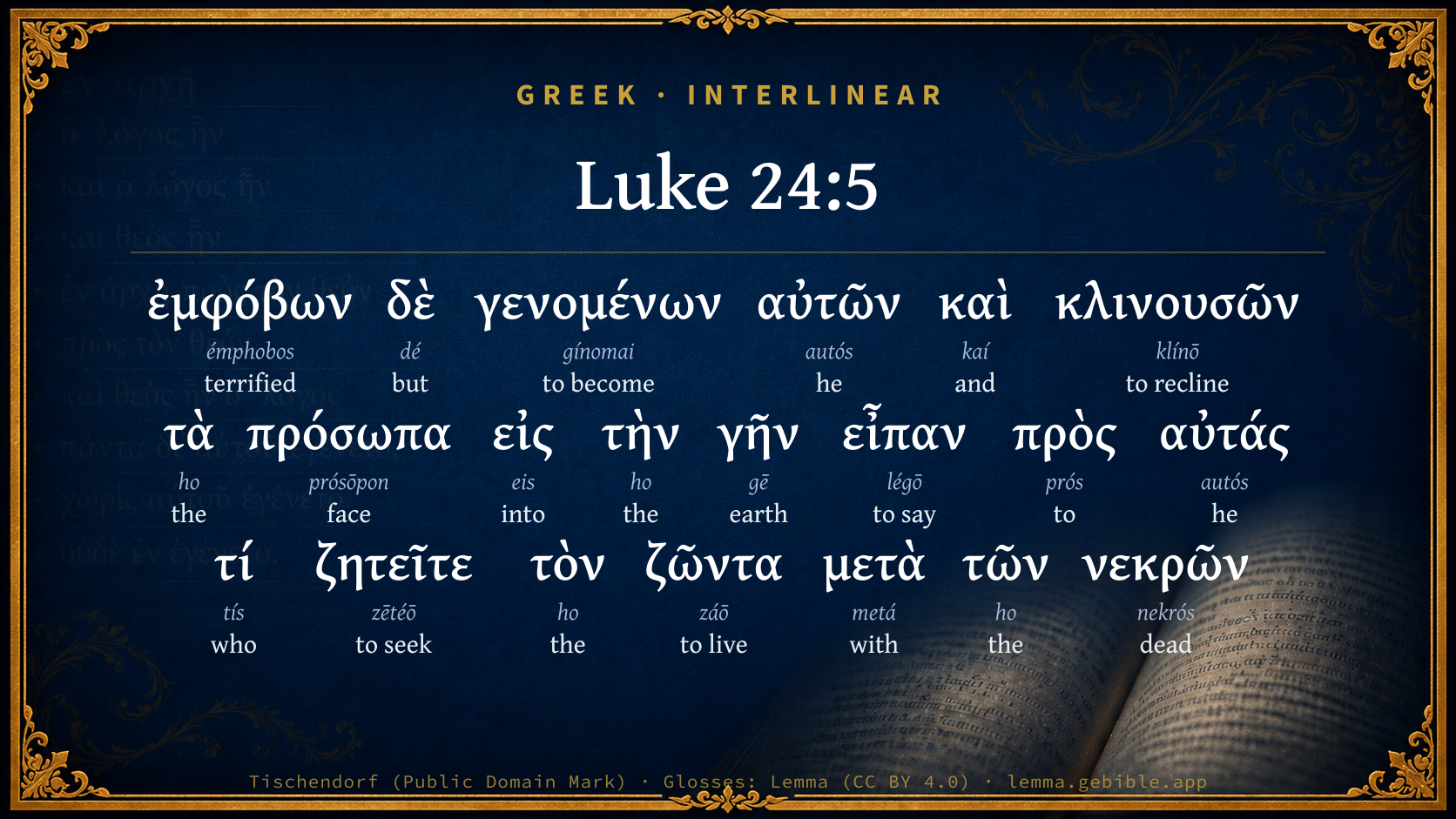
Download image
Cite this verse

Luke 24:5 (World English Bible). Public Domain. Lemma interlinear Bible study tool, https://lemma.gebible.app/v/luke/24/5.

Show BibTeX & RIS
BibTeX
RIS
English Translation
Becoming terrified, they bowed their faces down to the earth. They said to them, "Why do you seek the living among the dead?
World English Bible · Public Domain
Highlights
  • 1 first appearance in the Greek New Testament
Full analysis ↓
Download a study sheet

One document with this verse’s original text, its word-by-word gloss line, the meaning frame, cross-references with their text, attributed commentary, and full source and license credits — printable, and it pastes into notes with its structure intact.

This verse Autodidact and up

Study sheet (.html) Plain text (.txt)

A passage Seminary Student

Up to 50 verses in one chapter. A passage sheet keeps up to 6 commentary sources and 12 cross-references per verse, in the order this page ranks them, and says so on the sheet whenever that leaves anything out. Ask for a single verse and you get the Autodidact verse sheet above.

Everything on this page stays free to read, with no account — the sheet is a download of what is already on screen, not access to it.

Want to remove ads? Support Godless Engineer
Compare translations 3

The same verse in 3 English versions, stacked beneath the original-language interlinear above. Click any original word for its lexicon entry.

Each is an independent rendering of the whole verse — the interlinear is not word-aligned to these translations.

Highlighted words mark where these versions differ — a whole-verse word diff, not a word-by-word alignment.

  • World English Bible Public Domain
    Becoming terrified, they bowed their faces down to the earth. They said to them, "Why do you seek the living among the dead?
  • King James Version Public Domain
    And as they were afraid, and bowed down their faces to the earth, they said unto them, Why seek ye the living among the dead?
  • unfoldingWord Literal Text CC BY-SA 4.0
    And as they became terrified and bowed their faces toward the ground, they said to them, “Why are you seeking the living among the dead?

unfoldingWord Literal Text — © unfoldingWord, licensed CC BY-SA 4.0. Word-aligned USFM3 via Door43 (git.door43.org/unfoldingWord/en_ult).

Versions to compare (up to 4)

3 of 4 selected

Show all 19 translations

Every available English version of this verse, each an independent rendering of the whole verse.

  • World English Bible Public Domain
    Becoming terrified, they bowed their faces down to the earth. They said to them, "Why do you seek the living among the dead?
  • Berean Standard Bible Public Domain
    As the women bowed their faces to the ground in terror, the two men asked them, “Why do you look for the living among the dead?
  • Majority Standard Bible Public Domain
    As the women bowed their faces to the ground in terror, the two men asked them, “Why do you look for the living among the dead?
  • King James Version Public Domain
    And as they were afraid, and bowed down their faces to the earth, they said unto them, Why seek ye the living among the dead?
  • American Standard Version (1901) Public Domain
    and as they were affrighted and bowed down their faces to the earth, they said unto them, Why seek ye the living among the dead?
  • Revised Version (1885) Public Domain
    and as they were affrighted, and bowed down their faces to the earth, they said unto them, Why seek ye the living among the dead?
  • Geneva Bible (1599) Public Domain
    And as they were afraide, and bowed downe their faces to the earth, they sayd to them, Why seeke ye him that liueth, among the dead?
  • Douay-Rheims (1899) Public Domain
    And as they were afraid, and bowed down their countenance towards the ground, they said unto them: Why seek you the living with the dead?
  • Young's Literal Translation Public Domain
    and on their having become afraid, and having inclined the face to the earth, they said to them, `Why do ye seek the living with the dead?
  • Literal Standard Version CC BY-SA 4.0
    and on their having become afraid, and having inclined the face to the earth, they said to them, “Why do you seek the living with the dead?
  • Unlocked Literal Bible CC BY-SA 4.0
    As the women were filled with fear and bowed down their faces to the earth, they said to the women, “Why do you seek the living among the dead?
  • unfoldingWord Literal Text CC BY-SA 4.0
    And as they became terrified and bowed their faces toward the ground, they said to them, “Why are you seeking the living among the dead?
  • Darby Bible Public Domain
    And as they were filled with fear and bowed their faces to the ground, they said to them, Why seek ye the living one among the dead?
  • World Messianic Bible Public Domain
    Becoming terrified, they bowed their faces down to the earth. The men said to them, “Why do you seek the living among the dead?
  • Webster's Bible Public Domain
    And as they were afraid, and bowed down their faces to the earth, they said to them, Why seek ye the living among the dead?
  • Free Bible Version CC BY-SA 4.0
    The women were terrified and bowed down, their faces on the ground. They said to the women, “Why are you looking for someone who is alive among the dead?
  • Bible in Basic English Public Domain
    And while their faces were bent down to the earth in fear, these said to them, Why are you looking for the living among the dead?
  • Text-Critical English NT CC BY 4.0
    The women were terrified and bowed their faces to the ground, but the men said to them, “Why do you seek the living among the dead?
  • Tyndale New Testament (1534) Public Domain
    And as they were a frayde and bowed doune their faces to the erth: they sayd to them: why seke ye the lyvinge amonge the deed?

Literal Standard Version (2020), Covenant Press — licensed CC BY-SA 4.0. Text via the HelloAO Bible API (eBible.org). Unlocked Literal Bible (unfoldingWord) — licensed CC BY-SA 4.0. Text via the HelloAO Bible API (eBible.org). unfoldingWord Literal Text — © unfoldingWord, licensed CC BY-SA 4.0. Word-aligned USFM3 via Door43 (git.door43.org/unfoldingWord/en_ult). Free Bible Version, Dr. Jonathan Gallagher — licensed CC BY-SA 4.0. Text via the HelloAO Bible API (eBible.org).

Word by word

More ways to search: Search by grammar → Find every occurrence → Compare this word →

Practice this passage: Drill this verse → Learn its vocabulary →

ἐμφόβων
émphobos
G1719
“terrified”
Adjective, Genitive, Plural, Masculine
Part of Speech
Adjective
Case
Genitive
Number
Plural
Gender
Masculine
Full Thayer's Definition

Origin: from G1722 and G5401

TDNT: None

1. thrown into fear, terrified, affrighted
  1. δὲ dé G1161 “but” Conjunction
  2. γενομένων gínomai G1096 “to become” Verb, Aorist, Middle deponent, Participle, Genitive, Plural, Feminine
  3. αὐτῶν autós G846 “he” Personal pronoun, Genitive, Plural, Feminine
  4. καὶ kaí G2532 “and” Conjunction
  5. κλινουσῶν klínō G2827 “to recline” Verb, Present, Active, Participle, Genitive, Plural, Feminine
  6. τὰ ho G3588 “the” Article, Accusative, Plural, Neuter
  7. πρόσωπα prósōpon G4383 “face” Noun, Accusative, Plural, Neuter
  8. εἰς eis G1519 “into” Preposition
  9. τὴν ho G3588 “the” Article, Accusative, Singular, Feminine
  10. γῆν gē G1093 “earth” Noun, Accusative, Singular, Feminine
  11. εἶπαν légō G3004 “to say” Verb, Aorist, Active, Indicative, 3rd person, Plural
  12. πρὸς prós G4314 “to” Preposition
  13. αὐτάς autós G846 “he” Personal pronoun, Accusative, Plural, Feminine
  14. τί tís G5101 “who” Interrogative pronoun, Accusative, Singular, Neuter
  15. ζητεῖτε zētéō G2212 “to seek” Verb, Present, Active, Indicative, 2nd person, Plural
  16. τὸν ho G3588 “the” Article, Accusative, Singular, Masculine
  17. ζῶντα záō G2198 “to live” Verb, Present, Active, Participle, Accusative, Singular, Masculine
  18. μετὰ metá G3326 “with” Preposition
  19. τῶν ho G3588 “the” Article, Genitive, Plural, Masculine
  20. νεκρῶν nekrós G3498 “dead” Adjective, Genitive, Plural, Masculine

About this verse

These counts appear in no published source. They are computed here, from the morphology-tagged text and Lemma’s own curated glosses. What Lemma adds →

21
words
17
distinct lemmas
Gospels
section

Notable vocabulary

The rarest word here is ἐμφόβων terrified G1719 — appearing just 5 times in the whole Greek New Testament.

First appearance in Scripture

This word makes its first canonical appearance in the Greek New Testament here:

  • ἐμφόβων terrified G1719

Shared distinctive vocabulary

ἐμφόβων terrified G1719 occurs in 5 verses of the Greek New Testament. Also found in:
Repetition

Words recur within this verse:

  • τὰ the G3588 ×4
  • αὐτῶν he G846 ×2

Cross-references

12

Topical passages linked to Luke 24:5 in the Treasury of Scripture Knowledge — connected by theme and wording, ordered by reader-vote popularity; previews shown in the World English Bible.

  • Mark 16:5–6 Entering into the tomb, they saw a young man sitting on the right side, dressed in a white robe, and they were amazed.
  • Revelation 1:18 and the Living one. I was dead, and behold, I am alive forevermore. Amen. I have the keys of Death and of Hades.
  • Matthew 28:3–5 His appearance was like lightning, and his clothing white as snow.
  • Luke 1:12–13 Zacharias was troubled when he saw him, and fear fell upon him.
  • Revelation 2:8 "To the angel of the assembly in Smyrna write: "The first and the last, who was dead, and has come to life says these things:
  • Daniel 10:16 Behold, one in the likeness of the sons of men touched my lips: then I opened my mouth, and spoke and said to him who stood before me, my lord, by reason of the vision my sorrows are turned on me, and I retain no strength.
  • Daniel 10:19 He said, "Greatly beloved man, don't be afraid: peace be to you, be strong, yes, be strong." When he spoke to me, I was strengthened, and said, "Let my lord speak; for you have strengthened me."
  • Daniel 8:17–18 So he came near where I stood; and when he came, I was frightened, and fell on my face: but he said to me, Understand, son of man; for the vision belongs to the time of the end.
  • Daniel 10:7–12 I, Daniel, alone saw the vision; for the men who were with me didn't see the vision; but a great quaking fell on them, and they fled to hide themselves.
  • Acts 10:3–4 At about the ninth hour of the day, he clearly saw in a vision an angel of God coming to him, and saying to him, "Cornelius!"
  • Hebrews 7:8 Here people who die receive tithes, but there one receives tithes of whom it is testified that he lives.
  • Luke 1:29 But when she saw him, she was greatly troubled at the saying, and considered what kind of salutation this might be.

Cross-references courtesy of OpenBible.info (CC BY 4.0).

Commentary

Notes on Luke 24:5 from classic Christian and Jewish commentators (each source and its license shown beneath its notes). The classic Christian expositions comment on the surrounding passage and are grouped to its opening verse, so a note may address several verses; the Jewish commentaries on the Tanakh (Rashi and others) are per-verse, so they appear only where the commentator wrote on this verse.

Lemma curates 59 commentaries, every one of them public domain or Creative Commons licensed, each selected and text-cleaned for this edition rather than reprinted as found. About our sources →

MacLaren's Expositions of Holy Scripture

Alexander MacLaren

Luke

THE FIRST EASTER SUNRISE

THE LIVING DEAD

Luk 24:5 - Luk 24:6.

We can never understand the utter desolation of the days that lay betwixt Christ’s Death and His Resurrection. Our faith rests on centuries. We know that that grave was not even an interruption to the progress of His work, but was the straight road to His triumph and His glory. We know that it was the completion of the work of which the raising of the widow’s son and of Lazarus were but the beginnings. But these disciples did not know that. To them the inferior miracles by which He had redeemed others from the power of the grave, must have made His own captivity to it all the more stunning; and the thought which such miracles ending so must have left upon them, must have been something like, ‘He saved others; Himself He cannot save.’ And therefore we can never think ourselves fully back to that burst of strange sudden thankfulness with which these weeping Marys found those two calm angel forms sitting with folded wings, like the Cherubim over the Mercy-seat, but overshadowing a better propitiation, and heard the words of my text, ‘Why seek ye the living among the dead? He is not here, but is risen.’

But yet, although the words before us, in the full depth and preciousness of their meaning, of course could only be once fulfilled, we may not only gather from them thoughts concerning that one death and resurrection, but we may likewise apply them, in a very permissible modification of meaning, to the present condition of all who have departed in His faith and fear; since for us, too, it is true that, whenever we go to an open grave, sorrowing for those whom we love, or oppressed with the burden of mortality in any shape, if our eyes are anointed, we can see there sitting the quiet angel forms; and if our ears be purged from the noise of earth, we can hear them saying to us, in regard to all that have gone away, ‘Why seek ye the living in these graves? They are not here; they are risen, as He said.’ The thoughts are very old, brethren. God be thanked that they are old! Perhaps to some of you they may come now with new power, because they come with new application to your own present condition. Perhaps to some of you they may sound very weak, and ‘words weaker than your grief will make grief more’;-but such as they are, let us look at them for a moment or two together now.

The first thought, then, that these words of the angel messengers, and the scene in which we find them, suggest, is this-The dead are the living.

Language, which is more accustomed and adapted to express the appearances than the realities of things, leads us astray very much when we use the phrase ‘the dead’ as if it expressed the continuance of the condition into which men pass in the act of dissolution. It misleads us no less, when we use it as if it expressed in itself the whole truth even as to that act of dissolution. ‘The dead’ and ‘the living’ are not names of two classes which exclude each other. Much rather, there are none who are dead. The dead are the living who have died. Whilst they were dying they lived, and after they were dead they lived more fully. All live unto God. ‘God is not the God of the dead, but of the living.’ Oh, how solemnly sometimes that thought comes up before us, that all those past generations which have stormed across this earth of ours, and then have fallen into still forgetfulness, live yet. Somewhere at this very instant, they now verily are! We say, ‘They were, they have been’. There are no have beens! Life is life for ever. To be is eternal being. Every man that has died is at this instant in the full possession of all his faculties, in the intensest exercise of all his capacities, standing somewhere in God’s great universe, ringed with the sense of God’s presence, and feeling in every fibre of his being that life, which comes after death, is not less real, but more real, not less great, but more great, not less full or intense, but more full and intense, than the mingled life which, lived here on earth, was a centre of life surrounded with a crust and circumference of mortality. The dead are the living. They lived whilst they died; and after they die, they live on for ever.

Such a conviction has as a matter of fact been firmly grasped as an unquestionable truth and a familiar operative belief only within the sphere of the Christian revelation. From the natural point of view the whole region of the dead is ‘a land of darkness, without any order, where the light is as darkness.’ The usual sources of human certainty fail us here. Reason is only able to stammer a peradventure. Experience and consciousness are silent. ‘The simple senses’ can only say that it looks as if Death were an end, the final Omega. Testimony there is none from any pale lips that have come back to unfold the secrets of the prison-house.

The history of Christ’s Death and Resurrection, His dying words ‘This day thou shalt be with Me in Paradise,’ the full identity of being with which He rose from the grave, the manhood changed and yet the same, the intercourse of the forty days before His ascension, which showed the continuance of all the old love ‘stronger than death,’ and was in all essential points like His former intercourse with His disciples, though changed in form and introductory to the times when they should see Him no more in the flesh-these teach us, not as a peradventure, nor as a dim hope, nor as a strong foreboding which may be in its nature prophetic, but as a certainty based upon a historical fact, that Death’s empire is partial in its range and transitory in its duration. But, after we are convinced of that, we can look again with new eyes even on the external accompaniments of death, and see that sense is too hasty in its conclusion that death is the final end. There is no reason from what we see passing before our eyes then to believe, that it, with all its pitifulness and all its pain, has any power at all upon the soul. True, the spirit gathers itself into itself, and, poising itself for its flight, becomes oblivious of what is passing round about it. True, the tenant that is about to depart from the house in which he has dwelt so long, closes the windows before he goes. But what is there in the cessation of the power of communication with an outer world-what is there in the fact that you clasp the nerveless hand, and it returns no pressure; that you whisper gentle words that you think might kindle a soul under the dull, cold ribs of death itself, and get no answer-that you look with weeping gaze to catch the response of affection from out of the poor filmy, closing, tearless eyes there, and look in vain-what is there in all that to lead to the conviction that the spirit is participant of that impotence and silence? Is not the soul only self-centring itself, retiring from, the outposts, but not touched in the citadel? Is it not only that as the long sleep of life begins to end, and the waking eye of the soul begins to open itself on realities, the sights and sounds of the dream begin to pass away? Is it not but that the man, in dying, begins to be what he fully is when he is dead, ‘dead unto sin,’ dead unto the world, that he may ‘live unto God’ that he may live with God, that he may live really? And so we can look upon that ending of life, and say, ‘It is a very small thing; it only cuts off the fringes of my life, it does not touch me at all’ It only plays round about the husk, and does not get at the core. It only strips off the circumferential mortality, but the soul rises up untouched by it, and shakes the bands of death from off its immortal arms, and flutters the stain of death from off its budding wings, and rises fuller of life because of death, and mightier in its vitality in the very act of submitting the body to the law, ‘Dust thou art, and unto dust shalt thou return.’

Touching but a part of the being, and touching that but for a moment, death is no state, it is an act. It is not a condition, it is a transition. Men speak about life as ‘a narrow neck of land, betwixt two unbounded seas’: they had better speak about death as that. It is an isthmus, narrow and almost impalpable, on which, for one brief instant, the soul poises itself; whilst behind it there lies the inland lake of past being, and before it the shoreless ocean of future life, all lighted with the glory of God, and making music as it breaks even upon these dark, rough rocks. Death is but a passage. It is not a house, it is only a vestibule. The grave has a door on its inner side. We roll the stone to its mouth and come away, thinking that we have left them there till the Resurrection. But when the outer access to earth is fast closed, the inner portal that opens on heaven is set wide, and God says to His child, ‘Come, enter into thy chambers and shut thy doors about thee . . . until the indignation be overpast!’ Death is a superficial thing, and a transitory thing-a darkness that is caused by the light, and a darkness that ends in the light-a trifle, if you measure it by duration; a trifle if you measure it by depth. The death of the mortal is the emancipation and the life of the immortal. Then, brethren, we may go with the words of my text, and look upon every green hillock below which any that are dear to us are lying, and say to ourselves, ‘Not here-God be thanked, no-not here: living, and not dead; yonder, with the Master!’ Oh, we think far too much of the grave, and far too little of the throne and the glory! We are far too much the creatures of sense; and the accompaniments of dissolution and departure fill up our hearts and our eyes. Think them all away, believe them all away, love them all away. Stand in the light of Christ’s life, and Christ’s death, and Christ’s rising, till you feel, ‘Thou art a shadow, not a substance-no real thing at all.’ Yes, a shadow; and where a shadow falls there must be sunlight above to cast it. Look up, then, above the shadow Death, above the sin and separation from God, of which it is the shadow! Look up to the unsetting light of the Eternal life on the throne of the universe, and see bathed in it the living dead in Christ!

God has taken them to Himself, and we ought not to think {if we would think as the Bible speaks} of death as being anything else than the transitory thing which breaks down the brazen walls and lets us into liberty. For, indeed, if you will examine the New Testament on this subject, I think you will be surprised to find how very seldom-scarcely ever-the word ‘death’ is employed to express the mere fact of the dissolution of the connection between soul and body. It is strange, but significant, that the Apostles, and Christ Himself, so rarely use the word to express that which we exclusively mean by it. They use all manner of other expressions as if they felt that the fact remains, but that all that made it death has gone away. In a real sense, and all the more real because the external fact continues, Christ ‘hath abolished death.’ Two men may go down to the grave together: of one this may be the epitaph, ‘He that believeth in Christ shall never die’; and of the other-passing through precisely the same physical experience and appearance, the dissolution of soul and body, we may say,-’There, that is death-death as God sent it, to be the punishment of man’s sin.’ The outward fact remains the same, the whole inner character of it is altered. As to them that believe, though they have passed through the experience of painful separation-slow, languishing departure, or suddenly being caught up in some chariot of fire; not only are they living now, but they never died at all! Have you understood ‘death’ in the full, pregnant sense of the expression, which means not only that shadow, the separation of the body from the soul; but that reality, the separation of the soul from life, because of the separation of the soul from God?

Then, secondly, this text, indeed the whole incident, may set before us the other consideration that since they have died, they live a better life than ours.

I am not going to enter here, at any length, or very particularly, into what seem to me to be the irrefragable scriptural grounds for holding the complete, uninterrupted, and even intensified consciousness of the soul of man, in the interval between death and the Resurrection. ‘Absent from the body, present with the Lord.’ ‘This day shalt thou be with Me in Paradise.’ These words, if there were none other, are surely enough; seeing that of all that dark region we know only what it pleases God to tell us in the Bible, and seeing that it does not please Him to give us more than hints and glimpses of any part of it. But putting aside all attempts to elaborate a full doctrine of the intermediate state from the few Scripture expressions that bear on it, I merely allege, in general terms, that the present life of departed saints is fuller and nobler than that which they possessed on earth. They are even now, whatever be the details of their condition, ‘the spirits of just men made perfect.’ As yet the body is not glorified-but the spirits of the perfected righteous are now parts of that lofty society whose head is Christ, whose members are the angels of God, the saints on earth and the equally conscious redeemed who ‘sleep in Jesus.’

In what particulars is their life now higher than it was? First, they have close fellowship with Christ; then, they are separated from this present body of weakness, of dishonour, of corruption; then, they are withdrawn from all the trouble, and toil, and care of this present life; and then, and not least surely, they have death behind them, not having that awful figure standing on their horizon waiting for them to come up with it. These are some of the elements of the life of the sainted dead. What a wondrous advance on the life of earth they reveal if we think of them! They are closer to Christ; they are delivered from the body, as a source of weakness; as a hinderer of knowledge; as a dragger-down of all the aspiring tendencies of the soul; as a source of sin; as a source of pain. They are delivered from all the necessity of labour which is agony, of labour which is disproportionate to strength, of labour which often ends in disappointment, of labour which is wasted so often in mere keeping life in, of labour which at the best is a curse, though it be a merciful curse too. They are delivered from that ‘fear of death’ which, though it be stripped of its sting, is never extinguished in any soul of man that lives; and they can smile at the way in which that narrow and inevitable passage bulked so large before them all their days, and after all, when they came to it, was so slight and small! If these are parts of the life of them that ‘sleep in Jesus,’ if they are fuller of knowledge, fuller of wisdom, fuller of love and capacity of love, and object of love; fuller of holiness, fuller of energy, and yet full of rest from head to foot; if all the hot tumult of earthly experience is stilled and quieted, all the fever beating of this blood of ours for ever at an end; all the ‘slings and arrows of outrageous fortune’ done with for ever, and if the calm face which we looked last upon, and out of which the lines of sorrow, and pain, and sickness melted away, giving it a nobler nobleness than we had ever seen upon it in life, is only an image of the restful and more blessed being into which they have passed,-if the dead are thus, then ‘Blessed are the dead!’ No wonder that one aspect of that blessedness-the ‘sleeping in Jesus’-has been the one that the weary have laid hold of at all times; but do not let us forget what lies even in that figure of sleep, or distort it as if it meant to express a less vivid life than that here below. I think we sometimes misunderstand what the Bible means when it speaks about death as a sleep, by taking it to express the idea that that intermediate state is one of a kind of depressed consciousness, and of a less full vitality than the present. Not so. Sleep is rest, that is one reason for the scriptural application of the word to death. Sleep is the cessation of all connection with the external world, that is another reason. As we play with the names of those that are familiar to us, so a loving faith can venture to play, as it were, with the awful name of Him who is King of Terrors, and to minimise it down to that shadow and reflection of itself which we find in the nightly act of going to rest. That may be another reason. But sleep is not unconsciousness; sleep does not touch the spirit. Sleep sets us free from relations to the outer world but the soul works as hard, though in a different way, when we slumber as when we wake. People who know what it is to dream, ought never to fancy that when the Bible talks about death as sleep, it means to say to us that death is unconsciousness. By no means. Strip the man of the disturbance that comes from a fevered body, and he will have a calmer soul. Strip him of the hindrances that come from a body which is like an opaque tower around his spirit, with only a narrow slit here and a narrow door there-five poor senses, with which he can come into connection with an outer universe; and, then surely, the spirit will have wider avenues out to God, and larger powers of reception, because it has lost the earthly tabernacle which, just in proportion as it brought the spirit into connection with the earth to which the tabernacle belongs, severed its connection with the heavens that are above. They who have died in Christ live a fuller and a nobler life, by the very dropping away of the body; a fuller and a nobler life, by the very cessation of care, change, strife and struggle; and, above all, a fuller and nobler life, because they ‘sleep in Jesus,’ and are gathered into His bosom, and wake with Him yonder beneath the altar, clothed in white robes, and with palms in their hands, ‘waiting the adoption-to wit, the redemption of the body.’ For though death be a progress-a progress to the spiritual existence; though death be a birth to a higher and nobler state; though it be the gate of life, fuller and better than any which we possess; though the present state of the departed in Christ is a state of calm blessedness, a state of perfect communion, a state of rest and satisfaction;-yet it is not the final and perfect state, either.

And, therefore, in the last place, the better life, which the dead in Christ are living now, leads on to a still fuller life when they get back their glorified bodies.

The perfection of man is body, soul, and spirit. That is man, as God made him. The spirit perfected, the soul perfected, without the bodily life, is but part of the whole. For the future world, in all its glory, we have the firm basis laid that it, too, is to be in a real sense a material world, where men once more are to possess bodies as they did before, only bodies through which the spirit shall work conscious of no disproportion, bodies which shall be fit servants and adequate organs of the immortal souls within, bodies which shall never break down, bodies which shall never hem in nor refuse to obey the spirits that dwell in them, but which shall add to their power, and deepen their blessedness, and draw them closer to the God whom they serve and the Christ after the likeness of whose glorious body they are fashioned and conformed. ‘Body, soul, and spirit,’ the old combination which was on earth, is to be the perfect humanity of heaven. The spirits that are perfected, that are living in blessedness, that are dwelling in God, that are sleeping in Christ, at this moment are waiting, stretching out {I say, not longing, but} expectant hands of faith and hope; for that they would not be unclothed, but clothed upon with their house which is from heaven, that mortality might be swallowed up of life.

We have nothing to say, now and here, about what that bodily condition may be-about the differences and the identities between it and our present earthly house of this tabernacle. Only this we know-reverse all the weakness of flesh, and you get some faint notion of the glorious body. It is sown in corruption, dishonour, and weakness. It is raised in incorruption, glory, and power. Nay, more, it is sown a natural body, fit organ for the animal life or nature, which stands connected with this material universe; ‘it is raised a spiritual body,’ fit servant for the spirit that dwells in it, that works through it, that is perfected in its redemption.

Why, then, seek the living among the dead? ‘God giveth His beloved sleep’; and in that peaceful sleep, realities, not dreams, come round their quiet rest, and fill their conscious spirits and their happy hearts with blessedness and fellowship. And when thus lulled to sleep in the arms of Christ they have rested till it please Him to accomplish the number of His elect, then, in His own time, He will make the eternal morning to dawn, and the hand that kept them in their slumber shall touch them into waking, and shall clothe them when they arise according to the body of His own glory; and they looking into His face, and flashing back its love, its light, its beauty, shall each break forth into singing as the rising light of that unsetting day touches their transfigured and immortal heads, in the triumphant thanksgiving ‘I am satisfied, for I awake in Thy likeness.’

‘Therefore, comfort one another with these words,’ and remember that we are of the day, not of the night; let us not, then, sleep as do others; but let us reckon that Christ hath died for us, that whether we wake on earth or sleep in the grave, or wake in heaven, we may live together with Him!

Alexander MacLaren, Expositions of Holy Scripture (1904–1910) — public domain. Text from a community e-Sword module.

Tyndale Open Study Notes

Tyndale Open Resources

24:5-7 Jesus had told his followers many times that he would rise from the dead (see 9:22, 44; 17:25; 18:31-34). Jesus’ resurrection is a key tenet of the Christian faith (see 1 Cor 15:3-7, 12-57).

Tyndale Open Study Notes — © Tyndale Open Resources, licensed CC BY-SA 4.0. Text via the HelloAO Bible API.

Bengel's Gnomon

Johann Albrecht Bengel

Luk 24:5. Τὸν ζῶντα) Him, who not merely has returned to life, but is altogether the living One. [The truth of the resurrection is most surely established.—V. g.]—μετὰ τῶν νεκρῶν, with [‘among’] the dead) in the state and position (condition) of the dead.

Bengel's Gnomon of the New Testament — English translation (T&T Clark, Edinburgh, 1860) — public domain. Text from a community e-Sword module.

Expositor's Greek Testament

ed. W. Robertson Nicoll

Luk 24:5 . ἐμφόβων , fear-stricken, from ἔμφοβος , chiefly in late writers, for ἐν φόβῳ εἶναι . Vide Hermann, ad Viger. , p. 607. τὸν ζῶντα , the living one, simply pointing to the fact that Jesus was risen: no longer among the dead. μετὰ τῶν νεκρῶν , among the dead. The use of μετὰ in the sense of among, with the genitive, is common in Greek authors, as in Pindar’s line ( Pytkia , v., 127): μάκαρ μὲν ἀνδρῶν μέτα ἔναιεν . Wolf mentions certain scholars who suggested that μετὰ τ . νεκρῶν should be rendered “with the things for the dead,” i.e. , the spices and mortuaria . But of this sense no example has been cited.

The Expositor's Greek Testament, edited by W. Robertson Nicoll (1897–1910) — public domain. Text from a community e-Sword module.

Adam Clarke's Commentary

Verse 5. Why seek ye the living among the dead?] This was a common form of speech among the Jews, and seems to be applied to those who were foolishly, impertinently, or absurdly employed. As places of burial were unclean, it was not reasonable to suppose that the living should frequent them; or that if any was missing he was likely to be found in such places.

Adam Clarke's Commentary on the Bible (1810–1826) — public domain. Text from a community e-Sword/MySword module.

Ellicott's Commentary for English Readers

(5) Why seek ye the living among the dead?—Better, as in the margin, Him that liveth. The question was enough to change the whole current of their thoughts. The Lord whom they came to honour as dead was in very deed “living,” was emphatically “He that liveth,” alive for evermore (Rev_1:18). The primary meaning of the words is, of course, limited to this; but like the parallel, “let the dead bury their dead” (see Note on Mat_8:22), they suggest manifold applications. It is in vain that we seek “Him that liveth” in dead works, dead formulæ, dead or dying institutions. The eternal life that is in Christ is not to be found by looking into the graves of the past in the world’s history, or in those of our individual life. In both cases it is better to rise, as on the “stepping-stones of our dead selves,” to “higher things.”

A Bible Commentary for English Readers, edited by Charles John Ellicott (1878–1897) — public domain. Text from a community e-Sword module.

The Cambridge Bible for Schools and Colleges

gen. ed. J. J. S. Perowne

5. Why seek ye the living among the dead?] Comp. Act_1:11. The expression “the living” is probably used on the lips of the angels with something of its true mystic depth. Joh_1:4; Joh_5:26; Joh_11:25; Joh_20:31.

The Cambridge Bible for Schools and Colleges (gen. ed. J. J. S. Perowne; Cambridge University Press, 1878–1918) — public domain. Text from a community e-Sword module.

John Gill's Exposition

He is not here, but is risen,.... So in Mat 28:6 see the note there:

remember how he spake unto you when he was yet in Galilee; for these women that followed him from Galilee were along with the disciples when he said the following words to them; and which are recorded in Mat 17:22.

John Gill's Exposition of the Whole Bible (1746–1763) — public domain (CC PDM 1.0). Text via the HelloAO Bible API.

Trapp's Complete Commentary

John Trapp

5 And as they were afraid, and bowed down their faces to the earth, they said unto them, Why seek ye the living among the dead?

Ver. 5. See Mat 28:5-6.

John Trapp, A Commentary or Exposition upon All the Books of the Old and New Testament (1647–1656) — public domain. Text from a community e-Sword module.

Haydock's Catholic Bible Commentary

It is worthy of remark, that none of the disciples or friends of Christ, were so much astonished and struck at the many apparitions of angels, &c. as to be cast down to the ground, as the guards and his enemies were, but only through respect and reverential fear looked down upon the ground. Nor even did any of them fall down prostrate to adore our Saviour, when he appeared to them; because Christ was not now to be sought in the earth, among the dead, but was risen, and was to be looked for from heaven. Hence is derived the Catholic custom of praying in Pascal time, and on all Sundays, &c. not on the knee, but with the body respectfully bent, and bowing down their countenance towards the ground. (Ven. Bede)

George Leo Haydock (1774–1849), Haydock's Catholic Family Bible and Commentary, 1859 edition — public domain. Excludes Psalms (Douay-Rheims chapter numbering differs from Protestant) and Deuterocanonical books (Catholic canon only).

The Pulpit Commentary

Vers. 5, 6. The Resurrection and the Life.

No smallest touch of censure can we trace in the words of these angels. On their errand of faithful love these women would not be greeted thus. It was but a strong, awakening appeal, calling them to consider that, while they had come in the right spirit, they had come on a superfluous mission, and were looking in the wrong place for their Lord. Not there in the tomb among the dead, but breathing the air of a life that would never be laid down, was he whom they sought. The words attest

I THE RESURRECTION OF OUR LORD. This was:

1. Here attested by the angels. It was, at the same time, indicated by the empty tomb. The latter, of course, would not of itself prove such a fact; but it strongly sustained the word of the heavenly visitants. But beyond this, weightier than this, was:

2. The repeated and unmistakable evidence of the apostles and the women. Ten several times, at least, the risen Saviour was seen by those who knew him best. These were so thoroughly assured of the fact of his rising again, that they not only testified it, but risked and even sacrificed their lives to propagate a faith of which it was the corner-stone. And they not only undoubtedly believed it themselves, but they spoke as men who could be and who were credited by those who heard them. Then we have here:

3. The twofold buttress of a Divine promise and of human incredulity. Jesus "spake, saying,... the third day he should rise again." This was the fulfilment of the promise of One who gave such convincing proof that he could do what he willed. Moreover, it was believed in spite of the strongest incredulity. The apostles ought to have expected it, but they did not; we might almost say that it was the last thing they were looking for. They had given up their Lord and their cause as utterly lost; and when the tidings came, they refused to believe (ver. 11). So far from the Resurrection being the figment of a diseased expectation, it was a fact forced upon minds strongly predisposed to discredit it. The second clause of the angels" sentence was as true as the first: he was not there; he had risen. He had kept his word; he who had commanded the winds and the waves, and who showed himself Master of the elements of nature, now proved that the keys of death were in his royal hand, and proved himself to be the Son of God, the Lord of life. And with his "glorious resurrection" comes the fact of

II OUR OWN IMMORTALITY. The resurrection of Jesus Christ is the sure sign, proof, forerunner, of our own life beyond the grave. Without that supreme and crowning fact, we could have had no certain hope, no assurance; without that he could not have been to us "the Resurrection and the Life." With that he can be and is. Now we have in him a living Lord, who can carry cut his kindest promises and be to us all that, during his ministry, he undertook to be. Wherefore let us:

1. Seek and find spiritual life in the once-crucified and ever-living Saviour, "He that believeth in him, though he were spiritually dead, yet shall he live," live in very deed and truth, i.e. live before God, unto God, and in God partake of the life which is spiritual and Divine.

2. Be assured, then, of a blessed immortality; for "whoso liveth in him and believeth in him shall never die." His outward, bodily dissolution will be a mere incident in his career; so far from its being a termination of it, it will prove to be the starting-point of another and nobler life than the present, one nearer to God and far fuller of power, of usefulness, of blessedness.

3. Realize this truth concerning the departed. We may go to the grave and weep there like the sorrowing sisters of Bethany; we may tend their tomb with the carefulness which is the simple prompting of pure and deep affection; but let us learn to dissociate our thoughts of our departed friends from the grave. They are not there; let us not be seeking the living among the dead. There rest their mortal remains, but they themselves are with God, with the Saviour whose presence and friendship are exceeding gladness, with the holy and the true who have passed into the skies. They are in the light and the love and the joy of home. Let us dwell on this, and comfort ourselves and comfort one another with these thoughts. C.

The Pulpit Commentary (1880–1919), ed. H.D.M. Spence-Jones & Joseph S. Exell — public domain. Text from a community e-Sword module.

Cambridge Greek Testament for Schools and Colleges

5. τὸν ζῶντα. Comp. Act 1:11. The expression ‘the living’ is probably used on the lips of the angels with something of its true mystic depth. Joh 1:4; Joh 5:26; Joh 11:25; Joh 20:31.

5. To ten Apostles and others. Luk 24:36-49; Joh 20:19-23; Mar 16:14.

Cambridge Greek Testament for Schools and Colleges (Cambridge University Press, 1896; 21 vols, various authors incl. Carr, Maclear, Plummer, Farrar, Lumby, Moule, M. R. James, Simcox) — public domain. Text from a community e-Sword module.

Alford’s Greek Testament

Henry Alford

5.] τὸν ζῶντα, simply the living,—Him who liveth, as addressed to the women; but Olshausen’s view of a deeper meaning in the words (Bibl. Com. ii. 47) should be borne in mind;—τὸ κυρίως ζῆν παρὰ μόνῳ κυρίῳ τυγχάνει, in Joan. tom. ii. 11, vol. iv. p. 71.

6,

Henry Alford, The Greek Testament (1849–1861) — public domain. Text from a community e-Sword module.

International Critical Commentary

5. Angels were seen before the Lord was seen.

5. ἐφόβων δὲ γενομένων. In N. T. the use of ἔμφοβος (always with γίνεσθαι is almost confined to Lk. (ver. 37; Act 10:4, Act 10:24:25; Rev 11:13): in LXX (without γίνεσθαι) Ecclus. 19:24. The detail κλινουσῶν τὰ πρόσωπα εἰς τ. γῆν is peculiar to Lk Note πρὸς αὐτάς: Mt. and Mk. have the dat.

Τί ζητεῖτε τὸν ζῶντα μετὰ τῶν νεκρῶν; A rebuke: comp. 2:49 There is possibly a reference to Isa 8:19, τί ἐκζητοῦσιν περὶ τῶν ζώντων τοὺς νεκρούς; They ought to have remembered His assurance that on the third day He would rise again.

International Critical Commentary — older volumes (1896–1929), various authors — public domain. Text from a community e-Sword module.

Lesson kit

Teaching starters — assembled from the data on this page, not authored interpretation. Every prompt links to the verse data it draws on. Edit before teaching.

Luke, in the Gospels, opens this verse with 21 words (17 distinct Greek lemmas). Its most distinctive word is émphobos (“terrified”). A historical commentator’s framing appears above. Read the whole chapter for the surrounding context.

Discussion questions

  1. How does “terrified” (émphobos) shape what this verse is saying?
  2. The word “terrified” first appears here in Scripture. What is being introduced at this debut?
  3. Luke 24:37 shares the word «terrified» with this verse. How do the two illuminate each other?
  4. “the” occurs 4× in this one verse. What is the effect of the repetition?
  5. These translations render this verse differently. What is at stake in choosing one wording over another?
  6. Reading how MacLaren's Expositions of Holy Scripture and Tyndale Open Study Notes read this verse, where do the two commentators agree and where do they part?

Things to notice

  • 1 word makes its first canonical appearance in Scripture here.
  • These translations choose different wording for 12 words in this verse.
  • “the” occurs 4× in this single verse.
  • 17 distinct Greek lemmas span 21 words in this verse.

Reading settings

Reading text

Shown beneath each verse's original-language words.

Old Testament
Old Testament edition

Read the OT as the Masoretic Hebrew (MT) or the Greek Septuagint (LXX).

English shown for the Greek Septuagint (in the Hebrew ↔ Greek comparison).

Comparing translations? Open the Compare panel on any verse page to stack up to four side by side.