1 Samuel 1:21

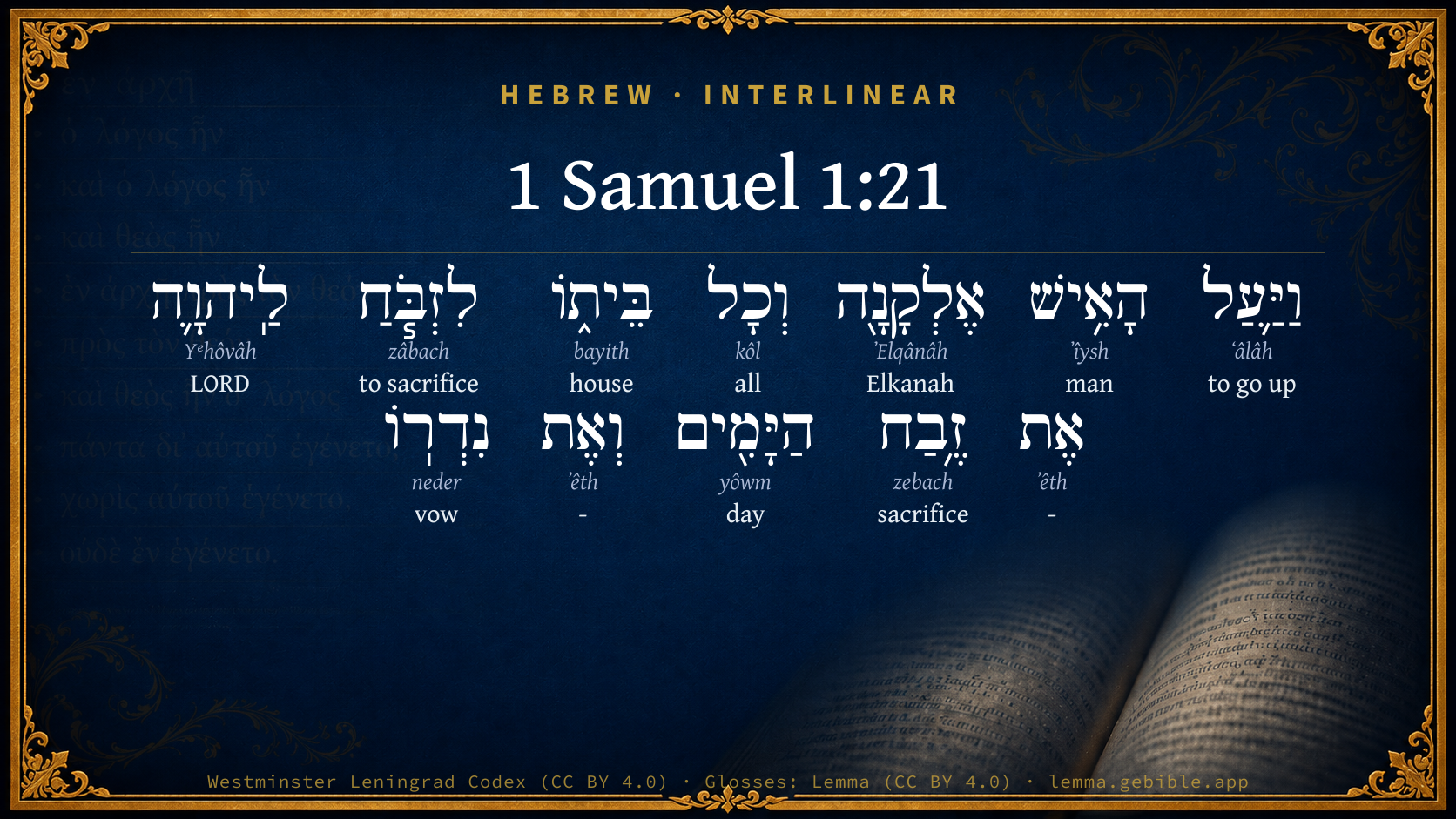
Hebrew (Westminster Leningrad Codex) 1 Samuel 1:21 appears in the Hebrew Old Testament. The text above is from the Westminster Leningrad Codex. Each word links to its Strong’s number, a concise gloss, and parsing drawn from the Open Scriptures Hebrew Bible morphology. Click any word for its full Brown-Driver-Briggs (BDB) entry.
Download image
Cite this verse

1 Samuel 1:21 (World English Bible). Public Domain. Lemma interlinear Bible study tool, https://lemma.gebible.app/v/1-samuel/1/21.

Show BibTeX & RIS
BibTeX
RIS
English Translation
The man Elkanah, and all his house, went up to offer to Yahweh the yearly sacrifice, and his vow.
World English Bible · Public Domain
Download a study sheet

One document with this verse’s original text, its word-by-word gloss line, the meaning frame, cross-references with their text, attributed commentary, and full source and license credits — printable, and it pastes into notes with its structure intact.

This verse Autodidact and up

Study sheet (.html) Plain text (.txt)

A passage Seminary Student

Up to 50 verses in one chapter. A passage sheet keeps up to 6 commentary sources and 12 cross-references per verse, in the order this page ranks them, and says so on the sheet whenever that leaves anything out. Ask for a single verse and you get the Autodidact verse sheet above.

Everything on this page stays free to read, with no account — the sheet is a download of what is already on screen, not access to it.

Want to remove ads? Support Godless Engineer
Compare translations 3

The same verse in 3 English versions, stacked beneath the original-language interlinear above. Click any original word for its lexicon entry.

Each is an independent rendering of the whole verse — the interlinear is not word-aligned to these translations.

Highlighted words mark where these versions differ — a whole-verse word diff, not a word-by-word alignment.

  • World English Bible Public Domain
    The man Elkanah, and all his house, went up to offer to Yahweh the yearly sacrifice, and his vow.
  • King James Version Public Domain
    And the man Elkanah, and all his house, went up to offer unto the LORD the yearly sacrifice, and his vow.
  • unfoldingWord Literal Text CC BY-SA 4.0
    And the man Elkanah and all of his house went up to sacrifice to Yahweh the sacrifice of the days and his vow.

unfoldingWord Literal Text — © unfoldingWord, licensed CC BY-SA 4.0. Word-aligned USFM3 via Door43 (git.door43.org/unfoldingWord/en_ult).

Versions to compare (up to 4)

3 of 4 selected

Show all 18 translations

Every available English version of this verse, each an independent rendering of the whole verse.

  • World English Bible Public Domain
    The man Elkanah, and all his house, went up to offer to Yahweh the yearly sacrifice, and his vow.
  • Berean Standard Bible Public Domain
    Then Elkanah and all his house went up to make the annual sacrifice to the LORD and to fulfill his vow,
  • Majority Standard Bible Public Domain
    Then Elkanah and all his house went up to make the annual sacrifice to the LORD and to fulfill his vow,
  • King James Version Public Domain
    And the man Elkanah, and all his house, went up to offer unto the LORD the yearly sacrifice, and his vow.
  • American Standard Version (1901) Public Domain
    And the man Elkanah, and all his house, went up to offer unto Jehovah the yearly sacrifice, and his vow.
  • Revised Version (1885) Public Domain
    And the man Elkanah, and all his house, went up to offer unto the LORD the yearly sacrifice, and his vow.
  • Geneva Bible (1599) Public Domain
    So the man Elkanah and all his house went vp to offer vnto the Lord the yeerely sacrifice, and his vowe:
  • Douay-Rheims (1899) Public Domain
    And Elcana her husband went up, and all his house, to offer to the Lord the solemn sacrifice, and his vow.
  • Young's Literal Translation Public Domain
    And the man Elkanah goeth up, and all his house, to sacrifice to Jehovah the sacrifice of the days, and his vow.
  • Literal Standard Version CC BY-SA 4.0
    And the man Elkanah goes up, and all his house, to sacrifice to YHWH the sacrifice of the days, and his vow.
  • Unlocked Literal Bible CC BY-SA 4.0
    Once again, Elkanah and all his house went up to offer to Yahweh the yearly sacrifice and pay his vow.
  • unfoldingWord Literal Text CC BY-SA 4.0
    And the man Elkanah and all of his house went up to sacrifice to Yahweh the sacrifice of the days and his vow.
  • Darby Bible Public Domain
    And Elkanah her husband, and all his house, went up to sacrifice to Jehovah the yearly sacrifice and his vow.
  • World Messianic Bible Public Domain
    The man Elkanah, and all his house, went up to offer to the LORD the yearly sacrifice and his vow.
  • Webster's Bible Public Domain
    And the man Elkanah, and all his house, went up to offer to the LORD the yearly sacrifice, and his vow.
  • Free Bible Version CC BY-SA 4.0
    Elkanah and all his family went to make the yearly sacrifice to the Lord and to fulfill his vow.
  • Bible in Basic English Public Domain
    And the man Elkanah with all his family went up to make the year's offering to the Lord, and to give effect to his oath.
  • JPS Tanakh (1917) Public Domain
    And the man Elkanah, and all his house, went up to offer unto the LORD the yearly sacrifice, and his vow.

Literal Standard Version (2020), Covenant Press — licensed CC BY-SA 4.0. Text via the HelloAO Bible API (eBible.org). Unlocked Literal Bible (unfoldingWord) — licensed CC BY-SA 4.0. Text via the HelloAO Bible API (eBible.org). unfoldingWord Literal Text — © unfoldingWord, licensed CC BY-SA 4.0. Word-aligned USFM3 via Door43 (git.door43.org/unfoldingWord/en_ult). Free Bible Version, Dr. Jonathan Gallagher — licensed CC BY-SA 4.0. Text via the HelloAO Bible API (eBible.org).

Word by word

More ways to search: Search by grammar → Find every occurrence → Compare this word →

Practice this passage: Drill this verse → Learn its vocabulary →

אֶלְקָנָ֖ה
ʼElqânâh
H511
“Elkanah”
Noun, Proper
Part of Speech
Noun
Type
Proper
Full BDB Definition

Origin: from H410 and H7069

TWOT: None

Elkanah = "God has possessed" or " God has created" - Samuel's father - a ruler in Jerusalem in the time of king Ahaz - one of David's mighty warriors - son of Korah - several Levites
  1. וַיַּ֛עַל ʻâlâh H5927 “and · to go up” Conjunction + Verb, Qal, Sequential Imperfect, 3rd Person, Masculine, Singular
  2. הָאִ֥ישׁ ʼîysh H376 “the · man” Particle, Definite Article + Noun, Common, Masculine, Singular, Absolute
  3. וְכָל kôl H3605 “and · all of” Conjunction + Noun, Common, Masculine, Singular, Construct
  4. בֵּית֑וֹ bayith H1004 “house · his” Noun, Common, Masculine, Singular, Construct + Suffix, Personal, 3rd Person, Masculine, Singular
  5. לִזְבֹּ֧חַ zâbach H2076 “to sacrifice” Preposition + Verb, Qal, Infinitive Construct
  6. לַֽיהוָ֛ה Yᵉhôvâh H3068 “to/for · LORD” Preposition + Noun, Proper
  7. אֶת ʼêth H853 “-” Particle, Direct Object
  8. זֶ֥בַח zebach H2077 “sacrifice of” Noun, Common, Masculine, Singular, Construct
  9. הַיָּמִ֖ים yôwm H3117 “the · days” Particle, Definite Article + Noun, Common, Masculine, Plural, Absolute
  10. וְאֶת ʼêth H853 “and · -” Conjunction + Particle, Direct Object
  11. נִדְרֽוֹ neder H5088 “vow · his” Noun, Common, Masculine, Singular, Construct + Suffix, Personal, 3rd Person, Masculine, Singular

About this verse

These counts appear in no published source. They are computed here, from the morphology-tagged text and Lemma’s own curated glosses. What Lemma adds →

12
words
11
distinct lemmas
Historical
section

Notable vocabulary

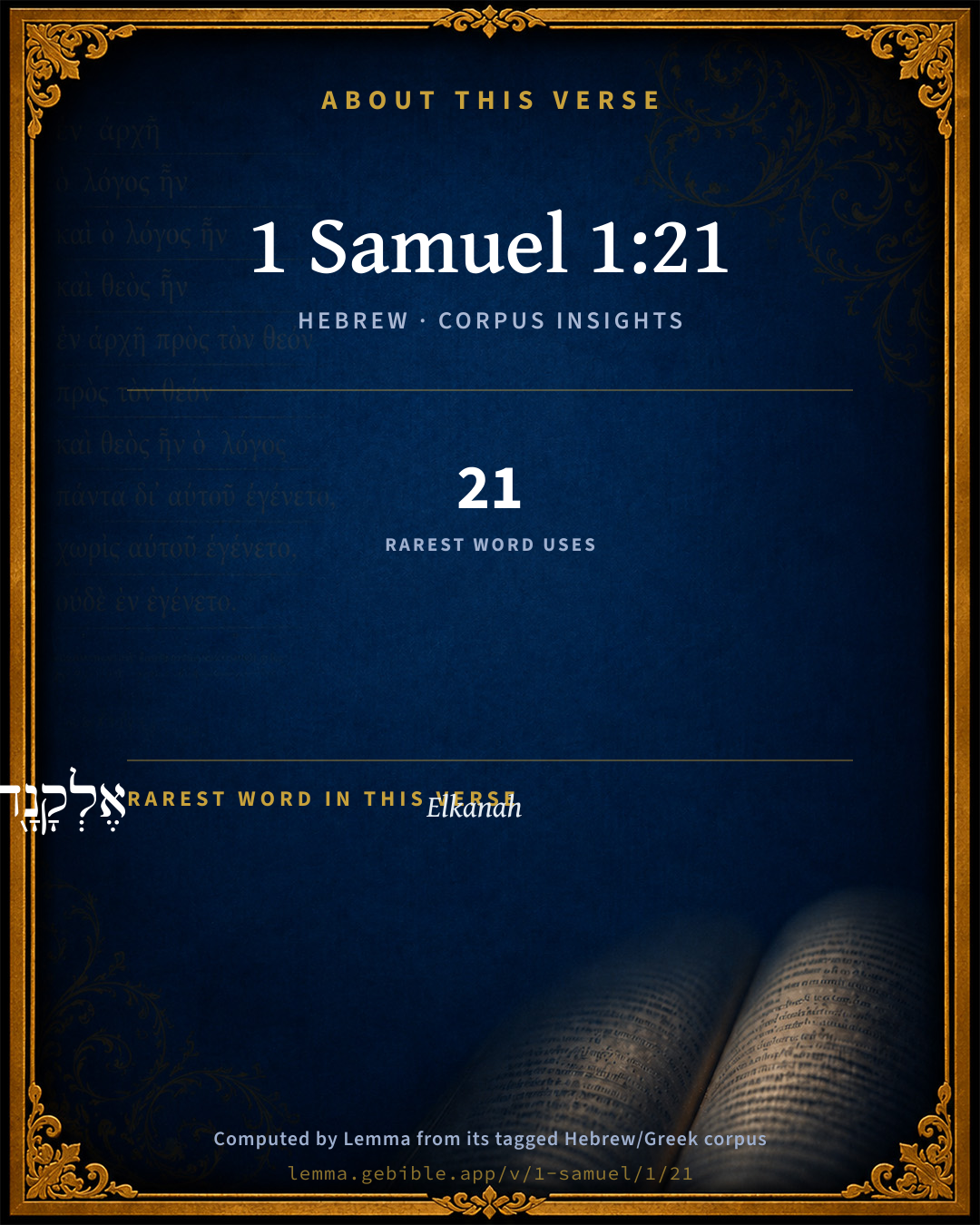
The rarest word here is אֶלְקָנָ֖ה Elkanah H511 — appearing just 21 times in the whole Hebrew Bible.

Shared distinctive vocabulary

אֶלְקָנָ֖ה Elkanah H511 occurs in 20 verses of the Hebrew Bible. Also found in:

Grammatical profile

  • 2 verbs
  • 8 nouns
  • 2 particles

Verb forms

  • וַיַּ֛עַל Qal · Sequential Imperfect
  • לִזְבֹּ֧חַ Qal · Infinitive Construct

Hebrew & Septuagint length

In English translation the verse runs 19 words from the Hebrew and 27 from the Septuagint (LXX English) — the Septuagint runs noticeably longer here. See the side-by-side →

A rough comparison of the two English renderings, which tokenize alike — not a word-level alignment.

Word counts can differ between the Hebrew and the Greek without any difference in meaning — e.g. the Hebrew direct-object marker אֵת has no separate Greek word, and Greek often adds the article ὁ.

Cross-references

5

Topical passages linked to 1 Samuel 1:21 in the Treasury of Scripture Knowledge — connected by theme and wording, ordered by reader-vote popularity; previews shown in the World English Bible.

  • 1 Samuel 1:3 This man went up out of his city from year to year to worship and to sacrifice to Yahweh of Hosts in Shiloh. The two sons of Eli, Hophni and Phinehas, priests to Yahweh, were there.
  • Deuteronomy 12:11 then it shall happen that to the place which Yahweh your God shall choose, to cause his name to dwell there, there shall you bring all that I command you: your burnt offerings, and your sacrifices, your tithes, and the heave-offering of your hand, and all your choice vows which you vow to Yahweh.
  • Joshua 24:15 If it seem evil to you to serve Yahweh, choose you this day whom you will serve; whether the gods which your fathers served that were beyond the River, or the gods of the Amorites, in whose land you dwell: but as for me and my house, we will serve Yahweh.
  • Genesis 18:19 For I have known him, to the end that he may command his children and his household after him, that they may keep the way of Yahweh, to do righteousness and justice; to the end that Yahweh may bring on Abraham that which he has spoken of him."
  • Psalms 101:2 I will be careful to live a blameless life. When will you come to me? I will walk within my house with a blameless heart.

Cross-references courtesy of OpenBible.info (CC BY 4.0).

Hebrew and Greek witnesses Masoretic Hebrew ↔ Greek Septuagint

The same verse in the two great witnesses to the Old Testament, shown verse-for-verse.

Here the Septuagint runs noticeably longer than the Hebrew — LXX2012 (modern English Septuagint) 27 words vs World English Bible 19. A rough length comparison of the two English translations, not a word-level alignment — read both below.

These are two independent witnesses, not word-aligned to each other, and the Septuagint is shown in lemma (dictionary) form.

Hebrew 1 Samuel 1:21 Masoretic · Westminster Leningrad Codex

וַיַּ֛עַל הָאִ֥ישׁ אֶלְקָנָ֖ה וְכָל בֵּית֑וֹ לִזְבֹּ֧חַ לַֽיהוָ֛ה אֶת זֶ֥בַח הַיָּמִ֖ים וְאֶת נִדְרֽוֹ

The man Elkanah, and all his house, went up to offer to Yahweh the yearly sacrifice, and his vow.

World English Bible · Public Domain

Greek LXX 1 Samuel 1:21 Septuagint · lemma form

καί ἀναβαίνω ὁ ἄνθρωπος ελκανα καί πᾶς ὁ οἶκος αὐτός θύω ἐν σηλωμ ὁ θυσία ὁ ἡμέρα καί ὁ εὐχή αὐτός καί πᾶς ὁ δέκατος ὁ γῆ αὐτός

And the man Helkana and all his house went up to offer in Selom the yearly sacrifice, and his vows, and all the tithes of his land.

LXX2012 (modern English Septuagint) · Public Domain

On this verse, The Pulpit Commentary discusses the Septuagint’s reading. Read the note in Commentary ↓

Hebrew: Westminster Leningrad Codex (CC BY 4.0). Greek: Septuagint (public domain); English from LXX2012 (modern English Septuagint) (Public Domain). How the Septuagint differs from the Hebrew →

Targum (Aramaic paraphrase)

1

The Targum is the ancient Jewish Aramaic paraphrase of the Hebrew Scriptures — an interpretive translation, not the Hebrew text itself. Onkelos (literal) and Pseudo-Jonathan (expansive) render the Torah, and Jonathan the Prophets. Coverage is partial: where no permissively-licensed English translation exists for a verse, only the Aramaic is shown. This is verse-level text, not a word-by-word alignment to the Hebrew.

  1. Targum Jonathan Prophets (Joshua–Malachi)
    וּסְלִיק גַבְרָא אֶלְקָנָה וְכָל אֱנַשׁ בֵּיתֵיהּ לְדַבָּחָא קֳדָם יְיָ יַת דְבַח מוֹעֲדַיָא וּלְשַׁלָמָא יַת נִדְרֵיהּ:

    (no public-domain English translation for this verse)

    Targum Jonathan — Aramaic: “Mikraot Gedolot” (public domain). English: “Sefaria Community Translation” (CC0 1.0 (public-domain dedication)); “London "Chaldee Paraphrase," 1871” (public domain). Text via Sefaria.

Commentary

Notes on 1 Samuel 1:21 from classic Christian and Jewish commentators (each source and its license shown beneath its notes). The classic Christian expositions comment on the surrounding passage and are grouped to its opening verse, so a note may address several verses; the Jewish commentaries on the Tanakh (Rashi and others) are per-verse, so they appear only where the commentator wrote on this verse.

Lemma curates 59 commentaries, every one of them public domain or Creative Commons licensed, each selected and text-cleaned for this edition rather than reprinted as found. About our sources →

Trapp's Complete Commentary

John Trapp

1Sa 1:21 And the man Elkanah, and all his house, went up to offer unto the LORD the yearly sacrifice, and his vow.

Ver. 21. And his vow.] Made first by his wife, and afterwards owned and ratified by himself. And perhaps he vowed something now to God, though it be not said what, besides the child, to show his thankfulness.

John Trapp, A Commentary or Exposition upon All the Books of the Old and New Testament (1647–1656) — public domain. Text from a community e-Sword module.

Joseph Benson's Commentary

1Sa 1:21. Elkanah and all his house went up — Hannah only and her child excepted. And his vow — By which it appears, though it was not expressed before, that he heard and consented to her vow; and that he added a vow of his own; probably when he saw his wife was with child; or before, when she told him what hope she had that her prayers would be heard; and when he worshipped God, as mentioned 1Sa 1:19.

Joseph Benson's Commentary on the Old and New Testaments (1811–1818) — public domain. Text from a community e-Sword module.

Whedon's Commentary on the Bible

Daniel D. Whedon

SAMUEL’S DEDICATION TO THE LORD AT SHILOH, 1Sa_1:21-28.

21. And his vow — What this vow of Elkanah was we do not know, but it is generally supposed that, like Hannah’s, it had reference to the child Samuel.

Daniel D. Whedon (gen. ed.), Commentary on the Old and New Testaments (1874–1909) — public domain. Text from a community e-Sword module.

The Preacher's Complete Homiletical Commentary

Joseph S. Exell (gen. ed.)

CRITICAL AND EXPOSITORY NOTES.—

1Sa_1:21. “Yearly Sacrifice” literally, the “offering of the days,”—the Israelites’ customary and obligatory annual sacrifice. The “offering of the days “is, as it were, the yearly reckoning with the Lord, the presentation of those portions of the property which fall to him in the course of the year” (Hengstenberg). “His Vow.” Here is a proof that Elkanah had likewise vowed unto the Lord in reference to Samuel.

1Sa_1:23. “Only the Lord establish His word.” “Elkanah seeks from God, and suppliantly begs with prayers, that, since God has bestowed on him male offspring, He will consecrate him and make him fit for His service (Calvin).

MAIN HOMILETICS OF THE PARAGRAPH.—1Sa_1:21-23

SERVING GOD IN THE HOME AND IN THE TEMPLE

I. An obedient recognition of Divine ordinances.

1. As to place. “And Elkanah went up to offer unto the Lord.” The value of laws or ordinances depends upon the wisdom of him who institutes them, and our obligation to observe them depends upon the claim to obedience that he has upon us and upon their adaptation to meet our needs. In the time of Elkanah, the place of the ark was the place appointed by God where his people were to assemble to perform acts of special worship. Under the New Testament dispensation, Christians are commanded to assemble themselves together for the same purpose (Heb_10:25), and the command is binding upon all because it has been given by Him who is fully acquainted with man’s spiritual needs, and knows how those needs will be most fully met.

2. As to time. Ancient Israel was commanded to assemble together at special seasons and on special days. Although it may be disputed whether Christians are bound to observe any particular day, there can be no doubt that the regular observance of a special day such as the Christian Sabbath, is indispensable to the maintenance of a national sense of the existence of a God, and if it is not absolutely necessary to preserve divine and spiritual life in the individual soul, it is indispensable to its growth and vigour. The obligation of Christians to observe a “Lord’s day” has its origin both in the Divine institution of the Sabbath at the Creation, in its recognition by Christ Himself (Mar_2:27), and in the manifest adaptation to meet their spiritual needs. He who knows man’s needs made the Sabbath for him, and to set it aside as unnecessary is to impute to Him ignorance as to the spiritual wants of His own creatures. We are as much bound to recognise a place and a period in which to meet for the public worship of God as the ancient Jew was. Christ Himself has attached a special promise to such a gathering in His name (Mat_18:20), and in two instances on record, cheered his first disciples by fulfilling it even in His bodily presence on “the first day of the week” (Joh_20:19-26). It is worthy of note that the divine ordinances were observed not only by Elkanah, but by “all his house,” that is, as is evident from the following-verses, by all who were not prevented by age or by home duties.

II. A service performed for God at home. “Hannah went not up,” etc. Hannah, in her present circumstances, served God to more purpose by absenting herself for the time from the public worship of God. God permits His human creatures to be co-workers with Him in the accomplishment of His purposes. He had purposed to bring about a revival of true godliness in Israel by means of Samuel, but in bringing about the accomplishment of his purpose, He worked through ordinary human channels and used human instrumentality. Hannah, by nourishing the bodily life of her child, and by training his infant mind in a knowledge of the God whose prophet he was to be, was a co-worker with God in the raising the nation to a higher spiritual condition. It is so in all God’s purposes in relation to the world, whether in the kingdom of nature or of grace. He has purposed that the earth shall bring forth her harvests year after year to supply man with bread. But He calls man to aid Him in the accomplishment of His purpose (Isa_28:26-29). And so in the spiritual kingdom. And when any man of God is raised up by Him for a great work, he is not the only instrument of its accomplishment, but all those who have helped to train him for God’s services—especially his mother, if she has been faithful to her trust—have a share in the honour and joy. It may be questioned if anyone in the kingdom of Israel at this time was doing so great a work for God as Hannah in the performance of her unobtrusive work in the privacy of her home.

OUTLINES AND SUGGESTIVE COMMENTS

1Sa_1:23. Hannah looked upon her child, not as a child only, but as an offering; she had two reasons to love him, one from nature and one from grace.… Those who purpose to consecrate cups or vessels of gold to the service of God, while they keep them in their house until the day of consecration, look upon them no longer as common objects, and do not permit them to be carelessly or indifferently handled. So Hannah, with much more reason, nurtured her child with a special reference to his introduction to the temple; she loved him more than as an ordinary child, she regarded him as an offering to the Lord, looking upon herself as sanctified through him; indeed, her house had become a temple since it enclosed this priest, this prophet.—Chrysostom.

The Preacher's Complete Homiletical Commentary (gen. ed. Joseph S. Exell; Funk & Wagnalls, c. 1892) — public domain (pre-1929). A full-Bible homiletical/sermon-outline anthology covering 65 of 66 books (2 John is absent from the source module). Text from a community e-Sword module.

Lange's Commentary on the Holy Scriptures

SECOND SECTION

Samuel’s Consecration and Restoration to the Lord

1Sa_1:21-28

I. The child Samuel at home till he is weaned. 1Sa_1:21-23

21And the man Elkanah and all his house went up to offer unto the Lord 22[Jehovah] the yearly sacrifice, and his vow. But Hannah went not up; for she said unto her husband, I will not go up until the child be weaned, and then I will bring him, that he may appear before the Lord [Jehovah], and there abide 23for ever. And Elkanah her husband said unto her, Do what seemeth thee good; tarry until thou have weaned him; only the Lord [Jehovah] establish his word. So the woman abode, and gave her son suck until she weaned him.

II. Samuel given back by his mother to the Lord. 1Sa_1:24-28

24And when she had weaned him, she took him up with her, with three bullocks, and one ephah of flour, and a bottle of wine, and brought him unto the house of 25the Lord [Jehovah] in Shiloh; and the child was young. And they slew a [the] 26bullock, and brought the child to Eli. And she said, O my lord, as thy soul liveth, my lord, I am the woman that stood by thee here, praying [to pray] unto the Lord 27[Jehovah]. For this child I prayed; and the Lord [Jehovah] hath given me my28petition which I asked of him: Therefore also I have lent [given29] him to the Lord [Jehovah]; as long as he liveth he shall be lent [he is given] to the Lord [Jehovah]. And he worshipped the Lord [Jehovah] there.

EXEGETICAL AND CRITICAL

1Sa_1:21. And the man Elkanah and all his house went up. This he did yearly, in order to present the offering of the days and the vow. The “offering of the days” is the annual offering, the offering which every Israelite was obliged and accustomed to present annually. “The offering of the days and the vow” is the brief statement of what is detailed at length in the Law. In going up with his whole house, Elkanah did as is commanded in Deu_12:17-18 : “Thou mayest not eat within thy gates the tithe of thy corn, or of thy wine, or of thy oil, or the firstlings of thy herds or of thy flock, nor any of thy vows which thou vowest, nor thy freewill-offerings, or offering of thine hand; but thou must eat them before the Lord thy God in the place which the Lord thy God shall choose, thou and thy son, and thy daughter, and thy man-servant, and thy maid-servant, and the Levite that is within thy gates; and thou shalt rejoice before the Lord thy God.” The offering of the days “is, as it were, the yearly reckoning with the Lord, the presentation of those portions of the property which fall to him in the course of the year.” Hengstenberg, Beit. [Contributions to an Introd. to the Pent.] III., 89, 90.—The Sing, “his vow” refers to the vow which Elkanah also had made based on the hearing of Hannah’s prayer. The addition of the Sept., “and all the tithes of his land” is, like the plural “his vows,” to be referred to the translator’s having in mind the above-quoted passage. Thenius (ad locum) remarks that the corresponding words וְכָל־מַעְשְׂרוֹת אַרְצוֹ [and all the tithes of his land] were probably purposely omitted by transcribers who regarded Samuel’s Levitical descent as certain, according to 1Ch_6:7 sq. and 19 sq.; but Josephus, who expressly describes Elkanah as a Levite, and follows the Alexandrine translation, has the addition also. It belongs to the category of explanatory additions and changes of which the Sept. is so full.

1Sa_1:22. After the child is weaned from his mother’s breast, Hannah will bring him to the Sanctuary. That the Heb. verb (גָּמַל) means here “to wean,” and does not include the idea of education (Seb. Schmid) as in 1Ki_11:20, is plain from the “gave suck,” (וַתֵּינֶק) in 1Sa_1:23. The ground adduced for this opinion, namely, that the child would otherwise be troublesome to Eli, is of no force; for, apart from the fact that a child three years old (this was the term of weaning, according to 2Ma_7:2730) is not troublesome in the East, his nurture and education could be committed to “the women that served at the door of the Tabernacle of meeting,” (1Sa_2:22).—The “appearing before the Lord,” for which Hannah will bring her son to Shiloh, supposes the existence there of the National Sanctuary instituted by Moses, and answers to the law (Exo_23:17; Exo_34:23): “Three times in the year all thy males shall appear before the Lord Jehovah.” The “abide for ever,” all his life (עַד־עוֹלָם) indicates the life-long consecration to service in the Sanctuary from his weaning on, while otherwise this service was binding only from the 25th year to the 50th. By the education which the boy received in the Sanctuary he was even as a child to grow into the service; and moreover, as a child, he could perform little outward services (Then.), so that the objection, that, as a newly weaned child, he was unfit for the Temple-service, falls to the ground.

1Sa_1:23. Only the Lord establish His word, that is, maintain, fulfil it, bring it to completion. The “word” (דְּבָרוֹ) refers not merely to Eli’s word, 1Sa_1:17, but to God’s factual discourse, which consisted in hearing Hannah’s prayer, and in the real promise which he had given, by the birth of the child, in reference to his destination to the service of the Lord. Bunsen excellently says: “Word, that is, may He fulfil what He designs with him and has promised by his birth, comp. 1Sa_1:11; 1Sa_1:20. The words refer, therefore, to the boy’s destination to the service of God, which the Eternal has in fact acknowledged by the partial fulfilment of the mother’s wish.” Similarly Calvin already: “Elkanah seeks from God, and suppliantly begs with prayers, that, since God has bestowed on him male offspring, He will consecrate him and make him fit for His service, and direct him by the power of His Holy Spirit, by which his service shall be grateful and acceptable to God.” Since there is no express word of the Lord to which the “word” may be referred, the Sept. avoids the difficulty by translating (groundlessly) τὸ ἐξελθὸν ἐκ τοῦ στόματός σου “that which came out of thy mouth.” The Heb. text is not therefore to be changed (with Then.), to accord with the Sept., into “only, let thy word stand” (אַךְ תָּקִימִי אֶת־דְּבָרֵךְ.) Clericus: “God had shown, not by words, but by very deed, that He approved Hannah’s vow, and had promised her a living son; and Elkanah prays that He will perform His promise. There is therefore no need to invent with the Rabbis an oracle31 uttered to the mother concerning the child about to be born.”

1Sa_1:24, sq. The case is the same here with the diverging translation of the Sept., “with a three-year-old bullock” [instead of “three bullocks”], which is occasioned by the singular “the bullock” of 1Sa_1:25. The contradiction between “three bullocks” and “one-bullock” cannot indeed be removed (with Bunsen) by regarding the sing as collective, Jdg_6:25 being cited in support of it; but it may properly be said with Keil that “the bullock” in 1Sa_1:25 denotes specially the offering with which the boy was returned to the Lord, “the burnt-offering by which the boy was dedicated to the Lord for life-long service in His Sanctuary, the two other bullocks serving for the yearly offering.” As it was understood that the two others were for the yearly festival-offering, that is, burnt-offering and thank-offering, it was not specially mentioned that they were sacrificed. Further, three bullocks are required by the quantity (one ephah) of flour which Elkanah takes with him, since, according to Num_15:8-10, three-tenths of an ephah of flour was required for a burnt-offering of one bullock. The peace-offering, like the burnt-offering, was connected with a meat- and drink-offering.—A striking example of the arbitrary fashion in which the Alex. translators got over difficulties in the text is found in their translation μετ’ αὐτῶν “with them” at the end of 1Sa_1:24 [the Heb. reads “the child was a child”]; as if, instead of the difficult נַעַר [“child”], to which the sense requires the addition of the predicate “small,” the text had read עִמָּם “with them.” The addition of the Sept. to 1Sa_1:24, “and his father slew the offering which he made annually to the Lord, and he brought the boy near,” and the translation in 1Sa_1:25, “and he slew the bullock, and Hannah the mother of the child brought him to Eli” are to be explained as efforts at exegesis, and give us no ground to correct the Heb. text, as Thenius supposes. Not the mother alone, but both parents gave the boy over to Eli, and thus presented him as an offering to the Lord.

1Sa_1:26 sq. Hannah makes herself known to Eli by reminding him of the circumstances under which she had prayed for the child (1Sa_1:11 sq.)32—On “stood” (הַנּצֶּבֶת) Clericus remarks: “they prayed to God standing.” For the custom of standing in prayer comp. Gen_18:22; Gen_19:27; Dan_9:20. In time of deeper devotion and emotion a kneeling posture also was adopted, (1Ki_8:54; 2Ch_6:13; Ezr_9:5).

1Sa_1:27. Three things move Hannah’s soul deeply and joyfully: 1) The recollection of the moment when she stood here and called on God for this Song of Solomon 2) the contemplation of the answer to her prayer, and the granting of the thing asked, and 3) the determination now to restore to the Lord what He had given her in this answer to her prayer.

1Sa_1:28. “And also I” (וְגַם אָנֹכִי) refers back to the words “and the Lord hath given me,” and implies a requital, et ego vicissim, “and I in my turn,” (Cler.). “It cannot be shown that הִשְׁאִיל means “lend,” as is generally assumed; it occurs in 1Sa_1:28, in the sense of “grant,“ “give.“ Knobel on Exo_12:36. Further, the signification “lend” is here inappropriate, because the “I also” expressly brings out the correspondence to the “gave,” of 1Sa_1:27. הִשְּׁאִיל means “cause to ask or demand,” “grant what is demanded,” “give.” The sense is: the Lord gave him to me, and so have I also given him to the Lord, as one asked or demanded. Calvin: “The sense is plain enough, namely, that she gave, dedicated to God the child obtained from Him by prayer.” The short concluding sentence “he is asked for the Lord,” expresses her determination to give him to the Lord for His service.—“They prayed,” not sing., referring to Elkanah, but plur., Elkanah and Hannah, (comp. 1Sa_1:19), Samuel not being included. [The plur. “they prayed” is easier, but the Heb. reads “he prayed,” (though some regard the form as plur.), and so Chald.; Syr. Ar. Vulg. have the plur.; Sept. omits the clause. If taken as sing. it no doubt refers to Elkanah, who, as head of the household, represented his wife and conducted the worship. (So Abarbanel הוֹדָה בְנֶדרֶ אִשְׁתּוֹ; he also mentions Samuel and Eli). This is the view of Keil and Wordsworth. The Bib. Comm. takes it as fem, sing., and makes Hannah the subject.—It is impossible to convey in an Eng. translation the fine play upon words of the Heb. in the principal sentence of this verse and the preceding. Literally it reads: The Lord has given me my asking which I asked of Him; and I also have caused the Lord to ask him; as long as he lives he is asked to the Lord. The contrast between the Qal and Hiph. of the verb “to ask” (שאל) is brought out in Exo_12:35 (asked, not borrowed, as in Eng. A. V.) and 36 (gave, not lent). Keil and Erdmann make the Hiph. a denominative from שָׁאוּל “asked” == “to make one asked,” but there does not seem to be authority for this; the best rendering is “give.”—Erdmann puts a semicolon after “liveth;” but it is better, with Chald. Syr. and Eng. A. V., to put it after the first Jehovah.—The ancient vss. (except Vulg.) take the היה “is” here to be equivalent to היה “lives,” or perhaps, read היה, and it is better to adopt the latter reading. Otherwise we must translate “and I also have given him to Jehovah all the days for which he was asked for Jehovah.”—Tr.].

HISTORICAL AND THEOLOGICAL

1. The mother’s determination, that the child should not be presented to the Lord in the Sanctuary till after he was weaned, was in keeping with the divine ordination that the child must first, in the bosom of natural maternal love, pass through the elementary conditions of the sustenance and earliest development of his physical life, before he could, in accordance with the divine destination, receive in the service of the Sanctuary the proper education and culture for his theocratic calling.

2. That God gives in answer to prayer, and that man devotes to God what he obtains, so that God takes again what He has given, or lays claim to it for the ends of His kingdom, is the law of reciprocity in the intercourse between the living God and His saints; the latter contribute nothing for the realization of the special ends of His kingdom, which they have not received from him, and are not by Him enabled to contribute.

3. Among the heroes of God’s kingdom who have been brought to the Lord by the prayers of their mothers and consecrated as His instruments, Samuel is a shining example of the full, unselfish devotion of the whole life to the Lord’s service, which is the condition of great profound capacity to further the kingdom of God.

4. An important principle of education is herein contained: every child should be devoted to the Lord’s service, from the beginning of his life on, with self-denial and prayer; and, in accordance with this destination, should receive his life-direction by education, selfish parental love yielding to the counsel of the divine will. Calvin: “Hannah, forgetting her own advantage, gives all the glory to God, thinking it would be well enough with her, if only God were glorified; and indeed it is right to yield to God all we have, whatever it may be.” In the education of children the using them to the divine and holy must begin with the weaning.33 From the beginning of his life the child must be “about his Father’s business.”

HOMILETICAL AND PRACTICAL

1Sa_1:21-28. The presentation of Samuel for constant service in the sanctuary. 1) What preceded it, according to Hannah’s wish and Elkanah’s consent (1Sa_1:21-22). 2) How it was performed, in bringing up Samuel to Shiloh and in delivering him to Eli and in prayer to the Lord (1Sa_1:24-28).

1Sa_1:21. Osiander: After receiving divine benefits we should not be more slothful in performing divine service, but rather be so much the more diligent and industrious.—Pious mothers are performing acceptable divine service when they are rearing their children faithfully and in the fear of God.—It is no reproach to a man when he prefers his wife’s better opinion to his own. [1Sa_1:23. Matt. Henry: So far was he from delighting to cross her, that he referred it entirely to her. Behold, how good and pleasant a thing it is, when yoke-fellows thus draw even in the yoke, and accommodate themselves to one another; each thinking well of what the other does, especially in works of piety and charity.—Tr.]

1Sa_1:24. Cramer: The rearing of children gives to parents, it is true, great toil and trouble, but when it is done in faith, it constitutes better works than when monks and nuns perform all their fasting, praying, castigations and indulgence-ceremonies; for those, not these, are enjoined by God in His word. Accordingly they are true acts of divine service, and receive from God their reward.

1Sa_1:25. Von Gerlach: That a three-year old boy should be already given over to the temple, was done in order that from the first awakening of his higher spiritual powers he might already be living amid these holy surroundings.—Seb. Schmidt: Children must at times be carried to divine service.—Starke (1Sa_1:26-27): The wonders of God’s goodness we should openly celebrate, and not keep silent about them. 1Sa_1:28. Parents give their children back to God when they advance them to holy baptism, present them to God in prayer, and rear them in a Christian manner. [There are many who think this can be, and often is, quite as well performed without infant baptism as with it.—Tr.]—Cramer: We should devote to the ministry the best talents and dearest children.

[1Sa_1:28. Giving back to the Lord: 1) All we have was given by the Lord. 2) All we have should be really consecrated to Him, and regarded and treated as His. 3) The Lord will then make all promote both our good and His glory.

1Sa_1:10; 1Sa_1:26. Agonizing supplication and joyful thanksgiving. Look on the two pictures and learn the lesson.—Chap. I. Hannah, her sorrows and her joys: I. Her sorrows. 1) She was childless. 2) She was derided and ridiculed. 3) She was unjustly accused by a good man. II. Her joys. 1) In the tender love of her husband. 2) In the answer to her agonizing prayer. 3) In being the mother of a prophet.—Tr.] [Chrysostom has five sermons on Hannah, which are discursive as usual, but contain some passages in his best vein. Works, ed. Migne, Vol. IV., p. 631.—Tr.]

Footnotes:

[29][1Sa_1:28. Erdmann renders: I have made him one prayed for (asked, erbeten) to the Lord as long as he lives; he is asked to the Lord (for the Lord). See Exegetical Notes in loco.—Tr.]

[30][Rashi says 22 months; Kimchi and others 24 months. For other opinions see “Synopsis Criticorum ” in loco.—Tr.].

[31][Rashi: “The Bath-qol (‘daughter of the voice’) went forth, saying: there shall arise a just one whose name shall be Samuel. Then every mother who bore a son called him Samuel; but when they saw his actions, they said, this is not Samuel. But when this one was born and they saw his manner of life, they said, this is that Samuel; and this is what the Scripture means, when it says, ‘the Lord confirm His word,’ that Samuel may be that just one.”—Tr.].

[32] בִּי in connection with אֲדנִי is an interjection, “hear,” or “I beg,” or “truly, my lord,” (Gen_43:20; Gen_44:18; Exo_4:10; Exo_4:13; Num_12:11; Jos_7:8; 1Ki_3:17; 1Ki_3:26). Many explain it as = “per me obsecro,” citing the corresponding Arab oath “per me.” Another explanation (Ges.) supposes a contraction of בְּעִי “request,” since “in the Aramaic translations בְּבָעוּ stands for the Heb, בִּי, for which the Samaritans at least wrote בעוּ ‘obsecro’ without בְ, Gen_42:30.” Ewald says: “Most probably בִּי is shortened from אָבִי (Job_34:36; 1Sa_14:12), a simple Interjection.”

[33][The German is: mit der Entwöhnung schon hat die Gewöhnung … zu beginnen.—Tr.]

Lange's Commentary on the Holy Scriptures (Critical, Doctrinal, and Homiletical), ed. John Peter Lange, English translation edited by Philip Schaff (1864–1880) — public domain. Text from a community e-Sword module.

Geneva Bible (1599)

Geneva Bible translators

This Elkanah was a Levite, 1 Chron. 6:27, and as some write once a year they accustomed to appear before the Lord with their families.

Geneva Bible (1599) marginal notes — public domain. Text via Bolls.life.

Jamieson, Fausset & Brown

Robert Jamieson, A. R. Fausset & David Brown

the man Elkanah . . . went up to offer . . . his vow--The solemn expression of his concurrence in Hannah's vow was necessary to make it obligatory. (See on Num 30:3).

Jamieson, Fausset & Brown — Commentary Critical and Explanatory on the Whole Bible (1871) — public domain (CC PDM 1.0). Text via the HelloAO Bible API.

Adam Clarke's Commentary

Verse 21. The man Elkanah and all his house] He and the whole of his family, Hannah and her child excepted, who purposed not to go up to Shiloh till her son was old enough to be employed in the Divine service.

And his vow] Probably he had also made some vow to the Lord on the occasion of his wife's prayer and vow; in which, from his love to her. he could not be less interested than herself.

Adam Clarke's Commentary on the Bible (1810–1826) — public domain. Text from a community e-Sword/MySword module.

Ellicott's Commentary for English Readers

(21) And his vow.—Elkanah too had vowed a vow unto the Lord, in case his wife Hannah should have a son. It has been remarked that vows are characteristic of that particular age of the Judges; for instance, we have detailed accounts of Samson and Jephthan’s vows, the oath in the Benjamite vow, &c.

A Bible Commentary for English Readers, edited by Charles John Ellicott (1878–1897) — public domain. Text from a community e-Sword module.

The Cambridge Bible for Schools and Colleges

gen. ed. J. J. S. Perowne

21–28. Samuel’s infancy and dedication to Jehovah

21. his vow] This assumes that Elkanah as well as Hannah had made a vow. The Sept. reads “his vows and all the tithes of his land.” Cp. Deu_12:11.

The Cambridge Bible for Schools and Colleges (gen. ed. J. J. S. Perowne; Cambridge University Press, 1878–1918) — public domain. Text from a community e-Sword module.

John Gill's Exposition

And the man Elkanah, and all his house,.... All his family, excepting Hannah, and her son Samuel; or all the men of his house, as the Targum; for only the males were obliged to appear at the three festivals:

went up to Shiloh; to the house of God there:

to offer unto the Lord the yearly sacrifice; either the passover, to which men commonly went up with their families: see Luk 2:41, or rather it may be what was offered at the feast of tabernacles, as Abarbinel thinks, the time of the ingathering the fruits of the earth, when men went up with their families to offer sacrifice, and express their joy on that account, Deu 16:10.

and his vow: which he had made between feast and feast; for whatever vows men made at home, on any account, they paid them at the yearly festivals; and this vow might be on the account of the birth of his son, by way of thanksgiving for that.

John Gill's Exposition of the Whole Bible (1746–1763) — public domain (CC PDM 1.0). Text via the HelloAO Bible API.

Haydock's Catholic Bible Commentary

Vow, in consequence of his son’s nativity. The sacrifice might be of precept, such as the paschal lamb, or for his wife’s purification and the redemption of his first-born, as they could not attend in person. (Calmet) --- Hebrew, "the victim of days and his vow," which he had probably made in conjunction with Anna. (Menochius)

George Leo Haydock (1774–1849), Haydock's Catholic Family Bible and Commentary, 1859 edition — public domain. Excludes Psalms (Douay-Rheims chapter numbering differs from Protestant) and Deuterocanonical books (Catholic canon only).

Matthew Poole's English Annotations

All his house, i.e. his wife Peninnah, and his children, which are ofttimes called a man’s house in Scripture, Hannah only and her child excepted, as it here follows.

The yearly sacrifice; that solemn sacrifice which was offered up once every year; probably the paschal lamb, which is oft called a sacrifice, as Exo 12:27; 34:25.

And his vow; by which it appears, though it was not expressed before, that he heard and consented to her vow, which was necessary to make it obligatory, Num 30, and that he added a vow of his own, of some singular sacrifice to be offered, if God answered his prayers.

Matthew Poole's English Annotations on the Holy Bible (1683–1685) — public domain. Text from a community e-Sword/MySword module.

The Pulpit Commentary

THE VOW FULFILLED (vers. 21-28).

Elkanah... went up. When at the return of the year Elkanah went up as usual to Shiloh, Hannah remained at home, purposing to wait there till her son was old enough to be given to the Lord. This followed soon after his weaning, which in the East is delayed much longer than with us. In RAPC 2Ma 7:27 we find three years mentioned as the usual period of lactation, but the chief Jewish authorities make the time one year shorter. At three years old a child in the East would cease to be troublesome; but besides this, there was an order of women attached to the sanctuary, (see 1Sa_2:22) and probably regulations for the training of children devoted to the temple service. The yearly sacrifice, lit. "sacrifice of days," would include among its duties the carrying to Shiloh of the tithes which were to be consumed before the Lord, (Deu_12:17, Deu_12:18) and the payment of those portions of the produce which belonged to Jehovah and the priests, and had become due during the year. His vow shows that Elkanah had ratified Hannah"s words, by adding thereto a thank-offering from himself.

At Shiloh Samuel was to abide forever; his dedication was to be for his whole life. And when Elkanah prays, Only the Lord establish his word, it is evident that he and Hannah expected that a child born under such special circumstances would, like so many children of mothers long barren, be intended for some extraordinary work. The word of Jehovah referred to is that spoken by Eli in ver. 17, which contained not merely the assurance of the birth of a son, but a general confirmation and approval of all that Hannah had prayed for. In ver. 24 the Septuagint reads, "a bullock of three years old," probably on account of the one bullock mentioned in ver. 25; but as three-tenths of an ephah of flour formed the appointed meat offering for one bullock, (Num_15:8-10) the mention of a whole ephah confirms the reading three bullocks. Probably the one bullock in ver. 25 was the special burnt offering accompanying the solemn dedication of Samuel to Jehovah"s service, while the other two were for Elkanah"s usual yearly sacrifice, and the thank offering which he had vowed. At the end of the verse the Hebrews reads, "And the child was a child," the word in both places being na"ar, which may mean anything up to fifteen years of age. The child really was about three years old, and the Sept. is probably right in reading, "And the child was with them." Both the Vulgate, however, and the Syriac agree with the Hebrew.

The Pulpit Commentary (1880–1919), ed. H.D.M. Spence-Jones & Joseph S. Exell — public domain. Text from a community e-Sword module.

John Wesley's Explanatory Notes

His house - Hannah only and her child excepted. His vow - By which it appears, though it was not expressed before, that he heard and consented to her vow, and that he added a vow of his own, if God answered his prayers.

John Wesley, Explanatory Notes Upon the Whole Bible (1754–1765) — public domain. Text via the GEBible commentary corpus.

Keil & Delitzsch

C. F. Keil & F. Delitzsch

When Elkanah went up again with his family to Shiloh, to present his yearly sacrifice and his vow to the Lord, Hannah said to her husband that she would not go up till she had weaned the boy, and could present him to the Lord, that he might remain there for ever. הימים זבח, the sacrifice of the days, i.e., which he was accustomed to offer on the days when he went up to the sanctuary; really, therefore, the annual sacrifice. It follows from the expression "and his vow," that Elkanah had also vowed a vow to the Lord, in case the beloved Hannah should have a son. The vow referred to the presentation of a sacrifice. And this explains the combination of את־נדרו with לזבּח.

(Note: The lxx add to τὰς εὐχὰς αὐτοῦ the clause καὶ πάσας τὰς δεκάτας τῆς γῆς αὐτοῦ ("and all the tithes of his land"). This addition is just as arbitrary as the alteration of the singular נדרו into the plural τὰς εὐχὰς αὐτοῦ. The translator overlooked the special reference of the word נדרו to the child desired by Elkanah, and imagined - probably with Deu 12:26-27 in his mind, where vows are ordered to be paid at the sanctuary in connection with slain offerings and sacrificial meals - that when Elkanah made his annual journey to the tabernacle he would discharge all his obligations to God, and consequently would pay his tithes. The genuineness of this additional clause cannot be sustained by an appeal to Josephus (Ant. v. 10, 3), who also has δεκάτας τε ἔφερον, for Josephus wrote his work upon the basis of the Alexandrian version. This statement of Josephus is only worthy of notice, inasmuch as it proves the incorrectness of the conjecture of Thenius, that the allusion to the tithes was intentionally dropped out of the Hebrew text by copyists, who regarded Samuel's Levitical descent as clearly established by Ch1 6:7-13 and Ch1 6:19-21. For Josephus (l. c. 2) expressly describes Elkanah as a Levite, and takes no offence at the offering of tithes attributed to him in the Septuagint, simply because he was well acquainted with the law, and knew that the Levites had to pay to the priests a tenth of the tithes that they received from the other tribes, as a heave-offering of Jehovah (Num 18:26.; cf. Neh 10:38). Consequently the presentation of tithe on the part of Elkanah, if it were really well founded in the biblical text, would not furnish any argument against his Levitical descent.)

Weaning took place very late among the Israelites. According to 2 Macc. 7:28, the Hebrew mothers were in the habit of suckling their children for three years. When the weaning had taken place, Hannah would bring her son up to the sanctuary, to appear before the face of the Lord, and remain there for ever, i.e., his whole life long. The Levites generally were only required to perform service at the sanctuary from their twenty-fifth to their fiftieth year (Num 8:24-25); but Samuel was to be presented to the Lord immediately after his weaning had taken place, and to remain at the sanctuary for ever, i.e., to belong entirely to the Lord. To this end he was to receive his training at the sanctuary, that at the very earliest waking up of his spiritual susceptibilities he might receive the impressions of the sacred presence of God. There is no necessity, therefore, to understand the word גּמל (wean) as including what followed the weaning, namely, the training of the child up to his thirteenth year (Seb. Schmidt), on the ground that a child of three years old could only have been a burden to Eli: for the word never has this meaning, not even in Kg1 11:20; and, as O. v. Gerlach has observed, his earliest training might have been superintended by one of the women who worshipped at the door of the tabernacle (Sa1 2:22).

Keil & Delitzsch — Biblical Commentary on the Old Testament (1861–1891) — public domain (CC PDM 1.0). Text via the HelloAO Bible API. (Old Testament only.)

unfoldingWord translationNotes

Door43 World Missions Community

his house

The word "house" is a metonym for the people who lived in the house. AT: "his family" (See: Metonymy)

is weaned

stops drinking milk and starts eating only solid food

he may appear before Yahweh and live there forever

Hannah had promised God that she would allow Samuel to live and work with Eli the priest in the temple (1 Samuel 1:11).

nursed her son

"gave her son milk"

translationWords

sacrifice

vow

life

eternity

confirm

word

unfoldingWord translationNotes — © Distant Shores Media and the Door43 World Missions Community, licensed CC BY-SA 4.0. Source: git.door43.org/Door43/en_tn.

Rashi

Rabbi Shlomo Yitzchaki (Rashi)

The festival offering. [Targum renders] the sacrifices of the appointed seasons.

And his vow. The vows he made between festivals he would offer on the next festival.

Rashi on the Tanakh — English translations: “The Judaica Press complete Tanach with Rashi, translated by A. J. Rosenberg” (CC BY 4.0); “Pentateuch with Rashi's commentary by M. Rosenbaum and A.M. Silbermann, 1929-1934” (public domain); “The Metsudah Tanach series, Lakewood, N.J” (CC BY 4.0); and “The Book of Joshua, Metsudah Publications, 1997” (CC BY 4.0). Text via Sefaria.

Radak

Rabbi David Kimhi (Radak)

And all his household (lit., house): It is like its translation [in Targum Yonatan], "And all the people of his house."

The annual sacrifice (lit., of the days): It is like its translation [in Targum Yonatan], "the sacrifice of the appointed time."

And his vow: [He went up] to sacrifice the yearly sacrifice that he was accustomed to sacrificing and the sacrifice of the appointed time as of yore, but he also went up to sacrifice his vow-offering. For he had vowed a sacrifice to the Lord for his son. And so did Yonatan translate [in the Targum], "and to fulfill his vow."

Radak on the Tanakh — English translations: “Sefaria Community Translation” (CC0 1.0 (public-domain dedication)); “Eliyahu Munk, HaChut Hameshulash” (CC BY 4.0); “Rabbi Mike Feuer, Jerusalem Anthology” (CC BY 4.0); and “R. David Kimhi on the first book of Psalms, Translated by R.G. Finch, London, 1919” (public domain). Text via Sefaria.

Lesson kit

Teaching starters — assembled from the data on this page, not authored interpretation. Every prompt links to the verse data it draws on. Edit before teaching.

1 Samuel, in the Historical, opens this verse with 12 words (11 distinct Hebrew lemmas). Its most distinctive word is ʼElqânâh (“Elkanah”). The Greek Septuagint runs longer here. A historical commentator’s framing appears above. Read the whole chapter for the surrounding context.

Discussion questions

  1. What does “Elkanah” (ʼElqânâh) contribute to the verse as a whole?
  2. Exodus 6:24 shares the word «Elkanah» with this verse. How do the two illuminate each other?
  3. Compared with the Hebrew, the Septuagint runs longer here. What questions does that raise?
  4. These translations render this verse differently; the difference is in the English rendering, not the original. What questions does that raise?
  5. The verb «וַיַּ֛עַל» is Qal Sequential Imperfect. How does its form color the action?
  6. Reading how Trapp's Complete Commentary and Joseph Benson's Commentary read this verse, where do the two commentators agree and where do they part?

Things to notice

Reading settings

Reading text

Shown beneath each verse's original-language words.

Old Testament
Old Testament edition

Read the OT as the Masoretic Hebrew (MT) or the Greek Septuagint (LXX).

English shown for the Greek Septuagint (in the Hebrew ↔ Greek comparison).

Comparing translations? Open the Compare panel on any verse page to stack up to four side by side.