
Revelation 7:3

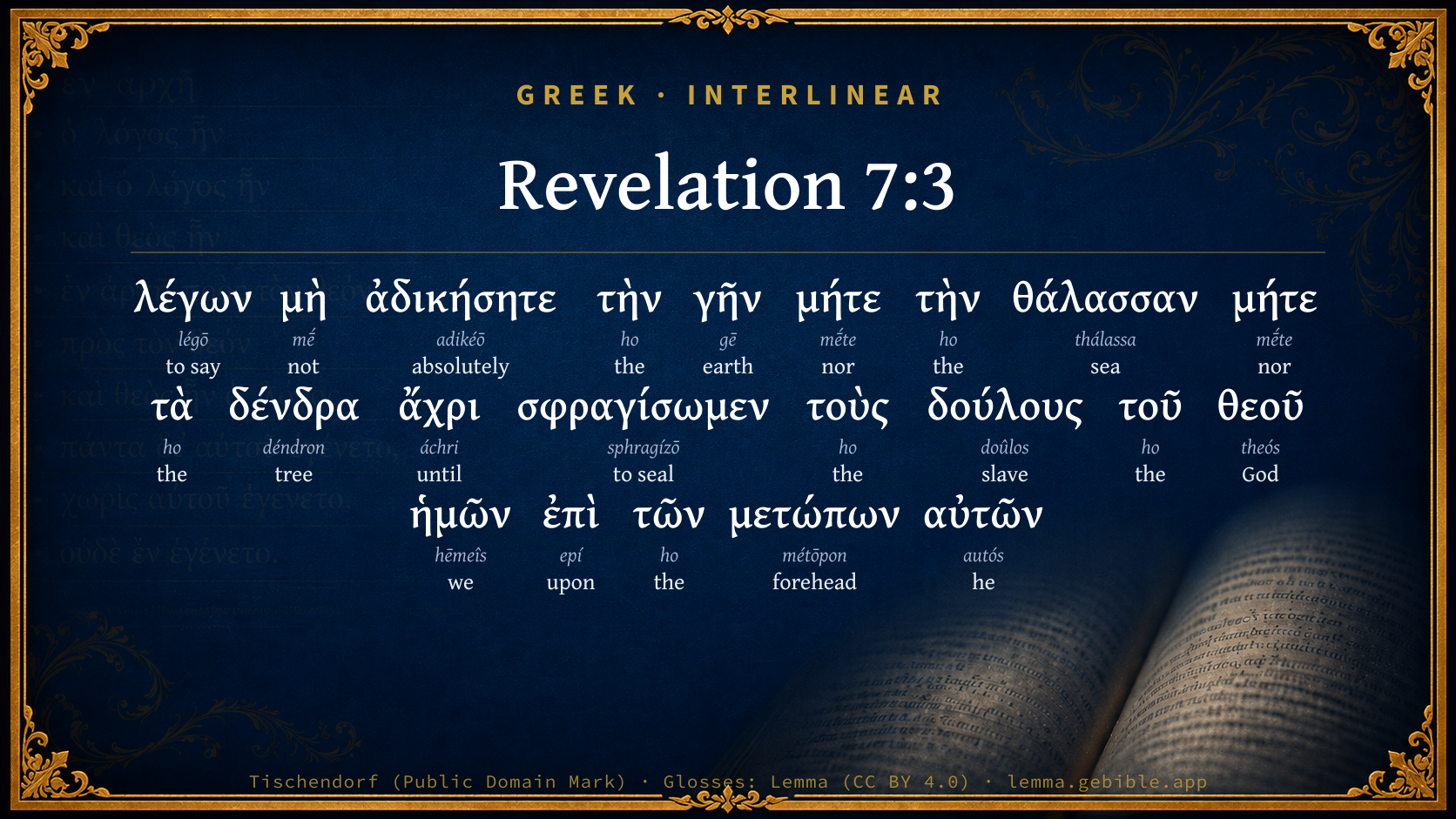
Greek (Tischendorf 8th ed.) Revelation 7:3 appears in the Greek New Testament. The text above is from the Tischendorf 8th edition. Each word links to its Strong’s number and a concise gloss. Click any word for its full Thayer’s Greek Lexicon entry.
Download image
Cite this verse

Revelation 7:3 (World English Bible). Public Domain. Lemma interlinear Bible study tool, https://lemma.gebible.app/v/revelation/7/3.

Show BibTeX & RIS
BibTeX
RIS
English Translation
saying, "Don't harm the earth, neither the sea, nor the trees, until we have sealed the bondservants of our God on their foreheads!"
World English Bible · Public Domain
Highlights
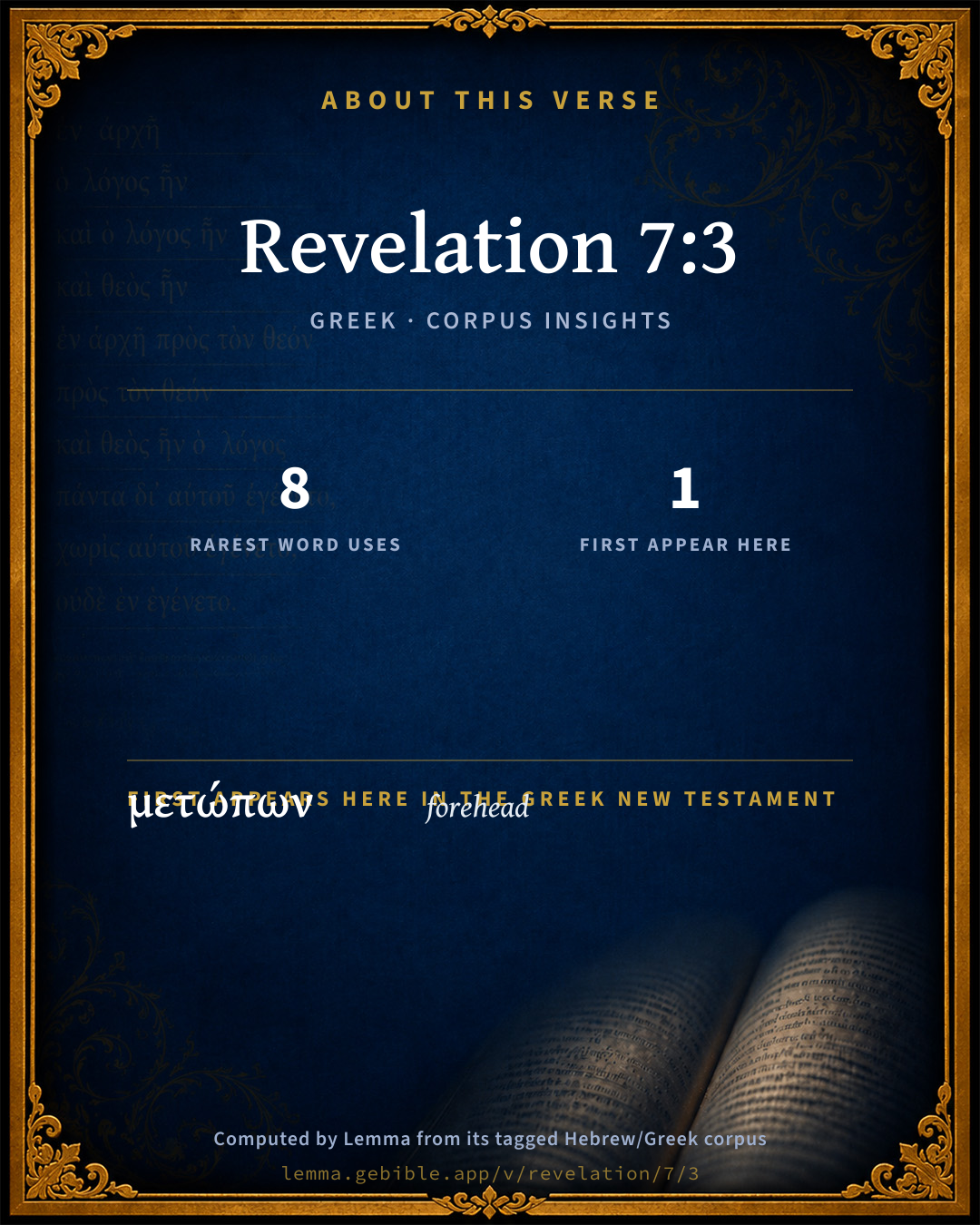
  • 1 first appearance in the Greek New Testament
Full analysis ↓
Download a study sheet

One document with this verse’s original text, its word-by-word gloss line, the meaning frame, cross-references with their text, attributed commentary, and full source and license credits — printable, and it pastes into notes with its structure intact.

This verse Autodidact and up

Study sheet (.html) Plain text (.txt)

A passage Seminary Student

Up to 50 verses in one chapter. A passage sheet keeps up to 6 commentary sources and 12 cross-references per verse, in the order this page ranks them, and says so on the sheet whenever that leaves anything out. Ask for a single verse and you get the Autodidact verse sheet above.

Everything on this page stays free to read, with no account — the sheet is a download of what is already on screen, not access to it.

Want to remove ads? Support Godless Engineer
Compare translations 3

The same verse in 3 English versions, stacked beneath the original-language interlinear above. Click any original word for its lexicon entry.

Each is an independent rendering of the whole verse — the interlinear is not word-aligned to these translations.

Highlighted words mark where these versions differ — a whole-verse word diff, not a word-by-word alignment.

  • World English Bible Public Domain
    saying, "Don't harm the earth, neither the sea, nor the trees, until we have sealed the bondservants of our God on their foreheads!"
  • King James Version Public Domain
    Saying, Hurt not the earth, neither the sea, nor the trees, till we have sealed the servants of our God in their foreheads.
  • unfoldingWord Literal Text CC BY-SA 4.0
    saying, “Do not harm the earth or the sea or the trees until we might seal the servants of our God on their foreheads.”

unfoldingWord Literal Text — © unfoldingWord, licensed CC BY-SA 4.0. Word-aligned USFM3 via Door43 (git.door43.org/unfoldingWord/en_ult).

Versions to compare (up to 4)

3 of 4 selected

Show all 19 translations

Every available English version of this verse, each an independent rendering of the whole verse.

  • World English Bible Public Domain
    saying, "Don't harm the earth, neither the sea, nor the trees, until we have sealed the bondservants of our God on their foreheads!"
  • Berean Standard Bible Public Domain
    “Do not harm the land or sea or trees until we have sealed the foreheads of the servants of our God.”
  • Majority Standard Bible Public Domain
    “Do not harm the land or sea or trees until we have placed a seal on the foreheads of the servants of our God.”
  • King James Version Public Domain
    Saying, Hurt not the earth, neither the sea, nor the trees, till we have sealed the servants of our God in their foreheads.
  • American Standard Version (1901) Public Domain
    saying, Hurt not the earth, neither the sea, nor the trees, till we shall have sealed the servants of our God on their foreheads.
  • Revised Version (1885) Public Domain
    saying, Hurt not the earth, neither the sea, nor the trees, till we shall have sealed the servants of our God on their foreheads.
  • Geneva Bible (1599) Public Domain
    Hurt ye not the earth, neither the sea, neither the trees, til we haue sealed the seruants of our God in their foreheads.
  • Douay-Rheims (1899) Public Domain
    Saying: Hurt not the earth, nor the sea, nor the trees, till we sign the servants of our God in their foreheads.
  • Young's Literal Translation Public Domain
    `Do not injure the land, nor the sea, nor the trees, till we may seal the servants of our God upon their foreheads.'
  • Literal Standard Version CC BY-SA 4.0
    “Do not injure the land, nor the sea, nor the trees, until we may seal the servants of our God on their foreheads.”
  • Unlocked Literal Bible CC BY-SA 4.0
    “Do not harm the earth, the sea, or the trees until we have put a seal on the foreheads of the servants of our God.”
  • unfoldingWord Literal Text CC BY-SA 4.0
    saying, “Do not harm the earth or the sea or the trees until we might seal the servants of our God on their foreheads.”
  • Darby Bible Public Domain
    saying, Hurt not the earth, nor the sea, nor the trees, until we shall have sealed the bondmen of our God upon their foreheads.
  • World Messianic Bible Public Domain
    saying, “Don’t harm the earth, the sea, or the trees, until we have sealed the bondservants of our God on their foreheads!”
  • Webster's Bible Public Domain
    Saying, Hurt not the earth, neither the sea, nor the trees, till we have sealed the servants of our God in their foreheads.
  • Free Bible Version CC BY-SA 4.0
    “Don't hurt the earth or the sea or the trees until we have placed a seal on the foreheads of God's true followers!”
  • Bible in Basic English Public Domain
    Do no damage to the earth, or the sea, or the trees, till we have put a mark on the servants of our God.
  • Text-Critical English NT CC BY 4.0
    “Do not harm the earth, the sea, or the trees until we have put a seal on the foreheads of the servants of our God.”
  • Tyndale New Testament (1534) Public Domain
    saying: Hurt not the erth nether the see nether the trees tyll we have sealed the servauntes of oure god in their forheddes.

Literal Standard Version (2020), Covenant Press — licensed CC BY-SA 4.0. Text via the HelloAO Bible API (eBible.org). Unlocked Literal Bible (unfoldingWord) — licensed CC BY-SA 4.0. Text via the HelloAO Bible API (eBible.org). unfoldingWord Literal Text — © unfoldingWord, licensed CC BY-SA 4.0. Word-aligned USFM3 via Door43 (git.door43.org/unfoldingWord/en_ult). Free Bible Version, Dr. Jonathan Gallagher — licensed CC BY-SA 4.0. Text via the HelloAO Bible API (eBible.org).

Word by word

More ways to search: Search by grammar → Find every occurrence → Compare this word →

Practice this passage: Drill this verse → Learn its vocabulary →

μετώπων
métōpon
G3359
“forehead”
Noun, Genitive, Plural, Neuter
Part of Speech
Noun
Case
Genitive
Number
Plural
Gender
Neuter
Full Thayer's Definition

Origin: from G3326 and ops (the face)

TDNT: 14:35,6

1. the space between the eyes, the forehead
  1. λέγων légō G3004 “to say” Verb, Present, Active, Participle, Nominative, Singular, Masculine
  2. μὴ mḗ G3361 “not” Particle, Negative
  3. ἀδικήσητε adikéō G91 “absolutely” Verb, Aorist, Active, Subjunctive, 2nd person, Plural
  4. τὴν ho G3588 “the” Article, Accusative, Singular, Feminine
  5. γῆν gē G1093 “earth” Noun, Accusative, Singular, Feminine
  6. μήτε mḗte G3383 “nor” Conjunction, Negative
  7. τὴν ho G3588 “the” Article, Accusative, Singular, Feminine
  8. θάλασσαν thálassa G2281 “sea” Noun, Accusative, Singular, Feminine
  9. μήτε mḗte G3383 “nor” Conjunction, Negative
  10. τὰ ho G3588 “the” Article, Accusative, Plural, Neuter
  11. δένδρα déndron G1186 “tree” Noun, Accusative, Plural, Neuter
  12. ἄχρι áchri G891 “until” Adverb
  13. σφραγίσωμεν sphragízō G4972 “to seal” Verb, Aorist, Active, Subjunctive, 1st person, Plural
  14. τοὺς ho G3588 “the” Article, Accusative, Plural, Masculine
  15. δούλους doûlos G1401 “slave” Noun, Accusative, Plural, Masculine
  16. τοῦ ho G3588 “the” Article, Genitive, Singular, Masculine
  17. θεοῦ theós G2316 “God” Noun, Genitive, Singular, Masculine
  18. ἡμῶν hēmeîs G2249 “we” Personal pronoun, 1st person, Genitive, Plural
  19. ἐπὶ epí G1909 “upon” Preposition
  20. τῶν ho G3588 “the” Article, Genitive, Plural, Neuter
  21. αὐτῶν autós G846 “he” Personal pronoun, Genitive, Plural, Masculine

About this verse

These counts appear in no published source. They are computed here, from the morphology-tagged text and Lemma’s own curated glosses. What Lemma adds →

22
words
16
distinct lemmas
Revelation
section

Notable vocabulary

The rarest word here is μετώπων forehead G3359 — appearing just 8 times in the whole Greek New Testament.

First appearance in Scripture

This word makes its first canonical appearance in the Greek New Testament here:

  • μετώπων forehead G3359

Shared distinctive vocabulary

μετώπων forehead G3359 occurs in 8 verses of the Greek New Testament. Also found in:
Repetition

Words recur within this verse:

Cross-references

25

Topical passages linked to Revelation 7:3 in the Treasury of Scripture Knowledge — connected by theme and wording, ordered by reader-vote popularity; previews shown in the World English Bible.

  • Ezekiel 9:4 Yahweh said to him, Go through the midst of the city, through the midst of Jerusalem, and set a mark on the foreheads of the men that sigh and that cry over all the abominations that are done in the midst of it.
  • Revelation 22:4 They will see his face, and his name will be on their foreheads.
  • Revelation 9:4 They were told that they should not hurt the grass of the earth, neither any green thing, neither any tree, but only those people who don't have God's seal on their foreheads.
  • Revelation 13:16 He causes all, the small and the great, the rich and the poor, and the free and the slave, to be given marks on their right hands, or on their foreheads;
  • Exodus 12:13 The blood shall be to you for a token on the houses where you are: and when I see the blood, I will pass over you, and there shall no plague be on you to destroy you, when I strike the land of Egypt.
  • Revelation 14:1 I saw, and behold, the Lamb standing on Mount Zion, and with him a number, one hundred forty-four thousand, having his name, and the name of his Father, written on their foreheads.
  • Revelation 20:4 I saw thrones, and they sat on them, and judgment was given to them. I saw the souls of those who had been beheaded for the testimony of Jesus, and for the word of God, and such as didn't worship the beast nor his image, and didn't receive the mark on their forehead and on their hand. They lived, and reigned with Christ for the thousand years.
  • Isaiah 26:20–21 Come, my people, enter you into your chambers, and shut your doors about you: hide yourself for a little moment, until the indignation be past.
  • Isaiah 54:17 No weapon that is formed against you shall prosper; and every tongue that shall rise against you in judgment you shall condemn. This is the heritage of the servants of Yahweh, and their righteousness which is of me, says Yahweh.
  • Exodus 12:23 For Yahweh will pass through to strike the Egyptians; and when he sees the blood on the lintel, and on the two side-posts, Yahweh will pass over the door, and will not allow the destroyer to come in to your houses to strike you.
  • Malachi 3:18 Then you shall return and discern between the righteous and the wicked, between him who serves God and him who doesn't serve him.
  • Revelation 6:6 I heard a voice in the midst of the four living creatures saying, "A choenix of wheat for a denarius, and three choenix of barley for a denarius! Don't damage the oil and the wine!"
  • Revelation 19:2 for true and righteous are his judgments. For he has judged the great prostitute, who corrupted the earth with her sexual immorality, and he has avenged the blood of his servants at her hand."
  • Exodus 9:4–6 Yahweh will make a distinction between the cattle of Israel and the cattle of Egypt; and there shall nothing die of all that belongs to the children of Israel."'"
  • Isaiah 6:13 If there are yet a tenth in it, It also shall in turn be eaten up: As a terebinth, and as an oak, whose stock remains, when they are felled; So the holy seed is its stock."
  • Isaiah 27:8 In measure, when you send them away, you do contend with them; he has removed [them] with his rough blast in the day of the east wind.
  • Isaiah 65:8 Thus says Yahweh, As the new wine is found in the cluster, and one says, Don't destroy it, for a blessing is in it: so will I do for my servants' sake, that I may not destroy them all.
  • Zephaniah 2:3 Seek Yahweh, all you humble of the land, who have kept his ordinances. Seek righteousness. Seek humility. It may be that you will be hidden in the day of Yahweh's anger.
  • Matthew 24:22 Unless those days had been shortened, no flesh would have been saved. But for the sake of the chosen ones, those days will be shortened.
  • John 12:26 If anyone serves me, let him follow me. Where I am, there will my servant also be. If anyone serves me, the Father will honor him.
  • Daniel 3:17 If it be [so], our God whom we serve is able to deliver us from the burning fiery furnace; and he will deliver us out of your hand, O king.
  • Daniel 3:26 Then Nebuchadnezzar came near to the mouth of the burning fiery furnace: he spoke and said, Shadrach, Meshach, and Abednego, you servants of the Most High God, come forth, and come here. Then Shadrach, Meshach, and Abednego came forth out of the midst of the fire.
  • Daniel 6:16 Then the king commanded, and they brought Daniel, and cast him into the den of lions. [Now] the king spoke and said to Daniel, Your God whom you serve continually, he will deliver you.
  • Matthew 24:31 He will send out his angels with a great sound of a trumpet, and they will gather together his chosen ones from the four winds, from one end of the sky to the other.
  • Romans 6:22 But now, being made free from sin, and having become servants of God, you have your fruit of sanctification, and the result of eternal life.

Cross-references courtesy of OpenBible.info (CC BY 4.0).

Commentary

Notes on Revelation 7:3 from classic Christian and Jewish commentators (each source and its license shown beneath its notes). The classic Christian expositions comment on the surrounding passage and are grouped to its opening verse, so a note may address several verses; the Jewish commentaries on the Tanakh (Rashi and others) are per-verse, so they appear only where the commentator wrote on this verse.

Lemma curates 59 commentaries, every one of them public domain or Creative Commons licensed, each selected and text-cleaned for this edition rather than reprinted as found. About our sources →

Bengel's Gnomon

Johann Albrecht Bengel

Rev 7:3. [81] ΣΦΡΑΓΊΣΩΜΕΝ, we may seal) By this sealing, the servants of God out of the tribes of Israel are preserved, all along from the time of John, against the calamities which threaten under the seven trumpets. Before this there had been no need of sealing, before the danger. The ancestors are sealed at one time, and their posterity at another. If the ancestors were slain, there would be no posterity. Under the trumpet of the fifth angel, not even are those slain who are not sealed; much less, therefore, are they slain who are sealed.

[81] ἀπὸ ἀνατολῆς ἡλίου, from the rising of the sun) It was from the east, therefore, that the plagues began.—V. g.—τὴν γῆν καὶ τὴν θάλασσαν, the earth and the sea) Here the trees are also mentioned. The earth is Asia; the sea Europe; the rivers (ch. Rev 8:10) and the trees, Africa,—V. g.

Bengel's Gnomon of the New Testament — English translation (T&T Clark, Edinburgh, 1860) — public domain. Text from a community e-Sword module.

Jamieson, Fausset & Brown

Robert Jamieson, A. R. Fausset & David Brown

Hurt not--by letting loose the destructive winds.

till we have sealed the servants of our God--parallel to Mat 24:31, "His angels . . . shall gather together His elect from the four winds." God's love is such, that He cannot do anything in the way of judgment, till His people are secured from hurt (Gen 19:22). Israel, at the eve of the Lord's coming, shall be found re-embodied as a nation; for its tribes are distinctly specified (Joseph, however, being substituted for Dan; whether because Antichrist is to come from Dan, or because Dan is to be Antichrist's especial tool [ARETAS, tenth century], compare Gen 49:17; Jer 8:16; Amo 8:14; just as there was a Judas among the Twelve). Out of these tribes a believing remnant will be preserved from the judgments which shall destroy all the Antichristian confederacy (Rev 6:12-17), and shall be transfigured with the elect Church of all nations, namely, 144,000 (or whatever number is meant by this symbolical number), who shall faithfully resist the seductions of Antichrist, while the rest of the nation, restored to Palestine in unbelief, are his dupes, and at last his victims. Previously to the Lord's judgments on Antichrist and his hosts, these latter shall destroy two-thirds of the nation, one-third escaping, and, by the Spirit's operation through affliction, turning to the Lord, which remnant shall form the nucleus on earth of the Israelite nation that is from this time to stand at the head of the millennial nations of the world. Israel's spiritual resurrection shall be "as life from the dead" to all the nations. As now a regeneration goes on here and there of individuals, so there shall then be a regeneration of nations universally, and this in connection with Christ's coming. Mat 24:34; "this generation (the Jewish nation) shall not pass till all these things be fulfilled," which implies that Israel can no more pass away before Christ's advent, than Christ's own words can pass away (the same Greek), Mat 24:35. So exactly Zac 13:8-9; Zac 14:2-4, Zac 14:9-21; compare Zac 12:2-14; Zac 13:1-2. So also Eze 8:17-18; Eze 9:1-7, especially Eze 9:4. Compare also Eze 10:2 with Rev 8:5, where the final judgments actually fall on the earth, with the same accompaniment, the fire of the altar cast into the earth, including the fire scattered over the city. So again, Rev 14:1, the same 144,000 appear on Zion with the Father's name in their forehead, at the close of the section, the twelfth through fourteenth chapters, concerning the Church and her foes. Not that the saints are exempt from trial: Rev 7:14 proves the contrary; but their trials are distinct from the destroying judgments that fall on the world; from these they are exempted, as Israel was from the plagues of Egypt, especially from the last, the Israelite doors having the protecting seal of the blood-mark.

foreheads--the most conspicuous and noblest part of man's body; on which the helmet, "the hope of salvation," is worn.

Jamieson, Fausset & Brown — Commentary Critical and Explanatory on the Whole Bible (1871) — public domain (CC PDM 1.0). Text via the HelloAO Bible API.

Adam Clarke's Commentary

Verse 3. Till we have sealed the servants of our God] There is manifestly an allusion to Eze 9:4 here. By sealing we are to understand consecrating the persons in a more especial manner to God, and showing, by this mark of God upon them, that they were under his more immediate protection, and that nothing should hurt them. It was a custom in the east, and indeed in the west too, to stamp with a hot iron the name of the owner upon the forehead or shoulder of his slave.

It is worthy of remark that not one Christian perished in the siege of Jerusalem; all had left the city, and escaped to Pella. This I have often had occasion to notice.

Adam Clarke's Commentary on the Bible (1810–1826) — public domain. Text from a community e-Sword/MySword module.

The Cambridge Bible for Schools and Colleges

gen. ed. J. J. S. Perowne

3. till we have sealed] The object of the sealing is twofold. (1) to mark them as God’s own, beyond the risk of loss; we may almost certainly infer, from this chapter compared with Rev_14:1, that the inscription of the seal is the Name of God and of the Lamb; and (2) to mark them as to be saved from the judgements that the other angels are to execute upon the world. Hence we are to compare this sealing, on the one hand with the mark (a less careful and indelible one than here—a cross marked with ink, not a name stamped with a seal) set on the protesting remnant in Eze_9:4; Eze_9:6 (R. V.): on the other hand, with 2Ti_2:19; Eph_1:13; Eph_4:30. It is scarcely likely indeed that St John refers consciously to these passages in St Paul, but it is likely that the image of the seal was the common property of the Apostolic Church, perhaps that the name was already applied, as in later times, to the rite which we call confirmation.

The Cambridge Bible for Schools and Colleges (gen. ed. J. J. S. Perowne; Cambridge University Press, 1878–1918) — public domain. Text from a community e-Sword module.

John Gill's Exposition

Saying, hurt not the earth, neither the sea, nor the trees,.... That is, as yet, for their commission was not contradicted, nor taken away by Christ; and at the time appointed, at the blowing of the several trumpets, they let loose the winds, and let in the Goths, Hans, and Vandals, the Saracens and Turks into the empire, and after that poured out the vials of God's wrath upon the Romish antichrist: this retarding of them was but in appearance, that there might be an opportunity to show to John what care would be taken all along of the church of Christ, and true servants of the living God:

till we have sealed the servants of our God in their foreheads; the servants of sin, Satan, and the beast of Rome, were took no notice nor care of; they were the persons to be hurt by the winds, signified by the earth, sea, and trees, even idolaters, small and great; but "the servants of our God", who serve him with grace in their hearts, from a principle of love, in the exercise of faith, without servile fear, and with reverence and godly fear, in righteousness and true holiness, and with a view to his glory; and are worshippers of him in spirit and in truth, being followers of the Lamb, whithersoever he goes; and so are the servants of his God, and their God; the sealing of them does not design the sealing of them with the seal of election, this was done in eternity; nor with the seal of the Spirit, which is common to all the saints in all ages; but it denotes the hiding and concealing, and so securing the saints amidst all the calamities of the empire, and throughout the whole time of the Romish apostasy, from first to last; and respects the time when the church fled into the wilderness, and was hid, and nourished with the hidden manna, for a time, and times, and half a time, Rev 12:14. Christ set a mark upon them, as was upon the houses of the Israelites, when the destroying angel passed through Egypt, and destroyed the firstborn in it; and as was upon the foreheads of those that sighed and cried in Jerusalem, when orders were given to slay young and old, Exo 12:23. Christ will have a people in the worst of times; he knows who are his, and he will take care of them; he has his chambers of protection to hide them in, till the indignation is over past: the sealers, "we", are either Father, Son, and Spirit, who are all jointly concerned for the welfare of the eject; or Christ and his ministering angels that attend him, whom he employs for the good and safety of the heirs of salvation: the seal with which these are sealed is the seal of the living God, the foreknowledge, love, care, and power of God; and the name of God, even Christ's Father's name, and their Father's name, in their foreheads; the new name of children of God, by and under which they are known and preserved by him: and this is said to be "in their foreheads", in allusion to servants, who used to be marked in their foreheads; hence they are called by Apuleius (c) "frontes literati"; and by Martial, a servant is called "fronte notatus" (d): but then these were such who had committed faults, and this was done by way of punishment (e); wherefore it can hardly be thought that the servants of God should be sealed, in allusion to them: but rather with reference to the mitre on the high priest's forehead, as some think; or it may be to Eze 9:4, and shows, that though these persons were hid and concealed from men, they were well known to God and Christ; nor were they ashamed to make a public and open confession of Christ before men, as did the true and faithful witnesses of Christ, the Waldenses and Albigenses, in the midst of the greatest darkness of Popery, and of danger from men; and who seem to be chiefly intended.

(c) Metamorph. l. 9. p. 130. (d) Epigr. l. 3. Ep. 20. (e) Vid. Popma de Operis Servorum, p. 170, &c.

John Gill's Exposition of the Whole Bible (1746–1763) — public domain (CC PDM 1.0). Text via the HelloAO Bible API.

Trapp's Complete Commentary

John Trapp

3 Saying, Hurt not the earth, neither the sea, nor the trees, till we have sealed the servants of our God in their foreheads.

Ver. 3. Hurt not] Reprobates often fare the better for those few righteous that are among them; they are therefore singularly foolish for seeking to rid them, and root them out, as the heathen emperors did. These resemble the stag in the emblem, that fed upon the leaves which hid him from the hunter and Samson-like, by pulling down the pillars, they bring the house upon their own heads.

In their foreheads] Not in their hands only, as the vassals of Antichrist, {Rev 13:16} who have free liberty to dissemble, deny their religion, do anything, so the Catholic cause be thereby advanced. My son, give me thy heart, said Gregory XIII to our English Papists, let who will have thy tongue and outward man.

John Trapp, A Commentary or Exposition upon All the Books of the Old and New Testament (1647–1656) — public domain. Text from a community e-Sword module.

Albert Barnes' Notes on the Bible

Saying, Hurt not the earth, neither the sea ... - Let the winds be restrained until what is here designated shall be done. These destroying angels were commanded to suspend the work of destruction until the servants of God could be rendered secure. The division here, as in Rev 7:1, of the “earth, the sea, and the trees,” seems to include everything - water, land, and the productions of the earth. Nothing was to be injured until the angel should designate the true servants of God.

Till we have sealed the servants of our God - The use of the plural “we” seems to denote that he did not expect to do it alone. Who were to be associated with him, whether angels or human beings, he does not intimate; but the work was evidently such that it demanded the agency of more than one.

In their foreheads - See the notes on Rev 7:2; compare Eze 9:4-5. A mark thus placed on the forehead would be conspicuous, and would be something which could at once be recognized if destruction should spread over the world. The fulfillment of this is to be found in two things:

(a)In something which would be conspicuous or prominent - so that it could be seen; and,

(b)In the mark being of such a nature or character that it would be a proper designation of the fact that they were the true servants of God.

Albert Barnes' Notes on the Bible (1834–1885) — public domain. Text from a community e-Sword/MySword module.

Haydock's Catholic Bible Commentary

Hurt not the earth, &c. Some understand Christ himself, who gives his commands in this manner to the Angels; others, an Angel of a higher rank or order. --- Till we seal the servants of our God in their foreheads, which may be expounded, let not persecutions and trials come upon them till they are strengthened by the spirit and grace of God, with which St. Paul sometimes says the servants of God are signed and sealed. See 2 Corinthians i. 22.; Ephesians i. 13. He alludes to the passages of Ezechiel (Chap. ix. 4.) where God bids and angel mark with the letter Tau the foreheads of those who should not be hurt by the judgments that were to fall upon Jerusalem; so God would protect the faithful Christians, who believe and put their trust in Christ crucified, and who from the first ages [centuries], in testimony of this faith, used to sign themselves by making the sign of the cross on their foreheads, of which the letter Tau was a figure or resemblance. See Tertullian, de lib. Corona militis. I beg the readers patience, if I here set down what I find in the great Synopsis Papismi, in folio, put out by Mr. Andrew Willet, and dedicated first to queen Elizabeth, and afterwards to king James the first. Among his demonstrations, as he calls them, that the pope is the antichrist, (Controv. iv. q. 10. p. 232 and 233) he tells us in plain terms, "that the sign of the cross is one of the visible signs of antichrist. And who," saith he, "hath taught the papists that the sign of the cross is to be borne or made on men’s foreheads? And that with crossing the forehead we are preserved from dangers? The superstitious marks of the cross had their beginning from the beast’s name, since the number of the beast’s name in the Revelation of St. John is by these Greek letters, Greek: chxs. The first letter, Greek: ch, is a cross; the middle letter, Greek: x, (in Latin, X) is also a side long cross; and the last letter, Greek: s, contains both Greek: s and Greek: t of which the latter is called a headless cross;" and then Mr. Willet concludes in these words, "And thus it plainly appears, that the marks whereby the papists say they honour Christ, are rather a dishonour to him, and are in very deed the cognizance of antichrist." Such an ingenious, and at the same time learned fancy, may perhaps outvie even those we have cited out of Mr. Brightman [in the annotations on Chap. iii. 14-22.], and may be equally serviceable to any country parson on the fifth of November, or on any day when he shall think fit to hold forth against the pope or popery. I suppose that Mr. Willet did not know that the Christians in the first ages [centuries] (as all Catholics to this day) made so frequent use of the sign of the cross, as it is witnessed by Tertullian above two hundred years before even any Protestant pretended that the popes began to be antichrists, or the great antichrist. And this, says he, they do by a tradition from father to son. At every setting forward or going about any thing, at coming home or going out, at putting on our clothes, at going to bathe, to table, to light a candle, to bed, to sit down, to any thing, we make the sign of the cross on our foreheads. And this is a tradition. The like is witnessed by St. John Chrysostom, St. Cyril of Jerusalem, and many of the Fathers. At the same time that with our hand we make the sign of the cross, we say these words, "in the name of the Father, and of the Son, and of the Holy Ghost;" the words used when any one is made a Christian, according to the command of Christ. So that the action itself puts us in mind that Jesus Christ died for us on the cross; and by the words, we make a profession of our Christian faith, that we believe in one God and three Persons. Can we do this too often? Dare we be ashamed of doing it? Was ever any thing more ridiculous than to call this in very deed the cognizance of antichrist? What must Mr. Willet have thought of the Protestants, or what can they think of him, and such like folio scribbers, to prove the popes the beast of St. John’s Revelation? What must, I say, Mr. Willet think of the public liturgy, or the book of common prayer, approved and used by the Church of England in his time, and which ordains that the sign of the cross shall be made by the priest on the forehead of every one that is baptized? This, according to Mr. Willet, is (when any one is made a Christian) to give him the badge, and visible sign of antichrist, to the dishonour of Christ, and what in very deed is the cognizance of antichrist. (Witham)

George Leo Haydock (1774–1849), Haydock's Catholic Family Bible and Commentary, 1859 edition — public domain. Excludes Psalms (Douay-Rheims chapter numbering differs from Protestant) and Deuterocanonical books (Catholic canon only).

Matthew Poole's English Annotations

A manifest allusion to Eze 9:4, and, as some think, to the usage of some eastern countries, for masters to set their names upon the forehead of their slaves, by which they were known to be theirs, as we mark our sheep or other beasts. Men as vainly dispute what this seal should be, as what the ת meant in Eze 9:1-11, the mark set upon those that mourned for the abominations of Jerusalem. The place where they were to be sealed signified the end of their sealing to be not so much for confirmation, for which seals are used, as notification, to signify to others they belong to God; so as it was of the same use as the blood upon the two side-posts and the upper door-posts of the Israelites in Egypt, Exo 12:13.

Matthew Poole's English Annotations on the Holy Bible (1683–1685) — public domain. Text from a community e-Sword/MySword module.

The Pulpit Commentary

Saying, Hurt not the earth, neither the sea, nor the trees. Hurt not, by loosing the four winds, as stated on ver. 2. The destruction prepared for the guilty world is not allowed to fall until God"s elect have been gathered in, and preserved free from danger. (cf. Mat_24:31, where immediately after the appearance of the Son of man, his elect are gathered from the four winds) (For the signification of the earth, the sea, and the trees, see on vers. 1 and 2) Till we have sealed the servants of our God in their foreheads. The angel associates himself with the first four, as being on an equality with them in this work, although he alone is stated to possess the seal (ver. 2). Of the nature of the sealing nothing more is indicated. The forehead is naturally mentioned as being the most conspicuous part of man, as well as that which we are accustomed to regard as the noblest and most vital part. The idea may be compared with that in Eze_9:4, Eze_9:6. It is remarkable, too, that the word in Ezekiel rendered "mark" is the name of the Hebrew letter tau, of which the ancient form was a cross (cf. the sign of the cross in baptism; also Rev_3:12, "I will write upon him the Name of my God... and my new Name;" Rev_14:1, "Having his Father s Name written in their foreheads"). "The servants of our God," says Bengel, is a title which especially belongs to holy men in Israel. (cf. Gen_1:17 Deu_32:36 Isa_61:6) Those who hold the preterist view believe that the Christians who escaped the destruction of Jerusalem are indicated by this expression. The sealed are probably these referred to by our Lord in Mat_24:22, Mat_24:24, Mat_24:31, as "the elect.

The wrath-restraining power of righteousness.

"Hurt not the.., till we have sealed," etc. These words send back our thoughts to like words addressed to Lot at Sodom, by the angel who was urging him to flee therefrom. "Haste thee," said he, "escape thither to Zoar; for I cannot do anything till thou be come thither". (Ge 19) Sodom"s ruin was suspended till Lot was safe. The wrath of God was ready to burst forth on the wicked cities of the plain, but it was restrained until the one righteous man in them was removed out of danger. "Until then," so the destroying angel said, "I cannot do anything." That incident is one out of many more, and our text tells of one of the chiefest of them, by which it is shown that goodness has greater power than wickedness. And this is a very instructive fact, and has parallels innumerable. God"s recognition of the wrath-restraining might of righteousness is clearly shown in the prayer which Abraham offered for those sinful cities. (Ge 18) Abraham believed in it to so great an extent that he pleaded that if there were fifty, or forty-five, or forty, or thirty, or twenty, or even ten righteous found in those cities, the Lord would spare them for their sake. And the Lord promised in each case, even were there only ten, that he would. And how often guilty Israel was spared the vengeance due to their sins for the sake of Moses who interceded for them! And the covenant made with their fathers how often that is given as the reason why God"s gracious dealing was continued to them! And once and again we read of forbearance and goodness shown to miserably guilty monarchs, such as Rehoboam, Manasseh, and others, because of the favour God bore towards David, their great and godly ancestor. In the prophecy of Ezekiel (Eze 9) there is given the vision of the man with the ink horn by his side, who, ere Jerusalem could be given over to vengeance, was commanded to set a mark on those who sighed and cried for the abominations done in her. That mark was as the blood of the Paschal lamb on the lintel and door-posts of the houses of Israel, which secured that household on whose dwelling it was found; and so, until this marking had taken place, the guilty Jerusalem could not be touched. And so here St. John sees an angel, having "the seal of the living God," who cries with a loud voice to the four angels to whom it was given to hurt the earth and the sea, saying, "Hurt not the earth, neither the sea, nor the trees, till we have sealed the servants of our God in their foreheads." Terrible judgments were about to break forth on the earth, but not until the servants of God were sealed could these judgments begin. A historic fact wonderfully corresponds to inspired vision. Before the actual blockade of Jerusalem by Titus, the Christians at Jerusalem, warned, as one ancient Father says, "by a certain oracle given to their leaders by revelation," or, as another says, "by an angel," took refuge across the Jordan, in the Peraean town of Pella. Thus from the horrors of that final siege, and from the fearful slaughter that went on in Jerusalem when at last the city was taken, these servants of God were delivered. And so also, we are told in Mt 24, that ere the last judgment of the world takes place, the elect shall be gathered together from the four winds, from one end of heaven to the other. They shall be taken to be with their Lord, where the vengeance coming on his foes cannot harm them. But what in all these instances we would chiefly note is, not so much the blessed security of the righteous themselves when the evil day comes on sinful men, as the restraining power their presence has on the coming of that evil day; how it delays it, holds it back, sometimes altogether turns it aside, or when it comes shortens it; as our Saviour said, "For the elects" sake those days shall be shortened." Verily his disciples are "the salt of the earth that preserving force which hinders the world from becoming one mass of corruption. Without such salt human life would become putrescent, and must at once be buried out of sight. Everywhere and always the tares are of the wheat amid which they have been planted by the enemy. Unskilful servants crave permission to go and pull them up forthwith, but are forbidden by the Lord, "lest," he says, "in pulling up the tares ye pull up the wheat also." Because of the "few names in Sardis" which had not defiled their garments, that Church which had nothing but the name of a living Church was nevertheless spared; had she been altogether dead, she would not have been. It is everywhere true that, like as it is with the body, whilst the principle of life lingers, the process of corruption cannot do anything against it; but when life departs, then soon it returns "dust to dust, ashes to ashes," and our loveliest and dearest ones have to be buried out of our sight. So, too, is it in the moral relations of man to God. Where there is some good thing in man towards God, this spiritual life, faint though it be, acts as a mighty conservative force in the individual and in society at large. It is this which keeps earth from being as hell. Sometimes, in some places and in some respects, we almost feel that it is like hell, for life then and there seems so horrible; but more commonly there are scattered amongst society those persons, principles, and habits which still make life worth living, which are its preserving salt, which stay moral corruption, and hold back the Divine judgments against man"s evil, and give hope of there being one day a realm in which "the people shall be all righteous," a new heaven and a new earth, wherein dwelleth righteousness. And what is true in the broader aspects of human life is true also in individual and in more limited senses. Have we not read of that beloved queen who interceded for the doomed citizens of Calais, and won from her stern husband the pardon which, but for the love he bore her, would never have been granted? Have we not known, also, instances do we not perpetually see them? in which former good conduct, righteous deeds done in days gone by, have tempered the severity with which otherwise failures in present conduct would be visited? How we grieve when some soldier hero has deserved punishment! how we all feel that his past heroism should tell, as it does tell, in mitigation of his sentence! And have we not known many an instance in which, for the sake of some beloved and honoured one, whose name is ever dear to us, we show kindness to those they loved, though such may be utterly unworthy of kindness, and, but for the name they bear or the relationship in which they stand to those so dear to us, they would have been dealt with in far other way? These are but common instances in common life of that great law which underlies Scripture facts, such as that told of in our text. But the supreme example of all others of the wrath-restraining power of righteousness is seen in the effects of our Saviour"s work, which we every one are advantaged by. Death was threatened against our first parents if they ate of the forbidden fruit. But why did not that death, which had been so solemnly declared, and so fearfully apprehended and shrunk from by the guilty parents of our race why was not that death inflicted? In the day that the forbidden fruit was eaten, the eaters thereof did not die, but were spared. Why? The answer is the same as that which must be given if it be asked why we are spared, notwithstanding our sin and manifold ill desert. It is because Christ was and is the Propitiation for the sins of the whole world. Beneath the broad shelter of God"s love in him, man"s Mediator and Redeemer, we are sheltered, protected, saved. We are underneath the shadow of the Almighty; and so, likewise, were the first transgressors. Therefore their threatened doom was not executed. And still it is he who comes between us and the eternal consequences of our sins. The burden of their guilt, the terror of their condemnation, the sting of their remorse, the doom they merit, all these and yet other consequences of our sin are by Christ warded off from every believer. They can do nothing against us whilst Christ has place in our hearts. He is the great High Priest, with censer full of the fragrant incense of his all-availing intercessions, who stands between the living and the dead, and so the plague is stayed. He is our City of Refuge, within which the avenger of blood can do us no harm; the one Propitiation, by whom our transgressions are covered over and done away. Blessed forever be his Name! And if we askWhy is it that righteousness has this wrath-restraining power, which in so many instances, and in this supreme instance especially, we have seen it has? the answer will be that given in the well-known words, "The righteous Lord loveth righteousness." Yes; he loveth it, and hence wherever it is found he showeth favour towards it, and for the sake of it will do and forbear to do much. As David for Jonathan"s sake was willing to show kindness to any of the rival house of Saul, notwithstanding their disloyalty, so, for the sake of righteousness, all that belong to it, even though the relation be remote, are blessed because of it. It is dear to the heart of God; he has embodied it in his own nature; he has made it the foundation of his throne; it is the household law of his eternal home; he has written it upon the conscience of man; he has made obedience to it fruitful of reward, and disobedience of sorrow; in Christ he has manifested it to the world, and for the sake of it Christ was content to die. In every way conceivable God has shown his love for it, and hence we can understand wherefore it is that he invests it with such power that its presence in a community or family lays its hand even on his own hand, and restrains the vengeance that sin deserves. Yes; it is dear to the heart of God; "the righteous Lord loveth" it; only those who possess it stand in his presence or can be permitted to crone there. And he has endowed it with an overcoming power, so that not only shall light have no counsel with darkness, but wherever it comes it immediately gives the signal for the darkness to flee away. So does righteousness, wherever it is, begin to make war with sin, and ultimately the victory shall be seen to be altogether its own. Though often beaten back and down, buffeted and trampled upon, yet it rises again and renews the conflict, and will carry it on until the righteous cause is triumphant and the evil overthrown. No wonder, therefore, that the righteous Lord loveth it, and for its sake does so many, so wonderful, and so gracious things. But now let us askWhat is this all-important truth to teach us? Surely it should arouse in our minds some such questions as theseAm I in the Righteous One? We have seen how he is the supreme example of righteousness restraining wrath. Ah! what shelter have we, or can we have, when the storm of the Divine displeasure shall fall and beat upon us? Who then will be our refuge and strength, if Christ be not? "Behold, O God our Shield, and look on the face of thine anointed!" When we pray this prayer, who can we think of but the Lord Jesus Christ? He is our Shield, our Champion, our Defender. Are we, then, in him? "How shall we escape if we neglect so great salvation?" And are we like that Righteous One? If we be truly in him, we shall be in some measure like him; and if so, shall belong to that blessed company of whom Christ said, "Ye are the salt of the earth." What are we? Of those on whose account favour and grace are shown to a hind, and life is made peaceful and wholesome; or of those who help to swell that torrent of iniquity which not only degrades, but destroys? Oh, how we ought to value the presence of righteous men in our midst! They are the true safeguards of our national well being. It is upon the character of a people, more than on anything else, the general good depends. No favourable outward circumstances, no wise organization, no well-ordered political constitution, can long uphold any community if the character of its members be godless and depraved. Sore calamity must come upon them, as it ever has, ere long time elapse. Of what amazing folly and sin, then, are they guilty who persecute the godly; who do their bad best to detach them from the faith, and to make them deny their Lord? It is an undermining of the very foundations of the house in which we live; a destruction of that upon which our all depends. Oh, let us be afraid, even if we be not servants of Christ ourselves, to do anything which would injure them or lessen their influence and power. Remember God hath said, "He that toucheth you toucheth the apple of mine eye." But, by surrender of yourself to Christ, come amongst them; be of their number; help forward their cause. Times of judgment are coming; the great judgment of all draws nigh. But "who shall stand in that day?" The reply is not, "No one shall be able to stand," for some, many, shall. All shall who have on them the mark of God, the sealing of the servants of God that seal of the Holy Spirit "whereby we are sealed unto the day of redemption." Oh that that mark may be more and more manifest on us now! So shall our Lord be glorified; so shall our fellow men be blessed through us, whether they confess it or no; and so at last, when the consequences of ill doing have to be borne, and the harvest of sin is reaped, then shall judgment be restrained until we are gathered where harm can never come. S.C.

The Pulpit Commentary (1880–1919), ed. H.D.M. Spence-Jones & Joseph S. Exell — public domain. Text from a community e-Sword module.

John Wesley's Explanatory Notes

Hurt not the earth, till we - Other angels were joined in commission with him. Have sealed the servants of our God on their foreheads - Secured the servants of God of the twelve tribes from the impending calamities; whereby they shall be as clearly distinguished from the rest, as if they were visibly marked on their foreheads.

John Wesley, Explanatory Notes Upon the Whole Bible (1754–1765) — public domain. Text via the GEBible commentary corpus.

The People's New Testament

B. W. Johnson

3. Hurt not, etc. The four winds are forbidden to do their work of destruction until the sealing has been accomplished; or in other words, until the preaching of the gospel has wrought a certain result.

B. W. Johnson's The People's New Testament with Notes (1889–1891) — public domain. Electronic text from the Christian Classics Ethereal Library (CCEL) ThML edition.

Cambridge Greek Testament for Schools and Colleges

3. ἄχρι σφραγίσωμεν. The object of the sealing is twofold: (1) to mark them as God’s own, beyond the risk of loss; we may almost certainly infer, from this chapter compared with Rev 14:1, that the inscription of the seal is the Name of God and of the Lamb; and (2) to mark them as to be saved from the judgements that the other angels are to execute upon the world. Hence we are to compare this sealing, on the one hand with the mark (a less careful and indelible one than here—a cross marked with ink, not a name stamped with a seal) set on the protesting remnant in Eze 9:4; Eze 9:6 (R. V[280]): on the other hand, with 2Ti 2:19; Eph 1:13; Eph 4:30. It is scarcely likely indeed that St John refers consciously to these passages in St Paul, but it is likely that the image of the seal was the common property of the Apostolic Church; ἡ σφραγὶς was certainly an early name for Baptism, e.g. Hermas Sim. ix. 16 ἡ σφραγὶς οὖν τὸ ὕδωρ ἐστίν, and passim; later it was applied especially to that part of the rite, which, when detached from Baptism, was known in the West as Confirmation.

[280] Revised Version.

Cambridge Greek Testament for Schools and Colleges (Cambridge University Press, 1896; 21 vols, various authors incl. Carr, Maclear, Plummer, Farrar, Lumby, Moule, M. R. James, Simcox) — public domain. Text from a community e-Sword module.

Vincent's Word Studies in the New Testament

Marvin R. Vincent

In their foreheads. Compare Exo 28:3; 6 - 38; Eze 9:4.

Marvin R. Vincent, Word Studies in the New Testament (1887–1900) — public domain. Text from a community e-Sword/MySword module.

Lesson kit

Teaching starters — assembled from the data on this page, not authored interpretation. Every prompt links to the verse data it draws on. Edit before teaching.

Revelation, in the Revelation, opens this verse with 22 words (16 distinct Greek lemmas). Its most distinctive word is métōpon (“forehead”). A historical commentator’s framing appears above. Read the whole chapter for the surrounding context.

Discussion questions

  1. How does “forehead” (métōpon) shape what this verse is saying?
  2. This is the first place “forehead” appears in Scripture (first appears here). What does its debut here establish?
  3. How does Revelation 9:4, which shares the word «forehead», read alongside this verse?
  4. What does the repetition of “the” (6× in this one verse) do in this verse?
  5. The translations on this page render this verse differently — a whole-verse word diff, not a word-by-word alignment. What might account for the different wordings?
  6. Compare how Bengel's Gnomon and Jamieson, Fausset & Brown read this verse. Where do they agree or differ?

Things to notice

  • 1 word makes its first canonical appearance in Scripture here.
  • These translations choose different wording for 13 words in this verse.
  • “the” occurs 6× in this single verse.
  • 16 distinct Greek lemmas span 22 words in this verse.

Reading settings

Reading text

Shown beneath each verse's original-language words.

Old Testament
Old Testament edition

Read the OT as the Masoretic Hebrew (MT) or the Greek Septuagint (LXX).

English shown for the Greek Septuagint (in the Hebrew ↔ Greek comparison).

Comparing translations? Open the Compare panel on any verse page to stack up to four side by side.