
Revelation 10:5

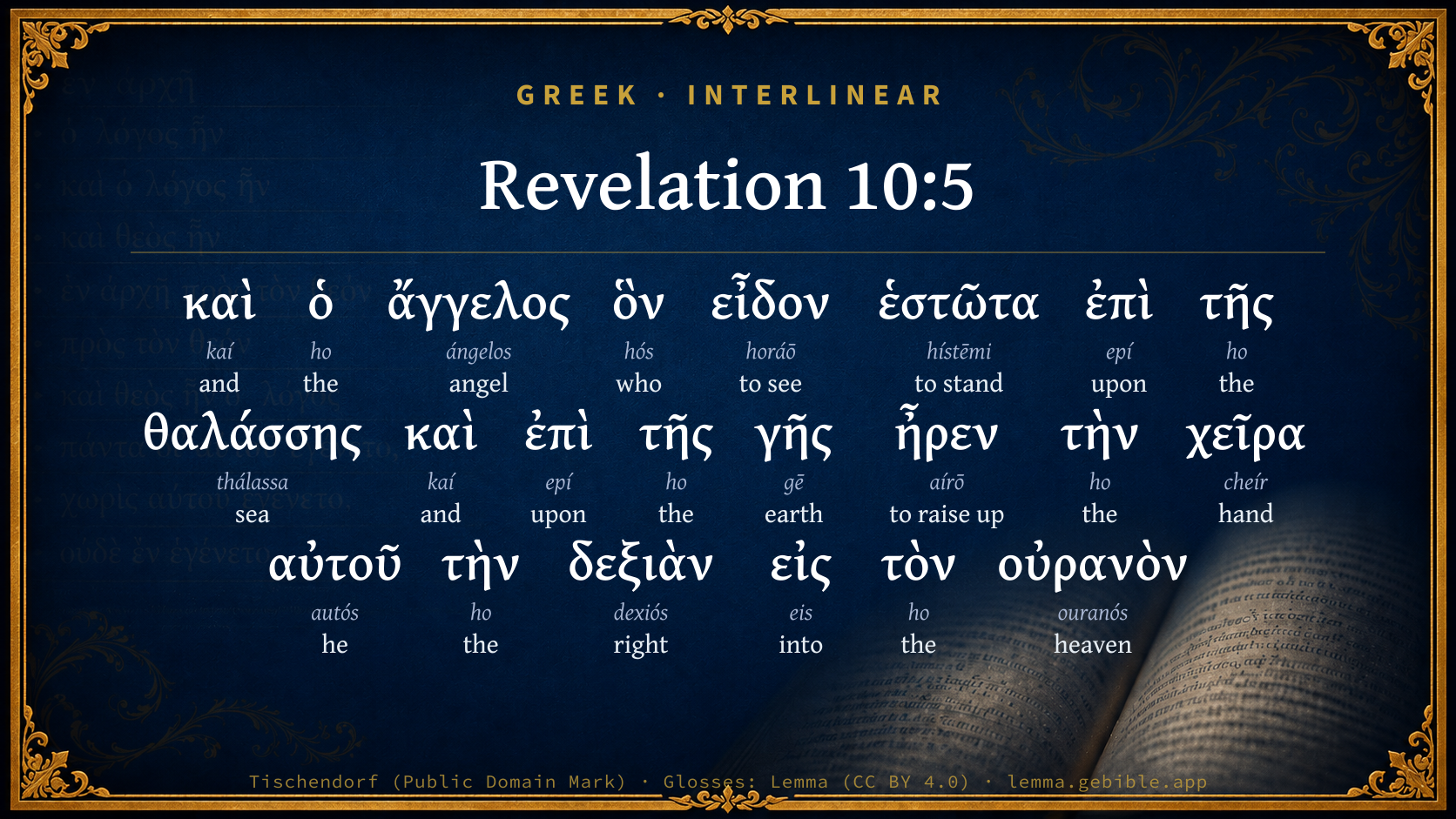
Greek (Tischendorf 8th ed.) Revelation 10:5 appears in the Greek New Testament. The text above is from the Tischendorf 8th edition. Each word links to its Strong’s number and a concise gloss. Click any word for its full Thayer’s Greek Lexicon entry.
Download image
Cite this verse

Revelation 10:5 (World English Bible). Public Domain. Lemma interlinear Bible study tool, https://lemma.gebible.app/v/revelation/10/5.

Show BibTeX & RIS
BibTeX
RIS
English Translation
The angel who I saw standing on the sea and on the land lifted up his right hand to the sky,
World English Bible · Public Domain
Download a study sheet

One document with this verse’s original text, its word-by-word gloss line, the meaning frame, cross-references with their text, attributed commentary, and full source and license credits — printable, and it pastes into notes with its structure intact.

This verse Autodidact and up

Study sheet (.html) Plain text (.txt)

A passage Seminary Student

Up to 50 verses in one chapter. A passage sheet keeps up to 6 commentary sources and 12 cross-references per verse, in the order this page ranks them, and says so on the sheet whenever that leaves anything out. Ask for a single verse and you get the Autodidact verse sheet above.

Everything on this page stays free to read, with no account — the sheet is a download of what is already on screen, not access to it.

Want to remove ads? Support Godless Engineer
Compare translations 3

The same verse in 3 English versions, stacked beneath the original-language interlinear above. Click any original word for its lexicon entry.

Each is an independent rendering of the whole verse — the interlinear is not word-aligned to these translations.

Highlighted words mark where these versions differ — a whole-verse word diff, not a word-by-word alignment.

  • World English Bible Public Domain
    The angel who I saw standing on the sea and on the land lifted up his right hand to the sky,
  • King James Version Public Domain
    And the angel which I saw stand upon the sea and upon the earth lifted up his hand to heaven,
  • unfoldingWord Literal Text CC BY-SA 4.0
    And the angel whom I saw standing on the sea and on the land raised his right hand to heaven

unfoldingWord Literal Text — © unfoldingWord, licensed CC BY-SA 4.0. Word-aligned USFM3 via Door43 (git.door43.org/unfoldingWord/en_ult).

Versions to compare (up to 4)

3 of 4 selected

Show all 19 translations

Every available English version of this verse, each an independent rendering of the whole verse.

  • World English Bible Public Domain
    The angel who I saw standing on the sea and on the land lifted up his right hand to the sky,
  • Berean Standard Bible Public Domain
    Then the angel I had seen standing on the sea and on the land lifted up his right hand to heaven.
  • Majority Standard Bible Public Domain
    Then the angel I had seen standing on the sea and on the land lifted up his right hand to heaven.
  • King James Version Public Domain
    And the angel which I saw stand upon the sea and upon the earth lifted up his hand to heaven,
  • American Standard Version (1901) Public Domain
    And the angel that I saw standing upon the sea and upon the earth lifted up his right hand to heaven,
  • Revised Version (1885) Public Domain
    And the angel which I saw standing upon the sea and upon the earth lifted up his right hand to heaven,
  • Geneva Bible (1599) Public Domain
    And the Angel which I sawe stand vpon the sea, and vpon the earth, lift vp his hand to heauen,
  • Douay-Rheims (1899) Public Domain
    And the angel, whom I saw standing upon the sea and upon the earth, lifted up his hand to heaven,
  • Young's Literal Translation Public Domain
    And the messenger whom I saw standing upon the sea, and upon the land, did lift up his hand to the heaven,
  • Literal Standard Version CC BY-SA 4.0
    And the messenger whom I saw standing on the sea, and on the land, lifted up his hand to the sky,
  • Unlocked Literal Bible CC BY-SA 4.0
    Then the angel I saw standing on the sea and the earth raised his right hand to heaven.
  • unfoldingWord Literal Text CC BY-SA 4.0
    And the angel whom I saw standing on the sea and on the land raised his right hand to heaven
  • Darby Bible Public Domain
    And the angel whom I saw stand on the sea and on the earth lifted up his right hand to the heaven,
  • World Messianic Bible Public Domain
    The angel whom I saw standing on the sea and on the land lifted up his right hand to the sky
  • Webster's Bible Public Domain
    And the angel which I saw stand upon the sea and upon the earth lifted up his hand to heaven,
  • Free Bible Version CC BY-SA 4.0
    The angel I saw standing on the sea and on the land held up his right hand to heaven.
  • Bible in Basic English Public Domain
    And the angel which I saw taking his position on the sea and on the earth, put up his right hand to heaven,
  • Text-Critical English NT CC BY 4.0
    Then the angel I had seen standing on the sea and on the land raised his right hand to heaven
  • Tyndale New Testament (1534) Public Domain
    And the angell which I sawe stonde apon the see and apon the erth lyfte vppe his honde to heven

Literal Standard Version (2020), Covenant Press — licensed CC BY-SA 4.0. Text via the HelloAO Bible API (eBible.org). Unlocked Literal Bible (unfoldingWord) — licensed CC BY-SA 4.0. Text via the HelloAO Bible API (eBible.org). unfoldingWord Literal Text — © unfoldingWord, licensed CC BY-SA 4.0. Word-aligned USFM3 via Door43 (git.door43.org/unfoldingWord/en_ult). Free Bible Version, Dr. Jonathan Gallagher — licensed CC BY-SA 4.0. Text via the HelloAO Bible API (eBible.org).

Word by word

More ways to search: Search by grammar → Find every occurrence → Compare this word →

Practice this passage: Drill this verse → Learn its vocabulary →

δεξιὰν
dexiós
G1188
“right”
Adjective, Accusative, Singular, Feminine
Part of Speech
Adjective
Case
Accusative
Number
Singular
Gender
Feminine
Full Thayer's Definition

Origin: from G1209

TDNT: 02:37,1

1. the right, the right hand 2. metaph. a. a place of honour or authority
  1. καὶ kaí G2532 “and” Conjunction
  2. ὁ ho G3588 “the” Article, Nominative, Singular, Masculine
  3. ἄγγελος ángelos G32 “angel” Noun, Nominative, Singular, Masculine
  4. ὃν hós G3739 “who” Relative pronoun, Accusative, Singular, Masculine
  5. εἶδον horáō G3708 “to see” Verb, Aorist, Active, Indicative, 1st person, Singular
  6. ἑστῶτα hístēmi G2476 “to stand” Verb, Perfect, Active, Participle, Accusative, Singular, Masculine
  7. ἐπὶ epí G1909 “upon” Preposition
  8. τῆς ho G3588 “the” Article, Genitive, Singular, Feminine
  9. θαλάσσης thálassa G2281 “sea” Noun, Genitive, Singular, Feminine
  10. καὶ kaí G2532 “and” Conjunction
  11. ἐπὶ epí G1909 “upon” Preposition
  12. τῆς ho G3588 “the” Article, Genitive, Singular, Feminine
  13. γῆς gē G1093 “earth” Noun, Genitive, Singular, Feminine
  14. ἦρεν aírō G142 “to raise up” Verb, Aorist, Active, Indicative, 3rd person, Singular
  15. τὴν ho G3588 “the” Article, Accusative, Singular, Feminine
  16. χεῖρα cheír G5495 “hand” Noun, Accusative, Singular, Feminine
  17. αὐτοῦ autós G846 “he” Personal pronoun, Genitive, Singular, Masculine
  18. τὴν ho G3588 “the” Article, Accusative, Singular, Feminine
  19. εἰς eis G1519 “into” Preposition
  20. τὸν ho G3588 “the” Article, Accusative, Singular, Masculine
  21. οὐρανὸν ouranós G3772 “heaven” Noun, Accusative, Singular, Masculine

About this verse

These counts appear in no published source. They are computed here, from the morphology-tagged text and Lemma’s own curated glosses. What Lemma adds →

22
words
15
distinct lemmas
Revelation
section

Shared distinctive vocabulary

δεξιὰν right G1188 occurs in 54 verses of the Greek New Testament. Also found in:
Repetition

Words recur within this verse:

Cross-references

22

Topical passages linked to Revelation 10:5 in the Treasury of Scripture Knowledge — connected by theme and wording, ordered by reader-vote popularity; previews shown in the World English Bible.

  • Daniel 12:7 I heard the man clothed in linen, who was above the waters of the river, when he held up his right hand and his left hand to heaven, and swore by him who lives forever that it shall be for a time, times, and a half; and when they have made an end of breaking in pieces the power of the holy people, all these things shall be finished.
  • Deuteronomy 32:40 For I lift up my hand to heaven, And say, As I live forever,
  • Acts 14:15 "Men, why are you doing these things? We also are men of like passions with you, and bring you good news, that you should turn from these vain things to the living God, who made the sky and the earth and the sea, and all that is in them;
  • Revelation 4:11 "Worthy are you, our Lord and God, the Holy One, to receive the glory, the honor, and the power, for you created all things, and because of your desire they existed, and were created!"
  • Revelation 10:2 He had in his hand a little open book. He set his right foot on the sea, and his left on the land.
  • Revelation 14:7 He said with a loud voice, "Fear the Lord, and give him glory; for the hour of his judgment has come. Worship him who made the heaven, the earth, the sea, and the springs of waters!"
  • Revelation 16:17 The seventh poured out his bowl into the air. A loud voice came forth out of the temple of heaven, from the throne, saying, "It is done!"
  • Revelation 1:18 and the Living one. I was dead, and behold, I am alive forevermore. Amen. I have the keys of Death and of Hades.
  • Revelation 4:9 When the living creatures give glory, honor, and thanks to him who sits on the throne, to him who lives forever and ever,
  • Genesis 1:1–2 In the beginning God created the heavens and the earth.
  • Genesis 14:22 Abram said to the king of Sodom, "I have lifted up my hand to Yahweh, God Most High, possessor of heaven and earth,
  • Exodus 20:11 for in six days Yahweh made heaven and earth, the sea, and all that is in them, and rested the seventh day; therefore Yahweh blessed the Sabbath day, and made it holy.
  • Nehemiah 9:6 You are Yahweh, even you alone; you have made heaven, the heaven of heavens, with all their host, the earth and all things that are thereon, the seas and all that is in them, and you preserve them all; and the host of heaven worships you.
  • Psalms 95:3–6 For Yahweh is a great God, A great King above all gods.
  • Genesis 22:15–16 The angel of Yahweh called to Abraham a second time out of the sky,
  • Exodus 6:8 I will bring you into the land which I swore to give to Abraham, to Isaac, and to Jacob; and I will give it to you for a heritage: I am Yahweh.'"
  • Psalms 146:5 Happy is he who has the God of Jacob for his help, Whose hope is in Yahweh, his God:
  • Psalms 148:1–7 Praise Yah! Praise Yahweh from the heavens! Praise him in the heights!
  • Ezekiel 20:5 and tell them, Thus says the Lord Yahweh: In the day when I chose Israel, and swore to the seed of the house of Jacob, and made myself known to them in the land of Egypt, when I swore to them, saying, I am Yahweh your God;
  • Acts 17:23 For as I passed along, and observed the objects of your worship, I found also an altar with this inscription: 'TO AN UNKNOWN GOD.' What therefore you worship in ignorance, this I announce to you.
  • Romans 1:20 For the invisible things of him since the creation of the world are clearly seen, being perceived through the things that are made, even his everlasting power and divinity; that they may be without excuse.
  • Hebrews 6:13 For when God made a promise to Abraham, since he could swear by none greater, he swore by himself,

Cross-references courtesy of OpenBible.info (CC BY 4.0).

Where the printed editions differ

1 variant

Places in this verse where the major printed Greek editions disagree on the wording in a way that affects the translation — a comparison of editions, not a manuscript-by-manuscript collation. The editions are the modern critical texts (Nestlé-Aland 28/27, SBL, Westcott-Hort, Tregelles, Tyndale House) and the traditional texts behind the KJV (the Textus Receptus and the Byzantine/Majority text). It is not a claim about which reading is original.

  1. Extra text
    τὴν δεξιὰν

    “the right”

    In NA28NA27TynSBLWHTregByz Not in TR

    τὴν δεξιὰν (tēn dexian) 'the right' is only in older manuscripts (NA28+NA27+Tyn+SBL+WH+Treg+Byz)

Textual data: Translators Amalgamated Greek New Testament (STEPBible TAGNT) · CC BY 4.0.

Commentary

Notes on Revelation 10:5 from classic Christian and Jewish commentators (each source and its license shown beneath its notes). The classic Christian expositions comment on the surrounding passage and are grouped to its opening verse, so a note may address several verses; the Jewish commentaries on the Tanakh (Rashi and others) are per-verse, so they appear only where the commentator wrote on this verse.

Lemma curates 59 commentaries, every one of them public domain or Creative Commons licensed, each selected and text-cleaned for this edition rather than reprinted as found. About our sources →

Jamieson, Fausset & Brown

Robert Jamieson, A. R. Fausset & David Brown

lifted up his hand--So A and Vulgate read. But B, C, Aleph, Syriac, and Coptic, ". . . his right hand." It was customary to lift up the hand towards heaven, appealing to the God of truth, in taking a solemn oath. There is in this part of the vision an allusion to Dan 12:1-13. Compare Rev 10:4, with Dan 12:4, Dan 12:9; and Rev 10:5-6, end, with Dan 12:7. But there the angel clothed in linen, and standing upon the waters, sware "a time, times, and a half" were to interpose before the consummation; here, on the contrary, the angel standing with his left foot on the earth, and his right upon the sea, swears there shall be time no longer. There he lifted up both hands to heaven; here he has the little book now open (whereas in Daniel the book is sealed) in his left hand (Rev 10:2), and he lifts up only his right hand to heaven.

Jamieson, Fausset & Brown — Commentary Critical and Explanatory on the Whole Bible (1871) — public domain (CC PDM 1.0). Text via the HelloAO Bible API.

The Biblical Illustrator

Joseph S. Exell

Rev_10:5-7

That there should be time no longer.

The end of time

That there should be time no longer. A tremendous asseveration, whether we regard the thing affirmed or the person who affirms it. Of the person making this asseveration we may say that there are traces about him, which, although he is called an angel, seem to identify him with our Lord Jesus Christ. In the first verse he is represented as clothed with a cloud; and the cloud vesture is stated in the Psalms to be the vesture of God Himself--clouds and darkness are round about Him. A rainbow encircles his head; and a rainbow is the well-known token of the covenant of grace made with us in and through Christ. His face, we are told, was as the sun. In the first chapter of this Book, John describes the countenance of the Son of Man to be as the sun shining in its strength; not to mention that one of the features of the glorified Christ, as He appeared at the Transfiguration, was this, His face did shine as the sun.

I. What may be meant by this cessation of time? Time, considered in itself, can never cease to exist. It must flow on and on to endless ages. Everything which happens must, of course, have a certain period of time, longer or shorter, in which to happen. The redeemed in glory will sing the praises of God and the Lamb. Time must elapse while they are singing those praises. If in the glorified body there should be a heart, it must go on, pulsation after pulsation, in never-ending succession. If in the new heavens and the new earth there should be anything analogous to that movement of the heavenly bodies which gives us day and night and the vicissitudes of the seasons, such a movement must necessarily ask time to proceed in--nay, as it proceeds, it must measure time. What, then, is meant by the announcement of a period when there shall be time no longer? Time, as I have said, must always flow on; but it may be annihilated to us, or in great measure annihilated. How this may be is not really an intricate or a subtle question, although it may at first sight appear so. It is generally and truly said that to Almighty God there is no such thing as time. If you understand this assertion, you will then find no difficulty in perceiving how time to us may be no longer. To say that to Almighty God there is no such thing as time, is only another method of expressing the truth (and be it said with the utmost reverence), that God has a perfect memory and a perfect foresight. There are many points of analogy between the mind and the eye. Imagine, then, an eye as free from the laws of the eye as you have been imagining a mind free from the laws of the mind. Imagine an eye not subjected to the laws of perspective, an eye to which things do not, as they recede from it, either diminish in size or fade in colour. It must be clear that to such an eye distance does not exist, just as to a mind endowed with perfect memory and perfect foresight time does not exist. One object may be placed a yard distant from the eye; another object may be placed a thousand miles distant; but if the latter of these objects appear of the same size, shape, and colour, and with all the same circumstantials, as it would if brought within the range of thirty-six inches to that eye distance is annihilated, and has no existence. And if God were to announce to any one that distance would be no more to him, this would be only another form of saying that his eyesight should be free from those limitations which are at present the conditions under which eyesight exists. Thus we have arrived at the last stage of our explanation. You have only to remember that the human mind, in another stage of existence, will be made competent for a far higher state of things than it can ever now attain, that its reach will be increased both as regards the past and the future, in order to comprehend the announcement that time shall be no longer. Our memory of all that has befallen us will then be perfect. Many events and sensations of our past career are buried away in the sod of the mind, trodden down into the soil, and overlaid by our more recent experiences. Of many very critical events, on our minds there is just a headstone, as it were, with a monumental inscription, giving in the coldest manner their name and date; but freshness, reality, and vitality they have none. Yet, even now, passages of our past history are, ever and anon, recalled to us with a wonderful vividness, by music, by odours, by long forgotten scenes, or by some other association of the senses. Sudden and transient flashings these, of a light which is destined one day to flush the whole mind, and to penetrate into its darkest recesses. The memory has really no more lost its deposits than the graveyard has lost the corpses entrusted to its keeping. Those deposits will one day start from the sod in all the freshness of new life, and stand up upon their feet an exceeding great army. Nor need we shrink from supposing that in that higher condition of existence the powers of memory and foresight possessed by the mind will be greatly enlarged, whether or not they be made, as regards our future experience, perfect.

II. Why the asseveration of the text is made upon oath. The reasons are obvious. First, its being made on oath argues its importance. We take an oath in matters of moment, not in trifles. Petty interests are felt to be beneath the solemnity and dignity of an appeal to Heaven. Secondly, an oath is an indication that the thing assevered appears till then in more or less uncertainty. It is the province of an oath to give assurance of something which was previously open to question.

III. To each one among us the abolition of time will be the hour of our own death. This I say, brethren, the time is short. Yes, that is the main point which the oath may be taken to imply--the infinite importance in Gods estimation of the time that remains to you upon earth. (Dean Goulburn.)

The end of time

I. What is meant by the end of time. Time, as far as man has any concern with it, is that portion of duration which is commensurate with the existence of our world, and which is measured by its diurnal and annual revolutions. It began when this world began to exist. The end of time, and the end of the world, are, then, expressions of the same import.

II. When will the event denoted by these expressions arrive? We learn from our text that it will arrive when the mystery of God shall be finished. Gods great object in creating this world and its inhabitants was to gratify and glorify Himself. Now, God at once glorifies and gratifies Himself when He displays His perfections in His works. Some of His perfections, as, for instance, His power, wisdom, and goodness, He displayed in the creation of the world; and they, as well as some other perfections of His nature, are still displayed in its providential government. But the principal display of His perfections is made in the work of redemption by Jesus Christ, the great object to which all His works of creation and providence ultimately refer. Agreeably, inspiration informs us, that for Jesus Christ all things were created; and that to Him there is given dominion and glory and a kingdom that all people, nations, and languages, should serve Him. When the purposes for which this kingdom was given to Christ, and set up in the world, are accomplished, the mystery of God, mentioned in our text, will be finished. Now the purposes for which this kingdom was given to Christ include two things. The first is, the complete salvation of all who are given to Him by the Father. The second is, the complete and final subjugation of His enemies.

III. What will be the attending circumstances and consequences of this event?

1. With respect to ourselves, considered as individuals, the end of time, or, which is the same thing to us, the end of our lives will be attended by circumstances, and followed by consequences, most important and interesting.

(1) We shall then be separated at once from all temporal and earthly objects.

(2) With the end of time our state of probation and our day of grace will end. We shall be removed from our present religious privileges and means of spiritual improvement.

(3) When time ends, eternity will begin. The moment in which we leave this temporary and mutable state, we shall enter a state which is eternal, and, of course, unchangeable.

2. The circumstances and consequences which will attend and follow the end of time with respect to the human race.

(1) When the end of time shall arrive, the general resurrection will take place.

(2) At the end of time, the day of judgment, the great day for which all other days were made, will arrive.

3. It remains only to consider what will then be the fate of the globe which we inhabit. Then the gold, the silver, the jewels, and all the glittering but delusive objects, for which so many thousands have bartered their souls, shall be destroyed. Lessons:

1. In view of this subject, however insignificant, how unworthy of an immortal being, do all merely temporal and earthly pursuits appear I

2. In full view of the end of time let me ask, are you all, my hearers, prepared for it? (E. Payson, D. D.)

The end of time

I. There is a period set at which time shall be no more.

1. Time had a beginning. There was a day, a year, that was the first, before which there was not another. But eternity was before, and will be after time; which therefore appears at present like a small island lifting up its head in the midst of the ocean.

2. Time has run from the beginning, and is running on in an uninterrupted course of addition of moments, hours, days, months, and years.

3. Time will come to an end. It has run long, but it will run out at length. The last sand in the glass of this world will pass. The period is set in the Divine decree, the last day and hour, though no man knows them.

(1) This present world shall be no more; these heavens and earth shall pass away by the general conflagration (2Pe_3:10).

(2) New years shall be no more. The year will come, the month, the day, hour and minute, after which there shall never be another. Let us improve our years then for eternity, and count our days so as to apply our hearts to wisdom.

(3) The different seasons will be no more. There will be no more summer and winter, seed-time and harvest. There will be an eternal spring in heaven; but an eternal winter, as it were, in hell, where is gnashing of teeth.

(4) The business of this life shall be no more. There shall be no more tilling of the ground, tending of flocks, merchandising, nor trades. How unhappy must they be who have no pleasure nor satisfaction in anything else, since these are not to last!

(5) The means of sustaining this life shall be no more. There shall be no more eating, drinking, nor sleeping.

(6) Relations shall be no more. Time going dissolves them all, as fellow-travellers part when come to their journeys end. There shall be no more magistrates and subjects, ministers and people, husbands and wives, parents and children, masters and servants (Job_3:19). Only the relation betwixt Christ and His people as head and members, which is not of this world, shall remain; and so the relation to God as His children (Luk_20:35-36); who are the children of God, being the children of the resurrection.

(7) Space for repentance shall be no more.

(8) Tribulation and adversity of the godly shall be no more.

(9) The prosperity and comfort of the wicked (Luk_16:25) shall be no more.

II. The weight of this truth, and its concern to mankind.

1. That it is of weight and concern to them appears in its being sworn to them; which implies--

(1) That men are very heedless about it, and slow to believe it, and be impressed with it.

(2) A legal intimation made to them of its ending.

(3) That the period of time is unalterably fixed, the bounds of it set, beyond which it cannot go; for it is set by an oath.

2. The weight of the thing lies in these three.

(1) That then that which concerns mankinds happiness or misery is completed; the state of probation is over, and the state of recompense takes place in perfection, both as to their bodies and souls.

(2) That then eternity succeeds the state of all for ever unalterable, no end to be expected more.

(3) That now or never must be done what is done for eternity.

Use. Then be exhorted suitably to improve this intimation of times ending.

1. Look beyond time, this world, and the state of things in it; carry your views into the other world, to eternity (2Co_4:18).

2. Lift your hearts from off the things of time, and set them on those that are eternal (Col_3:2).

3. Use this world passingly, as pilgrims and strangers in it (1Co_7:29-31).

4. Let not the frowns of this world, the troubles and trials of the present life, make deep impression on us: they will not last.

5. Be not lifted up with the worlds smiles, nor value yourselves on worldly prosperity; for time will put an end to this also.

6. Improve time while it lasts, for the ends it is given you for.

(1) Laying a good foundation for eternity, getting out of your natural state into the state of grace, believing on Christ, and repenting of sin.

(2) Living to the honour of God, endeavouring to act in your sphere for propagating the name and kingdom of Christ.

(3) Serving your generation in usefulness to mankind, seeking to forward the spiritual and temporal good of others; as David did (Act_13:36). (T. Boston.)

The mystery of God finished with time

I. We shall consider the mystery of God in His Kingdom among men.

1. We shall consider what that mystery of God is. A mystery is a secret or hidden thing.

2. I will show in what respects it is a mystery, the mystery of God; or that the kingdom of Christ, and His management, is a mystery, the mystery of God.

II. We shall consider the mystery of God as begun and carried on in time.

1. We shall consider the first opening of the mystery.

(1) In the promulgation of the promise of the gospel (Gen_3:15).

(2) In the offering of the first sacrifices, with the skins whereof our naked first parents were clothed (Gen_3:21).

2. We shall consider the gradual opening of the mystery. Of this we have an account in Heb_1:1.

3. We shall consider the progress of the mystery.

(1) It has never been interrupted since it began in paradise; the salvation of the Church has all along been carried on, and matters managed for that end.

(2) It has made such progress, that by this time it is drawing towards the period of finishing it.

(3) It is going on in our day, in the same powerful hand that has managed it all along.

But for a more full view of the mystery, as executed in time, we shall consider the eight following particulars of this mysterious kingdom, in every part of which there is a mystery.

1. The head of it, Jesus Christ, is a mystery. And He is a mystery, a mysterious Head:

(1) In the constitution of His person, being God and man in one person.

(2) In His offices.

(3) In all circumstances about Him.

2. The subjects of it, believers, are a mystery too. They are in the world indeed, but unknown to the world (1Jn_3:1).

3. The erection and conservation of it is a mystery (Luk_17:20).

(1) The beginnings of it were very small; how vastly soever it has spread.

(2) The means of erecting and setting it up were very unlikely and unusual, viz., the despised preaching of the gospel (Psa_110:2).

(3) The opposition to it from the beginning has been very great; yet it has made its way in face of all opposition.

(4) The means of keeping it up, even such as it was set up by. Not the power of the sword, but the preaching and teaching of the word of the gospel, and setting that home on mens consciences; prayers, and tears, patient suffering even unto death (Rev_12:11).

4. The seat of it is a mystery too.

5. The extent of it is a mystery, whether it is considered--

(1) In respect of the kind of jurisdiction He has in it.

(a) The kingdom of grace is in His hand.

(b) The kingdom of glory is in His hand too (Luk_22:29-30).

(c) The kingdom of providence is in His hand likewise.

(2) In respect of the bounds of it. It extends itself over both worlds (Mat_28:18; Rev_1:18).

6. The privileges of it are a mystery.

(1) Their union with Christ is a mystery (Eph_5:32).

(2) Their justification is a mystery.

(3) Their sanctification is a mystery.

(4) Their perseverance in grace is a mystery.

7. The life and practice of it is a mystery.

8. The manner of the conduct and management of it is a mystery. It is the manner of this kingdom--

(1) To prefer the most unlikely, baulking them that stand fairest for the preference in all human appearance (Mat_20:16).

(2) To let things go to an extremity, to the utmost point of hopelessness, before a hand be put to help them, and set them right again (Deu_32:36).

(3) To give the sharpest treatment to the greatest favourites. This is not the manner of men, but it is the manner of God (Psa_73:5; Psa_73:14).

(4) To meet men with astonishing strokes going in the way that God bade them, while they have a fair sunshine that are going in the way of their own hearts (Ecc_8:14).

(5) To lay by accepted petitions, and let them long lie by, time after time, while yet unacceptable requests are quickly granted.

(6) To answer accepted prayers quickly with some one terrible thing or other, which yet are to be graciously and bountifully answered in due time (Psa_65:5).

III. We are to consider the mystery of God as finished with time.

1. Let us consider when this mystery of God shall be finished.

2. Wherein does the finishing of this mystery lie? It lies in these three things following.

(1) The accomplishment of the remaining prophecies.

(2) The gathering in of all the elect.

(3) The completing of the salvation of the Church of the elect. This is the delivering up of the kingdom to the Father mentioned in 1Co_15:24.

3. It remains to show the import and consequence of this finishing the mystery of God. It is of greatest importance to the honour of God, and to the children of men. For then--

(1) The eternal purpose of God concerning mankind is fulfilled; the contrivance laid from eternity in the depth of wisdom about them, is executed.

(2) The covenant between the Father and Christ, the second Adam, is then fulfilled on both hands.

(3) Then the whole frame of the ordinances, now or since Adams fall, in use in the world for bringing in of sinners, and edifying of saints, is laid by.

(4) Then the matter of the Divine conduct towards mankind is altered so that it is quite new (Rev_21:5).

(5) Then Christs conquest is complete, His enemies made His footstool, which He is this day in expectation of (Heb_10:12-13).

4. Then the mystery is opened, and appears in a full light; though before veiled, the veil is then taken off.

5. There will be no more mystery of God; then it is finished.

IV. We shall consider the relation betwixt the mystery of God and time.

1. Time is the space appointed for the mystery of God its being executed.

2. The subsistence or continuation of time depends on the mystery. Had there been no mystery of God to have been carried on, time once polluted with sin, had ended soon after it began.

Hence we may learn:

1. Whence it comes to pass that there is so much stumbling of wicked men at the Divine conduct by Christ in the world. The matter is: it is a mystery, and their natural blindness hinders them to see it, so that they know it not (1Co_2:14).

2. How the godly come to have other thoughts of it; and true Christians admire the beauty and glory of it, which carnal men despise. It is the mystery of God, which He reveals to His friends and rearers of His name (Psa_25:14).

3. No reason to despise religion because the world generally do so.

4. Time is not continued as a sleep without a design. Oh, that men would consider that it is lengthened out on a particular design; which, being compassed, it shall end for good and all!

5. It is not this worlds business, but Heavens business, that is the great design of the continuing of time.

6. The mystery of God must be a matter of singular excellency, and of the last importance, that for it time is continued.

7. The mystery of God has, in the execution of it, been of long continuance; but it is drawing to a close.

8. When there is no more time requisite for the mystery of God, there will be no more time for other things neither; time will end with it; for it is for the sake of it that it is continued. (T. Boston.)

The Biblical Illustrator, edited by Joseph S. Exell (c. 1880s–1900s) — public domain. Text from a community e-Sword module.

Joseph Benson's Commentary

Rev 10:5-7. And the angel, &c. — But though I was not allowed to reveal what the seven thunders had uttered, yet the angel proceeded to give a further revelation of the dispensations of Divine Providence toward the world and the church in general; and, to confirm the truth and certainty of his revelation, he took his oath in the most solemn manner: he lifted up his hand to heaven, and sware by Him that liveth for ever and ever — By the eternal God, before whom a thousand years are but as a day is with us; who created the heaven, the earth, the sea, &c. — And consequently has the sovereign power over all; therefore all his enemies, though they rage a while on the earth and on the sea, yet must give place to him: That there should be time no longer — Greek, οτι χρονος ουκ εσται ετι, that the time shall not be yet; (so Lowman and Bishop Newton understand it;) that is, that the lime of the glorious state of the church, though sure to take place in its due time, should not be yet; but in the days of the voice of the seventh angel — Who was yet to sound; the mystery of God — In his providence toward his church; should be finished — Or completed. The mystery of God is his counsel or design, which begins in the present conversion and happiness of man on earth, will terminate in diffusing that felicity over all the world, and will complete it in a state of immortality; as he hath declared — Ως ευηγγελισε, according to the good news which he hath published; to his servants the prophets — And then the glorious state of the church should be no longer delayed. So long as the third wo remains on the earth and the sea, the mystery of God is not fulfilled. And the angel’s declaration that it shall be fulfilled, confirmed by a solemn oath, is made peculiarly for the consolation of holy men, who are afflicted under that wo. Indeed the wrath of God must be first fulfilled by the pouring out of the vials, and then comes the joyful fulfilling of the mystery of God.

Joseph Benson's Commentary on the Old and New Testaments (1811–1818) — public domain. Text from a community e-Sword module.

Tyndale Open Study Notes

Tyndale Open Resources

10:5-6 While raising one’s right hand is common in taking an oath today, it is rare in biblical literature (cp. Gen 14:22; 24:9; Dan 12:7). • When making an oath, Jews were very careful not to swear lightly by God’s name (see Exod 20:7). Jesus also rebuked insincere oath-taking (see Matt 5:33-37; 23:16-22). When God swore an oath, he did so in his own name as the highest possible point of reference (see Gen 22:16; Ps 89:35-36; Jer 22:5; Heb 6:13-18).

Tyndale Open Study Notes — © Tyndale Open Resources, licensed CC BY-SA 4.0. Text via the HelloAO Bible API.

Meyer's Critical & Exegetical Commentary

Heinrich August Wilhelm Meyer

Rev_10:5-7. The angel swears that immediately, viz., in the time of the seventh trumpet, which is at once to sound, the mystery of God shall be finished.

ἦρε τ. χεῖρα αὐτ. τ. ὁεξιὰν εἰς τ. οὐρανὸν. The angel can raise[2734] only his right hand, because his left holds the little book, Rev_10:2. The significance of the gesture is derived from the form of the oath. He raises his hand to heaven as to the high and holy place where the Eternal, and Almighty dwells,[2735] who even himself, in swearing by himself, raises his own hand to heaven.[2736]

Concerning the ἘΝ in connection with ὬΜΩΣΕΝ, cf. Mat_5:34 sqq.; Winer, p. 364.

Τῷ ΖῶΝΤΙ ΕἸς Τ. ΑἸΩΝ.

Ὃς ἜΚΤΙΣΕ Τ. ΟὐΡΑΝῸΝ, Κ.Τ.Λ. The pragmatic reference of this appeal to God, as the Eternal and Creator of all things, lies in the fact that the subject of the oath is the ΜΥΣΤΉΡΙΟΝ ΤΟῦ ΘΕΟῦ, therefore something concealed in Gods eternal decree, but which, in his time, he has not only in prophecy announced,through the ancient prophets (Rev_10:7), and now through John (Rev_10:11; Rev_1:1 sqq.),but also the Almighty Lord will infallibly bring about,[2737] and that, too, ἘΝ ΤΆΧΕΙ (Rev_1:1). For the angel swears, ὌΤΙ ΧΡΌΝΟς ΟὐΚΈΤΙ ἜΣΤΑΙ, that there should be time no longer. The authentic norm for the correct explanation of this expression is given by what follows, which defines the same thing from the contrasted side, ἈΛΛʼ ἘΝ Τ. ἩΜ., Κ.Τ.Λ.). It is accordingly not an entrance of a modern thought,[2738] but a complete misunderstanding of the text, when many interpreters, following Beda,[2739] have understood the words ΧΡΌΝΟς ΟὐΚΈΤΙ ἜΣΤΑΙ, of the absolute cessation of time, i.e., of the beginning of eternity. The opposite parallel, ἈΛΛʼ ἘΝ Τ. ἩΜΈΡΑΙς, Κ.Τ.Λ., by virtue of its chronological nature, excludes every explanation which presents the formula ΧΡΌΝΟς ΟὐΚΈΤΙ ἜΣΤΑΙ in any other way than chronologically. Ebrard, accordingly, is also incorrect when he understands by the ΧΡΌΝΟς, a season of grace. On the other hand, however, the contrast, Rev_10:7, as well as also the tenor of the formula χρόν. οὐκ. ἔστ., forbids us to recognize in this a definite, technical expression of Apocalyptic chronology, as Bengel wished, who found here a non-chronus, i.e., a period of more than a thousand and less than eleven hundred years, and accordingly reckoned the closing epoch of this non-chronus (i.e., the beginning of the thousand years reign) as the year 1836, since the starting-point occurred, at all events, before the year 842, the concluding year of the second woe,[2740] and apparently in the year 800, in which the reign was established. Grot., Calov., Vitr., C. a Lap., Eichh., Ew., De Wette., Hengstenb., etc., have correctly recognized the fact that the words ΧΡΌΝ. ΟὐΚ. ἜΣΤΑΙ express the immediate, and the indeed very positively defined (Rev_10:7), beginning of that which is called in Rev_10:7 the fulfilment of the mystery of God. But naturally, from this formal unanimity of the most expositors, there proceeds directly the greatest diversity of views, when the question is concerning the more precise reference of the formula, χρόν. οὐκ. ἔστ. according to the standard of what is said in Rev_10:7. But Vitr. is inaccurate, even in a formal respect, when he says, No delay of time is to intervene between the sound of the seventh trumpet, and the fulfilment of the prophetic oracles;[2741] for the affirmative determination, Rev_10:7, says in apposition to the words ὍΤΙ ΧΡ. ΟὐΚ. ἜΣΤΑΙ, which deny a further delay, that the (immediate, Rev_10:6) fulfilment of the mystery of God is to occur just at the time of the seventh trumpet. The question, therefore, is not concerning a delay, perhaps still occurring between the seventh sound of the trumpet and the fulfilment of the mystery of God; but the angel swears that between the present point of time (which falls after the close of the sixth trumpet, and before the second part of the second woe, that is finished only at Rev_11:14), and the fulfilment of the mystery of God, which is to be expected within the time of the seventh trumpet, there will be no more interval. [See Note LXV., p. 309.] What, therefore, might have been expected already after the close of the sixth seal-vision, but yet did not occur, because ch. 7 brought a special preparation,and, besides, from the seventh seal itself the new series of trumpet-visions proceeded, ch. 8 sq.,is not to come immediately, and that, too, in the seventh trumpet. Yet it does not actually occur in Rev_11:16-19.[2742]

ἌΛΛʼ ἘΝ Τ. ἩΜΈΡΑΙς Τῆς ΦΩΝῆς ΤΟῦ ἙΒΔ. ἈΓΓ. These words in combination with the immediately succeeding ὍΤΑΝ ΜΈΛΛΗ ΣΑΛΠΊΖΕΙΝ, which contain an epexegetical description of the ΦΩΝῆς Τ. ἙΒΔ. ἈΓΓ., appear to require an explanation like that of Bengel: Thus the angel makes himself heard, not only at the beginning of these days, but continually throughout them. The additional remark, at the end of the days this trumpet acquires the name of the last trump (1Co_15:52), is, of course, entirely without foundation in the context. But even the first statement of Bengel conflicts with the analogy of all the trumpet-voices hitherto in their proper nature (which, nevertheless, the words ὍΤΑΝ ΜΈΛΛῌ ΣΑΛΠ. themselves recall); since, by the heavenly trumpet-sounds, not future things themselves, but only such manifestations as signify what is to occur on earth, are introduced. The seeming difficulty which lies, therefore, in the fact that what is said in Rev_10:7 is of the days of the seventh trumpet, but which cannot be explained by regarding a continuance of the trumpet-voice during the whole of the still future period of that (actual) day, is very simply explained if it be acknowledged[2743] that in the expression ἘΝ Τ. ἩΜΈΡΑΙς Τ. ΦΩΝ. Τ. ἙΒΔ. ΑΓΓ. the standpoint of the vision is not purely maintained, but the reference to the events of the sixth trumpet-vision is intermingled; only from this last standpoint can we properly speak of the days of the last trumpet, viz., of the period in which that which is represented to the prophet by the final sound of the trumpet actually occurs.

ΚΑῚ ἘΤΕΛΈΣΘΗ. The annexing of the conclusion is Hebraistic, since the ΚΑῚ with the aor. corresponds to the Vav with the perf.[2744]

τὸ μυστήριον τοῦ θεοῦ. The contextual determination of this ideawhose character is indicated, in general, already by the correlate ideas of divine revelation (εὐηγγέλισε), and of prophecy (τ. προφ.) as the human announcement of the mystery revealed on Gods part[2745]lies partly in the fact that its actual fulfilment[2746] is placed in the time of the seventh, and consequently the last, trumpet; partly in that its revelation is conceived of by the prophets as a εὐαγγελίζειν, i.e., a communication of a joyful message. Besides, it needs no special proof, that the expression τοὺς ἑαυτ. δούλ., τοὺς προφήτας[2747] can refer only to O. T. prophets,[2748] but neither to N. T. prophets,[2749] nor to Christ and the apostles,[2750] as the mystery of God revealed to these prophets, and proclaimed by them, is infinitely more than the divine counsel concerning freeing Christians from the oppression of the Jews.[2751] According to the contextual indication just given, the ΜΥΣΤΉΡΙΟΝ ΤΟῦ ΘΕΟῦ, whose contents are here declared only by the general allusion to the O. T. predictions, refers to nothing but the glorious completion of the divine kingdom, the final goal whereto the deepest current of O. T. prophecy, which is on that account essentially an Apocalyptic element, tends. The next authentic explanation of the proper contents of the ΜΥΣΤ. Τ. Θ. is contained in the heavenly song of praise sounding forth after the seventh sound of the trumpet, Rev_11:17 sqq.

[2734] Cf. Dan_12:7; Gen_14:22.

[2735] Cf. Isa_57:15.

[2736] Deu_32:40.

[2737] Cf. the entirely similar reference of Gods self-designation, Rev_1:8.

[2738] Hengstenb.

[2739] At the last trumpet, the mutable variety of secular ages will cease.

[2740] Cf. on Rev_9:13 sqq.

[2741] Likewise Hengstenb.

[2742] Against Hengstenb., etc. See on that passage.

[2743] Cf. De Wette.

[2744] Exo_16:6; Exo_17:4, where the LXX. translate by καὶ with the fut. Cf. Ewald, Ebrard, Winer, p. 260.

[2745] Cf. Introduction, p. 32.

[2746] Cf. Luk_18:31.

[2747] Concerning the acc., besides εὐηγγέλισε, cf. Winer, p. 209.

[2748] N. de Lyra, Beng., De Wette, etc.

[2749] Grot., who seeks them altogether among the elders, Rev_5:5, Rev_7:13.

[2750] Eichh.

[2751] Eichh. Cf. Grot.: That indeed is, that Christians were allowed by Hadrian a residence at Jerusalem, and the free worship of God and Christ there.

NOTES BY THE AMERICAN EDITOR

LXV. Rev_10:6. χρόνος οὐκέτι ἔσται

Stier: The Greek word χρόνος applies equally to a long interval, a respite, a delay, a postponement; and we have already had several instances in which it has been so used, as, for instance, in ch. Rev_2:21, where we find it rendered space to repent; and ch. Rev_6:11, where it stands for a further period of rest and expectation. Therefore the meaning is simply this: that, whereas the angel with the seal demands an interval of time before the opening of the seventh seal, which interval is to be employed in sealing the servants of God, so this angel, on the contrary, denies any further space for repentance, any respite for the ungodly, before the sounding of the seventh trumpet. He affirms that stroke is to succeed stroke, and that, in a certain limited period, all will be finished. So, also, Beck, who, in illustration of this meaning of χρόνος, refers to its derivative χρονίζειν: Mat_24:48, My lord delayeth his coming; Mat_25:5, while the bridegroom tarried; Heb_10:37, He that shall come will come, and will not tarry. Space of time is the uniform meaning of χρόνος both in the Apocalypse (Rev_2:21, Rev_6:11, Rev_10:6, Rev_20:3) and the Gospel of St. John (Joh_5:6, Joh_7:33, Joh_12:35, Rev_14:9).

Meyer — Critical and Exegetical Commentary on the New Testament — English translation by Peter Christie, edited by Frederick Crombie (T&T Clark, 1880) — public domain. Text from a community e-Sword module.

Expositor's Greek Testament

ed. W. Robertson Nicoll

Rev 10:5-6 . Modelling from Dan 12:7 , the writer describes the angel’s oath (by the living God, as usual in O.T.; cf. Mat 26:63 ), with its native gesture ( cf. Trumbull’s Threshold-Covenant , 78 f.) and contents. In the ancient world oaths were usually taken in the open-air (Usener, Götternamen , 181), before the all-seeing deities of the upper light. But here, as at Rev 14:7 , the eschatological and the creative acts of God (the latter an outcome of His living might, as Sir 18:1 , En. Rev 10:1 , Act 16:15 , etc.) are deliberately conjoined; God’s activity in creation and providence would culminate in judgment. “There shall be no further delay,” or time lost. The interval of Rev 6:11 (Dan 12:7 ) is over: all is ripe now for the end, ἡ συντέλεια καιροῦ . The parallels in Slav. En. xxxiii. 2, 65:7, upon the abolition of seasons and periods of time are merely verbal. What engages the writer here is the usual point of importance in apocalyptic literature, viz. , “Is it long to the end? Is the future longer than the past” (4 Esd. 4:44 50)?

The Expositor's Greek Testament, edited by W. Robertson Nicoll (1897–1910) — public domain. Text from a community e-Sword module.

Geneva Bible (1599)

Geneva Bible translators

This was a gesture used of one that sweareth, which men do nowadays use.

Geneva Bible (1599) marginal notes — public domain. Text via Bolls.life.

Adam Clarke's Commentary

Verse 5. Lifted up his hand to heaven] As one making an appeal to the supreme Being.

Adam Clarke's Commentary on the Bible (1810–1826) — public domain. Text from a community e-Sword/MySword module.

Ellicott's Commentary for English Readers

(5-7) And the angel . . .—Translate, And the angel whom I saw standing upon the sea and upon the earth lifted his right hand to the heaven, and sware in (or, by) Him who liveth unto the ages of the ages, who created the heaven, and the things in it, and the earth, and the things in it, and the sea, and the things in it, that time (i.e., delay, or postponement) should no longer be: but in the days of the voice of the seventh angel, whenever he is about to sound (his trumpet) was finished the mystery of God, as he evangelised his servants the prophets. There is a change of tense which sounds strange: he says, then (not “will be,” but) was finished. In thought he hurries on to the end, and sees the close no longer in the dim future, but as, with the eye of God, an accomplished fact. The certainty is guaranteed with an oath. The gesture of the uplifted hand to give emphasis to the oath is of ancient date. Thus Abraham expressed his resolution to take none of the spoils of the conquered kings: “I have lift up mine hand unto the Lord . . . that I will not take from a thread to a shoelatchet” (Gen_14:22; comp. Exo_6:8, margin). So, too, does the man clothed in linen (Dan_12:6-9, a passage which, in much, is the foundation of the one before us) lift up both hands and sware that there shall be a fixed period for the accomplishment of the scattering of the power of the holy people. The oath in the passage under consideration is to the effect (not that time should cease and eternity begin, but) that there shall be no longer any delay. The suffering saints had cried, “How long?” (Rev_6:9-11), and they had been bidden to wait a little time. Now the close of all such waiting time is announced: when the seventh trumpet shall have blown the mystery of God will be finished. “‘ The mystery of God’ does not mean something which cannot be understood or explained. It is never applied to such matters, for example, as the origin of evil, or the doctrine of the Trinity in Unity. It does mean a secret; but then a secret may be told, and when told is no mystery. The mystery, or secret, of God means, therefore, the whole of His plan and of His counsel concerning this earth in its present state of discipline and of imperfection; all that God means to do upon it and towards it, even till that which we read of as the time of the end (Dan_12:4-9), the close of this last dispensation, and the introduction of that new heavens and new earth wherein dwelleth righteousness” (Dr. Vaughan). No wonder, as he announced this fast approaching close of the ages of suffering and trial, he should add, “According as He (not “declared”—an utterly inadequate word—but) evangelised—i.e., according to the glad tidings which He had ever proclaimed to and by His servants the prophets.” A somewhat remarkable parallelism between this passage and 1Co_15:51-52, has been pointed out. In both passages there is reference to the mystery, the glad tidings, and the last (the seventh trumpet is also the last) trumpet. This harmony of reference—taken in connection with St. Paul’s statement, “We shall not all sleep, but we shall all be changed”—is full of interest, if it were for nothing more than to notice the union of thought between the two Apostles; but it may also throw light upon the teaching respecting the first resurrection (Rev_20:5-6; but see Note there).

A Bible Commentary for English Readers, edited by Charles John Ellicott (1878–1897) — public domain. Text from a community e-Sword module.

The Cambridge Bible for Schools and Colleges

gen. ed. J. J. S. Perowne

5. lifted up his hand to heaven] Read, “his right hand.” Cf. Dan_12:7, where the angel lifts up both hands: here, his left is occupied with the book. For the gesture symbolic of an oath see Gen_14:22, &c.

The Cambridge Bible for Schools and Colleges (gen. ed. J. J. S. Perowne; Cambridge University Press, 1878–1918) — public domain. Text from a community e-Sword module.

John Gill's Exposition

And the angel which I saw stand upon the sea and upon the earth,.... His right foot being on the one, and his left foot upon the other, as described in Rev 10:2;

lifted up his hand to heaven; the Oriental versions read, "his right hand"; and so some copies, and the Complutensian edition: the man clothed in linen, Dan 12:6, who is the same with the angel here, held up both his hands; the lifting up of the hand was a gesture used in swearing: see Gen 14:22; so the Jews say (o), "the right hand", or by the right hand, , "this is an oath", according to Dan 12:7; or whether the right hand or the left, is an oath, according to Isa 62:8.

(o) T. Bab. Nazir, fol. 3. 2. Yalkut Simeoni, par. 2. fol. 58. 1.

John Gill's Exposition of the Whole Bible (1746–1763) — public domain (CC PDM 1.0). Text via the HelloAO Bible API.

Trapp's Complete Commentary

John Trapp

5 And the angel which I saw stand upon the sea and upon the earth lifted up his hand to heaven,

Ver. 5. Lifted up his hand] And so swore solemnly, Gen 14:22; Num 14:30; Eze 20:5. Because it seemed improbable (if not impossible) that ever Babylon should down, Rome be ruined. But all the judgments in the Revelation (those of the seven seals, seven trumpets, and seven vials) are still upon Rome pagan, Christian, and Antichristian. We may therefore conclude with that emperor of Germany, Frederic II,

" Roma diu titubans, variis erroribus acta

Gorruet, et mundi desinet esse caput."

"Rome tottering long, shall once be shattered,

And of the world shall cease to be the head."

John Trapp, A Commentary or Exposition upon All the Books of the Old and New Testament (1647–1656) — public domain. Text from a community e-Sword module.

Albert Barnes' Notes on the Bible

And the angel which I saw stand ... - Rev 10:2. That is, John saw him standing in this posture when he made the oath which he proceeds to record.

Lifted up his hand to heaven - The usual attitude in taking an oath, as if one called heaven to witness. See Gen 14:22; Deu 32:40; Eze 20:5-6. Compare the notes on Dan 12:7.

Albert Barnes' Notes on the Bible (1834–1885) — public domain. Text from a community e-Sword/MySword module.

Haydock's Catholic Bible Commentary

The angel....swore....that time shall be no longer. This seems to favour very much the exposition of those interpreters who think that all these things are not to be fulfilled till some short time before the end of the world. Others (of which see Alcazar, &c.) take this to be a prediction of the ruin and destruction of the Jews, particularly under the emperor Adrian. Others (see the bishop of Meaux) understands by this, that the time was approaching when God, by his judgments, would put an end to the idolatry and heathen worship of pagan Rome, and that his providence would make the Christian faith triumph over all its adversaries, and his Church flourish, as foretold by the ancient prophets; that is, this should come to pass when the seventh Angel should sound his trumpet. (Witham)

George Leo Haydock (1774–1849), Haydock's Catholic Family Bible and Commentary, 1859 edition — public domain. Excludes Psalms (Douay-Rheims chapter numbering differs from Protestant) and Deuterocanonical books (Catholic canon only).

Matthew Poole's English Annotations

And the angel which I saw stand upon the sea and upon the earth: see Rev 10:2; which Angel was Christ.

Lifted up his hand to heaven; as Dan 12:7, with which prophecy this agreeth. It is an ordinary gesture used in swearing.

Matthew Poole's English Annotations on the Holy Bible (1683–1685) — public domain. Text from a community e-Sword/MySword module.

Whedon's Commentary on the Bible

Daniel D. Whedon

5, 6. Hand to heaven—The angel in Dan_12:7 swore with both hands uplifted: in Gen_14:22, Deu_32:40, and Eze_20:5-6, and here, with but one hand upraised.

Who created… therein—The oath of God’s representative World-Angel fittingly ranges over the wide creation.

Time no longer—Our English translators seem to have understood the Angel as announcing the close of sublunary time. And that would make good sense, for he really does announce the judgment day. But the antithesis which that supposes between the terms time and eternity, seems not to exist in New Testament language. The real meaning is, that no delay or protracted time should intervene between the terminus of the sounding of the seventh trumpet and the judgment day. The consummation should, without delay, take place in the days of its sounding.

Dusterdieck, indeed, remarks that the trumpet is not supposed to be sounding during the whole period that its events are transpiring. Like the opened seal, the trumpet momentarily announces a new series of events. That, if true, affects no interpretation. The days of the voice would then be the period the announcing voice indicates. Yet it may be said, that as the seal remained open through its whole period, so the trumpet remained sounding. The trumpets, too, in the ancient temple service were not mere announcers, but a continuous music; and the trumpets at Jericho continued their regular blowing until the city “fell down flat.” So in the days of the voice of the seventh angel shall the mystery be complete; and forthwith, the judgment day shall reveal it.

Daniel D. Whedon (gen. ed.), Commentary on the Old and New Testaments (1874–1909) — public domain. Text from a community e-Sword module.

The Pulpit Commentary

And the angel which I saw stand upon the sea and upon the earth lifted up his hand to heaven; the right hand (Revised Version) is supported by a, B, C, P, Syriac, Coptic, Aethiopic, Armenian, Andreas, Arethas, Primasius. It is omitted in the Textus Receptus, which follows A, 1, 17, 36, Vulgate; of. Dan_12:7, a chapter also referred to in the preceding note (vide supra). In Daniel both hands are uplifted, here only one; in the other is the book. The action was customary among the Jews in swearing. (see Gen_14:22 Deu_32:40) (Upon the signification of "standing upon the sea and upon the earth," see on ver. 2)

The Pulpit Commentary (1880–1919), ed. H.D.M. Spence-Jones & Joseph S. Exell — public domain. Text from a community e-Sword module.

John Wesley's Explanatory Notes

And the angel - This manifestation of things to come under the trumpet of the seventh angel hath a twofold introduction: first, the angel speaks for God, verse 7; then Christ speaks for himself, chap. xi, 3. The angel appeals to the prophets of former times; Christ, to his own two witnesses. Whom I saw standing upon the earth and upon the sea, lifted up his right hand toward heaven - As yet the dragon was in heaven. When he is cast thence he brings the third and most dreadful woe on the earth and sea: so that it seems as if there would be no end of calamities. Therefore the angel comprises, in his posture and in his oath, both heaven, sea, and earth, and makes on the part of the eternal God and almighty Creator, a solemn protestation, that he will assert his kingly authority against all his enemies. He lifted up his right hand toward heaven - The angel in Daniel, Dan. xii, 7, (not improbably the same angel,) lifted up both his hands.

John Wesley, Explanatory Notes Upon the Whole Bible (1754–1765) — public domain. Text via the GEBible commentary corpus.

Scofield Reference Notes

C. I. Scofield

angel

(See Scofield "Heb 1:4").

The Scofield Reference Bible (1917 edition), notes by C. I. Scofield — public domain. Text from a community e-Sword module.

Burkitt's Expository Notes on the New Testament

William Burkitt

The angel that represented Christ, is here represented to St. John as swearing.

Where observe, 1. The ceremony used in swearing, Lifting up of the hand to heaven, appealing thereby to God as a witness and a judge.

2. The person sworn by, God; described,

(1.) By his eternity. He lives for ever, before and after all time.

(2.) By his omnipotency, and almighty power in the work of creation, making heaven and earth, and the sea, and all things that are therein.

An oath is proper to God, and as we are to swear by God, so God is only to be sworn by.

Observe, 3. The thing sworn, namely, That time shall be no more; that is, that there should be no farther delay of time, for the destruction of Jerusalem, and the obdurate Jews, say some; for the ruin of the Roman empire, for the destruction of Antichrist, say others; the performance of God’s word, both in his promises of deliverance to his church, and in the execution of judgment on her enemies, is now at hand.

Observe, 4. The promise made, and the assurance here given, namely, That the mystery of God should be finished, that is, the deliverance of the church should be completed, and the final confusion of her enemies shall be accomplished; which is called a mystery, because the world understands it not, nor will they believe the same. As mysteries have their own time to be made manifest in, so, to the comfort of the faithful, and the terror of the wicked, a day was then approaching, in which the happy condition of the afflicted should appear, and the calamitous state of the ungodly be discovered.

William Burkitt's Expository Notes on the New Testament (1700–1703) — public domain. Text from a community e-Sword module.

The People's New Testament

B. W. Johnson

5–7. And the angel … sware … that there should be time no longer. The whole passage means that the time remaining is short, and that in the time of the seventh trumpet angel the whole consummation shall be reached. In response to the anathemas, thunders, and persecutions, called forth by the Reformation, the great angel who stands on both sea and land lifted his hand and uttered his solemn oath that the period of probation, persecution and suffering on the part of the Church, soon shall end. In chapter 6, verse 10 the suffering martyrs of Pagan persecution cry, O Lord, how long? And here to the second great body of martyrs assurance is given that events are hastening to the end. The mystery shall be finished when the seventh angel shall sound.

B. W. Johnson's The People's New Testament with Notes (1889–1891) — public domain. Electronic text from the Christian Classics Ethereal Library (CCEL) ThML edition.

unfoldingWord translationNotes

Door43 World Missions Community

raised his right hand to heaven

He did this to show that he was swearing by God. (See: Symbolic Action)

He swore by the one who lives forever and ever

"He asked that what he was going to say would be confirmed by the one who lives forever and ever"

the one who lives forever and ever

Here "the one" refers to God.

There will be no more delay

"There will be no more waiting" or "God will not delay"

the mystery of God will be accomplished

This can be stated in active form. AT: "God will accomplish his mystery" or "God will complete his secret plan" (See: Active or Passive)

translationWords

angel

oath

life

eternity

create

mystery

God

preach

servant

prophet

unfoldingWord translationNotes — © Distant Shores Media and the Door43 World Missions Community, licensed CC BY-SA 4.0. Source: git.door43.org/Door43/en_tn.

Cambridge Greek Testament for Schools and Colleges

5. τὴν δεξιάν. Text. Rec[352] omits with A 1 36 and vg[353]

[352] Rec. Textus Receptus as printed by Scrivener.

[353] Vulgate.

5. τὴν χεῖρα αὐτοῦ τὴν δεξιάν. Cf. Dan 12:7, where the angel lifts up both hands: here, his left is occupied with the book. For the gesture symbolic of an oath see Gen 14:22, &c.: there may be a reference to that passage intended, in the description of the Most High that follows.

Cambridge Greek Testament for Schools and Colleges (Cambridge University Press, 1896; 21 vols, various authors incl. Carr, Maclear, Plummer, Farrar, Lumby, Moule, M. R. James, Simcox) — public domain. Text from a community e-Sword module.

Alford’s Greek Testament

Henry Alford

5-7.] The oath of the strong angel, that the time of fulfilment of all prophecy was close at hand. In this portion of the vision, the reminiscences of Dan 12:7 are very frequent:—καὶ ἤκουσα τοῦ ἀνδρὸς τοῦ ἐνδεδυμένου τὰ βαδδίν, ὃς ἦν ἐπάνω τοῦ ὕδατος τοῦ ποταμοῦ, καὶ ὕψωσε τὴν δεξιὰν αὐτοῦ καὶ τὴν ἀριστερὰν αὐτοῦ εἰς τὸν οὐρανόν, καὶ ὤμοσεν ἐν τῷ ζῶντι εἰς τὸν αἰῶνα, ὅτι εἰς καιρὸν καιρῶν καὶ ἥμισυ καιροῦ, ἐν τῷ συντελεσθῆναι διασκορπισμὸν γνώσονται πάντα ταῦτα. And the angel whom I saw standing upon the sea and upon the earth, lifted his right hand (not both hands, as in Daniel above, seeing that the little book lay open on his left. On the practice of lifting the hand in swearing, cf. ref. and Gen 14:22 (Exo 6:8 and Num 14:30, marg. and LXX)) towards heaven (as God’s dwelling-place, Isa 57:15) and sware by (construction, see reff.) Him that liveth to the ages of the ages (cf. Dan. above), who created the heaven and the things in it, and the earth and the things in it, and the sea and the things in it (this full and formal designation of God as Creator of all is given, because the subject of the angel’s oath is, the mystery of God, which necessarily rests in His power alone who made all things.

We may observe, that the fact as well as the form of this oath is against the supposition, that this strong angel is the Lord Himself. Considering St. John’s own declarations respecting the Son of God, it is utterly inconceivable that he should have related as spoken by Him an oath couched in these terms), that time (see below) should no longer be (i. e. should no more intervene: in allusion to the answer given to the cry of the souls of the martyrs, ch. 6:11, καὶ ἐῤῥέθη αὐτοῖς ἵνα ἀναπαύσωνται ἔτι χρόνον μικρόν. This whole series of trumpet-judgments has been an answer to the prayers of the saints, and now the vengeance is about to receive its entire fulfilment: χρόνος οὐκέτι ἔσται: the appointed delay is at an end. That this is the meaning is shewn by the ἀλλʼ ἐν τ. ἡμ. which follows. Several erroneous views have been taken of this saying: e. g., 1) that of “mutabilis sæcularium temporum varietas in novissima tuba cessabit,” al., and apparently the E. V. (“that there should be time no longer”)—that it imports the ending of the state of time, and the beginning of eternity: 2) the chronological one of Bengel, who allots a definite length, viz. 11111/9 years (?) to a chronus, and then interprets, “there shall not elapse a chronus:” bringing the end, on his successive-historical system, to the year 1836, which is self-refuted: 3) the view of Vitringa and Hengstenb., which grounds an error on the right understanding of these words themselves,—“moram nullam temporis esse intercessuram inter clangorem septimæ tubæ et oraculorum propheticorum implementum:” for the assertion of ver. 7, which is the carrying out of this denial, expressly identifies the days of the voice of the seventh angel, when he is about to sound, with the immediate fulfilment of all prophecy): but (ἀλλά is not = εἰ μή, but bears its proper meaning of strong contrast) in the days of the voice of the seventh angel (i. e. the days indicated, in the fulfilment of the vision, by the sounding of the seventh angel’s trumpet. De W. well observes, that there is in the diction of this clause a mingling of the fulfilment with the prophecy), when he is about to blow his trumpet (these words ὅταν μέλλῃ are used, as in reff., in their strictest propriety. For when the seventh angel does sound, the completed time of the fulfilment is simultaneous with his blowing: cf. ch. 11:18: so that it is properly said that the fulfilment comes in the days when he is about to blow. Elliott’s version, “at what time soever he may have to sound,” can hardly be the rendering of ὅταν μέλλῃ σαλπίζειν. For 1) ὅταν will not in the LXX and N. T. bear this emphatic uncertainty, but is simply “when,” in contingent clauses: and 2) μέλλῃ, in a sentence spoken strictly of time, must be kept to its temporal signification. Of course, the E. V., “when he shall begin to sound,” is inadmissible), then (this καί in apodosi is in fact the token of a mixed construction: which resolved would be ἀλλʼ ὅτι ἥξουσιν αἱ ἡμέραι κ.τ.λ., καὶ κ.τ.λ. So also in reff. See Winer, edn. 6, § 53. 3, f) the mystery of God (this expression will be best understood by ref. Rom., connected as it is here with the verb εὐηγγέλισεν (see below). It is the mystery of the kingdom, as unfolded in the course of the Gospel dispensation, as is clearly shewn by the thanksgiving after the blowing of the seventh trumpet in ch. 11:15 ff.) is fulfilled (lit., was fulfilled,—the speaker looking back, in prophetic anticipation, on the days spoken of, from a point when they should have become a thing past), as He evangelized (it is impossible to give the force of εὐηγγέλισεν with the accus. by a periphrasis, without losing its force. It expresses that God informed them of the glad tidings: it being left to be understood by their office of προφήτης, that they published the εὐαγγέλιον. See Gal 3:8, where the sense, though not the construction, is much the same) His servants the prophets.

Henry Alford, The Greek Testament (1849–1861) — public domain. Text from a community e-Sword module.

Vincent's Word Studies in the New Testament

Marvin R. Vincent

His hand. Add thn dexian the right, and see on ver. 2. On lifting the hand in swearing, see Gen 14:22; Exo 6:8 (margin); Deu 32:40.

Marvin R. Vincent, Word Studies in the New Testament (1887–1900) — public domain. Text from a community e-Sword/MySword module.

Lesson kit

Teaching starters — assembled from the data on this page, not authored interpretation. Every prompt links to the verse data it draws on. Edit before teaching.

Revelation, in the Revelation, opens this verse with 22 words (15 distinct Greek lemmas). Its most distinctive word is dexiós (“right”). A historical commentator’s framing appears above. Read the whole chapter for the surrounding context.

Discussion questions

  1. What does “right” (dexiós) contribute to the verse as a whole?
  2. How does Matthew 5:29, which shares the word «right», read alongside this verse?
  3. What does the repetition of “upon” (2× in this one verse) do in this verse?
  4. These translations render this verse differently. What is at stake in choosing one wording over another?
  5. Compare how Jamieson, Fausset & Brown and The Biblical Illustrator read this verse. Where do they agree or differ?

Things to notice

Reading settings

Reading text

Shown beneath each verse's original-language words.

Old Testament
Old Testament edition

Read the OT as the Masoretic Hebrew (MT) or the Greek Septuagint (LXX).

English shown for the Greek Septuagint (in the Hebrew ↔ Greek comparison).

Comparing translations? Open the Compare panel on any verse page to stack up to four side by side.