
Acts 4:26

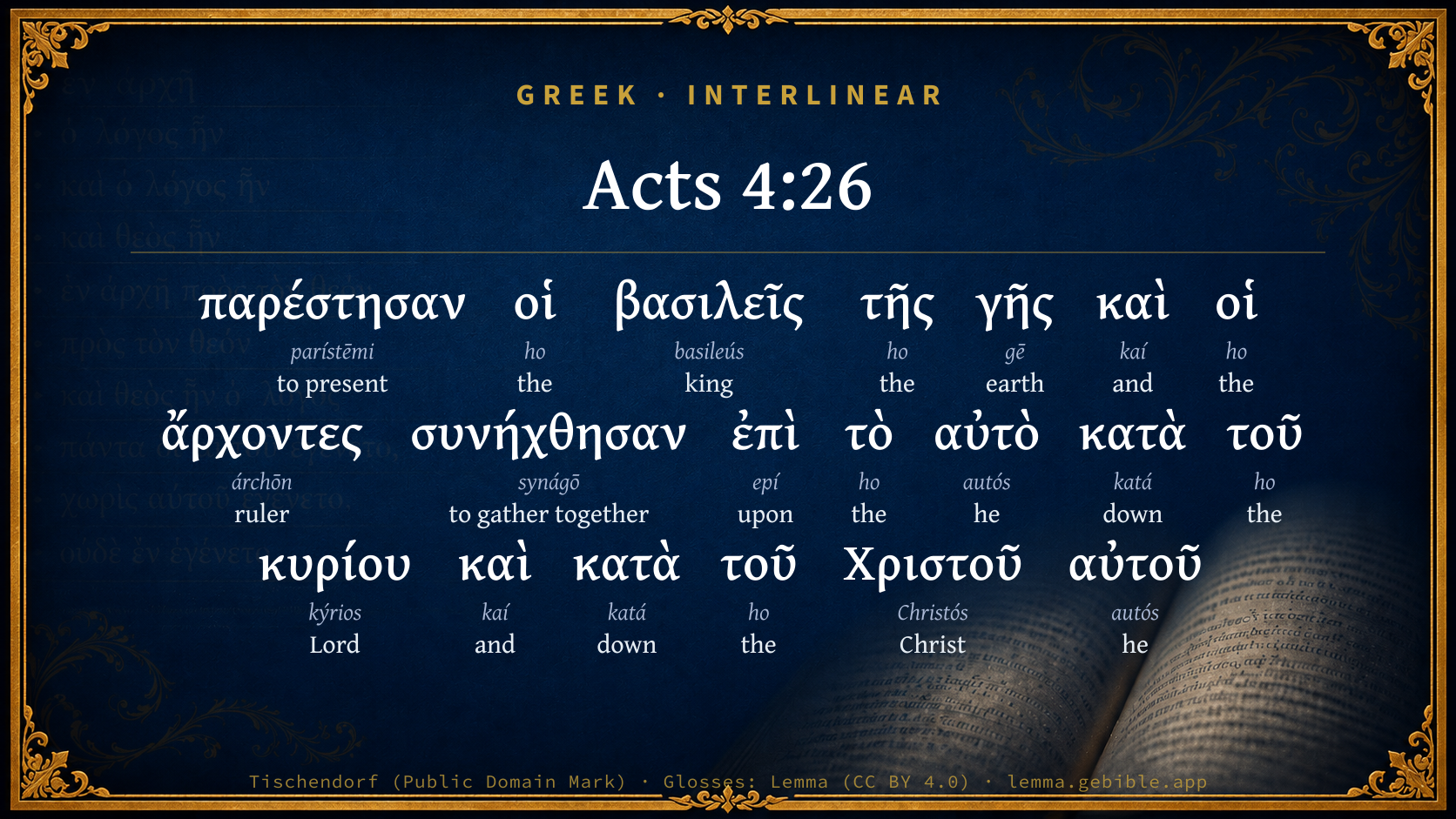
Greek (Tischendorf 8th ed.) Acts 4:26 appears in the Greek New Testament. The text above is from the Tischendorf 8th edition. Each word links to its Strong’s number and a concise gloss. Click any word for its full Thayer’s Greek Lexicon entry.
Download image
Cite this verse

Acts 4:26 (World English Bible). Public Domain. Lemma interlinear Bible study tool, https://lemma.gebible.app/v/acts/4/26.

Show BibTeX & RIS
BibTeX
RIS
English Translation
The kings of the earth take a stand, And the rulers take council together, Against the Lord, and against his Christ.'
World English Bible · Public Domain
Download a study sheet

One document with this verse’s original text, its word-by-word gloss line, the meaning frame, cross-references with their text, attributed commentary, and full source and license credits — printable, and it pastes into notes with its structure intact.

This verse Autodidact and up

Study sheet (.html) Plain text (.txt)

A passage Seminary Student

Up to 50 verses in one chapter. A passage sheet keeps up to 6 commentary sources and 12 cross-references per verse, in the order this page ranks them, and says so on the sheet whenever that leaves anything out. Ask for a single verse and you get the Autodidact verse sheet above.

Everything on this page stays free to read, with no account — the sheet is a download of what is already on screen, not access to it.

Want to remove ads? Support Godless Engineer
Compare translations 3

The same verse in 3 English versions, stacked beneath the original-language interlinear above. Click any original word for its lexicon entry.

Each is an independent rendering of the whole verse — the interlinear is not word-aligned to these translations.

Highlighted words mark where these versions differ — a whole-verse word diff, not a word-by-word alignment.

  • World English Bible Public Domain
    The kings of the earth take a stand, And the rulers take council together, Against the Lord, and against his Christ.'
  • King James Version Public Domain
    The kings of the earth stood up, and the rulers were gathered together against the Lord, and against his Christ.
  • unfoldingWord Literal Text CC BY-SA 4.0
    The kings of the earth took their stand and the rulers were gathered to the same against the Lord and against his Christ.’

unfoldingWord Literal Text — © unfoldingWord, licensed CC BY-SA 4.0. Word-aligned USFM3 via Door43 (git.door43.org/unfoldingWord/en_ult).

Versions to compare (up to 4)

3 of 4 selected

Show all 19 translations

Every available English version of this verse, each an independent rendering of the whole verse.

  • World English Bible Public Domain
    The kings of the earth take a stand, And the rulers take council together, Against the Lord, and against his Christ.'
  • Berean Standard Bible Public Domain
    The kings of the earth take their stand and the rulers gather together against the Lord and against His Anointed One.’
  • Majority Standard Bible Public Domain
    The kings of the earth take their stand and the rulers gather together against the Lord and against His Anointed One.’
  • King James Version Public Domain
    The kings of the earth stood up, and the rulers were gathered together against the Lord, and against his Christ.
  • American Standard Version (1901) Public Domain
    The kings of the earth set themselves in array, And the rulers were gathered together, Against the Lord, and against his Anointed:
  • Revised Version (1885) Public Domain
    The kings of the earth set themselves in array, And the rulers were gathered together, Against the Lord, and against his Anointed:
  • Geneva Bible (1599) Public Domain
    The Kings of the earth assembled, and the rulers came together against the Lord, and against his Christ.
  • Douay-Rheims (1899) Public Domain
    The kings of the earth stood up, and the princes assembled together against the Lord and his Christ.
  • Young's Literal Translation Public Domain
    the kings of the earth stood up, and the rulers were gathered together against the Lord and against His Christ;
  • Literal Standard Version CC BY-SA 4.0
    The kings of the earth stood up, and the rulers were gathered together against the LORD and against His Christ;
  • Unlocked Literal Bible CC BY-SA 4.0
    You said, 'The kings of the earth set themselves together, and the rulers gathered together against the Lord, and against his Christ.'
  • unfoldingWord Literal Text CC BY-SA 4.0
    The kings of the earth took their stand and the rulers were gathered to the same against the Lord and against his Christ.’
  • Darby Bible Public Domain
    The kings of the earth were there, and the rulers were gathered together against the Lord and against his Christ.
  • World Messianic Bible Public Domain
    The kings of the earth take a stand, and the rulers plot together, against the Lord, and against his Messiah.’
  • Webster's Bible Public Domain
    The kings of the earth stood up, and the rulers were assembled against the Lord, and against his Christ.
  • Free Bible Version CC BY-SA 4.0
    The kings of the earth prepared for war; the rulers united together against the Lord and against his Chosen One.’
  • Bible in Basic English Public Domain
    The kings of the earth were lifted up, the rulers came together, against the Lord, and against his Christ:
  • Text-Critical English NT CC BY 4.0
    The kings of the earth stand up, and the rulers are gathered together, against the Lord and against his Anointed.’
  • Tyndale New Testament (1534) Public Domain
    The kynges of the erth stode vp and the rulars came to gedder agaynst the Lorde and agaynst his Christ.

Literal Standard Version (2020), Covenant Press — licensed CC BY-SA 4.0. Text via the HelloAO Bible API (eBible.org). Unlocked Literal Bible (unfoldingWord) — licensed CC BY-SA 4.0. Text via the HelloAO Bible API (eBible.org). unfoldingWord Literal Text — © unfoldingWord, licensed CC BY-SA 4.0. Word-aligned USFM3 via Door43 (git.door43.org/unfoldingWord/en_ult). Free Bible Version, Dr. Jonathan Gallagher — licensed CC BY-SA 4.0. Text via the HelloAO Bible API (eBible.org).

Word by word

More ways to search: Search by grammar → Find every occurrence → Compare this word →

Practice this passage: Drill this verse → Learn its vocabulary →

ἄρχοντες
árchōn
G758
“ruler”
Noun, Nominative, Plural, Masculine
Part of Speech
Noun
Case
Nominative
Number
Plural
Gender
Masculine
Full Thayer's Definition

Origin: present participle of G757

TDNT: 09:08,8

1. a ruler, commander, chief, leader
  1. παρέστησαν parístēmi G3936 “to present” Verb, Aorist, Active, Indicative, 3rd person, Plural
  2. οἱ ho G3588 “the” Article, Nominative, Plural, Masculine
  3. βασιλεῖς basileús G935 “king” Noun, Nominative, Plural, Masculine
  4. τῆς ho G3588 “the” Article, Genitive, Singular, Feminine
  5. γῆς gē G1093 “earth” Noun, Genitive, Singular, Feminine
  6. καὶ kaí G2532 “and” Conjunction
  7. οἱ ho G3588 “the” Article, Nominative, Plural, Masculine
  8. συνήχθησαν synágō G4863 “to gather together” Verb, Aorist, Passive, Indicative, 3rd person, Plural
  9. ἐπὶ epí G1909 “upon” Preposition
  10. τὸ ho G3588 “the” Article, Accusative, Singular, Neuter
  11. αὐτὸ autós G846 “he” Personal pronoun, Accusative, Singular, Neuter
  12. κατὰ katá G2596 “down” Preposition
  13. τοῦ ho G3588 “the” Article, Genitive, Singular, Masculine
  14. κυρίου kýrios G2962 “Lord” Noun, Genitive, Singular, Masculine
  15. καὶ kaí G2532 “and” Conjunction
  16. κατὰ katá G2596 “down” Preposition
  17. τοῦ ho G3588 “the” Article, Genitive, Singular, Masculine
  18. Χριστοῦ Christós G5547 “Christ” Noun, Genitive, Singular, Masculine
  19. αὐτοῦ autós G846 “he” Personal pronoun, Genitive, Singular, Masculine

About this verse

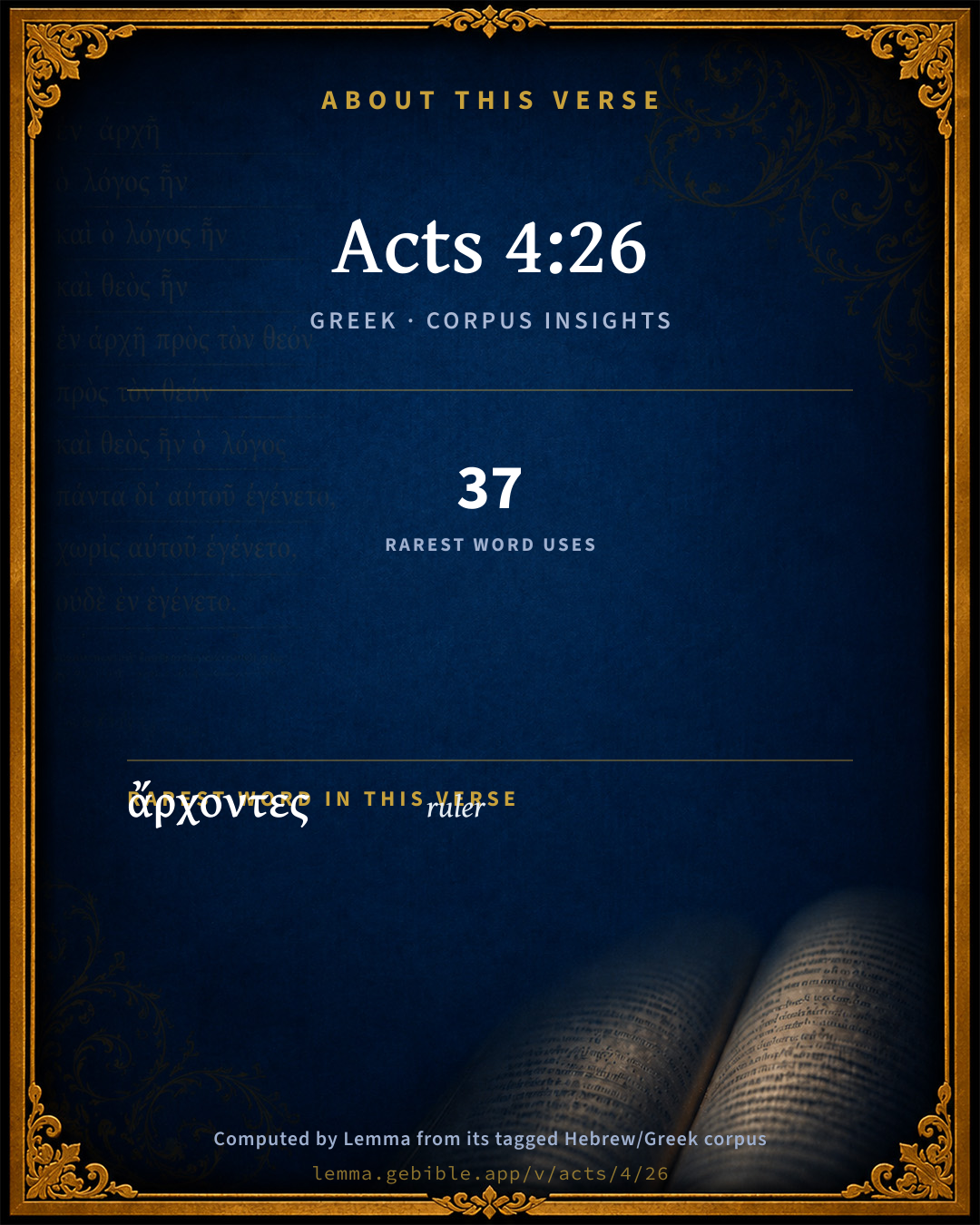
These counts appear in no published source. They are computed here, from the morphology-tagged text and Lemma’s own curated glosses. What Lemma adds →

20
words
12
distinct lemmas
Acts
section

Shared distinctive vocabulary

ἄρχοντες ruler G758 occurs in 36 verses of the Greek New Testament. Also found in:
Repetition

Words recur within this verse:

Cross-references

12

Topical passages linked to Acts 4:26 in the Treasury of Scripture Knowledge — connected by theme and wording, ordered by reader-vote popularity; previews shown in the World English Bible.

  • Psalms 2:2 The kings of the earth take a stand, And the rulers take counsel together, Against Yahweh, and against his anointed, saying,
  • Revelation 17:12–14 The ten horns that you saw are ten kings who have received no kingdom as yet, but they receive authority as kings, with the beast, for one hour.
  • Daniel 9:24 Seventy weeks are decreed on your people and on your holy city, to finish disobedience, and to make an end of sins, and to make reconciliation for iniquity, and to bring in everlasting righteousness, and to seal up vision and prophecy, and to anoint the most holy.
  • Psalms 83:2–8 For, behold, your enemies are stirred up. Those who hate you have lifted up their heads.
  • Acts 10:38 even Jesus of Nazareth, how God anointed him with the Holy Spirit and with power, who went about doing good and healing all who were oppressed by the devil, for God was with him.
  • Hebrews 1:9 You have loved righteousness, and hated iniquity; Therefore God, your God, has anointed you with the oil of gladness above your fellows."
  • Joel 3:9–14 Proclaim this among the nations: Prepare war. Stir up the mighty men. Let all the warriors draw near. Let them come up.
  • Luke 4:18 "The Spirit of the Lord is on me, Because he has anointed me to preach good news to the poor. He has sent me to heal the brokenhearted, To proclaim release to the captives, Recovering of sight to the blind, To deliver those who are crushed,
  • Revelation 17:17 For God has put in their hearts to do what he has in mind, and to be of one mind, and to give their kingdom to the beast, until the words of God should be accomplished.
  • Revelation 11:15 The seventh angel sounded, and great voices in heaven followed, saying, "The kingdom of the world has become the Kingdom of our Lord, and of his Christ. He will reign forever and ever!"
  • Revelation 12:10 I heard a loud voice in heaven, saying, "Now is come the salvation, the power, and the Kingdom of our God, and the authority of his Christ; for the accuser of our brothers has been thrown down, who accuses them before our God day and night.
  • Revelation 19:16–21 He has on his garment and on his thigh a name written, "KING OF KINGS, AND LORD OF LORDS."

Cross-references courtesy of OpenBible.info (CC BY 4.0).

Commentary

Notes on Acts 4:26 from classic Christian and Jewish commentators (each source and its license shown beneath its notes). The classic Christian expositions comment on the surrounding passage and are grouped to its opening verse, so a note may address several verses; the Jewish commentaries on the Tanakh (Rashi and others) are per-verse, so they appear only where the commentator wrote on this verse.

Lemma curates 59 commentaries, every one of them public domain or Creative Commons licensed, each selected and text-cleaned for this edition rather than reprinted as found. About our sources →

Tyndale Open Study Notes

Tyndale Open Resources

4:26 The Hebrew term Messiah (“anointed one”) originally referred to Israel’s anointed king; it came to refer to the Messiah, the coming King of Israel who would establish God’s Kingdom forever (2 Sam 7:14-16; Ps 89:36-37; Isa 9:6-7; 11:1-9; 61:1; Jer 23:5-6; 33:14-16; Luke 1:32-33).

Tyndale Open Study Notes — © Tyndale Open Resources, licensed CC BY-SA 4.0. Text via the HelloAO Bible API.

Bengel's Gnomon

Johann Albrecht Bengel

Act 4:26. Οἱ βασιλεῖς τῆς γῆς, the kings of the earth) All the kingdoms of the world have at some time or other assailed the Gospel.—οἱ ἄρχοντες, the rulers) Pilate was the representative of these; as Herod was of “the kings.” The prophecy and the event accurately correspond. Subsequently we read of Herod, not Pilate, having afflicted also the apostles.

Bengel's Gnomon of the New Testament — English translation (T&T Clark, Edinburgh, 1860) — public domain. Text from a community e-Sword module.

Expositor's Greek Testament

ed. W. Robertson Nicoll

Act 4:26 . παρέστησαν : not necessarily of hostile intent, although here the context indicates it; R.V., “set themselves in array,” lit [162] “presented themselves,” an exact rendering of the Hebrew יָצַב , which sometimes implies rising up against as here, Psa 2:2 , and cf. 2Sa 18:13 (R.V. margin). Of the generally accepted Messianic interpretation of the Psalm, and of the verses here quoted, there can be no doubt, cf. Edersheim, Jesus the Messiah , ii., 716 (appendix on Messianic passages), and Wetstein, in loco . The Psalm is regarded as full of Messianic references (Briggs, Messianic Prophecy , pp. 132 140, and 492, 493), cf., e.g. , the comment on this verse of the Psalm in the Mechilta (quoted in the Yalkut Shimeoni , ii., f. 90, 1 Sch. p. 227), Perowne, Psalms (small edition), p. 16; and Edersheim, u. s . The Psalm carries us back to the great Davidic promise in 2Sa 7:11-16 , and it reflects the Messianic hopes of the Davidic period. That hope the N.T. writers who quote this Psalm very frequently or refer to it, cf. Act 13:33 , Heb 1:5 ; Heb 5:5 , see fulfilled in Christ, the antitype of David and of Solomon. Thus the gathering together of the nations and their fruitless decrees find their counterpart in the alliance of Herod and Pilate, and the hostile combination of Jew and Gentile against the holy Servant Jesus, the anointed of God, and against His followers; although the words of the Psalm and the issues of the conflict carry on our thoughts to a still wider and deeper fulfilment in the final triumph of Christ’s kingdom, cf. the frequent recurrence of the language of the Psalm in Rev 12:5 ; Rev 19:15 , and cf. Rev 1:5 ; Rev 2:26-27 .

[162] literal, literally.

The Expositor's Greek Testament, edited by W. Robertson Nicoll (1897–1910) — public domain. Text from a community e-Sword module.

Adam Clarke's Commentary

Verse 26. Against the Lord and against his Christ.] κατα του χριστου αυτου should be translated, against his ANOINTED, because it particularly agrees with ονεχρισας, whom thou hast ANOINTED, in the succeeding verse.

Adam Clarke's Commentary on the Bible (1810–1826) — public domain. Text from a community e-Sword/MySword module.

John Calvin's Commentaries

26. Against the Lord, and his Christ. The Spirit teacheth by this word, that all those do make war against God which refuse to submit themselves to Christ; they do full little think this oftentimes, notwithstanding it is so that because God will reign in the person of his Son alone, we refuse to obey him so often as we rebel against Christ, as the Lord himself saith in John, “He which honoreth not the Son, honoreth not the Father.” Wherefore let the hypocrites profess a thousand times that they mean nothing less than to make war against God, yet shall they find this true, that God is their open enemy, unless they embrace Christ with his gospel. The use of this doctrine is double, for it armeth us against all the terrors of the flesh, because we must not fear, lest they get the victory of God which withstand the gospel. Again, we must beware, lest, through the contempt of godly doctrine, we advance ourselves against God to our own destruction.

John Calvin's Commentaries (1540-1563) — public domain. Text from the Calvin Translation Society English edition (1840s-50s) via the Christian Classics Ethereal Library (ccel.org). Calvin's coverage is partial (roughly two-thirds of the Bible); uncommented books and verses are honest gaps, never fabricated. The 19th-century editor's footnotes and remarks are omitted so the notes are faithfully Calvin's own voice.

Ellicott's Commentary for English Readers

(26) And against his Christ.—The question whether the word “Christ” should be used as a proper name, or translated, is commonly answered by accepting the former alternative. Here, perhaps, to maintain the connection with the Psalm and with the verb in the next verse, it would be better to say, “against His Anointed.” The “Lord” stands, of course, for the Supreme Deity of the Father.

A Bible Commentary for English Readers, edited by Charles John Ellicott (1878–1897) — public domain. Text from a community e-Sword module.

John Gill's Exposition

The kings of the earth stood up,.... Herod Antipas, tetrarch of Galilee, sometimes called a king, Mar 6:14 and Pilate the Roman governor, who represented his master Caesar; these stood, or rose up in an hostile manner, and set themselves against, and opposed themselves to the Messiah, Jesus of Nazareth:

and the rulers were gathered together; the Jewish rulers, Annas, Caiaphas, and the rest of the members of the sanhedrim, who met together more than once; and particularly at the high priest's palace, to consult how they should take Jesus and put him to death; and who also gathered together at the same place, when he was taken, to arraign, examine, and condemn him. And this opposition, and these conspiracies and consultations, were

against the Lord: Jehovah, the Father of Christ, who sent him, and anointed him; so that what was done against Christ, was done against the Lord, their views and designs, their interest and glory, being the same:

and against his Christ; or anointed one, who was anointed by him, with the Holy Ghost, from his birth, and at his baptism, to be prophet, priest, and King.

John Gill's Exposition of the Whole Bible (1746–1763) — public domain (CC PDM 1.0). Text via the HelloAO Bible API.

Trapp's Complete Commentary

John Trapp

26 The kings of the earth stood up, and the rulers were gathered together against the Lord, and against his Christ.

Ver. 26. Gathered together] Heb. Took counsel together. They plot and plough mischief to the Church, but all in vain, Psa 37:12; Job 4:8.

John Trapp, A Commentary or Exposition upon All the Books of the Old and New Testament (1647–1656) — public domain. Text from a community e-Sword module.

Albert Barnes' Notes on the Bible

The kings of the earth - The Psalmist specifies more particularly that kings and rulers would be opposed to the Messiah. This had occurred already by the opposition made to the Messiah by the rulers of the Jewish people, and it would be still more evinced by the opposition of princes and kings as the gospel spread among the nations.

Stood up - The word used here παρίστημι paristēmi commonly means “to present oneself, or to stand forth, for the purpose of aiding, counseling,” etc. But here it means that they “rose,” or “presented themselves,” to evince their opposition. They stood opposed to the Messiah, and offered resistance to him.

The rulers - This is another instance of the Hebrew parallelism. The word does not denote another class of people from kings, but expresses the same idea in another form, or in a more general manner, meaning that all classes of persons in authority would be opposed to the gospel.

Were gathered together - Hebrew, consulted together; were united in a consultation. The Greek implies that they were assembled for the purpose of consultation.

Against the Lord - In the Hebrew, “against Yahweh.” This is the special name which is given in the Scriptures to God. They rose against his plan of appointing a Messiah, and against the Messiah whom he had chosen.

Against his Christ - Hebrew, against his Messiah, or his Anointed. See the notes on Mat 1:1. This is one of the places where the word “Messiah” is used in the Old Testament. The word occurs in about 40 places, and is commonly translated “his anointed,” and is applied to kings. The direct reference of the word to the Messiah in the Old Testament is not frequent. This passage implies that opposition to the Messiah is opposition to Yahweh. And this is uniformly supposed in the sacred Scriptures. He that is opposed to Christ is opposed to God. He that neglects him neglects God. He that despises him despises God, Mat 10:40; Mat 18:5; Joh 12:44-45; Luk 10:16, “He that despiseth me, despiseth him that sent me.” The reasons of this are:

That the Messiah is “the brightness of the Father’s glory, and the express image of his person,” Heb 1:3.

(2)He is equal with the Father, possessing the same attributes and the same power, Joh 1:1; Phi 2:6.

(3)He is appointed by God to this great work of saving people. To despise him, or to oppose him, is to despise and oppose him who appointed him to this work, to contemn his counsels, and to set him at naught.

(4)His work is dear to God. It has engaged his thoughts. It has been approved by him. His mission has been confirmed by the miraculous power of the Father, and by every possible manifestation of his approbation and love. To oppose the Messiah is, therefore, to oppose what is dear to the heart of God, and which has long been the object of his tender solicitude. It follows from this, that they who neglect the Christian religion are exposing themselves to the displeasure of God, and endangering their everlasting interests. No man is safe who opposes God; and no man can have evidence that God will approve him who does not embrace the Messiah, whom He has appointed to redeem the world.

Albert Barnes' Notes on the Bible (1834–1885) — public domain. Text from a community e-Sword/MySword module.

Matthew Poole's English Annotations

These words do not vary in sense from what we read, Psa 2:2, but are the same for substance.

The kings; not only such who in a strict sense we call kings, but any chief governors, as Herod and Pilate were.

The rulers; the sanhedrim, or great council of the Jews.

Against the Lord; God looks upon it as done against him, whatsoever is done against them that fear him; thus the Israelites are said to be

gathered together against the Lord, Num 16:11, who were gathered against Moses and Aaron.

And against his Christ; our Saviour was at the right hand of his Father, but they who afflict his members afflict him; he cries from heaven to Saul, Why persecutest thou me? Act 9:4; and had before told his disciples, He that despiseth you despiseth me, Luk 10:16.

Matthew Poole's English Annotations on the Holy Bible (1683–1685) — public domain. Text from a community e-Sword/MySword module.

Whedon's Commentary on the Bible

Daniel D. Whedon

26. Heathen, people, kings, rulers, are all in array against Jehovah and his Anointed, (Psa_2:2,) that is, his Messiah or Christ.

Daniel D. Whedon (gen. ed.), Commentary on the Old and New Testaments (1874–1909) — public domain. Text from a community e-Sword module.

The Pulpit Commentary

Set themselves in array for stood up, A.V.; Anointed for Christ, A.V. Set themselves in array, Paristhmi does not specially mean "to set themselves in array," which implies a battle, of which there is not question home, but it means simply "to present" or "show themselves" (Act_1:3) "to be ready," or, as in ver. 10, "to stand." Anointed. The text in the whole citation follows the LXX exactly.

The Pulpit Commentary (1880–1919), ed. H.D.M. Spence-Jones & Joseph S. Exell — public domain. Text from a community e-Sword module.

MacLaren's Expositions of Holy Scripture

Alexander MacLaren

Acts

OBEDIENT DISOBEDIENCE

Act 4:19 - Act 4:31.

The only chance for persecution to succeed is to smite hard and swiftly. If you cannot strike, do not threaten. Menacing words only give courage. The rulers betrayed their hesitation when the end of their solemn conclave was but to ‘straitly threaten’; and less heroic confessors than Peter and John would have disregarded the prohibition as mere wind. None the less the attitude of these two Galilean fishermen is noble and singular, when their previous cowardice is remembered. This first collision with civil authority gives, as has been already noticed, the main lines on which the relations of the Church to hostile powers have proceeded.

I. The heroic refusal of unlawful obedience.

We shall probably not do injustice to John if we suppose that Peter was spokesman. If so, the contrast of the tone of his answer with all previously recorded utterances of his is remarkable. Warm-hearted impulsiveness, often wrong-headed and sometimes illogical, had been their mark; but here we have calm, fixed determination, which, as is usually its manner, wastes no words, but in its very brevity impresses the hearers as being immovable. Whence did this man get the power to lay down once for all the foundation principles of the limits of civil obedience, and of the duty of Christian confession? His words take rank with the ever-memorable sayings of thinkers and heroes, from Socrates in his prison telling the Athenians that he loved them, but that he must ‘obey God rather than you,’ to Luther at Worms with his ‘It is neither safe nor right to do anything against conscience. Here I stand; I can do nothing else. God help me! Amen.’ Peter’s words are the first of a long series.

This first instance of persecution is made the occasion for the clear expression of the great principles which are to guide the Church. The answer falls into two parts, in the first of which the limits of obedience to civil authority are laid down in a perfectly general form to which even the Council are expected to assent, and in the second an irresistible compulsion to speak is boldly alleged as driving the two Apostles to a flat refusal to obey.

It was a daring stroke to appeal to the Council for an endorsement of the principle in Act 4:19, but the appeal was unanswerable; for this tribunal had no other ostensible reason for existence than to enforce obedience to the law of God, and to Peter’s dilemma only one reply was possible. But it rested on a bold assumption, which was calculated to irritate the court; namely, that there was a blank contradiction between their commands and God’s, so that to obey the one was to disobey the other. When that parting of the ways is reached, there remains no doubt as to which road a religious man must take.

The limits of civil obedience are clearly drawn. It is a duty, because ‘the powers that be are ordained of God,’ and obedience to them is obedience to Him. But if they, transcending their sphere, claim obedience which can only be rendered by disobedience to Him who has appointed them, then they are no longer His ministers, and the duty of allegiance falls away. But there must be a plain conflict of commands, and we must take care lest we substitute whims and fancies of our own for the injunctions of God. Peter was not guided by his own conceptions of duty, but by the distinct precept of his Master, which had bid him speak. It is not true that it is the cause which makes the martyr, but it is true that many good men have made themselves martyrs needlessly. This principle is too sharp a weapon to be causelessly drawn and brandished. Only an unmistakable opposition of commandments warrants its use; and then, he has little right to be called Christ’s soldier who keeps the sword in the scabbard.

The articulate refusal in Act 4:20 bases itself on the ground of irrepressible necessity: ‘We cannot but speak.’ The immediate application was to the facts of Christ’s life, death, and glory. The Apostles could not help speaking of these, both because to do so was their commission, and because the knowledge of them and of their importance forbade silence. The truth implied is of wide reach. Whoever has a real, personal experience of Christ’s saving power, and has heard and seen Him, will be irresistibly impelled to impart what he has received. Speech is a relief to a full heart. The word, concealed in the prophet’s heart, burned there ‘like fire in his bones, and he was weary of forbearing.’ So it always is with deep conviction. If a man has never felt that he must speak of Christ, he is a very imperfect Christian. The glow of his own heart, the pity for men who know Him not, his Lord’s command, all concur to compel speech. The full river cannot be dammed up.

II. The lame and impotent conclusion of the perplexed Council.

How plain the path is when only duty is taken as a guide, and how vigorously and decisively a man marches along it! Peter had no hesitation, and his resolved answer comes crashing in a straight course, like a cannon-ball. The Council had a much more ambiguous oracle to consult in order to settle their course, and they hesitate accordingly, and at last do a something which is a nothing. They wanted to trim their sails to catch popular favour, and so they could not do anything thoroughly. To punish or acquit was the only alternative for just judges. But they were not just; and as Jesus had been crucified, not because Pilate thought Him guilty, but to please the people, so His Apostles were let off, not because they were innocent, but for the same reason. When popularity-hunters get on the judicial bench, society must be rotten, and nearing its dissolution. To ‘decree unrighteousness by a law’ is among the most hideous of crimes. Judges ‘willing to wound, and yet afraid to strike,’ are portents indicative of corruption. We may remark here how the physician’s pen takes note of the patient’s age, as making his cure more striking, and manifestly miraculous.

III. The Church’s answer to the first assault of the world’s power.

How beautifully natural that is, ‘Being let go, they went to their own,’ and how large a principle is expressed in the naive words! The great law of association according to spiritual affinity has much to do in determining relations here. It aggregates men, according to sorts; but its operation is thwarted by other conditions, so that companionship is often misery. But a time comes when it will work unhindered, and men will be united with their like, as the stones on some sea-beaches are laid in rows, according to their size, by the force of the sea. Judas ‘went to his own place,’ and, in another world, like will draw to like, and prevailing tendencies will be increased by association with those who share them.

The prayer of the Church was probably the inspired outpouring of one voice, and all the people said ‘Amen,’ and so made it theirs. Whose voice it was which thus put into words the common sentiment we should gladly have known, but need not speculate. The great fact is that the Church answered threats by prayer. It augurs healthy spiritual life when opposition and danger neither make cheeks blanch with fear nor flush with anger. No man there trembled nor thought of vengeance, or of repaying threats with threats. Every man there instinctively turned heavenwards, and flung himself, as it were, into God’s arms for protection. Prayer is the strongest weapon that a persecuted Church can use. Browning makes a tyrant say, recounting how he had tried to crush a man, that his intended victim

‘Stood erect, caught at God’s skirts, and prayed,

So I was afraid.’

The contents of the prayer are equally noteworthy. Instead of minutely studying it verse by verse, we may note some of its salient points. Observe its undaunted courage. That company never quivered or wavered. They had no thought of obeying the mandate of the Council. They were a little army of heroes. What had made them so? What but the conviction that they had a living Lord at God’s right hand, and a mighty Spirit in their spirits? The world has never seen a transformation like that. Unique effects demand unique causes for their explanation, and nothing but the historical truth of the facts recorded in the last pages of the Gospels and first of the Acts accounts for the demeanour of these men.

Their courage is strikingly marked by their petition. All they ask is ‘boldness’ to speak a word which shall not be theirs, but God’s. Fear would have prayed for protection; passion would have asked retribution on enemies. Christian courage and devotion only ask that they may not shrink from their duty, and that the word may be spoken, whatever becomes of the speakers. The world is powerless against men like that. Would the Church of to-day meet threats with like unanimity of desire for boldness in confession? If not, it must be because it has not the same firm hold of the Risen Lord which these first believers had. The truest courage is that which is conscious of its weakness, and yet has no thought of flight, but prays for its own increase.

We may observe, too, the body of belief expressed in the prayer. First it lays hold on the creative omnipotence of God, and thence passes to the recognition of His written revelation. The Church has begun to learn the inmost meaning of the Old Testament, and to find Christ there. David may not have written the second Psalm. Its attribution to him by the Church stands on a different level from Christ’s attribution of authorship, as, for instance, of the hundred and tenth Psalm. The prophecy of the Psalm is plainly Messianic, however it may have had a historical occasion in some forgotten revolt against some Davidic king; and, while the particular incidents to which the prayer alludes do not exhaust its far-reaching application, they are rightly regarded as partly fulfilling it. Herod is a ‘king of the earth,’ Pilate is a ‘ruler’; Roman soldiers are Gentiles; Jewish rulers are the representatives of ‘the people.’ Jesus is ‘God’s Anointed.’ The fact that such an unnatural and daring combination of rebels was predicted in the Psalm bears witness that even that crime at Calvary was foreordained to come to pass, and that God’s hand and counsel ruled. Therefore all other opposition, such as now threatened, will turn out to be swayed by that same Mighty Hand, to work out His counsel. Why, then, should the Church fear? If we can see God’s hand moving all things, terror is dead for us, and threats are like the whistling of idle wind.

Mark, too, the strong expression of the Church’s dependence on God. ‘Lord’ here is an unusual word, and means ‘Master,’ while the Church collectively is called ‘Thy servants,’ or properly, ‘slaves.’ It is a different word from that of ‘servant’ {rather than ‘child’} applied to Jesus in Act 4:27 - Act 4:30. God is the Master, we are His ‘slaves,’ bound to absolute obedience, unconditional submission, belonging to Him, not to ourselves, and therefore having claims on Him for such care as an owner gives to his slaves or his cattle. He will not let them be maltreated nor starved. He will defend them and feed them; but they must serve him by life, and death if need be. Unquestioning submission and unreserved dependence are our duties. Absolute ownership and unshared responsibility for our well-being belong to Him.

Further, the view of Christ’s relationship to God is the same as occurs in other of the early chapters of the Acts. The title of ‘Thy holy Servant Jesus’ dwells on Christ’s office, rather than on His nature. Here it puts Him in contrast with David, also called ‘Thy servant.’ The latter was imperfectly what Jesus was perfectly. His complete realisation of the prophetic picture of the Servant of the Lord in Isaiah is emphasised by the adjective ‘holy,’ implying complete devotion or separation to the service of God, and unsullied, unlimited moral purity. The uniqueness of His relation in this aspect is expressed by the definite article in the original. He is the Servant, in a sense and measure all His own. He is further the Anointed Messiah. This was the Church’s message to Israel and the stay of its own courage, that Jesus was the Christ, the Anointed and perfect Servant of the Lord, who was now in heaven, reigning there. All that this faith involved had not yet become clear to their consciousness, but the Spirit was guiding them step by step into all the truth; and what they saw and heard, not only in the historical facts of which they were the witnesses, but in the teaching of that Spirit, they could not but speak.

The answer came swift as the roll of thunder after lightning. They who ask for courage to do God’s will and speak Christ’s name have never long to wait for response. The place ‘was shaken,’ symbol of the effect of faithful witness-bearing, or manifestation of the power which was given in answer to their prayer. ‘They were all filled with the Holy Ghost,’ who now did not, as before, confer ability to speak with other tongues, but wrought no less worthily in heartening and fitting them to speak ‘in their own tongue, wherein they were born,’ in bold defiance of unlawful commands.

The statement of the answer repeats the petition verbatim: ‘With all boldness they spake the word.’ What we desire of spiritual gifts we get, and God moulds His replies so as to remind us of our petitions, and to show by the event that these have reached His ear and guided His giving hand.

Alexander MacLaren, Expositions of Holy Scripture (1904–1910) — public domain. Text from a community e-Sword module.

Scofield Reference Notes

C. I. Scofield

Lord Jehovah. Psa 2:2.

Christ Anointed. Psa 2:2.

The Scofield Reference Bible (1917 edition), notes by C. I. Scofield — public domain. Text from a community e-Sword module.

McGarvey & Pendleton's Commentaries

J. W. McGarvey

See notes on verse 23

J. W. McGarvey (with Philip Y. Pendleton), Commentaries on the New Testament (The Fourfold Gospel, 1914; Acts; and the epistles) — public domain. Text from a community e-Sword/MySword module.

unfoldingWord translationNotes

Door43 World Missions Community

Connecting Statement:

The believers complete their quotation from King David in the Psalms that they began in Acts 4:25.

The kings of the earth set themselves together, and the rulers gathered together against the Lord

These two lines mean basically the same thing. The two lines emphasize the combined effort of the earth's rulers to oppose God. (See: Parallelism)

set themselves together ... gathered together

These two phrases mean that they joined their armies together to fight a battle. AT: "set their armies together ... gathered their troops together" (See: Metonymy)

against the Lord, and against his Christ

Here the word "Lord" refers to God. In the Psalms, the word "Christ" refers to the Messiah or God's anointed one.

translationWords

king

rule

lord

Christ

unfoldingWord translationNotes — © Distant Shores Media and the Door43 World Missions Community, licensed CC BY-SA 4.0. Source: git.door43.org/Door43/en_tn.

Lesson kit

Teaching starters — assembled from the data on this page, not authored interpretation. Every prompt links to the verse data it draws on. Edit before teaching.

Acts, in the Acts, opens this verse with 20 words (12 distinct Greek lemmas). Its most distinctive word is árchōn (“ruler”). A historical commentator’s framing appears above. Read the whole chapter for the surrounding context.

Discussion questions

  1. How does “ruler” (árchōn) shape what this verse is saying?
  2. How does Matthew 9:18, which shares the word «ruler», read alongside this verse?
  3. What does the repetition of “down” (2× in this one verse) do in this verse?
  4. The translations on this page render this verse differently — a whole-verse word diff, not a word-by-word alignment. What might account for the different wordings?
  5. Compare how Tyndale Open Study Notes and Bengel's Gnomon read this verse. Where do they agree or differ?

Things to notice

  • These translations choose different wording for 9 words in this verse.
  • “down” occurs 2× in this single verse.
  • 12 distinct Greek lemmas span 20 words in this verse.

Reading settings

Reading text

Shown beneath each verse's original-language words.

Old Testament
Old Testament edition

Read the OT as the Masoretic Hebrew (MT) or the Greek Septuagint (LXX).

English shown for the Greek Septuagint (in the Hebrew ↔ Greek comparison).

Comparing translations? Open the Compare panel on any verse page to stack up to four side by side.