2 Peter 3:7

Greek (Tischendorf 8th ed.) 2 Peter 3:7 appears in the Greek New Testament. The text above is from the Tischendorf 8th edition. Each word links to its Strong’s number and a concise gloss. Click any word for its full Thayer’s Greek Lexicon entry.
Download image
Cite this verse

2 Peter 3:7 (World English Bible). Public Domain. Lemma interlinear Bible study tool, https://lemma.gebible.app/v/2-peter/3/7.

Show BibTeX & RIS
BibTeX
RIS
English Translation
But the heavens that now are, and the earth, by the same word have been stored up for fire, being reserved against the day of judgment and destruction of ungodly men.
World English Bible · Public Domain
Download a study sheet

One document with this verse’s original text, its word-by-word gloss line, the meaning frame, cross-references with their text, attributed commentary, and full source and license credits — printable, and it pastes into notes with its structure intact.

This verse Autodidact and up

Study sheet (.html) Plain text (.txt)

A passage Seminary Student

Up to 50 verses in one chapter. A passage sheet keeps up to 6 commentary sources and 12 cross-references per verse, in the order this page ranks them, and says so on the sheet whenever that leaves anything out. Ask for a single verse and you get the Autodidact verse sheet above.

Everything on this page stays free to read, with no account — the sheet is a download of what is already on screen, not access to it.

Want to remove ads? Support Godless Engineer
Compare translations 3

The same verse in 3 English versions, stacked beneath the original-language interlinear above. Click any original word for its lexicon entry.

Each is an independent rendering of the whole verse — the interlinear is not word-aligned to these translations.

Highlighted words mark where these versions differ — a whole-verse word diff, not a word-by-word alignment.

  • World English Bible Public Domain
    But the heavens that now are, and the earth, by the same word have been stored up for fire, being reserved against the day of judgment and destruction of ungodly men.
  • King James Version Public Domain
    But the heavens and the earth, which are now, by the same word are kept in store, reserved unto fire against the day of judgment and perdition of ungodly men.
  • unfoldingWord Literal Text CC BY-SA 4.0
    But the present heavens and the earth, by the same word, are having been reserved for fire, being kept for a day of judgment and destruction of the ungodly men.

unfoldingWord Literal Text — © unfoldingWord, licensed CC BY-SA 4.0. Word-aligned USFM3 via Door43 (git.door43.org/unfoldingWord/en_ult).

Versions to compare (up to 4)

3 of 4 selected

Show all 19 translations

Every available English version of this verse, each an independent rendering of the whole verse.

  • World English Bible Public Domain
    But the heavens that now are, and the earth, by the same word have been stored up for fire, being reserved against the day of judgment and destruction of ungodly men.
  • Berean Standard Bible Public Domain
    And by that same word, the present heavens and earth are reserved for fire, being kept for the day of judgment and destruction of ungodly men.
  • Majority Standard Bible Public Domain
    And by His word, the present heavens and earth are reserved for fire, being kept for the day of judgment and destruction of ungodly men.
  • King James Version Public Domain
    But the heavens and the earth, which are now, by the same word are kept in store, reserved unto fire against the day of judgment and perdition of ungodly men.
  • American Standard Version (1901) Public Domain
    but the heavens that now are, and the earth, by the same word have been stored up for fire, being reserved against the day of judgment and destruction of ungodly men.
  • Revised Version (1885) Public Domain
    but the heavens that now are, and the earth, by the same word have been stored up for fire, being reserved against the day of judgment and destruction of ungodly men.
  • Geneva Bible (1599) Public Domain
    But the heauens and earth, which are nowe, are kept by the same word in store, and reserued vnto fire against the day of condemnation, and of the destruction of vngodly men.
  • Douay-Rheims (1899) Public Domain
    But the heavens and the earth which are now, by the same word are kept in store, reserved unto fire against the day of judgment and perdition of the ungodly men.
  • Young's Literal Translation Public Domain
    and the present heavens and the earth, by the same word are treasured, for fire being kept to a day of judgment and destruction of the impious men.
  • Literal Standard Version CC BY-SA 4.0
    and by the same word, the present heavens and earth, having been stored up for fire, are being preserved until [the] day of judgment and destruction of impious men.
  • Unlocked Literal Bible CC BY-SA 4.0
    But now the heavens and the earth are reserved for fire by that same command. They are reserved for the day of judgment and the destruction of the ungodly people.
  • unfoldingWord Literal Text CC BY-SA 4.0
    But the present heavens and the earth, by the same word, are having been reserved for fire, being kept for a day of judgment and destruction of the ungodly men.
  • Darby Bible Public Domain
    But the present heavens and the earth by his word are laid up in store, kept for fire unto a day of judgment and destruction of ungodly men.
  • World Messianic Bible Public Domain
    But the heavens that exist now and the earth, by the same word have been stored up for fire, being reserved against the day of judgment and destruction of ungodly men.
  • Webster's Bible Public Domain
    But the heavens and the earth, which are now, by the same word are kept in store, reserved to fire against the day of judgment and perdition of ungodly men.
  • Free Bible Version CC BY-SA 4.0
    But by means of that same divine command the heavens and the earth that now exist are reserved for destruction by fire at the day of judgment when the wicked will be destroyed.
  • Bible in Basic English Public Domain
    But the present heaven and the present earth have been kept for destruction by fire, which is waiting for them on the day of the judging and destruction of evil men.
  • Text-Critical English NT CC BY 4.0
    Furthermore, by his word the heavens and the earth that now exist have been reserved for fire, being kept until the day of judgment and the destruction of the ungodly.
  • Tyndale New Testament (1534) Public Domain
    But the heves verely and erth which are now are kept by the same worde in store and reserved vnto fyre agaynst the daye of iudgement and perdicion of vngodly men.

Literal Standard Version (2020), Covenant Press — licensed CC BY-SA 4.0. Text via the HelloAO Bible API (eBible.org). Unlocked Literal Bible (unfoldingWord) — licensed CC BY-SA 4.0. Text via the HelloAO Bible API (eBible.org). unfoldingWord Literal Text — © unfoldingWord, licensed CC BY-SA 4.0. Word-aligned USFM3 via Door43 (git.door43.org/unfoldingWord/en_ult). Free Bible Version, Dr. Jonathan Gallagher — licensed CC BY-SA 4.0. Text via the HelloAO Bible API (eBible.org).

Word by word

More ways to search: Search by grammar → Find every occurrence → Compare this word →

Practice this passage: Drill this verse → Learn its vocabulary →

τεθησαυρισμένοι
thēsaurízō
G2343
“to store up”
Verb, Perfect, Passive, Participle, Nominative, Plural, Masculine
Part of Speech
Verb
Tense
Perfect
Voice
Passive
Mood
Participle
Case
Nominative
Number
Plural
Gender
Masculine
Full Thayer's Definition

Origin: from G2344

TDNT: 05:18,3

1. to gather and lay up, to heap up, store up a. to accumulate riches b. to keep in store, store up, reserve 2. metaph. so to live from day to day as to increase either the bitterness or the happiness of one's consequent lot
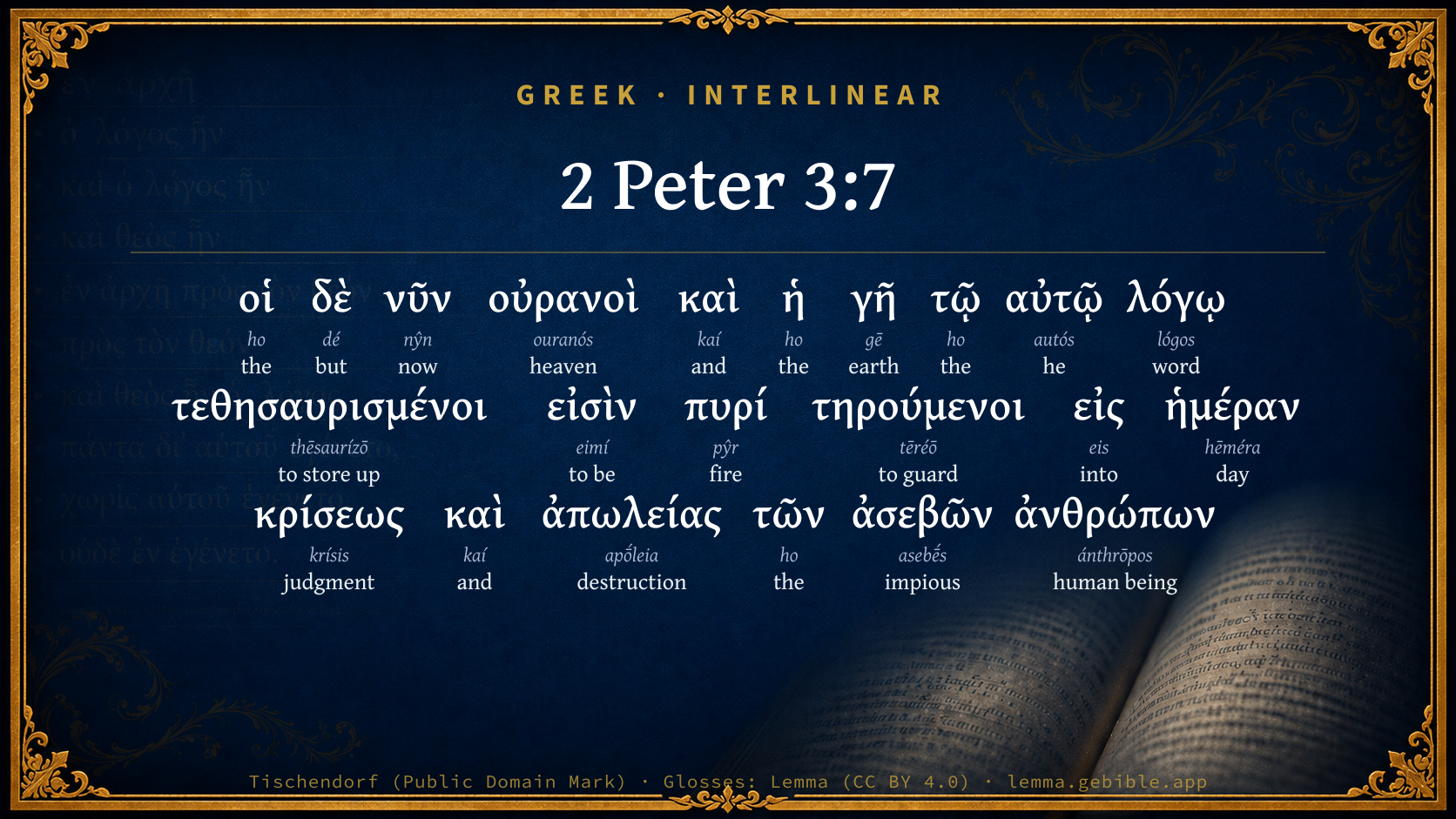
  1. οἱ ho G3588 “the” Article, Nominative, Plural, Masculine
  2. δὲ dé G1161 “but” Conjunction
  3. νῦν nŷn G3568 “now” Adverb
  4. οὐρανοὶ ouranós G3772 “heaven” Noun, Nominative, Plural, Masculine
  5. καὶ kaí G2532 “and” Conjunction
  6. ἡ ho G3588 “the” Article, Nominative, Singular, Feminine
  7. γῆ gē G1093 “earth” Noun, Nominative, Singular, Feminine
  8. τῷ ho G3588 “the” Article, Dative, Singular, Masculine
  9. αὐτῷ autós G846 “he” Personal pronoun, Dative, Singular, Masculine
  10. λόγῳ lógos G3056 “word” Noun, Dative, Singular, Masculine
  11. εἰσὶν eimí G1510 “to be” Verb, Present, Active, Indicative, 3rd person, Plural
  12. πυρί pŷr G4442 “fire” Noun, Dative, Singular, Neuter
  13. τηρούμενοι tēréō G5083 “to guard” Verb, Present, Passive, Participle, Nominative, Plural, Masculine
  14. εἰς eis G1519 “into” Preposition
  15. ἡμέραν hēméra G2250 “day” Noun, Accusative, Singular, Feminine
  16. κρίσεως krísis G2920 “judgment” Noun, Genitive, Singular, Feminine
  17. καὶ kaí G2532 “and” Conjunction
  18. ἀπωλείας apṓleia G684 “destruction” Noun, Genitive, Singular, Feminine
  19. τῶν ho G3588 “the” Article, Genitive, Plural, Masculine
  20. ἀσεβῶν asebḗs G765 “impious” Adjective, Genitive, Plural, Masculine
  21. ἀνθρώπων ánthrōpos G444 “human being” Noun, Genitive, Plural, Masculine

About this verse

These counts appear in no published source. They are computed here, from the morphology-tagged text and Lemma’s own curated glosses. What Lemma adds →

22
words
18
distinct lemmas
General Epistles
section

Notable vocabulary

The rarest word here is τεθησαυρισμένοι to store up G2343 — appearing just 8 times in the whole Greek New Testament.

Shared distinctive vocabulary

τεθησαυρισμένοι to store up G2343 occurs in 8 verses of the Greek New Testament. Also found in:

Repetition

Words recur within this verse:

Cross-references

25

Topical passages linked to 2 Peter 3:7 in the Treasury of Scripture Knowledge — connected by theme and wording, ordered by reader-vote popularity; previews shown in the World English Bible.

  • Isaiah 51:6 Lift up your eyes to the heavens, and look on the earth beneath; for the heavens shall vanish away like smoke, and the earth shall wax old like a garment; and those who dwell therein shall die in like manner: but my salvation shall be forever, and my righteousness shall not be abolished.
  • 2 Peter 3:10 But the day of the Lord will come as a thief in the night; in which the heavens will pass away with a great noise, and the elements will be dissolved with fervent heat, and the earth and the works that are in it will be burned up.
  • 2 Peter 3:12 looking for and earnestly desiring the coming of the day of God, by reason of which the heavens being on fire will be dissolved, and the elements will melt with fervent heat?
  • Revelation 21:1 I saw a new heaven and a new earth: for the first heaven and the first earth have passed away, and the sea is no more.
  • Matthew 24:35 Heaven and earth will pass away, but my words will not pass away.
  • 2 Thessalonians 1:7–8 and to give relief to you that are afflicted with us, when the Lord Jesus is revealed from heaven with his mighty angels in flaming fire,
  • 2 Peter 2:9 the Lord knows how to deliver the godly out of temptation and to keep the unrighteous under punishment for the day of judgment;
  • Matthew 25:41 Then he will say also to those on the left hand, 'Depart from me, you cursed, into the eternal fire which is prepared for the devil and his angels;
  • Matthew 12:36 I tell you that every idle word that men speak, they will give account of it in the day of judgment.
  • Jude 1:7 Even as Sodom and Gomorrah, and the cities around them, having, in the same way as these, given themselves over to sexual immorality and gone after strange flesh, are set forth as an example, suffering the punishment of eternal fire.
  • Revelation 20:11 I saw a great white throne, and him who sat on it, from whose face the earth and the heaven fled away. There was found no place for them.
  • Philippians 1:28 and in nothing frightened by the adversaries, which is for them a proof of destruction, but to you of salvation, and that from God.
  • 1 Timothy 6:9 But those who are determined to be rich fall into a temptation and a snare and many foolish and harmful lusts, such as drown men in ruin and destruction.
  • Psalms 50:3 Our God comes, and does not keep silent. A fire devours before him. It is very tempestuous around him.
  • Psalms 102:26 They will perish, but you will endure. Yes, all of them will wear out like a garment. You will change them like a cloak, and they will be changed.
  • Zephaniah 3:8 "Therefore wait for me," says Yahweh, "until the day that I rise up to the prey, for my determination is to gather the nations, that I may assemble the kingdoms, to pour on them my indignation, even all my fierce anger, for all the earth will be devoured with the fire of my jealousy.
  • Matthew 10:15 Most assuredly I tell you, it will be more tolerable for the land of Sodom and Gomorrah in the day of judgment than for that city.
  • Matthew 11:22 But I tell you, it will be more tolerable for Tyre and Sidon on the day of judgment than for you.
  • Matthew 11:24 But I tell you that it will be more tolerable for the land of Sodom, on the day of judgment, than for you."
  • Mark 6:11 Whoever will not receive you nor hear you, as you depart from there, shake off the dust that is under your feet for a testimony against them. Assuredly, I tell you, it will be more tolerable for Sodom and Gomorrah in the day of judgment than for that city!"
  • Romans 2:5 But according to your hardness and unrepentant heart you are treasuring up for yourself wrath in the day of wrath, revelation, and of the righteous judgment of God;
  • 2 Thessalonians 2:3 Let no one deceive you in any way. For it will not be, unless the departure comes first, and the man of sin is revealed, the son of destruction,
  • 1 John 4:17 In this love has been made perfect among us, that we may have boldness in the day of judgment, because as he is, even so are we in this world.
  • Revelation 17:8 The beast that you saw was, and is not; and is about to come up out of the abyss and to go into destruction. Those who dwell on the earth and whose names have not been written in the book of life from the foundation of the world will marvel when they see that the beast was, and is not, and shall be present.
  • Revelation 17:11 The beast that was, and is not, is himself also an eighth, and is of the seven; and he goes to destruction.

Cross-references courtesy of OpenBible.info (CC BY 4.0).

Where the printed editions differ

1 variant

Places in this verse where the major printed Greek editions disagree on the wording in a way that affects the translation — a comparison of editions, not a manuscript-by-manuscript collation. The editions are the modern critical texts (Nestlé-Aland 28/27, SBL, Westcott-Hort, Tregelles, Tyndale House) and the traditional texts behind the KJV (the Textus Receptus and the Byzantine/Majority text). It is not a claim about which reading is original.

  1. Different wording
    αὐτῷ

    “same”

    In NA28NA27TynSBLWHKJV Not in TregTRByz

    αὐτοῦ (autou) 'of him' occurs in a few manuscripts (Treg+TR+Byz) instead of αὐτῷ (autō) 'same' in older manuscripts (NA28+NA27+Tyn+SBL+WH+KJV)

Textual data: Translators Amalgamated Greek New Testament (STEPBible TAGNT) · CC BY 4.0.

Commentary

Notes on 2 Peter 3:7 from classic Christian and Jewish commentators (each source and its license shown beneath its notes). The classic Christian expositions comment on the surrounding passage and are grouped to its opening verse, so a note may address several verses; the Jewish commentaries on the Tanakh (Rashi and others) are per-verse, so they appear only where the commentator wrote on this verse.

Lemma curates 59 commentaries, every one of them public domain or Creative Commons licensed, each selected and text-cleaned for this edition rather than reprinted as found. About our sources →

Joseph Benson's Commentary

2Pe 3:7. But — Though the destruction of the old world by water shows that the present world may be destroyed, I do not say it will be destroyed by water. No: the heavens and the earth, which are now — This whole sublunary world; by the same word — Which at first created them, and afterward destroyed them, and then again restored them; are kept in store — Τεθησαυρισμενοι εισι πυρι τηρουμενοι, are treasured up and preserved for fire; that is, preserved from a deluge for the purpose of being burned. Therefore the earth is not always to remain, but is to suffer a destruction even more terrible than the former; at the day of judgment and perdition of ungodly men — The day when God will judge the world, and punish the ungodly with everlasting destruction. “In regard that Hammond and some other celebrated commentators understand this prophecy as a prediction of the destruction of Jerusalem, it will be proper here to inform the reader, that in support of their interpretation they appeal to the ancient Jewish prophecies, where, as they contend, the revolutions in the political state of empires and nations are foretold in the same forms of expression with those introduced in St. Peter’s prediction. The following are the prophecies to which they appeal: Isa 34:4; Eze 32:7; Joe 2:10; Joe 2:30-31; Amo 8:9; Hag 2:6; Mat 24:29. Now it is remarkable, in these prophecies none of the prophets have spoken, as Peter has done, of the entire destruction of this mundane system, nor of the destruction of any part thereof. They mention only the rolling of the heavens together as a scroll, the obscuring of the light of the sun and of the moon, the shaking of the heavens and the earth, and the falling down of the stars. Whereas Peter speaks of the utter destruction of all the parts of this mundane system by fire. This difference affords room for believing that the events foretold by the prophets are different in their nature from those foretold by the apostle; and that they are to be figuratively understood, while those predicted by the apostle are to be understood literally. To this conclusion likewise the phraseology of the prophets, compared with that of the apostle, evidently leads. For the prophetic phraseology, literally interpreted, exhibits impossibilities; such as the rolling of the heavens together as a scroll, the turning of the moon into blood, and the falling down of the stars from heaven as the leaf of a tree. Not so the apostolic phraseology. For the burning of the heavens, or atmosphere, and its passing away with a great noise, and the burning of the earth and the works thereon, together with the burning and melting of the elements, that is, of the constituent parts of which this terraqueous globe is composed, are all things possible, and therefore may be literally understood; while the things mentioned by the prophets can only be taken figuratively. This, however, is not all. There are things in the apostle’s prophecy which show that he intended it to be taken literally. As, 1st, He begins with an account of the perishing of the old world, to demonstrate, against the scoffers, the possibility of the perishing of the present heavens and earth. But that example would not have suited his purpose unless, by the burning of the present heavens and earth, he had meant the destruction of the material fabric. Wherefore the opposition stated in this prophecy between the perishing of the old world by water, and the perishing of the present world by fire, shows that the latter is to be as real a destruction of the material fabric as the former was. 2d, The circumstances of the present heavens and earth being treasured up and kept, ever since the first deluge, from all after deluges, in order to their being destroyed by fire at the day of judgment, shows that the apostle is speaking of a real, and not of a metaphorical destruction of the heavens and the earth. 3d, This appears likewise from the apostle’s foretelling, that after the present heavens and earth are burned, a new heaven and a new earth are to appear, in which the righteous are to dwell for ever. 4th, The time fixed by the apostle for the burning of the heavens and the earth, namely, the day of judgment and punishment of ungodly men, shows that the apostle is speaking, not of the destruction of a single city or nation during the subsistence of the world, but of the earth itself, with all the wicked who have dwelt thereon. These circumstances show that this prophecy, as well as the one recorded 2Th 1:9, is not to be interpreted metaphorically of the destruction of Jerusalem, but should be understood literally of the destruction of our mundane system, and of the general judgment.”

Joseph Benson's Commentary on the Old and New Testaments (1811–1818) — public domain. Text from a community e-Sword module.

Tyndale Open Study Notes

Tyndale Open Resources

3:7 The Old Testament associates fire with the day of the Lord (see Isa 30:30; 66:15-16).

Tyndale Open Study Notes — © Tyndale Open Resources, licensed CC BY-SA 4.0. Text via the HelloAO Bible API.

Bengel's Gnomon

Johann Albrecht Bengel

2Pe 3:7. Οἱ δὲ νῦν οὐρανοὶ, but the heavens which now are) The heavens are the same and the earth is the same, as of old (although they appear to have undergone no slight change at the deluge): but the mockers speak as though they were not at all the same. The apostle expresses their feeling, δὲ, but, makes an antithesis: by water, and, for or unto fire. Fire shall refute the mockers. This verse also depends upon that, 2Pe 3:5.—τῷ αὐτοῦ) The article is rarely placed before αὐτοῦ;[19] but it is thus placed, Heb 2:4; Jas 1:18.—τεθησαυρισμένοι, reserved) Therefore it is that the heavens and the earth do not more quickly grow old.—πυρὶ, unto or for, fire) The Dative. Let those fiery meteors be thought of, which in our time often gleam from the lofty sky.—τῶν ἀσεβῶν, of the ungodly) these very persons, and the others.

[19] Nevertheless the reading αὐτῷ, which is set down by the margin of the larger Ed. among those not to be approved of, in the margin of Ed. 2 is put on a level with the reading αὐτοῦ; and the Germ. Vers. bas “durch eben das Wort.”—E. B.

Τῷ αὐτῷ is read by AB (according to Lachm.) Vulg. Memph.: and so Lachm. But Τῷ αὐτοῦ, by B (according to Tisch.) C: and so Tisch. Stephens’ Rec. Text omits τῷ; but not so the Elzev. Rec. Text.—E.

Bengel's Gnomon of the New Testament — English translation (T&T Clark, Edinburgh, 1860) — public domain. Text from a community e-Sword module.

Meyer's Critical & Exegetical Commentary

Heinrich August Wilhelm Meyer

2Pe_3:7. οἱ δὲ οὐρανοὶ καὶ ἡ γῆ] The νῦν, which applies also to ἡ γῆ, cannot, if by ὁ τότε κόσμος is to be understood the world of living beings, be taken as an antithesis to τότε, but it refers simply to the present continuance of heaven and earth.

τῷ αὐτῷ [αὐτοῦ] λόγῳ] points back τῷ τοῦ Θεοῦ λόγῳ, 2Pe_3:5; if the reading αὐτοῦ be adopted, this adjunct gives expression to the thought that, like as the originating of the heavens and the earth was dependent on the Word of God, so also is their preservation to annihilation by fire. If, however, αὐτῷ be the true reading, the idea seems to be implied that the reservation of the heavens and the earth unto judgment is based already on the words of creation.[93] Though this idea be surprising, it can certainly not, with Hofmann, be said to be paradoxical. It is, however, also possible that ΑὐΤῷ is only meant to show that the word by which this keeping of the heavens and the earth takes place, is the Word of God equally with that by which they were created.

ΤΕΘΗΣΑΥΡΙΣΜΈΝΟΙ ΕἸΣΊ] are stored up, like a treasure, which is kept against a particular time, cf. Rom_2:5. Dietlein is of opinion that in the word the idea of use must be kept hold of; he defines it thus: that heaven and earth are to serve as the material for punishment, in such a manner, however, that they at the same time perish themselves; but this is justified neither by the reference (Rom_2:5), nor by the context.

πυρὶ ΤΗΡΟΎΜΕΝΟΙ Κ.Τ.Λ.] In that they are reserved for the fire against the day, etc.; πυρί is more appropriately joined with ΤΗΡΟΎΜΕΝΟΙ (Brückner, Fronmüller) than with ΤΕΘΗΣΑΥΡΙΣΜΈΝΟΙ ΕἸΣΊ (Wiesinger, Schott, Hofmann); this last term does not require the adjunct, since in itself it corresponds to the ἮΣΑΝ … ΣΥΝΕΣΤῶΣΑ, and it is only in the second member of the sentence that mention can be made of the future destruction by fire; otherwise, too, ΤΗΡΟΎΜΕΝΟΙ would be somewhat superfluous. The thought alluded to in ΠΥΡῚ ΤΗΡΟΎΜΕΝΟΙ is further developed in 2Pe_3:10. Nowhere in the O. T. or N. T. is this idea so definitely expressed as here; yet from this it does not follow that it is to be traced to Greek, more particularly to the Stoic philosophy, or to Oriental mythology. The O. T. makes frequent reference to a future change in the present condition of the world (Heaven and earth shall pass away, Psa_102:26-27), in connection with the appearance of God to judgment; cf. Isa_34:4; Isa_51:6; especially Isaiah 66, where in Isa_66:22 a new heaven and a new earth is expressly spoken of; thus, too, Job_14:12. Equally is it more than once set forth that God will come to judgment in the destroying fire, Isa_66:15, Dan_7:9-10, etc.; how easily, then, from passages such as these could the conception which finds expression here arise,[94] the more especially that it was promised that the world would never again be destroyed by a flood, and the destruction of Sodom and Gomorrah by fire appeared to be a type of the future judgment of the world.

Conceptions as to the worlds destruction similar to those in the O. T. are to be found in the N. T. Mat_5:18 (Mat_5:24; Mat_5:29), Heb_12:27; of fire accompanying the judgment, 1Co_3:13, 2Th_1:8; of the new heaven and the new earth, Rev_21:1.

εἰς ἡμέραν … ἀνθρώπων] The final end against which heaven and earth remain reserved for fire; ἈΠΏΛΕΙΑ: the opposite of ΣΩΤΗΡΊΑ, cf. Php_1:28 (chap. 2Pe_2:3).

Dietlein erroneously understands ΤῶΝ ἈΣΕΒῶΝ ἈΝΘΡΏΠΩΝ as a designation of the whole of mankind, in that, with the exception of the converted, they are ungodly. To any such exception there is here no reference; the phrase has reference rather to the ungodly in contrast to the godly.

[93] Dietlein: The sense is this, that the same λόγος which created the world, assigned also to the post-Noachic world its time and its judgment.

[94] When Schott denies this, and asserts in opposition that the passages Isa_66:15 ff., together with Mal_3:1-3; Mal_4:1, are the complete statements of that event, surely no judicious expositor will agree with him.

Meyer — Critical and Exegetical Commentary on the New Testament — English translation by Peter Christie, edited by Frederick Crombie (T&T Clark, 1880) — public domain. Text from a community e-Sword module.

Expositor's Greek Testament

ed. W. Robertson Nicoll

2Pe 3:7 . πυρὶ τηρούμενοι . According to the Jewish conception of the rainbow promise, water would not again be the destructive agency. The heaven and the earth are reserved for destruction by fire. τεθησαυρισμένοι : “set apart for”. The writer means that both the rainbow promise and the delay are not to be regarded as implying that there will be no more great cosmical changes.

The idea of the association of a great cosmical change with the coming of Christ is an interesting one. It involves the question of our environment when the natural is exchanged for the spiritual body. This writer evidently expects not complete annihilation of the present environment, but a “new heaven and a new earth, wherein dwelleth righteousness” (2Pe 3:13 ). St. Paul speaks of “the deliverance of the creation itself from the bondage of corruption into the glory of the liberty of the children of God”. “We are not informed as to the nature of our future environment, yet it must be such as to satisfy all the longings, and give scope for all the activities of a perfected humanity” (Mayor, ed. p. 207. See also his most interesting and suggestive note: “ Answer to the objection that no change is possible in the material universe ”; and with whole passage, 2Pe 3:5-7 , cf. Ruskin, Sesame and Lilies , p. 24.)

The Expositor's Greek Testament, edited by W. Robertson Nicoll (1897–1910) — public domain. Text from a community e-Sword module.

Geneva Bible (1599)

Geneva Bible translators

Thirdly, he pronounceth that it shall not be harder for God to burn heaven and earth with fire in that day which is appointed for the destruction of the wicked, (which thing he will also do) than it was for him in times past to make them with his only word and afterward to overwhelm them with water.

Geneva Bible (1599) marginal notes — public domain. Text via Bolls.life.

Jamieson, Fausset & Brown

Robert Jamieson, A. R. Fausset & David Brown

(Compare Job 28:5, end).

which are now--"the postdiluvian visible world." In contrast to "that then was," Pe2 3:6.

the same--Other oldest manuscripts read, "His" (God's).

kept in store--Greek, "treasured up."

reserved--"kept." It is only God's constantly watchful providence which holds together the present state of things till His time for ending it.

Jamieson, Fausset & Brown — Commentary Critical and Explanatory on the Whole Bible (1871) — public domain (CC PDM 1.0). Text via the HelloAO Bible API.

Adam Clarke's Commentary

Verse 7. But the heavens and the earth, which are now] The present earth and its atmosphere, which are liable to the same destruction, because the same means still exist, (for there is still water enough to drown the earth, and there is iniquity enough to induce God to destroy it and its inhabitants,) are nevertheless kept in store, τεθησαυρισμενοι, treasured up, kept in God's storehouse, to be destroyed, not by water, but by fire at the day of judgment.

From all this it appears that those mockers affected to be ignorant of the Mosaic account of the formation of the earth, and of its destruction by the waters of the deluge; and indeed this is implied in their stating that all things continued as they were from the creation. But St. Peter calls them back to the Mosaic account, to prove that this was false; for the earth, c., which were then formed, had perished by the flood and that the present earth, &c., which were formed out of the preceding, should, at the day of judgment, perish by the fire of God's wrath.

Adam Clarke's Commentary on the Bible (1810–1826) — public domain. Text from a community e-Sword/MySword module.

John Calvin's Commentaries

7. But the heavens and the earth which are now. He does not infer this as the consequence; for his purpose was no other than to dissipate the craftiness of scoffers respecting the perpetual state of nature, and we see many such at this day who being slightly embued with the rudiments of philosophy, only hunt after profane speculations, in order that they may pass themselves off as great philosophers.

But it now appears quite evident from what has been said, that there is nothing unreasonable in the declaration made by the Lord, that the heaven and the earth shall hereafter be consumed by fire, because the reason for the fire is the same as that for the water. For it was a common saying even among the ancients, that from these two chief elements all things have proceeded. But as he had to do with the ungodly, he speaks expressly of their destruction.

John Calvin's Commentaries (1540-1563) — public domain. Text from the Calvin Translation Society English edition (1840s-50s) via the Christian Classics Ethereal Library (ccel.org). Calvin's coverage is partial (roughly two-thirds of the Bible); uncommented books and verses are honest gaps, never fabricated. The 19th-century editor's footnotes and remarks are omitted so the notes are faithfully Calvin's own voice.

Ellicott's Commentary for English Readers

(7) By the same word.—Or, as some first-rate authorities read, by His word. The sense in either case is that the universe is preserved for judgment by the same power that created it. “His word” here does not mean any single utterance of God or passage of Scripture, such as Isa_66:15; Dan_7:9-10; Mal_4:1. Just as “the world that then was” was destroyed by water, so the present world is being treasured up to be destroyed by fire. Comp. Rom_2:5. Christ Himself, in a discourse which St. Peter heard (Mar_13:3), had made the Flood a type of the Judgment (Mat_24:37-39). (See below on 2Pe_3:10.) “Unto fire,” or “for fire,” should perhaps be taken with “kept in store” rather than with “reserved.”

A Bible Commentary for English Readers, edited by Charles John Ellicott (1878–1897) — public domain. Text from a community e-Sword module.

The Cambridge Bible for Schools and Colleges

gen. ed. J. J. S. Perowne

7. but the heavens and the earth, which are now, by the same word] Some of the better MSS. give by His word, but the received reading rests on sufficient authority.

are kept in store, reserved unto fire] Literally, are treasured up. The use of the word in reference to punishment has a parallel in Rom_2:5. In naming “fire” as the instrument of that “destruction” of the existing framework of the world, which is, like that by water, to be the starting-point of a new and purified order, the Apostle follows in the track of 2Th_1:8, and Dan_7:9-11. It may be noted, though not as pointing to the source from which the Apostle derived his belief, that this destruction of the world by fire entered into the physical teaching of the Stoics. It is not without interest to note that it was specially prominent in the teaching of Zeno of Tarsus, who succeeded Chrysippus as the leading teacher of the School (Euseb. Praep. Evang. xv. 18). It appears also, in a book probably familiar to the Apostle, the Book of Enoch, c. xc. 11.

against the day of judgment and perdition of ungodly men] The word for “perdition” is the same as that rendered “destruction” in chap. 2Pe_2:1, and is identical in meaning with the verb “perished” in the preceding verse. We cannot accordingly infer from it that the “ungodly” will cease to exist, but only that there will be a great and penal change in their condition. An interesting parallel to the teaching of this passage, probably in great part derived from it, is found in an Oration of Melito of Sardis, translated from the Syriac by Dr Cureton in a. d. 1855. “There was a flood of water.… There will be a flood of fire, and the earth will be burnt up together with its mountains … and the just shall be delivered from its fury, as their fellows in the Ark were saved from the waters of the Deluge.”

The Cambridge Bible for Schools and Colleges (gen. ed. J. J. S. Perowne; Cambridge University Press, 1878–1918) — public domain. Text from a community e-Sword module.

John Gill's Exposition

But the heavens and the earth which are now,.... In being, in distinction from, and opposition to the heavens that were of old, and the earth standing in and out of the water, and the world that then was when the waters of the flood overflowed it:

by the same word are kept in store; that is, by the word of God, as in Pe2 3:5; and the Syriac, Arabic, and Ethiopic versions read, "by his word"; by the same word that the heavens and the earth were made of old, or in the beginning, are they kept, preserved, and upheld in their being; or "are treasured up"; the heavens and the earth are a rich treasure, they are full of the riches God, as the God of nature and providence; and they are kept with care, as a treasure is, not to be touched or meddled with at present, but must continue in the same position and use; or they are laid up in the stores, and scaled up among the treasures of divine wrath and vengeance, and will be brought out another day, and made use of, to the destruction of the ungodly inhabitants of the world, and to aggravate and increase their misery and ruin: for it is further said of them, that they are

reserved unto fire; for though the world is, and has been preserved a long time without any visible alteration in it, yet it will not be always so preserved: and though it is, and will be kept from being drowned by water again, through the promise and power of God, yet it is kept and reserved for a general conflagration; see Pe2 3:10. And as the old world was put into a natural situation, so as to be drowned by water, there are now preparations making in nature, in the present world, for the burning of it; witness the fiery meteors, blazing stars, and burning comets in the heavens, and the subterraneous fires in the bowels of the earth, which in some places have already broke out: there are now many volcanos, burning mountains and islands, particularly in Sicily, Italy, and the parts adjacent, the seat of the beast, and where it is very likely the universal conflagration will begin, as Aetna, Vesuvius, Strombilo, and other volcanos; and even in our own island we have some symptoms and appearances of these fires under ground, as fiery eruptions in some places, and the hot waters at the Bath, and elsewhere, show; from all which it is plain that the heavens and earth, that now are, are not as they always were, and will be, but are reserved and prepared for burning; and that things are ripening apace, as men's sins also are, for the general conflagration. Josephus (w) relates, that Adam foretold that there would be a destruction of all things, once by the force of fire, and once by the power and multitude of water; and it is certain the Jews had knowledge of the destruction of the earth by fire, as by water: they say (x),

"that when the law was given to Israel, his (God's) voice went from one end of the world to the other, and trembling laid hold on all the nations of the world in their temples, and they said a song, as it is said, Psa 29:9, "and in his temple doth everyone speak of his glory": all of them gathered together to wicked Balaam, and said to him, what is the voice of the multitude which we hear, perhaps a flood is coming upon the world? he said unto them, "the Lord sitteth upon the flood, yea, the Lord sitteth King for ever", Psa 29:10. Thus hath the Lord swore, that he will not bring a flood upon the world; they replied to him, a flood of water he will not bring, but , "a flood of fire" he will bring, as it is said, Isa 66:16, "for by fire will the Lord plead",''

or judge: and hence they speak (y) of the wicked being judged with two sorts of, judgments, by water, and by fire: and, according to our apostle, the heavens and earth are kept and reserved to fire,

against the day of judgment, and perdition of ungodly men; the time when God will judge the world is fixed, though it is not known; and it is called a "day", because of the evidence and light in which things will appear, and the quick dispatch of business in it; and the "judgment" spoken of is the future judgment, and which is certain, and will be universal, righteous, and eternal, and when wicked and ungodly men will be punished with everlasting destruction: the bodies of those that will be alive at the general conflagration will be burnt in it, though not annihilated, and will be raised again, and both soul and body will be destroyed in hell.

(w) Antiqu. Jud. l. 1. c. 2. sect. 3. (x) T. Bab. Zebachim, fol. 116. 1. (y) Zohar in Gen. fol. 50. 4. & 51. 1.

John Gill's Exposition of the Whole Bible (1746–1763) — public domain (CC PDM 1.0). Text via the HelloAO Bible API.

Trapp's Complete Commentary

John Trapp

7 But the heavens and the earth, which are now, by the same word are kept in store, reserved unto fire against the day of judgment and perdition of ungodly men.

Ver. 7. Reserved unto fire] The old world was destroyed with water, propter ardorem libidinis, for the heat of their lust, saith Ludolphus; the world that is now shall be destroyed with fire, propter teporem charitatis, for their lack of love. This latter age of the world is so filthy (saith another) that it cannot be washed with water, and shall therefore be wasted with fire.

John Trapp, A Commentary or Exposition upon All the Books of the Old and New Testament (1647–1656) — public domain. Text from a community e-Sword module.

Albert Barnes' Notes on the Bible

But the heavens and the earth which are now - As they now exist. There is no difficulty here respecting what is meant by the word “earth,” but it is not so easy to determine precisely how much is included in the word “heavens.” It cannot be supposed to mean “heaven” as the place where God dwells; nor is it necessary to suppose that Peter understood by the word all that would now be implied in it, as used by a modern astronomer. The word is doubtless employed in a popular signification, referring to the “heavens as they appear to the eye;” and the idea is, that the conflagration would not only destroy the earth, but would change the heavens as they now appear to us. If, in fact, the earth with its atmosphere should be subjected to an universal conflagration, all that is properly implied in what is here said by Peter would occur.

By the same word - Dependent solely on the will of God. He has only to give command, and all will be destroyed. The laws of nature have no stability independent of his will, and at his pleasure all things could be reduced to nothing, as easily as they were made. A single word, a breath of command, from one Being, a Being over whom we have no control, would spread universal desolation through the heavens and the earth. Notwithstanding the laws of nature, as they are called, and the precision, uniformity, and power with which they operate, the dependence of the universe on the Creator is as entire as though there were no such laws, and as though all were conducted by the mere will of the Most High, irrespective of such laws. In fact, those laws have no efficiency of their own, but are a mere statement of the way in which God produces the changes which occur, the methods by which He operates who “works all in all.” At any moment he could suspend them; that is, he could cease to act, or withdraw his efficiency, and the universe would cease to be.

Are kept in store - Greek, “Are treasured up.” The allusion in the Greek word is to anything that is treasured up, or reserved for future use. The apostle does not say that this is the only purpose for which the heavens and the earth are preserved, but that this is one object, or this is one aspect in which the subject may be viewed. They are like treasure reserved for future use.

Reserved unto fire - Reserved or kept to be burned up. See the notes at 2Pe 3:10. The first mode of destroying the world was by water, the next will be by fire. That the world would at some period be destroyed by fire was a common opinion among the ancient philosophers, especially the Greek Stoics. What was the foundation of that opinion, or whence it was derived, it is impossible now to determine; but it is remarkable that it should have accorded so entirely with the statements of the New Testament. The authorities in proof that this opinion was entertained may be seen in Wetstein, in loc. See Seneca, N. Q. iii. 28; Cic. N. D. ii. 46; Simplicius in Arist. de Coelo i. 9; Eusebius, P. xv. 18. It is quite remarkable that there have been among the pagan in ancient and modern times so many opinions that accord with the statements of revelation - opinions, many of them, which could not have been founded on any investigations of science among them, and which must, therefore, have been either the result of conjecture, or handed down by tradition. Whatever may have been their origin, the fact that such opinions prevailed and were believed, may be allowed to have some weight in showing that the statements in the Bible are not improbable.

Against the day of judgment and perdition of ungodly men - The world was destroyed by a flood on account of the wickedness of its inhabitants. It would seem from this passage that it will be destroyed by fire with reference to the same cause; at least, that its destruction by fire will involve the perdition of wicked men. It cannot be inferred from this passage that the world will be as wicked at the general conflagration as it was in the time of Noah; but the idea in the mind of Peter seems to have been, that in the destruction of the world by fire the perdition of the wicked will be involved, or will at that time occur. It also seems to be implied that the fire will accomplish an important agency in that destruction, as the water did on the old world. It is not said, in the passage before us, whether those to be destroyed will be living at that time, or will be raised up from the dead, nor have we any means of determining what was the idea of Peter on that point. All that the passage essentially teaches is, that the world is reserved now with reference to such a consummation by fire; that is, that there are elements kept in store that may be enkindled into an universal conflagration, and that such a conflagration will be attended with the destruction of the wicked.

Albert Barnes' Notes on the Bible (1834–1885) — public domain. Text from a community e-Sword/MySword module.

Matthew Poole's English Annotations

The heavens; the ethereal, or starry heaven, as well as aerial; for, 2Pe 3:10,12, he distinguisheth the heavens that are to perish by fire, from the elements; and 2Pe 3:13, he opposeth a new heaven to that heaven which is to be consumed; but the new heaven is not meant merely of the aerial heaven. And why should not this be meant of the same heavens, which elsewhere in Scripture are said to perish? Job 14:12; Psa 102:26; All of them wax old, & c.

By the same word; the same as 2Pe 3:5.

Are kept in store; are kept safe as in a treasury, and untouched for a time, that they may be destroyed at last.

Reserved unto fire; that they may be consumed by it. The destruction of the world by fire at the last day, is opposed to the destruction of it by water in the flood.

Against the day of judgment; the general judgment.

And perdition of ungodly men; this the apostle speaks with an emphasis, because they were ungodly against whom he here bends his discourse.

Matthew Poole's English Annotations on the Holy Bible (1683–1685) — public domain. Text from a community e-Sword/MySword module.

Whedon's Commentary on the Bible

Daniel D. Whedon

7. Which are now—In antithesis to then was, in 2Pe_3:6.

By the same word—Same as the word of 2Pe_3:6. By that word the cosmos was created; by this, it is retained in existence.

Kept in store—Literal Greek, are treasured.

Perdition—Same Greek word as perished, in 2Pe_3:6.

Daniel D. Whedon (gen. ed.), Commentary on the Old and New Testaments (1874–1909) — public domain. Text from a community e-Sword module.

The Pulpit Commentary

But the heavens and the earth, which are now; rather, the heavens which are now, and the earth. The "now" does not refer, as some think, to any change wrought by the Flood, but distinguishes the present heavens and earth from the new heavens and new earth, which Christians are to look for (verse 13). By the same Word are kept in store, reserved unto fire. Several of the better manuscripts have "by his Word," which, on the whole, seems to give the best meaning. The reading in the text may, indeed, be understood in a similar sense, "by the same Word of God;" otherwise it would mean that the original word of creation determined also the duration of the world and the means of its destruction. The words rendered, "are kept in store," are, literally, "have been treasured (teqhsaurismenoi eijsin). (comp. Rom_2:5) It seems better to take the dative puri ("with fire," or "for fire") with this verb rather than with the following, as in the Authorized Version. If we take the first meaning of the dative, the sense will be that the world has been stored with fire, i.e., that it contains, stored up in its inner depths, the fire which is destined ultimately to destroy it. But the other view seems on the whole more probable; the heavens and the earth are stored up for fire or unto fire, i.e., with the purpose in the counsels of God of their ultimate destruction by fire. This is the clearest prophecy in Holy Scripture of the final conflagration of the universe; but comp. Isa_66:15; Dan_7:10; Mal_4:1; menoi 2Th_1:8. Such a doctrine formed part of the physical theories of the Stoics; it is also found in the "Book of Enoch." Against the day of judgment and perdition of ungodly men. The participle "reserved" (throu) is best taken with this clause: "Reserved against the day of judgment and perdition of ungodly men." But the heavens and the earth, which are now; rather, the heavens which are now, and the earth. The "now" does not refer, as some think, to any change wrought by the Flood, but distinguishes the present heavens and earth from the new heavens and new earth, which Christians are to look for (verse 13). By the same Word are kept in store, reserved unto fire. Several of the better manuscripts have "by his Word," which, on the whole, seems to give the best meaning. The reading in the text may, indeed, be understood in a similar sense, "by the same Word of God;" otherwise it would mean that the original word of creation determined also the duration of the world and the means of its destruction. The words rendered, "are kept in store," are, literally, "have been treasured (teqhsaurismenoi eijsin). (comp. Rom_2:5) It seems better to take the dative puri ("with fire," or "for fire") with this verb rather than with the following, as in the Authorized Version. If we take the first meaning of the dative, the sense will be that the world has been stored with fire, i.e., that it contains, stored up in its inner depths, the fire which is destined ultimately to destroy it. But the other view seems on the whole more probable; the heavens and the earth are stored up for fire or unto fire, i.e., with the purpose in the counsels of God of their ultimate destruction by fire. This is the clearest prophecy in Holy Scripture of the final conflagration of the universe; but comp. Isa_66:15; Dan_7:10; Mal_4:1; menoi 2Th_1:8. Such a doctrine formed part of the physical theories of the Stoics; it is also found in the "Book of Enoch." Against the day of judgment and perdition of ungodly men. The participle "reserved" (throu) is best taken with this clause: "Reserved against the day of judgment and perdition of ungodly men."

The Pulpit Commentary (1880–1919), ed. H.D.M. Spence-Jones & Joseph S. Exell — public domain. Text from a community e-Sword module.

John Wesley's Explanatory Notes

But the heavens and the earth, that are now - Since the flood. Are reserved unto fire at the day wherein God will judge the world, and punish the ungodly with everlasting destruction.

John Wesley, Explanatory Notes Upon the Whole Bible (1754–1765) — public domain. Text via the GEBible commentary corpus.

The People's New Testament

B. W. Johnson

7. By the same word. The heavens and earth of old were formed by the word of God, but the same word, which has always been sure, declares that they are reserved for fire. See Ps. 50:3; 97:3; Isa. 66:15, 24; Dan. 7:9; Mal. 4:1. Against the day of judgment. This destruction by fire will be when the Lord is revealed in judgment and when perdition comes on ungodly men.

B. W. Johnson's The People's New Testament with Notes (1889–1891) — public domain. Electronic text from the Christian Classics Ethereal Library (CCEL) ThML edition.

Cambridge Greek Testament for Schools and Colleges

7. οἱ δὲ νῦν οὐρανοί. He seems to speak of the Flood as if it had destroyed heaven and earth (in the Book of Enoch hyperbolical language of that kind is used of the Flood lxxxiii. 3, in a vision “the heaven collapsed and was borne off and fell to the earth”): and it may have been his view that the upper firmament did fall in and overwhelm the earth. But the general run of thought seems to be this. Of old the heavens were the means of destruction: in the future the heavens themselves will be destroyed (by fire).

τεθησαυρισμένοι πυρί, stored up—reserved—for fire; not stored with fire, which would mean that there was fire latent in them which would some day burst forth and consume them. That was the belief of Valentinus, a great heretical teacher of cent. ii.

τηρούμενοι κ.τ.λ. Cf. 2Pe 2:4; 2Pe 2:9.

Cambridge Greek Testament for Schools and Colleges (Cambridge University Press, 1896; 21 vols, various authors incl. Carr, Maclear, Plummer, Farrar, Lumby, Moule, M. R. James, Simcox) — public domain. Text from a community e-Sword module.

Alford’s Greek Testament

Henry Alford

7.] but the new heavens and earth (contrast to ὁ τότε κόσμος: the postdiluvian visible world) by His (God’s: if αὐτῷ be read, it must not be pressed to signify any one saying, but must refer generally (as with αὐτοῦ) to the prophetic word, which has announced that which comes to be mentioned) word are treasured up (perf. “have been, and are still,” kept in store, put by, against a certain time: see especially ref. Rom. Dietlein fancies that the idea of θησαυρός must be kept hold of, the οὐρανοὶ κ. γῆ being the stored-up material for wrath to be exercised on: but this is mere fancy, and is contradicted by Rom 2:5, where the reference is the same), being kept (present, denoting that it is only God’s constantly watchful Providence which holds together the present state of things till His time for ending it) for fire (πυρί, dat. commodi) against the day of judgment and perdition of impious men (τῶν ἀσεβῶν ἀνθρώπων does not, as Dietlein imagines, import that οἱ ἄνθρωποι, mankind, are ἀσεβεῖς: but = τῶν ἀσεβῶν ἐν ἀνθρώποις).

Henry Alford, The Greek Testament (1849–1861) — public domain. Text from a community e-Sword module.

Vincent's Word Studies in the New Testament

Marvin R. Vincent

The heavens - which now are [οι νυν ουρανοι] . A construction similar to the then world (ver. 6). The now heavens, or the present heavens. Kept in store [τεθησαυρισμενοι] . Rev., stored up. Lit., treasured up. The same word which is used in Luk 12:21, layeth up treasure. Sometimes with the kindred noun qhsaurouv, treasures, as Mt 6:19; lit., treasure treasures.

Unto fire. Some construe this with treasured up; as Rev., stored up for fire; others with reserved, as A. V.; others again give the sense stored with fire, indicating that the agent for the final destruction is already prepared.

Marvin R. Vincent, Word Studies in the New Testament (1887–1900) — public domain. Text from a community e-Sword/MySword module.

Lesson kit

Teaching starters — assembled from the data on this page, not authored interpretation. Every prompt links to the verse data it draws on. Edit before teaching.

2 Peter, in the General Epistles, opens this verse with 22 words (18 distinct Greek lemmas). Its most distinctive word is thēsaurízō (“to store up”). A historical commentator’s framing appears above. Read the whole chapter for the surrounding context.

Discussion questions

  1. What does “to store up” (thēsaurízō) contribute to the verse as a whole?
  2. Matthew 6:19 shares the word «to store up» with this verse. How do the two illuminate each other?
  3. “the” occurs 4× in this one verse. What is the effect of the repetition?
  4. These translations render this verse differently; the difference is in the English rendering, not the original. What questions does that raise?
  5. Reading how Joseph Benson's Commentary and Tyndale Open Study Notes read this verse, where do the two commentators agree and where do they part?

Things to notice

Reading settings

Reading text

Shown beneath each verse's original-language words.

Old Testament
Old Testament edition

Read the OT as the Masoretic Hebrew (MT) or the Greek Septuagint (LXX).

English shown for the Greek Septuagint (in the Hebrew ↔ Greek comparison).

Comparing translations? Open the Compare panel on any verse page to stack up to four side by side.