Ephesians 4:9

Greek (Tischendorf 8th ed.) Ephesians 4:9 appears in the Greek New Testament. The text above is from the Tischendorf 8th edition. Each word links to its Strong’s number and a concise gloss. Click any word for its full Thayer’s Greek Lexicon entry.
Download image
Cite this verse

Ephesians 4:9 (World English Bible). Public Domain. Lemma interlinear Bible study tool, https://lemma.gebible.app/v/ephesians/4/9.

Show BibTeX & RIS
BibTeX
RIS
English Translation
Now this, "He ascended," what is it but that he also first descended into the lower parts of the earth?
World English Bible · Public Domain
Highlights
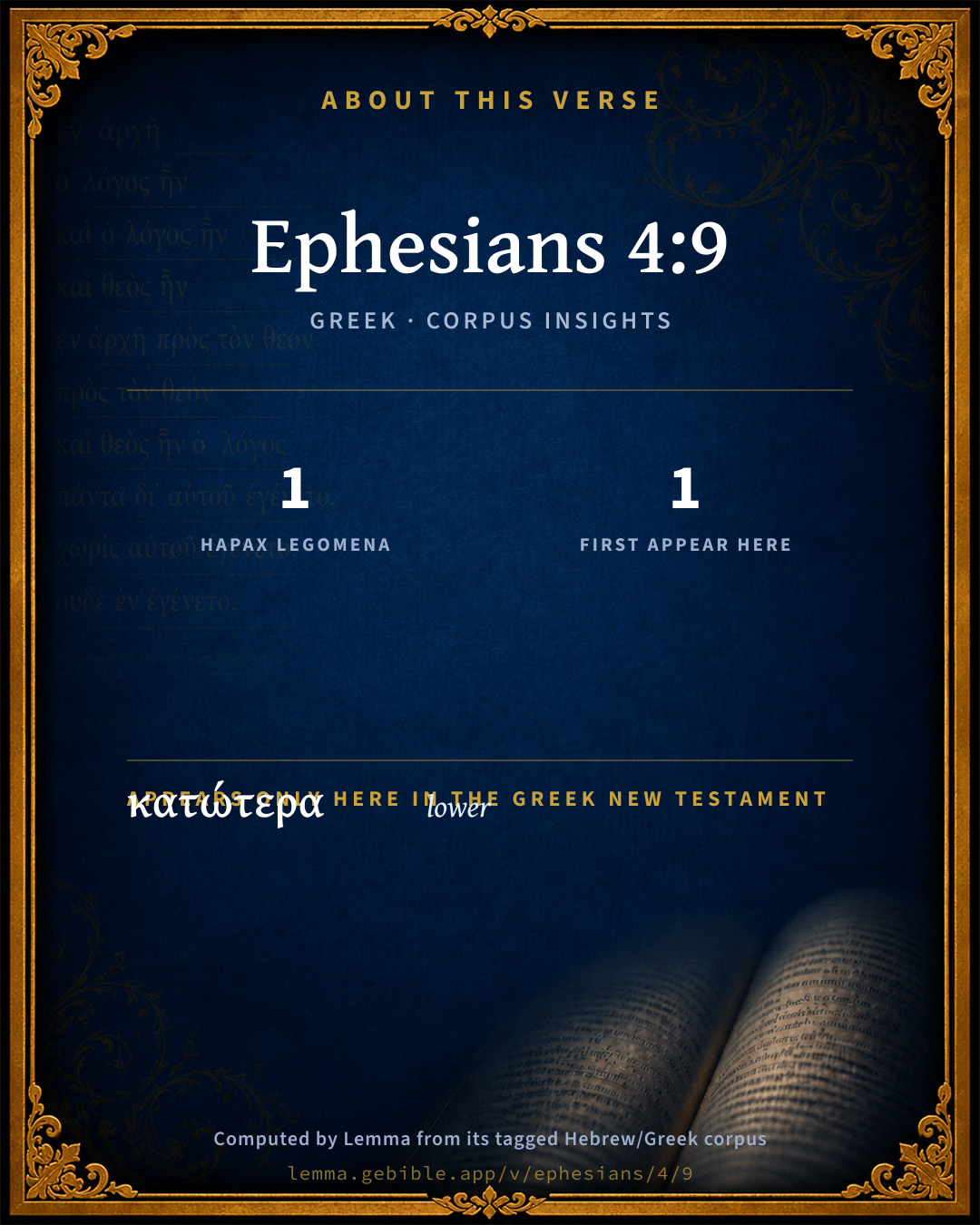
  • 1 hapax legomenon — only here in the Greek New Testament
  • 1 first appearance in the Greek New Testament
Full analysis ↓
Download a study sheet

One document with this verse’s original text, its word-by-word gloss line, the meaning frame, cross-references with their text, attributed commentary, and full source and license credits — printable, and it pastes into notes with its structure intact.

This verse Autodidact and up

Study sheet (.html) Plain text (.txt)

A passage Seminary Student

Up to 50 verses in one chapter. A passage sheet keeps up to 6 commentary sources and 12 cross-references per verse, in the order this page ranks them, and says so on the sheet whenever that leaves anything out. Ask for a single verse and you get the Autodidact verse sheet above.

Everything on this page stays free to read, with no account — the sheet is a download of what is already on screen, not access to it.

Want to remove ads? Support Godless Engineer
Compare translations 3

The same verse in 3 English versions, stacked beneath the original-language interlinear above. Click any original word for its lexicon entry.

Each is an independent rendering of the whole verse — the interlinear is not word-aligned to these translations.

Highlighted words mark where these versions differ — a whole-verse word diff, not a word-by-word alignment.

  • World English Bible Public Domain
    Now this, "He ascended," what is it but that he also first descended into the lower parts of the earth?
  • King James Version Public Domain
    (Now that he ascended, what is it but that he also descended first into the lower parts of the earth?
  • unfoldingWord Literal Text CC BY-SA 4.0
    And this “He ascended,” what is it except that he also descended into the lower regions of the earth?

unfoldingWord Literal Text — © unfoldingWord, licensed CC BY-SA 4.0. Word-aligned USFM3 via Door43 (git.door43.org/unfoldingWord/en_ult).

Versions to compare (up to 4)

3 of 4 selected

Show all 19 translations

Every available English version of this verse, each an independent rendering of the whole verse.

  • World English Bible Public Domain
    Now this, "He ascended," what is it but that he also first descended into the lower parts of the earth?
  • Berean Standard Bible Public Domain
    What does “He ascended” mean, except that He also descended to the lower parts of the earth?
  • Majority Standard Bible Public Domain
    What does “He ascended” mean, except that He also descended first to the lower parts of the earth?
  • King James Version Public Domain
    (Now that he ascended, what is it but that he also descended first into the lower parts of the earth?
  • American Standard Version (1901) Public Domain
    (Now this, He ascended, what is it but that he also descended into the lower parts of the earth?
  • Revised Version (1885) Public Domain
    (Now this, He ascended, what is it but that he also descended into the lower parts of the earth?
  • Geneva Bible (1599) Public Domain
    (Nowe, in that hee ascended, what is it but that he had also descended first into the lowest partes of the earth?
  • Douay-Rheims (1899) Public Domain
    Now that he ascended, what is it, but because he also descended first into the lower parts of the earth?
  • Young's Literal Translation Public Domain
    and that, he went up, what is it except that he also went down first to the lower parts of the earth?
  • Literal Standard Version CC BY-SA 4.0
    And that, He went up, what is it except that He also went down first into the lower parts of the earth?
  • Unlocked Literal Bible CC BY-SA 4.0
    What is the meaning of “He ascended,” except that he also descended into the lower regions of the earth?
  • unfoldingWord Literal Text CC BY-SA 4.0
    And this “He ascended,” what is it except that he also descended into the lower regions of the earth?
  • Darby Bible Public Domain
    But that he ascended, what is it but that he also descended into the lower parts of the earth?
  • World Messianic Bible Public Domain
    Now this, “He ascended”, what is it but that he also first descended into the lower parts of the earth?
  • Webster's Bible Public Domain
    Now that he ascended, what is it but that he also descended first into the lower parts of the earth?
  • Free Bible Version CC BY-SA 4.0
    (Regarding this: it says he ascended, but that means he also had previously descended to our lowly world.
  • Bible in Basic English Public Domain
    (Now this, He went up, what is it but that he first went down into the lower parts of the earth?
  • Text-Critical English NT CC BY 4.0
    (Now what does “he ascended” mean except that he first also descended into the lower parts of the earth?
  • Tyndale New Testament (1534) Public Domain
    That he ascended: what meaneth it but that he also descended fyrst into the lowest parties of the erth?

Literal Standard Version (2020), Covenant Press — licensed CC BY-SA 4.0. Text via the HelloAO Bible API (eBible.org). Unlocked Literal Bible (unfoldingWord) — licensed CC BY-SA 4.0. Text via the HelloAO Bible API (eBible.org). unfoldingWord Literal Text — © unfoldingWord, licensed CC BY-SA 4.0. Word-aligned USFM3 via Door43 (git.door43.org/unfoldingWord/en_ult). Free Bible Version, Dr. Jonathan Gallagher — licensed CC BY-SA 4.0. Text via the HelloAO Bible API (eBible.org).

Word by word

More ways to search: Search by grammar → Find every occurrence → Compare this word →

Practice this passage: Drill this verse → Learn its vocabulary →

κατώτερα
katṓteros
G2737
“lower”
Adjective, Accusative, Plural, Neuter, Comparative
Part of Speech
Adjective
Case
Accusative
Number
Plural
Gender
Neuter
Degree
Comparative
Full Thayer's Definition

Origin: comparative from G2736

TDNT: 13:40,4

1. lower
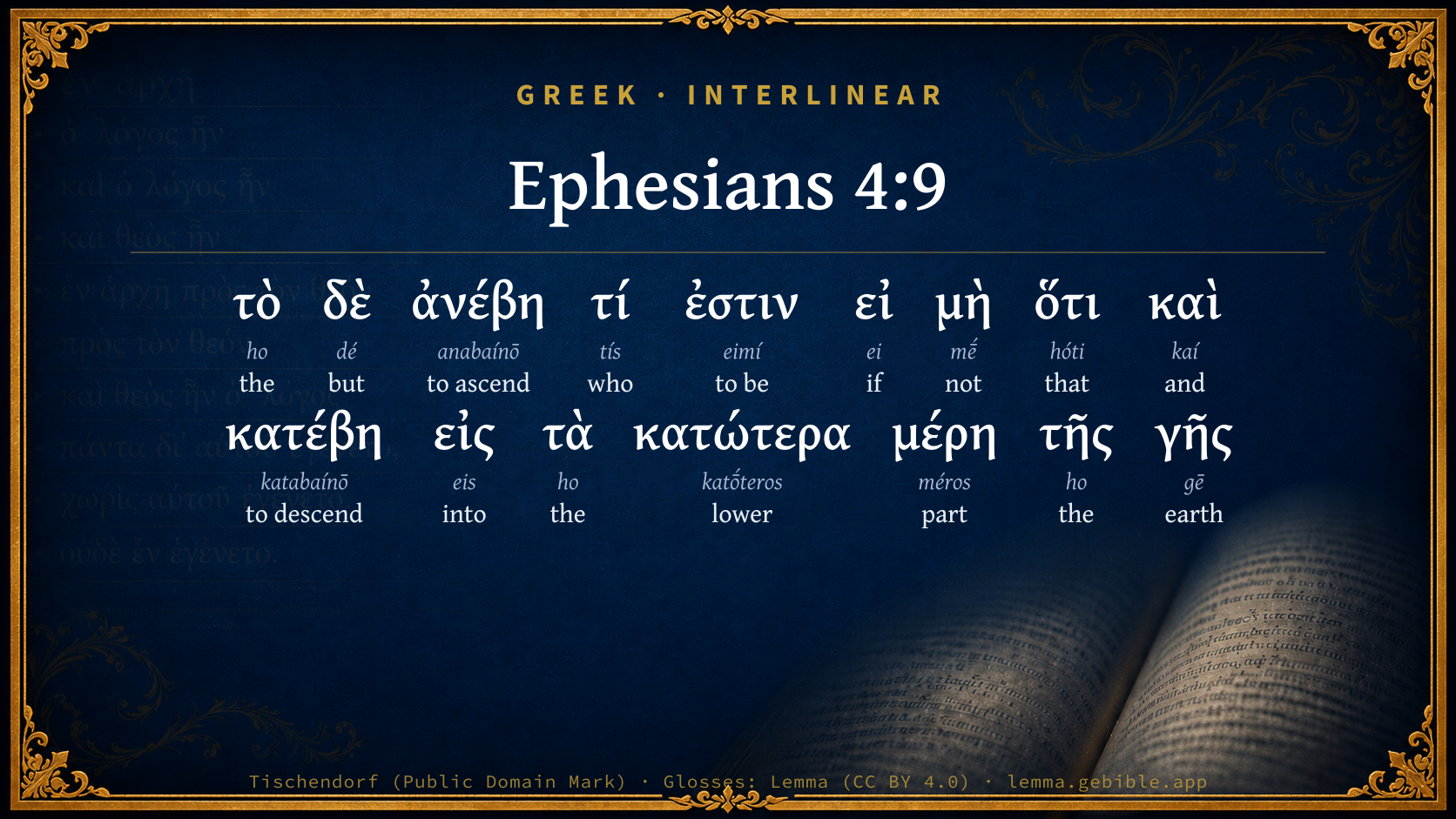
  1. τὸ ho G3588 “the” Article, Nominative, Singular, Neuter
  2. δὲ dé G1161 “but” Conjunction
  3. ἀνέβη anabaínō G305 “to ascend” Verb, Aorist, Active, Indicative, 3rd person, Singular
  4. τί tís G5101 “who” Interrogative pronoun, Nominative, Singular, Neuter
  5. ἐστιν eimí G1510 “to be” Verb, Present, Active, Indicative, 3rd person, Singular
  6. εἰ ei G1487 “if” Conditional
  7. μὴ mḗ G3361 “not” Particle, Negative
  8. ὅτι hóti G3754 “that” Conjunction
  9. καὶ kaí G2532 “and” Conjunction
  10. κατέβη katabaínō G2597 “to descend” Verb, Aorist, Active, Indicative, 3rd person, Singular
  11. εἰς eis G1519 “into” Preposition
  12. τὰ ho G3588 “the” Article, Accusative, Plural, Neuter
  13. μέρη méros G3313 “part” Noun, Accusative, Plural, Neuter
  14. τῆς ho G3588 “the” Article, Genitive, Singular, Feminine
  15. γῆς gē G1093 “earth” Noun, Genitive, Singular, Feminine

About this verse

These counts appear in no published source. They are computed here, from the morphology-tagged text and Lemma’s own curated glosses. What Lemma adds →

16
words
14
distinct lemmas
Pauline Epistles
section

Notable vocabulary

1 hapax legomenon — a word that appears only here in the entire Greek New Testament:

  • κατώτερα lower G2737

First appearance in Scripture

This word makes its first canonical appearance in the Greek New Testament here:

  • κατώτερα lower G2737

Shared distinctive vocabulary

μέρη part G3313 occurs in 40 verses of the Greek New Testament. Also found in:

Repetition

A word recurs within this verse:

Cross-references

21

Topical passages linked to Ephesians 4:9 in the Treasury of Scripture Knowledge — connected by theme and wording, ordered by reader-vote popularity; previews shown in the World English Bible.

  • John 3:13 No one has ascended into heaven, but he who descended out of heaven, the Son of Man, who is in heaven.
  • Matthew 12:40 For as Jonah was three days and three nights in the belly of the whale, so will the Son of Man be three days and three nights in the heart of the earth.
  • Proverbs 30:4 Who has ascended up into heaven, and descended? Who has gathered the wind in his fists? Who has bound the waters in his garment? Who has established all the ends of the earth? What is his name, and what is his son's name, if you know?
  • John 6:33 For the bread of God is that which comes down out of heaven, and gives life to the world."
  • Psalms 63:9 But those who seek my soul, to destroy it, Shall go into the lower parts of the earth.
  • Genesis 11:5 Yahweh came down to see the city and the tower, which the children of men built.
  • Exodus 19:20 Yahweh came down on Mount Sinai, to the top of the mountain. Yahweh called Moses to the top of the mountain, and Moses went up.
  • Psalms 8:5 For you have made him a little lower than God, And crowned him with glory and honor.
  • Psalms 139:15 My frame wasn't hidden from you, When I was made in secret, Woven together in the depths of the earth.
  • Isaiah 44:23 Sing, you heavens, for Yahweh has done it; shout, you lower parts of the earth; break forth into singing, you mountains, O forest, and every tree therein: for Yahweh has redeemed Jacob, and will glorify himself in Israel.
  • John 6:38 For I have come down from heaven, not to do my own will, but the will of him who sent me.
  • John 6:41 The Jews therefore murmured concerning him, because he said, "I am the bread which came down out of heaven."
  • John 6:51 I am the living bread which came down out of heaven. If anyone eats of this bread, he will live forever. Yes, the bread which I will give for the life of the world is my flesh."
  • John 6:58 This is the bread which came down out of heaven-- not as our fathers ate the manna, and died. He who eats this bread will live forever."
  • John 6:62 Then what if you would see the Son of Man ascending to where he was before?
  • John 16:27–28 for the Father himself loves you, because you have loved me, and have believed that I came forth from God.
  • John 20:17 Jesus said to her, "Don't touch me, for I haven't yet ascended to my Father; but go to my brothers, and tell them, 'I am ascending to my Father and your Father, to my God and your God.'"
  • Hebrews 2:9 But we see him who has been made a little lower than the angels, Jesus, because of the suffering of death crowned with glory and honor, that by the grace of God he should taste of death for everyone.
  • John 8:14 Jesus answered them, "Even if I testify about myself, my testimony is true, for I know where I came from, and where I am going; but you don't know where I came from, or where I am going.
  • Hebrews 2:7 You made him a little lower than the angels; You crowned him with glory and honor.
  • Acts 2:34–36 For David didn't ascend into the heavens, but he says himself, 'The Lord said to my Lord, "Sit by my right hand,

Cross-references courtesy of OpenBible.info (CC BY 4.0).

Where the printed editions differ

1 variant

Places in this verse where the major printed Greek editions disagree on the wording in a way that affects the translation — a comparison of editions, not a manuscript-by-manuscript collation. The editions are the modern critical texts (Nestlé-Aland 28/27, SBL, Westcott-Hort, Tregelles, Tyndale House) and the traditional texts behind the KJV (the Textus Receptus and the Byzantine/Majority text). It is not a claim about which reading is original.

  1. Extra text
    πρῶτον

    “first”

    In TRByz Not in NA28NA27TynSBLWHTreg

    πρῶτον (prōton) 'first' is only in traditional manuscripts (TR+Byz)

Textual data: Translators Amalgamated Greek New Testament (STEPBible TAGNT) · CC BY 4.0.

Commentary

Notes on Ephesians 4:9 from classic Christian and Jewish commentators (each source and its license shown beneath its notes). The classic Christian expositions comment on the surrounding passage and are grouped to its opening verse, so a note may address several verses; the Jewish commentaries on the Tanakh (Rashi and others) are per-verse, so they appear only where the commentator wrote on this verse.

Lemma curates 59 commentaries, every one of them public domain or Creative Commons licensed, each selected and text-cleaned for this edition rather than reprinted as found. About our sources →

The Biblical Illustrator

Joseph S. Exell

Eph_4:9-10

Now that He ascended, what is it but that He also descended first into the lower parts of the earth?

He that descended is the same also that ascended.

The eternal union in the person and work of the Redeemer

I. There was union between the greatness of Christs person and the greatness of His obedience. He was so great that He could not be greater. There was no possibility of His going higher. That is what Jesus Christ did in coming to the world--He descended. He not only assumed human nature, body and soul, into union with His Divine Person; but more than that--He descended. The Divine Person came down--the Divine Person was in the manger--He, the whole of Him, was made under the law.

II. There was union between the greatness of the obedience and the merits of the sufferings. Here again there must be no dividing. The sufferings without the obedience would not have been an atonement; and the sufferings and the obedience would not have given satisfaction without the greatness of the Person. And though He rendered perfect obedience in life, yet He could not be a Saviour without suffering--without shedding His blood. In hell there is suffering, but no obedience; in heaven there is obedience, but no suffering; but here, in one place, we behold both obedience and suffering.

III. There is union between the merits of the sufferings and the height of the exaltation (ascension). He who descended is the same also that ascended up far above all heavens. He could not ascend without descending first, and descending lower than the earth. All the riches of the Godhead as Creator would not pay our debt. He must give Himself as our ransom.

IV. There is union again between the height of his exaltation and his work in filling all things to the end of time: that He might fill all things. The Bible teaches us that He could not fill the Church without ascending up far above all heavens. Whilst here in poverty and bondage, working out our salvation, He was out of His poverty enriching those who came into contact with Him; but now He is rich in mercy, and from the throne He administers forgiveness. His great work on earth was to fill the demands of heaven; and His great work in heaven is to fill the demands of earth. From the earth He filled heaven with obedience; and from heaven He fills the earth with forgiveness. From the earth He filled heaven with satisfaction; and from heaven He fills the earth with peace. From the earth He filled heaven with atonement; and from heaven He fills the earth with holiness. (Lewis Edwards, D. D.)

The contrasted humiliation and exaltation of Christ

I. The circumstances of the Saviours depression from His original state.

1. The incarnation of Christ may be thus expressed.

2. This form of language may denote the death of Christ.

3. This style may be intended to intimate that burial to which He yielded.

4. The separation of the Redeemers Body and Spirit may be described in these words.

II. The glory of His subsequent exaltation.

1. It is in itself an absolute expression of love. To descend to all this humiliation and suffering could not be agreeable to any other end, save an achievement of mercy.

2. It justifies an expectation of surpassing benefits. Whatever was the quality of the act, it must answer to the act itself. Nothing little can it involve. If this be an errand of mercy, how great must be that mercy!

3. The act regulates and secures its own efficiency. The Messiah did not send His word to save us. From on high He did not direct the scheme of salvation. He descended to the lower parts of the earth. This showed His infinite intentness,

4. This act is to be regarded as of incomparable worth and excellence. Never were so combined, and never could so unite, the jealousy of the Infinite Honour and the commiseration of human woe.

III. The reciprocal influence of these respective facts. The same was He who bowed Himself to these indignities, and who seized these rewards. And this identity is of the greatest value. Surely it is much to understand, much to be certified, that He who was manifest in flesh--taking our very nature, seen in the relationships of our life--full of tenderness and compassion--the comforter of mourners and the friend of sinners--is none other than the Supreme over all things, guiding and administering all his prerogatives and powers to the very end for which he was incarnated and crucified. This is what the text affirms. (R. W. Hamilton, D. D.)

The ascension of Christ above all heavens, that He might fill all things

The ascension of Christ (His resurrection completed) sums up, according to Paul, the whole gospel, and stamps it with the seal of heaven. Aristotle tells us of Platos dialogues that they were but beautiful dreams without rational foundation or conclusion, ingenious stories to embody his spiritual instincts rather than to furnish a rational ground capable of sustaining the sublime hopes they seek to embody. How different this from the gospel which furnishes us with facts that are not only capable of sustaining the hopes of the world, but of inspiring hopes which infinitely transcend the highest imaginations of mans unaided powers to conceive, and which daily in our midst prove their Divine source by quickening dead souls, cleansing polluted hearts, and breaking the chains of evil habits!

I. The ascension of Christ looked at in the light of its previous and preparatory history. That the Son of Man ascended from the deepest depth of human history and experience, from the lower parts of the earth, up above all heavens, presupposes His descent. That He ascended, what does it imply but that He descended, and that His original home was above the heavens? He ascends to no height from which He did not descend. In short, to use his own words, that He came out from God and came into the world before He could again leave the world and enter upon His inheritance of the Fathers glory. He who was rich became poor, that we, through His poverty, might be rich.

II. We have now to look at this fact of our Lords ascension in the light of its declared purpose--That He might fill all things, which will reveal its connection with the vaster and ever-enlarging history of the world subsequent to His leaving the earth and His being carried up above all heavens. Let us, however, briefly consider it, first of all with respect to the new heavens and the new earth; then with respect to our nature and history; and lastly, with respect to the providence and government of God--as parts of the great whole to be filled from the fulness of the ascended Son of Man.

1. With respect to the new heavens and the new earth, what may we not infer, from the ascension of Christ in the full integrity of His nature, as to the conversion, transformation, and ennobling of the material of our earthly sphere? The nature and history of His person clearly reveal the relations between heaven and earth, the material and the spiritual, God and man. We cannot for a moment look upon the transformation and exaltation of Christs nature as an isolated fact, or as dissociated from the restitution of all things. The gospel, therefore, contains a gospel for nature as well as for man, the prediction of the day when the strife of elements shall cease, when the powers of darkness shall be swallowed up of light, when the lion shall lie down with the lamb, when the tares shall no longer grow with the wheat, when creation, now so weary, shall lift up her head and rejoice in the redemption for which she groans and travails.

2. Having seen what we are taught by the ascension of Christ with respect to the new heavens and the new earth, let us now consider what we should learn from it with respect to man. For if we cannot dissociate the history of Jesus from the history of the earth, much less are we able to do so from the history of mankind. He almost always speaks of Himself as the Son of Man. In Jesus Christ the headship of mankind is at the right hand of God with full powers of deliverance and exaltation for all men. By His ascension our nature is endowed with an exalted fulness, and clothed with a glory becoming the Son of God. In Jesus our nature is filled with all the fulness and clothed with all the glory of the Father. And, as such, He is exalted above the heavens on our behalf, as the centre of a new kingdom--a human kingdom--the kingdom of God and of His Christ. It is reserved for human nature to constitute the home kingdom of God. The kingdom of God is to be set up in our nature, and to unite the innermost powers of humanity with the innermost powers of Deity. But this kingdom of God is also to be the temple of God, not merely a Divine dominion lying round about and without the immediate presence of the King, and only indirectly and mediately associated with Him, but the sphere of His household presence--His home--the very life of which will be the enjoyment and worship of Himself.

3. Having considered the ascension of Christ in its relation to the new heavens and the new earth, and also with respect to the nature and history of man, let us now look at it, briefly, in its relation to the government and providence of God. If nature is gathered up and crowned in man, and mankind are gathered tip and represented in the Son of Man, who is exalted to the throne of universal dominion, then it is clear that all things are governed and caused to work together in the interests of His kingdom, which centres in His body the Church, which is His Bride; that all things are bent to one purpose, the end to which the whole creation moves. The history of the world and man, of nature, providence, and grace, is thus seen to be one whole of many parts, in which there has been nothing parenthetic or episodical--nothing in vain, but which has been working together for the one foreseen and pre-determined end. Tempest and storm have combined with sunshine and zephyr; anarchy and rebellion have wrought with submission and order; war and peace, slavery and liberty, sickness and health, death and life have all been made to cooperate in bringing about the condition and prospects of the present hour which carries the necessary preparations, and is charged with the necessary powers for the grand consummation of the Divine purpose. The leaven works through all elements; the tree grows through all seasons; the kingdom advances with every age.

III. In the last place, we can but very briefly glance at the method and means by which this purpose, for which the Son of man; is exalted above all the heavens, is to be carried out. It is being fulfilled in many ways; all means are subordinate to this one end. That He might fill all things is the one purpose--The one far off Divine event to which the whole creation moves. For this the heavens watch the earth labours, the elements work, and the undesigned strife of human history is carried on. Two things are ours--preaching and prayer, alike our duty and our privilege. By these the Church of 120 very soon over ran the nations, and turned the world upside down. By these now will the triumphs of the Church be carried on to her final conquests. (W. Pulsford, D. D.)

Christ filling all things

I. Christs life was marked by changes the most unparalleled. He descended from the highest circumstances to the lowest, and ascended from the lowest to the highest again.

II. Amidst all these changes He preserved His identity: the same.

1. The same in being.

2. The same in sympathy.

3. The same in purpose.

III. The grand end of these changes was the spreading of the highest influence through the universe. That He might fill all things. Fill all institutions, books, intellect, hearts, with His system and Spirit. (David Thomas.)

Christ filling all things

I. How Christ fills all things. Not with His body--for as it has been well said, Christs body may be anywhere at any time; but Christs Spirit is everywhere at all times. Of that body of Christ--of spiritual body at all, still more of spiritual body glorified--we know, and we can know, nothing; but, as far as our faculties can reach, body must occupy definite space. How, then, does Christ fill all things?

1. By His influence. We know that even here a person may occupy a much larger sphere than he actually fills with his presence. Carry on that idea of the power of extending influence infinitely, and we shall be arriving at some conception of the way in which Christ can fill all things. The effect of such a life and death--the beauty of that unparalleled character--the effect of that upon a world, who can estimate? How it has moulded the mind--how it has raised the tone--how it has determined the conduct of all mankind.

2. But there is more than influence, there is sovereignty and care. The queen fills her realms, and we are always conscious of the power of our queen. How much more does the royal, superintending power and love of Jesus fill the universe; There is nothing so small, that it is below it; and there is nothing so great, that it is above it; nothing independent of it; nothing despised by it.

3. By the presence of the Holy Ghost.

II. What does Christ fill? All things.

1. Heaven. Every spirit in heaven reflects Him. Every tongue tells of Him. Every joy is full of Him. Every holiness glorifies Him.

2. And there is a solemn sense in which Christ fills hell. A rejected Saviour--nothing else.

3. Christ fills all nature. You will miss the sweetness of nature, if you do not feel this. Christ is in the leaf and flower--in the morning blush and the evening glow--in the song of the little bird--in the loneliness of solitude--in the harmony of the landscape.

4. And providence--i.e., the ordered course of human events--it is all Christ. What is providence? The working together of all things for the sake of Gods people. Who administers Gods great empire with the delegated power? Christ. He hath put all things in subjection under His feet. Is it a sorrow? Christ fills that sorrow. Is it a joy? Christ fills that joy. And this is the true meaning of life; an inner current of Christ always running along parallel with the flow of events.

5. But, still more, the Church--the Church, which is His fulness--because He fills it. All ordinances, all gifts, all communications of the Spirit, all prayer and preaching, all our sweet worship, all our blessed sacraments, all our fellowships, all our sympathies, all our diversities, all our oneness--it is all Christ. Nothing would be real without Him. It is as He is there, that anything has power to teach, or to comfort, or to bless.

III. Why does Christ fill all things?

1. That all honours should be to Him in every degree; that all should owe all always to Him; that He should be the light and joy of the whole world.

2. That no man upon this earth should ever find any real satisfaction out of Christ. If you do, the voids will be always greater than the comforts. Other things may promise--but He is truth. Other things may trifle with you--but He loves you. Other things may please--but He fills.

3. That there may be always, in Christ, a fulness suited to every mans want. If we only look high enough, there is the fountain filled:--a full pardon--a full Bible--a full smile--a full rest--a full life--and a full heaven.

4. And so it comes at last to pass, that, in everything, it is not the thing, but the Christ that is in it--for He so fills, that He becomes the thing He fills; and, little by little, the crust drops off--like the shell horn the fruit; or, like the covering from the blossom. The external ceases; the material falls away; the material passes; and the Christ which it contains, stands out alone--the All in all of His servants souls: so that we have, and desire to have, in either world, only Him! (J. Vaughan, M. A.)

The humiliation and ascension of Christ

I. Christs humiliation and descension. Christ descended according to His Divine nature, not indeed by a proper and local motion; but because it united itself to a nature here below; in respect of which union to an earthly nature, it might metaphorically be said to descend to the place where that nature did reside. And thus much for the way and manner how Christ did descend. We are now to direct our next inquiry to the place whither He descended; and for this we are to reflect an eye upon the former verse of this chapter, which tells us that it was into the lower parts of the earth; but what those lower parts of the earth are, here lies the doubt, and here must be the explication. I conceive these words in the text to bear the same sense with, and perhaps to have reference to, those in Psa_139:15, where David, speaking of his conception in his mothers womb, says, that he was framed and fashioned in the lowest parts of the earth. In like manner, Christs descending into the lowest parts of the earth, may very properly be taken for His incarnation and conception in the womb of the blessed Virgin. I add, that these words, of Christs descending and ascending, are so put together in the text, that they seem to intend us a summary account of Christs whole transaction of that great work of mans redemption from first to last; which being begun in His conception, and consummate in His ascension, by what better can His descending be explained, than by His conception, the first part and instance of this great work, as His ascension was the last? So that by this explication the apostles words are cast into this easy and proper sense, that the same Christ, and eternal Son of God, who first condescended and debased Himself so far as to be incarnate and conceived in the flesh, was He who afterwards ascended into heaven, and was advanced to that pitch of sublime honour and dignity, far above the principalities and powers of men and angels.

II. Christs exaltation and ascension. As for the way and manner how He ascended, I affirm that it was according to His human nature, properly and by local motion; but according to His Divine, only by communication of properties, the action of one nature being ascribed to both, by virtue of their union in the same person. As for the place to which He advanced, it is, says the apostle, far above all heavens. But the words of the text have something of figure, of hyperbole, and latitude in them; and signify not, according to their literal niceness, a going above the heavens by a local superiority; but an advance to the most eminent place of dignity and glory in the highest heaven.

III. The qualification and state of Christs person. In reference to both these conditions He was the same--He that descended is the same also that ascended. Which to me seems a full argument to evince the unity of the two natures in the same person; since two several actions are ascribed to the same person, both of which, it is evident, could not be performed by the same nature.

IV. The end of Christs ascension that He might fill all things. Now, Christ may be said thus to fill all things in a double respect.

1. In respect of the omnipresence of His nature and universal diffusion of His Godhead. But yet this is not the filling all things directly intended in the text; for that was to be consequent to His ascension; He ascended that He might fill all things; it accrued to Him upon and after His ascension, not before; but His omnipresential filling all things being an inseparable property of His Divine nature, always agreed to Him, and was not then at length to be conferred on Him.

2. In the second place, therefore, Christ may be said to fill all things, in respect of the universal rule and government of all things in heaven and earth committed to Him as Mediator upon His ascension. All the elements the whole train and retinue of nature, are subservient to His pleasure, and instruments of His purposes. The stars fight in their courses under His banner, and subordinate their powers to the dictates of His will. The heavens rule all below them by their influences, but themselves are governed by His. He can command nature out of its course, and reverse the great ordinances of the creation. The government, the stress and burden of all things, lies upon His hands. The blind heathen have been told of an Atlas that shoulders up the heavens; but we know that He who supports the heavens is not under them, but above them. (R. South, D. D.)

The end and design of Christs ascension

1. In the first place, this term all things may refer to the whole series of prophecies and predictions recorded of Christ in the Scriptures; which He might be said to fill, or rather to fulfil by His ascension.

2. But, secondly, the term all things may refer to the Church; which sense I shall most insist upon, as carrying in it the subject matter of this days commemoration. Now, Christ, it seems, would not have the fabric of His Church inferior to that of the universe: it being itself indeed a lesser world picked or rather sifted out of the greater, where mankind is brought into a narrower compass, but refined to a greater perfection. And, as in the constitution of the world, the old philosophy strongly asserts that nature has with much care filled every little space and corner of it with body, there being nothing that it so much abhors as a vacuity: so Christ, as it were, following the methods of nature in the works of grace, has so advantageously framed the whole system of the Church; first, by an infinite power making in it capacities, and then by an equal goodness filling them. Now the Church being a society of men combined together in profession of Christian religion, it has unavoidably a double need or necessity emergent from its very nature and constitution. That is, one of government, the other of instruction; the first agreeing to it simply as a society, the second, as it is such a society. And it is Christs great prerogative to fill it in both these respects.

I. As for the time in which it was conferred, this is remarkable in a double respect.

1. In respect of the Christian religion itself, it being about its first solemn promulgation. The beginning of everything has a strange and potent influence upon its duration. And the first appearances usually determine men either in their acceptance or dislike. Had not Christ therefore ushered in His religion by miracle and wonder, and arrested mens first apprehensions of it by something grand and supernatural; He had hindered its progress by a disadvantageous setting forth, exposed it naked to infidelity, and so rendered it first disputable, and then despised. It had been like the betraying a sublime and noble composition by a low and creeping prologue, which blasts the reputation of the ensuing discourse, and shuts up the auditors approbation with prejudice and contempt.

2. But, secondly, the time of Christs sending the Spirit is very remarkable in respect of the apostles themselves. It was when they entered upon the full execution of their apostolic office; and from followers of Christ became the great leaders of the world.

II. The manner how it was conferred (see Act_2:2-3). This action exhibits to the world the great means chosen by God for the propagation of the kingdom of Christ.

The Biblical Illustrator, edited by Joseph S. Exell (c. 1880s–1900s) — public domain. Text from a community e-Sword module.

Tyndale Open Study Notes

Tyndale Open Resources

4:9-10 to our lowly world (or to the lowest parts of the earth): Some understand this phrase as referring to the tomb, to the world of the dead (cp. Matt 12:40; 1 Pet 3:18-20), or to the coming of the Spirit at Pentecost. Instead, it probably refers to the incarnation, when Christ . . . descended from heaven and became a man (see John 1:14; 3:13; Phil 2:7-8).

Tyndale Open Study Notes — © Tyndale Open Resources, licensed CC BY-SA 4.0. Text via the HelloAO Bible API.

Bengel's Gnomon

Johann Albrecht Bengel

Eph 4:9. Τὸ δὲ, ἀνέβη, Now this fact, namely, that He ascended) Paul proves that the language of the psalm is to be referred to Christ; and the ascension is inferred from the descent; Joh 3:13. All beheld the sojourn of the Son of God upon the earth: they ought, from this fact, to have believed His ascension, which they did not see. There is a similar mode of reasoning at Act 2:29, etc., Act 13:36-37; and especially at Heb 2:8-9. The humble characteristics predicated of the Messiah were fulfilled in Jesus; therefore the glorious things also predicated of the Messiah ought to be referred to Him.—κατέβη πρῶτον, He first descended) Paul takes for granted the Deity of Christ; for those who are of the earth, although they did not previously descend, obtain the privilege of ascent.—εἰς τὰ κατώτερα μέρη τῆς γῆς) not merely to the earth itself, but to the lowest parts of the earth [so that through all its depths nothing did He leave unvisited; comp. Eph 4:10.—V.g.] The highest heavens, or all the heavens, are opposed to the lowest parts of the earth, or to all parts of the earth. Christ, by His own power, took possession of all,—first of the earth, then of heaven. Men are joined with the mention of the earth; the captivity is joined with the mention of the lower parts.—τῆς γῆς, of the earth) in which men are.

Bengel's Gnomon of the New Testament — English translation (T&T Clark, Edinburgh, 1860) — public domain. Text from a community e-Sword module.

Meyer's Critical & Exegetical Commentary

Heinrich August Wilhelm Meyer

is not a (Rabbinical) argument to show that the subject of the passage in the psalm is no other than Christ, in so far as of Him alone could be predicated that descending which, in speaking of ascending, must be presumed to have gone before (Michaelis, Koppe; Güder, von der Erschein

Eph_4:9 is not a (Rabbinical) argument to show that the subject of the passage in the psalm is no other than Christ, in so far as of Him alone could be predicated that descending which, in speaking of ascending, must be presumed to have gone before (Michaelis, Koppe; Güder, von der Erschein. Christi unter den Todten, p. 83; also my own earlier view). Such an argument would have been aimless, since the subject of the passage of the psalm in its Messianic fulfilment was self-evident; it would, moreover, not have even logical correctness, since, in fact, God Himself, as often in the O. T., might be thought of as the καταβάς who ἀνέβη. Paul rather brings out in Eph_4:9 what the ascension of Christ prophetically meant in Psalms 68 contains as its presupposition; and this for the end of showing[210] how the matter affirmed and supported by the passage of the psalm in Eph_4:7, namely, Christs bestowal of grace on all individuals respectively, stands in necessary connection with His general position of filling the whole universe; a function upon which He must have entered by His very descending into the depths of the earth and His ascending above all heavens (Eph_4:10).

δέ] carrying forward the argument: but the ἈΝΈΒΗ, in order now to show you what is therewith said, etc.

τὸ ἀνέβη] not: the word ἀνέβη, for this does not occur in the passage of the psalm, but the predicate ἀνέβη, which was contained in ἀναβάς.

τί ἐστιν] not: what of an extraordinary nature (Hoelemann), but simply: what is said therewith, what is implied in it? Comp. Mat_9:13; Joh_16:17 f., Joh_10:6, al.

ὅτι καὶ κατέβη] that He also (not merely ascended, but also) descended. The having ascended presupposes the having descended. The correctness of this conclusion rests upon the admitted fact that the risen Christ had His original dwelling not upon earth, as Elijah had, but in the heaven, whither He went up; consequently He could not but have descended from this, if He has ascended. Comp. Joh_3:13.

The depth, however, into which He descendedwhether, namely, merely to the earth, or deeper still into the subterranean worldis not to be inferred from the ἀνέβη itself, but was fixed with historic certainty in the believing consciousness of the readers; hence Paul could with good reason write not merely ὍΤΙ ΚΑῚ ΚΑΤΈΒΗ, but ὍΤΙ ΚΑῚ ΚΑΤ. ΕἸς ΤᾺ ΚΑΤΏΤΕΡΑ Τῆς Γῆς, i.e. into that which is deeper down than the earth, into Hades (κατέβην δόμον Ἄϊδος εἴσω, Hom. od. xxiii. 252; Ἀΐδαο δόμους ὑπὸ κεύθεσι γαίης ἔρχεαι, Il. xxii. 482; comp. Od. xxiv. 204; Soph. Ant. 816, Trach. 1088). He might also have designated Hades by τὰ κατώτατα τῆς γῆς, the lowest depth of the earth (תַּחְתִּיּוֹת הָאָרֶץ, LXX. Psa_63:10; Prayer of Azar. 13; not Psa_139:15, where in the depths of the earth is only a sensuous form of the conception in secret); but has purposely chosen that comparative expressionin which the genitive is that of comparison, not the partitive genitivein order to impart as strong a colouring as possible to the depth of Hades, in contradiction to that heaven from which Christ descended; He descended deeper than the earth is (the earth being conceived of as a plane), in that He descended even into the sub terranean region beyond, into Hades. The goal of the humiliation Paul here designates locally, whereas at Php_2:8 he specifies it as respects the degree, namely, by μέχρι θανάτου κ.τ.λ., which, however, is as to substance in agreement with our passage, since the death of Christ had as its immediate consequence His descent into Hades (Luk_23:43; Mat_12:40; Act_2:27; 1Pe_3:19), as, indeed, also at Php_2:10 (καταχθονίων) this descent is presupposed as having taken place in death. The explanation of the so-called descent into hell (Irenaeus in Pitra, Spicileg. Solesmense, I. p. 7; Tertullian, Jerome, Pelagius, Ambrosiaster, Erasmus, Estius, Calovius, Bengel, and many others, including Rückert, Olshausen, Delitzsch, Lechler, Ewald, Hoelemann, Bleek; Baur scenting Gnosticism) is therefore the right one,[211] because the object was to present Christ as the One who fills the whole universe, so that, with a view to His entering upon this His all-filling activity, He has previously with His victorious presence passed through the whole world, having descended from heaven into the utmost depth, and ascended from this depth to the utmost heighta view, which of necessity had to extend not merely to the earth, but even into the nether world, just because Christ, as was historically certain for every believer, had been in the nether world, and consequently, by virtue of His exaltation to the right hand of God, really had the two utmost limits of the universe, from below upwards, as the terminos a quo and ad quem of His triumphal progress. Further, had Paul intended only the descent to earth (Thomas, Beza, Calvin, Grotius, Hammond, Michaelis, Fischer, de vitiis Lex. N.T., and many, including Winer, p. 470 [E. T. 666], Holzhausen, Meier, Matthies, Harless, Raebiger, p. 68 ff., Baumgarten-Crusius, de Wette, Hofmann, p. 345, Bisping, Schenkel, Schmid, Bibl. Theol. II. p. 291, Reiche, Comm. crit. p. 174 f., Beyschlag, Christol. d. N.T. p. 228), it would not be easy to see why he should not have written merely κατέβη, or at any rate simply κατέβη εἰς τὴν γῆν or κατέβη εἰς τὴν γῆν κάτω (Act_2:19), instead of employing the circumstantial and affected, but yet only feebly paraphrasing expression: into the lower regions, which are the earth (for so we should have to explain εἰς τὰ κατώτερα τῆς γῆς, understood only of the earth; see Winer, l.c. [E. T. 666]). This expression is only accounted for, sharp and telling, when it points the reader to a region lower than the earth, to that Hades, whither every reader knew that Christ had descended. Doubtless the apostle might have written simply εἰς ᾅδου (Act_2:27) or ἕως ᾅδου (Mat_11:23), or also εἰς τὴν ἄβυσσον (Rom_10:7) or εἰς τὴν καρδίαν τῆς γῆς (Mat_12:40); but the whole pathos of the passage, with its contrast of the extremes of depth and height, very naturally suggested the purposely chosen designation εἰς τὰ κατώτερα τῆς γῆς. The ordinary objection, that, in fact, Christ did not ascend from Hades, but from earth to heaven, is of no effect, because He has in reality returned, arisen and ascended from Hades, consequently Hades was the deepest terminus a quo of His ascension, as it had previously been the deepest terminus ad quem of His descent, and on this deepest turning-point all here depended, even apart from the fact that the long interval of forty days between resurrection and ascension is historically very problematic (see Remark subjoined to Luk_24:51). Nearest to our view come Chrysostom, Theodoret, Oecumenius, Bullinger, Drusius, Zachariae, and others, who, however, refer the passage only to the death and the burial (comp. also Erlang. Zeitschr. 1856, p. 284); whereas Calomesius, Witsius, Calixtus, and others (already Beza, by way of suggestion), appealing to Psa_139:15, strangely enough interpret it of the descent into the womb.

[210] The view of Chrysostom, Theophylact, Erasmus, Cornelius a Lapide, and others, again taken up by Olshausen (comp. also Hofmann, l.c. 343), that Paul would by the example of Christ exhort to humility, is quite at variance with the context. And Rückert also is wrong in holding that ver. 9 contains only an incidental remark, which might equally well have been wanting.

[211] Thomasius, II. p. 262, is still doubtful on the question; Kahnis, I. p. 508, regards it as preponderantly probable. Calvin called it inepta, and Reiche falsa.

Meyer — Critical and Exegetical Commentary on the New Testament — English translation by Peter Christie, edited by Frederick Crombie (T&T Clark, 1880) — public domain. Text from a community e-Sword module.

Expositor's Greek Testament

ed. W. Robertson Nicoll

Eph 4:9 . Τὸ δέ , ἀνέβη , τί ἐστιν εἰ μὴ ὅτι καὶ κατέβη πρῶτον : Now this, “He ascended,” what is it but that He also descended [ first ] ? The TR inserts πρῶτον , with [389] [390] 3 [391] 3 [392] [393] [394] , most cursives, Syr., Vulg., Goth., Arm., etc. The omission of πρῶτον is supported by [395] [396] [397] [398] * [399] [400] , 17, Boh., Sah., Eth., etc. The documentary evidence is pretty fairly balanced. The preponderance, however, on the whole, is on the side of the omission, especially in view of transcriptional probabilities. The word is deleted by LTTr; while WH and RV give it a place in the margin. The δέ has its usual transitional force, but with something added. It continues the thought, but does that in the form of an explanation or application; cf. Gal 2:2 ; Eph 5:3 ; see also Buttm., Gram. of N. T. Greek , p. 303; Winer.-Moult., p. 553. What the precise point of the quotation is, and what the explanation amounts to which is thus introduced, are questions of no small difficulty. The answer will appear when the particular terms have been examined. The clause τὸ δέ , ἀνέβη is not to be taken as if Paul were limiting himself to a play upon the word. What follows shows that he had in view the historical fact expressed in the ἀναβάς , viz. , the Ascension. As in Mat 9:3 ; Joh 10:6 ; Joh 16:17 , the τί ἐστιν has the force of What does it mean? What is implied in the statement? And the reply given by Paul in ὅτι καὶ κατέβη is that the ascent presupposes a previous descent . This of course is not given as an inference of universal application, but as one that holds good in the case in view, and one which gives Paul the warrant to use the quotation as he does. In the Psalm it was Jehovah that ascended, but that was only after He had first descended to earth in behalf of His people from His proper habitation in heaven. And so the Giver of gifts to whom Paul desires to direct his readers was One who had first come down to earth before He ascended. It was the belief of those whom Paul addressed ( cf. the express statement in Joh 3:13 ) that Christ’s proper abode was in heaven. That belief is here taken for granted, and the conclusion consequently is drawn that the Giver who ascended is Christ. εἰς τὰ κατώτερα μέρη τῆς γῆς : into the lower parts of the earth . The locality or the extent of the descent is now defined. The question is whether the locality in view is this world as a scene of existence lower than heaven, or the under world as a deeper depth than earth itself. Does the sentence refer to Christ’s incarnation and the subjection to which He humbled Himself on earth even unto death? Or does it point to His descent to Hades? And if the latter is the case, in what aspect and with what particular significance is His visit to the world of the dead presented? On these questions there has been and there continues to be great diversity of opinion. Both interpretations have large support. That the “lower parts of the earth” mean simply earth itself in distinction from heaven is the view of Calv., Grot., Mich., Winer., Harl., Thom., Reiche, de Wette, Hofm., Beyschlag, Schweitzer, Weiss, Pfleid., Bisping, Abb., Haupt and others. That they mean Hades is the view favoured by the Copt. and Eth. Versions, and by such interpreters as Iren., Tertull., Jer., Erasm., Estius, Beng., Rück., Olsh., Del., Bleek, Mey., Alf., Ell. (on the whole), etc. Those who adopt this latter view, however, are not wholly at one. The great majority indeed, especially among Patristic and Lutheran exegetes, understand Paul to affirm that Christ after His death made a manifestation of Himself in triumph to the world of the departed, and fulfilled a certain ministry there. That ministry is understood by some, especially among the Fathers, to have been concerned with the release of the souls of OT saints from the Limbus Patrim ; by others, especially among certain classes of modern commentators, to have been a new proclamation of grace to the whole world of the departed or to certain sections of the dead; cf. Pearson on the Creed, sub Art. v.; Salmond’s Christian Doctrine of Immortality , p. 421, etc. But there are those, especially Calvinistic theologians, who take the writer to mean nothing more, if he refers to Hades at all, than that like other men Christ passed at death into the world of the departed and had experience there of the power of death for a time. Some ( e.g. , Chrys., Theod., Oec.) are of opinion that the phrase points to the death or the burial of Christ, but do not press it beyond that. On the other hand, there are those ( e.g. , Von Soden, Abb.) who take the descent to be to earth and not to Hades, but instead of identifying it with the incarnation regard it as subsequent to the ascension. What then is the most reasonable interpretation?

[389] Codex Vaticanus (sæc. iv.), published in photographic facsimile in 1889 under the care of the Abbate Cozza-Luzi.

[390] Codex Sinaiticus (sæc. iv.), now at St. Petersburg, published in facsimile type by its discoverer, Tischendorf, in 1862.

[391] Codex Ephraemi (sæc. v.), the Paris palimpsest, edited by Tischendorf in 1843.

[392] Codex Mosquensis (sæc. ix.), edited by Matthæi in 1782.

[393] Codex Angelicus (sæc. ix.), at Rome, collated by Tischendorf and others.

[394] Codex Porphyrianus (sæc. ix.), at St. Petersburg, collated by Tischendorf. Its text is deficient for chap. Eph 2:13-16 .

[395] Autograph of the original scribe of א .

[396] Autograph of the original scribe of א .

[397] Codex Alexandrinus (sæc. v.), at the British Museum, published in photographic facsimile by Sir E. M. Thompson (1879).

[398] Codex Ephraemi (sæc. v.), the Paris palimpsest, edited by Tischendorf in 1843.

[399] Codex Claromontanus (sæc. vi.), a Græco-Latin MS. at Paris, edited by Tischendorf in 1852.

[400] Codex Boernerianus (sæc. ix.), a Græco-Latin MS., at Dresden, edited by Matthæi in 1791. Written by an Irish scribe, it once formed part of the same volume as Codex Sangallensis ( δ ) of the Gospels. The Latin text, g, is based on the O.L. translation.

It must be said in the first place that neither grammar nor textual criticism gives a decisive answer. The τῆς γῆς may be taken equally well as the appos. gen., = “the lower parts which are or make the earth”; the poss. gen., = “the lower parts belonging to earth,” Hades being conceived to be part of the earth, but its lower part; or the comp. gen., = “the parts lower than the earth”. But the comparative idea is not more pertinent to the one main line of interpretation than to the other. The κατώτερα may mean the parts lower than the earth itself, i.e. , Hades; but it may also mean the parts lower than heaven, i.e. , the earth. Nor does the variety in reading affect the sense, though much has been made of it. The word μέρη is inserted after κατώτερα by [401] [402] [403] [404] 3 [405] [406] [407] , Syr.-P., Boh., Vulg., Arm., Chrys., etc. It is omitted by [408] * [409] , Goth., Eth., Iren., etc. It must be held, therefore, to belong to the text, but it is not inconsistent with either interpretation. The main arguments in favour of Hades being in view are these; that if earth were meant, it is difficult to understand why some simpler form such as εἰς τὴν γῆν or εἰς τὴν γῆν κάτω (Act 2:19 ) was not chosen; that the use of so singular a phrase as τὰ κατώτερα , which recalls the LXX rendering for תַּחְתִּיּוֹת הָאָרֶץ , one of the OT expressions for the underworld, suggests at once that something lower than earth itself, a yet deeper depth, was intended (Mey.); that the accompanying phrases ὑπεράνω πάντων τῶν οὐρανῶν and ἵνα πληρώσῃ τὰ πάντα , being expressions of largest extension, make it reasonable to give the widest possible sense also to the κατώτερα ; and that justice is done to the peculiarity and the amplitude of the various expressions only by taking Paul’s idea to be that as Christ rose in order to fill the whole world, He had first to pass in His victorious power through all the great divisions of the universe heaven above, earth beneath, and even the subterranean world, in the assertion of His universal sovereignty. But there is much to be said on the other side. The superlative formula to, τὰ κατώτατα would have been more in point if the idea to be expressed had been that of a depth than which there was none deeper (Abb.), or that of a descent embracing all the several parts of the universe. In point of fact, too, it is not τὰ κατώτερα , but τὰ κατώτατα , that the LXX employs in reproducing the Hebrew הָאָרֶץ תַּחְתִּיּוֹת . If Hades had been intended, it is strange that Paul did not select one or other of the more familiar and quite unambiguous phrases which are used elsewhere, e.g. , ἕως ᾅδου (Mat 11:23 ), εἰς ᾅδου (Act 2:27 ), or such a formula as εἰς τὴν καρδίαν τῆς γῆς (Mat 12:40 ), εἰς τὴν ἄβυσσον (Rom 10:7 ). It is also to be considered that, granting it is the Ascension and not merely the Resurrection of Christ that is expressed by the ἀνέβη , it was not from Hades, but from earth that He did ascend. Further, the point immediately in view is not any work that Christ did in the world and its several parts, but the identity of the Person who descended, and ascended, and gave gifts. This is made sufficiently clear by the repeated αὐτός (Eph 4:10-11 ), and the idea of a Hades-visit or a Hades-ministry has no obvious relation to that. The great paragraph in Phi 2:5-10 , which is in some sense a parallel, has also to be taken into account. There again the whole statement turns upon the two great ideas of the incarnation with the humiliation involved in it and the exaltation, and nothing is said about any visit of Christ to the underworld. Here, too, the whole idea of a descent to Hades appears to be foreign to the thought. It is not suggested by the passage in the Psalm; for there is not a word about Sheol in it. Neither is there any indication of it in the context in the Epistle. For there the bestowal of gifts is referred not to Christ’s descent, but to His ascension, and no hint is given of any work done by Him in Hades with a view to that bestowal, or of any relation in which the world of the dead stands to His prerogative of giving . For these reasons we conclude that the phrase τὰ κατώτερα μέρη τῆς γῆς means the earth as a scene of existence, lower than His native heavens, to which Christ descended.

[401] Codex Vaticanus (sæc. iv.), published in photographic facsimile in 1889 under the care of the Abbate Cozza-Luzi.

[402] Codex Sinaiticus (sæc. iv.), now at St. Petersburg, published in facsimile type by its discoverer, Tischendorf, in 1862.

[403] Codex Ephraemi (sæc. v.), the Paris palimpsest, edited by Tischendorf in 1843.

[404] Codex Claromontanus (sæc. vi.), a Græco-Latin MS. at Paris, edited by Tischendorf in 1852.

[405] Codex Mosquensis (sæc. ix.), edited by Matthæi in 1782.

[406] Codex Angelicus (sæc. ix.), at Rome, collated by Tischendorf and others.

[407] Codex Porphyrianus (sæc. ix.), at St. Petersburg, collated by Tischendorf. Its text is deficient for chap. Eph 2:13-16 .

[408] Codex Claromontanus (sæc. vi.), a Græco-Latin MS. at Paris, edited by Tischendorf in 1852.

[409] Codex Boernerianus (sæc. ix.), a Græco-Latin MS., at Dresden, edited by Matthæi in 1791. Written by an Irish scribe, it once formed part of the same volume as Codex Sangallensis ( δ ) of the Gospels. The Latin text, g, is based on the O.L. translation.

The Expositor's Greek Testament, edited by W. Robertson Nicoll (1897–1910) — public domain. Text from a community e-Sword module.

Hodge's Commentary on Romans, Ephesians & First Corinthians

Charles Hodge

Eph_4:9, Eph_4:10

Now that he ascended, what is it but that he also descended first into the lower parts of the earth? He that descended is the same also that ascended up far above all heavens, that he might fill all things.

The obvious design of these verses is to show that the passage quoted from the Psalmist refers to Christ. The proof lies in the fact that ascension in the case of a divine person, a giver of spiritual gifts to men, implies a previous descent. It was Christ who descended, and therefore, it is Christ who ascended. It is true the Old Testament often speaks of Gods descending, and therefore, they may speak of his ascending. But according to the apostle, the divine person intended in those representations was the Son, and no previous descent or ascent, no previous triumph over his enemies, included all that the Spirit of prophecy intended by such representations. And, therefore, the Psalmist must be understood as having included in the scope of his language the most conspicuous and illustrious of Gods condescensions and exaltations. All other comings were but typical of his coming in the flesh, and all ascensions were typical of his ascension from the grave.

The apostle, therefore, here teaches that God, the subject of the sixty-eighth Psalm, descended into the lower parts of the earth; that he ascended up above all heavens, and that this was with the design that he might fill all things.

The Hebrew phrase תַחְתִּיוֹת אֶרֶץ to which the apostles τὰ κατώτερα μέρη τῆς γῆς, (the lower parts of the earth), answers, is used for the earth in opposition to heaven, Isa_44:23; probably for the grave in Psa_63:10; as a poetical designation for the womb in Psa_139:15; and for Hades or the invisible world, Eze_32:24. Perhaps the majority of commentators take this last to be the meaning of the passage before us. They suppose the reference is to the descensus ad inferos, or to Christs descending into hell. But in the first place this idea is entirely foreign to the meaning of the passage in the Psalm on which the apostle is commenting. In the second place, there as here, the only descent of which the context speaks is opposed to the ascending to heaven. He that ascended to heaven is he who first descended to earth. In the third place, this is the opposition so often expressed in other places and in other forms of expression, as in Joh_3:13, No man hath ascended up to heaven, but he that came down from heaven, even the Son of Man who is in heaven. Joh_6:38, I came down from heaven. Joh_8:14, I know whence I came and whither I go. Joh_16:28, I came forth from the Father, and am come into the world; again, I leave the world, and go to the Father. The expression of the apostle therefore means, the lower parts, viz. the earth. The genitive τῆς γῆς is the common genitive of apposition. Compare Act_2:19, where the heaven above is opposed to the earth beneath; and Joh_8:23.

He that descended to earth, who assumed our nature, is the same also that ascended up far above all heavens. Ὑπεράνω, longe supra, expressing the highest exaltation. As the Hebrew word for heaven is in the plural form, the New Testament writers often use the plural even when the heavens are considered as one, as in the phrase βασιλεία τῶν οὐπανῶν. But often there is a reference to a plurality of heavens, as when the expression all heavens is used. The Jews reckoned seven heavens, and Paul, 2Co_12:2, speaks of the third heavens; the atmosphere, the region of the stars, and above all the abode of God. Above all heavens plainly means above the whole universe; above all that is created visible and invisible; above thrones, principalities, and powers. All things, all created things, are subject to the ascended Redeemer.

He is thus exalted ἵνα πληρώσῃ τὰ πάντα, that he might fill all things. As the word πληρόω signifies to fill, to fulfill, to render perfect, and to accomplish, these words may mean

1. That he might fill all things, i.e. the universe with his presence and power.

2. That he might fulfill all the predictions and promises of God respecting his kingdom.

3. That he might render all perfect, replete with grace and goodness.

4. That he might accomplish all things necessary to the consummation of his work.

The first interpretation is greatly to be preferred. Τὰ πάντα properly means the universe; and if taken to mean anything else, it must be because the context demands it, which is not the case here. Secondly, this passage is evidently parallel with Eph_1:21, where also it is said of Christ as exalted, that he fills the universe in all its parts. Thirdly, the analogy of Scripture is in favor of this interpretation. The omnipresence and universal dominion of God are elsewhere expressed in a similar way. Do I not fill heaven and earth, saith the Lord. Jer_23:24. The same grand idea is expressed in Mat_28:18, All power is given unto me in heaven and upon earth; and in Phi_2:9, Phi_2:10, and in many other places. It is not of the ubiquity of Christs body of which the apostle speaks, as the Lutherans contend, but of the universal presence and power of the ascended Son of God. It is God clothed in our nature, who now exercises this universal dominion; and, therefore, the apostle may well say of Christ, as the incarnate God, that he gives gifts unto men.

Charles Hodge — Commentary on Romans (1835), First Corinthians (1857), and Ephesians (1856) — public domain. Text from a community e-Sword module.

Geneva Bible (1599)

Geneva Bible translators

Down to the earth, which is the lowest part of the world.

Geneva Bible (1599) marginal notes — public domain. Text via Bolls.life.

Jamieson, Fausset & Brown

Robert Jamieson, A. R. Fausset & David Brown

Paul reasons that (assuming Him to be God) His ascent implies a previous descent; and that the language of the Psalm can only refer to Christ, who first descended, then ascended. For God the Father does not ascend or descend. Yet the Psalm plainly refers to God (Eph 4:8, Eph 4:17-18). It must therefore be GOD THE SON (Joh 6:33, Joh 6:62). As He declares (Joh 3:13), "No man hath ascended up to heaven, but He that came down from heaven." Others, though they did not previously descend, have ascended; but none save Christ can be referred to in the Psalm as having done so; for it is of God it speaks.

lower parts of the earth--The antithesis or contrast to "far above all heavens," is the argument of ALFORD and others, to show that this phrase means more than simply the earth, namely, the regions beneath it, even as He ascended not merely to the visible heavens, but "far above" them. Moreover, His design "that He might fill all things" (Eph 4:10, Greek, "the whole universe of things") may imply the same. But see on Eph 4:10 on those words. Also the leading "captive" of the "captive hand" ("captivity") of satanic powers, may imply that the warfare reached to their habitation itself (Psa 63:9). Christ, as Lord of all, took possession first of the earth the unseen world beneath it (some conjecture that the region of the lost is in the central parts of our globe), then of heaven (Act 2:27-28). However, all we surely know is, that His soul at death descended to Hades, that is, underwent the ordinary condition of departed spirits of men. The leading captive of satanic powers here, is not said to be at His descent, but at His ascension; so that no argument can be drawn from it for a descent to the abodes of Satan. Act 2:27-28, and Rom 10:7, favor the view of the reference being simply to His descent to Hades. So PEARSON in Exposition of the Creed (Phi 2:10).

Jamieson, Fausset & Brown — Commentary Critical and Explanatory on the Whole Bible (1871) — public domain (CC PDM 1.0). Text via the HelloAO Bible API.

Adam Clarke's Commentary

Verse 9. But that he also descended] The meaning of the apostle appears to be this: The person who ascended is the Messiah, and his ascension plainly intimates his descension; that is, his incarnation, humiliation, death, and resurrection.

Adam Clarke's Commentary on the Bible (1810–1826) — public domain. Text from a community e-Sword/MySword module.

John Calvin's Commentaries

9. Now that he ascended. Here again the slanderers exclaim, that Paul’s reasoning is trifling and childish. “Why does he attempt to make those words apply to a real ascension of Christ, which were figuratively spoken about a manifestation of the Divine glory? Who does not know that the word ascend is metaphorical? The conclusion, that he also descended first, has therefore no weight.”

I answer, Paul does not here reason in the manner of a logician, as to what necessarily follows, or may be inferred, from the words of the prophet. He knew that what David spake about God’s ascension was metaphorical. But neither can it be denied, that the expression bears a reference to some kind of humiliation on the part of God which had previously existed. It is this humiliation which Paul justly infers from the declaration that God had ascended. And at what time did God descend lower than when Christ emptied himself? ( ᾿Αλλ ᾿ ἑαυτὸν ἐκένωσε, Philippians 2:7.) If ever there was a time when, after appearing to lay aside the brightness of his power, God ascended gloriously, it was when Christ was raised from our lowest condition on earth, and received into heavenly glory.

Besides, it is not necessary to inquire very carefully into the literal exposition of the Psalm, since Paul merely alludes to the prophet’s words, in the same manner as, on another occasion, he accommodates to his own subject a passage taken from the writings of Moses. “The righteousness which is of faith speaketh in this manner, Say not in thine heart, who shall ascend into heaven? (that is, to bring Christ down from above;) or, who shall descend into the deep (that is, to bring up Christ again from the dead.”) (Romans 10:6,7 Deuteronomy 30:12.) But the appropriateness of the application which Paul makes of the passage to the person of Christ is not the only ground on which it must be defended. Sufficient evidence is afforded by the Psalm itself, that this ascription of praise relates to Christ’s kingdom. Not to mention other reasons which might be urged, it contains a distinct prophecy of the calling of the Gentiles.

Into the lower parts of the earth. These words mean nothing more than the condition of the present life. To torture them so as to make them mean purgatory or hell, is exceedingly foolish. The argument taken from the comparative degree, “the lower parts,” is quite untenable. A comparison is drawn, not between one part of the earth and another, but between the whole earth and heaven; as if he had said, that from that lofty habitation Christ descended into our deep gulf.

John Calvin's Commentaries (1540-1563) — public domain. Text from the Calvin Translation Society English edition (1840s-50s) via the Christian Classics Ethereal Library (ccel.org). Calvin's coverage is partial (roughly two-thirds of the Bible); uncommented books and verses are honest gaps, never fabricated. The 19th-century editor's footnotes and remarks are omitted so the notes are faithfully Calvin's own voice.

Ellicott's Commentary for English Readers

(9) The lower parts of the earth.—This may mean either the regions of the earth, as “lower” than heaven, or the regions beneath the earth. The reasoning of the text in itself would be satisfied by the former. For St. Paul is simply arguing that the use of the phrase “ascended” from earth to heaven implies a previous corresponding descent, which must be from heaven to earth; exactly as in Joh_3:13, “No man hath ascended into heaven, but He that came down from heaven.” But form and usage of the phrase itself seem to point to the other meaning, which is held by almost all ancient interpreters and most moderns. It agrees with the strong expression of “filling all things,” in Eph_4:10, and is possibly suggested by the leading captive of the powers of hell and death. Though, perhaps, injurious to the strictness of the antithesis, it is quite accordant with St. Paul’s manner to introduce thus a fresh idea beyond the simple idea of descent, which is sufficient for his argument: “He descended—yea, even to the realms below.” For this idea is most apposite to that frequent reference to spiritual powers of evil found in this Epistle, and it may be thought to correspond by antithesis to the “far above all heavens” of the next verse.

(9, 10) These verses form a parenthesis, designed to bring out the pervading idea of this and the parallel Epistle—the Divine humanity of Christ as “filling all in all” and “gathering all things” into Himself.

A Bible Commentary for English Readers, edited by Charles John Ellicott (1878–1897) — public domain. Text from a community e-Sword module.

The Cambridge Bible for Schools and Colleges

gen. ed. J. J. S. Perowne

9. Now that he ascended] More lit., Now the [word, or thought,] He ascended.

what is it] As if to say, “What does it imply? It implies a previous descent, from the seat of royalty. And, in the light of the Fulfilment, this implied descent was ‘to the lower parts of the earth.’ ” The Apostle does not mean that the Psalm teaches anything special about the Descent, but that it implies a Descent, and that what that Descent was, Christians know. And the interest of the implied reference is, its supernatural correspondence in outline to Gospel facts; its imagery being of One who has left His throne and now returns upward.

first] Evidence is divided as to the right of this word to a place in the text. It is obviously, at worst, explanatory of the sense.

the lower parts of the earth] Does this mean “the lower regions, even the earth,” as distinct from heaven? Or, “the lower regions of the earth,” i.e. the region underground, the grave and its world? Our great theologian and critical scholar, Bp Pearson (Exposition of the Creed, Art. V.), inclines to the former view, with a reference to the Incarnation only. The phrase, so taken, may perhaps be illustrated by Isa_44:23; where, however, “lower parts of the earth” (LXX. “foundations of the earth”) may be contrasted with “mountains.” (Cp. also, perhaps, Psa_139:15.) On the other hand Psa_63:9 is distinctly in favour of a reference to “the grave.” Our judgment is on the whole for the second view, with a reference to the Death and Burial of the Incarnate Lord. Such a reference seems better to balance, in a sense, the phrase just below, “far above all heavens”; it falls in better with the amplitude of the words, “that He might fill all things” (cp. Rom_14:9); and it is in the manner of the N. T. to connect the Resurrection and Ascension as parts of one great whole. And the Lord’s Death is so profoundly concerned with the procurement of blessings to His Church that an allusion to it is à priori likely here.—Many of the Fathers (see Pearson’s notes under Art. V. of the Creed) take this passage to refer to a definite work done by the Lord in the under-world, a deliverance of the spirits of the Old Testament saints from a “Limbus” there. But certainly the words here teach nothing of the kind; only that He who suffered for us entered the state of disembodied souls, “the Grave,” “Sheol,” “Hades.” The mysterious passage 1Pe_3:18-19, will at once occur in the question. But upon it we can only say here that it is too isolated, and involves too many problems of interpretation, to allow any great and peculiar article of belief to be built upon it; and, upon any view, its only explicit reference is to the generation of the Flood. See again Pearson. And for a different view from his, stated with great ability and insight, see Note II. to The Unsafe Anchor, by the Rev. C. F. Childe.

The Cambridge Bible for Schools and Colleges (gen. ed. J. J. S. Perowne; Cambridge University Press, 1878–1918) — public domain. Text from a community e-Sword module.

John Gill's Exposition

Now that he ascended,.... These words are a conclusion of Christ's descent from heaven, from his ascension thither; for had he not first descended from thence, it could not have been said of him that he ascended; for no man hath ascended to heaven but he that came down from heaven, Joh 3:13 and they are also an explanation of the sense of the psalmist in the above citation, which takes in his humiliation as well as his exaltation; which humiliation is signified by his descent into the earth:

what is it but that he also descended first into the lower parts of the earth? this the Papists understand of his decent into a place they call Limbus Patrum, which they make to be contiguous to hell; and where they say the patriarchs were detained till Christ's coming; and that he went thither to deliver them out of it; and that these are the captivity he led captive; all which is fictitious and fabulous: for certain it is, that the place where Abraham was with Lazarus in his bosom was not near to hell, but afar off, and that there was a great gulf between them, Luk 16:23 and the spirits or souls of the patriarchs returned to God that gave them, when separated from their bodies, as the souls of men do now, Ecc 12:7 nor did Christ enter any such feigned place at his death, but went to paradise, where the penitent thief was that day with him; nor were the patriarchs, but the principalities and powers Christ spoiled, the captivity he led captive and triumphed over: some interpret this of Christ's descent into hell, which must be understood not locally, but of his enduring the wrath of God for sin, which was equivalent to the torments of hell, and of his being in the state of the dead; but it may rather design the whole of his humiliation, as his descent from heaven and incarnation in the virgin's womb, where his human nature was curiously wrought in the lowest parts of the earth; and his humbling himself and becoming obedient unto death, even the death of the cross, when he was made sin and a curse for his people, and bore all the punishment due to their transgressions; and his being in Hades, in the state of the dead, in the grave, in the heart of the earth, as Jonah in the whale's belly: reference seems to be had to Psa 139:15 where "the lower parts of the earth", is interpreted by the Targum on the place of , "his mother's womb"; and so it is by Jarchi, Aben Ezra, Kimchi, and Ben Melec. The Alexandrian copy and the Ethiopic version leave out the word "first" in this clause.

John Gill's Exposition of the Whole Bible (1746–1763) — public domain (CC PDM 1.0). Text via the HelloAO Bible API.

Trapp's Complete Commentary

John Trapp

9 (Now that he ascended, what is it but that he also descended first into the lower parts of the earth?

Ver. 9. Into the lower parts] That is, into his mother’s womb; according to Psa 139:15; "I was curiously wrought in the lowest parts of the earth," i.e. in the womb, where God formed and featured me: like as curious workmen, when they have some choice piece in hand, they perfect it in private, and then bring it forth to light for men to gaze at.

John Trapp, A Commentary or Exposition upon All the Books of the Old and New Testament (1647–1656) — public domain. Text from a community e-Sword module.

Albert Barnes' Notes on the Bible

Now that he ascended - That is, it is affirmed in the Psalm that he “ascended” - “Thou hast ascended on high.” This implies that there must have been a previous “descent;” or, as applicable to the Messiah, “it is a truth that he previously descended.” It is by no means certain that Paul meant to say that the “word” “ascended” demonstrated that there must have been a previous descent; but he probably means that in the case of Christ there was, “in fact,” a descent into the lower parts of the earth first. The language used here will appropriately express his descent to earth.

Into the lower parts of the earth - To the lowest state of humiliation. This seems to be the fair meaning of the words. Heaven stands opposed to earth. One is above; the other is beneath. From the one Christ descended to the other; and he came not only to the earth, but he stooped to the most humble condition of humanity here; see Phi 2:6-8; compare notes on Isa 44:23. Some have understood this of the grave; others of the region of departed spirits; but these interpretations do not seem to be necessary. It is the “earth itself” that stands in contrast with the heavens; and the idea is, that the Redeemer descended from his lofty eminence in heaven, and became a man of humble rank and condition; compare Psa 139:15.

Albert Barnes' Notes on the Bible (1834–1885) — public domain. Text from a community e-Sword/MySword module.

Haydock's Catholic Bible Commentary

Into the lower parts of the earth. This cannot signify into the grave only, especially since in that which we look upon as the apostles’ creed, we first profess to believe that he was buried, and afterwards that he descended into hell. (Witham)

George Leo Haydock (1774–1849), Haydock's Catholic Family Bible and Commentary, 1859 edition — public domain. Excludes Psalms (Douay-Rheims chapter numbering differs from Protestant) and Deuterocanonical books (Catholic canon only).

Matthew Poole's English Annotations

Now that he ascended, what is it but that he also descended first? The apostle interprets the psalmist, and concludes that David, when he foretold Christ’s glorification, or ascending up to heaven, did likewise foresee his humiliation and descent to the earth: q.d. When David speaks of God in the flesh ascending up on high, he doth thereby imply, that he should first descend to the earth.

Into the lower parts of the earth; either simply the earth, as the lowest part of the visible world, and so opposed to heaven, from whence he came down, Joh 3:13; 6:33,38,41,42,50,51; or the grave and state of the dead; or both rather, implying the whole of his humiliation, in opposition to his ascending, taken for the whole of his exaltation.

Matthew Poole's English Annotations on the Holy Bible (1683–1685) — public domain. Text from a community e-Sword/MySword module.

Whedon's Commentary on the Bible

Daniel D. Whedon

9. Now—The apostle now proceeds to give an exegesis of the psalmist’s words to show their applicability. The fact that the psalmist’s Jehovah ascended, implies that he had previously descended. Now commentators decide variously the questions that naturally arise. Does St. Paul here simply quote a passage from the Psalms as we would quote a passage of poetry apt to our subject? Or, does he view Jehovah’s ascent, with its implied descent, as a fitting emblem of Christ’s descent and ascension? Or is the former a divinely appointed type of the latter? Or were the images and words imparted by the true Jehovah-Jesus to his prophet-psalmist, truly, as by a glimpse, delineating his own descent and ascension? Either of these views justifies the apostle’s language. We prefer the first. As psalmist and apostle were both endowed with the same inspiration, St. Paul assuredly gives a true meaning, if not the sole true meaning, of the psalmist’s words; nay, he had a true endowment to read a new true meaning into the old words.

Lower parts of the earth—By one class of commentators this phrase is made to signify simply the earth; that is, these lower grounds, consisting of earth, in contrast with the heavens above. The phrase is used nine times in the Old Testament: Eze_26:20; Eze_31:14; Eze_31:16; Eze_31:18; Eze_32:18; Eze_32:24; Eze_26:20; Isa_44:12; and Psa_63:9. Dr.

Craven shows very clearly that in none of these cases can it designate merely the earth. He seems to establish the ground held by another class of commentators, that it signifies hades; by which we understand the unseen world of human disembodied spirits. Most of the above nine texts are, it will be seen, in Ezekiel, where the phrase is in our version freely translated hell. In the passage in Psalms the phrase figuratively designates the womb, as being the dark, semi-conscious hades of the unborn soul. For it was to a dim and obscure hades that good as well as bad expected to descend under the twilight of the old dispensation. See notes on Luk_16:22-23; Luk_23:43. That our Saviour, during his three days of burial, did visit in soul the region of spirits, is clear from his own statement to the dying thief, (Luk_23:43,) and from Peter’s words, (Act_2:27,) and, perhaps, from 1Pe_3:19.

The lowers or nethers of the earth (for the Greek word for parts is probably not genuine) means apparently the subterranean regions. Clearly in Greek and Roman paganism, Avernus, or the abodes of the spirits of the dead, was held to be beneath the earth’s surface. Both Homer and Virgil lead their heroes through the dark gates into the under world, where are Elysium and Tartarus, and where the good and the evil receive their due awards. No such full narrative or description is found in the Old Testament. And phrases like this might, perhaps, be explained on the principle of our note on Rom_10:7. To the ancients the heavens were a vast concave above, and the earth was a vast plain below, and the two made the great whole. God and angels were above in the heavens; man below; and hades still lower—a descent into the silent shades, and so lower than the plane of which the earth’s surface is part, if not directly beneath the earth’s surface. And these rudimental conceptions, though immensely supplemented by science, are uncontradicted by science, and are still essentially true. The first half of the Eighth Psalm was as true to Newton as to David, with a stupendous amount of underlying meaning superadded. Addison, in the age of Kepler and Newton, paraphrased that psalm in the lines,

“The spacious firmament on high,

With all the blue ethereal sky,

And spangled heavens, a shining frame,

Their great Original proclaim.”

The poet knew that he was painting but an apparent surface of things, yet he knew that that visible or conceptual surface covers and stands for all the truths, regions, and objects underlying that surface, as discovered and revealed to us by astronomy. But see our note, next verse.

Dr. Craven, adopting an ancient but not primitive theory, supposes that Christ in his descent to hades bore the spirits of the saints up to the eternal heaven—the abode of the glorified after the resurrection. From that view we dissent. We do suppose—

1. That after Christ came, and even as his advent was drawing nigh, it began to be perceived that in the sphere of the disembodied there were not merely indiscriminate darkness and silence, but a paradise of real, yet incomplete bliss. Hence hades is in the New Testament, though really inclusive of the whole, yet usually applied only to the woful side of the spirit domain; just as the name America, though inclusive of the whole continent, is often applied to the United States alone. Usually, we say; yet probably in Act_2:27 hades includes both.

2. That paradise is the name of the blessed side of the spirit-world until the second advent. Then, as death and hades will be merged in the lake of fire, (Rev_20:14,) so paradise will be merged in the final abodes of the blest. Rev_2:7; Rev_22:2.

3. That after the visit of Christ to hades, the third heaven and paradise were different, and not identical, is plain from 2Co_12:4, where see notes.

Daniel D. Whedon (gen. ed.), Commentary on the Old and New Testaments (1874–1909) — public domain. Text from a community e-Sword module.

The Pulpit Commentary

Now (the fact) that he ascended, what does it imply but that he descended first? The ascent implied a previous descent; that is, the ascent of the Son of God of one who was himself in heaven, who was in the bosom of the Father, (comp. Joh_3:13) implied that he had come down from heaven, a striking proof of his interest in and love for the children of men. And the descent was net merely to the ordinary condition of humanity, but to a more than ordinarily degraded condition, not merely to the surface of the earth, but to the lower parts of the earth. This has sometimes been interpreted of Hades, but surely without reason. If the expression denotes more than Christ"s humble condition, it probably means the grave. This was the climax of Christ"s humiliation; to be removed out of men"s sight, as too offensive for them to look on to be hidden away in the depths of the earth, in the grave, was indeed supremely humbling. The object is to show that, in bestowing gifts on men, Christ did not merely bring into play his inherent bountifulness as the Son of God, but acted as Mediator, by right of special purchase, through his work of humiliation on earth; and thus to lead us to think the more highly both of the Giver and of his gifts.

Vers. 9, 10.

The universal experience of Christ.

I THE ASCENSION OF CHRIST IMPLIES THAT HE HAD PREVIOUSLY DESCENDED.

1. It implies that he was low down at some period. Had he always enjoyed his rightful honors there could have been no act of rising to them. The coronation shows that the sovereign had once been a subject. The greatness of the elevation of Christ and the stir and change it produces are significant of the low depth of an earlier state.

2. It implies that he had been highly exalted at a previous period. The mere act of ascension may not show this, but the spiritual character of it does. All things ultimately find their level. The high-shooting fountain is an evidence that its water has come from a great elevation.

3. It implies that by his deep humiliation Christ merited his great exaltation. He did not simply deserve it by way of compensation. He earned the high honor of the Ascension by the patient sacrifice of himself in his descent down to a life of lowly service, down to the cross, down even to the dim land of the dead. (Php_2:5-11) Thus the last is first, and he who humbled himself is exalted.

II THE ASCENSION AND PREVIOUS DESCENDING OF CHRIST ENABLE HIM TO FILL ALL THINGS.

1. His presence enters into every grade of being. From his awful primeval glory down to the dread depths of Hades and then up to the throne and the right hand of God, by the vast sweep and range of his profound humiliation

2. and superb exaltation, along every step of existence traversed, Christ comes into personal contact with all life and death.

3. His experience gives him knowledge of every grade of being. And with this knowledge he has sympathy for all. Our lack of wide sympathies is chiefly owing to our narrow experience. Christ"s sympathy is as universal as his experience. In his exaltation he does not forget the scenes that moved his heart in lowlier walks.

... Resting by the incarnate Lord, Once bleeding, now triumphant for my sake, I mark him, how by seraph hosts adored, He to earth"s lowest cares is still awake.

4. Filling all things by experience, knowledge, and sympathy, he has power over all things. Down even to the spirits in prison to whom he preached by the Divine Spirit, and through every rank of life, he has influences to exert, graces to bestow, redemption to accomplish. There is no order of things, beyond the reach of Christ. As the great reward of his sacrifice and triumph, of his deepest humiliation and his highest exaltation, he fills heaven, earth, and hell with a presence which, if he is the same now as when he lived among men, is everywhere healing and redemptive. W.F.A.

The Pulpit Commentary (1880–1919), ed. H.D.M. Spence-Jones & Joseph S. Exell — public domain. Text from a community e-Sword module.

John Wesley's Explanatory Notes

Now this expression, He ascended, what is it, but that he descended - That is, does it not imply, that he descended first? Certainly it does, on the supposition of his being God. Otherwise it would not: since all the saints will ascend to heaven, though none of them descended thence. Into the lower parts of the earth - So the womb is called, Psalm cxxxix, 5; the grave, Psalm lxiii, 9.

John Wesley, Explanatory Notes Upon the Whole Bible (1754–1765) — public domain. Text via the GEBible commentary corpus.

The People's New Testament

B. W. Johnson

9. Now that he ascended. Paul, in applying this to Christ, shows that it implies that he must have descended from heaven, before his ascension to heaven. This must necessarily follow, if the one ascending is divine, and has a home in heaven, as the psalm indicates.

B. W. Johnson's The People's New Testament with Notes (1889–1891) — public domain. Electronic text from the Christian Classics Ethereal Library (CCEL) ThML edition.

unfoldingWord translationNotes

Door43 World Missions Community

He ascended

"Christ went up"

he also descended

"Christ also came down"

into the lower regions of the earth

Possible meanings are 1) the lower regions are a part of the earth or 2) "the lower regions" is another way of referring to the earth. AT: "into the lower regions, the earth"

that he might fill all things

"so that he might be present everywhere in his power"

fill

"complete" or "satisfy"

translationWords

heaven

unfoldingWord translationNotes — © Distant Shores Media and the Door43 World Missions Community, licensed CC BY-SA 4.0. Source: git.door43.org/Door43/en_tn.

Cambridge Greek Testament for Schools and Colleges

9. τὸ δέ Ἀνέβη τί ἐστιν εἰ μὴ ὄτι καὶ κατέβη κ.τ.λ. It is possible that the Ascent of the Ark to Zion was also a return, but it is more likely that St Paul simply takes occasion from the occurrence of the word in the quotation to call attention to a further feature in the Antitype. This passage is in language closely parallel to Joh 6:62; Joh 17:5. St Paul’s thought, however, is quite distinct from St John’s. He is not seeking in the Ascension a proof of the Incarnation, nor even emphasizing as in Php 2:8 f. the correspondence between the height of our Lord’s present glory and the depth of His earthly humiliation. He is calling attention to the absolute completeness of the experience through which the Christ had passed.

εἰς τὰ κατώτερα μέρη τῆς γῆς. There seems little doubt that this phrase refers (so Westcott and Robinson) to ‘Sheol,’ cf. Psa 63:10; Psa 139:15. ‘The descent into Hades’ is implied in Act 2:31, and dwelt upon in 1Pe 3:19. In combination with the Ascension ὑπεράνω πάντων τῶν οὐρανῶν it seems both here and in Rom 10:7 ff. to indicate the universality of Christ’s power over created spirits in every stage of degradation or exaltation. The language of ‘space’ provides a natural symbol of varieties of spiritual condition.

Cambridge Greek Testament for Schools and Colleges (Cambridge University Press, 1896; 21 vols, various authors incl. Carr, Maclear, Plummer, Farrar, Lumby, Moule, M. R. James, Simcox) — public domain. Text from a community e-Sword module.

Alford’s Greek Testament

Henry Alford

9.] Further explanation of this text. But that He ascended (τὸ ἀν. does not here mean, ‘the word’ ἀνέβη, which does not occur in the text cited), what is it (does it imply) except that he also (as well) descended to the lower parts of the earth (the argument seems to be this: the Ascension here spoken of was not a first exaltation, but a return to heaven of one who dwelt in heaven—οὐδεὶς ἀναβέβηκεν εἰς τὸν οὐρανόν, εἰ μὴ ὁ ἐκ τοῦ οὐρανοῦ καταβάς, ὁ υἱὸς τ. ἀνθρώπου ὁ ὢν ἐν τῷ οὐρανῷ, Joh 3:13, which is in fact the key to these verses. The ascent implied a previous descent. This is the leading thought. But it is doubted how far the words κατώτερα μέρη τῆς γῆς carry that descent, whether to earth merely, so that τῆς γῆς is the genitive of apposition,—or to Hades, so that it is genitive of possession. Usage will not determine—for 1) it is uncertain whether the Apostle meant any allusion to the corresponding Hebrew expression: 2) that expression is used both for Hades, Psa 63:9, and for earth (θεμέλια, LXX), Isa 44:23 (and for the womb, Psa 139:15). Nor can it be said (as Harl., Mey.) that the descent into hell would be irrelevant here—or that our Lord ascended not from Hades but from the earth: for, the fact of descent being the primary thought, we have only to ask as above, how far that descent is carried in the Apostle’s mind. The greater the descent, the greater the ascent: and if the αἰχμαλωσία consisted of Satan and his powers, the warfare in which they were taken captive would most naturally be contemplated in all its extent, as reaching to their habitation itself:—‘this ascent, what does it imply but a descent, and that even to the lower parts of the earth from which the spoils of victory were fetched?’ And this meaning seems to be upheld by the ἵνα πληρώσῃ τὰ πάντα which follows, as well as by the contrast furnished by ὑπεράνω πάντων τῶν οὐρανῶν. This interpretation is upheld by most of the ancients, Iren., Tert., Jer., Pelag., Ambrst.; also by Erasm., Est., Calov., Bengel, Rück., Olsh., Stier, Baur (uses it as a proof of the gnostic origin of the Epistle), Ellicott, al.: that of the Incarnation merely, descent on earth, by Beza, Calv., Grot., Schöttg., Mich., Storr, Winer, Harl., B.-Crus., Meyer, De W., al.: that of Christ’s death (and burial), by Chr., Thdrt., Œc., al.: that corresponding to Psa 139:15, by Beza (alt.), Witsius, al.)?

Henry Alford, The Greek Testament (1849–1861) — public domain. Text from a community e-Sword module.

International Critical Commentary

9. τὸ δὲ Ἀνέβη τί ἐστιν εἰ μὴ ὅτι καὶ κατέβη εἰς τὰ κατώτερα μέρη τῆς γῆς. “Now that He ascended, what is it but that He also descended into the lower parts of the earth?”

There is here a very important variety of reading—

κατέβη without πρῶτον is the reading of א* A C* D G 17 672, Boh., Sahid., Eth., Amiat., Iren., Orig., Chrys. (Comm.), Aug., Jerome.

κατέβη πρῶτον is read in אc B Cc K L P, most MSS. Vulg., Goth., Syr. (both), Arm., Theodoret.

The weight of authority is decidedly on the side of omission. Transcriptional evidence points the same way. The meaning which presented itself on the surface was that Christ who ascended had had His original seat in heaven, and that what the apostle intended, therefore, was that He descended before He ascended; hence πρῶτον would naturally suggest itself to the mind of a reader. On the other hand, it is not easy to see why it should be omitted. Reiche, indeed, takes the opposite new. The word, he says, might seem superfluous, since both in ver. 8 and ver. 10 we have ἀναβὰς εἰς ὕψος without πρῶτον; or, again, unsuitable, since Christ descended but once, supposing, namely, that the reference to ἀναβάς was missed. He thinks πρῶτον all but necessary to the argument of the apostle. This is just what some early copyists thought, and it is a consideration much more likely to have affected them than the opposite one, that the word was superfluous. It is rejected by most critics, but Westcott and Hort admit it to a place in the margin.

μέρη after κατώτερα has the authority of א A B C Dc K L P, while it is omitted by D* G (not f). The versions and Fathers are divided. The word is read in Vulg., Boh., Arm., Syr-Pesh, Chrys., Theodoret, Aug., but omitted by Goth., Syr. (Sch.), Eth., Iren., Theodotus. The insertion or omission makes no difference in the sense. Most recent critical editors retain the word. Tischendorf rejected it in his seventh, but restored it in his eighth edition. Alford, Ellicott, and Meyer pronounce against it; the last-mentioned suggesting that it is a gloss due to the old explanation of the descent into hell, in order to mark the place as subterranean.

τὸ δὲ Ἀνέβη, i.e. not the word ἀνέβη, which had not occurred, but that which is implied in ἀναβάς. τί ἐστιν εἰ μή, κ.τ.λ., i.e. “what does this mean but,” etc. τὰ κατώτερα τῆς γῆς. The genitive may be either partitive, the lower as distinguished from the higher parts of the earth, or of apposition, the lower regions, i.e. those of the earth. With the former interpretation we may understand either death simply, as Chrysostom and the other Greeks, τὰ κάτω μέρη τῆς γῆς τὸν θάνατόν φησιν, ἀπὸ τῆς τῶν ἀνθρώπων ὑπονοίας, quoting Gen 44:29; Psa 142:7; or Hades, as the place where departed spirits live, which is the view of Tertullian, Irenaeus, Jerome, and many moderns, including Bengel, Olshausen, Meyer (later editions), Alford, Ellicott, Barry.

But there are serious objections to this. First, if the apostle had meant to say that Christ descended to a depth below which there was no deeper, as He ascended to a height above which was none higher, he would doubtless have used the superlative. τὰ κατώτερα μέρη τῆς γῆς, if the genitive is partitive, could mean “the low-lying regions of the earth,” in opposition to τὰ ἀνωτερικὰ μέρη (Act 19:1). Meyer, indeed, takes the genitive as depending on the comparative; but this would be an awkward way of expressing what would more naturally have been expressed by an adverb. τὰ κατώτατα τῆς γῆς occurs in the Sept. Psa 63:9, Psa 139:15 (κατωτάτω); but in the former place the words mean death and destruction; in the latter they figuratively denote what is hidden, the place of formation of the embryo. The corresponding Hebrew phrase is found in Eze 32:18, Eze 32:24, referring to death and destruction, but rendered βάθος τῆς γῆς. Cf. Mat 11:23, where ᾅδου is used similarly. Such passages would support Chrysostom’s view rather than that under consideration. But, secondly, all these Old Testament expressions are poetic figures, and in a mere statement of fact like the present, St. Paul would hardly have given such a material local designation to the place of departed spirits, especially in connexion with the idea of Christ filling all things. Thirdly, the antithesis is between earth and heaven, between an ascent from earth to heaven, and a descent which is therefore probably from heaven to earth. Some, indeed, who adopt this view understand the descent as from heaven, some as from earth. For the argument from the connexion, see what follows.

For these reasons it seems preferable to take “the lower parts of the earth” as = “this lower earth.” Those who adopt this view generally assume that the descent preceded the ascent, and therefore understand by the descent, the Incarnation. This view, however, is not free from difficulty. St. Paul is speaking of the unity of the whole on the one hand, and of the diversity of individual gifts on the other. The latter is the topic in ver. 7 and again in ver. 11. To what purpose would be an interpolation such as this? It is not brought in to prove the heavenly pre-existence of Christ; that is assumed as known; for ascent to heaven does not imply descent thence, except on that assumption. And why the emphatic assertion of the identity of Him who ascended with Him who had previously descended, which was self-evident? But, in fact, this ascension is not what is in question, but the giving of gifts; what had to be shown was, that a descent was necessary, in order that He who ascended should give gifts. The descent, then, was contemporaneous with the giving, and, therefore, subsequent to the ascent. This seems to be indicated by the καί before κατέβη. It seems hardly possible to take καὶ κατέβη otherwise than as expressing something subsequent to ἀνέβη. The meaning then is, that the ascent would be without an object, unless it were followed by a descent. This is the descent of Christ to His Church alluded to in 2:17, “came and preached”; in 3:17, “that Christ may dwell in your hearts”; and which we also find in Joh 14:23, “we will come to Him”; also ib. 3 and 16:22. It is now clear why it was necessary to assert that ὁ καταβάς was the same as ὁ ἀναβάς. This interpretation is ably maintained by v. Soden.

International Critical Commentary — older volumes (1896–1929), various authors — public domain. Text from a community e-Sword module.

Vincent's Word Studies in the New Testament

Marvin R. Vincent

Now that He ascended. vers. 9 and 10 are parenthetical, showing what the ascension of Christ presupposes. By descending into the depths and ascending above all, He entered upon His function of filling the whole universe, in virtue of which function He distributes gifts to men. See ch. Eph 1:23. Rev., properly, inserts this, thus giving the force of the article which calls attention to the fact of ascension alluded to in the quotation. "Now the or this 'He ascended." ' What is it but. What does it imply?

Descended first [και κατεβη] . His ascent implies a previous descent. A. V. reads first, following the Tex. Rec. prwton. Rev., correctly, He also descended. Compare Joh 3:13.

The lower parts of the earth [τα κατωτερα μερη της γης] . The under world. The reference is to Christ 's descent into Hades. Some give the words a comparative force, deeper than the earth.

Marvin R. Vincent, Word Studies in the New Testament (1887–1900) — public domain. Text from a community e-Sword/MySword module.

Lesson kit

Teaching starters — assembled from the data on this page, not authored interpretation. Every prompt links to the verse data it draws on. Edit before teaching.

Ephesians, in the Pauline Epistles, opens this verse with 16 words (14 distinct Greek lemmas). Its most distinctive word is katṓteros (“lower”). A historical commentator’s framing appears above. Read the whole chapter for the surrounding context.

Discussion questions

  1. The word katṓteros carries the sense “lower.” How does it shape the verse?
  2. 1 word here appears nowhere else in the Greek New Testament. Why might the author reach for such rare wording?
  3. This is the first place “lower” appears in Scripture (first appears here). What does its debut here establish?
  4. How does Matthew 2:22, which shares the word «part», read alongside this verse?
  5. What does the repetition of “the” (3× in this one verse) do in this verse?
  6. These translations render this verse differently; the difference is in the English rendering, not the original. What questions does that raise?
  7. Compare how The Biblical Illustrator and Tyndale Open Study Notes read this verse. Where do they agree or differ?

Things to notice

  • 1 word in this verse appears nowhere else in the Greek New Testament.
  • 1 word makes its first canonical appearance in Scripture here.
  • These translations choose different wording for 5 words in this verse.
  • “the” occurs 3× in this single verse.
  • 14 distinct Greek lemmas span 16 words in this verse.

Reading settings

Reading text

Shown beneath each verse's original-language words.

Old Testament
Old Testament edition

Read the OT as the Masoretic Hebrew (MT) or the Greek Septuagint (LXX).

English shown for the Greek Septuagint (in the Hebrew ↔ Greek comparison).

Comparing translations? Open the Compare panel on any verse page to stack up to four side by side.