Revelation 11:4

Greek (Tischendorf 8th ed.) Revelation 11:4 appears in the Greek New Testament. The text above is from the Tischendorf 8th edition. Each word links to its Strong’s number and a concise gloss. Click any word for its full Thayer’s Greek Lexicon entry.
Download image
Cite this verse

Revelation 11:4 (World English Bible). Public Domain. Lemma interlinear Bible study tool, https://lemma.gebible.app/v/revelation/11/4.

Show BibTeX & RIS
BibTeX
RIS
English Translation
These are the two olive trees and the two lampstands, standing before the Lord of the earth.
World English Bible · Public Domain
Download a study sheet

One document with this verse’s original text, its word-by-word gloss line, the meaning frame, cross-references with their text, attributed commentary, and full source and license credits — printable, and it pastes into notes with its structure intact.

This verse Autodidact and up

Study sheet (.html) Plain text (.txt)

A passage Seminary Student

Up to 50 verses in one chapter. A passage sheet keeps up to 6 commentary sources and 12 cross-references per verse, in the order this page ranks them, and says so on the sheet whenever that leaves anything out. Ask for a single verse and you get the Autodidact verse sheet above.

Everything on this page stays free to read, with no account — the sheet is a download of what is already on screen, not access to it.

Want to remove ads? Support Godless Engineer
Compare translations 3

The same verse in 3 English versions, stacked beneath the original-language interlinear above. Click any original word for its lexicon entry.

Each is an independent rendering of the whole verse — the interlinear is not word-aligned to these translations.

Highlighted words mark where these versions differ — a whole-verse word diff, not a word-by-word alignment.

  • World English Bible Public Domain
    These are the two olive trees and the two lampstands, standing before the Lord of the earth.
  • King James Version Public Domain
    These are the two olive trees, and the two candlesticks standing before the God of the earth.
  • unfoldingWord Literal Text CC BY-SA 4.0
    These are the two olive trees and the two lampstands that stand before the Lord of the earth.

unfoldingWord Literal Text — © unfoldingWord, licensed CC BY-SA 4.0. Word-aligned USFM3 via Door43 (git.door43.org/unfoldingWord/en_ult).

Versions to compare (up to 4)

3 of 4 selected

Show all 19 translations

Every available English version of this verse, each an independent rendering of the whole verse.

  • World English Bible Public Domain
    These are the two olive trees and the two lampstands, standing before the Lord of the earth.
  • Berean Standard Bible Public Domain
    These witnesses are the two olive trees and the two lampstands that stand before the Lord of the earth.
  • Majority Standard Bible Public Domain
    These witnesses are the two olive trees and the two lampstands that stand before the Lord of the earth.
  • King James Version Public Domain
    These are the two olive trees, and the two candlesticks standing before the God of the earth.
  • American Standard Version (1901) Public Domain
    These are the two olive trees and the two candlesticks, standing before the Lord of the earth.
  • Revised Version (1885) Public Domain
    These are the two olive trees and the two candlesticks, standing before the Lord of the earth.
  • Geneva Bible (1599) Public Domain
    These are two oliue trees, and two candlestickes, standing before the God of the earth.
  • Douay-Rheims (1899) Public Domain
    These are the two olive trees, and the two candlesticks, that stand before the Lord of the earth.
  • Young's Literal Translation Public Domain
    these are the two olive `trees', and the two lamp-stands that before the God of the earth do stand;
  • Literal Standard Version CC BY-SA 4.0
    these are the two olive [trees], and the two lampstands that stand before the God of the earth;
  • Unlocked Literal Bible CC BY-SA 4.0
    These witnesses are the two olive trees and the two lampstands that have stood before the Lord of the earth.
  • unfoldingWord Literal Text CC BY-SA 4.0
    These are the two olive trees and the two lampstands that stand before the Lord of the earth.
  • Darby Bible Public Domain
    These are the two olive trees and the two lamps which stand before the Lord of the earth;
  • World Messianic Bible Public Domain
    These are the two olive trees and the two lamp stands, standing before the Lord of the earth.
  • Webster's Bible Public Domain
    These are the two olive-trees, and the two candlesticks standing before the God of the earth.
  • Free Bible Version CC BY-SA 4.0
    They are the two olive trees and the two candlesticks that stand in front of the Lord of the earth.
  • Bible in Basic English Public Domain
    These are the two olive-trees and the two lights, which are before the Lord of the earth.
  • Text-Critical English NT CC BY 4.0
    These are the two olive trees and the two lampstands that stand before the Lord of the earth.
  • Tyndale New Testament (1534) Public Domain
    These are two olyve trees and two candlestyckes stodinge before the god of the erth

Literal Standard Version (2020), Covenant Press — licensed CC BY-SA 4.0. Text via the HelloAO Bible API (eBible.org). Unlocked Literal Bible (unfoldingWord) — licensed CC BY-SA 4.0. Text via the HelloAO Bible API (eBible.org). unfoldingWord Literal Text — © unfoldingWord, licensed CC BY-SA 4.0. Word-aligned USFM3 via Door43 (git.door43.org/unfoldingWord/en_ult). Free Bible Version, Dr. Jonathan Gallagher — licensed CC BY-SA 4.0. Text via the HelloAO Bible API (eBible.org).

Word by word

More ways to search: Search by grammar → Find every occurrence → Compare this word →

Practice this passage: Drill this verse → Learn its vocabulary →

λυχνίαι
lychnía
G3087
“lampstand”
Noun, Nominative, Plural, Feminine
Part of Speech
Noun
Case
Nominative
Number
Plural
Gender
Feminine
Full Thayer's Definition

Origin: from G3088

TDNT: 09:24,5

1. a (candlestick) lamp stand, candelabrum
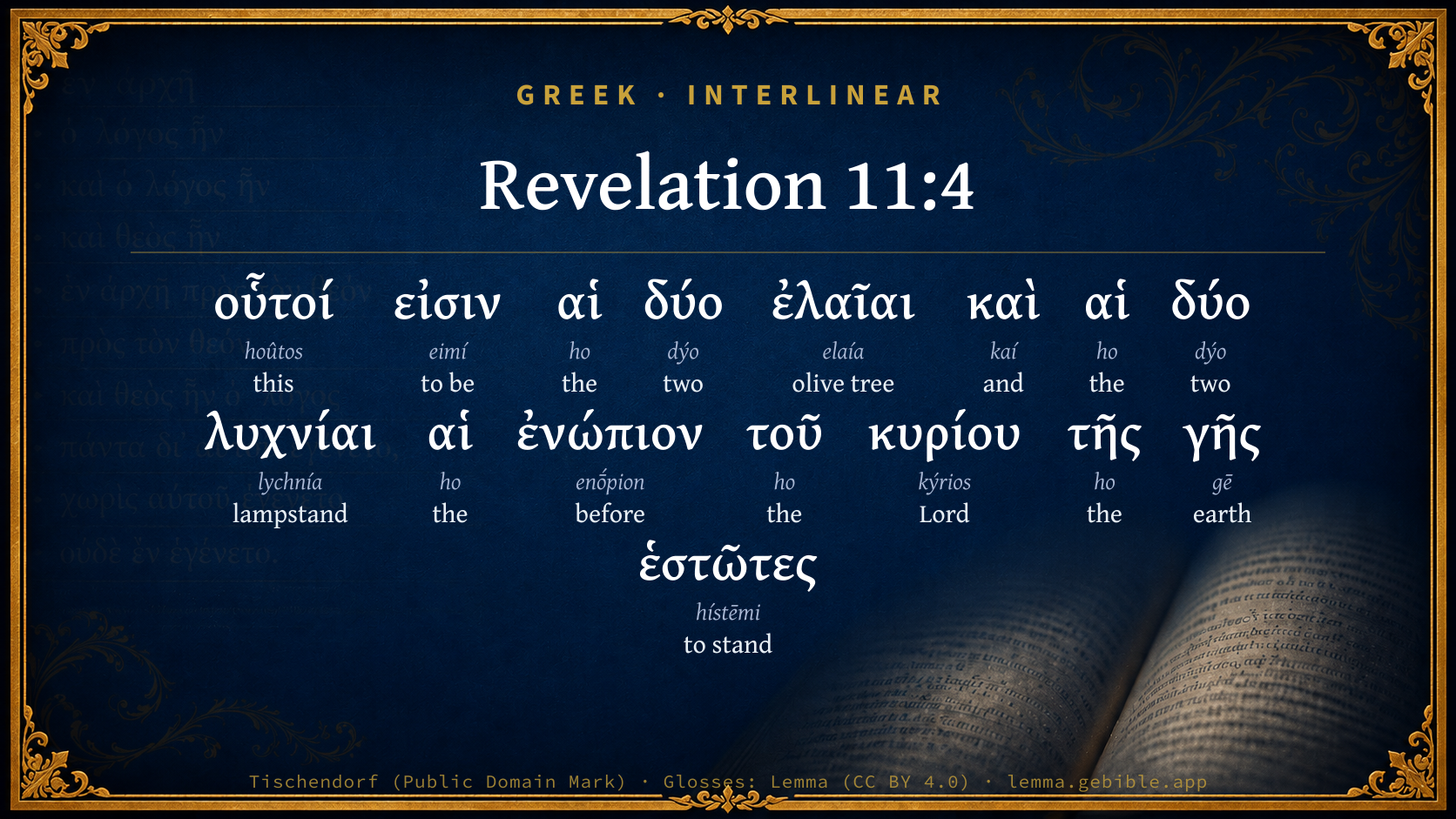
  1. οὗτοί hoûtos G3778 “this” Demonstrative pronoun, Nominative, Plural, Masculine
  2. εἰσιν eimí G1510 “to be” Verb, Present, Active, Indicative, 3rd person, Plural
  3. αἱ ho G3588 “the” Article, Nominative, Plural, Feminine
  4. δύο dýo G1417 “two” Adjective, Numeral (indeclinable)
  5. ἐλαῖαι elaía G1636 “olive tree” Noun, Nominative, Plural, Feminine
  6. καὶ kaí G2532 “and” Conjunction
  7. αἱ ho G3588 “the” Article, Nominative, Plural, Feminine
  8. δύο dýo G1417 “two” Adjective, Numeral (indeclinable)
  9. αἱ ho G3588 “the” Article, Nominative, Plural, Feminine
  10. ἐνώπιον enṓpion G1799 “before” Adverb
  11. τοῦ ho G3588 “the” Article, Genitive, Singular, Masculine
  12. κυρίου kýrios G2962 “Lord” Noun, Genitive, Singular, Masculine
  13. τῆς ho G3588 “the” Article, Genitive, Singular, Feminine
  14. γῆς gē G1093 “earth” Noun, Genitive, Singular, Feminine
  15. ἑστῶτες hístēmi G2476 “to stand” Verb, Perfect, Active, Participle, Nominative, Plural, Masculine

About this verse

These counts appear in no published source. They are computed here, from the morphology-tagged text and Lemma’s own curated glosses. What Lemma adds →

16
words
11
distinct lemmas
Revelation
section

Notable vocabulary

The rarest word here is λυχνίαι lampstand G3087 — appearing just 12 times in the whole Greek New Testament.

Shared distinctive vocabulary

λυχνίαι lampstand G3087 occurs in 11 verses of the Greek New Testament. Also found in:

Repetition

Words recur within this verse:

Cross-references

10

Topical passages linked to Revelation 11:4 in the Treasury of Scripture Knowledge — connected by theme and wording, ordered by reader-vote popularity; previews shown in the World English Bible.

  • Zechariah 4:11–14 Then I asked him, "What are these two olive trees on the right side of the lampstand and on the left side of it?"
  • Zechariah 4:2–3 He said to me, "What do you see?" I said, "I have seen, and, behold, a lampstand all of gold, with its bowl on the top of it, and its seven lamps thereon; there are seven pipes to each of the lamps, which are on the top of it;
  • Jeremiah 11:16 Yahweh called your name, A green olive tree, beautiful with goodly fruit: with the noise of a great tumult he has kindled fire on it, and the branches of it are broken.
  • Psalms 52:8 But as for me, I am like a green olive tree in God's house. I trust in God's loving kindness forever and ever.
  • Isaiah 54:5 For your Maker is your husband; Yahweh of Hosts is his name: and the Holy One of Israel is your Redeemer; the God of the whole earth shall he be called.
  • Revelation 1:20 the mystery of the seven stars which you saw in my right hand, and the seven golden lampstands. The seven stars are the angels of the seven assemblies. The seven lampstands are seven assemblies.
  • Romans 11:17 But if some of the branches were broken off, and you, being a wild olive, were grafted in among them, and became partaker with them of the root and of the richness of the olive tree;
  • Matthew 5:14–16 You are the light of the world. A city located on a hill can't be hidden.
  • Luke 11:33 "No man, when he has lit a lamp, puts it in a cellar, nor under a basket, but on a stand, that those who enter in may see the light.
  • Exodus 8:22 I will set apart in that day the land of Goshen, in which my people dwell, that no swarms of flies shall be there; to the end you may know that I am Yahweh in the midst of the earth.

Cross-references courtesy of OpenBible.info (CC BY 4.0).

Where the printed editions differ

1 variant

Places in this verse where the major printed Greek editions disagree on the wording in a way that affects the translation — a comparison of editions, not a manuscript-by-manuscript collation. The editions are the modern critical texts (Nestlé-Aland 28/27, SBL, Westcott-Hort, Tregelles, Tyndale House) and the traditional texts behind the KJV (the Textus Receptus and the Byzantine/Majority text). It is not a claim about which reading is original.

  1. Different wording
    κυρίου

    “Lord”

    In NA28NA27TynSBLWHTregByz Not in TR

    Θεοῦ (Theou) 'of God' occurs in traditional manuscripts (TR) instead of κυρίου (kuriou) 'Lord' in older manuscripts (NA28+NA27+Tyn+SBL+WH+Treg+Byz)

Textual data: Translators Amalgamated Greek New Testament (STEPBible TAGNT) · CC BY 4.0.

Commentary

Notes on Revelation 11:4 from classic Christian and Jewish commentators (each source and its license shown beneath its notes). The classic Christian expositions comment on the surrounding passage and are grouped to its opening verse, so a note may address several verses; the Jewish commentaries on the Tanakh (Rashi and others) are per-verse, so they appear only where the commentator wrote on this verse.

Lemma curates 59 commentaries, every one of them public domain or Creative Commons licensed, each selected and text-cleaned for this edition rather than reprinted as found. About our sources →

Tyndale Open Study Notes

Tyndale Open Resources

11:4 two olive trees and . . . two lampstands: See study note on 1:12; see also Exod 25:31-40; Zech 4:2-6.

Tyndale Open Study Notes — © Tyndale Open Resources, licensed CC BY-SA 4.0. Text via the HelloAO Bible API.

Bengel's Gnomon

Johann Albrecht Bengel

Rev 11:4. Αἱ δύο ἔλαιαι καὶ αἱ δύο λυχνίαι αἱ ἐνώπιον τοῦ Κυρίου τῆς γῆς ἑστῶτες) See App. Crit. Ed. ii. In Rev 11:13 He is called the God of heaven, and Isa 54:5, the God of the earth; Gen 24:3, the God of heaven and the God of the earth; but in this passage He is called the Lord of the earth, as in the parallel passage, Zec 4:14.—ἑστῶτες altogether agrees with grammatical rules and the taste of many, and still more so does αἱ ἑστῶσαι;[110] nor should I refuse to regard αἱ ἑστῶτες as a fault of the copyists, if this were the only instance of such a construction. But because the Apocalypse abounds in figurative expressions, as we have everywhere shown, in any passage where there is a variety of reading, I take it for granted, I admit, that the reading which is contrary to that which we should have expected is the true one, and that it has been simply and faithfully handed down by less perverse copyists; and I think that the others have been altered and conformed to the common rule by more recent copyists. In the present instance that הומדים is expressed from Zechariah, the passage quoted above, although the construction is easier in Hebrew than in Greek, as lately in לאמר, λέγων, Rev 11:1. The article is necessary in this place for the connection of the discourse, as ä in העמדים. No book has οἱ: therefore αἱ remains. The Greek article is much, more flexible than our custom admits: as τῷ τὸν φόρον, ὁ τὸ πολὺ, οἱ μακρὰν, κ.τ.λ. Therefore αἱ—ἑστῶτες, if it pleases you, is said, as though it were said, αἵ—εἰσὶν ἑστῶτες, where αἱ as the subject, and ἑστῶτες as the predicate, are not ill agreed. There is a disparity of genders not unlike this, ch. Rev 14:19. See also Notes on Chrys. de Sacerd. p. 504. If any one is positive that John could not have thus written, let him follow the reading which he judges that he wrote.

[110] Ἑστῶτες, ABC Vulg. But ἑστῶσαι, Rec. Text, with h.—E.

Bengel's Gnomon of the New Testament — English translation (T&T Clark, Edinburgh, 1860) — public domain. Text from a community e-Sword module.

Meyer's Critical & Exegetical Commentary

Heinrich August Wilhelm Meyer

Rev_11:4. The two witnesses of Christ (Rev_11:3) are further characterized in their nature and calling, and that, too, from Zechariah 4; for the definite art., αἱ δύο ἐλ., αἱ δύο λυχν., points back to this, as the entire verse is based upon the sense and expression of Zechariah 4. There Zech. beholds a golden candlestick with seven lamps, the symbol of the Church of God,[2833] besides two olive-trees, to the right and left of the candlestick, which receives from them its oil. The two ἐλαῖαι (LXX.) designate, besides the λυχνία, two anointed ones that stand by the Lord of the whole earth;[2834] viz., the two defenders and guardians of the theocracy given by God,

Zerubbabel and the high priest Joshua;[2835] but the symbol represents that only by the Spirit of God, and not by mans own power, the restoration of the kingdom of God can be effected, Rev_11:6. With this symbol of Zech., John agrees when he designates the two witnesses of Christ as ΑἹ ΔΎΟ ἘΛΑῖΑΙ, and as ἘΝΏΠΙΟΝ ΤΟῦ ΚΥΡΊΟΥ Τῆς Γῆς ἙΣΤῶΤΕς. The latter expression, whose harsh incorrectness (ΑἹ

ἙΣΤῶΤΕς) is explicable by the reference to the persons represented under the symbols of ἘΛΑῖΑΙ and ΛΥΧΝΊΑΙ,[2836] designates as little as the corresponding words in Zech. the two witnesses as representatives of the Church against the world,[2837] but as servants of God,[2838] who is here called, accordingly, the Lord of the world,[2839] because he shall establish the fact that he is the Almighty, who sends his servants into their office, and protects them against all enemies, Rev_11:5, and to the terror of their enemies can glorify[2840] the κατοικοῦντες ἐπὶ τῆς γῆς, Rev_11:10 sqq. Deviating, however, from Zech., John designates the two witnesses, not only as two ἐλαῖαι, but also as two λυχνίαι. He, of course, derives this symbolical idea from Zech., but gives it another application; for what is said here is neither concerning the kingdom of God in itself, nor its up-building through Christs two witnesses, but concerning a judgment upon the holy city, during which the two witnesses preach repentance, and that, too, in vain, Rev_11:7 sqq. In no respect have the two witnesses aught to do with the preservation of the temple.[2841] The idea of the one λυχνία in the sense of Zech. has therefore no place here. But John comprehends the symbol of the λυχνίαι in essentially the same significance as that of the ἑλαῖαι, when, precisely in the sense of Zec_4:6, he portrays what was just before expressed in clear words (δώσω τοῖς μάρτ. μ. καὶ προφητεύσουσιν); viz., that the efficiency of the two witnesses depends upon the Divine Spirit, not upon their own power, and hence becomes truly prophetic. John, therefore, describes the prophetic character of the two witnesses of Christ as like those two anointed ones in Zech.; but that he will not express the identity of the persons, nor designate the two witnesses as Zerubbabel and Joshua, who then must be regarded as repeated, follows partly from the deviation from Zech., and partly from other specifications in the context, Rev_11:3, Rev_11:5 sqq.[2842]

[2833] Cf. Rev_1:20.

[2834] LXX.: παρεστήκασι κυρίῳ πάσης γῆς.

[2835] Cf. Rev_3:1 sqq.

[2836] Cf. Rev_5:13. Winer, p. 499.

[2837] Against Ebrard, who understands the אְַדֹון כָּל־הָאָרֶץ as the Persian ruler of the world, and accordingly, in this passage, the κύριος τῆς γῆς as the Lord of this world.

[2838] Rev_8:2. Cf. Isa_6:1.

[2839] Cf., on the other hand, Rev_11:13.

[2840] Cf. Beng.

[2841] Rev_11:1, wherein many erroneously find the new building of the Christian Church symbolized.

[2842] See on Rev_11:13.

Meyer — Critical and Exegetical Commentary on the New Testament — English translation by Peter Christie, edited by Frederick Crombie (T&T Clark, 1880) — public domain. Text from a community e-Sword module.

Expositor's Greek Testament

ed. W. Robertson Nicoll

Rev 11:4 . They are further described in the terms applied by Zechariah to the two most prominent religious figures of his day, except that they are compared to two lampstands, not to one which is septiform. The idea is that their authority and influence are derived from God. As in Rev 11:7 , the function of the two witnesses ( cf. Deu 17:6 ; Deu 19:15 ) is defined as “prophecy,” but no details are given.

The Expositor's Greek Testament, edited by W. Robertson Nicoll (1897–1910) — public domain. Text from a community e-Sword module.

Geneva Bible (1599)

Geneva Bible translators

That is, the ordinary and perpetual instruments of spiritual grace, peace and light in my Church, which God by his only power preserved in this Temple. See Zech. 4:3.

Geneva Bible (1599) marginal notes — public domain. Text via Bolls.life.

Jamieson, Fausset & Brown

Robert Jamieson, A. R. Fausset & David Brown

standing before the God of the earth--A, B, C, Vulgate, Syriac, Coptic, and ANDREAS read "Lord" for "God": so Zac 4:14. Ministering to (Luk 1:19), and as in the sight of Him, who, though now so widely disowned on "earth," is its rightful King, and shall at last be openly recognized as such (Rev 11:15). The phrase alludes to Zac 4:10, Zac 4:14, "the two anointed ones that stand by the Lord of the whole earth." The article "the" marks this allusion. They are "the two candlesticks," not that they are the Church, the one candlestick, but as its representative light-bearers (Greek, "phosteres," Phi 2:15), and ministering for its encouragement in a time of apostasy. WORDSWORTH'S view is worth consideration, whether it may not constitute a secondary sense: the two witnesses, the olive trees, are THE TWO TESTAMENTS ministering their testimony to the Church of the old dispensation, as well as to that of the new, which explains the two witnesses being called also the two candlesticks (the Old and New Testament churches; the candlestick in Zac 4:2 is but one as there was then but one Testament, and one Church, the Jewish). The Church in both dispensations has no light in herself, but derives it from the Spirit through the witness of the twofold word, the two olive trees: compare Note, see on Rev 11:1, which is connected with this, the reed, the Scripture canon, being the measure of the Church: so PRIMASIUS [X, p. 314]: the two witnesses preach in sackcloth, marking the ignominious treatment which the word, like Christ Himself, receives from the world. So the twenty-four elders represent the ministers of the two dispensations by the double twelve. But Rev 11:7 proves that primarily the two Testaments cannot be meant; for these shall never be "killed," and never "shall have finished their testimony" till the world is finished.

Jamieson, Fausset & Brown — Commentary Critical and Explanatory on the Whole Bible (1871) — public domain (CC PDM 1.0). Text via the HelloAO Bible API.

Adam Clarke's Commentary

Verse 4. These are the two olive trees] Mentioned Zec 4:14, which there represent Zerubbabel and Joshua the high priest. The whole account seems taken from Zec 4:1-14. Whether the prophet and the apostle mean the same things by these emblems, we know not.

Adam Clarke's Commentary on the Bible (1810–1826) — public domain. Text from a community e-Sword/MySword module.

Ellicott's Commentary for English Readers

(4) These are . . .—Translate, These are the two olive trees and the two candlesticks which stand before the Lord of the earth. This is the verse which refers us to the vision of Zechariah for the basis of our present vision. There, as here, we have the two olive trees, which are explained to be “the two anointed ones which stand before the Lord of the whole earth.” The explanation is supposed to refer to Zerubbabel and Joshua. or, as others think, to Zechariah and Haggai. At that time these men were the witnesses for God in their land and among their people. But the answer of the angel is general: “the olive trees are the two anointed ones which stand,” &c. For the vision is general and age-long; it reminds us of the returned Jewish exiles, and of those who were then among them, as anointed witnesses, but it shows us that such witnesses are to be found in more than one era; for it is not Zerubbabel and Joshua who can exhaust the fulness of a vision which is the representation of the eternal truth that the oil of gladness and strength from God will rest on those who rely, not on might or power, but on God’s Spirit. The fact that the witnesses are two is brought more prominently forward here than in Zechariah. There, though the olive trees are two, the candlestick is but one, with seven lamps; here there are two candlesticks spoken of as well as two olive trees. This amplification of the original vision is, perhaps, designed to remind us of the greater latitude of diversity in the new dispensation. Just as in the early chapters of this book we had seven golden candlesticks, which, though one in Christ, yet are spoken of as separate, so here the double aspect, the diverse though united efforts of the two witnesses. are brought into prominence. It may serve to remind us. that the witnesses are to be expected to keep their individuality and to use freely their diverse powers. It is not from one class or with one mode of action that the witnesses come: they may be of the statesman class, like Moses and Zerubbabel; of the prophetic or priestly like Zechariah and Haggai, like Aaron and the later Joshua (Zec_3:1); for men may witness for God, according as the evils of their time and age require it in the State as well as in the Church. The work of Wilberforce, Clarkson, and Howard is a work and a witness for God as well as the work of Chrysostom, Athanasius, and Luther; for the witnesses are raised up to speak against the neglect of humanity as well as against errors in divinity; against a heartless as well as against a creedless Christianity, for both lead back to heathenism. These witnesses are burning and shining lights; in them is centred the light of their age; in them is found the token that the grace of God never fails, but as the Church’s day so shall her strength be. Here, too, we have the pledge that from Him who is both Priest and King the civil rulers as well as the ecclesiastical rulers may draw grace according to their gifts; and from Him, too, all who are made kings as well as priests to God may derive the power to give the double witness of a life anointed by the Spirit of consecration and ruled by the sceptre of righteousness.

A Bible Commentary for English Readers, edited by Charles John Ellicott (1878–1897) — public domain. Text from a community e-Sword module.

The Cambridge Bible for Schools and Colleges

gen. ed. J. J. S. Perowne

4. the two olive trees &c.] See Zechariah 4 passim. There apparently the “two Anointed Ones” are Zerubbabel and Jeshua, or rather perhaps the ideal King and Priest, conceived as types of Him Who is both: perhaps these two Witnesses similarly typify Him as King (cf. Deu_33:5) and Prophet.

The Cambridge Bible for Schools and Colleges (gen. ed. J. J. S. Perowne; Cambridge University Press, 1878–1918) — public domain. Text from a community e-Sword module.

John Gill's Exposition

These are the two olive trees,.... Or represented by the two olive trees in Zac 4:3, which there design Joshua and Zerubbabel; and who in laying out themselves, their gifts and wealth, in rebuilding and finishing the temple, were types of these witnesses, the ministers of the Gospel, in the successive ages of the apostasy; who may be compared to olive trees, because of the oil of grace, and the truth of it in them; and because of the gifts of the Spirit of God bestowed on them, or their having that anointing which teacheth all things; and because they freely impart their gifts, and the golden oil of the Gospel unto others, and also bring the good tidings of peace and salvation by Christ, of which the olive leaf is a symbol; and because they are like the olive tree, fat, flourishing, and fruitful in spiritual things; they are sons of oil, and God's anointed ones:

and the two candlesticks; which hold forth the light of the word, in the midst of Popish darkness: this shows that churches, as well as ministers, are designed by the witnesses, since the candlesticks are explained of the churches, Rev 1:20, though the simile well agrees with ministers of the word, who are the lights of the world, or hold forth the light of the Gospel, which is put into them by Christ: and these olive trees and candlesticks are represented as

standing before the God of the earth; ministering unto him, enjoying his presence, and having his assistance, and being under his protection. The Alexandrian copy, the Vulgate Latin, Syriac, and Arabic versions, read, "the Lord of the earth"; and so the Complutensian edition; see Zac 4:14.

John Gill's Exposition of the Whole Bible (1746–1763) — public domain (CC PDM 1.0). Text via the HelloAO Bible API.

Trapp's Complete Commentary

John Trapp

4 These are the two olive trees, and the two candlesticks standing before the God of the earth.

Ver. 4. These are the two olive trees] See Zec 4:3; Zec 4:11; Zec 4:14. in this book of the Revelation the Holy Ghost borrows all the elegancies and flowers in the story of the Old Testament, thereby to set out the story of the New in succeeding ages.

John Trapp, A Commentary or Exposition upon All the Books of the Old and New Testament (1647–1656) — public domain. Text from a community e-Sword module.

Albert Barnes' Notes on the Bible

These are the two olive-trees - These are represented by the two olive-trees, or these are what are symbolized by the two olive-trees. There can be little doubt that there is an allusion here to Zec 4:3, Zec 4:11, Zec 4:14, though the imagery is in some respects changed. The prophet Zec 4:2-3 saw in vision “a candlestick all of gold, with a bowl upon the top of it, and his seven lamps thereon, and seven pipes to the seven lamps, which were upon the top thereof; and two olive-trees by it, one upon the right side of the bowl, and the other upon the left side thereof.” These two “olive branches” were subsequently declared Rev 11:14 to be “the two anointed ones, that stand by the Lord of the whole earth.” The olive-trees, or olive-branches Rev 11:12, appear in the vision of the prophet to have been connected with the ever-burning lamp by golden pipes; and as the olive-tree produced the oil used by the ancients in their lamps, these trees are represented as furnishing a constant supply of oil through the golden pipes to the candlestick, and thus they become emblematic of the supply of grace to the church. John uses this emblem, not in the sense exactly in which it was employed by the prophet, but to denote that these two “witnesses,” which might be compared with the two olivetrees, would be the means of supplying grace to the church. As the olive-tree furnished oil for the lamps, the two trees here would seem properly to denote ministers of religion; and as there can be no doubt that the candlesticks, or lamp-bearers, denote churches, the sense would appear to be that it was through the pastors of the churches that the oil of grace which maintained the brightness of those mystic candlesticks, or the churches, was conveyed. The image is a beautiful one, and expresses a truth of great importance to the world; for God has designed that the lamp of piety shall be kept burning in the churches by truth supplied through ministers and pastors.

And the two candlesticks - The prophet Zechariah saw but one such candlestick or lamp-bearer; John here saw two - as there are two “witnesses” referred to. In the vision described in Rev 1:12, he saw seven - representing the seven churches of Asia. For an explanation of the meaning of the symbol, see the notes on that verse.

Standing before the God of the earth - So Zec 4:14, “These be the two anointed ones, that stand by the Lord of the whole earth.” The meaning is, that they stood, as it were, in the very presence of God - as, in the tabernacle and temple, the golden candlestick stood “before” the ark on which was the symbol of the divine presence, though separated from it by a veil. Compare the notes on Rev 9:13. This representation, that the ministers of religion “stand before the Lord,” is one that is not uncommon in the Bible. Thus it is said of the priests and Levites: “The Lord separated the tribe of Levi, to staled before the Lord, to minister unto him, and to bless his name,” Deu 10:8; compare Deu 18:7. The same thing is said of the prophets, as in the cases of Elijah and Elisha: “As the Lord liveth, before whom I stand,” 1Ki 17:1; also, 1Ki 18:15; 2Ki 3:14; 2Ki 5:16; compare Jer 15:19. The representation is, that they ministered, as it were, constantly in his presence, and under his eye.

Albert Barnes' Notes on the Bible (1834–1885) — public domain. Text from a community e-Sword/MySword module.

Haydock's Catholic Bible Commentary

These are the two olive-trees, flourishing with works of piety and mercy, and the two candlesticks shining with faith and good works. (Witham)

George Leo Haydock (1774–1849), Haydock's Catholic Family Bible and Commentary, 1859 edition — public domain. Excludes Psalms (Douay-Rheims chapter numbering differs from Protestant) and Deuterocanonical books (Catholic canon only).

Matthew Poole's English Annotations

Here is a manifest allusion to Zechariah’s vision, Zec 4:2,3,11-14, though with some little difference. He saw a candlestick all of gold, with a bowl upon the top of it, and his seven lamps thereon, and seven pipes to the seven lamps, which were upon the top thereof: and two olive trees by it, one upon the right side of the bowl, and the other upon the left side thereof. The angel tells him, that these two olive branches which through the two golden pipes did empty the golden oil out of themselves, were the two anointed ones, or the two sons of oil, that stood by the Lord of the whole earth. By which some understand Zerubbabel and Joshua; some, those godly magistrates and priests, which after the captivity the Jewish church should have, and prefigured a gospel ministry, who being filled with knowledge and grace, should feed the Lord’s church (as pastors after his own heart) with wisdom and understanding, from the gifts and graces of God’s Holy Spirit, which they should receive; which further confirmeth me, that by the two witnesses, Rev 11:3, we are to understand a godly magistracy and ministry, or rather the latter only, to whom prophesying most strictly agreeth, and who have a more special relation to the candlesticks here mentioned, by which churches are meant, Rev 1:20.

And the two candlesticks standing before the God of the earth: in Zechariah’s vision was but one candlestick, how comes here a mention to be made of two? Mr. Mede confesseth himself at a loss here, unless here another candlestick be added to signify the Gentiles’ conversion to Christ. Others think that it denoteth the small number of gospel churches that should be left; they were reckoned seven, Rev 1:20; here they are reduced to two. Possibly it may denote the different state of God’s church. In the Old Testament God had but one church, viz. that of the Jews; but now he hath many churches, and they are all fed from faithful ministers, as olive branches pouring out their oil of grace and knowledge upon them.

Matthew Poole's English Annotations on the Holy Bible (1683–1685) — public domain. Text from a community e-Sword/MySword module.

Whedon's Commentary on the Bible

Daniel D. Whedon

4. Two candlesticks—The candlestick, in this book, uniformly represents a church, and the olive trees which supply the oil naturally represent the ministry. Hence the witnesses, as the impersonation of these two bodies, are two. Nothing is more common than the impersonating a collective body in an individual. In this book a nation is a beast, a corrupt church is a harlot. A testifying church and a testifying ministry are two witnesses.

The imagery is based, with free modifications, upon Zec_4:2-13. The prophet there sees two candlesticks, (or rather lamps,) into which two olive trees are pouring, through pipes, their golden oil. And these are there said to represent “the two anointed ones that stand by the Lord of the whole earth.” These two are Joshua, representing the priesthood, and Zerubbabel, representing the nation.

Before the God… earth—Like prime-ministers before their divine Sovereign.

Daniel D. Whedon (gen. ed.), Commentary on the Old and New Testaments (1874–1909) — public domain. Text from a community e-Sword module.

The Pulpit Commentary

These are the two olive trees, and the two candlesticks. The "two olive trees" and the "two candlesticks" are here identical. Thus, while St. John uses the figure of Zechariah, he does not apply it in every detail. In the prophet, but one candlestick is mentioned. "The two olive trees," which supply the material for the candlesticks, are fit emblems of the Old and New Testaments; the candlesticks typify the Jewish and Christian Churches. These are identical so far as being God"s witnesses; the Church derives her stores from the Word of God, the light of the Word of God is manifested through the Church. Standing before the God of the earth; the Lord of the earth (Revised Version). The participle is masculine, though the preceding article and nouns are feminine, probably as being more in keeping with the masculine character under which the two witnesses are depicted. Perhaps he is described as the "Lord of the earth," since the witnesses are to prophesy before all the earth. (cf. ver. 9 and Mat_24:14)

The Pulpit Commentary (1880–1919), ed. H.D.M. Spence-Jones & Joseph S. Exell — public domain. Text from a community e-Sword module.

John Wesley's Explanatory Notes

These are the two olive trees - That is, as Zerubbabel and Joshua, the two olive trees spoken of by Zechariah, Zech. iii, 9, iv, 10, were then the two chosen instruments in God's hand, even so shall these. be in their season. Being themselves full of the unction of the Holy One, they shall continually transmit the same to others also. And the two candlesticks - Burning and shining lights. Standing before the Lord of the earth - Always waiting on God, without the help of man, and asserting his right over the earth and all things therein.

John Wesley, Explanatory Notes Upon the Whole Bible (1754–1765) — public domain. Text via the GEBible commentary corpus.

Scofield Reference Notes

C. I. Scofield

God

Adonai. Zec 4:14.

The Scofield Reference Bible (1917 edition), notes by C. I. Scofield — public domain. Text from a community e-Sword module.

Burkitt's Expository Notes on the New Testament

William Burkitt

Observe here, 1. A double title given by God unto the two witnesses, spoken of in the former verse; they are styled olive-trees and candlesticks. As the olive-tree is always green, so the ministry of these witnesses is lively and efficacious; as the olive is a sign of peace, and the oil that drops from the olive an emblem of grace, so the ministry of these witnesses was a ministry both of grace and peace. Again, they are called olive-trees, because they are to minister oil to the candlesticks, which are to hold out light unto others.

Here note, That the title of candlesticks given to the churches, chap. 1 is here given to the ministers of the church; partly to show the near relation that is between them, and partly to point out the duty that is mutually incumbent upon them; namely, to hold forth the light of truth unto others.

And farther, these candlesticks are said to stand before the God of the earth, signifying their fidelity in the discharge of their duty, as in the presence of God, before whom they stand.

Observe, 2. The efficacy and power of these witnesses’ ministry in the certain effects of it. What was said of Elijah and Elisha literally, is applied unto them spiritually.

1. As Elijah brought fire down from heaven, which devoured the enemy, so fire proceeds out of these witnesses’ mouth, not by way of imprecation, but by way of denunciation, pronouncing the threatenings and judgments of God against them, continuing in their impenitency.

2. As Elijah had power to shut heaven, so have these witnesses power to do the like during the time of their prophecy; that is, God is provoked for the world’s ill treatment of his faithful witnesses to withhold the spiritual rain of the word, and the refreshing doctrine of the gospel, from them.

Again, when it is said that these witnesses have power to turn the waters into blood, and to smite the earth with all plagues, there is a manifest allusion to Moses and Aaron, who exercised such a power. Exodus 7.

Accordingly, God being provoked by the indignities offered to his faithful witnesses, permits the pure doctrine of the gospel to be corrupted, and avenges their cause, by bringing judgments on the world, as Moses did upon Egypt, according to the threatenings denounced by them.

Whence we may learn, what great credit and esteem the faithful witnesses and ministers of Christ are in with God; what power and prerogative is given to them, far surpassing the power of any mortal prince, even a power to open and shut heaven, to turn waters into blood, and to smite the earth: that is, God doth all these things upon a just occasion in vindication of them, and in revenge for the injuries done unto them.

William Burkitt's Expository Notes on the New Testament (1700–1703) — public domain. Text from a community e-Sword module.

The People's New Testament

B. W. Johnson

4. These are the two olive trees, and the two candlesticks. The olive tree was the source of the oil used to provide for the candlesticks. The candlesticks, burning the oil, gave forth light. The symbols imply that during this period of 1260 days God shall have two agencies, bearing divine witness, which shall give forth light to men. These agencies shall be filled and sustained by the Spirit.

B. W. Johnson's The People's New Testament with Notes (1889–1891) — public domain. Electronic text from the Christian Classics Ethereal Library (CCEL) ThML edition.

Cambridge Greek Testament for Schools and Colleges

4. ἑστῶτες. Text. Rec[374] reads ἑστῶσαι with אccP 1.

[374] Rec. Textus Receptus as printed by Scrivener.

4. αἱ δύο ἐλαῖαι καὶ αἱ δύο λυχνίαι. As in Zechariah 4. the two olive trees or the two Anointed Ones supply the bowl of one golden candlestick with oil, it may be a question whether the reference is directly to Zechariah or to a tradition which grew from his words: the two candlesticks, cf. Psa 132:17, are clearly known beforehand like the two olive trees: we know from the “Psalms of Solomon,” Rev 8:12, Rev 17:6, that there was a widespread feeling that from the time of Epiphanes there had been no lawful kingdom or lawful priesthood, for the Maccabees had usurped both: this would explain a belief founded on Zechariah that a lawful kingdom and priesthood must be restored before the Kingdom of Christ, as there was a belief founded on Malachi that Christ would not come before Elias had appeared. Hence this verse would be an exact parallel to Mat 11:14, at once a sanction and a correction to existing belief. In Zechariah apparently the “two Anointed Ones” are Zerubbabel and Jeshua, or rather perhaps the ideal King and Priest, conceived as types of Him Who is both: perhaps these two Witnesses similarly typify Him as King (cf. Deu 33:5) and Prophet.

ἑστῶτες. The masculine is not surprising after οὗτοι; but the position of the participle is as singular here as that of the verb in Rev 7:2.

Cambridge Greek Testament for Schools and Colleges (Cambridge University Press, 1896; 21 vols, various authors incl. Carr, Maclear, Plummer, Farrar, Lumby, Moule, M. R. James, Simcox) — public domain. Text from a community e-Sword module.

Vincent's Word Studies in the New Testament

Marvin R. Vincent

Two olive trees. See Zechariah 4.

Candlesticks. See Zechariah 4, and note on Mt 10:15.

The God. Read kuriou the Lord. Compare Zec 4:14.

Marvin R. Vincent, Word Studies in the New Testament (1887–1900) — public domain. Text from a community e-Sword/MySword module.

Lesson kit

Teaching starters — assembled from the data on this page, not authored interpretation. Every prompt links to the verse data it draws on. Edit before teaching.

Revelation, in the Revelation, opens this verse with 16 words (11 distinct Greek lemmas). Its most distinctive word is lychnía (“lampstand”). A historical commentator’s framing appears above. Read the whole chapter for the surrounding context.

Discussion questions

  1. How does “lampstand” (lychnía) shape what this verse is saying?
  2. How does Matthew 5:15, which shares the word «lampstand», read alongside this verse?
  3. What does the repetition of “two” (2× in this one verse) do in this verse?
  4. These translations render this verse differently; the difference is in the English rendering, not the original. What questions does that raise?
  5. Compare how Tyndale Open Study Notes and Bengel's Gnomon read this verse. Where do they agree or differ?

Things to notice

Reading settings

Reading text

Shown beneath each verse's original-language words.

Old Testament
Old Testament edition

Read the OT as the Masoretic Hebrew (MT) or the Greek Septuagint (LXX).

English shown for the Greek Septuagint (in the Hebrew ↔ Greek comparison).

Comparing translations? Open the Compare panel on any verse page to stack up to four side by side.