Acts 8:33

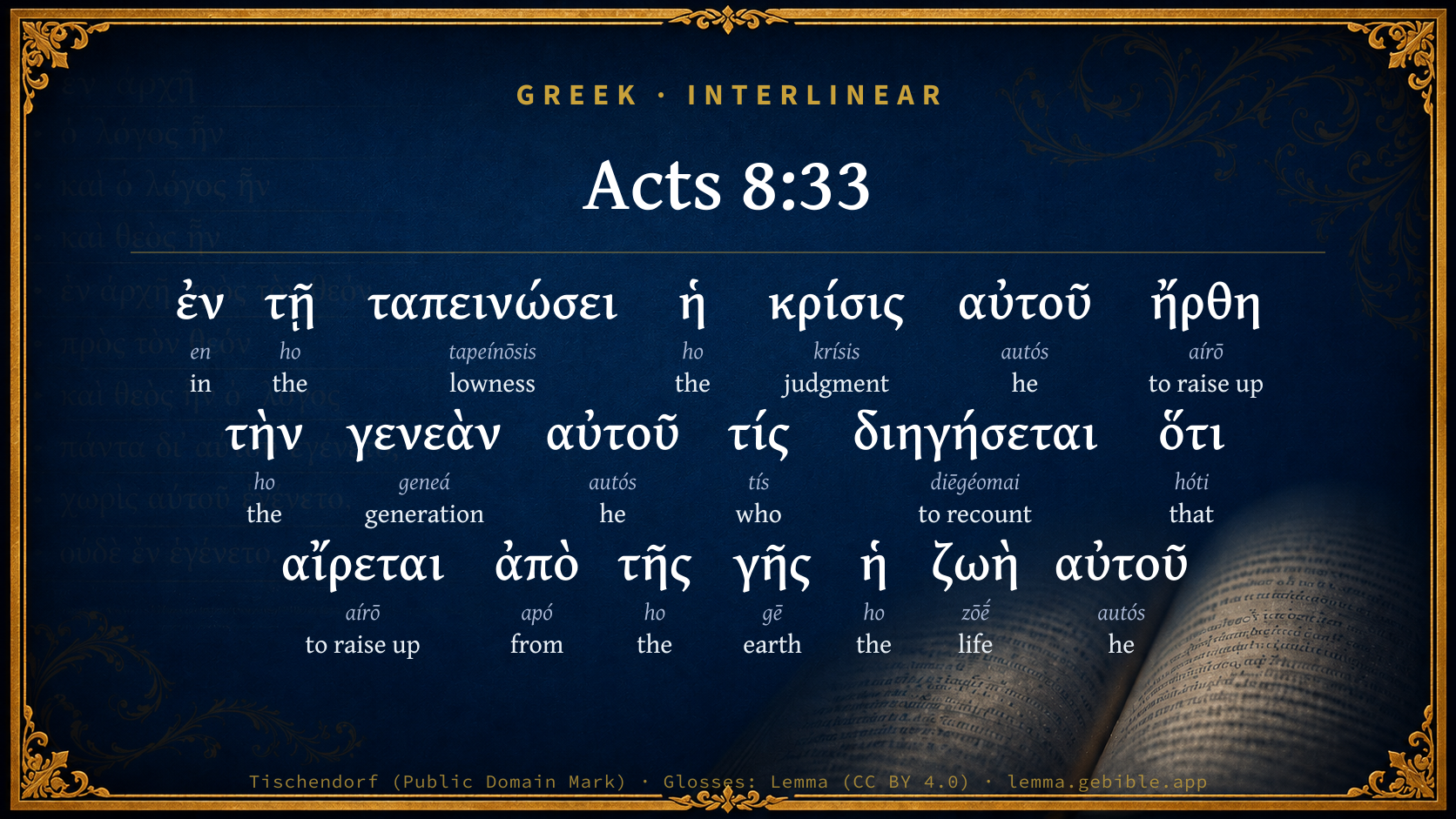
Greek (Tischendorf 8th ed.) Acts 8:33 appears in the Greek New Testament. The text above is from the Tischendorf 8th edition. Each word links to its Strong’s number and a concise gloss. Click any word for its full Thayer’s Greek Lexicon entry.
Download image
Cite this verse

Acts 8:33 (World English Bible). Public Domain. Lemma interlinear Bible study tool, https://lemma.gebible.app/v/acts/8/33.

Show BibTeX & RIS
BibTeX
RIS
English Translation
In his humiliation, his judgment was taken away. Who will declare His generation? For his life is taken from the earth."
World English Bible · Public Domain
Download a study sheet

One document with this verse’s original text, its word-by-word gloss line, the meaning frame, cross-references with their text, attributed commentary, and full source and license credits — printable, and it pastes into notes with its structure intact.

This verse Autodidact and up

Study sheet (.html) Plain text (.txt)

A passage Seminary Student

Up to 50 verses in one chapter. A passage sheet keeps up to 6 commentary sources and 12 cross-references per verse, in the order this page ranks them, and says so on the sheet whenever that leaves anything out. Ask for a single verse and you get the Autodidact verse sheet above.

Everything on this page stays free to read, with no account — the sheet is a download of what is already on screen, not access to it.

Want to remove ads? Support Godless Engineer
Compare translations 3

The same verse in 3 English versions, stacked beneath the original-language interlinear above. Click any original word for its lexicon entry.

Each is an independent rendering of the whole verse — the interlinear is not word-aligned to these translations.

Highlighted words mark where these versions differ — a whole-verse word diff, not a word-by-word alignment.

  • World English Bible Public Domain
    In his humiliation, his judgment was taken away. Who will declare His generation? For his life is taken from the earth."
  • King James Version Public Domain
    In his humiliation his judgment was taken away: and who shall declare his generation? for his life is taken from the earth.
  • unfoldingWord Literal Text CC BY-SA 4.0
    In humiliation his justice was taken away. Who will describe his generation? For his life is taken from the earth.”

unfoldingWord Literal Text — © unfoldingWord, licensed CC BY-SA 4.0. Word-aligned USFM3 via Door43 (git.door43.org/unfoldingWord/en_ult).

Versions to compare (up to 4)

3 of 4 selected

Show all 19 translations

Every available English version of this verse, each an independent rendering of the whole verse.

  • World English Bible Public Domain
    In his humiliation, his judgment was taken away. Who will declare His generation? For his life is taken from the earth."
  • Berean Standard Bible Public Domain
    In His humiliation He was deprived of justice. Who can recount His descendants? For His life was removed from the earth.”
  • Majority Standard Bible Public Domain
    In His humiliation He was deprived of justice. Who can recount His descendants? For His life was removed from the earth.”
  • King James Version Public Domain
    In his humiliation his judgment was taken away: and who shall declare his generation? for his life is taken from the earth.
  • American Standard Version (1901) Public Domain
    In his humiliation his judgment was taken away: His generation who shall declare? For his life is taken from the earth.
  • Revised Version (1885) Public Domain
    In his humiliation his judgment was taken away: His generation who shall declare? For his life is taken from the earth.
  • Geneva Bible (1599) Public Domain
    In his humilitie his iudgement hath bene exalted: but who shall declare his generation? for his life is taken from the earth.
  • Douay-Rheims (1899) Public Domain
    In humility his judgment was taken away. His generation who shall declare, for his life shall be taken from the earth?
  • Young's Literal Translation Public Domain
    in his humiliation his judgment was taken away, and his generation -- who shall declare? because taken from the earth is his life.'
  • Literal Standard Version CC BY-SA 4.0
    In His humiliation His judgment was taken away, || And His generation—who will declare? Because His life is taken from the earth.”
  • Unlocked Literal Bible CC BY-SA 4.0
    In his humiliation justice was taken away from him. Who can fully describe his descendants? For his life was taken from the earth.”
  • unfoldingWord Literal Text CC BY-SA 4.0
    In humiliation his justice was taken away. Who will describe his generation? For his life is taken from the earth.”
  • Darby Bible Public Domain
    In his humiliation his judgment has been taken away, and who shall declare his generation? for his life is taken from the earth.
  • World Messianic Bible Public Domain
    In his humiliation, his judgment was taken away. Who will declare His generation? For his life is taken from the earth.”
  • Webster's Bible Public Domain
    In his humiliation his judgment was taken away: and who shall declare his generation? for his life is taken from the earth.
  • Free Bible Version CC BY-SA 4.0
    He was humiliated and denied justice. No one can speak of his descendants, for his life came to an end.”
  • Bible in Basic English Public Domain
    Being of low degree, his cause was not given a hearing: who has knowledge of his family? for his life is cut off from the earth.
  • Text-Critical English NT CC BY 4.0
    In his humiliation he was denied justice. Who will tell of his posterity? For his life was taken from the earth.”
  • Tyndale New Testament (1534) Public Domain
    Because of his humblenes he was not estemed: who shall declare his generacion? for his lyfe is taken from the erthe.

Literal Standard Version (2020), Covenant Press — licensed CC BY-SA 4.0. Text via the HelloAO Bible API (eBible.org). Unlocked Literal Bible (unfoldingWord) — licensed CC BY-SA 4.0. Text via the HelloAO Bible API (eBible.org). unfoldingWord Literal Text — © unfoldingWord, licensed CC BY-SA 4.0. Word-aligned USFM3 via Door43 (git.door43.org/unfoldingWord/en_ult). Free Bible Version, Dr. Jonathan Gallagher — licensed CC BY-SA 4.0. Text via the HelloAO Bible API (eBible.org).

Word by word

More ways to search: Search by grammar → Find every occurrence → Compare this word →

Practice this passage: Drill this verse → Learn its vocabulary →

ταπεινώσει
tapeínōsis
G5014
“lowness”
Noun, Dative, Singular, Feminine
Part of Speech
Noun
Case
Dative
Number
Singular
Gender
Feminine
Full Thayer's Definition

Origin: from G5013

TDNT: 08:01,1

1. lowness, low estate 2. metaph. a. spiritual abasement, leading one to perceive and lament his (moral) littleness and guilt
  1. ἐν en G1722 “in” Preposition
  2. τῇ ho G3588 “the” Article, Dative, Singular, Feminine
  3. ἡ ho G3588 “the” Article, Nominative, Singular, Feminine
  4. κρίσις krísis G2920 “judgment” Noun, Nominative, Singular, Feminine
  5. αὐτοῦ autós G846 “he” Personal pronoun, Genitive, Singular, Masculine
  6. ἤρθη aírō G142 “to raise up” Verb, Aorist, Passive, Indicative, 3rd person, Singular
  7. τὴν ho G3588 “the” Article, Accusative, Singular, Feminine
  8. γενεὰν geneá G1074 “generation” Noun, Accusative, Singular, Feminine
  9. αὐτοῦ autós G846 “he” Personal pronoun, Genitive, Singular, Masculine
  10. τίς tís G5101 “who” Interrogative pronoun, Nominative, Singular, Masculine
  11. διηγήσεται diēgéomai G1334 “to recount” Verb, Future, Middle deponent, Indicative, 3rd person, Singular
  12. ὅτι hóti G3754 “that” Conjunction
  13. αἴρεται aírō G142 “to raise up” Verb, Present, Passive, Indicative, 3rd person, Singular
  14. ἀπὸ apó G575 “from” Preposition
  15. τῆς ho G3588 “the” Article, Genitive, Singular, Feminine
  16. γῆς gē G1093 “earth” Noun, Genitive, Singular, Feminine
  17. ἡ ho G3588 “the” Article, Nominative, Singular, Feminine
  18. ζωὴ zōḗ G2222 “life” Noun, Nominative, Singular, Feminine
  19. αὐτοῦ autós G846 “he” Personal pronoun, Genitive, Singular, Masculine

About this verse

These counts appear in no published source. They are computed here, from the morphology-tagged text and Lemma’s own curated glosses. What Lemma adds →

20
words
13
distinct lemmas
Acts
section

Notable vocabulary

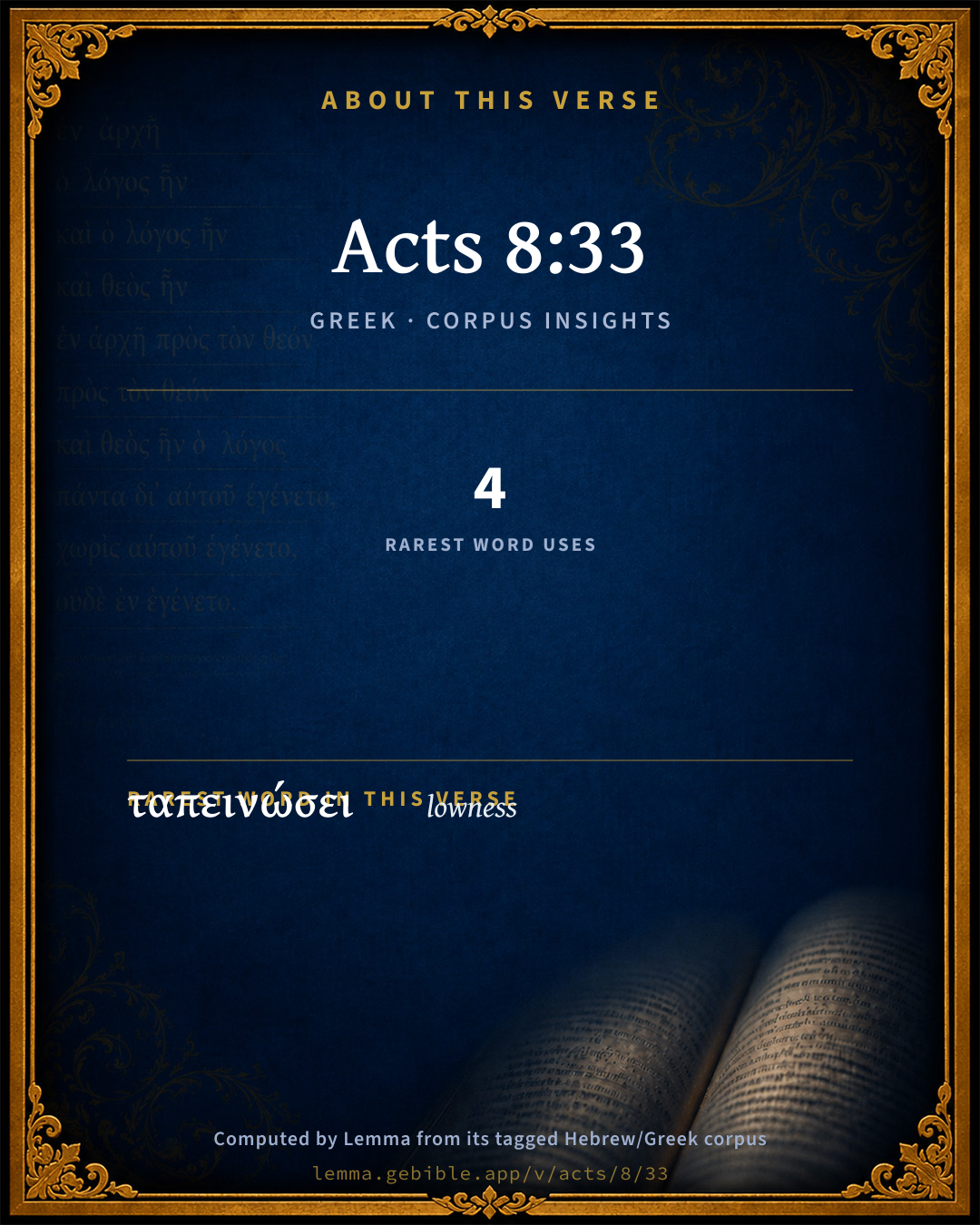
The rarest word here is ταπεινώσει lowness G5014 — appearing just 4 times in the whole Greek New Testament.

Shared distinctive vocabulary

ταπεινώσει lowness G5014 occurs in 4 verses of the Greek New Testament. Also found in:

Repetition

Words recur within this verse:

  • ἤρθη to raise up G142 ×2
  • τῇ the G3588 ×5
  • αὐτοῦ he G846 ×3

Cross-references

15

Topical passages linked to Acts 8:33 in the Treasury of Scripture Knowledge — connected by theme and wording, ordered by reader-vote popularity; previews shown in the World English Bible.

  • Isaiah 53:12 Therefore will I divide him a portion with the great, and he shall divide the spoil with the strong; because he poured out his soul to death, and was numbered with the transgressors: yet he bore the sin of many, and made intercession for the transgressors.
  • Isaiah 53:8 By oppression and judgment he was taken away; and as for his generation, who [among them] considered that he was cut off out of the land of the living for the disobedience of my people to whom the stroke [was due]?
  • Zechariah 13:7 "Awake, sword, against my shepherd, And against the man who is close to me," says Yahweh of Hosts. Strike the shepherd, and the sheep will be scattered; And I will turn my hand against the little ones.
  • Philippians 2:8–9 And being found in human form, he humbled himself, becoming obedient to death, yes, the death of the cross.
  • Job 27:2 "As God lives, who has taken away my right, The Almighty, who has made my soul bitter.
  • Job 34:5 For Job has said, 'I am righteous, God has taken away my right:
  • Psalms 22:15 My strength is dried up like a potsherd. My tongue sticks to the roof of my mouth. You have brought me into the dust of death.
  • Psalms 22:30 Posterity shall serve him. Future generations shall be told about the Lord.
  • Isaiah 5:23 Who acquit the guilty for a bribe, But deny justice for the innocent!
  • Isaiah 10:2 to turn aside the needy from justice, and to rob the poor of my people of their right, that widows may be their spoil, and that they may make the fatherless their prey!
  • Isaiah 53:10 Yet it pleased Yahweh to bruise him; he has put him to grief: when you shall make his soul an offering for sin, he shall see [his] seed, he shall prolong his days, and the pleasure of Yahweh shall prosper in his hand.
  • Daniel 9:26 After the sixty-two weeks the Anointed One shall be cut off, and shall have nothing: and the people of the prince who shall come shall destroy the city and the sanctuary; and the end of it shall be with a flood, and even to the end shall be war; desolations are determined.
  • Habakkuk 1:4 Therefore the law is paralyzed, and justice never goes forth; for the wicked surround the righteous; therefore justice goes forth perverted.
  • Matthew 27:12–26 When he was accused by the chief priests and elders, he answered nothing.
  • John 19:12–16 At this, Pilate was seeking to release him, but the Jews cried out, saying, "If you release this man, you aren't Caesar's friend! Everyone who makes himself a king speaks against Caesar!"

Cross-references courtesy of OpenBible.info (CC BY 4.0).

Commentary

Notes on Acts 8:33 from classic Christian and Jewish commentators (each source and its license shown beneath its notes). The classic Christian expositions comment on the surrounding passage and are grouped to its opening verse, so a note may address several verses; the Jewish commentaries on the Tanakh (Rashi and others) are per-verse, so they appear only where the commentator wrote on this verse.

Lemma curates 59 commentaries, every one of them public domain or Creative Commons licensed, each selected and text-cleaned for this edition rather than reprinted as found. About our sources →

Bengel's Gnomon

Johann Albrecht Bengel

Act 8:33. Ἐν, in) when He was humbled, immediately His judgment was taken away [was set aside by God]. “He was justified in the Spirit:” 1Ti 3:16.—γενεὰν) age, and thence progeny. Both are joined in Isa 53:10, He shall see His seed, He shall prolong His days; and Act 8:11, He shall see of the travail of His soul, and shall be satisfied. The sense is, “The age of other men is, say, Seventy years,” but the age of Messiah is inexpressible.—ὅτι) כי, because. The connecting link between His humiliation and exaltation.—αἴρεται ἀπὸ τῆς γῆς, is taken away from the earth) The life of Jesus Christ, as compared with the fathers, Luke 3, was very short on the earth: He was cut off, Dan 9:26, which serves as a most lucid argument that His generation is fixed elsewhere.

Bengel's Gnomon of the New Testament — English translation (T&T Clark, Edinburgh, 1860) — public domain. Text from a community e-Sword module.

Expositor's Greek Testament

ed. W. Robertson Nicoll

Act 8:33 . ἐν τῇ ταπεινώσει κ . τ . λ ., cf. Isa 53:7-8 , “in his humiliation his judgment was taken away” (LXX), so A. and R.V., generally taken to mean by his humbling himself his judgment was cancelled, cf. Phi 2:6-7 , so Wendt in seventh and eighth editions: cf. Grimm-Thayer, sub v. , κρίσις , the punishment appointed for him was taken away, i.e. , ended, and so sub v. , αἴρω = to cause to cease, Col 2:14 . But the words “in his humiliation” etc., may also fairly mean that in the violence and injustice done to him his judgment, i.e. , the fair trial due to him, was withheld, and thus they conform more closely to the Hebrew “by oppression and by (unjust) judgment he was taken away,” so Hitzig, Ewald, Cheyne and R.V. So to the same effect Delitzsch takes the words to mean that hostile oppression and judicial persecution befel him, and out of them he was removed by death ( cf. R.V. margin). (The words have been taken to mean that by oppression and judgment he was hurried off and punished, raptus est ad supplicium .) τὴν ( δὲ ) γενεὰν αὐτοῦ τίς διηγήσεται ; (LXX), “his generation who shall declare?” R.V., the words may mean “who shall declare the wickedness of the generation in which he lived?” (see Grimm-Thayer, sub v. , γενεά ) their wickedness, i.e. , in their treatment of him; so De Wette (and Meyer in early editions), and to the same effect, Lumby, Rendall, cf. our Lord’s own words, Mat 12:39-42 , etc. In Meyer-Wendt (seventh and eighth edition) the words are taken to mean “who can fitly declare the number of those who share his life?” i.e. , his posterity, his disciples, so Felten (but see on the other hand, Delitzsch, in loco ). The Hebrew seems to mean, as in R.V. text, “and as for his generation who among them considered that he was cut off out of the land of the living? for the transgression of my people” etc., see Cheyne, in loco; Briggs, Messianic Prophecy , p. 358, and Delitzsch, Jesaia , pp. 523, 524, fourth edition (see also Page’s note, and Wendt, edition 1899). The references by the Fathers ( cf. Bede and Wordsworth) to the eternal generation of the Son, and the mystery of His Incarnation, do not seem to find support in the Hebrew or in the Greek rendering. On the oldest Jewish interpretations of Isa 53 , see Dalman’s Der leidende und der sterbende Messias , pp. 21 23, 27 35, 89, 91; and see also in connection with the passage before us, Athanasius, Four Discourses against the Arians , i., 13, 54, and Dr. Robertson’s note; see also above on St. Peter’s Discourses in chap. 3, and below on Act 26:23 . αἴρεται ἀπὸ τῆς γῆς : “is taken,” i.e. , with violence (here = Hebrew גָזַר ), cf. use of αἴρω , LXX, Act 22:22 ; Act 21:36 , Mat 24:39 , Luk 23:18 , Joh 19:15 .

The Expositor's Greek Testament, edited by W. Robertson Nicoll (1897–1910) — public domain. Text from a community e-Sword module.

Geneva Bible (1599)

Geneva Bible translators

How long his age shall last: for Christ having once risen from the dead, dieth no more, Rom. 6:9.

The Hebrew text readeth it thus, Out of a narrow strait, and out of judgment was he taken: whereby the narrow strait, he meaneth the grave and the very bands of death, and by judgment, the punishment which was laid upon him, and the miserable state which Christ took upon him for our sakes, in bearing his Father’s wrath.

Geneva Bible (1599) marginal notes — public domain. Text via Bolls.life.

Adam Clarke's Commentary

Verse 33. In his humiliation, his judgment was taken away] He who was the fountain of judgment and justice had no justice shown him (mercy he needed not) in his humiliation; viz. that time in which he emptied himself, and appeared in the form of a servant.

Who shall declare his generation] την γενεαν αυτου: Answering to the Hebrew דורו doro, which Bp. Lowth understands as implying his manner of life. It was the custom among the Jews, when they were taking away any criminal from judgment to execution, to call out and inquire whether there was any person who could appear in behalf of the character of the criminal-whether there was any who, from intimate acquaintance with his manner of life, could say any thing in his favour? This circumstance I have noticed before, and it has been particularly remarked in the case of Stephen: see at Ac 7:60. In our Lord's case, this benevolent inquiry does not appear to have been made; and perhaps to this breach of justice, as well as of custom, the prophet refers; and this shows how minutely the conduct of those bad men was known seven hundred years before it took place. God can foreknow what he pleases, and can do what he pleases; and all the operations of his infinite mind are just and right. Some think that, who shall declare his generation? refers to his eternal Sonship; others, to his miraculous conception by the Holy Spirit, in the womb of the virgin; others, to the multitudinous progeny of spiritual children which should be born unto God, in consequence of his passion and meritorious death. Perhaps the first, which refers to the usual custom in behalf of the criminal, is the best and most natural sense.

Adam Clarke's Commentary on the Bible (1810–1826) — public domain. Text from a community e-Sword/MySword module.

John Calvin's Commentaries

33. In his humility his judgment. The eunuch had either the Greek volume, or else Luke did set down the reading which was then used, as he useth to do. The prophet saith that Christ was exalted out of sorrow and judgment, by which words he signifieth a wonderful victory, which immediately ensued his casting down. For if he had been oppressed with death, there could nothing have been hoped for at his hands.

Therefore, to the end the prophet may establish our faith in Christ, after that he had described him to be stricken with the hand of God, and to be subject to be slain, he putteth upon him a new person now; to wit, that he cometh up out of the depth of death as a conqueror, and out of the very hell, being the author of eternal Life. I know, indeed, that this place is diversely expounded. Some there be which understand by this, that he was carried from the prison to the cross; other some there be who think that to be taken away doth signify as much as to be brought to nought. And, indeed, the signification of the Hebrew word, לחה (lachah) is doubtful, as is also the signification of the Greek word αιρεσθαι. But he which shall thoroughly weigh the text, [context,] shall agree with me in that which I have said, that he passeth now from that doleful and unseemly sight which he had set before our eyes, unto the new beginning of unlooked-for glory. Therefore the Greek interpretation differeth not much from the words of the prophet in the sum of the matter. For Christ’s judgment was exalted in his humility or casting down; because at such time as he might seem to be cast down and oppressed, the Father maintained his cause. After this sort judgment shall be taken in this place (as in many other) for right. But it signifieth condemnation in the Hebrew text. For the prophet saith, that after that Christ shall be brought into great straits, and shall be like unto a condemned and lost man, he shall be lifted up by the hand of the Father. Therefore the meaning of the words is, that Christ must first have suffered death, before the Father should exalt him unto the glory of his kingdom; which doctrine must be translated unto the whole body of the Church; because all the godly ought wonderfully to be lifted up with the hand of God, that they be not swallowed up of death. But when God appeareth to be the revenger of his, he doth not only restore them to life but also, getteth to them excellent triumphs of many deaths, as Christ did triumph most gloriously upon the cross; whereof the apostle maketh mention in the Colossians 2.

His generation. After that the prophet hath set forth the victorious death of Christ, he addeth now that his victory shall not last only for a small time, but shall go beyond all number of years. For the exclamation of the prophet importeth as much as if he should deny that the perpetuity of Christ’s kingdom can be expressed by the tongue of men. But interpreters have wrested this place miserably. Whereas the old writers have endeavored hereby to prove the Eternal Generation of the Word of God against Arius, it is too far dissenting from the prophet’s mind. Chrysostom’s exposition is never a whit truer, who referreth it unto the human generation. Neither do they understand the prophet’s meaning, which suppose that he inveigheth against the men of that age. Other some think better, who take it to be spoken of the Church, save only that they are deceived in the word generation, which they think doth signify a posterity or issue. But the word דר, (dor,) which the prophet useth, signifieth, amongst the Hebrews, an age, or the continuance of man’s life. Therefore, undoubtedly this is the prophet’s meaning, that Christ’s life shall endure for ever, when as he shall be once delivered by his Father’s grace from death; although this life, which is without end, appertaineth unto the whole body of the Church; because Christ rose, not that he may live for hlmself, but for us. Therefore, he extolleth now in the members the fruit and effect of that victory which he placed in the Head. Wherefore every one of the faithful may conceive sure hope of eternal life out of this place; secondly, the perpetuity of the Church is rather avouched in the person of Christ.

Because his life is taken from the earth. This is, to look to, (to be) a very absurd reason, that Christ doth reign with such renown in heaven and earth, because he was cut off. For who can believe that death is the cause of life? But this was done by the wonderful counsel of God, that hell should be a ladder, whereby Christ should ascend into heaven; that reproach should be unto him a passage into life; that the joyful brightness of salvation should appear out of the horror and darkness of the cross; that blessed immortality should flow from the deep pit of death. Because he humbled himself, therefore the Father exalted him, that every knee may bow before him, (Philippians 2:10,) etc. Now must we bethink ourselves what fellowship we have with Christ, that it may not be troublesome to any to go the same way.

John Calvin's Commentaries (1540-1563) — public domain. Text from the Calvin Translation Society English edition (1840s-50s) via the Christian Classics Ethereal Library (ccel.org). Calvin's coverage is partial (roughly two-thirds of the Bible); uncommented books and verses are honest gaps, never fabricated. The 19th-century editor's footnotes and remarks are omitted so the notes are faithfully Calvin's own voice.

Ellicott's Commentary for English Readers

(33) In his humiliation his judgment was taken away.—The Hebrew runs, as in the English version of Isa_53:8, which fairly represents its natural construction, “He was taken from prison (or oppression) and from judgment,” i.e., was delivered from His sufferings just when they seemed to culminate. A different meaning has, however, been given to the Hebrew preposition by many scholars, who render the words, “Through oppression and [unjust] judgment He was taken away”—i.e., He was the victim of a judicial murder. The LXX., which is here followed, seems to have adopted a different construction, “By His humiliation, by His low estate, His judgment (i.e., the righteous judgment which was His due) was taken away.” Here also, however, the word “judgment” has been taken in a different sense, and the words have been interpreted as meaning, “His condemnation was taken away, or cancelled”—i.e., because He humbled Himself He was afterwards exalted. Assuming Philip to have explained the words as they stand in the LXX., the first of these two latter interpretations has most to commend itself. The story of the Passion, the unrighteous sentence passed on the Lord Jesus because He stood before the Council and the Governor as poor and friendless, would be dwelt on as filling in the outlines of the prophetic picture.

Who shall declare his generation?—The Hebrew noun may mean, as in Psa_14:5, the men of a given period, or those sharing a common character. The words have, however, been very variously taken: (1) “Who shall declare the number of those who share His life, and are, as it were, sprung from Him”—i.e., Who can count His faithful disciples? (2) “Who shall declare the wickedness of the crooked and perverse generation in which He lived?” (3) “Who, as far as His generation went, were wise enough to consider?” Assuming, as before, that it was the LXX. that Philip explained, the second of these seems preferable, as corresponding with the frequent use of the word “generation” with condemnatory epithets attached to it both by our Lord Himself (Mat_12:39-42; Mat_16:4; Mat_17:17) and His Apostles (Act_2:40; Php_2:15). The sense which some commentators have affixed to it, “Who shall declare His duration?” “Who shall set limits to the life of Him who is One with the Eternal?” or, as others, “Who shall declare the mystery of His mode of birth?”—i.e., of the Incarnation—are, it is believed, untenable as regards the Hebrew, and yet more so as regards the Greek.

For his life is taken from the earth.—The Hebrew admits of no other meaning than that the Sufferer was hurried to a violent death. The fact that in being thus taken from the earth the Sufferer was exalted to heaven, though true in itself, cannot be found in the words.

We are not concerned here with a detailed explanation, either of the words that precede, or those that follow, the passage quoted in Isaiah 53, but it is difficult to think of Philip as not taking in context as well as text, and unfolding in full, not only the fact of the Passion, but its atoning and redeeming power, as set forth in the prophet’s marvellous prediction.

A Bible Commentary for English Readers, edited by Charles John Ellicott (1878–1897) — public domain. Text from a community e-Sword module.

The Cambridge Bible for Schools and Colleges

gen. ed. J. J. S. Perowne

33. in his humiliation, &c.] The Hebrew text signifies “Through oppression and through judgement (i.e. punishment) he was taken away.”

who shall declare his generation?] i.e. who shall describe his contemporaries, men who under a form of judicial punishment oppressed the sufferer, and put him to death?

for his life is taken from the earth] The Hebrew has “for he was cut off out of the land of the living.” It will be seen from a comparison of the Hebrew and the LXX. that the latter is in some parts rather a paraphrase than a translation.

Some of the Jews interpreted this passage of the Messiah and some of the congregation of Israel. In the Targum of Jonathan these two interpretations run side by side.

The Cambridge Bible for Schools and Colleges (gen. ed. J. J. S. Perowne; Cambridge University Press, 1878–1918) — public domain. Text from a community e-Sword module.

John Gill's Exposition

And the eunuch answered Philip, and said,.... After he had read the passage out, and Philip had put the question to him, whether he understood it; and after he had taken him up into his chariot to sit with him, and instruct him:

I pray thee, of whom speakest the prophet this? being desirous of knowing who was the subject of this famous prophecy: which to know was very useful and edifying, and was not a matter of mere indifference and speculation, but of great moment and concern. A like way of speaking, in order to know the sense of a passage, is used by the Jews (w): thus upon reading Pro 31:2, it is asked,

"of whom does Solomon say this Scripture? he does not say it but of his father David.''

Does he speak

of himself or of some other man? which is very properly and pertinently put; since there might be some appearance of its application to Isaiah, who suffered under Manasseh; and it might be applied to different persons, as it has been since by the Jews; as to Josiah, Jeremiah in particular, and to the people of Israel in general, though very wrongly: Josiah could never be intended, as one of their noted commentators (x) expounds the paragraph; since it was not the sins of the people that were the cause of his death, but his own, and his vanity in meddling with what he had nothing to do with, and had no real call unto; nor can it be said of him that he did no violence, or that he bore the sins of others, and died for them, and made his soul an offering for sin; nor were his days prolonged; nor did the pleasure of the Lord prosper in his hand: nor is the passage applicable to Jeremiah, as another of their writers (y) would have it; he was not free from sin; nor was he wounded for the sins of his people; nor did he undergo his sufferings with patience; nor had he a large number of disciples; nor was he extolled and exalted, as this person is said to be: much less, as others (z) say, is the whole body of the people of Israel in captivity intended; since one single individual as spoken of throughout the whole; and is manifestly distinguished from the people of Israel, whose sins and sorrows he was to bear, and for whose transgressions he was to be stricken and wounded. In all which they go contrary to their Targum (a), Talmud (b), and other ancient writings (c), which interpret many things in this section or paragraph of the Messiah (d): however, as it might be differently understood, or difficult to be understood, the eunuch very appropriately puts this question.

(w) T. Bab. Beracot, fol. 10. 1. (x) Abarbinel in Isa. liii. (y) Sandiah Gaon in Aben Ezra in ib. (z) Jarchi, Aben Ezra, & Kimchi in ib. (a) In Isa. lii. 13. and liii. 10. (b) T. Bab. Sanhedrin, fol. 98. 2. (c) Zohar in Exod. fol. 85. 2. Midrash Ruth, fol. 33. 2. (d) See my Book of the Prophecies of the Messiah, p. 161. &c.

John Gill's Exposition of the Whole Bible (1746–1763) — public domain (CC PDM 1.0). Text via the HelloAO Bible API.

Trapp's Complete Commentary

John Trapp

33 In his humiliation his judgment was taken away: and who shall declare his generation? for his life is taken from the earth.

Ver. 33. His judgment was taken away] That is, he was set safe from his enemies, that judged and executed him. He rose, and reigneth in despite of them.

And who shall declare his generation] Saeculum eius. (Beza.) Or can tell how long his kingdom shall last? for being raised from the dead, he dieth no more. He may as well die at the right hand of his Father as in the hearts of his children.

John Trapp, A Commentary or Exposition upon All the Books of the Old and New Testament (1647–1656) — public domain. Text from a community e-Sword module.

Albert Barnes' Notes on the Bible

In his humiliation - This varies from the Hebrew, but is copied exactly from the Septuagint, showing that he was reading the Septuagint. The Hebrew text is: “He was taken from prison and from judgment.” The word rendered “prison” denotes any kind of “detention,” or even “oppression.” It does not mean, as with us, to be confined “in” a prison or jail, but may mean “custody,” and be applied to the detention or custody of the Saviour when his hands were bound, and he was led to be tried. See the notes on Mat 27:2. It is not known why the Septuagint thus translated the expression “he was taken from prison,” etc., by “in his humiliation,” etc. The word “from prison” may mean, as has been remarked, however, from “oppression,” and this does not differ materially from “humiliation”; and in this sense the Septuagint understood it. The “meaning” of the expression in the Septuagint and the Acts is clear. It denotes that in his state of oppression and calamity; when he was destitute of protectors and friends; when at the lowest state of humiliation, and therefore most the object of pity, “in addition to that,” justice was denied him; his judgment - a just sentence - was taken away, or withheld, and he was delivered to be put to death. His deep humiliation and friendless state was “followed” by an unjust and cruel condemnation, when no one would stand forth to plead his cause. Every circumstance thus goes to deepen the view of his sufferings.

His judgment - Justice, a just sentence, was denied him, and he was cruelly condemned.

And who shall declare his generation? - The word “generation” used here properly denotes “posterity”; then “an age” of mankind, comprehending about 30 years, as we speak of this and the next generation; then it denotes “the men” of a particular age or time. Very various interpretations have been given of this expression. Lowth translates it, “His manner of life who would declare?” referring, as he supposes, to the fact that when a prisoner was condemned and led to execution, it was customary for a proclamation to be made by a crier in these words, “Whoever knows anything about his innocence, let him come and declare it.” This passage is taken from the Gemara of Babylon (Kennicott, as quoted by Lowth). The same Gemara of Babylon on this passage adds, “that before the death of Jesus, this proclamation was made 40 days; but no defense could be found” - a manifest falsehood, and a story strikingly illustrative of the character of the Jewish writings.

The Gemara was written some time after Christ, perhaps not far from the year 180 (Lardner), and is a collection of commentaries on the traditional laws of the Jews. That this custom existed is very probable; but it is certain that no such thing was done on the trial of the Saviour. The Chaldee paraphrase translates the passage in Isaiah, “He shall collect our captivity from infirmities and vengeance; and who can declare what wonderful things shall be done for us in his days?” Others have referred this question to his Deity, or his divine “generation”; intimating that no one could explain the mystery of his eternal generation. But the word in the Scriptures has no such signification; and such a sense would not suit the connection (see Calvin in loco.) Others have referred it to “his own spiritual posterity,” his disciples, his family; “the number of his friends and followers who could enumerate?” (Calvin, Beza, etc.) Another sense which the word has is to denote the “people” of any particular age or time (Mat 11:16; Mat 23:36; Luk 16:8, etc.); and it has been supposed that the question here means, “Who can describe the character and wickedness of the generation when he shall live - the enormous crime of that age, in putting him to death?” On this passage, see the notes on Isa 53:8. Perhaps, after all that has been written on this passage, the simple idea is, “Who shall stand up for him, declaring who he is? Who will appear for him? Who will vindicate him?” meaning that all would forsake him, and that there would be none to “declare really who he was.”

For his life ... - The Hebrew is, “For he was cut off from the land of the living”; that is he was put to death. The expression used in the Acts was taken from the Septuagint, and means substantially the same as the Hebrew.

Albert Barnes' Notes on the Bible (1834–1885) — public domain. Text from a community e-Sword/MySword module.

Matthew Poole's English Annotations

In his humiliation; when our blessed Saviour was in his lowest condition, and the utmost degree of his exinanition; his soul being made a sacrifice for us, and suffering that desertion for a time we had merited for ever, and his body laid in the grave as in a prison; then

his judgment, the punishment which was inflicted upon him in our stead,

was taken away; for he brake the bonds of death, and opened the prison door: this was foretold, although in somewhat differing expressions, by the prophet Isaiah, Isa 53:7,8.

Who shall declare his generation? Those that shall be brought forth by this travail of his soul are innumerable, or his own eternal generation (who could do such great things as overcame death itself for us) is inexpressible: but by generation others (more to the scope of this place) understand Christ’s duration, or abiding, notwithstanding that he died; γενεα, does often signify duration; and thus it is an ordinary expression with the prophet, Isa 34:10,17, from generation to generation: now none can comprehend that eternal duration of Christ, who dies no more, Rom 6:9, and of whose kingdom there is no end, Luk 1:33.

For his life is taken from the earth; Christ aquired his glory by his suffering; his very exceeding great weight of glory was indeed wrought for him by his afflictions, (as for us, 2Co 4:17), his becoming obedient unto the death was the cause why he was so highly exalted, Phi 2:8,9.

Matthew Poole's English Annotations on the Holy Bible (1683–1685) — public domain. Text from a community e-Sword/MySword module.

The Pulpit Commentary

His generation who shall declare? for and who shall declare his generation? A.V. and T.R. The preceding quotation is taken verbatim from the LXX, which, however, varies somewhat from the Hebrew. In this verse, for the Hebrew as rendered in the A.V., "He was taken from prison and from judgment," the LXX has, "In his humiliation his judgment was taken away," having evidently read in their copy wOfpvmi wOrxOme, or perhaps wOrxb, "Through or, "in" his oppression humiliation his judgment was taken away." Mr. Cheyne translates the Hebrew, "Through oppression and through a judgment sentence he was taken "away to death." For the Hebrew of the A.V., "He was cut off out of the land of the living," the LXX has, "His life is taken from the earth," where they must have read wOyj,"his life," as the subject of the verb, instead of the living, taken in construction with ˜ r,a, the earth. The differences, however, are not material in regard to the general meaning of the passage. His generation who shall declare? The explanation of this difficult expression belongs tea commentary on Isaiah. Here it must suffice to say that the explanation most in accordance with the meaning of the Hebrew words (jjecy and wOrwOd), with the context, and with the turn of thought in Isa_38:10-12 and Jer_11:19, is that given in the "Speaker"sCommentary:" "Who will consider, give serious thought to, his life or age, seeing it is so prematurely cut off?" which is merely another way of saying that Messiah should "be cut off" (Dan_9:26) from the land of the living, that his Name be no more remembered" (Jeremiah, as above). It was the frustration of this hope of Jesus being forgotten in consequence of his death that so troubled the Sanhedrim. (Act_5:28)

The Pulpit Commentary (1880–1919), ed. H.D.M. Spence-Jones & Joseph S. Exell — public domain. Text from a community e-Sword module.

John Wesley's Explanatory Notes

In his humiliation his judgment was taken away - That is, when he was a man, he had no justice shown him. To take away a person's judgment, is a proverbial phrase for oppressing him. And who shall declare, or count his generation - That is, who can number his seed, Isaiah liii, 10; which he hath purchased by laying down his life?

John Wesley, Explanatory Notes Upon the Whole Bible (1754–1765) — public domain. Text via the GEBible commentary corpus.

Godbey's Commentary on the New Testament

William B. Godbey

33. “In his humiliation his judgment was taken away.” It is a significant fact that our Savior was killed by a cruel mob, stirred up and led by the preachers who stood at the head of the popular church, claiming, and doubtless believing, that they were God’s true ministers. Pilate, the Roman governor, as history says, had not a sufficient military force to keep the peace, having recently sent away a detachment to quell an insurrection in Syria. Consequently, defiant of Roman laws, which gave every man a fair trial and the right of self-defense, he assigned the death-warrant of Jesus merely as a peace measure, to keep the mob from killing him and, at the same time, deluging Jerusalem in blood. “Who shall declare his generation?

because his life is taken away from the earth.” “Generation” here means race, family, posterity, hence it means the spiritual children of God. If Jesus had not died, the plan of salvation would have collapsed and He would have had no spiritual posterity. The sown grain must die in the earth in order to produce a crop. You must die [i. e., old Adam in you] if you ever have a spiritual posterity. Hence, as a rule, unsanctified people have few, if any, spiritual children. Because our Savior redeemed the world by His death, in the grand finale He will exhibit before the Great White Throne a spiritual posterity which neither men, angels nor archangels can ever enumerate. They will outnumber the sands of the sea, the dust of the desert, the leaves of the forest and the stars of heaven; while contrastively Satan’s rabble will dwindle into an insignificant handful. This is one of the many confirmations of the wonderful achievements of the millennial reign, when the world will be flooded with overwhelming populations, the devil cast out, the road to hell overgrown with pennyroyal and dog-fennel, holiness covering the earth as the waters cover the sea, earth’s teeming millions sweeping up to heaven as the millennial centuries go by, thus supplying heaven with her long-anticipated populations redeemed from the earth by the blood of her Son. Meanwhile the chariot rolls along and time is unconsciously beguiled, the Ethiopian electrified by the thrilling gospel of Philip. They arrive at some water, recognized by the eunuch calling the attention of his comrade and inquiring why he should not be baptized, pursuant to the preaching of Philip from Isa 52:15. As the inspired narrative says that this was a desert, and geography reveals no river in that region, and Eusebius, the historian of the fourth century, describes the spring Bethsoron along that road, certifying that it was commemorated by the baptism of the Ethiopian eunuch at the hands of Philip, you must not forget that (Act 8:37) the eunuch’s confession is an interpolation [see R. V.]. I hold in my hand the oldest Greek Testament in the world. It has nothing of it. That verse was composed and inserted by Erasmus, a contemporary of Martin Luther, in the sixteenth century, who, while transcribing his Greek Testament, concluded that the connection required a confession there, and supposing that some careless transcriber had left it out, he composed and inserted that thirty-seventh verse. Subsequently older manuscripts were found, and especially the Sinaitic which I hold in my hand. As none of them have that verse, it is demonstrative proof that it never existed till Erasmus composed and inserted it.

William B. Godbey, Commentary on the New Testament (1896–1900) — public domain. Text from a community e-Sword module.

McGarvey & Pendleton's Commentaries

J. W. McGarvey

See notes on verse 31

J. W. McGarvey (with Philip Y. Pendleton), Commentaries on the New Testament (The Fourfold Gospel, 1914; Acts; and the epistles) — public domain. Text from a community e-Sword/MySword module.

Cambridge Greek Testament for Schools and Colleges

33. ἐν τῇ ταπεινώσει, in His humiliation. The Hebrew text signifies ‘through oppression and through judgment (i.e. punishment) he was taken away.’

τὴν γενεὰν κ.τ.λ., who shall declare His generation? i.e. who shall describe His contemporaries, men who under a form of judicial punishment oppressed the sufferer, and put Him to death?

ὅτι αἴρεται ἀπὸ τῆς γῆς ἡ ζωὴ αὐτοῦ, for His life is taken from the earth. The Hebrew has ‘for He was cut off out of the land of the living.’ It will be seen from a comparison of the Hebrew and the LXX. that the latter is in some parts rather a paraphrase than a translation.

Some of the Jews interpreted this passage of a suffering prophet, but most generally it was applied to the suffering nation. Although the notion of a suffering Messiah fell very much into the background, yet it is to be found in some Rabbinical interpretations of Isaiah. In the Targum of Jonathan the Messianic and the national application of the words run side by side. On the whole subject, see Perowne, Psalms (5th edition), Appendix.

Cambridge Greek Testament for Schools and Colleges (Cambridge University Press, 1896; 21 vols, various authors incl. Carr, Maclear, Plummer, Farrar, Lumby, Moule, M. R. James, Simcox) — public domain. Text from a community e-Sword module.

Alford’s Greek Testament

Henry Alford

33. ἐν τῇ ταπεινώσει αὐτοῦ ἡ κρίσις αὐτ. ἤρθη] Heb. ‘He was taken away by distress and judgment’ [so in the margin of E. V.]: i.e. as Lowth, ‘by an oppressive judgment.’

γενεὰν αὐτοῦ] i.e., the age in which He shall live—‘the wickedness of his contemporaries.’ The fathers, and Bede (and so Wordsworth), explain ‘His generation’ of His eternal Sonship and His miraculous Incarnation. But the Heb. does not seem to bear this out. See the meaning discussed at length, and another interpretation defended in Stier, Jesaias, &c., pp. 466-470. Cf. also Gesenius’ Thesaurus under דּוֹר.

Henry Alford, The Greek Testament (1849–1861) — public domain. Text from a community e-Sword module.

Vincent's Word Studies in the New Testament

Marvin R. Vincent

Humiliation. See on Mt 11:29.

Generation. His contemporaries. Who shall declare their wickedness ?

Marvin R. Vincent, Word Studies in the New Testament (1887–1900) — public domain. Text from a community e-Sword/MySword module.

Lesson kit

Teaching starters — assembled from the data on this page, not authored interpretation. Every prompt links to the verse data it draws on. Edit before teaching.

Acts, in the Acts, opens this verse with 20 words (13 distinct Greek lemmas). Its most distinctive word is tapeínōsis (“lowness”). A historical commentator’s framing appears above. Read the whole chapter for the surrounding context.

Discussion questions

  1. The word tapeínōsis carries the sense “lowness.” How does it shape the verse?
  2. How does Luke 1:48, which shares the word «lowness», read alongside this verse?
  3. What does the repetition of “to raise up” (2× in this one verse) do in this verse?
  4. The translations on this page render this verse differently — a whole-verse word diff, not a word-by-word alignment. What might account for the different wordings?
  5. Compare how Bengel's Gnomon and Expositor's Greek Testament read this verse. Where do they agree or differ?

Things to notice

  • These translations choose different wording for 6 words in this verse.
  • “to raise up” occurs 2× in this single verse.
  • 13 distinct Greek lemmas span 20 words in this verse.

Reading settings

Reading text

Shown beneath each verse's original-language words.

Old Testament
Old Testament edition

Read the OT as the Masoretic Hebrew (MT) or the Greek Septuagint (LXX).

English shown for the Greek Septuagint (in the Hebrew ↔ Greek comparison).

Comparing translations? Open the Compare panel on any verse page to stack up to four side by side.