Revelation 11:6

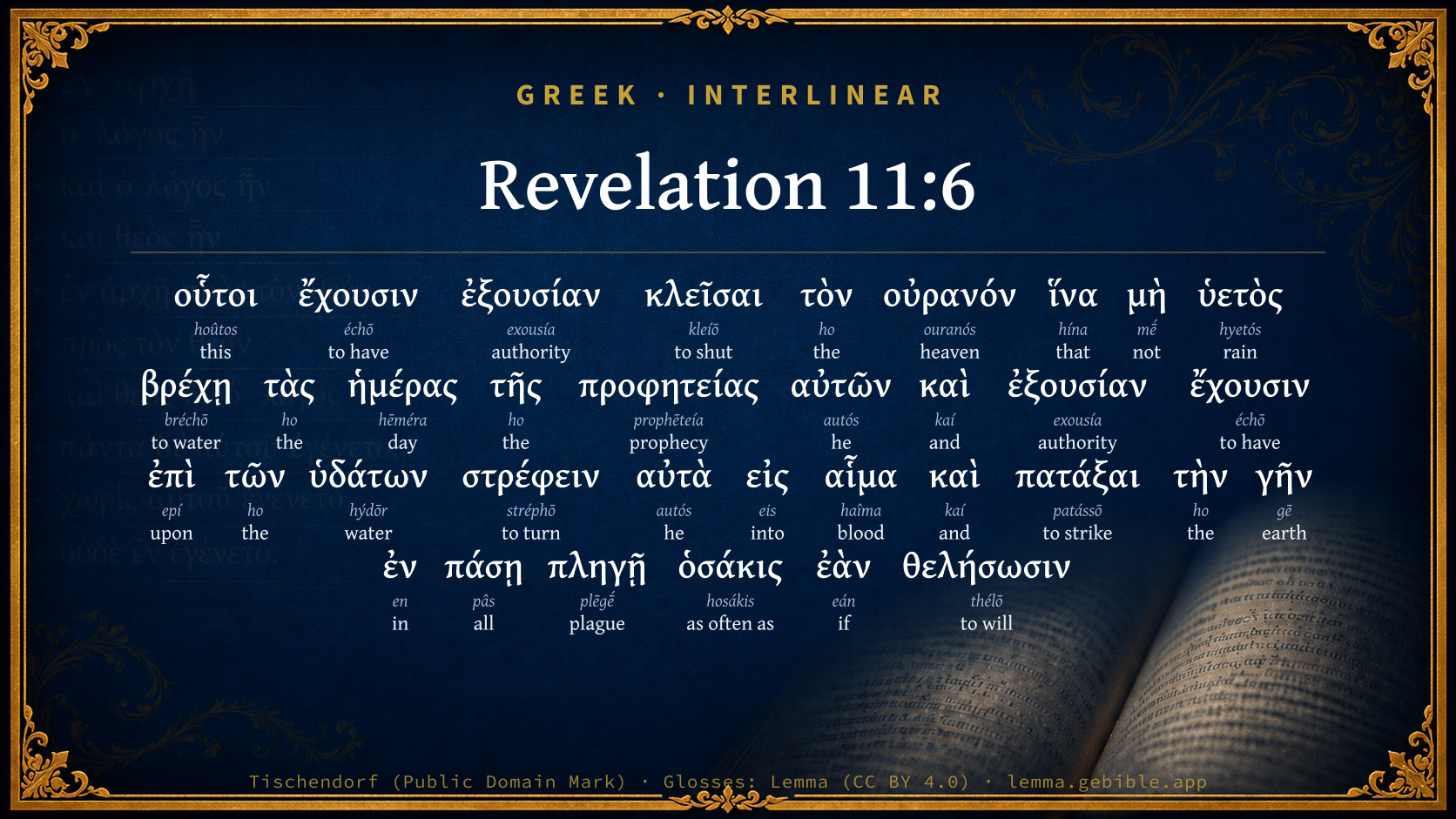
Greek (Tischendorf 8th ed.) Revelation 11:6 appears in the Greek New Testament. The text above is from the Tischendorf 8th edition. Each word links to its Strong’s number and a concise gloss. Click any word for its full Thayer’s Greek Lexicon entry.
Download image
Cite this verse

Revelation 11:6 (World English Bible). Public Domain. Lemma interlinear Bible study tool, https://lemma.gebible.app/v/revelation/11/6.

Show BibTeX & RIS
BibTeX
RIS
English Translation
These have the power to shut up the sky, that it may not rain during the days of their prophecy. They have power over the waters, to turn them into blood, and to strike the earth with every plague, as often as they desire.
World English Bible · Public Domain
Download a study sheet

One document with this verse’s original text, its word-by-word gloss line, the meaning frame, cross-references with their text, attributed commentary, and full source and license credits — printable, and it pastes into notes with its structure intact.

This verse Autodidact and up

Study sheet (.html) Plain text (.txt)

A passage Seminary Student

Up to 50 verses in one chapter. A passage sheet keeps up to 6 commentary sources and 12 cross-references per verse, in the order this page ranks them, and says so on the sheet whenever that leaves anything out. Ask for a single verse and you get the Autodidact verse sheet above.

Everything on this page stays free to read, with no account — the sheet is a download of what is already on screen, not access to it.

Want to remove ads? Support Godless Engineer
Compare translations 3

The same verse in 3 English versions, stacked beneath the original-language interlinear above. Click any original word for its lexicon entry.

Each is an independent rendering of the whole verse — the interlinear is not word-aligned to these translations.

Highlighted words mark where these versions differ — a whole-verse word diff, not a word-by-word alignment.

  • World English Bible Public Domain
    These have the power to shut up the sky, that it may not rain during the days of their prophecy. They have power over the waters, to turn them into blood, and to strike the earth with every plague, as often as they desire.
  • King James Version Public Domain
    These have power to shut heaven, that it rain not in the days of their prophecy: and have power over waters to turn them to blood, and to smite the earth with all plagues, as often as they will.
  • unfoldingWord Literal Text CC BY-SA 4.0
    They have authority to close up the sky so that no rain might fall during the days of their prophesy, and they have power over the waters to turn them into blood and to strike the earth with every plague as often as they may desire.

unfoldingWord Literal Text — © unfoldingWord, licensed CC BY-SA 4.0. Word-aligned USFM3 via Door43 (git.door43.org/unfoldingWord/en_ult).

Versions to compare (up to 4)

3 of 4 selected

Show all 19 translations

Every available English version of this verse, each an independent rendering of the whole verse.

  • World English Bible Public Domain
    These have the power to shut up the sky, that it may not rain during the days of their prophecy. They have power over the waters, to turn them into blood, and to strike the earth with every plague, as often as they desire.
  • Berean Standard Bible Public Domain
    These witnesses have power to shut the sky so that no rain will fall during the days of their prophecy, and power to turn the waters into blood and to strike the earth with every kind of plague as often as they wish.
  • Majority Standard Bible Public Domain
    These witnesses have power to shut the sky so that no rain will fall during the days of their prophecy, and power to turn the waters into blood and to strike the earth with every kind of plague as often as they wish.
  • King James Version Public Domain
    These have power to shut heaven, that it rain not in the days of their prophecy: and have power over waters to turn them to blood, and to smite the earth with all plagues, as often as they will.
  • American Standard Version (1901) Public Domain
    These have the power to shut the heaven, that it rain not during the days of their prophecy: and they have power over the waters to turn them into blood, and to smite the earth with every plague, as often as they shall desire.
  • Revised Version (1885) Public Domain
    These have the power to shut the heaven, that it rain not during the days of their prophecy: and they have power over the waters to turn them into blood, and to smite the earth with every plague, as often as they shall desire.
  • Geneva Bible (1599) Public Domain
    These haue power to shut heauen, that it raine not in the dayes of their prophecying, and haue power ouer waters to turne them into blood, and to smite the earth with all maner plagues, as often as they will.
  • Douay-Rheims (1899) Public Domain
    These have power to shut heaven, that it rain not in the days of their prophecy: and they have power over waters to turn them into blood, and to strike the earth with all plagues as often as they will.
  • Young's Literal Translation Public Domain
    These have authority to shut the heaven, that it may not rain rain in the days of their prophecy, and authority they have over the waters to turn them to blood, and to smite the land with every plague, as often as they may will.
  • Literal Standard Version CC BY-SA 4.0
    These have authority to shut the sky, that rain may not rain in the days of their prophecy, and they have authority over the waters to turn them to blood, and to strike the land with every plague, as often as they may will.
  • Unlocked Literal Bible CC BY-SA 4.0
    These witnesses have authority to close up the sky so that no rain will fall during the time that they prophesy. They have power to turn the waters to blood and to strike the earth with every kind of plague whenever they wish.
  • unfoldingWord Literal Text CC BY-SA 4.0
    They have authority to close up the sky so that no rain might fall during the days of their prophesy, and they have power over the waters to turn them into blood and to strike the earth with every plague as often as they may desire.
  • Darby Bible Public Domain
    These have power to shut the heaven that no rain may fall during the days of their prophecy; and they have power over the waters to turn them into blood, and to smite the earth as often as they will with every plague.
  • World Messianic Bible Public Domain
    These have the power to shut up the sky, that it may not rain during the days of their prophecy. They have power over the waters, to turn them into blood, and to strike the earth with every plague, as often as they desire.
  • Webster's Bible Public Domain
    These have power to shut heaven, that it rain not in the days of their prophecy: and have power over waters to turn them to blood, and to smite the earth with all plagues, as often as they will.
  • Free Bible Version CC BY-SA 4.0
    These two witnesses have the power to close the sky so that it will not rain during the time of their prophecy. They also have the power to turn the waters into blood, and to strike the earth with all kinds of plagues, as often as they want.
  • Bible in Basic English Public Domain
    These have the power to keep the heaven shut, so that there may be no rain in the days when they are prophets: and they have power over the waters to make them into blood, and to send every sort of disease on the earth as their pleasure is.
  • Text-Critical English NT CC BY 4.0
    These two men have the power to shut the sky, so that no rain will fall during the days of their prophesying. They also have power over the waters to turn them into blood and to strike the earth with every plague as often as they want.
  • Tyndale New Testament (1534) Public Domain
    These have power to shut heven that it rayne not in the dayes of their prophesyinge: and have power over waters to turne them to bloud and to smyte the erth with almaner plages as often as they will.

Literal Standard Version (2020), Covenant Press — licensed CC BY-SA 4.0. Text via the HelloAO Bible API (eBible.org). Unlocked Literal Bible (unfoldingWord) — licensed CC BY-SA 4.0. Text via the HelloAO Bible API (eBible.org). unfoldingWord Literal Text — © unfoldingWord, licensed CC BY-SA 4.0. Word-aligned USFM3 via Door43 (git.door43.org/unfoldingWord/en_ult). Free Bible Version, Dr. Jonathan Gallagher — licensed CC BY-SA 4.0. Text via the HelloAO Bible API (eBible.org).

Word by word

More ways to search: Search by grammar → Find every occurrence → Compare this word →

Practice this passage: Drill this verse → Learn its vocabulary →

ὁσάκις
hosákis
G3740
“as often as”
Adverb
Part of Speech
Adverb
Full Thayer's Definition

Origin: multiple adverb from G3739

TDNT: None

1. as often as, as often soever as
  1. οὗτοι hoûtos G3778 “this” Demonstrative pronoun, Nominative, Plural, Masculine
  2. ἔχουσιν échō G2192 “to have” Verb, Present, Active, Indicative, 3rd person, Plural
  3. ἐξουσίαν exousía G1849 “authority” Noun, Accusative, Singular, Feminine
  4. κλεῖσαι kleíō G2808 “to shut” Verb, Aorist, Active, Infinitive
  5. τὸν ho G3588 “the” Article, Accusative, Singular, Masculine
  6. οὐρανόν ouranós G3772 “heaven” Noun, Accusative, Singular, Masculine
  7. ἵνα hína G2443 “that” Conjunction
  8. μὴ mḗ G3361 “not” Particle, Negative
  9. ὑετὸς hyetós G5205 “rain” Noun, Nominative, Singular, Masculine
  10. βρέχῃ bréchō G1026 “to water” Verb, Present, Active, Subjunctive, 3rd person, Singular
  11. τὰς ho G3588 “the” Article, Accusative, Plural, Feminine
  12. ἡμέρας hēméra G2250 “day” Noun, Accusative, Plural, Feminine
  13. τῆς ho G3588 “the” Article, Genitive, Singular, Feminine
  14. προφητείας prophēteía G4394 “prophecy” Noun, Genitive, Singular, Feminine
  15. αὐτῶν autós G846 “he” Personal pronoun, Genitive, Plural, Masculine
  16. καὶ kaí G2532 “and” Conjunction
  17. ἐξουσίαν exousía G1849 “authority” Noun, Accusative, Singular, Feminine
  18. ἔχουσιν échō G2192 “to have” Verb, Present, Active, Indicative, 3rd person, Plural
  19. ἐπὶ epí G1909 “upon” Preposition
  20. τῶν ho G3588 “the” Article, Genitive, Plural, Neuter
  21. ὑδάτων hýdōr G5204 “water” Noun, Genitive, Plural, Neuter
  22. στρέφειν stréphō G4762 “to turn” Verb, Present, Active, Infinitive
  23. αὐτὰ autós G846 “he” Personal pronoun, Accusative, Plural, Neuter
  24. εἰς eis G1519 “into” Preposition
  25. αἷμα haîma G129 “blood” Noun, Accusative, Singular, Neuter
  26. καὶ kaí G2532 “and” Conjunction
  27. πατάξαι patássō G3960 “to strike” Verb, Aorist, Active, Infinitive
  28. τὴν ho G3588 “the” Article, Accusative, Singular, Feminine
  29. γῆν gē G1093 “earth” Noun, Accusative, Singular, Feminine
  30. ἐν en G1722 “in” Preposition
  31. πάσῃ pâs G3956 “all” Adjective, Dative, Singular, Feminine
  32. πληγῇ plēgḗ G4127 “plague” Noun, Dative, Singular, Feminine
  33. ἐὰν eán G1437 “if” Conditional
  34. θελήσωσιν thélō G2309 “to will” Verb, Aorist, Active, Subjunctive, 3rd person, Plural

About this verse

These counts appear in no published source. They are computed here, from the morphology-tagged text and Lemma’s own curated glosses. What Lemma adds →

35
words
27
distinct lemmas
Revelation
section

Notable vocabulary

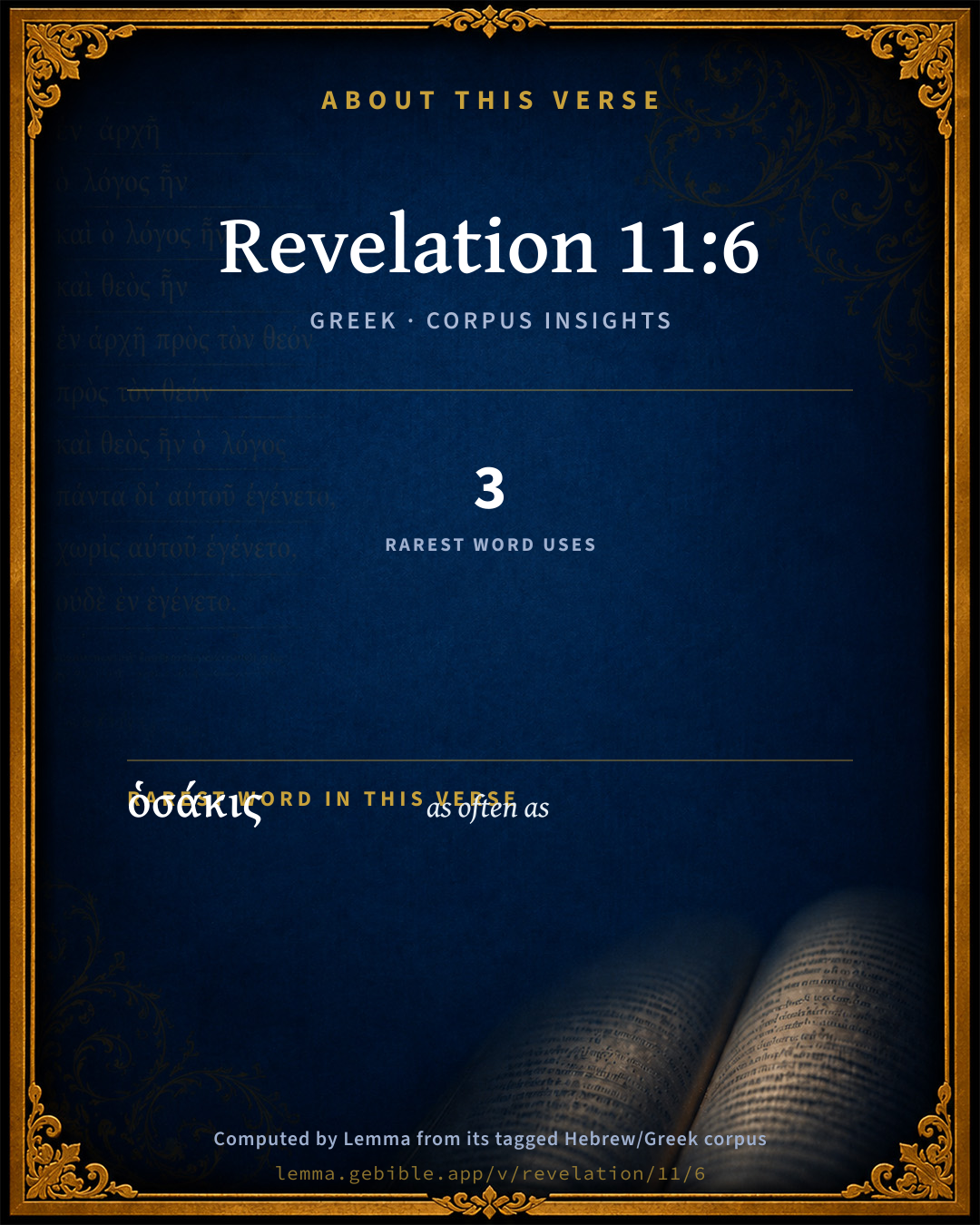
The rarest word here is ὁσάκις as often as G3740 — appearing just 3 times in the whole Greek New Testament.

Shared distinctive vocabulary

ὁσάκις as often as G3740 occurs in 3 verses of the Greek New Testament. Also found in:

Repetition

Words recur within this verse:

  • ἔχουσιν to have G2192 ×2
  • ἐξουσίαν authority G1849 ×2
  • τὸν the G3588 ×5
  • αὐτῶν he G846 ×2
  • καὶ and G2532 ×2

Cross-references

7

Topical passages linked to Revelation 11:6 in the Treasury of Scripture Knowledge — connected by theme and wording, ordered by reader-vote popularity; previews shown in the World English Bible.

  • 1 Kings 17:1 Elijah the Tishbite, who was of the foreigners of Gilead, said to Ahab, As Yahweh, the God of Israel, lives, before whom I stand, there shall not be dew nor rain these years, but according to my word.
  • Luke 4:25 But truly I tell you, there were many widows in Israel in the days of Elijah, when the sky was shut up three years and six months, when a great famine came over all the land.
  • Exodus 7:17–25 Thus says Yahweh, "In this you shall know that I am Yahweh. Behold, I will strike with the rod that is in my hand on the waters which are in the river, and they shall be turned to blood.
  • Psalms 105:26–36 He sent Moses, his servant, And Aaron, whom he had chosen.
  • 1 Samuel 4:8 Woe to us! who shall deliver us out of the hand of these mighty gods? these are the gods that struck the Egyptians with all manner of plagues in the wilderness.
  • James 5:16–18 Confess your offenses to one another, and pray one for another, that you may be healed. The effective, earnest prayer of a righteous man is powerfully effective.
  • Ezekiel 7:1–12 Moreover the word of Yahweh came to me, saying,

Cross-references courtesy of OpenBible.info (CC BY 4.0).

Commentary

Notes on Revelation 11:6 from classic Christian and Jewish commentators (each source and its license shown beneath its notes). The classic Christian expositions comment on the surrounding passage and are grouped to its opening verse, so a note may address several verses; the Jewish commentaries on the Tanakh (Rashi and others) are per-verse, so they appear only where the commentator wrote on this verse.

Lemma curates 59 commentaries, every one of them public domain or Creative Commons licensed, each selected and text-cleaned for this edition rather than reprinted as found. About our sources →

Tyndale Open Study Notes

Tyndale Open Resources

11:6 These two witnesses were given power to stop the rain and bring down plagues, as were Elijah (see 1 Kgs 17:1; 18:41-46) and Moses (see Exod 7:14-24; 8:1–11:10).

Tyndale Open Study Notes — © Tyndale Open Resources, licensed CC BY-SA 4.0. Text via the HelloAO Bible API.

Jamieson, Fausset & Brown

Robert Jamieson, A. R. Fausset & David Brown

These . . . power--Greek, "authorized power."

it rain not--Greek, "huetos brechee," "rain shower not," literally, "moisten" not (the earth).

smite . . . with all plagues--Greek, "with (literally, 'in') every plague."

Jamieson, Fausset & Brown — Commentary Critical and Explanatory on the Whole Bible (1871) — public domain (CC PDM 1.0). Text via the HelloAO Bible API.

Adam Clarke's Commentary

Verse 6. These have power to shut heaven] As Elijah did, 1Kgs 17:1-18:46.

To turn them to blood] As Moses did, Ex 7:19-25. They shall have power to afflict the land with plagues, similar to those which were inflicted on the Egyptians.

Adam Clarke's Commentary on the Bible (1810–1826) — public domain. Text from a community e-Sword/MySword module.

The Cambridge Bible for Schools and Colleges

gen. ed. J. J. S. Perowne

6. power to shut heaven] Like Elijah: over waters, &c. like Moses.

The Cambridge Bible for Schools and Colleges (gen. ed. J. J. S. Perowne; Cambridge University Press, 1878–1918) — public domain. Text from a community e-Sword module.

John Gill's Exposition

These have power to shut heaven,.... For these have the keys of the kingdom of heaven given them, and whatever they bind or loose on earth is bound or loosed in heaven; or in other words, having the true key of knowledge in matters, both of doctrine and discipline, given them, whatever they declare, according to the word of God, to be doctrines fit to be received or rejected, and to be the ordinances of God, and matters of worship to be attended to, and what are not, should be so: and in particular,

that it rain not in the days of their prophecy; that is, on their enemies, the antichristian party; for otherwise it must rain on those to whom they minister, their prophecy itself being rain in a spiritual sense: so rain is explained of prophecy in the Targum on Isa 5:6, which paraphrases the words thus;

"I will command the prophets that they do not prophesy upon them prophecy:''

for this is to be understood not literally, since the days of their prophecy, or preaching in sackcloth, are 1260, that is, 1260 years, and which is the term and duration of antichrist's reign: wherefore, if this was the case, there must be a famine and great distress, during this long space of time; but as this is not matter of fact, so it would not comport with that plenty, luxury, and deliciousness, in which the whore of Babylon is said to live: but the words are to be taken in a spiritual sense, and to be understood of the Gospel, and doctrines of it, or the word of God, which is sometimes compared to rain, Deu 32:2. God is the author and giver of rain, and he only; none of the vanities, or idols of the Gentiles, can give it; has the rain a father? it has, but not on earth, only God who is in heaven; and so the Gospel is of God, and it is he only that can make men able ministers of it; the rain comes down from above, from heaven, and of the same original and descent is the Gospel, it is the voice speaking from heaven; the rain falls, according to divine direction, in one place, and not another, on one city, and not another; and so the Gospel is sometimes in one place, and sometimes in another; it is forbid here, and ordered there. Showers of rain moisten and soften the earth, and make it susceptive of seed; and the Gospel is the means of softening hard hearts, and of making them capable of receiving suitable impressions: rain refreshes the earth, revives the plants and trees, and makes them fruitful; and so the Gospel, attended with a divine blessing, refreshes drooping saints, revives the work of God in them, and is the means of filling them with all the fruits of righteousness. Now the withholding of this rain denotes a famine, not of bread, or a thirst for water, but of hearing the word of the Lord; and as it is a judgment on a nation, or on a city, not to be rained upon, so it is a spiritual judgment upon a people, when God commands his clouds, his ministers, to rain no rain of the Gospel on them; and it is one of the judgments upon the antichristian party, that they have not the Gospel preached unto them, nor any dew of powerful and efficacious grace distilled on them, but are left to their blindness, darkness, and hardness of heart: and these witnesses carrying the Gospel along with them, where they prophesy and preach, is called a shutting up heaven, so that it rain not on the followers of antichrist, from whom they separate themselves, or by whom they are cast out; and this is ascribed to them, and is owing to their removal or ejection; much in the same sense as the night and darkness are to the sun's remove; that is, these follow upon it. The allusion is to the withholding of rain in the times of Elijah, one of the types of these witnesses, because of the idolatries of Ahab and Jezebel, Kg1 17:1. In like manner is the rain of the Gospel withheld during the reign of antichrist, because of the idolatry and superstition of the apostasy.

And have power over waters to turn them to blood; by "waters" are meant people, multitudes, nations, and tongues, and particularly those over whom antichrist reigns, Rev 17:15, and turning of them into blood designs the confusions and wars raised among them on account of the prophesying of these witnesses, and the persecutions and bloodshed which followed upon it; which eventually are the end and issue of preaching the Gospel; see Mat 10:34. The allusion is to one of the plagues of Egypt, and to Moses and Aaron, who were types of these witnesses turning the waters of Egypt into blood, Exo 7:20; and answers to the second and third vials, Rev 16:3.

And to smite the earth with all plagues as often as they will; alluding to the plagues of Egypt, one of the names of Rome, or the Roman jurisdiction, in Rev 11:8, and which is meant by the earth here; and referring to the rest of the seven vials poured out by these witnesses, signified by seven angels; and their having power so to do as often as they will, is to be understood of these plagues being inflicted on the inhabitants of the earth, or followers of antichrist, in answer to their prophecies and prayers, which are made according to the will of God, and so always have their effect, being such.

John Gill's Exposition of the Whole Bible (1746–1763) — public domain (CC PDM 1.0). Text via the HelloAO Bible API.

Trapp's Complete Commentary

John Trapp

6 These have power to shut heaven, that it rain not in the days of their prophecy: and have power over waters to turn them to blood, and to smite the earth with all plagues, as often as they will.

Ver. 6. That it rain not] That the influence of divine grace be withheld from those that despise the gospel; so that they become as those mountains of Gilboa, 2Sa 1:21, or that accursed earth, Heb 6:8.

John Trapp, A Commentary or Exposition upon All the Books of the Old and New Testament (1647–1656) — public domain. Text from a community e-Sword module.

Albert Barnes' Notes on the Bible

These have power to shut heaven - That is, so far as rain is concerned - for this is immediately specified. There is probably a reference here to an ancient opinion that the rain was kept in the clouds of heaven as in reservoirs or bottles, and that when they were opened it rained; when they were closed it ceased to rain. So Job, “He bindeth up the waters in his thick clouds, and the cloud is not rent under them,” Job 26:8. “Which the clouds do drop and distil upon man abundantly,” Job 36:28. “Who can number the clouds in wisdom? or who can stay the bottles of heaven?” Job 38:37; compare Gen 1:7; Gen 7:12; Gen 8:2; 2Ki 7:2. To shut or close up the heavens, therefore, is to restrain the rain from descending, or to produce a drought. Compare notes on Jam 5:17.

That it rain not in the days of their prophecy - In the time when they prophesy. Probably the allusion here is to what is said of Elijah, 1Ki 17:1. This would properly refer to some miraculous power; but still it may be used to denote merely that they would be clothed with the power of causing blessings to be withheld from people, as if rain were withheld; that is, that in consequence of the calamities that would be brought upon them, and the persecutions which they would endure, God would bring judgments upon people as if they were clothed with this power. The language, therefore, it seems to me, does not necessarily imply that they would have the power of working miracles.

And have power over waters to turn them to blood - The allusion here is doubtless to what occurred in Egypt, Exo 7:17. Compare the notes on Rev 8:8. This, too, would literally denote the power of working a miracle; but still it is not absolutely necessary to suppose that this is intended. Anything that would be represented by turning waters into blood, would correspond with all that is necessarily implied in the language. If any great calamity should occur in consequence of what was done to them that would be properly represented by turning the waters into blood so that they could not be used, and that was so connected with the treatment which they received as to appear to be a judgment of heaven on that account, or that would appear to have come upon the world in consequence of their imprecations, it would be all that is necessarily implied in this language.

And to smite the earth with all plagues - All kinds of plague or calamity; disease, pestilence, famine, flood, etc. The word “plague” - πληγῇ plēgē - which means, properly, “stroke, stripe, blow,” would include any or all of these. The meaning here is, that great calamities would follow the manner in which they were treated, as if the power were lodged in their hands.

As often as they will - So that it would seem that they could exercise this power as they pleased.

Albert Barnes' Notes on the Bible (1834–1885) — public domain. Text from a community e-Sword/MySword module.

Matthew Poole's English Annotations

It is plain that here is an allusion to Elijah, who prayed earnestly that it might not rain; and it rained not on the earth by the space of three years and six months, Jam 5:17; see the story, 1Ki 17:1; and to Moses, who turned the waters into blood in Egypt; and after was an instrument to smite the land of Egypt with plagues. But what power analogous to this the ministers of the gospel have had, or have, is not easy to determine. It is certain, the apostles had a miraculous power, but they rarely used it, but in doing good to men; Ananias and Sapphira indeed were struck dead upon their word, Act 5:1-11; and Elymas the sorcerer was struck blind by them; but this power is long since ceased. Mr. Mede understands this power of the keys of doctrine and church censures the ministers of the gospel should be intrusted with; so as they should not preach the gospel unto such as contemned their ministry; by the withholding of which means of grace, also, they would be deprived of the dew of heavenly grace. And, indeed, this seemeth more proper than to understand it of the keys of discipline; for what power of this nature have ministers over those who are without? I take a general explication to be the best. If any hurt them, God shall revenge their cause, not only by spiritual, but by temporal judgments, bringing all manner of evils upon their adversaries. They are said to have power to do it, because God will do it in the revenge of the injuries done unto them.

Matthew Poole's English Annotations on the Holy Bible (1683–1685) — public domain. Text from a community e-Sword/MySword module.

Whedon's Commentary on the Bible

Daniel D. Whedon

6. As the individual judgment upon rejection of the gospel prophecy is given in Rev_11:5, so now we have the public judgments. The firmament of God’s goodness becomes brass, and the genial showers of mercy descend not.

Waters… blood—Nay, the very mercies of God, designed for our life and happiness, are transformed, by the divine judgments, to the very image and essence of curse. The very gospel, the water of life, proves to be the stream of death.

As often as they will—Which will, since they are but the embodiments of divine truth, is simply the expression of God’s law. This absoluteness of their power of inflicting judgments is the absoluteness of the divine justice, not of their personal caprice. And all their power of infliction is simply the power of annunciation, sure to be fulfilled by the divine power. It was thus that Elijah burned up the fifties; and thus that Peter struck Ananias dead. It is thus that the Christian prophet, in the true performance of his duties, slays men and nations. His word kills, because God within the word kills, according to the word. What kills all men is just this word, “The soul that sinneth, it shall die.”

Daniel D. Whedon (gen. ed.), Commentary on the Old and New Testaments (1874–1909) — public domain. Text from a community e-Sword module.

The Pulpit Commentary

These have power to shut heaven, that it rain not in the days of their prophecy: and have power over waters to turn them to blood, and to smite the earth with all plagues, as often as they will; the power... the heaven... the waters... every plague (Revised Version). The whole verse is descriptive of the powers entrusted to Moses and Elijah, and is intended to convey the idea that the power which supported them would likewise support the two witnesses. It is doubtful whether the meaning should be pressed further than this. If we do so, it may, perhaps, be said that (in the words of Wordsworth) "if any one despises God"s witnesses, they have the power, like Elias, to shut heaven, and exclude all who reject them. The dews of Divine grace are withheld from all who scorn them." It is thus a fulfilment of our Lord"s words, "Whosoever hath, to him shall be given, and he shall have more abundance: but whosoever hath not, from him shall be taken away even that he hath". (Mat_13:12) And again, besides the punishments which are finally to fall on the ungodly, it is the case that the rejection of God"s will is followed on this earth by troubles which would be avoided were men to listen to the witness borne of him.

The Pulpit Commentary (1880–1919), ed. H.D.M. Spence-Jones & Joseph S. Exell — public domain. Text from a community e-Sword module.

John Wesley's Explanatory Notes

These have power - And they use that power. See verse 10. To shut heaven, that it rain not in the days of their prophesying - During those "twelve hundred and sixty days." And have power over the waters - In and near Jerusalem. To turn them into blood - As Moses did those in Egypt. And to smite the earth with all plagues, as often as they will - This is not said of Moses or Elijah, or any mere man besides. And how is it possible to understand this otherwise than of two individual persons?

John Wesley, Explanatory Notes Upon the Whole Bible (1754–1765) — public domain. Text via the GEBible commentary corpus.

unfoldingWord translationNotes

Door43 World Missions Community

to close up the sky so that no rain will fall

John speaks of the sky as if it had a door that can be opened to let rain fall or closed to stop the rain. AT: "to keep rain from falling from the sky" (See: Metaphor)

to turn

"to change"

to strike the earth with every kind of plague

John speaks of the plagues as if they were a stick that someone could hit the earth with. AT: "to cause all kinds of trouble to occur on earth" (See: Metaphor)

bottomless pit

This is an extremely deep narrow hole. Possible meanings are 1) the pit has no bottom; it continues to go down further forever or 2) the pit is so deep that it is as if it had no bottom. See how you translated this in Revelation 9:1.

translationWords

testimony

authority

heaven

prophet

power

turn

water

blood

earth

kind

plague

testimony

beast

pit

unfoldingWord translationNotes — © Distant Shores Media and the Door43 World Missions Community, licensed CC BY-SA 4.0. Source: git.door43.org/Door43/en_tn.

Cambridge Greek Testament for Schools and Colleges

6. κλεῖσαι τὸν οὐρανόν. Like Elias.

τὰς ἡμέρας τῆς προφητείας αὐτῶν. Is this term fixed with conscious reference to the three years and six months for which Elias did shut heaven (Luk 4:25; Jas 5:17)? The term was no doubt arrived at by adding the dry interval between the spring and autumn rains to the three years for which both failed, as the regular rains were renewed at Elijah’s prayer at the end of the third year.

στρέφειν αὐτὰ εἰς αἷμα. Like Moses.

Cambridge Greek Testament for Schools and Colleges (Cambridge University Press, 1896; 21 vols, various authors incl. Carr, Maclear, Plummer, Farrar, Lumby, Moule, M. R. James, Simcox) — public domain. Text from a community e-Sword module.

Vincent's Word Studies in the New Testament

Marvin R. Vincent

To shut up the heaven. As Elijah, 1Ki 17:1; Luk 4:25; Jas 5:17.

That it rain not [ινα μη βρεχη υετος] . Lit., that the rain may not wet. To turn them into blood. Compare Exo 7:19.

To smite [παταξαι] . Used by John only in Revelation, here and Rev 19:15. Compare Mt 26:31; Mr 14:27; Luk 22:49, 50; Act 12:7, 23. With all plagues [παση πληγη] . Singular number. Rev., correctly, with every plague. See on Mr 3:10. Not merely with the plagues with which Moses smote Egypt.

Marvin R. Vincent, Word Studies in the New Testament (1887–1900) — public domain. Text from a community e-Sword/MySword module.

Lesson kit

Teaching starters — assembled from the data on this page, not authored interpretation. Every prompt links to the verse data it draws on. Edit before teaching.

Revelation, in the Revelation, opens this verse with 35 words (27 distinct Greek lemmas). Its most distinctive word is hosákis (“as often as”). A historical commentator’s framing appears above. Read the whole chapter for the surrounding context.

Discussion questions

  1. What does “as often as” (hosákis) contribute to the verse as a whole?
  2. How does 1 Corinthians 11:25, which shares the word «as often as», read alongside this verse?
  3. What does the repetition of “to have” (2× in this one verse) do in this verse?
  4. The translations on this page render this verse differently — a whole-verse word diff, not a word-by-word alignment. What might account for the different wordings?
  5. Compare how Tyndale Open Study Notes and Jamieson, Fausset & Brown read this verse. Where do they agree or differ?

Things to notice

Reading settings

Reading text

Shown beneath each verse's original-language words.

Old Testament
Old Testament edition

Read the OT as the Masoretic Hebrew (MT) or the Greek Septuagint (LXX).

English shown for the Greek Septuagint (in the Hebrew ↔ Greek comparison).

Comparing translations? Open the Compare panel on any verse page to stack up to four side by side.