

Mark 4:31
Greek (Tischendorf 8th ed.) Mark 4:31 appears in the Greek New Testament. The text above is from the Tischendorf 8th edition. Each word links to its Strong’s number and a concise gloss. Click any word for its full Thayer’s Greek Lexicon entry.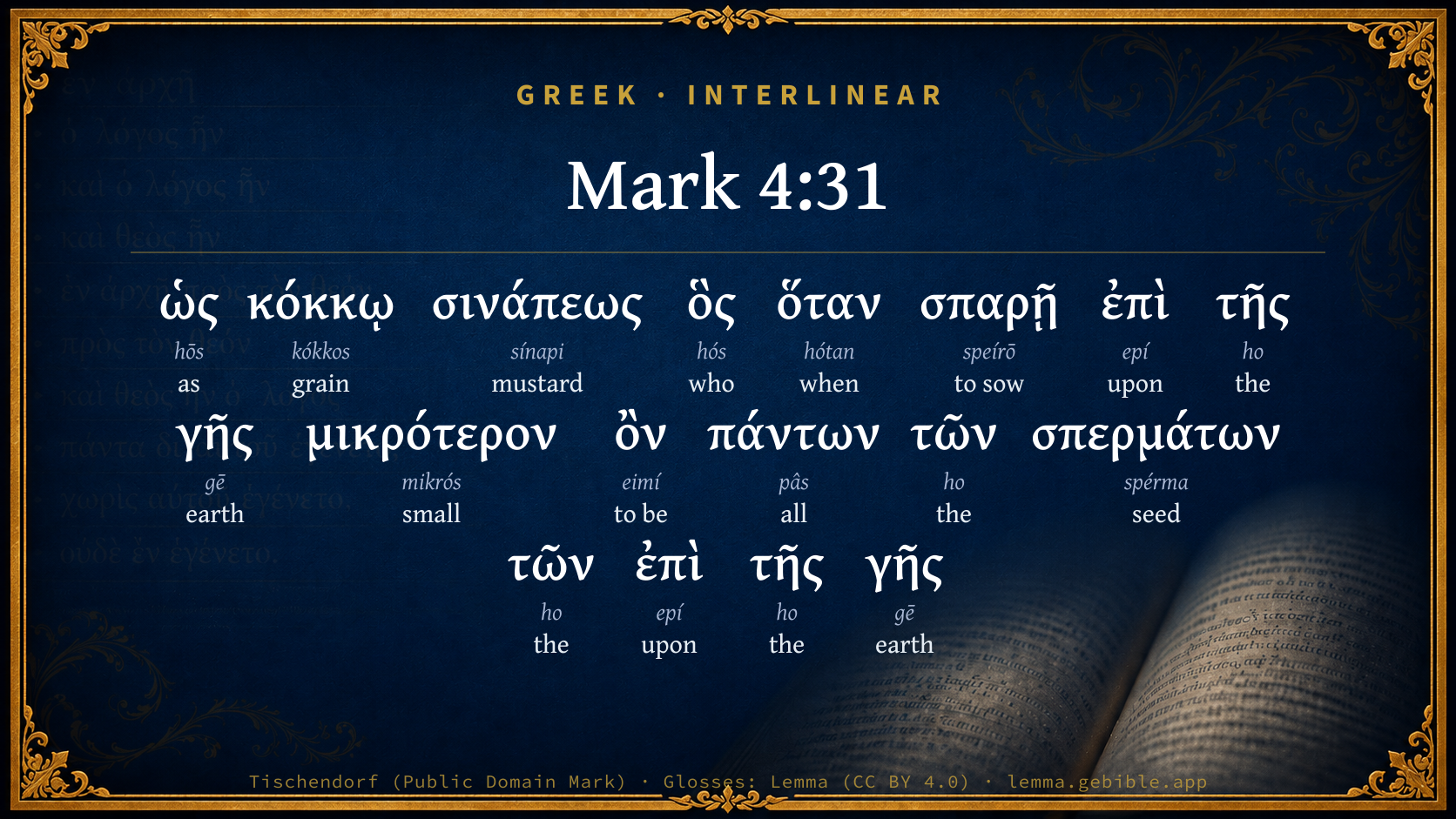
It's like a grain of mustard seed, which, when it is sown in the earth, though it is less than all the seeds that are on the earth,
Download a study sheet
One document with this verse’s original text, its word-by-word gloss line, the meaning frame, cross-references with their text, attributed commentary, and full source and license credits — printable, and it pastes into notes with its structure intact.
This verse Autodidact and up
A passage Seminary Student
Up to 50 verses in one chapter. A passage sheet keeps up to 6 commentary sources and 12 cross-references per verse, in the order this page ranks them, and says so on the sheet whenever that leaves anything out. Ask for a single verse and you get the Autodidact verse sheet above.
Everything on this page stays free to read, with no account — the sheet is a download of what is already on screen, not access to it.
Compare translations 3
The same verse in 3 English versions, stacked beneath the original-language interlinear above. Click any original word for its lexicon entry.
Each is an independent rendering of the whole verse — the interlinear is not word-aligned to these translations.
Highlighted words mark where these versions differ — a whole-verse word diff, not a word-by-word alignment.
-
World English Bible Public Domain
It's like a grain of mustard seed, which, when it is sown in the earth, though it is less than all the seeds that are on the earth,
-
King James Version Public Domain
It is like a grain of mustard seed, which, when it is sown in the earth, is less than all the seeds that be in the earth:
-
unfoldingWord Literal Text CC BY-SA 4.0
like a mustard seed, which, when it has been sown in the soil, being the smallest of all the seeds on the earth,
unfoldingWord Literal Text — © unfoldingWord, licensed CC BY-SA 4.0. Word-aligned USFM3 via Door43 (git.door43.org/unfoldingWord/en_ult).
Show all 19 translations
Every available English version of this verse, each an independent rendering of the whole verse.
-
World English Bible Public Domain
It's like a grain of mustard seed, which, when it is sown in the earth, though it is less than all the seeds that are on the earth,
-
Berean Standard Bible Public Domain
It is like a mustard seed, which is the smallest of all seeds sown upon the earth.
-
Majority Standard Bible Public Domain
It is like a mustard seed, which is the smallest of all seeds sown upon the earth.
-
King James Version Public Domain
It is like a grain of mustard seed, which, when it is sown in the earth, is less than all the seeds that be in the earth:
-
American Standard Version (1901) Public Domain
It is like a grain of mustard seed, which, when it is sown upon the earth, though it be less than all the seeds that are upon the earth,
-
Revised Version (1885) Public Domain
It is like a grain of mustard seed, which, when it is sown upon the earth, though it be less than all the seeds that are upon the earth,
-
Geneva Bible (1599) Public Domain
It is like a graine of mustarde seede, which when it is sowen in the earth, is the least of all seedes that be in the earth:
-
Douay-Rheims (1899) Public Domain
It is as a grain of mustard seed: which when it is sown in the earth, is less than all the seeds that are in the earth:
-
Young's Literal Translation Public Domain
As a grain of mustard, which, whenever it may be sown on the earth, is less than any of the seeds that are on the earth;
-
Literal Standard Version CC BY-SA 4.0
As a grain of mustard, which, whenever it may be sown on the earth, is less than any of the seeds that are on the earth;
-
Unlocked Literal Bible CC BY-SA 4.0
It is like a mustard seed which, when it is sown, is the smallest of all the seeds on earth.
-
unfoldingWord Literal Text CC BY-SA 4.0
like a mustard seed, which, when it has been sown in the soil, being the smallest of all the seeds on the earth,
-
Darby Bible Public Domain
As to a grain of mustard [seed], which, when it is sown upon the earth, is less than all seeds which are upon the earth,
-
World Messianic Bible Public Domain
It’s like a grain of mustard seed, which, when it is sown in the earth, though it is less than all the seeds that are on the earth,
-
Webster's Bible Public Domain
It is like a grain of mustard-seed, which, when it is sown in the earth, is less than all the seeds that are in the earth.
-
Free Bible Version CC BY-SA 4.0
“It's like a mustard seed, the tiniest seed of all.
-
Bible in Basic English Public Domain
It is like a grain of mustard seed, which, when it is put in the earth, is smaller than all the seeds on the earth,
-
Text-Critical English NT CC BY 4.0
It is like a grain of mustard seed, which, when it is sown on the ground, is smaller than all the seeds on earth.
-
Tyndale New Testament (1534) Public Domain
It is lyke a grayne of mustard seed which when it is sowe in the erth is the leest of all seedes that be in the erth:
Literal Standard Version (2020), Covenant Press — licensed CC BY-SA 4.0. Text via the HelloAO Bible API (eBible.org). Unlocked Literal Bible (unfoldingWord) — licensed CC BY-SA 4.0. Text via the HelloAO Bible API (eBible.org). unfoldingWord Literal Text — © unfoldingWord, licensed CC BY-SA 4.0. Word-aligned USFM3 via Door43 (git.door43.org/unfoldingWord/en_ult). Free Bible Version, Dr. Jonathan Gallagher — licensed CC BY-SA 4.0. Text via the HelloAO Bible API (eBible.org).
Word by word
More ways to search: Search by grammar → Find every occurrence → Compare this word →
Practice this passage: Drill this verse → Learn its vocabulary →
- Appears 5× in the Greek New Testament
- First appears at Matthew 13:31
- Part of Speech
- Noun
- Case
- Genitive
- Number
- Singular
- Gender
- Neuter
Full Thayer's Definition
- ὡς hōs G5613 “as” Adverb
- κόκκῳ kókkos G2848 “grain” Noun, Dative, Singular, Masculine
- σινάπεως sínapi G4615 “mustard” Noun, Genitive, Singular, Neuter
- ὃς hós G3739 “who” Relative pronoun, Nominative, Singular, Masculine
- ὅταν hótan G3752 “when” Conjunction
- σπαρῇ speírō G4687 “to sow” Verb, Aorist, Passive, Subjunctive, 3rd person, Singular
- ἐπὶ epí G1909 “upon” Preposition
- τῆς ho G3588 “the” Article, Genitive, Singular, Feminine
- γῆς gē G1093 “earth” Noun, Genitive, Singular, Feminine
- μικρότερον mikrós G3398 “small” Adjective, Nominative, Singular, Neuter, Comparative
- ὂν eimí G1510 “to be” Verb, Present, Active, Participle, Nominative, Singular, Neuter
- πάντων pâs G3956 “all” Adjective, Genitive, Plural, Neuter
- τῶν ho G3588 “the” Article, Genitive, Plural, Neuter
- σπερμάτων spérma G4690 “seed” Noun, Genitive, Plural, Neuter
- τῶν ho G3588 “the” Article, Genitive, Plural, Neuter
- ἐπὶ epí G1909 “upon” Preposition
- τῆς ho G3588 “the” Article, Genitive, Singular, Feminine
- γῆς gē G1093 “earth” Noun, Genitive, Singular, Feminine
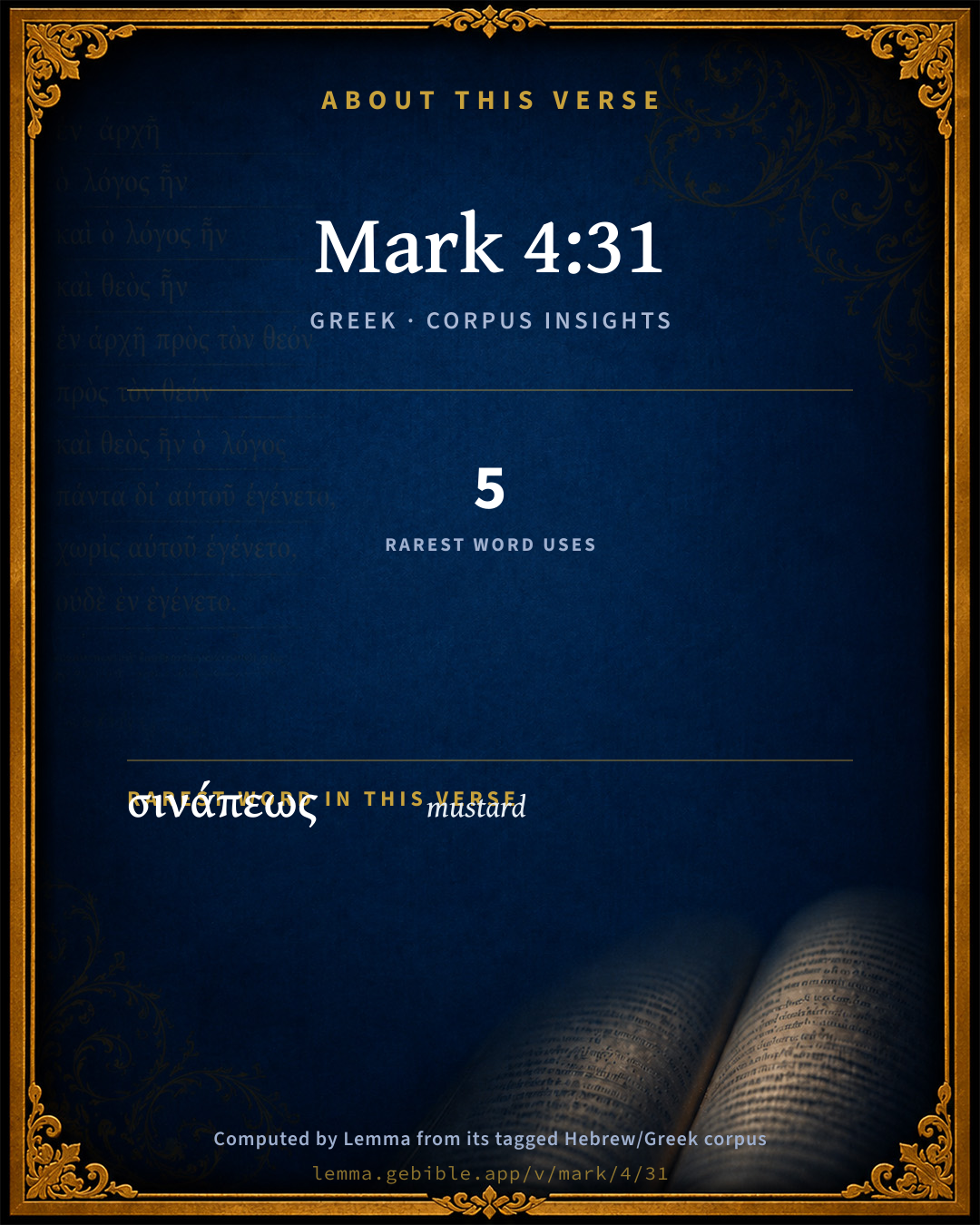
About this verse
These counts appear in no published source. They are computed here, from the morphology-tagged text and Lemma’s own curated glosses. What Lemma adds →
- 18
- words
- 13
- distinct lemmas
- Gospels
- section
Cross-references
27Topical passages linked to Mark 4:31 in the Treasury of Scripture Knowledge — connected by theme and wording, ordered by reader-vote popularity; previews shown in the World English Bible.
- Acts 19:20 So the word of the Lord was growing and becoming mighty.
- Luke 13:18–19 He said, "What is the Kingdom of God like? To what shall I compare it?
- Genesis 22:17–18 that in blessing I will bless you, and in multiplying I will multiply your seed as the stars of the heavens, and as the sand which is on the seashore. Your seed will possess the gate of his enemies.
- Daniel 2:44–45 In the days of those kings shall the God of heaven set up a kingdom which shall never be destroyed, nor shall the sovereignty of it be left to another people; but it shall break in pieces and consume all these kingdoms, and it shall stand forever.
- Malachi 1:11 For from the rising of the sun even to the going down of the same, my name is great among the nations, and in every place incense will be offered to my name, and a pure offering: for my name is great among the nations," says Yahweh of Hosts.
- Psalms 72:16–19 There shall be abundance of grain throughout the land. Its fruit sways like Lebanon. Let it flourish, thriving like the grass of the field.
- Isaiah 2:2–3 It shall happen in the latter days, that the mountain of Yahweh's house shall be established on the top of the mountains, And shall be raised above the hills; And all nations shall flow to it.
- Isaiah 9:7 Of the increase of his government and of peace there shall be no end, on the throne of David, and on his kingdom, to establish it, and to uphold it with justice and with righteousness from henceforth even forever. The zeal of Yahweh of Hosts will perform this.
- Isaiah 49:6–7 yes, he says, It is too light a thing that you should be my servant to raise up the tribes of Jacob, and to restore the preserved of Israel: I will also give you for a light to the Gentiles, that you may be my salvation to the end of the earth.
- Isaiah 53:2 For he grew up before him as a tender plant, and as a root out of a dry ground: he has no form nor comeliness; and when we see him, there is no beauty that we should desire him.
- Isaiah 53:12–54:3 Therefore will I divide him a portion with the great, and he shall divide the spoil with the strong; because he poured out his soul to death, and was numbered with the transgressors: yet he bore the sin of many, and made intercession for the transgressors.
- Isaiah 60:22 The little one shall become a thousand, and the small one a strong nation; I, Yahweh, will hasten it in its time.
- Ezekiel 17:22–24 Thus says the Lord Yahweh: I will also take of the lofty top of the cedar, and will set it; I will crop off from the topmost of its young twigs a tender one, and I will plant it on a high and lofty mountain:
- Daniel 2:34–35 You saw until a stone was cut out without hands, which struck the image on its feet that were of iron and clay, and broke them in pieces.
- Amos 9:11–15 In that day I will raise up the tent of David who is fallen, and close up its breaches, and I will raise up its ruins, and I will build it as in the days of old;
- Micah 4:1–2 But in the latter days, It will happen that the mountain of Yahweh's temple will be established on the top of the mountains, And it will be exalted above the hills; And peoples will stream to it.
- Zechariah 2:11 Many nations shall join themselves to Yahweh in that day, and shall be my people; and I will dwell in the midst of you, and you shall know that Yahweh of Hosts has sent me to you.
- Zechariah 8:20–23 Thus says Yahweh of Hosts: "Many peoples, and the inhabitants of many cities will yet come;
- Zechariah 12:8 In that day Yahweh will defend the inhabitants of Jerusalem. He who is feeble among them at that day will be like David, and the house of David will be like God, like the angel of Yahweh before them.
- Zechariah 14:6–9 It will happen in that day, that there will not be light, cold, or frost.
- Matthew 13:31–33 He set another parable before them, saying, "The Kingdom of Heaven is like a grain of mustard seed, which a man took, and sowed in his field;
- Acts 2:41 Then those who gladly received his word were baptized. There were added that day about three thousand souls.
- Acts 4:4 But many of those who heard the word believed, and the number of the men came to be about five thousand.
- Acts 5:14 More believers were added to the Lord, multitudes of both men and women.
- Acts 21:20 They, when they heard it, glorified God. They said to him, "You see, brother, how many thousands there are among the Jews of those who have believed, and they are all zealous for the law.
- Revelation 11:15 The seventh angel sounded, and great voices in heaven followed, saying, "The kingdom of the world has become the Kingdom of our Lord, and of his Christ. He will reign forever and ever!"
- Revelation 20:1–6 I saw an angel coming down out of heaven, having the key of the abyss and a great chain in his hand.
Cross-references courtesy of OpenBible.info (CC BY 4.0).
Lesson kit
Teaching starters — assembled from the data on this page, not authored interpretation. Every prompt links to the verse data it draws on. Edit before teaching.
Mark, in the Gospels, opens this verse with 18 words (13 distinct Greek lemmas). Its most distinctive word is sínapi (“mustard”). A historical commentator’s framing appears above. Read the whole chapter for the surrounding context.
Discussion questions
- How does “mustard” (sínapi) shape what this verse is saying?
- How does Matthew 13:31, which shares the word «mustard», read alongside this verse?
- What does the repetition of “upon” (2× in this one verse) do in this verse?
- The translations on this page render this verse differently — a whole-verse word diff, not a word-by-word alignment. What might account for the different wordings?
- Compare how Bengel's Gnomon and Expositor's Greek Testament read this verse. Where do they agree or differ?
Things to notice
- These translations choose different wording for 9 words in this verse.
- “upon” occurs 2× in this single verse.
- 13 distinct Greek lemmas span 18 words in this verse.
Commentary
Notes on Mark 4:31 from classic Christian and Jewish commentators (each source and its license shown beneath its notes). The classic Christian expositions comment on the surrounding passage and are grouped to its opening verse, so a note may address several verses; the Jewish commentaries on the Tanakh (Rashi and others) are per-verse, so they appear only where the commentator wrote on this verse.
Lemma curates 59 commentaries, every one of them public domain or Creative Commons licensed, each selected and text-cleaned for this edition rather than reprinted as found. About our sources →
Bengel's Gnomon
Johann Albrecht Bengel
Bengel's Gnomon of the New Testament — English translation (T&T Clark, Edinburgh, 1860) — public domain. Text from a community e-Sword module.
Expositor's Greek Testament
ed. W. Robertson Nicoll
The Expositor's Greek Testament, edited by W. Robertson Nicoll (1897–1910) — public domain. Text from a community e-Sword module.
Adam Clarke's Commentary
Adam Clarke's Commentary on the Bible (1810–1826) — public domain. Text from a community e-Sword/MySword module.
Ellicott's Commentary for English Readers
A Bible Commentary for English Readers, edited by Charles John Ellicott (1878–1897) — public domain. Text from a community e-Sword module.
The Cambridge Bible for Schools and Colleges
gen. ed. J. J. S. Perowne
The Cambridge Bible for Schools and Colleges (gen. ed. J. J. S. Perowne; Cambridge University Press, 1878–1918) — public domain. Text from a community e-Sword module.
John Gill's Exposition
John Gill's Exposition of the Whole Bible (1746–1763) — public domain (CC PDM 1.0). Text via the HelloAO Bible API.
Trapp's Complete Commentary
John Trapp
John Trapp, A Commentary or Exposition upon All the Books of the Old and New Testament (1647–1656) — public domain. Text from a community e-Sword module.
Albert Barnes' Notes on the Bible
Albert Barnes' Notes on the Bible (1834–1885) — public domain. Text from a community e-Sword/MySword module.
The People's New Testament
B. W. Johnson
B. W. Johnson's The People's New Testament with Notes (1889–1891) — public domain. Electronic text from the Christian Classics Ethereal Library (CCEL) ThML edition.
Cambridge Greek Testament for Schools and Colleges
Cambridge Greek Testament for Schools and Colleges (Cambridge University Press, 1896; 21 vols, various authors incl. Carr, Maclear, Plummer, Farrar, Lumby, Moule, M. R. James, Simcox) — public domain. Text from a community e-Sword module.
Alford’s Greek Testament
Henry Alford
Henry Alford, The Greek Testament (1849–1861) — public domain. Text from a community e-Sword module.
International Critical Commentary
International Critical Commentary — older volumes (1896–1929), various authors — public domain. Text from a community e-Sword module.
Vincent's Word Studies in the New Testament
Marvin R. Vincent
Marvin R. Vincent, Word Studies in the New Testament (1887–1900) — public domain. Text from a community e-Sword/MySword module.