Revelation 12:9

Greek (Tischendorf 8th ed.) Revelation 12:9 appears in the Greek New Testament. The text above is from the Tischendorf 8th edition. Each word links to its Strong’s number and a concise gloss. Click any word for its full Thayer’s Greek Lexicon entry.
Download image
Cite this verse

Revelation 12:9 (World English Bible). Public Domain. Lemma interlinear Bible study tool, https://lemma.gebible.app/v/revelation/12/9.

Show BibTeX & RIS
BibTeX
RIS
English Translation
The great dragon was thrown down, the old serpent, he who is called the devil and Satan, the deceiver of the whole world. He was thrown down to the earth, and his angels were thrown down with him.
World English Bible · Public Domain
Download a study sheet

One document with this verse’s original text, its word-by-word gloss line, the meaning frame, cross-references with their text, attributed commentary, and full source and license credits — printable, and it pastes into notes with its structure intact.

This verse Autodidact and up

Study sheet (.html) Plain text (.txt)

A passage Seminary Student

Up to 50 verses in one chapter. A passage sheet keeps up to 6 commentary sources and 12 cross-references per verse, in the order this page ranks them, and says so on the sheet whenever that leaves anything out. Ask for a single verse and you get the Autodidact verse sheet above.

Everything on this page stays free to read, with no account — the sheet is a download of what is already on screen, not access to it.

Want to remove ads? Support Godless Engineer
Compare translations 3

The same verse in 3 English versions, stacked beneath the original-language interlinear above. Click any original word for its lexicon entry.

Each is an independent rendering of the whole verse — the interlinear is not word-aligned to these translations.

Highlighted words mark where these versions differ — a whole-verse word diff, not a word-by-word alignment.

  • World English Bible Public Domain
    The great dragon was thrown down, the old serpent, he who is called the devil and Satan, the deceiver of the whole world. He was thrown down to the earth, and his angels were thrown down with him.
  • King James Version Public Domain
    And the great dragon was cast out, that old serpent, called the Devil, and Satan, which deceiveth the whole world: he was cast out into the earth, and his angels were cast out with him.
  • unfoldingWord Literal Text CC BY-SA 4.0
    And the great dragon was thrown down, the ancient serpent called Diabolos and Satan, the one deceiving the whole world. He was thrown down to the earth and his angels were thrown down with him.

unfoldingWord Literal Text — © unfoldingWord, licensed CC BY-SA 4.0. Word-aligned USFM3 via Door43 (git.door43.org/unfoldingWord/en_ult).

Versions to compare (up to 4)

3 of 4 selected

Show all 19 translations

Every available English version of this verse, each an independent rendering of the whole verse.

  • World English Bible Public Domain
    The great dragon was thrown down, the old serpent, he who is called the devil and Satan, the deceiver of the whole world. He was thrown down to the earth, and his angels were thrown down with him.
  • Berean Standard Bible Public Domain
    And the great dragon was hurled down—that ancient serpent called the devil and Satan, the deceiver of the whole world. He was hurled to the earth, and his angels with him.
  • Majority Standard Bible Public Domain
    And the great dragon was hurled down—that ancient serpent called the devil and Satan, the deceiver of the whole world. He was hurled to the earth, and his angels with him.
  • King James Version Public Domain
    And the great dragon was cast out, that old serpent, called the Devil, and Satan, which deceiveth the whole world: he was cast out into the earth, and his angels were cast out with him.
  • American Standard Version (1901) Public Domain
    And the great dragon was cast down, the old serpent, he that is called the Devil and Satan, the deceiver of the whole world; he was cast down to the earth, and his angels were cast down with him.
  • Revised Version (1885) Public Domain
    And the great dragon was cast down, the old serpent, he that is called the Devil and Satan, the deceiver of the whole world; he was cast down to the earth, and his angels were cast down with him.
  • Geneva Bible (1599) Public Domain
    And the great dragon, that olde serpent, called the deuil and Satan, was cast out, which deceiueth all the world: he was euen cast into the earth, and his angels were cast out with him.
  • Douay-Rheims (1899) Public Domain
    And that great dragon was cast out, that old serpent, who is called the devil and Satan, who seduceth the whole world; and he was cast unto the earth, and his angels were thrown down with him.
  • Young's Literal Translation Public Domain
    and the great dragon was cast forth -- the old serpent, who is called `Devil,' and `the Adversary,' who is leading astray the whole world -- he was cast forth to the earth, and his messengers were cast forth with him.
  • Literal Standard Version CC BY-SA 4.0
    and the great dragon was cast forth—the old serpent, who is called “Devil,” and “Satan,” who is leading the whole world astray—he was cast forth to the earth, and his messengers were cast forth with him.
  • Unlocked Literal Bible CC BY-SA 4.0
    The great dragon—that old serpent called the devil or Satan, who deceives the whole world—was thrown down to the earth, and his angels were thrown down with him.
  • unfoldingWord Literal Text CC BY-SA 4.0
    And the great dragon was thrown down, the ancient serpent called Diabolos and Satan, the one deceiving the whole world. He was thrown down to the earth and his angels were thrown down with him.
  • Darby Bible Public Domain
    And the great dragon was cast out, the ancient serpent, he who is called Devil and Satan, he who deceives the whole habitable world, he was cast out into the earth, and his angels were cast out with him.
  • World Messianic Bible Public Domain
    The great dragon was thrown down, the old serpent, he who is called the devil and Satan, the deceiver of the whole world. He was thrown down to the earth, and his angels were thrown down with him.
  • Webster's Bible Public Domain
    And the great dragon was cast out, that old serpent, called the Devil, and Satan, which deceiveth the whole world: he was cast out upon the earth, and his angels were cast out with him.
  • Free Bible Version CC BY-SA 4.0
    The great dragon, the ancient serpent called the devil and Satan who deceives the whole world, was thrown down to the earth, and his angels with him.
  • Bible in Basic English Public Domain
    And the great dragon was forced down, the old snake, who is named the Evil One and Satan, by whom all the earth is turned from the right way; he was forced down to the earth, and his angels were forced down with him.
  • Text-Critical English NT CC BY 4.0
    The great dragon was thrown down, the old serpent, who is called the devil and Satan, the deceiver of the whole world. He was thrown down to the earth, and his angels were thrown down with him.
  • Tyndale New Testament (1534) Public Domain
    And the grett dragon that olde serpent called the devyll and Sathanas was cast out. Which desceaveth all the worlde. And he was cast into the erth and his angelles were cast out also.

Literal Standard Version (2020), Covenant Press — licensed CC BY-SA 4.0. Text via the HelloAO Bible API (eBible.org). Unlocked Literal Bible (unfoldingWord) — licensed CC BY-SA 4.0. Text via the HelloAO Bible API (eBible.org). unfoldingWord Literal Text — © unfoldingWord, licensed CC BY-SA 4.0. Word-aligned USFM3 via Door43 (git.door43.org/unfoldingWord/en_ult). Free Bible Version, Dr. Jonathan Gallagher — licensed CC BY-SA 4.0. Text via the HelloAO Bible API (eBible.org).

Word by word

More ways to search: Search by grammar → Find every occurrence → Compare this word →

Practice this passage: Drill this verse → Learn its vocabulary →

ἀρχαῖος
archaîos
G744
“original”
Adjective, Nominative, Singular, Masculine
Part of Speech
Adjective
Case
Nominative
Number
Singular
Gender
Masculine
Full Thayer's Definition

Origin: from G746

TDNT: 09:06,8

1. that has been from the beginning, original, primal, old ancient a. of men, things, times, conditions
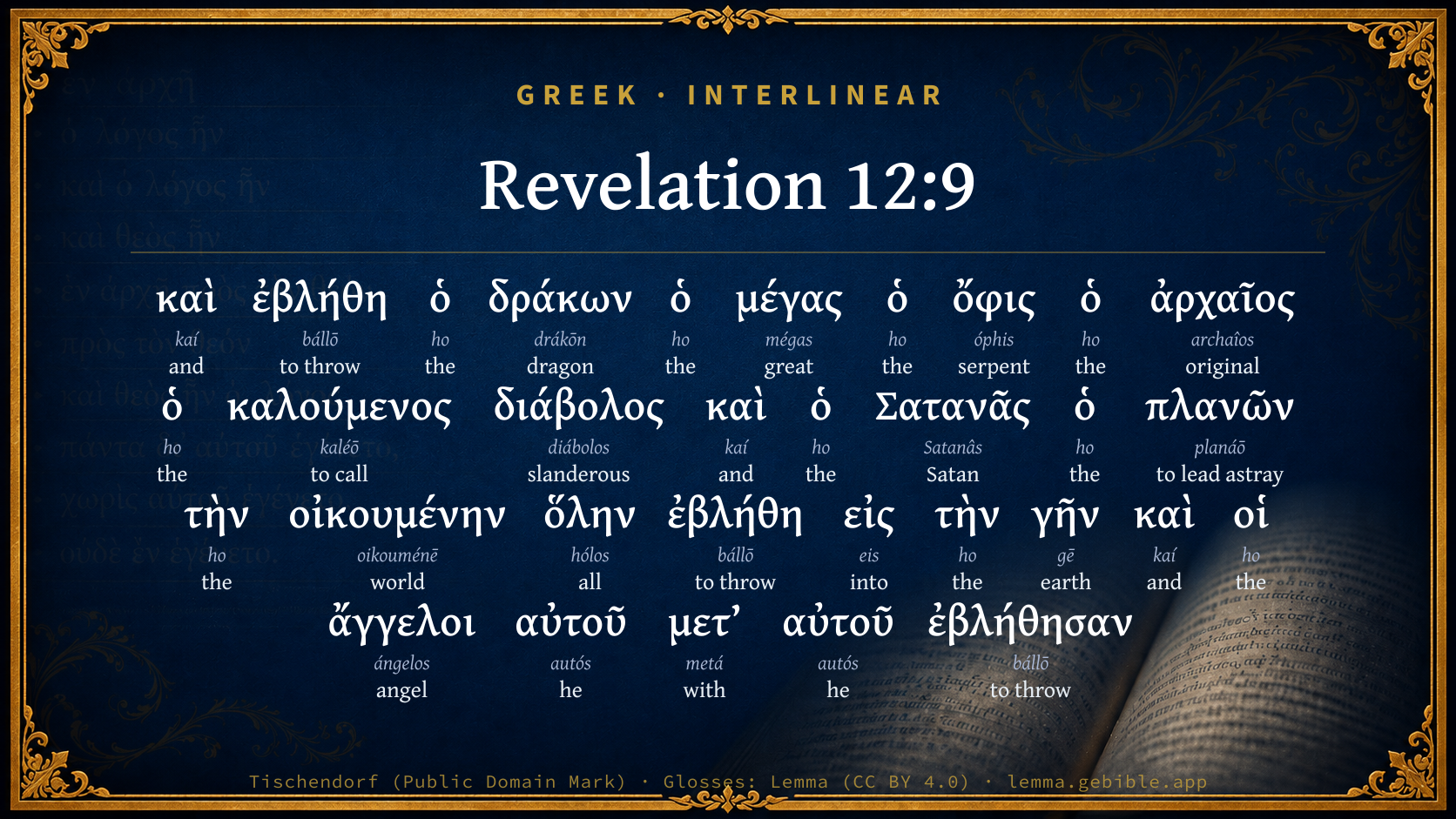
  1. καὶ kaí G2532 “and” Conjunction
  2. ἐβλήθη bállō G906 “to throw” Verb, Aorist, Passive, Indicative, 3rd person, Singular
  3. ὁ ho G3588 “the” Article, Nominative, Singular, Masculine
  4. δράκων drákōn G1404 “dragon” Noun, Nominative, Singular, Masculine
  5. ὁ ho G3588 “the” Article, Nominative, Singular, Masculine
  6. μέγας mégas G3173 “great” Adjective, Nominative, Singular, Masculine
  7. ὁ ho G3588 “the” Article, Nominative, Singular, Masculine
  8. ὄφις óphis G3789 “serpent” Noun, Nominative, Singular, Masculine
  9. ὁ ho G3588 “the” Article, Nominative, Singular, Masculine
  10. ὁ ho G3588 “the” Article, Nominative, Singular, Masculine
  11. καλούμενος kaléō G2564 “to call” Verb, Present, Passive, Participle, Nominative, Singular, Masculine
  12. διάβολος diábolos G1228 “slanderous” Adjective, Nominative, Singular, Masculine
  13. καὶ kaí G2532 “and” Conjunction
  14. ὁ ho G3588 “the” Article, Nominative, Singular, Masculine
  15. Σατανᾶς Satanâs G4567 “Satan” Noun, Nominative, Singular, Masculine
  16. ὁ ho G3588 “the” Article, Nominative, Singular, Masculine
  17. πλανῶν planáō G4105 “to lead astray” Verb, Present, Active, Participle, Nominative, Singular, Masculine
  18. τὴν ho G3588 “the” Article, Accusative, Singular, Feminine
  19. οἰκουμένην oikouménē G3625 “world” Noun, Accusative, Singular, Feminine
  20. ὅλην hólos G3650 “all” Adjective, Accusative, Singular, Feminine
  21. ἐβλήθη bállō G906 “to throw” Verb, Aorist, Passive, Indicative, 3rd person, Singular
  22. εἰς eis G1519 “into” Preposition
  23. τὴν ho G3588 “the” Article, Accusative, Singular, Feminine
  24. γῆν gē G1093 “earth” Noun, Accusative, Singular, Feminine
  25. καὶ kaí G2532 “and” Conjunction
  26. οἱ ho G3588 “the” Article, Nominative, Plural, Masculine
  27. ἄγγελοι ángelos G32 “angel” Noun, Nominative, Plural, Masculine
  28. αὐτοῦ autós G846 “he” Personal pronoun, Genitive, Singular, Masculine
  29. μετ’ metá G3326 “with” Preposition
  30. αὐτοῦ autós G846 “he” Personal pronoun, Genitive, Singular, Masculine
  31. ἐβλήθησαν bállō G906 “to throw” Verb, Aorist, Passive, Indicative, 3rd person, Plural

About this verse

These counts appear in no published source. They are computed here, from the morphology-tagged text and Lemma’s own curated glosses. What Lemma adds →

32
words
18
distinct lemmas
Revelation
section

Notable vocabulary

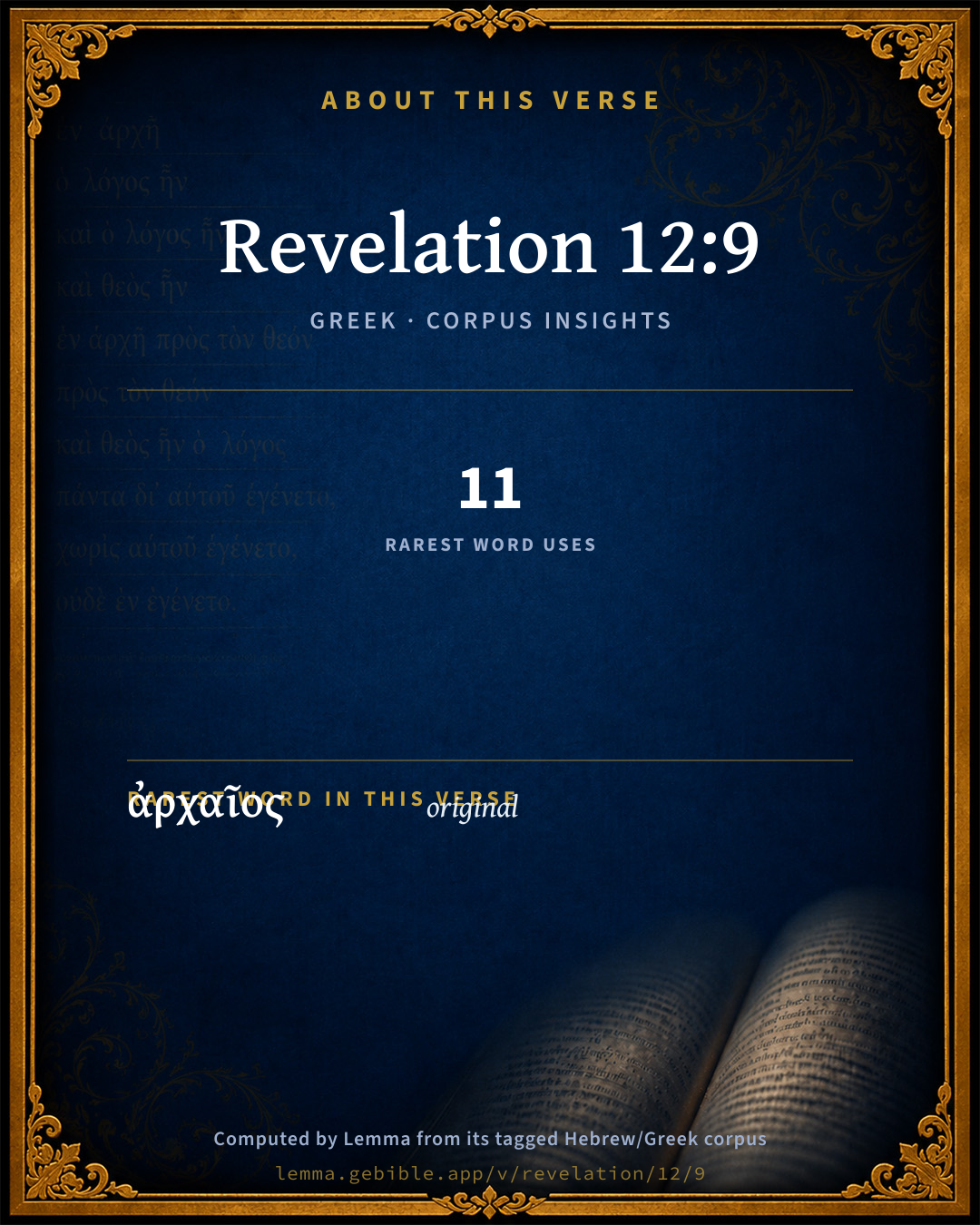
The rarest word here is ἀρχαῖος original G744 — appearing just 11 times in the whole Greek New Testament.

Shared distinctive vocabulary

ἀρχαῖος original G744 occurs in 11 verses of the Greek New Testament. Also found in:

Repetition

Words recur within this verse:

  • ἐβλήθη to throw G906 ×3
  • ὁ the G3588 ×10
  • καὶ and G2532 ×3
  • αὐτοῦ he G846 ×2

Cross-references

64

Topical passages linked to Revelation 12:9 in the Treasury of Scripture Knowledge — connected by theme and wording, ordered by reader-vote popularity; previews shown in the World English Bible.

  • Luke 10:18 He said to them, "I saw Satan having fallen like lightning from heaven.
  • John 12:31 Now is the judgment of this world. Now the prince of this world will be cast out.
  • Revelation 20:10 The devil who deceived them was thrown into the lake of fire and sulfur, where the beast and the false prophet are also. They will be tormented day and night forever and ever.
  • Isaiah 14:12 How you are fallen from heaven, day-star, son of the morning! How you are cut down to the ground, who laid the nations low!
  • 1 John 5:19 We know that we are of God, and the whole world lies in the power of the evil one.
  • Job 2:1–2 Again it happened on the day when the sons of God came to present themselves before Yahweh, that Satan came also among them to present himself before Yahweh.
  • 2 Corinthians 4:4 in whom the god of this world has blinded the minds of the unbelieving, that the light of the Gospel of the glory of Christ, who is the image of God, should not dawn on them.
  • Revelation 20:2–3 He seized the dragon, the old serpent, which is the devil and Satan, who deceives the whole inhabited earth, and bound him for a thousand years,
  • Genesis 3:1 Now the serpent was more subtle than any animal of the field which Yahweh God had made. He said to the woman, "Yes, has God said, 'You shall not eat of any tree of the garden?'"
  • 2 Thessalonians 2:9–11 even he whose coming is according to the working of Satan with all power and signs and lying wonders,
  • Revelation 12:7 There was war in the sky. Michael and his angels made war on the dragon. The dragon and his angels made war.
  • Isaiah 65:25 The wolf and the lamb shall feed together, and the lion shall eat straw like the ox; and dust shall be the serpent's food. They shall not hurt nor destroy in all my holy mountain, says Yahweh.
  • John 8:44 You are of your Father, the devil, and you want to do the desires of your father. He was a murderer from the beginning, and doesn't stand in the truth, because there is no truth in him. When he speaks a lie, he speaks on his own; for he is a liar, and the father of it.
  • 1 Peter 5:8 Be sober and self-controlled. Be watchful. Your adversary the devil, walks around like a roaring lion, seeking whom he may devour.
  • 1 John 3:8–10 He who sins is of the devil, for the devil has been sinning from the beginning. To this end the Son of God was revealed, that he might destroy the works of the devil.
  • Revelation 2:24 But to you I say, to the rest who are in Thyatira, as many as don't have this teaching, who don't know what some call 'the deep things of Satan,' to you I say, I am not putting any other burden on you.
  • Isaiah 27:1 In that day Yahweh with his hard and great and strong sword will punish leviathan the swift serpent, and leviathan the crooked serpent; and he will kill the monster that is in the sea.
  • Matthew 4:1 Then Jesus was led up by the Spirit into the wilderness to be tempted by the devil.
  • Luke 22:31 The Lord said, "Simon, Simon, behold, Satan asked to have you, that he might sift you as wheat,
  • Acts 26:18 to open their eyes, that they may turn from darkness to light and from the power of Satan to God, that they may receive remission of sins and an inheritance among those who are sanctified by faith in me.'
  • Romans 16:18 For those who are such don't serve our Lord, Jesus Christ, but their own belly; and by their smooth and flattering speech, they deceive the hearts of the innocent.
  • 2 Corinthians 2:11 that no advantage may be gained over us by Satan; for we are not ignorant of his schemes.
  • 2 Corinthians 11:14 And no wonder, for even Satan masquerades as an angel of light.
  • Revelation 2:13 "I know your works and where you dwell, where Satan's throne is. You hold firmly to my name, and didn't deny my faith in the days of Antipas my witness, my faithful one, who was killed among you, where Satan dwells.
  • Revelation 9:1 The fifth angel sounded, and I saw a star from the sky which had fallen to the earth. The key to the pit of the abyss was given to him.
  • Revelation 12:3 Another sign was seen in heaven. Behold, a great red dragon, having seven heads and ten horns, and on his heads seven crowns.
  • Revelation 20:8 and he will come out to deceive the nations which are in the four corners of the earth, Gog and Magog, to gather them together to the war; the number of whom is as the sand of the sea.
  • Genesis 3:4–5 The serpent said to the woman, "You won't surely die,
  • Genesis 3:13 Yahweh God said to the woman, "What is this you have done?" The woman said, "The serpent deceived me, and I ate."
  • Job 1:6–12 Now it happened on the day when the sons of God came to present themselves before Yahweh, that Satan also came among them.
  • Matthew 4:5 Then the devil took him into the holy city. He set him on the pinnacle of the temple,
  • Matthew 4:8 Again, the devil took him to an exceedingly high mountain, and showed him all the kingdoms of the world, and their glory.
  • Matthew 4:10 Then Jesus said to him, "Get behind me, Satan! For it is written, 'You shall worship the Lord your God, and him only shall you serve.'"
  • Matthew 25:41 Then he will say also to those on the left hand, 'Depart from me, you cursed, into the eternal fire which is prepared for the devil and his angels;
  • Luke 8:12 Those along the road are those who hear, then the devil comes, and takes away the word from their heart, that they may not believe and be saved.
  • Luke 22:3 Satan entered into Judas, who was surnamed Iscariot, who was numbered with the twelve.
  • 2 Corinthians 11:3 But I am afraid that somehow, as the serpent deceived Eve in his craftiness, so your minds might be corrupted from the simplicity that is in Christ.
  • 1 Chronicles 21:1 Satan stood up against Israel, and moved David to number Israel.
  • Zechariah 3:1–2 He showed me Joshua the high priest standing before the angel of Yahweh, and Satan standing at his right hand to be his adversary.
  • Matthew 13:39 The enemy who sowed them is the devil. The harvest is the end of the age, and the reapers are angels.
  • Matthew 24:24 For there will arise false christs, and false prophets, and they will show great signs and wonders, so as to lead astray, if possible, even the chosen ones.
  • Luke 13:16 Ought not this woman, being a daughter of Abraham, whom Satan had bound eighteen long years, be freed from this bondage on the Sabbath day?"
  • John 14:30 I will no more speak much with you, for the prince of the world comes, and he has nothing in me.
  • John 16:11 about judgment, because the prince of this world has been judged.
  • Acts 5:3 But Peter said, "Ananias, why has Satan filled your heart to lie to the Holy Spirit, and to keep back part of the price of the land?
  • Romans 16:20 And the God of peace will quickly crush Satan under your feet. The grace of our Lord Jesus Christ be with you.
  • 2 Corinthians 12:7 By reason of the exceeding greatness of the revelations, that I should not be exalted excessively, there was given to me a thorn in the flesh, a messenger of Satan to buffet me, that I should not be exalted excessively.
  • Ephesians 4:14 that we may no longer be children, tossed back and forth and carried about with every wind of doctrine, by the trickery of men, in craftiness, after the wiles of error;
  • 2 Thessalonians 2:3 Let no one deceive you in any way. For it will not be, unless the departure comes first, and the man of sin is revealed, the son of destruction,
  • 1 Timothy 2:14 Adam wasn't deceived, but the woman, being deceived, has fallen into disobedience;
  • 1 Timothy 3:6–7 not a new convert, lest being puffed up he fall into the same condemnation as the devil.
  • 2 Timothy 3:13 But evil men and impostors will grow worse and worse, deceiving and being deceived.
  • Hebrews 2:14 Since then the children have shared in flesh and blood, he also himself in like manner partook of the same, that through death he might bring to nothing him who had the power of death, that is, the devil,
  • Jude 1:9 But Michael, the archangel, when contending with the devil and arguing about the body of Moses, dared not bring against him an abusive condemnation, but said, "May the Lord rebuke you!"
  • Revelation 2:9 "I know your works, oppression, and your poverty (but you are rich), and the blasphemy of those who say they are Jews, and they are not, but are a synagogue of Satan.
  • Revelation 3:9 Behold, I give of the synagogue of Satan, of those who say they are Jews, and they are not, but lie. Behold, I will make them to come and worship before your feet, and to know that I have loved you.
  • Revelation 9:20 The rest of mankind, who were not killed with these plagues, didn't repent of the works of their hands, that they wouldn't worship demons, and the idols of gold, and of silver, and of brass, and of stone, and of wood; which can neither see, nor hear, nor walk.
  • Revelation 13:14 He deceives my own people who dwell on the earth because of the signs he was granted to do in front of the beast; saying to those who dwell on the earth, that they should make an image to the beast who had the sword wound and lived.
  • Revelation 16:14 for they are spirits of demons, performing signs; which go forth to the kings of the whole inhabited earth, to gather them together for the war of that great day of God, the Almighty.
  • Revelation 19:20 The beast was taken, and with him the false prophet who worked the signs in his sight, with which he deceived those who had received the mark of the beast and those who worshiped his image. These two were thrown alive into the lake of fire that burns with sulfur.
  • Ezekiel 28:16 By the abundance of your traffic they filled the midst of you with violence, and you have sinned: therefore I have cast you as profane out of the mountain of God; and I have destroyed you, covering cherub, from the midst of the stones of fire.
  • Revelation 12:14–15 Two wings of the great eagle were given to the woman, that she might fly into the wilderness to her place, so that she might be nourished for a time, and times, and half a time, from the face of the serpent.
  • Revelation 18:2 He cried with a mighty voice, saying, "Fallen, fallen is Babylon the great, and she has become a habitation of demons, a prison of every unclean spirit, and a prison of every unclean and hateful bird!
  • Revelation 18:23 The light of a lamp will shine no more at all in you. The voice of the bridegroom and of the bride will be heard no more at all in you; for your merchants were the princes of the earth; for with your sorcery all the nations were deceived.

Cross-references courtesy of OpenBible.info (CC BY 4.0).

Commentary

Notes on Revelation 12:9 from classic Christian and Jewish commentators (each source and its license shown beneath its notes). The classic Christian expositions comment on the surrounding passage and are grouped to its opening verse, so a note may address several verses; the Jewish commentaries on the Tanakh (Rashi and others) are per-verse, so they appear only where the commentator wrote on this verse.

Lemma curates 59 commentaries, every one of them public domain or Creative Commons licensed, each selected and text-cleaned for this edition rather than reprinted as found. About our sources →

The Biblical Illustrator

Joseph S. Exell

Rev_12:9

The great dragon.

., that old serpent, called the Devil, and Satan.

The foes of God and of His Church

I. Our For Is A Personal One (Rev_12:9).

II. He Is An Old One. The devil sinneth from the beginning (1Jn_3:8; Joh_8:44).

III. He Is A Daring One.

IV. His Attempts Are Often Failures. The dragon warred and his angels, and they prevailed not (Rev_12:8).

V. He Is An Angry Foe. He hath great wrath, knowing that he hath but a short time (Rev_12:12).

VI. He Is A Malicious One (Rev_12:13).

VII. He Is A Watchful And Crafty One (Rev_12:4; Rev_12:13; Rev_12:15), varying his methods according to the case in hand.

VIII. He Is A Circumscribed Foe. This chapter tells us of three limits put to him and to his power.

1. One, of space. He is cast down to earth. He is the God of this world (2Co_4:4).

2. A second, of time. A time, and times, and half a time.

3. There is yet a third limit, that of force. The earth helped the woman, etc. (Rev_12:16). We are taught in Scripture that there are five ways by which his power is restricted and his intention foiled.

(1) There is providential dispensation (Rev_12:6; Rev_12:14; Rev_12:16; 1Co_10:13).

(2) There is angelic ministry (Rev_12:7).

(3) There is the direct exertion of Christs commanding word (Mat_17:18).

(4) There is the counteracting power of Divine grace (2Co_12:9).

(5) There is the intercession of our Redeemer (Luk_22:31-32).

IX. He is a foe with whose devices we have to reckon in fighting the battle of life (Rev_12:17). Note--

1. He is one at whom we cannot afford to laugh, and whose existence we cannot afford to deny.

2. He is a foe before whom we need not quail.

3. He is a foe to whom not an inch of room should be given (Eph_4:27).

4. He is a foe for whose onsets we should prepare by a survey and appropriation of heavenly forces.

5. He is a foe on whose ultimate defeat and complete discomfiture we may surely and confidently reckon if we look to Jesus. (C. Clemance, D. D.)

Satan the great dragon

In calling him the dragon, the Holy Spirit seems to hint at his mysterious power and character. To us a spirit such as he is must ever be a mystery in his being and working. Satan is a mysterious personage though he is not a mythical one. We can never doubt his existence if we have once come into conflict with him; yet he is to us all the more real because so mysterious. If he were flesh and blood it would be far easier to contend with him; but to fight with this spiritual wickedness in high places is a terrible task. As a dragon he is full of cunning and ferocity. In him force is allied with craft; and if he cannot achieve his purpose at once by power, he waits his time. He deludes, he deceives; in fact, he is said to deceive the whole world. What a power of deception must reside in him, when under his influence the third part of the stars of heaven are made to fall, and myriads of men in all ages have worshipped demons and idols! He has steeped the minds of men in delusion, so that they cannot see that they should worship none but God, their Maker. He is styled the old serpent; and this reminds us how practised he is in every evil art. He was a liar from the beginning, and the father of lies. After thousands of years of constant practice in deception he is much too cunning for us. If we think that we can match him by craft we are grievous fools, for he knows vastly more than the wisest of mortals; and if it once comes to a game of policies, he will certainly clear the board, and sweep our tricks into the bag. To this cunning he adds great speed, so that he is quick to assail at any moment, darting down upon us like a hawk upon a poor chick. He is not everywhere present; but it is hard to say where he is not. He cannot be omnipresent; but yet, by that majestic craft of his, he so manages his armies of fallen ones that, like a great general, he superintends the whole field of battle, and seems present at every point. No door can shut him out, no height of piety can rise beyond his reach. He meets us in all our weaknesses, and assails us from every point of the compass. He comes upon us unawares, and gives us wounds which are not easily healed. But yet, powerful as this infernal spirit certainly must be, his power is defeated when we are resolved never to be at peace with him. (C. H. Spurgeon.)

The Biblical Illustrator, edited by Joseph S. Exell (c. 1880s–1900s) — public domain. Text from a community e-Sword module.

Bengel's Gnomon

Johann Albrecht Bengel

Rev 12:9. Ὁ καλούμενος διάβολος, καὶ ὁ σατανᾶς, κ.τ.λ. The devil and Satan are exactly synonymous, as Druse teaches, and Raphel, in his Annot. from Polybius, p. 719; for both שטן, and διαβάλλειν mean to place one’ self between for the purpose of resistance; wherefore also the Septuagint frequently has διάβολος for שטן, which is retained at 1Ki 11:14; 1Ki 11:23; 1Ki 11:25. Therefore there is no more difference between them than between gladius, in ordinary appellation, and ensis in poetic usage. The only difference lies in the Hebrew and Greek idiom; and the adversary is pointed out, who harasses the Gentiles, as the devil, and the Jews, as Satan; in this place, indeed, saints of both classes. Even Andreas of Cזsareia saw, that there was force in the double appellation; and lest I should be accused of refining too nicely, Grotius refers this double appellation to the Jews and Gentiles. But the observation appertains to this text, in which both the Hebrew and the Greek names are joined together: in other texts, even the appellation of the devil, inasmuch as it is alone, may no doubt appertain to the Jews.—ὁ πλανῶν, which deceiveth) The devil is a liar and a murderer, Joh 8:44; a seducer, in this passage, and raging, Rev 12:12, where despair, in consequence of the shortness of the time, inflames his rage. But the saints, who overcome him, have faith, love, and hope.

Bengel's Gnomon of the New Testament — English translation (T&T Clark, Edinburgh, 1860) — public domain. Text from a community e-Sword module.

Meyer's Critical & Exegetical Commentary

Heinrich August Wilhelm Meyer

Rev_12:9. καὶ ἐβλήθη. After the circumstantial designation of the subject has been given, the verb is repeated, and then receives also the more accurate determination, ἐβλ. εἰς τὴν γῆν. The aggregation of designations describe the nature and activity of the enemy as completely as possible; which is appropriate for the reason that thereby it is, on the one hand, indicated what believers have to expect from this enemy now working against them on earth,[3106] and, on the other hand, it is said that this enemy, even though his hostile activity be so various, yet is already a thoroughly conquered adversary.[3107] First stands the designation Ὁ ΔΡΆΚΩΝ Ὁ ΜΈΓΑς, as that of the subject given by Rev_12:3 sqq., with which the other designations are connected as appositives: Ὁ ὌΦΙς Ὁ ἈΡΧΑῖΟς, with an allusion to Genesis 3,[3108] whence also the rabbinical expressions חַנָחשׁ הַקַרִמֹונִי and חַנָחָשׁ הַראשֹׁוך[3109] are derived.

Ὁ ΚΑΛΟΎΜΕΝΟς ΔΙΆΒΟΛΟς, Κ.Τ.Λ. The ΔΙΆΒΟΛΟς stands here with the Ὁ ΚΑΛΟΎΜΕΝΟς in a like manner as an appellative, just as in Rev_20:3 with Ὅς ἘΣΤΙΝ; while, on the other hand, the Ὁ ΣΑΤΑΝᾶς, because of the art.,[3110] appears in both places as a proper noun, like Ὁ ΔΙΆΒΟΛΟς also in, e.g., Rev_20:10. The definition added to Ὁ ΣΑΤ., viz., Ὁ ΠΛΑΝῶΝ Τ. ΟἸΚ. ὍΛ., which is not altogether intelligible from what is said in Rev_12:1, but refers to the antichristic activity of Satan[3111] described in ch. 13, shows us on its part that the entire present account has its peculiar intention and meaning, not so much in itself, as rather in its connection with what follows.[3112]

[3106] Cf. Rev_12:12 sqq.

[3107] Cf. Rev_12:10 sqq.

[3108] Cf. 2Co_11:3.

[3109] Cf. Schöttgen.

[3110] Which Ew. incorrectly wants to remove.

[3111] Cf. especially Rev_13:14, Rev_20:8; Rev_20:10.

[3112] Rev_12:17 sqq.

Meyer — Critical and Exegetical Commentary on the New Testament — English translation by Peter Christie, edited by Frederick Crombie (T&T Clark, 1880) — public domain. Text from a community e-Sword module.

Expositor's Greek Testament

ed. W. Robertson Nicoll

Rev 12:9 . Δράκων and ὄφις are in the LXX interchangeable terms for the leviathan or sea-monster of mythology, who is here defined as the old serpent (a rabbinical expression, cf. Gfrörer, i. 386 389); so Tiâmat, the primaeval rebel, as dragon and serpent ( cf. Rohde’s Psyche , 371) had been identified in JE’s paradise-story with the malicious and envious devil (Sap. 2:24; En. xx. 7; Test. Reub. 5). The opponent of God was the adversary of man ( cf. Oesterley’s [917] vol. of Mess. Idea , 176 f.). Two characteristic traits of Satan are blended here: ( a ) cunning exercised on men to lure them into ruin ( πλανῶν , κ . τ . λ ., cf. 2Co 2:11 ; 2Co 11:3 ), and ( b ) eagerness to thwart and slander them before God (Rev 12:10 , cf. En. xl. 7; Zec 3:1 f.). The second is naive and archaic, of course, in a Christian apocalypse.

[917] Codex Sangermanensis (sæc. ix.), a Græco-Latin MS., now at St. Petersburg, formerly belonging to the Abbey of Saint-Germain-des-Prés. Its text is largely dependent upon that of D. The Latin version, e (a corrected copy of d), has been printed, but with incomplete accuracy, by Belsheim (18 5).

The Expositor's Greek Testament, edited by W. Robertson Nicoll (1897–1910) — public domain. Text from a community e-Sword module.

Jamieson, Fausset & Brown

Robert Jamieson, A. R. Fausset & David Brown

that old serpent--alluding to Gen 3:1, Gen 3:4.

Devil--the Greek, for "accuser," or "slanderer."

Satan--the Hebrew for "adversary," especially in a court of justice. The twofold designation, Greek and Hebrew, marks the twofold objects of his accusations and temptations, the elect Gentiles and the elect Jews.

world--Greek, "habitable world."

Jamieson, Fausset & Brown — Commentary Critical and Explanatory on the Whole Bible (1871) — public domain (CC PDM 1.0). Text via the HelloAO Bible API.

Adam Clarke's Commentary

Verse 9. That old serpent] The rabbins speak much of this being, sometimes under the notion of הרע יצר yetser hara, the evil principle, and sometimes Samael.

He was cast out into the earth, and his angels were cast out with him.] This is very like a saying in the book Bahir, in Sohar Gen., fol. 27, col. 107: "And God cast out Samael and his troops from the place of their holiness."

NOTES ON CHAP. XII., BY J. E. C.

Ver. 9. And the great dragon was cast out, c.] By the terms Devil and Satan mentioned in this verse, Pareus, Faber, and many other commentators, understand literally the great spiritual enemy of mankind. But this view of the passage cannot be correct, from the circumstance that it is the dragon which is thus called. Now, if by the dragon be meant the devil, then use are necessarily led to this conclusion, that the great apostate spirit is a monster, having seven heads and ten horns and also that he has a tail, with which he drags after him the third part of the stars of heaven. The appellations, old serpent, devil, and Satan, must, therefore, be understood figuratively. The heathen power is called that old serpent which deceived the whole world, from its subtlety against the Christians, and its causing the whole Roman world, as far as it was in its power, to embrace the absurdities of paganism. It is called the devil, from its continual false accusations and slanders against the true worshippers of God, for the devil is a liar from the beginning; and it is also called Satan, שטן, which is a Hebrew word signifying an adversary, from its frequent persecutions of the Christian Church. The dragon and his angels are said to be cast out, which is more than was said in the preceding verse. There mention is made of his being found no longer in heaven, or on the throne of the Roman empire, here he is entirely cast out from all offices of trust in the empire; his religion is first only tolerated, and then totally abolished, by the imperial power. This great event was not the work of a reign; it took up many years, for it had to contend with the deep-rooted prejudices of the heathen, who to the very last endeavoured to uphold their declining superstition. Paganism received several mortal strokes in the time of Constantine and his sons Constans and Constantius. It was farther reduced by the great zeal of Jovian, Valentinian, and Valens; and was finally suppressed by the edicts of Gratian, Theodosius I., and his successors. It was not till A.D. 388 that Rome itself, the residence of the emperor, was generally reformed from the absurdities of paganism; but the total suppression of paganism soon followed the conversion of the metropolitan city, and about A.D. 395 the dragon may be considered, in an eminent sense, to have been cast into the earth, that is, into a state of utter subjection to the ruling dynasty of Christian emperors.

Adam Clarke's Commentary on the Bible (1810–1826) — public domain. Text from a community e-Sword/MySword module.

Ellicott's Commentary for English Readers

(9) And the great dragon . . .—Better, And he was thrown down, the great dragon, the ancient serpent, he that is called the Devil and Satan: he who deceives the whole world was thrown to the earth, and his angels were thrown with him. Thus the victory of Christ is marked by the overthrow of the great adversary. The stronger than the strong one has come, and taken away his armour (Luk_11:21-22). The death-blow is given. The prince of this world (who found nothing in Christ) is judged (Joh_16:11). The adversary is described as the dragon, the fierce and cruel foe who is ever ready to devour (1Pe_5:8). The ancient serpent. The serpent was used as an emblem of the evil principle. (Comp. Gen_3:1). But the head of the ancient foe of man is now bruised: he is the devil, the accuser and calumniator. He is called the accuser of the brethren in the next verse; he is Satan, the adversary, and he is the seducer, the deceiver, as he is a liar, and the father of it (Joh_8:44).

A Bible Commentary for English Readers, edited by Charles John Ellicott (1878–1897) — public domain. Text from a community e-Sword module.

The Cambridge Bible for Schools and Colleges

gen. ed. J. J. S. Perowne

9. cast out] “Out” is not expressed—the sense is rather “cast down.”

that old serpent] Gen_3:1. This is the only place in canonical Scripture (see, however, Wis_2:24) where we are told that the Tempter in Eden was the Devil: but it cannot be doubted that we are so told here.

the Devil and Satan] The Greek word from which the former name is derived is regularly used in the LXX. as the representative of the latter: though the two are not quite synonymous, the Hebrew name meaning “the Adversary,” and the Greek “the Slanderer” (e.g. the same word is used in a general sense in 1Ti_3:11). “Satan” has the article here, as always in the O. T., except in the Book of Job; it is still rather a designation than a proper name. In Enoch xl. 7 we have it used in the plural in a passage very like this: “The fourth voice I heard expelling the Satans, and prohibiting them from coming into the presence of the Lord of spirits, to prefer accusations against the inhabitants of the earth.” The voice is afterwards explained to be that of Phanuel, the angel of penitence and hope.

he was cast out into the earth] St Luk_10:18, St Joh_12:31 throw light on what must be meant—a breaking of the power of the Devil by that of the Incarnate Lord: but we cannot be quite sure that our Lord speaks of the same fall of Satan in both passages, or in either of the same that St John describes.

The Cambridge Bible for Schools and Colleges (gen. ed. J. J. S. Perowne; Cambridge University Press, 1878–1918) — public domain. Text from a community e-Sword module.

John Gill's Exposition

And the great dragon was cast out,.... From heaven, or from power and authority in the Roman empire, namely, the devil, where he had long presided; it is observable that Constantine himself speaks of "the dragon" being removed from the government of the commonwealth by the providence of God, and by the ministry, or means of him (m); and he had his own effigies on a table placed before the porch of his palace, with the cross over his head, and a dragon under his feet thrust through with darts, and falling headlong (n);

the old serpent; who is so called, because, of old, from the beginning, almost as soon as the world was, he appeared in the form of a serpent, or rather made use of it as an instrument and means, by which he seduced Eve, and so brought on the ruin of mankind, it is very usual with the Jews to call the devil , "the old serpent" (o); wherefore John uses this phrase as a known one, to explain who was meant by the great dragon:

called the devil and Satan; the first of these names signifies an accuser, and a forger of calumnies, and such is the old serpent; he accuses God to men, as if he was envious of their happiness, as in the case of our first parents, and of men to God, of which there is an instance in the case of Job; and hence he is in Rev 12:10 called the accuser of the brethren; and the latter of them signifies an enemy, one that is filled with hatred and enmity to God and Christ, and to his church and people, whose adversary he is said to be, and at whose right hand he stands to resist, as he did Joshua the high priest:

which deceiveth the whole world; which he did by deceiving our first parents, from whom all mankind spring, and in whose loins they were when they were deceived; so the Jews say (p) of the old serpent, that , "he deceives the whole world"; and so he deceived and corrupted the old world before the flood; and so he seduces every age and generation of men in the world; but here the Roman empire, sometimes called all the world, as in Luk 2:1, is meant, whom Satan deceived by drawing it into idolatry and superstition;

he was cast out into the earth; he was cast out of the Roman empire, from the rule of it, and worship in it, the Heathen gods and Heathen emperors being no more; when he possessed and instigated, and influenced the Huns, Goths, and Vandals, a meaner and baser sort of people, hereafter in this chapter called the earth, which is said to help the woman, contrary to the intention of Satan; the phrase denotes the greatness of the fall of Satan, his loss of power, and the meanness and low estate of the persons he afterwards had the power of, both the savage people before mentioned, and the antichristian party:

and his angels were cast out with him; the Heathen emperors, magistrates, priests, and other votaries of his, which he made use of as instruments to do his will.

(m) Euseb. de Vita Constantini, l. 2. c. 46. (n) Ib. l. 3. c. 3. (o) T. Bab. Sota, fol. 9. 2. & Sanhedrin, fol. 29. 1. Imre Binah in Zohar in Gen. fol. 3. 1. & 15. 2. & passim, Raya Mehimna in Zohar in Exod. fol. 50. 1. Tzeror Hammor, fol. 7. 3. & 8. 2. & 26. 3. & 46. 1. & Caphtor, fol. 101. 2. (p) Tzeror Hammor, fol. 13. 3.

John Gill's Exposition of the Whole Bible (1746–1763) — public domain (CC PDM 1.0). Text via the HelloAO Bible API.

Trapp's Complete Commentary

John Trapp

9 And the great dragon was cast out, that old serpent, called the Devil, and Satan, which deceiveth the whole world: he was cast out into the earth, and his angels were cast out with him.

Ver. 9. Was cast out] Full sore against his will. If the enemies had but as much power as malice, the Church should never rest. But they shall be utterly routed and outed, as at this day they are here to our great comfort.

That old serpent] When he was young he outwitted our first parents, 2Co 11:3, then when their reason was not depraved. Now that he is old, and we but children, Eph 4:14, had we not need look to him, and not be ignorant of his wiles?

Which deceiveth the whole world] Having for that purpose his set and composed machinations, 2Co 2:11, his methods artificially moulded, Eph 6:11, his depths, sleights, coggings of dice, &c. And herein he is incessantly exercised, as the participle of the present tense noteth, ο πλανων.

John Trapp, A Commentary or Exposition upon All the Books of the Old and New Testament (1647–1656) — public domain. Text from a community e-Sword module.

Albert Barnes' Notes on the Bible

And the great dragon was cast out - See the notes on Rev 12:3. That there may be an allusion in the language here to what actually occurred in some far distant period of the past, when Satan was ejected from heaven, there can be no reason to doubt. Our Saviour seems to refer to such an event in the language which he uses when he says Luk 10:18, “I beheld Satan as lightning fall from heaven”; and Jude, perhaps Rev 12:6, may refer to the same event. All that we know on the subject leads us to suppose that at some time there was a revolt among the angels, and that the rebellious part were cast out of heaven, for an allusion to this is not infrequent in the Scriptures. Still the event here referred to is a symbolical representation of what could occur at a later period, when the church would be about to spread and he triumphant, and when Satan would wage a deadly war against it. That opposition would be as if he made war on Michael the archangel, and the heavenly hosts, and his failure would be as great as if he were vanquished and cast out of heaven.

That old serpent - This doubtless refers to the serpent that deceived Eve (Gen 3:1-11; Rev 20:2; compare the notes on 2Co 11:3); and this passage may be adduced as a proof that the real tempter of Eve was the devil, who assumed the form of a serpent. The word “old” here refers to the fact that his appearance on earth was at an early stage of the world’s history, and that he had long been employed in the work which is here attributed to him - that of opposing the church.

Called the devil - To whom the name devil is given. That is, this is the same being that is elsewhere and commonly known by that name. See the notes on Mat 4:1.

And Satan - Another name given to the same being - a name, like the other, designed to refer to something in his character. See it explained in the notes on Job 1:6.

Which deceiveth the whole world - Whose character is that of a deceiver; whose agency extends over all the earth. See the Joh 8:44 note, and 1Jo 5:19 note.

He was cast out into the earth - That is, he was not suffered to pursue his designs in heaven, but was cast down to the earth, where he is permitted for a time to carry on his warfare against the church. According to the interpretation proposed above, this refers to the period when there were indications that God was about to set up his kingdom on the earth. The language, however, is such as would be used on the supposition that there had been, at some period, a rebellion in heaven, and that Satan and his followers had been cast out to return there no more. It is difficult to explain this language except on that supposition; and such a supposition is, in itself, no more improbable than the apostasy and rebellion of man.

And his angels were cast out with him - They shared the lot of their leader. As applicable to the state of things to which this refers, the meaning is, that all were overthrown; that no enemy of the church would remain unsubdued; that the victory would be final and complete. As applicable to the event from which the language is supposed to have been derived - the revolt in heaven - the meaning is, that the followers in the revolt shared the lot of the leader, and that all who rebelled were ejected from heaven. The first and the only revolt in heaven was quelled; and the result furnished to the universe an impressive proof that none who rebelled there would be forgiven - that apostasy so near the throne could not be pardoned.

Albert Barnes' Notes on the Bible (1834–1885) — public domain. Text from a community e-Sword/MySword module.

Matthew Poole's English Annotations

And the great dragon was cast out; the dragon mentioned Rev 12:3, which typified the pagan emperors. In casting them out,

the devil who influenced them, was cast out, who is here called the

old serpent, with reference to the form in which he seduced Eve, as well as his malignity to man.

The devil, that is, the accuser of the brethren, (of which we have an instance in Job 1:1-22),

and Satan, which name he hath from his opposition to Christ and all Christians.

Which deceiveth the whole world; by seducing them to idolatry and superstition.

He was cast out into the earth; cast down from his former state.

And his angels were cast out with him; the instruments he used in persecuting the church, were put out of power. Mr. Mede understands it of the demons which the heathens worshipped as inferior gods. John, being in his trance still, thought he saw a great red dragon, (which he judged to be the devil), and Christ, or the good angels, fighting with and overcoming him; and that he saw the devil, and those evil angels assisting him, thrown down to the earth. This prophetically and typically signified; that though the Roman emperors, being pagans, should persecute the church upwards of three hundred years, yet they should be overthrown, and paganism, with all its idolatry and superstition, should be rooted out; which occasioned a great deal of glory to God from the praises and thanksgivings of his people, expressed in the next three verses.

Matthew Poole's English Annotations on the Holy Bible (1683–1685) — public domain. Text from a community e-Sword/MySword module.

Whedon's Commentary on the Bible

Daniel D. Whedon

9. Great dragon was cast out—As if with exultant feeling the seer reiterates the fact of his expulsion, giving his name in full, and making sure that we know that he is the very ancient devil. And when he emerges from his long concealment at Rev_20:2, he is identified with the same list of titles.

Cast out into the earth—From being a supreme ruler he is humbled to be an angry, groveling, earthly persecutor. Paganism ceased to be the religion of the Roman empire by the edict of Milan, under Constantine, A.D. 313, and its rites were prohibited by Theodosius the Great, A.D. 392. This was the completed downfall of the pagan dragon.

Daniel D. Whedon (gen. ed.), Commentary on the Old and New Testaments (1874–1909) — public domain. Text from a community e-Sword module.

The Pulpit Commentary

And the great dragon was cast out, that old serpent, called the Devil, and Satan, which deceiveth the whole world; c ast down (Revised Version); the whole inhabited earth (Revised Version, margin). "The dragon:" so called, because he is the destroyer (see on ver. 3). "The ancient serpent," as he was revealed in Ge 3. So in Joh_8:44 he is "the destroyer from the beginning." "The devil" (Diabolov) is the Greek rendering of the Hebrew Satan, mc, "the accuser, the adversary;" reference is made in ver. 10 to the signification of the name, "The Deceiver." Wordsworth says, "The deceits by which Satan cheated the world in oracles, sorcery, soothsaying, magic, and other frauds, are here specially noticed. These were put to flight by the power of Christ and of the Holy Ghost, in the preaching of the gospel by the apostles and others in the first ages of Christianity. Our Lord himself, speaking of the consequence of the preaching of the seventy disciples, reveals the spiritual struggle and the victory: "I was beholding Satan as lightning fall from heaven"." (Luk_10:17, Luk_10:18) He was cast out into the earth, and his angels were cast out with him; cast down to the earth, etc. (Revised Version). "To the earth" in a twofold sense:

(1) the phrase is a description of the loss of dignity and power on the part of Satan, in being cast to earth as opposed to heaven;

(2) earth is the scene of his future operations, where he may still in some degree sustain the struggle against God.

The Pulpit Commentary (1880–1919), ed. H.D.M. Spence-Jones & Joseph S. Exell — public domain. Text from a community e-Sword module.

John Wesley's Explanatory Notes

And the great dragon was cast out - It is not yet said, unto the earth - He was cast out of heaven; and at this the inhabitants of heaven rejoice. He is termed the great dragon, as appearing here in that shape, to intimate his poisonous and cruel disposition. The ancient serpent - In allusion to his deceiving Eve in that form. Dragons are a kind of large serpent. Who is called the Devil and Satan - These are words of exactly the same meaning; only the former is Greek; the latter, Hebrew; denoting the grand adversary of all the saints, whether Jews or gentiles. He has deceived the whole world - Not only in their first parents, but through all ages, and in all countries, into unbelief and all wickedness; into the hating and persecuting faith and all goodness. He was cast out unto the earth - He was cast out of heaven; and being cast out thence, himself came to the earth. Nor had he been unemployed on the earth before, although his ordinary abode was in heaven.

John Wesley, Explanatory Notes Upon the Whole Bible (1754–1765) — public domain. Text via the GEBible commentary corpus.

Scofield Reference Notes

C. I. Scofield

world "oikoumene" = inhabited earth. (See Scofield "Luk 2:1").

angels (See Scofield "Heb 1:4").

The Scofield Reference Bible (1917 edition), notes by C. I. Scofield — public domain. Text from a community e-Sword module.

Cambridge Greek Testament for Schools and Colleges

9. ὁ μέγας ὁ ὄφις. א 1 Primas[412] read ὁ μέγας ὄφις.

[412] Primasius, edited by Haussleiter.

ἐβλήθησαν. Hieron[413] and several cursives omit.

[413] St Jerome.

9. ἐβλήθη. “Was cast down,” rather than “cast out.”

ὁ ὄφις ὁ ἀρχαῖος. Gen 3:1. This is the only place in canonical Scripture (see, however, Wis 2:24) where we are told that the Tempter in Eden was the Devil: but it cannot be doubted that we are so told here.

ὁ καλούμενος διάβολος καὶ ὁ Σατανᾶς. In spite of the way the articles are placed, of course these are both names of the Dragon. The former name is regularly used in the LXX. as the representative of the latter: though the two are not quite synonymous, the Hebrew name meaning “the Adversary,” and the Greek “the Slanderer” (e.g. the same word is used in a general sense in 1Ti 3:11). “Satan” has the article here, as always in the O.T., except in the Book of Job—it is still rather a designation than a proper name. In Enoch xl. 7 we have it used in the plural in a passage very like this: “The fourth voice I heard expelling the Satans, and prohibiting them from coming into the presence of the Lord of spirits, to prefer accusations against the inhabitants of the earth.” The voice is afterwards explained to be that of Phanuel, the angel of penitence and hope.

ἐβλήθη εἰς τὴν γῆν. St Luk 10:18, St Joh 12:31 throw light on what must be meant—a breaking of the power of the Devil by that of the Incarnate Lord: but we cannot be quite sure that our Lord speaks of the same fall of Satan in both passages, or in either of the same that St John describes.

Cambridge Greek Testament for Schools and Colleges (Cambridge University Press, 1896; 21 vols, various authors incl. Carr, Maclear, Plummer, Farrar, Lumby, Moule, M. R. James, Simcox) — public domain. Text from a community e-Sword module.

Vincent's Word Studies in the New Testament

Marvin R. Vincent

The great dragon [ο δρακων ο μεγας] . Lit., the dragon, the great (dragon).

That old serpent [ο οφις ο αρχαιος] . Lit., the serpent, the old (serpent). For this habitual construction in John, see on 1Jo 4:9. For ajrcaiov old, see on 1Jo 2:7, and compare "he was a murderer ajp' ajrchv from the beginning," Joh 8:44; ajrch beginning being etymologically akin to ajrcaiov old.

The Devil. See on Mt 4:1.

Satan. See on Luk 10:18.

The deceiver [ο πλανων] . Lit., he that deceiveth. See on 1Jo 1:8. World [οικουμενην] . See on Luk 2:1 The world with all its inhabitants. Down to [εις] . Lit., into.

Marvin R. Vincent, Word Studies in the New Testament (1887–1900) — public domain. Text from a community e-Sword/MySword module.

Lesson kit

Teaching starters — assembled from the data on this page, not authored interpretation. Every prompt links to the verse data it draws on. Edit before teaching.

Revelation, in the Revelation, opens this verse with 32 words (18 distinct Greek lemmas). Its most distinctive word is archaîos (“original”). A historical commentator’s framing appears above. Read the whole chapter for the surrounding context.

Discussion questions

  1. How does “original” (archaîos) shape what this verse is saying?
  2. How does Matthew 5:21, which shares the word «original», read alongside this verse?
  3. What does the repetition of “to throw” (3× in this one verse) do in this verse?
  4. The translations on this page render this verse differently — a whole-verse word diff, not a word-by-word alignment. What might account for the different wordings?
  5. Compare how The Biblical Illustrator and Bengel's Gnomon read this verse. Where do they agree or differ?

Things to notice

  • These translations choose different wording for 15 words in this verse.
  • “to throw” occurs 3× in this single verse.
  • 18 distinct Greek lemmas span 32 words in this verse.

Reading settings

Reading text

Shown beneath each verse's original-language words.

Old Testament
Old Testament edition

Read the OT as the Masoretic Hebrew (MT) or the Greek Septuagint (LXX).

English shown for the Greek Septuagint (in the Hebrew ↔ Greek comparison).

Comparing translations? Open the Compare panel on any verse page to stack up to four side by side.