Revelation 3:10

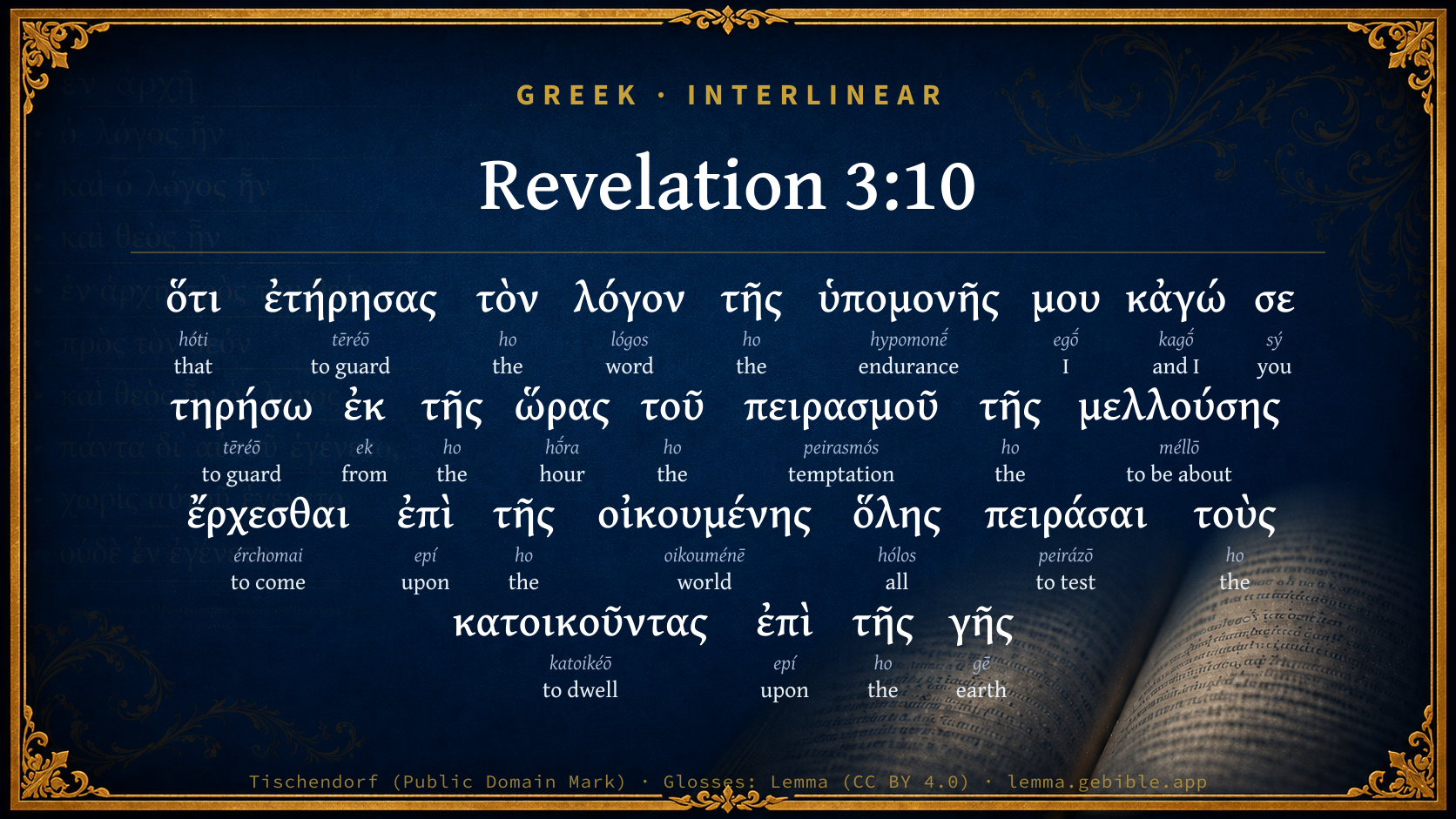
Greek (Tischendorf 8th ed.) Revelation 3:10 appears in the Greek New Testament. The text above is from the Tischendorf 8th edition. Each word links to its Strong’s number and a concise gloss. Click any word for its full Thayer’s Greek Lexicon entry.
Download image
Cite this verse

Revelation 3:10 (World English Bible). Public Domain. Lemma interlinear Bible study tool, https://lemma.gebible.app/v/revelation/3/10.

Show BibTeX & RIS
BibTeX
RIS
English Translation
Because you kept my command to endure, I also will keep you from the hour of testing, which is to come on the whole world, to test those who dwell on the earth.
World English Bible · Public Domain
Download a study sheet

One document with this verse’s original text, its word-by-word gloss line, the meaning frame, cross-references with their text, attributed commentary, and full source and license credits — printable, and it pastes into notes with its structure intact.

This verse Autodidact and up

Study sheet (.html) Plain text (.txt)

A passage Seminary Student

Up to 50 verses in one chapter. A passage sheet keeps up to 6 commentary sources and 12 cross-references per verse, in the order this page ranks them, and says so on the sheet whenever that leaves anything out. Ask for a single verse and you get the Autodidact verse sheet above.

Everything on this page stays free to read, with no account — the sheet is a download of what is already on screen, not access to it.

Want to remove ads? Support Godless Engineer
Compare translations 3

The same verse in 3 English versions, stacked beneath the original-language interlinear above. Click any original word for its lexicon entry.

Each is an independent rendering of the whole verse — the interlinear is not word-aligned to these translations.

Highlighted words mark where these versions differ — a whole-verse word diff, not a word-by-word alignment.

  • World English Bible Public Domain
    Because you kept my command to endure, I also will keep you from the hour of testing, which is to come on the whole world, to test those who dwell on the earth.
  • King James Version Public Domain
    Because thou hast kept the word of my patience, I also will keep thee from the hour of temptation, which shall come upon all the world, to try them that dwell upon the earth.
  • unfoldingWord Literal Text CC BY-SA 4.0
    Because you have kept my word of endurance, I will also keep you from the hour of testing being about to come upon the whole world to test the ones living on the earth.

unfoldingWord Literal Text — © unfoldingWord, licensed CC BY-SA 4.0. Word-aligned USFM3 via Door43 (git.door43.org/unfoldingWord/en_ult).

Versions to compare (up to 4)

3 of 4 selected

Show all 19 translations

Every available English version of this verse, each an independent rendering of the whole verse.

  • World English Bible Public Domain
    Because you kept my command to endure, I also will keep you from the hour of testing, which is to come on the whole world, to test those who dwell on the earth.
  • Berean Standard Bible Public Domain
    Because you have kept My command to persevere, I will also keep you from the hour of testing that is about to come upon the whole world, to test those who dwell on the earth.
  • Majority Standard Bible Public Domain
    Because you have kept My command to persevere, I will also keep you from the hour of testing that is about to come upon the whole world, to test those who dwell on the earth.
  • King James Version Public Domain
    Because thou hast kept the word of my patience, I also will keep thee from the hour of temptation, which shall come upon all the world, to try them that dwell upon the earth.
  • American Standard Version (1901) Public Domain
    Because thou didst keep the word of my patience, I also will keep thee from the hour of trial, that `hour' which is to come upon the whole world, to try them that dwell upon the earth.
  • Revised Version (1885) Public Domain
    Because thou didst keep the word of my patience, I also will keep thee from the hour of trial, that hour which is to come upon the whole world, to try them that dwell upon the earth.
  • Geneva Bible (1599) Public Domain
    Because thou hast kept the woorde of my patience, therefore I wil deliuer thee from the houre of tentation, which will come vpon all the world, to trie them that dwell vpon the earth.
  • Douay-Rheims (1899) Public Domain
    Because thou hast kept the word of my patience, I will also keep thee from the hour of the temptation, which shall come upon the whole world to try them that dwell upon the earth.
  • Young's Literal Translation Public Domain
    `Because thou didst keep the word of my endurance, I also will keep thee from the hour of the trial that is about to come upon all the world, to try those dwelling upon the earth.
  • Literal Standard Version CC BY-SA 4.0
    Because you kept the word of My endurance, I also will keep you from the hour of the trial that is about to come on all the world, to try those dwelling on the earth.
  • Unlocked Literal Bible CC BY-SA 4.0
    Since you have kept my command to endure patiently, I will also keep you from the hour of testing that is coming on the whole world, to test those who live on the earth.
  • unfoldingWord Literal Text CC BY-SA 4.0
    Because you have kept my word of endurance, I will also keep you from the hour of testing being about to come upon the whole world to test the ones living on the earth.
  • Darby Bible Public Domain
    Because thou hast kept the word of my patience, *I* also will keep thee out of the hour of trial, which is about to come upon the whole habitable world, to try them that dwell upon the earth.
  • World Messianic Bible Public Domain
    Because you kept my command to endure, I also will keep you from the hour of testing which is to come on the whole world, to test those who dwell on the earth.
  • Webster's Bible Public Domain
    Because thou hast kept the word of my patience, I also will keep thee from the hour of temptation, which shall come upon all the world, to try them that dwell upon the earth.
  • Free Bible Version CC BY-SA 4.0
    Because you have persevered as I told you to, I will take care of you during the testing time that is coming on the whole world when those who live on the earth will be on trial.
  • Bible in Basic English Public Domain
    Because you have kept my word in quiet strength, I will keep you from the hour of testing which is coming on all the world, to put to the test those who are on earth.
  • Text-Critical English NT CC BY 4.0
    Because yoʋ have kept my command to persevere, I will keep yoʋ from the hour of trial that is about to come upon the whole world to test those who dwell on the earth.
  • Tyndale New Testament (1534) Public Domain
    Because thou hast kept the wordes of my paciece therfore I will kepe the from the houre of temptacion which will come upo all the worlde to tempte them that dwell vpon the erth.

Literal Standard Version (2020), Covenant Press — licensed CC BY-SA 4.0. Text via the HelloAO Bible API (eBible.org). Unlocked Literal Bible (unfoldingWord) — licensed CC BY-SA 4.0. Text via the HelloAO Bible API (eBible.org). unfoldingWord Literal Text — © unfoldingWord, licensed CC BY-SA 4.0. Word-aligned USFM3 via Door43 (git.door43.org/unfoldingWord/en_ult). Free Bible Version, Dr. Jonathan Gallagher — licensed CC BY-SA 4.0. Text via the HelloAO Bible API (eBible.org).

Word by word

More ways to search: Search by grammar → Find every occurrence → Compare this word →

Practice this passage: Drill this verse → Learn its vocabulary →

οἰκουμένης
oikouménē
G3625
“world”
Noun, Genitive, Singular, Feminine
Part of Speech
Noun
Case
Genitive
Number
Singular
Gender
Feminine
Full Thayer's Definition

Origin: feminine participle present passive of G3611 (as noun, by implication of G1093 )

TDNT: 07:37,7

1. the inhabited earth a. the portion of the earth inhabited by the Greeks, in distinction from the lands of the barbarians b. the Roman empire, all the subjects of the empire c. the whole inhabited earth, the world d. the inhabitants of the earth, men 2. the universe, the world
  1. ὅτι hóti G3754 “that” Conjunction
  2. ἐτήρησας tēréō G5083 “to guard” Verb, Aorist, Active, Indicative, 2nd person, Singular
  3. τὸν ho G3588 “the” Article, Accusative, Singular, Masculine
  4. λόγον lógos G3056 “word” Noun, Accusative, Singular, Masculine
  5. τῆς ho G3588 “the” Article, Genitive, Singular, Feminine
  6. ὑπομονῆς hypomonḗ G5281 “endurance” Noun, Genitive, Singular, Feminine
  7. μου egṓ G1473 “I” Personal pronoun, 1st person, Genitive, Singular
  8. κἀγώ kagṓ G2504 “and I” Personal pronoun, 1st person, Nominative, Singular, Aramaic form
  9. σε sý G4771 “you” Personal pronoun, 2nd person, Accusative, Singular
  10. τηρήσω tēréō G5083 “to guard” Verb, Future, Active, Indicative, 1st person, Singular
  11. ἐκ ek G1537 “from” Preposition
  12. τῆς ho G3588 “the” Article, Genitive, Singular, Feminine
  13. ὥρας hṓra G5610 “hour” Noun, Genitive, Singular, Feminine
  14. τοῦ ho G3588 “the” Article, Genitive, Singular, Masculine
  15. πειρασμοῦ peirasmós G3986 “temptation” Noun, Genitive, Singular, Masculine
  16. τῆς ho G3588 “the” Article, Genitive, Singular, Feminine
  17. μελλούσης méllō G3195 “to be about” Verb, Present, Active, Participle, Genitive, Singular, Feminine
  18. ἔρχεσθαι érchomai G2064 “to come” Verb, Present, Middle or Passive deponent, Infinitive
  19. ἐπὶ epí G1909 “upon” Preposition
  20. τῆς ho G3588 “the” Article, Genitive, Singular, Feminine
  21. ὅλης hólos G3650 “all” Adjective, Genitive, Singular, Feminine
  22. πειράσαι peirázō G3985 “to test” Verb, Aorist, Active, Infinitive
  23. τοὺς ho G3588 “the” Article, Accusative, Plural, Masculine
  24. κατοικοῦντας katoikéō G2730 “to dwell” Verb, Present, Active, Participle, Accusative, Plural, Masculine
  25. ἐπὶ epí G1909 “upon” Preposition
  26. τῆς ho G3588 “the” Article, Genitive, Singular, Feminine
  27. γῆς gē G1093 “earth” Noun, Genitive, Singular, Feminine

About this verse

These counts appear in no published source. They are computed here, from the morphology-tagged text and Lemma’s own curated glosses. What Lemma adds →

28
words
19
distinct lemmas
Revelation
section

Notable vocabulary

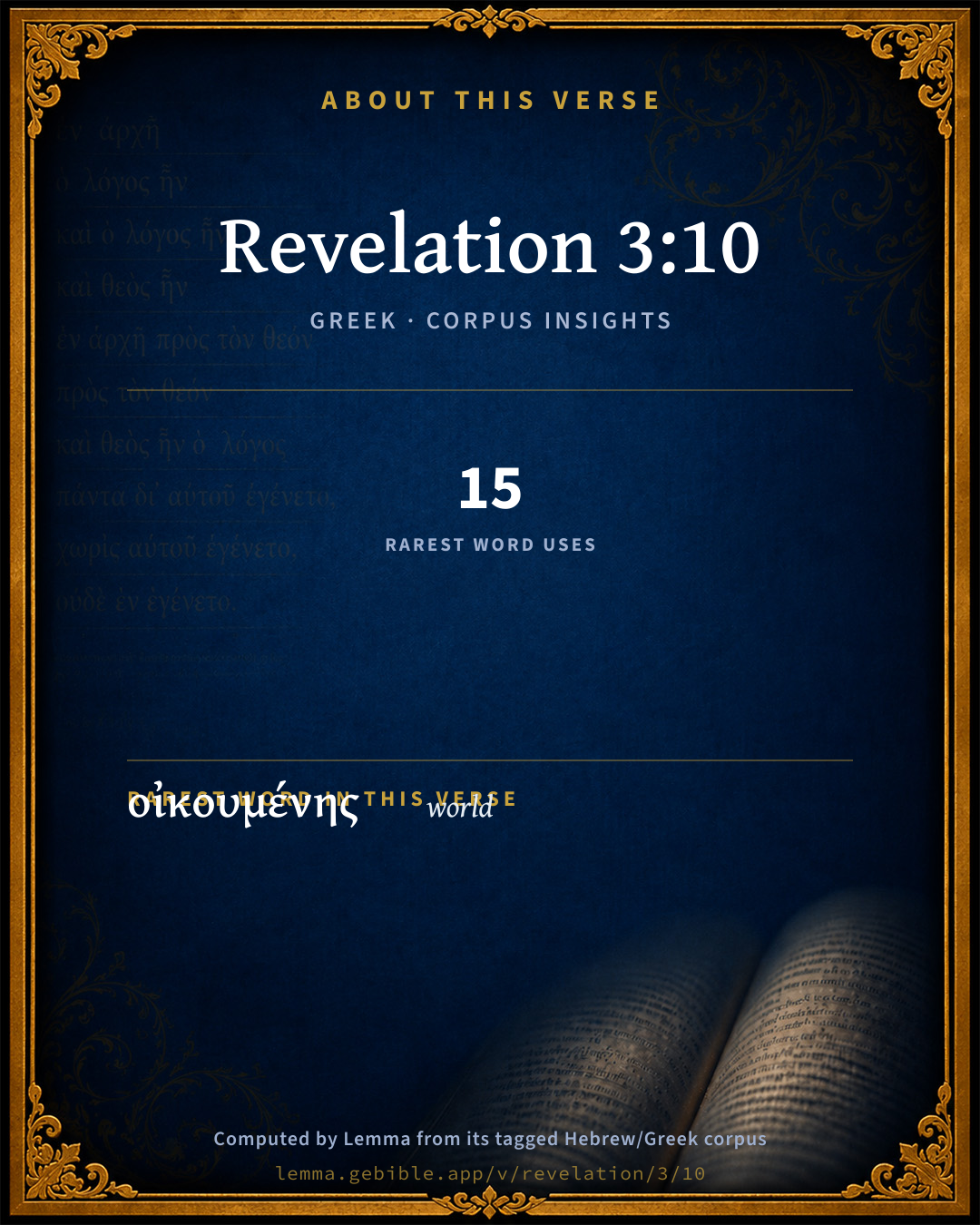
The rarest word here is οἰκουμένης world G3625 — appearing just 15 times in the whole Greek New Testament.

Shared distinctive vocabulary

οἰκουμένης world G3625 occurs in 15 verses of the Greek New Testament. Also found in:

Repetition

Words recur within this verse:

  • ἐτήρησας to guard G5083 ×2
  • ἐπὶ upon G1909 ×2
  • τὸν the G3588 ×8

Cross-references

20

Topical passages linked to Revelation 3:10 in the Treasury of Scripture Knowledge — connected by theme and wording, ordered by reader-vote popularity; previews shown in the World English Bible.

  • 2 Peter 2:9 the Lord knows how to deliver the godly out of temptation and to keep the unrighteous under punishment for the day of judgment;
  • Revelation 14:12 Here is the patience of the saints, those who keep the commandments of God, and the faith of Jesus."
  • Daniel 12:10 Many shall purify themselves, and make themselves white, and be refined; but the wicked shall do wickedly; and none of the wicked shall understand; but those who are wise shall understand.
  • Zechariah 13:9 I will bring the third part into the fire, And will refine them as silver is refined, And will test them like gold is tested. They will call on my name, and I will hear them. I will say, 'It is my people;' And they will say, 'Yahweh is my God.'"
  • 1 Corinthians 10:13 No temptation has taken you except what is common to man. God is faithful, who will not allow you to be tempted above what you are able, but will with the temptation also make the way of escape, that you may be able to endure it.
  • Revelation 2:10 Don't be afraid of the things which you are about to suffer. Behold, the devil is about to throw some of you into prison, that you may be tested; and you will have oppression for ten days. Be faithful to death, and I will give you the crown of life.
  • 1 Peter 4:12 Beloved, don't be astonished at the fiery trial which has come upon you, to test you, as though a strange thing happened to you.
  • Matthew 6:13 Bring us not into temptation, but deliver us from the evil one. For yours is the Kingdom, the power, and the glory forever. Amen.'
  • Revelation 1:9 I John, your brother and partner with you in oppression, Kingdom, and perseverance in Christ Jesus, was on the isle that is called Patmos because of God's Word and the testimony of Jesus Christ.
  • Revelation 13:10 If anyone has captivity, he will go. If anyone is with the sword, he must be killed. Here is the endurance and the faith of the saints.
  • Isaiah 24:17 Fear, and the pit, and the snare, are on you, O inhabitant of the earth.
  • Ephesians 6:13 Therefore, put on the whole armor of God, that you may be able to withstand in the evil day, and, having done all, to stand.
  • Revelation 8:13 I saw, and I heard an eagle, flying in mid heaven, saying with a loud voice, "Woe! Woe! Woe for those who dwell on the earth, because of the other voices of the trumpets of the three angels, who are yet to sound!"
  • Revelation 6:10 They cried with a loud voice, saying, "How long, Master, the holy and true, until you judge and avenge our blood on those who dwell on the earth?"
  • Matthew 24:14 This Gospel of the Kingdom will be preached in the whole world for a testimony to all the nations, and then the end will come.
  • Matthew 26:41 Watch and pray, that you don't enter into temptation. The spirit indeed is willing, but the flesh is weak."
  • Revelation 13:8 All who dwell on the earth will worship him, everyone whose name has not been written from the foundation of the world in the book of life of the Lamb who has been killed.
  • Revelation 13:14 He deceives my own people who dwell on the earth because of the signs he was granted to do in front of the beast; saying to those who dwell on the earth, that they should make an image to the beast who had the sword wound and lived.
  • Revelation 17:8 The beast that you saw was, and is not; and is about to come up out of the abyss and to go into destruction. Those who dwell on the earth and whose names have not been written in the book of life from the foundation of the world will marvel when they see that the beast was, and is not, and shall be present.
  • Romans 1:8 First, I thank my God through Jesus Christ for all of you, that your faith is proclaimed throughout the whole world.

Cross-references courtesy of OpenBible.info (CC BY 4.0).

Commentary

Notes on Revelation 3:10 from classic Christian and Jewish commentators (each source and its license shown beneath its notes). The classic Christian expositions comment on the surrounding passage and are grouped to its opening verse, so a note may address several verses; the Jewish commentaries on the Tanakh (Rashi and others) are per-verse, so they appear only where the commentator wrote on this verse.

Lemma curates 59 commentaries, every one of them public domain or Creative Commons licensed, each selected and text-cleaned for this edition rather than reprinted as found. About our sources →

MacLaren's Expositions of Holy Scripture

Alexander MacLaren

Revelation

KEEPING AND KEPT

Rev 3:10.

There are only two of the seven churches which receive no censure or rebuke from Jesus Christ; and of these two - viz., the churches of Smyrna and Philadelphia - the former receives but little praise though much sympathy. This church at Philadelphia stands alone in the abundance and unalloyed character of the eulogium which Christ passes upon it. He doles out His praise with a liberal hand, and nothing delights Him more than when He can commend even our imperfect work. He does not wait for our performances to reach the point of absolute sinlessness before He approves them. Do you think that a father or a mother, when its child was trying to please him or her, would be at all likely to say, ‘Your gift is worth very little. I could buy a far better one in a shop’? And do you think that Jesus Christ’s love and delight in the service of His children are less generous than ours? Surely not.

So here we are not to suppose that these good souls in Philadelphia lived angelic lives of unbroken holiness because Jesus Christ has nothing but praise for them. Rather we are to learn the great thought that, in all our poor, stained service, He recognizes the central motive and main drift, and, accepting these, is glad when He can commend. ‘Thou hast kept the word of My patience,’ and, with a beautiful reciprocity, ‘I will keep those that keep My word from’ and ‘in the hour of temptation.’

I. Now notice, in the first place, the thing kept.

That is a remarkable phrase ‘the word of My patience.’ A verse or two before, our Lord had said to the same church, evidently speaking about the same thing in them, ‘Thou hast a little strength, and hast kept My word.’ This expression, ‘the word of My patience,’ seems to be best understood in the same general way as that other which precedes it, and upon which it is a commentary and an explanation. It refers, not to individual commandments to patience, but to the entire gospel message, the general whole of ‘the Word of Jesus Christ’ communicated therein to men. That is a profound and beautiful way of characterizing the sum of the revelation of God in Christ as ‘the word of His patience,’ and is one which yields ample reward to meditative thought.

The whole gospel, then, is so named, inasmuch as it all records the patience which Christ exercised.

What does the New Testament mean by ‘patience’? Not merely endurance, although, of course, that is included, but endurance of such a sort as will secure persistence in work, in spite of all the opposition and sufferings which may come in the way. The world’s patience simply means, ‘Pour on, I will endure.’ The New Testament patience has in it the idea of perseverance as well as of endurance, and means, not only that we bow to the pain or the sorrow, but that nothing in sorrow, nothing in trial, nothing in temptation, nothing in antagonism, has the smallest power to divert us from doing what we know to be right. The man who will reach his hand through the smoke of hell to lay hold of plain duty is the patient man of the New Testament. ‘Though there were as many devils in Worms as there are tiles on the housetops, I will go in.’ That speech of Luther’s, though uttered with a little too much energy, expressed the true idea of Christian patience. High above the stormy and somewhat rough determination of the servant towers, calm and gentle, and therefore stronger, the ‘patience’ of the Lord, and the whole story of His life on earth may well be regarded, from this point of view, as the record of His unfaltering and meek continuance in obedience to the Father’s will, in the face of opposition and suffering. His life, to use a secular word, was the most ‘heroic’ ever lived. Before Him was the thing to be done, and between Him and it were massed such battalions of antagonism and evil as never were mustered in opposition to any other saintly soul upon earth. And through all He went persistently, with ‘His face like a flint,’ of set purpose to do the work for which He came into the world.

But there was no fierce antagonism about Jesus Christ’s patience. His persistence, in spite of all obstacles and opposition, was the persistence of meekness, the heroism of gentleness. Patience in the lower sense of quiet endurance, as well as in the higher, of heroic scorn of all that opposition could do to hinder the realization of the Father’s will, is deeply stamped upon His life. We think of His gentleness, of His meekness, of His humility, of all the softer, and, as men insolently call them, the more feminine virtues in Christ’s character. But I do not know that we often enough think of what men, with equal insolence and shortsightedness, call the masculine virtues of which, too, He is the great Exemplar, that magnificent, unparalleled, and perfectly quiet and unostentatious invincibility of will and heroism of settled resolve with which He pressed towards the mark, though the mark was a cross.

This is the theme of the gospel story, and this Apocalypse of a gentle Christ, whose gentleness was the gentleness of inflexible strength, this story, or word ‘of My patience,’ is that which we are to lay upon our hearts. For that name is fitly applied to the gospel, inasmuch as it enjoins upon every one of us in our degree, and in regard of the far easier tasks and slighter antagonisms with which we have to do and \ which we have to meet, to make Christ’s persistence the model for our lives. So the whole morality of Christianity may almost be gathered up into this one expression, which sets forth at once the law and the supreme motive for fulfilling it. Unwelcome and hard tasks are made easy and delightsome when we hear Jesus say, ‘The record of My patience is thy pattern and thy power. Be like Me, and thou shalt be perfect and entire, wanting nothing.’

II. Notice, next, the keepers of this word.

The metaphor represents to us the action of one who, possessing some valuable thing, puts it into some safe place, takes great care of it, carries it very near to the heart, perhaps within the robe, and watches tenderly and jealously over it. So ‘thou hast kept the word of My patience.’

There are two ways by which Christians are to do that; the one is by inwardly cherishing the word and the other by outwardly obeying it. There should be both the inward counting it dear and precious, and treasuring it in mind and heart, as the Psalmist says,

‘Thy word have I hid in my heart, that I should not offend against Thee,’ and also the regulation of conduct which we more usually regard as keeping the commandment.

Let me say a word, and it shall only be a word, about each of these two things. I am afraid that the plain practical duty of reading their Bibles is getting to be a much neglected duty amongst professing Christian people. I do not know how you are to keep the words of Christ’s patience in your hearts and minds if you do not read them. I am afraid that most Christian congregations nowadays do their systematic and prayerful study of the New Testament by proxy, and expect their ministers to read the Bible for them and to tell them what is there. A mother will sometimes take a morsel of her child’s food into her mouth, and half masticate it first before she passes it to the little gums. I am afraid that newspapers, and circulating libraries, and magazines, and little religious books - very good in their way, but secondary and subordinate - have taken the place that our fathers used to have filled by honest reading of God’s Word. And that is one of the reasons, and I believe it is a very large part of the reason, why so many professing Christians do not come up to this standard; and instead of ‘running with patience the race that is set before them,’ walk in an extraordinarily leisurely fashion, by fits and starts, and sometimes with long intervals, in which they sit still on the road, and are not a mile farther at a year’s end than they were when it began. There never was, and there never will be, vigorous Christian life unless there be an honest and habitual study of God’s Word. There is no short-cut by which Christians can reach the end of the race. Foremost among the methods by which their eyes are enlightened and their hearts rejoiced are application to the eyes of their understanding of that eye-salve, and the hiding in their hearts of that sweet solace and fountain of gladness, the Word of Christ’s patience, the revelation of God’s will. The trees whose roots are laved and branches freshened by that river have leaves that never wither, and all their blossoms set.

But the word is kept by continual obedience in action as well as by inward treasuring. Obviously the inward must precede the outward. Unless we can say with the Psalmist, ‘Thy word have I hid in my heart,’ we shall not be able to say with him, ‘I have not hid Thy righteousness within my heart.’ If the Word of the Lord is to sound like a rousing trumpet-blast from our lives, it must first be heard in secret by us, and its music linger in our listening hearts.

We need this brave persistence in daily life if we are not to fail wholly. Very instructive in this aspect are many of the Scripture allusions to ‘patience’ as essential to the various virtues and blessednesses of Christian life.

For example, In your patience ye shall win your souls.’ Only he who presses right on, in spite of all that externals can do to hinder him from realizing his conviction of duty, is the lord of his own spirit. All others are slaves to something or some one. By persistence in the paths of Christian service, no matter what around or within us may rise up to hinder us, and by such persistence only, do we become masters of ourselves. Many a man has to walk, as in the old days of ordeal by fire, over a road strewn with hot ploughshares, to get to the place where God will have him to be. And if he does not flinch, though he may reach the goal with scorched feet, he will reach it with a quiet heart, and possess himself, whatever he may lose.

Again, the Lord Himself says to us, ‘These are those which bring forth fruit with patience.’ There is no growth of Christian character, no flowering of Christian conduct, no setting of incipient virtues into the mature fruit of settled habit, without this persistent adherence in the face of all antagonism, to the dictates of conscience and the commandment of Christ. It is the condition of bringing forth fruit, some thirty, some sixty, and some a hundredfold.

Again the Scripture says, demanding this same persistence, gentle abstinence, and sanctified stiffneckedness, ‘Run with perseverance the race that is set before you.’ There is no progress in the Christian course, no accomplishing the stadia through which we have to pass, except there be this dogged keeping at what we know to be duty, in spite of all the reluctance of trembling limbs, and the cowardice of our poor hearts.

III. We have here Christ keeping the keepers of His word.

‘Because thou hast kept the word of My patience I will keep thee from,’ and in, ‘the hour of temptation.’ There is a beautiful reciprocity, as I said. Christ will do for us as we have done with His word. Christ still does in heaven what He did upon earth. In the great high priest’s prayer recorded by the evangelist who was also the amanuensis of these letters from heaven, Jesus said, ‘I kept them in Thy name which Thou hast given Me, and I guarded them, and not one of them perished.’ And now, speaking from heaven, He continues His earthly guardianship, and bids us trust that, just as when with His followers here, He sheltered them as a parent bird does its young, fluttering round them, bearing them up on its wings, and drew them within the sacred circle of His sweet, warm, strong, impregnable protection, so, if we keep the word of His patience, cherishing the story of His life in our hearts, and humbly seeking to mould our lives after its sweet and strong beauty, He will keep us in the midst of, and also from, the hour of temptation. The Christ in heaven is as near each trembling heart and feeble foot, to defend and to uphold, as was the Christ upon earth.

He does not promise to keep us at a distance from temptation, so as that we shall not have to face it, but from means, as any that can look at the original will see, that He will save us out of it, we having previously been in it, so as that ‘the hour of temptation’ shall not be the hour of falling. Yes! the man whose heart is filled with the story of Christ’s patience, and who is seeking to keep that word, will walk in the midst of the fire-damp of this mine that we live in, as with a safety lamp in his hand, and there will be no explosion. If we keep our hearts in the love of God, and in that great word of Christ’s patience, the gunpowder in our nature will be wetted, and when a spark falls upon it there will be no flash. Outward circumstances will not be emptied of their power to tempt, but our susceptibility will be deadened in proportion as we keep the word of the patience of the patient Christ. The lustre of earthly brightnesses will have no glory by reason of the glory that excelleth, and when set by the side of heavenly gifts will show black against their radiance, as would electric light between the eye and the sun.

It is great to wrestle with temptation and fling it, but it is greater to be so strong that it never grasps us.

It is great to be victor over passions and lusts, and to put our heel upon them and suppress them, but it is better to be so near the Master that they have crouched before Him, and ‘the lion eats straw like the ox.’

To such blessed state we attain if, and only if, we draw near to Him and in daily communion with Him secure that the secret of His patient continuance in well-doing is repeated in us. So we shall be lifted above temptation. That great word of His patience, and the spirit which goes with the word, will be for us like the cotton wool that chemists put into the flask which they wish to seal hermetically from the approach of microscopic germs of corruption. It will let all the air through, but it will keep all the infinitesimal animated points of poison out. It will filter the most polluted atmosphere, and bring it to our lungs clean and clear. ‘If thou keep the word of My patience I will keep thee from the hour of temptation.’

Alexander MacLaren, Expositions of Holy Scripture (1904–1910) — public domain. Text from a community e-Sword module.

Tyndale Open Study Notes

Tyndale Open Resources

3:10 Jesus will protect Christians who persevere through trials (cp. Isa 43:2-4; John 10:27-28; 1 Cor 10:13; Heb 6:18-19). • The great time of testing refers to the end times, when the world experiences tribulation.

Tyndale Open Study Notes — © Tyndale Open Resources, licensed CC BY-SA 4.0. Text via the HelloAO Bible API.

Bengel's Gnomon

Johann Albrecht Bengel

Rev 3:10. [49] ΤΟῪς ΚΑΤΟΙΚΟῦΝΤΑς ἘΠῚ Τῆς Γῆς) Thus the Septuagint often render, when in the Hebrew ישבי הארץ is found: Isa 26:21, etc. But the word ΣΚΗΝΟῦΝ is used of the inhabitants of heaven, ch. Rev 12:12.

[49] σὲ, thee) A most gracious exception in so great a temptation.—V. g.

Bengel's Gnomon of the New Testament — English translation (T&T Clark, Edinburgh, 1860) — public domain. Text from a community e-Sword module.

Meyer's Critical & Exegetical Commentary

Heinrich August Wilhelm Meyer

Rev_3:10. ὅτι ἐτήρησας

κἀγώ σε τηρήσω. The form of the antanaclasis[1453] corresponds with the inner relation between the performance of the church, and the reward on the Lords part; but even the performance of the church depends entirely upon the Lords grace, as the ΛΌΓΟς Τ. ὙΠΟΜ. itself, which the church has kept, is full of divine power, nourishes and supports the faith, fidelity, patience, and hope of the church, and thus qualifies the same for victory.

ΤῸΝ ΛΌΓΟΝ Τῆς ὙΠΟΜΟΝῆς ΜΟΥ. The gen. ὙΠΟΜΟΝῆς designates the ΛΌΓΟς according to its peculiar nature, as it depends upon its contents;[1454] the pronoun ΜΟΥ belongs not only to Τῆς ὙΠΟΜ.,[1455] but[1456] to the whole conception Τ. ΛΟΓ. Τ. ὙΠΟΜ.[1457] The form of statement in Rev_1:9 is therefore, at all events, a different one.[1458] Consequently Τ. ΛΟΓ. Τ. ὙΠΟΜ. ΜΟΥ cannot be: the word concerning Christs patience, concerning the sufferings of Christ patiently endured for us, or the word of constancy in Christs faith;[1459] or the word which makes its demands partly according to its contents and spirit,[1460] and partly by virtue of the duty of confession and steadfastness in following, as it belongs to me and mine;[1461] also not: my patience, i. e., the specifically Christian, expressly required by the Lord himself, and enjoined as a preservative against the judgments threatened against the world.[1462] The vacillation and juncture of different ideas by all interpreters who wish to refer the μου only to τ. ὑπομ. reveals the unnaturalness of the combination. The λόγος τῆς ὑπομονῆς of the Lord dare not, however, be explained: the word which among other commandments contains that of patience also, an explanation which is incorrectly ascribed to Grot., who, as many others vacillating concerning the relation of the μου, says at one time: My precept concerning patience, and then, again, that the patience of Christ signifies that which Christ has enjoined. The whole word of God as a word of patience rather appears to be the view of the Revelation in general, and of our epistle in particular, because with respect to troubles unavoidable to believers it gives and demands steadfast, faithful, and hopeful patience, i.e., the virtue which alone can lead us from all troubles to glory.[1463] With respect to the already present and still future troubles, every thing to the believer turns upon the fact that he overcomes. This he can attain only through the ὑπομονή, to which the word of his Lord points him. Thus the writer of the Apoc. can from his point of vision regard the whole word of Christ as a λόγον τῆς ὑπομονῆς with the same right as, e.g., Paul, the preacher of righteousness, alone by faith in the Crucified, represents the whole gospel as the λόγος τοῦ σταυροῦ[1464]

In the words κἀγώ σε τηρήσω ἐκ τῆς ὥρας, κ.τ.λ., the church at Philadelphia is not promised that it shall be preserved from the hour of trial, i.e., that it shall not meet with sufferings full of trial,[1465] but in accordance with the presentation of the Apoc., that the troubles before the coming of the Lord will befall all believers, who of course are sealed,[1466] lest by the temptation in the troubles they may fall;[1467] and in accordance with the corresponding expression τηρ. ἐκ,[1468] in distinction from ΤΗΡ. ἈΠΌ,[1469] the church at Philadelphia, since it has already maintained victorious patience, is also to be delivered by his confirming grace from the universal distress impending before the coming of the Lord.[1470]

The ὭΡΑ ΤΟῦ ΠΕΙΡΑΣΜΟῦ, Κ.Τ.Λ., i.e., the precise period wherein the temptation is to occur,[1471] refers to no persecution whatever proceeding from the Roman emperors,neither that of Nero,[1472] nor some one after Domitian,[1473] possibly under Trajan,[1474]also not, as Primas and Beda[1475] arbitrarily agree, to sufferings occasioned by antichrist; but the idea, here not more minutely defined, is to be referred, according to the further development of the Apoc., to all the afflictions which, before the personal coming of the Lord,[1476] are to burst upon believers;[1477] the punishments impending by Gods wrath only over unbelievers before the appearing of the Lord are not meant.[1478]

The idea of the πειρασμός and πειράσαι[1479] has its justification because, on the one hand, to believers the danger of a fall into such suffering is present,[1480]and hence there go with it the promise σὲ τηρήσω, the command κράτει, κ.τ.λ., Rev_3:11, and the pledge to the victor, Rev_3:12,but, on the other hand, to unbelievers such suffering must actually be a temptation,[1481] and that, too, of such kind as that because of their impenitent unbelief they will ever fall by it the deeper, and their hostility to what is holy be always the more revealed by despair and blasphemy.[1482]

ἐπὶ τὴς οἰκουμένης ὅλης. The remark that hereby the Roman empire is designated[1483] is correct only so far as in Johns historical horizon the whole world appears comprehended in the Roman empire. Yet by this (erroneous) limitation, the prophetic truth remains untouched, that the hour of temptation is to come to the actual οἰκουμένη ὅλη, as certainly as the Lord himself is to appear as absolutely Judge of all.

πειράσαι τοὺς κατοικοῦντας ἐπὶ τῆς γῆς. Those dwelling on the earth are, according to the constant mode of expression in the Apoc.,[1484] the mass of men, in contradistinction to believers redeemed from all nations and tongues.[1485] The πειράσαι refers to them in so far only as they are not kept (σὲ τηρήσω).

[1453] Beng., etc.

[1454] Cf. Winer, p. 222.

[1455] Calov., Ew., De Wette, Hengstenb., etc.

[1456] Cf. Rev_13:3; Col_1:13; Heb_1:3.

[1457] Winer, p. 222. Obscure: Grot., Vitr., Eichh., Heinr., Ebrard.

[1458] Against Hengstenb., etc.

[1459] Calov.

[1460] As the word of the cross (1Co_1:18).

[1461] Vitr., who also paraphrases: They preserved the word of the Lords patience; i.e., the word of the Lord, which is a word of patience, because no one can with constancy profess the doctrine of the gospel, unless, at the same time, he fortify himself to bear with patience the afflictions accompanying the profession of Christianity. All Christians must bear the cross of Christ (Mat_16:24), i.e., θλῖψις; but θλῖψις works ὑπομονήν (Rom_5:3), so that the λογ. τῆς ὑπομον. is nothing else than the λογ. τοῦ σταυροῦ (1Co_1:18).

[1462] Luk_21:19; Luk_8:15; Mat_10:22; Mat_24:13. Hengstenb.

[1463] Cf. Rev_1:9; Mat_24:13.

[1464] Cf. 1Co_1:17 sqq., Rev_2:1.

[1465] Whereby either the church at Philadelphia alone, as constituting a special exception (Beng., Eichh., Ebrard), or certain afflictions (chs. 6, 8), in whose presence all believers are to remain approved (Rev_7:3 sqq.; De Wette; cf. Ewald, Züll.), are regarded.

[1466] The case is different in Rev_9:3, where they who are sealed are not touched by a plague immediately coming from the abyss.

[1467] Cf. Rev_7:3; Rev_7:14; Mat_24:22; Mat_24:24.

[1468] Joh_17:15. Cf. Rev_7:14 : ἐρχ. ἐκ τ. θλίψ.

[1469] Jam_1:27; Pro_7:5. Cf. 2Th_3:3.

[1470] Cf. Vitr., Hengstenb., Ew. ii., Volkm.

[1471] Cf. Rev_14:7; Rev_14:15.

[1472] Grot.

[1473] N. de Lyra.

[1474] Alcas., Pareus, etc.

[1475] Cf. Andr., Areth.

[1476] Cf. immediately afterwards Rev_3:11 : ἕρχομαι ταχύ.

[1477] Cf. ch. 6.

[1478] Cf. ch. 16.

[1479] Cf. Rev_2:10.

[1480] Cf. Mat_24:22; Mat_24:24.

[1481] Cf. Deu_4:34; Deu_7:19; Deu_29:3.

[1482] Rev_9:20. Cf. Rev_16:11; Rev_16:21; Hengstenb.

[1483] Cf. Luk_2:1; Grot., Vitr., Stern, etc.

[1484] Rev_6:10, Rev_11:10, Rev_13:8; Rev_13:14, etc. Cf. Act_4:26.

[1485] Cf. Rev_5:9.

Meyer — Critical and Exegetical Commentary on the New Testament — English translation by Peter Christie, edited by Frederick Crombie (T&T Clark, 1880) — public domain. Text from a community e-Sword module.

Expositor's Greek Testament

ed. W. Robertson Nicoll

Rev 3:10 . The position of μου shows that it belongs not to τὸν λόγον τῆς ὑπομονῆς as a whole, but to ὑπομονῆς (2Th 3:5 ). The precise sense therefore is not “my word about patience” ( i.e. , my counsel of patience as the supreme virtue of these latter days, so Weiss, Bousset, etc.), but “the word, or the preaching, of that patience which refers to me” ( i.e. , the patient endurance with which, amid present trials, Christ is to be served; so Alford, Spitta, Holtzm.). See Psa 38 (39), 8: καὶ νῦν τίς ἡ ὑπομονή μου ; οὐχὶ ὁ κύριος ; The second reason for praising the Philadelphian Christians is their loyal patience under persecution, as well as the loyal confession of Christ (Rev 3:8 ) which had possibly brought on that persecution. κἀγὼ κ . τ . λ . (“I in turn”; cf. similar connection in Joh 17:6-8 ), a reproduction of the saying preserved in Luk 21:36 . The imminent period τοῦ πειρασμοῦ refers to the broken days which, in eschatological schemes, were to herald messiah’s return. Later on, this period is specifically defined as a time of seduction to imperial worship ( cf. Rev 13:14-17 , Rev 7:2 , with Dan 7:1 , LXX). The Philadelphian Christians will not only triumph over the contempt and intrigues of their Jewish foes but also over the wider pagan trial (which is also a temptation), inasmuch as their devotion, already manifested in face of Jewish malice, will serve to carry them through the storm of Roman persecution. The reward of loyalty is in fact fresh power to be loyal on a higher level: “the wages of going on, and ever to be”. This seems better than to take the world-wide trial as the final attempt (Rev 8:13 , Rev 11:10 , etc.) to induce repentance in men or to punish them, from which the P. Christians ( cf. Rev 7:1-8 , and Ps. Sol. 13:4 10, 15:6, 7) would be exempt; but it is impossible from the grammar and difficult from the sense, to decide whether τηρεῖν ἐκ means successful endurance (pregnant sense as in Joh 17:15 ) or absolute immunity ( cf. 2Pe 2:9 ), safe emergence from the trial or escape from it entirely (thanks to the timely advent of Christ, Rev 3:11 ). Note the fine double sense of τηρεῖν : unsparing devotion is spared at least some forms of distress and disturbance. It is like Luther’s paradox that when a man learns to say with Christ, “The cross, the cross,” there is no cross. Rabbinic piety ( Sanh. 98 b) expected exemption from the tribulation of the latter days only for those who were absorbed in good works and in sacred studies.

The Expositor's Greek Testament, edited by W. Robertson Nicoll (1897–1910) — public domain. Text from a community e-Sword module.

Geneva Bible (1599)

Geneva Bible translators

Because thou hast been patient and constant, as I would my servants should be.

Geneva Bible (1599) marginal notes — public domain. Text via Bolls.life.

Jamieson, Fausset & Brown

Robert Jamieson, A. R. Fausset & David Brown

patience--"endurance." "The word of My endurance" is My Gospel word, which teaches patient endurance in expectation of my coming (Rev 1:9). My endurance is the endurance which I require, and which I practice. Christ Himself now endures, patiently waiting until the usurper be cast out, and all "His enemies be made His footstool." So, too, His Church, for the joy before her of sharing His coming kingdom, endures patiently. Hence, in Rev 3:11, follows, "Behold, I come quickly."

I also--The reward is in kind: "because thou didst keep," &c. "I also (on My side) will keep thee," &c.

from--Greek, "(so as to deliver thee) out of," not to exempt from temptation.

the hour of temptation--the appointed season of affliction and temptation (so in Deu 4:34 the plagues are called "the temptations of Egypt"), literally, "the temptation": the sore temptation which is coming on: the time of great tribulation before Christ's second coming.

to try them that dwell upon the earth--those who are of earth, earthy (Rev 8:13). "Dwell" implies that their home is earth, not heaven. All mankind, except the elect (Rev 13:8, Rev 13:14). The temptation brings out the fidelity of those kept by Christ and hardens the unbelieving reprobates (Rev 9:20-21; Rev 16:11, Rev 16:21). The particular persecutions which befell Philadelphia shortly after, were the earnest of the great last tribulation before Christ's coming, to which the Church's attention in all ages is directed.

Jamieson, Fausset & Brown — Commentary Critical and Explanatory on the Whole Bible (1871) — public domain (CC PDM 1.0). Text via the HelloAO Bible API.

Adam Clarke's Commentary

Verse 10. The word of my patience] The doctrine which has exposed you to so much trouble and persecution, and required so much patience and magnanimity to bear up under its attendant trials.

The hour of temptation] A time of sore and peculiar trial which might have proved too much for their strength. He who is faithful to the grace of God is often hidden from trials and difficulties which fall without mitigation on those who have been unfaithful in his covenant. Many understand by the hour of temptation the persecution under Trajan, which was greater and more extensive than the preceding ones under Nero and Domitian.

To try them] That is, such persecutions will be the means of trying and proving those who profess Christianity, and showing who were sound and thorough Christians and who were not.

Adam Clarke's Commentary on the Bible (1810–1826) — public domain. Text from a community e-Sword/MySword module.

Ellicott's Commentary for English Readers

(10) Because thou hast kept (better, didst keep) the word of my patience.—The one who keeps God’s word is kept. Such is “the benigna talio of the kingdom of God,” as Archbishop Trench calls it. The promise does not mean the being kept away from, but the being kept out from the tribulation. The head should be kept above the waters; they should not be ashamed, because they had kept the word of patience. It is through patience, as well as comfort of the Scripture that we have the hope which maketh not ashamed. (Comp. Rom_15:5, and Rev_3:3-5.)

A Bible Commentary for English Readers, edited by Charles John Ellicott (1878–1897) — public domain. Text from a community e-Sword module.

The Cambridge Bible for Schools and Colleges

gen. ed. J. J. S. Perowne

10. Because … I also] It would be possible, but hardly in accordance with the usage of this book, to connect this with what goes before, “that I have loved thee, because thou hast kept …, and I will keep thee from.…”

The Cambridge Bible for Schools and Colleges (gen. ed. J. J. S. Perowne; Cambridge University Press, 1878–1918) — public domain. Text from a community e-Sword module.

John Gill's Exposition

Behold, I come quickly,.... To bring on this hour of temptation on the reformed churches, which will be at the beginning of this period; to help and deliver, save and preserve the truly godly among them; to destroy antichrist, and introduce the latter day glory:

hold that fast which thou hast; either her grace in the exercise of it, as her faith, patience, &c. or rather the doctrines of the Gospel, and the ordinances of it, which she had received, as delivered by Christ and his apostles: and which she had held in the truth and purity of them, and is now exhorted to hold them fast, since this hour of temptation would be a trying time to her faith, patience, integrity, and constancy:

that no man take thy crown; not eternal happiness, called a crown of life, glory, and righteousness, and which was prepared for her, and promised to her, and would be certainly given her; nor was there any danger of another's taking it from her; not but that exhortations of this kind to the saints are necessary, with respect to that, to excite to diligence, care, and watchfulness; and are no ways contrary to their final perseverance, and certain salvation, but are means thereof: but either her honour for her faith and faithfulness, for her integrity, sincerity, and purity, is here meant; or the glorious things which were spoken of this church state, and to be accomplished in it, Psa 87:3; see Isa 60:1.

John Gill's Exposition of the Whole Bible (1746–1763) — public domain (CC PDM 1.0). Text via the HelloAO Bible API.

Trapp's Complete Commentary

John Trapp

10 Because thou hast kept the word of my patience, I also will keep thee from the hour of temptation, which shall come upon all the world, to try them that dwell upon the earth.

Ver. 10. The word of my patience] So called,

1. Because we must suffer for the truth of it.

2. Because, hid in the heart, it worketh patience.

I will keep thee] From the hurt, if not from the smart of it; from the common distraction, if not from the common destruction.

Which shall come upon all the world] So the Romans in their pride called their empire.

To try them that dwell] sc. By that sharp and sore persecution under Trajan the emperor.

John Trapp, A Commentary or Exposition upon All the Books of the Old and New Testament (1647–1656) — public domain. Text from a community e-Sword module.

Albert Barnes' Notes on the Bible

Because thou hast kept the word of my patience - My word commanding or enjoining patience; that is, thou hast manifested the patience which I require. They had shown this in the trials which they had experienced; he promises now, that in return he will keep them in the future trials that shall come upon the world. One of the highest rewards of patience in one trial is the grace that God gives us to bear another. The fact that we have been patient and submis sive may be regarded as proof that he will give us grace that we may be patient and submissive in the trials that are to come. God does not leave those who have shown that they will not leave him.

I also will keep thee - That is, I will so keep you that you shall not sink under the trials which will prove a severe temptation to many. This does not mean that they would be actually kept from calamity of all kinds, but that they would be kept from the temptation of apostasy in calamity. He would give them grace to bear up under trials with a Christian spirit, and in such a manner that their salvation should not be endangered.

From the hour of temptation - The season; the time; the period of temptation. You shall be no kept that what will prove to be a time of temptation to so many, shall not endanger your salvation. Though others fall, you shall not; though you may be afflicted with others, yet you shall have grace to sustain you.

Which shall come upon all the world - The phrase used here - “all the world” - may either denote the whole world; or the whole Roman empire; or a large district of country; or the land of Judaea. See the notes on Luk 2:1. Here, perhaps, all that is implied is, that the trial would be very extensive or general - so much so as to embrace the world, as the word was understood by those to whom the epistle was addressed. It need not be supposed that the whole world literally was included in it, or even all the Roman empire, but what was the world to them - the region which they would embrace in that term. If there were some far-spreading calamity in the country where they resided, it would probably be all that would be fairly embraced in the meaning of the word. It is not known to what trial the speaker refers. It may have been some form of persecution, or it may have been some calamity by disease, earthquake, or famine that was to occur. Tacitus (see Wetstein, in loco) mentions an earthquake that sank twelve cities in Asia Minor, in one night, by which, among others, Philadelphia was deeply affected; and ‘it is possible that there may have been reference here to that overwhelming calamity. But nothing can be determined with certainty in regard to this.

To try them that dwell upon the earth - To test their character. It would rather seem from this that the affliction was some form of persecution as adapted to test the fidelity of those who were affected by it. The persecutions in the Roman empire would furnish abundant occasions for such a trial.

Albert Barnes' Notes on the Bible (1834–1885) — public domain. Text from a community e-Sword/MySword module.

Matthew Poole's English Annotations

Because thou hast kept the word of my patience: the doctrine of the gospel is, unquestionably, the word here called the word of the Lord’s patience, because it was that word, that doctrine, which (as those times went) could not he adhered to and observed without much patience in those that adhered to it; both actively, waiting for the promises revealed in it, and passively, enduring all manner of trials and crosses. To keep this word, was to keep close not only to the matters of faith revealed in it, but to the duty imposed by it upon ministers and others in the preaching and propagating of the gospel, and all the duties of a holy life.

I also will keep thee from the hour of temptation, which shall come upon all the world; for this faithfulness God promises to keep the ministers of this church from those persecutions which raged elsewhere, and were further, in Trajan’s time, to come upon all Christians living under the Roman empire.

To try them that dwell upon the earth; to try those Christians that lived within that empire, how well they would adhere to Christ, and the profession of the gospel. This I take to be a more proper sense, than theirs who would interpret this hour of temptation of the day of judgment, which is never so called.

Matthew Poole's English Annotations on the Holy Bible (1683–1685) — public domain. Text from a community e-Sword/MySword module.

Whedon's Commentary on the Bible

Daniel D. Whedon

10. My patience—So Rev_1:9, “the patience of Jesus Christ,” (if that be an allowed reading,) namely, a patience which is his and his followers.

Hast kept… keep thee—The faithful work has its fitting reward; the keeper shall be kept.

Hour of temptation—The Greek word for temptation may mean the presentation of agreeable inducements to sin before one’s mind, in order to elicit sin; and so the devil tempts. Or it may mean the presentation of a test or trial, adverse or agreeable, to allow the will or character to display itself. So every fearful crisis brought upon us is a temptation. And especially that great crisis which precedes the great white throne, (Rev_20:11,) is a test, a trial, of the soul. The trial here described is mundane—upon all the world—and not in one nation or kingdom: is not merely a persecution in Asia Minor, but over the entire world, and upon all that dwell upon the earth. This is the same universality as in Rev_1:7. The rich promise to the faithful Philadelphian is, that in that great ordeal he shall be kept from terror and despair.

Daniel D. Whedon (gen. ed.), Commentary on the Old and New Testaments (1874–1909) — public domain. Text from a community e-Sword module.

The Pulpit Commentary

Because thou didst keep (see notes on Rev_1:3 and Rev_2:26) the word of my patience, I also will keep thee. This is the Divine lex talionis. "Forgive, and ye shall be forgiven; give, and it shall be given unto you"; (Luk_6:37, Luk_6:38) keep, and ye shall be kept. Compare "I know mine own, and mine own know me". (Joh_10:14) "The word of my patience" may mean either the gospel, which everywhere teaches patience, or those sayings of Christ in which he specially inculcates this duty. (Luk_8:15 Luk_21:19 Mat_10:22 Mat_24:13) In "I also will keep thee" the two pronouns are in emphatic contrast. From the hour of temptation. The phrase, threin ek , occurs elsewhere in the New Testament only in Joh_17:15 (comp. Jam_1:27, where we have threin apo , and 2Th_3:3, fulassein apo). It is not certain that the common explanation, that apo implies exemption from trial, while ek implies preservation under trial, holds good. "Temptation" (peirasmov) generally has no article in the New Testament. (Mat_6:13 Mat_26:41 Mar_14:38, etc.; comp. especially Luk_8:13) Here it has the article, as if "the temptation" were to be of no ordinary kind. The word does not occur elsewhere in St. John"s writings. In order to bring substantive and verb into harmony, the Revised Version renders peirasmov "trial," the word for "to try" being peirasai . "World" here is not the kosmov , "the ordered universe", (Rev_11:15 Rev_13:8 Rev_17:8) but the oikumenh , "the inhabited earth". (Rev_12:9 Rev_16:14) The phrase, "to dwell upon the earth," katoikein epi thv ghv , is peculiar to the Apocalypse. (Rev_6:10 Rev_8:13 Rev_11:10 Rev_13:8, Rev_13:14) "The hour of trial" seems to be that which Christ had foretold should precede his coming, especially the triumph of antichrist. Hence the declaration in the next verse.

The Pulpit Commentary (1880–1919), ed. H.D.M. Spence-Jones & Joseph S. Exell — public domain. Text from a community e-Sword module.

John Wesley's Explanatory Notes

Because thou hast kept the word of my patience - The word of Christ is indeed a word of patience. I also will keep thee - O happy exemption from that spreading calamity! From the hour of temptation - So that thou shalt not enter into temptation; but it shall pass over thee. The hour denotes the short time of its continuance; that is, at any one place. At every one it was very sharp, though short; wherein the great tempter was not idle, chap. ii, 10. Which hour shall come upon the whole earth - The whole Roman empire. It went over the Christians, and over the Jews and heathens; though in a very different manner. This was the time of the persecution under the seemingly virtuous emperor Trajan. The two preceding persecutions were under those monsters, Nero and Domitian; but Trajan was so admired for his goodness, and his persecution was of such a nature, that it was a temptation indeed, and did throughly try them that dwelt upon the earth.

John Wesley, Explanatory Notes Upon the Whole Bible (1754–1765) — public domain. Text via the GEBible commentary corpus.

Scofield Reference Notes

C. I. Scofield

world

"oikoumene" = inhabited earth. (See Scofield "Luk 2:1").

The Scofield Reference Bible (1917 edition), notes by C. I. Scofield — public domain. Text from a community e-Sword module.

Burkitt's Expository Notes on the New Testament

William Burkitt

Still our blessed Saviour proceeds with promises and encouragements to this church, Because thou hast kept the word of my patience.

Here note, That the doctrine of the gospel is called the word of Christ’s patience, partly because it teaches patience in persecuting times, and partly because it is a doctrine which cannot firmly be adhered to without patience, Thou hast kept the word of my patience.

To keep this word of Christ’s patience, implies not only the keeping his doctrine pure and uncorrupted from error, but also the observing and practising all the duties of a good life.

And note, The reward promised to this church for the performing of this duty, Because thou hast kept--I will keep thee; Christ will not be behind-hand in rewarding our obedience, no, not in this life: I will (here) keep thee from the hour of temptation, which shall come upon all the world.

Here note, 1. That a time of affliction, much more of persecution, is a time of temptation, because an afflicted and persecuted state hath many circumstances attending it, by which all are tried and some ensnared.

Note, 2. That a time of trial and temptation will come, most certainly come, sooner or later, upon all persons that dwell upon the earth, upon sinners as well as saints, upon hypocrites as well as sincere Christians; which trials will infallibly discover the faith and constancy of the one, the corruption and apostasy of the other: Because thou hast kept the word of my patience, I will also keep thee from the hour of temptation.

William Burkitt's Expository Notes on the New Testament (1700–1703) — public domain. Text from a community e-Sword module.

The People's New Testament

B. W. Johnson

10. Hast kept the word of my patience. Hast endured and kept my word. In the hour of temptation. Of stern and cruel trial. Some great crisis of trial and sorrow which should come on all the world. We may not know just what our Lord referred to, but we can believe that he fulfilled his promise. The Lord's coming is promised in 2:25; in 3:3, and here. In the first instance it is said he will “come;” in the second, “as a thief;” here, that he will come “quickly.”

B. W. Johnson's The People's New Testament with Notes (1889–1891) — public domain. Electronic text from the Christian Classics Ethereal Library (CCEL) ThML edition.

Cambridge Greek Testament for Schools and Colleges

10. ὅτι ἐτήρησας … κἀγώ. It would be possible, but hardly in accordance with the usage of this book, to connect this with what goes before, “that I have loved thee, because thou hast kept …, and I will keep thee from.…”

Cambridge Greek Testament for Schools and Colleges (Cambridge University Press, 1896; 21 vols, various authors incl. Carr, Maclear, Plummer, Farrar, Lumby, Moule, M. R. James, Simcox) — public domain. Text from a community e-Sword module.

Vincent's Word Studies in the New Testament

Marvin R. Vincent

The word of my patience [τον λογον της υπομονης μου] Not the words which Christ has spoken concerning patience, but the word of Christ which requires patience to keep it; the gospel which teaches the need o£ a patient waiting for Christ. On patience, see on 2Pe 1:6; Jas 5:7.

From the hour [εκ] . The preposition implies, not a keeping from temptation, but a keeping in temptation, as the result of which they shall be delivered out of its power. Compare Joh 17:15.

Of temptation [του πειρασμου] . Lit., "of the trial" See on Mt 6:13; 1Pe 1:7. Rev., trial.

World [οικουμενης] . See on Luk 2:1

Marvin R. Vincent, Word Studies in the New Testament (1887–1900) — public domain. Text from a community e-Sword/MySword module.

Lesson kit

Teaching starters — assembled from the data on this page, not authored interpretation. Every prompt links to the verse data it draws on. Edit before teaching.

Revelation, in the Revelation, opens this verse with 28 words (19 distinct Greek lemmas). Its most distinctive word is oikouménē (“world”). A historical commentator’s framing appears above. Read the whole chapter for the surrounding context.

Discussion questions

  1. What does “world” (oikouménē) contribute to the verse as a whole?
  2. How does Matthew 24:14, which shares the word «world», read alongside this verse?
  3. What does the repetition of “to guard” (2× in this one verse) do in this verse?
  4. The translations on this page render this verse differently — a whole-verse word diff, not a word-by-word alignment. What might account for the different wordings?
  5. Compare how MacLaren's Expositions of Holy Scripture and Tyndale Open Study Notes read this verse. Where do they agree or differ?

Things to notice

  • These translations choose different wording for 22 words in this verse.
  • “to guard” occurs 2× in this single verse.
  • 19 distinct Greek lemmas span 28 words in this verse.

Reading settings

Reading text

Shown beneath each verse's original-language words.

Old Testament
Old Testament edition

Read the OT as the Masoretic Hebrew (MT) or the Greek Septuagint (LXX).

English shown for the Greek Septuagint (in the Hebrew ↔ Greek comparison).

Comparing translations? Open the Compare panel on any verse page to stack up to four side by side.