Revelation 6:4

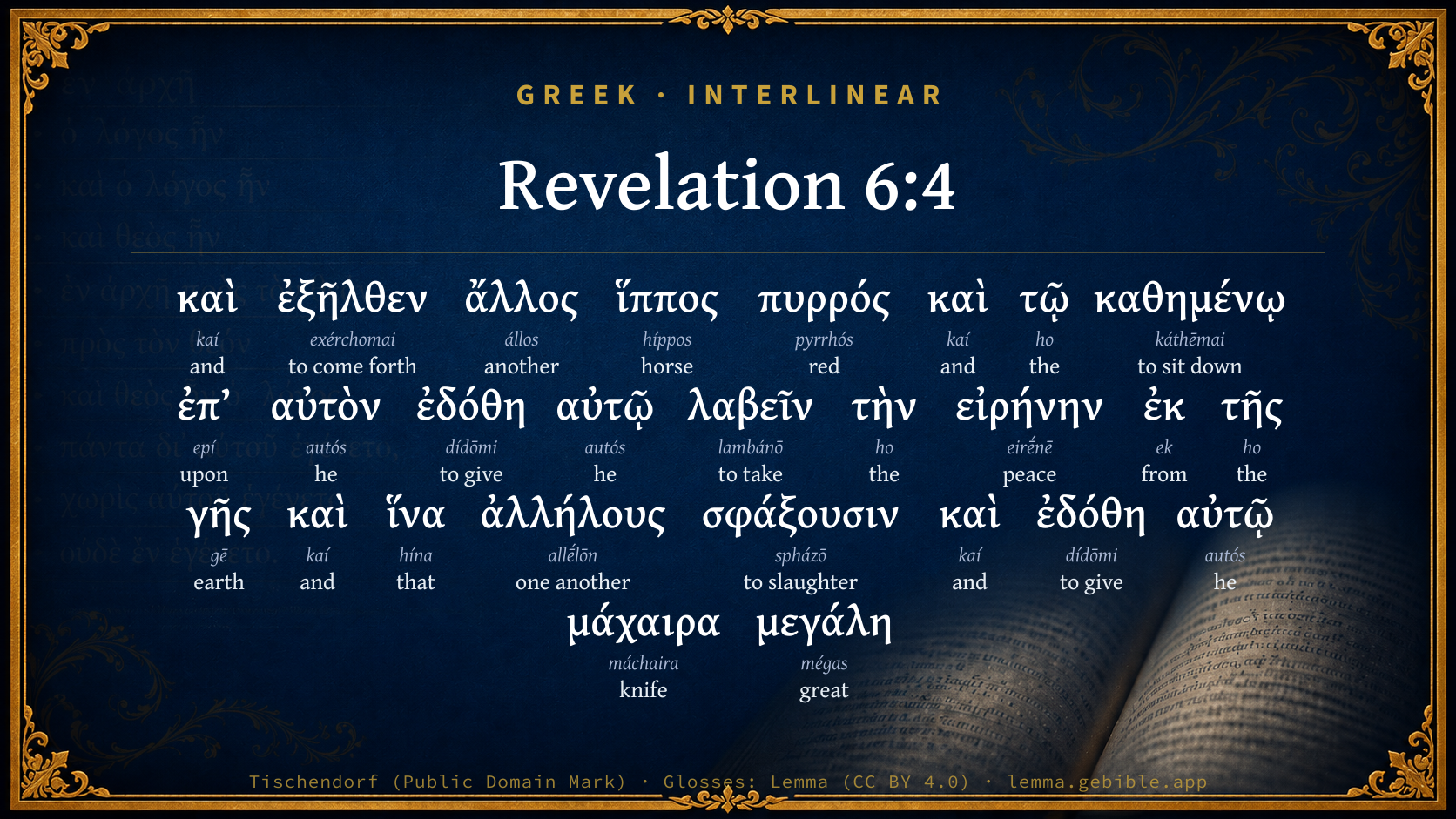
Greek (Tischendorf 8th ed.) Revelation 6:4 appears in the Greek New Testament. The text above is from the Tischendorf 8th edition. Each word links to its Strong’s number and a concise gloss. Click any word for its full Thayer’s Greek Lexicon entry.
Download image
Cite this verse

Revelation 6:4 (World English Bible). Public Domain. Lemma interlinear Bible study tool, https://lemma.gebible.app/v/revelation/6/4.

Show BibTeX & RIS
BibTeX
RIS
English Translation
Another came forth, a red horse. To him who sat on it was given power to take peace from the earth, and that they should kill one another. There was given to him a great sword.
World English Bible · Public Domain
Download a study sheet

One document with this verse’s original text, its word-by-word gloss line, the meaning frame, cross-references with their text, attributed commentary, and full source and license credits — printable, and it pastes into notes with its structure intact.

This verse Autodidact and up

Study sheet (.html) Plain text (.txt)

A passage Seminary Student

Up to 50 verses in one chapter. A passage sheet keeps up to 6 commentary sources and 12 cross-references per verse, in the order this page ranks them, and says so on the sheet whenever that leaves anything out. Ask for a single verse and you get the Autodidact verse sheet above.

Everything on this page stays free to read, with no account — the sheet is a download of what is already on screen, not access to it.

Want to remove ads? Support Godless Engineer
Compare translations 3

The same verse in 3 English versions, stacked beneath the original-language interlinear above. Click any original word for its lexicon entry.

Each is an independent rendering of the whole verse — the interlinear is not word-aligned to these translations.

Highlighted words mark where these versions differ — a whole-verse word diff, not a word-by-word alignment.

  • World English Bible Public Domain
    Another came forth, a red horse. To him who sat on it was given power to take peace from the earth, and that they should kill one another. There was given to him a great sword.
  • King James Version Public Domain
    And there went out another horse that was red: and power was given to him that sat thereon to take peace from the earth, and that they should kill one another: and there was given unto him a great sword.
  • unfoldingWord Literal Text CC BY-SA 4.0
    And another horse, fiery red, came out! And to the one sitting on it, it was granted to him to take peace from the earth, and so that they will slaughter one another, and a great sword was given to him.

unfoldingWord Literal Text — © unfoldingWord, licensed CC BY-SA 4.0. Word-aligned USFM3 via Door43 (git.door43.org/unfoldingWord/en_ult).

Versions to compare (up to 4)

3 of 4 selected

Show all 19 translations

Every available English version of this verse, each an independent rendering of the whole verse.

  • World English Bible Public Domain
    Another came forth, a red horse. To him who sat on it was given power to take peace from the earth, and that they should kill one another. There was given to him a great sword.
  • Berean Standard Bible Public Domain
    Then another horse went forth. It was bright red, and its rider was granted permission to take away peace from the earth and to make men slay one another. And he was given a great sword.
  • Majority Standard Bible Public Domain
    Then another horse went forth. It was bright red, and its rider was granted permission to take away peace from the earth and to make men slay one another. And he was given a great sword.
  • King James Version Public Domain
    And there went out another horse that was red: and power was given to him that sat thereon to take peace from the earth, and that they should kill one another: and there was given unto him a great sword.
  • American Standard Version (1901) Public Domain
    And another `horse' came forth, a red horse: and to him that sat thereon it was given to take peace from the earth, and that they should slay one another: and there was given unto him a great sword.
  • Revised Version (1885) Public Domain
    And another horse came forth, a red horse: and to him that sat thereon it was given to take peace from the earth, and that they should slay one another: and there was given unto him a great sword.
  • Geneva Bible (1599) Public Domain
    And there went out an other horse, that was red, and power was giuen to him that sate thereon, to take peace from the earth, and that they should kill one another, and there was giuen vnto him a great sword.
  • Douay-Rheims (1899) Public Domain
    And there went out another horse that was red: and to him that sat thereon, it was given that he should take peace from the earth, and that they should kill one another, and a great sword was given to him.
  • Young's Literal Translation Public Domain
    and there went forth another horse -- red, and to him who is sitting upon it, there was given to him to take the peace from the land, and that one another they may slay, and there was given to him a great sword.
  • Literal Standard Version CC BY-SA 4.0
    And there went forth another horse—fire-colored, and to him who is sitting on it, there was given to him to take peace from the earth, and that they may slay one another, and there was given to him a great sword.
  • Unlocked Literal Bible CC BY-SA 4.0
    Then another horse came out—fiery red. To its rider was given permission to take peace away from the earth, so that its people would slaughter one another. This rider was given a huge sword.
  • unfoldingWord Literal Text CC BY-SA 4.0
    And another horse, fiery red, came out! And to the one sitting on it, it was granted to him to take peace from the earth, and so that they will slaughter one another, and a great sword was given to him.
  • Darby Bible Public Domain
    And another, a red horse, went forth; and to him that sat upon it, to him it was given to take peace from the earth, and that they should slay one another; and there was given to him a great sword.
  • World Messianic Bible Public Domain
    Another came out, a red horse. To him who sat on it was given power to take peace from the earth, and that they should kill one another. There was given to him a great sword.
  • Webster's Bible Public Domain
    And there went out another horse that was red: and power was given to him that sat upon him to take peace from the earth, and that they should kill one another: and there was given to him a great sword.
  • Free Bible Version CC BY-SA 4.0
    Another horse came out, a red one. Its rider was given a large sword, and the power to take away peace from the earth so that people would slaughter one other.
  • Bible in Basic English Public Domain
    And another horse came out, a red horse; and it was given to him who was seated on it to take peace from the earth, so that people might put one another to death: and there was given to him a great sword.
  • Text-Critical English NT CC BY 4.0
    Then another horse came out, a fiery red one. Its rider was permitted to take peace from the earth, so that people would slay one another, and he was given a great sword.
  • Tyndale New Testament (1534) Public Domain
    And there went out another horsse that was red and power was geven to him that satte thereon to take peace from the erth and that they shulde kyll one another. And there was geven vnto him a gret swearde.

Literal Standard Version (2020), Covenant Press — licensed CC BY-SA 4.0. Text via the HelloAO Bible API (eBible.org). Unlocked Literal Bible (unfoldingWord) — licensed CC BY-SA 4.0. Text via the HelloAO Bible API (eBible.org). unfoldingWord Literal Text — © unfoldingWord, licensed CC BY-SA 4.0. Word-aligned USFM3 via Door43 (git.door43.org/unfoldingWord/en_ult). Free Bible Version, Dr. Jonathan Gallagher — licensed CC BY-SA 4.0. Text via the HelloAO Bible API (eBible.org).

Word by word

More ways to search: Search by grammar → Find every occurrence → Compare this word →

Practice this passage: Drill this verse → Learn its vocabulary →

πυρρός
pyrrhós
G4450
“red”
Adjective, Nominative, Singular, Masculine
Part of Speech
Adjective
Case
Nominative
Number
Singular
Gender
Masculine
Full Thayer's Definition

Origin: from G4442

TDNT: 21:53,0

1. having the colour of fire, red
  1. καὶ kaí G2532 “and” Conjunction
  2. ἐξῆλθεν exérchomai G1831 “to come forth” Verb, Aorist, Active, Indicative, 3rd person, Singular
  3. ἄλλος állos G243 “another” Adjective, Nominative, Singular, Masculine
  4. ἵππος híppos G2462 “horse” Noun, Nominative, Singular, Masculine
  5. καὶ kaí G2532 “and” Conjunction
  6. τῷ ho G3588 “the” Article, Dative, Singular, Masculine
  7. καθημένῳ káthēmai G2521 “to sit down” Verb, Present, Middle or Passive deponent, Participle, Dative, Singular, Masculine
  8. ἐπ’ epí G1909 “upon” Preposition
  9. αὐτὸν autós G846 “he” Personal pronoun, Accusative, Singular, Masculine
  10. ἐδόθη dídōmi G1325 “to give” Verb, Aorist, Passive, Indicative, 3rd person, Singular
  11. αὐτῷ autós G846 “he” Personal pronoun, Dative, Singular, Masculine
  12. λαβεῖν lambánō G2983 “to take” Verb, Aorist, Active, Infinitive
  13. τὴν ho G3588 “the” Article, Accusative, Singular, Feminine
  14. εἰρήνην eirḗnē G1515 “peace” Noun, Accusative, Singular, Feminine
  15. ἐκ ek G1537 “from” Preposition
  16. τῆς ho G3588 “the” Article, Genitive, Singular, Feminine
  17. γῆς gē G1093 “earth” Noun, Genitive, Singular, Feminine
  18. καὶ kaí G2532 “and” Conjunction
  19. ἵνα hína G2443 “that” Conjunction
  20. ἀλλήλους allḗlōn G240 “one another” Reciprocal pronoun, Accusative, Plural, Masculine
  21. σφάξουσιν spházō G4969 “to slaughter” Verb, Future, Active, Indicative, 3rd person, Plural
  22. καὶ kaí G2532 “and” Conjunction
  23. ἐδόθη dídōmi G1325 “to give” Verb, Aorist, Passive, Indicative, 3rd person, Singular
  24. αὐτῷ autós G846 “he” Personal pronoun, Dative, Singular, Masculine
  25. μάχαιρα máchaira G3162 “knife” Noun, Nominative, Singular, Feminine
  26. μεγάλη mégas G3173 “great” Adjective, Nominative, Singular, Feminine

About this verse

These counts appear in no published source. They are computed here, from the morphology-tagged text and Lemma’s own curated glosses. What Lemma adds →

27
words
19
distinct lemmas
Revelation
section

Notable vocabulary

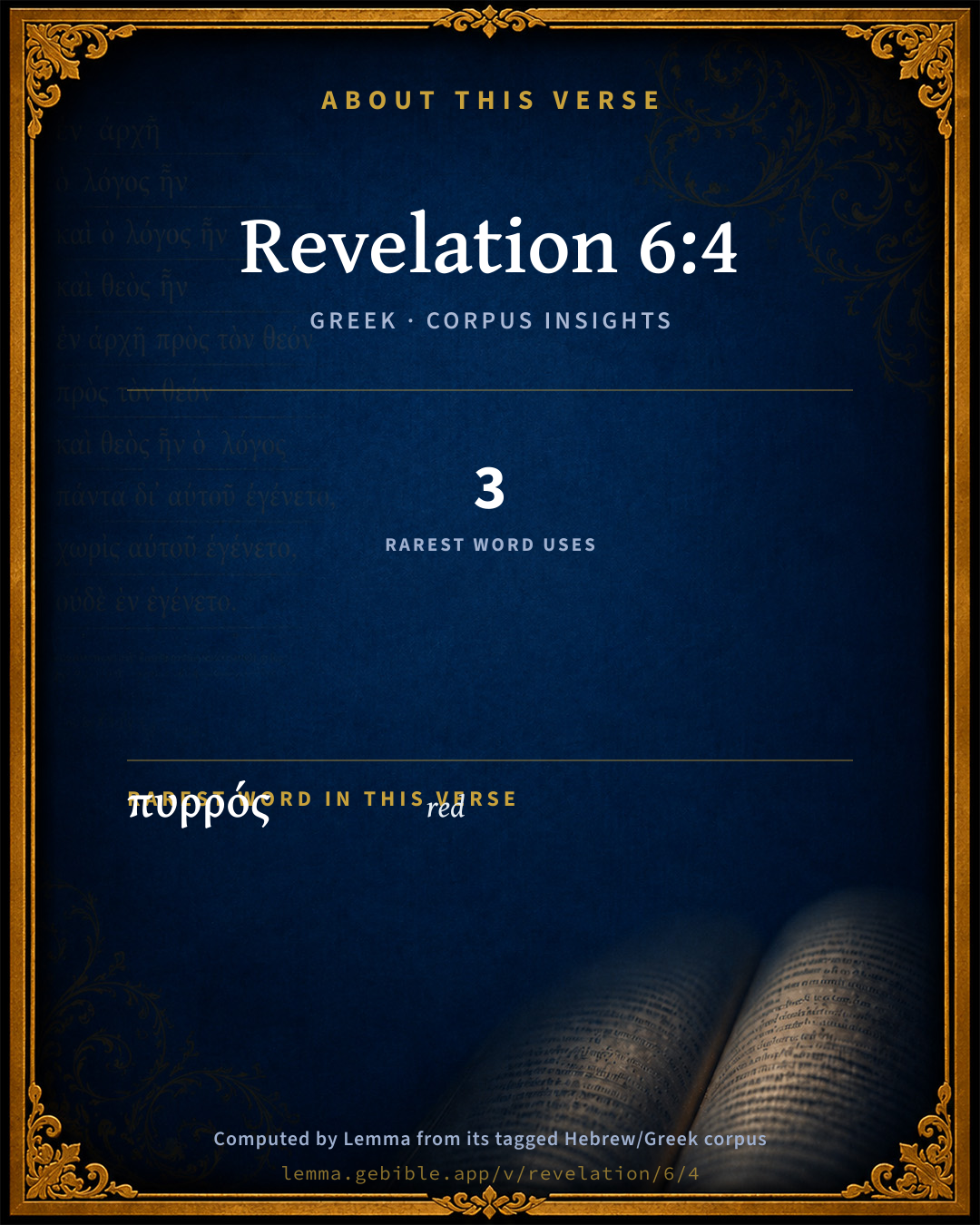
The rarest word here is πυρρός red G4450 — appearing just 3 times in the whole Greek New Testament.

Shared distinctive vocabulary

πυρρός red G4450 occurs in 3 verses of the Greek New Testament. Also found in:

Repetition

Words recur within this verse:

  • ἐδόθη to give G1325 ×2
  • καὶ and G2532 ×4
  • τῷ the G3588 ×3
  • αὐτὸν he G846 ×3

Cross-references

10

Topical passages linked to Revelation 6:4 in the Treasury of Scripture Knowledge — connected by theme and wording, ordered by reader-vote popularity; previews shown in the World English Bible.

  • Zechariah 6:2 In the first chariot were red horses; in the second chariot black horses;
  • Matthew 10:34 "Don't think that I came to send peace on the earth. I didn't come to send peace, but a sword.
  • Revelation 13:10 If anyone has captivity, he will go. If anyone is with the sword, he must be killed. Here is the endurance and the faith of the saints.
  • Revelation 17:6 I saw the woman drunken with the blood of the saints, and with the blood of the martyrs of Jesus. When I saw her, I wondered with great amazement.
  • Zechariah 1:8 "I had a vision in the night, and, behold, a man riding on a red horse, and he stood among the myrtle trees that were in a ravine; and behind him there were red, brown, and white horses.
  • Ezekiel 30:24–25 I will strengthen the arms of the king of Babylon, and put my sword in his hand: but I will break the arms of Pharaoh, and he shall groan before him with the groanings of a deadly wounded man.
  • Daniel 5:19 and because of the greatness that he gave him, all the peoples, nations, and languages trembled and feared before him: whom he would he killed, and whom he would he kept alive; and whom he would he raised up, and whom he would he put down.
  • John 19:11 Jesus answered, "You would have no power at all against me, unless it were given to you from above. Therefore he who delivered me to you has greater sin."
  • Revelation 12:3 Another sign was seen in heaven. Behold, a great red dragon, having seven heads and ten horns, and on his heads seven crowns.
  • Revelation 17:3 He carried me away in the Spirit into a wilderness. I saw a woman sitting on a scarlet-colored animal, full of blasphemous names, having seven heads and ten horns.

Cross-references courtesy of OpenBible.info (CC BY 4.0).

Commentary

Notes on Revelation 6:4 from classic Christian and Jewish commentators (each source and its license shown beneath its notes). The classic Christian expositions comment on the surrounding passage and are grouped to its opening verse, so a note may address several verses; the Jewish commentaries on the Tanakh (Rashi and others) are per-verse, so they appear only where the commentator wrote on this verse.

Lemma curates 59 commentaries, every one of them public domain or Creative Commons licensed, each selected and text-cleaned for this edition rather than reprinted as found. About our sources →

Bengel's Gnomon

Johann Albrecht Bengel

Rev 6:4. Τὴν εἰρήνην τῆς γῆς) See App. The shorter reading is generally the genuine one.—ἵνα) See App. [Most dreadful wars are signified.—V. g.]

Bengel's Gnomon of the New Testament — English translation (T&T Clark, Edinburgh, 1860) — public domain. Text from a community e-Sword module.

Jamieson, Fausset & Brown

Robert Jamieson, A. R. Fausset & David Brown

red--the color of blood. The color of the horse in each case answers to the mission of the rider. Compare Mat 10:24-36, "Think not I am come to send peace on earth; I came not to send peace, but a sword." The white horse of Christ's bloodless victories is soon followed, through man's perversion of the Gospel, by the red horse of bloodshed; but this is overruled to the clearing away of the obstacles to Christ's coming kingdom. The patient ox is the emblem of the second living creature who, at the opening of this seal, saith, "Come." The saints amidst judgments on the earth in patience "endure to the end."

that they should kill--The Greek is indicative future, "that they may, as they also shall, kill one another."

Jamieson, Fausset & Brown — Commentary Critical and Explanatory on the Whole Bible (1871) — public domain (CC PDM 1.0). Text via the HelloAO Bible API.

Adam Clarke's Commentary

Verse 4. Another horse-red] The emblem of war; perhaps also of severe persecution, and the martyrdom of the saints.

Him that sat thereon] Same say, Christ; others, Vespasian; others, the Roman armies; others, Artabanus, king of the Parthians, &c., &c.

Take peace from the earth] To deprive Judea of all tranquillity.

They should kill one another] This was literally the case with the Jews, while besieged by the Romans.

A great sword.] Great influence and success, producing terrible carnage.

Adam Clarke's Commentary on the Bible (1810–1826) — public domain. Text from a community e-Sword/MySword module.

The Cambridge Bible for Schools and Colleges

gen. ed. J. J. S. Perowne

The Second Seal, Rev_6:3-4

4. to take peace] The word “peace” has the article, which according to Greek usage may mean merely “peace in general, peace in the abstract,” but may also very well stand for “the peace” which the conquests of the previous Rider have left as their fruit.

that they should kill one another] Some understand this of civil war exclusively: and such wars have indeed most of the character of war as indicated under this seal. But its full meaning perhaps includes all wars, so far as they are aimless bloodshedding, not painful steps towards human progress. Here we can agree almost entirely with the “continuous historical” interpreters, who see the fulfilment of these four seals in the reigns of the “five good emperors,” when Trajan carried imperial conquest to its utmost height: in the civil wars and mutinies during and after the age of the Severi, in the famines that followed: and in the general distress that made the Barbarian conquest possible. Only we need not regard their meaning as exhausted in the fifth century (much less in the third). We may see e. g. the contrast of the two first seals in the Crusades compared with the religious wars of the Reformation: in the conquests of the French Republic and Empire, compared with the Red and the White Terror, and the mutual crimes of the Holy Alliance and the Carbonari: even in our own country, in a comparison of the reigns of Edward III. and Henry V. with those of their respective successors, or of Elizabeth’s with Charles I.’s: while again the civil war of the latter was noble and fruitful compared with the Dutch war of his son.

The Cambridge Bible for Schools and Colleges (gen. ed. J. J. S. Perowne; Cambridge University Press, 1878–1918) — public domain. Text from a community e-Sword module.

John Gill's Exposition

And there went out another horse, that was red,.... Which may be an emblem either of the suffering state of the church, being answerable to the Smyrnaean one, as the purity and power of the Gospel, represented in the former seal, may answer to the Ephesine church; or else of those contentions and divisions occasioned among men through the Gospel, which, though of a peaceable nature, yet, through the corruption and depravity of men, brings not peace, but a sword; or rather of those bloody wars within the period of time signified by this seal, which came as punishments on the enemies of the Gospel:

and power was given to him that sat thereon; not the Lord Jesus Christ, who is said to ride on a red horse, Zac 1:8; though indeed he presides over his church and people, and takes the care of them when the most desolating judgments are in the earth, and causes all things to work together for good; nor Satan, the red dragon, who was a murderer from the beginning, and delights in effusion of blood, and in stirring up of men to destroy one another, whenever he is permitted; but Trajan the Roman emperor, in whose reign John died; and who came from the west, and was a Spaniard, as was Hadrian his successor, who may be joined with him; which was the side, or quarter, on which the living creature was that spoke to John; and in the times of these emperors were very bloody and civil wars: wherefore power is said to be given him,

to take peace from the earth; that is, from the Roman empire, which is sometimes called the whole world; and which could not have been done, if power had not been given from him who makes peace, and creates evil:

and that they should kill one another: which refers not to the havoc and slaughter which the Jews made one of another at the destruction of Jerusalem, but to the Jews murdering of the Greeks and Romans, and the Romans the Jews, in the times of the above emperors. In Trajan's time, the Jews who dwelt about Cyrene, under the conduct of one Andrew, fell upon the Romans and Greeks, and killed many, fed on their flesh, ate their bowels, besmeared themselves with their blood, and covered themselves with their skins; many of them they sawed asunder, from the crown of the head down to the middle; many of them they threw to the wild beasts, and many of them they forced to fight among themselves, till they had destroyed above two hundred and twenty thousand men; in Egypt and Cyprus they committed the same kind of outrages, their leader being one Artemion, where two hundred and forty thousand men perished (r); Lybia was almost emptied of men by them; so that Hadrian, the successor of Trajan, was obliged to send colonies to repeople the places they had made desolate. But at length they were overcome by Lupus, governor of Egypt, and by Marcius Turbo, and by Lucius, whom Trajan sent against them (s), and destroyed great numbers of them; and for the space of about fourteen years they were quiet; but in Hadrian's time they rose again, and set one Bar Cochab, a false Messiah, at the head of them, whom they proclaimed king: when Hadrian sent forces against them, and with great difficulty subdued them, took the city Bither, where they were, and destroyed at times five hundred and eighty thousand of them (t); the Jews say, that he put men, women, and children to death in such numbers, that their blood ran down into the main sea, yea, that a horse might go up to his nose in blood (u); they say that he destroyed in Bither double the number of those that came out of Egypt, even twelve hundred thousand men (w); some of their accounts are very extravagant, and exceed all bounds (x); however, the slaughter was very great, that it may well be said,

and there was given unto him a great sword; to slay men with; though Hadrian on his death bed, amidst his pains, would fain have had a sword given to him to have dispatched his own life, and could not obtain one (y); the Jews say he destroyed all the land of Judea (z).

(r) Dion Cassius in Vita Trajani. (s) Euseb. Eccl. Hist. l. 4. c. 2. (t) Dion Cassius in Vita Hadrian. (u) T. Bab. Gittin, fol. 57. 1. & Hieros. Taanith, fol. 69. 1. Echa Rabbati, fol. 52. 3. (w) Jucaasin, fol. 142. 2. & 143. 1. (x) T. Hieros Taanith, fol. 68. 4. & T. Bab. Gittin, fol. 157. 2. Shirhashirim Rabba, fol. 13. 1. (y) Spartianus in Vita Hadriani, & Aurel. Victor. Epitome. (z) T. Hieros. Peah, fol. 20. 1.

John Gill's Exposition of the Whole Bible (1746–1763) — public domain (CC PDM 1.0). Text via the HelloAO Bible API.

Trapp's Complete Commentary

John Trapp

4 And there went out another horse that was red: and power was given to him that sat thereon to take peace from the earth, and that they should kill one another: and there was given unto him a great sword.

Ver. 4. That was red] Portending troubles and tragedies, bloody wars and terrible persecutions. Those ten first were so cruel, that St Jerome writes in one of his epistles that for every day in the year were murdered 5000, except the first day of January.

To him that sat thereon] Christ, Mat 10:34; Zec 1:8. He stands over his Church as the Agonothetes. {a} So he did at St Stephen’s martyrdom, Act 7:55. He moderates and overrules the enemy’s cruelty.

And that they should kill one another] viz. The persecutors should rise up and destroy one another, as the Romans did the Jews, and the Jews the Romans in various provinces. And as the emperors, who got nothing (most of them) by their adoption or designation to the empire, nisi ut citius interficerentur, but to be cut off the sooner. (Tacit.) All or most of the persecuting Caesars died unnatural deaths.

A great sword] That of the gospel, Eph 6:17, which takes away peace, by accident, Mat 24:6. Christ threateneth the contempt of the gospel with wars and rumours of wars. Our late Edgehill battle was fought in the vale of Red Horse; as if God had meant to say, "I have now sent you the red horse, to avenge the quarrel of the white."

{a} A superintendent or director of the great public games of Greece. ŒD

John Trapp, A Commentary or Exposition upon All the Books of the Old and New Testament (1647–1656) — public domain. Text from a community e-Sword module.

Albert Barnes' Notes on the Bible

And there went out another horse - In this symbol there were, as in the others, several particulars which it is proper to explain in order that we may be able to understand its application. The particular things in the symbol are the following:

(a) The horse. See this explained in the notes on Rev 6:2.

(b) The color of the horse: another horse that was red. This symbol cannot be mistaken. As the white horse denoted prosperity, triumph, and happiness, so this would denote carnage, discord, bloodshed. This is clear, not only from the nature of the emblem, but from the explanation immediately added: “And power was given to him that sat thereon to take peace from the earth, and that they should kill one another.” On the color, compare Bochart, Hieroz. P. 1, lib. 2, c. 7: p. 104. See also Zec 1:8. There is no possibility of mistaking this, that a time of slaughter is denoted by this emblem.

(c) The power given to him that sat on the horse: and power was given to him that sat thereon to take peace from the earth, and that they should kill one another. This would seem to indicate that the condition immediately preceding this was a condition of tranquility, and that this was now disturbed by some cause producing discord and bloodshed. This idea is confirmed by the original words - τὴν εἰρήνην tēn eirēnēn - “the peace”; that is, the previously existing peace. When peace in general is referred to, the word is used without the article: Mat 10:34, “Think not that I am come to send peace - βαλεῖν εἰρήνην balein eirēnēn - upon the earth.” Compare Luk 1:79; Luk 2:14; Luk 19:38; Mar 5:34; Joh 14:27; Joh 16:33; Act 7:26; Act 9:31, et al. in the Greek. In these cases the word “peace” is without the article. The characteristics of the period referred to by this are:

(a)That peace and tranquility existed before;

(b)That such peace and tranquility were now taken away, and were succeeded by confusion and bloodshed; and,

(c)That the particular form of that confusion was civil discord, producing mutual slaughter: “that they should kill one another.”

The presentation of a sword: and there was given unto him a great sword. As an emblem of what he was to do, or of the period that was referred to by the opening of the seal.

The sword is an emblem of war, of slaughter, of authority Rom 13:4, and is used here as signifying that that period would be characterized by carnage. Compare Isa 34:5; Rev 19:17-18; Lev 26:25; Gen 27:40; Mat 10:34; Mat 26:52. It is not said by whom the sword was presented, but the fact is merely referred to, that the rider wets presented with a sword as a symbol of what would occur.

In inquiring now into the period referred to by this symbol, we naturally look to what immediately succeeded the one which was represented by the opening of the first seal; that is, the period which followed the accession of Commodus, 180 a.d. We shall find, in the events which succeeded his accession to the empire, a state of things which remarkably accords with the account given by John in this emblem - so much so, that if it were supposed that the book was written after these events had occurred, and that John had designed to represent them by this symbol, he could not have selected a more appropriate emblem. The only authority which it is necessary to refer to here is Mr. Gibbon; who, as before remarked, seems to have been raised up by a special Providence to make a record of those events which were referred to by some of the most remarkable prophecies in the Bible. As he had the highest qualifications for an historian, his statements may be relied on as accurate; and as he had no belief in the inspiration of the prophetic records, his testimony will riot be charged with partiality in their favor. The following particulars, therefore, will furnish a full illustration of the opining of the second seal:

(a) The previous state of peace. This is implied in the expression, “and power was given to him to take peace from the earth.” Of this we have had a full confirmation in the peaceful reign of Hadrian and tim Antenines. See the notes on the exposition of the first seal. Mr. Gibbon, speaking of the accession of Commodus to the imperial throne, says that he “had nothing to wish, and everything to enjoy. The beloved son of Marcus (Commodus) succeeded his father amidst the acclamations of the senate and armies; and when he ascended the throne, the happy youth saw around him neither competitor to remove, nor enemies to punish. In this calm elevated station, it was surely natural that he should prefer the love of mankind to their detestation; the mild glories of his five predecessors to the ignominions fate of Nero and Domitian,” i. 51. So again, on the same page, he says of Commodus, “His graceful person, popular address, and imagined virtues attracted the public favor; the honorable peace which he had recently granted to the barbarians diffused an universal joy.” No one can doubt that the accession of Commodus was preceded by a remarkable prevalence of peace and prosperity.

(b) Civil war and bloodshed: to take peace from the earth, and that they should kill one another. Of the applicability of this to the time supposed to be represented by this seal, we have the fullest confirmation in the series of civil wars commencing with the assassination of the emperor Commodus, 193 a.d., and continued, with scarcely any intervals of intermission, for 80 or 90 years. So Sismondi, on the fall of the Roman empire (i. 36), says, “With Commodus’ death commenced the third and most calamitous period. It lasted 92 years, from 193 to 284. During that time, 32 emperors, and 27 pretenders to the empire, alternately hurried each other from the throne, by incessant civil warfare. Ninety-two years of almost incessant civil warfare taught the world on what a frail foundation the virtue of the Antonines had reared the felicity of the empire.” The full history of this period may be seen in Gibbon, i. pp. 50-197.

Of course it is impossible in these notes to present anything like a complete account of the characteristics of those times. Yet the briefest summary may well show the general condition of the Roman empire then, and the propriety of representing it by the symbol of a red horse, as a period when peace would be taken from the earth, and when people would kill one another. Commodus himself is represented by Mr. Gibbon in the following words: “Commodus was not, as be has been represented, a tiger, born with an insatiate thirst of human blood, and capable, from his infancy, of the most inhuman actions. Nature had formed him of a weak, rather than a wicked disposition. His simplicity and timidity rendered him the slave of his attendants, who gradually corrupted his mind. His cruelty, which at first obeyed the dictates of others, degenerated into habit, and at length became the ruling passion of his soul,” i. 51.

During the first three years of his reign “his hands were yet unstained with blood” (Ibid.), but he soon degenerated into a most severe and bloody tyrant, and “when Commodus had once tasted human blood, he was incapable of pity or remorse,” i. 52. “The tyrant’s rage,” says Mr. Gibbon (i. 52), “after having shed the noblest blood of the senate, at length recoiled on the principal instrument of his cruelty. While Commodus was immersed in blood and luxury he devolved the detail of public business on Perennis, a servile and ambitious minister, who had obtained his post by the murder of his predecessor,” etc. “Every sentiment of virtue and humanity was extinct in the mind of Commodus,” i. 55. After detailing the history of his crimes, his follies, and his cruelties, Mr. Gibbon remarks of him: “His cruelty proved at last fatal to himself. He had shed with impunity the best blood of Rome: he perished as soon as he was dreaded by his own domestics. Marcia, his favorite concubine, Eclectus, his chamberlain, and Laetus, his pretorian prefect, alarmed by the fate of their companions and predecessor, resolved to prevent the destruction which every hour hung over their heads, either from the mad caprice of the tyrant, or the sudden indignation of the people. Marcia seized the occasion of presenting a draught of wine to her lover, after he had fatigued himself with hunting some wild beasts. Commodus retired to sleep; but while he was laboring with the effects of poison and drunkenness, a robust youth, by profession a wrestler, entered his chamber, and strangled him without resistance,” i. 57.

The immediate consequence of the assassination of Commodus was the elevation of Pertinax to the throne, and his murder eighty-six days after (Decline and Fall, i. 60). Then followed the public setting-up of the empire to sale by the pretorian guards, and its purchase by a wealthy Roman senator, Didius Julianus, or Julian, who, “on the throne of the world, found himself without a friend and without an adherent,” i. 63. “The streets and public places in Rome resounded with clamors and imprecations.” “The public discontent was soon diffused from the center to the frontiers of the empire,” i. 63. In the midst of this universal indignation Septimius Severus, who then commanded the army in the neighborhood of the Danube, resolved to avenge the death of Pertinax, and to seize upon the imperial crown. He marched to Rome, overcame the feeble Julian, and placed himself on the throne. Julian, after having reigned 66 days, was beheaded in a private apartment of the baths of the palace, i. 67. “In less than four years Severus subdued the riches of the East, and the valor of the West. He vanquished two competitors of reputation and ability, and defeated numerous armies provided with weapons and discipline equal to his own,” i. 68.

Mr. Gibbon then enters into a detail of “the two civil wars against Niger and Albinus” - rival competitors for the empire (i. 68-70), both of whom were vanquished, and both of whom were put to death “in their flight from the field of battle.” Yet he says, “Although the wounds of civil war were apparently healed, its mortal poison still lurked in the vitals of the constitution,” i. 71. After the death of Severus, then follows an account of the contentions between his sons, Geta and Caracalla, and of the death of the former by the instigation of the latter (i. 77); then of the remorse of Caracalla, in which it is said that “his disordered fancy often beheld the angry forms of his father and his brother rising into life to threaten and upbraid him” (i. 77); then of the cruelties which Caracalla inflicted on the friends of Geta, in which “it was computed that, under the vague appellation of the friends of Geta, above twenty thousand persons of both sexes suffered death” (i. 78); then of the departure of Caracalla from the capital, and his cruelties in other parts of the empire, concerning which Mr. Gibbon remarks (i. 78, 79), that “Caracalla was the common enemy of mankind. Every province was by turns the scene of his rapine and cruelty. In the midst of peace and repose, upon the slightest provocation, he issued his commands at Alexandria in Egypt for a general massacre. From a secure post in the temple of Serapis he viewed and directed the slaughter of many thousand citizens, as well as strangers, without distinguishing either the number or the crime of the sufferers,” etc.

Then follows the account of the assassination of Caracalla (i. 80); then, and in consequence of that, of the civil war which crushed Macrinus, and raised Elagabalus to the throne (i. 83); then of the life and follies of that wretched voluptuary, and of his massacre by the pretorian guards (i. 86); then, after an interval of thirteen years, of the murder of his successor, the second Severus, on the Rhine; then of the civil wars excited against his murderer and successor, Maximin, in which the two emperors of a day - the Gordians, father and son - perished in Africa, and Maximin himself, and his son, in the siege of Aquileia; then of the murder at Rome of the two joint emperors, Maximus and Balbinus; and quickly after that an account of the murder of their successor in the empire, the third and youngest Gordian, on the banks of the river Aboras; then of the slaughter of the next emperor Philip, together with his son and associate in the empire, in the battle near Verona: and this state of things may be said to have continued until the accession of Diocletian to the empire, 284 a.d. See Decline and Fall, i. 110-197. Does any portion of the history of the world present a similar period of connected history that would be so striking a fulfillment of the symbols used here of “peace being taken from the earth,” and “men killing one another?” In regard to this whole period it is sufficient, after reading Mr. Gibbon’s account, to ask two questions:

(1) If it were supposed that John lived after this period, and designed to represent this by an expressive symbol, could he have found one that would have characterized it better than this does?

(2) And if it should be supposed that Mr. Gibbon designed to write a commentary on this “seal,” and to show the exact fulfillment of the symbol, could he have selected a better portion of history to do it, or could he have better described facts that would be a complete fulfillment? It is only necessary to observe further:

(c) that this is a marked and definite period. It has such a beginning, and such a continuance and ending, as to show that tiffs symbol was applicable to this as a period of the world. For it was not only preceded by a state of peace, as is supposed in the symbol, but no one can deny that the condition of things in the empire, from Commodus onward through many years, was such as to be appropriately designated by the symbol used here.

Albert Barnes' Notes on the Bible (1834–1885) — public domain. Text from a community e-Sword/MySword module.

Matthew Poole's English Annotations

And there went out another horse that was red; signifying blood and slaughter.

And power was given to him that sat thereon to take peace from the earth; either to Christ, (as some say), or to those that ruled the affairs of the Roman empire at that time, to disturb the peace of the church.

And that they should kill one another: this was a time of much blood.

And there was given unto him a great sword; and therefore a sword is given to him that rode upon the this horse. Some think that this period began with Nero, thirty-four years before the other ended (according to what was said before); others make it to begin with Trajan, and to comprehend eighty years, until the time of Commodus; in which time Trajan, and Hadrian, and the three Antoninuses successively ruled the Roman empire: the reigns of Trajan and Hadrian took up near half the time, in which time this prophecy was most eminently fulfilled; for in Trajan’s time the Jews rebelling, and killing many subjects of the Roman empire, to the number of twenty-two thousand in one place, and two hundred and forty thousand in another place, themselves were as miserably handled by the Roman forces sent by Trajan and Hadrian, who slew of them (as histories tell us) five hundred and fourscore thousand: nay, the Jews themselves say, they lost double the number of those who came out of Egypt, and more than they lost by Nebuchadnezzar, or by Titus when their city was taken: on the other side the Romans lost very many. Many Christians also were put to death during this period, during which was the third and fourth persecution.

Matthew Poole's English Annotations on the Holy Bible (1683–1685) — public domain. Text from a community e-Sword/MySword module.

Whedon's Commentary on the Bible

Daniel D. Whedon

Second seal—of CARNAGE, attendant upon conquest, Rev_6:3-4.

4. Red—Etymologically, the word signifies fire-red, but by use it often signifies blood-red.

Take peace from the earth—Not that the entire earth should be at war at once, but through the centuries, and through the earth, the blood-demon should roam, destroying the peace of the world.

Daniel D. Whedon (gen. ed.), Commentary on the Old and New Testaments (1874–1909) — public domain. Text from a community e-Sword module.

The Pulpit Commentary

And there went out another horse that was red. There is a very general agreement that the red horse signifies war slaughter by the sword which was given to "him that sat thereon." Slight variations of the application occur. Wordsworth, following the more ancient expositors, thinks that only that aspect of war is intended which consists in the persecution of the saints; while Alford and others would not restrict the meaning, but consider that war in general is meant, relying upon the following words, "that they should kill one another," and quoting our Lord"s prophecy, "I came not to send peace, but a sword". (Mat_10:34) Both views may be correct. Though there had never been persecution, war would be one of the great afflictions from which Christians in various ages suffer, and in which they need consolation; but we may well believe that St. John, in writing to Christians who were themselves being grievously persecuted, should refer especially to the slaughter of the saints, as one of the trials inflicted upon them with God"s knowledge and permission. The Revelation, intended as a support to those to whom St. John wrote, and applying directly and specially to their situation, has vet a wider application, and foreshadows the fate of each individual Christian and the Church in general throughout all ages. And power was given to him that sat thereon to take peace from the earth; and to him that sat upon him it was given him to take peace out of the earth.

The pronoun is redundant; it has no special signification. (see Rev_2:26 Rev_3:12, Rev_3:21) "The peace" (thnhn); that is, peace in general, not the peace left by the first appearance. "Power". (cf. Rev_4:11 Rev_1:6 Rev_7:12) A few authorities omit ek , "out." "The earth" has been erroneously restricted to the Roman empire or to Judaea. The whole world is meant. Here is a repetition of our Lord"s prophecy, "I came not to send peace, but a sword". (Mat_10:34) The sword directed against the saints of God is, by God"s providence, converted into an instrument for the refining and conversion of his kingdom. As in the death of Christ, Satan was foiled with his own weapon, and by death came life, so what is intended by the enemies of God to be the extermination of Christianity is the means of increasing and strengthening his Church. And that they should kill one another; that is, that among the inhabitants of the earth some should kill others. As explained above, this includes both the slaughter of the saints and war in general. The verb sfattw , "to sacrifice," is peculiar to St. John, being found only in the Revelation and in 1Jn_3:12. The use of this verb seems to imply that the vision more immediately contemplates the death of the martyrs. And there was given unto him a great sword. Here, again, macaira , though used also in a wider sense, signifies strictly the sacrificial knife, the natural instrument of the slaughter mentioned. It is the LXX word used in Gen_22:6, Gen_22:10, in the account of the sacrifice of Isaac, where it is also closely connected with sfattw , "to sacrifice," the verb used in this passage.

The Pulpit Commentary (1880–1919), ed. H.D.M. Spence-Jones & Joseph S. Exell — public domain. Text from a community e-Sword module.

John Wesley's Explanatory Notes

There went forth another horse that was red - A colour suitable to bloodshed. And to him that sat thereon it was given to take peace from the earth - Vespasian, in the year 75, had dedicated a temple to Peace; but after a time we hear little more of peace. All is full of war and bloodshed, chiefly in the western world, where the main business of men seemed to be, to kill one another. To this horseman there was given a great sword; and he had much to do with it; for as soon as Trajan ascended the throne, peace was taken from the earth. Decebalus, king of Dacia, which lies westward from Patmos, put the Roman to no small trouble. The war lasted five years, and consumed abundance of men on both sides; yet was only a prelude to much other bloodshed, which followed for a long season. All this was signified by the great sword, which strikes those who are near, as the bow does those who are at a distance.

John Wesley, Explanatory Notes Upon the Whole Bible (1754–1765) — public domain. Text via the GEBible commentary corpus.

Cambridge Greek Testament for Schools and Colleges

4. καὶ ἐξῆλθεν. א reads καὶ ἴδον, καὶ ἰδοὺ ἐξῆλθεν.

ἐδόθη αὐτῷ. אcA omit αὐτῷ.

σφάξουσιν with AC 36; Text. Rec[235] reads σφάξωσιν with אB2P 1 &c.

[235] Rec. Textus Receptus as printed by Scrivener.

4. ἐδόθη αὐτῷ: see crit. note and on Rev 2:7.

τὴν εἰρήνην. This may mean merely “peace in general,” “peace in the abstract,” but may also stand for “the peace” which the conquests of the previous Rider have left as their fruit.

ἵνα ἀλλήλους σφάξουσιν. This is the first instance of the future with ἵνα, which illiterate “barbarians” would think as natural as the future with ὄπως. The MSS. are never unanimous: the editors are by no means always unanimous, nor is it possible, on the hypothesis that the writer conforms fitfully to the common construction, ever to be quite sure whether the MSS. which represent the “regular” or the “irregular” construction are right. No MS. has the “irregular” construction in all the places where it commends itself to a majority of editors. Moreover most of the forms which mark the future or the subjunctive are liable to be confounded with one another. A possible theory is that in this Book ἵνα with the future indicative corresponds to ἵνα with the subjunctive in ordinary Greek, while ἵνα with the subjunctive aorist (which is much commoner than the present) corresponds to ἵνα with the optative. As for the sense, some understand this of civil war exclusively: and such wars have indeed most of the character of war as indicated under this seal. But its full meaning perhaps includes all wars, so far as they are aimless blood-shedding, not painful steps towards human progress. Here we can agree almost entirely with the “continuous historical” interpreters, who see the fulfilment of these four seals in the reigns of the “five good emperors,” when Trajan carried imperial conquest to its utmost height; in the civil wars and mutinies during and after the age of the Severi; in the famines that followed; and in the general distress that made the Barbarian conquest possible. Only we need not regard their meaning as exhausted in the fifth century (much less in the third). We may see e.g. the contrast of the two first seals in the Crusades compared with the religious wars of the Reformation: in the conquests of the French Republic and Empire, compared with the Red and the White Terror, and the mutual crimes of the Holy Alliance and the Carbonari: even in our own country, in a comparison of the reigns of Edward III. and Henry V. with those of their respective successors, or of Elizabeth’s with Charles I.’s: while again the civil war of the latter was noble and fruitful compared with the Dutch war of his son.

Cambridge Greek Testament for Schools and Colleges (Cambridge University Press, 1896; 21 vols, various authors incl. Carr, Maclear, Plummer, Farrar, Lumby, Moule, M. R. James, Simcox) — public domain. Text from a community e-Sword module.

Alford’s Greek Testament

Henry Alford

4.] And when he opened the second seal, I heard the second living-being saying, Come (see above on ver. 1). And there came forth another horse, red (the colour of blood: so 4 Kings 3:22, ὕδατα πυῤῥὰ ὡς αἷμα. The colour of the horse in each case has reference to the employment of the rider. Tertullian, de Spectaculis, 9, vol. i. p. 641, says: “russeum … Marti … consecraverunt”), and to him that sat upon him it was given (to him) to take away peace (τὴν εἰρ. not, as Elliott, “the peace left by the former seal,” for 1) the former seal neither implies nor leaves such peace, and 2) these four seals are strictly correlative, not consecutive on one another: but, peace in its entirety, the τήν distributing, as the logicians say, the substantive. See for εἰρήνη without the art., Mat 10:34 (peace, at all: any peace): Luk 2:14 (peace, in each particular case, under every circumstance), &c.: with the art., Rom 14:19, τὰ τῆς εἰρ. διώκωμεν: 15:33, al., ὁ θεὸς τῆς εἰρήνης: Eph 2:14, αὐτὸς ἐστὶν ἡ εἰρήνη ἡμῶν, &c.) out of the earth (generally, as ever: not, Judæa, nor the Roman “orbis terrarum,” nor any special portion merely) and that they (men: the inhabitants of the earth) shall kill (the pregnant future after ἵνα not only imports the result of purpose, but includes also matter of fact, “that they may … which they also shall;” see Winer (edn. 6, § 41 b. 1. b), who however inteprets it as expressing duration (?), whereas the aor. denotes rapid transition) one another: and there was given to him a great sword (the key to the interpretation of this seal is to be found in Mat 10:34, μὴ νομίσητε ὅτι ἦλθον βαλεῖν εἰρήνην ἐπὶ τὴν γῆν· οὐκ ἦλθον βαλεῖν εἰρήνην ἀλλὰ μάχαιραν: see also Luk 12:51. It represents to us the taking away of peace from the earth, the slaying one another, the reign of the sword, as one of the destined concomitants of the growing and conquering power of Christ, and one of the world-long and world-wide preparations for His coming. Observe, all limitations of this meaning are wrong: whether to the persecutions of the Christians, or to any period of time, ancient or modern. The above was the most ancient interpretation; e. g. we have in Victorinus, “Equus roseus et qui sedebat super eum habens gladium. bella sunt significata futura, ut legimus in Evangelio, Surget enim gens contra gentem,” &c., Mat 24:7).

5,

Henry Alford, The Greek Testament (1849–1861) — public domain. Text from a community e-Sword module.

Vincent's Word Studies in the New Testament

Marvin R. Vincent

Red [πυρρος] . From pur fire. Flame - colored. Compare 2Ki 3:22; Zec 1:8. Only here and chapter Rev 12:3.

To take peace from the earth. Compare Mt 10:34; Mt 24:7.

Kill [σφαξωσιν] . See on chapter Rev 5:6.

Sword [μαχαιρα] . Compare Mt 10:34. In Homer, a large knife or dirk, worn next the sword - sheath, and used to slaughter animals for sacrifice. Thus, "The son of Atreus, having drawn with his hands the knife [μαχαιραν] which hung ever by the great sheath of his sword, cut the hair from the heads of the lambs.... He spake, and cut the lambs ' throats with the pitiless brass" (" Iliad, "3, 271 - 292). It is used by the surgeon Machaon to cut out an arrow (" Iliad," 11, 844). Herodotus, Aristophanes, and Euripides use the word in the sense of a knife for cutting up meat. Plato, of a knife for pruning trees. As a weapon it appears first in Herodotus : " Here they (the Greeks) defended themselves to the last, such as still had swords, using them (vii., 225) Later of the sabre or bent sword, contrasted with the xifov or straight sword. Aristophanes uses it with the adjective mia single, for a razor, contrasted with macaira diplh, the double knife or scissors. This and rJomfaia (see on Luk 2:35) are the only words used in the New Testament for sword. Qifov (see above) does not occur. In Septuagint macaira of the knife of sacrifice used by Abraham (Gen 22:6, 10).

Marvin R. Vincent, Word Studies in the New Testament (1887–1900) — public domain. Text from a community e-Sword/MySword module.

Lesson kit

Teaching starters — assembled from the data on this page, not authored interpretation. Every prompt links to the verse data it draws on. Edit before teaching.

Revelation, in the Revelation, opens this verse with 27 words (19 distinct Greek lemmas). Its most distinctive word is pyrrhós (“red”). A historical commentator’s framing appears above. Read the whole chapter for the surrounding context.

Discussion questions

  1. The word pyrrhós carries the sense “red.” How does it shape the verse?
  2. How does Acts 20:4, which shares the word «red», read alongside this verse?
  3. What does the repetition of “to give” (2× in this one verse) do in this verse?
  4. These translations render this verse differently. What is at stake in choosing one wording over another?
  5. Compare how Bengel's Gnomon and Jamieson, Fausset & Brown read this verse. Where do they agree or differ?

Things to notice

Reading settings

Reading text

Shown beneath each verse's original-language words.

Old Testament
Old Testament edition

Read the OT as the Masoretic Hebrew (MT) or the Greek Septuagint (LXX).

English shown for the Greek Septuagint (in the Hebrew ↔ Greek comparison).

Comparing translations? Open the Compare panel on any verse page to stack up to four side by side.