
Luke 12:51

Greek (Tischendorf 8th ed.) Luke 12:51 appears in the Greek New Testament. The text above is from the Tischendorf 8th edition. Each word links to its Strong’s number and a concise gloss. Click any word for its full Thayer’s Greek Lexicon entry.
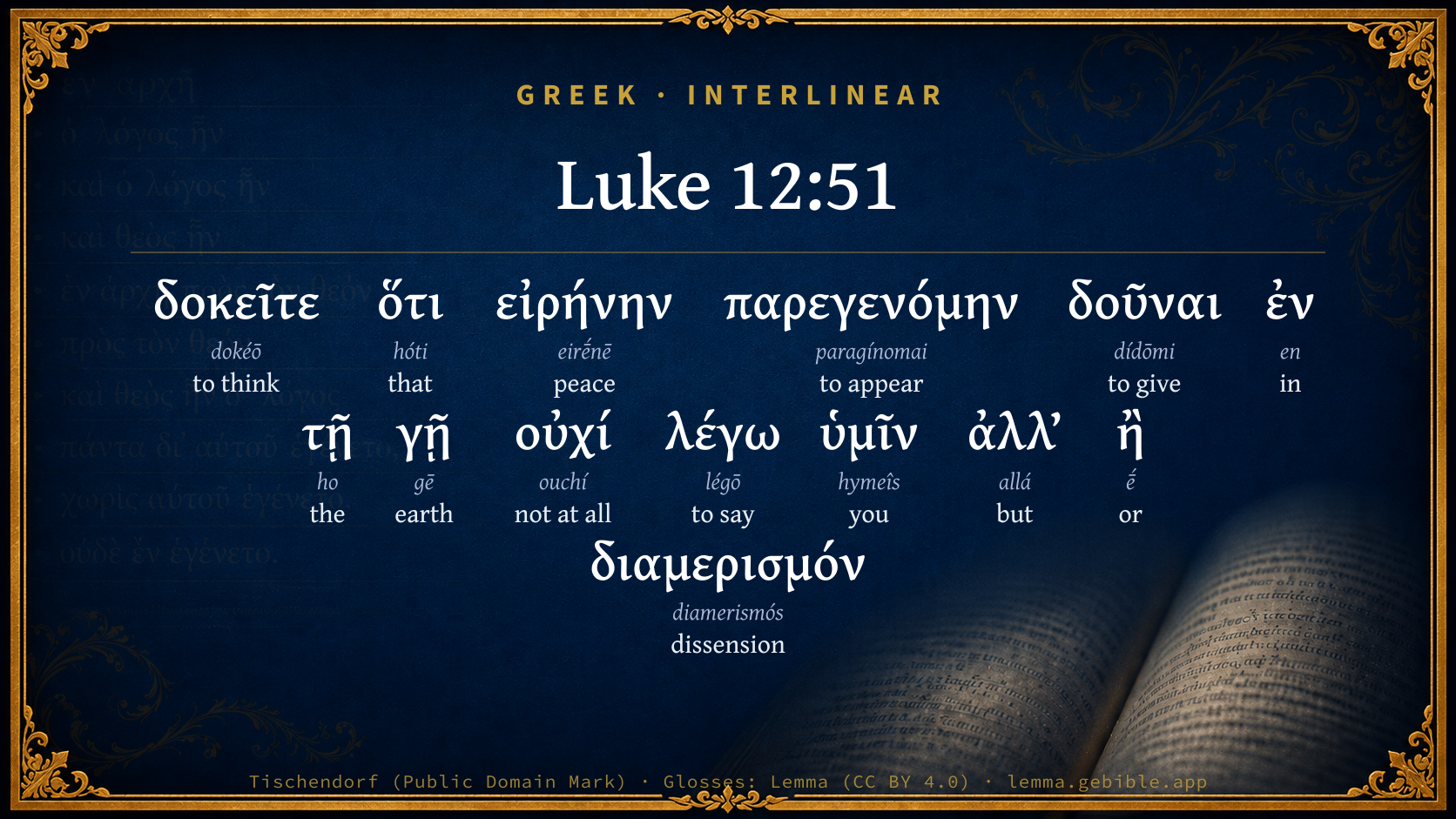
Download image
Cite this verse

Luke 12:51 (World English Bible). Public Domain. Lemma interlinear Bible study tool, https://lemma.gebible.app/v/luke/12/51.

Show BibTeX & RIS
BibTeX
RIS
English Translation
Do you think that I have come to give peace in the earth? I tell you, no, but rather division.
World English Bible · Public Domain
Highlights
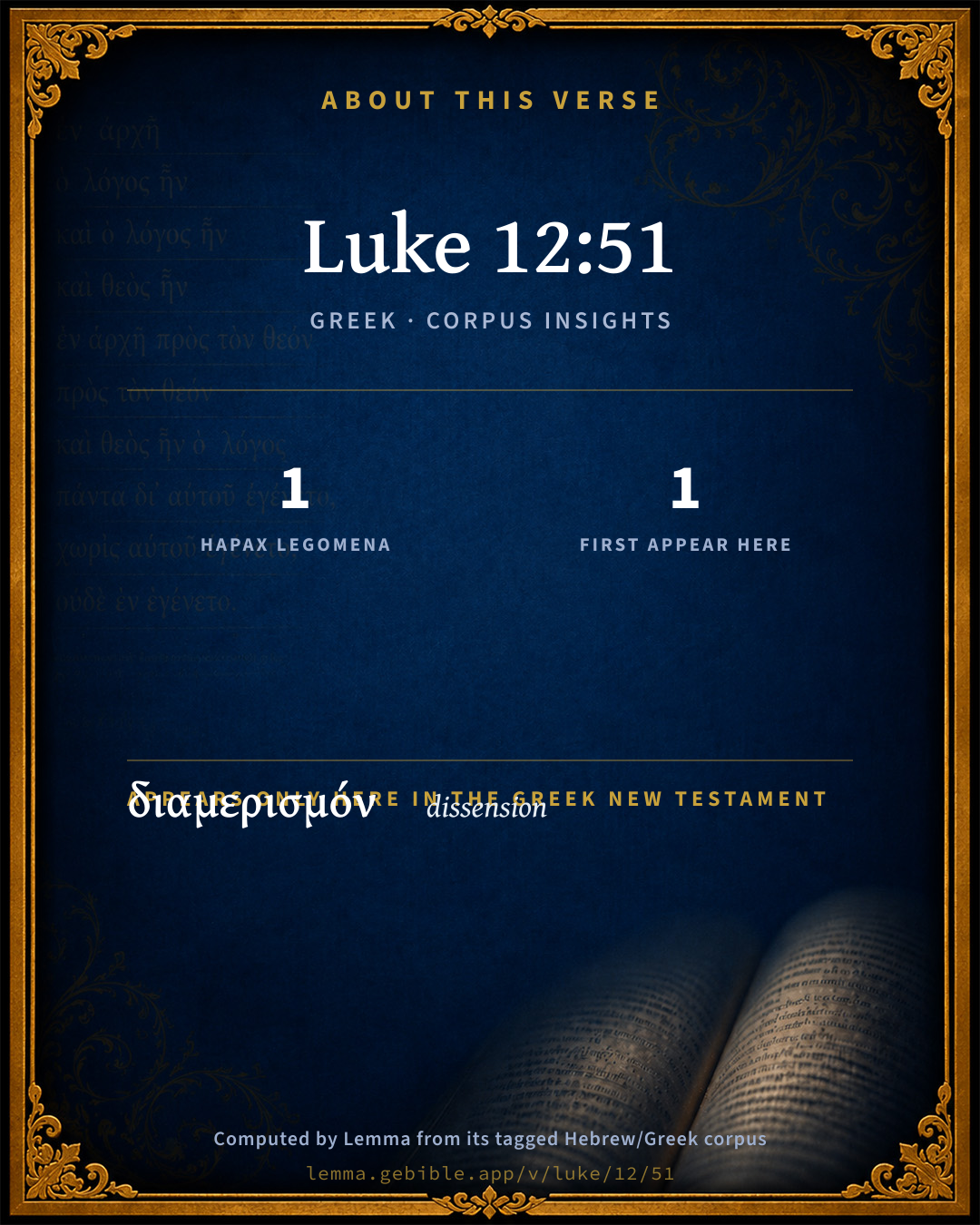
  • 1 hapax legomenon — only here in the Greek New Testament
  • 1 first appearance in the Greek New Testament
Full analysis ↓
Download a study sheet

One document with this verse’s original text, its word-by-word gloss line, the meaning frame, cross-references with their text, attributed commentary, and full source and license credits — printable, and it pastes into notes with its structure intact.

This verse Autodidact and up

Study sheet (.html) Plain text (.txt)

A passage Seminary Student

Up to 50 verses in one chapter. A passage sheet keeps up to 6 commentary sources and 12 cross-references per verse, in the order this page ranks them, and says so on the sheet whenever that leaves anything out. Ask for a single verse and you get the Autodidact verse sheet above.

Everything on this page stays free to read, with no account — the sheet is a download of what is already on screen, not access to it.

Want to remove ads? Support Godless Engineer
Compare translations 3

The same verse in 3 English versions, stacked beneath the original-language interlinear above. Click any original word for its lexicon entry.

Each is an independent rendering of the whole verse — the interlinear is not word-aligned to these translations.

Highlighted words mark where these versions differ — a whole-verse word diff, not a word-by-word alignment.

  • World English Bible Public Domain
    Do you think that I have come to give peace in the earth? I tell you, no, but rather division.
  • King James Version Public Domain
    Suppose ye that I am come to give peace on earth? I tell you, Nay; but rather division:
  • unfoldingWord Literal Text CC BY-SA 4.0
    Do you think that I came to give peace on the earth? No, I say to you, but rather division.

unfoldingWord Literal Text — © unfoldingWord, licensed CC BY-SA 4.0. Word-aligned USFM3 via Door43 (git.door43.org/unfoldingWord/en_ult).

Versions to compare (up to 4)

3 of 4 selected

Show all 19 translations

Every available English version of this verse, each an independent rendering of the whole verse.

  • World English Bible Public Domain
    Do you think that I have come to give peace in the earth? I tell you, no, but rather division.
  • Berean Standard Bible Public Domain
    Do you think that I have come to bring peace to the earth? No, I tell you, but division.
  • Majority Standard Bible Public Domain
    Do you think that I have come to bring peace to the earth? No, I tell you, but division.
  • King James Version Public Domain
    Suppose ye that I am come to give peace on earth? I tell you, Nay; but rather division:
  • American Standard Version (1901) Public Domain
    Think ye that I am come to give peace in the earth? I tell you, Nay; but rather division:
  • Revised Version (1885) Public Domain
    Think ye that I am come to give peace in the earth? I tell you, Nay; but rather division:
  • Geneva Bible (1599) Public Domain
    Thinke ye that I am come to giue peace on earth? I tell you, nay, but rather debate.
  • Douay-Rheims (1899) Public Domain
    Think ye, that I am come to give peace on earth? I tell you, no; but separation.
  • Young's Literal Translation Public Domain
    `Think ye that peace I came to give in the earth? no, I say to you, but rather division;
  • Literal Standard Version CC BY-SA 4.0
    Do you think that I came to give peace in the earth? No, I say to you, but rather division;
  • Unlocked Literal Bible CC BY-SA 4.0
    Do you think that I came to bring peace on the earth? No, I tell you, but rather division.
  • unfoldingWord Literal Text CC BY-SA 4.0
    Do you think that I came to give peace on the earth? No, I say to you, but rather division.
  • Darby Bible Public Domain
    Think ye that I have come to give peace in the earth? Nay, I say to you, but rather division:
  • World Messianic Bible Public Domain
    Do you think that I have come to give peace in the earth? I tell you, no, but rather division.
  • Webster's Bible Public Domain
    Suppose ye that I am come to give peace on earth? I tell you, No; but rather division:
  • Free Bible Version CC BY-SA 4.0
    Do you think that I came to bring peace on earth? No, I tell you, I bring division.
  • Bible in Basic English Public Domain
    Is it your opinion that I have come to give peace on earth? I say to you, No, but division:
  • Text-Critical English NT CC BY 4.0
    Do you think I have come to grant peace on earth? No, I tell you, but division.
  • Tyndale New Testament (1534) Public Domain
    Suppose ye that I am come to sende peace on erth? I tell you naye: but rather debate.

Literal Standard Version (2020), Covenant Press — licensed CC BY-SA 4.0. Text via the HelloAO Bible API (eBible.org). Unlocked Literal Bible (unfoldingWord) — licensed CC BY-SA 4.0. Text via the HelloAO Bible API (eBible.org). unfoldingWord Literal Text — © unfoldingWord, licensed CC BY-SA 4.0. Word-aligned USFM3 via Door43 (git.door43.org/unfoldingWord/en_ult). Free Bible Version, Dr. Jonathan Gallagher — licensed CC BY-SA 4.0. Text via the HelloAO Bible API (eBible.org).

Word by word

More ways to search: Search by grammar → Find every occurrence → Compare this word →

Practice this passage: Drill this verse → Learn its vocabulary →

About this verse

These counts appear in no published source. They are computed here, from the morphology-tagged text and Lemma’s own curated glosses. What Lemma adds →

14
words
14
distinct lemmas
Gospels
section

Notable vocabulary

1 hapax legomenon — a word that appears only here in the entire Greek New Testament:

  • διαμερισμόν dissension G1267

First appearance in Scripture

This word makes its first canonical appearance in the Greek New Testament here:

  • διαμερισμόν dissension G1267

Shared distinctive vocabulary

παρεγενόμην to appear G3854 occurs in 37 verses of the Greek New Testament. Also found in:
Cross-references

6

Topical passages linked to Luke 12:51 in the Treasury of Scripture Knowledge — connected by theme and wording, ordered by reader-vote popularity; previews shown in the World English Bible.

  • Matthew 10:34–36 "Don't think that I came to send peace on the earth. I didn't come to send peace, but a sword.
  • Luke 12:49 "I came to throw fire on the earth. I wish it were already kindled.
  • Zechariah 11:10–11 I took my staff Favor, and cut it apart, that I might break my covenant that I had made with all the peoples.
  • Matthew 24:7–10 For nation will rise against nation, and kingdom against kingdom; and there will be famines, plagues, and earthquakes in various places.
  • Zechariah 11:14 Then I cut apart my other staff, even Union, that I might break the brotherhood between Judah and Israel.
  • Zechariah 11:7–8 So I fed the flock of slaughter, especially the oppressed of the flock. I took for myself two staffs. The one I called "Favor," and the other I called "Union," and I fed the flock.

Cross-references courtesy of OpenBible.info (CC BY 4.0).

Commentary

Notes on Luke 12:51 from classic Christian and Jewish commentators (each source and its license shown beneath its notes). The classic Christian expositions comment on the surrounding passage and are grouped to its opening verse, so a note may address several verses; the Jewish commentaries on the Tanakh (Rashi and others) are per-verse, so they appear only where the commentator wrote on this verse.

Lemma curates 59 commentaries, every one of them public domain or Creative Commons licensed, each selected and text-cleaned for this edition rather than reprinted as found. About our sources →

The Biblical Illustrator

Joseph S. Exell

Luk_12:51-53

Suppose ye that I am come to give peace on earth?

--

Strife engendered by the gospel

We try to soften this terrible prophecy by our comments. As if we could explain facts which are notorious to every reader of history, to every one who has had experience of what is passing in his own time I As if we could convince any reasonable persons that there have not been, that there are not, these strifes in families; that the gospel of Christ has not provoked them, and does not provoke them still t Or as if our Lord, supposing He is the Prince of Peace, as we say He is, wanted our help to vindicate Him from the charge of being the Author of war t Surely we may trust Him with His own character. All that is required of us is, that we should let His words come to us in the fulness of their power and their condemnation. Goodness and gentleness do stir up what is opposed to them in us; we know that they do. Our sectarian animosities are kindled by the message of Gods goodwill to men; we know that they are. Can we not understand then, how, coming among a set of hostile factions, which abhorred one another, but observed a conventional decency in their strife, Christ stirred up their rage to its very depths? Cannot we understand how the fury of both burned for awhile against Him--a hollow truce being established between them by the presence of a common enemy? Did it not revenge itself for that restraint afterwards? Did not every hearth and household become a battle-field in that war? This was the state of Jerusalem, as its own historian describes it in the latter days. He can give us the narrative calmly, Jew though He was. When Jesus looked forward to it, He was straitened with agony. He felt in every fibre of His own being what was coming upon His land. There may have been moments when the evil spirit thrust the thought full upon Him: Would it not be better to shrink from Thy task? If this is the effect of the peace which Thou proclaimest, why not let them welter on without any announcement of Gods kingdom? Such suggestions have been continually made to His followers, when they have spoken of peace, and when those to whom they have spoken have made them ready for the battle. If He was tempted in all points like them, He cannot have been free from this kind of anguish, Nor will He have overcome the tempter with any other weapons than those with which He has furnished them. He must have said, for Himself and for them, My work is with the Lord, and My judgment with My God. In His own time My Father will accomplish His purpose. The hollow alliances of sects will end in more fierce and frantic war. But through that war wilt come the discovery of the peace which passeth understanding, the peace which lasts in the midst of the worlds tribulations; that peace will be established through the whole creation. (F. D. Maurice, M. A.)

Religious divisions

I. Let us inquire, then, into THE SCRIPTURE DOCTRINE WITH REGARD TO THE EFFECTS OR CONSEQUENCES OF THE MISSION OF CHRIST, Christs mission into our world has two sets of effects. There are its effects upon the Christian believer, and its effects upon human society.

1. There are its effects upon the true believer of the gospel. These are manifold and great.

(1) Let us take, in the first place, the effect upon the believer in respect of his relation to God. That effect is peace. Our text was never meant to deny it. We have peace with God through our Lord Jesus Christ. But such as are in Him have peace from God the Father. He gives them that peace.

Peace, He has said, I leave with you; My peace I give unto you: not as the world giveth, give I unto you. Let not your heart be troubled, neither let it be afraid.

(2) Consider, in the second place, the effect upon the believer as regards his own dispositions and feelings. Here also it is peace. The fruit of the Spirit is peace. The kingdom of God is righteousness, and peace, and joy in the Holy Ghost. Christ came to take the bitterness and enmity out of our hearts, and to reconcile us to God.

(3) In the third place, attend to the effect upon the believer with reference to his fellow-believers. Again the effect is peace. He is united to them in love.

(4) Notice, lastly, the effect upon the believer with reference to them that are without. True it is that Christ came to draw a people for Himself out of the world. Come out from among them, and be ye separate, is indeed His call to every sinner to whom the gospel is preached. Let us go on to consider its effects upon human society.

2. The effects, or consequences upon human society may be divided into ultimate and immediate.

(1) Those that are ultimate. They are of the happiest kind. The description in the passage from which our text is taken does not suit them at all. Scripture pourtrays them in most attractive terms. The mountains, we are told, shall bring peace to the people, and the little hills, by righteousness. He shall come down like rain upon the mown grass; as showers that water the earth. In His days shall the righteous flourish, and abundance of peace, so long as the moon endureth (Psa_72:3; Psa_72:6-7; Psa_72:10-11; Psa_72:17; Isa_2:4; Isa_11:6-10). The prediction of the angels shall be verified, and on earth there shall be peace.

(2) The immediate consequences. When we look into these, far different scenes present themselves. But we must distinguish.

(a) An immediate consequence of the mission of Jesus is the very opposite of division. Wicked confederacies are occasioned by it. The kings of the earth set themselves, and the rulers take counsel together, against the Lord, and against His Anointed, saying, Let us break their bands asunder, and cast away their cords from us. Pharisees and Sadducees cry together, Away with Him; crucify Him. Herod and Pontius Pilate join hands over His grave.

(b) But, secondly, and to come at last to the doctrine of the text, division and strife among men are also immediate results of the mission of our Lord.

II. Having thus arrived at the subject which the text brings before us, and having ascertained what place, among the effects of Christs mission, belongs to that particular effect of it which we have now to consider, we go on to advert to SOME SCRIPTURE EXAMPLES OF THE FEUDS AND BROILS WHICH JESUS FORETOLD, The schisms and dissentions which our Lord sends on the earth may be classified.

1. In families. An example is furnished in the family circle of Jesus Himself. His brethren, we are told, did not believe in Him (Joh_7:1-10). His own kinsmen took umbrage at His doctrine and claims. An instance of alienation in its earliest stage occurs in the case of the man who was born blind (Joh_9:1-41.).

2. Christ makes strife among friends and companions. An instance occurred in the case of Himself and His disciples (Joh_6:60-66). Then, again, what a breach did Christ make between Saul of Tarsus and the allies at Damascus, to whom the former had letters from the authorities in Jerusalem. We are told that they took counsel to kill Him, watching the gates day and night (Act_9:19-24).

3. Christ makes strife in the general community. There are many examples of this. Pauls preaching at Antioch in Pisidia (Act_13:42-50; Act_18:12-17; Act_19:23-34).

4. Christ sends division into the visible Church. Take the following practical illustrations of the fact.

(1) There is the controversy which arose at the time of the feast of tabernacles, as recorded (Joh_7:40-53).

(2) We have the history of the labours of Paul and Barnabas at Iconium Act_14:1-7).

(3) Next, let us attend the great apostle to Corinth, and consider his eventful sojourn there. The record is in Act_18:1; Act_18:4-8, After these things Paul departed from Athens, and came to Corinth. And he reasoned in the synagogue every Sabbath, and persuaded the Jews and the Greeks. And when Silas and Timotheus were come from Macedonia, Paul was pressed in the spirit, and testified to the Jews that Jesus was Christ.

And when they opposed themselves, and blasphemed, he shook his raiment, and said unto them, Your blood be upon your own heads; I am clean: from henceforth I will go unto the Gentiles. And he departed thence, and entered into a certain mans house, named Justus, one that worshipped God, whose house joined hard to the synagogue. And Crispus, the chief ruler of the synagogue, believed on the Lord with all his house; and many of the Corinthians hearing believed, and were baptized. What was it that fell out at Corinth on this occasion? There was a disruption of the Church. Paul, as his manner ever was, began by addressing himself to those to whom belonged ,, the adoption, and the glory, and the covenants, and the giving of the law, and the service of God, and the promises. A disruption ensued, as we have said.

(4) Let us attend the Apostle of the Gentiles once more, and consider what befel during his ministry at Ephesus:--And it came to pass, that while Apollos was at Corinth, Paul having passed through the upper coasts, came to Ephesus. And he went into the synagogue, and spake boldly for the space of three months, disputing and persuading the things concerning the kingdom of God. But when divers were hardened, and believed not, but spake evil of that way before the multitude, he departed from them, and separated the disciples, disputing dally in the school of one Tyrannus. And this continued by the space of two years; so that all they which dwelt in Asia heard the word of the Lord Jesus, both Jews and Greeks (Act_19:1; Act_19:8-12; Act_19:18-20).

III. Thus have we examined the successive schisms and feuds that sacred history shows to have arisen from the mission of our Lord. It is now time that we shortly advert to THE PROPER CAUSES TO WHICH THESE ARE TO BE TRACED. We have just said that Paul was not blameworthy in regard to the divisions with which he had to do. Although, however, Paul did not do wrong, it by no means follows that wrong was not done. Strife and separation, especially in the worship and service of God, are not good, and blame must lie somewhere on account of them. Where, then, ought the blame to be laid? We shall specify some causes which reason and Scripture point to, as lying at the foundation of all religious strife, and you will then be better able to judge in the distribution of the blame.

1. There is the existence of sin. From whence come wars and fightings among you? Come they not hence, even of your lusts that war in your members? The first, the greatest, and the worst division of all, was produced by sin. It was sin that set God and man at variance. Next came division between man and his fellow, and this was the native effect of sin. The fatal schism between Cain and his brother, had sin at the root of it. Sin must create discord. There never will be peace in the world or in the Church, until it is cast out.

2. There is Satans rule in the world. Satan, my brethren, has his dark kingdom amongst us. And is he the friend of peace? Delighting in strife tot its own sake, he delights in it also as an instrument of gratifying his malice against Christ, and of injuring the kingdom of Christ. We say, then, that the rule of the crafty god of this world is a cause, and a prime one, of the divisions that take place.

3. There is the enmity of the wicked. Is it not true that the Church of God everywhere is hated by the world? This hatred is not unfruitful. It has raised persecutions of every form; and its emissaries have gone forth, alas! too seldom in vain, to create envyings, strifes, heresies, schisms in the Church 1

IV. It remains to say somewhat on THE RELATION BETWEEN THE DIVISIONS WHICH ARE FOUND TO BE IMMEDIATE CONSEQUENCES OF CHRISTS MISSION ON EARTH, AND THOSE ULTIMATE RESULTS WHICH HAVE BEEN PROMISED. We have already adverted to the nature of the latter, and given specimens of the glowing language of Scripture concerning them. To the former they bear no resemblance--they are not only different--they are contrary. But God, who makes all things helpful to His designs, and the very mischiefs that flow from sin, the world, and the devil, and are meant to thwart Him, conducive to the execution of His plans, has established an important relation between the two.

1. Present divisions will enhance the enjoyment of the final unity and peace. The sweetness of pleasure is increased by the recollection of pain that preceded it. The memory of disease heightens the relish of health.

2. Divisions now prepare the way for the peace and unity that are to come. Divisions testify of the existence of evils of which they are the natural fruits. By their means the attention of the Church is turned to these evils and fixed down upon them. And believers will err much if they seek to heal divisions in any other way. Let them beware of patching up a premature peace. The outward form of unity is a mockery, and the maintenance of it a hypocrisy and a sin, when unity of heart and principle does not exist. It is only a pernicious semblance of peace that can be reached, so long as the roots of discord and schism are not pulled up. (A. Gray.)

Variance caused by the gospel

Among a low caste people at Ellenpur near Gondah in Northern India, there has been a great struggle to draw the converts back into heathenism. The following case, as described by Mr. B.

H. Badeley, an American missionary, we give as an illustration. In the jungle lived a man and his wife who had several children, and a young girl eighteen years of age. This uneducated village girl was very brave in her endurance of persecution for Christs sake. She had learned to love the Saviour by attending the services at the house of the native preacher and noticing the conduct of his wife. Several months before her baptism she told her relatives that it was her purpose to become a Christian; but they would not hear of it, and threatened to kill her if she dared to take such a step. She continued, however, to attend the preaching, and the Lord Jesus drew her towards Himself. One Sunday after the service, her relatives came in a body to take her away. Her infuriated mother fell upon her, and made several attempts to harm her, but was prevented. The native teacher told the people that if the girl wished to go with them they could take her, but if she chose to stay among the Christian families she was at liberty to do so. They then used every effort to make her willing to go, promising her fine clothes, jewels, presents, and rich food, but in vain. They besought her not to disgrace them by becoming a Christian, but she only answered that she had become a Christian in heart and could not change. At last, on their promising not to do her any harm, the native preacher, fearing a disturbance, let her go. Then they carried her to another village some miles away, shut her up, threatened to kill her, endeavoured to change her purpose by incantations; but all in vain: she remained firm. At last they decided to give her up, and brought her to the native preacher, saying: Here, take her; we can do nothing with her. Shortly after this we had the pleasure of baptizing her.

The Biblical Illustrator, edited by Joseph S. Exell (c. 1880s–1900s) — public domain. Text from a community e-Sword module.

Tyndale Open Study Notes

Tyndale Open Resources

12:51-53 I have come to divide people: Jesus’ ministry demands a decision for or against God that divides even family members.

Tyndale Open Study Notes — © Tyndale Open Resources, licensed CC BY-SA 4.0. Text via the HelloAO Bible API.

Bengel's Gnomon

Johann Albrecht Bengel

Luk 12:51. Οὐχὶ) Nay; not peace of such a kind as that which congregates together heterogeneous elements, the good and bad alike.—διαμερισμὸν, division) The sword has the power of ‘dividing,’ Heb 4:12. And the fire, of which Luk 12:49 treats, separates heterogeneous elements, and congregates together homogeneous ones.

Bengel's Gnomon of the New Testament — English translation (T&T Clark, Edinburgh, 1860) — public domain. Text from a community e-Sword module.

Meyer's Critical & Exegetical Commentary

Heinrich August Wilhelm Meyer

Luk_12:51-53. See on Mat_10:34 f., where the representation is partly simplified, partly, on the model of Mic_7:6, enriched.

ἀλλʼ ἤ] but only, originated from ἄλλο and ἤ, without, however, its being required to write ἄλλʼ ἤ. See on this expression in general, Krüger, de formula ἄλλʼ ἤ et affinium particul. etc. natura et usu, Brunsvig. 1834; Klotz, ad Devar. p. 31 ff. Comp. on 2Co_1:13. Otherwise Stallbaum, ad Plat. Phaedr. p. 81 B.

ἀπὸ τοῦ νῦν] Jesus already realizes His approaching death. Comp. Luk_22:69.

In Luk_12:53 are three hostile couples; the description therefore is different from that at Luk_12:52, not a more detailed statement of the circumstances mentioned in Luk_12:52 (Bleek).

Meyer — Critical and Exegetical Commentary on the New Testament — English translation by Peter Christie, edited by Frederick Crombie (T&T Clark, 1880) — public domain. Text from a community e-Sword module.

Expositor's Greek Testament

ed. W. Robertson Nicoll

Luk 12:51 . διαμερισμόν : instead of Mt.’s μάχαιραν , an abstract prosaic term for a concrete pictorial one; exactly descriptive of the fact, however, and avoiding possible misapprehension as to Christ’s aim = Jesus not a patron of war .

The Expositor's Greek Testament, edited by W. Robertson Nicoll (1897–1910) — public domain. Text from a community e-Sword module.

Jamieson, Fausset & Brown

Robert Jamieson, A. R. Fausset & David Brown

peace . . . ? Nay, &c.--the reverse of peace, in the first instance. (See on Mat 10:34-36.) The connection of all this with the foregoing warnings about hypocrisy, covetousness, and watchfulness, is deeply solemn: "My conflict hasten apace; Mine over, yours begins; and then, let the servants tread in their Master's steps, uttering their testimony entire and fearless, neither loving nor dreading the world, anticipating awful wrenches of the dearest ties in life, but looking forward, as I do, to the completion of their testimony, when, reaching the haven after the tempest, they shall enter into the joy of their Lord."

Jamieson, Fausset & Brown — Commentary Critical and Explanatory on the Whole Bible (1871) — public domain (CC PDM 1.0). Text via the HelloAO Bible API.

Adam Clarke's Commentary

Verse 51. To give peace] See Mt 10:34.

Adam Clarke's Commentary on the Bible (1810–1826) — public domain. Text from a community e-Sword/MySword module.

Ellicott's Commentary for English Readers

(51-53) Suppose ye that I am come to give peace?—See Notes on Mat_10:34-35. The chief variations are “division” for “sword,” and, in Luk_12:53, the doubled statement of reciprocated enmity in each relationship.

A Bible Commentary for English Readers, edited by Charles John Ellicott (1878–1897) — public domain. Text from a community e-Sword module.

The Cambridge Bible for Schools and Colleges

gen. ed. J. J. S. Perowne

51. Suppose ye] as they were far too much inclined to suppose, Luk_19:11

that I am come to give peace on earth] It is only in His ultimate kingdom that Christ will be fully the Prince of Peace, as was understood even by Simeon, Luk_2:34-35; see too Joh_9:39.

Nay; but rather division] “I came not to send peace but a sword,” Mat_10:34. “Near me, near the sword” (unwritten saying of Christ). “There was a division among the people because of him,” Joh_7:43.

The Cambridge Bible for Schools and Colleges (gen. ed. J. J. S. Perowne; Cambridge University Press, 1878–1918) — public domain. Text from a community e-Sword module.

John Gill's Exposition

For from henceforth there shall be five in one house,.... Which are the five following, mentioned in the next verse; the father and the son, the mother and the daughter, and her daughter-in-law, or son's wife; for the mother and mother-in-law are one and the same person, only standing in different relations; as a mother to her own daughter, and a mother-in-law to her son's wife, or to her husband's daughter by his first wife; though the former best answers to the word used: now from the time of Christ's saying these words, or quickly after this, immediately upon his baptism of sufferings, or soon after his death, when the Gospel should be preached more publicly and extensively, this should be the effect of it; that supposing a family consisting of the above number, they should be

divided from one another, in the following manner:

three against two, and two against three; three that did not believe in Christ, against two that did believe in him; or two that did not believe, against three that did; or three that did, against two that did not; or two that did, against three that did not. The Ethiopic version reads, "two shall be separated from three, and one shall be separated from two".

John Gill's Exposition of the Whole Bible (1746–1763) — public domain (CC PDM 1.0). Text via the HelloAO Bible API.

Trapp's Complete Commentary

John Trapp

51 Suppose ye that I am come to give peace on earth? I tell you, Nay; but rather division:

Ver. 51. See Mat 10:34.

John Trapp, A Commentary or Exposition upon All the Books of the Old and New Testament (1647–1656) — public domain. Text from a community e-Sword module.

Albert Barnes' Notes on the Bible

See the notes at Mat 10:34-36.

Albert Barnes' Notes on the Bible (1834–1885) — public domain. Text from a community e-Sword/MySword module.

Matthew Poole's English Annotations

See Poole on "Mat 10:34-35". Our Saviour in these words doth but pursue the same argument which began Luk 12:49, to show what would be the consequences of the doctrine of the gospel. And hereby they might have understood a design in our Saviour to convince them, that the business of the Messiah whom they expect was not to exercise a temporal but a spiritual kingdom and power, not to restore to their nation a civil peace, but to purchase their peace with God, and to bring them to that joy and peace which is consequent to believing. For as to the external state of things, it would be much more troubled than it was before; our Lord foresaw how tenacious both the Jews and pagans, and in succeeding ages Christians also, would be of their idolatries and superstitious rites and usages, with whom their believing relations not complying, there would be greater feuds and animosities arise than ever were before; the father would hate the son, the son the father, &c. Before the gospel came amongst the heathens, they were entirely the devil’s kingdom, which is not divided against itself. But when by Christ those who belonged to the election of grace should be separated, through the devil’s rage and men’s lusts, there would be continual feuds and divisions.

Matthew Poole's English Annotations on the Holy Bible (1683–1685) — public domain. Text from a community e-Sword/MySword module.

The Pulpit Commentary

Suppose ye that I am come to give peace on earth? I tell you, Nay; but rather division. But the Master quickly leaves himself and his own sad forebodings. He puts by for a season his own holy impatience and continues his warnings. "I have been dwelling on the troublous times quickly coming on. Do not deceive yourselves, my disciples; the great change about to be inaugurated will only be carried out in war and by divisions in the individual house as in the nation. I bring not peace, but a sword, remember." And then follows a curious picture of a home torn asunder by the conflict of thought which would spring up as the result of the cross and of the preaching of the cross.

The Pulpit Commentary (1880–1919), ed. H.D.M. Spence-Jones & Joseph S. Exell — public domain. Text from a community e-Sword module.

John Wesley's Explanatory Notes

Suppose ye that I am come to send peace upon earth - That universal peace will be the immediate effect of my coming? Not so, but quite the contrary. Matt. x, 34.

John Wesley, Explanatory Notes Upon the Whole Bible (1754–1765) — public domain. Text via the GEBible commentary corpus.

The People's New Testament

B. W. Johnson

51–53. Suppose ye that I am come to give peace on earth? See notes on Matt. 10:34.

B. W. Johnson's The People's New Testament with Notes (1889–1891) — public domain. Electronic text from the Christian Classics Ethereal Library (CCEL) ThML edition.

unfoldingWord translationNotes

Door43 World Missions Community

Do you think that I came to bring peace on the earth? No, I tell you, but rather division

Jesus asks a question to let them know that he is going to correct their wrong understanding. You may need to supply the words "I came" that are omitted in the second sentence. AT: "You think that I came to bring peace on the earth, but I tell you I did not. Instead, I came to bring division" (See: Rhetorical Question)

division

"hostility" or "discord"

there will be five in one house divided

This is an example of the kind of division there will be even within families.

there will be five in one house

It may be helpful to state that this refers to people. AT: "there will be five people in one house" (See: Ellipsis)

against ... against ... against ... against ... against ... against ... against ... against

"will oppose ... will oppose ... will oppose ... will oppose ... will oppose ... will oppose ... will oppose ... will oppose"

translationWords

peace

earth

unfoldingWord translationNotes — © Distant Shores Media and the Door43 World Missions Community, licensed CC BY-SA 4.0. Source: git.door43.org/Door43/en_tn.

Cambridge Greek Testament for Schools and Colleges

51. δοκεῖτε. As they were far too much inclined to suppose, Luk 19:11.

ὅτι εἰρήνην παρεγενόμην δοῦναι ἐν τῇ γῇ. It is only in His ultimate kingdom that Christ will be fully the Prince of Peace, as was understood even by Simeon, Luk 2:34-35; see too Joh 9:39.

οὐχὶ … ἀλλ’ ἢ διαμερισμόν. “There was a division among the people because of him,” Joh 7:43. The phrase ἀλλ’ ἢ is a contraction of ἄλλο ἢ (I am come to send no other thing than division). It occurs but three times in the N.T., here, 2Co 1:13 and (perhaps) 1Co 3:5. Winer, p. 552 n. St Luke uses διαμερισμὸν for the μάχαιραν found in St Matthew. “I came not to send peace but a sword.” Mat 10:34. “Near me, near the sword” (unwritten saying of Christ). The Hebrew חרב would admit either rendering (LXX[271] often πόλεμον).

[271] LXX. Septuagint.

Cambridge Greek Testament for Schools and Colleges (Cambridge University Press, 1896; 21 vols, various authors incl. Carr, Maclear, Plummer, Farrar, Lumby, Moule, M. R. James, Simcox) — public domain. Text from a community e-Sword module.

Alford’s Greek Testament

Henry Alford

51-53.] The work of this fire, as it burns onward in the world, will not be peace, but division: see Mal 3:2, Mal 3:3, Mal 3:18; Mal 4:1, where we have the separating effect of this fire in its completion at the great day: see also Mat 3:12.

On the passage itself, see notes on Mat 10:35, Mat 10:36.

Henry Alford, The Greek Testament (1849–1861) — public domain. Text from a community e-Sword module.

International Critical Commentary

51. With vv. 51. and 53 comp. Mat 10:34, Mat 10:35. It was the belief of the Jews that the Messiah would at once introduce a reign of peace and prosperity. Jesus does not wish His followers to live in a fool’s paradise. He is no enthusiast making wild and delusive promises. In this world they must expect tribulation.

ἀλλʼ ἤ. “Except I but.” Although the ἀλλʼ has no accent, it seems to represent ἄλλο rather than ἀλλά: “I came not to send any other thing than division.” Or there may be a mixture of οὐδὲν ἄλλο ἤ and οὐδὲν ἄλλο, ἀλλά: comp. 2Co 1:13; Job 6:5; Ecclus. 37:12, 44:10. The expression is common in class. Grk.; and in Hdt. i. 49. I, ix. 8, 3 the origin of it seems to be shown. See Stallbaum on Phædo, 81 B; Win. liii:7. n. 5, p. 552.

διαμρισμός. Comp. Mic 7:12; Eze 48:29; here only in N. T. Again Christ prepares them for disappointment.

International Critical Commentary — older volumes (1896–1929), various authors — public domain. Text from a community e-Sword module.

Lesson kit

Teaching starters — assembled from the data on this page, not authored interpretation. Every prompt links to the verse data it draws on. Edit before teaching.

Luke, in the Gospels, opens this verse with 14 words (14 distinct Greek lemmas). Its most distinctive word is diamerismós (“dissension”). A historical commentator’s framing appears above. Read the whole chapter for the surrounding context.

Discussion questions

  1. How does “dissension” (diamerismós) shape what this verse is saying?
  2. This verse holds 1 word here found nowhere else in the Greek New Testament. What might the rare word draw attention to?
  3. The word “dissension” first appears here in Scripture. What is being introduced at this debut?
  4. Matthew 2:1 shares the word «to appear» with this verse. How do the two illuminate each other?
  5. The translations on this page render this verse differently — a whole-verse word diff, not a word-by-word alignment. What might account for the different wordings?
  6. Reading how The Biblical Illustrator and Tyndale Open Study Notes read this verse, where do the two commentators agree and where do they part?

Things to notice

  • 1 word in this verse appears nowhere else in the Greek New Testament.
  • 1 word makes its first canonical appearance in Scripture here.
  • These translations choose different wording for 10 words in this verse.
  • 14 distinct Greek lemmas span 14 words in this verse.

Reading settings

Reading text

Shown beneath each verse's original-language words.

Old Testament
Old Testament edition

Read the OT as the Masoretic Hebrew (MT) or the Greek Septuagint (LXX).

English shown for the Greek Septuagint (in the Hebrew ↔ Greek comparison).

Comparing translations? Open the Compare panel on any verse page to stack up to four side by side.