Hebrews 8:9

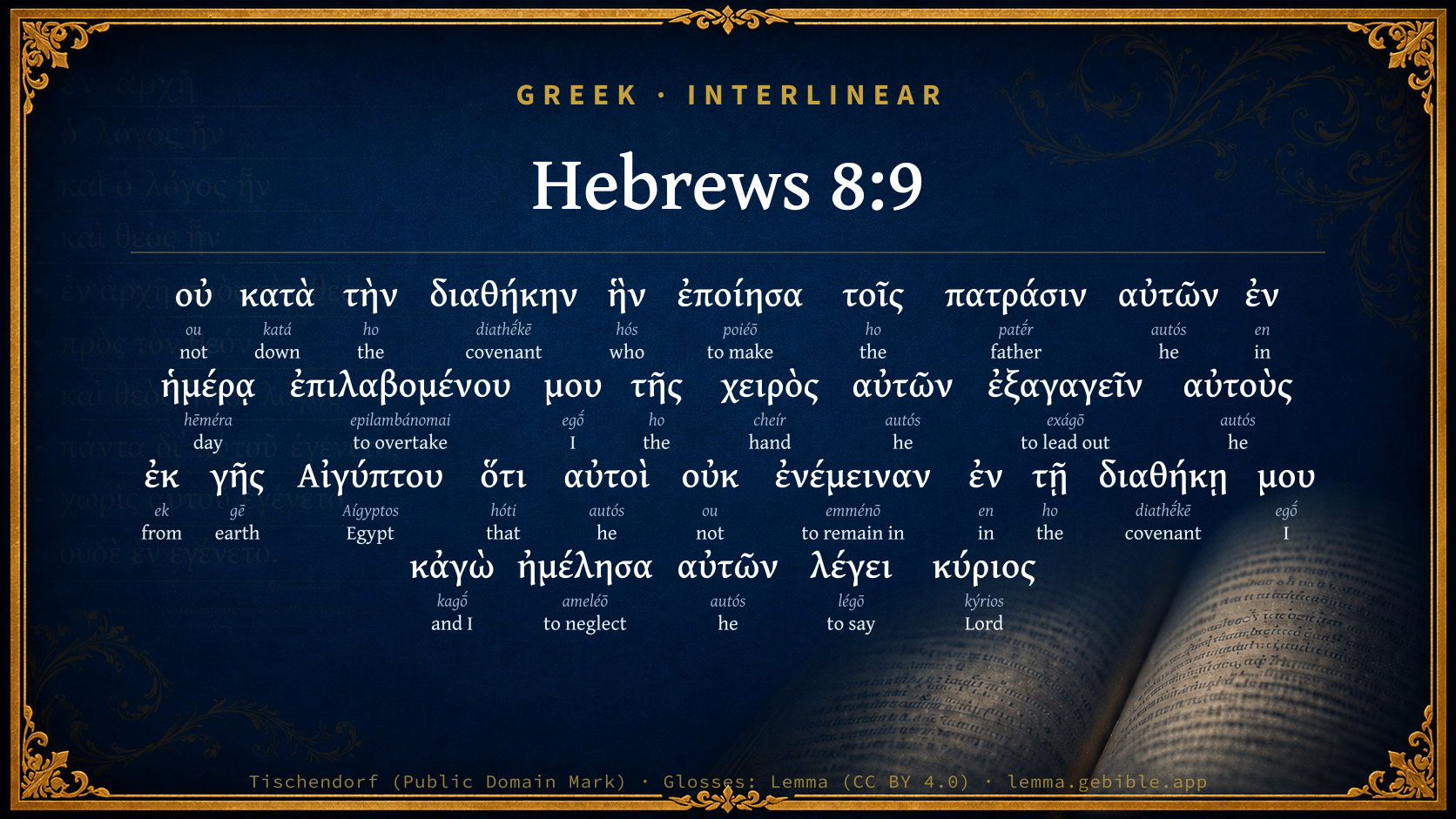
Greek (Tischendorf 8th ed.) Hebrews 8:9 appears in the Greek New Testament. The text above is from the Tischendorf 8th edition. Each word links to its Strong’s number and a concise gloss. Click any word for its full Thayer’s Greek Lexicon entry.
Download image
Cite this verse

Hebrews 8:9 (World English Bible). Public Domain. Lemma interlinear Bible study tool, https://lemma.gebible.app/v/hebrews/8/9.

Show BibTeX & RIS
BibTeX
RIS
English Translation
Not according to the covenant that I made with their fathers, In the day that I took them by the hand to lead them out of the land of Egypt; For they didn't continue in my covenant, And I disregarded them," says the Lord.
World English Bible · Public Domain
Download a study sheet

One document with this verse’s original text, its word-by-word gloss line, the meaning frame, cross-references with their text, attributed commentary, and full source and license credits — printable, and it pastes into notes with its structure intact.

This verse Autodidact and up

Study sheet (.html) Plain text (.txt)

A passage Seminary Student

Up to 50 verses in one chapter. A passage sheet keeps up to 6 commentary sources and 12 cross-references per verse, in the order this page ranks them, and says so on the sheet whenever that leaves anything out. Ask for a single verse and you get the Autodidact verse sheet above.

Everything on this page stays free to read, with no account — the sheet is a download of what is already on screen, not access to it.

Want to remove ads? Support Godless Engineer
Compare translations 3

The same verse in 3 English versions, stacked beneath the original-language interlinear above. Click any original word for its lexicon entry.

Each is an independent rendering of the whole verse — the interlinear is not word-aligned to these translations.

Highlighted words mark where these versions differ — a whole-verse word diff, not a word-by-word alignment.

  • World English Bible Public Domain
    Not according to the covenant that I made with their fathers, In the day that I took them by the hand to lead them out of the land of Egypt; For they didn't continue in my covenant, And I disregarded them," says the Lord.
  • King James Version Public Domain
    Not according to the covenant that I made with their fathers in the day when I took them by the hand to lead them out of the land of Egypt; because they continued not in my covenant, and I regarded them not, saith the Lord.
  • unfoldingWord Literal Text CC BY-SA 4.0
    not according to the covenant that I made with their fathers on the day I grasped their hand to lead them out of the land of Egypt, because they did not continue in my covenant, and I did not care about them, says the Lord.

unfoldingWord Literal Text — © unfoldingWord, licensed CC BY-SA 4.0. Word-aligned USFM3 via Door43 (git.door43.org/unfoldingWord/en_ult).

Versions to compare (up to 4)

3 of 4 selected

Show all 19 translations

Every available English version of this verse, each an independent rendering of the whole verse.

  • World English Bible Public Domain
    Not according to the covenant that I made with their fathers, In the day that I took them by the hand to lead them out of the land of Egypt; For they didn't continue in my covenant, And I disregarded them," says the Lord.
  • Berean Standard Bible Public Domain
    It will not be like the covenant I made with their fathers when I took them by the hand to lead them out of the land of Egypt, because they did not abide by My covenant, and I disregarded them, declares the Lord.
  • Majority Standard Bible Public Domain
    It will not be like the covenant I made with their fathers when I took them by the hand to lead them out of the land of Egypt, because they did not abide by My covenant, and I disregarded them, declares the Lord.
  • King James Version Public Domain
    Not according to the covenant that I made with their fathers in the day when I took them by the hand to lead them out of the land of Egypt; because they continued not in my covenant, and I regarded them not, saith the Lord.
  • American Standard Version (1901) Public Domain
    Not according to the covenant that I made with their fathers In the day that I took them by the hand to lead them forth out of the land of Egypt; For they continued not in my covenant, And I regarded them not, saith the Lord.
  • Revised Version (1885) Public Domain
    Not according to the covenant that I made with their fathers In the day that I took them by the hand to lead them forth out of the land of Egypt; For they continued not in my covenant, And I regarded them not, saith the Lord.
  • Geneva Bible (1599) Public Domain
    Not like the Testament that I made with their fathers, in the day that I tooke them by the hand, to leade them out of the land of Egypt: for they continued not in my Testament, and I regarded them not, saith the Lord.
  • Douay-Rheims (1899) Public Domain
    Not according to the testament which I made to their fathers, on the day when I took them by the hand to lead them out of the land of Egypt: because they continued not in my testament: and I regarded them not, saith the Lord.
  • Young's Literal Translation Public Domain
    not according to the covenant that I made with their fathers, in the day of My taking `them' by their hand, to bring them out of the land of Egypt -- because they did not remain in My covenant, and I did not regard them, saith the Lord, --
  • Literal Standard Version CC BY-SA 4.0
    not according to the covenant that I made with their fathers, in the day of My taking [them] by their hand, to bring them out of the land of Egypt—because they did not remain in My covenant, and I did not regard them, says the LORD—
  • Unlocked Literal Bible CC BY-SA 4.0
    It will not be like the covenant that I made with their ancestors on the day that I took them by their hand to lead them out of the land of Egypt. For they did not carefully obey my covenant, and I disregarded them —says the Lord.
  • unfoldingWord Literal Text CC BY-SA 4.0
    not according to the covenant that I made with their fathers on the day I grasped their hand to lead them out of the land of Egypt, because they did not continue in my covenant, and I did not care about them, says the Lord.
  • Darby Bible Public Domain
    not according to the covenant which I made to their fathers in [the] day of my taking their hand to lead them out of the land of Egypt; because *they* did not continue in my covenant, and *I* did not regard them, saith [the] Lord.
  • World Messianic Bible Public Domain
    not according to the covenant that I made with their fathers in the day that I took them by the hand to lead them out of the land of Egypt; for they didn’t continue in my covenant, and I disregarded them,” says the Lord.
  • Webster's Bible Public Domain
    Not according to the covenant that I made with their fathers, in the day when I took them by the hand to lead them out of the land of Egypt; because they continued not in my covenant, and I regarded them not, saith the Lord.
  • Free Bible Version CC BY-SA 4.0
    This will not be like the agreement I made with their forefathers when I led them by the hand out of the land of Egypt. For they didn't keep their part of the agreed relationship, so I gave up on them, says the Lord.
  • Bible in Basic English Public Domain
    Not like the agreement which I made with their fathers when I took them by the hand, to be their guide out of the land of Egypt; for they did not keep the agreement with me, and I gave them up, says the Lord.
  • Text-Critical English NT CC BY 4.0
    not like the covenant I made with their fathers on the day when I took them by the hand to lead them out of the land of Egypt. For they did not continue in my covenant, so I had no regard for them, says the Lord.
  • Tyndale New Testament (1534) Public Domain
    not lyke the testament that I made with their fathers at that tyme when I toke them by the hondes to lede them oute of the londe of Egipte for they continued not in my testament and I regarded them not sayth the lorde.

Literal Standard Version (2020), Covenant Press — licensed CC BY-SA 4.0. Text via the HelloAO Bible API (eBible.org). Unlocked Literal Bible (unfoldingWord) — licensed CC BY-SA 4.0. Text via the HelloAO Bible API (eBible.org). unfoldingWord Literal Text — © unfoldingWord, licensed CC BY-SA 4.0. Word-aligned USFM3 via Door43 (git.door43.org/unfoldingWord/en_ult). Free Bible Version, Dr. Jonathan Gallagher — licensed CC BY-SA 4.0. Text via the HelloAO Bible API (eBible.org).

Word by word

More ways to search: Search by grammar → Find every occurrence → Compare this word →

Practice this passage: Drill this verse → Learn its vocabulary →

ἐνέμειναν
emménō
G1696
“to remain in”
Verb, Aorist, Active, Indicative, 3rd person, Plural
Part of Speech
Verb
Tense
Aorist
Voice
Active
Mood
Indicative
Person
3rd person
Number
Plural
Full Thayer's Definition

Origin: from G1722 and G3306

TDNT: 13:36,6

1. to remain in, continue 2. to persevere in anything, a state of mind etc. 3. to hold fast, to be true to, abide by, keep
  1. οὐ ou G3756 “not” Particle, Negative
  2. κατὰ katá G2596 “down” Preposition
  3. τὴν ho G3588 “the” Article, Accusative, Singular, Feminine
  4. διαθήκην diathḗkē G1242 “covenant” Noun, Accusative, Singular, Feminine
  5. ἣν hós G3739 “who” Relative pronoun, Accusative, Singular, Feminine
  6. ἐποίησα poiéō G4160 “to make” Verb, Aorist, Active, Indicative, 1st person, Singular
  7. τοῖς ho G3588 “the” Article, Dative, Plural, Masculine
  8. πατράσιν patḗr G3962 “father” Noun, Dative, Plural, Masculine
  9. αὐτῶν autós G846 “he” Personal pronoun, Genitive, Plural, Masculine
  10. ἐν en G1722 “in” Preposition
  11. ἡμέρᾳ hēméra G2250 “day” Noun, Dative, Singular, Feminine
  12. ἐπιλαβομένου epilambánomai G1949 “to overtake” Verb, Aorist, Middle deponent, Participle, Genitive, Singular, Masculine
  13. μου egṓ G1473 “I” Personal pronoun, 1st person, Genitive, Singular
  14. τῆς ho G3588 “the” Article, Genitive, Singular, Feminine
  15. χειρὸς cheír G5495 “hand” Noun, Genitive, Singular, Feminine
  16. αὐτῶν autós G846 “he” Personal pronoun, Genitive, Plural, Masculine
  17. ἐξαγαγεῖν exágō G1806 “to lead out” Verb, Aorist, Active, Infinitive
  18. αὐτοὺς autós G846 “he” Personal pronoun, Accusative, Plural, Masculine
  19. ἐκ ek G1537 “from” Preposition
  20. γῆς gē G1093 “earth” Noun, Genitive, Singular, Feminine
  21. Αἰγύπτου Aígyptos G125 “Egypt” Noun, Genitive, Singular, Feminine
  22. ὅτι hóti G3754 “that” Conjunction
  23. αὐτοὶ autós G846 “he” Personal pronoun, Nominative, Plural, Masculine
  24. οὐκ ou G3756 “not” Particle, Negative
  25. ἐν en G1722 “in” Preposition
  26. τῇ ho G3588 “the” Article, Dative, Singular, Feminine
  27. διαθήκῃ diathḗkē G1242 “covenant” Noun, Dative, Singular, Feminine
  28. μου egṓ G1473 “I” Personal pronoun, 1st person, Genitive, Singular
  29. κἀγὼ kagṓ G2504 “and I” Personal pronoun, 1st person, Nominative, Singular, Aramaic form
  30. ἠμέλησα ameléō G272 “to neglect” Verb, Aorist, Active, Indicative, 1st person, Singular
  31. αὐτῶν autós G846 “he” Personal pronoun, Genitive, Plural, Masculine
  32. λέγει légō G3004 “to say” Verb, Present, Active, Indicative, 3rd person, Singular
  33. κύριος kýrios G2962 “Lord” Noun, Nominative, Singular, Masculine

About this verse

These counts appear in no published source. They are computed here, from the morphology-tagged text and Lemma’s own curated glosses. What Lemma adds →

34
words
23
distinct lemmas
General Epistles
section

Notable vocabulary

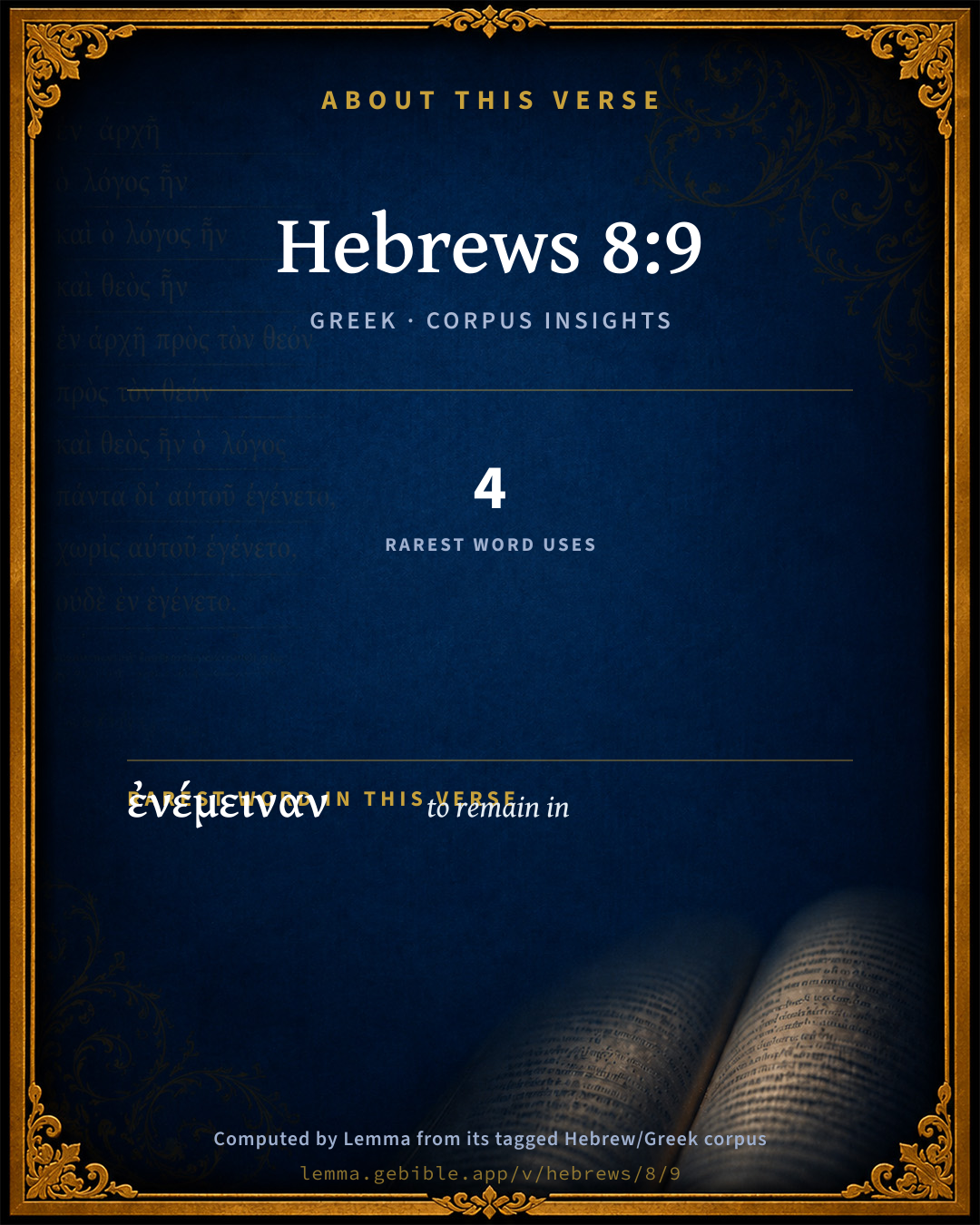
The rarest word here is ἐνέμειναν to remain in G1696 — appearing just 4 times in the whole Greek New Testament.

Shared distinctive vocabulary

ἐνέμειναν to remain in G1696 occurs in 4 verses of the Greek New Testament. Also found in:

Repetition

Words recur within this verse:

Cross-references

42

Topical passages linked to Hebrews 8:9 in the Treasury of Scripture Knowledge — connected by theme and wording, ordered by reader-vote popularity; previews shown in the World English Bible.

  • Jeremiah 31:32 not according to the covenant that I made with their fathers in the day that I took them by the hand to bring them out of the land of Egypt; which my covenant they broke, although I was a husband to them, says Yahweh.
  • Galatians 4:24 These things contain an allegory, for these are two covenants. One is from Mount Sinai, bearing children to bondage, which is Hagar.
  • Mark 8:23 He took hold of the blind man by the hand, and brought him out of the village. When he had spit on his eyes, and laid his hands on him, he asked him if he saw anything.
  • Genesis 19:16 But he lingered; and the men laid hold on his hand, and on the hand of his wife, and on the hand of his two daughters, Yahweh being merciful to him; and they took him out, and set him outside of the city.
  • Exodus 24:3–11 Moses came and told the people all the words of Yahweh, and all the ordinances; and all the people answered with one voice, and said, "All the words which Yahweh has spoken will we do."
  • Exodus 34:10 He said, "Behold, I make a covenant: before all your people I will do marvels, such as have not been worked in all the earth, nor in any nation; and all the people among which you are shall see the work of Yahweh; for it is an awesome thing that I do with you.
  • Deuteronomy 5:2–3 Yahweh our God made a covenant with us in Horeb.
  • Deuteronomy 29:1 These are the words of the covenant which Yahweh commanded Moses to make with the children of Israel in the land of Moab, besides the covenant which he made with them in Horeb.
  • Deuteronomy 29:12 that you may enter into the covenant of Yahweh your God, and into his oath, which Yahweh your God makes with you this day;
  • Deuteronomy 29:25 Then men shall say, Because they forsook the covenant of Yahweh, the God of their fathers, which he made with them when he brought them forth out of the land of Egypt,
  • Deuteronomy 31:16–18 Yahweh said to Moses, Behold, you shall sleep with your fathers; and this people will rise up, and play the prostitute after the strange gods of the land, where they go to be among them, and will forsake me, and break my covenant which I have made with them.
  • 2 Kings 17:15–18 They rejected his statutes, and his covenant that he made with their fathers, and his testimonies which he testified to them; and they followed vanity, and became vain, and [went] after the nations that were round about them, concerning whom Yahweh had charged those who they should not do like them.
  • Job 8:20 "Behold, God will not cast away a blameless man, Neither will he uphold the evil-doers.
  • Psalms 77:20 You led your people like a flock, By the hand of Moses and Aaron.
  • Psalms 78:10–11 They didn't keep God's covenant, And refused to walk in his law.
  • Psalms 78:57 But turned back, and dealt treacherously like their fathers. They were turned aside like a deceitful bow.
  • Psalms 105:43 He brought forth his people with joy, His chosen with singing.
  • Song of Solomon 8:5 Who is this who comes up from the wilderness, Leaning on her beloved? Under the apple tree I aroused you. There your mother conceived you. There she was in labor and bore you.
  • Isaiah 24:5–6 The earth also is polluted under the inhabitants of it; because they have transgressed the laws, violated the statutes, broken the everlasting covenant.
  • Isaiah 40:11 He will feed his flock like a shepherd, he will gather the lambs in his arm, and carry them in his bosom, [and] will gently lead those who have their young.
  • Isaiah 63:9 In all their affliction he was afflicted, and the angel of his presence saved them: in his love and in his pity he redeemed them; and he bore them, and carried them all the days of old.
  • Jeremiah 11:7–8 For I earnestly protested to your fathers in the day that I brought them up out of the land of Egypt, even to this day, rising early and protesting, saying, Obey my voice.
  • Jeremiah 22:8–9 Many nations shall pass by this city, and they shall say every man to his neighbor, Why has Yahweh done thus to this great city?
  • Ezekiel 16:8 Now when I passed by you, and looked at you, behold, your time was the time of love; and I spread my skirt over you, and covered your nakedness: yes, I swore to you, and entered into a covenant with you, says the Lord Yahweh, and you became mine.
  • Ezekiel 16:59 For thus says the Lord Yahweh: I will also deal with you as you have done, who have despised the oath in breaking the covenant.
  • Ezekiel 20:37–38 I will cause you to pass under the rod, and I will bring you into the bond of the covenant;
  • Amos 5:22 Yes, though you offer me your burnt offerings and meal-offerings, I will not accept them; Neither will I regard the peace offerings of your fat animals.
  • Malachi 2:13 This again you do: you cover the altar of Yahweh with tears, with weeping, and with sighing, because he doesn't regard the offering any more, neither receives it with good will at your hand.
  • Acts 9:8 Saul arose from the ground, and when his eyes were opened, he saw no one. They led him by the hand, and brought him into Damascus.
  • Acts 13:11 Now, behold, the hand of the Lord is on you, and you will be blind, not seeing the sun for a season!" Immediately there fell on him a mist and darkness. He went around seeking someone to lead him by the hand.
  • Galatians 3:15–19 Brothers, I speak like men. Though it is only a man's covenant, yet when it has been confirmed, no one makes it void, or adds to it.
  • Hebrews 9:18–20 Therefore even the first covenant has not been dedicated without blood.
  • Exodus 19:4–5 'You have seen what I did to the Egyptians, and how I bore you on eagles' wings, and brought you to myself.
  • Joshua 23:15–16 It shall happen, that as all the good things are come on you of which Yahweh your God spoke to you, so will Yahweh bring on you all the evil things, until he have destroyed you from off this good land which Yahweh your God has given you.
  • Judges 10:13–14 Yet you have forsaken me, and served other gods: therefore I will save you no more.
  • Isaiah 41:13 For I, Yahweh your God, will hold your right hand, saying to you, Don't be afraid; I will help you.
  • Isaiah 63:11–13 Then he remembered the days of old, Moses [and] his people, [saying], Where is he who brought them up out of the sea with the shepherds of his flock? where is he who put his holy Spirit in the midst of them?
  • Exodus 32:8 They have turned aside quickly out of the way which I commanded them. They have made themselves a molten calf, and have worshiped it, and have sacrificed to it, and said, 'These are your gods, Israel, which brought you up out of the land of Egypt.'"
  • Psalms 78:52–54 But he led forth his own people like sheep, And guided them in the wilderness like a flock.
  • Psalms 136:11–14 And brought out Israel from among them; For his loving kindness endures forever;
  • Isaiah 51:18 There is none to guide her among all the sons whom she has brought forth; neither is there any who takes her by the hand among all the sons who she has brought up.
  • Lamentations 4:16 The anger of Yahweh has scattered them; he will no more regard them: They didn't respect the persons of the priests, they didn't favor the elders.

Cross-references courtesy of OpenBible.info (CC BY 4.0).

Commentary

Notes on Hebrews 8:9 from classic Christian and Jewish commentators (each source and its license shown beneath its notes). The classic Christian expositions comment on the surrounding passage and are grouped to its opening verse, so a note may address several verses; the Jewish commentaries on the Tanakh (Rashi and others) are per-verse, so they appear only where the commentator wrote on this verse.

Lemma curates 59 commentaries, every one of them public domain or Creative Commons licensed, each selected and text-cleaned for this edition rather than reprinted as found. About our sources →

Tyndale Open Study Notes

Tyndale Open Resources

8:9 God made a covenant with their ancestors at Sinai (Exod 19:1-8; 24:7-8; 34:27-28; Deut 4:13). • I took them by the hand: In rescuing his people from the land of Egypt, God led them as a parent might lead a child that could not fend for itself (see Exod 12–14). • They did not remain faithful: See Heb 3:7-19; Num 14:1-38; Deut 9; Ps 106. • so I turned my back on them: The covenant warned that if the people turned away, God would turn away from them (see Deut 28:15-68; 30:11-20; 1 Kgs 8:22-53; 2 Chr 6:12-42).

Tyndale Open Study Notes — © Tyndale Open Resources, licensed CC BY-SA 4.0. Text via the HelloAO Bible API.

Bengel's Gnomon

Johann Albrecht Bengel

Heb 8:9. Ἐποίησα, I made) LXX., διεθέμην, I have arranged or disposed. To perfect is more than to make and dispose.—ἡμέρᾳ, in the day) Days, in the plural, are opposed to this one day, Heb 8:8. These many days are the days that intervened between the day of the Exodus and the New Testament.—ἐπιλαβομένου μου τῆς χειρὸς αὐτῶν, when I took them by the hand) Whilst their sense of the Divine help and power was recent, these men in old times obeyed; but they were wont soon to revolt and turn God from them. This was their custom; comp. presently after, they continued not. It was not merely one singular act.—ἐκ γῆς Αἰγύπτου, out of the land of Egypt) There are three periods:—1. That of the promise; 2. That of instruction (pædagogiæ); 3. That of fulfilment. The instruction (as children) began at the time of the departure from Egypt, with that which was destined to become old (Heb 8:13).—αὐτοὶ οὐκ ἐνέμειναν ἐν τῇ διαθήκῃ μου, κᾀγὼ ἠμέλησα αὐτῶν, they did not continue in My covenant, and I did not regard (care for) them) Correlatives, as Heb 8:10, from the opposite, I will be to them a GOD, and they shall be to Me a people; but the method of proceeding is now reversed: the people had begun first to put an end to the covenant: God both begins and perfects all things in the new covenant, Heb 8:10-11.—κᾀγὼ ἠμέλησα αὐτῶν) LXX., καὶ ἐγὼ ἠμέλησα αὐτῶν, and I did not regard them. ואנכי בעלתי בם, and I ruled over them; although some claim for the verb בעל, the meaning געל, disregard, from the Arabic idiom. God’s ruling and disregard may, in some measure, be reconciled in this view: I treated them as if they were not Mine; Hos 1:9: nor was I propitious to their sins; Deu 29:19; Deu 31:16, etc. They are not regarded over whom such lordly rule is exercised; they do not rejoice in (are not privileged with) that access, in which those who are in covenant or in friendship rejoice; Joh 15:15: but they are treated as slaves; nor are they held in great consideration, whatever may befall them; Eze 24:6, at the end; Jer 15:1-2. The passages, Jer 3:14, Eze 20:33; Eze 20:37, express a somewhat similar idea: but in both places there is rather a promise than a threatening; nay, even in the present, Jer 31:32. The Hebrew Masters, as Surenhusius shows, in βίβλῷ καταλλαγῆς, p. 628, understand the word בעלתי to apply to the dominion of love and good pleasure; and it is not, save by an error in writing, that they turn it into the contrary, בחלתי, I have disdained or disregarded (fastidivi). The LXX. seem evidently to have read געלתי בם, which very word Jeremiah uses, ch. Jer 14:19, μὴ ἀπὸ Σιὼν ἀπέστη (געלה) ἡ ψυχή σου; hath thy soul loathed Sion?

Bengel's Gnomon of the New Testament — English translation (T&T Clark, Edinburgh, 1860) — public domain. Text from a community e-Sword module.

Meyer's Critical & Exegetical Commentary

Heinrich August Wilhelm Meyer

Heb_8:9. Οὐ κατὰ τὴν διαθήκην, ἣν ἐπίησα τοῖς πατράσιν αὐτῶν] negative unfolding of the foregoing positive expression καινήν (namely, a covenant): not after the manner of the covenant (לֹא כַבְּרִית) which I made for their fathers, i.e. one qualitatively different therefore, and that as being a better one.

ἣν ἐποίησα] LXX.: ἣν διεθέμην.

τοῖς πατράσιν αὐτῶν] in the Hebrew אֶת־אֲבו̇תָם, with their fathers. The mere dative with ἐποίησα excludes the notion of reciprocity in the covenant-founding which has taken place, and presents it purely as the work of the disposition made by God.

ἐν ἡμέρᾳ ἐπιλαβομένου μου κ.τ.λ.] in the day (at the time) when I look hold of their hand, to lead them forth out of the land of Egypt (בְּיו̇ם הֶחֱזִיקִי בְיָדָם לְחו̇צִיאָם מֵאֶרֶץ מִצְרָיִם). An unwieldy but not exactly incorrect construction (see Winer, Gramm., 7 Aufl. p. 531), in place of which Justin Martyr, Dial. cum Tryph. Jud_1:11, in citing the same words of Scripture, has chosen the less cumbrous ἐν ᾗ ἐπελαβόμην. The note of time characterizes the covenant as the Mosaic one.

ὅτι] for; not: because, as protasis to κἀγὼ κ.τ.λ. as the apodosis (Calvin, Böhme, Hofmann, al.).

κἀγώ] emphatic personal opposition to αὐτοί: and consequently I also concerned not myself about them.

λέγει κύριος] LXX. (Cod. Alex. too): φησὶ κύριος.

Meyer — Critical and Exegetical Commentary on the New Testament — English translation by Peter Christie, edited by Frederick Crombie (T&T Clark, 1880) — public domain. Text from a community e-Sword module.

Expositor's Greek Testament

ed. W. Robertson Nicoll

Heb 8:9 . οὐ κατὰ τὴν διαθήκην … “Not according to the covenant which I made with their fathers.” These words express negatively wherein the καινότης of the covenant consists. It was not to be a repetition of that which had failed. It was to be framed with a view to avoiding the defects of the old. It must not be such a covenant as dealt in symbols and externals. That former covenant is further defined in the words ἣν ἐποίησα …, a clause which is intended to remind the readers that it was through no lack of power or grace on God’s part that the covenant had failed. His intention and power to fulfil His part was put beyond doubt by the deliverance from Egypt. ἐν ἡμέρᾳ ἐπιλαβομένου μου τ . χειρὸς αὐτῶν … “sicut nutrix apprehendit manum parvuli, vel qui de fovea per manum attrahit aliquem sive secum ducit” (Herveius). The construction determined by the Hebrew, which, however, has the infinitive not the participle, is, according to Winer (710) “perhaps unusual, but not incorrect.” Buttmann, however, (316) condemns it as “a perfectly un-Greek construction” and “nothing more than a thoughtless imitation of the original Hebrew, of which no other similar example is to be found in the N.T.” Cf. Bar 2:28 ἐν ἡμέρᾳ ἐντειλαμένου σου , κ . τ . λ . Cf. Viteau, Gram . p. 209 10. On ἐπιλαβ . see Heb 2:16 . ὅτι αὐτοὶ οὐκ ἐνέμειναν “because they continued not in my covenant, and I regarded them not, saith the Lord”. Both parties abandoned the covenant and so it became null. Bengel’s note on this clause is this: “Correlata, uti Heb 8:10 , ex opposito: Ero eis in Deum, et illi erunt mihi in populum ; sed ratione inversa: populus fecerat initium tollendi foederis prius: in novo omnia et incipit et perficit Deus”. The pronouns are emphatic in both clauses κἀγὼ ἠμέλησα αὐτῶν representing וְאָנֹכַי בָּעַלְתִי בָּם which in A.V. is rendered “although I was an husband to them.” Grotius suggests a variant in the Hebrew as giving rise to the translation ἠμέλησα but it seems to be justified by an analogous Arabic expression (see Moses Stuart in loc . and Bleek).

The Expositor's Greek Testament, edited by W. Robertson Nicoll (1897–1910) — public domain. Text from a community e-Sword module.

Jamieson, Fausset & Brown

Robert Jamieson, A. R. Fausset & David Brown

Not according to, &c.--very different from, and far superior to, the old covenant, which only "worked wrath" (Rom 4:15) through man's "not regarding" it. The new covenant enables us to obey by the Spirit's inward impulse producing love because of the forgiveness of our sins.

made with--rather as Greek, "made to": the Israelites being only recipients, not coagents [ALFORD] with God.

I took them by the hand--as a father takes his child by the hand to support and guide his steps. "There are three periods: (1) that of the promise; (2) that of the pedagogical instruction; (3) that of fulfilment" [BENGEL]. The second, that of the pedagogical pupilage, began at the exodus from Egypt.

I regarded them not--English Version, Jer 31:32, translates, "Although I was an husband unto them." Paul's translation here is supported by the Septuagint, Syriac, and GESENIUS, and accords with the kindred Arabic. The Hebrews regarded not God, so God, in righteous retribution, regarded them not. On "continued not in my covenant," Schelling observes: The law was in fact the mere ideal of a religious constitution: in practice, the Jews were throughout, before the captivity, more or less polytheists, except in the time of David, and the first years of Solomon (the type of Messiah's reign). Even after the return from Babylon, idolatry was succeeded by what was not much better, formalism and hypocrisy (Mat 12:43). The law was (1) a typical picture, tracing out the features of the glorious Gospel to be revealed; (2) it had a delegated virtue from the Gospel, which ceased, therefore, when the Gospel came.

Jamieson, Fausset & Brown — Commentary Critical and Explanatory on the Whole Bible (1871) — public domain (CC PDM 1.0). Text via the HelloAO Bible API.

Adam Clarke's Commentary

Verse 9. Not according to the covenant] The new covenant is of a widely different nature to that of the old; it was only temporal and earthly in itself, though it pointed out spiritual and eternal things. The new covenant is totally different from this, as we have already seen; and such a covenant, or system of religion, the Jews should have been prepared to expect, as the Prophet Jeremiah had, in the above place, so clearly foretold it.

They continued not in my covenant] It should be observed that the word διαθνκν, which we translate covenant, often means religion itself; and its various precepts. The old covenant in general stated, on God's side, I will be your God; on the Israelites' side, We will be thy people. This covenant they brake; they served other gods, and neglected the precepts of that holy religion which God had delivered to them.

And I regarded them not] Καγω ημελησα αυτων· And I neglected them or despised them; but the words in the Hebrew text of the prophet are ואנכי בעלתי בם veanochi baalti bam, which we translate, although I was a husband to them. If our translation be correct, is it possible to account for this most strange difference between the apostle and the prophet? Could the Spirit of God be the author of such a strange, not to say contradictory, translation of the same words? Let it be observed:

1. That the apostle quotes from the Septuagint; and in quoting a version accredited by and commonly used among the Jews, he ought to give the text as he found it, unless the Spirit of God dictated an extension of meaning, as is sometimes the case; but in the present case there seems to be no necessity to alter the meaning.

2. The Hebrew words will bear a translation much nearer to the Septuagint and the apostle than our translation intimates. The words might be literally rendered, And I was Lord over them, or I lorded or ruled over them; i.e., I chastised them for their transgressions, and punished them for their iniquities; ημελησα, I took no farther care of them, and gave them up into the hands of their enemies, and so they were carried away into captivity. This pretty nearly reconciles the Hebrew and the Greek, as it shows the act of God in reference to them is nearly the same when the proper meaning of the Hebrew and Greek words is considered.

Some suppose that the letter ע ain in בעלתי is changed for ח cheth, and that the word should be read בחלתי bachalti, I have hated or despised them. An ancient and learned Jew, Rab. Parchon, has these remarkable words on this passage,

ואנכי בעלתי בם׃ פ

שנאתים וזו העין מתחלבה כחית שג

וגם נכשם כחלה בי׃ פ

שנאה אותי,

and I baatti baam, translate, I hated them; for ע ain is here changed and stands for ח cheth, as it is said, their soul bachalah bi, translate, hath hated me." None of the Hebrew MSS. collated by Kennicott and De Rossi give any various reading on this word. Some of the versions have used as much latitude in their translations of the Hebrew as the Septuagint. But it is unnecessary to discuss this subject any farther; the word בעל baal itself, by the consent of the most learned men, signifies to disdain or despise, and this is pretty nearly the sense of the apostle's expression.

Adam Clarke's Commentary on the Bible (1810–1826) — public domain. Text from a community e-Sword/MySword module.

John Calvin's Commentaries

9. Not according to the covenant, etc. Here is expressed the difference between the covenant which then existed and the new one which he caused them to expect. The Prophet might have otherwise said only: “I will renew the covenant which through your fault has come to nothing;” but he now expressly declares that it would be one unlike the former. By saying that the covenant was made in the day when he laid holds on their hand to rescue them from bondage, he enhanced the sin of defection by thus reminding them of so great a benefit. At the same time he did not accuse one age only of ingratitude; but as these very men who had been delivered immediately fell away, and as their posterity after their example continually relapsed, hence the whole nation had become covenant-breakers.

By saying that he disregarded them or cared not for them, he intimates that it would profit them nothing to have been once adopted as his people, unless he succored them by this new kind of remedy. At the same time the Prophet expresses in Hebrew something more; but this has little to do with the present question.

John Calvin's Commentaries (1540-1563) — public domain. Text from the Calvin Translation Society English edition (1840s-50s) via the Christian Classics Ethereal Library (ccel.org). Calvin's coverage is partial (roughly two-thirds of the Bible); uncommented books and verses are honest gaps, never fabricated. The 19th-century editor's footnotes and remarks are omitted so the notes are faithfully Calvin's own voice.

Ellicott's Commentary for English Readers

(9) Not according to the covenant.—The difference is declared below (Heb_8:10-12). “In the day when” they were led forth out of Egypt the token of God’s covenant was the deliverance itself. At Sinai, Exo_24:7-8 (see Heb_9:18-22), the “book of the covenant” was read, and “the blood of the covenant” was “sprinkled on the people,” who had promised obedience to all the words that the Lord had said.

And I regarded them not.—It is here that the translation departs from the Hebrew, which, as is now generally believed, is faithfully represented in our Authorised version: “although I was an husband unto them” (that is, had the authority of a husband). The quotation here follows the LXX. without change.

A Bible Commentary for English Readers, edited by Charles John Ellicott (1878–1897) — public domain. Text from a community e-Sword module.

The Cambridge Bible for Schools and Colleges

gen. ed. J. J. S. Perowne

9. I took them by the hand] See note on Heb_2:16.

because they continued not in my covenant] The disobedience of the Israelites was a cause for nullifying the covenant which they had transgressed (Jdg_2:20-21; 2Ki_17:15-18). Comp. Hos_1:9, “Ye are not my people, and I will not be your God.”

and I regarded them not] These words correspond to the “though I was a husband unto them” of the original. The quotation is from the LXX., who perhaps followed a slightly different reading. Rabbi Kimchi holds that the rendering of the LXX. is justifiable even with the present reading.

The Cambridge Bible for Schools and Colleges (gen. ed. J. J. S. Perowne; Cambridge University Press, 1878–1918) — public domain. Text from a community e-Sword module.

John Gill's Exposition

Not according to the covenant that I made with their fathers,.... The ancestors of the Jews at Mount Sinai:

in the day when I took then, by the hand to lead them out of the land of Egypt; which is mentioned, not only to observe the time when the former covenant was made with the Israelites, which was just upon their deliverance out of Egypt; but also to show their weakness and inability to have delivered themselves, and the tenderness of God towards them; they were like children, they could not help themselves when God took them by the hand, and brought them forth with an outstretched arm; and likewise to expose their ingratitude, and vindicate his conduct towards them:

because they continued not in my covenant; though they promised, at the reading of it, that all that the Lord had said, they would hear and do; but their hearts were not right with God, and they were not steadfast in his covenant, and therefore their carcasses fell in the wilderness:

and I regarded them not, saith the Lord; the words in Jer 31:32 are very differently rendered in our translation, "although I was an husband unto them": and so it becomes an aggravation of their sin of ingratitude, in not continuing in his covenant: in the margin it is rendered interrogatively, "should I have continued an husband unto them?" that is, after they had so treated him, no; as if he should say, I will not behave towards them as such; I will reject them, and disregard them. The Chaldee paraphrase is just the reverse of the apostle's translation, "and I was well pleased with them": some render them, "I ruled over them", as a lord over his servants, in a very severe manner. Others, observing the great difference there is between the Hebrew text, and the apostle's version, have supposed a different Hebrew copy from the present, used by the Septuagint, or the apostle, in which, instead of it was read either or but there is no need of such a supposition, since Dr. Pocock (g) has shown, that in the Arabic language, signifies to loath and abhor, and so to disregard; and Kimchi (h) relates it as a rule laid down by his father, that wherever this word is used in construction with it is to be taken in an ill part, and signifies the same as "I have loathed"; in which sense that word is used in Zac 11:8 and so here, I have loathed them, I abhorred them, I rejected them, I took no care of them, disregarded them, left their house desolate, and suffered wrath to come upon them to the uttermost.

(g) Not. Miscell. in Port. Mesis, p. 9. (h) In Jer. xxxi. 32. & Sepher Shorashim, rad.

John Gill's Exposition of the Whole Bible (1746–1763) — public domain (CC PDM 1.0). Text via the HelloAO Bible API.

Trapp's Complete Commentary

John Trapp

9 Not according to the covenant that I made with their fathers in the day when I took them by the hand to lead them out of the land of Egypt; because they continued not in my covenant, and I regarded them not, saith the Lord.

Ver. 9. The covenant that I made] He meaneth not here the covenant of grace made with Abraham, but circumcision, the legal ceremonies and services, that burden which neither they nor their fathers could bear.

When I took them by the hand] Teaching them to go, taking them by the arms, Hos 11:3, keeping their feet, 1Sa 2:9, and leading them through the deep, as a horse in the wilderness, that they should not stumble, Isa 63:13.

And I regarded them not] Heb. Although I was a husband unto them, q.d. Yet nevertheless they forsook the guide of their youth, and forgat the covenant of their God, Jer 31:32; Pro 2:17. Therefore God regarded them not, or cared not for them, as the Greek hath it, ημελησα. "If you forsake him, he will forsake you," 2Ch 15:2.

John Trapp, A Commentary or Exposition upon All the Books of the Old and New Testament (1647–1656) — public domain. Text from a community e-Sword module.

Albert Barnes' Notes on the Bible

Not according to the covenant ... - An arrangement or dispensation relating mainly to outward observances, and to temporal blessings. The meaning is, that the new dispensation would be different from what was made with them when they came out of Egypt. In what respects it would differ is specified in Heb 8:10-12.

Because they continued not in my covenant - In Jeremiah, in the Hebrew, this is, “while my covenant they brake.” That is, they failed to comply with the conditions on which I promised to bestow blessings upon them. In Jeremiah this is stated as a simple fact; in the manner in which the apostle quotes it, it is given as a reason why he would give a new arrangement. The apostle has quoted it literally from the Septuagint, and the sense is not materially varied. The word rendered “because” - ὅτι hoti - may mean “since” - “since they did not obey that covenant, and it was ineffectual in keeping them from sin, showing that it was not perfect or complete in regard to what was needful to be done for man, a new arrangement shall be made that will be without defect.” This accords with the reasoning of the apostle; and the idea is, simply, that an arrangement may be made for man adapted to produce important ends in one state of society or one age of the world, which would not be well adapted to him in another, and which would not accomplish all which it would be desirable to accomplish for the race. So an arrangement may be made for teaching children which would not answer the purpose of instructing those of mature years, and which at that time of life may be superseded by another. A system of measures may be adapted to the infancy of society, or to a comparatively rude period of the world, which would be ill adapted to a more advanced state of society. Such was the Hebrew system. It was well adapted to the Jewish community in their circumstances, and answered the end then in view. It served to keep them separate from other people; to preserve the knowledge and the worship of the true God, and to introduce the gospel dispensation.

And I regarded them not - In Jeremiah this is, “Although I was an husband unto them.” The Septuagint is as it is quoted here by Paul. The Hebrew is, ואנכי בצלתי בם wa'aanokiy baa‛altiy baam - which may be rendered, “although I was their Lord;” or as it is translated by Gesenius, “and I rejected them.” The word בּצל bàal - means:

(1)To be lord or master over anything Isa 26:13;

(2)To become the husband of anyone Deu 21:13; Deu 24:1;

(3)With ba-, “to disdain, to reject”; so Jer 3:14. It is very probable that this is the meaning here, for it is not only adopted by the Septuagint, but by the Syriac. So Abulwalid, Kimchi, and Rabbi Tanchum understood it.

The Arabic word means “to reject, to loath, to disdain.” All that is necessary to observe here is, that it cannot be demonstrated that the apostle has not given the true sense of the prophet. The probability is, that the Septuagint translators would give the meaning which was commonly understood to be correct, and there is still more probability that the Syriac translator would adopt the true sense, for.

(1)The Syriac and Hebrew languages strongly resemble each other; and,

(2)The old Syriac version - the Peshito - is incomparably a better translation than the Septuagint.

If this, therefore, be the correct translation, the meaning is, that since they did not regard and obey the laws which he gave them, God would reject them as his people, and give new laws better adapted to save people. Instead of regarding and treating them as his friends, he would punish them for their offences, and visit them with calamities.

Albert Barnes' Notes on the Bible (1834–1885) — public domain. Text from a community e-Sword/MySword module.

Matthew Poole's English Annotations

The Spirit proceedeth to show the form of the covenant denied.

Not according to the covenant that I made with their fathers; not the same covenant for habit or form, nor any like unto the same for the manner of its administration, as was made by the Lord with the Hebrews their progenitors, when they were strangers in Egypt, and under great bondage there.

In the day when I took them by the hand; the day that I laid my hand on them, and took hold of theirs, even the last day of the four hundred and thirty years foretold to Abraham, Gen 15:13,16; compare Exo 12:40,41; as a father takes hold of his child to pluck it out of danger. It is a metaphor setting out God’s special act of providence, in their miraculous deliverance out of Egypt, keeping them in his hand, while he was smiting their enemies; setting them at liberty, and then striking covenant with them, and binding them by it to be his obedient people, as such redemption mercy did deserve. At which time the covenant was unlike the promise or gospel one for external habit and form only, as carried on by a ceremonial law and priesthood, over which Christ’s was to have the pre-eminency for power and efficacy of administration.

Because they continued not in my covenant; these unbelieving Hebrews, under that administration of the covenant, continued not faithful to it, as by their own word and consent they bound themselves to it, but apostatized from God and his truth, Deu 5:27. The word used by the prophet הפרן signifieth the breaking and making void the covenant. The administration of it did not hold them in close to God, but they frustrated all God’s ordinances, turned idolaters, forsook the Lord, and worshipped the gods of the nations round about.

And I regarded them not; hmelhsa, I took no care of them, I did neither esteem nor regard them, but cast them off from being my people for their lewd, treacherous covenant-breaking with me; they would not return unto me, and I rejected them from being my people, or a people as they were before. Who knows where the nine tribes and the half are? And in what a dispersed, shattered condition are the remaining Jews to this day! The apostle in this follows the Septuagint, who read the effect of their sin, their rejection, for what was their sin itself, which by the prophet is expressed ואזבי בעלהי should I be a Lord or Husband to them; which is an aggravation of their sin from God’s dominion over them or marriage-relation to them; yet did they break his marriage-covenant with them according to their lewd and whorish heart: see Eze 16:1-63; 23:1-49. But in this quotation by the apostle, and translation of the Septuagint, it is a metonymy of the effect for the cause, to reject, cast off, or neglect them for their treachery to him in their marriage covenant, which was the true cause of it. The verb itself בעל may signify to neglect or despise; and so Kimchi reads it, Jer 3:1, and is so rendered in this place by other rabbies, and so it signifieth in other languages.

Saith the Lord: this is God’s irrevocable word, used four times by the prophet, Jer 31:31-34, and three times repeated by the apostle here, as proper only to the Lord; none can speak so truly, certainly, infallibly, as he.

Matthew Poole's English Annotations on the Holy Bible (1683–1685) — public domain. Text from a community e-Sword/MySword module.

Whedon's Commentary on the Bible

Daniel D. Whedon

9. Not… covenant… fathers—Positively, as last verse, it was to be a new covenant; negatively, it was not to be the old one continued and amended: it was to be a substitution, not an improvement merely. The old covenant was to cease existence, and a new one take its place. And, lest the words might seem to signify some minor change, a full specification of the old covenant is given. It was that covenant made when God led Israel out of… Egypt, namely, the Mosaic covenant. A change no less than an abolition of the Mosaic and an establishment of a new Messianic covenant, was to take place.

Because—Important reason given: the failure of Israel (not of God) to keep the covenant. They continued not, then I regarded them not.

Daniel D. Whedon (gen. ed.), Commentary on the Old and New Testaments (1874–1909) — public domain. Text from a community e-Sword module.

John Wesley's Explanatory Notes

When I took them by the hand - With the care and tenderness of a parent. And just while this was fresh in their memory, they obeyed; but presently after they shook off the yoke. They continued not in my covenant, and I regarded them not - So that covenant was soon broken in pieces.

John Wesley, Explanatory Notes Upon the Whole Bible (1754–1765) — public domain. Text via the GEBible commentary corpus.

The People's New Testament

B. W. Johnson

9. Not according to the covenant, etc. It shall differ from the covenant of Sinai made while the Lord was leading Israel up from Egypt. Because they continued not in my covenant. Israel had broken the covenant, and been unfaithful.

B. W. Johnson's The People's New Testament with Notes (1889–1891) — public domain. Electronic text from the Christian Classics Ethereal Library (CCEL) ThML edition.

Cambridge Greek Testament for Schools and Colleges

9. ἐπιλαβομένου. See note on Heb 2:16. The construction is harsh but is taken from the LXX. of Jer 31:32, and represents the infinitive. Winer, p. 714.

οὐκ ἐνέμειναν. The disobedience of the Israelites was a cause of nullifying the covenant which they had transgressed (Jdg 2:20-21; 2Ki 17:15-18). Comp. Hos 1:9, “Ye are not my people, and I will not be your God.”

ἠμέλησα αὐτῶν. These words correspond to the “though I was a husband unto them” of the original. The quotation is from the LXX., who perhaps followed a slightly different reading. Rabbi Kimchi holds that the rendering of the LXX. is justifiable even with the present reading.

Cambridge Greek Testament for Schools and Colleges (Cambridge University Press, 1896; 21 vols, various authors incl. Carr, Maclear, Plummer, Farrar, Lumby, Moule, M. R. James, Simcox) — public domain. Text from a community e-Sword module.

Alford’s Greek Testament

Henry Alford

9.] (this covenant is first specified negatively: it is not to be like that first one) not according to the covenant (לֹא כַבְּרִית, different in quality from, not after the measure of) which I made (LXX again, διεθέμην: see reff.) to (not “with:” it is a pure dative, and betokens mere agency on the part of the subject, God: the people of Israel, the objects, being only recipients, not co-agents) their fathers, in the day of my taking hold of their hand (the idiom is Hebraistic: בְּיוֹם הֶחֱזִיקִי בְיָדָם. Justin M. Dial. c. Tryph. c. 11, p. 112, cites it ἐν ἡμέρᾳ ᾗ ἐπελαβόμην. This expression would shew beyond a doubt, being one which the Writer of our Epistle would never have adopted in a translation of his own, that he is quoting the LXX) to bring them out of the land of Egypt: because they abode not in my covenant, and I disregarded them (thus, making ὅτι render a reason for the foregoing, and attaching it to the whole following sentence, most of the moderns: and this is apparently most agreeable to the Heb., אֲשֶׁר־הֵמָּה הֵפֵרוּ אֶת־בְּרִיתִי, where, says Bleek, the אֲשֶׁר is only a particle of relation or connexion with the preceding, either for the subject, “quippe illi,” or for the object, “quod fœdus meum:” and either way it = “for (or because) they broke my covenant.” But many take the sentence beginning with ὅτι as an independent one—“because they abode not in my covenant, I also disregarded them.” So Chrys. (αὐτὴν τὴν αἰτίαν δεικνύς, διʼ ἣν καταλιμπάνει αὐτούς), Thl., Böhme, Kuinoel, Klee, al.), saith (φησί, LXX) the Lord.

On the fact, οὐκ ἐνέμειναν, Delitzsch gives a striking quotation from Schelling, Offenbarungsphilosophie,—“The Law appears to be the mere ideal of a religious constitution, as it has never existed in fact: in practice, the Jews were almost throughout polytheists. The substance of their national feeling was formed by heathendom: the accidents only, by revelation. From the queen of heaven down to the abominations of the Phœnicians, and even to Cybele, the Jews passed through every grade of paganism.” “In fact,” adds Delitzsch, “there is no period of the history of Israel before the captivity, in which more or less idolatry was not united with the worship of Jehovah, except the time of David and the first years of Solomon, during which the influence of Samuel still continued to be felt. And when by the captivity Idol-worship was completely eradicated from the people, as far at least as regards that part of it which returned, it is well known that a hypocritical letter-worship got the mastery over them, which was morally very little better.” See note on Mat 12:43.

Henry Alford, The Greek Testament (1849–1861) — public domain. Text from a community e-Sword module.

Vincent's Word Studies in the New Testament

Marvin R. Vincent

In the day when I took [εν ημερα επιλαβομενου μου] . An unusual construction. Lit. in the day of me having taken hold. Comp. Joh 4:39.

Marvin R. Vincent, Word Studies in the New Testament (1887–1900) — public domain. Text from a community e-Sword/MySword module.

Westcott on Hebrews & the Epistles of John

Brooke Foss Westcott

9. οὐ κατὰ τὴν διαθ] The Lord having fixed the breadth of His Now Covenant, as embracing the wholé

Ὁ εὗρ. See Gea. Thea, a. ν. 203, and Additional Note.

10—12. The positive characteristics of the New Covenant, ‘the better promises’ on which it rests, are to bo found in (1) its spirituality (o. 10), (2) its universal efficacy (v. 11), (3) its assurance of froe forgivonoss (Ὁ. 12).

Brooke Foss Westcott (1825–1901), The Epistle to the Hebrews (1889) and The Epistles of St John (1883) — public domain (pre-1929). Text recovered from Internet Archive / Google Books OCR scans. Westcott’s Gospel of John commentary is not included (its OCR lost the chapter running-heads required for reliable verse-keying). Some Greek quoted in the Hebrews volume is imperfectly rendered by the OCR.

Lesson kit

Teaching starters — assembled from the data on this page, not authored interpretation. Every prompt links to the verse data it draws on. Edit before teaching.

Hebrews, in the General Epistles, opens this verse with 34 words (23 distinct Greek lemmas). Its most distinctive word is emménō (“to remain in”). A historical commentator’s framing appears above. Read the whole chapter for the surrounding context.

Discussion questions

  1. How does “to remain in” (emménō) shape what this verse is saying?
  2. How does Acts 14:22, which shares the word «to remain in», read alongside this verse?
  3. What does the repetition of “covenant” (2× in this one verse) do in this verse?
  4. The translations on this page render this verse differently — a whole-verse word diff, not a word-by-word alignment. What might account for the different wordings?
  5. Compare how Tyndale Open Study Notes and Bengel's Gnomon read this verse. Where do they agree or differ?

Things to notice

  • These translations choose different wording for 13 words in this verse.
  • “covenant” occurs 2× in this single verse.
  • 23 distinct Greek lemmas span 34 words in this verse.

Reading settings

Reading text

Shown beneath each verse's original-language words.

Old Testament
Old Testament edition

Read the OT as the Masoretic Hebrew (MT) or the Greek Septuagint (LXX).

English shown for the Greek Septuagint (in the Hebrew ↔ Greek comparison).

Comparing translations? Open the Compare panel on any verse page to stack up to four side by side.