Revelation 10:6

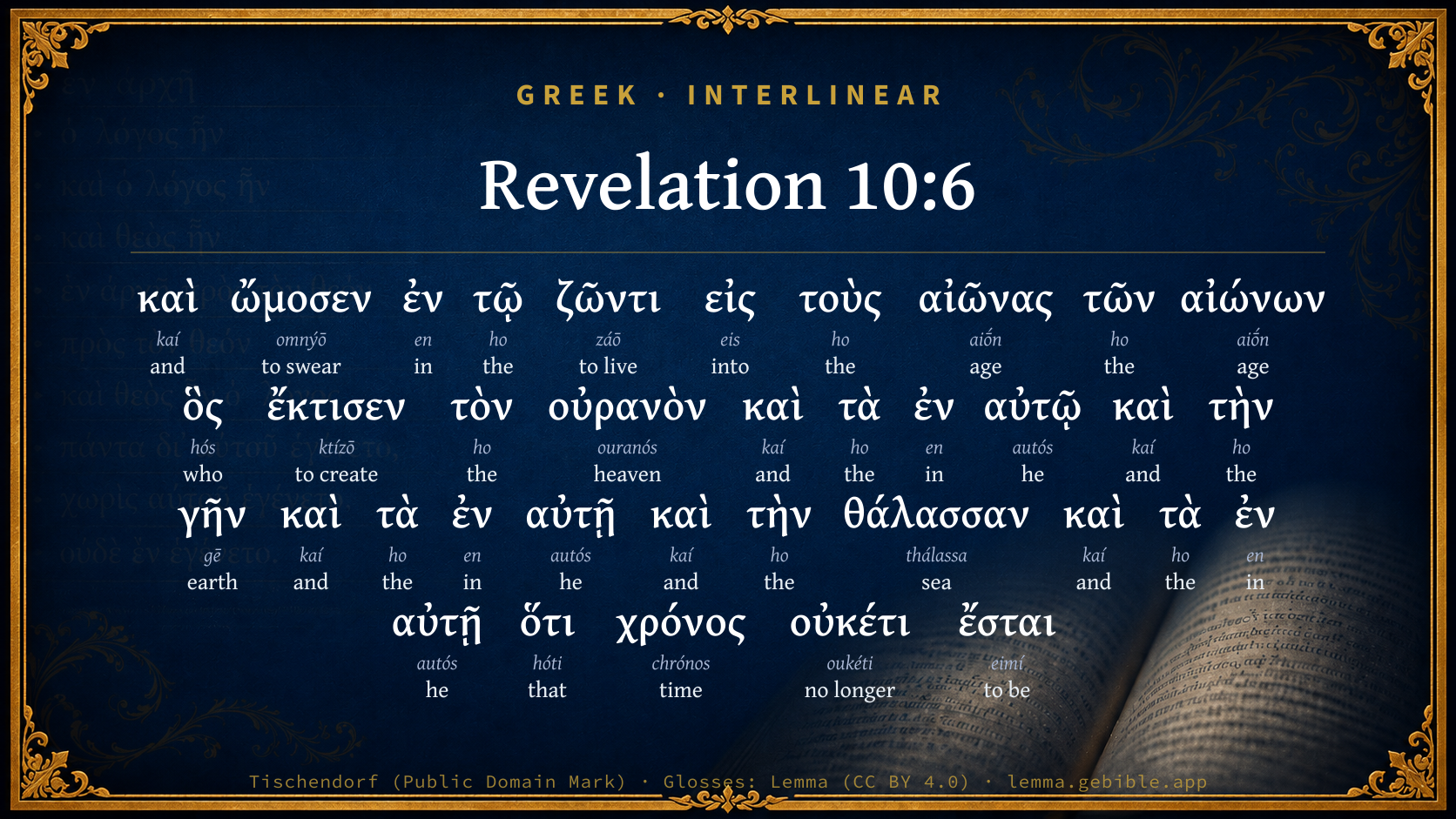
Greek (Tischendorf 8th ed.) Revelation 10:6 appears in the Greek New Testament. The text above is from the Tischendorf 8th edition. Each word links to its Strong’s number and a concise gloss. Click any word for its full Thayer’s Greek Lexicon entry.
Download image
Cite this verse

Revelation 10:6 (World English Bible). Public Domain. Lemma interlinear Bible study tool, https://lemma.gebible.app/v/revelation/10/6.

Show BibTeX & RIS
BibTeX
RIS
English Translation
and swore by him who lives forever and ever, who created heaven and the things that are in it, the earth and the things that are in it, and the sea and the things that are in it, that there will no longer be delay,
World English Bible · Public Domain
Download a study sheet

One document with this verse’s original text, its word-by-word gloss line, the meaning frame, cross-references with their text, attributed commentary, and full source and license credits — printable, and it pastes into notes with its structure intact.

This verse Autodidact and up

Study sheet (.html) Plain text (.txt)

A passage Seminary Student

Up to 50 verses in one chapter. A passage sheet keeps up to 6 commentary sources and 12 cross-references per verse, in the order this page ranks them, and says so on the sheet whenever that leaves anything out. Ask for a single verse and you get the Autodidact verse sheet above.

Everything on this page stays free to read, with no account — the sheet is a download of what is already on screen, not access to it.

Want to remove ads? Support Godless Engineer
Compare translations 3

The same verse in 3 English versions, stacked beneath the original-language interlinear above. Click any original word for its lexicon entry.

Each is an independent rendering of the whole verse — the interlinear is not word-aligned to these translations.

Highlighted words mark where these versions differ — a whole-verse word diff, not a word-by-word alignment.

  • World English Bible Public Domain
    and swore by him who lives forever and ever, who created heaven and the things that are in it, the earth and the things that are in it, and the sea and the things that are in it, that there will no longer be delay,
  • King James Version Public Domain
    And sware by him that liveth for ever and ever, who created heaven, and the things that therein are, and the earth, and the things that therein are, and the sea, and the things which are therein, that there should be time no longer:
  • unfoldingWord Literal Text CC BY-SA 4.0
    and swore by the one living to the ages of the ages, who created heaven and the in it and the earth and the in it and the sea and the in it, “There will be no more time,

unfoldingWord Literal Text — © unfoldingWord, licensed CC BY-SA 4.0. Word-aligned USFM3 via Door43 (git.door43.org/unfoldingWord/en_ult).

Versions to compare (up to 4)

3 of 4 selected

Show all 19 translations

Every available English version of this verse, each an independent rendering of the whole verse.

  • World English Bible Public Domain
    and swore by him who lives forever and ever, who created heaven and the things that are in it, the earth and the things that are in it, and the sea and the things that are in it, that there will no longer be delay,
  • Berean Standard Bible Public Domain
    And he swore by Him who lives forever and ever, who created heaven and everything in it, the earth and everything in it, and the sea and everything in it: “There will be no more delay!
  • Majority Standard Bible Public Domain
    And he swore by Him who lives forever and ever, who created heaven and everything in it, the earth and everything in it, and the sea and everything in it: “There will be no more delay!
  • King James Version Public Domain
    And sware by him that liveth for ever and ever, who created heaven, and the things that therein are, and the earth, and the things that therein are, and the sea, and the things which are therein, that there should be time no longer:
  • American Standard Version (1901) Public Domain
    and sware by him that liveth for ever and ever, who created the heaven and the things that are therein, and the earth and the things that are therein, and the sea and the things that are therein, that there shall be delay no longer:
  • Revised Version (1885) Public Domain
    and sware by him that liveth for ever and ever, who created the heaven and the things that are therein, and the earth and the things that are therein, and the sea and the things that are therein, that there shall be time no longer:
  • Geneva Bible (1599) Public Domain
    And sware by him that liueth for euermore, which created heauen, and the thinges that therein are, and the earth, and the things that therein are, and the sea, and the thinges that therein are, that time should be no more.
  • Douay-Rheims (1899) Public Domain
    And he swore by him that liveth for ever and ever, who created heaven, and the things which are therein; and the earth, and the things which are in it; and the sea, and the things which are therein: That time shall be no longer.
  • Young's Literal Translation Public Domain
    and did swear in Him who doth live to the ages of the ages, who did create the heaven and the things in it, and the land and the things in it, and the sea and the things in it -- that time shall not be yet,
  • Literal Standard Version CC BY-SA 4.0
    and swore by Him who lives through the ages of the ages, who created the sky and the things in it, and the land and the things in it, and the sea and the things in it—that time will not be yet,
  • Unlocked Literal Bible CC BY-SA 4.0
    He swore by the one who lives forever and ever, who created heaven and all that is in it, the earth and all that is on it, and the sea and all that is in it, and the angel said, “There will be no more delay.
  • unfoldingWord Literal Text CC BY-SA 4.0
    and swore by the one living to the ages of the ages, who created heaven and the in it and the earth and the in it and the sea and the in it, “There will be no more time,
  • Darby Bible Public Domain
    and swore by him that lives to the ages of ages, who created the heaven and the things that are in it, and the earth and the things that are in it, and the sea and the things that are in it, that there should be no longer delay;
  • World Messianic Bible Public Domain
    and swore by him who lives forever and ever, who created heaven and the things that are in it, the earth and the things that are in it, and the sea and the things that are in it, that there will no longer be delay,
  • Webster's Bible Public Domain
    And swore by him that liveth for ever and ever, who created heaven, and the things that are in it, and the earth, and the things that are in it, and the sea, and the things which are in it, that there should be time no longer:
  • Free Bible Version CC BY-SA 4.0
    He made a sacred oath by the one who lives for ever and ever, who created the heavens and everything in them, and the earth and everything in it, and the sea and everything in it. “No more delay!” he said.
  • Bible in Basic English Public Domain
    And took his oath by him who is living for ever and ever, who made the heaven and the things in it, and the earth and the things in it, and the sea and the things in it, that there would be no more waiting:
  • Text-Critical English NT CC BY 4.0
    and swore by him who lives forever and ever, who created heaven and everything in it, the earth and everything in it, and the sea and everything in it, and said that there would no longer be delay,
  • Tyndale New Testament (1534) Public Domain
    and swore by him that liveth for ever more which created heven and the thynges that ther in are and the see and the thynges which therin are: that there shulde be no lenger tyme:

Literal Standard Version (2020), Covenant Press — licensed CC BY-SA 4.0. Text via the HelloAO Bible API (eBible.org). Unlocked Literal Bible (unfoldingWord) — licensed CC BY-SA 4.0. Text via the HelloAO Bible API (eBible.org). unfoldingWord Literal Text — © unfoldingWord, licensed CC BY-SA 4.0. Word-aligned USFM3 via Door43 (git.door43.org/unfoldingWord/en_ult). Free Bible Version, Dr. Jonathan Gallagher — licensed CC BY-SA 4.0. Text via the HelloAO Bible API (eBible.org).

Word by word

More ways to search: Search by grammar → Find every occurrence → Compare this word →

Practice this passage: Drill this verse → Learn its vocabulary →

ἔκτισεν
ktízō
G2936
“to create”
Verb, Aorist, Active, Indicative, 3rd person, Singular
Part of Speech
Verb
Tense
Aorist
Voice
Active
Mood
Indicative
Person
3rd person
Number
Singular
Full Thayer's Definition

Origin: probably akin to G2932 (through the idea of proprietor-ship of the manufacturer)

TDNT: 19:40,5

1. to make habitable, to people, a place, region, island a. to found a city, colony, state 2. to create a. of God creating the worlds b. to form, shape, i.e. to completely change or transform
  1. καὶ kaí G2532 “and” Conjunction
  2. ὤμοσεν omnýō G3660 “to swear” Verb, Aorist, Active, Indicative, 3rd person, Singular
  3. ἐν en G1722 “in” Preposition
  4. τῷ ho G3588 “the” Article, Dative, Singular, Masculine
  5. ζῶντι záō G2198 “to live” Verb, Present, Active, Participle, Dative, Singular, Masculine
  6. εἰς eis G1519 “into” Preposition
  7. τοὺς ho G3588 “the” Article, Accusative, Plural, Masculine
  8. αἰῶνας aiṓn G165 “age” Noun, Accusative, Plural, Masculine
  9. τῶν ho G3588 “the” Article, Genitive, Plural, Masculine
  10. αἰώνων aiṓn G165 “age” Noun, Genitive, Plural, Masculine
  11. ὃς hós G3739 “who” Relative pronoun, Nominative, Singular, Masculine
  12. τὸν ho G3588 “the” Article, Accusative, Singular, Masculine
  13. οὐρανὸν ouranós G3772 “heaven” Noun, Accusative, Singular, Masculine
  14. καὶ kaí G2532 “and” Conjunction
  15. τὰ ho G3588 “the” Article, Accusative, Plural, Neuter
  16. ἐν en G1722 “in” Preposition
  17. αὐτῷ autós G846 “he” Personal pronoun, Dative, Singular, Masculine
  18. καὶ kaí G2532 “and” Conjunction
  19. τὴν ho G3588 “the” Article, Accusative, Singular, Feminine
  20. γῆν gē G1093 “earth” Noun, Accusative, Singular, Feminine
  21. καὶ kaí G2532 “and” Conjunction
  22. τὰ ho G3588 “the” Article, Accusative, Plural, Neuter
  23. ἐν en G1722 “in” Preposition
  24. αὐτῇ autós G846 “he” Personal pronoun, Dative, Singular, Feminine
  25. καὶ kaí G2532 “and” Conjunction
  26. τὴν ho G3588 “the” Article, Accusative, Singular, Feminine
  27. θάλασσαν thálassa G2281 “sea” Noun, Accusative, Singular, Feminine
  28. καὶ kaí G2532 “and” Conjunction
  29. τὰ ho G3588 “the” Article, Accusative, Plural, Neuter
  30. ἐν en G1722 “in” Preposition
  31. αὐτῇ autós G846 “he” Personal pronoun, Dative, Singular, Feminine
  32. ὅτι hóti G3754 “that” Conjunction
  33. χρόνος chrónos G5550 “time” Noun, Nominative, Singular, Masculine
  34. οὐκέτι oukéti G3765 “no longer” Adverb, Negative
  35. ἔσται eimí G1510 “to be” Verb, Future, Middle deponent, Indicative, 3rd person, Singular

About this verse

These counts appear in no published source. They are computed here, from the morphology-tagged text and Lemma’s own curated glosses. What Lemma adds →

36
words
17
distinct lemmas
Revelation
section

Notable vocabulary

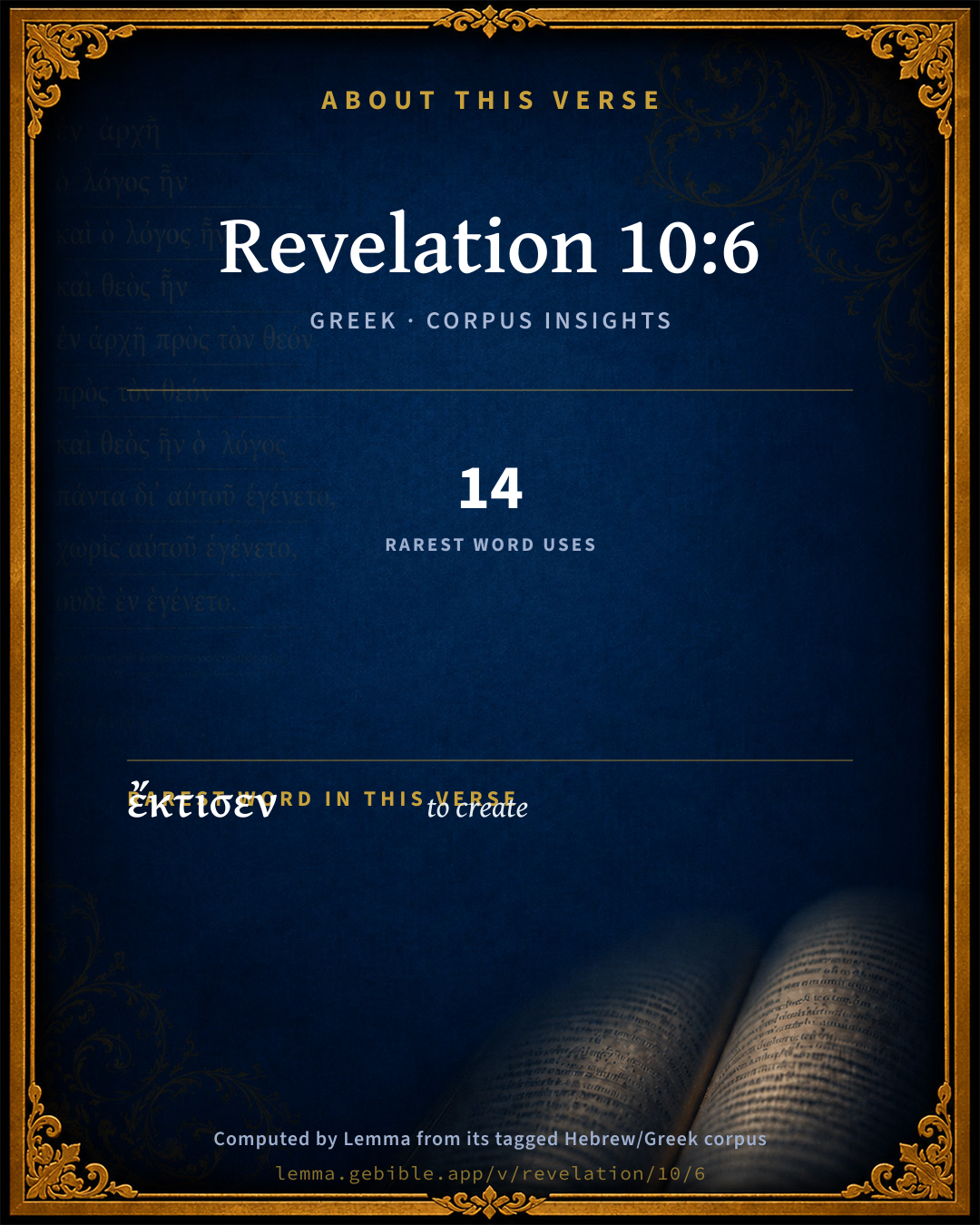
The rarest word here is ἔκτισεν to create G2936 — appearing just 14 times in the whole Greek New Testament.

Shared distinctive vocabulary

ἔκτισεν to create G2936 occurs in 12 verses of the Greek New Testament. Also found in:

Repetition

Words recur within this verse:

Cross-references

3

Topical passages linked to Revelation 10:6 in the Treasury of Scripture Knowledge — connected by theme and wording, ordered by reader-vote popularity; previews shown in the World English Bible.

  • Revelation 4:11 "Worthy are you, our Lord and God, the Holy One, to receive the glory, the honor, and the power, for you created all things, and because of your desire they existed, and were created!"
  • Revelation 4:9 When the living creatures give glory, honor, and thanks to him who sits on the throne, to him who lives forever and ever,
  • Revelation 16:17 The seventh poured out his bowl into the air. A loud voice came forth out of the temple of heaven, from the throne, saying, "It is done!"

Cross-references courtesy of OpenBible.info (CC BY 4.0).

Commentary

Notes on Revelation 10:6 from classic Christian and Jewish commentators (each source and its license shown beneath its notes). The classic Christian expositions comment on the surrounding passage and are grouped to its opening verse, so a note may address several verses; the Jewish commentaries on the Tanakh (Rashi and others) are per-verse, so they appear only where the commentator wrote on this verse.

Lemma curates 59 commentaries, every one of them public domain or Creative Commons licensed, each selected and text-cleaned for this edition rather than reprinted as found. About our sources →

Albert Barnes' Notes on the Bible

And sware by him that liveth forever and ever - By the ever-living God: a form of an oath in extensive use now. The essential idea in such an oath is an appeal to God; a solemn reference to Him as a witness; an utterance in the presence of Him who is acquainted with the truth or falsehood of what is said, and who will punish him who appeals to him falsely. It is usual, in such an oath, in order to give to it greater solemnity, to refer to some attribute of God, or something in the divine character on which the mind would rest at the time, as tending to make it more impressive. Thus, in the passage before us, the reference is to God as “ever-living”; that is, he is now a witness, and he ever will be; he has now the power to detect and punish, and he ever will have the same power.

Who created heaven, and the things that therein are, ... - Who is the Maker of all things in heaven, on the earth, and in the sea; that is, throughout the universe. The design of referring to these things here is what is just specified to give increased solemnity to the oath by a particular reference to someone of the attributes of God. With this view nothing could be more appropriate than to refer to him as the Creator of the universe - denoting his infinite power, his right to rule and control all things.

That there should be time no longer - This is a very important expression, as it is the substance of what the angel affirmed in so solemn a manner; and as the interpretation of the whole passage depends on it. It seems now to be generally agreed among critics that our translation does not give the true sense, inasmuch:

(a)As that was not the close of human affairs, and

(b)As he proceeds to state what would occur after that.

Accordingly, different versions of the passage have been proposed. Prof. Stuart renders it, “that delay shall be no longer.” Mr. Elliott, “that the time shall not yet be; but in the days of the voice of the seventh angel, whensoever he may be about to sound, then the mystery of God shall be finished.” Mr. Lord, “that the time shall not be yet, but in the days of the voice of the seventh angel,” etc. Andrew Fuller (Works, vol. vi. p. 113), “there should be no delay.” So Dr. Gill. Mr. Daubuz, “the time shall not be yet.” Vitringa (p. 432), tempus non fore amplius, “time shall be no more.” He explains it (p. 433) as meaning, “not that this is to be taken absolutely, as if at the sounding of the seventh trumpet all things were then to terminate, and the glorious epiphany - ἐπίφανεια epiphaneia (or manifestation of Jesus Christ) - was then to occur, who would put an end to all the afflictions of his church; but in a limited sense - restricte - as meaning that there would be no delay between the sounding of the seventh trumpet and the fulfillment of the prophecies.” The sense of this passage is to be determined by the meaning of the words and the connection:

(a) The word “time” - χρόνος chronos - is the common Greek word to denote time, and may be applied to time in general, or to any specified time or period. See Robinson, Lexicon sub voce, (a, b). In the word itself there is nothing to determine its particular signification here. It might refer either to time in general, or to the time under consideration, and which was the subject of the prophecy. Which of these is the true idea is to be ascertained by the other circumstances referred to. It should be added, however, that the word does not of itself denote delay, and is never used to denote that directly. It can only denote that because delay occupies or consumes time, but this sense of the noun is not found in the New Testament. It is found, however, in the verb χρονίζω chronizō, to linger, to delay, to be long in coming, Mat 25:5; Luk 1:21.

(b) The absence of the article - “time,” not “the time” - would naturally give it a general signification, unless there was something in the connection to limit it to some well-known period under consideration. See the notes on Rev 8:2; Rev 10:3. In this latter view, if the time referred to would be sufficiently definite without the article, the article need not be inserted. This is such a case, and comes under the rule for the omission of the article as laid down by Dr. Middleton, part i. ch. 3: The principle is, that when the copula, or verb connecting the subject and predicate, is the verb substantive, then the article is omitted. “To affirm the existence,” says he, “of that of which the existence is already assumed, would be superfluous; to deny it, would be contradictory and absurd.” As applicable to the case before us, the meaning of this rule would be, that the nature of the time here referred to is implied in the use of the substantive verb (ἔσται estai), and that consequently it is not necessary to specify it. All that needs to be said on this point is, that, on the supposition that John referred to a specified time, instead of time in general, it would not be necessary, under this rule, to insert the article. The reference would be understood without it, and the insertion would be unnecessary. This is substantially the reasoning of Mr. Elliott (vol. ii. p. 123), and it is submitted for what it is worth. My own knowledge of the usages of the Greek article is too limited to justify me in pronouncing an opinion on the subject, but the authorities are such as to authorize the assertion that, on the supposition that a particular well-known period were here referred to, the insertion of the article would not be necessary.

(c) The particle rendered “longer” - έτι eti - “time shall be no longer” - means properly, according to Robinson (Lexicon), “yet, still”; implying:

(1) Duration - as spoken of the present time; of the present in allusion to the past, and, with a negative, no more, no longer;

(2) Implying accession, addition, yet, more, further, besides. According to Buttmann, Grammatical section 149, vol. i. p. 430, it means, when alone, “yet still, yet further; and with a negative, no more, no further.” The particle occurs often in the New Testament, as may be seen in the Concordance. It is more frequently rendered “yet” than by any other word (compare Mat 12:46; Mat 17:5; Mat 19:20; Mat 26:47; Mat 27:63; Mar 5:35; Mar 8:17; Mar 12:6; Mar 14:43 - and so in the other Gospels, the Acts , and the Epistles); in all, 50 times. In the Book of Revelation it is only once rendered “yet,” Rev 6:11, but is rendered “more” in Rev 3:12; Rev 7:16; Rev 9:12; Rev 12:8; Rev 18:21-22 (three times), Rev 18:23 (twice); Rev 20:3; Rev 21:1, Rev 21:4 (twice); “longer” in Rev 10:6; “still” in Rev 22:11 (four times). The usage, therefore, will justify the rendering of the word by “yet,” and in connection with the negative, “not yet” - meaning that the thing referred to would not occur immediately, but would be hereafter. In regard to the general meaning, then, of this passage in its connection, we may remark:

(a) That it cannot mean, literally, that there would be time no longer, or that the world would then come to an end absolutely, for the speaker proceeds to disclose events that would occur after that, extending far into tim future Rev 10:11, and the detail that follows Rev. 11 before the sounding of the seventh trumpet is such as to occupy a considerable period, and the seventh trumpet is also yet to sound. No fair construction of the language, therefore, would require us to understand this as meaning that the affairs of the world were then to terminate.

(b) The connection, then, apart from the question of grammatical usage, will require some such construction as that above suggested - “that the time,” to wit, some certain, known, or designated time, “would not be yet,” but would be in some future period; that is, as specified, Rev 10:7, “in the days of the voice of the seventh angel, when he shall begin to sound.” Then “the mystery of God would be finished,” and the affairs of the world would be put on their permanent footing.

(c) This would imply that, at the time when the angel appeared, or in the time to which he refers, there would be some expectation or general belief that the “mystery was then to be finished, and that the affairs of the world were to come to an end. The proper interpretation would lead us to suppose that there would be so general an expectation of this, as to make the solemn affirmation of the angel proper to correct a prevailing opinion, and to show that the right interpretation was not put on what seemed to be the tendency of things.

(d) As a matter of fact, we find that this expectation did actually exist at the time of the Reformation; that such an interpretation was put on the prophecies, and on the events that occurred; and that the impression that the Messiah was about to come, and the reign of saints about to commence, was so strong as to justify some interference, like the solemn oath of the angel, to correct the misapprehension. It is true that this impression had existed in former times, and even in the early ages of the church; but, as a matter of fact, it was true, and eminently true, in the time of the Reformation, and there was, on many accounts, a strong tendency to that form of belief. The Reformers, in interpreting the prophecies, learned to connect the downfall of the papacy with the coming of Christ, and with his universal reign upon the earth; and as they saw the evidences of the approach of the former, they naturally anticipated the latter as about to occur.

Compare Dan 2:34; Dan 12:11; 2Th 2:3, 2Th 2:8. The anticipation that the Lord Jesus was about to come; that the affairs of the world, in the present form, were to be wound up; that the reign of the saints would soon commence; and that the permanent kingdom of righteousness would be established, became almost the current belief, of the Reformers, and was frequently expressed in their writings. Thus, Luther, in the year 1520, in his answer to the pope’s bull of excommunication, expresses his anticipations: “Our Lord Jesus Christ yet liveth and reigneth; who, I firmly trust, will shortly come, and slay with the spirit of his mouth, and (destroy with the brightness of his coming, that Man of Sin” (Merle D’Aubig., vol. ii. p. 166). After being summoned before the Diet at Worms, and after condemnation had been pronounced on him by the emperor, he fell back for comfort on the same joyous expectation. “For this once,” he said, “the Jews, as on the crucifixion day, may sing their paean; but Easter will come for us, and then we shall sing Hallelujah” (D’Aubig., vol. ii. p. 275). The next year, writing to Staupitz, he made a solemn appeal against his abandoning the Reformation, by reference to the sure and advancing fulfillment of Daniel’s prophecy. “My father,” said he, “the abominations of the pope, with his whole kingdom, must be destroyed; and the Lord does this without hand, by the Word alone. The subject exceeds all human comprehension. I cherish the best hopes” (Milner, p. 692).

In 1523 he thus, in a similar strain, expresses his hopes: “The kingdom of Antichrist, according to the prophet Daniel, must be broken without hands; that is, the Scriptures will be understood by and by; and every one will preach against papal tyranny, from the Word of God, until the Man of Sin is deserted of all, and dies of himself” (Milner, p. 796). The same sentiments respecting the approach of the end of the world were entertained by Melancthon. In commenting on the passage in Daniel relating to the “little horn,” he thus refers to an argument which has been prevalent: “The words of the prophet Elias should be marked by every one, and inscribed upon our walls, and on the entrances of our houses. Six thousand years shall the world stand, and after that be destroyed; two thousand years without the law; two thousand years under the law of Moses; two thousand years under the Messiah; and if any of those years are not fulfilled, they will be shortened (a shortening intimated by Christ also, on account of our sins).”

The following manuscript addition to this argument has been found in Melancthon’s hand, in Luther’s own copy of the German Bible: “Written 1557 a.d., and from the creation of the world, 5519; from which number we may see that this aged world is not far from its end.” So also the British Reformers believed. Thus, Dr. Latimer: “Let us cry to God day and night ... Most merciful Father, let thy kingdom come! Paul saith, The Lord will not come until the swerving from the faith cometh 2Th 2:3; which thing is already done and past. Antichrist is already known throughout all the world. Wherefore the day is not far off.” Then, reverting to the consideration of the age of the world, as Melancthon had done, he says, “The world was ordained to endure, as all learned ones affirm, 6000 years. Now of that number there be past 5552 years, so that there is no more left but 448 years. Furthermore, those days shall be shortened for the elect’s sake. Therefore, all those excellent and learned men, whom without doubt God hath sent into the world in these last days to give the world warning, do gather out of sacred Scripture that the last day cannot be far off.”

So again, in a sermon on the nearness of the second advent, he says, “So that peradventure it may come in my days, old as I am, or in my children’s days.” Indeed, it is well known that this was a prevalent opinion among the Reformers; and this fact will show with what propriety, if the passage before us was designed to refer to the Reformation, this solemn declaration of the angel was made, that the “time would not be yet” - that those anticipations which would spring up from the nature of the case, and from the interpretations which would be put on what seemed to be the obvious sense of the prophecies, were unfounded, and that a considerable time must yet intervene before the events would be consummated.

(e) The proper sense of this passage, then, according to the above interpretation would be “And the angel lifted up his hand to heaven, and sware by him that liveth forever and ever, That the time should not yet be; but, in the days of the voice of the seventh angel, when he shall begin to sound, the mystery of God shall be finished.” Appearances, indeed, would then indicate that the affairs of the world were to be wound up, and that the prophecies respecting the end of the world were about to be fulfilled: but the angel solemnly swears “by Him who lives forever and ever” - and whose reign therefore extends through all the changes on the earth - “by Him who is the Creator of all things,” and whose purpose alone can determine when the end shall be, that the time would not be yet. Those cherished expectations would not yet be realized, but there was a series of important events to intervene before the end would come. Then - at the time when the seventh angel should sound - would be the consummation of all things.

Albert Barnes' Notes on the Bible (1834–1885) — public domain. Text from a community e-Sword/MySword module.

Bengel's Gnomon

Johann Albrecht Bengel

Rev 10:6. Ὅτι χρόνος οὐκέτι ἔσται, That a chronus [whole period] shall be no longer) Many pass by this most weighty utterance with a slight comment. Henr. Efferhen, in his 6th and 13th Homily respecting Gog and Magog, thus interprets it: the space of a year shall not pass, namely, between Gog and the end of all things. He perceived that chronus here ought to be taken in a specific sense: but Gog is much later than the Non-chronus (which would be more in accordance with the Latin idiom to call Ne-chronus); and this period is much longer than a year. I should rather say, it is longer than 1000 years; and shorter than chronus, that is, than 1111 1/9 years. It will end A. 1836. From thence reckoning backward, it is chronus to the former part of the year 725: and the beginning of the Non-chronus immediately succeeded the beginning of the Chronus. At the beginning of Non-chronus, the Saracens were not only in possession of Jerusalem, but even appeared to threaten destruction to the whole of the Christian Church, as the second woe came to its height. But yet the angel affirms that these and the following evils shall be overcome within a chronus. Eudes conquered the Saracens, A. 726; and Charles Martel destroyed a great multitude of them, A. 731, in the battle of Tours. See Vitringa on Rev 12:16. Charlemagne, the grandson of Martel, A. 800, commenced a new line of emperors in the West, or, in other words, of “many kings,” Rev 10:11. And this Non-chronus comprises, beside other things, a small portion of the third woe, the 3½ times of the woman in the wilderness, and the duration of the beast variously divided. There is indeed great doubt respecting these periods, and many say that nothing can be known before the end; by which very assertion the martyrs and witnesses of the truth, at the Reformation, and before and after it, who relied on the Apocalypse, and especially on ch. 13 and 17, are deserted, and the principal advantage of prophecy, which forewarns and forearms us against the evils which threaten, is made void. The truth is, that for the opening of prophecy, either the whole event is necessary, or a considerable part is sufficient. If the whole event is necessary, the Apocalypse will never be understood before the end of the world; for the event extends itself up to that goal, nay, even to eternity itself. If a considerable part is sufficient, why do we not make use of that part, so as to measure future things by the past, and not to run into events without preparation? The rash man is he who sleeps in danger, not he who foresees it. We ought not to be so confident in determining future things, but that the things, which the text has not defined, or at any rate the interpreter does not as yet distinctly see, should be determined by the result. Die Erkl. Offenb. pp. 725, 874, 1064, etc., has many examples. But they who avoid all particulars, do not even know what they ought to look for in the event. Docility in spiritual things, and sobriety, are in entire consonance with each other.

Bengel's Gnomon of the New Testament — English translation (T&T Clark, Edinburgh, 1860) — public domain. Text from a community e-Sword module.

Geneva Bible (1599)

Geneva Bible translators

There shall never be anymore time.

Neither time itself, nor the things that are in time: but that the world to come is at hand which is altogether of eternity and beyond all times.

Geneva Bible (1599) marginal notes — public domain. Text via Bolls.life.

Jamieson, Fausset & Brown

Robert Jamieson, A. R. Fausset & David Brown

liveth for ever and ever--Greek, "liveth unto the ages of the ages" (compare Dan 12:7).

created heaven . . . earth . . . sea, &c.--This detailed designation of God as the Creator, is appropriate to the subject of the angel's oath, namely, the consummating of the mystery of God (Rev 10:7), which can surely be brought to pass by the same Almighty power that created all things, and by none else.

that there should be time no longer--Greek, "that time (that is, an interval of time) no longer shall be." The martyrs shall have no longer a time to wait for the accomplishment of their prayers for the purgation of the earth by the judgments which shall remove their and God's foes from it (Rev 6:11). The appointed season or time of delay is at an end (the same Greek is here as in Rev 6:11, chronus). Not as English Version implies, Time shall end and eternity begin.

Jamieson, Fausset & Brown — Commentary Critical and Explanatory on the Whole Bible (1871) — public domain (CC PDM 1.0). Text via the HelloAO Bible API.

Adam Clarke's Commentary

Verse 6. By him that liveth for ever and ever] The eternal, self-existent Jehovah, the Maker of all things.

That there should be time no longer] That the great counsels relative to the events already predicted should be immediately fulfilled, and that there should be no longer delay. This has no reference to the day of judgment.

Adam Clarke's Commentary on the Bible (1810–1826) — public domain. Text from a community e-Sword/MySword module.

The Cambridge Bible for Schools and Colleges

gen. ed. J. J. S. Perowne

6. sware by him] This angel therefore is in no sense a divine Person.

6, 7. that there shall be time no longer: but] i.e. as we say, “there shall be no more time lost, but” …: “there shall be delay no longer.” It is not in harmony with the usual language of Scripture to suppose that finite “time” is meant to be opposed to eternity.

The Cambridge Bible for Schools and Colleges (gen. ed. J. J. S. Perowne; Cambridge University Press, 1878–1918) — public domain. Text from a community e-Sword module.

John Gill's Exposition

And sware by him that liveth for ever and ever,.... That is, by the living God, who is the true God: and is so described to distinguish him from idol gods, who have no life nor breath in them; and to assert the excellency and perfection of his nature, who has life in himself originally, and independently, is the fountain of life to all creatures living, and who are supported in their life and being by him; and so he always was, is, and ever will be; this is the same as swearing by Ancuialus (p):

who created heaven, and the things that therein are; the airy, starry, and third heavens, and the inhabitants of them, the fowls of the air, the sun, moon, and stars, and the angels of heaven, as well as the souls of departed saints, and the bodies of as many as are there:

and the earth, and the things that therein are; men, beasts, and creeping things, trees, herbs, minerals, &c.

and the sea, and the things which are therein: the several sorts of fishes in it: this is also said to distinguish the great God from all false gods, who made not the heavens and the earth, who alone is, and ought to be the object of an oath, or by whom an oath is to be made, and not any creature whatsoever; and since the Angel that here swears is the Lord Jesus Christ, this may be understood of him either as man, swearing by God the Father, in which respect the Father is greater than he; or as a divine person, and so swears by himself, Heb 6:13; for to himself do these characters belong of living for ever and ever, and of having made the heaven, earth, and sea, and all in them: the thing he swears to is,

that there should be time no longer which is not to be understood of the cessation of time, and the swallowing of it up in eternity, at the end of all things, when it will be no more measured out by the revolutions of the sun and moon, which will then be no more; for this did not take place upon the angel's oath, or at the time this vision refers to; for after this, there is to be time for the seventh angel to sound his trumpet in, though perhaps that is excepted in the next verse; and after the sounding of that, there will be the space of a thousand years, in which Christ will reign with his people on earth; and after that there will be some space of time for the Gog and Magog army to attack the beloved city; all which will be before the end of all things, or before eternity, properly speaking, takes place; and besides, such an illustrious appearing of Christ as before described, and so solemn an oath as is here made, do not seem necessary to ascertain a truth which nobody doubts of; and everyone knows that after this world, and all things in it are at an end, time will be no more. The true key to this passage is Dan 12:7; where the man clothed in linen swears, that to the end of wonders should be a time, times, and a half, and here the angel swears that time should be no longer; that is, that these time, and times, and half a time, should be no longer; that these dates would be up, and the events affixed to them be accomplished, when the seventh angel should begin to sound his trumpet: the same divisions of time are made in Rev 12:14; and are the same exactly with the 1260 days, or years, and the forty two months of years, so often mentioned in this book: for a time is a prophetic year, that is, 360 years; and times are two prophetic years, or 70 years; and half a time is half a prophetic year, or 180 years, in all 1260 years: now add the several events to be accomplished in this period of time, and it will give the full sense of this passage thus; the angel swears that the thee of antichrist's reign, his tyranny over the saints, his persecution of them, which was to last forty two months, Rev 13:5, should be no longer; nor of the holy city being trodden under foot by the Gentiles, the Papists, which bears the same date, Rev 11:2, and is called the times of the Gentiles, Luk 21:24; nor of the witnesses prophesying in sackcloth, which has just the same measure of duration, Rev 11:3; nor of the church's retirement, and being hid in the wilderness, Rev 12:14; in short, the time of the four monarchies, and of the last of them, the Roman, and of the last branch of that, the Papal, should be no more than till the sounding of the seventh trumpet, when the kingdoms of this world shall become the kingdoms of our Lord, and of his Christ; Rev 11:15; the words will bear to be rendered, as some have observed, "that there should be delay no longer"; that is, of the coming and kingdom of Christ; though the bridegroom has tarried, he will come, and will not tarry beyond the time the angel swears to; every seal of the sealed book is a delay of, and a stop upon, the open appearance of Christ's kingdom; and the opening of every seal is an advance to it; and when the sixth seal was opened, and Paganism destroyed, and Christianity spread throughout the empire, the kingdom of Christ might have been expected to have appeared; but there was a seventh seal to be opened, which was a stop upon it, and which when opened brought ruin and destruction upon the Christian empire, both western and eastern, under the first six trumpets; and till the seventh sounds there will be a delay of Christ's kingdom, but when that sounds there will be no more a delay.

(p) Martial Epigr. l. 11. ep. 60.

John Gill's Exposition of the Whole Bible (1746–1763) — public domain (CC PDM 1.0). Text via the HelloAO Bible API.

Trapp's Complete Commentary

John Trapp

6 And sware by him that liveth for ever and ever, who created heaven, and the things that therein are, and the earth, and the things that therein are, and the sea, and the things which are therein, that there should be time no longer:

Ver. 6. That there should be time no longer] i.e. The beast’s time shall be no longer, but till the days of the seventh trumpet, which were shortly then approaching. Or there shall be now no longer delay or protraction of time.

John Trapp, A Commentary or Exposition upon All the Books of the Old and New Testament (1647–1656) — public domain. Text from a community e-Sword module.

Matthew Poole's English Annotations

And sware by him that liveth, &c.; that is, by God; for this description can agree to no other, neither is it lawful to swear by any other: see Dan 12:7.

That there should be time no longer; there shall be an end of the world, so some; but this John knew well enough. It is rather to be understood of the time of the fourth monarchy, the Roman empire should come to an end; or, the time of the afflictions of the church, whether by pagan or antichristian enemies, should be no more.

Matthew Poole's English Annotations on the Holy Bible (1683–1685) — public domain. Text from a community e-Sword/MySword module.

The Pulpit Commentary

And sware by him that liveth forever and ever. The Triune God. (cf. Rev_1:11 Rev_4:10, etc.; also Deu_32:40 Psa_45:6 Heb_1:8, etc.) Who created heaven, and the things that therein are, and the earth, and the things that therein are, and the sea, and the things which are therein. Though the balance of authority is in favour of the last clause, yet it is omitted by a*, A, and some cursives. (cf. Exo_20:4) These two characteristics of God his eternity and his omnipotence are referred to in order to demonstrate the certainty of the fulfilment of the prophecy which follows. That there should be time no longer (oti cronov ouketi estai); that time no longer shall be. This may be rendered:

(1) Time (a finite terminable period, as opposed to eternity) shall no longer exist, but eternity shall be entered upon.

(2) There shall be no more time, in the sense of "there shall be no longer any delay" in the infliction of the last judgment, set forth under the seventh trumpet. The solution seems to be that both meanings are implied. There seems to be a reference to the words of Rev_6:11, to the eti cronon micron , during which the saints were to rest and await the infliction of God"s wrath upon the ungodly. The visions of the first six trumpets have shown how, in the period of the world"s existence, the ungodly do not escape judicial retribution. But that is not all; the force of the six judgments not having served to reduce the worldly to repentance, there can be no more delay, the last final judgment follows. But the last judgment, which follows quickly upon the other six, (Rev_11:14) is for eternity. (Rev_11:18) The advent of this woe is, therefore, simultaneous with the end of cronov , or "time, by which we signify that definite period, cut out of eternity, as it were, which is coeval with the existence of the world, and ceases with its destruction. The expression, therefore, implies, "The measure of God"s punishments, viewed as opportunities for repentance, is exhausted; there is a limit to his endurance; the allotted time having been run, and his mercy to a large extent having been spurned, there is no more delay;" then falls the last final blow, which is at the end of "time," and at the beginning (for many) of eternity. Ebrard renders, "A space of time in which to repent a meaning compatible with the explanation given above. Others render, "The time of the fulfilment shall not be yet, but it shall be when the seventh trumpet sounds;" but this interpretation makes cronov equal kairov . Others, again, have made cronov , a chronus, equal a definite number of years, and have endeavoured to compute the exact equivalent of the period (see Bengel, in loc. ).

No more time.

"The angel... sware... that there should be time no longer." This word of the angel is capable of being rendered, and has been rendered, in three different ways. Take it as meaning

I THE TIME IS NOT YET COME. It is easy to believe that the persecuted people of St. John"s day, as often since, might have thought that the judgments which they witnessed and the distresses they endured could not but be the beginning of the end. Our Lord knew that they would think so, and hence (Matthew 24) warned them that they should see and suffer much; but "the end" was "not yet." They had asked what should be the sign of his coming, and of "the end of the age." They were eagerly expecting it. At his ascension they asked the like question again. The apostolic Epistles are full of evidence that the second coming of our Lord was expected as near at hand. St. Paul wrote his Second Epistle to the Thessalonians to dispel this idea, or at any rate to moderate its effects. And when Jerusalem fell, and when the Roman empire fell, it was confidently believed that the end of all things was close at hand. And had we lived in those awful days, it is likely that we should have thought so too. And we know how calculations have been made as to the time of the end. The illustrious Bengel reckoned that it would be in 1836, and his mistake is on record as a warning to all who would make similar rash statements, though even yet the warning is neglected by some. But our Lord has told us that it is not for us "to know the times and the seasons" (Acts 1), and all human calculations are therefore foredoomed to error. And it is well for us that we cannot know. "Ignorance is bliss" in regard to such a subject. Could we fix the date, those far off from it would harden themselves in their sin; those near at hand would become as the Thessalonians did, unfitted for their daily duty, and would not, as St. Paul bade them do, "mind their own business." And so in regard to what is to each one of us as the end of all things, the date of our death, we are kept in merciful ignorance of it. And to keep us therein God has so ordered our lives that there is no hour of it in which men may not die, and in which many do not die, and no hour of it in which they certainly know that they must and shall. Hence little children die, and young men and maidens, boys and girls, as well as the old and grey headed. Ruthless and cruel are seemingly not a few of the visitations of death, cutting down youth in the first freshness and bloom of life, often not sparing the bride and mother in the fulness of their joy, forcing the hot tears from the young husband and wife as they mourn hopelessly over the cradle that held the little one whose life was to them dearer than their own. Such things are. And to some they seem horrible and cruel. But it is in order that we all may be delivered from that paralysis of hope and energy which would come upon us, as it comes upon the convicted felon in the condemned cell, if we knew the actual moment when we must die, and could count off every hour that draws us on to the inevitable doom. Therefore is it well that we do not know the time or the season. And in regard to the end of the world, what mercy is there in the fact that the time is not yet, that "the master of the house" has not yet "risen up, and shut to the door"! For now many will enter who then will not be able. We are thankful that Christ has not yet "accomplished the number of his elect." And they who are his, how much they yet have to do to learn and to obtain before they are prepared to meet their Lord! "The bride has" not yet "made herself ready;" but she must and will, and that she may "the Bridegroom" tarries. Therefore, if this be the meaning of the angel"s oath, that "the time is not yet," we rejoice in it both for ourselves and for myriads more.

II THERE SHALL BE NO MORE TIME. And this we believe is the meaning here that there shall be no longer delay, postponement, no more weary waiting, no longer any lingering of the accomplishment of God"s purposes. So regarded, it was for the. Church of St. John"s day a blessed sursum corda, a cordial and good cheer, helping them to endure patiently and to hope on more and more. The "mystery of God" shall soon "be finished," so soon that, as we say "we are come" to any city when we see its towers and spires rising before us, although we may yet be some considerable distance from its gates; so, because the time is so short, we may say it is over, the waiting time is past it exists "no longer." And thus:

1. The Christian may comfort himself. True, the age drags out its weary length, but each individual life is short, and generally long before even that short life is done the recompenses of God, the earnest and pledge of the yet larger recompenses of eternity, are given. "The Lord is not slack concerning his promises how often we have gratefully to confess that! Yes; they are so given, even here and now, that the believer is constrained to own, "Goodness and mercy have followed me all the days of my life." Tares are undoubtedly amongst the wheat, to its sore detriment and harm, but they are not always to be there; it is a mystery that they are there at all; we would like to go and pull them up, but we cannot; but the harvest draws on, and then the trouble will all be over. But:

2. The enemies of God should be afraid. The avenging gods so the old pagan world believed have their feet shod with wool. Men hear not their silent approach, and they may be upon them, they often are, in a moment. The sinner never knows how near God"s judgment upon his sin may be. Of many the angel hath sworn that there shall be time no longer; the judgment of God shall fall. In a moment, in bright noonday, when the sky is without a cloud, unseen and unheard, the last link that binds the mass of snow and ice to the mountain side is severed, and the avalanche rushes down into the depths below. Do not the events of every day prove, now on this sinner against God"s laws, and now on that, that God hath sworn concerning them, "there should be time no longer"?

III ALL TIME SHALL CEASE. Thus also our text may be understood. "Time" and "duration" are not synonymous terms the latter includes eternity as well as time; but time and eternity, notwithstanding their common quality of duration, are contrasted in Scripture as being of essentially different natures. Time means the present condition of things; eternity, that condition which belongs to the age to come. "The things that are seen are temporal, but the things which are unseen are eternal." Time is of the age that now is; eternity, of the age that is to come. Thus understood, it is not difficult to believe that time this age shall cease. The Bible speaks of "ages." The word is commonly rendered "world," but its true meaning is "age." Thus it speaks of "ages of ages," "this age," "the age to come." And every branch of science tells of different "ages." Geology speaks of them and marks them off one from another by different names. History, biology, philology, all speak in similar way. All tell of ages when the condition of things was altogether different from what we see now, and how one age has succeeded and prepared for another. Therefore that there should be a passing away of the present age to which time belongs, and that it should be followed by one in which time, as we understand it, should be no more, is affirmed, not only by the Bible, but by manifold other evidence beside. And not only shall there be succession, but advance. There have been ages in which we can trace no form of life. These have been succeeded by others which have had life, but only in its lower forms. These again by others possessing higher forms, and at length the highest of all, that of man. And in harmony with all this the Bible bids us look on to an infinitely better condition of things than now we know of, in the age or world to come, whereof the sacred writers speak. Here "the whole creation groaneth and travaileth together in pain even until now;" but there "the creation itself also shall be delivered from the bondage of corruption," etc. (Romans 8). The inscrutable problem of this present life, "the mystery of God," as it is termed in ver. 7, shall "be finished," and there shall be "a new heavens and a new earth, wherein dwelleth righteousness." And the means whereby all this shall be brought about, not only the Bible, but scientific research also, reveal with startling clearness. The Bible says that the angels of God "shall gather out of his kingdom all things that do offend, and them that work iniquity." Science says that in the progress of the ages the fittest alone survive. All that are incapable of the higher life that is to be disappear and perish, and the fit and worthy alone remain. Such is the solemn "Amen" of science to the teachings of the Word of God. And are there not like facts visible even now amidst mankind? Growth and advancement in races, tribes, nations, families, and individuals, the records and observation of human life, are full of such happy facts; but, on the other hand, there are the mournful facts amid the same subjects, of degeneracy, decay, and death. Character determines these things, and the Bible says the same. Oh, how, then, does all this appeal to every soul! For what am I preparing myself? Must I be doomed to die because I am not fit for the better life that is to be when time shall be no longer? or and God grant it may be so! am I by virtue of my living union with the Lord Jesus Christ, who is himself "the Life," destined for glory, honour, and immortality with him in the Eternal? That this may be so is why our pulpits and sermons are forever re-echoing with the appeal, "Come to Christ." The Bible and experience alike attest that it is through living faith, carrying along with it, as such faith ever does, the surrender of the will, the heart, to him, that we become vitally grafted into him, and so in his life the eternal, the blessed, the glorious do forever share. For he said, "Because I live, ye shall live also. S.C.

The Pulpit Commentary (1880–1919), ed. H.D.M. Spence-Jones & Joseph S. Exell — public domain. Text from a community e-Sword module.

John Wesley's Explanatory Notes

And swear - The six preceding trumpets pass without any such solemnity. It is the trumpet of the seventh angel alone which is confirmed by so high an oath. By him that liveth forever and ever - Before whom a thousand years are but a day. Who created the heaven, the earth, the sea, and the things that are therein - And, consequently, has the sovereign power over all: therefore, all his enemies, though they rage a while in heaven, on the sea, and on the earth, yet must give place to him. That there shall be no more a time - "But in the days of the voice of the seventh angel, the mystery of God shall be fulfilled:" that is, a time, a chronos, shall not expire before that mystery is fulfilled. A chronos (1111 years) will nearly pass before then, but not quite. The period, then, which we may term a non-chronos (not a whole time) must be a little, and not much, shorter than this. The non-chronos here mentioned seems to begin in the year 800, (when Charles the Great instituted in the west a new line of emperors, or of "many kings,") to end in the year 1836; and to contain, among other things, the "short time" of the third woe, the "three times and a half" of the woman in the wilderness, and the "duration" of the beast.

John Wesley, Explanatory Notes Upon the Whole Bible (1754–1765) — public domain. Text via the GEBible commentary corpus.

Cambridge Greek Testament for Schools and Colleges

6, 7. ὅτι χρόνος οὐκέτι ἔσται, ἀλλʼ …, i.e. as we say, “there shall be no more time lost, but” …: “there shall be delay no longer,” Eze 12:22-23. It is not in harmony with the usual language of Scripture to suppose that finite “time” is meant to be opposed to eternity.

6. καὶ τὴν γῆν … καὶ τὴν θάλασσαν καὶ τὰ ἐν αὐτῇ. A omits all this; 1, 12 omit καὶ τῆν γῆν καὶ τὰ ἐν αὐτῇ; א* Primas[354] arm[355] omit καὶ τὴν θάλ. κ.τ.λ.; cop[356] æth[357] read τὸν οὐπανὸν καὶ τὴν γῆν καὶ τὴν θάλασσαν καὶ τὰ ἐν αὐτοῖς πάντα.

[354] Primasius, edited by Haussleiter.

[355] Armenian.

[356] Coptic.

[357] Aethiopic Version.

6. ὤμοσεν ἐν τῷ ζῶντι … This angel is therefore in no sense a divine Person.

Cambridge Greek Testament for Schools and Colleges (Cambridge University Press, 1896; 21 vols, various authors incl. Carr, Maclear, Plummer, Farrar, Lumby, Moule, M. R. James, Simcox) — public domain. Text from a community e-Sword module.

Vincent's Word Studies in the New Testament

Marvin R. Vincent

Swear by [ωμοσεν εν] . Lit., "swear in," a Hebrew idiom.

Should be time no longer [χρονος ουκ εσται επι] . Rev., correctly, shall be, etc. The meaning is not, as popularly understood, that time shall cease to exist, but that there shall be no more delay (so Rev., in margin) before the fulfillment of the divine purposes respecting the Church on earth. Possibly with allusion to the cry how long (ch. 6 10).

Marvin R. Vincent, Word Studies in the New Testament (1887–1900) — public domain. Text from a community e-Sword/MySword module.

Lesson kit

Teaching starters — assembled from the data on this page, not authored interpretation. Every prompt links to the verse data it draws on. Edit before teaching.

Revelation, in the Revelation, opens this verse with 36 words (17 distinct Greek lemmas). Its most distinctive word is ktízō (“to create”). A historical commentator’s framing appears above. Read the whole chapter for the surrounding context.

Discussion questions

  1. How does “to create” (ktízō) shape what this verse is saying?
  2. Mark 13:19 shares the word «to create» with this verse. How do the two illuminate each other?
  3. “age” occurs 2× in this one verse. What is the effect of the repetition?
  4. The translations on this page render this verse differently — a whole-verse word diff, not a word-by-word alignment. What might account for the different wordings?
  5. Reading how Albert Barnes' Notes on the Bible and Bengel's Gnomon read this verse, where do the two commentators agree and where do they part?

Things to notice

Reading settings

Reading text

Shown beneath each verse's original-language words.

Old Testament
Old Testament edition

Read the OT as the Masoretic Hebrew (MT) or the Greek Septuagint (LXX).

English shown for the Greek Septuagint (in the Hebrew ↔ Greek comparison).

Comparing translations? Open the Compare panel on any verse page to stack up to four side by side.