Luke 23:44

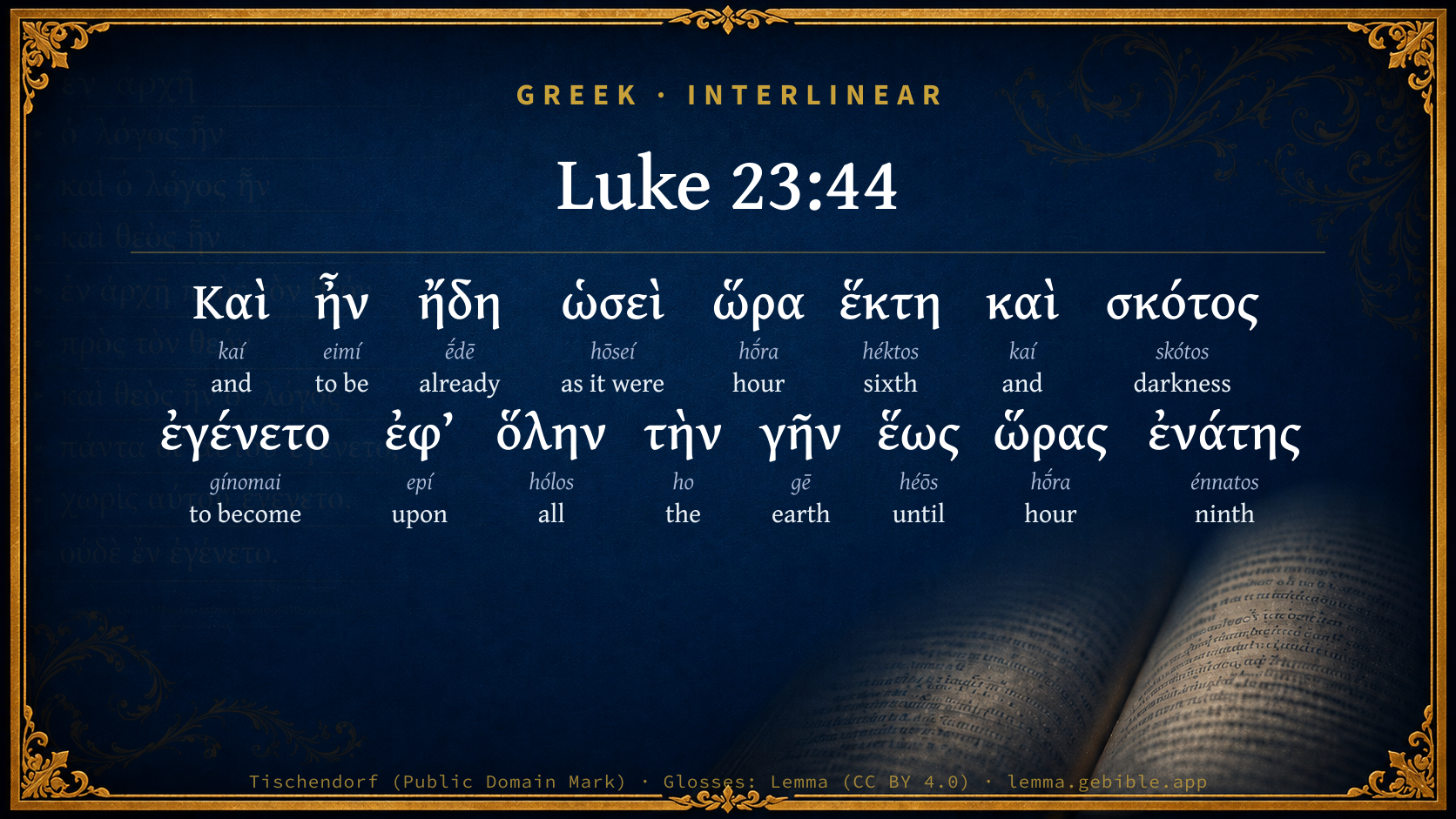
Greek (Tischendorf 8th ed.) Luke 23:44 appears in the Greek New Testament. The text above is from the Tischendorf 8th edition. Each word links to its Strong’s number and a concise gloss. Click any word for its full Thayer’s Greek Lexicon entry.
Download image
Cite this verse

Luke 23:44 (World English Bible). Public Domain. Lemma interlinear Bible study tool, https://lemma.gebible.app/v/luke/23/44.

Show BibTeX & RIS
BibTeX
RIS
English Translation
It was now about the sixth hour, and darkness came over the whole land until the ninth hour.
World English Bible · Public Domain
Download a study sheet

One document with this verse’s original text, its word-by-word gloss line, the meaning frame, cross-references with their text, attributed commentary, and full source and license credits — printable, and it pastes into notes with its structure intact.

This verse Autodidact and up

Study sheet (.html) Plain text (.txt)

A passage Seminary Student

Up to 50 verses in one chapter. A passage sheet keeps up to 6 commentary sources and 12 cross-references per verse, in the order this page ranks them, and says so on the sheet whenever that leaves anything out. Ask for a single verse and you get the Autodidact verse sheet above.

Everything on this page stays free to read, with no account — the sheet is a download of what is already on screen, not access to it.

Want to remove ads? Support Godless Engineer
Compare translations 3

The same verse in 3 English versions, stacked beneath the original-language interlinear above. Click any original word for its lexicon entry.

Each is an independent rendering of the whole verse — the interlinear is not word-aligned to these translations.

Highlighted words mark where these versions differ — a whole-verse word diff, not a word-by-word alignment.

  • World English Bible Public Domain
    It was now about the sixth hour, and darkness came over the whole land until the ninth hour.
  • King James Version Public Domain
    And it was about the sixth hour, and there was a darkness over all the earth until the ninth hour.
  • unfoldingWord Literal Text CC BY-SA 4.0
    And it was already about the sixth hour, and darkness happened over the whole land until the ninth hour.

unfoldingWord Literal Text — © unfoldingWord, licensed CC BY-SA 4.0. Word-aligned USFM3 via Door43 (git.door43.org/unfoldingWord/en_ult).

Versions to compare (up to 4)

3 of 4 selected

Show all 19 translations

Every available English version of this verse, each an independent rendering of the whole verse.

  • World English Bible Public Domain
    It was now about the sixth hour, and darkness came over the whole land until the ninth hour.
  • Berean Standard Bible Public Domain
    It was now about the sixth hour, and darkness came over all the land until the ninth hour.
  • Majority Standard Bible Public Domain
    It was now about the sixth hour, and darkness came over all the land until the ninth hour.
  • King James Version Public Domain
    And it was about the sixth hour, and there was a darkness over all the earth until the ninth hour.
  • American Standard Version (1901) Public Domain
    And it was now about the sixth hour, and a darkness came over the whole land until the ninth hour,
  • Revised Version (1885) Public Domain
    And it was now about the sixth hour, and a darkness came over the whole land until the ninth hour,
  • Geneva Bible (1599) Public Domain
    And it was about the sixt houre: and there was a darkenes ouer all the land, vntill the ninth houre.
  • Douay-Rheims (1899) Public Domain
    And it was almost the sixth hour; and there was darkness over all the earth until the ninth hour.
  • Young's Literal Translation Public Domain
    And it was, as it were, the sixth hour, and darkness came over all the land till the ninth hour,
  • Literal Standard Version CC BY-SA 4.0
    And it was, as it were, the sixth hour, and darkness came over all the land until the ninth hour,
  • Unlocked Literal Bible CC BY-SA 4.0
    It was now about the sixth hour, and darkness came over the whole land until the ninth hour
  • unfoldingWord Literal Text CC BY-SA 4.0
    And it was already about the sixth hour, and darkness happened over the whole land until the ninth hour.
  • Darby Bible Public Domain
    And it was about [the] sixth hour, and there came darkness over the whole land until [the] ninth hour.
  • World Messianic Bible Public Domain
    It was now about the sixth hour, and darkness came over the whole land until the ninth hour.
  • Webster's Bible Public Domain
    And it was about the sixth hour, and there was a darkness over all the land until the ninth hour.
  • Free Bible Version CC BY-SA 4.0
    By this time it was around noon and darkness fell over the whole land until three in the afternoon.
  • Bible in Basic English Public Domain
    And it was now about the sixth hour; and all the land was dark till the ninth hour;
  • Text-Critical English NT CC BY 4.0
    Now it was about the sixth hour, and there was darkness over the whole land until the ninth hour.
  • Tyndale New Testament (1534) Public Domain
    And it was about the sixt houre. And ther came a darcknes over all the londe vntyll the nynth houre

Literal Standard Version (2020), Covenant Press — licensed CC BY-SA 4.0. Text via the HelloAO Bible API (eBible.org). Unlocked Literal Bible (unfoldingWord) — licensed CC BY-SA 4.0. Text via the HelloAO Bible API (eBible.org). unfoldingWord Literal Text — © unfoldingWord, licensed CC BY-SA 4.0. Word-aligned USFM3 via Door43 (git.door43.org/unfoldingWord/en_ult). Free Bible Version, Dr. Jonathan Gallagher — licensed CC BY-SA 4.0. Text via the HelloAO Bible API (eBible.org).

Word by word

More ways to search: Search by grammar → Find every occurrence → Compare this word →

Practice this passage: Drill this verse → Learn its vocabulary →

ἐνάτης
énnatos
G1766
“ninth”
Adjective, Genitive, Singular, Feminine
Part of Speech
Adjective
Case
Genitive
Number
Singular
Gender
Feminine
Full Thayer's Definition

Origin: ordinal from G1767

TDNT: None

1. ninth a. the ninth hour corresponds to our 3 o'clock in the afternoon for the sixth hour of the Jews coincides with the twelfth of the day as divided by our method, and the first hour of the day is 6 A.M. to us
  1. Καὶ kaí G2532 “and” Conjunction
  2. ἦν eimí G1510 “to be” Verb, Imperfect, Active, Indicative, 3rd person, Singular
  3. ἤδη ḗdē G2235 “already” Adverb
  4. ὡσεὶ hōseí G5616 “as it were” Adverb
  5. ὥρα hṓra G5610 “hour” Noun, Nominative, Singular, Feminine
  6. ἕκτη héktos G1623 “sixth” Adjective, Nominative, Singular, Feminine
  7. καὶ kaí G2532 “and” Conjunction
  8. σκότος skótos G4655 “darkness” Noun, Nominative, Singular, Neuter
  9. ἐγένετο gínomai G1096 “to become” Verb, Aorist, Middle deponent, Indicative, 3rd person, Singular
  10. ἐφ’ epí G1909 “upon” Preposition
  11. ὅλην hólos G3650 “all” Adjective, Accusative, Singular, Feminine
  12. τὴν ho G3588 “the” Article, Accusative, Singular, Feminine
  13. γῆν gē G1093 “earth” Noun, Accusative, Singular, Feminine
  14. ἕως héōs G2193 “until” Adverb
  15. ὥρας hṓra G5610 “hour” Noun, Genitive, Singular, Feminine

About this verse

These counts appear in no published source. They are computed here, from the morphology-tagged text and Lemma’s own curated glosses. What Lemma adds →

16
words
14
distinct lemmas
Gospels
section

Notable vocabulary

The rarest word here is ἐνάτης ninth G1766 — appearing just 10 times in the whole Greek New Testament.

Shared distinctive vocabulary

ἐνάτης ninth G1766 occurs in 10 verses of the Greek New Testament. Also found in:

Repetition

Words recur within this verse:

Cross-references

12

Topical passages linked to Luke 23:44 in the Treasury of Scripture Knowledge — connected by theme and wording, ordered by reader-vote popularity; previews shown in the World English Bible.

  • Matthew 27:45 Now from the sixth hour there was darkness over all the land until the ninth hour.
  • Mark 15:33–34 When the sixth hour had come, there was darkness over the whole land until the ninth hour.
  • Amos 8:9 "It will happen in that day," says the Lord Yahweh, "That I will cause the sun to go down at noon, And I will darken the earth in the clear day.
  • Acts 2:20 The sun will be turned into darkness, And the moon into blood, Before the great and glorious day of the Lord comes.
  • Matthew 27:52 The tombs were opened, and many bodies of the saints who had fallen asleep were raised;
  • John 19:14 Now it was the Preparation Day of the Passover, at about the sixth hour. He said to the Jews, "Behold, your King!"
  • Amos 5:18 "Woe to you who desire the day of Yahweh! Why do you long for the day of Yahweh? It is darkness, And not light.
  • Mark 15:39 When the centurion, who stood by opposite him, saw that he cried out like this and breathed his last, he said, "Truly this man was the Son of God!"
  • Exodus 10:21–23 Yahweh said to Moses, "Stretch out your hand toward the sky, that there may be darkness over the land of Egypt, even darkness which may be felt."
  • Psalms 105:28 He sent darkness, and made it dark. They didn't rebel against his words.
  • Joel 2:31 The sun will be turned into darkness, And the moon into blood, Before the great and terrible day of Yahweh comes.
  • Habakkuk 3:8–11 Was Yahweh displeased with the rivers? Was your anger against the rivers, Or your wrath against the sea, That you rode on your horses, On your chariots of salvation?

Cross-references courtesy of OpenBible.info (CC BY 4.0).

Commentary

Notes on Luke 23:44 from classic Christian and Jewish commentators (each source and its license shown beneath its notes). The classic Christian expositions comment on the surrounding passage and are grouped to its opening verse, so a note may address several verses; the Jewish commentaries on the Tanakh (Rashi and others) are per-verse, so they appear only where the commentator wrote on this verse.

Lemma curates 59 commentaries, every one of them public domain or Creative Commons licensed, each selected and text-cleaned for this edition rather than reprinted as found. About our sources →

The Biblical Illustrator

Joseph S. Exell

Luk_23:44-45

There was a darkness over all the earth

The three hours darkness

What a call must that mid-day midnight have been to the careless sons of men! They knew not that the Son of God was among them; nor that He was working out human redemption.

The grandest hour in all history seemed likely to pass by unheeded, when, suddenly, night hastened from her chambers and usurped the day. Every one asked his fellow, What means this darkness? Business stood still: the plough stayed in mid-furrow, and the axe paused uplifted. It was the middle of the day, when men are busiest; but they made a general pause. Around the great death-bed an appropriate quiet was secured. I doubt not that a shuddering awe came over the masses of the people, and the thoughtful foresaw terrible things. Those who had stood about the cross, and had dared to insult the majesty of Jesus, were paralyzed with fear.

I. First, let us view this darkness as A MIRACLE WHICH AMAZES US.

1. It may seem a trite observation that this darkness was altogether out of the natural course of things. Since the world began was it not heard that at high noon there should be darkness over all the land. It was out of the order of nature altogether. Some deny miracles; and if they also deny God, I will not at this time deal with them. He may make certain rules for His actions, and it may be His wisdom to keep to them; but surely He must reserve to Himself the liberty to depart from His own laws, or else He has in a measure laid aside his personal Godhead, deified law, and set it up above Himself.

2. Further, this miracle was not only out of the order of nature, but it is one which would have been pronounced impossible. It is not possible that there should be an eclipse of the sun at the time of the full moon. The moon at the time when she is in her full is not in a position in which she could possibly cast her shadow upon the earth. The Passover was at the time of the full moon, and therefore it was not possible that the sun should then undergo an eclipse. This darkening of the sun was not strictly an astronomical eclipse; the darkness was doubtless produced in some other way: yet to those who were present it did seem to be a total eclipse of the sun--a thing impossible.

3. Concerning this miracle, I have also further to remark that this darkening of the sun surpassed all ordinary and natural eclipses. It lasted longer than an ordinary eclipse, and it came in a different manner. According to Luke, the darkness all over the land came first, and the sun was darkened afterwards: the darkness did not begin with the sun, but mastered the sun. It was unique and supernatural.

4. Again, this darkness appears to have been most natural and fitting. Like the earthquake and the rending of the veil of the temple, it seems a proper attendant of the Lords passion.

II. Secondly, I desire you to regard this darkness as A VEIL WHICH CONCEALS.

1. What I see in that veil is, first of all, that it was a concealment for those guilty enemies. Did you ever think of that? It is as if God Himself said, I cannot bear it. I will not see this infamy! Descend, O veil! Down fell the heavy shades.

2. But further, that darkness was a sacred concealment for the blessed Person of our Divine Lord. So to speak, the angels found for their King a pavilion of thick clouds, in the which His Majesty might be sheltered in its hour of misery. It was too much for wicked eyes to gaze so rudely on that immaculate Person.

3. This darkness also warns us, even us who are most reverent. This darkness tells us all that the Passion is a great mystery, into which we cannot pry. God veiled the cross in darkness, and in darkness much of its deeper meaning lies; not because God would not reveal it, but because we have not capacity enough to discern it all.

4. Once again, this veil of darkness also pictures to me the way in which the powers of darkness will always endeavour to conceal the cross of Christ. We fight with darkness when we try to preach the cross.

III. Now we pass on to speak of this darkness as A SYMBOL WHICH INSTRUCTS. The yell falls down and conceals; but at the same time, as an emblem, it reveals.

1. The darkness is the symbol of the wrath of God which fell on those who slew His only begotten Son. God was angry, and His frown removed the light of day.

2. The symbol also tells us what our Lord Jesus Christ endured. The darkness outside of Him was the figure of the darkness that was within Him. In Gethsemane a thick darkness fell upon our Lords Spirit. His day was the light of His Fathers face: that face was hidden and a terrible night gathered around Him.

3. Again, I think I see in that darkness also what it was that Jesus was battling with; for we must never forget that the cross was a battle-field to Him, wherein He triumphed gloriously. He was fighting then with darkness; with the powers of darkness of which Satan is the head; with the darkness of human ignorance, depravity and falsehood.

IV. I come to my fourth point, and my closing words will deal with THE SYMPATHY WHICH PROPHESIES. Do you see the sympathy of mature with her Lord--the sympathy of the sun in the heavens with the Sun of Righteousness? It was not possible for Him by whom all things were made to be in darkness, and for nature to remain in the light.

1. The first sympathetic fact I see is this: all lights are dim when Christ shines not.

2. Next, see the dependence of all creation upon Christ, as evidenced by its darkness when He withdraws. It was not meet that He who made all worlds should die, and yet all worlds should go on just as they had done. If He suffers eclipse, they must suffer eclipse too; if the Sun of Righteousness be made to set in blood, the natural sun must keep touch with Him. There is no light for any man except in Christ; and till you believe in Him thick darkness shall blind you, and you shall stumble in it and perish.

3. Another practical lesson is this: If we are in the dark at this time, if our spirits are sunk in gloom, let us not despair, for the Lord Christ Himself was there. (C. H. Spurgeon)

The veiled cross

I. THE SUGGESTIONS OF THIS DARKNESS.

1. It indicated the going out of the worlds Light.

2. It represented the ignorance of the Gentiles, and the malignity of the Jews.

3. It reminds us of the mystery of the Atonement.

II. THE EFFECTS OF THE DARKNESS UPON THOSE WHO SURROUNDED THE CROSS.

1. It increased the solemnity of the event.

2. It veiled His agony from those who were around.

3. It whispered warning to the impenitent. (A. Rowland, LL. B.)

The Biblical Illustrator, edited by Joseph S. Exell (c. 1880s–1900s) — public domain. Text from a community e-Sword module.

Joseph Benson's Commentary

Luk 23:44-45. About the sixth hour — Answering to twelve o’clock with us; there was darkness, &c. — See on Mat 27:45. The noon-tide darkness, covering the sun, obscured all the upper hemisphere. And the lower was equally darkened, the moon being in opposition to the sun, and so receiving no light from it. Until the ninth hour — Or three o’clock in the afternoon. And the veil of the temple was rent, &c. — See on Mat 27:51.

Joseph Benson's Commentary on the Old and New Testaments (1811–1818) — public domain. Text from a community e-Sword module.

Lange's Commentary on the Holy Scriptures

B. The End of the Conflict. Luk_23:44-56

1. The Repose of Death (Luk_23:44-46)

(Parallel with Mat_27:45-50; Mar_15:33-37; Joh_19:28-30.)

44And it was [now19] about the sixth hour, and there was [came, ἐγένετο] a darknessover all the earth [land] until the ninth hour. 45And the sun was darkened, and thevail of the temple was rent in the midst. 46And when Jesus had cried with a loud voice, he said, Father, into thy hands I commend [commit] nay spirit: and having said thus, he gave up the ghost [expired, ἐξέπνευαεν].

EXEGETICAL AND CRITICAL

Synoptical Remarks.—The more the history of the Passion hastens towards its end, the more evidently does it appear that Luke sums up his narrative in few words. The commendation of Mary to John, the lamentation of our Lord upon the cross, the last refreshment of the Dying One, he passes over. On the other hand, he gives account of the rending of the veil in the temple immediately before our Saviour’s death, although from Matthew it appears that this took place simultaneously, or, indeed, even a moment later. In view of the rapid succession of events, it is, however, almost impossible to speak here of former and latter. We also owe to Luke alone the communication of the last, the seventh word on the cross, and the statement of the miracles during the dying of our Lord. He attaches himself, although he is very brief, more to Mark than to Matthew, and while he, like the other Synoptics, passes over in silence the breaking of the legs of the robbers and the piercing of our Saviour’s side, he coincides again, in the rather detailed description of His burial, with the other Evangelists.

Luk_23:44. A darkness.—Respecting the cause, the character, and the historical certainty of this darkness, comp. Lange on Mat_27:46. Entirely without ground do the Jews, in the Gospel of Nicodemus, tell Pilate (Luke 11) that an ordinary eclipse took place. See Thilo, p. 592. The well-known testimony of Phlegon, to be sure, we also should not venture to use to prove therewith the credibility of this Evangelical account, since he speaks rather of a natural, although more than ordinarily deep darkening of the sun, as to which, moreover, it is still doubtful in which year of the 202d Olympiad it took place. Yet whoever holds our Lord for Him for whom He declared Himself, will, in this mourning of nature at the death of Jesus, be as far from finding anything incredible as anything insignificant. Unquestionably, there are mythical accounts of similar natural manifestations even at the death of Romulus, of Cæsar, and others; but what in the sphere of profane history is invention, may none the less in the sacred history be true. And if, in certain Rabbinical writings, the death of famous men is compared to the darkening of the mid-day sun, these expressions are, at all events, later than our Evangelical narratives, and may indeed, moreover, have very well originated from the analogy of the here-related fact. In a word, the idea so strikingly expressed in the familiar

Sol tibi signa dabit, solem quis dicere falsum audeat, &c.

has become reality. As respects, particularly, the account of Luke itself, it might, on a literal interpretation, seem as if he meant that the sun until the ninth hour, although there was already a deep darkness, yet had remained all the time visible, but that then, in the moment of Jesus’ death, the sun itself also became invisible. But, even supposing that the genuineness of the words καὶ ἐσκοτίσθη ὁ ἥλ. were above all doubt (De Wette disputes this, and Griesbach is also for omitting them), there would yet be no essential difficulty in connecting the thought thus, that (Luk_23:45) with καί the proper cause of σκότος κ.τ.λ. is stated. It often occurs that two phenomena are coördinated or arranged together, of which the second constitutes the natural ground of the first. Precisely the same interpretation appears, moreover, to lie at the basis of the reading which appears in B., C., L., cursives, Origen [Cod. Sin. has τοῦ ἡλίου ἐκλίποντος—C. C. S.], τοῦ ἡλίου ἐκλείποντος. The participial clause indicates a causal connection, and on internal grounds it is not probable that Luke meant to give an account of a great darkness, during which the sun for three hours yet remained continually visible.

Luk_23:45. And the veil of the temple.—Attempts have been made to explain these phenomena also naturally, as a mere result of the earthquake, of which Luke has given no particular account. But can we represent to ourselves an earthquake by which—not from below up but from above down—a curtain should be rent which was one finger thick, thirty ells long, woven of purple and scarlet, and, according to the testimony of Jewish scholars, renewed from time to time? How could anything of the kind take place without other buildings in the capital, and especially the temple, having suffered serious harm, and, indeed, without their having been converted by the convulsion into a heap of ruins? Quite as arbitrary is the conjecture that the curtain was old and worn out (Kuinoel), as well as the assumption that it was, perhaps, too tensely stretched and too tightly fastened both at the bottom and on the two sides (Paulus). Even in the last case, a rending through an earthquake would have been impossible without a simultaneous rending of the walls or roof of the temple. As to the rest, Luke is entirely silent as to the sleeping saints whose resurrection Matthew relates; but that John passes over all these miracles appears to be best explained from the character of his whole gospel, which has less reference to the outer revelation of the glory of the Logos than to the spiritual character of His whole manifestation and activity. Of Luke’s account the same holds good, although in a lesser measure, which Lange has remarked in respect to that of Matthew: “The Evangelist has gathered the reminiscences of these traits, and comprehended them in words which, in effect, have the resonance of a hymn, without thereby losing their historical character, for here the history itself took on the character of a hymn.”

Luk_23:46. Father, into Thy hands.—It is involved in the nature of the case that this utterance must be placed after the τετέλεσται of John, since he also states the substance of it with a παρέδωκεν τὸπν. According to Matthew and Mark also, the dying Christ cries out with a loud voice, but what He exclaims Luke alone relates to us. Here, too, we hear from His lips an utterance from the Psalms, Psa_31:5. (The reading of Tischendorf, παρατίθεμαι, deserves the preference above the Recepta, παραθήσομαι, which appears to be borrowed from the Septuagint, Psa_31:5.) ΙΙαρατίθεσθαι is to be understood here not in the weak sense of “commend,” but in its proper sense of “commit,” tradere. Into the Father’s mighty hand our Lord now commits, as a precious deposit, the spirit which is ready to depart from the body, and departs, therefore, with composure and hope, to the condition of separation (Paradise, Luk_23:43), preceding the Penitent Thief and all his fellow-redeemed.

Expired, ἐξέπνευσεν.—So also Mark, stronger still Matthew, ἀφῆκεν τὸ πνεῦμα, emisit spiritum. Even then, when He, according to the nature of the case, finds Himself in deepest dependence, He yet exhibits and uses His true freedom (Joh_10:18), and does what now is commanded by the course of nature so entirely with free choice, that the dying becomes not only His present lot, but also the supreme act of love and obedience.

DOCTRINAL AND ETHICAL

1. Comp. Lange on the parallels, and, respecting the significance and the purpose of the death of our Lord itself, Christian Dogmatics.

2. The last word of our Lord on the cross impresses on all the rest, as also on His whole life, the seal. With composed, clear spirit, He proceeds, the immaculately Pure, into eternity. With childlike trust He gives His spirit into the Father’s guardian hand; with joyful hope He looks towards the rest and joy of death. Only after He, in the sixth word on the cross, has rendered account of His completed work, does He give us, finally, in addition, knowledge of His personal expectation. A word of Scripture is the torch which lights Him down into the valley of the shadow of death; He dies with the Scriptures on His lips, in which He has ever lived. Therefore, also, it is not necessary to ascribe to the 31st Psalm a direct Messianic signification; our Lord simply takes a word of Scripture on His lips as an expression of His own inward state, while He, doubtless not casually, passes over in silence that which the poet immediately adds: “Thou hast redeemed me, O Lord God of truth.” What

David in a certain sense utters as his motto of life, that He uses as His dying device.

3. The darkening of the sun in the moment of the dying of Jesus, points us to a deep hidden connection between the realm of nature and that of grace, which has yet been but little investigated by theologians. Not only as “sorrowing, as it were, with her greatest Son” (Hase), does nature veil herself in a mourning garment, but where the Incarnate Lord, through Whom all things were made, grows pale in death, there does convulsed nature depose concerning His greatness an unequivocal testimony. And as respects the rending of the curtain, the Epistle to the Hebrews (Luk_9:8) refers us clearly enough to the symbolical significance of this fact. Apparently their terror at the occurrence occasions the first involuntary information on the side of the Jews, since otherwise they would have been glad to keep it hidden. Various Jewish traditions respecting the miracles which at this very time, about forty years before the destruction of Jerusalem, came to pass in the sanctuary, we find collected in Sepp, l.c. iii., p. 586; they permit the faint traces of the truth of a fact to be recognized, whose actual occurrence stands more exactly detailed in the gospels. As respects, finally, the objection that in the Holy Scriptures, besides here, there exist no further actual allusions to the miracles here mentioned at the death of our Lord, we can in part very well acknowledge this without deriving therefrom any unfavorable inference in reference to the Evangelical narratives, but must also refer to Revelation 11, where it speaks of the wakening of the two witnesses, a revelation connected therewith, the opening of the heavenly temple (= the rending of the veil), and other miracles, which involuntarily remind us of what is here related.

4. The dying of Stephen, Huss, Luther, and others, even in their last words, an echo of the last words of our Lord.

5. The last word on the cross an unequivocal argument for the personality of God, as well as for the personality of the human spirit and its individual immortality. “Whoever could think that Jesus, with these words, breathed out His life forever into the empty air, such an one certainly knows nothing of the true, living spirit, and, consequently, nothing of the living God, and of the living power of the Crucified One.” Ullmann.

HOMILETICAL AND PRACTICAL

“When even the creation is stirred, be not thou slumbering, O my heart.”—Light and darkness in the dying hour of our Lord united upon Calvary: 1. Gloomy night in nature, and therein the light of Providence; 2. gloomy night of suffering, and therein the light of Jesus’ greatness; 3. gloomy night of death, and therein the light of a living hope.—The rent veil; of what it gives testimony: 1. That, a. a new economy is begun, b. a perfect atonement effected, c. a blessed fellowship founded; 2. to what it incites: a. to believing beholding, b. to courageous approach (Heb_10:19), c. to holy self-surrender.—Jesus’ death: 1. The lowest depth of His humiliation: 2. the beginning of His exaltation.—“Let us go with Him, that we may die with Him,” Joh_11:16.—A pilgrimage to Calvary on the mortal day of our Lord: 1. What seest thou there? 2. what feelest thou there? 3. what confessest thou there? 4. what promisest thou there?—The ninth hour; the high significance of this moment: 1. For our Lord; 2. for His friends and foes; 3. for the world; 4. for the Father.—“Ye do show forth the Lord’s death,” 1Co_11:20.—Calvary a school for Christian life, suffering, and dying.—Christ has: 1. Died; 2. died for us; 3. died for us that we also might die with Him.

Starke:—Darkness is finally punished with darkness; consider this, ye children of darkness.—Since Christ has died, we need no expiatory sacrifice more.—Christ from the deepest abandonment passing over into the highest composure.—No longer in the hands of His enemies, but in those of the Father.—The saint prays not only in the beginning and the continuance, but also at the end of his suffering.—Canstein:—Jesus dies, like a true corn of wheat, to bring forth much fruit, Joh_12:24.—Die willingly where God wills, for Jesus died not in a sumptuous canopied bed, but poor and naked on the cross.—Brentius:—The souls of the righteous are in God’s hands, and no torment touches them. What would we more?—Heubner:—As Jesus did all that He did for us, so also for us was this prayer; He has committed our souls also with His own to the Father.—Steinmeyer:—The last word on the cross proclaims: 1. The glory of a blessed death; 2. the glory of the dying Son of God; 3. the glory of His high-priestly sacrificial death.—Draseke:—The death of Jesus as culmination and completion of His life. He shows: 1. A supreme composure of soul; 2. supreme love to man; 3. supreme Mediatorial power; 4. supreme Filial glory.—Tholuck:—How the Lord dies: 1. With inner freedom; 2. with clear consciousness; 3. with perfect trust.—Arndt:—Luk_23:46 as cap-stone of the last words. Taken together: 1. The first two, words of compassion; 2. the two following, words of comfort for those outwardly and inwardly forsaken; 3. the last three, words of strengthening for those wrestling with death.—Krummacher:—Father, into Thy hands. The How and Why of the death of Jesus.—Harms:—The word “for you” to be weighed: 1. The faith which the word demands; 2. the repentance which it effects; 3. the consolation which it brings with it.—Schmidt:—How holy and awful the dying of the Saviour is.—Van der Palm:—1. Jesus’ death the fulfilment of all God’s promises; 2. Jesus’ death the main substance of the Apostolic preaching; 3. Jesus’ death the completion of His teaching and the crown of His life; 4. Jesus’ death our life.

[19]Luk_23:44.—̓́Ηδη may here be confidently received into the text. [Found in B., C.1, L. Cod. Sin. omits it. Tregelles brackets it. Lachmann, Tischendorf, Meyer, Alford adopt it. Has dropped out of the MSS. from its resemblance to the preceding ην δε which is found in nearly all the MSS. that omit ηδη, instead of και ην or ην, which those have that read ηδη—C. C. S.]

Lange's Commentary on the Holy Scriptures (Critical, Doctrinal, and Homiletical), ed. John Peter Lange, English translation edited by Philip Schaff (1864–1880) — public domain. Text from a community e-Sword module.

Godbey's Commentary on the New Testament

William B. Godbey

JESUS EXPIRES AMID THE DARKNESS

Luk 23:44-46; Joh 19:28-30; Mar 15:33-37; Mat 27:45-50. “And from the sixth hour there was darkness over all the earth until the ninth hour.” Infidelity has ransacked astronomy to find a total solar eclipse at this time and thus account for the darkness. If you will think of one fact you will see the utter folly of such an effort. You know it was the time of the Jewish Passover, which always took place at the full moon of our April. You know this is a time when a solar eclipse is utterly impossible, as the moon is in the east and the sun is in the west, the eclipse necessarily taking place when they are both on the same side of the earth, as the moon must come between the earth and the sun in order to produce the eclipse. Luk 23:45 : “And the sun was darkened.” This settles the matter against the hypothesis of an eclipse, as the sun is not darkened in that case, but shining as brightly as if no intervening object casts a dark shadow on the earth. The revelation sustains the conclusion that the sun himself actually refused to shine.

“He dies, the Friend of sinners dies! Lo, Salem’s daughters weep around! A solemn darkness veils the skies, A sudden trembling shakes the ground. Come, saints, and drop a tear or two For Him who groaned beneath your load: He shed a thousand drops for you —

A thousand drops of richest blood.”

Mat 27:46-49 : “About the ninth hour, Jesus cried with a great voice, saying, Eli, Eli, lama sabachthani? that is My God, My God, why hast Thou forsaken Me?” Thus the darkness, prevailed from twelve to three o’clock, when our Lord expired with these words. A momentous crisis right here culminates, leading us down into the profoundest depths of the redemptive scheme.

“He made Him sin who knew no sin, in order that we may be the righteousness of God in Him.” (2Co 5:21.)

In this wonderfully terse statement of the vicarious atonement, be sure you recognize the fact that “sin” in both clauses is a noun. If you take it for a verb, you ruin the passage. In the Greek, you see on a glance that it is a noun in both instances; but not so in English, which is a loose, unmechanical language, splendid for universal use, but really unfit for a Divine revelation. Consequently, God in mercy made the intensely mechanical Greek, in order to reveal His wonderful truth to the world in such an explicit presentation that human ingenuity: can never evade its legitimate meaning. While Jesus knew no sin — i. e., was always perfectly sinless and holy, — God made Him “sin” as a substitute for a guilty world. E. V. gives it “to be sin,” as you see, italicizing “to be,” showing thereby that it is not in the original, which is true. “To be” is objectionable, too much savoring the idea that Jesus in some way had sin in Him, which is utterly incorrect and unsustained by the Scripture. I trow, this moment, when God turned His face away from Him, was the identical crisis when He laid on Him the sins of the whole world, and the above Scripture was verified.

God can not look upon sin under any circumstances; hence when He laid the sins of the whole world on His Own Son, He turned His face away from Him, when the humanity cried out as above. You see here that sin and righteousness are antithetical and coextensive, all sin being laid on Jesus and all the world receiving the righteousness of God — i. e., being justified in Him — this taking place in infancy, and explaining the fact of universal infantile salvation. This is also the sinner’s hope. As Jesus carried all of his sins on the cross, he has nothing to do but forsake all, receive the righteousness of God by faith, and become a disciple of our Lord.

“And certain ones of those standing by hearing, said, He is calling for Elijah.” As they did not understand the Hebrew word “Eli,” taking the sound, they mistook it for Elijah. “And immediately one of them, running, and taking a sponge, and filling it with vinegar, putting it on a reed, gave Him drink. And the rest said, Let Him alone; let us see if Elijah is coming to save Him.” They all knew well that Elijah never died, but was translated to heaven alive. Therefore, looking upon him as still alive, and thinking that Jesus was calling him, they did not know but he would ride down from heaven on his fiery chariot, as he had gone up from the land of Moab many centuries ago.

Luk 23:46. “Calling with a great voice, Jesus said, Father, into Thy hands I will commit My spirit. And saying these things, He expired.” Matthew and John say, “He gave up His spirit;” i. e., the human spirit left the body, going into Hades as above described, proclaimed His victory in hell, meeting the thief and all the Old Testament saints in the intermediate paradise, and returned the third morn, when He re-entered His body. As Jesus is both man and God, He has a perfect human soul and body, like Adam before he fell. O what a time the soul-sleeping heresy has with plain and unmistakable Scriptures like these, showing positively that Jesus had a human soul, which He gave up when He died, and it returned to His body in the resurrection, as they are under the necessity either to abandon their false doctrine or prove that Jesus had no soul, which you see flatly contradicts the Word of God, as here given! I hope, reader, if you have a creed of any kind you will throw it away, and take the Bible for your only guide. If your creed is true, you do not need it, as the Bible includes it; if untrue throw it away, lest it lead you to hell.

William B. Godbey, Commentary on the New Testament (1896–1900) — public domain. Text from a community e-Sword module.

Tyndale Open Study Notes

Tyndale Open Resources

23:44 Darkness symbolizes sorrow as well as God’s judgment (Ps 23:4; Isa 8:22; 9:1-2).

Tyndale Open Study Notes — © Tyndale Open Resources, licensed CC BY-SA 4.0. Text via the HelloAO Bible API.

Bengel's Gnomon

Johann Albrecht Bengel

Luk 23:44. Ὅλην, the whole) Mid-day darkness arising from the sun obscured the whole upper hemisphere; and the moon, which was then in opposition to the sun, without deriving any light from the sun, left in obscurity the lower hemisphere.

Bengel's Gnomon of the New Testament — English translation (T&T Clark, Edinburgh, 1860) — public domain. Text from a community e-Sword module.

Meyer's Critical & Exegetical Commentary

Heinrich August Wilhelm Meyer

Luk_23:44-46. See on Mat_27:45; Mat_27:50 f.; Mar_15:33; Mar_15:37 f. According to Luke, the connection of events was as follows: It was already about the sixth hour, when there is darkness over the whole earth till the ninth hour (yet the sun is still visible),then the sun also vanishes in darknessthe veil is rent

Jesus utters His last cry, and dies.

καί] as Luk_19:43; Mar_15:25.

τὸ πνεῦμά μου] my spirit, comprehending the whole spiritual nature, contrasted with the dying body; Act_7:59. Comp. in general, Hahn, Theol. d. N. T. I. p. 410.

Luk_23:46. εἰς χεῖράς σου κ.τ.λ.] from Psa_31:6, which words Jesus makes His own, committing His spirit wholly to the disposal of God; and this perfect surrender to God, whose control extends even to Hades (Luk_16:22; Wis_3:1; Act_2:27), is not out of keeping with Luk_23:43.

This prayer is to be placed after the τετέλεσται of Joh_19:30, and corresponds to the παρέδωκεν τὸ πνεῦμα of John. Probably, however, the idea παρέδωκεν τὸ πνεῦμα was only by the more accurately explaining tradition moulded into the definite words, as Luke has them.

Meyer — Critical and Exegetical Commentary on the New Testament — English translation by Peter Christie, edited by Frederick Crombie (T&T Clark, 1880) — public domain. Text from a community e-Sword module.

Expositor's Greek Testament

ed. W. Robertson Nicoll

Luk 23:44-49 . After crucifixion (Mat 27:45-56 , Mar 15:33-41 ).

Luk 23:44 . ἐφʼ ὅλην τὴν γῆν : though Lk. writes for Gentiles this phrase need not mean more than over the whole land of Israel.

The Expositor's Greek Testament, edited by W. Robertson Nicoll (1897–1910) — public domain. Text from a community e-Sword module.

Geneva Bible (1599)

Geneva Bible translators

Christ being even at the point of death, showeth himself to be God almighty, even to the blind.

Geneva Bible (1599) marginal notes — public domain. Text via Bolls.life.

Matthew Henry's Commentary

In these verses we have three things: -

I. Christ's dying magnified by the prodigies that attended it: only two are here mentioned, which we had an account of before. 1. The darkening of the sun at noon-day. It was now about the sixth hour, that is, according to our computation, twelve o'clock at noon; and there was a darkness over all the earth until the ninth hour. The sun was eclipsed and the air exceedingly clouded at the same time, both which concurred to this thick darkness, which continued three hours, not three days, as that of Egypt did. 2. The rending of the veil of the temple. The former prodigy was in the heavens, this in the temple; for both these are the houses of God, and, when the Son of God was thus abused, they could not but feel the indignity, and thus signify their resentment of it. By this rending of the veil was signified the taking away of the ceremonial law, which was a wall of partition between Jews and Gentiles, and of all other difficulties and discouragements in our approaches to God, so that now we may come boldly to the throne of grace.

II. Christ's dying explained (Luk 23:46) by the words with which he breathed out his soul. Jesus had cried with a loud voice when he said, Why hast thou forsaken me? So we are told in Matthew and Mark, and, it should seem, it was with a loud voice that he said this too, to show his earnestness, and that all the people might take notice of it: and this he said, Father, into thy hands I commend my spirit. 1. He borrowed these words from his father David (Psa 31:5); not that he needed to have words put into his mouth, but he chose to make use of David's words to show that it was the Spirit of Christ that testified in the Old Testament prophets, and that he came to fulfil the scripture. Christ died with scripture in his mouth. Thus he directs us to make use of scripture language in our addresses to God. 2. In this address to God he calls him Father. When he complained of being forsaken, he cried, Eli, Eli, My God, my God; but, to show that dreadful agony of his soul was now over, he here calls God Father. When he was giving up his life and soul for us, he did for us call God Father, that we through him might receive the adoption of sons. 3. Christ made use of these words in a sense peculiar to himself as Mediator. He was now to make his soul an offering for our sin (Isa 53:10), to give his life a ransom for many (Mat 20:28), by the eternal Spirit to offer himself, Heb 9:14. He was himself both the priest and the sacrifice; our souls were forfeited, and his must go to redeem the forfeiture. The price must be paid into the hands of God, the party offended by sin; to him he had undertaken to make full satisfaction. Now by these words he offered up the sacrifice, did, as it were, lay his hand upon the head of it, and surrender it; tithēmi - "I deposit it, I pay it down into thy hands. Father, accept of my life and soul instead of the lives and souls of the sinners I die for." The animus offerentis - the good will of the offerer, was requisite to the acceptance of the offering. Now Christ here expresses his cheerful willingness to offer himself, as he had done when it was first proposed to him (Heb 10:9, Heb 10:10), Lo, I come to do thy will, by which will we are sanctified. 4. Christ hereby signifies his dependence upon his Father for his resurrection, by the re-union of his soul and body. He commends his spirit into his Father's hand, to be received into paradise, and returned the third day. By this it appears that our Lord Jesus, as he had a true body, so he had a reasonable soul, which existed in a state of separation from the body, and thus he was made like unto his brethren; this soul he lodged in his Father's hand, committed it to his custody, resting in hope that it should not be left in hades, in its state of separation from the body, no, not so long as that the body might see corruption. 5. Christ has hereby left us an example, has fitted those words of David to the purpose of dying saints, and hath, as it were, sanctified them for their use. In death our great care should be about our souls, and we cannot more effectually provide for their welfare than by committing them now into the hands of God, as a Father, to be sanctified and governed by his Spirit and grace, and at death committing them into his hands to be made perfect in holiness and happiness. We must show that we are freely willing to die, that we firmly believe in another life after this, and are desirous of it, by saying, Father, into thy hands I commend my spirit.

III. Christ's dying improved by the impressions it made upon those that attended him.

1. The centurion that had command of the guard was much affected with what he saw, Luk 23:47. He was a Roman, a Gentile, a stranger to the consolations of Israel; and yet he glorified God. He never saw such amazing instances of divine power, and therefore took occasion thence to adore God as the Almighty. And he bore a testimony to the patient sufferer: "Certainly this was a righteous man, and was unjustly put to death." God's manifesting his power so much to do him honour was a plain evidence of his innocency. His testimony in Matthew and Mark goes further: Truly this was the Son of God. But in his case this amounts to the same; for, if he was a righteous man, he said very truly when he said that he was the Son of God; and therefore that testimony of his concerning himself must be admitted, for, if it were false, he was not a righteous man.

2. The disinterested spectators could not but be concerned. This is taken notice of only here, Luk 23:48. All the people that came together to that sight, as is usual upon such occasions, beholding the things which were done, could not but go away very serious for the time, whatever they were when they came home: They smote their breasts, and returned. (1.) They laid the thing very much to heart for the present. They looked upon it as a wicked thing to put him to death, and could not but think that some judgment of God would come upon their nation for it. Probably these very people were of those that had cried, Crucify him, crucify him, and, when he was nailed to the cross, reviled and blasphemed him; but now they were so terrified with the darkness and the earthquake, and the uncommon manner of his expiring, that they had not only their mouths stopped, but their consciences startled, and in remorse for what they had done, as the publican, they smote upon their breasts, beat upon their own hearts, as those that had indignation at themselves. Some think that this was a happy step towards that good work which was afterwards wrought upon them, when they were pricked to the heart, Act 2:37. (2.) Yet, it should seem, the impression soon wore off: They smote their breasts, and returned. They did not show any further token of respect to Christ, nor enquire more concerning him, but went home; and we have reason to fear that in a little time they quite forgot it. Thus many that see Christ evidently set forth crucified among them in the word and sacraments are a little affected for the present, but it does not continue; they smite their breasts, and return. They see Christ's face in the glass of the ordinances and admire him; but they go away, and straightway forget what manner of man he is, and what reason they have to love him.

3. His own friends and followers were obliged to keep their distance, and yet got as near as they could and durst, to see what was done (Luk 23:49): All his acquaintance, that knew him and were known of him, stood afar off, for fear lest if they had been near him they should have been taken up as favourers of him; this was part of his sufferings, as of Job's (Job 19:13): He hath put my brethren far from me, and mine acquaintance are verily estranged from me. See Psa 88:18. And the women that followed him together from Galilee were beholding these things, not knowing what to make of them, nor so ready as they should have been to take them for certain preludes of his resurrection. Now was Christ set for a sign that should be spoken against, as Simeon foretold, that the thoughts of many hearts might be revealed, Luk 2:34, Luk 2:35.

Matthew Henry's Commentary on the Whole Bible (1708–1710) — public domain (CC PDM 1.0). Text via the HelloAO Bible API.

Adam Clarke's Commentary

Verse 44. Darkness over all the earth] See Clarke on Mt 27:45. The darkness began at the sixth hour, about our twelve o'clock at noon, and lasted till the ninth hour, which answered to our three o'clock in the afternoon.

Adam Clarke's Commentary on the Bible (1810–1826) — public domain. Text from a community e-Sword/MySword module.

Ellicott's Commentary for English Readers

(44-46) And it was about the sixth hour.—See Notes on Mat_27:45-50; Mar_15:33-37. We can only conjecturally account for the omission of the “ELI, ELI, LAMA SABACHTHANI,” so prominent in the other two reports; but it is at least conceivable, assuming the same sources of information as before, that the women who stood by the cross may have shrunk from repeating words so terrible, and have loved to dwell rather on those which seemed to them to speak, not of abandonment, but of an absolute and unshaken trust. It is remarkable that this, like the cry of apparent despair, is a quotation from the Psalms (Psa_31:6).

A Bible Commentary for English Readers, edited by Charles John Ellicott (1878–1897) — public domain. Text from a community e-Sword module.

The Cambridge Bible for Schools and Colleges

gen. ed. J. J. S. Perowne

44-49. Darkness. The Veil of the Temple rent. The End. Remorse of the Spectators.

44. it was about the sixth hour] i.e. mid-day. This seems at first sight to contradict Joh_19:14, but there is fair ground to conjecture that ‘sixth’ was an early misreading for ‘third’ (written Γ). For other proposed solutions of the discrepancy see Life of Christ, ii. 385. The solution which asserts that St John used a different way of reckoning time is very precarious. St Luke omits the presence of the Virgin and the two other Marys and Salome at the Cross, and the words “Woman, behold thy son,” “Behold thy mother.” During the three hours’ darkness no incident is recorded, but we trace a deepening sense of remorse and horror in the crowd. The fact that the sun was thus “turned into darkness” was, at last, that ‘sign from heaven’ for which the Pharisees had mockingly asked.

over all the earth] Rather, over all the land. There is no reason to believe that the darkness was over all the world. The Fathers (Origen, 100: Cels. ii. 33, 59, and Jerome, Chron.) indeed appeal to two heathen historians—Phlegon and Thallus—for a confirmation of it, but the testimony is too vague to be relied on, either as to time or circumstance. They both speak of an eclipse.

The Cambridge Bible for Schools and Colleges (gen. ed. J. J. S. Perowne; Cambridge University Press, 1878–1918) — public domain. Text from a community e-Sword module.

John Gill's Exposition

And behold, there was a man named Joseph,.... See Gill on Mat 27:57.

a counsellor; Mark says, he was an "honourable" one; he was either one of the council of the high priest, or a member of the great sanhedrim; See Gill on Mar 15:43.

and he was a good man, and a just; he was kind and beneficent in his temper, and just, and righteous in his life and actions; a like character is given of Joseph the husband of Mary, the mother of our Lord, Mat 1:19.

John Gill's Exposition of the Whole Bible (1746–1763) — public domain (CC PDM 1.0). Text via the HelloAO Bible API.

Trapp's Complete Commentary

John Trapp

44 And it was about the sixth hour, and there was a darkness over all the earth until the ninth hour.

Ver. 44. See Mat 27:25; Mar 15:33.

John Trapp, A Commentary or Exposition upon All the Books of the Old and New Testament (1647–1656) — public domain. Text from a community e-Sword module.

Albert Barnes' Notes on the Bible

See the notes at Mat 27:45-50.

Albert Barnes' Notes on the Bible (1834–1885) — public domain. Text from a community e-Sword/MySword module.

Whedon's Commentary on the Bible

Daniel D. Whedon

44. Darkness over all the earth—Over all the land, as it is translated in Matthew. Not the globe, (for it was night at the antipodes,) nor perhaps was even all Palestine covered, but the vicinity and adjacent country. Nor was it an eclipse, since the Passover was at full moon. As the darkness was not universal but local, so it was not astronomical but atmospheric.

Modern learning has rejected the quotations from old authors, such as Phlegon and Thallus, to prove the universality of the obscuration.

Daniel D. Whedon (gen. ed.), Commentary on the Old and New Testaments (1874–1909) — public domain. Text from a community e-Sword module.

The Pulpit Commentary

The time of the Crucifixion. and it was about the sixth hour. We have before given (see note on Luk_22:47) the approximate hours of the several acts of the last night and day. This verse gives us the time of the duration of the "darkness from the sixth to the ninth hour; that is in our reckoning, from 12 noon to 3 p.m. With this date the other two synoptists agree. (comp. Mat_27:45 Mar_15:33) Our Lord had then been on the cross three hours. (see Mar_15:25, where it is stated that he was crucified in the third hour, i.e. 9 a.m.) But while the three synoptists are in perfect harmony, we are met with a grave difficulty in St. John"s account, for in Joh_19:14: of his Gospel we read how the final condemnation of our Lord by Pilate took place about the sixth hour. At first sight, to attempt here to harmonize St. John with the three synoptists would seem a hopeless task, as St. John apparently gives the hour of the final condemnation by Pilate, which the three give as the hour when the darkness began, i.e. when the Sufferer had already hung on the cross for three hours. Various explanations have been suggested; among these the most satisfying and probable is the supposition that, while the three synoptists followed the usual Jewish mode of reckoning time, St. John, writing some half a century later in quite another country, possibly twenty years after Jerusalem and the temple had been destroyed, and the Jewish polity had disappeared, adopted another mode of reckoning the hours, thus following, probably, a practice of the province in which he was living, and for which he was especially writing. Dr. Westcott, in an additional note on Joh_19:14, examines the four occasions on which St. John mentions a definite hour of the day; and comes to the conclusion that the fourth evangelist generally reckoned his hours from midnight. The Romans reckoned their civil days from midnight, and there are also traces of reckoning the hours from midnight in Asia Minor. "About the sixth hour" would then be about six a.m. Before touching upon the strange darkness which at the sixth hour seems to have hung over the land like a black pall, we note that somewhere in the first three hours, possibly after the words spoken to the dying penitent, must be placed the incident of the entrusting the virgin-mother to St. John. (Joh_19:25, etc.) There is no doubt that on the surface of this, his third word from the cross, lay a loving desire to spare his mother the sight of his last awful suffering. Hence his command to John to watch over from henceforth the mother of his Lord. We may assume, then, that, in obedience to his Master"s word, John led Mary away before the sixth hour. So Bengel, who comments here, "Great is the faith of Mary to be present at the cross; great was her submission to go away before his death." And there was a darkness over all the earth until the ninth hour. St. Matthew gives us additional particulars respecting this phenomenon. He says that besides this darkness there was also an earthquake, and that several graves were opened, and the dead during those hours of solemn gloom appeared to many in the holy city. Early Christian writers of high authority, such as Tertullian ("Apol.," ch. 21) and Origen ("Contra Cels.," 2:33), appeal to this strange phenomenon as if attested by heathen writers. It was evidently no slight or imaginary portent, but one that was well known in the early Christian years. The narrative does not oblige us to think of anything more than an indescribable and oppressive darkness, which like a vast black pall hung over earth and sea. The effect on the scoffing multitude was quickly perceptible. We hear of no more cries of mocking and derision; only just at the end of the three dark hours is the silence broken by the mysterious and awful cry of the Sinless One related by SS. Matthew and Mark, "My God, my God, why hast thou forsaken me?" Godet"s comment is remarkable: "The darkness, the rending of the veil of the temple, the earthquake, and the opening of several graves, are explained by the profound connection existing on the one side between Christ and humanity, on the other between humanity and nature. Christ is the Soul of humanity, as humanity is the soul of the external world." The darkness, he suggests, was perhaps connected with the earthquake with which it was accompanied, or it may have resulted from an atmospherical or cosmical cause. The phenomenon need not necessarily have extended over all the earth: it probably was confined to Palestine and the adjacent countries.

The shelter of the darkness.

The darkness which fell upon Jerusalem at midday and enshrouded the scene of the Crucifixion was a phenomenon for which it is impossible to account physically, and which it is not easy to explain morally. It is a matter for reverent conjecture, for thoughtful and devout inference, for sacred and solemn imagination. We are on sure ground when we say that it came from the Divine Father, and came on behalf of his beloved Son. We do not venture much when we suggest that it came in response to that Son"s appeal in this dark "day of his flesh". (Heb_5:7) We may do well to consider what was the probable impression it made on those who were concerned in that sad and sacred scene.

I ON THE LEADERS OF THE PEOPLE. Surely they were smitten with consternation. One would suppose that, as these men witnessed the wonderful works of Christ, some doubts as to the rightness of their antagonism to him must have darted into their minds, and that beneath their confident and defiant attitude of enmity there must have lain some secret misgivings as to the course they were taking. Probably they were not without their fears that something would happen at the last to disappoint them. But as the day wore on, and Jesus actually hung upon the cross, and his strength was certainly going, and the people quietly acquiesced if they did not possibly "assist," all seemed to be satisfactory, to be indeed triumphant. When, lo! a strange, unaccountable darkness, an impenetrable obscurity! The sun refuses to shine at midday. No man sees his fellow, or sees him only in the faintest light. The Crucified One is screened from view. The scoffs and shouts are silenced, and there is a terrible stillness and solemnity. What can that mean? God is speaking in his own chosen way, and is rebuking their guilty deed. There is a quaking at the proud Pharisee"s heart, a trembling in the soul of the scribe; there are no more taunts from their bitter lips; an unspeakable terror invades even their closed hearts which no casuistry can bar. Is it, then, the blood of their Messiah that they have been shedding?

II ON THE MULTITUDE. How must they have been subdued with awe, if not agitated with wild alarm! How overwhelming to their less cultured minds must so astounding an event have been! "Whither," we hear them say, "have our rulers led us? Surely there is something sacred and Divine in this Galilaean Prophet! Heaven is pronouncing in his favor. Have we crucified our King? Will his blood be upon us?" and the daughters of Jerusalem already begin to weep for themselves and for their children, as they think that some great calamity impends.

III ON THE ROMAN SOLDIER. Trained to face peril and to be calm even in the presence of overshadowing death, he probably remained quiet and firm, the least moved of all the throng. Nothing could be done, and he would lean on his spear, waiting the centurion"s command when light should break; though exceedingly astonished and awe-struck, he would stand to his post with unmoved purpose and well-mastered fear.

IV ON THE DISCIPLES. To them it must have come as a relief, if not a promise. Believing in their Lord, wondering with great amazement at his capture and crucifixion, they would feel that any miraculous interposition was not unlikely, was quite probable. It raised their hopes a few degrees above despair; possibly many degrees. If God interposed thus far, he might restore everything. At the least, this welcome darkness screened themselves, who were too near the cross for security, though too far from their Master for service; perhaps it quieted their fear while it comforted their conscience.

V ON THE SAVIOUR HIMSELF. TO him we may be well assured that it was a most welcome succor.

1. It was a verdict from heaven attesting his innocency. It brought confusion to his enemies and confirmation to himself It was "a sign from heaven" distinctly in his favor. The sun refused to shine on so guilty a crime as that then perpetrated; the darkness that wrapped them round was God"s attestation of the darkness of the deed then being enacted.

2. It effectually shut the mouth of ribaldry and reproach. "it stopped each wagging head, it silenced each gibing tongue." We cannot tell how painful and how piercing to his sensitive spirit those cruel mockings were; nor can we, therefore, tell how much of a relief was the stillness that came with the darkness.

3. It screened him from shame. Men would leave the Crucified exposed in shame and nakedness to die, but an unseen hand was stretched forth to draw the drapery of darkness round him and hide him from vulgar gaze.

4. It gave him a desired privacy for sorrow and for prayer. Sorrow and prayer always seek solitude; they desire to be alone with God. We do not like any others, except it be one that is most beloved, to witness the deeper griefs, or the sadder and sterner wrestlings of our soul. We seek the shade of some Gethsemane for such sacred experiences as these. What awful sorrow now rested upon Christ, now agitated his soul to its very depths, we may never understand. But we know that the burden he bore for us was at its very heaviest, that the sorrow he endured for us was at its extremest point just at this time, for it culminated in that terrible cry of desolation (Mat_27:45, Mat_27:46) which we do not try to fathom, which silences all speech and subdues every spirit. Such sacred sorrow, accompanied, as it certainly was, with the most close communion and fervent prayer, was not for the curiosity of that heartless crowd. It needed the most perfect privacy. And so the Divine Father, in this supreme hour of his Son"s great work and of the redemption of mankind, "made darkness, and it was night;" shut the Savior round with the merciful folds of thick darkness, that he might be alone with that Father in whose sole presence the great sacrifice was to be completed. C.

The Pulpit Commentary (1880–1919), ed. H.D.M. Spence-Jones & Joseph S. Exell — public domain. Text from a community e-Sword module.

John Wesley's Explanatory Notes

There was darkness over all the earth - The noon-tide darkness, covering the sun, obscured all the upper hemisphere. And the lower was equally darkened, the moon being in opposition to the sun, and so receiving no light from it. Matt. xxvii, 45.

John Wesley, Explanatory Notes Upon the Whole Bible (1754–1765) — public domain. Text via the GEBible commentary corpus.

Kretzmann's Popular Commentary

Paul E. Kretzmann

The death of Jesus:

v. 44. And it was about the sixth hour, and there was a darkness over all the earth until the ninth hour.

v. 45. And the sun was darkened, and the veil of the Temple was rent in the midst.

v. 46. And when Jesus had cried with a loud voice, He said, Father, into Thy hands I commend My spirit; and having said thus, He gave up the ghost.

v. 47. Now when the centurion saw what was done, he glorified God, saying, Certainly this was a righteous Man.

v. 48. And all the people that came together to that sight, beholding the things which were done, smote their breasts and returned.

v. 49. And all His acquaintance, and the women that followed Him from Galilee, stood afar off, beholding these things.

It was the sixth hour according to Jewish, high noon according to modern reckoning, when the miracle here narrated came to pass. See Mat 27:45-56; Mar 15:33-41. Suddenly, not only in Judea, but over the whole earth that was just then enjoying the blessing of sunlight, an abnormal, inexplicable darkness fell, one that was mentioned even by heathen writers. The sun simply failed the people of the world; his light was shut off. All nature was mourning at the climax of the suffering of Jesus. This darkness was a picture of the greater, deeper darkness that had fallen into the soul of the Redeemer. He was literally forsaken by God, given over into the power of the spirits of darkness, to suffer the indescribable agonies of hell. Christ, in these three hours, had to bear and feel the full strength, the full terror of the divine wrath over the sins of the world. He was in prison and judgment, He poured out His soul in death, He endured the agonies of hell. What an incomprehensible humiliation! The eternal Son of God in the depths of eternal death! But this also was for our salvation, in order that we might be delivered from the pain of death and hell. For delivered we are, since Jesus in the midst of the agony of hell clung to His heavenly Father and conquered wrath, hell, and damnation. But when these terrible hours were over, the victory was gained. Not as one that was expiring in weakness, but as one that proclaimed Himself the Conqueror over all the foes of mankind, Jesus committed His soul into the hands of His heavenly Father. Thus He fulfilled the great work of atonement for the sins of the whole world, thus He died for us. It was a true death. The band which united soul and body was severed. But His death was His own voluntary deed. In His own power He laid down His life, Joh 10:18. He sacrificed Himself unto God. In dying, He, as the Stronger, vanquished death and took it captive forever. Christ loved us and gave Himself for us, He was delivered for our offenses, Eph 5:2; Rom 4:25. By His death He destroyed him that had the power of death, the devil, and delivered us from death and the devil, Heb 2:14-15.

But no sooner had He closed His eyes in death than all nature seemed to rise in a sudden uproar to avenge this crime committed upon the person of the Holy One of God. The wonderful veil, or curtain, which hung before the Most Holy Place in the Temple was torn down through the midst, and other great signs and wonders occurred which filled the people with dread. The centurion, the captain of the guard at the cross, was moved to give glory to God; he was convinced that Jesus was truly the Son of God, righteous in the absolute sense. And likewise all those that had come together near the place of the crucifixion and had remained to see this climax of the work of Christ, beat upon their breasts and turned to go back home, moved in a way which they could hardly explain to themselves. God had spoken, and men were filled with dread. The acquaintances of Jesus also stood at some distance, among them the women whom Luke had mentioned in a commending tone before, Luk 8:2-3. They saw everything that happened, and their hearts may well have been strengthened at such an exhibition of divine power. They remained even after the death of their Master and after all these great signs had come to pass; it was hard for them to leave the beloved body of their Lord.

Paul E. Kretzmann, Popular Commentary of the Bible (1921–1924) — public domain. Text from a community e-Sword module.

Burkitt's Expository Notes on the New Testament

William Burkitt

Observe here, 1. What prodigies in nature happened and fell out at the crucifixion of our Saviour; the sun was darkened at the setting of the Sun of Righteousness; and the veil of the temple was rent; signifying that God was now about to forsake his temple; that the ceremonial law was now abolishing, and the partition wall between Jew and Gentile being now pulling down, all may have access to God through the blood of a Mediator.

Observe, 2. The last prayer of our Saviour before his death, Father, into thy hands I commend my spirit; they are words full of faith, and comfort, fit to be the last breathings of every gracious soul in the world.

Learn hence, that dying believers are both warranted and encouraged by Christ’s example, believingly to commend their precious souls into the hands of God as a gracious father, Father, into thy hands.

Observe, 3. What influence our Saviour’s death had upon the centurion: He glorified God, saying, Verily, this was a righteous man.

Here note, that Christ had a testimony of his innocency and righteousness given unto him from all sorts of persons whatsoever: Pilate and Herod pronounced him innocent; Pilate’s wife proclaimed him a righteous person; Judas, the traitor, declared it was innocent blood; the thief on the cross affirmed he had done nothing amiss; and the centurion owned him to be a righteous man; yea, the Son of God. Mar 15:39 Only the Pharisees and chief priests, which were teachers of others; not ignorance, but obstinacy and malice, blinded and hardened them to their ruin and destruction; instead of owning and receiving him for their Saviour, they ignominiously put him to death as the vilest impostor.

William Burkitt's Expository Notes on the New Testament (1700–1703) — public domain. Text from a community e-Sword module.

McGarvey & Pendleton's Commentaries

J. W. McGarvey

J. W. McGarvey's The Fourfold Gospel [CXXXIII. C. Three Hours' Darkness].

CXXXIII. THE CRUCIFIXION. Subdivision C. DARKNESS THREE HOURS. AFTER FOUR MORE SAYINGS, \line JESUS EXPIRES. STRANGE EVENTS ATTENDING HIS DEATH. aMATT. XXVII. 45-56; bMARK XV. 33-41; cLUKE XXIII. 44-49; dJOHN XIX. 28-30.

c44 And it was now about the sixth hour, b33 And a45 Now bwhen the sixth hour was come, there was ca darkness came aover all bthe whole land afrom the sixth hour buntil the ninth hour. c45 the sun's light failing [The darkness lasted from noon until three o'clock. It could not have been an eclipse, for the moon was always full on the first day of the passover. Whether the darkness was over the whole world, or simply all of Palestine, is uncertain, as, according to the usage of Bible language, the words would be the same]: b34 And at aabout the ninth hour Jesus cried with a loud voice, saying, Eli, Eli bEloi, Eloi, lama sabachthani? which is, athat is, [729] bbeing interpreted, My God, my God, why hast thou forsaken me? [We can imagine what it would mean to a righteous man to feel that he was forsaken of God. But the more we feel and enjoy the love of another, the greater our sense of loss at being deprived of it. Considering, therefore, the near and dear relationship between the Son and Father, it is evident that we can never know or fathom the depth of anguish which this cry expressed. Suffice it to say, that this was without doubt the most excruciating of all Christ's sufferings, and it, too, was a suffering in our stead. The words of the cry are found at Psa_22:1. Eli is Hebrew, Eloi Aramaic or Syro-Chaldaic for "My God." The former would be used by Jesus if he quoted the Scripture, the latter if he spoke the language of the people.] 35 And some of them that stood by, { athis man when they heard it, said, bBehold, he athis man calleth Elijah. d28 After this Jesus, knowing that all things are now finished, that the scripture might be accomplished, saith, I thirst. 29 There was set there a vessel full of vinegar: a48 And straightway one of them ran, and took a sponge, and filled it with band filling a sponge full of vinegar, aand put it on a reed, and gave him to drink. dso they put a sponge full of the vinegar upon hyssop, and brought it to his mouth. bsaying, a49 And the rest said, Let be; let us see whether Elijah cometh bto take him down. ato save him. [Jesus had now been upon the cross for six hours, and fever and loss of blood and the strain upon the muscles of his chest had rendered his articulation difficult and indistinct. For this reason some of those who stood by, though perfectly familiar with the language, misunderstood him and thought that he called upon Elijah. Immediately afterwards Jesus speaks of his thirst, and vinegar is given to him to remove the dryness from his throat. Those who give the vinegar and those who stand by, unite in saying "Let be." This phrase has no reference to the vinegar; it is a general expression, meaning, "Let us do nothing to prevent him from calling upon Elijah, or to prevent Elijah from [730] coming."] b37 And d30 When Jesus therefore had received the vinegar, aJesus cried again with buttered a loud voice, dhe said, It is finished [He had come, had ministered, had suffered, and had conquered. There now remained but the simple act of taking possession of the citadel of the grave, and the overthrowing of death. By his righteousness Jesus had triumphed in man's behalf and the mighty task was accomplished]: c46 And Jesus, crying with a loud voice, said, Father, into thy hands I commend my spirit [ Psa_31:5]: and having said this, dhe bowed his head, and gave up ayielded up bthe ghost. ahis spirit. [None of the Evangelists speaks of Jesus as dying; for he yielded up his spirit voluntarily-- Joh_10:18.] 51 And behold, the veil of the temple was rent in two cin the midst. bfrom the top to the bottom. [The veil was the heavy curtain which hung between the holy and the most holy places in the sanctuary. By shutting out from the most holy place all persons except the high priest, who alone was permitted to pass through it, and this only once in the year, it signified that the way into the holiest--that is, into heaven--was not yet made manifest while the first tabernacle was standing ( Heb_9:7, Heb_9:8). But the moment that Jesus died, thus making the way manifest, the veil was appropriately rent in twain from top to bottom, disclosing the most holy place to the priests who were at that time offering the evening incense in the holy place.] aand the earth did quake; and the rocks were rent; 52 and the tombs were opened; and many bodies of the saints that had fallen asleep were raised; 53 and coming forth out of the tombs after his resurrection they entered into the holy city and appeared unto many. [The earthquake, the rending of the rocks, and the consequent opening of the graves, occurred at the moment Jesus died, while the resurrection and visible appearance in the city of the bodies of the saints occurred "after his resurrection," for Jesus himself was the "first-born from the dead" ( Col_1:18). Matthew chooses to mention the last event here because of its association with the rending of [731] the rocks, which opened the rock-hewn sepulchres in which the saints had slept. There has been much speculation as to what became of these risen saints. We have no positive information, but the natural presumption is, that they ascended to heaven. These resurrections were symbolic, showing that the resurrection of Christ is the resurrection of the race-- 1Co_15:22.] b39 And when the centurion, who stood by awatching Jesus, bover against him, saw that he so gave up the ghost, asaw the earthquake, and the things that were cwhat was done, he glorified God, saying, bhe said, cCertainly this was a righteous man. a54 Now the centurion, and they that were with him feared exceedingly, saying, Truly this bman was the Son of God. [The conduct of Jesus upon the cross and the disturbances of nature which accompanied his death convinced the centurion that Jesus was a righteous man. But knowing that Jesus claimed to be the Son of God, and this claim was the real cause for which the Jews were crucifying him, he concludes, since he concedes that Jesus is righteous, that he is also all that he professed to be--the Son of God. There is no just reason for minimizing his confession, as though he had said, "A son of the gods;" for he said nothing of that kind, and those err as to the use of Scriptural language who think so. Like the centurions of Capernaum ( Mat_8:10) and Cæsarea ( Act_10:1, Act_10:2), this Roman surpassed in faith those who had better opportunities. But in this faith he was not alone.] c48 And all the multitudes that came together to this sight, when they beheld the things that were done, returned smiting their breasts. [The people who had acted under the influence of the priests now yielded to superior influences and began to experience that change of sentiment which led so many to repent and confess Christ at Pentecost.] 49 And all his acquaintance, a55 And many women balso awere there beholding cthe women that awho had followed cwith aJesus from Galilee, ministering unto him: cstood afar off, abeholding from afar, cseeing these things. bamong [732] whom i were both Mary Magdalene, and Mary the mother of James the less and of Joses, and Salome; athe mother of the sons of Zebedee. b41 who, when he was in Galilee, followed him, and ministered unto him; and many other women that came up with him unto Jerusalem. [John has already mentioned this group of women (see Act_16:29). The synoptists, who make mention of the women toward the close of the crucifixion, do not mention the mother of Jesus as any longer among them. It is likely that she had withdrawn with John, being unable longer to endure the sight. As to the ministering of these women, see p. 297, 298.]

[FFG 729-733]

J. W. McGarvey (with Philip Y. Pendleton), Commentaries on the New Testament (The Fourfold Gospel, 1914; Acts; and the epistles) — public domain. Text from a community e-Sword/MySword module.

unfoldingWord translationNotes

Door43 World Missions Community

about the sixth hour

"about noon." This reflects the custom at the time of counting hours beginning with daybreak at 6 a.m.

darkness came over the whole land

"the entire land became dark"

until the ninth hour

"until 3 p.m." This reflects the custom at the time of counting hours beginning with daybreak at 6 a.m.

as the sun's light failed

This does not refer to sundown. Rather, the light of the sun darkened during the middle of the day. Use a term to describe the sun becoming dark rather than the sun going down.

the curtain of the temple

"the curtain inside the temple." This was the curtain that separated the most holy place from the rest of the temple.

the curtain of the temple was split in two

"the curtain of the temple was torn into two pieces." This can be stated in active form. AT: "God tore the temple curtain into two pieces from the top to the bottom" (See: Active or Passive)

translationWords

hour

curtain

temple

unfoldingWord translationNotes — © Distant Shores Media and the Door43 World Missions Community, licensed CC BY-SA 4.0. Source: git.door43.org/Door43/en_tn.

Cambridge Greek Testament for Schools and Colleges

44–49. DARKNESS. THE VEIL OF THE TEMPLE RENT. THE END. REMORSE OF THE SPECTATORS

44. ὡσεὶ ὥρα ἕκτη. I.e. mid-day. This seems at first sight to contradict Joh 19:14, but there is fair ground to conjecture that ‘sixth’ (which would be written ϛ’) was an early misreading for ‘third’ (written Γ’). For other proposed solutions of the discrepancy see Life of Christ, II. 385. The solution which asserts that St John used a different way of reckoning time is very precarious. St Luke omits the presence of the Virgin and the two other Marys and Salome at the Cross, and the words “Woman, behold thy son,” “Behold thy mother.” During the three hours’ darkness no incident is recorded, but we trace a deepening sense of remorse and horror in the crowd. The fact that the sun was thus “turned into darkness” was, at last, that ‘sign from heaven’ for which the Pharisees had mockingly asked.

ἐφ’ ὅλην τὴν γῆν. ‘Over all the land’ (not “earth” as in A.V[410]). There is no reason to believe that the darkness was over all the world. The Fathers (Origen, c. Cels. II. 33, 59, and Jerome, Chron.) indeed appeal to two heathen historians—Phlegon and Thallus—for a confirmation of it, but the testimony is too vague to be relied on either as to time or circumstance. They both speak of an eclipse.

[410] A.V. Authorised Version.

Cambridge Greek Testament for Schools and Colleges (Cambridge University Press, 1896; 21 vols, various authors incl. Carr, Maclear, Plummer, Farrar, Lumby, Moule, M. R. James, Simcox) — public domain. Text from a community e-Sword module.

Alford’s Greek Testament

Henry Alford

44-46.] Our account is very short and epitomizing—containing however, peculiar to itself, the last word of our Lord on the cross.

The impression conveyed by this account, if we had no other, would be that the veil was rent before the death of Jesus;—but the more detailed account of Matthew corrects this.

Henry Alford, The Greek Testament (1849–1861) — public domain. Text from a community e-Sword module.

International Critical Commentary

44-49. The Death. In substance, and sometimes in wording Lk. is the same as Mat 27:45-56 and Mar 15:33-41. But the words recorded in ver. 46 are peculiar to this Gospel, and once more (comp. vv. 27-32) are among the most precious details in the history of the Passion.

44. ἤδη ὡσεί ὥρα ἔκτη. This is Lk.’s first note as to the time of day (22:66), and he qualifies it with his favourite ὡσεί (3:23, 9:14, 28, 22:41, 59, 24:11). In days in which there were no clocks, and on a day on which the darkness and the earthquake caused so much disturbance of the ordinary signs of the hour, very large margin for inaccuracy may be covered by ὡσεί. All three Synoptists give the sixth hour, i.e. about noon, as the time when the darkness began; while Mk. (15:25) gives the third hour as the time of the Crucifixion. On the apparent discrepancy between these statements and Joh 19:14 see Ramsay in the Expositor for March 1893 and June 1896. The ἤδη is in B C* L Boh.

ἐφʼ ὅλην τὴν γῆν. “Over the whole land” (Orig. Luth: Calv. Bez. Mald. Nösg. Schanz, Hahn, Tyn. Con Gen. RV.), rather than “over all the earth” (Euthym. Beng. De W. Mey. Godet, AV.). For “land” comp. 4:25, 21:23: for “earth” 21:35; Act 1:8. The Gospel of Peter has ἦν δὲ μεσημβρία καὶ ακότος κατέσχε πᾶσαν τὴν Ἰουδαίαν, where, as here, the time of day and the darkness are co-ordinate (καί, not ὅτε): Win. liii. 3, p. 543.

These exceptional phenomena, as Godet points out, may be attributed either to a supernatural cause or to a providential coincidence. On ne peut méconnitre une relation profonde, d’un côté, entre l’homme et la nature, de l’ autre, entre l’humanité et Christ. The sympathy of nature with the sufferings of the Son of God is what seems to be indicated in all three accounts, which are here almost verbally the same; and possibly the Evangelists believed the darkness to have enveloped the whole earth.

International Critical Commentary — older volumes (1896–1929), various authors — public domain. Text from a community e-Sword module.

Vincent's Word Studies in the New Testament

Marvin R. Vincent

Sixth hour. Midday.

Ninth hour. See on Mt 27:46.

Marvin R. Vincent, Word Studies in the New Testament (1887–1900) — public domain. Text from a community e-Sword/MySword module.

Lesson kit

Teaching starters — assembled from the data on this page, not authored interpretation. Every prompt links to the verse data it draws on. Edit before teaching.

Luke, in the Gospels, opens this verse with 16 words (14 distinct Greek lemmas). Its most distinctive word is énnatos (“ninth”). A historical commentator’s framing appears above. Read the whole chapter for the surrounding context.

Discussion questions

  1. The word énnatos carries the sense “ninth.” How does it shape the verse?
  2. Matthew 20:5 shares the word «ninth» with this verse. How do the two illuminate each other?
  3. “hour” occurs 2× in this one verse. What is the effect of the repetition?
  4. The translations on this page render this verse differently — a whole-verse word diff, not a word-by-word alignment. What might account for the different wordings?
  5. Reading how The Biblical Illustrator and Joseph Benson's Commentary read this verse, where do the two commentators agree and where do they part?

Things to notice

  • These translations choose different wording for 9 words in this verse.
  • “hour” occurs 2× in this single verse.
  • 14 distinct Greek lemmas span 16 words in this verse.

Reading settings

Reading text

Shown beneath each verse's original-language words.

Old Testament
Old Testament edition

Read the OT as the Masoretic Hebrew (MT) or the Greek Septuagint (LXX).

English shown for the Greek Septuagint (in the Hebrew ↔ Greek comparison).

Comparing translations? Open the Compare panel on any verse page to stack up to four side by side.