Mark 2:10

Greek (Tischendorf 8th ed.) Mark 2:10 appears in the Greek New Testament. The text above is from the Tischendorf 8th edition. Each word links to its Strong’s number and a concise gloss. Click any word for its full Thayer’s Greek Lexicon entry.
Download image
Cite this verse

Mark 2:10 (World English Bible). Public Domain. Lemma interlinear Bible study tool, https://lemma.gebible.app/v/mark/2/10.

Show BibTeX & RIS
BibTeX
RIS
English Translation
But that you may know that the Son of Man has authority on earth to forgive sins"--he said to the paralytic--
World English Bible · Public Domain
Download a study sheet

One document with this verse’s original text, its word-by-word gloss line, the meaning frame, cross-references with their text, attributed commentary, and full source and license credits — printable, and it pastes into notes with its structure intact.

This verse Autodidact and up

Study sheet (.html) Plain text (.txt)

A passage Seminary Student

Up to 50 verses in one chapter. A passage sheet keeps up to 6 commentary sources and 12 cross-references per verse, in the order this page ranks them, and says so on the sheet whenever that leaves anything out. Ask for a single verse and you get the Autodidact verse sheet above.

Everything on this page stays free to read, with no account — the sheet is a download of what is already on screen, not access to it.

Want to remove ads? Support Godless Engineer
Compare translations 3

The same verse in 3 English versions, stacked beneath the original-language interlinear above. Click any original word for its lexicon entry.

Each is an independent rendering of the whole verse — the interlinear is not word-aligned to these translations.

Highlighted words mark where these versions differ — a whole-verse word diff, not a word-by-word alignment.

  • World English Bible Public Domain
    But that you may know that the Son of Man has authority on earth to forgive sins"--he said to the paralytic--
  • King James Version Public Domain
    But that ye may know that the Son of man hath power on earth to forgive sins, (he saith to the sick of the palsy,)
  • unfoldingWord Literal Text CC BY-SA 4.0
    But in order that you may know that the Son of Man has authority on the earth to forgive sins,”—he says to the paralytic—

unfoldingWord Literal Text — © unfoldingWord, licensed CC BY-SA 4.0. Word-aligned USFM3 via Door43 (git.door43.org/unfoldingWord/en_ult).

Versions to compare (up to 4)

3 of 4 selected

Show all 19 translations

Every available English version of this verse, each an independent rendering of the whole verse.

  • World English Bible Public Domain
    But that you may know that the Son of Man has authority on earth to forgive sins"--he said to the paralytic--
  • Berean Standard Bible Public Domain
    But so that you may know that the Son of Man has authority on earth to forgive sins...” He said to the paralytic,
  • Majority Standard Bible Public Domain
    But so that you may know that the Son of Man has authority on earth to forgive sins...” He said to the paralytic,
  • King James Version Public Domain
    But that ye may know that the Son of man hath power on earth to forgive sins, (he saith to the sick of the palsy,)
  • American Standard Version (1901) Public Domain
    But that ye may know that the Son of man hath authority on earth to forgive sins (he saith to the sick of the palsy),
  • Revised Version (1885) Public Domain
    But that ye may know that the Son of man hath power on earth to forgive sins (he saith to the sick of the palsy),
  • Geneva Bible (1599) Public Domain
    But that ye may knowe, that the Sonne of man hath authoritie in earth to forgiue sinnes, (he sayde vnto the sicke of the palsie.)
  • Douay-Rheims (1899) Public Domain
    But that you may know that the Son of man hath power on earth to forgive sins, (he saith to the sick of the palsy,)
  • Young's Literal Translation Public Domain
    `And, that ye may know that the Son of Man hath authority on the earth to forgive sins -- (he saith to the paralytic) --
  • Literal Standard Version CC BY-SA 4.0
    And that you may know that the Son of Man has authority on the earth to forgive sins—(He says to the paralytic)—
  • Unlocked Literal Bible CC BY-SA 4.0
    But in order that you may know that the Son of Man has authority on earth to forgive sins,” he said to the paralytic,
  • unfoldingWord Literal Text CC BY-SA 4.0
    But in order that you may know that the Son of Man has authority on the earth to forgive sins,”—he says to the paralytic—
  • Darby Bible Public Domain
    But that ye may know that the Son of man has power on earth to forgive sins, he says to the paralytic,
  • World Messianic Bible Public Domain
    But that you may know that the Son of Man has authority on earth to forgive sins” —he said to the paralytic—
  • Webster's Bible Public Domain
    But that ye may know that the Son of man hath power on earth to forgive sins, he saith to the sick with the palsy,
  • Free Bible Version CC BY-SA 4.0
    But to convince you that the Son of man has the right to forgive sins,
  • Bible in Basic English Public Domain
    But so that you may see that the Son of man has authority for the forgiveness of sins on earth, (he said to the man,)
  • Text-Critical English NT CC BY 4.0
    But so that you may know that the Son of Man has authority on earth to forgive sins” —he said to the paralytic—
  • Tyndale New Testament (1534) Public Domain
    That ye maye knowe that the sonne of man hath power in erth to forgeve synnes he spake vnto ye sicke of the palsie:

Literal Standard Version (2020), Covenant Press — licensed CC BY-SA 4.0. Text via the HelloAO Bible API (eBible.org). Unlocked Literal Bible (unfoldingWord) — licensed CC BY-SA 4.0. Text via the HelloAO Bible API (eBible.org). unfoldingWord Literal Text — © unfoldingWord, licensed CC BY-SA 4.0. Word-aligned USFM3 via Door43 (git.door43.org/unfoldingWord/en_ult). Free Bible Version, Dr. Jonathan Gallagher — licensed CC BY-SA 4.0. Text via the HelloAO Bible API (eBible.org).

Word by word

More ways to search: Search by grammar → Find every occurrence → Compare this word →

Practice this passage: Drill this verse → Learn its vocabulary →

παραλυτικῷ
paralytikós
G3885
“paralytic”
Adjective, Dative, Singular, Masculine
Part of Speech
Adjective
Case
Dative
Number
Singular
Gender
Masculine
Full Thayer's Definition

Origin: from a derivative of G3886

TDNT: None

1. paralytic a. suffering from the relaxing of the nerves of one's side b. disabled, weak of limb
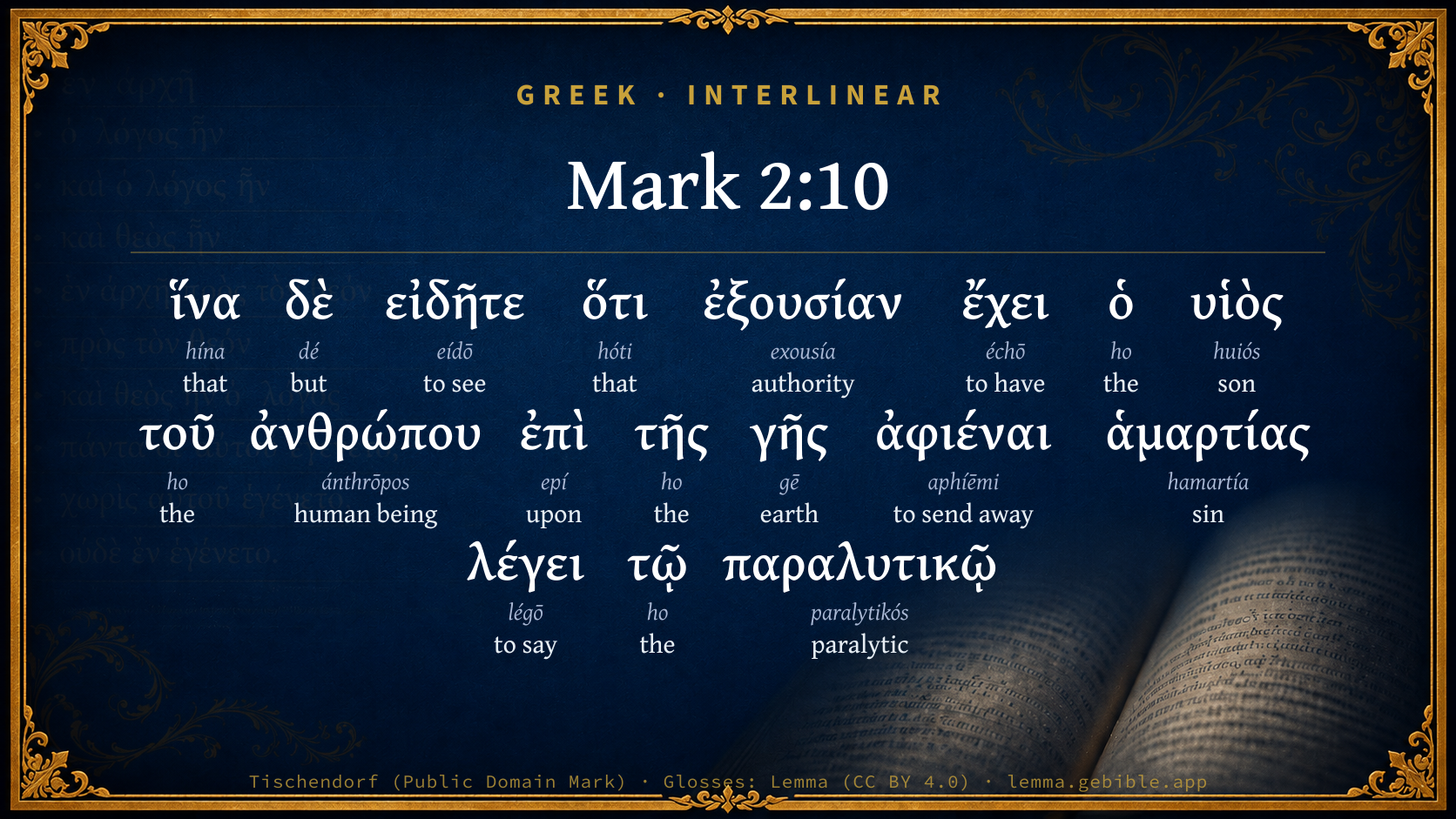
  1. ἵνα hína G2443 “that” Conjunction
  2. δὲ dé G1161 “but” Conjunction
  3. εἰδῆτε eídō G1492 “to see” Verb, Perfect, Active, Subjunctive, 2nd person, Plural
  4. ὅτι hóti G3754 “that” Conjunction
  5. ἐξουσίαν exousía G1849 “authority” Noun, Accusative, Singular, Feminine
  6. ἔχει échō G2192 “to have” Verb, Present, Active, Indicative, 3rd person, Singular
  7. ὁ ho G3588 “the” Article, Nominative, Singular, Masculine
  8. υἱὸς huiós G5207 “son” Noun, Nominative, Singular, Masculine
  9. τοῦ ho G3588 “the” Article, Genitive, Singular, Masculine
  10. ἀνθρώπου ánthrōpos G444 “human being” Noun, Genitive, Singular, Masculine
  11. ἐπὶ epí G1909 “upon” Preposition
  12. τῆς ho G3588 “the” Article, Genitive, Singular, Feminine
  13. γῆς gē G1093 “earth” Noun, Genitive, Singular, Feminine
  14. ἀφιέναι aphíēmi G863 “to send away” Verb, Present, Active, Infinitive
  15. ἁμαρτίας hamartía G266 “sin” Noun, Accusative, Plural, Feminine
  16. λέγει légō G3004 “to say” Verb, Present, Active, Indicative, 3rd person, Singular
  17. τῷ ho G3588 “the” Article, Dative, Singular, Masculine

About this verse

These counts appear in no published source. They are computed here, from the morphology-tagged text and Lemma’s own curated glosses. What Lemma adds →

18
words
15
distinct lemmas
Gospels
section

Notable vocabulary

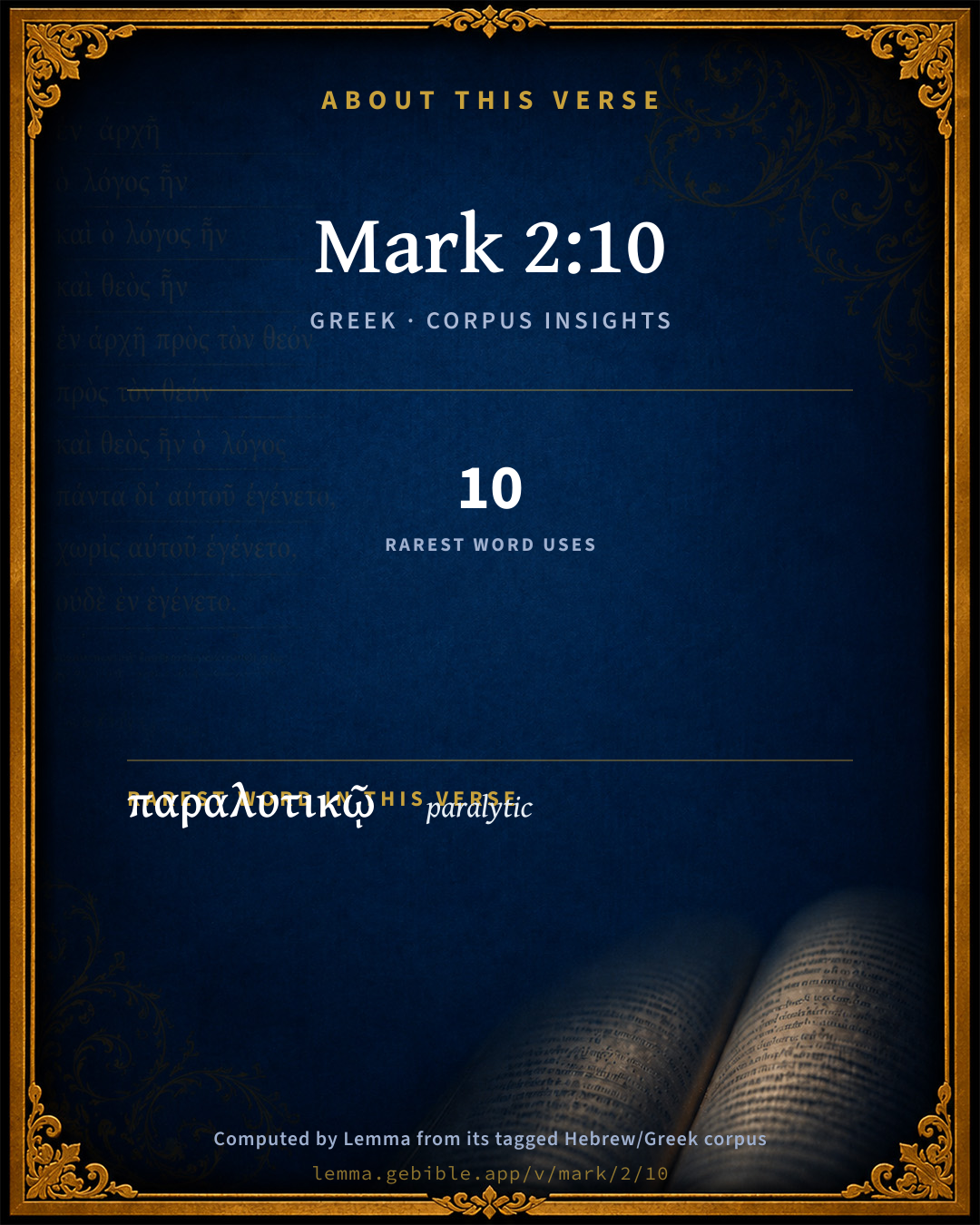
The rarest word here is παραλυτικῷ paralytic G3885 — appearing just 10 times in the whole Greek New Testament.

Shared distinctive vocabulary

παραλυτικῷ paralytic G3885 occurs in 9 verses of the Greek New Testament. Also found in:

Repetition

A word recurs within this verse:

Cross-references

6

Topical passages linked to Mark 2:10 in the Treasury of Scripture Knowledge — connected by theme and wording, ordered by reader-vote popularity; previews shown in the World English Bible.

  • Daniel 7:13–14 I saw in the night-visions, and, behold, there came with the clouds of the sky one like a son of man, and he came even to the ancient of days, and they brought him near before him.
  • Matthew 9:6–8 But that you may know that the Son of Man has authority on earth to forgive sins..." (then he said to the paralytic), "Get up, and take up your mat, and go up to your house."
  • Acts 5:31 God exalted him with his right hand to be a Prince and a Savior, to give repentance to Israel, and remission of sins.
  • John 5:20–27 For the Father has affection for the Son, and shows him all things that he himself does. He will show him greater works than these, that you may marvel.
  • Matthew 16:13 Now when Jesus came into the parts of Caesarea Philippi, he asked his disciples, saying, "Who do men say that I, the Son of Man, am?"
  • 1 Timothy 1:13–16 although I was before a blasphemer, a persecutor, and insolent. However, I obtained mercy, because I did it ignorantly in unbelief.

Cross-references courtesy of OpenBible.info (CC BY 4.0).

Commentary

Notes on Mark 2:10 from classic Christian and Jewish commentators (each source and its license shown beneath its notes). The classic Christian expositions comment on the surrounding passage and are grouped to its opening verse, so a note may address several verses; the Jewish commentaries on the Tanakh (Rashi and others) are per-verse, so they appear only where the commentator wrote on this verse.

Lemma curates 59 commentaries, every one of them public domain or Creative Commons licensed, each selected and text-cleaned for this edition rather than reprinted as found. About our sources →

The Expositor's Bible

CHAPTER 2:10 (Mar_2:10)

THE SON OF MAN

"The Son of man hath power on earth to forgive sins." Mar_2:10 (R.V.)

WHEN asserting His power to forgive sins, Jesus, for the first time in our Gospel, called Himself the Son of man.

It is a remarkable phrase. The profound reverence which He from the first inspired, restrained all other lips from using it, save only when the first martyr felt such a rush of sympathy from above poured into his soul, that the thought of Christ's humanity was more moving than that of His deity. So too it is then alone that He is said to be not enthroned in heaven, but standing, "the Son of man, standing on the right hand of God" (Act_7:56). [3]

What then does this title imply? Beyond doubt it is derived from Daniel's vision: "Behold there came with the clouds of heaven one like unto a Son of man, and He came even to the Ancient of Days" (Dan_7:13). And it was by the bold and unequivocal appropriation of this verse that Jesus brought upon Himself the judgment of the council (Mat_26:64; Mar_14:62).

Now the first impression which the phrase in Daniel produces is that of strong and designed contrast between the Son of man and the Eternal God. We wonder at seeing man "brought nigh" to Deity. Nor may we suppose that to be "like unto a Son of man," implies only an appearance of manhood. In Daniel the Messiah can be cut off. When Jesus uses the epithet, and even when He quotes the prophecy, He not only resembles a Son of man, He is truly such; He is most frequently "the Son of man," the pre-eminent, perhaps the only one. [4]

But while the expression intimates a share in the lowliness of human nature, it does not imply a lowly rank among men.

Our Lord often suggested by its use the difference between His circumstances and His dignity. "The Son of man hath not where to lay His head:" "Betrayest thou the Son of man with a kiss," in each of these we feel that the title asserts a claim to different treatment. And in the great verse, God "hath given Him authority to execute judgment, because He is the Son of man," we discern that although human hands are chosen as fittest to do judgment upon humanity, yet His extraordinary dignity is also taken into account. The title belongs to our Lord's humiliation, but is far from an additional abasement; it asserts His supremacy over those whom He is not ashamed to call brethren.

We all are sons of men; and Jesus used the phrase when He promised that all manner of sins and blasphemies shall be forgiven to us. But there is a higher sense in which, among thousands of the ignoble, we single out one "real man;" and in this sense, as fulfilling the idea, Jesus was the Second Man. What a difference exists between the loftiest sons of vulgar men, and the Son of our complete humanity, of the race, "of Man." The pre-eminence even of our best and greatest is fragmentary and incomplete. In their veins runs but a portion of the rich life-blood of the race: but a share of its energy throbs in the greatest bosom. We seldom find the typical thinker in the typical man of action. Originality of purpose and of means are not commonly united. To know all that holiness embraces, we must combine the energies of one saint with the gentler graces of a second and the spiritual insight of a third. There is no man of genius who fails to make himself the child of his nation and his age, so that Shakespeare would be impossible in France, Hugo in Germany, Goethe in England. Two great nations slay their kings and surrender their liberties to military dictators, but Napoleon would have been unendurable to us, and Cromwell ridiculous across the channel.

Large allowances are to be made for the Greek in Plato, the Roman in Epictetus, before we can learn of them. Each and all are the sons of their tribe and century, not of all mankind and all time. But who will point out the Jewish warp in any word or institution of Jesus? In the new man which is after His image there cannot be Greek and Jew, circumcision and uncircumcision, barbarian, Scythian, bondman, freeman, but Christ is all and in all, something of Him represented by each, all of them concentrated in Him. He alone speaks to all men without any foreign accent, and He alone is recognized and understood as widely as the voices of nature, as the sigh of waves and breezes, and the still endurance of the stars. Reading the Gospels, we become aware that four writers of widely different bias and temperament have all found an equally congenial subject, so that each has given a portrait harmonious with the others, and yet unique. It is because the sum total of humanity is in Christ, that no single writer could have told His story.

But now consider what this implies. It demands an example from which lonely women and heroic leaders of action should alike take fire. It demands that He should furnish meditation for sages in the closet, and should found a kingdom more brilliant than those of conquerors. It demands that He should strike out new paths towards new objects, and be supremely original without deviating from what is truly sane and human, for any selfish or cruel or unwholesome joy. It demands the gentleness of a sheep before her shearers, and such burning wrath as seven times over denounced against the hypocrites of Jerusalem woe and the damnation of hell. It demands the sensibilities which made Gethsemane dreadful, and the strength which made Calvary sublime. It demands that when we approach Him we should learn to feel the awe of others worlds, the nearness of God, the sinfulness of sin, the folly of laying up much goods for many years; that life should be made solemn and profound, but yet that it should not be darkened nor depressed unduly; that nature and man should be made dear to us, little children, and sinners who are scorned yet who love much, and lepers who stand afar off -- yes, and even the lilies of the field, and the fowls of the air; that He should not be unaware of the silent processes of nature which bears fruit of itself, of sunshine and rain, and the fury of storms and torrents, and the leap of the lightning across all the sky. Thus we can bring to Jesus every anxiety and every hope, for He, and only He, was tempted in all points like unto us. Universality of power, of sympathy, and of influence, is the import of this title which Jesus claims. And that demand Jesus only has satisfied, Who is the Master of Sages, the Friend of sinners, the Man of Sorrows, and the King of kings, the one perfect blossom on the tree of our humanity, the ideal of our nature incarnate, the Second Adam in Whom the fullness of the race is visible. The Second Man is the Lord from Heaven. And this strange and solitary grandeur He foretold, when He took to Himself this title, itself equally strange and solitary, the Son of man.

[3] The exceptions in the Revelation are only apparent. St. John does not call Jesus the Son of man (Joh_1:13), nor see Him, but only the type of Him, standing (Joh_1:6).

[4] And this proves beyond question that He did not merely follow Ezekiel in applying to himself the epithet as if it meant a son among many sons of men, but took the description in Daniel for His own. Ezekiel himself indeed never employs the phrase: he only records it.

William Robertson Nicoll, ed., The Expositor's Bible (London: Hodder & Stoughton, 1887–1910) — public domain. 65 of 66 books (1 Corinthians is not separately keyed, as that volume carries no machine-parseable verse references); section-level commentary keyed to the opening verse. Introductory and overview sections not keyed to a specific passage are excluded.

Jamieson, Fausset & Brown

Robert Jamieson, A. R. Fausset & David Brown

But that ye may know that the Son of man hath power on earth to forgive sins--that forgiving power dwells in the Person of this Man, and is exercised by Him while on this earth and going out and in with you.

(he saith to the sick of the palsy),

Jamieson, Fausset & Brown — Commentary Critical and Explanatory on the Whole Bible (1871) — public domain (CC PDM 1.0). Text via the HelloAO Bible API.

The Cambridge Bible for Schools and Colleges

gen. ed. J. J. S. Perowne

10. that ye may know] “By doing that which is capable of being put to the proof, I will vindicate My right and power to do that which, in its very nature, is incapable of being proved.”

the Son of man] This is the first time this title occurs in St Mark, where we find it 14 times. This title is never applied by the writers of the Gospels themselves to the Eternal Son of God. Whenever it occurs, it is so applied by our Lord, and no other. There are only three exceptions to this rule, (1) where the title is used by Stephen (Act_7:56), and (2) by St John (Rev_1:13; Rev_14:14). During, however, the period of His sojourn here on earth, there was no title our Lord was pleased so often and so constantly to apply to Himself. Son of a man He was not. Son of Man he was. The word used in the original for “man” implies human being, and the expression denotes that He who was the Son of God from all Eternity became the “Son of Man” in time, the second Adam, the second Head of our race, the crown of our humanity. For the expression in the O.T. see Dan_7:13.

on earth] This power is not exercised, as ye think, only in heaven by God, but also by the Son of Man on earth.

The Cambridge Bible for Schools and Colleges (gen. ed. J. J. S. Perowne; Cambridge University Press, 1878–1918) — public domain. Text from a community e-Sword module.

John Gill's Exposition

I say unto thee, arise, and take up thy bed,.... He bid him, in an authoritative way to arise from his bed, in which he was brought, and on which he lay before him, and take it up upon his shoulders, directly, and in the face of all the people, carry it away:

and go thy way into thine house; to show himself whole to his family and friends, and go about his business; See Gill on Mat 9:6,

John Gill's Exposition of the Whole Bible (1746–1763) — public domain (CC PDM 1.0). Text via the HelloAO Bible API.

Trapp's Complete Commentary

John Trapp

10 But that ye may know that the Son of man hath power on earth to forgive sins, (he saith to the sick of the palsy,)

Ver. 10. Hath power on earth] Christus iure divino omnia faciebat, non iniusta aliqua virtute ac tyrannica. Christ did all in his Father’s right, and not of necessity.

John Trapp, A Commentary or Exposition upon All the Books of the Old and New Testament (1647–1656) — public domain. Text from a community e-Sword module.

Haydock's Catholic Bible Commentary

The Son of man. Jesus Christ here proveth that himself as man, and not as God only, hath power to forgive sins; by this, that he was able to do miracles, and make the sick man suddenly rise; so the apostles and their successors, though they be not God, may in like manner have authority from God to remit sins, not as God, but as God’s ministers, and acting in his name, and vested with his delegated authority. --- On earth. This power which the Son of man hath to remit sins on earth, was never taken from him, but is perpetuated in his sacraments and ministers, by whom he still remitteth sins in the Church, and not in heaven only. Relative to sin, there is one court of conscience on earth, and another in heaven, and the judgment of heaven followeth and approveth this on earth; as is plain by the words of our Saviour, to Peter first, and then to all the apostles: Whatsoever thou shalt bind upon earth, it shall by bound also in heaven; and whatsoever thou shalt loose upon earth, it shall be loosed also in heaven. See Matthew xvi. 19. and xviii. 18. Whereupon St. Jerome sayeth: that priests having the keys of the kingdom of heaven, judge in some manner before the day of judgment. (Ep. v. ad Heliod; and St. John Chrysostom, more at large, lib. iii. de Sacerd.)

George Leo Haydock (1774–1849), Haydock's Catholic Family Bible and Commentary, 1859 edition — public domain. Excludes Psalms (Douay-Rheims chapter numbering differs from Protestant) and Deuterocanonical books (Catholic canon only).

Scofield Reference Notes

C. I. Scofield

Son of man

(See Scofield "Mat 8:20")

The Scofield Reference Bible (1917 edition), notes by C. I. Scofield — public domain. Text from a community e-Sword module.

unfoldingWord translationNotes

Door43 World Missions Community

But in order that you may know

"But so that you may know." The word "you" refers to the scribes and the crowd.

that the Son of Man has authority

Jesus refers to himself as the "Son of Man." AT: "that I am the Son of Man and I have authority" (See: First, Second, or Third Person)

in front of everyone

"while all the people there were watching"

translationWords

Son of Man

authority

forgive

sin

amazed

glory

God

unfoldingWord translationNotes — © Distant Shores Media and the Door43 World Missions Community, licensed CC BY-SA 4.0. Source: git.door43.org/Door43/en_tn.

Cambridge Greek Testament for Schools and Colleges

10. ἐξουσίαν ἔχει. Hath authority. God has the power, and has given authority to the Son of Man to exercise it (Joh 5:27; Joh 5:30).

ὁ υἱὸς τοῦ ἀνθρώπου. This remarkable expression is used 14 times by Mk. All of these are preserved in Mt., who adds 19, most of which have come from Q. The total for the four Gospels is 81, 12 of which are in Jn. Lk. has it 8 times in common with Mk and Matthew , 8 times in common with Matthew , , 8 times without either. All four Evangelists represent Christ as using this title of Himself. They never call Him “the Son of Man,” and they nowhere record that anyone gave Him this title. The theory that He never used this title of Himself is untenable. Even if it were certain, which it is not, that the difference between υἱὸς ἀνθρώπου, “son of man” or “human being,” and ὁ υἱὸς τοῦ ἀνθρώπου, “the Son of Man,” could not be expressed in Aramaic, it is incredible that all four Evangelists have gone wrong on this point. Christ sometimes spoke Greek, and He may have used the expression ὁ υἱὸς τοῦ ἀνθρώπου. Even if He did not, the Evangelists, whoever they were, represent the memories of numerous persons who knew whether or no Christ had applied this unusual title to Himself. Allen, S. Matthew, pp. lxxi. f.; Driver, Hastings D.B. iv. pp. 579 f.; Dalman, Words, pp. 249, 253, 259. If the first Christians had invented a designation for the now risen and glorified Lord, they would not have chosen an expression so indeterminate as “the Son of Man.”

Here, as in Mar 2:28, it is possible to conjecture that the Aramaic original meant mankind in general. The meaning then would be, not that all men possess this power, but that it is possible for a man to have it. Such an interpretation makes good sense, and Mat 9:8 favours it. But this is not often the case: in Mar 8:13; Mar 8:38, Mar 9:9; Mar 9:12; Mar 9:31, Mar 10:33; Mar 10:45, Mar 14:21; Mar 14:41, such an interpretation is scarcely possible, and in Mar 13:26, Mar 14:62 is quite impossible.

ἐπὶ τῆς γῆς. In Mt. and Lk. these words immediately precede ἀφιέναι ἁμαρτίας, and it is possible that they did so in the original text of Mk. So [376][377][378][379][380][381]c[382][383], Latt. Syr-Pesh. Memph. Arm. Goth. But [384] here has ἀφ. ἁμ. ἐπὶ τ. γῆς, and is supported by [385] and two cursives. A third reading, ἀφ. ἐπὶ τ. γ. ἁμ. ([386][387][388][389][390][391][392][393][394][395], Syr-Hark.) adds weight to [396] as indicating that ἐπὶ τ. γ. belongs to ἀφ. ἁμαρτ. rather than to ὁ υἱὸς τ. ἀν. The absolution which the Son of Man declares takes effect on earth, for it is in accordance with Divine rule.

[376] Codex Sinaiticus. 4th cent. Discovered by Tischendorf in 1859 at the Monastery of St Katharine on Mount Sinai. Now at St Petersburg. The whole Gospel, ending at Mar 16:8. Photographic facsimile, 1911.

[377] Codex Ephraemi. 5th cent. A palimpsest: the original writing has been partially rubbed out, and the works of Ephraem the Syrian have been written over it; but a great deal of the original writing has been recovered; of Mark we have Mar 1:17 to Mar 6:31, Mar 8:5 to Mar 12:29, Mar 13:19 to Mar 16:20. In the National Library at Paris.

[378] Codex Bezae. 6th cent. Has a Latin translation (d) side by side with the Greek text, and the two do not quite always agree. Presented by Beza to the University Library of Cambridge in 1581. Remarkable for its frequent divergences from other texts. Contains Mark, except Mar 16:15-20, which has been added by a later hand. Photographic facsimile, 1899.

[379] Codex Seidelianus II. 9th or 10th cent. Contains Mar 1:1-31; Mar 2:4 to Mar 15:43; Mar 16:14-20.

[380] Codex Regius. 8th cent. An important witness. At Paris. Contains Mar 1:1 to Mar 10:15; Mar 10:30 to Mar 15:1; Mar 15:20 to Mar 16:20, but the shorter ending is inserted between Mar 16:8 and Mar 16:9, showing that the scribe preferred it to the longer one.

[381] Codex Campianus. 9th cent. At Paris. Gospels complete.

[382] Codex Sangallensis. 9th or 10th cent. Contains the Gospels nearly complete, with an interlinear Latin translation. The text of Mark is specially good, agreeing often with CL. At St Gall.

[383] Codex Rossanensis. 6th cent. Mar 16:14-20 is missing.

[384] Codex Vaticanus. 4th cent., but perhaps a little later than א. In the Vatican Library almost since its foundation by Pope Nicolas V., and one of its greatest treasures. The whole Gospel, ending at Mar 16:8. Photographic facsimile, 1889.

[385] Codex Beratinus. 6th cent. Contains Mar 1:1 to Mar 14:62.

[386] Codex Alexandrinus. 5th cent. Brought by Cyril Lucar, Patriarch of Constantinople, from Alexandria, and afterwards presented by him to King Charles I. in 1628. In the British Museum. The whole Gospel. Photographic facsimile, 1879.

[387] Codex Basiliensis. 8th cent. At Basle.

[388] Codex Boreelianus. Once in the possession of John Boreel. 9th cent. At Utrecht. Contains Mk 1–41; Mar 2:8-23; Mar 3:5 to Mar 11:6; Mar 11:27 to Mar 14:54; Mar 15:6-39; Mar 16:19-20.

[389] Codex Seidelianus I. 9th or 10th cent. Contains Mar 1:13 to Mar 14:18; Mar 14:25 to Mar 16:20.

[390] Codex Cyprius. 9th cent. One of the seven uncials which have the Gospels complete, the others being אBMSUΩ. At Paris.

[391] Codex Vaticanus. 10th cent. Dated A.D. 949.

[392] Codex Nanianus. 9th or 10th cent. Gospels complete.

[393] Codex Mosquensis. 9th cent.

[394] Codex Oxoniensis. 9th cent. Contains Mark, except Mar 3:35 to Mar 6:20.

[395] Codex Petropolitanus. 9th cent. Gospels almost complete. Mar 16:18-20 is in a later hand.

[396] Codex Vaticanus. 4th cent., but perhaps a little later than א. In the Vatican Library almost since its foundation by Pope Nicolas V., and one of its greatest treasures. The whole Gospel, ending at Mar 16:8. Photographic facsimile, 1889.

Cambridge Greek Testament for Schools and Colleges (Cambridge University Press, 1896; 21 vols, various authors incl. Carr, Maclear, Plummer, Farrar, Lumby, Moule, M. R. James, Simcox) — public domain. Text from a community e-Sword module.

International Critical Commentary

10. ἵνα δὲ εἴδητε—but that ye may know. Here was an opportunity to put his power to a practical test. As a general thing, the power to forgive sins admits of no such test, but only of those finer inward tests by which a change of spiritual condition and relation becomes known. But here the forgiveness was manifested in an outward change, making itself known in cure, as the sin had discovered itself in disease. ἐξουσίαν—authority, or right. This is the proper meaning, rather than power, and it evidently fits this case.

ὁ υἱὸς τοῦ ἀνθρώπου—the Son of Man. This is a Messianic title, the use of which is to be traced to the Messianic interpretation of Dan 7:13-27. In the post-canonical Jewish literature, it appears several times in the Book of Enoch.2 It is the favorite title applied by Jesus to himself in the Synoptical Gospels, Son of God being used by Jesus himself only in the fourth Gospel.3 In the passage in Dan., the prophet sees in vision a fifth power succeeding the four great world-powers, only this is in his vision like a son of man, while the preceding powers have been represented as beasts. And in the interpretation that follows (see especially v. 18, 22, 27) this power is said to be the kingdom of the saints of the Most High. But later, when the hopes of the people were concentrated finally on a Messianic king, this passage was given Messianic interpretation, and Son of Man came to be a Messianic title, though not so distinctive, not so commonly accepted, as the name Messiah. The choice of it by Jesus was partly for this reason. To have called himself plainly the Messiah would have precipitated a crisis, forcing the people to decide prematurely on his claim. And it is evident from the doubt of the people, not only about what he was, but in regard to this very point, what he himself claimed to be, that the title used by him familiarly was indecisive. However, there can be little doubt, that the reason for the choice of the name Son of Man lay deeper than this, and is to be found in the significance of the name itself, aside from its historic sense. Everywhere, Jesus uses the Messianic phraseology of his time, but rarely limits himself to its current meaning. This name, Son of Man, was to the Jews a Messianic title, only that and nothing more. But Jesus fastens upon it because it identified him with humanity, and owing to the generic use of the word Man in it, with the whole of humanity. His chosen title, as well as his life, showed that his great desire was to impress on us his brotherhood with man.

ἐπὶ τῆς γῆς—upon the earth. Contrasted with the power of God to forgive sins in heaven. Of course, the power to forgive sins, involved in the mere cure of diseases resulting from them, is in itself small. But the significance of these words lies in the unity of our Lord’s work implied in them. As the redeemer and deliverer of mankind, he is appointed to cope with the whole power of evil among men, to strike at its roots, as well as its twigs and branches, and at its effects, as well as its causes. And the whole is so far the one power trusted to him, that one part becomes the sign of the other.

International Critical Commentary — older volumes (1896–1929), various authors — public domain. Text from a community e-Sword module.

Vincent's Word Studies in the New Testament

Marvin R. Vincent

Power [εξουσιαν] ; or better, authority, as Rev., in margin. The word is derived from exesti, it is permitted or lawful. It combines the ideas of right and might. Authority or right is the dominant meaning in the New Testament.

Marvin R. Vincent, Word Studies in the New Testament (1887–1900) — public domain. Text from a community e-Sword/MySword module.

Lesson kit

Teaching starters — assembled from the data on this page, not authored interpretation. Every prompt links to the verse data it draws on. Edit before teaching.

Mark, in the Gospels, opens this verse with 18 words (15 distinct Greek lemmas). Its most distinctive word is paralytikós (“paralytic”). A historical commentator’s framing appears above. Read the whole chapter for the surrounding context.

Discussion questions

  1. How does “paralytic” (paralytikós) shape what this verse is saying?
  2. Matthew 4:24 shares the word «paralytic» with this verse. How do the two illuminate each other?
  3. “the” occurs 4× in this one verse. What is the effect of the repetition?
  4. These translations render this verse differently. What is at stake in choosing one wording over another?
  5. Reading how The Expositor's Bible and Jamieson, Fausset & Brown read this verse, where do the two commentators agree and where do they part?

Things to notice

Reading settings

Reading text

Shown beneath each verse's original-language words.

Old Testament
Old Testament edition

Read the OT as the Masoretic Hebrew (MT) or the Greek Septuagint (LXX).

English shown for the Greek Septuagint (in the Hebrew ↔ Greek comparison).

Comparing translations? Open the Compare panel on any verse page to stack up to four side by side.