פָּנֶה
face
‘face’ is one of 8 main senses fuller range ↓
Full lexicon entry — Brown-Driver-Briggs (BDB)
From Brown-Driver-Briggs (BDB)
Where this word appears
See every Construct-state word in the Hebrew Bible →
Grammar key — what these labels mean
Part of speech
- Noun
- A naming word — a person, place, thing, or idea.
Noun type
- Common
- A common noun — a general class of person, place, or thing (“king,” “city,” “water”), not a specific name.
State
- Construct
- A noun bound to a following noun in a possessive / “of” relationship (the construct chain).
- Absolute
- The independent form of a noun, not bound to a following word.
Gender
- Both
- Attested as both masculine and feminine.
Number
- Plural
- More than one (in Hebrew, generally three or more).
109 verses where H6440 appears in the Construct state in the Book of Exodus. Filtered view — show all forms. Click any verse to open its interlinear word-by-word view. Verse text shown in the World English Bible for context — . Each verse’s Hebrew form is shown with its reference; the English is not keyword-highlighted, since the data carries no word-level English alignment. Use “Compare translations” on any verse to read it across multiple English versions. This concordance covers the Hebrew Bible; Septuagint (Greek Old Testament) occurrences are not indexed here.
Exodus
- Exodus 1:12 מִ/פְּנֵ֖י prep + n c bp cs But the more they afflicted them, the more they multiplied and the more they spread out. They were grieved because of the children of Israel.
- Exodus 2:15 מִ/פְּנֵ֣י prep + n c bp cs Now when Pharaoh heard this thing, he sought to kill Moses. But Moses fled from the face of Pharaoh, and lived in the land of Midian, and he sat down by a well.
- Exodus 3:6 פָּנָ֔י/ו n c bp cs + sfx pers 3ms Moreover he said, "I am the God of your father, the God of Abraham, the God of Isaac, and the God of Jacob." Moses hid his face; for he was afraid to look at God.
- Exodus 3:7 מִ/פְּנֵ֣י prep + n c bp cs Yahweh said, "I have surely seen the affliction of my people who are in Egypt, and have heard their cry because of their taskmasters, for I know their sorrows.
- Exodus 4:3 מִ/פָּנָֽי/ו prep + n c bp cs + sfx pers 3ms He said, "Throw it on the ground." He threw it on the ground, and it became a snake; and Moses ran away from it.
- Exodus 4:21 לִ/פְנֵ֣י prep + n c bp cs Yahweh said to Moses, "When you go back into Egypt, see that you do before Pharaoh all the wonders which I have put in your hand, but I will harden his heart and he will not let the people go.
- Exodus 6:12 לִ/פְנֵ֥י prep + n c bp cs Moses spoke before Yahweh, saying, "Behold, the children of Israel haven't listened to me. How then shall Pharaoh listen to me, who am of uncircumcised lips?"
- Exodus 6:30 לִ/פְנֵ֣י prep + n c bp cs Moses said before Yahweh, "Behold, I am of uncircumcised lips, and how shall Pharaoh listen to me?"
- Exodus 7:9 לִ/פְנֵֽי prep + n c bp cs "When Pharaoh speaks to you, saying, 'Perform a miracle!' then you shall tell Aaron, 'Take your rod, and cast it down before Pharaoh, that it become a serpent.'"
- Exodus 7:10 לִ/פְנֵ֥י וְ/לִ/פְנֵ֥י prep + n c bp cs conj + prep + n c bp cs Moses and Aaron went in to Pharaoh, and they did so, as Yahweh had commanded: and Aaron cast down his rod before Pharaoh and before his servants, and it became a serpent.
- Exodus 8:20 לִ/פְנֵ֣י prep + n c bp cs Yahweh said to Moses, "Rise up early in the morning, and stand before Pharaoh; behold, he comes forth to the water; and tell him, 'This is what Yahweh says, "Let my people go, that they may serve me.
- Exodus 8:24 מִ/פְּנֵ֥י prep + n c bp cs Yahweh did so; and there came grievous swarms of flies into the house of Pharaoh, and into his servants' houses: and in all the land of Egypt the land was corrupted by reason of the swarms of flies.
- Exodus 9:10 לִ/פְנֵ֣י prep + n c bp cs They took ashes of the furnace, and stood before Pharaoh; and Moses sprinkled it up toward the sky; and it became a boil breaking forth with boils on man and on animal.
- Exodus 9:11 לִ/פְנֵ֥י מִ/פְּנֵ֣י prep + n c bp cs prep + n c bp cs The magicians couldn't stand before Moses because of the boils; for the boils were on the magicians, and on all the Egyptians.
- Exodus 9:13 לִ/פְנֵ֣י prep + n c bp cs Yahweh said to Moses, "Rise up early in the morning, and stand before Pharaoh, and tell him, 'This is what Yahweh, the God of the Hebrews, says: "Let my people go, that they may serve me.
- Exodus 9:30 מִ/פְּנֵ֖י prep + n c bp cs But as for you and your servants, I know that you don't yet fear Yahweh God."
- Exodus 10:3 מִ/פָּנָ֑/י prep + n c bp cs + sfx pers 1cs Moses and Aaron went in to Pharaoh, and said to him, "This is what Yahweh, the God of the Hebrews, says: 'How long will you refuse to humble yourself before me? Let my people go, that they may serve me.
- Exodus 10:10 פְּנֵי/כֶֽם n c bp cs + sfx pers 2mp He said to them, "Yahweh be with you if I will let you go with your little ones! See, evil is clearly before your faces.
- Exodus 10:11 פְּנֵ֥י n c bp cs Not so! Go now you who are men, and serve Yahweh; for that is what you desire!" They were driven out from Pharaoh's presence.
- Exodus 10:14 לְ֠/פָנָי/ו prep + n c bp cs + sfx pers 3ms The locusts went up over all the land of Egypt, and rested in all the borders of Egypt. They were very grievous. Before them there were no such locusts as they, neither after them shall be such.
- Exodus 10:28 פָּנַ֔/י פָנַ֖/י n c bp cs + sfx pers 1cs n c bp cs + sfx pers 1cs Pharaoh said to him, "Get away from me! Be careful to see my face no more; for in the day you see my face you shall die!"
- Exodus 10:29 פָּנֶֽי/ךָ n c bp cs + sfx pers 2ms Moses said, "You have spoken well. I will see your face again no more."
- Exodus 11:10 לִ/פְנֵ֣י prep + n c bp cs Moses and Aaron did all these wonders before Pharaoh, and Yahweh hardened Pharaoh's heart, and he didn't let the children of Israel go out of his land.
- Exodus 13:21 לִ/פְנֵי/הֶ֨ם prep + n c bp cs + sfx pers 3mp Yahweh went before them by day in a pillar of cloud, to lead them on their way, and by night in a pillar of fire, to give them light, that they might go by day and by night:
- Exodus 13:22 לִ/פְנֵ֖י prep + n c bp cs the pillar of cloud by day, and the pillar of fire by night, didn't depart from before the people.
- Exodus 14:2 לִ/פְנֵי֙ לִ/פְנֵי֙ prep + n c bp cs prep + n c bp cs "Speak to the children of Israel, that they turn back and encamp before Pihahiroth, between Migdol and the sea, before Baal Zephon. You shall encamp opposite it by the sea.
- Exodus 14:9 לִ/פְנֵ֖י prep + n c bp cs The Egyptians pursued after them: all the horses and chariots of Pharaoh, his horsemen, and his army; and overtook them encamping by the sea, beside Pihahiroth, before Baal Zephon.
- Exodus 14:19 לִ/פְנֵי֙ מִ/פְּנֵי/הֶ֔ם prep + n c bp cs prep + n c bp cs + sfx pers 3mp The angel of God, who went before the camp of Israel, moved and went behind them; and the pillar of cloud moved from before them, and stood behind them.
- Exodus 14:25 מִ/פְּנֵ֣י prep + n c bp cs He took off their chariot wheels, and they drove them heavily; so that the Egyptians said, "Let's flee from the face of Israel, for Yahweh fights for them against the Egyptians!"
- Exodus 16:9 לִ/פְנֵ֣י prep + n c bp cs Moses said to Aaron, "Tell all the congregation of the children of Israel, 'Come near before Yahweh, for he has heard your murmurings.'"
- Exodus 16:14 פְּנֵ֤י n c bp cs When the dew that lay had gone, behold, on the surface of the wilderness was a small round thing, small as the hoar-frost on the ground.
- Exodus 16:33 לִ/פְנֵ֣י prep + n c bp cs Moses said to Aaron, "Take a pot, and put an omer-full of manna in it, and lay it up before Yahweh, to be kept throughout your generations."
- Exodus 16:34 לִ/פְנֵ֥י prep + n c bp cs As Yahweh commanded Moses, so Aaron laid it up before the Testimony, to be kept.
- Exodus 17:5 לִ/פְנֵ֣י prep + n c bp cs Yahweh said to Moses, "Walk on before the people, and take the elders of Israel with you, and take the rod in your hand with which you struck the Nile, and go.
- Exodus 17:6 לְ/פָנֶ֨י/ךָ prep + n c bp cs + sfx pers 2ms Behold, I will stand before you there on the rock in Horeb. You shall strike the rock, and water will come out of it, that the people may drink." Moses did so in the sight of the elders of Israel.
- Exodus 18:12 לִ/פְנֵ֥י prep + n c bp cs Jethro, Moses' father-in-law, took a burnt offering and sacrifices for God. Aaron came with all of the elders of Israel, to eat bread with Moses' father-in-law before God.
- Exodus 19:7 לִ/פְנֵי/הֶ֗ם prep + n c bp cs + sfx pers 3mp Moses came and called for the elders of the people, and set before them all these words which Yahweh commanded him.
- Exodus 19:18 מִ֠/פְּנֵי prep + n c bp cs Mount Sinai, the whole of it, smoked, because Yahweh descended on it in fire; and its smoke ascended like the smoke of a furnace, and the whole mountain quaked greatly.
- Exodus 20:3 פָּנָֽ/יַ n c bp cs + sfx pers 1cs You shall have no other gods before me.
- Exodus 20:20 פְּנֵי/כֶ֖ם n c bp cs + sfx pers 2mp Moses said to the people, "Don't be afraid, for God has come to test you, and that his fear may be before you, that you won't sin."
- Exodus 21:1 לִ/פְנֵי/הֶֽם prep + n c bp cs + sfx pers 3mp "Now these are the ordinances which you shall set before them.
- Exodus 23:15 פָנַ֖/י n c bp cs + sfx pers 1cs You shall observe the feast of unleavened bread. Seven days you shall eat unleavened bread, as I commanded you, at the time appointed in the month Abib (for in it you came out from Egypt), and no one shall appear before me empty.
- Exodus 23:17 פְּנֵ֖י n c bp cs Three times in the year all your males shall appear before the Lord Yahweh.
- Exodus 23:20 לְ/פָנֶ֔י/ךָ prep + n c bp cs + sfx pers 2ms "Behold, I send an angel before you, to keep you by the way, and to bring you into the place which I have prepared.
- Exodus 23:21 מִ/פָּנָ֛י/ו prep + n c bp cs + sfx pers 3ms Pay attention to him, and listen to his voice. Don't provoke him, for he will not pardon your disobedience, for my name is in him.
- Exodus 23:23 לְ/פָנֶי/ךָ֒ prep + n c bp cs + sfx pers 2ms For my angel shall go before you, and bring you in to the Amorite, the Hittite, the Perizzite, the Canaanite, the Hivite, and the Jebusite; and I will cut them off.
- Exodus 23:27 לְ/פָנֶ֔י/ךָ prep + n c bp cs + sfx pers 2ms I will send my terror before you, and will confuse all the people to whom you come, and I will make all your enemies turn their backs to you.
- Exodus 23:28 לְ/פָנֶ֑י/ךָ מִ/לְּ/פָנֶֽי/ךָ prep + n c bp cs + sfx pers 2ms prep + prep + n c bp cs + sfx pers 2ms I will send the hornet before you, which will drive out the Hivite, the Canaanite, and the Hittite, from before you.
- Exodus 23:29 מִ/פָּנֶ֖י/ךָ prep + n c bp cs + sfx pers 2ms I will not drive them out from before you in one year, lest the land become desolate, and the animals of the field multiply against you.
- Exodus 23:30 מִ/פָּנֶ֑י/ךָ prep + n c bp cs + sfx pers 2ms Little by little I will drive them out from before you, until you have increased and inherit the land.
- Exodus 23:31 מִ/פָּנֶֽי/ךָ prep + n c bp cs + sfx pers 2ms I will set your border from the Red Sea even to the sea of the Philistines, and from the wilderness to the River; for I will deliver the inhabitants of the land into your hand, and you shall drive them out before you.
- Exodus 25:20 וּ/פְנֵי/הֶ֖ם פְּנֵ֥י conj + n c bp cs + sfx pers 3mp n c bp cs The cherubim shall spread out their wings upward, covering the mercy seat with their wings, with their faces toward one another. The faces of the cherubim shall be toward the mercy seat.
- Exodus 25:30 פָּנִ֖ים לְ/פָנַ֥/י n c bp prep + n c bp cs + sfx pers 1cs You shall set bread of the presence on the table before me always.
- Exodus 25:37 פָּנֶֽי/הָ n c bp cs + sfx pers 3fs You shall make its lamps seven, and they shall light its lamps to give light to the space in front of it.
- Exodus 26:9 פְּנֵ֥י n c bp cs You shall couple five curtains by themselves, and six curtains by themselves, and shall double over the sixth curtain in the forefront of the tent.
- Exodus 27:21 לִ/פְנֵ֣י prep + n c bp cs In the tent of meeting, outside the veil which is before the testimony, Aaron and his sons shall keep it in order from evening to morning before Yahweh: it shall be a statute forever throughout their generations on the behalf of the children of Israel.
- Exodus 28:12 לִ/פְנֵ֧י prep + n c bp cs You shall put the two stones on the shoulder-pieces of the ephod, to be stones of memorial for the children of Israel: and Aaron shall bear their names before Yahweh on his two shoulders for a memorial.
- Exodus 28:25 פָּנָֽי/ו n c bp cs + sfx pers 3ms The other two ends of the two braided chains you shall put on the two settings, and put them on the shoulder-pieces of the ephod in the forepart of it.
- Exodus 28:27 פָּנָ֔י/ו n c bp cs + sfx pers 3ms You shall make two rings of gold, and shall put them on the two shoulder-pieces of the ephod underneath, in the forepart of it, close by the coupling of it, above the skillfully woven band of the ephod.
- Exodus 28:29 לִ/פְנֵֽי prep + n c bp cs Aaron shall bear the names of the children of Israel in the breastplate of judgment on his heart, when he goes in to the holy place, for a memorial before Yahweh continually.
- Exodus 28:30 לִ/פְנֵ֣י לִ/פְנֵ֥י prep + n c bp cs prep + n c bp cs You shall put in the breastplate of judgment the Urim and the Thummim; and they shall be on Aaron's heart, when he goes in before Yahweh: and Aaron shall bear the judgment of the children of Israel on his heart before Yahweh continually.
- Exodus 28:35 לִ/פְנֵ֧י prep + n c bp cs It shall be on Aaron to minister: and the sound of it shall be heard when he goes in to the holy place before Yahweh, and when he comes out, that he not die.
- Exodus 28:37 פְּנֵֽי n c bp cs You shall put it on a lace of blue, and it shall be on the sash; on the front of the sash it shall be.
- Exodus 28:38 לִ/פְנֵ֥י prep + n c bp cs It shall be on Aaron's forehead, and Aaron shall bear the iniquity of the holy things, which the children of Israel shall make holy in all their holy gifts; and it shall be always on his forehead, that they may be accepted before Yahweh.
- Exodus 29:10 לִ/פְנֵ֖י prep + n c bp cs "You shall bring the bull before the tent of meeting: and Aaron and his sons shall lay their hands on the head of the bull.
- Exodus 29:11 לִ/פְנֵ֣י prep + n c bp cs You shall kill the bull before Yahweh, at the door of the tent of meeting.
- Exodus 29:23 לִ/פְנֵ֥י prep + n c bp cs and one loaf of bread, one cake of oiled bread, and one wafer out of the basket of unleavened bread that is before Yahweh.
- Exodus 29:24 לִ/פְנֵ֥י prep + n c bp cs You shall put all of this in Aaron's hands, and in his sons' hands, and shall wave them for a wave-offering before Yahweh.
- Exodus 29:25 לִ/פְנֵ֣י prep + n c bp cs You shall take them from their hands, and burn them on the altar on the burnt offering, for a sweet savor before Yahweh: it is an offering made by fire to Yahweh.
- Exodus 29:26 לִ/פְנֵ֣י prep + n c bp cs "You shall take the breast of Aaron's ram of consecration, and wave it for a wave-offering before Yahweh: and it shall be your portion.
- Exodus 29:42 לִ/פְנֵ֣י prep + n c bp cs It shall be a continual burnt offering throughout your generations at the door of the tent of meeting before Yahweh, where I will meet with you, to speak there to you.
- Exodus 30:6 לִ/פְנֵ֣י לִ/פְנֵ֣י prep + n c bp cs prep + n c bp cs You shall put it before the veil that is by the ark of the testimony, before the mercy seat that is over the testimony, where I will meet with you.
- Exodus 30:8 לִ/פְנֵ֥י prep + n c bp cs When Aaron lights the lamps at evening, he shall burn it, a perpetual incense before Yahweh throughout your generations.
- Exodus 30:16 לִ/פְנֵ֣י prep + n c bp cs You shall take the atonement money from the children of Israel, and shall appoint it for the service of the tent of meeting; that it may be a memorial for the children of Israel before Yahweh, to make atonement for your souls."
- Exodus 30:36 לִ/פְנֵ֤י prep + n c bp cs and you shall beat some of it very small, and put some of it before the testimony in the tent of meeting, where I will meet with you. It shall be to you most holy.
- Exodus 32:1 לְ/פָנֵ֔י/נוּ prep + n c bp cs + sfx pers 1cp When the people saw that Moses delayed to come down from the mountain, the people gathered themselves together to Aaron, and said to him, "Come, make us gods, which shall go before us; for as for this Moses, the man who brought us up out of the land of Egypt, we don't know what has become of him."
- Exodus 32:5 לְ/פָנָ֑י/ו prep + n c bp cs + sfx pers 3ms When Aaron saw this, he built an altar before it; and Aaron made a proclamation, and said, "Tomorrow shall be a feast to Yahweh."
- Exodus 32:11 פְּנֵ֖י n c bp cs Moses begged Yahweh his God, and said, "Yahweh, why does your wrath burn hot against your people, that you have brought forth out of the land of Egypt with great power and with a mighty hand?
- Exodus 32:12 פְּנֵ֣י n c bp cs Why should the Egyptians speak, saying, 'He brought them forth for evil, to kill them in the mountains, and to consume them from the surface of the earth?' Turn from your fierce wrath, and repent of this evil against your people.
- Exodus 32:20 פְּנֵ֣י n c bp cs He took the calf which they had made, and burnt it with fire, ground it to powder, and scattered it on the water, and made the children of Israel drink of it.
- Exodus 32:23 לְ/פָנֵ֑י/נוּ prep + n c bp cs + sfx pers 1cp For they said to me, 'Make us gods, which shall go before us; for as for this Moses, the man who brought us up out of the land of Egypt, we don't know what has become of him.'
- Exodus 32:34 לְ/פָנֶ֑י/ךָ prep + n c bp cs + sfx pers 2ms Now go, lead the people to the place of which I have spoken to you. Behold, my angel shall go before you. Nevertheless in the day when I punish, I will punish them for their sin."
- Exodus 33:2 לְ/פָנֶ֖י/ךָ prep + n c bp cs + sfx pers 2ms I will send an angel before you; and I will drive out the Canaanite, the Amorite, and the Hittite, and the Perizzite, the Hivite, and the Jebusite:
- Exodus 33:14 פָּנַ֥/י n c bp cs + sfx pers 1cs He said, "My presence will go with you, and I will give you rest."
- Exodus 33:15 פָּנֶ֨י/ךָ֙ n c bp cs + sfx pers 2ms He said to him, "If your presence doesn't go with me, don't carry us up from here.
- Exodus 33:16 פְּנֵ֥י n c bp cs For how would people know that I have found favor in your sight, I and your people? Isn't it in that you go with us, so that we are separated, I and your people, from all the people who are on the surface of the earth?"
- Exodus 33:19 פָּנֶ֔י/ךָ לְ/פָנֶ֑י/ךָ n c bp cs + sfx pers 2ms prep + n c bp cs + sfx pers 2ms He said, "I will make all my goodness pass before you, and will proclaim the name of Yahweh before you. I will be gracious to whom I will be gracious, and will show mercy on whom I will show mercy."
- Exodus 33:20 פָּנָ֑/י n c bp cs + sfx pers 1cs He said, "You cannot see my face, for man may not see me and live."
- Exodus 33:23 וּ/פָנַ֖/י conj + n c bp cs + sfx pers 1cs then I will take away my hand, and you will see my back; but my face shall not be seen."
- Exodus 34:6 פָּנָי/ו֮ n c bp cs + sfx pers 3ms Yahweh passed by before him, and proclaimed, "Yahweh! Yahweh, a merciful and gracious God, slow to anger, and abundant in loving kindness and truth,
- Exodus 34:11 מִ/פָּנֶ֗י/ךָ prep + n c bp cs + sfx pers 2ms Observe that which I command you this day. Behold, I drive out before you the Amorite, the Canaanite, the Hittite, the Perizzite, the Hivite, and the Jebusite.
- Exodus 34:20 פָנַ֖/י n c bp cs + sfx pers 1cs The firstborn of a donkey you shall redeem with a lamb: and if you will not redeem it, then you shall break its neck. All the firstborn of your sons you shall redeem. No one shall appear before me empty.
- Exodus 34:23 פְּנֵ֛י n c bp cs Three times in the year all your males shall appear before the Lord Yahweh, the God of Israel.
- Exodus 34:24 מִ/פָּנֶ֔י/ךָ פְּנֵי֙ prep + n c bp cs + sfx pers 2ms n c bp cs For I will drive out nations before you and enlarge your borders; neither shall any man desire your land when you go up to appear before Yahweh, your God, three times in the year.
- Exodus 34:29 פָּנָ֖י/ו n c bp cs + sfx pers 3ms It happened, when Moses came down from Mount Sinai with the two tablets of the testimony in Moses' hand, when he came down from the mountain, that Moses didn't know that the skin of his face shone by reason of his speaking with him.
- Exodus 34:30 פָּנָ֑י/ו n c bp cs + sfx pers 3ms When Aaron and all the children of Israel saw Moses, behold, the skin of his face shone; and they were afraid to come near him.
- Exodus 34:33 פָּנָ֖י/ו n c bp cs + sfx pers 3ms When Moses was done speaking with them, he put a veil on his face.
- Exodus 34:34 לִ/פְנֵ֤י prep + n c bp cs But when Moses went in before Yahweh to speak with him, he took the veil off, until he came out; and he came out, and spoke to the children of Israel that which he was commanded.
- Exodus 34:35 פְּנֵ֣י פְּנֵ֣י פָּנָ֔י/ו n c bp cs n c bp cs n c bp cs + sfx pers 3ms The children of Israel saw Moses' face, that the skin of Moses' face shone: and Moses put the veil on his face again, until he went in to speak with him.
- Exodus 35:20 מִ/לִּ/פְנֵ֥י prep + prep + n c bp cs All the congregation of the children of Israel departed from the presence of Moses.
- Exodus 36:3 מִ/לִּ/פְנֵ֣י prep + prep + n c bp cs and they received from Moses all the offering which the children of Israel had brought for the work of the service of the sanctuary, with which to make it. They brought yet to him freewill-offerings every morning.
- Exodus 37:9 וּ/פְנֵי/הֶ֖ם פְּנֵ֥י conj + n c bp cs + sfx pers 3mp n c bp cs The cherubim spread out their wings on high, covering the mercy seat with their wings, with their faces toward one another. The faces of the cherubim were toward the mercy seat.
- Exodus 39:18 פָּנָֽי/ו n c bp cs + sfx pers 3ms The other two ends of the two braided chains they put on the two settings, and put them on the shoulder-pieces of the ephod, in the front of it.
- Exodus 39:20 פָּנָ֔י/ו n c bp cs + sfx pers 3ms They made two rings of gold, and put them on the two shoulder-pieces of the ephod underneath, in the front of it, close by its coupling, above the skillfully woven band of the ephod.
- Exodus 40:5 לִ/פְנֵ֖י prep + n c bp cs You shall set the golden altar for incense before the ark of the testimony, and put the screen of the door to the tent.
- Exodus 40:6 לִ/פְנֵ֕י prep + n c bp cs You shall set the altar of burnt offering before the door of the tent of the tent of meeting.
- Exodus 40:23 לִ/פְנֵ֣י prep + n c bp cs He set the bread in order on it before Yahweh, as Yahweh commanded Moses.
- Exodus 40:25 לִ/פְנֵ֣י prep + n c bp cs He lit the lamps before Yahweh, as Yahweh commanded Moses.
- Exodus 40:26 לִ/פְנֵ֖י prep + n c bp cs He put the golden altar in the tent of meeting before the veil;
About this entry
At a glance — auto-summarized from this page’s data, not written by a person. Every figure links to its source below. This summary describes the numbers; it doesn’t interpret them.
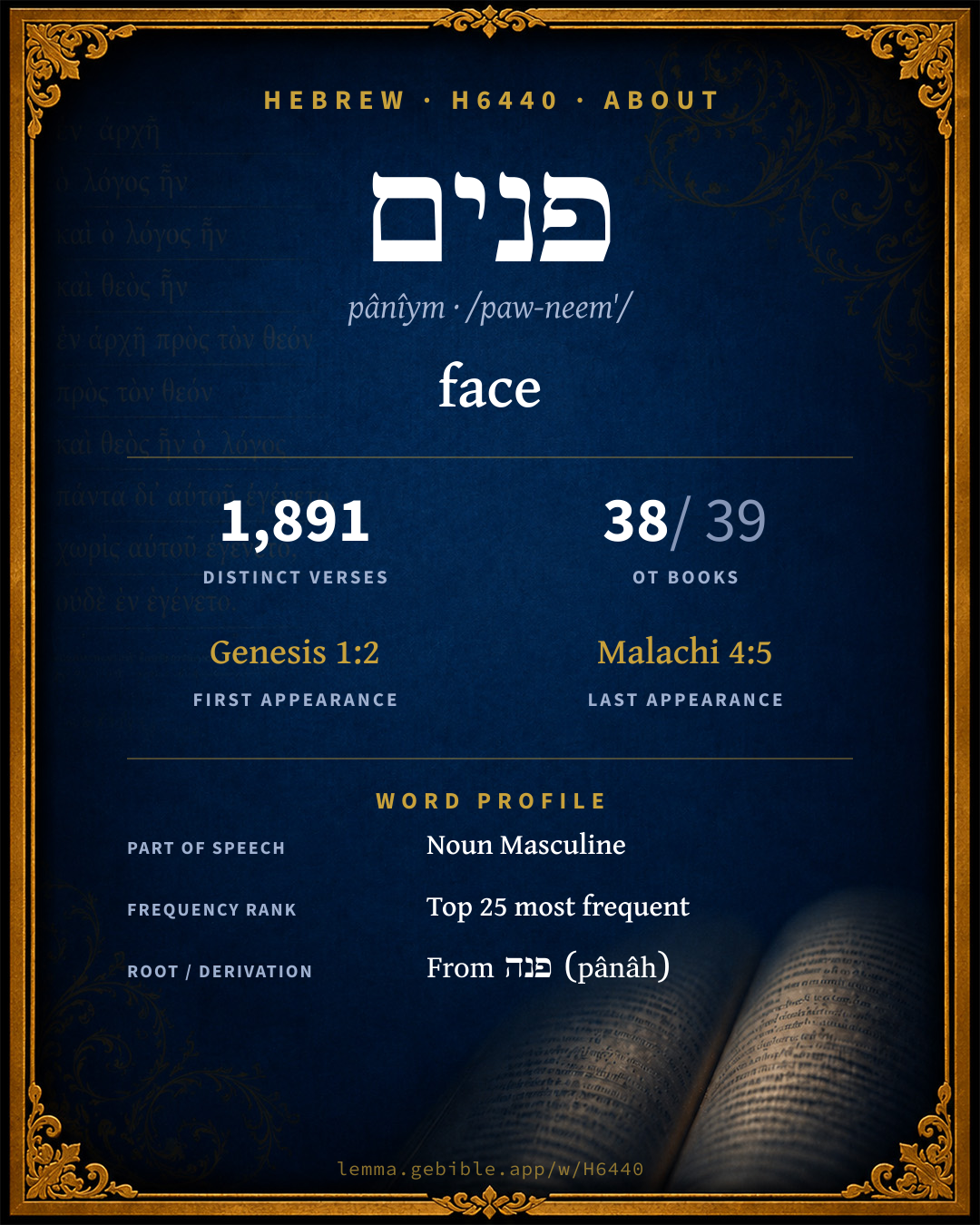
פנים — transliterated pânîym — is a Hebrew noun carrying the sense “face.” Where the King James Version says “before,” newer translations reach for “face of” (unfoldingWord Literal Text); the renderings breakdown has the detail. It appears 1,891 verses across 38 books of the Hebrew Bible, among its most common vocabulary. Debuting at Genesis 1:2, it then recurs through the corpus. It is not a single-sense word — see its full sense range. See the sense tree, 1,891-verse concordance, and the renderings breakdown below.
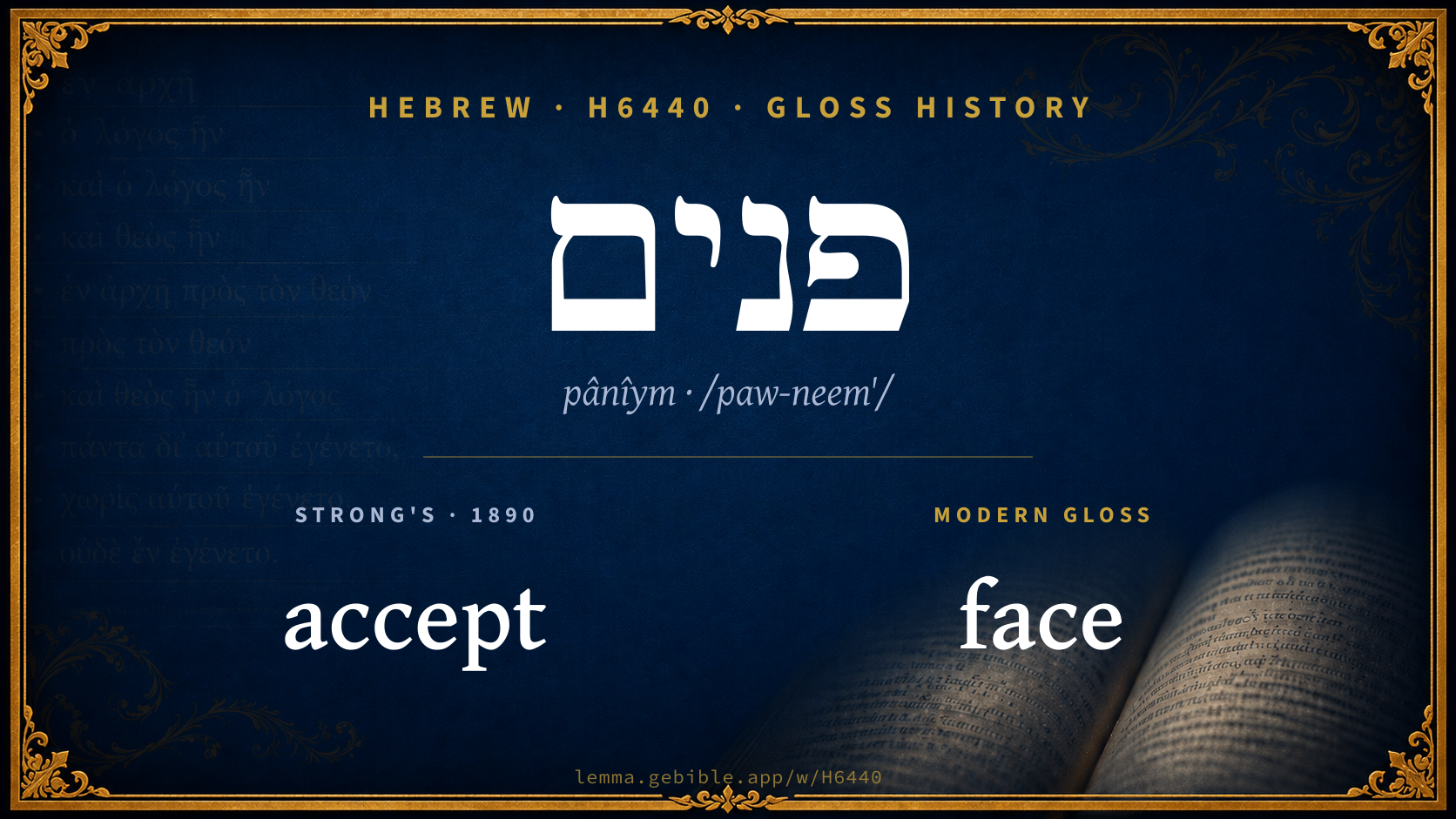
Gloss history
Strong's 1890 vs modern scholarship
About this word
Strong's H6440 catalogs a Hebrew word from the Hebrew Old Testament.
These counts are not copied from any lexicon or concordance. They are computed here, from the morphology-tagged Hebrew Old Testament. What Lemma adds →
- 1,891
- distinct verses
- The word appears in 1,891 distinct verses.
- 38 / 39
- OT books
- The word appears in 38 of 39 Old Testament books.
- #20
- by frequency
- Top 25 most frequent Hebrew words (rank 20 of 8,640 Hebrew words by occurrence).
View all 1,891 occurrences in the concordance →
By section of the Old Testament
By traditional corpus
Conventional, traditional groupings — biblical authorship is debated, so this is a traditional corpus grouping, not an authorship claim. Each share is this word’s portion of its verses in that division of the Hebrew canon. Each figure is a share of the word’s 1,891 distinct verses.
- Prophets (Nevi'im) 820 verses · 43%
- Torah (Pentateuch) 542 verses · 29%
- Writings (Ketuvim) 529 verses · 28%
How translations render this word
Counts come from each version’s own published word-to-Strong’s tagging or interlinear alignment — an approximate guide to how each version renders this word, not a word-level alignment the data otherwise carries. Because each total is that version’s own tagged count, the per-version totals vary from one another and need not match the appearance or distinct-verse counts above. These counts may also differ from a printed concordance because Lemma counts each distinctly tagged rendering and does not collapse phrase taggings into a single head-word total. This is a fixed set of word-tagged versions (KJV, ASV, BSB, ULT) and does not change with the reading translation you choose elsewhere. Each version’s license is shown beside its name below (and on Sources).
BDB lists this Strong’s number as 2 distinct words (homographs). Each count above pools all of them and is not split by sense — see the Senses section below. A low-frequency rendering may belong to a different one of those words, not the primary meaning.
- King James Version†: Before 989×, Face 251×, Presence 66×
- American Standard Version†: Before 818×, Face 203×, Presence 61×
- Berean Standard Bible†: Before 459×, Face 209×, Presence 143×
- unfoldingWord Literal Text†: Face of 688×, Face 539×, Faces 156×
King James Version Public Domain
Renders H6440 across 2,087† tagged occurrences — most commonly:
Plus other, less common renderings. Plus 178 renderings that appear only once — usually multi-word phrases or single function words the recovered tagging swept in, not distinct renderings. Not rendered by a distinct English word in 22 further occurrences.
American Standard Version Public Domain
Renders H6440 across 2,079† tagged occurrences — most commonly:
Plus other, less common renderings. Plus 354 renderings that appear only once — usually multi-word phrases or single function words the recovered tagging swept in, not distinct renderings.
Berean Standard Bible Public Domain
Renders H6440 across 1,833† tagged occurrences — most commonly:
Plus other, less common renderings. Plus 150 renderings that appear only once — usually multi-word phrases or single function words the recovered tagging swept in, not distinct renderings. Not rendered by a distinct English word in 285 further occurrences.
unfoldingWord Literal Text CC BY-SA 4.0
Renders H6440 across 2,096† tagged occurrences — most commonly:
Plus other, less common renderings. Plus 86 renderings that appear only once — usually multi-word phrases or single function words the recovered tagging swept in, not distinct renderings.
44 senses and sub-senses in the full BDB
What do BDB’s symbols mean?
BDB uses these scholarly abbreviations:
| Symbol | Meaning |
|---|---|
| 𝔊 | the Septuagint (the ancient Greek translation, LXX) |
| 𝔙 | the Vulgate (the Latin translation) |
| 𝔖 | the Syriac version (the Peshitta) |
| 𝔗 | the Targum (the Aramaic translation) |
| ψ | the Psalms |
| √ | root (the underlying root or stem) |
| ‖ | parallel passage (a synonymous or contrasted parallel) |
| † | the dagger: every passage where the word occurs is cited |
The 44 senses and sub-senses the full Brown-Driver-Briggs lexicon distinguishes for this word, in lexicon order (not ranked by frequency), with BDB’s own verbatim wording and sub-sense lettering. Shown in Hebrew script with BDB’s own scholarly abbreviations. The condensed entry is in the Lexicon Entry tab. See also the Forms in the corpus table below.
- I.
- 1. face, faces (Je 30:6; Ez 27:35 +, cf. 1:6; 10:14, 21 etc.): e.g. Jeremiah 30:6
- a. lit., of man Gn 43:31; 2 S 19:5; 1 K 19:13; Lv 13:41; Dn 8:18; 10:9, 15 +; עוֹר פ׳ Ex 34:29, 30, 35; pale (from alarm) Is 29:22; Je 30:6, flushed Is 13:8;Ez 21:3, cf. Na 2:11; Jo 2:6; tearful Is 25:8; Jb 16:16; sad, פ׳ רעים Gn 40:7, cf.Ne 2:2, 3, also רֹעַ פ׳ Ec 7:3 i.e. sadness; יֵיטִב פ׳ Pr 15:13 maketh glad the face; נָֽפְלוּ פָנֶיךָ Gn 4:5, 6 why is thy face fallen (in displeasure), cf. 1 S 1:18 (reading נָֽפְלָה, נָֽפְלוּ, or הִפִּילָה); covered with shame Ez 7:18; whence fig. of confusion, discomfiture Je 51:51 ψ 69:8; 83:17, etc. e.g. Genesis 43:31
- b. of י׳ Ex 33:20, cf. v 23. e.g. Exodus 33:20
- c. פָּנִים אֶל־פָּנִים face to face, of seeing (God) Gn 32:31, cf. Ju 6:22, knowing Dt 34:10, judging Ez 20:35, speaking Ex 33:11, and so פ׳ בְּפ׳ Dt 5:4; נִתְרָאֶה פָּנִים 2 K 14:8 see each other (in the) face = meet each other in battle, cf. v 11 = 2 Ch 25:17, 21. e.g. Genesis 32:31
- d. of relations with י׳: הֵרִים פ׳ Ezr 9:6, in worship (v. also נשׂא); in spiritual sense Je 2:27; 32:33 (פָּנָה אֵלַי עֹרֶף וְלֹא פָנִים); נָתַן פ׳ לִדְרוֹשׁ י׳ 2 Ch 20:3; נָתַן אֶת־פ׳ אֶל־אֲדֹנָי Dn 9:3; הַבָּנִים קְשֵׁי פָנִים Ez 2:4. e.g. Ezra 9:6
- e. of י׳ himself, לֹא יָסִיר פָּנִים מִכֶּם 2 Ch 30:9; פְּנֵי י׳ בְּעֹשֵׂי רָ֑ע ψ 34:17; גַּעֲרַת פָּנֶיךָ 80:17.—Vid. further sub 7. e.g. 2 Chronicles 30:9
- 2.
- a. = presence, person, of י׳ Ex 33:14, 15, בְּפָנָיו Dt 4:37, מַלְאַךְ פָּנָיו Is 63:9; לֶחֶם הַפָּנִים, v. לֶחֶם; of י׳ in anger La 4:16 ψ 21:10; 139:7; of Absalom; 2 S 17:11; in weakened sense, nearly = sf. (cf. נפשׁ 4 a), ψ 42:12; 43:5 Pr 7:15. e.g. Exodus 33:14
- b. c. ראה technically, see one’s face, i.e. appear before one, in one’s presence: before a man Gn 32:21 (+ 3 other uses of פ׳), (God, c. יראה pointed as Niph., v. II 2); especially as privilege, = have access to, man of rank Gn 43:3, 5; 44:23, 26, king Ex 10:28(×2) cf. v 29 (all J), 2 S 14:24(×2), 28, 32 cf. 3:13(×2); רֹאֵי פְנֵי הַמֶּלֶךְ 2 K 25:19 = Je 52:25;Est 1:14; implying favour of person seen, man Gn 33:10 (J), God v 10, cf. Jb 33:26 (Hiph.), and, c. חזה, ψ 11:7; 17:15. e.g. Genesis 32:21
- 3. face of seraphim Is 6:2, cherubim Ex 25:20(×2) = 37:9(×2), Ez 1:8, 11; 2 Ch 3:13 +. e.g. Isaiah 6:2
- 4. face of animals, פְּנֵי הַצֹּאן Gn 30:40; פ׳ אַרְיֵה וּפ׳ שׁוֹר ופ׳ נֶשֶׁר Ez 1:10 (in descr. of cherubim), cf. 10:14; פ׳ אַרְיֵה also 1 Ch 12:8 (fig.), פ׳־כְפִיר Ez 41:19; פִּתְחֵי פ׳ Jb 41:6 of crocodile. e.g. Genesis 30:40
- 5. face (= surface) of ground (הָאֲדָמָה) Gn 2:6; 4:14; 7:4 ψ 104:30 +, so פ׳ הָאָרֶץ Gn 1:29; 7:3; 8:9; 11:4, 8, 9; 19:28; Is 24:1, פ׳ תֵבֵל Is 14:21; 27:6; of a field; Pr 24:31; פ׳ תְהוֹם Gn 1:2(×2) Jb 38:30, פ׳ הַמַּיִם Gn 7:18; פ׳ רְקִיעַ הַשָּׁמַיִם 1:20; פ׳־כִסֵּה Jb 26:9 i.e. of God’s throne (but Bu reads כֶּסֶה fullmoon); פ׳ הַלּוֹט Is 25:7 v. [לוּט]; פ׳ לְבוּשׁוֹ Jb 41:5 the expanse of his [the crocodile’s] coat; front (especially Ezek.), of house Ez 41:14; 47:1, פ׳ הַקֹּדֶשׁ 41:21; of gate 40:6, 20, 22; 42:15; 43:4; of chamber 40:44(×2), 45, 46; of pot (סִיר) Je 1:13; פ׳ הַמִּלְחָמָה 2 S 10:9 battle-front = 1 Ch 19:10 (vb. agrees with הַמּ׳ in gender, Ges§ 146 a); = van of locust-army Jo 2:20 (opp. סֹפוֹ); front, i.e. edge, of sword Ez 21:21, of axe Ec 10:10; = condition, state of a thing, as denoted by its appearance; of flock Pr 27:23; פ׳ הַדָּבָר 2 S 14:20 the appearance (situation, attitude) of the affair. e.g. Genesis 2:6
- 6. as adv.loc. מִפָּנִים וּמֵאָחוֹר 2 S 10:9 before and behind = פ׳ וְא׳ 1 Ch 19:10, also Ez 2:10; 2 Ch 13:14; פְּנֵי toward Ct 7:5, also in front (to the East?) of 2 Ch 20:16 (v. לִפְנֵי d infr.); לְפָנִים forward Je 7:24 (opp. לְאָחוֹר); מִלִּפְנִים 1 K 6:29 v. פְּנִימָה; adv.temp. לְפָנִים formerly Dt 2:12, 20; Jos 11:10; Ju 1:10, 11, 23 + 12 times; מִלְּפָנִים Is 41:26 from beforetime (‖ מֵרֹאשׁ). e.g. 2 Samuel 10:9
- 7. for other phrases see: אוֹר vb. Hiph. 5; אוֹר n. 10; בּוֹשׁ Hiph.; בקשׁ Pi. 3; בּשֶׁת 1, p. 102; [הַכָּרָה], p. 648; הָדַר 2; וָעַם Niph.; וָעַף 1; חָבַשׁ 1 a; I. חָדָה; I. חָוַר; חָזַק Pi. 5; II. חלה; IV. חמר; חָפָה; טָחַן; יָעַד Hoph.; יְשׁוּעָה 3, p. 447; כּוּן Hiph. 3; כִּפֶּר 1, p. 497; כָּסָה Pi. 1, 2; מָאוֹר, p. 22; מְגַמָּה p. 169; I. מוּל; מַשּׂא, p. 673; [נָבַט] Hiph. 3; נֶגֶד 1, 2 c; נֹכַח; נָכַר Hiph.; נָפַל 3 b, and Hiph. 5; נָשָׂא 1 b (3); נָתַן 2 b; סָבַב Hiph. 1 a; סָתַר Hiph. 2; סֵתֶר 2 a; עַז, עָזַז Hiph.; עָמַד Hiph. 6 a; ii. עֻמָּה; [צָרַב]; [קָדַם] Pi.; שִׂים; שׁוּב Hiph.; שִׁית; II. שָׁנָה Pi.; תֹּפֶת I. עֵבֶר 2.
- 1. face, faces (Je 30:6; Ez 27:35 +, cf. 1:6; 10:14, 21 etc.): e.g. Jeremiah 30:6
- II. פְּנֵי, with prepositions:—
- 1. אֶל־פְּנֵי:
- a. to the presence of, Ex 23:17 pregn. יֵרָאֶה … אֶל־פְּנֵי הָאָדוֹן shall appear (coming) to the presence of (= before) י׳ (‖ 34:23 אֶת־פְּנֵי הָא׳); c. יָצָא = to confront 2 Ch 19:2. e.g. Exodus 23:17
- b. to the front of, after a vb. of motion, Lv 6:7 הַקְרֵב אֹתָהּ … אֶל־פְּנֵי הַמִּזְבֵּחַ, 9:5; 16:2 Nu 17:8; 20:10. e.g. Leviticus 6:7
- c. towards or on the front of (אֶל = עַל: see p. 41), Ez 41:4, 12, 15, 25; 42:2, 3, 7, 10, 13; 45:7; 48:21. e.g. Ezekiel 41:4
- d. on to the surface of, Lv 14:53 וְשִׁלַּח … אֶל־פְּנֵי הַשָּׂדֶה, Ez 16:5. e.g. Leviticus 14:53
- 2. אֶת־פְּנֵי close by (II. אֵת) the face or front of: hence
- a. in the presence of, 1 S 2:11 אֶת־פ׳ עֵלִי 1 K 12:6 who stood אֶת־פ׳ שְׁלֹמֹה (cf. לִפְנֵי 10:8), Est 1:10; Pr 17:24; pregn. (nisi וַיַּנִּחֵם leg., 𝔖 𝔗 We Dr al.) 1 S 22:4. Spec. אֶת־פְּנֵי י׳ Gn 19:13 (1 S 2:17), v 27 1 S 2:18; and with נִרְאָה of the appearance of all males at the three annual חַגִּים, Ex 34:23 יֵרָאֶה כָּל־זְכוּרְךָ אֶת־פ׳ הָאָדֹן, v 24 Dt 16:16 (cf. Dr), 31:11; 1 S 1:22 (‖אל־פ׳ י׳ Ex 23:17); so פָּנַי alone Ex 23:15 = 34:20 (לֹא יֵרָאוּ פָנַי רֵיקָם), Is 1:12, פָנֶיךָ ψ 42:3 (according to many, as GesThes Di Ex 23:15 Che Is 1:12, crit. n., the vb. in all these passages was originally Qal, afterwards pointed as Niph. to avoid the expression see the face of י׳); אֶת־פָּנֶיךָ in thy presence ψ 16:11; 21:7; 140:14. e.g. 1 Samuel 2:11
- b. in front of, Gn 33:18 וַיִּחַן אֶת־פ׳ הָעִיר, Lv 4:6 לִפְנֵי י׳ אֶת־פ׳ פָרֹכֶת הַקֹּדֶשׁ, v 17.—מֵאֵת פְּנֵי from before, v. II. אֵת 4 a. e.g. Genesis 33:18
- 3. בִּפְנֵי: †(a) in the face of, mostly in partic. phrases, with hostile import: thus, with יָרַק to spit Nu 12:14; Dt 25:9; התיצב to make a stand Dt 7:24; 11:25, and עמד Jos 10:8, לֹא יַעֲמֹד אִישׁ בְּפָנֶיךָ 21:42; 23:9; עָנָה to answer (give evidence) against, Ho 5:5 וענה גאון ישׂראל בפניו, 7:10; Jb 16:8; וְנָקֹטּוּ בִּפְנֵיהֶם = feel loathing against their own selves, Ez 6:9, so 20:43; 36:31. †(b) in front of, Ez 42:12. e.g. Numbers 12:14
- 4. לִפְנֵי, proposes at the face or front of, the most general word for in the presence of, before: as Gn 18:22 עֹמֵד לִפְנֵי אַבְרָהָם, Ex 4:21; 11:10; 2 S 2:14; Pr 17:18 + often; after a vb. of motion, Gn 47:2 וַיַּצִּיגֵם לפני פ׳ and set them before Ph., 27:20 כִּי הִקְרָה י׳ לפני lit. made (it) to meet before me (cf. 24:12), Ex 29:10; Pr 18:16 etc. In partic., e.g. Genesis 18:22
- a. With the implication of (a) under the eye or oversight of, Dt 25:2; 1 S 3:1. (b) under the eye and regard of, Gn 17:18 לוּ יִשְׁמָעֵאל יִחְיֶה לְפָנֶיךָ, Ho 6:2; Is 53:2 ψ 61:8; cf. Je 30:20; 31:36; Is 66:22 ψ 102:29: also 1 S 2:28; 2 S 19:14. (c) fig. for in (or into) the full (mental) view of, Gn 6:13 קֵץ כָּל־בָּשָׂר בָּא לְפָנַי is come in before me, La 1:22 תָּבֹא כָל־רָעָתָם לְפָנֶיךָ, Jon 1:2 עָֽלְתָה לְפָנַי (cf. אֶל Gn 18:21; Ex 2:23), Is 65:6 כְּתוּבָה לְפָנָ֑י, Je 2:22 נִכְתָּם עֲוֹנֵךְ לְפָנַי (cf. נֶגְדִּי Is 47:12). (d) openly before, 1 S 12:2 הִתְהַלֵּךְ לִפְנֵי, and with collat. idea of deserving (and receiving) regard 2:35, especially לפני י׳ Gn 17:1 al. (v. p. 236a). (e) in presence of the moon or sun, ψ 72:5, 17, i.e. as long as they endure. (f) free before, at the disposal of, Gn 13:9 הֲלֹא כָל־הָאָרֶץ לְפָנֶיךָ (cf. 20:15; 34:10; 47:6; Je 40:4; 2 Ch 14:6), 24:51; Ct 8:12. (g) in the sight (estimation) of, Gn 7:1 thee have I seen to be just before me, 10:9 a mighty hunter before י׳, Dt 24:4 תּוֹעֵבָה ל׳ י׳, v 13 צְדָקָה ל׳ י׳, 1 S 20:1b, אָרוּר ל׳ י׳ Jos 6:26; 1 S 26:19, לְרָצוֹן ל׳ י׳ acceptable before י׳, Lv 1:3 +, ψ 19:15; 2 K 5:1 a great man לִפְנֵי אֲדֹנָיו, Pr 14:12 ψ 143:2; וַיִּיטַב ל׳ (late syn. of earlier בְּעֵינֵי) †Ne 2:5, 6; Est 5:14; טוֹב ל׳ Ec 2:26; 7:26; cf. also נָתַן לְרַחֲמִים לִפְנֵי, v. רַחֲמִים. (h) לִפְנֵי י׳, spec. of acts done with a solemn sense of י׳’s presence, often, but not always, at a sanctuary: Gn 27:7 that I may eat and bless thee before י׳, before I die, Ex 18:12 to eat bread before God, Dt 1:45 ye wept before י׳, 6:25; 12:7 (to eat, so v 18 14:23, 26; 15:20), v 12 (rejoice, so v 18 27:7; Is 9:2), Jos 18:6; 24:1; Ju 11:11; 20:23, 26; 21:2; 1 S 7:6; 10:19; 11:15; 12:7; 15:33; 23:18; 2 S 5:3; 7:18; 21:9; and constantly in P, as Ex 16:9, 33, 34; Lv 1:5, 11; 3:1, 7 etc.; of residents in Jerus. Is 23:18. So in הָלַךְ ל׳ י׳ 1 K 2:4 al. (v. p. 234b c). e.g. Deuteronomy 25:2
- b. In other phrases:—(a) עָמַד לִפְנֵי to stand before, i.e. wait upon, be in attendance on, Dt 1:38 al. (v. עָמַד 1 e). Simil. הָיָה לְפְנֵי 1 S 19:7 (cf. 29:8), 2 K 5:2; עָבַד ל׳ 2 S 16:19. (b) הִשְׁתַּחֲוָה לִפְנֵי to bow down before Gn 23:12; Dt 26:10; 2 K 18:22 al. (v. sub שָׁחָה; also נָפַל 3 b): so with הִתְפַּלֵּל to pray 1 S 1:12 +; cf. הלך לפני 1 K 12:30; 1 Ch 21:30. (c) to be smitten (נִגַּף) before a foe; v. נָגַף Niph. [contrast נוּס מִפְּנֵי: infr. 6 a]. So with נָפַל 1 S 14:13; נָתַן (in helplessness or flight), especially in Dt, as 1:8, 21; 7:2, 23; Jos 10:12; 11:6 + (Dr Dt lxxxii): cf. Ju 4:15; 2 S 5:20; Is 45:1; Je 1:17. (d) עָמַד לִפְנֵי to stand (make a stand) before (not quite so strong as ע׳ בִּפְנֵי, supr. 3), Ex 9:11; Ju 2:14; 2 K 10:4; Je 49:19 ψ 76:8; 147:17; Na 1:6; so with הִתְיַצֵּב Dt 9:2; Jos 1:5; Jb 41:2, קוּם Jos 7:12, 13. (e) in hostile sense (rare), יָצָא לִפְנֵי go forth to face 1 Ch 14:8; 2 Ch 14:9. (f) לִפְנֵי (נָתַן) שִׂים, of food, to set or place before, Gn 18:8; 24:33 +. (g) נָתַן לִפְנֵי to set before, i.e. propound for acceptance or choice, usually of laws (especially Dt Je), Dt 4:8; 11:26, 32; 30:1, 15, 19; 1 K 9:6 (D2), Je 9:12; 21:8; 26:4; 44:10; Dn 9:10, cf. Ez 23:24 (place at disposal of): so with שִׂים Ex 19:7; 21:1. e.g. Deuteronomy 1:38
- c. With reference to position: (a) in front of, before, especially with vbs. of motion (with which נֶגֶד is hardly used), Gn 32:21 בַּמִּנְחָה הַהֹלֶכֶת לְפָנָ֔י that goeth before me, 33:14 the cattle אֲשֶׁר לְפָנַי, Ex 17:5; 23:20 etc.; in the description of a march or procession, Ex 13:21, 22; Nu 10:33; Is 52:12; 58:8 +; 2 S 3:31 and wail before Abner (before his bier); of flocks before a shepherd Gn 32:18; of captives or booty driven before a conqueror 1 S 30:20 (read וַיִּנְהֲגוּ לְפָנָיו We Dr), Is 8:4; 40:10 = 62:11 וּפְעֻלָּתוֹ לְפָנָיו his recompence (i.e. his newly-recovered people, regarded as his prize of war) before him, Am 9:4; La 1:5, 6. (b) of a leader, etc. = at the head of, Dt 10:11; Ju 9:39; 1 S 8:20; Mi 1:13 al.; cf. בא ויצא לפני (העם) Nu 27:17; 1 S 18:13, 16; 2 Ch 1:10; Ec 4:16 before whom (at whose head) he was. (c) denoting superiority, before, above, Gn 48:20 וַיָּשֶׂם את־אפרים לפני מנשׁה, Jb 34:19. e.g. Genesis 32:21
- d. Of places (not very common): Ex 14:2 before Pi-haḥiroth …, before Baal-ẓephon, Nu 33:7b; Gn 23:17 אשׁר ל׳ מַמְרֵא (usually על פני מ׳: v. 7 a d), 1 Ch 19:7; Ne 8:1, 3; before the temple, veil, altar, etc., Ex 16:34 + ל׳ הָעֵדֻת, 30:6 + ל׳ הַפָּרֹכֶת, 40:5, 6; Nu 3:38; 7:10 al. (all P), 1 K 6:20(?), 21; 7:49 +. e.g. Exodus 14:2
- e. Of time, before: Am 1:1 לפני הָרָֽעַשׁ׃ before the earthquake, Gn 29:26; 30:30 לְפָנַי before me (i.e. before I came to thee), Ex 10:14 לפניו לא היה כן before it there was not the like, Nu 13:22; 1 K 16:25, 30 מִכֹּל אֲשֶׁר לְפָנָיו, Is 43:10; 48:7; Pr 8:25; Jb 15:7 etc. Sq. inf., Gn 13:10 לִפְנֵי שַׁחֵת י׳ before י׳’s destroying, etc., 27:7 לִפְנֵי מוֹתִי, 36:31; 1 S 9:15 +. Once, in late Heb., לִפְנֵי מִזֶּה before this Ne 13:4. e.g. Amos 1:1
- f. In the manner of, like (rare and dub.), 1 S 1:16 אַל־תִּתֵּן אֶת־אֲמָֽתְךָ לִפְנֵי בַת־בִּלִיַּעַל like a worthless woman, Jb 3:24 like my food, 4:19 they are crushed like the moth (cf. Lat. pro). e.g. 1 Samuel 1:16
- 5. מִלִּפְנֵי73 from before:—
- a. from the presence of (properly, from a position before a person or object: to be distinguished from מִפְּנֵי; v. 6): (a) Gn 41:46 ויצא יוסף מִלִּפְנֵי פ׳ from before Ph. 47:10; 2 K 5:27; 6:32 +; מל׳ י׳ Gn 4:6 Cain went forth from before י׳, Jon 1:3, 10; spec. of the sanctuary, Lv 9:24 ותצא אשׁ מלפני י׳ (so 10:2), קֶצֶף Nu 17:11 (cf. 2 Ch 19:2), with לָקַח etc. Lv 16:12; Nu 17:24; 20:9; 1 S 21:7 the shew-bread that was removed from before י׳; from before a place 1 K 8:54; Ezr 10:6 2 Ch 1:13. (b) of taking, etc., from before a person, Gn 23:4 to bury my dead from before me, v 3 Ex 36:3; Dt 17:18 וכתב לו מִשְׁנֵה התורה הזאת מל׳ הכהנים from (the copy) before the priests, 28:31 גָּזוּל מלפניך. (c) with בקשׁ Est 4:8 [cf. מִן קֳדָם Dn 2:18]; and to express the idea of proceeding from a person, Est 1:19 [cf. Dn 2:15], Ec 10:5; 1 Ch 29:12 הָעשֶׁר והכבוד מלפניך (cf. Acts 3:19); ψ 17:2 מלפניך יֵצֵא משׁפטי. (d) of cutting off, etc., from before י׳ (cf. לִפְנֵי a b, c), Lv 22:3; 1 K 8:25 לֹא־יִכָּרֵת לְךָ אִישׁ מִלְּפָנַי, Je 31:36; 33:18; Is 48:19: ψ 51:13 אַל־תַּשְׁלִיכֵנִי מִלְּפָנֶיךָ (cf. 8 a); Je 16:17 לֹא נִסְתְּרוּ מִלְּפָנַי, 18:23; Ne 3:37. (e) of expelling from before an invader, Ex 23:28; Dt 9:4; 11:23; 31:3 + (but much less common than מִפְּנֵי). e.g. Genesis 41:46
- b. (Chiefly late) to express the source or cause, with the force of the לְ weakened, in cases where the earlier language would have used מִפְּנֵי: with vbs. of fearing, 1 S 18:12; Ec 3:14; 8:12, 13; 1 Ch 16:30 חִילוּ מִלְּפָנָיו [‖ ψ 96:9 מפניו], ψ 114:7(×2); Est 7:6; 2 Ch 32:7 (+ מפני); failing, etc., Is 57:16 ψ 97:5; being humbled, 1 K 21:29 (+ מפני), 2 Ch 32:12, 23; 34:27 [‖ 2 K 22:19 מפני], 36:12; crying for help 1 S 8:18 [cf. מפני Ex 3:7], singing 1 Ch 16:33 [‖ ψ 96:13 לפני], fleeing 19:18 [‖ 2 S 10:18 מִפְּנֵי]. e.g. 1 Samuel 18:12
- c. of time, once, = לִפְנֵי Ec 1:10. With later usages of מל׳, cf. מִן קֳדָם in Biblical Aramaic and 𝔗 (DrSm lxx–lxxi, lxxiii); v. also Köii. 320. Cp. מִלְּפָנִים Is 41:26 (‖מֵרֹאשׁ). e.g. Ecclesiastes 1:10
- 6. מִפְּנֵי from the face or presence of, from before, Ex 14:19 וַיִּסַּע עמוד הענן מִפְּנֵיהֶם removed from before them, Is 30:11; Ho 11:2; so e.g. Exodus 14:19
- a. (often with suggestion of causation (v. מִן 2 d, e, f), because of, for fear of [so AV RV Ju 9:21; 1 S 21:11; 23:26; Je 35:11(×2); 37:11; 41:9; 50:16]) after vbs. of hiding Gn 3:8; 4:14; Is 2:10 (cf. v 19, 21); and especially of escaping, Ju 9:21 (Thes ‘bene 𝔙 ob metum A.’), 1 S 18:11; 19:10; 23:26, or fleeing, Ex 4:3; 14:25; 1 S 17:24 + often (v. בָּרַח and נוּס), and expelling, destroying, etc. Ex 23:30 אֲגָֽרְשֶׁנּוּ מִפָּנֶיךָ I will expel them from before thee, 34:11, 24 אוֹרִישׁ גּוֹיִם מִפָּנֶיךָ (v. הוֹרִישׁ), Lv 18:24; Dt 8:20; Am 2:9 ψ 89:24 + often (as though clearing the way for Israel, for Israel’s sake: cf. Is 63:12 בּוֹקֵעַ מַיִם מִפְּנֵיהֶם, Jos 2:10; 4:23). Pregn. Is 17:9 כַּעֲזוּבַת … אשׁר עזבו מפני בני ישׂר׳ which they forsook (fleeing) from before, etc. e.g. Judges 9:21
- b. implying causation more distinctly, ψ 9:4 יאבדו מפניך perish from before thee or at thy presence, Dt 7:20: very often with vbs. of fearing, as נור, יגר, חיל, ירא, ערץ, פחד, קוץ Ex 9:30; Nu 22:3(×2); Dt 1:17; Je 5:22 etc. (mostly when the object inspiring fear is a person: when it is a thing, מִן alone is preferred; but see Dt 5:5; 9:19); of being alarmed or dismayed Gn 45:3; Jos 2:9; Je 1:17; Jb 23:15, etc.; of humbling oneself Ex 10:3; Ju 11:33 +; with other words, to indicate the external ground of an action or effect, as הַס מִפָּנָיו be silent at (i.e. because of) his presence Zp 1:7; Hb 2:20; Ju 5:5 the mts. flowed מפני י׳ at the presence of י׳, Is 63:19; Je 4:26; Na 1:5, ψ 68:3 as wax melteth מפני אשׁ; Dt 20:19; Is 19:1; 26:17 כן היינו מפניך so were we through thy presence (more than לפניך,—implying that their state was due to י׳); קום מפני to rise up at the presence of Gn 31:35; Lv 19:32. (N.B. In a, b, freq. rendered before in AV RV, and so confused with לפני; but the מִן retains always its full force in the Heb.) e.g. Psalms 9:4
- c. of the cause, whether nearer or more remote: (a) Gn 6:13 מָֽלְאָה הָאָרֶץ חָמָס מִפְּנֵיהֶם because of them (i.e. occasioned by them), 27:46 I loathe my life because of the daughters of Heth, 36:7 the land could not support them because of their cattle, 41:31; 47:13; Ex 3:7 their cry by reason of their task-masters, 8:20 תִּשָּׁחֵת הָאָרֶץ מִפְּנֵי הֶעָרֹב, 9:11; Jos 2:11; 23:3; Ju 2:18; 6:6; 1 K 5:17; 8:11; + often; Is 10:27 (RVm), Je 15:17 ψ 38:4, 6, etc.; Je 4:4 + מִפְּנֵי רֹעַ מַעַלְלֵיכֶם by reason of the evil of your doings, 7:12; 9:6; 13:17; 14:16; 23:9 + often (b) stating the reason for which a thing is not done (Lat. prae), 1 K 8:11 Jb 37:19. †(c) with אֲשֶׁר as a conj., twice, because that, Ex 19:18; Je 44:23.—Nu 33:8 v. פִּי הַחִירֹת. e.g. Genesis 6:13
- 7. עַל־פְּנֵי (cf. Ph. עַל פְּנֵ, עלת פְּנֵ, Lzb352) has different meanings according to the different senses of the noun and the prep.:—
- a. From the sense of face or front: (a) in front of (more definite and distinct than לפני): ψ 18:43 as dust before the wind (cf. לפני 35:5; 83:14 +), Gn 32:22 the present passed on על־פניו in front of him, Ex 33:19 אעביר כל־טוּבי על־פניך, 2 S 15:18, 23 (read על־פניו: v. Dr), Jb 4:15; = in the sight of, Lv 10:3 ועל־פני כל העם אֶכָּבֵד, Je 6:7 עַל־פָּנַי תָּמִיד חֳלִי וּמַכָּה, 13:26 (cf. Na 3:5), ψ 9:20 יִשָּֽׁפְטוּ גוים על־פניך before thee: defiantly, Jb 1:11 אם־לא על־ פניך יְרָֽרְכֶךָּ will renounce thee to thy face, 6:28 ועל־פניכם אם אֲכַזֵּב, 21:31; to die in the presence of any one (= in his lifetime) †Gn 11:28; Nu 3:4. (b) before, to the exclusion of another, i.e. in preference to, Dt 21:16, and perhaps (Ew§ 217 l) Ex 20:3 (Dt 5:7) לא יהיה לך אלהים אחרים על־פני (Thes al. as c). (c) in addition to, Jb 16:14 פֶּרֶץ עַל־פְּנֵי־פֶרֵץ יִפְרְצֵנִי. (d) of localities, in front of, mostly (but not always: v. GFM Ju., p. 351) = east of, 1 K 6:3 the porch in front of, etc., v 3 7:6; 8:8; 2 Ch 3:17; Ez 42:3; Gn 16:12 על־פני כל־אחיו ישׁכן (cf. 25:18b), perhaps (Di al.) with collateral idea of defiance; עַל־פ׳ מַמְרֵא 23:19 (50:13), Ex 16:14; often in אשׁר על־פני … Gn 25:9 (49:30), מצרים v 18a (Jos 13:3 1 S 15:7), Nu 21:11; 33:7a, ירחו Dt 32:49 (34:1), Jos 13:3, 25; 15:8 (18:16), 17:7; 18:14; 19:11; Ju 16:3; 1 S 24:3 (prob.), 26:1, 3; 2 S 2:24; 1 K 11:7 (the Mt. of Olives, E. of Jerus.; so 2 K 23:13; Zc 14:4), 17:3, 5.—Gn 1:20 let fowl fly על־פני רקיע השׁמים in front of the firmament of heaven, viz. as looked up to from below, i.e. between the firmament and the earth. (e) with vbs. implying direction, over towards, Gn 18:16 וישׁקף על־פני סדם, 19:28; Nu 21:20 (23:28) נשׁקפה על־פני הישׁימן overlooking; to sprinkle against the front of Lv 16:14; in a hostile sense (rare), Na 2:2 עָלָה מֵפִיץ עַל־פָּנַיִךְ, ψ 21:13; Ez 32:10. e.g. Psalms 18:43
- b. From the sense of surface, Gn 1:2 על־פני תהום upon the face of the deep, Ex 16:14 על־פ׳ המדבר: often in the phrases הארץ (כל) על־פני Gn 1:29; 7:3; 11:4, and (more freq.) על־פני האדמה on the face of the ground 6:1; 7:23 etc.; על פני השׂדה Lv 17:5; Nu 19:16; 1 S 14:25 +; after vbs. of motion, 11:4 lest we be scattered over the face of all the earth, v 8, 9; Ex 32:20; Lv 14:7 (v 53 אל), Is 18:2; 19:8; Am 5:8; Ez 32:4; Jb 5:10 +. e.g. Genesis 1:2
- 8. מֵעַל־פְּנֵי:
- a. from before the face of, Gn 23:3 Abraham rose up מֵעַל פְּנֵי מֵתוֹ from before his dead, i.e. from mourning before or beside it; †(פניו) מֵעַל פני from before my (his) face, often in K Je of the rejection of Isr. or the temple, as with שִׁלַּח 1 K 9:7 (‖ 2 Ch 7:20 השׁליך), Je 15:1, השׁליך 2 K 13:23; 24:20 (Je 52:3), Je 7:15, נטשׁ Je 23:39, הסיר 2 K 17:18, 23; 23:27; 24:3; Je 32:31. e.g. Genesis 23:3
- b. from off the surface of, often in the phrase מֵעַל פְּנֵי הָאֲדָמָה, with verbs of cutting off, removing, expelling, etc., †Gn 4:14; 6:7; 7:4; 8:8; Ex 32:12; Dt 6:15; 1 S 20:15; 1 K 9:7; 13:34; Am 9:8; Je 28:16; Zp 1:2, 3. e.g. Genesis 4:14
- 1. אֶל־פְּנֵי:
Senses from the full Brown-Driver-Briggs lexicon (Brown, Driver, Briggs; Oxford 1906 — public domain), digitized via Sefaria, supplemented by the OpenScriptures HebrewLexicon (CC BY 4.0). Full attribution on Sources.
Word origin
pl. פָּנִים 2123 n.m. Pr 25:23 and (Ez 21:21 = edge; on 2 S 10:9 v. infr.) f. face, also faces (as turned toward one);—pl. abs. פָּנִים Gn 32:31 +; cstr. פְּנֵי 2 S 14:32 +; sf. 1 s. פָּנַי Gn 43:3 +; 3 ms. פָּנָיו Gn 4:5 +, פָּנֵ֑ימוֹ ψ 11:7 (Köii. 1, 446); 2 mpl. פְּנֵיכֶם Gn 40:7 +, etc.;—usually c. vb. pl., Gn 4:5, 6; Ex 33:14 +; c. vb. sg. La 4:16 (through influence of intervening י׳, Ges§ 146 a), Pr 15:14 (but read פִּי, as Qr, v. פֶּה);—
— Brown-Driver-Briggs (Oxford 1906, public domain), digitized via Sefaria, supplemented by the OpenScriptures HebrewLexicon (CC BY 4.0). See Sources.
Derived from פנה (pânâh) (H6437) — to turn.
Jastrow Dictionary
A second Hebrew/Aramaic lexicon for comparison, covering Aramaic and post-biblical (Talmudic, Targumic, Midrashic) usage that the biblical-Hebrew BDB does not. Matched by lemma rather than by Strong’s number, so a lemma may carry more than one Jastrow headword (shown separately below), and the entries cover usage well beyond the Bible.
פָּנִים
- c. pl. (b. h.; front, face; countenance, person. Pesik. Baḥod., p. 110ᵃ, a. e. (פ׳ זעופות) פ׳ זועפות, v. זָעַף. Mekh. B’shall., Vayassʿa, s. 2; Yalk. Ex. 258, v. חָשׁוּךְ. Gen. R. s. 91 (ref. to Gen. XLI, 56) אין פְּנֵי הארץ אלא עשירים ‘the face of the land’ means the wealthy; בזמן שאדם עשיר יש לו פ׳ שמחים וכ׳ when a man is rich, he has a countenance which is glad to see his friend, but when he is poor אין לו פ׳ לראות וכ׳ he has not the face to see (his friend), because he is ashamed &c. Keth. 7ᵇ והוא שבאו פ׳ חדשות provided a new face appears, i.e., a person that has not attended the wedding festivities before this. Ib. 8ᵃ אי איכא פ׳ חדשות if there is a new guest.—B. Kam. 96ᵇ פ׳ חדשות באו לכאן things have assumed a new face, i.e. the object after its transmutation is no longer the same as the one stolen; a. v. fr.—נשא פ׳; גלה פ׳ &c., v. נָשָׂא, גָּלָה &c.—Cant. R. to VII, 9 מהדרין פ׳, v. פָּנָה.—לחם הפ׳, v. לֶחֶם.—Euphem. פ׳ של מטה, or פ׳ pudenda. Sabb. 41ᵃ. Ber. 24ᵃ יכולה לכסות פָּנֶיהָ וכ׳ she can cover her nakedness &c. Nidd. 14ᵇ; a. fr.—Trnsf. aspect, manner, way of interpretation. Cant. R. to II, 4 התורה שנדרשת מ"ט פ׳ טהור ומ"ט פ׳ טמא the Torah on the laws of which arguments are held, forty-nine in favor of ‘clean’ (permitted), and forty nine in favor of ‘unclean’ (forbidden); Num. R. s. 2 תורה שהיא נדרשת מ"ט פ׳ the Torah which is interpreted in forty-nine ways; a. fr.—לְפָ׳ a) for appearance sake, formally. Meg. 12ᵃ הם לא עשו אלא לפ׳ … אלא לפ׳ they (in bowing to the idol) acted merely for show (yielding to force), so the Lord dealt with them merely formally (not in full earnest, ref. to Lam. III, 33).—b) in front; (of time) before this, in the past. Ḥag. II, 1 מה לפ׳ ומה לאחור what was before (creation), and what will be in the future (when the world will be no more; Gen. R. s. 1 מה בי"ת זה סתום … ופתוח מִלְּפָנָיו וכ׳ as the letter ב (of בראשית, Gen. I, 1) is closed on all sides and open in front, so art thou not permitted to ask what is above and what is below, what was before and what will be hereafter; [oth. opin. מה לפ׳ ומה לאחור what is in the extreme east beyond the sphere, and what in the west; v., however, Rashi Hag. l. c. (Ḥag. 11ᵇ), a. Ḥag. 16ᵃ].—Ber. 5ᵇ לפני מטתי in front of my bed, expl. סמוך למיטתי immediately after rising. Ib. 7ᵃ, a. fr. יהי רצון מִלְּפָנֶיךָ (abbrev. יהר"מ may it be thy will. Ib. יהי רצון מִלְּפָנַי may it be my will. Ib. שלשה דברים בקש משה מִלִּפְנֵי וכ׳ for three things Moses prayed I before the Lord. Ib. I, 4 שתים לְפָנֶיהָ two benedictions preceding it (the reading of the Sh’mʿa); a. v. fr.—Sifra Vayikra, Ḥobah, Par. 13, ch. XXIII אמש ושֶׁלְּפָנָיו ושֶׁלִּפְנֵי פנָיו yesterday and the day before yesterday, and the day before that.—לִפְנֵי עִוֵּר (also לפני only, v. עִוֵּר I) the law prohibiting an act which may lead a person to sin (Lev. XIX, 14). Ab. Zar. 14ᵃ וליחוש … אל׳ מפקדינן אל׳ דל׳ לא וכ׳ (Ms. M. אל׳ עור) but should we not apprehend, that he might sell (the incense) to others, who will burn it for idols? Said A., we are commanded to guard against an act directly leading to sin, but not against one that may indirectly cause sin; ib. 21ᵃ.—מִפְּנֵי for the sake of, on account of; מפני ש־ because. Sabb. II, 5 מ׳ שהוא מתיירא מ׳ גוים וכ׳ because he is afraid of invaders, of robbers, or of an evil wind. Ber. I, 3 וסכנתי בעצמי מ׳ וכ׳, v. סָכַן II. Ib. 3ᵃ מ׳ מה נכנסת וכ׳ why didst thou enter these ruins? Ib. מ׳ שלשה דברים for three reasons; מ׳ חשד because you give cause to suspicion; מ׳ המפולת because debris may fall on you; מ׳ המזיקין on account of demons; a. v. fr.—בִּפְנֵי in the presence of. Ib.ᵇ ב׳ המת in the presence of a dead person. Ib. 31ᵇ המורה הלכה ב׳ רבו he who gives a decision in his teacher’s presence; a. v. fr.—Kidd. 64ᵇ הנודר עד פְּנֵי פסח וכ׳; Ned. VIII, 2 הנודר עד לִפְנֵי הפסח וכ׳ if one says in his vow, ‘until p’né (lifné) Passover’, R. M. says, he is bound until Passover begins; R. J. says, until it is passed; Kidd. 65ᵃ, v. פְּנֵי I. e.g. Genesis 41:56
פְּנִים
- v. I Kings VI, 29; preced., cmp. ἐνώπια) [that which is in front of you when you enter,] inside, interior; לִפְנַי (וְ)לִפְ׳ the innermost. Tosef. Yom. II, 5 היו מסיקין מבחוץ והיה נאפה ונרדה מבפ׳ they heated the oven towards the outside (placed the fuel in front), and it (the show-bread) was baked and shoveled out from the interior; Yoma 38ᵃ, v. נָסַק. B. Mets. 16ᵃ זו אינה צריכה לפ׳ this (question) need not be brought inside (the college); צריכה לפ׳ ולפני לפ׳ it must be brought inside and even to the innermost. Y. Kil. IX, 32ᵇ bot. יכנס … לפ׳ let R. Ḥ. the elder go into the interior (to the front benches); לפ׳ ממני in front of me?; ר׳ … לפ׳ ור׳ ישמעאל … לפני לפ׳ R. Ḥ. … to the interior, R. I. … to the innermost (the very first); Y. Keth. XII, 35ᵃ bot. לפני ולפ׳. Y. Yeb. VI, 7ᶜ אחותו לעולם היא (מִ)בִּפְ׳ וכ׳ a priest’s sister is always inside (a member of the priestly family), until she steps outside (by marriage). Sabb. I, 1; a. v. fr.—לפ׳ משורת הדין, v. דִּין II.—Esp. the Temple precincts, the Temple and the priests’ court; לפני ולפ׳ the innermost, Holy of Holies. Ab. Zar. 50ᵃ בעינא כעין פ׳ (for a gift to an idol to be permanently forbidden for use, even after cancellation,) it is required that it be like the offerings in the interior Temple (sacrifices, incense &c., to the exclusion of votive gifts like candles, jewels &c.). Men. 9ᵃ לא בעיא בפ׳ must not necessarily be done within the Temple precincts, opp. to חוץ לחומת העזרה. Ib. נהי … פ׳ מיהת בעיא although it may be done by a non-priest, it must at least be done within &c. Y. Yoma V, 42ᵇ bot. כלפי לפ׳ towards the interior; a. fr.—Ib.; Y. Kil. VIII, 31ᶜ bot. מהו מבפ׳ (מהו) מבחוץ does it belong inside (to the Holy of Holies) or outside (to the Holy)?, v. טְרַקְסִין. e.g. 1 Kings 6:29
A Dictionary of the Targumim, the Talmud Babli and Yerushalmi, and the Midrashic Literature (Marcus Jastrow; London, Luzac, 1903) — Public Domain. Digitized via Sefaria. Digitized via Sefaria. Full attribution on Sources.
Forms in the corpus
The 386 distinct written forms H6440 takes in the Hebrew Bible, most frequent first — each parse links to that state’s occurrences in the concordance. Hebrew forms include their vowel points and cantillation, so a single lemma takes many written forms.
The 60 most common forms are shown; 326 rarer forms follow in the full concordance.
Same root — word family
Other BDB entries built from the same root as H6440, grouped by Strong’s listed origin. These share a root / origin per the lexicon — not necessarily a shared meaning. Each links to that word’s own entry.
Derives from
Shares the same root
Derived from this word
Proper names from this root
People and places named from this root — a name, not an additional meaning of the word.
Compare all same-root words → Showing 4 of 8 — not the complete family. 2 of the same-root words are proper names (people or places). They share a root, not necessarily a meaning.
Septuagint verse parallels
This word appears in 1,786 verses that also exist in the Greek Old Testament (Septuagint), out of the 1,891 Hebrew verses it occurs in. You can read those verses in Greek by switching the Old Testament edition to the Septuagint.
Read these verses in the Septuagint
- Genesis 1:2
- Exodus 1:12
- Leviticus 1:3
- Numbers 3:4
- Deuteronomy 1:8
- Joshua 1:5
- Judges 1:10
- Ruth 2:10
- 1 Samuel 1:12
- 2 Samuel 2:14
- 1 Kings 1:2
- 2 Kings 1:15
This is a verse-level parallel only — the same verses exist in both the Hebrew and Greek Old Testaments. No word-level Hebrew↔Greek correspondence is claimed: the data carries no such alignment, so no Greek word is shown as this Hebrew word’s translation. Coverage is not total — the Septuagint omits the deuterocanon and renumbers the Psalms, so some Hebrew verses have no direct Greek parallel.