
Exodus 37:9

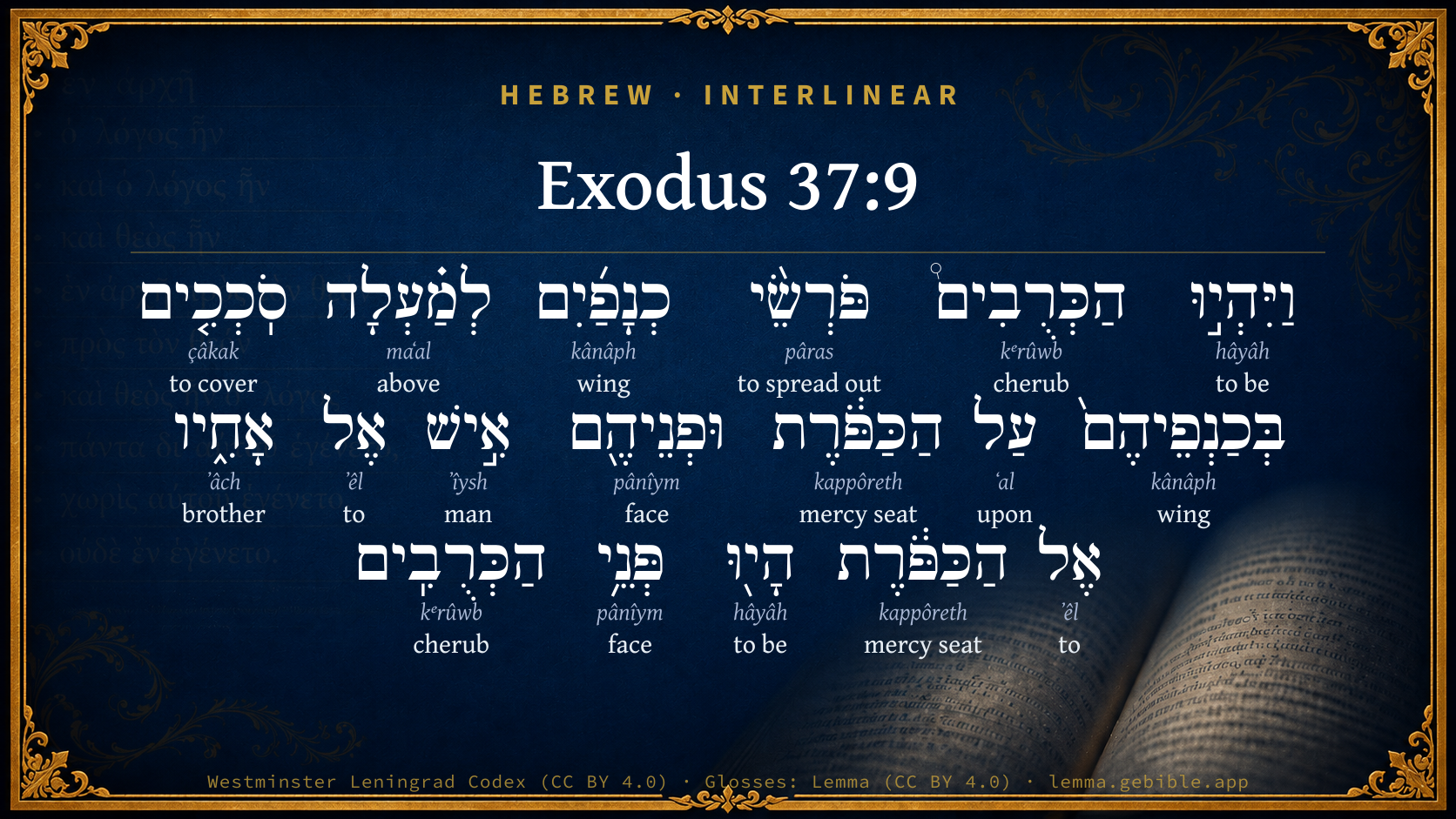
Hebrew (Westminster Leningrad Codex) Exodus 37:9 appears in the Hebrew Old Testament. The text above is from the Westminster Leningrad Codex. Each word links to its Strong’s number, a concise gloss, and parsing drawn from the Open Scriptures Hebrew Bible morphology. Click any word for its full Brown-Driver-Briggs (BDB) entry.
Download image
Cite this verse

Exodus 37:9 (World English Bible). Public Domain. Lemma interlinear Bible study tool, https://lemma.gebible.app/v/exodus/37/9.

Show BibTeX & RIS
BibTeX
RIS
English Translation
The cherubim spread out their wings on high, covering the mercy seat with their wings, with their faces toward one another. The faces of the cherubim were toward the mercy seat.
World English Bible · Public Domain
Download a study sheet

One document with this verse’s original text, its word-by-word gloss line, the meaning frame, cross-references with their text, attributed commentary, and full source and license credits — printable, and it pastes into notes with its structure intact.

This verse Autodidact and up

Study sheet (.html) Plain text (.txt)

A passage Seminary Student

Up to 50 verses in one chapter. A passage sheet keeps up to 6 commentary sources and 12 cross-references per verse, in the order this page ranks them, and says so on the sheet whenever that leaves anything out. Ask for a single verse and you get the Autodidact verse sheet above.

Everything on this page stays free to read, with no account — the sheet is a download of what is already on screen, not access to it.

Want to remove ads? Support Godless Engineer
Compare translations 3

The same verse in 3 English versions, stacked beneath the original-language interlinear above. Click any original word for its lexicon entry.

Each is an independent rendering of the whole verse — the interlinear is not word-aligned to these translations.

Highlighted words mark where these versions differ — a whole-verse word diff, not a word-by-word alignment.

  • World English Bible Public Domain
    The cherubim spread out their wings on high, covering the mercy seat with their wings, with their faces toward one another. The faces of the cherubim were toward the mercy seat.
  • King James Version Public Domain
    And the cherubim spread out their wings on high, and covered with their wings over the mercy seat, with their faces one to another; even to the mercy seatward were the faces of the cherubim.
  • unfoldingWord Literal Text CC BY-SA 4.0
    And the cherubim were spreading out their wings upward, covering over the atonement lid with their wings, and their faces each toward his brother. The faces of the cherubim were toward the atonement lid.

unfoldingWord Literal Text — © unfoldingWord, licensed CC BY-SA 4.0. Word-aligned USFM3 via Door43 (git.door43.org/unfoldingWord/en_ult).

Versions to compare (up to 4)

3 of 4 selected

Show all 18 translations

Every available English version of this verse, each an independent rendering of the whole verse.

  • World English Bible Public Domain
    The cherubim spread out their wings on high, covering the mercy seat with their wings, with their faces toward one another. The faces of the cherubim were toward the mercy seat.
  • Berean Standard Bible Public Domain
    And the cherubim had wings that spread upward, overshadowing the mercy seat. The cherubim faced each other, looking toward the mercy seat.
  • Majority Standard Bible Public Domain
    And the cherubim had wings that spread upward, overshadowing the mercy seat. The cherubim faced each other, looking toward the mercy seat.
  • King James Version Public Domain
    And the cherubim spread out their wings on high, and covered with their wings over the mercy seat, with their faces one to another; even to the mercy seatward were the faces of the cherubim.
  • American Standard Version (1901) Public Domain
    And the cherubim spread out their wings on high, covering the mercy-seat with their wings, with their faces one to another; toward the mercy-seat were the faces of the cherubim.
  • Revised Version (1885) Public Domain
    And the cherubim spread out their wings on high, covering the mercy-seat with their wings, with their faces one to another; toward the mercy-seat were the faces of the cherubim.
  • Geneva Bible (1599) Public Domain
    And the Cherubims spread out their wings on hie, and couered the Merciseat with their wings, and their faces were one towards another: towarde the Merciseat were the faces of the Cherubims.
  • Douay-Rheims (1899) Public Domain
    Spreading their wings, and covering the propitiatory, and looking one towards the other, and towards it.
  • Young's Literal Translation Public Domain
    and the cherubs are spreading out wings on high, covering over the mercy-seat with their wings, and their faces `are' one towards another; towards the mercy-seat have the faces of the cherubs been.
  • Literal Standard Version CC BY-SA 4.0
    and the cherubim are spreading out wings on high, covering over the propitiatory covering with their wings, and their faces [are] toward one another; the faces of the cherubim have been toward the propitiatory covering.
  • Unlocked Literal Bible CC BY-SA 4.0
    The cherubim spread out their wings upward and overshadowed the atonement lid with them. The cherubim faced one another and looked toward the center of the atonement lid.
  • unfoldingWord Literal Text CC BY-SA 4.0
    And the cherubim were spreading out their wings upward, covering over the atonement lid with their wings, and their faces each toward his brother. The faces of the cherubim were toward the atonement lid.
  • Darby Bible Public Domain
    And the cherubim spread out [their] wings over it, covering over with their wings the mercy-seat; and their faces were opposite to one another: the faces of the cherubim were [turned] toward the mercy-seat.
  • World Messianic Bible Public Domain
    The cherubim spread out their wings above, covering the mercy seat with their wings, with their faces toward one another. The faces of the cherubim were toward the mercy seat.
  • Webster's Bible Public Domain
    And the cherubim spread out their wings on high, and covered with their wings over the mercy-seat, with their faces one to another; even towards the mercy-seat were the faces of the cherubim.
  • Free Bible Version CC BY-SA 4.0
    The cherubim were designed with spread wings pointing upward, covering the atonement cover. The cherubim were placed facing each other, looking down towards the atonement cover.
  • Bible in Basic English Public Domain
    And their wings were stretched out over the cover; the faces of the winged ones were opposite one another and facing the cover.
  • JPS Tanakh (1917) Public Domain
    And the cherubim spread out their wings on high, screening the ark-cover with their wings, with their faces one to another; toward the ark-cover were the faces of the cherubim.

Literal Standard Version (2020), Covenant Press — licensed CC BY-SA 4.0. Text via the HelloAO Bible API (eBible.org). Unlocked Literal Bible (unfoldingWord) — licensed CC BY-SA 4.0. Text via the HelloAO Bible API (eBible.org). unfoldingWord Literal Text — © unfoldingWord, licensed CC BY-SA 4.0. Word-aligned USFM3 via Door43 (git.door43.org/unfoldingWord/en_ult). Free Bible Version, Dr. Jonathan Gallagher — licensed CC BY-SA 4.0. Text via the HelloAO Bible API (eBible.org).

Word by word

More ways to search: Search by grammar → Find every occurrence → Compare this word →

Practice this passage: Drill this verse → Learn its vocabulary →

סֹֽכְכִ֤ים
çâkak
H5526
“covering”
Verb, Qal, Participle Active, Masculine, Plural, Absolute
Part of Speech
Verb
Stem
Qal
Form
Participle Active
Gender
Masculine
Number
Plural
State
Absolute
Full BDB Definition

Origin: a primitive root

TWOT: 1475 , 1492 , 2259 , 2260

(Qal) to hedge, fence about, shut in - to block, overshadow, screen, stop the approach, shut off, cover - (Qal) - to screen, cover - to cover oneself - protector (participle) - (Hiphil) - to screen, cover - to cover, defecate (euphemism) - (Qal) to cover, lay over - to weave together - (Qal) to weave together - (Pilpel) to weave, weave together
  1. וַיִּהְי֣וּ hâyâh H1961 “and · to be” Conjunction + Verb, Qal, Sequential Imperfect, 3rd Person, Masculine, Plural
  2. הַכְּרֻבִים֩ kᵉrûwb H3742 “the · cherubim” Particle, Definite Article + Noun, Common, Masculine, Plural, Absolute
  3. פֹּרְשֵׂ֨י pâras H6566 “spreading out” Verb, Qal, Participle Active, Masculine, Plural, Construct
  4. כְנָפַ֜יִם kânâph H3671 “wings” Noun, Common, Feminine, Dual, Absolute
  5. לְמַ֗עְלָה maʻal H4605 “to/for · above · toward” Preposition + Adverb + Suffix, Demonstrative
  6. בְּכַנְפֵיהֶם֙ kânâph H3671 “in/at · wings · their” Preposition + Noun, Common, Feminine, Dual, Construct + Suffix, Personal, 3rd Person, Masculine, Plural
  7. עַל ʻal H5921 “upon” Preposition
  8. הַכַּפֹּ֔רֶת kappôreth H3727 “the · mercy seat” Particle, Definite Article + Noun, Common, Feminine, Singular, Absolute
  9. וּפְנֵיהֶ֖ם pânîym H6440 “and · face(s) · their” Conjunction + Noun, Common, Both, Plural, Construct + Suffix, Personal, 3rd Person, Masculine, Plural
  10. אִ֣ישׁ ʼîysh H376 “man” Noun, Common, Masculine, Singular, Absolute
  11. אֶל ʼêl H413 “to” Preposition
  12. אָחִ֑יו ʼâch H251 “brother · his” Noun, Common, Masculine, Singular, Construct + Suffix, Personal, 3rd Person, Masculine, Singular
  13. אֶל ʼêl H413 “to” Preposition
  14. הַכַּפֹּ֔רֶת kappôreth H3727 “the · mercy seat” Particle, Definite Article + Noun, Common, Feminine, Singular, Absolute
  15. הָי֖וּ hâyâh H1961 “to be” Verb, Qal, Perfect, 3rd Person, Common, Plural
  16. פְּנֵ֥י pânîym H6440 “face(s) of” Noun, Common, Both, Plural, Construct
  17. הַכְּרֻבִֽים kᵉrûwb H3742 “the · cherubim” Particle, Definite Article + Noun, Common, Masculine, Plural, Absolute

About this verse

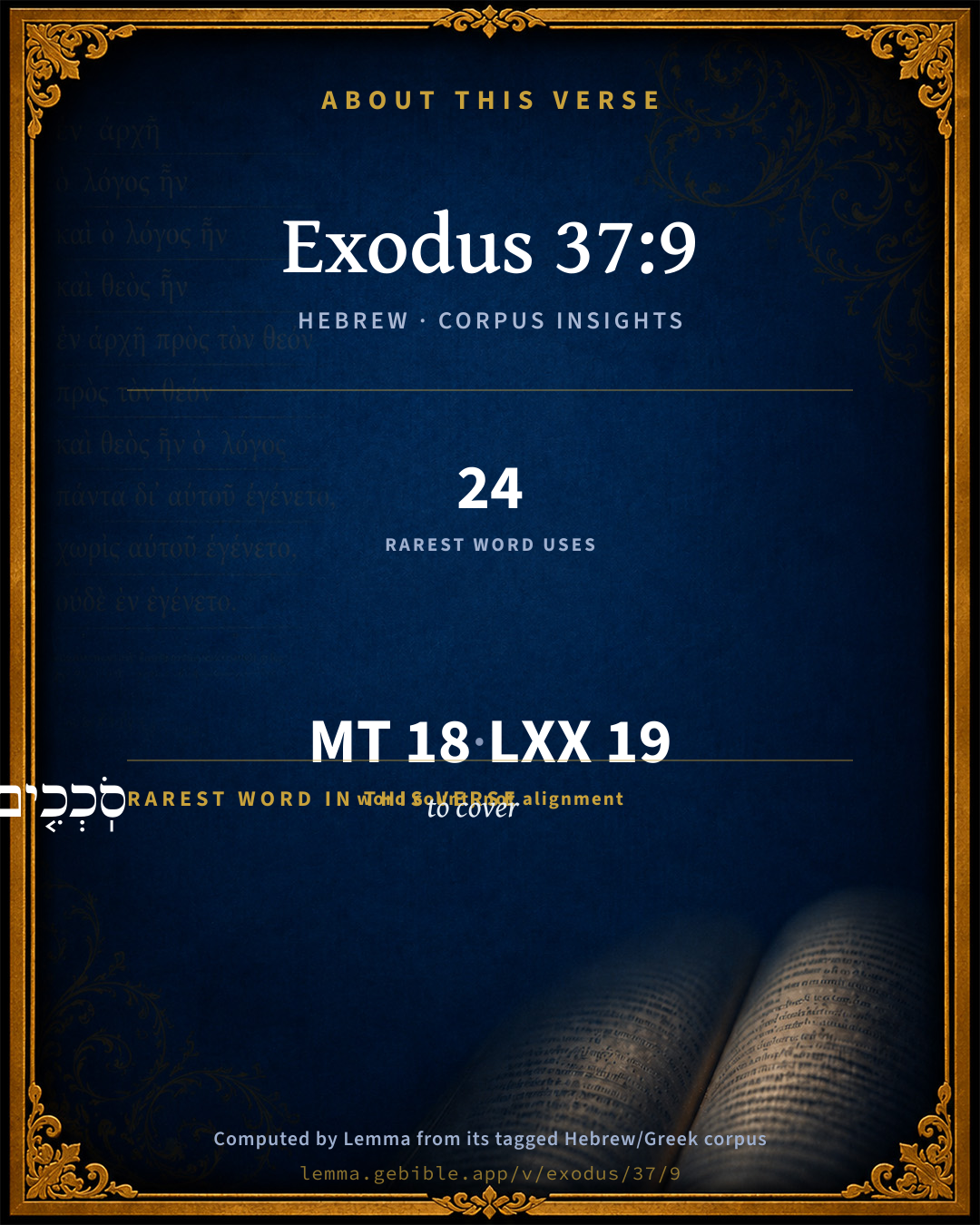
These counts appear in no published source. They are computed here, from the morphology-tagged text and Lemma’s own curated glosses. What Lemma adds →

18
words
12
distinct lemmas
Pentateuch
section

Notable vocabulary

The rarest word here is סֹֽכְכִ֤ים to cover H5526 — appearing just 24 times in the whole Hebrew Bible.

Shared distinctive vocabulary

סֹֽכְכִ֤ים to cover H5526 occurs in 24 verses of the Hebrew Bible. Also found in:

Grammatical profile

  • 4 verbs
  • 10 nouns
  • 3 prepositions
  • 1 adverb

Verb forms

  • וַיִּהְי֣וּ Qal · Sequential Imperfect
  • פֹּרְשֵׂ֨י Qal · Participle Active
  • סֹֽכְכִ֤ים Qal · Participle Active
  • הָי֖וּ Qal · Perfect

Repetition

Words recur within this verse — often emphatic in Hebrew:

  • וַיִּהְי֣וּ to be H1961 ×2
  • הַכְּרֻבִים֩ cherub H3742 ×2
  • כְנָפַ֜יִם wing H3671 ×2
  • הַכַּפֹּ֔רֶת mercy seat H3727 ×2
  • וּפְנֵיהֶ֖ם face H6440 ×2
  • אֶל to H413 ×2

Hebrew & Septuagint length

In English translation the verse runs 31 words from the Hebrew and 26 from the Septuagint (LXX English) — closely comparable.

A rough comparison of the two English renderings, which tokenize alike — not a word-level alignment.

Word counts can differ between the Hebrew and the Greek without any difference in meaning — e.g. the Hebrew direct-object marker אֵת has no separate Greek word, and Greek often adds the article ὁ.

In the original languages it is 18 Hebrew tokens and 19 Greek tokens — but the two are counted differently (Hebrew bundles its prefixes and suffixes into one token; the Greek is in lemma form), so that isn’t a like-for-like length.

Cross-references

12

Topical passages linked to Exodus 37:9 in the Treasury of Scripture Knowledge — connected by theme and wording, ordered by reader-vote popularity; previews shown in the World English Bible.

  • Genesis 3:24 So he drove out the man; and he placed Cherubs at the east of the garden of Eden, and the flame of a sword which turned every way, to guard the way to the tree of life.
  • Genesis 28:12 He dreamed. Behold, a stairway set up on the earth, and the top of it reached to heaven. Behold, the angels of God ascending and descending on it.
  • Exodus 25:20 The cherubim shall spread out their wings upward, covering the mercy seat with their wings, with their faces toward one another. The faces of the cherubim shall be toward the mercy seat.
  • Isaiah 6:2 Above him stood the seraphim. Each one had six wings. With two he covered his face. With two he covered his feet. With two he flew.
  • Ezekiel 10:1–22 Then I looked, and see, in the expanse that was over the head of the cherubim there appeared above them as it were a sapphire stone, as the appearance of the likeness of a throne.
  • John 1:51 He said to him, "Most assuredly, I tell you, hereafter you will see heaven opened, and the angels of God ascending and descending on the Son of Man."
  • 2 Corinthians 3:18 But we all, with unveiled face beholding as in a mirror the glory of the Lord, are transformed into the same image from glory to glory, even as from the Lord, the Spirit.
  • Ephesians 3:10 to the intent that now through the assembly the manifold wisdom of God might be made known to the principalities and the powers in the heavenly places,
  • Philippians 3:8 Yes most assuredly, and I count all things to be loss for the excellency of the knowledge of Christ Jesus, my Lord, for whom I suffered the loss of all things, and count them nothing but refuse, that I may gain Christ
  • 1 Timothy 3:16 Without controversy, the mystery of godliness is great: God was revealed in the flesh, Justified in the spirit, Seen by angels, Preached among the nations, Believed on in the world, And received up in glory.
  • Hebrews 1:14 Aren't they all ministering spirits, sent out to do service for the sake of those who will inherit salvation?
  • 1 Peter 1:12 To them it was revealed, that not to themselves, but to you, did they minister these things, which now have been announced to you through those who preached the Gospel to you by the Holy Spirit sent out from heaven; which things angels desire to look into.

Cross-references courtesy of OpenBible.info (CC BY 4.0).

Hebrew and Greek witnesses Masoretic Hebrew ↔ Greek Septuagint

The same verse in the two great witnesses to the Old Testament, shown verse-for-verse.

These are two independent witnesses, not word-aligned to each other, and the Septuagint is shown in lemma (dictionary) form.

Hebrew Exodus 37:9 Masoretic · Westminster Leningrad Codex

וַיִּהְי֣וּ הַכְּרֻבִים֩ פֹּרְשֵׂ֨י כְנָפַ֜יִם לְמַ֗עְלָה סֹֽכְכִ֤ים בְּכַנְפֵיהֶם֙ עַל הַכַּפֹּ֔רֶת וּפְנֵיהֶ֖ם אִ֣ישׁ אֶל אָחִ֑יו אֶל הַכַּפֹּ֔רֶת הָי֖וּ פְּנֵ֥י הַכְּרֻבִֽים

The cherubim spread out their wings on high, covering the mercy seat with their wings, with their faces toward one another. The faces of the cherubim were toward the mercy seat.

World English Bible · Public Domain

Greek LXX Exodus 37:9 Septuagint · lemma form

καί ὁ κλίτος ὁ πρός βορέας ἑκατόν ἐπί ἑκατόν καί ὁ στῦλος αὐτός εἴκοσι καί ὁ βάσις αὐτός εἴκοσι

and on the north side one hundred every way, and on the south side one hundred every way, and their posts twenty and their sockets twenty.

LXX2012 (modern English Septuagint) · Public Domain

Hebrew: Westminster Leningrad Codex (CC BY 4.0). Greek: Septuagint (public domain); English from LXX2012 (modern English Septuagint) (Public Domain). How the Septuagint differs from the Hebrew →

Targum (Aramaic paraphrase)

2

The Targum is the ancient Jewish Aramaic paraphrase of the Hebrew Scriptures — an interpretive translation, not the Hebrew text itself. Onkelos (literal) and Pseudo-Jonathan (expansive) render the Torah, and Jonathan the Prophets. Coverage is partial: where no permissively-licensed English translation exists for a verse, only the Aramaic is shown. This is verse-level text, not a word-by-word alignment to the Hebrew.

  1. Targum Onkelos Torah (Genesis–Deuteronomy)
    וַהֲווֹ כְרוּבַיָא פְּרִיסָן גַדְפֵיהוֹן לְעֵלָא נָטְלִין בְּגַדְפֵיהוֹן עַל כַּפֻּרְתָּא וְאַפֵּיהוֹן חַד לָקֳבֵל חַד לָקֳבֵל כַּפֻּרְתָּא הֲווֹ אַפֵּי כְרוּבַיָא:

    (no public-domain English translation for this verse)

    Targum Onkelos — Aramaic: “Onkelos Genesis” (public domain); “Onkelos Exodus” (public domain); “Onkelos Leviticus” (public domain); “Onkelos Numbers” (public domain); “Onkelos Deuteronomy” (public domain). English: “Sefaria Community Translation” (CC0 1.0 (public-domain dedication)); “J.W. Etheridge. The Targums of Onkelos and Jonathan Ben Uzziel on the Pentateuch. London: Longmans, Green, 1862” (public domain). Text via Sefaria.

  2. Targum Pseudo-Jonathan Torah (Genesis–Deuteronomy)
    וַהֲווֹן כְּרוּבַיָא פְּרִיסִין גַּדְפֵיהוֹן בַּהֲדֵי רֵישֵׁיהוֹן לְעֵילָא מְטַלְלִין בְּגַדְפֵיהוֹן עַל כַּפּוּרְתָּא וְאַפֵּיהוֹן חַד לִקְבֵיל חָד כָּל קֳבֵיל כַּפּוּרְתָּא הֲווֹן אַנְפֵּי כְּרוּבַיָא

    And the kerubaia spread forth their wings, with their heads upward, overshadowing the mercy seat with their wings, and their faces were toward each other, over against the mercy seat were the faces of the kerubaia.

    Targum Pseudo-Jonathan — Aramaic: “Targum Jonathan on Genesis” (public domain); “Targum Jonathan on Exodus” (public domain); “Targum Jonathan on Leviticus” (public domain); “Targum Jonathan on Numbers” (public domain); “Targum Jonathan on Deuteronomy” (public domain). English: “The Targum of Jonathan ben Uzziel, trans. J. W. Etheridge, London, 1862” (public domain). Text via Sefaria.

Commentary

Notes on Exodus 37:9 from classic Christian and Jewish commentators (each source and its license shown beneath its notes). The classic Christian expositions comment on the surrounding passage and are grouped to its opening verse, so a note may address several verses; the Jewish commentaries on the Tanakh (Rashi and others) are per-verse, so they appear only where the commentator wrote on this verse.

Lemma curates 59 commentaries, every one of them public domain or Creative Commons licensed, each selected and text-cleaned for this edition rather than reprinted as found. About our sources →

Haydock's Catholic Bible Commentary

Covering... This indicated that the Scriptures were to be studied with diligence, as they have a literal and a mystical sense. (St. Gregory of Nyssa)

George Leo Haydock (1774–1849), Haydock's Catholic Family Bible and Commentary, 1859 edition — public domain. Excludes Psalms (Douay-Rheims chapter numbering differs from Protestant) and Deuterocanonical books (Catholic canon only).

Lesson kit

Teaching starters — assembled from the data on this page, not authored interpretation. Every prompt links to the verse data it draws on. Edit before teaching.

Exodus, in the Pentateuch, opens this verse with 18 words (12 distinct Hebrew lemmas). Its most distinctive word is çâkak (“to cover”). A historical commentator’s framing appears above. Read the whole chapter for the surrounding context.

Discussion questions

  1. The word çâkak carries the sense “to cover.” How does it shape the verse?
  2. How does Exodus 25:20, which shares the word «to cover», read alongside this verse?
  3. What does the repetition of “to be” (2× in this one verse) do in this verse?
  4. The translations on this page render this verse differently — a whole-verse word diff, not a word-by-word alignment. What might account for the different wordings?
  5. «וַיִּהְי֣וּ» is a Qal Sequential Imperfect verb. How does that grammatical form shape the action described?

Things to notice

Reading settings

Reading text

Shown beneath each verse's original-language words.

Old Testament
Old Testament edition

Read the OT as the Masoretic Hebrew (MT) or the Greek Septuagint (LXX).

English shown for the Greek Septuagint (in the Hebrew ↔ Greek comparison).

Comparing translations? Open the Compare panel on any verse page to stack up to four side by side.