
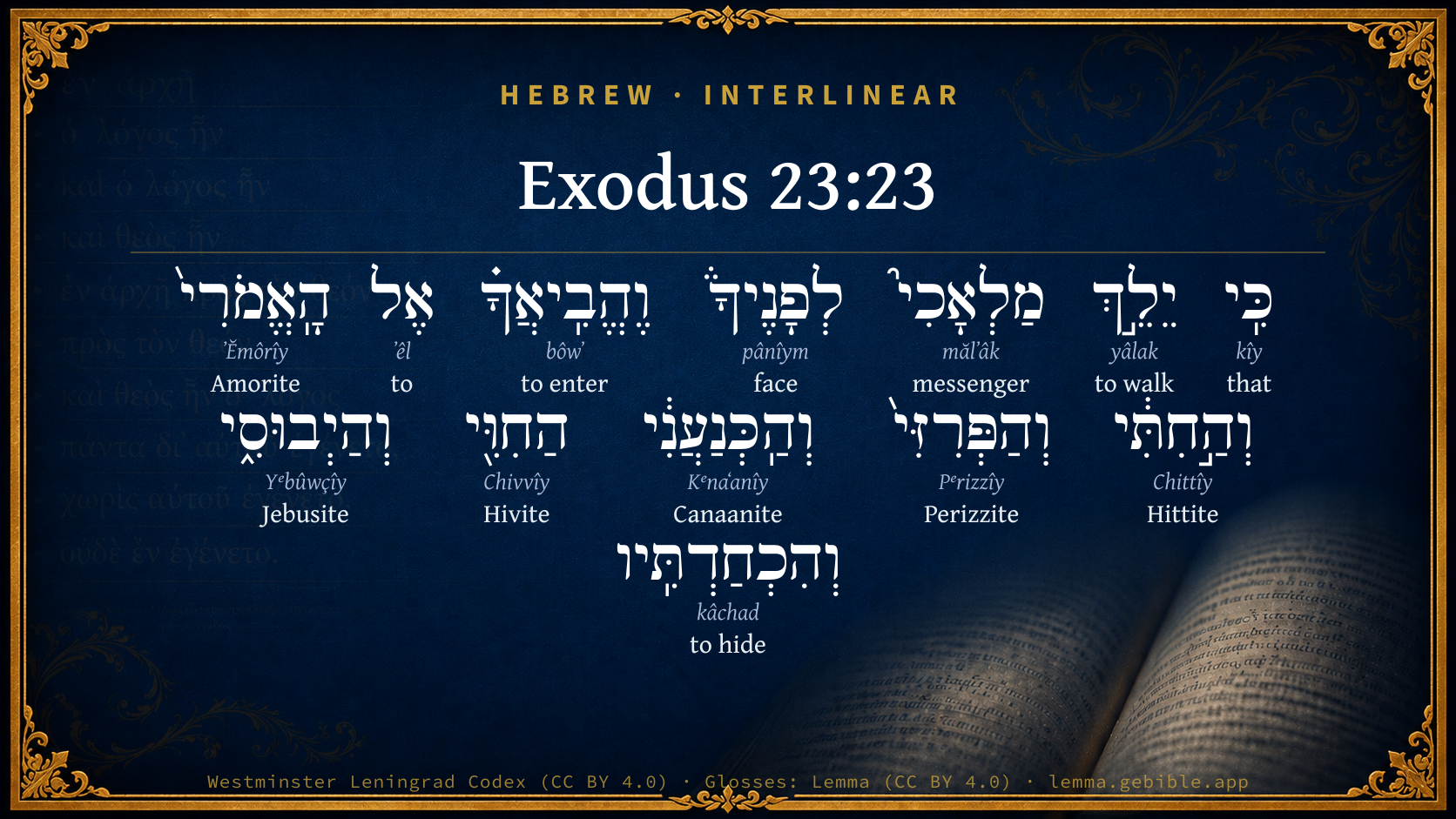
Exodus 23:23

Hebrew (Westminster Leningrad Codex) Exodus 23:23 appears in the Hebrew Old Testament. The text above is from the Westminster Leningrad Codex. Each word links to its Strong’s number, a concise gloss, and parsing drawn from the Open Scriptures Hebrew Bible morphology. Click any word for its full Brown-Driver-Briggs (BDB) entry.
Download image
Cite this verse

Exodus 23:23 (World English Bible). Public Domain. Lemma interlinear Bible study tool, https://lemma.gebible.app/v/exodus/23/23.

Show BibTeX & RIS
BibTeX
RIS
English Translation
For my angel shall go before you, and bring you in to the Amorite, the Hittite, the Perizzite, the Canaanite, the Hivite, and the Jebusite; and I will cut them off.
World English Bible · Public Domain
Download a study sheet

One document with this verse’s original text, its word-by-word gloss line, the meaning frame, cross-references with their text, attributed commentary, and full source and license credits — printable, and it pastes into notes with its structure intact.

This verse Autodidact and up

Study sheet (.html) Plain text (.txt)

A passage Seminary Student

Up to 50 verses in one chapter. A passage sheet keeps up to 6 commentary sources and 12 cross-references per verse, in the order this page ranks them, and says so on the sheet whenever that leaves anything out. Ask for a single verse and you get the Autodidact verse sheet above.

Everything on this page stays free to read, with no account — the sheet is a download of what is already on screen, not access to it.

Want to remove ads? Support Godless Engineer
Compare translations 3

The same verse in 3 English versions, stacked beneath the original-language interlinear above. Click any original word for its lexicon entry.

Each is an independent rendering of the whole verse — the interlinear is not word-aligned to these translations.

Highlighted words mark where these versions differ — a whole-verse word diff, not a word-by-word alignment.

  • World English Bible Public Domain
    For my angel shall go before you, and bring you in to the Amorite, the Hittite, the Perizzite, the Canaanite, the Hivite, and the Jebusite; and I will cut them off.
  • King James Version Public Domain
    For mine Angel shall go before thee, and bring thee in unto the Amorites, and the Hittites, and the Perizzites, and the Canaanites, the Hivites, and the Jebusites: and I will cut them off.
  • unfoldingWord Literal Text CC BY-SA 4.0
    For my angel will go before your face and bring you to the Amorites and the Hittites and the Perizzites and the Canaanites, the Hivites and the Jebusites. I will annihilate them.

unfoldingWord Literal Text — © unfoldingWord, licensed CC BY-SA 4.0. Word-aligned USFM3 via Door43 (git.door43.org/unfoldingWord/en_ult).

Versions to compare (up to 4)

3 of 4 selected

Show all 18 translations

Every available English version of this verse, each an independent rendering of the whole verse.

  • World English Bible Public Domain
    For my angel shall go before you, and bring you in to the Amorite, the Hittite, the Perizzite, the Canaanite, the Hivite, and the Jebusite; and I will cut them off.
  • Berean Standard Bible Public Domain
    For My angel will go before you and bring you into the land of the Amorites, Hittites, Perizzites, Canaanites, Hivites, and Jebusites, and I will annihilate them.
  • Majority Standard Bible Public Domain
    For My angel will go before you and bring you into the land of the Amorites, Hittites, Perizzites, Canaanites, Hivites, and Jebusites, and I will annihilate them.
  • King James Version Public Domain
    For mine Angel shall go before thee, and bring thee in unto the Amorites, and the Hittites, and the Perizzites, and the Canaanites, the Hivites, and the Jebusites: and I will cut them off.
  • American Standard Version (1901) Public Domain
    For mine angel shall go before thee, and bring thee in unto the Amorite, and the Hittite, and the Perizzite, and the Canaanite, the Hivite, and the Jebusite: and I will cut them off.
  • Revised Version (1885) Public Domain
    For mine angel shall go before thee, and bring thee in unto the Amorite, and the Hittite, and the Perizzite, and the Canaanite, the Hivite, and the Jebusite: and I will cut them off.
  • Geneva Bible (1599) Public Domain
    For mine Angel shall go before thee, and bring thee vnto the Amorites, and the Hittites, and the Perizzites, and the Canaanites, the Hiuites, and the Iebusites, and I will destroy them.
  • Douay-Rheims (1899) Public Domain
    And my angel shall go before thee, and shall bring thee in unto the Amorrhite, and the Hethite, and the Pherezite, and the Chanaanite, and the Hevite, and the Jebusite, whom I will destroy.
  • Young's Literal Translation Public Domain
    `For My messenger goeth before thee, and hath brought thee in unto the Amorite, and the Hittite, and the Perizzite, and the Canaanite, the Hivite, and the Jebusite, and I have cut them off.
  • Literal Standard Version CC BY-SA 4.0
    For My Messenger goes before you, and has brought you to the Amorite, and the Hittite, and the Perizzite, and the Canaanite, the Hivite, and the Jebusite, and I have cut them off.
  • Unlocked Literal Bible CC BY-SA 4.0
    My angel will go before you and bring you to the Amorites, Hittites, Perizzites, Canaanites, Hivites, and the Jebusites. I will destroy them.
  • unfoldingWord Literal Text CC BY-SA 4.0
    For my angel will go before your face and bring you to the Amorites and the Hittites and the Perizzites and the Canaanites, the Hivites and the Jebusites. I will annihilate them.
  • Darby Bible Public Domain
    For mine Angel shall go before thee, and bring thee in unto the Amorites and the Hittites and the Perizzites and the Canaanites, the Hivites and the Jebusites; and I will cut them off.
  • World Messianic Bible Public Domain
    For my angel shall go before you, and bring you in to the Amorite, the Hittite, the Perizzite, the Canaanite, the Hivite, and the Jebusite; and I will cut them off.
  • Webster's Bible Public Domain
    For my Angel shall go before thee, and bring thee in to the Amorites, and the Hittites, and the Perizzites, and the Canaanites, and the Hivites, and the Jebusites; and I will cut them off.
  • Free Bible Version CC BY-SA 4.0
    For my angel will go ahead of you and take you into the land of the Amorites, Hittites, Perizzites, Canaanites, Hivites, and Jebusites, and I will wipe them out.
  • Bible in Basic English Public Domain
    And my angel will go before you, guiding you into the land of the Amorite and the Hittite and the Perizzite and the Canaanite and the Hivite and the Jebusite, and they will be cut off by my hand.
  • JPS Tanakh (1917) Public Domain
    For Mine angel shall go before thee, and bring thee in unto the Amorite, and the Hittite, and the Perizzite, and the Canaanite, the Hivite, and the Jebusite; and I will cut them off.

Literal Standard Version (2020), Covenant Press — licensed CC BY-SA 4.0. Text via the HelloAO Bible API (eBible.org). Unlocked Literal Bible (unfoldingWord) — licensed CC BY-SA 4.0. Text via the HelloAO Bible API (eBible.org). unfoldingWord Literal Text — © unfoldingWord, licensed CC BY-SA 4.0. Word-aligned USFM3 via Door43 (git.door43.org/unfoldingWord/en_ult). Free Bible Version, Dr. Jonathan Gallagher — licensed CC BY-SA 4.0. Text via the HelloAO Bible API (eBible.org).

Word by word

More ways to search: Search by grammar → Find every occurrence → Compare this word →

Practice this passage: Drill this verse → Learn its vocabulary →

וְהַפְּרִזִּי֙
Pᵉrizzîy
H6522
“and · the · Perizzite”
Conjunction + Particle, Definite Article + Noun, Gentilic, Masculine, Singular, Absolute
Part of Speech
Conjunction + Particle + Noun
Type
Gentilic
Gender
Masculine
Number
Singular
State
Absolute
Full BDB Definition

Origin: for H6521

TWOT: None

Perizzite = "belonging to a village" - a people who inhabited southern Canaan prior to the conquest
  1. כִּֽי kîy H3588 “that” Conjunction
  2. יֵלֵ֣ךְ yâlak H3212 “to walk” Verb, Qal, Imperfect, 3rd Person, Masculine, Singular
  3. מַלְאָכִי֮ mălʼâk H4397 “messenger · my” Noun, Common, Masculine, Singular, Construct + Suffix, Personal, 1st Person, Common, Singular
  4. לְפָנֶיךָ֒ pânîym H6440 “to/for · face(s) · your” Preposition + Noun, Common, Both, Plural, Construct + Suffix, Personal, 2nd Person, Masculine, Singular
  5. וֶהֱבִֽיאֲךָ֗ bôwʼ H935 “and · to enter · you” Conjunction + Verb, Hiphil, Sequential Perfect, 3rd Person, Masculine, Singular + Suffix, Personal, 2nd Person, Masculine, Singular
  6. אֶל ʼêl H413 “to” Preposition
  7. הָֽאֱמֹרִי֙ ʼĔmôrîy H567 “the · Amorite” Particle, Definite Article + Noun, Gentilic, Masculine, Singular, Absolute
  8. וְהַ֣חִתִּ֔י Chittîy H2850 “and · the · Hittite” Conjunction + Particle, Definite Article + Noun, Gentilic, Masculine, Singular, Absolute
  9. וְהַֽכְּנַעֲנִ֔י Kᵉnaʻanîy H3669 “and · the · Canaanite” Conjunction + Particle, Definite Article + Noun, Gentilic, Masculine, Singular, Absolute
  10. הַחִוִּ֖י Chivvîy H2340 “the · Hivite” Particle, Definite Article + Noun, Gentilic, Masculine, Singular, Absolute
  11. וְהַיְבוּסִ֑י Yᵉbûwçîy H2983 “and · the · Jebusite” Conjunction + Particle, Definite Article + Noun, Gentilic, Masculine, Singular, Absolute
  12. וְהִכְחַדְתִּֽיו kâchad H3582 “and · to hide · him” Conjunction + Verb, Hiphil, Sequential Perfect, 1st Person, Common, Singular + Suffix, Personal, 3rd Person, Masculine, Singular

About this verse

These counts appear in no published source. They are computed here, from the morphology-tagged text and Lemma’s own curated glosses. What Lemma adds →

13
words
13
distinct lemmas
Pentateuch
section

Notable vocabulary

The rarest word here is וְהַפְּרִזִּי֙ Perizzite H6522 — appearing just 23 times in the whole Hebrew Bible.

Shared distinctive vocabulary

וְהַפְּרִזִּי֙ Perizzite H6522 occurs in 23 verses of the Hebrew Bible. Also found in:

Grammatical profile

  • 3 verbs
  • 8 nouns
  • 1 preposition
  • 1 conjunction

Verb forms

  • יֵלֵ֣ךְ Qal · Imperfect
  • וֶהֱבִֽיאֲךָ֗ Hiphil · Sequential Perfect
  • וְהִכְחַדְתִּֽיו Hiphil · Sequential Perfect

Hebrew & Septuagint length

In English translation the verse runs 31 words from the Hebrew and 32 from the Septuagint (LXX English) — closely comparable.

A rough comparison of the two English renderings, which tokenize alike — not a word-level alignment.

Word counts can differ between the Hebrew and the Greek without any difference in meaning — e.g. the Hebrew direct-object marker אֵת has no separate Greek word, and Greek often adds the article ὁ.

Cross-references

7

Topical passages linked to Exodus 23:23 in the Treasury of Scripture Knowledge — connected by theme and wording, ordered by reader-vote popularity; previews shown in the World English Bible.

  • Exodus 23:20 "Behold, I send an angel before you, to keep you by the way, and to bring you into the place which I have prepared.
  • Isaiah 5:13 Therefore my people go into captivity for lack of knowledge; Their honorable men are famished, And their multitudes are parched with thirst.
  • Genesis 15:19–21 the Kenites, the Kenizzites, the Kadmonites,
  • Genesis 34:2 Shechem the son of Hamor the Hivite, the prince of the land, saw her. He took her, lay with her, and humbled her.
  • Exodus 3:17 and I have said, I will bring you up out of the affliction of Egypt to the land of the Canaanite, the Hittite, the Amorite, the Perizzite, the Hivite, and the Jebusite, to a land flowing with milk and honey."'
  • Exodus 32:2 Aaron said to them, "Take off the golden rings, which are in the ears of your wives, of your sons, and of your daughters, and bring them to me."
  • Joshua 24:8–11 I brought you into the land of the Amorites, that lived beyond the Jordan: and they fought with you; and I gave them into your hand, and you possessed their land; and I destroyed them from before you.

Cross-references courtesy of OpenBible.info (CC BY 4.0).

Hebrew and Greek witnesses Masoretic Hebrew ↔ Greek Septuagint

The same verse in the two great witnesses to the Old Testament, shown verse-for-verse.

These are two independent witnesses, not word-aligned to each other, and the Septuagint is shown in lemma (dictionary) form.

Hebrew Exodus 23:23 Masoretic · Westminster Leningrad Codex

כִּֽי יֵלֵ֣ךְ מַלְאָכִי֮ לְפָנֶיךָ֒ וֶהֱבִֽיאֲךָ֗ אֶל הָֽאֱמֹרִי֙ וְהַ֣חִתִּ֔י וְהַפְּרִזִּי֙ וְהַֽכְּנַעֲנִ֔י הַחִוִּ֖י וְהַיְבוּסִ֑י וְהִכְחַדְתִּֽיו

For my angel shall go before you, and bring you in to the Amorite, the Hittite, the Perizzite, the Canaanite, the Hivite, and the Jebusite; and I will cut them off.

World English Bible · Public Domain

Greek LXX Exodus 23:23 Septuagint · lemma form

πορεύομαι γάρ ὁ ἄγγελος ἐγώ ἡγέομαι σύ καί εἰςἄγω σύ πρός ὁ ἀμορραῖος καί χετταῖος καί φερεζαῖος καί χαναναῖος καί γεργεσαῖος καί ευαῖος καί ιεβουσαῖος καί ἐκτρίβω αὐτός

For my angel shall go as your leader, and shall bring you to the Amorite, and Chettite, and Pherezite, and Chananite, and Gergesite, and Evite, and Jebusite, and I will destroy them.

LXX2012 (modern English Septuagint) · Public Domain

On this verse, Adam Clarke's Commentary discusses the Septuagint’s reading. Read the note in Commentary ↓

Hebrew: Westminster Leningrad Codex (CC BY 4.0). Greek: Septuagint (public domain); English from LXX2012 (modern English Septuagint) (Public Domain). How the Septuagint differs from the Hebrew →

Targum (Aramaic paraphrase)

2

The Targum is the ancient Jewish Aramaic paraphrase of the Hebrew Scriptures — an interpretive translation, not the Hebrew text itself. Onkelos (literal) and Pseudo-Jonathan (expansive) render the Torah, and Jonathan the Prophets. Coverage is partial: where no permissively-licensed English translation exists for a verse, only the Aramaic is shown. This is verse-level text, not a word-by-word alignment to the Hebrew.

  1. Targum Onkelos Torah (Genesis–Deuteronomy)
    אֲרֵי יְהַךְ מַלְאָכִי קֳדָמָךְ וְיָעֵלִנָךְ לְוָת אֱמוֹרָאֵי וְחִתָּאֵי וּפְרִיזָאֵי וּכְנַעֲנָאֵי חִוָאֵי וִיבוּסָאֵי וֶאֱשֵׁצִנוּן:

    (no public-domain English translation for this verse)

    Targum Onkelos — Aramaic: “Onkelos Genesis” (public domain); “Onkelos Exodus” (public domain); “Onkelos Leviticus” (public domain); “Onkelos Numbers” (public domain); “Onkelos Deuteronomy” (public domain). English: “Sefaria Community Translation” (CC0 1.0 (public-domain dedication)); “J.W. Etheridge. The Targums of Onkelos and Jonathan Ben Uzziel on the Pentateuch. London: Longmans, Green, 1862” (public domain). Text via Sefaria.

  2. Targum Pseudo-Jonathan Torah (Genesis–Deuteronomy)
    אֲרוּם יְטַיֵיל מַלְאָכִי קֳדָמָךְ וְיֵעָלִינָךְ לְוַת אֱמוֹרָאֵי וְחִיתָּאֵי וּפְרִיזָאֵי וּכְנַעֲנָאֵי חִיוָאֵי וִיבוּסָאֵי וְאֵישֵׁיצִינוּן

    For My Angel shall go before thee, and bring thee to the Amoraee, and Pherizaee, and Kenaanaee, Hivaee, and Jebusaee; and I will destroy them.

    Targum Pseudo-Jonathan — Aramaic: “Targum Jonathan on Genesis” (public domain); “Targum Jonathan on Exodus” (public domain); “Targum Jonathan on Leviticus” (public domain); “Targum Jonathan on Numbers” (public domain); “Targum Jonathan on Deuteronomy” (public domain). English: “The Targum of Jonathan ben Uzziel, trans. J. W. Etheridge, London, 1862” (public domain). Text via Sefaria.

Commentary

Notes on Exodus 23:23 from classic Christian and Jewish commentators (each source and its license shown beneath its notes). The classic Christian expositions comment on the surrounding passage and are grouped to its opening verse, so a note may address several verses; the Jewish commentaries on the Tanakh (Rashi and others) are per-verse, so they appear only where the commentator wrote on this verse.

Lemma curates 59 commentaries, every one of them public domain or Creative Commons licensed, each selected and text-cleaned for this edition rather than reprinted as found. About our sources →

Trapp's Complete Commentary

John Trapp

Exo 23:23 For mine Angel shall go before thee, and bring thee in unto the Amorites, and the Hittites, and the Perizzites, and the Canaanites, the Hivites, and the Jebusites: and I will cut them off.

Ver. 23. For mine angel.] Heb., Malachi; which is by transposition of letters Michael, as some Rabbis have observed.

John Trapp, A Commentary or Exposition upon All the Books of the Old and New Testament (1647–1656) — public domain. Text from a community e-Sword module.

Adam Clarke's Commentary

Verse 23. Unto the Amorites] There are only six of the seven nations mentioned here, but the Septuagint, Samaritan, Coptic, and one Hebrew MS., add Girgashite, thus making the seven nations.

Adam Clarke's Commentary on the Bible (1810–1826) — public domain. Text from a community e-Sword/MySword module.

Ellicott's Commentary for English Readers

(23) I will cut them off.—Or, cut them down—i.e., make them cease to be nations, not exterminate them utterly. Jebusites, Hittites, and others continued to inhabit Canaan, and were probably absorbed ultimately into the Hebrew population, having become full proselytes.

A Bible Commentary for English Readers, edited by Charles John Ellicott (1878–1897) — public domain. Text from a community e-Sword module.

The Cambridge Bible for Schools and Colleges

gen. ed. J. J. S. Perowne

23. the Amorite, &c.] see on Exo_3:8.

cut them off] Exo_9:15, 1Ki_13:34 (D2[196]). A rare word.

[196] Deuteronomic passages in Josh., Jud., Kings.

The Cambridge Bible for Schools and Colleges (gen. ed. J. J. S. Perowne; Cambridge University Press, 1878–1918) — public domain. Text from a community e-Sword module.

John Gill's Exposition

And ye shall serve the Lord your God,.... And him only, who had brought them out of Egypt, and done so many great and good things for them at the Red sea, and now in the wilderness; by which he appeared to be the true Jehovah, the one and only living God, and to be their God in covenant, who had promised them much, and had performed it; and therefore was in a special and peculiar manner their God, and they were under the highest obligations to serve and worship him in the way and manner he directed them to:

and he shall bless thy bread and thy water; and make them nourishing and refreshing to them, and preserve them thereby in health, as well as prosper and succeed them, and increase their worldly substance:

and I will take sickness away from the midst of thee; the stroke of bitterness, or the bitter stroke, as the Targum of Jonathan, any grievous disease, which is bitter and distressing; signifying that there should be none among them, but that they should be healthful, and free from distempers and diseases.

John Gill's Exposition of the Whole Bible (1746–1763) — public domain (CC PDM 1.0). Text via the HelloAO Bible API.

Albert Barnes' Notes on the Bible

I will cut them off - The national existence of the Canaanites was indeed to be “utterly” destroyed, every trace of their idolatries was to be blotted out, no social contact was to be held with them while they served other gods, nor were alliances of any kind to be formed with them. (See Deut. 7; Deu 12:1-4, Deu 12:29-31.) But it is alike contrary to the spirit of the divine law, and to the facts bearing on the subject scattered in the history, to suppose that any obstacle was put in the way of well disposed individuals of the denounced nations who left their sins and were willing to join the service of Yahweh. The spiritual blessings of the covenant were always open to those who sincerely and earnestly desired to possess them. See Exo 20:10; Lev 19:34; Lev 24:22.

Albert Barnes' Notes on the Bible (1834–1885) — public domain. Text from a community e-Sword/MySword module.

Whedon's Commentary on the Bible

Daniel D. Whedon

23. The Amorites — On the names and location of these tribes see notes and map at Jos_3:10.

Daniel D. Whedon (gen. ed.), Commentary on the Old and New Testaments (1874–1909) — public domain. Text from a community e-Sword module.

The Pulpit Commentary

The Amorites, and the Hittites, etc. The nations of Canaan proper, to whom the Gergashites are sometimes added. See the comment on 2Sa_3:8. I will cut them off. Or "cut them down," i.e. , destroy them from being any longer nations, but not exterminate them, as is generally supposed. David had a "Hittite" among his "mighty men", (2Sa_23:39) and was on friendly terms with Araunah the "Jebusite". (2Sa_24:18-24)

The Pulpit Commentary (1880–1919), ed. H.D.M. Spence-Jones & Joseph S. Exell — public domain. Text from a community e-Sword module.

unfoldingWord translationNotes

Door43 World Missions Community

General Information:

Yahweh continues telling Moses his laws for the people of Israel.

You must not ... do as they do

The Israelites must not live as the people who worship other gods. AT: "You must not ... live as the people who worship those gods" (See: Assumed Knowledge and Implicit Information)

he will bless your bread and water

This is a merism that means food and drink. AT: "he will bless your food and drink" or "he will bless you by giving you food and drink" (See: Merism)

he will bless ... I will remove

Yahweh switched between the first and third pronoun to refer to himself. Here both "he" and "I" refer to Yahweh. (See: First, Second, or Third Person)

translationWords

angel

Amorite

Hittite

Perizzite

Canaan

Hivite

Jebus

bow

false god

worship

column

Yahweh

bless

unfoldingWord translationNotes — © Distant Shores Media and the Door43 World Missions Community, licensed CC BY-SA 4.0. Source: git.door43.org/Door43/en_tn.

Lesson kit

Teaching starters — assembled from the data on this page, not authored interpretation. Every prompt links to the verse data it draws on. Edit before teaching.

Exodus, in the Pentateuch, opens this verse with 13 words (13 distinct Hebrew lemmas). Its most distinctive word is Pᵉrizzîy (“Perizzite”). A historical commentator’s framing appears above. Read the whole chapter for the surrounding context.

Discussion questions

  1. How does “Perizzite” (Pᵉrizzîy) shape what this verse is saying?
  2. Genesis 13:7 shares the word «Perizzite» with this verse. How do the two illuminate each other?
  3. These translations render this verse differently. What is at stake in choosing one wording over another?
  4. The verb «יֵלֵ֣ךְ» is Qal Imperfect. How does its form color the action?
  5. Reading how Trapp's Complete Commentary and Adam Clarke's Commentary read this verse, where do the two commentators agree and where do they part?

Things to notice

Reading settings

Reading text

Shown beneath each verse's original-language words.

Old Testament
Old Testament edition

Read the OT as the Masoretic Hebrew (MT) or the Greek Septuagint (LXX).

English shown for the Greek Septuagint (in the Hebrew ↔ Greek comparison).

Comparing translations? Open the Compare panel on any verse page to stack up to four side by side.