
Exodus 32:11

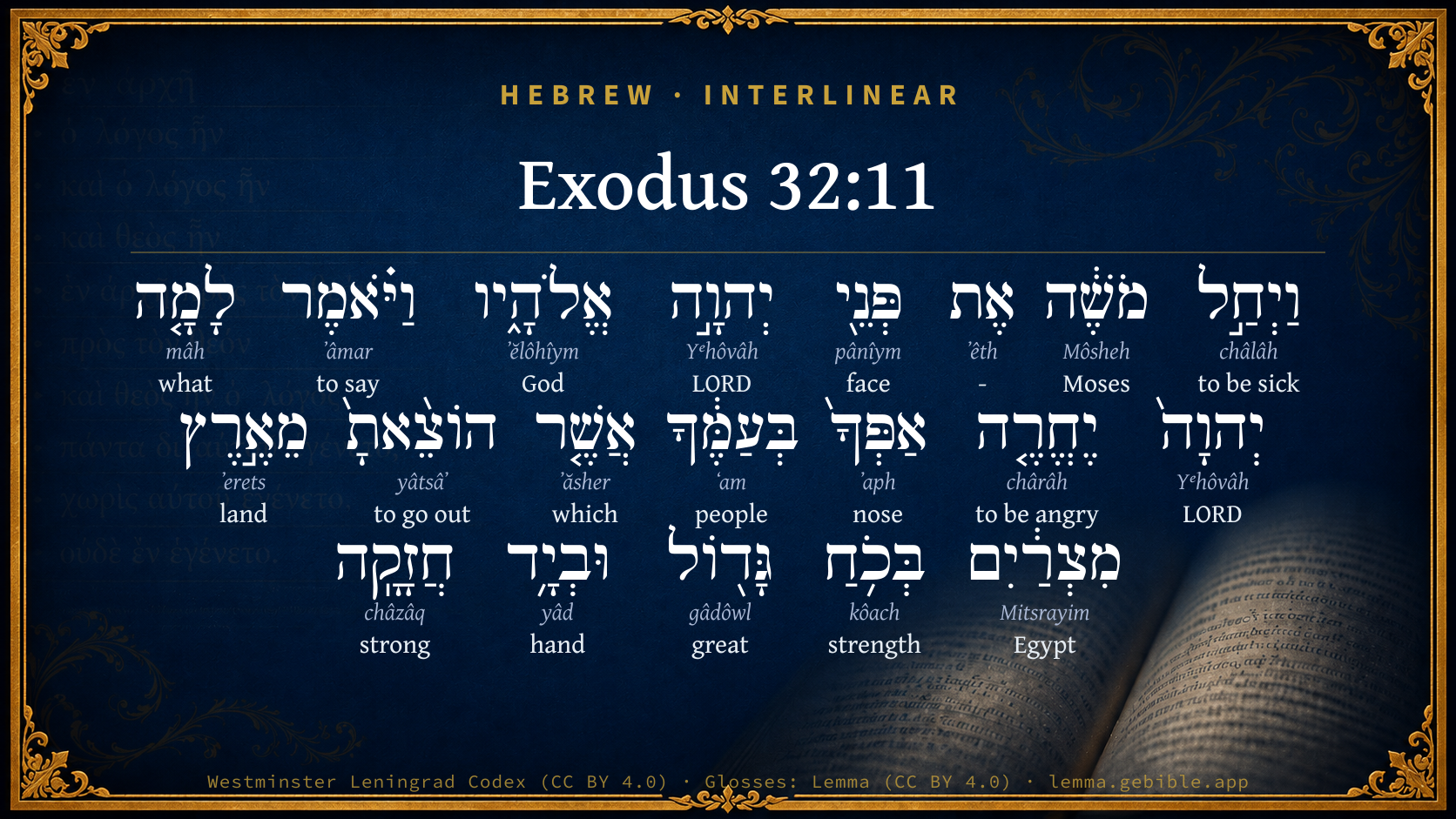
Hebrew (Westminster Leningrad Codex) Exodus 32:11 appears in the Hebrew Old Testament. The text above is from the Westminster Leningrad Codex. Each word links to its Strong’s number, a concise gloss, and parsing drawn from the Open Scriptures Hebrew Bible morphology. Click any word for its full Brown-Driver-Briggs (BDB) entry.
Download image
Cite this verse

Exodus 32:11 (World English Bible). Public Domain. Lemma interlinear Bible study tool, https://lemma.gebible.app/v/exodus/32/11.

Show BibTeX & RIS
BibTeX
RIS
English Translation
Moses begged Yahweh his God, and said, "Yahweh, why does your wrath burn hot against your people, that you have brought forth out of the land of Egypt with great power and with a mighty hand?
World English Bible · Public Domain
Download a study sheet

One document with this verse’s original text, its word-by-word gloss line, the meaning frame, cross-references with their text, attributed commentary, and full source and license credits — printable, and it pastes into notes with its structure intact.

This verse Autodidact and up

Study sheet (.html) Plain text (.txt)

A passage Seminary Student

Up to 50 verses in one chapter. A passage sheet keeps up to 6 commentary sources and 12 cross-references per verse, in the order this page ranks them, and says so on the sheet whenever that leaves anything out. Ask for a single verse and you get the Autodidact verse sheet above.

Everything on this page stays free to read, with no account — the sheet is a download of what is already on screen, not access to it.

Want to remove ads? Support Godless Engineer
Compare translations 3

The same verse in 3 English versions, stacked beneath the original-language interlinear above. Click any original word for its lexicon entry.

Each is an independent rendering of the whole verse — the interlinear is not word-aligned to these translations.

Highlighted words mark where these versions differ — a whole-verse word diff, not a word-by-word alignment.

  • World English Bible Public Domain
    Moses begged Yahweh his God, and said, "Yahweh, why does your wrath burn hot against your people, that you have brought forth out of the land of Egypt with great power and with a mighty hand?
  • King James Version Public Domain
    And Moses besought the LORD his God, and said, LORD, why doth thy wrath wax hot against thy people, which thou hast brought forth out of the land of Egypt with great power, and with a mighty hand?
  • unfoldingWord Literal Text CC BY-SA 4.0
    But Moses entreated the face of Yahweh his God. And he said, “Yahweh, why does your nose burn against your people whom you have brought out from the land of Egypt with great power and with a strong hand?

unfoldingWord Literal Text — © unfoldingWord, licensed CC BY-SA 4.0. Word-aligned USFM3 via Door43 (git.door43.org/unfoldingWord/en_ult).

Versions to compare (up to 4)

3 of 4 selected

Show all 18 translations

Every available English version of this verse, each an independent rendering of the whole verse.

  • World English Bible Public Domain
    Moses begged Yahweh his God, and said, "Yahweh, why does your wrath burn hot against your people, that you have brought forth out of the land of Egypt with great power and with a mighty hand?
  • Berean Standard Bible Public Domain
    But Moses sought the favor of the LORD his God, saying, “O LORD, why does Your anger burn against Your people, whom You brought out of the land of Egypt with great power and a mighty hand?
  • Majority Standard Bible Public Domain
    But Moses sought the favor of the LORD his God, saying, “O LORD, why does Your anger burn against Your people, whom You brought out of the land of Egypt with great power and a mighty hand?
  • King James Version Public Domain
    And Moses besought the LORD his God, and said, LORD, why doth thy wrath wax hot against thy people, which thou hast brought forth out of the land of Egypt with great power, and with a mighty hand?
  • American Standard Version (1901) Public Domain
    And Moses besought Jehovah his God, and said, Jehovah, why doth thy wrath wax hot against thy people, that thou hast brought forth out of the land of Egypt with great power and with a mighty hand?
  • Revised Version (1885) Public Domain
    And Moses besought the LORD his God, and said, LORD, why doth thy wrath wax hot against thy people, which thou hast brought forth out of the land of Egypt with great power and with a mighty hand?
  • Geneva Bible (1599) Public Domain
    But Moses praied vnto the Lord his God, and said, O Lord, why doeth thy wrath waxe hote against thy people, which thou hast brought out of the lande of Egypt, with great power and with a mightie hand?
  • Douay-Rheims (1899) Public Domain
    But Moses besought the Lord his God, saying: Why, O Lord, is thy indignation kindled against thy people, whom thou hast brought out of the land of Egypt, with great power, and with a mighty hand?
  • Young's Literal Translation Public Domain
    And Moses appeaseth the face of Jehovah his God, and saith, `Why, O Jehovah, doth Thine anger burn against Thy people, whom Thou hast brought forth out of the land of Egypt with great power and with a strong hand?
  • Literal Standard Version CC BY-SA 4.0
    And Moses appeases the face of his God YHWH and says, “Why, O YHWH, does Your anger burn against Your people, whom You have brought forth out of the land of Egypt with great power and with a strong hand?
  • Unlocked Literal Bible CC BY-SA 4.0
    But Moses tried to calm down Yahweh his God. He said, “Yahweh, why does your anger burn against your people, whom you have brought out of the land of Egypt with great power and with a mighty hand?
  • unfoldingWord Literal Text CC BY-SA 4.0
    But Moses entreated the face of Yahweh his God. And he said, “Yahweh, why does your nose burn against your people whom you have brought out from the land of Egypt with great power and with a strong hand?
  • Darby Bible Public Domain
    And Moses besought Jehovah his God, and said, Why, Jehovah, doth thy wrath burn against thy people, which thou hast brought forth out of the land of Egypt with great power and with a strong hand?
  • World Messianic Bible Public Domain
    Moses begged the LORD his God, and said, “LORD, why does your wrath burn hot against your people, that you have brought out of the land of Egypt with great power and with a mighty hand?
  • Webster's Bible Public Domain
    And Moses besought the LORD his God, and said, LORD, why [] thy wrath wax hot against thy people, which thou hast [] forth from the land of Egypt, with great power, and with [] mighty hand?
  • Free Bible Version CC BY-SA 4.0
    But Moses pleaded with the Lord his God, saying, “Why are you angry with the people you brought out of the land of Egypt with tremendous power and great strength?
  • Bible in Basic English Public Domain
    But Moses made prayer to God, saying, Lord, why is your wrath burning against your people whom you took out of the land of Egypt, with great power and with the strength of your hand?
  • JPS Tanakh (1917) Public Domain
    And Moses besought the LORD his God, and said: 'LORD, why doth Thy wrath wax hot against Thy people, that Thou hast brought forth out of the land of Egypt with great power and with a mighty hand?

Literal Standard Version (2020), Covenant Press — licensed CC BY-SA 4.0. Text via the HelloAO Bible API (eBible.org). Unlocked Literal Bible (unfoldingWord) — licensed CC BY-SA 4.0. Text via the HelloAO Bible API (eBible.org). unfoldingWord Literal Text — © unfoldingWord, licensed CC BY-SA 4.0. Word-aligned USFM3 via Door43 (git.door43.org/unfoldingWord/en_ult). Free Bible Version, Dr. Jonathan Gallagher — licensed CC BY-SA 4.0. Text via the HelloAO Bible API (eBible.org).

Word by word

More ways to search: Search by grammar → Find every occurrence → Compare this word →

Practice this passage: Drill this verse → Learn its vocabulary →

חֲזָקָֽה
châzâq
H2389
“strong”
Adjective, Adjective, Feminine, Singular, Absolute
Part of Speech
Adjective
Type
Adjective
Gender
Feminine
Number
Singular
State
Absolute
Full BDB Definition

Origin: from H2388

TWOT: 636a

strong, stout, mighty - strong - severe, sharp, hot - firm, hard - a strong one (substantive)
  1. וַיְחַ֣ל châlâh H2470 “and · to be sick” Conjunction + Verb, Piel, Sequential Imperfect, 3rd Person, Masculine, Singular
  2. מֹשֶׁ֔ה Môsheh H4872 “Moses” Noun, Proper
  3. אֶת ʼêth H853 “-” Particle, Direct Object
  4. פְּנֵ֖י pânîym H6440 “face(s) of” Noun, Common, Both, Plural, Construct
  5. יְהוָ֣ה Yᵉhôvâh H3068 “LORD” Noun, Proper
  6. אֱלֹהָ֑יו ʼĕlôhîym H430 “God(s) · his” Noun, Common, Masculine, Plural, Construct + Suffix, Personal, 3rd Person, Masculine, Singular
  7. וַיֹּ֗אמֶר ʼâmar H559 “and · to say” Conjunction + Verb, Qal, Sequential Imperfect, 3rd Person, Masculine, Singular
  8. לָמָ֤ה mâh H4100 “to/for · what” Preposition + Particle, Interrogative
  9. יְהוָה֙ Yᵉhôvâh H3068 “LORD” Noun, Proper
  10. יֶחֱרֶ֤ה chârâh H2734 “to be angry” Verb, Qal, Imperfect, 3rd Person, Masculine, Singular
  11. אַפְּךָ֙ ʼaph H639 “nose · your” Noun, Common, Masculine, Singular, Construct + Suffix, Personal, 2nd Person, Masculine, Singular
  12. בְּעַמֶּ֔ךָ ʻam H5971 “in/at · people · your” Preposition + Noun, Common, Masculine, Singular, Construct + Suffix, Personal, 2nd Person, Masculine, Singular
  13. אֲשֶׁ֤ר ʼăsher H834 “which” Particle, Relative
  14. הוֹצֵ֨אתָ֙ yâtsâʼ H3318 “to go out” Verb, Hiphil, Perfect, 2nd Person, Masculine, Singular
  15. מֵאֶ֣רֶץ ʼerets H776 “from · land of” Preposition + Noun, Common, Both, Singular, Construct
  16. מִצְרַ֔יִם Mitsrayim H4714 “Egypt” Noun, Proper
  17. בְּכֹ֥חַ kôach H3581 “in/at · strength” Preposition + Noun, Common, Masculine, Singular, Absolute
  18. גָּד֖וֹל gâdôwl H1419 “great” Adjective, Adjective, Masculine, Singular, Absolute
  19. וּבְיָ֥ד yâd H3027 “and · in/at · hand” Conjunction + Preposition + Noun, Common, Both, Singular, Absolute

About this verse

These counts appear in no published source. They are computed here, from the morphology-tagged text and Lemma’s own curated glosses. What Lemma adds →

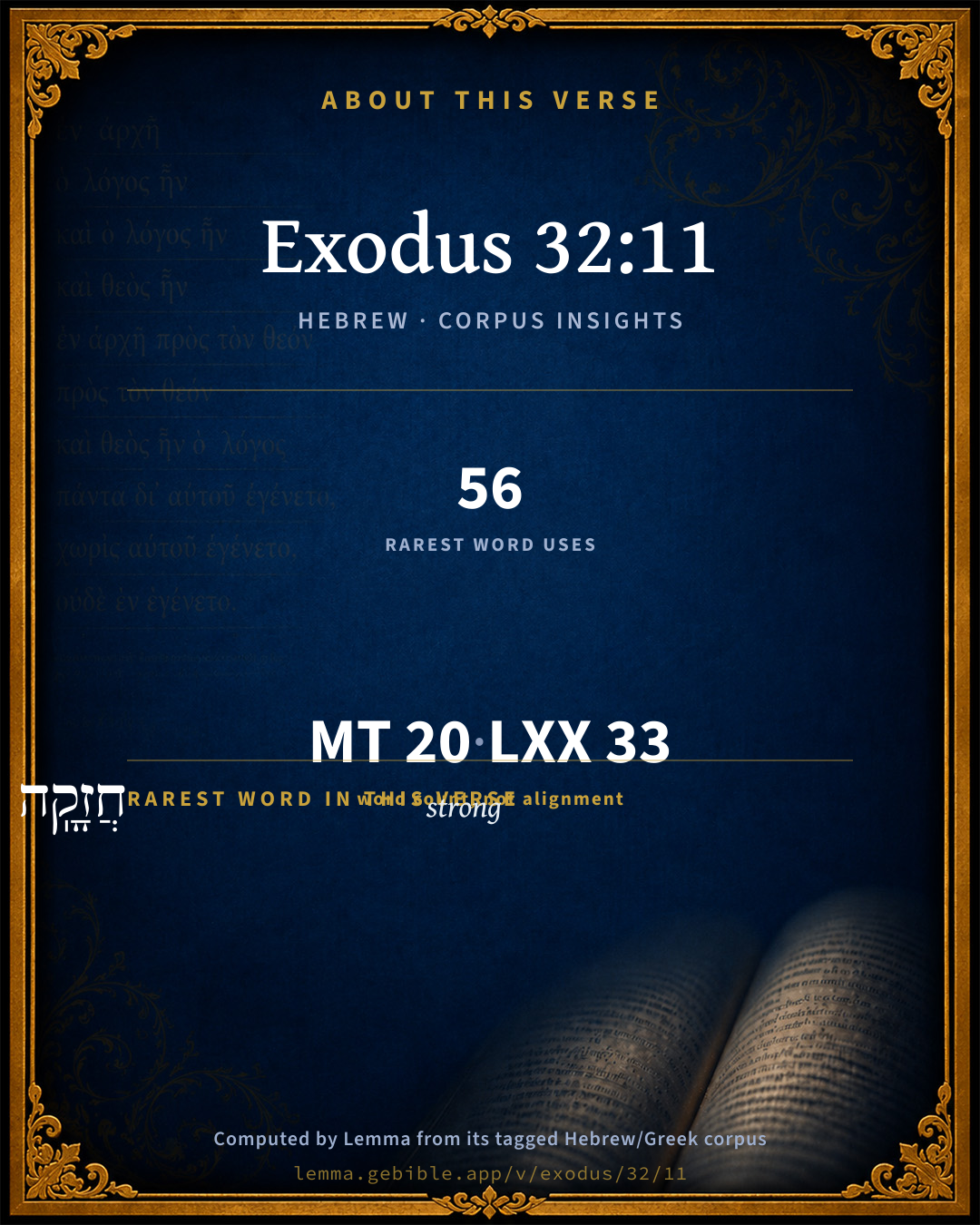
20
words
19
distinct lemmas
Pentateuch
section

Shared distinctive vocabulary

חֲזָקָֽה strong H2389 occurs in 54 verses of the Hebrew Bible. Also found in:

Grammatical profile

  • 4 verbs
  • 11 nouns
  • 2 adjectives
  • 3 particles

Verb forms

  • וַיְחַ֣ל Piel · Sequential Imperfect
  • וַיֹּ֗אמֶר Qal · Sequential Imperfect
  • יֶחֱרֶ֤ה Qal · Imperfect
  • הוֹצֵ֨אתָ֙ Hiphil · Perfect

Repetition

A word recurs within this verse — often emphatic in Hebrew:

  • יְהוָ֣ה LORD H3068 ×2

Hebrew & Septuagint length

In English translation the verse runs 36 words from the Hebrew and 36 from the Septuagint (LXX English) — the same length.

A rough comparison of the two English renderings, which tokenize alike — not a word-level alignment.

Word counts can differ between the Hebrew and the Greek without any difference in meaning — e.g. the Hebrew direct-object marker אֵת has no separate Greek word, and Greek often adds the article ὁ.

In the original languages it is 20 Hebrew tokens and 33 Greek tokens — but the two are counted differently (Hebrew bundles its prefixes and suffixes into one token; the Greek is in lemma form), so that isn’t a like-for-like length.

Cross-references

8

Topical passages linked to Exodus 32:11 in the Treasury of Scripture Knowledge — connected by theme and wording, ordered by reader-vote popularity; previews shown in the World English Bible.

  • Deuteronomy 9:18–20 I fell down before Yahweh, as at the first, forty days and forty nights; I did neither eat bread nor drink water; because of all your sin which you sinned, in doing that which was evil in the sight of Yahweh, to provoke him to anger.
  • Deuteronomy 9:26–29 I prayed to Yahweh, and said, Lord Yahweh, don't destroy your people and your inheritance, that you have redeemed through your greatness, that you have brought forth out of Egypt with a mighty hand.
  • Psalms 106:23 Therefore he said that he would destroy them, Had Moses, his chosen, not stood before him in the breach, To turn away his wrath, so that he wouldn't destroy them.
  • Numbers 11:11 Moses said to Yahweh, Why have you dealt ill with your servant? and why haven't I found favor in your sight, that you lay the burden of all this people on me?
  • Numbers 16:22 They fell on their faces, and said, God, the God of the spirits of all flesh, shall one man sin, and will you be angry with all the congregation?
  • Psalms 74:1–2 God, why have you rejected us forever? Why does your anger smolder against the sheep of your pasture?
  • Isaiah 63:17 O Yahweh, why do you make us to err from your ways, and harden our heart from your fear? Return for your servants' sake, the tribes of your inheritance.
  • Jeremiah 12:1–2 Righteous are you, Yahweh, when I contend with you; yet would I reason the cause with you: why does the way of the wicked prosper? why are all they at ease who deal very treacherously?

Cross-references courtesy of OpenBible.info (CC BY 4.0).

Hebrew and Greek witnesses Masoretic Hebrew ↔ Greek Septuagint

The same verse in the two great witnesses to the Old Testament, shown verse-for-verse.

These are two independent witnesses, not word-aligned to each other, and the Septuagint is shown in lemma (dictionary) form.

Hebrew Exodus 32:11 Masoretic · Westminster Leningrad Codex

וַיְחַ֣ל מֹשֶׁ֔ה אֶת פְּנֵ֖י יְהוָ֣ה אֱלֹהָ֑יו וַיֹּ֗אמֶר לָמָ֤ה יְהוָה֙ יֶחֱרֶ֤ה אַפְּךָ֙ בְּעַמֶּ֔ךָ אֲשֶׁ֤ר הוֹצֵ֨אתָ֙ מֵאֶ֣רֶץ מִצְרַ֔יִם בְּכֹ֥חַ גָּד֖וֹל וּבְיָ֥ד חֲזָקָֽה

Moses begged Yahweh his God, and said, "Yahweh, why does your wrath burn hot against your people, that you have brought forth out of the land of Egypt with great power and with a mighty hand?

World English Bible · Public Domain

Greek LXX Exodus 32:11 Septuagint · lemma form

καί δέω μωυσῆς ἔναντι κύριος ὁ θεός καί εἶπον ἵνα τίς κύριος θυμόω ὀργή εἰς ὁ λαός σύ ὅς ἐκἄγω ἐκ γῆ αἴγυπτος ἐν ἰσχύς μέγας καί ἐν ὁ βραχίων σύ ὁ ὑψηλός

And Moses prayed before the Lord God, and said, Therefore, O Lord, are you very angry with your people, whom you brought out of the land of Egypt with great strength, and with your high arm?

LXX2012 (modern English Septuagint) · Public Domain

Hebrew: Westminster Leningrad Codex (CC BY 4.0). Greek: Septuagint (public domain); English from LXX2012 (modern English Septuagint) (Public Domain). How the Septuagint differs from the Hebrew →

Targum (Aramaic paraphrase)

2

The Targum is the ancient Jewish Aramaic paraphrase of the Hebrew Scriptures — an interpretive translation, not the Hebrew text itself. Onkelos (literal) and Pseudo-Jonathan (expansive) render the Torah, and Jonathan the Prophets. Coverage is partial: where no permissively-licensed English translation exists for a verse, only the Aramaic is shown. This is verse-level text, not a word-by-word alignment to the Hebrew.

  1. Targum Onkelos Torah (Genesis–Deuteronomy)
    וְצַלִי משֶׁה קֳדָם יְיָ אֱלָהֵהּ וַאֲמַר לְמָא יְיָ יִתְקֵף רוּגְזָךְ בְּעַמָךְ דִי אַפֶּקְתָּא מֵאַרְעָא דְמִצְרַיִם בְּחֵיל רַב וּבִידָא תַקִיפָא:

    (no public-domain English translation for this verse)

    Targum Onkelos — Aramaic: “Onkelos Genesis” (public domain); “Onkelos Exodus” (public domain); “Onkelos Leviticus” (public domain); “Onkelos Numbers” (public domain); “Onkelos Deuteronomy” (public domain). English: “Sefaria Community Translation” (CC0 1.0 (public-domain dedication)); “J.W. Etheridge. The Targums of Onkelos and Jonathan Ben Uzziel on the Pentateuch. London: Longmans, Green, 1862” (public domain). Text via Sefaria.

  2. Targum Pseudo-Jonathan Torah (Genesis–Deuteronomy)
    וְאִתְחַלְחַל משֶׁה מִן רְתִיתָא וּשְׁרֵי לְצַלָּאָה קֳדָם יְיָ אֱלָהֵיהּ וַאֲמַר לְמָא יְיָ יִתְקוֹף רוּגְזָךְ בְּעַמָּךְ דְּהַנְפָּקַת מֵאַרְעָא דְמִצְרַיִם בְּחֵיל רַב וּבִידָא תַקִיפָא

    And Mosheh was shaken with fear, and began to pray before the Lord his God; and he said, Wherefore should Thy wrath, O Lord, prevail against Thy people whom Thou didst bring up from the land of Mizraim, with great power and with a mighty hand.

    Targum Pseudo-Jonathan — Aramaic: “Targum Jonathan on Genesis” (public domain); “Targum Jonathan on Exodus” (public domain); “Targum Jonathan on Leviticus” (public domain); “Targum Jonathan on Numbers” (public domain); “Targum Jonathan on Deuteronomy” (public domain). English: “The Targum of Jonathan ben Uzziel, trans. J. W. Etheridge, London, 1862” (public domain). Text via Sefaria.

Commentary

Notes on Exodus 32:11 from classic Christian and Jewish commentators (each source and its license shown beneath its notes). The classic Christian expositions comment on the surrounding passage and are grouped to its opening verse, so a note may address several verses; the Jewish commentaries on the Tanakh (Rashi and others) are per-verse, so they appear only where the commentator wrote on this verse.

Lemma curates 59 commentaries, every one of them public domain or Creative Commons licensed, each selected and text-cleaned for this edition rather than reprinted as found. About our sources →

Ellicott's Commentary for English Readers

MOSES’ REPLY, AND GOD’S “REPENTANCE.”

(11-13) Moses has three arguments: (1) God has done so much for His people, that surely He will not now make all of none effect (Exo_32:11); (2) their destruction will give a triumph to the Egyptians (Exo_32:12); (3) it will nullify the promises made to Abraham, Isaac, and Jacob (Gen_15:5; Gen_17:2-6; Gen_26:1; Gen_28:12; Gen_35:11), causing Moses to eclipse their glory, and to be looked upon as the true patriarch and progenitor of the “peculiar people” (Exo_32:13). To these arguments he adds entreaties that God will be merciful, and change His purpose (Exo_32:12).

(14) The Lord repented of the evil.—Moses’ intercession was effectual. God spared the people at his desire. He is, therefore, said to have “repented”; not that He had really changed His purpose, for He had known from the beginning that Moses would intercede and that He would spare, but because He first announced a (conditional) purpose, and then announced a different one. The mode of speech is, as so frequently, anthropomorphic.

A Bible Commentary for English Readers, edited by Charles John Ellicott (1878–1897) — public domain. Text from a community e-Sword module.

Trapp's Complete Commentary

John Trapp

Exo 32:11 And Moses besought the LORD his God, and said, LORD, why doth thy wrath wax hot against thy people, which thou hast brought forth out of the land of Egypt with great power, and with a mighty hand?

Ver. 11. Lord, why doth thy wrath.] God offered Moses a great fortune. {Exo 32:10} He tendering God’s glory refused, and makes request for the people. It is the ingenuity of saints to study God’s ends more than their own, and drown all self-respects in his glory. Good servants, such as were Bacon and Burleigh to Queen Elizabeth should consult their master’s praise, rather than their own profit. "Moses was faithful in all God’s house as a servant." {Heb 3:2; Heb 3:5}

John Trapp, A Commentary or Exposition upon All the Books of the Old and New Testament (1647–1656) — public domain. Text from a community e-Sword module.

The Biblical Illustrator

Joseph S. Exell

Exo_32:11-14

Moses besought the Lord.

The intercession

We find him in succession--

1. Highly privileged.

2. Deeply grieved.

3. Raised to a holy frame of mind.

4. Visibly answered.

5. Abundantly strengthened.

I. Many events have taken place since Moses, at the Lords command, drove back the waters of the Red Sea, and the song of deliverance voiced forth from heart and mouth of many myriads. Amidst the sound of thunder and of trumpets, heaven has already spoken to the earth, and Israels camp has now for weeks been gathered round Mount Sinai, waiting patiently till Moses shall return. Return! Where is he, then, you ask, and where can Amrams son remain with more advantage than amidst the people, who, as is already fully evident, cannot remain without his help and guidance for another single day? Where? As if Moses could have been himself had he been always living in the abject sphere in which this Israel moved; as if a man to whom the Lord Almighty has vouchsafed a look into celestial mysteries should hasten back to earth again! The story of those forty days is written in heavens register; and if Moses were himself still here to give his witness as to what occurred, perhaps he would repeat the words of Paul regarding the most blessed hour of his experience, Whether it took place in the body, or out of the body, I cannot tell--God knoweth. It is enough for us that he receives the law there through the medium of angels; that at this time he may have had withdrawn from him the cloud, which hitherto had quite concealed from human eyes Gods counsel in its grand development, as now revealed in these last times; that there is now made known to him, not merely the grand principles of law to regulate the Jewish commonwealth, but Gods express appointments as to everything relating to the life, both civil and religious, of the chosen nation, even to minute details; that he is now allowed (and this, the greatest privilege of all, I mention last) to pray in such a way that he most truly lives in close communion with the Infinite. Oh, happy Moses! who shall tell in what a stream of deep enjoyment you must then have bathed; how much refreshment your soul must have drawn from the full cup of Gods delights; and how oblivious you must have now become of all the troubles which so often, like a leaden weight, oppressed your soul on earth? How high stands this great man of God above the carnal Israelites, who long for nothing so incessantly as for Egyptian flesh! Among those born of women, there has not been one, belonging to the days of the Old Covenant, that stood in such an intimate relation to Jehovah, except, it may be, Abraham alone: in this respect, then, we look upon Moses as a happy man. But the greatest privilege which Moses had at Sinai--confidential intercourse with God--is granted to each one of us who know Him in His Son.

II. Yet do not think that such a privilege exempts you from a multitude of struggles on this earth; rather, when you but look at Moses case, and find how deeply grieved he was, the contrary seems true. He is still standing in Gods holy presence, raised above the dust of earth, when suddenly he hears the words addressed to him, Go, get thee down; for thy people, which thou broughtest out of the land of Egypt, have corrupted themselves. Thy people: these are bitter, cutting words. Is it not just as if Jehovah meant to say, A people such as this can no more be accounted Mine? What has occurred to rouse the Holy One to wrath? These be thy gods, O Israel, which brought thee up out of the land of Egypt. Oh, wretched nation, thus, when not much more than called to liberty, to stretch their hands out for the fetters of unrighteousness, and, as it were, before the eyes of that Jehovah who touched yonder mountain-top and made it tremble, thus so quickly to transgress the first requirement of His holy laws! But we may also readily imagine what unutterable grief it was to Moses in particular, that even while in the immediate presence of his God, a dark cloud rises on His face. Is this, then, the reward for all the faithfulness with which he has devoted his whole energies to such an arduous work as Israels deliverance? Is this the seal confirming what the people, scarcely forty days before, declared, All that the Lord hath spoken we will do? Where are the songs of thanksgiving that echoed all along the shores of the Red Sea? They now are changed into the shouts of a rebellious mob. Where is the spoil that the dismayed Egyptians gave up? It has been spent on the adorning of an idol. Where is the prospect now of national prosperity to be enjoyed if men observed the ordinances of the Lord? I have seen this people, and behold it is a stiff-necked people; now, therefore, let Me alone, that My wrath may wax hot against them, and that I may consume them. Let Me alone! How well we recognize in these few words the living God, who glories in omnipotence combined with faithfulness, and who will not even let His anger burn without forewarning this His faithful servant of the dreadful work He is about to do. But ye should be in something like a proper state to understand the depth of this mans sorrow--ye who had saved your dearest child from certain death, and who, just at the very moment when you fancied all was safe, beheld the one whom you had rescued rushing wilfully into the jaws of death. But which of us, my fellow Christians, has not at some time had experience like Moses in that memorable hour? We may have deemed ourselves blest in our fellowship with God, when suddenly the harsh, discordant sound of sin was heard--the clash of weapons in the struggle of this life. For the disciple always finds even yet, as did his Lord of old, that the desert where he undergoes temptation immediately adjoins the Jordan of self-dedication; yea, just in proportion as, like Moses, we are placed in higher station, and more privileged than other men, we often find our trials too are heavier. Like Moses, too, we often see our noblest efforts for the good of men in general rewarded with most base ingratitude; or, in a few brief hours, what we have raised by dint of sweat and toil, continued through successive years and months, is broken down through careless weakness on anothers part. In utter disappointment, we pour out our grief before the ruins of the edifice we reared so carefully; and when we would continue to rejoice in hope that God will yet fulfil His promises, it seems as if God hid His face from us, and we are terrified.

III. Would that we all were but of such a holy frame of mind as was the servant of the Lord, whose utter disappointment you have hitherto been witnessing. Does not the simple fact that Moses, at a moment such as this, betakes himself to prayer say very much for him? But which of us that suddenly perceives what deeply grieves us is at once inclined to pray, and not, instead, disposed to cry out in despair, but most of all disposed to silence and to utter inactivity? Now, it is well for him that he still lingers at the top, not at the foot, of Sinai, for he is near that God to whom he never called in vain. Moses pours out his supplications in the quiet solitude--for whom? Is it for himself, that God may give him strength to bear the burden of such oft rejection by the people? But wherefore should he think about himself, when his heart is filled with the thought of Israels salvation? Why should he think of men in their rejection of himself, when they so shamefully provoked the Lord? Nay, here the lawgiver becomes a mediator, interceding for his people in their sins, with but his prayers for an offering; words fail me in attempting to describe his true nobility of soul, which comes out in his prayers and pleadings here. Does it not seem as if love were exhausting all its energies in trying to find out, not some slight palliations of the shameful conduct which must be pronounced quite inexcusable, but some good grounds for not requiring, in this case, full satisfaction for the vast amount of guilt incurred? Now he reminds Jehovah of the great deliverance He has already wrought for Israel, and asks Him if He really intends to bring destruction upon His own handiwork. Then He points out to Him what the Egyptians and the other nations well might say when they would learn that the object of their hatred was destroyed. Again, he lays before Jehovah His own promise made to Abraham, Isaac, and Jacob; and he asks what must become of that, if He do not turn from His wrath in time. And, finally, he earnestly entreats the Lord, if it must even be so, to take away his life, if Israels life, now forfeited, cannot be bought at any other price. In the full strength of interceding love he can be quite oblivious of everything except the sinful Israel; nor does he leave the mountain-top till he brings down with him the promise that the sentence, merited even though it is, shall be delayed at least, if not repealed. Does not a holy rapture seize you when you listen to a prayer like this? Here, we deliberately say, there is one greater even than Abraham when pleading in behalf of the guilty Sodom; for those wicked men had not rejected Abraham, at least in person, and the patriarch did not express his readiness to give his own life as an offering for sin. Who does not feel that prayer like this truly deserves the name; while, on the other hand, so much of what bears that fair name is little more than a mere mumbling over of some forms, and that, too, in a way the most mechanical--if it be not: indeed, but covert sin? Nay, it is not enough that you should cry to God for help whenever your own want and misery oppress your soul; Moses calls loudly, Pray for others too--and the more earnestly for them, as they are more unfortunate, more sinful than yourselves, and more unthankful and unkind to you! Neither is it enough that you present to Him your own and others miseries; for Moses says again, Gods honour must be made the one great object in your prayer; woe to the man whose prayer is but self-seeking who does not endeavour to extol Gods majesty! Nor yet, again, is it enough that you should raise your heart at special times in prayer, but soon abate your zeal; Moses cries out to every one who strives on earth, Continue, persevere in prayer; the faithful friends of God are the best friends of men!

IV. But does not this still further and more plainly show itself when you perceive how Moses was heard in prayer? There is (may I express it so?) something beyond description, human or Divine, in these words found in Exo_32:14 : Then the Lord repented of the evil which He thought to do unto His people. Nay, what man could expect by prayer to make God alter His decree? what godly man could wish to have such power? God has determined at all times to show His grace to sinful men, but He is gracious only to the humble prayer; and now, when Israel themselves neglect to pray that He may take away impending judgments, Moses puts himself in the position of the sinners; and no sooner does he venture on his intercession than he obtains Gods pardon for them all. Moses has prayed for grace, but grace does not in every case mean quite the same thing as impunity; and Moses himself is fully conscious that the nation must atone for its own sins, even when it is not visited according to its sins. Thou wast a God that forgavest them, though Thou tookest vengeance of their inventions. These words, penned by the Psalmist, form the motto of Gods dealings with Israel. When God exterminates some hundreds, He acts like the surgeon, sparing not the knife though it inflicts much pain, nor hesitating to remove most precious, yea, important, members, that the body may itself be saved from otherwise inevitable death. Yea, what is it that prayer cannot do--humble, believing, fervent, persevering prayer? It opens up the treasures hid in Gods paternal heart, and shuts the flood-gates of His penal judgments; it brings blessings down upon the head already laden with the curse of sin; nor has it lost its power, although the mouth of him who offered it is long since silent in the dust of death. And is the history of the Israel of the New Covenant less rich in illustrations of the truth that God desires to have entreaty made to Him, not merely by, but also for, His people, so that He may pity them? Run over, then, yourselves the annals of Christs reign, and ponder specially the record made of your own history. What keeps the sword from Peters head when that of James already is removed? The Church sends up in his behalf a constant prayer that keeps the rock from falling down. What has the Christian Church to thank for her great teacher, Augustine? The prayer of Monica; because a child for whom so many tears were shed could not by any possibility be lost. Christians! if you most truly seek your brothers and your own salvation, persevere in prayer!

V. Your own salvation--yes; it is just here that our own interest, which we so fully understand, combines most beautifully with our brothers too. Come, look at Moses, in the last place, fully strengthened after prayer. Let us once more look to the sequel of the history. When you behold the man of more than eighty years descending from the mountain of the Lord with all the fire of youth still full in him, do you not recognize in that the power of fellowship with God in heaven? What calmness in his eye, what firmness in his gait, what firm decision in his actions, and what strength combined with moderation, as this very page can testify! Surely you do not disapprove of what he did, when, in a boiling rage, he cast away the tables made of stone, so breaking them, and strewed the dust obtained by pounding down the golden calf upon the water used to quench the thirst of Israel? See my zeal for the Lord! So Moses might have said with better right than Jehu did in later times, for his was anger without sin. And we confess that we would scarce have looked on him as Moses--yea, would almost have despised him--had he not on this occasion cast a single glance of deepest anger upon the abomination now committed by the Israelites. What would have been the meaning of such intercession for a race of sinners if the intercessor had esteemed the sin itself as trivial? Then, even though the world be all opposed to us, the Lord, in His eternal faithfulness, remains upon our side; though even our dearest friends may fall, the Friend who cannot die still watches us; although the head may bend through weariness, the heart that still can pray renews its youth. Behold in this the explanation of the mystery why two men, both engaged in the selfsame life-struggle, may yet fight in ways so utterly dissimilar, that while the one sinks under wounds he has received, the other issues from the fight victorious; the one required to carry on the war at his own charges, while the other had Omnipotence itself upon his side. On Sinai Moses prays for a rebellious nation; on Golgotha you hear Jesus pleading for His executioners when He was being crucified. Moses invokes God for His grace towards Israel only; Jesus for that same grace to sinners of all tribes and tongues, peoples and nations--yea, even towards you and me, in all our guilt. Moses but offers to make his own life a sacrifice for sin, while Jesus actually gives His life as a ransom for many. Moses obtains for Israel no more than mitigation of the penalty, not full forgiveness; Jesus can bestow a full salvation on all those who come to God by Him. Moses expires when he has watched and prayed for forty years, seeking the good of Israel; but Jesus ever lives, appearing in Gods presence for our interest. Nay, Israel, we do not envy you of this your prayerful mediator; we thank God that we look unto a higher One. (J. J. Van Oosterzee, D. D.)

The Biblical Illustrator, edited by Joseph S. Exell (c. 1880s–1900s) — public domain. Text from a community e-Sword module.

Joseph Benson's Commentary

Exo 32:11. And Moses besought the Lord his God — If God would not be called the God of Israel, yet he hoped he might address him as his own God. Now Moses is standing in the gap to turn away the wrath of God, Psa 106:23. He took the hint which God gave him when he said, Let me alone, which, though it seemed to forbid his interceding, did really encourage it, by showing what power the prayer of faith hath with God.

Joseph Benson's Commentary on the Old and New Testaments (1811–1818) — public domain. Text from a community e-Sword module.

Tyndale Open Study Notes

Tyndale Open Resources

32:11-13 If a test was involved, Moses passed it. He refused to put himself in God’s place (32:11). He knew that God is just and faithful and that he would not deliver people only to destroy them (32:12). He refused to accept the invitation to become the father of a great nation, since that would involve God’s breaking his promises to Abraham, Isaac, and Jacob (32:13). Moses had learned who God really is.

Tyndale Open Study Notes — © Tyndale Open Resources, licensed CC BY-SA 4.0. Text via the HelloAO Bible API.

The Cambridge Bible for Schools and Colleges

gen. ed. J. J. S. Perowne

11. besought] properly, as Arabic seems to shew, ‘made sweet the face of,’ fig. for, entreated, sought to conciliate: a frequent idiom, e.g. 1Sa_13:12, 1Ki_13:6, Jer_26:19; with a human object, Psa_45:12, Pro_19:6, Job_11:19. In the prayer which follows, Moses urges four motives for mercy: (1) Israel is Jehovah’s people; (2) its deliverance has demanded the exertion of great power; (3) the mockery of the Egyptians, if it now perish; (4) the oath to the forefathers. Cf. the intercession in Num_14:13-19.

a mighty hand] See on Exo_3:19.

The Cambridge Bible for Schools and Colleges (gen. ed. J. J. S. Perowne; Cambridge University Press, 1878–1918) — public domain. Text from a community e-Sword module.

John Gill's Exposition

And Moses besought the Lord his God,.... As the Lord was the God of Moses, his covenant God, and he had an interest in him, he made use of it in favour of the people of Israel:

and said, why doth thy wrath wax hot against thy people? so as to think or speak of consuming them utterly; otherwise he knew there was reason for his being angry and wroth with them; but though they were deserving of his hot wrath and displeasure, and even to be dealt with in the manner proposed, yet he entreats he would consider they were his people; his special people, whom he had chose above all people, and had redeemed them from the house of bondage, had given them laws, and made a covenant with them, and many promises unto them, and therefore hoped he would not consume them in his hot displeasure; God had called them the people of Moses, and Moses retorts it, and calls them the people of God, and makes use of their relation to him as an argument with him in their favour; and which also shows that Moses did not understand that the Lord by calling them his people disowned them as his:

which thou hast brought out of the land of Egypt with great power, and with a mighty hand? this the Lord had ascribed to Moses, and observes it is an aggravation of their ingratitude to Moses, and here Moses retorts, and ascribes it to God, and to his mighty power; as for himself he was only a weak feeble instrument, the Lord was the efficient cause of their deliverance, in which he had shown the exceeding greatness of his power; and he argues from hence, that seeing he had exerted his mighty arm in bringing them from thence, that he would not now lift it up against them and destroy them.

John Gill's Exposition of the Whole Bible (1746–1763) — public domain (CC PDM 1.0). Text via the HelloAO Bible API.

Haydock's Catholic Bible Commentary

Why, &c. Calvin here accuses Moses of arrogance, in prescribing laws to God’s justice. But St. Jerome (ep. ad Gaud.) commends his charity and "prayer, which hindered God’s power." (Worthington)

George Leo Haydock (1774–1849), Haydock's Catholic Family Bible and Commentary, 1859 edition — public domain. Excludes Psalms (Douay-Rheims chapter numbering differs from Protestant) and Deuterocanonical books (Catholic canon only).

Matthew Poole's English Annotations

The Lord his God; emphatically so called: q.d. Moses had not lost his interest in God, though Israel had.

Why doth thy wrath wax hot, so hot as to consume them utterly? For though he saw reason enough why God should be angry with them, yet he humbly expostulates with God whether it would be for his honour utterly to destroy them. Or this is a petition delivered in form of an interrogation or expostulation, as Mat 8:29, compared with Luk 8:28.

Against thy people, an ingenious retortion: q.d. They are not my people, as thou calledst them, Exo 32:7, but thy people, which he proves in the following words.

Matthew Poole's English Annotations on the Holy Bible (1683–1685) — public domain. Text from a community e-Sword/MySword module.

Whedon's Commentary on the Bible

Daniel D. Whedon

11-13. Moses besought — The intercession of Moses is seen in its graphic outline by the two words of interrogation, Why and wherefore, (the same word in the Hebrew, למה,) and the three verbs in the imperative turn… repent… remember. It consists of solemn appeal and earnest petition. The appeals are of the nature of exclamations of soul-anguish over the thought of such penal wrath after such a triumph as the exodus, and of the reproach which the Egyptians might then exultingly and contemptuously utter. The petitions end with a pleading of the promises made to the great patriarchs.

Daniel D. Whedon (gen. ed.), Commentary on the Old and New Testaments (1874–1909) — public domain. Text from a community e-Sword module.

The Pulpit Commentary

Vers. 11-13. Moses has three pleas wherewith he "wrestles with God:

1. Israel is God"s people, for whom he has done so much that surely he willnot now destroy them, and so undo his own work.

2. Egypt will be triumphant if Israel is swept away, and will misapprehendthe Divine action.

3. The promises made to Abraham, (Gen_15:5 Gen_17:2-6; etc.) Isaac, (Gen_26:4) and Jacob, (Gen_28:14 Gen_35:11) which had received a partial fulfilment, would seem to be revoked and withdrawn if the nation already formed were destroyed and a fresh start made.

Ver. 11-15. The intercession of Moses.

This intercession should be studied and laid to heart by all Christians, especially by Christian ministers, whose duty it is to "watch for the souls" of others, as "they that must give account." It was

I EARNEST AND IMPASSIONED. No feeble voice, no lukewarm, timid utterance, was heard in the words whereby the leader sought to save his people. Prayer, expostulation, almost reproach, sound in them. God is besought, urged, importuned, to grant the boon begged of him. The tone of Jacob"s answer rings in them, will not let thee go, except thou bless." (Gen_32:26)

II UNSELFISH, OR RATHER SELF-RENOUNCING. The promise, "I will make of thee a great nation," has evidently taken no hold of the unselfish nature of the prophet. He declines to give it a thought. God must keep his promises to Abraham, Isaac, and Jacob not make a new promise, as if everything was now to begin afresh. The offer, which might have tempted any man, is simply set aside, as if it had not been made, or at any rate could not have been seriously meant; and the whole energy of the speaker concentrated on inducing God to spare his people.

III WELL-REASONED. Three arguments are used, and each of them has real weight.

(1) Israel is God"s people has been chosen, called, taken into covenant, protected and defended after a marvellous fashion. All this Divine effort would have been simply thrown away, if the announced purpose were carried out and Israel destroyed. God does not usually allow his plans to be baulked, his designs to remain unaccomplished. If he "has begun a good work," he (commonly) wills to "bring it to good effect." Will he not do so in this case?

(2) Are the enemies of God to be allowed a triumph? Israel"s destruction would afford to the Egyptians an ample field for scoffs, ridicule, self-glorification. Would God suffer this?

(3) Promises had been made, with great solemnity (" Thou swarest by thine own self," ver. 13), to the patriarchs, Abraham, Isaac, and Jacob, that the "Peculiar people" should spring from them. These might be kept in the letter, but would they be kept in the spirit, if all their descendants were now destroyed, except some three, and a new nation was created out of the descendants of Moses?

IV EFFECTUAL. "The Lord repented of the evil, which he thought to do unto his people" (ver. 14). The intercession of Moses prevailed the announced purpose was given up. God spared his People, though his anger against them continued; and they were punished in a different way (vers. 33-35).

The Pulpit Commentary (1880–1919), ed. H.D.M. Spence-Jones & Joseph S. Exell — public domain. Text from a community e-Sword module.

John Wesley's Explanatory Notes

And Moses besought the Lord his God - If God would not be called the God of Israel, yet he hoped he might address him as his own God. Now Moses is standing in the gap to turn away the wrath of God. Psalm cvi, 23. He took the hint which God gave him when he said, Let me alone, which, though it seemed to forbid his interceding, did really encourage it, by shewing what power the prayer of faith hath with God.

John Wesley, Explanatory Notes Upon the Whole Bible (1754–1765) — public domain. Text via the GEBible commentary corpus.

Rashi

Rabbi Shlomo Yitzchaki (Rashi)

למה ה‘ יחרה אפך WHEREFORE, O LORD, DOTH THY WRATH GLOW [AGAINST THY PEOPLE] — Does anyone become jealous of another, except a wise man of a wise man or a hero of a hero?! (Avodah Zarah 55a)

Rashi on the Tanakh — English translations: “The Judaica Press complete Tanach with Rashi, translated by A. J. Rosenberg” (CC BY 4.0); “Pentateuch with Rashi's commentary by M. Rosenbaum and A.M. Silbermann, 1929-1934” (public domain); “The Metsudah Tanach series, Lakewood, N.J” (CC BY 4.0); and “The Book of Joshua, Metsudah Publications, 1997” (CC BY 4.0). Text via Sefaria.

Ramban (Nachmanides)

Rabbi Moshe ben Nachman (Ramban / Nachmanides)

ETERNAL, WHY DOTH THY WRATH WAX HOT AGAINST THY PEOPLE? Now when Moses prayed about this great sin, it would have been fitting that he do so by way of confession and supplication, similar to what he said later on, Oh, this people have sinned a great sin, and just as Ezra prayed and confessed because of the faithlessness of them of the captivity, 9:4. and there is no reason why he should say, why doth the Eternal etc.? Our Rabbis, prompted by this [difficulty], have in various homiletic ways tried to mention several reasons for Moses’ minimizing the sin before Him.By way of the Truth, [the mystic lore of the Cabala], Moses is saying: “Why do You give permission to the attribute of justice to hold sway over Your people, for You have taken them out of the land of Egypt for the sake of Your Name with the attribute of mercy ruling over them, and with the attribute of justice upon their enemies.”Now this prayer — Why doth the Eternal… Wherefore should the Egyptians speak — appears really to be the very same prayer he mentioned in the Book of Deuteronomy, And I prayed unto G-d and I said: O Eternal G-d, destroy not Thy people, for the purport of the prayer is alike in both cases, the difference being only that here Scripture mentioned the prayer before it told us that he came down from the mountain, and there Moses mentioned it after it tells us that he came down from the mountain. But Rabbi Abraham ibn Ezra’s opinion is that Moses did not pray for Israel as long as the idol was among them; but only when G-d told him, Let me alone, that I may destroy them, Verse 14. and he realized that the fate [of the people] was dependent upon him, did he go down the mountain and destroy the calf, and then he returned to pray for forty days, there being no strict chronological order in the narrative of the Torah. But I do not agree with this opinion. For the prayer he recited upon his return to the mountain [after he had cleansed the camp of the idol] is the one which he mentions, Oh, this people have sinned a great sin. And if it is all one prayer which Moses said during the forty days after he returned to the mountain, why does Scripture divide it, mentioning here [in Verses 11-13] part of it, and after he had come down, mentioning the other part [in Verses 31-32]? Rather, these are two separate prayers. Therefore it appears that when G-d told him Let Me alone, that My wrath may wax hot against them, Moses immediately besought the face of the Eternal and did not delay at all, for he was afraid lest the wrath go out from G-d and the plague would begin and consume them in a moment, Verse 10. therefore at once he said, Eternal, why doth Thy wrath wax hot against Thy people? Similarly I found it in Eileh Shemoth Rabbah: “Said Moses: ‘If I leave Israel [to their fate] and go down the mountain, they will never have a restoration again. Instead I will not move from here until I seek mercy for them.’ Immediately Moses began pleading on their behalf etc.” Thus he prayed for them and G-d repented of the evil which He said to kill them and destroy them. That does not mean that He was [completely] reconciled with them, but at least He said, “I have repented, I will not destroy them.” And now that Moses had time, he went down the mountain and burnt the calf, and punished its worshippers, and afterwards he said to the people, I will go up unto the Eternal, perhaps I shall make atonement for your sin, so that He should entirely forgive you. However, in the Book of Deuteronomy Moses narrated the account in another order, stating that after G-d had told him, Let Me alone, that I may destroy them, he said, So I turned and came down., Verse 15. The reason [for this change in the account of the narrative] is that Moses was listing to them there all their transgressions, and the pains he took for them. Thus he told them of the golden calf they had made in Horeb, Verse 8. on account of which he had to break the Tablets of the Law and to pray for them forty days and forty nights, and also for Aaron, Verse 20. and how he was put to the trouble of burning the calf. Then he continued to tell what they had done at Taberah, and at Massah, and at Kibroth-hattaavah, Verse 22. And when the Eternal sent them from Kadesh-barnea;, Verse 23. and after he finished, Ye have been rebellious against the Eternal from the day that I knew you, Verse 24. he went back to the matter of his prayers which he had mentioned, and set down in order the two prayers, saying, So I fell down before the Eternal the forty days and forty nights that I fell down; because the Eternal had said He would destroy you, Verse 25. — until I prayed, destroy not Thy people., Verse 26. It was not necessary for him to mention the second prayer, etc. because he had already said there that he prayed for them forty days, and even here it does not mention [all the prayers he recited], for who can write down the many supplications and entreaties that he prayed for them during the forty days. And if you will understand what I have explained, then you will really comprehend that there were [here] two prayers, for at first he besought the face of the Eternal his G-d, and at the end [i.e., after he came down the mountain and burnt the golden calf etc. and then returned to the mountain], he fell down before the Eternal for forty days, Verse 25. as it is explained in the section, and Moses returned unto the Eternal. Now in the Book of Deuteronomy he mentioned, Moreover the Eternal was very angry with Aaron… and I prayed for Aaron also at the same time. This he did not mention here at all for the sake of Aaron’s honor, for Moses did not want to mention in Aaron’s lifetime that he had been dependent upon his prayer, in order that he should not feel ashamed. But there [in the Book of Deuteronomy] after Aaron’s death, he informed us of the truth. This is the correct order in these Scriptural sections.

Ramban (Nachmanides) on the Tanakh — English translation: “Commentary on the Torah by Ramban (Nachmanides). Translated and annotated by Charles B. Chavel. New York, Shilo Pub. House, 1971-1976” (CC BY 4.0). Text via Sefaria.

Lesson kit

Teaching starters — assembled from the data on this page, not authored interpretation. Every prompt links to the verse data it draws on. Edit before teaching.

Exodus, in the Pentateuch, opens this verse with 20 words (19 distinct Hebrew lemmas). Its most distinctive word is châzâq (“strong”). A historical commentator’s framing appears above. Read the whole chapter for the surrounding context.

Discussion questions

  1. What does “strong” (châzâq) contribute to the verse as a whole?
  2. How does Exodus 3:19, which shares the word «strong», read alongside this verse?
  3. What does the repetition of “LORD” (2× in this one verse) do in this verse?
  4. The translations on this page render this verse differently — a whole-verse word diff, not a word-by-word alignment. What might account for the different wordings?
  5. «וַיְחַ֣ל» is a Piel Sequential Imperfect verb. How does that grammatical form shape the action described?
  6. Compare how Ellicott's Commentary for English Readers and Trapp's Complete Commentary read this verse. Where do they agree or differ?

Things to notice

Reading settings

Reading text

Shown beneath each verse's original-language words.

Old Testament
Old Testament edition

Read the OT as the Masoretic Hebrew (MT) or the Greek Septuagint (LXX).

English shown for the Greek Septuagint (in the Hebrew ↔ Greek comparison).

Comparing translations? Open the Compare panel on any verse page to stack up to four side by side.