
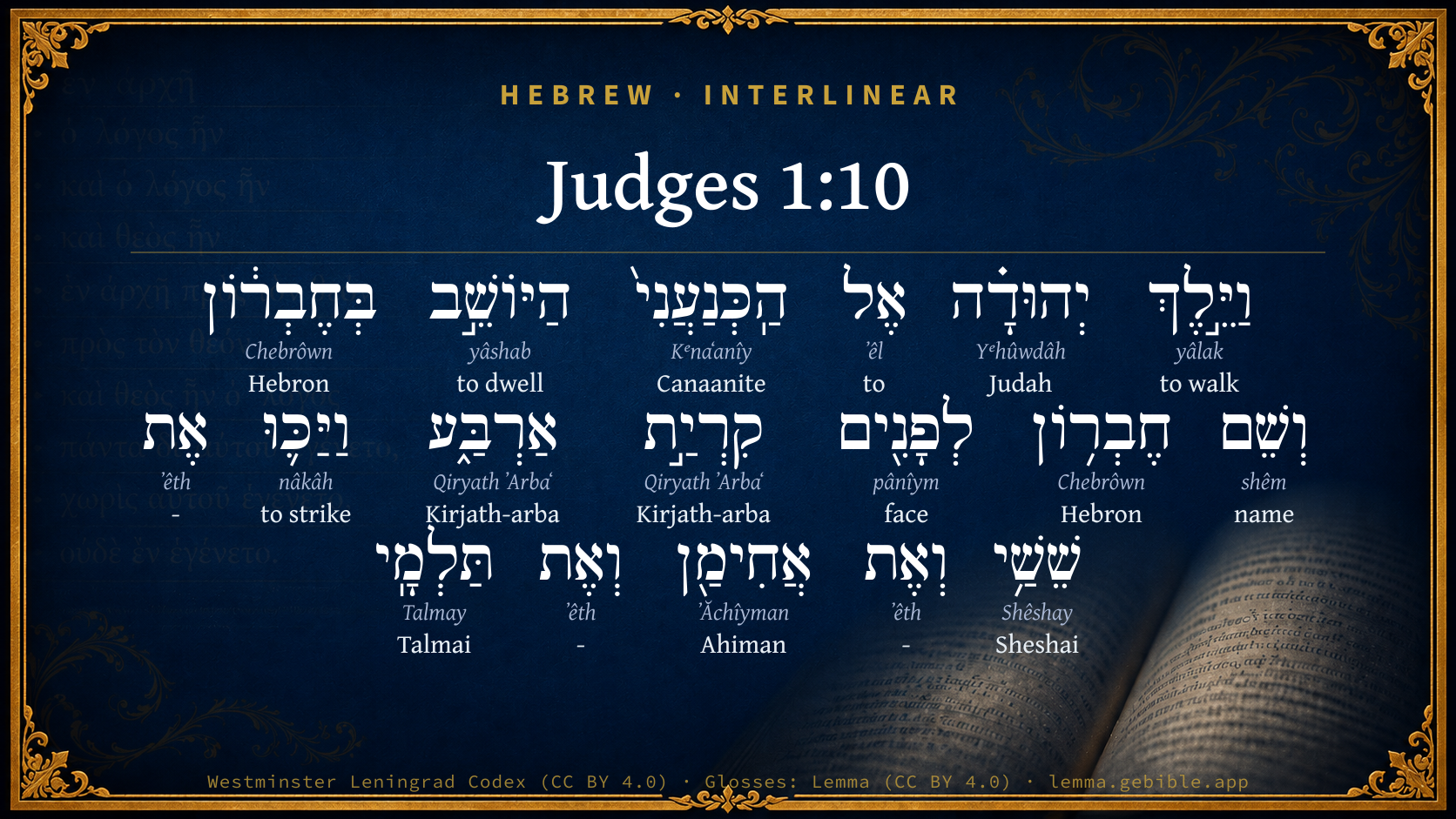
Judges 1:10

Hebrew (Westminster Leningrad Codex) Judges 1:10 appears in the Hebrew Old Testament. The text above is from the Westminster Leningrad Codex. Each word links to its Strong’s number, a concise gloss, and parsing drawn from the Open Scriptures Hebrew Bible morphology. Click any word for its full Brown-Driver-Briggs (BDB) entry.
Download image
Cite this verse

Judges 1:10 (World English Bible). Public Domain. Lemma interlinear Bible study tool, https://lemma.gebible.app/v/judges/1/10.

Show BibTeX & RIS
BibTeX
RIS
English Translation
Judah went against the Canaanites who lived in Hebron (now the name of Hebron before was Kiriath Arba); and they struck Sheshai, and Ahiman, and Talmai.
World English Bible · Public Domain
Download a study sheet

One document with this verse’s original text, its word-by-word gloss line, the meaning frame, cross-references with their text, attributed commentary, and full source and license credits — printable, and it pastes into notes with its structure intact.

This verse Autodidact and up

Study sheet (.html) Plain text (.txt)

A passage Seminary Student

Up to 50 verses in one chapter. A passage sheet keeps up to 6 commentary sources and 12 cross-references per verse, in the order this page ranks them, and says so on the sheet whenever that leaves anything out. Ask for a single verse and you get the Autodidact verse sheet above.

Everything on this page stays free to read, with no account — the sheet is a download of what is already on screen, not access to it.

Want to remove ads? Support Godless Engineer
Compare translations 3

The same verse in 3 English versions, stacked beneath the original-language interlinear above. Click any original word for its lexicon entry.

Each is an independent rendering of the whole verse — the interlinear is not word-aligned to these translations.

Highlighted words mark where these versions differ — a whole-verse word diff, not a word-by-word alignment.

  • World English Bible Public Domain
    Judah went against the Canaanites who lived in Hebron (now the name of Hebron before was Kiriath Arba); and they struck Sheshai, and Ahiman, and Talmai.
  • King James Version Public Domain
    And Judah went against the Canaanites that dwelt in Hebron: (now the name of Hebron before was Kirjatharba:) and they slew Sheshai, and Ahiman, and Talmai.
  • unfoldingWord Literal Text CC BY-SA 4.0
    Then Judah went down to the Canaanite living in Hebron. (Now the name of Hebron previously Kiriath Arba.) And they struck Sheshai and Ahiman and Talmai.

unfoldingWord Literal Text — © unfoldingWord, licensed CC BY-SA 4.0. Word-aligned USFM3 via Door43 (git.door43.org/unfoldingWord/en_ult).

Versions to compare (up to 4)

3 of 4 selected

Show all 18 translations

Every available English version of this verse, each an independent rendering of the whole verse.

  • World English Bible Public Domain
    Judah went against the Canaanites who lived in Hebron (now the name of Hebron before was Kiriath Arba); and they struck Sheshai, and Ahiman, and Talmai.
  • Berean Standard Bible Public Domain
    Judah also marched against the Canaanites who were living in Hebron (formerly known as Kiriath-arba), and they struck down Sheshai, Ahiman, and Talmai.
  • Majority Standard Bible Public Domain
    Judah also marched against the Canaanites who were living in Hebron (formerly known as Kiriath-arba), and they struck down Sheshai, Ahiman, and Talmai.
  • King James Version Public Domain
    And Judah went against the Canaanites that dwelt in Hebron: (now the name of Hebron before was Kirjatharba:) and they slew Sheshai, and Ahiman, and Talmai.
  • American Standard Version (1901) Public Domain
    And Judah went against the Canaanites that dwelt in Hebron (now the name of Hebron beforetime was Kiriath-arba); and they smote Sheshai, and Ahiman, and Talmai.
  • Revised Version (1885) Public Domain
    And Judah went against the Canaanites that dwelt in Hebron: (now the name of Hebron beforetime was Kiriath-arba:) and they smote Sheshai, and Ahiman, and Talmai.
  • Geneva Bible (1599) Public Domain
    And Iudah went against the Canaanites that dwelt in Hebron, which Hebron beforetime was called Kiriath-arba: and they slewe Sheshai, and Ahiman and Talmai.
  • Douay-Rheims (1899) Public Domain
    And Juda going forward against the Chanaanite, that dwelt in Hebron (the name whereof was in former times Cariath-Arbe) slew Sesai, and Ahiman, and Tholmai:
  • Young's Literal Translation Public Domain
    and Judah goeth unto the Canaanite who is dwelling in Hebron (and the name of Hebron formerly `is' Kirjath-Arba), and they smite Sheshai, and Ahiman, and Talmai.
  • Literal Standard Version CC BY-SA 4.0
    and Judah goes to the Canaanite who is dwelling in Hebron (and the name of Hebron [was] formerly Kirjath-Arba), and they strike Sheshai, and Ahiman, and Talmai.
  • Unlocked Literal Bible CC BY-SA 4.0
    Judah advanced against the Canaanites who lived in Hebron (the name of Hebron was previously Kiriath Arba), and they defeated Sheshai, Ahiman, and Talmai.
  • unfoldingWord Literal Text CC BY-SA 4.0
    Then Judah went down to the Canaanite living in Hebron. (Now the name of Hebron previously Kiriath Arba.) And they struck Sheshai and Ahiman and Talmai.
  • Darby Bible Public Domain
    And Judah went against the Canaanites who dwelt in Hebron (now the name of Hebron was formerly Kir'iath-ar'ba); and they defeated She'shai and Ahi'man and Talmai.
  • World Messianic Bible Public Domain
    Judah went against the Canaanites who lived in Hebron. (The name of Hebron before that was Kiriath Arba.) They struck Sheshai, Ahiman, and Talmai.
  • Webster's Bible Public Domain
    And Judah went against the Canaanites that dwelt in Hebron: (now the name of Hebron before was Kirjath-arba:) and they slew Sheshai, and Ahiman, and Talmai.
  • Free Bible Version CC BY-SA 4.0
    They attacked the Canaanites who lived in Hebron (previously known as Kiriath Arba) and defeated Sheshai, Ahiman, and Talmai.
  • Bible in Basic English Public Domain
    And Caleb went against the Canaanites of Hebron: (now in earlier times Hebron was named Kiriath-arba:) and he put Sheshai and Ahiman and Talmai to the sword.
  • JPS Tanakh (1917) Public Domain
    And Judah went against the Canaanites that dwelt in Hebron — now the name of Hebron beforetime was Kiriath-arba — and they smote Sheshai, and Ahiman, and Talmai.

Literal Standard Version (2020), Covenant Press — licensed CC BY-SA 4.0. Text via the HelloAO Bible API (eBible.org). Unlocked Literal Bible (unfoldingWord) — licensed CC BY-SA 4.0. Text via the HelloAO Bible API (eBible.org). unfoldingWord Literal Text — © unfoldingWord, licensed CC BY-SA 4.0. Word-aligned USFM3 via Door43 (git.door43.org/unfoldingWord/en_ult). Free Bible Version, Dr. Jonathan Gallagher — licensed CC BY-SA 4.0. Text via the HelloAO Bible API (eBible.org).

Word by word

More ways to search: Search by grammar → Find every occurrence → Compare this word →

Practice this passage: Drill this verse → Learn its vocabulary →

שֵׁשַׁ֥י
Shêshay
H8344
“Sheshai”
Noun, Proper
Part of Speech
Noun
Type
Proper
Full BDB Definition

Origin: probably for H8343

TWOT: None

Sheshai = "noble" - son of Anak, one of the giants in the land of Canaan
  1. וַיֵּ֣לֶךְ yâlak H3212 “and · to walk” Conjunction + Verb, Qal, Sequential Imperfect, 3rd Person, Masculine, Singular
  2. יְהוּדָ֗ה Yᵉhûwdâh H3063 “Judah” Noun, Proper
  3. אֶל ʼêl H413 “to” Preposition
  4. הַֽכְּנַעֲנִי֙ Kᵉnaʻanîy H3669 “the · Canaanite” Particle, Definite Article + Noun, Gentilic, Masculine, Singular, Absolute
  5. הַיּוֹשֵׁ֣ב yâshab H3427 “the · dwelling” Particle, Definite Article + Verb, Qal, Participle Active, Masculine, Singular, Absolute
  6. בְּחֶבְר֔וֹן Chebrôwn H2275 “in/at · Hebron” Preposition + Noun, Proper
  7. וְשֵׁם shêm H8034 “and · name of” Conjunction + Noun, Common, Masculine, Singular, Construct
  8. חֶבְר֥וֹן Chebrôwn H2275 “Hebron” Noun, Proper
  9. לְפָנִ֖ים pânîym H6440 “to/for · face(s)” Preposition + Noun, Common, Both, Plural, Absolute
  10. קִרְיַ֣ת Qiryath ʼArbaʻ H7153 “Kirjath-arba” Noun, Proper
  11. אַרְבַּ֑ע Qiryath ʼArbaʻ H7153 “Kirjath-arba” Adjective, Cardinal number, Feminine, Singular, Absolute
  12. וַיַּכּ֛וּ nâkâh H5221 “and · to strike” Conjunction + Verb, Hiphil, Sequential Imperfect, 3rd Person, Masculine, Plural
  13. אֶת ʼêth H853 “-” Particle, Direct Object
  14. וְאֶת ʼêth H853 “and · -” Conjunction + Particle, Direct Object
  15. אֲחִימַ֖ן ʼĂchîyman H289 “Ahiman” Noun, Proper
  16. וְאֶת ʼêth H853 “and · -” Conjunction + Particle, Direct Object
  17. תַּלְמָֽי Talmay H8526 “Talmai” Noun, Proper

About this verse

These counts appear in no published source. They are computed here, from the morphology-tagged text and Lemma’s own curated glosses. What Lemma adds →

18
words
14
distinct lemmas
Historical
section

Notable vocabulary

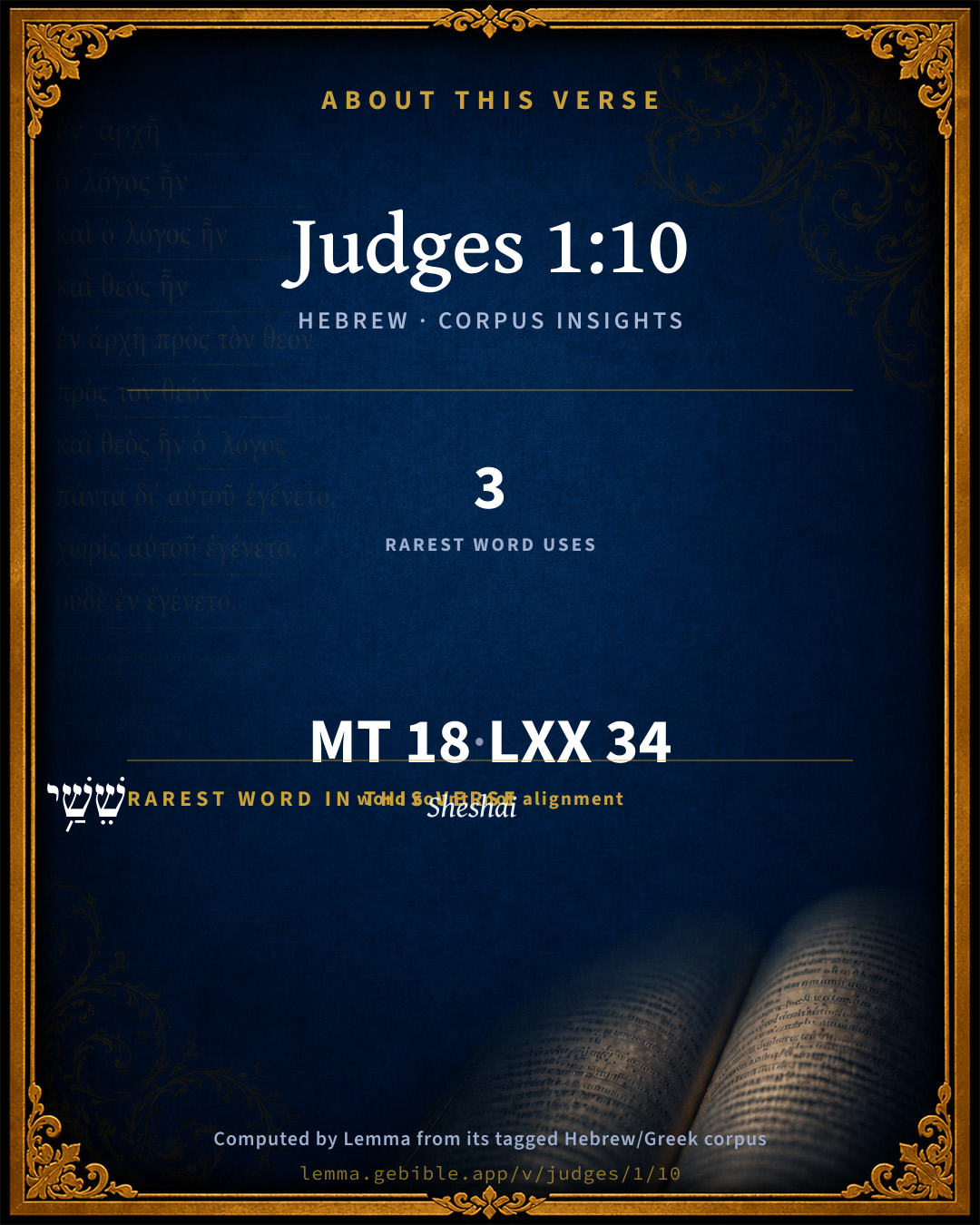
The rarest word here is שֵׁשַׁ֥י Sheshai H8344 — appearing just 3 times in the whole Hebrew Bible.

Shared distinctive vocabulary

שֵׁשַׁ֥י Sheshai H8344 occurs in 3 verses of the Hebrew Bible. Also found in:

Grammatical profile

  • 3 verbs
  • 10 nouns
  • 1 adjective
  • 1 preposition
  • 3 particles

Verb forms

  • וַיֵּ֣לֶךְ Qal · Sequential Imperfect
  • הַיּוֹשֵׁ֣ב Qal · Participle Active
  • וַיַּכּ֛וּ Hiphil · Sequential Imperfect

Repetition

Words recur within this verse — often emphatic in Hebrew:

  • בְּחֶבְר֔וֹן Hebron H2275 ×2
  • קִרְיַ֣ת Kirjath-arba H7153 ×2

Hebrew & Septuagint length

In English translation the verse runs 26 words from the Hebrew and 35 from the Septuagint (LXX English) — closely comparable.

A rough comparison of the two English renderings, which tokenize alike — not a word-level alignment.

Word counts can differ between the Hebrew and the Greek without any difference in meaning — e.g. the Hebrew direct-object marker אֵת has no separate Greek word, and Greek often adds the article ὁ.

In the original languages it is 18 Hebrew tokens and 34 Greek tokens — but the two are counted differently (Hebrew bundles its prefixes and suffixes into one token; the Greek is in lemma form), so that isn’t a like-for-like length.

Cross-references

8

Topical passages linked to Judges 1:10 in the Treasury of Scripture Knowledge — connected by theme and wording, ordered by reader-vote popularity; previews shown in the World English Bible.

  • Numbers 13:22 They went up by the South, and came to Hebron; and Ahiman, Sheshai, and Talmai, the children of Anak, were there. (Now Hebron was built seven years before Zoan in Egypt.)
  • Joshua 14:15 Now the name of Hebron before was Kiriath Arba; [which Arba was] the greatest man among the Anakim. The land had rest from war.
  • Numbers 13:33 There we saw the Nephilim, the sons of Anak, who come of the Nephilim: and we were in our own sight as grasshoppers, and so we were in their sight.
  • Joshua 15:13–19 To Caleb the son of Jephunneh he gave a portion among the children of Judah, according to the commandment of Yahweh to Joshua, even Kiriath Arba, [which Arba was] the father of Anak (the same is Hebron).
  • Judges 1:20 They gave Hebron to Caleb, as Moses had spoken: and he drove out there the three sons of Anak.
  • Ecclesiastes 9:11 I returned, and saw under the sun, that the race is not to the swift, nor the battle to the strong, neither yet bread to the wise, nor yet riches to men of understanding, nor yet favor to men of skill; but time and chance happen to them all.
  • Jeremiah 9:23 Thus says Yahweh, Don't let the wise man glory in his wisdom, neither let the mighty man glory in his might, don't let the rich man glory in his riches;
  • Psalms 33:16–17 There is no king saved by the multitude of a host. A mighty man is not delivered by great strength.

Cross-references courtesy of OpenBible.info (CC BY 4.0).

Hebrew and Greek witnesses Masoretic Hebrew ↔ Greek Septuagint

The same verse in the two great witnesses to the Old Testament, shown verse-for-verse.

These are two independent witnesses, not word-aligned to each other, and the Septuagint is shown in lemma (dictionary) form.

Hebrew Judges 1:10 Masoretic · Westminster Leningrad Codex

וַיֵּ֣לֶךְ יְהוּדָ֗ה אֶל הַֽכְּנַעֲנִי֙ הַיּוֹשֵׁ֣ב בְּחֶבְר֔וֹן וְשֵׁם חֶבְר֥וֹן לְפָנִ֖ים קִרְיַ֣ת אַרְבַּ֑ע וַיַּכּ֛וּ אֶת שֵׁשַׁ֥י וְאֶת אֲחִימַ֖ן וְאֶת תַּלְמָֽי

Judah went against the Canaanites who lived in Hebron (now the name of Hebron before was Kiriath Arba); and they struck Sheshai, and Ahiman, and Talmai.

World English Bible · Public Domain

Greek LXX Judges 1:10 Septuagint · lemma form

καί πορεύομαι ἰούδας πρός ὁ χαναναῖος ὁ καταοἰκέω ἐν χεβρων καί ἐκἔρχομαι χεβρων ἐκ ἐναντίος καί ὁ ὄνομα εἰμί χεβρων ὁ πρότερος καριαθαρβοξεφερ καί πατάσσω ὁ σεσσι καί αχινααν καί θολμι γέννημα ὁ ενακ

And Judas went to the Chananite who lived in Chebron; and Chebron came out against him; and the name of Chebron before was Cariatharbocsepher: and they struck Sessi, and Achiman, and Tholmi, children of Enac.

LXX2012 (modern English Septuagint) · Public Domain

On this verse, The Cambridge Bible for Schools and Colleges discusses the Septuagint’s reading. Read the note in Commentary ↓

Hebrew: Westminster Leningrad Codex (CC BY 4.0). Greek: Septuagint (public domain); English from LXX2012 (modern English Septuagint) (Public Domain). How the Septuagint differs from the Hebrew →

Targum (Aramaic paraphrase)

1

The Targum is the ancient Jewish Aramaic paraphrase of the Hebrew Scriptures — an interpretive translation, not the Hebrew text itself. Onkelos (literal) and Pseudo-Jonathan (expansive) render the Torah, and Jonathan the Prophets. Coverage is partial: where no permissively-licensed English translation exists for a verse, only the Aramaic is shown. This is verse-level text, not a word-by-word alignment to the Hebrew.

  1. Targum Jonathan Prophets (Joshua–Malachi)
    וַאֲזַלוּ דְבֵית יְהוּדָה לְוַת כְּנַעֲנָאֵי דְיַתְבִין בְּחֶבְרוֹן וְשׁוּם חֶבְרוֹן מִלְקַדְמִין קִרְיַת אַרְבַּע וּמְחוֹ יַת שֵׁשַׁי וְיַת אֲחִימָן וְיַת תַּלְמָי:

    (no public-domain English translation for this verse)

    Targum Jonathan — Aramaic: “Mikraot Gedolot” (public domain). English: “Sefaria Community Translation” (CC0 1.0 (public-domain dedication)); “London "Chaldee Paraphrase," 1871” (public domain). Text via Sefaria.

Commentary

Notes on Judges 1:10 from classic Christian and Jewish commentators (each source and its license shown beneath its notes). The classic Christian expositions comment on the surrounding passage and are grouped to its opening verse, so a note may address several verses; the Jewish commentaries on the Tanakh (Rashi and others) are per-verse, so they appear only where the commentator wrote on this verse.

Lemma curates 59 commentaries, every one of them public domain or Creative Commons licensed, each selected and text-cleaned for this edition rather than reprinted as found. About our sources →

The Cambridge Bible for Schools and Colleges

gen. ed. J. J. S. Perowne

10. The conquest of Hebron (contrast Jos_10:36-37 D) is here ascribed to Judah as part of the general operations against the Canaanites (Jdg_1:9); later on, the Judahites, having taken the city, made it over to Caleb (Jdg_1:20). In Jos_15:14 J, however, Hebron is captured by Caleb; it was a victory over the Anâkim, not over Canaanites in general; and such was undoubtedly the original version of the story. The editor here has altered the original narrative to fit his scheme of Judah’s victories; this has involved the removal of Jdg_1:20 from its proper place before Jdg_1:10. Fortunately the parallel passage in Joshua helps us to recover the original form of the text:

Jos_15:13-15.Jdg_1:20; Jdg_1:10-11.And unto Caleb the son of Jephunneh he gave [Hebron]†[22]. And Caleb drove out thence the three sons of Anak, Sheshai, and Ahiman, and Talmai, the children of Anak. And he went up thence against the inhabitants of Debir etc.

[22] The words which intervene come from P.And they gave Hebron unto Caleb, as Moses had spoken: and he drove out thence the three sons of Anak (20), Sheshai, and Ahiman, and Talmai (10b). And he went thence against the inhabitants of Debir etc. (11).Thus the whole of Jdg_1:10, except the names of the giants, is due to the editor. Arranging the text in this way we obtain a consistent narrative, a proper subject for the verb ‘and he went’ in Jdg_1:11, and the introduction of Caleb at a point which explains how he came to be speaking in Jdg_1:12.

Hebron] The modern el-Ḥalîl (= the friend), so called from its association with Abraham the friend of God, is the highest point in the Judaean Highlands, 3040 ft. above the sea. Its position made it the metropolis of the Negeb, which began a little to the south.

now the name of Hebron beforetime was Kiriath-arba] An archaeological gloss, cf. 11b. The ancient name of Hebron is frequently mentioned by P, e.g. Gen_23:2, Jos_15:54 etc.; in Gen_23:19; Gen_35:27 P it is given as Mamre. Kiriath-arba = lit. ‘city of four,’ i.e. Tetrapolis, perhaps because the city was divided into four quarters inhabited by different races; cf. Tripolis on the Phoenician coast, founded by Tyre, Sidon, and Aradus. The word arba is not a proper name, as a late Jewish tradition took it, Jos_14:15; Jos_15:13; Jos_21:11; in all three places the LXX has preserved the original reading ‘Kiriath-arba the metropolis of Anak.’ Burney in Journ. Theol. Studies 12:118 f. explains the name as ‘the city of (the god) Four’; he quotes Babyl. parallels for this usage; which, however, is questioned by some Assyriologists.

Sheshai, and Ahiman, and Talmai] Either ‘the three sons of the Anak’ from Jdg_1:20 (cf. Jos_15:14) should precede; or we may place ‘the children of Anak’ after the names, following the LXX here and Jos_15:14. The names may refer to families rather than to individuals; they look as if they were Aramaic. Sheshai (Ezr_10:40) is connected by Sayce with the Shasu, i.e. ‘plunderers,’ or Bedouin of S. Canaan frequently alluded to on Egyptian monuments, though the forms are not philologically the same; cf. Sheshan in 1Ch_2:31-35, a name belonging to this region. Ahiman 1Ch_9:17 probably = ‘brother of Mìnî,’ the god of fortune, Isa_65:11. Talmai is found in N. Arabia, in Nabataean inscriptions (C.I.S. ii. 321, 344, 348), and as the name of kings of Lihyan, an Arabian tribe (Müller, Epigr. Denkmäler aus Arabien nos. 4, 9, 25 from el-‘Öla). The three giants are mentioned in connexion with the visit of the spies, one of whom was Caleb, to Hebron Num_13:22; Num_13:28 JE. The spies travelled northwards from Kadesh; and Caleb, when he attacked Hebron, most likely also advanced from the south. The two expeditions cannot have been separated by any long interval of time, according to the narrative of J.

Underlying the story there seems to be a dim recollection of the fact that the various clans which in time grew into the tribe of Judah, the Calebites, Kenites, Jerahmeelites, entered Canaan, not from the E. after crossing the Jordan, but from the S. by advancing from Kedesh.

The Cambridge Bible for Schools and Colleges (gen. ed. J. J. S. Perowne; Cambridge University Press, 1878–1918) — public domain. Text from a community e-Sword module.

Trapp's Complete Commentary

John Trapp

Jdg 1:10 And Judah went against the Canaanites that dwelt in Hebron: (now the name of Hebron before [was] Kirjatharba:) and they slew Sheshai, and Ahiman, and Talmai.

Ver. 10. And they slew Sheshai, &c.] Those huge giants were slain by such as seemed but grasshoppers unto them. See Jos 11:21-22.

10 But these speak evil of those things which they know not: but what they know naturally, as brute beasts, in those things they corrupt themselves.

Ver. 10. Of those things which they] So do the Papists in railing against imputed righteousness, assurance of salvation, the testimony of God’s Spirit witnessing with our spirits, &c.

In those things they corrupt themselves] As in eating, drinking, carnal copulation, &c., holding neither mean nor measure, as he in Aristophanes (in Ranis), οστις γε πινειν οιδε και βινειν μονον, who was good for nothing else but to epicurize.

John Trapp, A Commentary or Exposition upon All the Books of the Old and New Testament (1647–1656) — public domain. Text from a community e-Sword module.

Whedon's Commentary on the Bible

Daniel D. Whedon

CONQUEST OF HEBRON, AND EXPLOIT AND REWARD OF OTHNIEL, Jdg_1:10-15.

This passage is nearly identical with Jos_15:14-19. It may have been copied from the Book of Joshua, or from some older work. See the notes on the passage in Joshua. It is characteristic of the Hebrew historians to interweave such episodes as this and the following one about the Kenites into a narrative which touches persons or places with which they were associated.

The date of this conquest of Hebron and Debir is uncertain, but from Jos_14:6-15; Jos_15:13-19, it appears that it occurred during the lifetime of Joshua. Caleb was eighty-five years old at the time of the Conquest, or at its close, and some little time may have passed before he conquered Debir, but not probably many years. But whatever the date, the episodical character of this section, (Jdg_1:10-16,) and the resumption of the narrative of Judah and Simeon’s exploits at Jdg_1:17, show the futility of arguing from this passage that all the rest of the events of the chapter must have happened before the death of Joshua.

Daniel D. Whedon (gen. ed.), Commentary on the Old and New Testaments (1874–1909) — public domain. Text from a community e-Sword module.

Geneva Bible (1599)

Geneva Bible translators

These three were giants, and the children of Anak.

Geneva Bible (1599) marginal notes — public domain. Text via Bolls.life.

Ellicott's Commentary for English Readers

(10) That dwelt in Hebron.—See Jos_10:36-37. Hebron is midway between Jerusalem and Beersheba, and twenty miles from either. The first name of the city, which is one of the most ancient in the world (Num_13:22), was Mamre (Gen_13:18), from the name of its chief (Gen_14:24). It is now called El-Khulîl (“the friend”), from Abraham. It was a city of refuge (Jos_21:11-13). If the view taken as to the chronology of this chapter is correct, this assault is identical with those touched upon in Jos_11:21; Jos_14:6-15; Jos_15:13-14. The LXX. have, “Hebron came forth against Judah.” For later references to Hebron, see Neh_11:25; 1Ma_5:65.

Kirjath-arba.—That is, “the city of Arba.” The word afterwards became archaic and poetical (Psa_48:2; Isa_25:2). All the cities thus named (Kir-jath-huzoth, Kirjath-jearim, &c.) existed before the conquest of Palestine. We find the root in Iskariot (i.e., man of Kerioth, a town in the south of Judah). Arba was the father of Anak (Jos_15:13; Jos_14:15), and Fürst interprets the name “hero of Baal.” Some, however, take Arba for the numeral “four,” so that Kirjath-arba would mean Tetrapolis; and connect the name Hebron with the Arabic “Cherbar,” a confederation, “the cities of Hebron” (2Sa_2:3).

Sheshai, and Animan, and Talmai.—Possibly the names of three clans of the Anakim (Num_13:22-23). The Anakim are connected with the Nephilim—giant races sprung from the union of the sons of God with the daughters of men. Josephus says that giant bones of the race were shown in his day (Antt. v. 2, § 3). They were doubtless the bones of extinct animals, and being taken for human remains might well lead to the conclusion of Josephus, that these giants “had bodies so large, and countenances so entirely different from other men, that they were surprising to the sight.”

A Bible Commentary for English Readers, edited by Charles John Ellicott (1878–1897) — public domain. Text from a community e-Sword module.

John Gill's Exposition

And Judah went against the Canaanites that dwelt in Hebron,.... Hebron was first taken by Joshua, and the inhabitants of it put to the sword, Jos 10:36; but while Joshua was employed in making other conquests, the Canaanites found ways and means of getting into the possession of it again; wherefore, when a grant of it was made to Caleb, he, with the assistance of the tribe of Judah, of which he was prince, regained it, Jos 15:12; wherefore what is recorded here is only a repetition of what was then done; unless it can be thought that this fact was there inserted by anticipation, or that there were two expeditions of the children of Judah against this place:

now the name of Hebron, before was Kirjatharba: see Jos 14:15; in the first of which Caleb, with the assistance of this tribe, drove out the three giants only, who afterwards got possession again, and in this put them to death, as follows:

and they slew Sheshai, and Ahiman, and Talmai; see Num 13:22; but what follows concerning their going from hence to Debir, and the offer of Caleb to give his daughter in marriage to whomsoever should take it, does not seem so well to agree with times after the death of Joshua; since it is highly probable that Caleb, who was contemporary with him and Eleazar, was now dead, and at least cannot well be thought to have a young daughter at this time undisposed of in marriage; wherefore these facts are only repeated upon observing Judah's having taken Jerusalem, to show what exploits were performed by men of that tribe; wherefore for what is after said, Jdg 1:11, as is said in Jos 15:15, where the same things are related in express words as here, containing the request of Caleb's daughter: such an one, as made to Domitian, is related by Martial (l).

(l) "Est mihi sitque precor", &c. l. 9. ep. 16.

John Gill's Exposition of the Whole Bible (1746–1763) — public domain (CC PDM 1.0). Text via the HelloAO Bible API.

Haydock's Catholic Bible Commentary

Hebron. This expedition against Hebron, &c., is the same as is related [in] Josue xv. 24. It is here repeated, to give the reader at once a short sketch of all the achievements of the tribe of Juda against the Chanaanites. (Challoner) --- Josue had taken Hebron before; (Josue x. 37,) and Caleb retakes it. (Calmet)

George Leo Haydock (1774–1849), Haydock's Catholic Family Bible and Commentary, 1859 edition — public domain. Excludes Psalms (Douay-Rheims chapter numbering differs from Protestant) and Deuterocanonical books (Catholic canon only).

Matthew Poole's English Annotations

Judah went, under the conduct of Caleb, as it is recorded, Jos 15:11, &c.; for that relation, and this here following, are doubtless one and the same expedition and war, as appears by all the circumstances; and it is mentioned either there by anticipation, or here by repetition. Of this and the following verses, see the notes there.

Matthew Poole's English Annotations on the Holy Bible (1683–1685) — public domain. Text from a community e-Sword/MySword module.

The Pulpit Commentary

Hebron See Num_13:22Jo Num_14:13-15 Num_15:13-19. Hebron was the burial-place of Abraham and Sarah, (Gen_23:2, etc.; Gen_25:9) of Isaac and Rebekah, and of Jacob and Leah, (Gen_35:27-29 Gen_49:31 Gen_50:13) and the mosque, within whose massive walls the tombs of Abraham and the other four above mentioned are still preserved with the utmost reverence, is the most remarkable object in the modem city, which is called El-Khalil (the friend), after Abraham, the friend of God. A very interesting account of the Prince of Wales"s visit to the Mosque of Hebron in 1862 is given in Dean Stanley s "Sermons in the East." David reigned in Hebron seven years and six mouths before he transferred the seat of power to Jerusalem. (see 2Sa_2:1, etc.; 2Sa_5:1-5)

The Pulpit Commentary (1880–1919), ed. H.D.M. Spence-Jones & Joseph S. Exell — public domain. Text from a community e-Sword module.

John Wesley's Explanatory Notes

Judah went - Under the conduct of Caleb, as is recorded, ver. 14, &c., for that relation, and this, are doubtless one and the same expedition, and it is mentioned there by anticipation.

John Wesley, Explanatory Notes Upon the Whole Bible (1754–1765) — public domain. Text via the GEBible commentary corpus.

Lesson kit

Teaching starters — assembled from the data on this page, not authored interpretation. Every prompt links to the verse data it draws on. Edit before teaching.

Judges, in the Historical, opens this verse with 18 words (14 distinct Hebrew lemmas). Its most distinctive word is Shêshay (“Sheshai”). A historical commentator’s framing appears above. Read the whole chapter for the surrounding context.

Discussion questions

  1. The word Shêshay carries the sense “Sheshai.” How does it shape the verse?
  2. Numbers 13:22 shares the word «Sheshai» with this verse. How do the two illuminate each other?
  3. “Hebron” occurs 2× in this one verse. What is the effect of the repetition?
  4. These translations render this verse differently. What is at stake in choosing one wording over another?
  5. The verb «וַיֵּ֣לֶךְ» is Qal Sequential Imperfect. How does its form color the action?
  6. Reading how The Cambridge Bible for Schools and Colleges and Trapp's Complete Commentary read this verse, where do the two commentators agree and where do they part?

Things to notice

Reading settings

Reading text

Shown beneath each verse's original-language words.

Old Testament
Old Testament edition

Read the OT as the Masoretic Hebrew (MT) or the Greek Septuagint (LXX).

English shown for the Greek Septuagint (in the Hebrew ↔ Greek comparison).

Comparing translations? Open the Compare panel on any verse page to stack up to four side by side.