
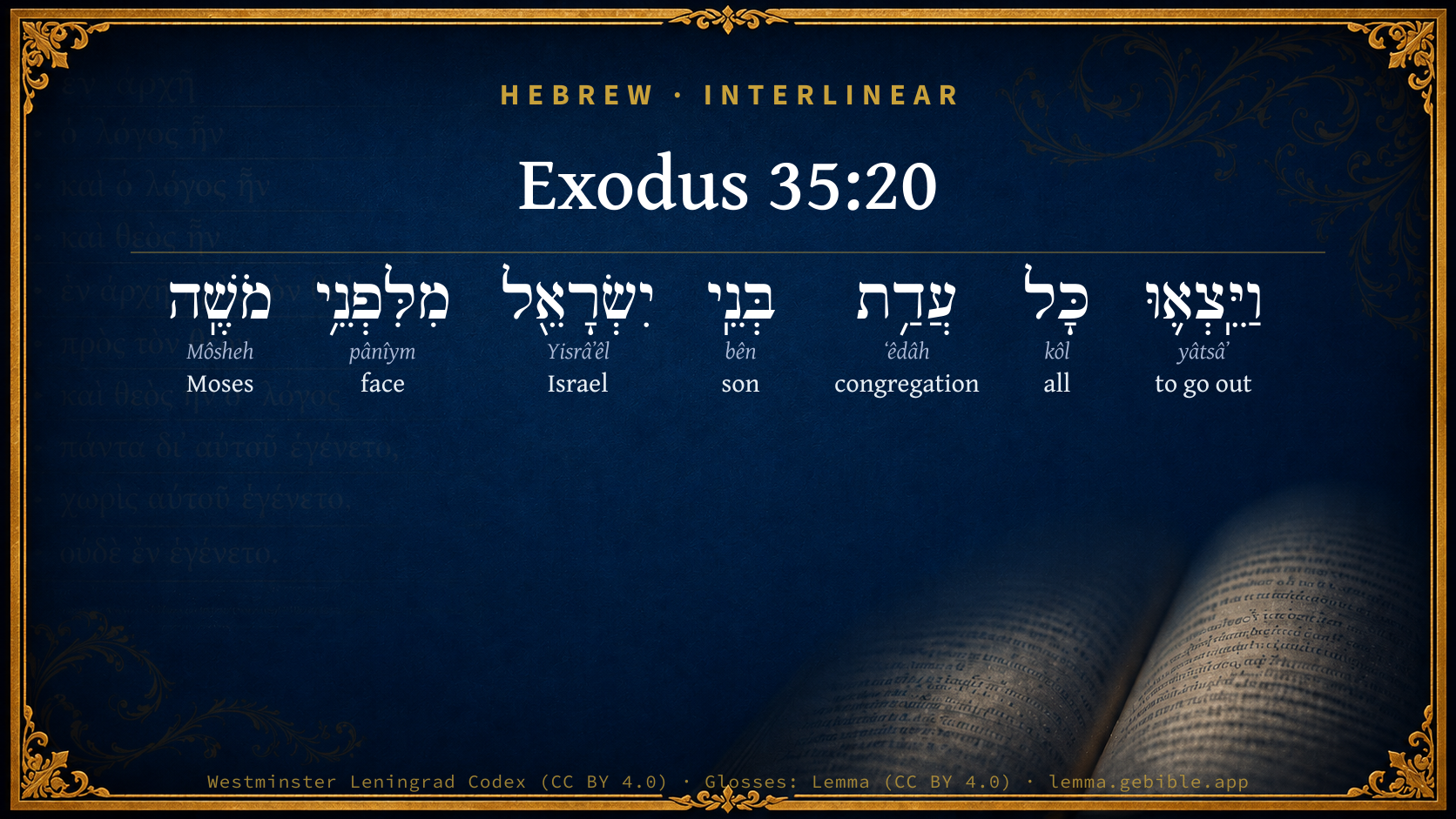
Exodus 35:20

Hebrew (Westminster Leningrad Codex) Exodus 35:20 appears in the Hebrew Old Testament. The text above is from the Westminster Leningrad Codex. Each word links to its Strong’s number, a concise gloss, and parsing drawn from the Open Scriptures Hebrew Bible morphology. Click any word for its full Brown-Driver-Briggs (BDB) entry.
Download image
Cite this verse

Exodus 35:20 (World English Bible). Public Domain. Lemma interlinear Bible study tool, https://lemma.gebible.app/v/exodus/35/20.

Show BibTeX & RIS
BibTeX
RIS
English Translation
All the congregation of the children of Israel departed from the presence of Moses.
World English Bible · Public Domain
Download a study sheet

One document with this verse’s original text, its word-by-word gloss line, the meaning frame, cross-references with their text, attributed commentary, and full source and license credits — printable, and it pastes into notes with its structure intact.

This verse Autodidact and up

Study sheet (.html) Plain text (.txt)

A passage Seminary Student

Up to 50 verses in one chapter. A passage sheet keeps up to 6 commentary sources and 12 cross-references per verse, in the order this page ranks them, and says so on the sheet whenever that leaves anything out. Ask for a single verse and you get the Autodidact verse sheet above.

Everything on this page stays free to read, with no account — the sheet is a download of what is already on screen, not access to it.

Want to remove ads? Support Godless Engineer
Compare translations 3

The same verse in 3 English versions, stacked beneath the original-language interlinear above. Click any original word for its lexicon entry.

Each is an independent rendering of the whole verse — the interlinear is not word-aligned to these translations.

Highlighted words mark where these versions differ — a whole-verse word diff, not a word-by-word alignment.

  • World English Bible Public Domain
    All the congregation of the children of Israel departed from the presence of Moses.
  • King James Version Public Domain
    And all the congregation of the children of Israel departed from the presence of Moses.
  • unfoldingWord Literal Text CC BY-SA 4.0
    And all of the congregation of the sons of Israel went away from before the face of Moses.

unfoldingWord Literal Text — © unfoldingWord, licensed CC BY-SA 4.0. Word-aligned USFM3 via Door43 (git.door43.org/unfoldingWord/en_ult).

Versions to compare (up to 4)

3 of 4 selected

Show all 18 translations

Every available English version of this verse, each an independent rendering of the whole verse.

  • World English Bible Public Domain
    All the congregation of the children of Israel departed from the presence of Moses.
  • Berean Standard Bible Public Domain
    Then the whole congregation of Israel withdrew from the presence of Moses.
  • Majority Standard Bible Public Domain
    Then the whole congregation of Israel withdrew from the presence of Moses.
  • King James Version Public Domain
    And all the congregation of the children of Israel departed from the presence of Moses.
  • American Standard Version (1901) Public Domain
    And all the congregation of the children of Israel departed from the presence of Moses.
  • Revised Version (1885) Public Domain
    And all the congregation of the children of Israel departed from the presence of Moses.
  • Geneva Bible (1599) Public Domain
    Then all the Congregation of the children of Israel departed from the presence of Moses.
  • Douay-Rheims (1899) Public Domain
    And all the multitude of the children of Israel going out from the presence of Moses,
  • Young's Literal Translation Public Domain
    And all the company of the sons of Israel go out from the presence of Moses,
  • Literal Standard Version CC BY-SA 4.0
    And all the congregation of the sons of Israel go out from the presence of Moses,
  • Unlocked Literal Bible CC BY-SA 4.0
    Then all the tribes of Israel left and went away from Moses's presence.
  • unfoldingWord Literal Text CC BY-SA 4.0
    And all of the congregation of the sons of Israel went away from before the face of Moses.
  • Darby Bible Public Domain
    And all the assembly of the children of Israel departed from before Moses.
  • World Messianic Bible Public Domain
    All the congregation of the children of Israel departed from the presence of Moses.
  • Webster's Bible Public Domain
    And all the congregation of the children of Israel departed from the presence of Moses.
  • Free Bible Version CC BY-SA 4.0
    The Israelites left Moses,
  • Bible in Basic English Public Domain
    And all the children of Israel went away from Moses.
  • JPS Tanakh (1917) Public Domain
    And all the congregation of the children of Israel departed from the presence of Moses.

Literal Standard Version (2020), Covenant Press — licensed CC BY-SA 4.0. Text via the HelloAO Bible API (eBible.org). Unlocked Literal Bible (unfoldingWord) — licensed CC BY-SA 4.0. Text via the HelloAO Bible API (eBible.org). unfoldingWord Literal Text — © unfoldingWord, licensed CC BY-SA 4.0. Word-aligned USFM3 via Door43 (git.door43.org/unfoldingWord/en_ult). Free Bible Version, Dr. Jonathan Gallagher — licensed CC BY-SA 4.0. Text via the HelloAO Bible API (eBible.org).

Word by word

More ways to search: Search by grammar → Find every occurrence → Compare this word →

Practice this passage: Drill this verse → Learn its vocabulary →

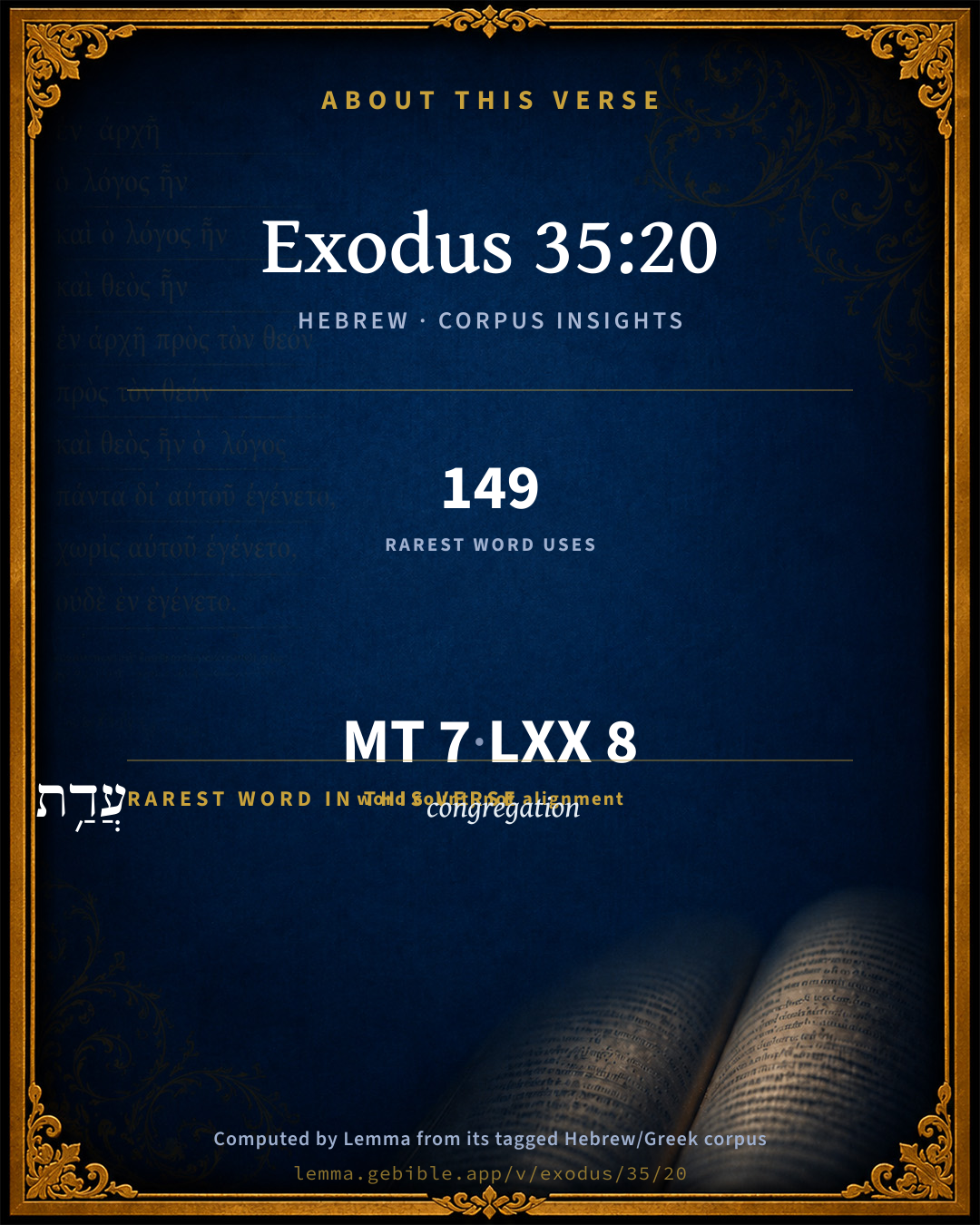
About this verse

These counts appear in no published source. They are computed here, from the morphology-tagged text and Lemma’s own curated glosses. What Lemma adds →

7
words
7
distinct lemmas
Pentateuch
section

Grammatical profile

  • 1 verb
  • 6 nouns

Verb forms

  • וַיֵּֽצְא֛וּ Qal · Sequential Imperfect

Hebrew & Septuagint length

In English translation the verse runs 14 words from the Hebrew and 34 from the Septuagint (LXX English) — the Septuagint runs noticeably longer here. See the side-by-side →

A rough comparison of the two English renderings, which tokenize alike — not a word-level alignment.

Word counts can differ between the Hebrew and the Greek without any difference in meaning — e.g. the Hebrew direct-object marker אֵת has no separate Greek word, and Greek often adds the article ὁ.

In the original languages it is 7 Hebrew tokens and 8 Greek tokens — but the two are counted differently (Hebrew bundles its prefixes and suffixes into one token; the Greek is in lemma form), so that isn’t a like-for-like length.

Hebrew and Greek witnesses Masoretic Hebrew ↔ Greek Septuagint

The same verse in the two great witnesses to the Old Testament, shown verse-for-verse.

Here the Septuagint runs noticeably longer than the Hebrew — LXX2012 (modern English Septuagint) 34 words vs World English Bible 14. A rough length comparison of the two English translations, not a word-level alignment — read both below.

These are two independent witnesses, not word-aligned to each other, and the Septuagint is shown in lemma (dictionary) form.

Hebrew Exodus 35:20 Masoretic · Westminster Leningrad Codex

וַיֵּֽצְא֛וּ כָּל עֲדַ֥ת בְּנֵֽי יִשְׂרָאֵ֖ל מִלִּפְנֵ֥י מֹשֶֽׁה

All the congregation of the children of Israel departed from the presence of Moses.

World English Bible · Public Domain

Greek LXX Exodus 35:20 Septuagint · lemma form

καί ἐκἔρχομαι πᾶς συναγωγή υἱός ἰσραήλ ἀπό μωυσῆς

And all the congregation of the children of Israel went out from Moses. And they brought, they whose heart prompted them, and they to whoever it seemed good in their mind, each and offering:

LXX2012 (modern English Septuagint) · Public Domain

Hebrew: Westminster Leningrad Codex (CC BY 4.0). Greek: Septuagint (public domain); English from LXX2012 (modern English Septuagint) (Public Domain). How the Septuagint differs from the Hebrew →

Targum (Aramaic paraphrase)

2

The Targum is the ancient Jewish Aramaic paraphrase of the Hebrew Scriptures — an interpretive translation, not the Hebrew text itself. Onkelos (literal) and Pseudo-Jonathan (expansive) render the Torah, and Jonathan the Prophets. Coverage is partial: where no permissively-licensed English translation exists for a verse, only the Aramaic is shown. This is verse-level text, not a word-by-word alignment to the Hebrew.

  1. Targum Onkelos Torah (Genesis–Deuteronomy)
    וּנְפָקוּ כָּל כְּנִשְׁתָּא דִבְנֵי יִשְׂרָאֵל מִן קֳדָם משֶׁה:

    (no public-domain English translation for this verse)

    Targum Onkelos — Aramaic: “Onkelos Genesis” (public domain); “Onkelos Exodus” (public domain); “Onkelos Leviticus” (public domain); “Onkelos Numbers” (public domain); “Onkelos Deuteronomy” (public domain). English: “Sefaria Community Translation” (CC0 1.0 (public-domain dedication)); “J.W. Etheridge. The Targums of Onkelos and Jonathan Ben Uzziel on the Pentateuch. London: Longmans, Green, 1862” (public domain). Text via Sefaria.

  2. Targum Pseudo-Jonathan Torah (Genesis–Deuteronomy)
    וּנְפָקוּ כָּל כְּנִישְׁתָּא דִבְנֵי יִשְרָאֵל מִן קֳדָם משֶׁה

    And all the congregation of the sons of Israel went out from before Mosheh.

    Targum Pseudo-Jonathan — Aramaic: “Targum Jonathan on Genesis” (public domain); “Targum Jonathan on Exodus” (public domain); “Targum Jonathan on Leviticus” (public domain); “Targum Jonathan on Numbers” (public domain); “Targum Jonathan on Deuteronomy” (public domain). English: “The Targum of Jonathan ben Uzziel, trans. J. W. Etheridge, London, 1862” (public domain). Text via Sefaria.

Commentary

Notes on Exodus 35:20 from classic Christian and Jewish commentators (each source and its license shown beneath its notes). The classic Christian expositions comment on the surrounding passage and are grouped to its opening verse, so a note may address several verses; the Jewish commentaries on the Tanakh (Rashi and others) are per-verse, so they appear only where the commentator wrote on this verse.

Lemma curates 59 commentaries, every one of them public domain or Creative Commons licensed, each selected and text-cleaned for this edition rather than reprinted as found. About our sources →

Matthew Henry's Commentary

Moses having made known to them the will of God, they went home and immediately put in practice what they had heard, Exo 35:20. O that every congregation would thus depart from the hearing of the word of God, with a full resolution to be doers of the same! Observe here,

I. The offerings that were brought for the service of the tabernacle (Exo 35:21, etc.), concerning which many things may be noted. 1. It is intimated that they brought their offerings immediately; they departed to their tents immediately to fetch their offering, and did not desire time to consider of it, lest their zeal should be cooled by delays. What duty God convinces us of, and calls us to, we should set about speedily. No season will be more convenient than the present season. 2. It is said that their spirits made them willing (Exo 35:21), and their hearts, Exo 35:29. What they did they did cheerfully, and from a good principle. They were willing, and it was not any external inducement that made them so, but their spirits. It was from a principle of love to God and his service, a desire of his presence with them in his ordinances, gratitude for the great things he had done for them, faith in his promise of what he would further do (or, at least, from the present consideration of these things), that they were willing to offer. What we give and do for God is then acceptable when it comes from a good principle in the heart and spirit. 3. When it is said that as many as were willing-hearted brought their offerings (Exo 35:22), it should seem as if there were some who were not, who loved their gold better than their God, and would not part with it, no, not for the service of the tabernacle. Such there are, who will be called Israelites, and yet will not be moved by the equity of the thing, God's expectations from them, and the good examples of those about them, to part with any thing for the interests of God's kingdom: they are for the true religion, provided it be cheap and will cost them nothing. 4. The offerings were of divers kinds, according as they had; those that had gold and precious stones brought them, not thinking any thing too good and too rich to part with for the honour of God. Those that had not precious stones to bring brought goats' hair, and rams' skins. If we cannot do as much as others for God, we must not therefore sit still and do nothing: if the meaner offerings which are according to our ability gain us not such a reputation among men, yet they shall not fail of acceptance with God, who requires according to what a man hath, and not according to what he hath not, Co2 8:12; Kg2 5:23. Two mites from a pauper were more pleasing than so many talents from a Dives. God has an eye to the heart of the giver more than to the value of the gift. 5. Many of the things they offered were their ornaments, bracelets and rings, and tablets or lockets (Exo 35:22); and even the women parted with these. Can a maid forget her ornaments? Thus far they forgot them that they preferred the beautifying of the sanctuary before their own adorning. Let this teach us, in general, to part with that for God, when he calls for it, which is very dear to us, which we value, and value ourselves by; and particularly to lay aside our ornaments, and deny ourselves in them, when either they occasion offence to others or feed our own pride. If we think those gospel rules concerning our clothing too strict (Ti1 2:9, Ti1 2:10; Pe1 3:3, Pe1 3:4), I fear we should scarcely have done as these Israelites did. If they thought their ornaments well bestowed upon the tabernacle, shall not we think the want of ornaments well made up by the graces of the Spirit? Pro 1:9. 6. These rich things that they offered, we may suppose, were mostly the spoils of the Egyptians; for the Israelites in Egypt were kept poor, till they borrowed at parting. And we may suppose the rulers had better things (Exo 35:27), because, having more influence among the Egyptians, they borrowed larger sums. Who would have thought that ever the wealth of Egypt should have been so well employed? but thus God has often made the earth to help the woman, Rev 12:16. It was by a special providence and promise of God that the Israelites got all that spoil, and therefore it was highly fit that they should devote a part of it to the service of that God to whom they owed it all. Let every man give according as God hath prospered him, Co1 16:2. Extraordinary successes should be acknowledged by extraordinary offerings. Apply it to human learning, arts and sciences, which are borrowed, as it were, from the Egyptians. Those that are enriched with these must devote them to the service of God and his tabernacle: they may be used as helps to understand the scriptures, as ornaments or handmaids to divinity. But then great care must be taken that Egypt's gods mingle not with Egypt's gold. Moses, though learned in all the learning of the Egyptians, did not therefore pretend, in the least instance, to correct the pattern shown him in the mount. The furnishing of the tabernacle with the riches of Egypt was perhaps a good omen to the Gentiles, who, in the fulness of time, should be brought into the gospel tabernacle, and their silver and their gold with them (Isa 60:9), and it should be said, Blessed be Egypt my people, Isa 19:25. 7. We may suppose that the remembrance of the offerings made for the golden calf made them the more forward in these offerings. Those that had then parted with their ear-rings would not testify their repentance by giving the rest of their jewels to the service of God: godly sorrow worketh such a revenge, Co2 7:11. And those that had kept themselves pure from that idolatry yet argued with themselves, "Were they so forward in contributing to an idol, and shall we be backward or sneaking in our offerings to the Lord?" Thus some good was brought even out of that evil.

II. The work that was done for the service of the tabernacle (Exo 35:25): The women did spin with their hands. Some spun fine work, of blue and purple; others coarse work, of goats' hair, and yet theirs also is said to be done in wisdom, Exo 35:26. As it is not only rich gifts, so it is not only fine work that God accepts. Notice is here taken of the good women's work for God, as well as of Bezaleel's and Aholiab's. The meanest hand for the honour of God, shall have an honourable recompence. Mary's anointing of Christ's head shall be told for a memorial (Mat 26:13); and a record is kept of the women that laboured in the gospel tabernacle (Phi 4:3), and were helpers to Paul in Christ Jesus, Rom 16:3. It is part of the character of the virtuous woman that she layeth her hands to the spindle, Pro 31:19. This employment was here turned to a pious use, as it may be still (though we have no hangings to make for the tabernacle) by the imitation of the charity of Dorcas, who made coats and garments for poor widows, Act 9:39. Even those that are not in a capacity to give in charity may yet work in charity; and thus the poor may relieve the poor, and those that have nothing but their limbs and senses may be very charitable in the labour of love.

Matthew Henry's Commentary on the Whole Bible (1708–1710) — public domain (CC PDM 1.0). Text via the HelloAO Bible API.

The Preacher's Complete Homiletical Commentary

Joseph S. Exell (gen. ed.)

MAIN HOMILETICS OF THE PARAGRAPH.—Exo_35:20-29

HINTS FOR BUILDING COMMITTEES

The wishes of God were made known in the previous section, and the people forth with resolved themselves into a committee of ways and means for carrying those wishes out. The action of the committee was—

I. Immediate, Exo_35:20-21. They did not hold a meeting to take into consideration the recommendations, and adopt the report. Nor did they elect a chairman, secretary, and working committee, to advise when, where, and how measures were to be carried out, but went away at once and commenced the work, before their ardour evaporated in idleness and their determination in talk. Had they met but once and debated the question, the probabilities are, like their Christian successors, the work might never have been done.

II. Spontaneous and earnest, Exo_35:21. They had but one public meeting, and that a very short one, and that without resolutions or amendment or exciting appeals. The cause itself was all the eloquence they wanted. God had graciously forgiven them, and had condescended to dwell amongst them, and wanted a house for that purpose. That was enough for them. Their gratitude to, and love of God, did all the rest. Should Christian people want other incentives than these? and should their contributions to building funds, &c., be less prompt, less free, less generous? Must Christian contributions, for God’s cause, be prompted by dinners, soirees, harangues, bazaars, when Jewish contributions were given because the people’s heart was stirred up, and their spirit made willing by the grandeur of the cause? (2Co_8:9-12).

III. According to individual ability. From gold and silver, down to brass and badgers’ skins. Nothing was too good or rich, nothing too poor. “They did what they could.” The poor did not draw back because of their poverty. The rich did not plead the many demands upon their wealth. God required then, as now, “according to what a man had, not according to what he had not.” God looks at quality as well as quantity, and has scales of His own in which to weigh the widows’ mites. The wisdom of this encouragement to poor as well as rich is obvious. Let the poor man feel that, because it has been raised partly by his exertions, the building belongs as much to him as to the rich man, and that he does not occupy its benches on sufferance or through charity.

IV. Self-denying. Many of these gifts for the sanctuary were the ornaments, luxuries, and comforts, and even the necessities of life. They felt that the work was worth the sacrifice. And what work? Let the Christian remember that the Tabernacle was mainly for domestic worship, not for teaching the will of God to the foreigner and idolater outside. When we consider, then, the work of Christian Churches, how that they are not merely or mainly for the comfort and edification of believers, but for the preaching of the Gospel for the lost and the depraved, how much more should we be willing to dispense with the superfluities of life, that the Word of God “may have free course and be glorified!”

V. Laborious. Their gifts did not supersede their individual exertion, Exo_35:29. And those who could present no material gift gave their time and skill.

1. Let those who can work as well as give, do both. This applies particularly to women who, indeed, are specifically mentioned. The Church has wisely followed this example, and utilised this source of profit in Working-meetings, &c. Let them never go out of date. Not merely for the pecuniary profit, although that is by no means to be overlooked, but for the good feeling and sympathy that are established, and because of the interest in the Lord’s work that it develops.

2. Let those who can’t give, work. Many a little country chapel has been built by the exertions of its congregation in their overtime. Work is money, and work done for God is perhaps more prolific in blessing, and more acceptable to God. This applies to the children. Let them have a share in the work; and let them be able in after years to look back with satisfaction and gratitude that they were early in life instructed and encouraged to work for God.

VI. In conclusion—our text implies that some were unwilling, and did not embark on this glorious enterprise.

1. Some were selfish. They loved their property more than they loved their God.

2. Some may have argued, “Amongst such a vast congregation, one contribution will not be missed,” as many Christians do to-day.

3. Some may have argued, “We are poor, and our mite will be really nothing in aid of the undertaking.”

4. But all who failed to do what they could in this matter, necessarily failed to receive that special blessing which God has for, the “cheerful giver.”

—J. W. Burn.

ILLUSTRATIONS

BY

REV. WILLIAM ADAMSON

Moral Law! Exo_35:1-35.

(1.) The ceremonial law was like a scaffolding around a building which is being slowly and gradually raised. When the building is completed, the scaffolding is taken away. But the moral law is like the rafters, deep sunk in the building itself. These cannot be taken away without the ruin of the whole structure of revelation.

(2.) The ceremonial law is like the bright petals of a blossom, which drop off to make room for the fruit. But the moral law is like the stem, which upholds both blossom and fruit. For God is holy—God is good; and therefore the law of holiness and goodness must, like God, endure for ever.

“Thy God is good, His mercy nigh,

His love sustains thy tottering feet;

Trust Him, for His grace is sure,

Ever doth His Truth endure.”

—Zehn.

Gift-Generosity! Exo_35:21.

(1.) Dr. Fowler remarks that the servants of God should be as hearty as the servants of Satan have been. They gave their ornaments for the golden calf; now they give them to God. Let grace succeed sin, as Paul passed from a self-sacrificing persecutor to a self-denying and laborious preacher. God invites but does not compel. Every one is to do what he can. Christ’s kingdom rests on the affections. Its motive is love, its object is the perfection of love.

(2.) Spurgeon relates of a woman who was known to be very poor, that she offered at a missionary meeting to subscribe one penny a week to the mission field. When remonstrated with, that surely she could not afford such a sum in her great poverty, she replied, “I spin so many hanks of yarn a week for my living, and I’ll spin one hank more, which will be a penny a week for the Society.”

“To pass, when life her light withdraws,

Not void of righteous self-applause,

Nor in a merely selfish cause.”

Church Gifts! Exo_35:21-22. Bickersteth says the urgent needs of the Church Missionary Society were set before his flock on November 25th; and, although his congregation was by no means a wealthy one, £100 was collected. A printed note was circulated during the week following, in which he asked for a great effort to be made to raise the sum of £300 in this emergency of Foreign Missions. On Sunday £300 were cast into the Lord’s treasury, including a cheque for £100—a roll of bank notes to the amount of £75, the proceeds of the sale of a silver bowl, and a little boy’s silver cup. There were also two small gold rings put in the plates, and two more silver mugs were since sent for sale. So that he had £400, or more than he asked for, to send to the Society for missions to the heathen.

“But what or who are we, alas!

That we in giving are so free!

Thine own before our offering was,

And all we have we have from Thee.”

—Wicher.

Almsgiving, &c.! Exo_35:21-22. Two women were one day discussing what constituted the true beauty of the hand. Differing in opinion, they selected a gentleman at umpire. It was a delicate matter. He thought of Paris and the three goddesses. Glancing from one to the other of the hands presented for examination, he replied at last, “Ask the poor, and they will tell you that there is a more beautiful hand than these.” Astonished at this reply, they inquired, “What hand?” To which he responded that the poor considered that the most beautiful hand in the world which was devoted to deeds of loving service and almsgiving. There is one hand more beautiful still—the hand that with a humble, grateful heart, brings gifts for the worship and service of God.

“At least not rotting like a weed,

But, having sown some generous seed,

Fruitful of further good indeed.”

Necklaces and Jewels! Exo_35:22. Hengstenberg tells us that in Egypt costly and elegant ornaments abounded in proportion as the clothing was simple and scarce. Girdles, necklaces, armlets, rings and earrings of various kinds, suspended from the neck, are found represented in the paintings, and in fact still exist among the mummies—the excellence of the Egyptians in some of the nicer and more elaborate and useful branches of art. They imitated, with a skill not certainly surpassed by moderns, the amethyst, the emerald, and other precious stores; and they formed necklaces of all the hues of the rainbow. From these, it is plain—as a matter of history—that the Israelites received instructions in the art of making, as well as engraving, precious stones.

“The jasper, streaked with many a tender dye,

The sapphire, of celestial blue serene,

The agate, once Chalcedon’s peerless boast,

The melibean hyacinth, and last

The lucid violet of amethyst.”

—Bickersteth.

Permanent Offerings! Exo_35:22. Dr. Judson tells of a Karen woman who offered herself for baptism. After the usual examination, he inquired whether she could give up her ornaments for Christ. It was an unexpected blow. He explained the spirit of the Gospel, and appealed to her own consciousness of vanity. He then read to her the apostle’s prohibition in 1Ti_2:9. She looked again and again at her handsome necklace; and then, with an air of modest decision, she took it off, saying, “I love Christ more than this.”

“No love but Thine, but Thine can me relieve;

No light but Thine, but Thine will I receive;

No light, no love but THINE.”

—Bonar.

Fine Linen! Exo_35:25. In the tombs of Beni Hassan, there are pictures of the method of preparing and twisting the thread for the manufacture of the fine liner or byssus of which the priest’s garments were composed. The yarn was beaten with clubs, and the thread boiled in water, so as to soften it. Arsinoe, Pelusium, and Alexandria were celebrated for their weaving, which was principally done by men, and not by women. In agreement with this last fact, the preparation of the cloth for the sanctuary, and of the robes of the priests, was entrusted throughout to the care of men. The women did the spinning, and they bought of the people which they had spun.

“To toil in tasks, however mean,

For all we know of right and true,

In this alone our worth is seen;

’Tis this we were ordained to do.”

—Sterling.

Spindle and Spinning! Exo_35:25. In ancient times, and even in periods not long ago in our own country, the distaff and spindle formed as commonly the occupation in the higher ranks of society, as do the more elegant accomplishments of the present day. Even in the Augustan age of Rome, the Emperor usually wore no other garments than what were made at home by his wife, sister, or daughter. Irby and Mangles in their “Travels” say, that in Arabia, while the girls guard the flocks they have a bundle of wool at their backs for spinning. The spindle was probably the most ancient form of spinning apparatus. In India and other parts of the East, the art of spinning, so says the author of “Rays from the East,” is still of the most primitive kind. The Hindoo mother, placing her infant on the ground, will sit by the hour turning the simply-formed machine with her hand; at her wheel

“Spinning amain, as if to overtake

The never-halting time; or, in her turn,

Teaching some novice in the Eastern home

Her skill in this, or other household work.”

Tribute-Offerings! Exo_35:29.

(1.) Gratitude! A slave in the Southern plantations was aided by a Canadian to escape from the horrible oppression of a slave-driver. He was enabled to procure employment in Canada, and, being a skilled mechanician by natural talent, he was able to command a liberal income. Every half-year a mysterious gift reached the home of the Canadian liberator—“Gratitude’s tribute for my freedom.” Freed from the bondage of Egyptian taskmasters, Israel had ample occasion to testify their gratitude to the Divine deliverer.

(2.) Gladness! Frequently, an announcement may be seen in the daily papers that the Queen has been graciously pleased to accept some subject’s gift, a book, or something else. The donor is glad to have his gift accepted by so great a personage as his sovereign. It becomes a red-letter day on which the donation was acknowledged. What gladness the Israelite donors ought to have felt in their hearts that the “King”—the “Divine King” in their midst, and heaven’s dread Sovereign-consented to receive their voluntary offerings!

“Pitying Lord, wilt Thou despise

This my sacrifice?

Tell me, Saviour, do I bring Anything?”

—Kimball.

Sacred Self-denial! Exo_35:29.

(1.) In a happy rural parsonage were two children. The parish was a poor one, often visited with distress and disease. The elder girl delighted in deeds of loving service amongst the aged and needy the younger found pleasure in self-gratification. On one occasion came an urgent demand upon the charity of the charitable, and the love of the loving. The elder was desirous of helping in time of need, and gave up her trinkets and presents, with the consent of her another, to be appropriated to supplying the necessity. But the younger hugged her presents, and grudged to give her necklaces and ornaments. On the following Sunday, as they walked to the house of God, they presented a singular contrast, the one plainly attired, with no ornament of any kind, the other arrayed in all her prettiness of jewel and adornment—which was the happier! Churchgoers, who saw outwardly, may have thought the one in all her bravery; but her mother and her God knew otherwise.

(2.) So Moses and Jehovah saw that the hearts of those Israelites, who had cheerfully given up their armlets and amulets of gold and silver, their jewels and necklaces of precious stones, were happier far than those who still retained them. They may have derided their plainly-robed fellows for their over-devotion to God; but they could not have the inward sense of joy and satisfaction which springs from unselfish self-sacrifice for God. And when the givers and non-givers stood before the completed tabernacle, on whom would the Divine benediction rest. Thus will it be when the Church of Christ is perfect in the last day.

“Their earthly ministry approved, He’ll enroll

Their names among the citizens of heaven,

And freemen of His sinless universe.”

The Preacher's Complete Homiletical Commentary (gen. ed. Joseph S. Exell; Funk & Wagnalls, c. 1892) — public domain (pre-1929). A full-Bible homiletical/sermon-outline anthology covering 65 of 66 books (2 John is absent from the source module). Text from a community e-Sword module.

Jamieson, Fausset & Brown

Robert Jamieson, A. R. Fausset & David Brown

all the congregation of Israel departed from the presence of Moses--No exciting harangues were made, nor had the people Bibles at home in which they could compare the requirements of their leader and see if these things were so. But they had no doubt as to his bearing to them the will of God, and they were impressed with so strong a sense of its being their duty, that they made a spontaneous offer of the best and most valuable treasures they possessed.

Jamieson, Fausset & Brown — Commentary Critical and Explanatory on the Whole Bible (1871) — public domain (CC PDM 1.0). Text via the HelloAO Bible API.

The Cambridge Bible for Schools and Colleges

gen. ed. J. J. S. Perowne

20–29. How the people responded to Moses’ summons: ordinary men, women, and ‘rulers,’ all brought willingly whatever their means, or their ability, enabled them to provide. An ideal picture of a community ready and eager to contribute liberally to the sanctuary and service of its God. Cf. on Exo_25:1.

20–29. Presentation of the offerings.

The Cambridge Bible for Schools and Colleges (gen. ed. J. J. S. Perowne; Cambridge University Press, 1878–1918) — public domain. Text from a community e-Sword module.

John Gill's Exposition

And all the congregation of the children of Israel departed from the presence of Moses. After they had heard what Moses was ordered to propose unto them, they immediately went to their tents, and fetched what they had with them, or were willing to part with, and brought it directly as a freewill offering to the Lord; as Exo 35:21 shows: from hence, Aben Ezra observes, we may learn, that the whole congregation of Israel came to the tabernacle, company after company.

shows: from hence, Aben Ezra observes, we may learn, that the whole congregation of Israel came to the tabernacle, company after company.

Exodus 35:21

exo 35:21

exo 35:21

exo 35:21And they came everyone whose heart stirred him up,.... Who felt an impulse upon his mind, a strong inclination in him:

and everyone whom his spirit made willing; or was endowed with a free and liberal spirit, and was heartily willing to bear a part, and cheerfully contribute to this service; otherwise the willing mind, as well as the ability, were given them of God; see Ch1 29:14,

and they brought the Lord's offering; an offering to him, and such as he directed and disposed them to bring, and which was for his worship and service, and the honour of his name, and was acceptable to him:

to the work of the tabernacle of the congregation; for the making of that, the several parts of it, and all things in it:

and for all his service; either the service of God, or of his tabernacle, which is the same:

and for the holy garments; that is, of Aaron and his sons.

John Gill's Exposition of the Whole Bible (1746–1763) — public domain (CC PDM 1.0). Text via the HelloAO Bible API.

Kretzmann's Popular Commentary

Paul E. Kretzmann

The Willing Offerings

v. 20. And all the congregation of the children of Israel departed from the presence of Moses. They hurried from the meeting-place to their tents with a spontaneous, joyful willingness.

v. 21. And they came, everyone whose heart stirred him up, who felt lifted up, moved thereto, and everyone whom his spirit made willing, and they brought the Lord’s offering to the work of the Tabernacle of the Congregation, and for all his service, and for the holy garments.

v. 22. And they came, both men and women, the women almost getting ahead of the men in the joyful, spirited rivalry, as many as were willing-hearted, and brought bracelets, and earrings, and rings, such as were worn on the fingers, and tablets, small golden globules which were worn in strings at the wrist or around the neck, all jewels of gold, ornaments of every kind; and every man that offered, offered an offering of gold unto the Lord, whatever he had consecrated to the Lord by the gesture of weaving, or moving back and forth.

v. 23. And every man with whom was found blue, and purple, and scarlet, and fine linen, and goats’ hair, and red skins of rams, and badgers’ skins (Cf vv. 6-7), brought them.

v. 24. Every one that did offer an offering of silver and brass brought the Lord’s offering, he took or lifted his gift from his property and dedicated it for the service of the Lord; and every man with whom was found shittim wood for any work of the service, brought it.

v. 25. And all the women that were wise hearted, that had artistic talent, did spin with their hands, and brought that which they had spun, both of blue, and of purple, and of scarlet, and of fine linen (Cf v. 6).

v. 26. And all the women whose heart stirred them up in wisdom spun goats’ hair for the outer covering of the Tabernacle.

v. 27. And the rulers brought onyx stones, and stones to be set, for the ephod and for the breastplate;

v. 28. and spice, and oil for the light, and for the anointing oil, and for the sweet incense.

v. 29. The children of Israel brought a willing offering unto the Lord, every man and woman whose heart made them willing, urged them on, to bring for all manner of work which the Lord had commanded to be made by the hand of Moses. It was a scene altogether different from that which had taken place some two months before, when the people had been swayed by their idolatrous passions.

Paul E. Kretzmann, Popular Commentary of the Bible (1921–1924) — public domain. Text from a community e-Sword module.

unfoldingWord translationNotes

Door43 World Missions Community

all the tribes of Israel

This refers to the people in the tribes. AT: "the people from all the tribes of Israel" (See: Metonymy)

whose heart stirred him up

Here "heart" refers to the person. The heart that responded to God is spoken of as if it were water stirred up by a storm. AT: "who responded to God" (See: Synecdoche and Metaphor)

whom his spirit made willing

Here "spirit" refers to the person. AT: "who was willing" or "who wanted to" (See: Synecdoche)

all who had a willing heart

Here "heart" refers to the person. AT: "everyone who was willing" (See: Synecdoche)

brooches, earrings, rings, and ornaments

These are different kinds of jewelry.

translationWords

twelve tribes of Israel

heart

spirit

sacrifice

tabernacle

holy

gold

unfoldingWord translationNotes — © Distant Shores Media and the Door43 World Missions Community, licensed CC BY-SA 4.0. Source: git.door43.org/Door43/en_tn.

Ibn Ezra

Rabbi Abraham ibn Ezra

The entire congregation … departed. This indicates that the entire congregation had come to the Tent of Meeting, one segment at a time.

Ibn Ezra on the Tanakh — English translations: “Sefaria Community Translation” (CC0 1.0 (public-domain dedication)); “Yalkut, Sifsei Chachomim Chumash, Metsudah Publications, 2009” (CC BY 4.0); and “Commentary of Ibn Ezra on Isaiah - trans. by M. Friedlander, 1873” (public domain). Text via Sefaria.

Lesson kit

Teaching starters — assembled from the data on this page, not authored interpretation. Every prompt links to the verse data it draws on. Edit before teaching.

Exodus, in the Pentateuch, opens this verse with 7 words (7 distinct Hebrew lemmas). Its most distinctive word is ʻêdâh (“congregation”). The Greek Septuagint runs longer here. A historical commentator’s framing appears above. Read the whole chapter for the surrounding context.

Discussion questions

  1. What does “congregation” (ʻêdâh) contribute to the verse as a whole?
  2. Compared with the Hebrew, the Septuagint runs longer here. What questions does that raise?
  3. The translations on this page render this verse differently — a whole-verse word diff, not a word-by-word alignment. What might account for the different wordings?
  4. The verb «וַיֵּֽצְא֛וּ» is Qal Sequential Imperfect. How does its form color the action?
  5. Reading how Matthew Henry's Commentary and The Preacher's Complete Homiletical Commentary read this verse, where do the two commentators agree and where do they part?

Things to notice

Reading settings

Reading text

Shown beneath each verse's original-language words.

Old Testament
Old Testament edition

Read the OT as the Masoretic Hebrew (MT) or the Greek Septuagint (LXX).

English shown for the Greek Septuagint (in the Hebrew ↔ Greek comparison).

Comparing translations? Open the Compare panel on any verse page to stack up to four side by side.