
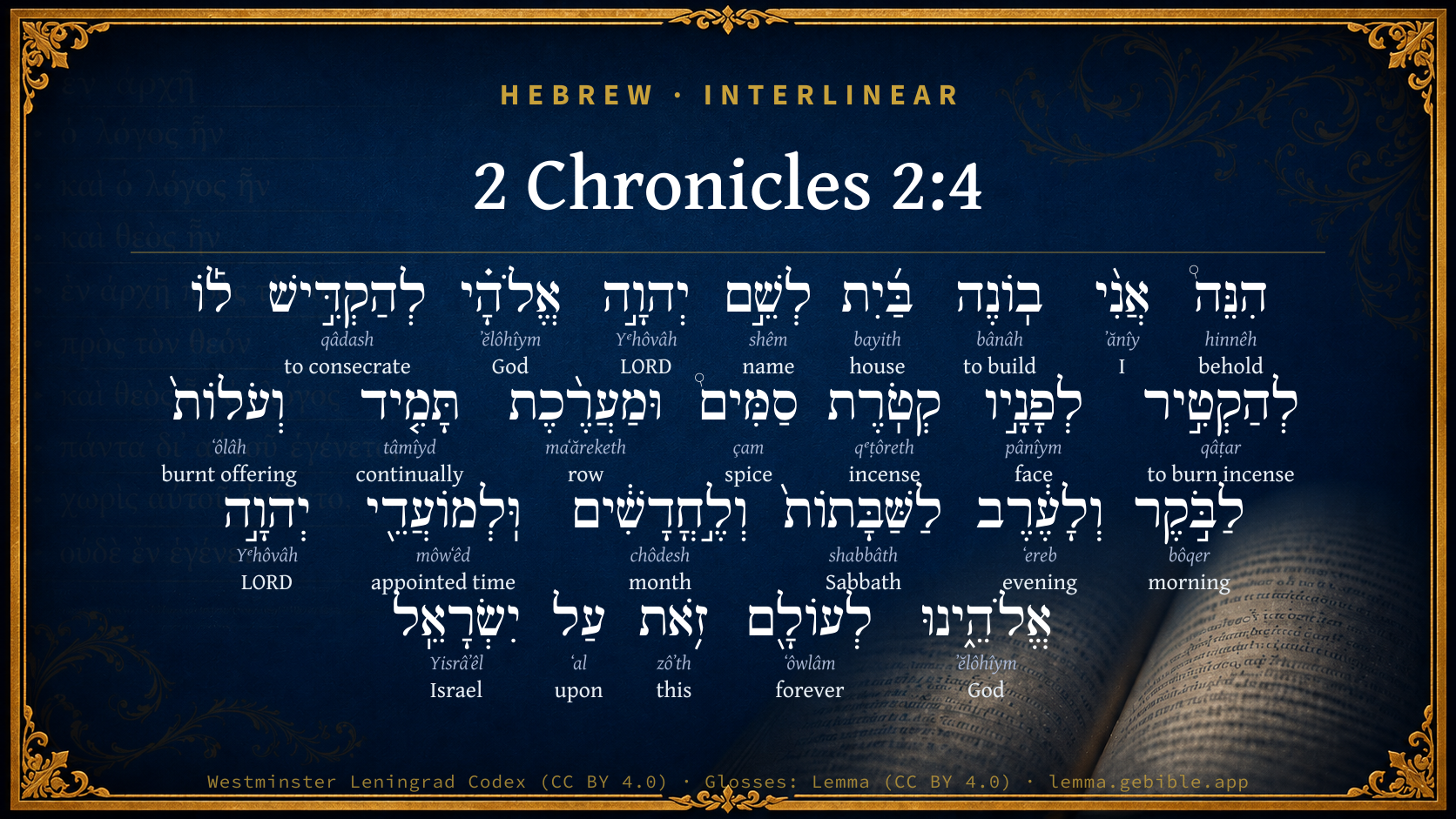
2 Chronicles 2:4

Hebrew (Westminster Leningrad Codex) 2 Chronicles 2:4 appears in the Hebrew Old Testament. The text above is from the Westminster Leningrad Codex. Each word links to its Strong’s number, a concise gloss, and parsing drawn from the Open Scriptures Hebrew Bible morphology. Click any word for its full Brown-Driver-Briggs (BDB) entry.
Download image
Cite this verse

2 Chronicles 2:4 (World English Bible). Public Domain. Lemma interlinear Bible study tool, https://lemma.gebible.app/v/2-chronicles/2/4.

Show BibTeX & RIS
BibTeX
RIS
English Translation
Behold, I am about to build a house for the name of Yahweh my God, to dedicate it to him, and to burn before him incense of sweet spices, and for the continual show bread, and for the burnt offerings morning and evening, on the Sabbaths, and on the new moons, and on the set feasts of Yahweh our God. This is [an ordinance] forever to Israel.
World English Bible · Public Domain
Download a study sheet

One document with this verse’s original text, its word-by-word gloss line, the meaning frame, cross-references with their text, attributed commentary, and full source and license credits — printable, and it pastes into notes with its structure intact.

This verse Autodidact and up

Study sheet (.html) Plain text (.txt)

A passage Seminary Student

Up to 50 verses in one chapter. A passage sheet keeps up to 6 commentary sources and 12 cross-references per verse, in the order this page ranks them, and says so on the sheet whenever that leaves anything out. Ask for a single verse and you get the Autodidact verse sheet above.

Everything on this page stays free to read, with no account — the sheet is a download of what is already on screen, not access to it.

Want to remove ads? Support Godless Engineer
Compare translations 3

The same verse in 3 English versions, stacked beneath the original-language interlinear above. Click any original word for its lexicon entry.

Each is an independent rendering of the whole verse — the interlinear is not word-aligned to these translations.

Highlighted words mark where these versions differ — a whole-verse word diff, not a word-by-word alignment.

  • World English Bible Public Domain
    Behold, I am about to build a house for the name of Yahweh my God, to dedicate it to him, and to burn before him incense of sweet spices, and for the continual show bread, and for the burnt offerings morning and evening, on the Sabbaths, and on the new moons, and on the set feasts of Yahweh our God. This is [an ordinance] forever to Israel.
  • King James Version Public Domain
    Behold, I build an house to the name of the LORD my God, to dedicate it to him, and to burn before him sweet incense, and for the continual shewbread, and for the burnt offerings morning and evening, on the sabbaths, and on the new moons, and on the solemn feasts of the LORD our God. This is an ordinance for ever to Israel.
  • unfoldingWord Literal Text CC BY-SA 4.0
    Behold, I am building a house for the name of Yahweh my God, to consecrate to him, to sacrifice before him spiced incense and the regular display, and burnt offerings in the morning and in the evening, on the Sabbaths and on the new moons, and the appointed times of Yahweh our God. Forever, this is over Israel.

unfoldingWord Literal Text — © unfoldingWord, licensed CC BY-SA 4.0. Word-aligned USFM3 via Door43 (git.door43.org/unfoldingWord/en_ult).

Versions to compare (up to 4)

3 of 4 selected

Show all 18 translations

Every available English version of this verse, each an independent rendering of the whole verse.

  • World English Bible Public Domain
    Behold, I am about to build a house for the name of Yahweh my God, to dedicate it to him, and to burn before him incense of sweet spices, and for the continual show bread, and for the burnt offerings morning and evening, on the Sabbaths, and on the new moons, and on the set feasts of Yahweh our God. This is [an ordinance] forever to Israel.
  • Berean Standard Bible Public Domain
    Behold, I am about to build a house for the Name of the LORD my God to dedicate to Him for burning fragrant incense before Him, for displaying the showbread continuously, and for making burnt offerings every morning and evening as well as on the Sabbaths, New Moons, and appointed feasts of the LORD our God. This is ordained for Israel forever.
  • Majority Standard Bible Public Domain
    Behold, I am about to build a house for the Name of the LORD my God to dedicate to Him for burning fragrant incense before Him, for displaying the showbread continuously, and for making burnt offerings every morning and evening as well as on the Sabbaths, New Moons, and appointed feasts of the LORD our God. This is ordained for Israel forever.
  • King James Version Public Domain
    Behold, I build an house to the name of the LORD my God, to dedicate it to him, and to burn before him sweet incense, and for the continual shewbread, and for the burnt offerings morning and evening, on the sabbaths, and on the new moons, and on the solemn feasts of the LORD our God. This is an ordinance for ever to Israel.
  • American Standard Version (1901) Public Domain
    Behold, I am about to build a house for the name of Jehovah my God, to dedicate it to him, and to burn before him incense of sweet spices, and for the continual showbread, and for the burnt-offerings morning and evening, on the sabbaths, and on the new moons, and on the set feasts of Jehovah our God. This is `an ordinance' for ever to Israel.
  • Revised Version (1885) Public Domain
    Behold, I build an house for the name of the LORD my God, to dedicate it to him, and to burn before him incense of sweet spices, and for the continual shewbread, and for the burnt offerings morning and evening, on the sabbaths, and on the new moons, and on the set feasts of the LORD our God. This is an ordinance for ever to Israel;
  • Geneva Bible (1599) Public Domain
    Behold, I buylde an house vnto the Name of the Lord my God, to sanctifie it vnto him, and to burne sweete incense before him, and for the continuall shewbread, and for the burnt offrings of the morning and euening, on the Sabbath dayes, and in the new moneths, and in the solemne feastes of the Lord our God: this is a perpetuall thing for Israel.
  • Douay-Rheims (1899) Public Domain
    So do with me that I may build a house to the name of the Lord my God, to dedicate it to burn incense before him, and to perfume with aromatical spices, and for the continual setting forth of bread, and for the holocausts, morning and evening, and on the sabbaths, and on the new moons, and the solemnities of the Lord our God for ever, which are commanded for Israel.
  • Young's Literal Translation Public Domain
    lo, I am building a house to the name of Jehovah my God, to sanctify `it' to Him, to make perfume before Him, perfume of spices, and a continual arrangement, and burnt-offerings at morning and at evening, at sabbaths, and at new moons, and at appointed seasons of Jehovah our God; to the age this `is' on Israel.
  • Literal Standard Version CC BY-SA 4.0
    behold, I am building a house for the Name of my God YHWH, to sanctify [it] to Him, to make incense before Him, incense of spices, and a continual arrangement, and burnt-offerings at morning and at evening, at Sabbaths, and at new moons, and at appointed times of our God YHWH; this [is] on Israel for all time.
  • Unlocked Literal Bible CC BY-SA 4.0
    See, I am about to build a house for the name of Yahweh my God, to set it apart to him, to burn incense of sweet spices before him, to set out the bread of the presence, and for the burnt offerings morning and evening, on the Sabbaths and on the new moons, and on the appointed feasts for Yahweh our God. This is forever, for Israel.
  • unfoldingWord Literal Text CC BY-SA 4.0
    Behold, I am building a house for the name of Yahweh my God, to consecrate to him, to sacrifice before him spiced incense and the regular display, and burnt offerings in the morning and in the evening, on the Sabbaths and on the new moons, and the appointed times of Yahweh our God. Forever, this is over Israel.
  • Darby Bible Public Domain
    Behold, I build a house unto the name of Jehovah my God to dedicate it to him, to burn before him sweet incense, and for the continual arrangement [of the shewbread], and for the morning and evening burnt-offerings [and] on the sabbaths and on the new moons, and on the set feasts of Jehovah our God. This is [an ordinance] for ever to Israel.
  • World Messianic Bible Public Domain
    Behold, I am about to build a house for the name of the LORD my God, to dedicate it to him, to burn before him incense of sweet spices, for the continual show bread, and for the burnt offerings morning and evening, on the Sabbaths, on the new moons, and on the set feasts of the LORD our God. This is an ordinance forever to Israel.
  • Webster's Bible Public Domain
    Behold, I build a house to the name of the LORD my God, to dedicate it to him, and to burn before him sweet incense, and for the continual show-bread, and for the burnt-offerings morning and evening, on the sabbaths, and on the new moons, and on the solemn feasts of the LORD our God. This is an ordinance for ever to Israel.
  • Free Bible Version CC BY-SA 4.0
    “Please do as you did with my father David when you sent him cedar timber for him to build a palace to live in. I'm about to start building a Temple to honor the Lord my God, dedicated to him, where he will be offered sweet-smelling incense, where the showbread will be always set out in rows, and where burnt offerings will be made every morning and evening, on the Sabbaths, at new moon festivals, and at the feasts of the Lord our God—this to be done forever in Israel.
  • Bible in Basic English Public Domain
    See! I am building a house for the name of the Lord my God, to be made holy to him, where perfumes of sweet spices will be burned before him, and the holy bread will be placed at all times, and burned offerings will be offered morning and evening, on the Sabbaths and at the new moons, and on the regular feasts of the Lord our God. This is a law for ever to Israel.
  • JPS Tanakh (1917) Public Domain
    (2-3) Behold, I am about to build a house for the name of the LORD my God, to dedicate it to Him, and to burn before Him incense of sweet spices, and for the continual showbread, and for the burnt-offerings morning and evening, on the sabbaths, and on the new moons, and on the appointed seasons of the LORD our God. This is an ordinance for ever to Israel.

Literal Standard Version (2020), Covenant Press — licensed CC BY-SA 4.0. Text via the HelloAO Bible API (eBible.org). Unlocked Literal Bible (unfoldingWord) — licensed CC BY-SA 4.0. Text via the HelloAO Bible API (eBible.org). unfoldingWord Literal Text — © unfoldingWord, licensed CC BY-SA 4.0. Word-aligned USFM3 via Door43 (git.door43.org/unfoldingWord/en_ult). Free Bible Version, Dr. Jonathan Gallagher — licensed CC BY-SA 4.0. Text via the HelloAO Bible API (eBible.org).

Word by word

More ways to search: Search by grammar → Find every occurrence → Compare this word →

Practice this passage: Drill this verse → Learn its vocabulary →

וּמַעֲרֶ֨כֶת
maʻăreketh
H4635
“and · row of”
Conjunction + Noun, Common, Feminine, Singular, Construct
Part of Speech
Conjunction + Noun
Type
Common
Gender
Feminine
Number
Singular
State
Construct
Full BDB Definition

Origin: from H6186

TWOT: 1694e

row, line
  1. הִנֵּה֩ hinnêh H2009 “behold” Particle, Demonstrative
  2. אֲנִ֨י ʼănîy H589 “I” Pronoun, Personal, 1st Person, Common, Singular
  3. בֽוֹנֶה bânâh H1129 “building” Verb, Qal, Participle Active, Masculine, Singular, Absolute
  4. בַּ֜יִת bayith H1004 “house” Noun, Common, Masculine, Singular, Absolute
  5. לְשֵׁ֣ם shêm H8034 “to/for · name of” Preposition + Noun, Common, Masculine, Singular, Construct
  6. יְהוָ֣ה Yᵉhôvâh H3068 “LORD” Noun, Proper
  7. אֱלֹהָ֗י ʼĕlôhîym H430 “God(s) · my” Noun, Common, Masculine, Plural, Construct + Suffix, Personal, 1st Person, Common, Singular
  8. לְהַקְדִּ֣ישׁ qâdash H6942 “to consecrate” Preposition + Verb, Hiphil, Infinitive Construct
  9. לְהַקְטִ֣יר qâṭar H6999 “to burn incense” Preposition + Verb, Hiphil, Infinitive Construct
  10. לְפָנָ֣יו pânîym H6440 “to/for · face(s) · his” Preposition + Noun, Common, Both, Plural, Construct + Suffix, Personal, 3rd Person, Masculine, Singular
  11. קְטֹֽרֶת qᵉṭôreth H7004 “incense of” Noun, Common, Feminine, Singular, Construct
  12. סַמִּים֩ çam H5561 “spices” Noun, Common, Masculine, Plural, Absolute
  13. תָּמִ֤יד tâmîyd H8548 “continually” Noun, Common, Masculine, Singular, Absolute
  14. וְעֹלוֹת֙ ʻôlâh H5930 “and · burnt offerings” Conjunction + Noun, Common, Feminine, Plural, Absolute
  15. לַבֹּ֣קֶר bôqer H1242 “to/for the · morning” Preposition, Determined + Noun, Common, Masculine, Singular, Absolute
  16. וְלָעֶ֔רֶב ʻereb H6153 “and · to/for the · evening” Conjunction + Preposition, Determined + Noun, Common, Masculine, Singular, Absolute
  17. לַשַּׁבָּתוֹת֙ shabbâth H7676 “to/for the · Sabbaths” Preposition, Determined + Noun, Common, Both, Plural, Absolute
  18. וְלֶ֣חֳדָשִׁ֔ים chôdesh H2320 “and · to/for the · months” Conjunction + Preposition, Determined + Noun, Common, Masculine, Plural, Absolute
  19. וּֽלְמוֹעֲדֵ֖י môwʻêd H4150 “and · to/for · appointed times of” Conjunction + Preposition + Noun, Common, Masculine, Plural, Construct
  20. יְהוָ֣ה Yᵉhôvâh H3068 “LORD” Noun, Proper
  21. אֱלֹהֵ֑ינוּ ʼĕlôhîym H430 “God(s) · our” Noun, Common, Masculine, Plural, Construct + Suffix, Personal, 1st Person, Common, Plural
  22. לְעוֹלָ֖ם ʻôwlâm H5769 “to/for · forever” Preposition + Noun, Common, Masculine, Singular, Absolute
  23. זֹ֥את zôʼth H2063 “this” Pronoun, Demonstrative, Feminine, Singular
  24. עַל ʻal H5921 “upon” Preposition
  25. יִשְׂרָאֵֽל Yisrâʼêl H3478 “Israel” Noun, Proper

About this verse

These counts appear in no published source. They are computed here, from the morphology-tagged text and Lemma’s own curated glosses. What Lemma adds →

27
words
24
distinct lemmas
Historical
section

Notable vocabulary

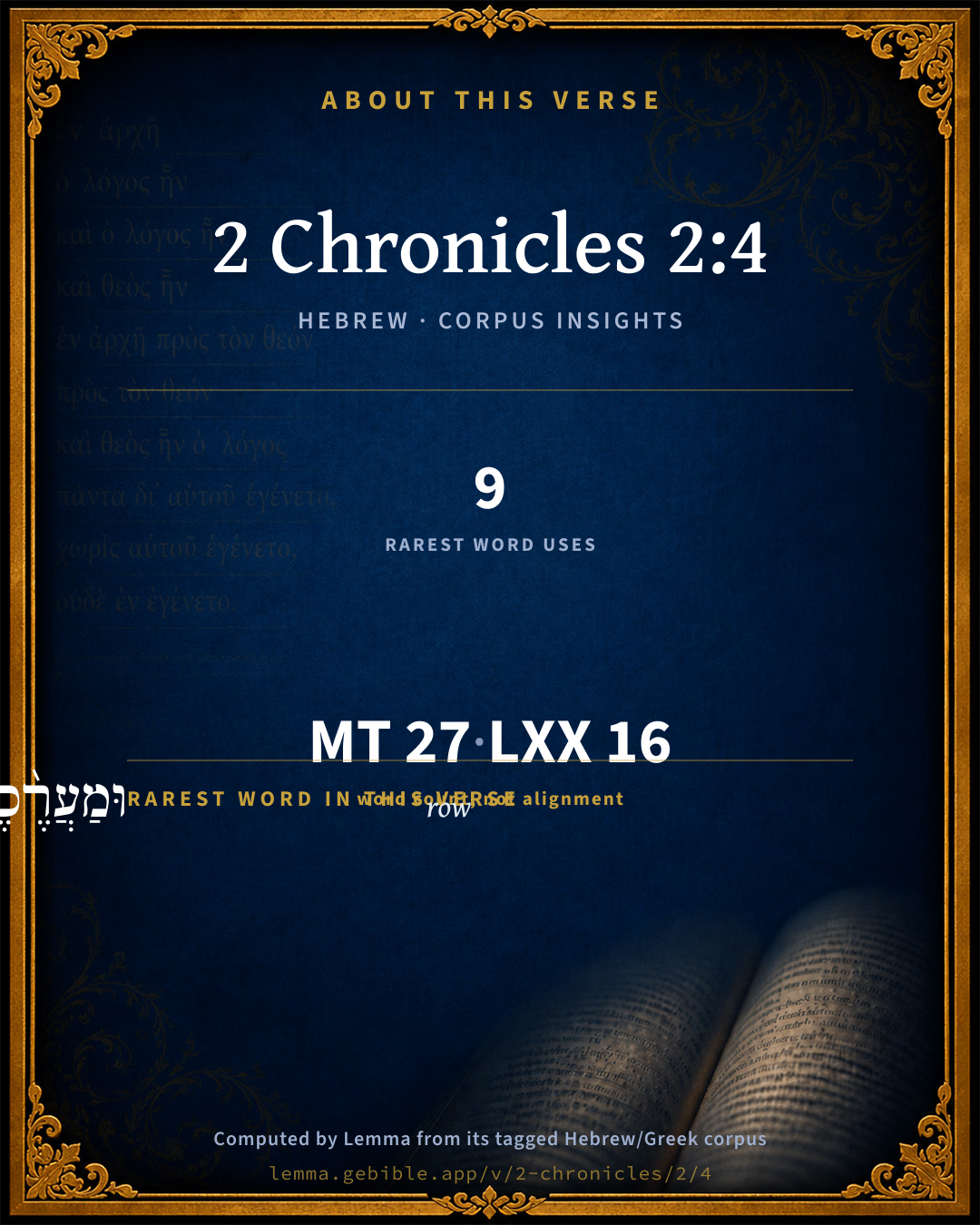
The rarest word here is וּמַעֲרֶ֨כֶת row H4635 — appearing just 9 times in the whole Hebrew Bible.

Shared distinctive vocabulary

וּמַעֲרֶ֨כֶת row H4635 occurs in 9 verses of the Hebrew Bible. Also found in:

Grammatical profile

  • 3 verbs
  • 19 nouns
  • 2 pronouns
  • 2 prepositions
  • 1 particle

Verb forms

  • בֽוֹנֶה Qal · Participle Active
  • לְהַקְדִּ֣ישׁ Hiphil · Infinitive Construct
  • לְהַקְטִ֣יר Hiphil · Infinitive Construct

Repetition

Words recur within this verse — often emphatic in Hebrew:

  • יְהוָ֣ה LORD H3068 ×2
  • אֱלֹהָ֗י God H430 ×2

Hebrew & Septuagint length

In English translation the verse runs 67 words from the Hebrew and 69 from the Septuagint (LXX English) — closely comparable.

A rough comparison of the two English renderings, which tokenize alike — not a word-level alignment.

Word counts can differ between the Hebrew and the Greek without any difference in meaning — e.g. the Hebrew direct-object marker אֵת has no separate Greek word, and Greek often adds the article ὁ.

In the original languages it is 27 Hebrew tokens and 16 Greek tokens — but the two are counted differently (Hebrew bundles its prefixes and suffixes into one token; the Greek is in lemma form), so that isn’t a like-for-like length.

Cross-references

9

Topical passages linked to 2 Chronicles 2:4 in the Treasury of Scripture Knowledge — connected by theme and wording, ordered by reader-vote popularity; previews shown in the World English Bible.

  • Exodus 30:7 Aaron shall burn incense of sweet spices on it every morning. When he tends the lamps, he shall burn it.
  • Exodus 25:30 You shall set bread of the presence on the table before me always.
  • 2 Chronicles 2:1 Now Solomon purposed to build a house for the name of Yahweh, and a house for his kingdom.
  • Leviticus 23:1–17 Yahweh spoke to Moses, saying,
  • Leviticus 24:5–9 "You shall take fine flour, and bake twelve cakes of it: two tenth parts of an ephah shall be in one cake.
  • Numbers 28:1–29 Yahweh spoke to Moses, saying,
  • 1 Kings 8:18 But Yahweh said to David my father, Whereas it was in your heart to build a house for my name, you did well that it was in your heart:
  • 1 Kings 8:63 Solomon offered for the sacrifice of peace-offerings, which he offered to Yahweh, two and twenty thousand oxen, and one hundred twenty thousand sheep. So the king and all the children of Israel dedicated the house of Yahweh.
  • Exodus 29:38–42 "Now this is that which you shall offer on the altar: two lambs a year old day by day continually.

Cross-references courtesy of OpenBible.info (CC BY 4.0).

Hebrew and Greek witnesses Masoretic Hebrew ↔ Greek Septuagint

The same verse in the two great witnesses to the Old Testament, shown verse-for-verse.

These are two independent witnesses, not word-aligned to each other, and the Septuagint is shown in lemma (dictionary) form.

Hebrew 2 Chronicles 2:4 Masoretic · Westminster Leningrad Codex

הִנֵּה֩ אֲנִ֨י בֽוֹנֶה בַּ֜יִת לְשֵׁ֣ם יְהוָ֣ה אֱלֹהָ֗י לְהַקְדִּ֣ישׁ ל֡וֹ לְהַקְטִ֣יר לְפָנָ֣יו קְטֹֽרֶת סַמִּים֩ וּמַעֲרֶ֨כֶת תָּמִ֤יד וְעֹלוֹת֙ לַבֹּ֣קֶר וְלָעֶ֔רֶב לַשַּׁבָּתוֹת֙ וְלֶ֣חֳדָשִׁ֔ים וּֽלְמוֹעֲדֵ֖י יְהוָ֣ה אֱלֹהֵ֑ינוּ לְעוֹלָ֖ם זֹ֥את עַל יִשְׂרָאֵֽל

Behold, I am about to build a house for the name of Yahweh my God, to dedicate it to him, and to burn before him incense of sweet spices, and for the continual show bread, and for the burnt offerings morning and evening, on the Sabbaths, and on the new moons, and on the set feasts of Yahweh our God. This is [an ordinance] forever to Israel.

World English Bible · Public Domain

Greek LXX 2 Chronicles 2:4 Septuagint · lemma form

καί ὁ οἶκος ὅς ἐγώ οἰκοδομέω μέγας ὅτι μέγας ὁ θεός ἐγώ παρά πᾶς ὁ θεός

behold, I also his son am building a house to the name of the Lord my God, to consecrate it to him, to burn incense before him, and to offer show bread continually, and to offer up whole burnt offerings continually morning and evening, and on the sabbaths, and at the new moons, and at the feasts of the Lord our God: this is a perpetual statute for Israel.

LXX2012 (modern English Septuagint) · Public Domain

On this verse, The Pulpit Commentary discusses the Septuagint’s reading. Read the note in Commentary ↓

Hebrew: Westminster Leningrad Codex (CC BY 4.0). Greek: Septuagint (public domain); English from LXX2012 (modern English Septuagint) (Public Domain). How the Septuagint differs from the Hebrew →

Commentary

Notes on 2 Chronicles 2:4 from classic Christian and Jewish commentators (each source and its license shown beneath its notes). The classic Christian expositions comment on the surrounding passage and are grouped to its opening verse, so a note may address several verses; the Jewish commentaries on the Tanakh (Rashi and others) are per-verse, so they appear only where the commentator wrote on this verse.

Lemma curates 59 commentaries, every one of them public domain or Creative Commons licensed, each selected and text-cleaned for this edition rather than reprinted as found. About our sources →

Trapp's Complete Commentary

John Trapp

2Ch 2:4 Behold, I build an house to the name of the LORD my God, to dedicate [it] to him, [and] to burn before him sweet incense, and for the continual shewbread, and for the burnt offerings morning and evening, on the sabbaths, and on the new moons, and on the solemn feasts of the LORD our God. This [is an ordinance] for ever to Israel.

Ver. 4. To dedicate it to him, &c.] Not to be impiae gentis arcanum, as Florus basely slandereth this temple.

John Trapp, A Commentary or Exposition upon All the Books of the Old and New Testament (1647–1656) — public domain. Text from a community e-Sword module.

Joseph Benson's Commentary

2Ch 2:4. To dedicate it to him — To his honour and worship. For the continual show-bread — So called here and Num 4:7, because it stood before the Lord continually, by a constant succession of new bread, when the old was removed. See Exo 25:30; Lev 24:8.

Joseph Benson's Commentary on the Old and New Testaments (1811–1818) — public domain. Text from a community e-Sword module.

Ellicott's Commentary for English Readers

(4) I build.—Am about to build (bôneh).

To the name of the Lord.—1Ki_3:2; 1Ch_16:35; 1Ch_22:7.

To dedicate.—Or, consecrate. (Comp. Lev_27:14; 1Ki_9:3; 1Ki_9:7.) The italicised and should be omitted, as the following words define the purpose of the dedication, viz., for burning before him, &c. Comp. Vulgate: “Ut consecrem eam ad adolendum incensum coram illo.” (See Exo_25:6; Exo_30:7-8.)

And for the continual shewbread, and for the burnt offerings.—In the Hebrew this is loosely connected with the verb rendered to burn, as part of its object: for offering before him incense of spices and a continual pile (of shewbread) and burnt offerings. (See Lev_24:5; Lev_24:8; Num_28:4.)

On the sabbaths, and on the new moons, and on the solemn feasts.—1Ch_23:31. “Solemn feasts:” set seasons. These special sacrifices are prescribed in Num_28:9 to Num_29:40

This is an ordinance for ever to Israel.—Literally, for ever this is (is obligatory) upon Israel, viz., this ordinance of offerings. (Comp. the similar phrase, 1Ch_23:31; and the formula, “a statute for ever,” so common in the Law, Exo_12:14; Exo_29:9.)

A Bible Commentary for English Readers, edited by Charles John Ellicott (1878–1897) — public domain. Text from a community e-Sword module.

The Cambridge Bible for Schools and Colleges

gen. ed. J. J. S. Perowne

4. the continual shewbread] See 1Ch_9:32, notes; Lev_24:5-9.

on the solemn feasts) R.V. on the set feasts. Cp. 1Ch_23:31, note.

The Cambridge Bible for Schools and Colleges (gen. ed. J. J. S. Perowne; Cambridge University Press, 1878–1918) — public domain. Text from a community e-Sword module.

John Gill's Exposition

And the house which I build is great,.... Not so very large, though that, with all apartments and courts belonging to it, he intended to build, was so; but because magnificent in its structure and decorations:

for great is our God above all gods; and therefore ought to have a temple to exceed all others, as the temple at Jerusalem did.

John Gill's Exposition of the Whole Bible (1746–1763) — public domain (CC PDM 1.0). Text via the HelloAO Bible API.

Albert Barnes' Notes on the Bible

The symbolic meaning of “burning incense” is indicated in Rev 8:3-4. Consult the marginal references to this verse.

The solemn feasts - The three great annnual festivals, the Passover, the Feast of Weeks (Pentecost), and the Feast of tabernacles Lev. 23:4-44; Deut. 16:1-17.

Albert Barnes' Notes on the Bible (1834–1885) — public domain. Text from a community e-Sword/MySword module.

Matthew Poole's English Annotations

To dedicate it to him, i.e. to his honour and worship.

For the continual shew-bread; so called here and Num 9:7, because it was to be there continually, by a constant succession of new bread when the old was removed; of which see Exo 25:30; Lev 24:8.

Matthew Poole's English Annotations on the Holy Bible (1683–1685) — public domain. Text from a community e-Sword/MySword module.

The Pulpit Commentary

In the nine headings contained in this verse we may consider that the leading religious observances and services of the nation are summarized. To dedicate it. The more frequent rendering of the Hebrew word here used is "to hallow," Or "to sanctify.

(1) Sweet incense (see Exo_30:1, Exo_30:6-9, 34-38 37:25-29; Rev_5:8 Rev_6:9 Rev_8:3-5) This sweet incense, compounded of the four ingredients stacte, onycha, galbanum, pure frankincense, was to be burnt morning and evening, at the time of the morning and evening sacrifices on the altar made of shittim wood, overlaid with gold, which stood in the holy place facing the ark. with the table of shewbread on the one hand, and the golden candlestick on the other. While the act of atonement was set forth by the offering of the victim on the brazen altar in the outer court, the ascending, acceptable, and accepted prayer and aspiration of the congregation were expressed by the sweet incense-burning.

(2) The continual shew-bread (dymiT; tk,r,) The elementary meaning of the word here rendered "shewbread" is "a ranging in order," whether the "order" might be, e.g. , that of an army in battle array, (1Sa_4:16 1Sa_17:8 1Sa 22:48) or of the lamps of the holy candlestick, (Exo_39:37) or of pilings of wood to be burnt on the altar, (Jud_1:6:26) or of cakes of bread, as presumably "here and in some parallel passages. (Lev_24:6) For the table which was to carry these cakes, see Exo_25:23-30 Exo_37:10-16; the last verse of the former passage speaking of the shewbread under the name (For the position of the table, see (Exo_26:35) The word employed in the text is first used to express the piles of cakes, called in our Authorized Version shewbread in Lev_24:6, Lev_24:7; then 1Ch_9:32 1Ch_23:29 1Ch_28:16; as also again in 2Ch_13:11 2Ch_29:18; and in Neh_10:33. Where in these passages the word is not expressed, that it is understood may be gathered from the other passages. (Num_4:7) The bread consisted of twelve large cakes of unleavened dough, (Lev_24:5-9) ranged in two heaps, and with a golden cup of frankincense (Lev_24:7) to each pile. When on every seventh day new cakes were substituted, the old ones belonged to the priests (Lev_24:8, 9 8:31; Mat_12:4; Exo_29:33, Exo_29:34) The twelve cakes pointed to the twelve tribes. Their size may be judged from the statement that each cake contained two tenth deals, i.e. two-tenths of an ephah, equal to about six pounds and a quarter. The exact significance of this bread is not stated in Scripture. Part of it lay plainly in the twelve cakes, part, perhaps, in their becoming priest"s food, found by the people, (Lev_24:8) after having been presented seven days before the Lord. Much that is interesting but not finally satisfactory on the question may be found in the article "Shewbread" in Dr. Smith"s "Bible Dictionary," 3:1271. Our Authorized Version "shewbread" comes from Luther"s Schaubrode. Wickliffe, after the Vulgate panes propositionis, designates it "the loaves of proposition." The New Testament has, insiv Heb_9:2, hJ proqe twn artwn; as also in the Gospels (Mat_12:4; Luk_6:4) while the Septuagint has artoi ejnwpioi, (Exo_25:30) and artoi thv prosforav. (1Ki_7:48) The question really turns on the significance of the designation of Exo_25:30 (

(3) The burnt offerings morning and evening. A succinct statement of these offerings, constituting the "daily offering," is given in Num_28:3-8, according to its original institution, (Exo_29:38-42) except in the added mention of the "strong wine," or strong drink, spoken of in the latter part of ver. 7, which had probably originated as an incident of the wilderness-journey. The morning and evening offering were alike, viz. a lamb, a meal offering consisting of a tenth of an ephah of flour, mixed with the fourth part of a bin of beaten oil, and a drink offering consisting of the fourth part of a bin of "wine," or of "strong drink.

(4) The burnt offering on the sabbath. The account of this is given in Num_28:9, Num_28:10; and any previous institution of it is not recorded. The sabbath-day burnt offerings were the double of the daily offerings. (Eze_46:4)

(5) The burnt offering on the new moons; see Num_27:11-15, where the phrase, of your months," is what is "the beginnings of your months" is what is employed, i.e. the first day of each month. (Lev_10:10) No previous mention of this burnt offering is found. It consisted of two bullocks, one ram, seven lambs,

(a) with meat offering consisting of three-tenths of an ephah of flour mixed with oil for each bullock; two-tenths of an ephah of flour mixed with oil for the ram; one-tenth of an ephah of flour similarly mixed for each lamb;

(b) with drink offering, of half a hin of wine to each bullock; the third part of a hin to the ram; and the fourth part of a hin to each lamb. A kid of the goats for a sin offering, which in fact was offered before the burnt offering. And all these were to be additional to the continual offering of the day, with its drink offering (see also Isa_66:23; Eze_46:3; Amo_8:5)

(6) The burnt offering on the solemn feasts of the Lord. These were the three great festivals of the year the Passover (Exo_12:3-20, Exo_12:27, 43 Lev_23:4-8; Deu_16:1-8) the Feast of Weeks (Exo_23:16 Exo_34:22 Lev_23:15-21; Num_28:26; Deu_16:8-12) the Feast of Tabernacles (Exo_23:16 Lev_23:33-44; Num_29:13-40; Deu_16:13-15)

Vers. 4-6.

The acceptableness of the imperfect.

The letter which Solomon wrote to Hiram was one that contained more than a business proposal; it was something beyond the opening of a negotiation; it included some valuable truth which not only may have benefited the then King of Tyro, but may be of real value to us at this date and this distance. For it intimated

I THE INESTIMABLE ADVANTAGE OF THE REVEALED RELIGION OVER CONTEMPORARY FAITHS. "Great is our God above all gods" (ver. 5). Great indeed; for he was the living God, and they were only imaginary; he was the holy God, and they were (by supposition) unholy; he was just and kind, and they were capricious and cruel; he could and did hear and answer prayer, and they were powerless and helpless. Who could estimate the priceless advantage to the nation of having for the object of its worship the Lord God of Israel? It makes a difference which is simply incalculable to have as the Object of our worship a Being who is worthy of our devotion. What, then, is it to us to be worshipping the Divine Father revealed to us in and by Jesus Christ?

1. It is to be seeking the favour of that Living One who holds us all in hismighty hand, and is able and is willing to confer upon us inestimable blessings, even unto eternal life.

2. It is to be drawing nigh unto, and to be drawn spiritually towards, theHoly One; it is thus to be attracted in spirit, in sympathy, in character, in life, toward the Perfect One; it is to be gradually, unconsciously, effectually transformed into his likeness. For whom we reverence, we follow; whom we love, we resemble; and just as we worship the Divine Father and love the Divine Friend, so shall we breathe his spirit and bear his likeness.

II THE IMPERFECTNESS OF THE MATERIAL AND OF THE HUMAN, IN VIEW OF THE DIVINE GREATNESS.

1. The material. "Who is able to build him a house, seeing the heaven cannot contain him?" The temple of a heathen deity may be supposed by its ignorant devotees to be its residence; it certainly contains its visible image, the idol. But the temple Solomon was about to build could in no true sense become the residence of Jehovah. No building could contain him; "the heaven of heavens" could not do that: how much less an earthly house! There is no cathedral, no Christian sanctuary, that can be properly thought of as the residence or earthly home of Jesus Christ. The heaven where he dwells cannot contain him.

2. The human. "Who am I, that I should build," etc? To be the principal agent in the construction of the one building with which the Name of Jehovah would be associated, and the only building where there would be

(1) an abiding manifestation of his presence, and

(2) the opportunity of approaching him by sacrifice, this was an honour of which Solomon naturally and becomingly considered himself unworthy.

And who among the holiest and the wisest of men, who among the most faithful servants of Jesus Christ, can consider himself worthy to be

(1) the spokesman of his brethren in drawing nigh to God in prayer;

(2) the messenger to make known the love and grace of God as manifested in Jesus Christ his Son;

(3) the workman in even the humblest corner of that sacred and blessed field the field of Christian service? To be thus engaged for the Father of spirits, for the Redeemer of mankind, should be considered by us all an honour of which we are wholly unworthy.

III THE ACCEPTABLENESS OF IMPERFECT SERVICE.

1. Though the temple at Jerusalem could not contain God, yet it couldrender various valuable services (vers. 4, 6). It was a place where God met with and manifested himself to the people; where they drew consciously near to him, and realized that he was very near to them; where they communed with him and rejoiced before him; where they sought and found forgiveness of their sins; where they made grateful acknowledgment of their indebtedness to him for all blessings; and where they dedicated themselves anew to his service. Imperfect as it was, and utterly unable to constitute the residence of Deity, it yet answered most useful ends.

2. And thus with us who are the servants of God. Imperfection marks ourcharacter and our work; we are not worthy to "build him a house," nor to do anything, however humble, in his name and cause. Yet God will bless us, Christ will own and honour us as his servants, if only we are loyal and true. "To the wicked God says, What hast thou to do to declare my statutes?" etc.. (Psa_50:16) But to the upright in heart (including the penitent, see, (Psa_51:12, Psa_51:13) to all those who have returned in spirit to him, and who sincerely desire to extend his reign over the hearts of men, he is ever saying, "Go, work in my vineyard; go, build up my kingdom; go, gather my erring sons and daughters, and lead them home to my heart. C.

The Pulpit Commentary (1880–1919), ed. H.D.M. Spence-Jones & Joseph S. Exell — public domain. Text from a community e-Sword module.

Scofield Reference Notes

C. I. Scofield

shewbread

(See Scofield "Exo 25:30").

The Scofield Reference Bible (1917 edition), notes by C. I. Scofield — public domain. Text from a community e-Sword module.

unfoldingWord translationNotes

Door43 World Missions Community

I am about to build a house for the name of Yahweh my God

Here "name" represents the person. See how you translated a similar phrase in 2 Chronicles 2:1. AT: "I am about to build a house where Yahweh my God may live" or "I am about to build a house where people may worship Yahweh my God" (See: Metonymy)

I am about to build

Solomon would command his people to build the house. AT: "I am about to command my people to build" (See: Metonymy)

the bread of the presence

This is a reference to the 12 loaves of bread that were placed in front of the altar.

new moons

This was the time of a festival coinciding with the movement of the moon.

This is forever, for Israel

Here "This" refers back to all the ways the people will worship Yahweh at his temple. AT: "These are the things Yahweh has commanded Israel to do forever"

God is greater

This is a reference to God being more important and more powerful than other gods, not to being larger than other gods.

translationWords

God

set apart

incense

bread

burnt offering

Sabbath

new moon

festival

eternity

Israel

false god

unfoldingWord translationNotes — © Distant Shores Media and the Door43 World Missions Community, licensed CC BY-SA 4.0. Source: git.door43.org/Door43/en_tn.

Rashi

Rabbi Shlomo Yitzchaki (Rashi)

And the House, which I am building, is great Therefore, I require of you to send me of your buildings. Now if you say, “Make the House smaller, so that you will not need other people,” I cannot do so, because our God is greater than all Gods; therefore, I cannot diminish it or make it smaller.

Rashi on the Tanakh — English translations: “The Judaica Press complete Tanach with Rashi, translated by A. J. Rosenberg” (CC BY 4.0); “Pentateuch with Rashi's commentary by M. Rosenbaum and A.M. Silbermann, 1929-1934” (public domain); “The Metsudah Tanach series, Lakewood, N.J” (CC BY 4.0); and “The Book of Joshua, Metsudah Publications, 1997” (CC BY 4.0). Text via Sefaria.

Lesson kit

Teaching starters — assembled from the data on this page, not authored interpretation. Every prompt links to the verse data it draws on. Edit before teaching.

2 Chronicles, in the Historical, opens this verse with 27 words (24 distinct Hebrew lemmas). Its most distinctive word is maʻăreketh (“row”). A historical commentator’s framing appears above. Read the whole chapter for the surrounding context.

Discussion questions

  1. How does “row” (maʻăreketh) shape what this verse is saying?
  2. Leviticus 24:6 shares the word «row» with this verse. How do the two illuminate each other?
  3. “LORD” occurs 2× in this one verse. What is the effect of the repetition?
  4. These translations render this verse differently; the difference is in the English rendering, not the original. What questions does that raise?
  5. The verb «בֽוֹנֶה» is Qal Participle Active. How does its form color the action?
  6. Reading how Trapp's Complete Commentary and Joseph Benson's Commentary read this verse, where do the two commentators agree and where do they part?

Things to notice

Reading settings

Reading text

Shown beneath each verse's original-language words.

Old Testament
Old Testament edition

Read the OT as the Masoretic Hebrew (MT) or the Greek Septuagint (LXX).

English shown for the Greek Septuagint (in the Hebrew ↔ Greek comparison).

Comparing translations? Open the Compare panel on any verse page to stack up to four side by side.