
Exodus 32:34

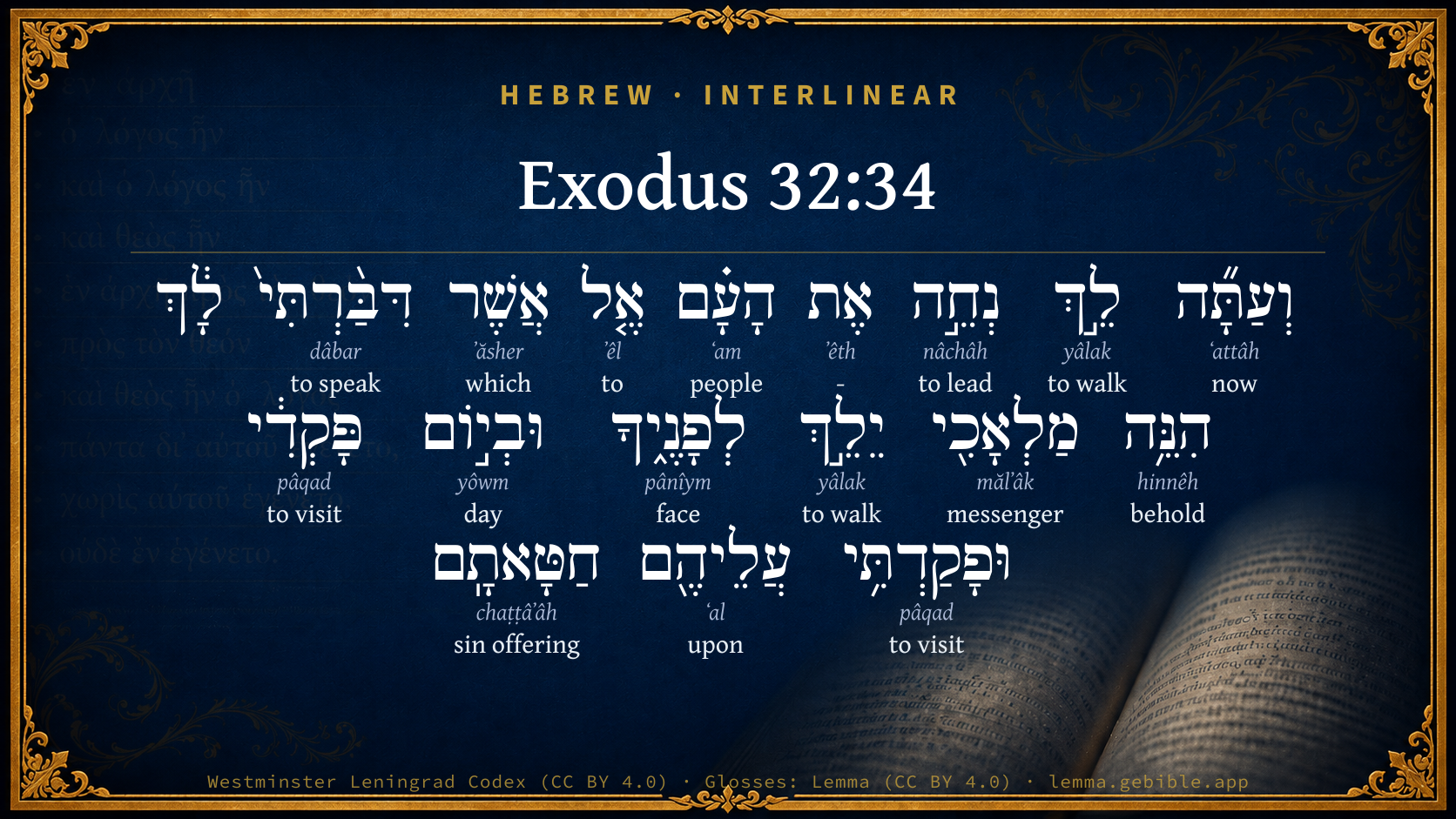
Hebrew (Westminster Leningrad Codex) Exodus 32:34 appears in the Hebrew Old Testament. The text above is from the Westminster Leningrad Codex. Each word links to its Strong’s number, a concise gloss, and parsing drawn from the Open Scriptures Hebrew Bible morphology. Click any word for its full Brown-Driver-Briggs (BDB) entry.
Download image
Cite this verse

Exodus 32:34 (World English Bible). Public Domain. Lemma interlinear Bible study tool, https://lemma.gebible.app/v/exodus/32/34.

Show BibTeX & RIS
BibTeX
RIS
English Translation
Now go, lead the people to the place of which I have spoken to you. Behold, my angel shall go before you. Nevertheless in the day when I punish, I will punish them for their sin."
World English Bible · Public Domain
Download a study sheet

One document with this verse’s original text, its word-by-word gloss line, the meaning frame, cross-references with their text, attributed commentary, and full source and license credits — printable, and it pastes into notes with its structure intact.

This verse Autodidact and up

Study sheet (.html) Plain text (.txt)

A passage Seminary Student

Up to 50 verses in one chapter. A passage sheet keeps up to 6 commentary sources and 12 cross-references per verse, in the order this page ranks them, and says so on the sheet whenever that leaves anything out. Ask for a single verse and you get the Autodidact verse sheet above.

Everything on this page stays free to read, with no account — the sheet is a download of what is already on screen, not access to it.

Want to remove ads? Support Godless Engineer
Compare translations 3

The same verse in 3 English versions, stacked beneath the original-language interlinear above. Click any original word for its lexicon entry.

Each is an independent rendering of the whole verse — the interlinear is not word-aligned to these translations.

Highlighted words mark where these versions differ — a whole-verse word diff, not a word-by-word alignment.

  • World English Bible Public Domain
    Now go, lead the people to the place of which I have spoken to you. Behold, my angel shall go before you. Nevertheless in the day when I punish, I will punish them for their sin."
  • King James Version Public Domain
    Therefore now go, lead the people unto the place of which I have spoken unto thee: behold, mine Angel shall go before thee: nevertheless in the day when I visit I will visit their sin upon them.
  • unfoldingWord Literal Text CC BY-SA 4.0
    So now go, lead the people to where I have spoken to you! Behold, my angel will go before your face. But on the day I visit them, then I will visit their sin on them.”

unfoldingWord Literal Text — © unfoldingWord, licensed CC BY-SA 4.0. Word-aligned USFM3 via Door43 (git.door43.org/unfoldingWord/en_ult).

Versions to compare (up to 4)

3 of 4 selected

Show all 18 translations

Every available English version of this verse, each an independent rendering of the whole verse.

  • World English Bible Public Domain
    Now go, lead the people to the place of which I have spoken to you. Behold, my angel shall go before you. Nevertheless in the day when I punish, I will punish them for their sin."
  • Berean Standard Bible Public Domain
    Now go, lead the people to the place I described. Behold, My angel shall go before you. But on the day I settle accounts, I will punish them for their sin.”
  • Majority Standard Bible Public Domain
    Now go, lead the people to the place I described. Behold, My angel shall go before you. But on the day I settle accounts, I will punish them for their sin.”
  • King James Version Public Domain
    Therefore now go, lead the people unto the place of which I have spoken unto thee: behold, mine Angel shall go before thee: nevertheless in the day when I visit I will visit their sin upon them.
  • American Standard Version (1901) Public Domain
    And now go, lead the people unto `the place' of which I have spoken unto thee: behold, mine angel shall go before thee; nevertheless in the day when I visit, I will visit their sin upon them.
  • Revised Version (1885) Public Domain
    And now go, lead the people unto the place of which I have spoken unto thee: behold, mine angel shall go before thee: nevertheless in the day when I visit, I will visit their sin upon them.
  • Geneva Bible (1599) Public Domain
    Go nowe therefore, bring the people vnto the place which I commanded thee: behold, mine Angel shall goe before thee, but yet in the day of my visitation I wil visite their sinne vpon them.
  • Douay-Rheims (1899) Public Domain
    But go thou, and lead this people whither I have told thee: my angel shall go before thee. And I in the day of revenge will visit this sin also of theirs.
  • Young's Literal Translation Public Domain
    and now, go, lead the people whithersoever I have spoken to thee of; lo, My messenger goeth before thee, and in the day of my charging -- then I have charged upon them their sin.'
  • Literal Standard Version CC BY-SA 4.0
    and now, go, lead the people wherever I have spoken to you of; behold, My Messenger goes before you, and in the day of my charging—then I have charged their sin on them.”
  • Unlocked Literal Bible CC BY-SA 4.0
    So now go, lead the people to the place of which I have spoken to you. See, my angel will go before you. But on the day that I punish them, I will punish them for their sin.”
  • unfoldingWord Literal Text CC BY-SA 4.0
    So now go, lead the people to where I have spoken to you! Behold, my angel will go before your face. But on the day I visit them, then I will visit their sin on them.”
  • Darby Bible Public Domain
    And now go, lead the people whither I have told thee: behold, my Angel shall go before thee; but in the day of my visiting I will visit their sin upon them.
  • World Messianic Bible Public Domain
    Now go, lead the people to the place of which I have spoken to you. Behold, my angel shall go before you. Nevertheless, in the day when I punish, I will punish them for their sin.”
  • Webster's Bible Public Domain
    Therefore now go, lead the people to the place of which I have spoken to thee: Behold, my angel shall go before thee: Nevertheless, in the day when I visit, I will visit their sin upon them.
  • Free Bible Version CC BY-SA 4.0
    Now go and lead the people to the place I told you about. Look, my angel will go before you, but at the time I decide to punish, I will punish them for their sin.”
  • Bible in Basic English Public Domain
    But now, go, take the people into that place of which I have given you word; see, my angel will go before you: but when the time of my judging has come, I will send punishment on them for their sin.
  • JPS Tanakh (1917) Public Domain
    And now go, lead the people unto the place of which I have spoken unto thee; behold, Mine angel shall go before thee; nevertheless in the day when I visit, I will visit their sin upon them.'

Literal Standard Version (2020), Covenant Press — licensed CC BY-SA 4.0. Text via the HelloAO Bible API (eBible.org). Unlocked Literal Bible (unfoldingWord) — licensed CC BY-SA 4.0. Text via the HelloAO Bible API (eBible.org). unfoldingWord Literal Text — © unfoldingWord, licensed CC BY-SA 4.0. Word-aligned USFM3 via Door43 (git.door43.org/unfoldingWord/en_ult). Free Bible Version, Dr. Jonathan Gallagher — licensed CC BY-SA 4.0. Text via the HelloAO Bible API (eBible.org).

Word by word

More ways to search: Search by grammar → Find every occurrence → Compare this word →

Practice this passage: Drill this verse → Learn its vocabulary →

נְחֵ֣ה
nâchâh
H5148
“lead”
Verb, Qal, Imperative, 2nd Person, Masculine, Singular
Part of Speech
Verb
Stem
Qal
Form
Imperative
Person
2nd Person
Gender
Masculine
Number
Singular
Full BDB Definition

Origin: a primitive root

TWOT: 1341

to lead, guide - (Qal) to lead, bring - (Hiphil) to lead, guide
  1. וְעַתָּ֞ה ʻattâh H6258 “and · now” Conjunction + Adverb
  2. לֵ֣ךְ yâlak H3212 “walk” Verb, Qal, Imperative, 2nd Person, Masculine, Singular
  3. אֶת ʼêth H853 “-” Particle, Direct Object
  4. הָעָ֗ם ʻam H5971 “the · people” Particle, Definite Article + Noun, Common, Masculine, Singular, Absolute
  5. אֶ֤ל ʼêl H413 “to” Preposition
  6. אֲשֶׁר ʼăsher H834 “which” Particle, Relative
  7. דִּבַּ֨רְתִּי֙ dâbar H1696 “to speak” Verb, Piel, Perfect, 1st Person, Common, Singular
  8. הִנֵּ֥ה hinnêh H2009 “behold” Particle, Demonstrative
  9. מַלְאָכִ֖י mălʼâk H4397 “messenger · my” Noun, Common, Masculine, Singular, Construct + Suffix, Personal, 1st Person, Common, Singular
  10. יֵלֵ֣ךְ yâlak H3212 “to walk” Verb, Qal, Imperfect, 3rd Person, Masculine, Singular
  11. לְפָנֶ֑יךָ pânîym H6440 “to/for · face(s) · your” Preposition + Noun, Common, Both, Plural, Construct + Suffix, Personal, 2nd Person, Masculine, Singular
  12. וּבְי֣וֹם yôwm H3117 “and · in/at · day of” Conjunction + Preposition + Noun, Common, Masculine, Singular, Construct
  13. פָּקְדִ֔י pâqad H6485 “to visit · me” Verb, Qal, Infinitive Construct + Suffix, Personal, 1st Person, Common, Singular
  14. וּפָקַדְתִּ֥י pâqad H6485 “and · to visit” Conjunction + Verb, Qal, Sequential Perfect, 1st Person, Common, Singular
  15. עֲלֵיהֶ֖ם ʻal H5921 “upon · them” Preposition + Suffix, Personal, 3rd Person, Masculine, Plural
  16. חַטָּאתָֽם chaṭṭâʼâh H2403 “sin offering · their” Noun, Common, Feminine, Singular, Construct + Suffix, Personal, 3rd Person, Masculine, Plural

About this verse

These counts appear in no published source. They are computed here, from the morphology-tagged text and Lemma’s own curated glosses. What Lemma adds →

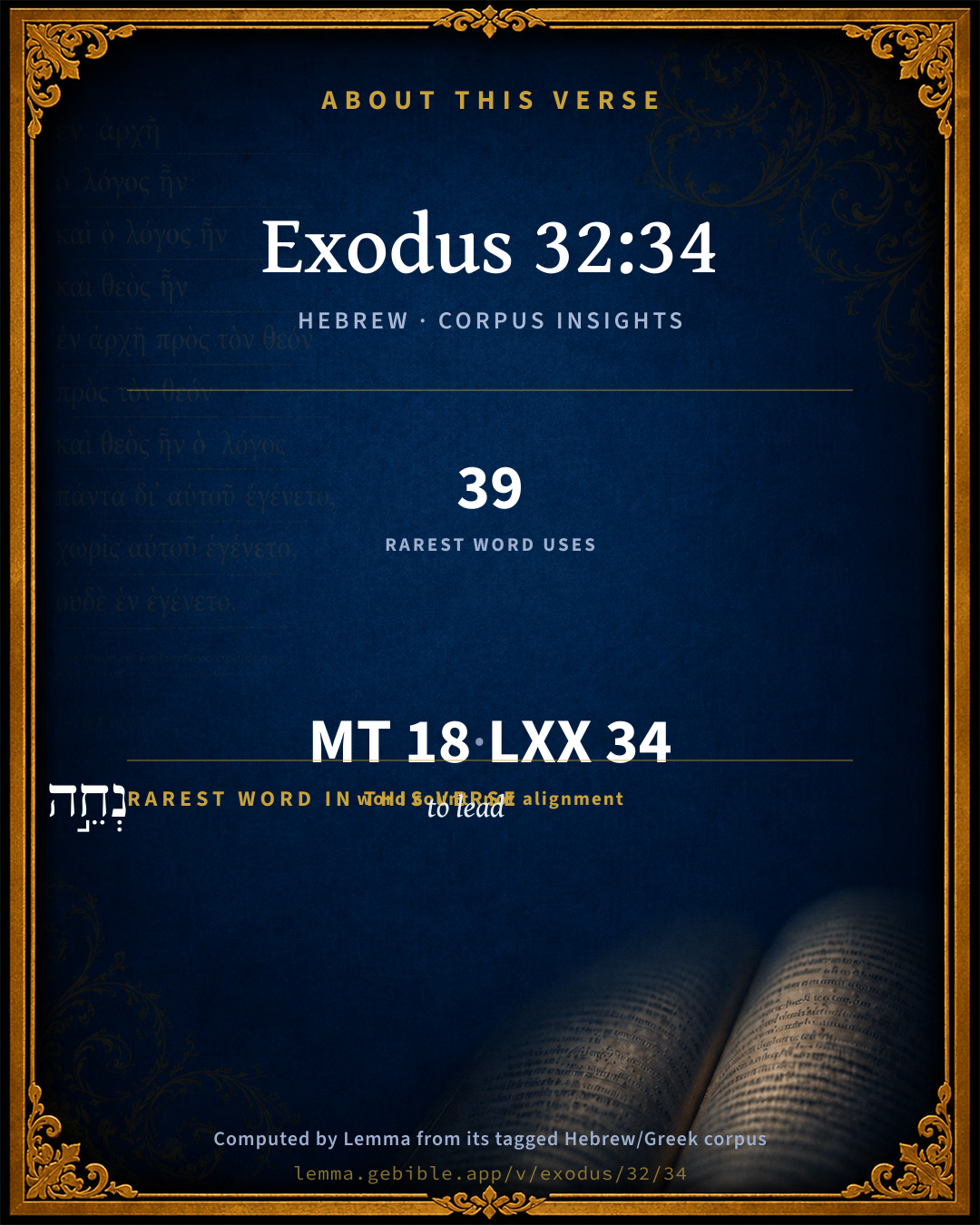
18
words
15
distinct lemmas
Pentateuch
section

Shared distinctive vocabulary

נְחֵ֣ה to lead H5148 occurs in 39 verses of the Hebrew Bible. Also found in:

Grammatical profile

  • 6 verbs
  • 5 nouns
  • 3 prepositions
  • 1 adverb
  • 3 particles

Verb forms

  • לֵ֣ךְ Qal · Imperative
  • נְחֵ֣ה Qal · Imperative
  • דִּבַּ֨רְתִּי֙ Piel · Perfect
  • יֵלֵ֣ךְ Qal · Imperfect
  • פָּקְדִ֔י Qal · Infinitive Construct
  • וּפָקַדְתִּ֥י Qal · Sequential Perfect

Repetition

Words recur within this verse — often emphatic in Hebrew:

  • לֵ֣ךְ to walk H3212 ×2
  • פָּקְדִ֔י to visit H6485 ×2

Hebrew & Septuagint length

In English translation the verse runs 36 words from the Hebrew and 40 from the Septuagint (LXX English) — closely comparable.

A rough comparison of the two English renderings, which tokenize alike — not a word-level alignment.

Word counts can differ between the Hebrew and the Greek without any difference in meaning — e.g. the Hebrew direct-object marker אֵת has no separate Greek word, and Greek often adds the article ὁ.

In the original languages it is 18 Hebrew tokens and 34 Greek tokens — but the two are counted differently (Hebrew bundles its prefixes and suffixes into one token; the Greek is in lemma form), so that isn’t a like-for-like length.

Cross-references

15

Topical passages linked to Exodus 32:34 in the Treasury of Scripture Knowledge — connected by theme and wording, ordered by reader-vote popularity; previews shown in the World English Bible.

  • Exodus 23:20 "Behold, I send an angel before you, to keep you by the way, and to bring you into the place which I have prepared.
  • Deuteronomy 32:35 Vengeance is mine, and recompense, At the time when their foot shall slide: For the day of their calamity is at hand, The things that are to come on them shall make haste.
  • Exodus 3:17 and I have said, I will bring you up out of the affliction of Egypt to the land of the Canaanite, the Hittite, the Amorite, the Perizzite, the Hivite, and the Jebusite, to a land flowing with milk and honey."'
  • Exodus 33:2 I will send an angel before you; and I will drive out the Canaanite, the Amorite, and the Hittite, and the Perizzite, the Hivite, and the Jebusite:
  • Exodus 33:14–15 He said, "My presence will go with you, and I will give you rest."
  • Matthew 23:35 that on you may come all the righteous blood shed on the earth, from the blood of righteous Abel to the blood of Zachariah son of Barachiah, whom you killed between the sanctuary and the altar.
  • Exodus 20:5 you shall not bow yourself down to them, nor serve them, for I, Yahweh your God, am a jealous God, visiting the iniquity of the fathers on the children, on the third and on the fourth generation of those who hate me,
  • Numbers 14:27–30 How long [shall I bear] with this evil congregation, that murmur against me? I have heard the murmurings of the children of Israel, which they murmur against me.
  • Numbers 20:16 and when we cried to Yahweh, he heard our voice, and sent an angel, and brought us forth out of Egypt: and, behold, we are in Kadesh, a city in the uttermost of your border.
  • Psalms 99:8 You answered them, Yahweh our God. You are a God who forgave them, Although you took vengeance for their doings.
  • Isaiah 63:9 In all their affliction he was afflicted, and the angel of his presence saved them: in his love and in his pity he redeemed them; and he bore them, and carried them all the days of old.
  • Jeremiah 5:9 Shall I not visit for these things? says Yahweh; and shall not my soul be avenged on such a nation as this?
  • Jeremiah 5:29 Shall I not visit for these things? says Yahweh; shall not my soul be avenged on such a nation as this?
  • Amos 3:14 "For in the day that I visit the transgressions of Israel on him, I will also visit the altars of Bethel; And the horns of the altar will be cut off, And fall to the ground.
  • Romans 2:4–6 Or do you despise the riches of his goodness, forbearance, and patience, not knowing that the goodness of God leads you to repentance?

Cross-references courtesy of OpenBible.info (CC BY 4.0).

Hebrew and Greek witnesses Masoretic Hebrew ↔ Greek Septuagint

The same verse in the two great witnesses to the Old Testament, shown verse-for-verse.

These are two independent witnesses, not word-aligned to each other, and the Septuagint is shown in lemma (dictionary) form.

Hebrew Exodus 32:34 Masoretic · Westminster Leningrad Codex

וְעַתָּ֞ה לֵ֣ךְ נְחֵ֣ה אֶת הָעָ֗ם אֶ֤ל אֲשֶׁר דִּבַּ֨רְתִּי֙ לָ֔ךְ הִנֵּ֥ה מַלְאָכִ֖י יֵלֵ֣ךְ לְפָנֶ֑יךָ וּבְי֣וֹם פָּקְדִ֔י וּפָקַדְתִּ֥י עֲלֵיהֶ֖ם חַטָּאתָֽם

Now go, lead the people to the place of which I have spoken to you. Behold, my angel shall go before you. Nevertheless in the day when I punish, I will punish them for their sin."

World English Bible · Public Domain

Greek LXX Exodus 32:34 Septuagint · lemma form

νυνί δέ βαδίζω καταβαίνω καί ὁδηγέω ὁ λαός οὗτος εἰς ὁ τόπος ὅς εἶπον σύ ἰδού ὁ ἄγγελος ἐγώ προπορεύομαι πρό πρόσωπον σύ ὅς δέ ἄν ἡμέρα ἐπισκέπτω ἐπιἄγω ἐπί αὐτός ὁ ἁμαρτία αὐτός

And now go, descend, and lead this people into the place of which I spoke to you: behold, my angel shall go before your face; and in the day when I shall visit I will bring upon them their sin.

LXX2012 (modern English Septuagint) · Public Domain

Hebrew: Westminster Leningrad Codex (CC BY 4.0). Greek: Septuagint (public domain); English from LXX2012 (modern English Septuagint) (Public Domain). How the Septuagint differs from the Hebrew →

Targum (Aramaic paraphrase)

2

The Targum is the ancient Jewish Aramaic paraphrase of the Hebrew Scriptures — an interpretive translation, not the Hebrew text itself. Onkelos (literal) and Pseudo-Jonathan (expansive) render the Torah, and Jonathan the Prophets. Coverage is partial: where no permissively-licensed English translation exists for a verse, only the Aramaic is shown. This is verse-level text, not a word-by-word alignment to the Hebrew.

  1. Targum Onkelos Torah (Genesis–Deuteronomy)
    וּכְעַן אִיזֵל דַבַּר יָת עַמָא לַאֲתַר דִי מַלֵלִית לָךְ הָא מַלְאָכִי יְהַךְ קֳדָמָךְ וּבְיוֹם אַסַעֲרוּתִי וְאַסְעַר עֲלֵיהוֹן חוֹבֵיהוֹן:

    (no public-domain English translation for this verse)

    Targum Onkelos — Aramaic: “Onkelos Genesis” (public domain); “Onkelos Exodus” (public domain); “Onkelos Leviticus” (public domain); “Onkelos Numbers” (public domain); “Onkelos Deuteronomy” (public domain). English: “Sefaria Community Translation” (CC0 1.0 (public-domain dedication)); “J.W. Etheridge. The Targums of Onkelos and Jonathan Ben Uzziel on the Pentateuch. London: Longmans, Green, 1862” (public domain). Text via Sefaria.

  2. Targum Pseudo-Jonathan Torah (Genesis–Deuteronomy)
    וּכְדוּן אִיזֵיל דְּבַר יַת עַמָּא לַאֲתַר דְּמַלֵּילִית לָךְ הָא מַלְאָכִי יְטַיֵּיל קֳדָמָךְ וּבְיוֹם אַסְעָרוּתִי וְאַסְעַר עֲלֵיהוֹן חוֹבֵיהוֹן

    But now, go lead the people to the place of which I have told thee; behold, My angel shall proceed before thee; but in the day of My visitation I will visit upon them their sin.

    Targum Pseudo-Jonathan — Aramaic: “Targum Jonathan on Genesis” (public domain); “Targum Jonathan on Exodus” (public domain); “Targum Jonathan on Leviticus” (public domain); “Targum Jonathan on Numbers” (public domain); “Targum Jonathan on Deuteronomy” (public domain). English: “The Targum of Jonathan ben Uzziel, trans. J. W. Etheridge, London, 1862” (public domain). Text via Sefaria.

Commentary

Notes on Exodus 32:34 from classic Christian and Jewish commentators (each source and its license shown beneath its notes). The classic Christian expositions comment on the surrounding passage and are grouped to its opening verse, so a note may address several verses; the Jewish commentaries on the Tanakh (Rashi and others) are per-verse, so they appear only where the commentator wrote on this verse.

Lemma curates 59 commentaries, every one of them public domain or Creative Commons licensed, each selected and text-cleaned for this edition rather than reprinted as found. About our sources →

Trapp's Complete Commentary

John Trapp

Exo 32:34 Therefore now go, lead the people unto [the place] of which I have spoken unto thee: behold, mine Angel shall go before thee: nevertheless in the day when I visit I will visit their sin upon them.

Ver. 34. I will visit.] I will pay them home for the new and the old.

John Trapp, A Commentary or Exposition upon All the Books of the Old and New Testament (1647–1656) — public domain. Text from a community e-Sword module.

Joseph Benson's Commentary

Exo 32:34-35. My angel shall go before thee — Some created angel that was employed in the common services of his kingdom, which intimated that they were not to expect any thing for the future to be done for them out of the common road of providence. When I visit — Hereafter, when I shall see cause to punish them for other sins, I will visit for this among the rest. From hence the Jews have a saying, that from henceforward no judgment fell upon Israel, but there was in it an ounce of the powder of the golden calf. And the Lord plagued the people — Probably by the pestilence, or some other infectious disease. Thus Moses prevailed for a mitigation of the punishment, but could not wholly turn away the wrath of God.

Joseph Benson's Commentary on the Old and New Testaments (1811–1818) — public domain. Text from a community e-Sword module.

Tyndale Open Study Notes

Tyndale Open Resources

32:34 the place I told you about: Canaan, which God had promised to give to Abraham’s descendants (see 3:17; 32:13; 33:1). • when I come to call the people to account: Because of God’s mercy, judgment may not always come immediately (though in this instance God soon sent a plague, 32:35), but it will come for those who persist in sin (see Matt 13:24-30).

Tyndale Open Study Notes — © Tyndale Open Resources, licensed CC BY-SA 4.0. Text via the HelloAO Bible API.

Adam Clarke's Commentary

Verse 34. Lead the people unto the place] The word place is not in the text, and is with great propriety omitted. For Moses never led this people into that place, they all died in the wilderness except Joshua and Caleb; but Moses led them towards the place, and thus the particle אל el here should be understood, unless we suppose that God designed to lead them to the borders of the land, but not to take them into it.

I will visit their sin] I will not destroy them, but they shall not enter into the promised land. They shall wander in the wilderness till the present generation become extinct.

Adam Clarke's Commentary on the Bible (1810–1826) — public domain. Text from a community e-Sword/MySword module.

Ellicott's Commentary for English Readers

(34) Lead the people unto the place of which I have spoken—i.e., continue their leader until Palestine is reached. (See Exo_3:8; Exo_3:17; Exo_6:4-8, &c.)

Mine Angel shall go before thee.—So far as the form of the expression goes, the promise is, as nearly as possible, a repetition of the original one, “Behold, I send an angel before thee, to keep thee in the way, and to bring thee into the place which I have prepared” (Exo_23:20). But the meaning of the promise is wholly changed, as we learn from the opening paragraph of the ensuing chapter (Exo_33:1-3). The “angel” now promised as a guide is not to be God Himself (“I will not go up in the midst of thee “), but a creature, between whom and God the distance is immeasurable.

In the day when I visit I will visit their sin upon them.—All sin is followed by suffering; the sequence is inevitable. God had now consented to spare His people, and to take them back into favour; but they were not to expect that matters would be with them as if their sin had not taken place. It would still be “visited upon them”—not, indeed, by instant death, but still in some way or other. The weary waiting in the wilderness for forty years may have been a part of the punishment (Num_14:33); but it may also have been inflicted on different persons in many different ways.

A Bible Commentary for English Readers, edited by Charles John Ellicott (1878–1897) — public domain. Text from a community e-Sword module.

The Cambridge Bible for Schools and Colleges

gen. ed. J. J. S. Perowne

34. He yields, however, so far to Moses’ entreaty as to put off the punishment of the people to an indefinite future, and to bid Moses lead Israel on to Canaan, under the guidance—not indeed of Himself personally, but—of His angel. It is true, the angel usually (see on Exo_3:1, Exo_23:20) represents Jehovah so fully as not to be exclusive of Him: but Exo_33:2 (see the note), 3, shew that (unless the clause is a later insertion) it must be exclusive of Him here.

The Cambridge Bible for Schools and Colleges (gen. ed. J. J. S. Perowne; Cambridge University Press, 1878–1918) — public domain. Text from a community e-Sword module.

John Gill's Exposition

And the Lord plagued the people,.... That is, continued so to do at certain times, with the pestilence, or other calamities; for this seems not to refer, as some think, to the slaughter of the 3000 men: the reason follows:

because they made the calf which Aaron made; that is, they provided him with materials to make it; they urged and solicited him to do it, and would not be easy without it, so that the making of it is ascribed to them; or they served it, as Onkelos; or bowed unto it, as Jonathan; with which agree the Syriac, Arabic, and Samaritan versions, which render it, they served, or worshipped, or sacrificed to the calf which Aaron made.

John Gill's Exposition of the Whole Bible (1746–1763) — public domain (CC PDM 1.0). Text via the HelloAO Bible API.

Matthew Poole's English Annotations

Behold, mine angel; not Christ, the Angel of the covenant, who had hitherto gone before them; but a created angel, as appears by comparing this with Exo 33:2,3,12; though Moses obtained the revocation of this threatening, Exo 33:14,17. I will visit their sin upon them; when I shall punish them for their other sins, which I foresee they will commit, I will remember and punish this also.

Matthew Poole's English Annotations on the Holy Bible (1683–1685) — public domain. Text from a community e-Sword/MySword module.

Whedon's Commentary on the Bible

Daniel D. Whedon

34. Now go, lead the people — The people having broken the covenant, Jehovah speaks as though he would have Moses depart from Sinai without having the tables renewed, or proceeding with the erection of the tabernacle, whose pattern had been shown him in the mount. He assures him of the presence of his Angel, as in Exo_23:20, but declares that the sin of the people cannot go unpunished. But Moses’s persistent intercession and mediation, as shown in the following chapter, led to a renewal of the covenant.

Daniel D. Whedon (gen. ed.), Commentary on the Old and New Testaments (1874–1909) — public domain. Text from a community e-Sword module.

The Pulpit Commentary

Lead the people unto the place, etc. This was a revocation of the sentence of death passed in verse 10. The people was to be spared, and Moses was to conduct them to Palestine. Mine Angel shall go before thee. Mine Angel not I myself. (compare Exo_33:2, Exo_33:3) Another threatened punishment, which was revoked upon the repentance of the people (ib, 4, 6), and the earnest prayer of Moses (ib, 14-16). I will visit their sin upon them. Kalisch thinks that a plague was at once sent, and so understands verse 35. But most commentators regard the day of visitation as that on which it was declared that none of those who had quitted Egypt should enter Canaan, (Num_14:35) and regard that sentence as, in fact, provoked by the golden calf idolatry (ib, 22).

The Pulpit Commentary (1880–1919), ed. H.D.M. Spence-Jones & Joseph S. Exell — public domain. Text from a community e-Sword module.

John Wesley's Explanatory Notes

My angel shall go before them - Some created angel that was employed in the common services of his kingdom, which intimated that they were not to expect any thing for the future to be done for them out of the common road of providence. When I visit - Hereafter he shall see cause to punish them for other sins, I will visit for this among the rest. From hence the Jews have a saying, that from hence-forward no judgment fell upon Israel, but there was in it an ounce of the powder of the golden calf.

John Wesley, Explanatory Notes Upon the Whole Bible (1754–1765) — public domain. Text via the GEBible commentary corpus.

Scofield Reference Notes

C. I. Scofield

Angel

(See Scofield "Heb 1:4").

The Scofield Reference Bible (1917 edition), notes by C. I. Scofield — public domain. Text from a community e-Sword module.

Rashi

Rabbi Shlomo Yitzchaki (Rashi)

אל אשר דברתי לך OF WHICH I HAVE SPOKEN UNTO THEE — Here we have an instance of לך connected with the verb דבר being used in place of אליך (i. e. where לך actually means speaking to, not as its usual meaning it, speaking “concerning” someone or “in the interest of” someone as often pointed out by Rashi; cf. e. g., Rashi’s comment on Genesis 28:15). Similar is, (1 Kings 2:19) “to speak unto him (לדבר לו) for Adonijah” (cf. Rashi on that verse).

הנה מלאכי BEHOLD, MINE ANGEL [SHALL GO BEFORE THEE] — My messenger, not Myself.

וביום פקדי וגו׳ AND IN THE DAY WHEN I VISIT [I WILL VISIT THEIR SIN UPON THEM] — At present I listen to you and will refrain from consuming them all at once — but ever and ever throughout the ages, when I am visiting them for their sins I shall visit them at the same time for a little of this sin in addition to their other sins for which I am then punishing them. Indeed no punishment ever comes upon Israel in which there is not part payment for the sin of the golden calf (cf. Sanhedrin 102a).

Rashi on the Tanakh — English translations: “The Judaica Press complete Tanach with Rashi, translated by A. J. Rosenberg” (CC BY 4.0); “Pentateuch with Rashi's commentary by M. Rosenbaum and A.M. Silbermann, 1929-1934” (public domain); “The Metsudah Tanach series, Lakewood, N.J” (CC BY 4.0); and “The Book of Joshua, Metsudah Publications, 1997” (CC BY 4.0). Text via Sefaria.

Ramban (Nachmanides)

Rabbi Moshe ben Nachman (Ramban / Nachmanides)

AND NOW GO, LEAD THE PEOPLE. [G-d is saying here:] “Since I have repented from destroying them, lead them unto the place of which I have spoken unto thee — to the place of the Amorite, the Canaanite, etc.” However, He did not want to mention this expressly, for this was said in a manner of anger, as if to say: “What I have said to you, I shall do in your honor, but I will not forgive them their sin, for in the day when I visit, I will visit their sin upon them — I will visit it upon them even after they come to the Land.” This was an allusion to the time of the exile, or to what our Rabbis have said that “No punishment [ever comes upon Israel] in which there is not a small part for the sin of the golden calf.”

Ramban (Nachmanides) on the Tanakh — English translation: “Commentary on the Torah by Ramban (Nachmanides). Translated and annotated by Charles B. Chavel. New York, Shilo Pub. House, 1971-1976” (CC BY 4.0). Text via Sefaria.

Lesson kit

Teaching starters — assembled from the data on this page, not authored interpretation. Every prompt links to the verse data it draws on. Edit before teaching.

Exodus, in the Pentateuch, opens this verse with 18 words (15 distinct Hebrew lemmas). Its most distinctive word is nâchâh (“to lead”). A historical commentator’s framing appears above. Read the whole chapter for the surrounding context.

Discussion questions

  1. What does “to lead” (nâchâh) contribute to the verse as a whole?
  2. Genesis 24:27 shares the word «to lead» with this verse. How do the two illuminate each other?
  3. “to walk” occurs 2× in this one verse. What is the effect of the repetition?
  4. The translations on this page render this verse differently — a whole-verse word diff, not a word-by-word alignment. What might account for the different wordings?
  5. The verb «לֵ֣ךְ» is Qal Imperative. How does its form color the action?
  6. Reading how Trapp's Complete Commentary and Joseph Benson's Commentary read this verse, where do the two commentators agree and where do they part?

Things to notice

Reading settings

Reading text

Shown beneath each verse's original-language words.

Old Testament
Old Testament edition

Read the OT as the Masoretic Hebrew (MT) or the Greek Septuagint (LXX).

English shown for the Greek Septuagint (in the Hebrew ↔ Greek comparison).

Comparing translations? Open the Compare panel on any verse page to stack up to four side by side.