
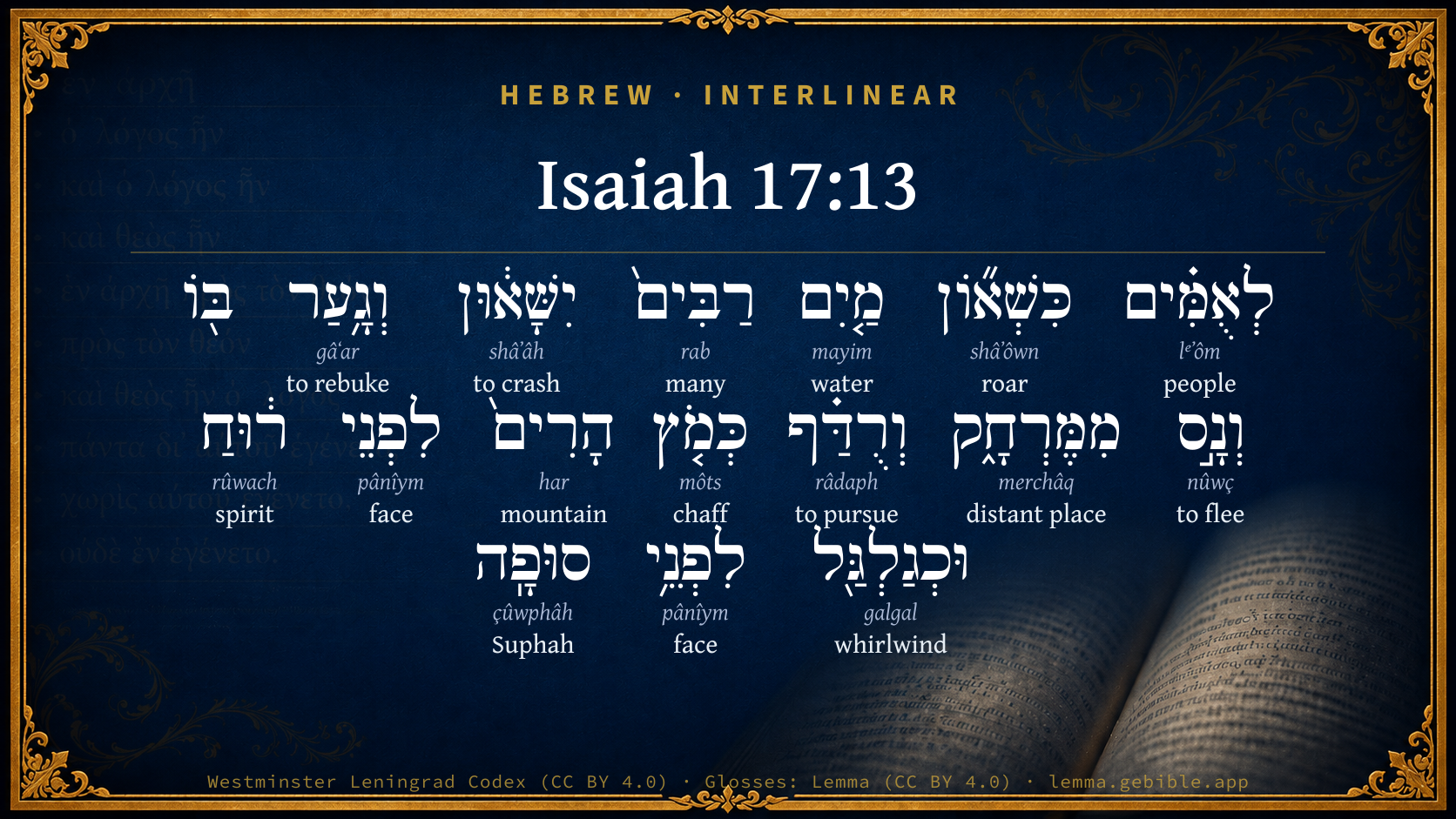
Isaiah 17:13

Hebrew (Westminster Leningrad Codex) Isaiah 17:13 appears in the Hebrew Old Testament. The text above is from the Westminster Leningrad Codex. Each word links to its Strong’s number, a concise gloss, and parsing drawn from the Open Scriptures Hebrew Bible morphology. Click any word for its full Brown-Driver-Briggs (BDB) entry.
Download image
Cite this verse

Isaiah 17:13 (World English Bible). Public Domain. Lemma interlinear Bible study tool, https://lemma.gebible.app/v/isaiah/17/13.

Show BibTeX & RIS
BibTeX
RIS
English Translation
The nations shall rush like the rushing of many waters: but he shall rebuke them, and they shall flee far off, and shall be chased as the chaff of the mountains before the wind, and like the whirling dust before the storm.
World English Bible · Public Domain
Download a study sheet

One document with this verse’s original text, its word-by-word gloss line, the meaning frame, cross-references with their text, attributed commentary, and full source and license credits — printable, and it pastes into notes with its structure intact.

This verse Autodidact and up

Study sheet (.html) Plain text (.txt)

A passage Seminary Student

Up to 50 verses in one chapter. A passage sheet keeps up to 6 commentary sources and 12 cross-references per verse, in the order this page ranks them, and says so on the sheet whenever that leaves anything out. Ask for a single verse and you get the Autodidact verse sheet above.

Everything on this page stays free to read, with no account — the sheet is a download of what is already on screen, not access to it.

Want to remove ads? Support Godless Engineer
Compare translations 3

The same verse in 3 English versions, stacked beneath the original-language interlinear above. Click any original word for its lexicon entry.

Each is an independent rendering of the whole verse — the interlinear is not word-aligned to these translations.

Highlighted words mark where these versions differ — a whole-verse word diff, not a word-by-word alignment.

  • World English Bible Public Domain
    The nations shall rush like the rushing of many waters: but he shall rebuke them, and they shall flee far off, and shall be chased as the chaff of the mountains before the wind, and like the whirling dust before the storm.
  • King James Version Public Domain
    The nations shall rush like the rushing of many waters: but God shall rebuke them, and they shall flee far off, and shall be chased as the chaff of the mountains before the wind, and like a rolling thing before the whirlwind.
  • unfoldingWord Literal Text CC BY-SA 4.0
    The peoples roar like the roar of many waters, but he will rebuke him, and he will flee far away, and he will be pursued, like chaff of the mountains to the face of the wind, and like tumbleweed to the face of a whirlwind.

unfoldingWord Literal Text — © unfoldingWord, licensed CC BY-SA 4.0. Word-aligned USFM3 via Door43 (git.door43.org/unfoldingWord/en_ult).

Versions to compare (up to 4)

3 of 4 selected

Show all 18 translations

Every available English version of this verse, each an independent rendering of the whole verse.

  • World English Bible Public Domain
    The nations shall rush like the rushing of many waters: but he shall rebuke them, and they shall flee far off, and shall be chased as the chaff of the mountains before the wind, and like the whirling dust before the storm.
  • Berean Standard Bible Public Domain
    The nations rage like the rush of many waters. He rebukes them, and they flee far away, driven before the wind like chaff on the hills, like tumbleweeds before a gale.
  • Majority Standard Bible Public Domain
    The nations rage like the rush of many waters. He rebukes them, and they flee far away, driven before the wind like chaff on the hills, like tumbleweeds before a gale.
  • King James Version Public Domain
    The nations shall rush like the rushing of many waters: but God shall rebuke them, and they shall flee far off, and shall be chased as the chaff of the mountains before the wind, and like a rolling thing before the whirlwind.
  • American Standard Version (1901) Public Domain
    The nations shall rush like the rushing of many waters: but he shall rebuke them, and they shall flee far off, and shall be chased as the chaff of the mountains before the wind, and like the whirling dust before the storm.
  • Revised Version (1885) Public Domain
    The nations shall rush like the rushing of many waters: but he shall rebuke them, and they shall flee far off, and shall be chased as the chaff of the mountains before the wind, and like the whirling dust before the storm.
  • Geneva Bible (1599) Public Domain
    The people shall make a sounde like the noise of many waters: but God shall rebuke them, and they shall flee farre off, and shalbe chased as the chaffe of the mountaines before the winde, and as a rolling thing before the whirlewinde.
  • Douay-Rheims (1899) Public Domain
    Nations shall make a noise like the noise of waters overflowing, but he shall rebuke him, and he shall flee far off: and he shall be carried away as the dust of the mountains before the wind, and as a whirlwind before a tempest.
  • Young's Literal Translation Public Domain
    Nations as the wasting of many waters are wasted, And He hath pushed against it, And it hath fled afar off, And been pursued as chaff of hills before wind, And as a rolling thing before a hurricane.
  • Literal Standard Version CC BY-SA 4.0
    Nations crash as the roaring of many waters, || And He rebuked them, || And they fled far off, || And were pursued as chaff of hills before wind, || And as a rolling thing before a windstorm.
  • Unlocked Literal Bible CC BY-SA 4.0
    The nations will roar like the rushing of many waters, but he will rebuke them and they will flee far away, they will be chased before the wind like chaff on the mountains, and like weeds whirling before a storm.
  • unfoldingWord Literal Text CC BY-SA 4.0
    The peoples roar like the roar of many waters, but he will rebuke him, and he will flee far away, and he will be pursued, like chaff of the mountains to the face of the wind, and like tumbleweed to the face of a whirlwind.
  • Darby Bible Public Domain
    The nations rush as the rushing of many waters; but he will rebuke them, and they shall flee far away, and shall be chased as the chaff of the mountains before the wind, and like a whirling [of dust] before the whirlwind:
  • World Messianic Bible Public Domain
    The nations will rush like the rushing of many waters, but he will rebuke them, and they will flee far off, and will be chased like the chaff of the mountains before the wind, and like the whirling dust before the storm.
  • Webster's Bible Public Domain
    The nations shall rush like the rushing of many waters: but God will rebuke them, and they shall flee far off, and shall be chased as the chaff of the mountains before the wind, and like a rolling thing before the whirlwind.
  • Free Bible Version CC BY-SA 4.0
    The nations roar like the roaring of crashing waves. But he confronts them, and they run far away, blown by the wind like chaff on the mountains, like tumbleweeds driven by a storm.
  • Bible in Basic English Public Domain
    But he will put a stop to them, and make them go in flight far away, driving them like the waste of the grain on the tops of the mountains before the wind, and like the circling dust before the storm.
  • JPS Tanakh (1917) Public Domain
    The nations shall rush like the rushing of many waters; but He shall rebuke them, and they shall flee far off, and shall be chased as the chaff of the mountains before the wind, and like the whirling dust before the storm.

Literal Standard Version (2020), Covenant Press — licensed CC BY-SA 4.0. Text via the HelloAO Bible API (eBible.org). Unlocked Literal Bible (unfoldingWord) — licensed CC BY-SA 4.0. Text via the HelloAO Bible API (eBible.org). unfoldingWord Literal Text — © unfoldingWord, licensed CC BY-SA 4.0. Word-aligned USFM3 via Door43 (git.door43.org/unfoldingWord/en_ult). Free Bible Version, Dr. Jonathan Gallagher — licensed CC BY-SA 4.0. Text via the HelloAO Bible API (eBible.org).

Word by word

More ways to search: Search by grammar → Find every occurrence → Compare this word →

Practice this passage: Drill this verse → Learn its vocabulary →

יִשָּׁא֔וּן
shâʼâh
H7582
“to crash”
Verb, Niphal, Imperfect, 3rd Person, Masculine, Plural + Suffix, n
Part of Speech
Verb
Stem
Niphal
Form
Imperfect
Person
3rd Person
Gender
Masculine
Number
Plural
Full BDB Definition

Origin: a primitive root

TWOT: 2301

crash, make a din or crash, crash into ruins, be in ruins, be desolated - (Qal) to crash into ruins - (Niphal) - to be ruined - to crash - to be left (a desolation) - (Hiphil) - to cause to crash - to cause to be desolated
  1. לְאֻמִּ֗ים lᵉʼôm H3816 “peoples” Noun, Common, Masculine, Plural, Absolute
  2. כִּשְׁא֞וֹן shâʼôwn H7588 “like/as · roar of” Preposition + Noun, Common, Masculine, Singular, Construct
  3. מַ֤יִם mayim H4325 “water(s)” Noun, Common, Masculine, Plural, Absolute
  4. רַבִּים֙ rab H7227 “many” Adjective, Adjective, Masculine, Plural, Absolute
  5. וְגָ֥עַר gâʻar H1605 “and · to rebuke” Conjunction + Verb, Qal, Sequential Perfect, 3rd Person, Masculine, Singular
  6. וְנָ֣ס nûwç H5127 “and · to flee” Conjunction + Verb, Qal, Sequential Perfect, 3rd Person, Masculine, Singular
  7. מִמֶּרְחָ֑ק merchâq H4801 “from · distant place” Preposition + Noun, Common, Masculine, Singular, Absolute
  8. וְרֻדַּ֗ף râdaph H7291 “and · to pursue” Conjunction + Verb, Pual, Sequential Perfect, 3rd Person, Masculine, Singular
  9. כְּמֹ֤ץ môts H4671 “like/as · chaff of” Preposition + Noun, Common, Masculine, Singular, Construct
  10. הָרִים֙ har H2022 “mountains” Noun, Common, Masculine, Plural, Absolute
  11. לִפְנֵי pânîym H6440 “to/for · face(s) of” Preposition + Noun, Common, Both, Plural, Construct
  12. ר֔וּחַ rûwach H7307 “spirit” Noun, Common, Both, Singular, Absolute
  13. וּכְגַלְגַּ֖ל galgal H1534 “and · like/as · whirlwind” Conjunction + Preposition + Noun, Common, Masculine, Singular, Absolute
  14. לִפְנֵ֥י pânîym H6440 “to/for · face(s) of” Preposition + Noun, Common, Both, Plural, Construct
  15. סוּפָֽה çûwphâh H5492 “Suphah” Noun, Common, Feminine, Singular, Absolute

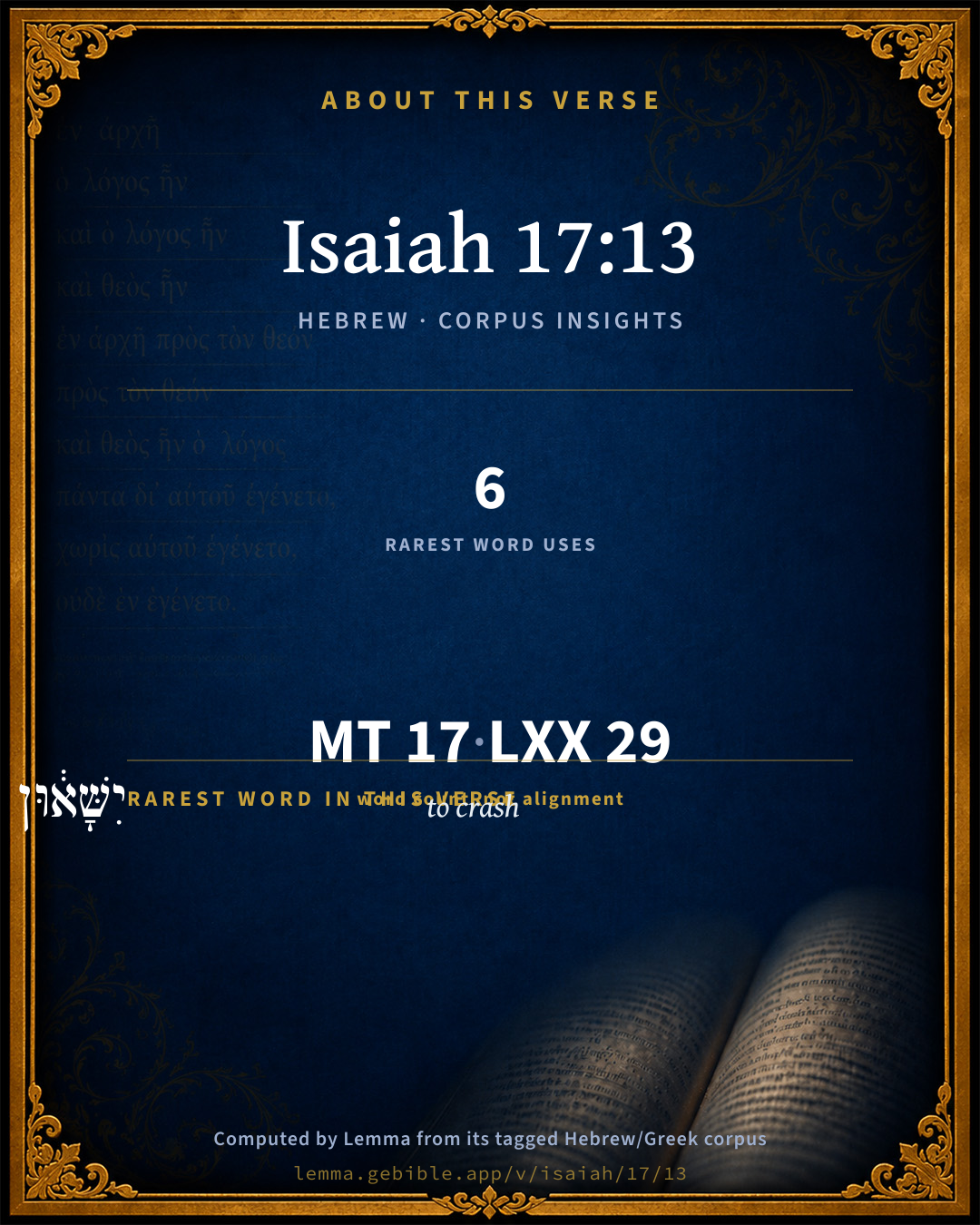
About this verse

These counts appear in no published source. They are computed here, from the morphology-tagged text and Lemma’s own curated glosses. What Lemma adds →

17
words
15
distinct lemmas
Prophets
section

Notable vocabulary

The rarest word here is יִשָּׁא֔וּן to crash H7582 — appearing just 6 times in the whole Hebrew Bible.

Shared distinctive vocabulary

יִשָּׁא֔וּן to crash H7582 occurs in 5 verses of the Hebrew Bible. Also found in:

Grammatical profile

  • 4 verbs
  • 11 nouns
  • 1 adjective
  • 1 preposition

Verb forms

  • יִשָּׁא֔וּן Niphal · Imperfect
  • וְגָ֥עַר Qal · Sequential Perfect
  • וְנָ֣ס Qal · Sequential Perfect
  • וְרֻדַּ֗ף Pual · Sequential Perfect

Repetition

A word recurs within this verse — often emphatic in Hebrew:

  • לִפְנֵי face H6440 ×2

Hebrew & Septuagint length

In English translation the verse runs 42 words from the Hebrew and 42 from the Septuagint (LXX English) — the same length.

A rough comparison of the two English renderings, which tokenize alike — not a word-level alignment.

Word counts can differ between the Hebrew and the Greek without any difference in meaning — e.g. the Hebrew direct-object marker אֵת has no separate Greek word, and Greek often adds the article ὁ.

In the original languages it is 17 Hebrew tokens and 29 Greek tokens — but the two are counted differently (Hebrew bundles its prefixes and suffixes into one token; the Greek is in lemma form), so that isn’t a like-for-like length.

Cross-references

22

Topical passages linked to Isaiah 17:13 in the Treasury of Scripture Knowledge — connected by theme and wording, ordered by reader-vote popularity; previews shown in the World English Bible.

  • Psalms 9:5 You have rebuked the nations. You have destroyed the wicked. You have blotted out their name forever and ever.
  • Job 21:18 That they are as stubble before the wind, As chaff that the storm carries away?
  • Psalms 1:4 The wicked are not so, But are like the chaff which the wind drives away.
  • Isaiah 41:15–16 Behold, I have made you [to be] a new sharp threshing instrument having teeth; you shall thresh the mountains, and beat them small, and shall make the hills as chaff.
  • Isaiah 29:5 But the multitude of your foes shall be like small dust, and the multitude of the awesome ones as chaff that passes away: yes, it shall be in an instant suddenly.
  • Job 38:11 And said, 'Here you may come, but no further; Here shall your proud waves be stayed?'
  • Psalms 35:5 Let them be as chaff before the wind, Yahweh's angel driving them on.
  • Psalms 46:5–11 God is in her midst. She shall not be moved. God will help her at dawn.
  • Psalms 83:13–15 My God, make them like tumbleweed; Like chaff before the wind.
  • Isaiah 10:15–16 Shall the axe boast itself against him who hews therewith? Shall the saw magnify itself against him who wields it? as if a rod should wield those who lift it up, [or] as if a staff should lift up [him who is] not wood.
  • Isaiah 10:33–34 Behold, the Lord, Yahweh of Hosts, will lop the boughs with terror: and the high of stature shall be hewn down, and the lofty shall be brought low.
  • Isaiah 14:25 that I will break the Assyrian in my land, and on my mountains tread him under foot: then shall his yoke depart from off them, and his burden depart from off their shoulder.
  • Isaiah 25:4–5 For you have been a stronghold to the poor, a stronghold to the needy in his distress, a refuge from the storm, a shade from the heat, when the blast of the awesome ones is as a storm against the wall.
  • Isaiah 27:1 In that day Yahweh with his hard and great and strong sword will punish leviathan the swift serpent, and leviathan the crooked serpent; and he will kill the monster that is in the sea.
  • Isaiah 30:30–33 Yahweh will cause his glorious voice to be heard, and will show the lighting down of his arm, with the indignation of [his] anger, and the flame of a devouring fire, with a blast, and tempest, and hailstones.
  • Isaiah 31:8–9 The Assyrian shall fall by the sword, not of man; and the sword, not of men, shall devour him; and he shall flee from the sword, and his young men shall become subject to forced labor.
  • Isaiah 33:1–3 Woe to you who destroy, and you weren't destroyed; and deal treacherously, and they didn't deal treacherously with you! When you have ceased to destroy, you shall be destroyed; and when you have made an end of dealing treacherously, they shall deal treacherously with you.
  • Isaiah 33:9–12 The land mourns and languishes; Lebanon is confounded and withers away; Sharon is like a desert; and Bashan and Carmel shake off [their leaves].
  • Isaiah 37:29–38 Because of your raging against me, and because your arrogance is come up into my ears, therefore will I put my hook in your nose, and my bridle in your lips, and I will turn you back by the way by which you came.
  • Daniel 2:35 Then was the iron, the clay, the brass, the silver, and the gold, broken in pieces together, and became like the chaff of the summer threshing floors; and the wind carried them away, so that no place was found for them: and the stone that struck the image became a great mountain, and filled the whole earth.
  • Hosea 13:3 Therefore they will be like the morning cloud, And like the dew that passes away early, Like the chaff that is driven with the whirlwind out of the threshing floor, And like the smoke out of the chimney.
  • Mark 4:39–41 He awoke, and rebuked the wind, and said to the sea, "Peace! Be still!" The wind ceased, and there was a great calm.

Cross-references courtesy of OpenBible.info (CC BY 4.0).

Hebrew and Greek witnesses Masoretic Hebrew ↔ Greek Septuagint

The same verse in the two great witnesses to the Old Testament, shown verse-for-verse.

These are two independent witnesses, not word-aligned to each other, and the Septuagint is shown in lemma (dictionary) form.

Hebrew Isaiah 17:13 Masoretic · Westminster Leningrad Codex

לְאֻמִּ֗ים כִּשְׁא֞וֹן מַ֤יִם רַבִּים֙ יִשָּׁא֔וּן וְגָ֥עַר בּ֖וֹ וְנָ֣ס מִמֶּרְחָ֑ק וְרֻדַּ֗ף כְּמֹ֤ץ הָרִים֙ לִפְנֵי ר֔וּחַ וּכְגַלְגַּ֖ל לִפְנֵ֥י סוּפָֽה

The nations shall rush like the rushing of many waters: but he shall rebuke them, and they shall flee far off, and shall be chased as the chaff of the mountains before the wind, and like the whirling dust before the storm.

World English Bible · Public Domain

Greek LXX Isaiah 17:13 Septuagint · lemma form

ὡς ὕδωρ πολύς ἔθνος πολύς ὡς ὕδωρ πολύς βία καταφέρω καί ἀποσκορακίζω αὐτός καί πόρρω αὐτός διώκω ὡς χνοῦν ἄχυρον λικμάω ἀπέναντι ἄνεμος καί ὡς κονιορτός τροχός καταιγίς φέρω

many nations like much water, as when much water rushes violently: and they shall drive him away, and pursue him afar, as the dust of chaff when men winnow before the wind, and as a storm whirling the dust of the wheel.

LXX2012 (modern English Septuagint) · Public Domain

Hebrew: Westminster Leningrad Codex (CC BY 4.0). Greek: Septuagint (public domain); English from LXX2012 (modern English Septuagint) (Public Domain). How the Septuagint differs from the Hebrew →

Targum (Aramaic paraphrase)

1

The Targum is the ancient Jewish Aramaic paraphrase of the Hebrew Scriptures — an interpretive translation, not the Hebrew text itself. Onkelos (literal) and Pseudo-Jonathan (expansive) render the Torah, and Jonathan the Prophets. Coverage is partial: where no permissively-licensed English translation exists for a verse, only the Aramaic is shown. This is verse-level text, not a word-by-word alignment to the Hebrew.

  1. Targum Jonathan Prophets (Joshua–Malachi)
    מַלְכְּוָן דִכְאִתְרְגוּשַׁת מַיִין סַגִיאִין מִתְרַגְשִׁין וִיזוּף בֵּיהּ וְיֶעְרוּק מֵרָחִיק וִיתְרַדֵף כְּמוֹץ טוּרַיָא קֳדָם רוּחָא וּכְגַלְגְלָא קֳדָם עַלְעוּלָא:

    The kings roar like the roaring of many waters, and he shall rebuke him, and he shall flee far off, and shall be driven as the chaff of the hills before the wind, and like a rolling thing before the whirlwind.

    Targum Jonathan — Aramaic: “Mikraot Gedolot” (public domain). English: “Sefaria Community Translation” (CC0 1.0 (public-domain dedication)); “London "Chaldee Paraphrase," 1871” (public domain). Text via Sefaria.

Commentary

Notes on Isaiah 17:13 from classic Christian and Jewish commentators (each source and its license shown beneath its notes). The classic Christian expositions comment on the surrounding passage and are grouped to its opening verse, so a note may address several verses; the Jewish commentaries on the Tanakh (Rashi and others) are per-verse, so they appear only where the commentator wrote on this verse.

Lemma curates 59 commentaries, every one of them public domain or Creative Commons licensed, each selected and text-cleaned for this edition rather than reprinted as found. About our sources →

Trapp's Complete Commentary

John Trapp

Isa 17:13 The nations shall rush like the rushing of many waters: but [God] shall rebuke them, and they shall flee far off, and shall be chased as the chaff of the mountains before the wind, and like a rolling thing before the whirlwind.

Ver. 13. The nations shall rush.] Or, Rustle. The Assyrians did so when they brake in. {Isa 36:1-20}

But God shall rebuke them,] i.e., Chide them, smite them, and so set it on, as none shall be able to take it off.

And they shall flee far off.] Heb., He shall flee, viz., Sennacherib, who, was frightened with the slaughter of his soldiers by the angel, shall flee his utmost.

John Trapp, A Commentary or Exposition upon All the Books of the Old and New Testament (1647–1656) — public domain. Text from a community e-Sword module.

Tyndale Open Study Notes

Tyndale Open Resources

17:13 God will silence them: The Lord is sovereign over the nations, as he is over the sea (Ps 65:7).

Tyndale Open Study Notes — © Tyndale Open Resources, licensed CC BY-SA 4.0. Text via the HelloAO Bible API.

Geneva Bible (1599)

Geneva Bible translators

He addeth this for the consolation of the faithful which were in Israel.

Geneva Bible (1599) marginal notes — public domain. Text via Bolls.life.

Jamieson, Fausset & Brown

Robert Jamieson, A. R. Fausset & David Brown

shall . . . shall--rather, "God rebuketh (Psa 9:5) them, and they flee--are chased"; the event is set before the eyes as actually present, not future.

chaff of . . . mountains--Threshing floors in the East are in the open air on elevated places, so as to catch the wind which separates the chaff from the wheat (Psa 88:13; Hos 13:3).

rolling thing--anything that rolls: stubble.

Jamieson, Fausset & Brown — Commentary Critical and Explanatory on the Whole Bible (1871) — public domain (CC PDM 1.0). Text via the HelloAO Bible API.

Ellicott's Commentary for English Readers

(13) But God shall rebuke them.—Better, He shall rebuke. The insertion of the word “God” weakens the force of the sublime indefiniteness of the Hebrew.

Like a rolling thing.—The Hebrew word is the same as the “wheel” of Psa_83:13, and probably refers, like the “chaff of the mountains,” to the whirling dust-clouds driven from an elevated threshing-floor before the wind (Psa_1:4; Psa_35:5). There is no sufficient authority for the “thistle-down” of the margin.

A Bible Commentary for English Readers, edited by Charles John Ellicott (1878–1897) — public domain. Text from a community e-Sword module.

The Cambridge Bible for Schools and Colleges

gen. ed. J. J. S. Perowne

13. The Assyrians shall perish at the rebuke of jehovah. The first clause of the verse is almost identical with the last words of Isa_17:12, and is wanting in the Peshito and a few Hebr. MSS. It may have arisen through dittography, although some think the repetition is rhetorically effective, contrasting the long-drawn-out terror of the invasion with the sharp and sudden visitation described in what follows.

but God shall rebuke them] Better: but he (Jehovah) rebuketh it (the tumult of nations). The following verbs should also be rendered as presents and in the singular number: it fleeth … is chased. The “rebuke” of Jehovah is His voice of thunder (Psa_104:7).

chaff of the mountains] Threshing-floors were chosen by preference on elevated situations, free to the wind, which carried away the stubble without any artificial winnowing process.

a rolling thing] R.V. the whirling dust, as in Psa_83:13. The translation “stubble,” however, is supported by the analogy of Aramaic and Arabic words.

For the figure, comp. ch. Isa_29:5; Psa_1:4; Psa_35:5, &c.

The Cambridge Bible for Schools and Colleges (gen. ed. J. J. S. Perowne; Cambridge University Press, 1878–1918) — public domain. Text from a community e-Sword module.

John Gill's Exposition

The nations shall rush like the rushing of many waters,.... With great force and noise, and run over the whole land, as the Assyrian army did, until it came to Jerusalem, and there it stopped; see Isa 8:7,

but God shall rebuke them; as he did the waters of the Red Sea, Psa 106:9 and as Christ rebuked the winds and sea, and made a calm, Mat 8:26. The word "God" is not in the text, but rightly supplied; for as none but he can rebuke the mighty waters of the sea, so none but he could have destroyed such an army in the manner it was, and wrought such a salvation for his people. The phrase, is expressive both of his wrath and power.

And they shall flee afar off; from Jerusalem to Nineveh, reckoned to be six hundred and eighty four miles from thence: or, "he shall flee afar off" (x); that is, Sennacherib, and the few that escaped with him, for, his army was destroyed; see Kg2 19:36,

and shall be chased as the chaff of the mountains before the wind; chaff upon the floor is easily chased away with the fan, and much more easily chaff upon the mountains with the wind; it was usual with the Jews to thresh their corn, and winnow it on hills and mountains, to which the allusion is; see Ch2 3:1 or "the dust of the mountains", as some (y) render it, which is more exposed to the wind than that in the valleys. Kings and great men of the earth are but as dust with God; and the higher they are, or they exalt themselves, the more they are exposed to the power of his wrath, and as easily cast down as the dust is scattered by the wind:

and like a rolling thing before the whirlwind; or "like a wheel" (z), as the word is sometimes rendered; or any round thing, as a round wisp of straw or stubble, which is easily and swiftly moved and rolled along, especially by a strong wind. Jarchi interprets it of the flower of thorns; that is, the down of the thistle, which, when blown off, rolls up, and, being exceeding light, is carried away at once; see Psa 83:13 all which shows what poor light things the greatest of men are in the hands of God, and with what ease he can chase them from place to place, and out of the world, when it is his pleasure.

(x) "fugiet de procul", Vatablus. (y) "velut, pulvis montium", Tigurine version. (z) "sicut rota". Junius & Tremellius; "tanquam glomus stipularum", Piscator.

John Gill's Exposition of the Whole Bible (1746–1763) — public domain (CC PDM 1.0). Text via the HelloAO Bible API.

Albert Barnes' Notes on the Bible

God shall rebuke them - The word ‘God’ is not here in the original, but is evidently to be supplied. The word ‘rebuke’ means that he would disarrange their plans, prevent their success, and defeat their purposes. It shows the great power of God, that he can thus by a “rebuke” - a word - arrest mighty nations, and discomfit thom when they are tumultuously hastening onward in the confidence of victory. This discomfiture refers, doubtless, to the overthrow of Sennacherib and his army by the pestilence (2Ki 19:35; see the notes at Isa 37:36).

And they shall flee far off - The whole army of Sennacherib was not destroyed, but a part with himself returned to Assyria 2Ki 19:36.

And shall be chased as the chaff ... - Denoting the case with which God would do it, and the certain and entire discomfiture of the army. The figure is one that is very striking in describing an army that is routed, and that flees in disorder (compare Job 21:18; Psa 1:4; Psa 35:5; Isa 29:5; Hos 13:3).

And like a rolling thing - Margin, ‘Thistle-down.’ It means, literally, anything that “rolls” (גלגל galgal, from גלל gâlal, to roll). It is applied to chaff, stubble, or anything that is driven about by a whirlwind Psa 83:14.

Albert Barnes' Notes on the Bible (1834–1885) — public domain. Text from a community e-Sword/MySword module.

Matthew Poole's English Annotations

Shall rebuke them; not in words, but deeds; shall discomfit and overthrow them.

Like a rolling thing, which is easily moved by every slight touch, and much more by a violent wind. Or, like a wisp, to wit, of straw, which is sometimes rolled together.

Matthew Poole's English Annotations on the Holy Bible (1683–1685) — public domain. Text from a community e-Sword/MySword module.

The Pulpit Commentary

God shall rebuke them; literally, he shall rebuke them he who alone can do so. There is no need to mention his name. They shall flee far off. The destruction of the great bulk of Sennacherib"s army in the night was followed, as soon as morning came, by the hasty flight of the survivors. (2Ki_19:36 Isa_37:37) And shall be chased. Herodotus says that the Egyptians pursued the army of Sennacherib and slew vast numbers (2:141). As the chaff of the mountains. (comp. Hos_13:3) Threshing-floors were ordinarily placed upon eminences, (2Sa_24:18 2Ch_3:1) where the wind had freer course and consequently greater power. Like a rolling thing; or, like whirling dust (Kay). The word used commonly means "a wheel."

The Pulpit Commentary (1880–1919), ed. H.D.M. Spence-Jones & Joseph S. Exell — public domain. Text from a community e-Sword module.

J. A. Alexander on Isaiah

Joseph Addison Alexander

“Nations, like the rush of many waters, rush; and He rebukes it, and it flees from afar, and is chased like the chaff of hills before a wind, and like a rolling thing before a whirlwind.” While there seems to be an obvious allusion to the flight of Sennacherib and the remnant of his host (Isa 37:36-37) the terms are so selected as to admit of a wider application to all Jehovah’s enemies, and thus prepare the way for the general declaration in the following verse.

Joseph Addison Alexander, The Prophecies of Isaiah (1846–1847; New York: Scribner, 1870–1878) — public domain. Text from a community e-Sword module.

Rashi

Rabbi Shlomo Yitzchaki (Rashi)

and He shall rebuke them [lit.] him i.e., the Holy One, blessed be He, [shall rebuke] that rushing [or throng].

like the chaff of the mountains He likens the wicked to the most inferior of all species and the most inferior of that species. The chaff of the mountains is drier than that of the valleys.

and like the thistle blossoms Heb. וּכְגַלְגַל. That is from the blossom of the thistles called kardouns in O.F. [chardons in modern French] similar to those with which they pull woolen garments, and they are not hard. When the end of the summer arrives, they burst open by themselves and the wind scatters them. Now that bursting is made like a round wheel (גַלְגַּל) [var. like a wagon wheel], like a sort of eye in the center with five spokes around it.

Rashi on the Tanakh — English translations: “The Judaica Press complete Tanach with Rashi, translated by A. J. Rosenberg” (CC BY 4.0); “Pentateuch with Rashi's commentary by M. Rosenbaum and A.M. Silbermann, 1929-1934” (public domain); “The Metsudah Tanach series, Lakewood, N.J” (CC BY 4.0); and “The Book of Joshua, Metsudah Publications, 1997” (CC BY 4.0). Text via Sefaria.

Ibn Ezra

Rabbi Abraham ibn Ezra

But He shall rebuke him. God will rebuke the king of Assyria.

From far off. That is, far from his own land.

And shall be chased. The part of the army that will be left will be pursued.

Ibn Ezra on the Tanakh — English translations: “Sefaria Community Translation” (CC0 1.0 (public-domain dedication)); “Yalkut, Sifsei Chachomim Chumash, Metsudah Publications, 2009” (CC BY 4.0); and “Commentary of Ibn Ezra on Isaiah - trans. by M. Friedlander, 1873” (public domain). Text via Sefaria.

Lesson kit

Teaching starters — assembled from the data on this page, not authored interpretation. Every prompt links to the verse data it draws on. Edit before teaching.

Isaiah, in the Prophets, opens this verse with 17 words (15 distinct Hebrew lemmas). Its most distinctive word is shâʼâh (“to crash”). A historical commentator’s framing appears above. Read the whole chapter for the surrounding context.

Discussion questions

  1. The word shâʼâh carries the sense “to crash.” How does it shape the verse?
  2. How does 2 Kings 19:25, which shares the word «to crash», read alongside this verse?
  3. What does the repetition of “face” (2× in this one verse) do in this verse?
  4. These translations render this verse differently. What is at stake in choosing one wording over another?
  5. «יִשָּׁא֔וּן» is a Niphal Imperfect verb. How does that grammatical form shape the action described?
  6. Compare how Trapp's Complete Commentary and Tyndale Open Study Notes read this verse. Where do they agree or differ?

Things to notice

Reading settings

Reading text

Shown beneath each verse's original-language words.

Old Testament
Old Testament edition

Read the OT as the Masoretic Hebrew (MT) or the Greek Septuagint (LXX).

English shown for the Greek Septuagint (in the Hebrew ↔ Greek comparison).

Comparing translations? Open the Compare panel on any verse page to stack up to four side by side.