
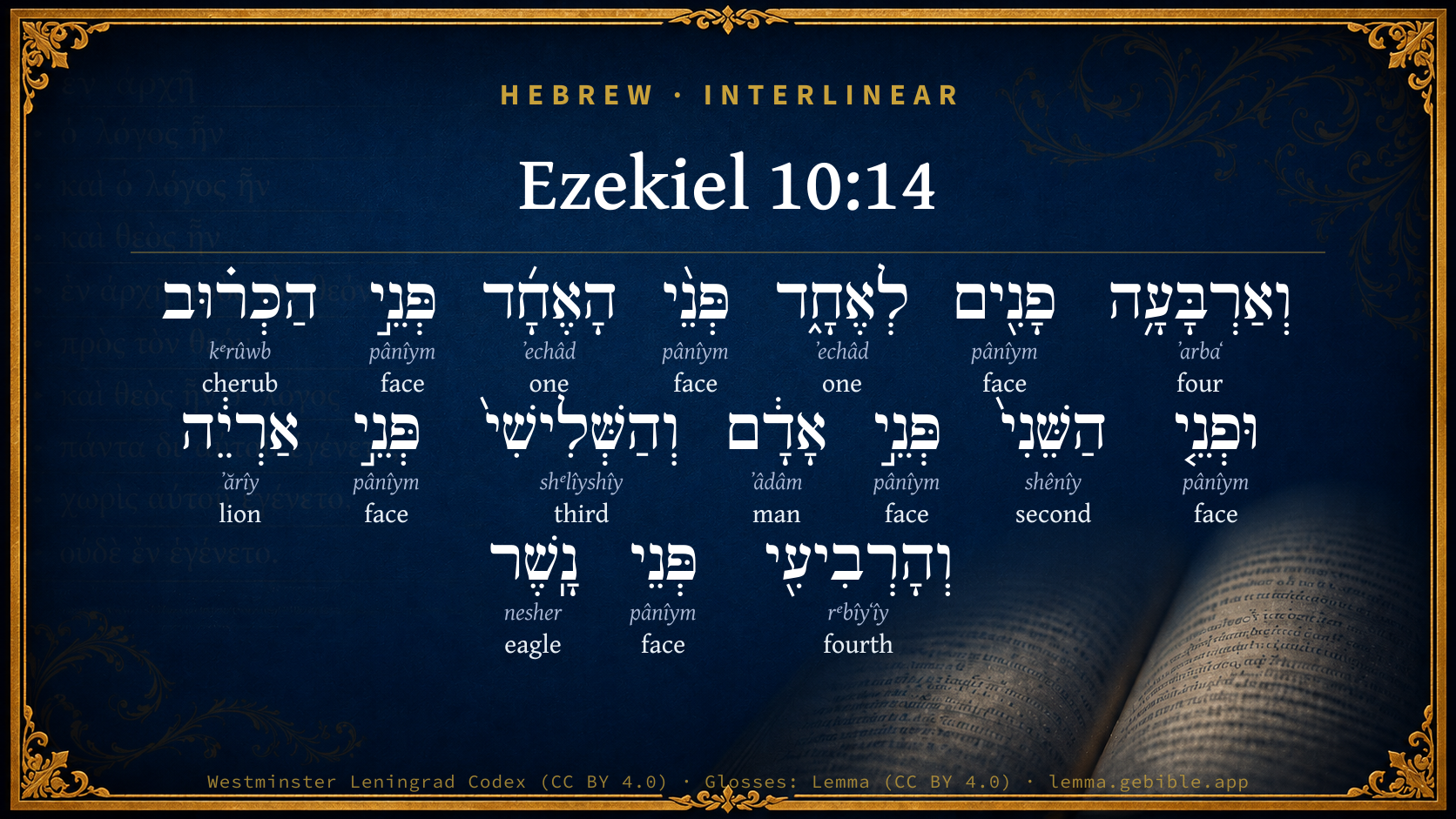
Ezekiel 10:14

Hebrew (Westminster Leningrad Codex) Ezekiel 10:14 appears in the Hebrew Old Testament. The text above is from the Westminster Leningrad Codex. Each word links to its Strong’s number, a concise gloss, and parsing drawn from the Open Scriptures Hebrew Bible morphology. Click any word for its full Brown-Driver-Briggs (BDB) entry.
Download image
Cite this verse

Ezekiel 10:14 (World English Bible). Public Domain. Lemma interlinear Bible study tool, https://lemma.gebible.app/v/ezekiel/10/14.

Show BibTeX & RIS
BibTeX
RIS
English Translation
Every one had four faces: the first face was the face of the cherub, and the second face was the face of a man, and the third face the face of a lion, and the fourth the face of an eagle.
World English Bible · Public Domain
Download a study sheet

One document with this verse’s original text, its word-by-word gloss line, the meaning frame, cross-references with their text, attributed commentary, and full source and license credits — printable, and it pastes into notes with its structure intact.

This verse Autodidact and up

Study sheet (.html) Plain text (.txt)

A passage Seminary Student

Up to 50 verses in one chapter. A passage sheet keeps up to 6 commentary sources and 12 cross-references per verse, in the order this page ranks them, and says so on the sheet whenever that leaves anything out. Ask for a single verse and you get the Autodidact verse sheet above.

Everything on this page stays free to read, with no account — the sheet is a download of what is already on screen, not access to it.

Want to remove ads? Support Godless Engineer
Compare translations 3

The same verse in 3 English versions, stacked beneath the original-language interlinear above. Click any original word for its lexicon entry.

Each is an independent rendering of the whole verse — the interlinear is not word-aligned to these translations.

Highlighted words mark where these versions differ — a whole-verse word diff, not a word-by-word alignment.

  • World English Bible Public Domain
    Every one had four faces: the first face was the face of the cherub, and the second face was the face of a man, and the third face the face of a lion, and the fourth the face of an eagle.
  • King James Version Public Domain
    And every one had four faces: the first face was the face of a cherub, and the second face was the face of a man, and the third the face of a lion, and the fourth the face of an eagle.
  • unfoldingWord Literal Text CC BY-SA 4.0
    They had four faces each; the first face was the face of a cherub, the second face was the face of a man, the third the face of a lion, and the fourth the face of an eagle.

unfoldingWord Literal Text — © unfoldingWord, licensed CC BY-SA 4.0. Word-aligned USFM3 via Door43 (git.door43.org/unfoldingWord/en_ult).

Versions to compare (up to 4)

3 of 4 selected

Show all 18 translations

Every available English version of this verse, each an independent rendering of the whole verse.

  • World English Bible Public Domain
    Every one had four faces: the first face was the face of the cherub, and the second face was the face of a man, and the third face the face of a lion, and the fourth the face of an eagle.
  • Berean Standard Bible Public Domain
    Each of the cherubim had four faces: the first face was that of a cherub, the second that of a man, the third that of a lion, and the fourth that of an eagle.
  • Majority Standard Bible Public Domain
    Each of the cherubim had four faces: the first face was that of a cherub, the second that of a man, the third that of a lion, and the fourth that of an eagle.
  • King James Version Public Domain
    And every one had four faces: the first face was the face of a cherub, and the second face was the face of a man, and the third the face of a lion, and the fourth the face of an eagle.
  • American Standard Version (1901) Public Domain
    And every one had four faces: the first face was the face of the cherub, and the second face was the face of a man, and the third face the face of a lion, and the fourth the face of an eagle.
  • Revised Version (1885) Public Domain
    And every one had four faces: the first face was the face of the cherub, and the second face was the face of a man, and the third the face of a lion, and the fourth the face of an eagle.
  • Geneva Bible (1599) Public Domain
    And euery beast had foure faces: the first face was the face of a Cherub, and the second face was the face of a man, and the thirde the face of a lyon, and the fourth the face of an Egle.
  • Douay-Rheims (1899) Public Domain
    And every one had four faces: one face was the face of a cherub, and the second face, the face of a man: and in the third was the face of a lion: and in the fourth the face of an eagle.
  • Young's Literal Translation Public Domain
    And four faces `are' to each; the face of the one `is' the face of the cherub, and the face of the second the face of man, and of the third the face of a lion, and of the fourth the face of an eagle.
  • Literal Standard Version CC BY-SA 4.0
    And four faces [are] to each; the face of the first [is] the face of the cherub, and the face of the second [is] the face of man, and of the third the face of a lion, and of the fourth the face of an eagle.
  • Unlocked Literal Bible CC BY-SA 4.0
    They had four faces each; the first face was the face of a cherub, the second face was the face of a man, the third the face of a lion, and the fourth the face of an eagle.
  • unfoldingWord Literal Text CC BY-SA 4.0
    They had four faces each; the first face was the face of a cherub, the second face was the face of a man, the third the face of a lion, and the fourth the face of an eagle.
  • Darby Bible Public Domain
    And every one had four faces: the first face was the face of a cherub, and the second face the face of a man, and the third the face of a lion, and the fourth the face of an eagle.
  • World Messianic Bible Public Domain
    Every one of them had four faces. The first face was the face of the cherub. The second face was the face of a man. The third face was the face of a lion. The fourth was the face of an eagle.
  • Webster's Bible Public Domain
    And every one had four faces: the first face was the face of a cherub, and the second face was the face of a man, and the third the face of a lion, and the fourth the face of an eagle.
  • Free Bible Version CC BY-SA 4.0
    Each of them had four faces: the first face was a cherub's face, the second a man's face, the third a lion's face, and the fourth an eagle's face.
  • Bible in Basic English Public Domain
    And every one had four faces: the first face was the face of a winged one, and the second was the face of a man, and the third the face of a lion, and the fourth the face of an eagle.
  • JPS Tanakh (1917) Public Domain
    And every one had four faces: the first face was the face of the cherub, and the second face was the face of a man, and the third the face of a lion, and the fourth the face of an eagle.

Literal Standard Version (2020), Covenant Press — licensed CC BY-SA 4.0. Text via the HelloAO Bible API (eBible.org). Unlocked Literal Bible (unfoldingWord) — licensed CC BY-SA 4.0. Text via the HelloAO Bible API (eBible.org). unfoldingWord Literal Text — © unfoldingWord, licensed CC BY-SA 4.0. Word-aligned USFM3 via Door43 (git.door43.org/unfoldingWord/en_ult). Free Bible Version, Dr. Jonathan Gallagher — licensed CC BY-SA 4.0. Text via the HelloAO Bible API (eBible.org).

Word by word

More ways to search: Search by grammar → Find every occurrence → Compare this word →

Practice this passage: Drill this verse → Learn its vocabulary →

נָֽשֶׁר
nesher
H5404
“eagle”
Noun, Common, Masculine, Singular, Absolute
Part of Speech
Noun
Type
Common
Gender
Masculine
Number
Singular
State
Absolute
Full BDB Definition

Origin: from an unused root meaning to lacerate

TWOT: 1437

eagle, vulture, griffon-vulture
  1. וְאַרְבָּעָ֥ה ʼarbaʻ H702 “and · four” Conjunction + Adjective, Cardinal number, Masculine, Singular, Absolute
  2. פָנִ֖ים pânîym H6440 “face(s)” Noun, Common, Both, Plural, Absolute
  3. לְאֶחָ֑ד ʼechâd H259 “to/for · one” Preposition + Adjective, Cardinal number, Masculine, Singular, Absolute
  4. פְּנֵ֨י pânîym H6440 “face(s) of” Noun, Common, Both, Plural, Construct
  5. הָאֶחָ֜ד ʼechâd H259 “the · one” Particle, Definite Article + Adjective, Cardinal number, Masculine, Singular, Absolute
  6. פְּנֵ֣י pânîym H6440 “face(s) of” Noun, Common, Both, Plural, Construct
  7. הַכְּר֗וּב kᵉrûwb H3742 “the · cherub” Particle, Definite Article + Noun, Common, Masculine, Singular, Absolute
  8. וּפְנֵ֤י pânîym H6440 “and · face(s) of” Conjunction + Noun, Common, Both, Plural, Construct
  9. הַשֵּׁנִי֙ shênîy H8145 “the · second” Particle, Definite Article + Adjective, Ordinal number, Masculine, Singular, Absolute
  10. פְּנֵ֣י pânîym H6440 “face(s) of” Noun, Common, Both, Plural, Construct
  11. אָדָ֔ם ʼâdâm H120 “man” Noun, Common, Masculine, Singular, Absolute
  12. וְהַשְּׁלִישִׁי֙ shᵉlîyshîy H7992 “and · the · third” Conjunction + Particle, Definite Article + Adjective, Ordinal number, Masculine, Singular, Absolute
  13. פְּנֵ֣י pânîym H6440 “face(s) of” Noun, Common, Both, Plural, Construct
  14. אַרְיֵ֔ה ʼărîy H738 “lion” Noun, Common, Masculine, Singular, Absolute
  15. וְהָרְבִיעִ֖י rᵉbîyʻîy H7243 “and · the · fourth” Conjunction + Particle, Definite Article + Adjective, Ordinal number, Masculine, Singular, Absolute
  16. פְּנֵי pânîym H6440 “face(s) of” Noun, Common, Both, Plural, Construct

About this verse

These counts appear in no published source. They are computed here, from the morphology-tagged text and Lemma’s own curated glosses. What Lemma adds →

17
words
10
distinct lemmas
Prophets
section

Shared distinctive vocabulary

נָֽשֶׁר eagle H5404 occurs in 26 verses of the Hebrew Bible. Also found in:

Grammatical profile

  • 11 nouns
  • 6 adjectives

Repetition

Words recur within this verse — often emphatic in Hebrew:

  • פָנִ֖ים face H6440 ×7
  • לְאֶחָ֑ד one H259 ×2

Cross-references

5

Topical passages linked to Ezekiel 10:14 in the Treasury of Scripture Knowledge — connected by theme and wording, ordered by reader-vote popularity; previews shown in the World English Bible.

  • Revelation 4:7 The first creature was like a lion, and the second creature like a calf, and the third creature had a face like a man, and the fourth was like a flying eagle.
  • 1 Kings 7:36 On the plates of the stays of it, and on the panels of it, he engraved cherubim, lions, and palm trees, according to the space of each, with wreaths round about.
  • Ezekiel 10:21 Every one had four faces, and every one four wings; and the likeness of the hands of a man was under their wings.
  • 1 Kings 7:29 and on the panels that were between the ledges were lions, oxen, and cherubim; and on the ledges there was a pedestal above; and beneath the lions and oxen were wreaths of hanging work.
  • Ezekiel 1:6–10 Everyone had four faces, and everyone of them had four wings.

Cross-references courtesy of OpenBible.info (CC BY 4.0).

Hebrew and Greek witnesses Masoretic Hebrew ↔ Greek Septuagint

The same verse in the two great witnesses to the Old Testament, shown verse-for-verse.

These are two independent witnesses, not word-aligned to each other, and the Septuagint is shown in lemma (dictionary) form.

Hebrew Ezekiel 10:14 Masoretic · Westminster Leningrad Codex

וְאַרְבָּעָ֥ה פָנִ֖ים לְאֶחָ֑ד פְּנֵ֨י הָאֶחָ֜ד פְּנֵ֣י הַכְּר֗וּב וּפְנֵ֤י הַשֵּׁנִי֙ פְּנֵ֣י אָדָ֔ם וְהַשְּׁלִישִׁי֙ פְּנֵ֣י אַרְיֵ֔ה וְהָרְבִיעִ֖י פְּנֵי נָֽשֶׁר

Every one had four faces: the first face was the face of the cherub, and the second face was the face of a man, and the third face the face of a lion, and the fourth the face of an eagle.

World English Bible · Public Domain

On this verse, The Cambridge Bible for Schools and Colleges discusses the Septuagint’s reading. Read the note in Commentary ↓

Hebrew: Westminster Leningrad Codex (CC BY 4.0). Greek: Septuagint (public domain); English from a public-domain English Septuagint. How the Septuagint differs from the Hebrew →

Targum (Aramaic paraphrase)

1

The Targum is the ancient Jewish Aramaic paraphrase of the Hebrew Scriptures — an interpretive translation, not the Hebrew text itself. Onkelos (literal) and Pseudo-Jonathan (expansive) render the Torah, and Jonathan the Prophets. Coverage is partial: where no permissively-licensed English translation exists for a verse, only the Aramaic is shown. This is verse-level text, not a word-by-word alignment to the Hebrew.

  1. Targum Jonathan Prophets (Joshua–Malachi)
    וְאַרְבָּעָא אַפִּין לְחַד אַפֵּי חַד אַפֵּי כְרוּבָא וְאַפֵּי תִנְיָנָא אַפֵּי אֱנָשָׁא וּתְלִיתָאָה אַפֵּי אַרְיָא וּרְבִיעָאָה אַפֵּי נִשְׁרָא:

    (no public-domain English translation for this verse)

    Targum Jonathan — Aramaic: “Mikraot Gedolot” (public domain). English: “Sefaria Community Translation” (CC0 1.0 (public-domain dedication)); “London "Chaldee Paraphrase," 1871” (public domain). Text via Sefaria.

Commentary

Notes on Ezekiel 10:14 from classic Christian and Jewish commentators (each source and its license shown beneath its notes). The classic Christian expositions comment on the surrounding passage and are grouped to its opening verse, so a note may address several verses; the Jewish commentaries on the Tanakh (Rashi and others) are per-verse, so they appear only where the commentator wrote on this verse.

Lemma curates 59 commentaries, every one of them public domain or Creative Commons licensed, each selected and text-cleaned for this edition rather than reprinted as found. About our sources →

Trapp's Complete Commentary

John Trapp

Eze 10:14 And every one had four faces: the first face [was] the face of a cherub, and the second face [was] the face of a man, and the third the face of a lion, and the fourth the face of an eagle.

Ver. 14. The face of a cherub,] i.e., Humana quidem, sed splendidissima, saith Junius: Facies pueri alati, saith another. There are those who tell us, that in the Syriac tongue, the word cherub is taken from a word which signifieth drawing the plough, which is the bullock’s proper labour. We must believe therefore, say they, that cherub signifieth properly the figure of a bullock, under which hieroglyphically was represented an angel. The laborious preacher’s face shall once shine as an angel’s.

John Trapp, A Commentary or Exposition upon All the Books of the Old and New Testament (1647–1656) — public domain. Text from a community e-Sword module.

The Biblical Illustrator

Joseph S. Exell

Eze_10:14

Every one had four faces; the first face was the face of a cherub.

The Christian ministry

The text seems to have a decided reference to the angelic hosts,--those ministers of God who do His pleasure. To resemble these should be the great desire of every Christian, that Gods will may be done on earth even as it is done in heaven. But especially should this be the case with the Christian minister: his office greatly resembles that of the holy intelligences above; he is a messenger of God to mankind, an angel of the Church, and therefore well does it become him to study the character and emulate the holiness of cherubim and seraphim in heaven.

I. The first face was that of a cherub. The symbol--

1. Of exalted dignity. Dwelling around the throne of Deity. His especial ambassadors, etc. No office can be more exalted than that of the Christian ministry. It is that to which Jehovah appointed His own Son. One writer quaintly remarks, God had only one Son, and He made a preacher of Him. Workers together with God, etc.

2. Of elevated devotion. They are represented as holding great intimacy and close fellowship with God. How indispensable that the ministers of Christ live near to the Lord, hold close communion with the skies.

3. Of distinguished holiness. Ye that bear the vessels of the Lord, etc., as the priests of old. Not only partakers of the ordinary graces of the Spirit, but adorned with the mature fruits of holiness to the glory of God.

II. The second symbol is that of a man. With the sanctity of the cherub is to be united the sympathy of sanctified humanity. As men, Christian ministers are--

1. To be influenced by their relationship to Jesus as Head of the Church. They should have His meekness, humility, lowliness, desire to labour, readiness to suffer, etc.

2. To feel for their fellow sinners peculiar compassion. They are their brethren, of one blood, spirit, and destiny.

3. To know their own insufficiency and entire dependence on Gods blessing. This treasure in earthen vessels, etc. Paul planteth, etc.

III. The third emblem was the face of a lion. By this we are to understand the strength and magnanimity which are necessary to the ministerial office. The Christian minister must be strong in the grace which is in Christ Jesus. He must be strong to resist evil, to stand firm in the conflict, and to conduct himself as a man of God.

IV. The fourth symbol is that of the eagle. By this--

1. The true character of the ministers work is portrayed. He has to do with spiritual things. He teaches not philosophy, science, economy, legislation, but the truths of the kingdom of God, the knowledge of the way of salvation.

2. The symbol of the eagle may be designed also to be expressive of their ardour and zeal The minister of Jesus is to be instant, earnest, energetic, zealously affected in every good thing.

3. His soul is to yearn with intense anxiety over perishing sinners. Application--

1. Let the solemn character of the office ever be cherished, and a lively sense of its importance be maintained from day to day.

2. Let the glorious results of faithfulness in the Saviours service animate to constancy and perseverance. (J. Burns, D. D.)

The combination of faculties in spiritual life

In the power of this life it does not matter where we are, or under what conditions we are found, we find a sufficiency of grace. Mr. Ruskin, in his Loves Meinie, describes the Phalerope, a strange bird living out of the way of human beings, in the Polar regions of Greenland, Norway and Lapland, which he calls The Arctic Fairy. It is a central type of all bird power, but with elf gifts added: it flies like a lark, trips on water lily leaves like a fairy, swims like a duck, and roves like a seagull, having been seen sixty miles from land; and finally, though living chiefly in Lapland and Iceland, it has been seen serenely swimming and catching flies in the hot water of the geysers, in which a man could not bear his hand. As the above bird has a combination of faculties, so the gift of Eternal Life as personified in Christ bestows faculties of grace which enable us to stand in the clear light of Gods holy throne, which empower us to bear trials fiery ordeal, which equip us for conflict with the great adversary, which endow us with endurance in treading lifes rough way, which energise with strength in the work of the Gospel, which environ us with peace and joy in time of persecution, and which ennoble our whole being, for we are lifted into the realm of Gods dear Son. (Footsteps of Truth.)

The Biblical Illustrator, edited by Joseph S. Exell (c. 1880s–1900s) — public domain. Text from a community e-Sword module.

Joseph Benson's Commentary

Eze 10:14. And every one had four faces — See notes on Eze 1:6-10. The first had the face of a cherub — That is, of an ox, as appears by comparing this verse with Eze 1:10. The word cherub, indeed, originally signifies an ox. The several faces are here represented in a different order from the description given of them Eze 1:10, of which difference this reason may be assigned. In the first chapter the prophet saw this vision coming out of the north, and advancing southward, (Eze 10:4,) where the face of a man, being placed on the south side, was first in view. The lion, being on the east part, was toward his right hand; the ox, being placed toward the west, was on his left; and the eagle was toward the north. This interpretation is justified from the situation of the standards of the several tribes of Israel in the wilderness, (Num 2:2; Num 2:10; Num 2:18; Num 2:25,) where Judah, whose standard was a lion, was placed on the east side; Reuben, whose standard was a man, was placed on the south; Ephraim, whose standard was an ox, was placed on the west; and Dan, whose standard was an eagle, was placed on the north side. Here the prophet is supposed to stand westward of the Shechinah, as that was moving eastward: so the ox was first in his view.

Joseph Benson's Commentary on the Old and New Testaments (1811–1818) — public domain. Text from a community e-Sword module.

Jamieson, Fausset & Brown

Robert Jamieson, A. R. Fausset & David Brown

cherub--but in Eze 1:10 it is an ox. The chief of the four cherubic forms was not the ox, but man. Therefore "cherub" cannot be synonymous with "ox." Probably Ezekiel, standing in front of one of the cherubim (namely, that which handed the coals to the man in linen), saw of him, not merely the ox-form, but the whole fourfold form, and therefore calls him simply "cherub"; whereas of the other three, having only a side view, he specifies the form of each which met his eye [FAIRBAIRN]. As to the likelihood of the lower animals sharing in "the restoration of all things," see Isa 11:6; Isa 65:25; Rom 8:20-21; this accords with the animal forms combined with the human to typify redeemed man.

Jamieson, Fausset & Brown — Commentary Critical and Explanatory on the Whole Bible (1871) — public domain (CC PDM 1.0). Text via the HelloAO Bible API.

Adam Clarke's Commentary

Verse 14. The first - was the face of a cherub] In Eze 1:10, this is called the "face of an ox;" here, the "face of a cherub:" hence, a cherub was in the likeness of an ox, at least, as to its head. כרוב kerub never occurs as a verb; and its meaning cannot be precisely ascertained. Parkhurst thinks the כ caph to be here the note of similitude; and then translates כ ke, "like," רב rab or רוב rob, "the mighty one;" and, in consequence, makes the cherubim an emblem of the Holy Trinity. See his lengthy Dissertation under כרב in his Hebrew and English Lexicon.

Adam Clarke's Commentary on the Bible (1810–1826) — public domain. Text from a community e-Sword/MySword module.

John Calvin's Commentaries

Now Ezekiel descends to the animals themselves, which he now pronounces to be cherubim, yet under another form than that in the sanctuary. We said in the first chapter why he saw four cherubim since only two surrounded the ark of the covenant. This variation may seem absurd, for God was accustomed to accommodate his visions to the forms of the law, that he might hold the people in the simplicity of the law. But the reason which I brought forward in the first chapter is by no means to be rejected, because in truth so great was the grossness and rudeness of the people, that it was necessary to bend aside from the first and genuine institution. God had been content with two cherubim, and in that number doubtless he represented all angels; but he was surrounded on the right hand and on the left that he might show the people that he could never be wanting in power to bring them help. Now the Jews were so stupified that they shut up God in heaven, because scarcely any recognition of his providence then remained, as we have already seen. Since, therefore, the Jews thus excluded God from the government of the world, he was obliged to use a new form, different from that of the law, that they might really perceive that God’s government extended over the four quarters of the world. And there is no doubt that by the four living creatures God reminded them that nothing took place in the world without his control. But when the world is described, its four quarters or regions are put.

Now, therefore, we understand why the Prophet saw not two cherubim only but four: the same reason for difference in the form of the cherubim is also added. For the cherubim were like winged boys: but the Prophet says, that each of the living creatures was furnished with four heads. This was doubtless an assistance towards rousing’ the people from their torpor, because the Jews could not otherwise understand the meaning and the force of the angelic inspiration by which God governs the whole world: hence after four living creatures had been presented before the Prophet, four heads were also given to each living creature, namely, the head of an ox, of a man, of a lion, and of an eagle We said in the first chapter, that by these heads all living creatures were represented to us: for although trees, and the sea, and rivers, and herbs, and the air, and stars, and sun, are parts of the universe, yet in living beings there is some nearer approach to God, and some clearer display of his energy: for there is motion in a man, in an ox, in an eagle, and in a lion. These animals comprehend within themselves all parts of the universe by that figure of speech by which a part represents the whole. Meanwhile since angels are living creatures we must observe in what sense God attributes to angels themselves the head of a lion, an eagle, and a man: for this seems but little in accordance with their nature. But he could not better express the inseparable connection which exists in the motion of angels and all creatures. We have said, that angels are not called the powers of God in vain: now when a lion either roars or exercises its strength, it seems to move by its own strength, so also it may be said of other animals. But God here says, that the living creatures are in some sense parts of the angels though not of the same substance, for this is not to be understood of similarity of nature but. of effect. We are to understand, therefore, that while men move about and discharge their duties, they apply themselves in different directions to the objects of their pursuit, and so also do wild beasts; yet there are angelic motions underneath, so that neither men nor animals move themselves, but their whole vigor depends on a secret inspiration.

A difficult question remains, namely, why Ezekiel says here that the first head was that of a cherub, while in the first chapter he said it was that of an ox. (Ezekiel 10:10.) Some escape the difficulty by saying that it appeared at a distance like an ox, but a nearer inspection showed it to be a cherub, But this is too forced, so that I have no doubt that there is some difference in the vision; nor does what he afterwards adds, that this was the living creature which he saw at the river Chebar, oppose this; for he calls anything which is like another, and has the same object, the same thing. Paul says their fathers in the desert ate the same spiritual food, and drank the same spiritual drink. (1 Corinthians 10:3, 4.) But we know how different was the symbol manna, and the water flowing from the rock, from the sacred Supper which Christ left for us; but as I have already said, since there is an affinity between the sacred symbols, they are to be referred to the same scope. Thus Paul says, the same drink and the same food, and Ezekiel says, it was the same living creature. Meanwhile, there is nothing out of place in our saying that the vision is slightly changed, For when God opened himself at first, the Prophet was on profane ground, now the vision is added more in the form of the sanctuary, because he was seized by the Spirit, that he might see the abominations by which the Jews had stained the temple, as already stated. When therefore the face of an ox was presented to the Prophet, near the river Chebar, that he might now understand that they were angels, or living’ cherubs, and that the four heads may not distract him, the face of a cherub is presented to him; so that, being admonished by this sign, he may determine that each living creature is nothing else than an angel or cherub, although it differs from the received form, of which God had proposed to Moses an example on the mount.

We now understand why God turned aside from the course prescribed in his law, when he offered this vision to his Prophet; because, in truth, the people had so degenerated from all sense of piety, that they could not be taught by the simple plan or rule of the law, but had need of gross remembrancers. This is one explanation. Then again four living creatures are employed, that God may signify that his energy is diffused through the whole universe. Then, again, four heads are assigned to each living creature, that we may know that no part of the world is free from his providence, and from that secret inspiration which is efficacious through angels. Then as to the last clause, where the face of an ox appeared to the Prophet before, now he beholds that of a cherub, that he may understand that these living creatures are nothing else than angels; but the reason why God endues his angels with a new form, is because the slothfulness of the people was so great, that they did not recognize what they ought to have been familiar with, for it was not God’s fault that they had not imbibed the doctrine of piety from their earliest childhood. Now it follows —

John Calvin's Commentaries (1540-1563) — public domain. Text from the Calvin Translation Society English edition (1840s-50s) via the Christian Classics Ethereal Library (ccel.org). Calvin's coverage is partial (roughly two-thirds of the Bible); uncommented books and verses are honest gaps, never fabricated. The 19th-century editor's footnotes and remarks are omitted so the notes are faithfully Calvin's own voice.

The Cambridge Bible for Schools and Colleges

gen. ed. J. J. S. Perowne

14. The verse, which LXX. omits, is difficult. The words rendered “first face” might have that sense or the sense “one face” at a pinch, but mean naturally “face of the first;” and those rendered “the second face” can hardly mean anything but “the face of the second,” for it is precarious to extend constructions like Jer_46:2 “the year of the fourth” (year) = the fourth year, to other words than “year.” The easiest course would be to omit the word “face” before “first” and “second,” as in fact it does not stand before “third” and “fourth;” or perhaps it might be enough to omit it before “second” and assume that the anomalous constr. “one face” (Lev_24:22; 2Ki_12:10) had led to the insertion of “face” before “the second.”

face of a cherub] Of the cherub. As the other faces were those of a man, a lion, and an eagle, this face must be that of the ox (ch. Eze_1:10). Why should this be called the face of the cherub? It is said that the winged bulls at the portals of Assyrian temples are called cherubs in Assyrian (Fried. Del. Paradies, p. 153, Lenormant, Les origines de l’histoire, p. 118), but these winged bulls have not the face of an ox but that of a man, and there is no probability that in Israel the cherubs in the temple were ox-faced.

It seems possible to explain the verse only by making some suppositions which may appear rather artificial, viz. first that the prophet looking at the phenomenon of the chariot and four creatures as a whole saw four faces presented to him, one (and a different one) by each of the creatures, and that he named the faces which were thus presented to him. We should then translate “the face of the first,” “the face of the second” &c., though this seems opposed to the meaning of the first words of the verse. And secondly, that he assumes the side of the chariot presented to him not to be the front, but regards the side looking in another direction as the front or head. His view of the chariot is taken when it rose and proceeded eastward (Eze_10:19); and he regards the side of the chariot turned to the east as the front, and he calls the cherub which led the movement to the east the cherub. Further at this moment the chariot and cherubim were standing on the south side of the house (Eze_10:3), and the prophet’s position was probably near the house and thus to the north or left of the phenomenon. Now the ox-face of all the cherubs was on their left (ch. Eze_1:10), that is, in the case of a cherub leading the movement eastward, toward the north where the prophet presumably was standing. Thus he would see the ox-face of the first cherub (whose human face was eastward, leading the whole chariot). He would also see the man’s face of the cherub on the side of the chariot facing himself, the lion’s face of the cherub who stood on the west side of the chariot, and the eagle’s face of the cherub on the south side of the chariot, for all the eagle-faces looked inward to the centre of the chariot. This is the order followed in the verse.

The Cambridge Bible for Schools and Colleges (gen. ed. J. J. S. Perowne; Cambridge University Press, 1878–1918) — public domain. Text from a community e-Sword module.

John Gill's Exposition

And everyone had four faces,.... That is, everyone of the wheels, for of these the words are continued; and which agrees with Eze 1:15; See Gill on Eze 1:15,

the first face was the face of a cherub; this being in the room of the ox's face, Eze 1:10, shows that the face of an ox and a cherub are the same; and that the living creatures have the general name of cherubim, from the face of an ox; and are so called from which in the Syriac and Chaldee languages signifies to "plough", that creature being made use of in such service:

and the second face was the face of a man, and the third the face of a lion, and the fourth the face of an eagle; how these are applicable to Gospel churches, and the true members of them; see Gill on Eze 1:15.

John Gill's Exposition of the Whole Bible (1746–1763) — public domain (CC PDM 1.0). Text via the HelloAO Bible API.

Albert Barnes' Notes on the Bible

The first face ... - The face of the first was the face of the cherub, and the face of the second was the face of a man, and the third the face of a lion and the fourth the face of an eagle. Of the four faces of each cherub, the seer names only one - the face looking in the direction in which that cherub leads the motion of the chariot. The face of the cherub which presented itself to the seer was that of “an ox.” When he looking northward first saw the chariot the “ox-face” was on the left side Eze 1:10. This would make the ox-face look eastward, and it is not unlikely that the man might approach the chariot from the southeastern part of the inner court.

Albert Barnes' Notes on the Bible (1834–1885) — public domain. Text from a community e-Sword/MySword module.

Haydock's Catholic Bible Commentary

Cherub, or "ox." All four seem to have had the resemblance of a man, but one more than the rest, which had respectively the appearance rather of an ox, a lion, or an eagle: (Worthington) or the ox was predominant in all, as both the head and feet were of it; (Calmet) which, however, does not constitute the greatest part, chap. i. 5. (Haydock)

George Leo Haydock (1774–1849), Haydock's Catholic Family Bible and Commentary, 1859 edition — public domain. Excludes Psalms (Douay-Rheims chapter numbering differs from Protestant) and Deuterocanonical books (Catholic canon only).

Matthew Poole's English Annotations

Every one, of the living creatures, Eze 1:6, the cherubims in this chapter.

The first face, which each had.

The face of a cherub: in Babylon, at the river Chebar, he saw somewhat a different face; in the temple he seeth a cherub, one of the faces, which leads us to look on angels employed in those revolutions.

The second face, the second which each cherubim had, was a man’s face, &c.: see Eze 1:6,10.

Matthew Poole's English Annotations on the Holy Bible (1683–1685) — public domain. Text from a community e-Sword/MySword module.

Whedon's Commentary on the Bible

Daniel D. Whedon

14. This is a description corresponding exactly to that given in Eze_1:10, except that here, instead of “the face of an ox,” we have the face of a cherub. Many explanations of this have been attempted, but none seem satisfactory. Some suppose that Ezekiel calls the face of the ox the face of “the cherub” (Hebrews) — referring to the one which had given the coal of fire to the man in linen; others think that he refers thus to it because the movement of the chariot was in the direction which it faced; others imagine that he intends to express here the idea that the typical cherub form was that of an ox, while still others venture to hint that the prophet had changed the face of an ox into the face of the cherub, because the former notion had proven distasteful to his companions in exile. The last two suppositions are contradicted by many direct statements in both visions; the other hypotheses do not seem very convincing, and unless a future examination of ancient manuscripts shall show a corruption of the text it may be best frankly to acknowledge that we do not know why the prophet makes this change. Professor Toy omits the verse from his revised text.

Daniel D. Whedon (gen. ed.), Commentary on the Old and New Testaments (1874–1909) — public domain. Text from a community e-Sword module.

The Pulpit Commentary

The first face was the face of a cherub, etc.; better, with the Revised Version, of the cherub. This takes the place of "the face of an ox" Eze_1:10, and it is first in order instead of being, as there, the third. It is as though, in this second vision, he recognizes that this was emphatically the cherubic form. Possibly the article indicates that this was the form that had given the "coals of fire" in ver. 7. Each form, we must remember, had the four faces, but the prophet names the face which each presented to him as he gazed.

The Pulpit Commentary (1880–1919), ed. H.D.M. Spence-Jones & Joseph S. Exell — public domain. Text from a community e-Sword module.

John Wesley's Explanatory Notes

Everyone - Of the living creatures, chap. i, 6.

John Wesley, Explanatory Notes Upon the Whole Bible (1754–1765) — public domain. Text via the GEBible commentary corpus.

Rashi

Rabbi Shlomo Yitzchaki (Rashi)

the face of one was the face of the cherub That was the face of the ox, which was transformed into a cherub.

Rashi on the Tanakh — English translations: “The Judaica Press complete Tanach with Rashi, translated by A. J. Rosenberg” (CC BY 4.0); “Pentateuch with Rashi's commentary by M. Rosenbaum and A.M. Silbermann, 1929-1934” (public domain); “The Metsudah Tanach series, Lakewood, N.J” (CC BY 4.0); and “The Book of Joshua, Metsudah Publications, 1997” (CC BY 4.0). Text via Sefaria.

Lesson kit

Teaching starters — assembled from the data on this page, not authored interpretation. Every prompt links to the verse data it draws on. Edit before teaching.

Ezekiel, in the Prophets, opens this verse with 17 words (10 distinct Hebrew lemmas). Its most distinctive word is nesher (“eagle”). A historical commentator’s framing appears above. Read the whole chapter for the surrounding context.

Discussion questions

  1. What does “eagle” (nesher) contribute to the verse as a whole?
  2. How does Exodus 19:4, which shares the word «eagle», read alongside this verse?
  3. What does the repetition of “face” (7× in this one verse) do in this verse?
  4. These translations render this verse differently. What is at stake in choosing one wording over another?
  5. Compare how Trapp's Complete Commentary and The Biblical Illustrator read this verse. Where do they agree or differ?

Things to notice

Reading settings

Reading text

Shown beneath each verse's original-language words.

Old Testament
Old Testament edition

Read the OT as the Masoretic Hebrew (MT) or the Greek Septuagint (LXX).

English shown for the Greek Septuagint (in the Hebrew ↔ Greek comparison).

Comparing translations? Open the Compare panel on any verse page to stack up to four side by side.