
Judges 9:21

Hebrew (Westminster Leningrad Codex) Judges 9:21 appears in the Hebrew Old Testament. The text above is from the Westminster Leningrad Codex. Each word links to its Strong’s number, a concise gloss, and parsing drawn from the Open Scriptures Hebrew Bible morphology. Click any word for its full Brown-Driver-Briggs (BDB) entry.
Download image
Cite this verse

Judges 9:21 (World English Bible). Public Domain. Lemma interlinear Bible study tool, https://lemma.gebible.app/v/judges/9/21.

Show BibTeX & RIS
BibTeX
RIS
English Translation
Jotham ran away, and fled, and went to Beer, and lived there, for fear of Abimelech his brother.
World English Bible · Public Domain
Download a study sheet

One document with this verse’s original text, its word-by-word gloss line, the meaning frame, cross-references with their text, attributed commentary, and full source and license credits — printable, and it pastes into notes with its structure intact.

This verse Autodidact and up

Study sheet (.html) Plain text (.txt)

A passage Seminary Student

Up to 50 verses in one chapter. A passage sheet keeps up to 6 commentary sources and 12 cross-references per verse, in the order this page ranks them, and says so on the sheet whenever that leaves anything out. Ask for a single verse and you get the Autodidact verse sheet above.

Everything on this page stays free to read, with no account — the sheet is a download of what is already on screen, not access to it.

Want to remove ads? Support Godless Engineer
Compare translations 3

The same verse in 3 English versions, stacked beneath the original-language interlinear above. Click any original word for its lexicon entry.

Each is an independent rendering of the whole verse — the interlinear is not word-aligned to these translations.

Highlighted words mark where these versions differ — a whole-verse word diff, not a word-by-word alignment.

  • World English Bible Public Domain
    Jotham ran away, and fled, and went to Beer, and lived there, for fear of Abimelech his brother.
  • King James Version Public Domain
    And Jotham ran away, and fled, and went to Beer, and dwelt there, for fear of Abimelech his brother.
  • unfoldingWord Literal Text CC BY-SA 4.0
    Then Jotham escaped and fled, and he went to Beer. And he dwelled there from the face of Abimelech his brother.

unfoldingWord Literal Text — © unfoldingWord, licensed CC BY-SA 4.0. Word-aligned USFM3 via Door43 (git.door43.org/unfoldingWord/en_ult).

Versions to compare (up to 4)

3 of 4 selected

Show all 18 translations

Every available English version of this verse, each an independent rendering of the whole verse.

  • World English Bible Public Domain
    Jotham ran away, and fled, and went to Beer, and lived there, for fear of Abimelech his brother.
  • Berean Standard Bible Public Domain
    Then Jotham ran away, escaping to Beer, and he lived there for fear of his brother Abimelech.
  • Majority Standard Bible Public Domain
    Then Jotham ran away, escaping to Beer, and he lived there for fear of his brother Abimelech.
  • King James Version Public Domain
    And Jotham ran away, and fled, and went to Beer, and dwelt there, for fear of Abimelech his brother.
  • American Standard Version (1901) Public Domain
    And Jotham ran away, and fled, and went to Beer, and dwelt there, for fear of Abimelech his brother.
  • Revised Version (1885) Public Domain
    And Jotham ran away, and fled, and went to Beer, and dwelt there, for fear of Abimelech his brother.
  • Geneva Bible (1599) Public Domain
    And Iotham ran away, and fled, and went to Beer, and dwelt there for feare of Abimelech his brother.
  • Douay-Rheims (1899) Public Domain
    And when he had said thus he fled, and went into Bera: and dwelt there for fear of Abimelech his brother.
  • Young's Literal Translation Public Domain
    And Jotham hasteth, and fleeth, and goeth to Beer, and dwelleth there, from the face of Abimelech his brother.
  • Literal Standard Version CC BY-SA 4.0
    And Jotham hurries, and flees, and goes to Beer, and dwells there, from the face of his brother Abimelech.
  • Unlocked Literal Bible CC BY-SA 4.0
    Jotham fled and ran away, and he went to Beer. He lived there because it was far away from Abimelech, his brother.
  • unfoldingWord Literal Text CC BY-SA 4.0
    Then Jotham escaped and fled, and he went to Beer. And he dwelled there from the face of Abimelech his brother.
  • Darby Bible Public Domain
    And Jotham ran away and fled, and went to Beer and dwelt there, for fear of Abim'elech his brother.
  • World Messianic Bible Public Domain
    Jotham ran away and fled, and went to Beer and lived there, for fear of Abimelech his brother.
  • Webster's Bible Public Domain
    And Jotham ran away, and fled, and went to Beer, and dwelt there, for fear of Abimelech his brother.
  • Free Bible Version CC BY-SA 4.0
    Then Jotham escaped and ran away. He went to Beer and stayed there because of the threat of Abimelech his brother.
  • Bible in Basic English Public Domain
    Then Jotham straight away went in flight to Beer, and was living there for fear of his brother Abimelech.
  • JPS Tanakh (1917) Public Domain
    And Jotham ran away, and fled, and went to Beer, and dwelt there, for fear of Abimelech his brother.

Literal Standard Version (2020), Covenant Press — licensed CC BY-SA 4.0. Text via the HelloAO Bible API (eBible.org). Unlocked Literal Bible (unfoldingWord) — licensed CC BY-SA 4.0. Text via the HelloAO Bible API (eBible.org). unfoldingWord Literal Text — © unfoldingWord, licensed CC BY-SA 4.0. Word-aligned USFM3 via Door43 (git.door43.org/unfoldingWord/en_ult). Free Bible Version, Dr. Jonathan Gallagher — licensed CC BY-SA 4.0. Text via the HelloAO Bible API (eBible.org).

Word by word

More ways to search: Search by grammar → Find every occurrence → Compare this word →

Practice this passage: Drill this verse → Learn its vocabulary →

בְּאֵ֑רָה
Bᵉʼêr
H876
“Beer · toward”
Noun, Proper + Suffix, Demonstrative
Part of Speech
Noun
Type
Proper
Full BDB Definition

Origin: the same as H875

TWOT: None

Beer = "well" - an oasis rest in desert during the Exodus - a city west of Hebron
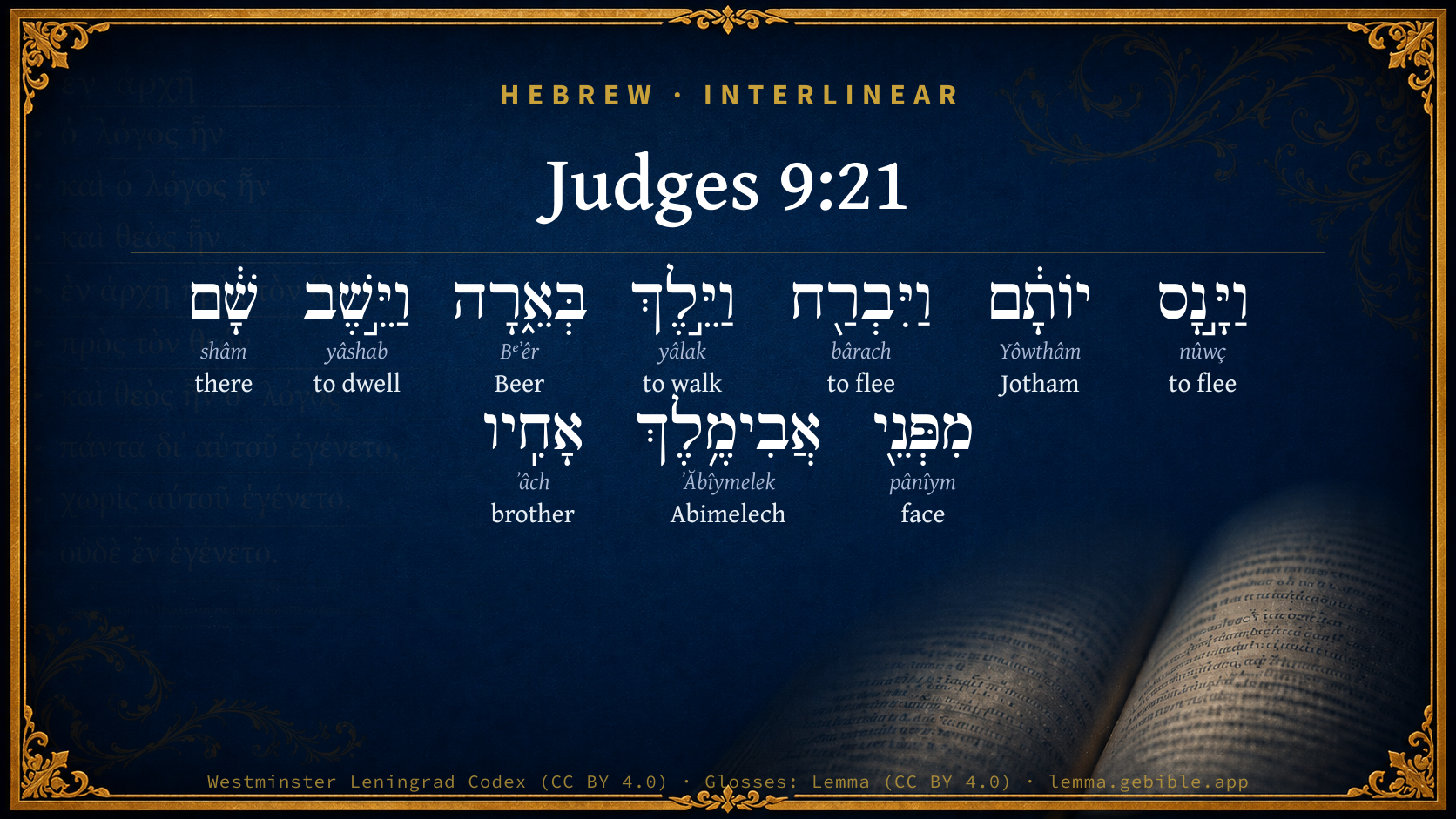
  1. וַיָּ֣נָס nûwç H5127 “and · to flee” Conjunction + Verb, Qal, Sequential Imperfect, 3rd Person, Masculine, Singular
  2. יוֹתָ֔ם Yôwthâm H3147 “Jotham” Noun, Proper
  3. וַיִּבְרַ֖ח bârach H1272 “and · to flee” Conjunction + Verb, Qal, Sequential Imperfect, 3rd Person, Masculine, Singular
  4. וַיֵּ֣לֶךְ yâlak H3212 “and · to walk” Conjunction + Verb, Qal, Sequential Imperfect, 3rd Person, Masculine, Singular
  5. וַיֵּ֣שֶׁב yâshab H3427 “and · to dwell” Conjunction + Verb, Qal, Sequential Imperfect, 3rd Person, Masculine, Singular
  6. שָׁ֔ם shâm H8033 “there” Adverb
  7. מִפְּנֵ֖י pânîym H6440 “from · face(s) of” Preposition + Noun, Common, Both, Plural, Construct
  8. אֲבִימֶ֥לֶךְ ʼĂbîymelek H40 “Abimelech” Noun, Proper
  9. אָחִֽיו ʼâch H251 “brother · his” Noun, Common, Masculine, Singular, Construct + Suffix, Personal, 3rd Person, Masculine, Singular

About this verse

These counts appear in no published source. They are computed here, from the morphology-tagged text and Lemma’s own curated glosses. What Lemma adds →

10
words
10
distinct lemmas
Historical
section

Notable vocabulary

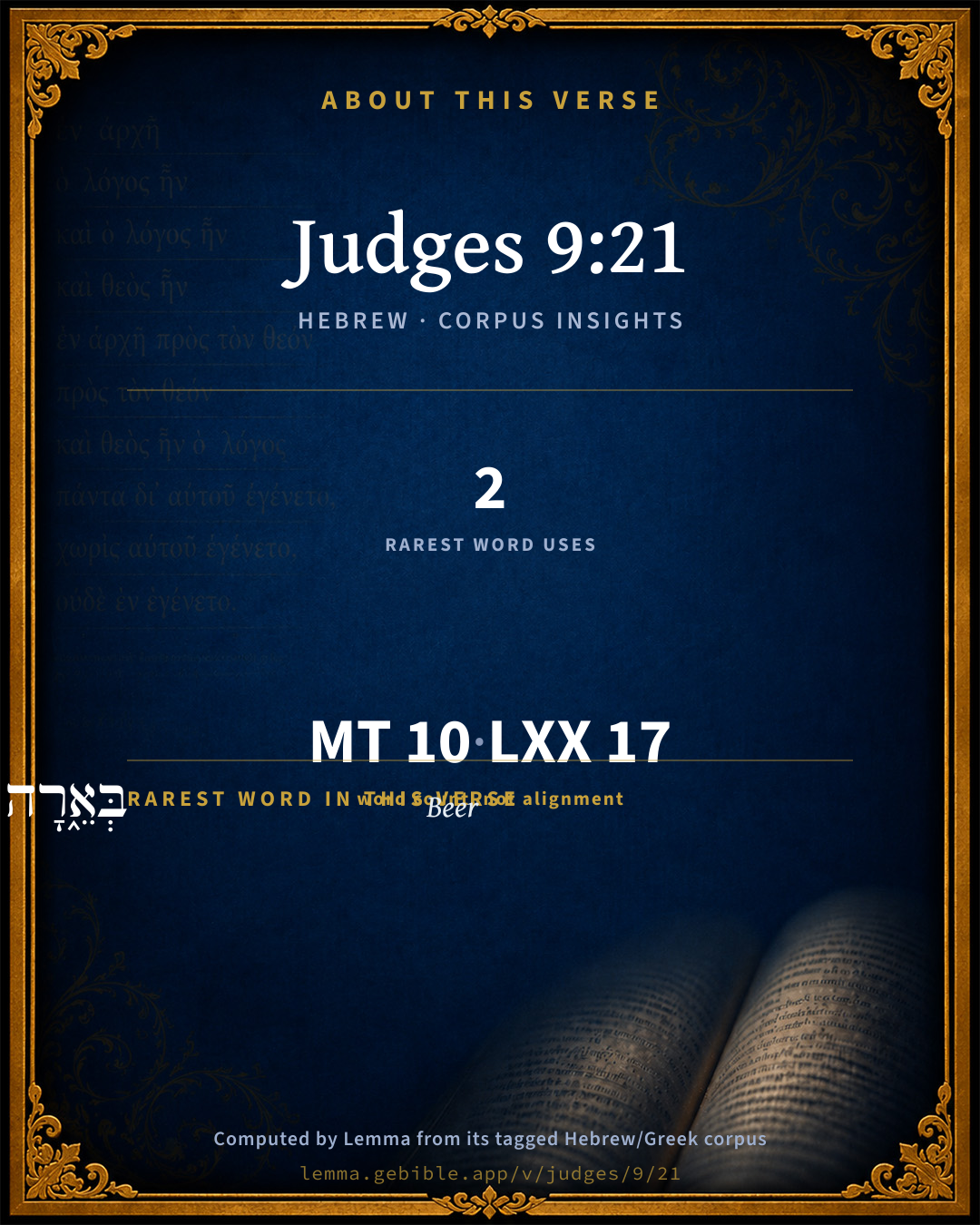
The rarest word here is בְּאֵ֑רָה Beer H876 — appearing just 2 times in the whole Hebrew Bible.

Shared distinctive vocabulary

בְּאֵ֑רָה Beer H876 occurs in 2 verses of the Hebrew Bible. Also found in:

Grammatical profile

  • 4 verbs
  • 5 nouns
  • 1 adverb

Verb forms

  • וַיָּ֣נָס Qal · Sequential Imperfect
  • וַיִּבְרַ֖ח Qal · Sequential Imperfect
  • וַיֵּ֣לֶךְ Qal · Sequential Imperfect
  • וַיֵּ֣שֶׁב Qal · Sequential Imperfect

Hebrew & Septuagint length

In English translation the verse runs 18 words from the Hebrew and 23 from the Septuagint (LXX English) — closely comparable.

A rough comparison of the two English renderings, which tokenize alike — not a word-level alignment.

Word counts can differ between the Hebrew and the Greek without any difference in meaning — e.g. the Hebrew direct-object marker אֵת has no separate Greek word, and Greek often adds the article ὁ.

In the original languages it is 10 Hebrew tokens and 17 Greek tokens — but the two are counted differently (Hebrew bundles its prefixes and suffixes into one token; the Greek is in lemma form), so that isn’t a like-for-like length.

Cross-references

3

Topical passages linked to Judges 9:21 in the Treasury of Scripture Knowledge — connected by theme and wording, ordered by reader-vote popularity; previews shown in the World English Bible.

  • Numbers 21:16 From there they traveled to Beer: that is the well of which Yahweh said to Moses, Gather the people together, and I will give them water.
  • Joshua 19:8 and all the villages that were round about these cities to Baalath Beer, Ramah of the South. This is the inheritance of the tribe of the children of Simeon according to their families.
  • 2 Samuel 20:14 He went through all the tribes of Israel to Abel, and to Beth Maacah, and all the Berites: and they were gathered together, and went also after him.

Cross-references courtesy of OpenBible.info (CC BY 4.0).

Hebrew and Greek witnesses Masoretic Hebrew ↔ Greek Septuagint

The same verse in the two great witnesses to the Old Testament, shown verse-for-verse.

These are two independent witnesses, not word-aligned to each other, and the Septuagint is shown in lemma (dictionary) form.

Hebrew Judges 9:21 Masoretic · Westminster Leningrad Codex

וַיָּ֣נָס יוֹתָ֔ם וַיִּבְרַ֖ח וַיֵּ֣לֶךְ בְּאֵ֑רָה וַיֵּ֣שֶׁב שָׁ֔ם מִפְּנֵ֖י אֲבִימֶ֥לֶךְ אָחִֽיו

Jotham ran away, and fled, and went to Beer, and lived there, for fear of Abimelech his brother.

World English Bible · Public Domain

Greek LXX Judges 9:21 Septuagint · lemma form

καί φεύγω ιωαθαν καί ἀποδιδράσκω καί πορεύομαι ἕως βαιηρ καί οἰκέω ἐκεῖ ἀπό πρόσωπον αβιμελεχ ἀδελφός αὐτός

And Joatham fled, and ran away, and went as far as Baeer, and lived there out of the way of his brother Abimelech.

LXX2012 (modern English Septuagint) · Public Domain

Hebrew: Westminster Leningrad Codex (CC BY 4.0). Greek: Septuagint (public domain); English from LXX2012 (modern English Septuagint) (Public Domain). How the Septuagint differs from the Hebrew →

Targum (Aramaic paraphrase)

1

The Targum is the ancient Jewish Aramaic paraphrase of the Hebrew Scriptures — an interpretive translation, not the Hebrew text itself. Onkelos (literal) and Pseudo-Jonathan (expansive) render the Torah, and Jonathan the Prophets. Coverage is partial: where no permissively-licensed English translation exists for a verse, only the Aramaic is shown. This is verse-level text, not a word-by-word alignment to the Hebrew.

  1. Targum Jonathan Prophets (Joshua–Malachi)
    וַאֲפֵּךְ יוֹתָם וַעֲרַק וַאֲזַל לִבְאֵר וִיתֵיב תַּמָן מִן קֳדָם אֲבִימֶלֶךְ אֲחוֹהִי:

    (no public-domain English translation for this verse)

    Targum Jonathan — Aramaic: “Mikraot Gedolot” (public domain). English: “Sefaria Community Translation” (CC0 1.0 (public-domain dedication)); “London "Chaldee Paraphrase," 1871” (public domain). Text via Sefaria.

Commentary

Notes on Judges 9:21 from classic Christian and Jewish commentators (each source and its license shown beneath its notes). The classic Christian expositions comment on the surrounding passage and are grouped to its opening verse, so a note may address several verses; the Jewish commentaries on the Tanakh (Rashi and others) are per-verse, so they appear only where the commentator wrote on this verse.

Lemma curates 59 commentaries, every one of them public domain or Creative Commons licensed, each selected and text-cleaned for this edition rather than reprinted as found. About our sources →

Trapp's Complete Commentary

John Trapp

Jdg 9:21 And Jotham ran away, and fled, and went to Beer, and dwelt there, for fear of Abimelech his brother.

Ver. 21. And Jotham ran away, and fled, and went.] It was but high time to fly, Cito, citius, citissime, whence all this heap of words in the text. So fled Jacob from Esau, David from Saul, Paul from his persecutors. {Act 9:23-25} It is not unlawful in some cases to save ourselves by flight. Tertullian was too rigid in this point. God hath not set us as standing marks or butts to be shot at.

John Trapp, A Commentary or Exposition upon All the Books of the Old and New Testament (1647–1656) — public domain. Text from a community e-Sword module.

Joseph Benson's Commentary

Jdg 9:21. Jotham ran away and fled — Which he might easily do, having the advantage of the hill, and because the people were not forward to pursue a man whom they knew to have such just cause to speak, and so little power to do them hurt. To Beer — A place remote from Shechem, and out of Abimelech’s reach.

Joseph Benson's Commentary on the Old and New Testaments (1811–1818) — public domain. Text from a community e-Sword module.

Jamieson, Fausset & Brown

Robert Jamieson, A. R. Fausset & David Brown

Joatham . . . went to Beer--the modern village El-Bireh, on the ridge which bounds the northern prospect of Jerusalem.

Jamieson, Fausset & Brown — Commentary Critical and Explanatory on the Whole Bible (1871) — public domain (CC PDM 1.0). Text via the HelloAO Bible API.

Adam Clarke's Commentary

Verse 21. Went to Beer] Mr. Maundrell, in his journey from Aleppo to Jerusalem, p. 64, 5th edit., mentions a place of this name, which he thinks to be that to which Jotham fled, and supposed to be the same as Mishmash, 1Sa 14:5; 1Sa 14:31. It is situated, he says, towards the south, on an easy declivity; and has a fountain of excellent water at the bottom of the hill from which it has taken its name.

Adam Clarke's Commentary on the Bible (1810–1826) — public domain. Text from a community e-Sword/MySword module.

Ellicott's Commentary for English Readers

(21) Went to Beer.—Since Beer means a “well,” it. was naturally a very common name in Palestine. There is nothing to show with certainty whether this Beer is Beeroth in Benjamin (Jos_9:17), now el Bireh, about. six miles north of Jerusalem (see my Life of Christ, i. 73), or the el Bireh which lies on the road from Shechem to Askalon, or the el Bireh near Endor. Probably Jotham would be safe anywhere in the territories of Judah or Benjamin, without going, as Ewald supposes, to the Beer of Num_21:16, on the frontiers of Moab, an ancient sanctuary on the other side of the Jordan, possibly the Beer-elim (palm-well) of Isa_15:8.

For fear of Abimelech.—Literally, from the face of Abimelech.

A Bible Commentary for English Readers, edited by Charles John Ellicott (1878–1897) — public domain. Text from a community e-Sword module.

The Cambridge Bible for Schools and Colleges

gen. ed. J. J. S. Perowne

21. Beer] Unknown; a common name = a well.

The Cambridge Bible for Schools and Colleges (gen. ed. J. J. S. Perowne; Cambridge University Press, 1878–1918) — public domain. Text from a community e-Sword module.

John Gill's Exposition

And Jotham ran away, and fled,.... Having delivered his fable, and the application of it, he made his escape, having the advantage of being on the top of a mountain, at some distance from the people, and perhaps they might not be inclined to do him any harm:

and went to Beer; which some take to be the same with Baalathbeer in the tribe of Simeon, Jos 19:8 Jerom (f) says, the village Bera, whither Jotham fled, is eight miles from Eleutheropolis to the north; but Mr. Maundrell (g), who was in those parts in 1697, gives us a better account of it; and, according to him, it is about two hours and a half's travel from Bethel to it, and three hours and one third from it to Jerusalem; Beer, he says, enjoys a very pleasant situation, on an easy declivity, fronting southward; at the bottom of the hill it has a plentiful fountain of excellent water, from which it had its name:

and dwelt there for fear of Abimelech his brother; how long he dwelt there is not certain, and we hear no more of him after this, Josephus says (h) he lay hid in the mountains three years for fear of Abimelech, which perhaps he concluded from Abimelech's reigning three years, as follows.

(f) De loc. Heb. fol. 89. I (g) Journey from Aleppo, &c. p. 64, 66. (h) Antiqu. l. 5. c. 7. sect. 2.

John Gill's Exposition of the Whole Bible (1746–1763) — public domain (CC PDM 1.0). Text via the HelloAO Bible API.

Haydock's Catholic Bible Commentary

Bera. Hebrew, Bar or Beera, "the well." There was a place of this name in the tribe of Ruben, where the Israelites encamped, Numbers xxi. 16. Bersabee, in the tribe of Juda, was another famous well, and it is probable that Joatham would retire to some distant place. (Haydock) --- St. Jerome mentions a Bera, eight miles north of Eleutheropolis; and Maundrell speaks of another, about 21 miles from Sichem, on the road to Jerusalem. The dominion of Abimelech did not extend far. (Calmet)

George Leo Haydock (1774–1849), Haydock's Catholic Family Bible and Commentary, 1859 edition — public domain. Excludes Psalms (Douay-Rheims chapter numbering differs from Protestant) and Deuterocanonical books (Catholic canon only).

Matthew Poole's English Annotations

He might easily flee, having the advantage of the hill and other accommodations for flight, and because the people were not forward to pursue a man whom they knew to have such just cause and great provocation to speak, and so little power to do them any hurt.

Beer; a place remote from Shechem, and out of Abimelech’s reach. There were divers places of that name.

Matthew Poole's English Annotations on the Holy Bible (1683–1685) — public domain. Text from a community e-Sword/MySword module.

Whedon's Commentary on the Bible

Daniel D. Whedon

21. Jotham ran away — After such a burning application of his fable he knew that his only safety was in flight. The precipice from the top of which he spoke enabled him to get the start of any who might be disposed to pursue him.

Beer — The locality of this town is uncertain. There was a place of this name east of the Dead Sea, in the confines of Moab, where the Israelites were encamped, (Num_21:16,) and possibly this was the very spot to which Jotham fled. Some identify it with Beeroth, the modern el-Bireh, seven miles north of Jerusalem. Jos_9:17.

Dwelt there — Probably in obscurity and sorrow. Nothing more is heard of him in Scripture. Thus many of earth’s noblest natures, like the lone desert flower, are doomed to pine in obscurity and neglect.

Daniel D. Whedon (gen. ed.), Commentary on the Old and New Testaments (1874–1909) — public domain. Text from a community e-Sword module.

The Pulpit Commentary

Jotham ran away. Being close to the top of Gerizim, Jotham had the open country before him. It would take the men of Shechem twenty minutes to ascend the hill, by which time Jotham would be out of sight, and two or three miles on his way. Beer, to which he fled, is thought to be either the same as Beeroth, among the heights of the tribe of Benjamin, (Jos_9:17) now El-Birch, "the first halting-place for caravans on the northern road from Jerusalem" ("Sinai and Palestine," p. 210); or a place called by Eusebius Beta, now El-Birch, eight Roman miles from Eleutheropolis (now Beit Jibrin), and possibly the same as the place of the same name described by Maundrell as four hours from Jerusalem, and two hours west of Bethel; or, as Ewald thinks, Beer beyond Jordan. (Num_21:16) It is impossible to decide which, or whether any, of these is the place designated as Jotham s place of refuge.

Strength in weakness.

How ridiculous does it sound: Jotham ran away!" The bodily presence and outward achievements of really great men are often contemptible. But Jotham, like many another, is not to be estimated from without.

I THE CONSCIENCE OF THE NATION WAS APPEALED TO THROUGH ITS IMAGINATION. He had shown himself to the whole people. The literary simplicity and charm of his fable would rivet the attention of men upon the essential wrong committed, and the folly.

II THE MORAL FORCES OF THE WORLD ARE ITS STRONGEST, AND WILL IN THE END PREVAIL. The "case" had been portrayed by a stroke of genius, so that no craft or sophistry could ever justify it. The claim of Abimelech, etc. was stripped of all its pretensions. To leave a matter with the conscience of men and with God is often harder than to contest it by force of arms. Christ yielded to the physical force and perverted authority of the Jews, but by his bearing at the judgment and by the matchless clearness of his statements he put his persecutors for ever in the wrong, and became the mightiest Ruler the world has known. M.

The Pulpit Commentary (1880–1919), ed. H.D.M. Spence-Jones & Joseph S. Exell — public domain. Text from a community e-Sword module.

John Wesley's Explanatory Notes

And fled - Which he might easily do, having the advantage of the hill, and because the people were not forward to pursue a man whom they knew to have such just cause to speak, and so little power to do them hurt. To Beer - A place remote from Shechem, and out of Abimelech's reach.

John Wesley, Explanatory Notes Upon the Whole Bible (1754–1765) — public domain. Text via the GEBible commentary corpus.

Keil & Delitzsch

C. F. Keil & F. Delitzsch

But Jotham fled to Beer, after charging the Shechemites with their iniquity, and dwelt there before his brother Abimelech ("before," i.e., "for fear of." - Jerome). Beer in all probability is not the same place as Beeroth in the tribe of Benjamin (Jos 9:17), but, according to the Onom. (s. v. Βηρά), a place eight Roman miles to the north of Eleutheropolis, situated in the plain; at present a desolate village called el Breh, near the mouth of Wady es Surr, not far from the former Beth-shemesh (Rob. Pal. ii. p. 132).

Keil & Delitzsch — Biblical Commentary on the Old Testament (1861–1891) — public domain (CC PDM 1.0). Text via the HelloAO Bible API. (Old Testament only.)

Lesson kit

Teaching starters — assembled from the data on this page, not authored interpretation. Every prompt links to the verse data it draws on. Edit before teaching.

Judges, in the Historical, opens this verse with 10 words (10 distinct Hebrew lemmas). Its most distinctive word is Bᵉʼêr (“Beer”). A historical commentator’s framing appears above. Read the whole chapter for the surrounding context.

Discussion questions

  1. The word Bᵉʼêr carries the sense “Beer.” How does it shape the verse?
  2. Numbers 21:16 shares the word «Beer» with this verse. How do the two illuminate each other?
  3. The translations on this page render this verse differently — a whole-verse word diff, not a word-by-word alignment. What might account for the different wordings?
  4. The verb «וַיָּ֣נָס» is Qal Sequential Imperfect. How does its form color the action?
  5. Reading how Trapp's Complete Commentary and Joseph Benson's Commentary read this verse, where do the two commentators agree and where do they part?

Things to notice

Reading settings

Reading text

Shown beneath each verse's original-language words.

Old Testament
Old Testament edition

Read the OT as the Masoretic Hebrew (MT) or the Greek Septuagint (LXX).

English shown for the Greek Septuagint (in the Hebrew ↔ Greek comparison).

Comparing translations? Open the Compare panel on any verse page to stack up to four side by side.