
Genesis 32:21

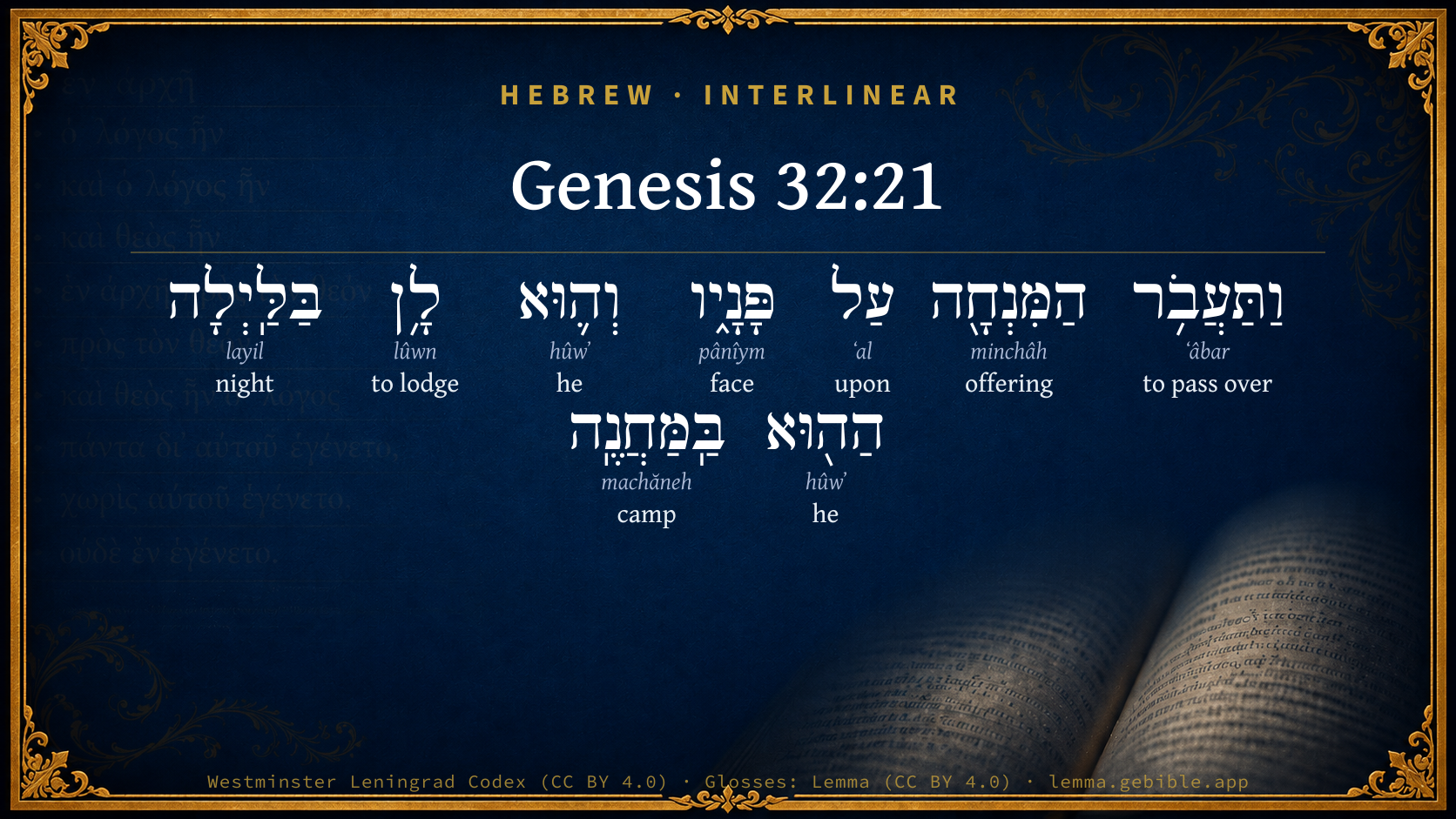
Hebrew (Westminster Leningrad Codex) Genesis 32:21 appears in the Hebrew Old Testament. The text above is from the Westminster Leningrad Codex. Each word links to its Strong’s number, a concise gloss, and parsing drawn from the Open Scriptures Hebrew Bible morphology. Click any word for its full Brown-Driver-Briggs (BDB) entry.
Download image
Cite this verse

Genesis 32:21 (World English Bible). Public Domain. Lemma interlinear Bible study tool, https://lemma.gebible.app/v/genesis/32/21.

Show BibTeX & RIS
BibTeX
RIS
English Translation
So the present passed over before him: and he himself lodged that night in the camp.
World English Bible · Public Domain
Download a study sheet

One document with this verse’s original text, its word-by-word gloss line, the meaning frame, cross-references with their text, attributed commentary, and full source and license credits — printable, and it pastes into notes with its structure intact.

This verse Autodidact and up

Study sheet (.html) Plain text (.txt)

A passage Seminary Student

Up to 50 verses in one chapter. A passage sheet keeps up to 6 commentary sources and 12 cross-references per verse, in the order this page ranks them, and says so on the sheet whenever that leaves anything out. Ask for a single verse and you get the Autodidact verse sheet above.

Everything on this page stays free to read, with no account — the sheet is a download of what is already on screen, not access to it.

Want to remove ads? Support Godless Engineer
Compare translations 3

The same verse in 3 English versions, stacked beneath the original-language interlinear above. Click any original word for its lexicon entry.

Each is an independent rendering of the whole verse — the interlinear is not word-aligned to these translations.

Highlighted words mark where these versions differ — a whole-verse word diff, not a word-by-word alignment.

  • World English Bible Public Domain
    So the present passed over before him: and he himself lodged that night in the camp.
  • King James Version Public Domain
    So went the present over before him: and himself lodged that night in the company.
  • unfoldingWord Literal Text CC BY-SA 4.0
    Then the gift went before him, and he himself stayed for that night in the camp. Jacob Wrestles with God, Who Names Him Israel 32:22-32

unfoldingWord Literal Text — © unfoldingWord, licensed CC BY-SA 4.0. Word-aligned USFM3 via Door43 (git.door43.org/unfoldingWord/en_ult).

Versions to compare (up to 4)

3 of 4 selected

Show all 18 translations

Every available English version of this verse, each an independent rendering of the whole verse.

  • World English Bible Public Domain
    So the present passed over before him: and he himself lodged that night in the camp.
  • Berean Standard Bible Public Domain
    So Jacob’s gifts went on before him, while he spent the night in the camp.
  • Majority Standard Bible Public Domain
    So Jacob’s gifts went on before him, while he spent the night in the camp.
  • King James Version Public Domain
    So went the present over before him: and himself lodged that night in the company.
  • American Standard Version (1901) Public Domain
    So the present passed over before him: and he himself lodged that night in the company.
  • Revised Version (1885) Public Domain
    So the present passed over before him: and he himself lodged that night in the company.
  • Geneva Bible (1599) Public Domain
    So went the present before him: but he taried that night with the companie.
  • Douay-Rheims (1899) Public Domain
    So the presents went before him, but himself lodged that night in the camp.
  • Young's Literal Translation Public Domain
    and the present passeth over before his face, and he hath lodged during that night in the camp.
  • Literal Standard Version CC BY-SA 4.0
    and the present passes over before his face, and he has lodged during that night in the camp.
  • Unlocked Literal Bible CC BY-SA 4.0
    So the gifts went on ahead of him. He himself stayed that night in the camp.
  • unfoldingWord Literal Text CC BY-SA 4.0
    Then the gift went before him, and he himself stayed for that night in the camp. Jacob Wrestles with God, Who Names Him Israel 32:22-32
  • Darby Bible Public Domain
    And the gift went over before him; and he himself lodged that night in the camp.
  • World Messianic Bible Public Domain
    So the present passed over before him, and he himself stayed that night in the camp.
  • Webster's Bible Public Domain
    So the present went over before him; and he himself lodged that night in the company.
  • Free Bible Version CC BY-SA 4.0
    So the gifts went on ahead while Jacob spent the night at the camp.
  • Bible in Basic English Public Domain
    So the servants with the offerings went on in front, and he himself took his rest that night in the tents with his people.
  • JPS Tanakh (1917) Public Domain
    (32-22) So the present passed over before him; and he himself lodged that night in the camp.

Literal Standard Version (2020), Covenant Press — licensed CC BY-SA 4.0. Text via the HelloAO Bible API (eBible.org). Unlocked Literal Bible (unfoldingWord) — licensed CC BY-SA 4.0. Text via the HelloAO Bible API (eBible.org). unfoldingWord Literal Text — © unfoldingWord, licensed CC BY-SA 4.0. Word-aligned USFM3 via Door43 (git.door43.org/unfoldingWord/en_ult). Free Bible Version, Dr. Jonathan Gallagher — licensed CC BY-SA 4.0. Text via the HelloAO Bible API (eBible.org).

Word by word

More ways to search: Search by grammar → Find every occurrence → Compare this word →

Practice this passage: Drill this verse → Learn its vocabulary →

לָ֥ן
lûwn
H3885
“lodging”
Verb, Qal, Participle Active, Masculine, Singular, Absolute
Part of Speech
Verb
Stem
Qal
Form
Participle Active
Gender
Masculine
Number
Singular
State
Absolute
Full BDB Definition

Origin: a primitive root

TWOT: 1096 , 1097

to lodge, stop over, pass the night, abide - (Qal) - to lodge, pass the night - to abide, remain (figuratively) - (Hiphil) to cause to rest or lodge - (Hithpalpel) to dwell, abide - to grumble, complain, murmur - (Niphal) to grumble - (Hiphil) to complain, cause to grumble
  1. וַתַּעֲבֹ֥ר ʻâbar H5674 “and · to pass over” Conjunction + Verb, Qal, Sequential Imperfect, 3rd Person, Feminine, Singular
  2. הַמִּנְחָ֖ה minchâh H4503 “the · offering” Particle, Definite Article + Noun, Common, Feminine, Singular, Absolute
  3. עַל ʻal H5921 “upon” Preposition
  4. פָּנָ֑יו pânîym H6440 “face(s) · his” Noun, Common, Both, Plural, Construct + Suffix, Personal, 3rd Person, Masculine, Singular
  5. וְה֛וּא hûwʼ H1931 “and · he” Conjunction + Pronoun, Personal, 3rd Person, Masculine, Singular
  6. בַּלַּֽיְלָה layil H3915 “in/at the · night” Preposition, Determined + Noun, Common, Masculine, Singular, Absolute
  7. הַה֖וּא hûwʼ H1931 “the · he” Particle, Definite Article + Pronoun, Personal, 3rd Person, Masculine, Singular
  8. בַּֽמַּחֲנֶֽה machăneh H4264 “in/at the · camp” Preposition, Determined + Noun, Common, Both, Singular, Absolute

About this verse

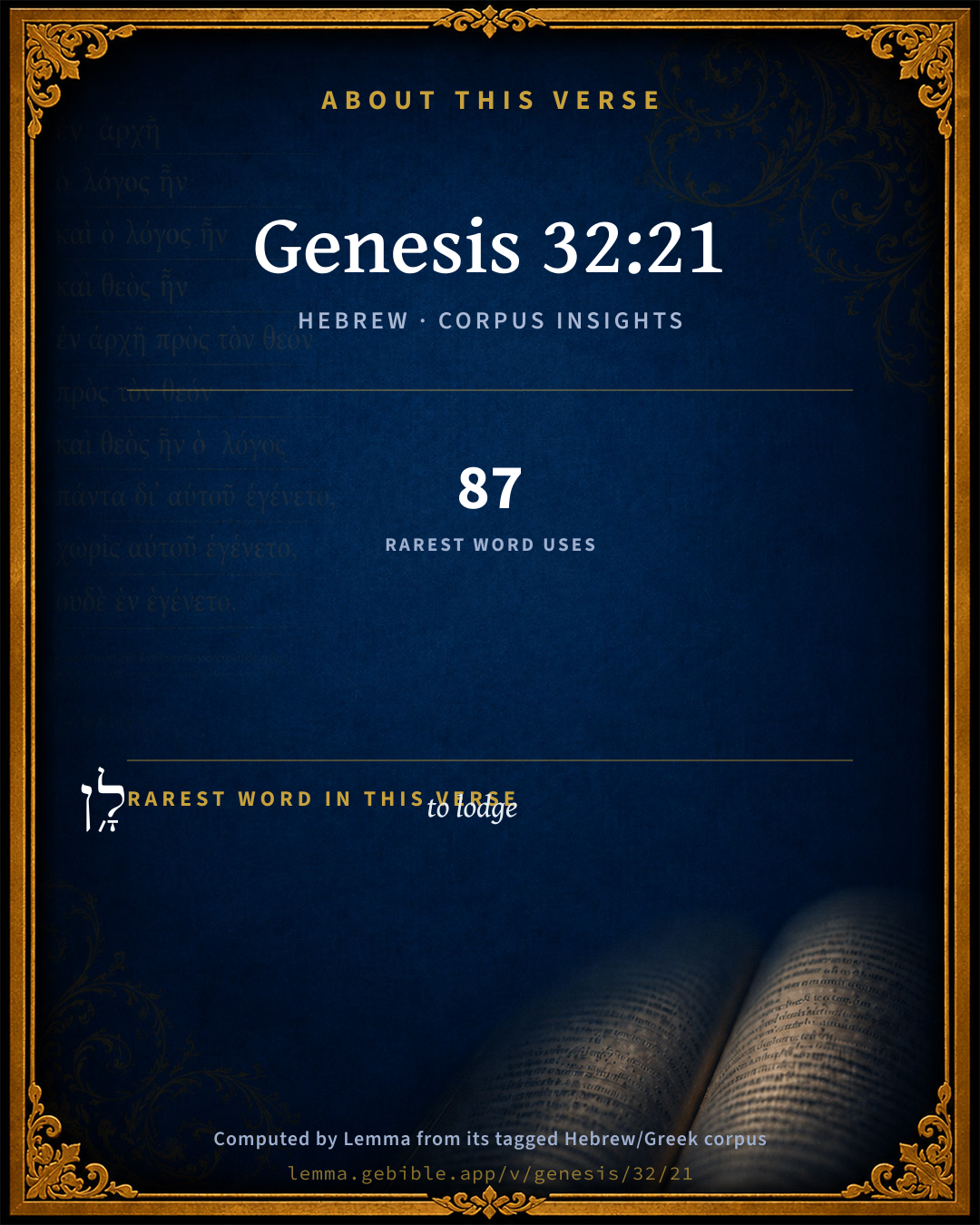
These counts appear in no published source. They are computed here, from the morphology-tagged text and Lemma’s own curated glosses. What Lemma adds →

9
words
8
distinct lemmas
Pentateuch
section

Grammatical profile

  • 2 verbs
  • 4 nouns
  • 2 pronouns
  • 1 preposition

Verb forms

  • וַתַּעֲבֹ֥ר Qal · Sequential Imperfect
  • לָ֥ן Qal · Participle Active

Repetition

A word recurs within this verse — often emphatic in Hebrew:

  • וְה֛וּא he H1931 ×2

Hebrew & Septuagint length

In English translation the verse runs 16 words from the Hebrew and 16 from the Septuagint (LXX English) — the same length.

A rough comparison of the two English renderings, which tokenize alike — not a word-level alignment.

Word counts can differ between the Hebrew and the Greek without any difference in meaning — e.g. the Hebrew direct-object marker אֵת has no separate Greek word, and Greek often adds the article ὁ.

Hebrew and Greek witnesses Masoretic Hebrew ↔ Greek Septuagint

The same verse in the two great witnesses to the Old Testament, shown verse-for-verse.

These are two independent witnesses, not word-aligned to each other, and the Septuagint is shown in lemma (dictionary) form.

Hebrew Genesis 32:21 Masoretic · Westminster Leningrad Codex

וַתַּעֲבֹ֥ר הַמִּנְחָ֖ה עַל פָּנָ֑יו וְה֛וּא לָ֥ן בַּלַּֽיְלָה הַה֖וּא בַּֽמַּחֲנֶֽה

So the present passed over before him: and he himself lodged that night in the camp.

World English Bible · Public Domain

Greek LXX Genesis 32:21 Septuagint · lemma form

καί εἶπον ἰδού ὁ παῖς σύ ἰακώβ παραγίγνομαι ὀπίσω ἐγώ εἶπον γάρ ἐκἱλάσκομαι ὁ πρόσωπον αὐτός ἐν ὁ δῶρον ὁ προπορεύομαι αὐτός καί μετά οὗτος ὁράω ὁ πρόσωπον αὐτός ἴσως γάρ προςδέχομαι ὁ πρόσωπον ἐγώ

So the presents went on before him, but he himself lodged that night in the camp.

LXX2012 (modern English Septuagint) · Public Domain

Hebrew: Westminster Leningrad Codex (CC BY 4.0). Greek: Septuagint (public domain); English from LXX2012 (modern English Septuagint) (Public Domain). How the Septuagint differs from the Hebrew →

Targum (Aramaic paraphrase)

2

The Targum is the ancient Jewish Aramaic paraphrase of the Hebrew Scriptures — an interpretive translation, not the Hebrew text itself. Onkelos (literal) and Pseudo-Jonathan (expansive) render the Torah, and Jonathan the Prophets. Coverage is partial: where no permissively-licensed English translation exists for a verse, only the Aramaic is shown. This is verse-level text, not a word-by-word alignment to the Hebrew.

  1. Targum Onkelos Torah (Genesis–Deuteronomy)
    וְתֵימְרוּן אַף הָא עַבְדָּךְ יַעֲקֹב אָתֵי בַתְרָנָא אֲרֵי אֲמַר אַנְחִנֵּהּ לְרוּגְזֵהּ בְּתִקְרֻבְתָּא דְּאָזְלַת קֳדָמַי וּבָתַר כֵּן אֶחֱזֵי אַפּוֹהִי מָאִים יִסַּב אַפָּי

    (no public-domain English translation for this verse)

    Targum Onkelos — Aramaic: “Onkelos Genesis” (public domain); “Onkelos Exodus” (public domain); “Onkelos Leviticus” (public domain); “Onkelos Numbers” (public domain); “Onkelos Deuteronomy” (public domain). English: “Sefaria Community Translation” (CC0 1.0 (public-domain dedication)); “J.W. Etheridge. The Targums of Onkelos and Jonathan Ben Uzziel on the Pentateuch. London: Longmans, Green, 1862” (public domain). Text via Sefaria.

  2. Targum Pseudo-Jonathan Torah (Genesis–Deuteronomy)
    וְתֵימְרוּן אוּף הָא עַבְדָךְ יַעֲקב אָתֵי בַּתְרָנָא אֲרוּם אָמַר נַרְעֵי יַת סְבַר אַפּוֹי בְּדוֹרָנָא דִמְהַלְכָא קֳדָמַי וּמִבָּתַר כֵּן נֶחֱמֵי אַנְפּוֹי הַלְוַאי יִסְבַּר לִי אַפִּין

    and say, And, behold, thy servant Jakob also cometh after us. For he said, I will make his countenance friendly by the gift which goeth before me, and afterward will see his face: peradventure he may accept me.

    Targum Pseudo-Jonathan — Aramaic: “Targum Jonathan on Genesis” (public domain); “Targum Jonathan on Exodus” (public domain); “Targum Jonathan on Leviticus” (public domain); “Targum Jonathan on Numbers” (public domain); “Targum Jonathan on Deuteronomy” (public domain). English: “The Targum of Jonathan ben Uzziel, trans. J. W. Etheridge, London, 1862” (public domain). Text via Sefaria.

Commentary

Notes on Genesis 32:21 from classic Christian and Jewish commentators (each source and its license shown beneath its notes). The classic Christian expositions comment on the surrounding passage and are grouped to its opening verse, so a note may address several verses; the Jewish commentaries on the Tanakh (Rashi and others) are per-verse, so they appear only where the commentator wrote on this verse.

Lemma curates 59 commentaries, every one of them public domain or Creative Commons licensed, each selected and text-cleaned for this edition rather than reprinted as found. About our sources →

Trapp's Complete Commentary

John Trapp

Gen 32:21 So went the present over before him: and himself lodged that night in the company.

Ver. 21. And himself lodged that night.] But lay upon thorns, and had little rest.

“Eις εστι δουλος οικιας, ο δερποτης”

The master is the greatest servant in the house, and hath most business. This verse did so please Luther, that he translated it in certain Dutch rhymes. {a}

{a} Jo. Manlii, loc. com.

John Trapp, A Commentary or Exposition upon All the Books of the Old and New Testament (1647–1656) — public domain. Text from a community e-Sword module.

The Biblical Illustrator

Joseph S. Exell

Gen_32:21-23

Himself lodged that night in the company

Lessons -

1.

Honest hearts do not only intend good, but see it done, before they rest.

2. Means lawful being used for safety, men may better lie down in peace.

3. It behoveth masters of families to rest among the charge, when it may be (Gen_32:21).

4. Diligence and early care of theirs becomes Governors of families in times of danger.

5. Wives and children are the chiefest matter of a mans care and providence.

6. It is fatherly care to see as much as they can wives and children past danger (Gen_32:22).

7. It is the duty of the father of the family to order the motions of all under him.

8. After wives and children, substance is to be cared for, to keep it safe, for subsistence (Gen_32:23). (G. Hughes, B. D.)

The Biblical Illustrator, edited by Joseph S. Exell (c. 1880s–1900s) — public domain. Text from a community e-Sword module.

Jamieson, Fausset & Brown

Robert Jamieson, A. R. Fausset & David Brown

himself lodged--not the whole night, but only a part of it.

Jamieson, Fausset & Brown — Commentary Critical and Explanatory on the Whole Bible (1871) — public domain (CC PDM 1.0). Text via the HelloAO Bible API.

The Cambridge Bible for Schools and Colleges

gen. ed. J. J. S. Perowne

21. company] Lit. “camp”; cf. Gen_32:7.

The Cambridge Bible for Schools and Colleges (gen. ed. J. J. S. Perowne; Cambridge University Press, 1878–1918) — public domain. Text from a community e-Sword module.

John Gill's Exposition

So went the present over before him,.... Over the brook Jabbok, after mentioned, the night before Jacob did:

and himself lodged that night in the company; or "in the camp" (c), either in the place called Mahanaim, from the hosts or crowds of angels seen there; or rather in his own camp, his family and servants; or, as Aben Ezra distinguishes, in the camp with his servants, and not in his tent, lest his brother should come and smite him; and so Nachmanides.

(c) "in castris", Vatablus, Drusius, Schmidt; "in acie sua", Junius & Tremellius; "in exercitu", Piscator.

John Gill's Exposition of the Whole Bible (1746–1763) — public domain (CC PDM 1.0). Text via the HelloAO Bible API.

Whedon's Commentary on the Bible

Daniel D. Whedon

21. That night — The night following the day on which the messengers returned from Esau. Gen_32:6. His successive movements seem to have been as follows: 1) Report of Esau’s coming. 2) Great fear and excitement, and first plans and arrangements for escape. Gen_32:7. 3) He betakes himself to earnest prayer. Gen_32:9 to Gen_12:4) Having encamped for the night, he selects the present for Esau, and sends it on at once, over the ford, while he proposes to stay all night in the encampment. Gen_32:13 to Gen_21:5) After the present has passed over, he is restless still, and rises up that same night, and sees his wives and all his family safely over the Jabbok, he only remaining behind. Gen_32:22-24.

Daniel D. Whedon (gen. ed.), Commentary on the Old and New Testaments (1874–1909) — public domain. Text from a community e-Sword module.

The Pulpit Commentary

Vers. 21-23. So (literally, and) went the present over Before him: and himself lodged that night in the company. And he rose up that night, i.e. some time before daybreak (vide ver. 24) and took his two wives, and him two women servants (Bilhah and Zilpah), and his eleven sons (Dinah being not mentioned in accordance with the common usage of the Bible), and passed over the ford the word signifies a place of passing over. Tristram ("Land of Israel," p. 558) speaks of the strong current reaching the horses girths at the ford crossed by himself and twenty horsemenJabbok. Jabbok, from bakak, to empty, to pour forth (Kalisch), or from abak, to struggle (Keil), may have been so named either from the natural appearance of the river, or, as is more probable, by prolepsis from the wrestling which took place upon its banks. It is now called the Wady Zerka, or Blue River, which flows into the Jordan, nearly opposite Shechem, and midway between the Lake Tiberias and the Dead Sea. The stream is rapid, and often Completely hidden by the dense mass of oleander which fringes its banks ("Land of Israel," p. 558). And he took them, and sent them (literally, caused them to pass) over the brook, and sent over that he had himself remaining on the north side (Delitzsch, Keil, Kurtz, Murphy, Gerlach, Wordsworth, Alford), although, having once crossed the stream (ver. 22), it is not perfectly apparent that he recrossed, which has led some to argue that the wrestling occurred on the south of the river (Knobel, Rosenm Lange, Kalisch).

The Pulpit Commentary (1880–1919), ed. H.D.M. Spence-Jones & Joseph S. Exell — public domain. Text from a community e-Sword module.

Rashi

Rabbi Shlomo Yitzchaki (Rashi)

אכפרה פניו I WILL APPEASE HIM — I will remove his anger. Similarly, (Isaiah 28:18) "and your covenant with death shall be annulled (וכפר)”; (Isaiah 47:11) “Thou shalt not be able to put it away (וכפרה”. I am of the opinion that wherever the verb כפר is used in association with iniquity and sin and in association with anger (פנים), it always signifies wiping away, removing. It is an Aramaic expression occurring frequently in the Talmud: “He wiped his hand off (כפר ידיה)”, and (Gittin 56a) ‘‘he wants to wipe (לכפורי) his hands off on this man” (i.e. he desires to put the responsibility upon me). In Biblical Hebrew, also, the bowls of the Sanctuary are called, (Ezra 1:10) "כפורי of gold” — and they are so called because the priest wiped his hands on them — on the rim of the bowl (Zevachim 93b).

Rashi on the Tanakh — English translations: “The Judaica Press complete Tanach with Rashi, translated by A. J. Rosenberg” (CC BY 4.0); “Pentateuch with Rashi's commentary by M. Rosenbaum and A.M. Silbermann, 1929-1934” (public domain); “The Metsudah Tanach series, Lakewood, N.J” (CC BY 4.0); and “The Book of Joshua, Metsudah Publications, 1997” (CC BY 4.0). Text via Sefaria.

Ramban (Nachmanides)

Rabbi Moshe ben Nachman (Ramban / Nachmanides)

‘ACHAPRAH’ (I WILL APPEASE) HIM WITH THE PRESENT. I.e., “I will dissipate his anger.” Similarly: ‘Vechupar’ (and annulled shall be) your covenant with death; Thou shalt not be able ‘kaprah’ (to put it away)., 47:11. I am of the opinion that whenever the word kaparah is used in association with iniquity and sin and in association with the word panim (anger), it always signifies erasing and removing. It is an Aramaic expression occurring frequently in the Talmud: “He wished to wipe his hands on that man.” In Biblical Hebrew, also, the bowls in the Sanctuary are called ‘Kipurei’ of gold because the priest wiped his hand on them, that is, on the rims of the bowl. These are the words of our Rabbi Shlomo [Rashi]. And so also did Onkelos translate: “I will calm his anger.” If so, the explanation of the verse will [not] be that Jacob said these words, but that Jacob thought to himself, “I will appease him.” It is Scripture that tells us this [but it is not part of Jacob’s instructions to his messengers], for it would have been improper for the messengers to do so and thereby remind Esau of his antagonism towards Jacob. And so did Rabbi Abraham ibn Ezra explain it.But it does not appear to me to be correct that Scripture should find it necessary to tell us Jacob’s thought at this time when it is a well known matter pertaining to all who send presents. Besides, if it were so, Scripture should have mentioned this originally [in connection with the first drove, in Verse 19], And, behold, he is also behind us, for he thought, “I will appease him with the present,” for now [when commanding the leaders of the second and third droves] he did not add to that instruction [which he gave the leader of the first drove].However, the correct interpretation is that now Jacob additionally explained to them that they should say in a respectful manner, Behold, he is also behind us, that is to say, “Behold, your servant Jacob is also behind us, and he has sent us before him in order to give a ransom for his life, using this present as a means of seeing your honor’s face, just as servants present their ransom when they are given permission to see the king’s face. And afterward I will see his face, for perhaps he will accept me and honor me by permitting me to be among those who see the king’s face.” This was a way of expressing Esau’s exalted status and was due to Jacob’s fear of him. The expression achaprah panav is then being used as it is used in the verse, The wrath of a king is as messengers of death; but a wise man ‘yechaprenah,’ meaning he will give ransom to allay the wrath. And the connotation of “wiping away” attached to forgiveness is not valid in the Sacred Language but rather in the Aramaic tongue. Similarly, ‘kipurei’ of gold is the Babylonian name for bowls, for the word kaparah is never used in association with “sin,” meaning “wipe away,” but instead Scripture says: ‘lechapeir’ (to make atonement) for your souls; ‘lechapeir’ (to make atonement) for him, and he shall be forgiven, i.e., for his soul. And Scripture also says: ‘achaprah’ (I shall make atonement) for your sin. All of these are related to the expression, Then shall they give every man ‘kopher’ for his soul, which means a ransom.

Ramban (Nachmanides) on the Tanakh — English translation: “Commentary on the Torah by Ramban (Nachmanides). Translated and annotated by Charles B. Chavel. New York, Shilo Pub. House, 1971-1976” (CC BY 4.0). Text via Sefaria.

Radak

Rabbi David Kimhi (Radak)

ואמרתם, even though this instruction had already been given both collectively and individually, he repeated it again until they would remember to add “your servant Yaakov is following behind us.” Esau was to have the impression that Yaakov followed these shepherds, his servants, on his way to Seir in order to present himself to him.

אכפרה פניו, I want to remove his anger. Every time the word כפרה appears it means the removal of something. For instance, in Isaiah 28,18 וכפר בריתכם את מות, “your covenant with death will be removed, cancelled.” The expression כפרת עון means “the removal of sin.” Compare also Isaiah 46,11.

פניו, a reference to anger, seeing that anger is visible in one’s face. The idea of אכפרה פניו is to accomplish that his face no longer reflect his feeling of anger. We find this expression with Chanah, Samuel’s mother, after she had poured out her angry heart to G’d, having been deliberately goaded by Peninah, Elkanah’s other wife. (Samuel I 1,18) We also find this usage in Job 9,26.

Radak on the Tanakh — English translations: “Sefaria Community Translation” (CC0 1.0 (public-domain dedication)); “Eliyahu Munk, HaChut Hameshulash” (CC BY 4.0); “Rabbi Mike Feuer, Jerusalem Anthology” (CC BY 4.0); and “R. David Kimhi on the first book of Psalms, Translated by R.G. Finch, London, 1919” (public domain). Text via Sefaria.

Lesson kit

Teaching starters — assembled from the data on this page, not authored interpretation. Every prompt links to the verse data it draws on. Edit before teaching.

Genesis, in the Pentateuch, opens this verse with 9 words (8 distinct Hebrew lemmas). Its most distinctive word is lûwn (“to lodge”). A historical commentator’s framing appears above. Read the whole chapter for the surrounding context.

Discussion questions

  1. How does “to lodge” (lûwn) shape what this verse is saying?
  2. “he” occurs 2× in this one verse. What is the effect of the repetition?
  3. These translations render this verse differently; the difference is in the English rendering, not the original. What questions does that raise?
  4. The verb «וַתַּעֲבֹ֥ר» is Qal Sequential Imperfect. How does its form color the action?
  5. Reading how Trapp's Complete Commentary and The Biblical Illustrator read this verse, where do the two commentators agree and where do they part?

Things to notice

Reading settings

Reading text

Shown beneath each verse's original-language words.

Old Testament
Old Testament edition

Read the OT as the Masoretic Hebrew (MT) or the Greek Septuagint (LXX).

English shown for the Greek Septuagint (in the Hebrew ↔ Greek comparison).

Comparing translations? Open the Compare panel on any verse page to stack up to four side by side.