
2 Samuel 10:9

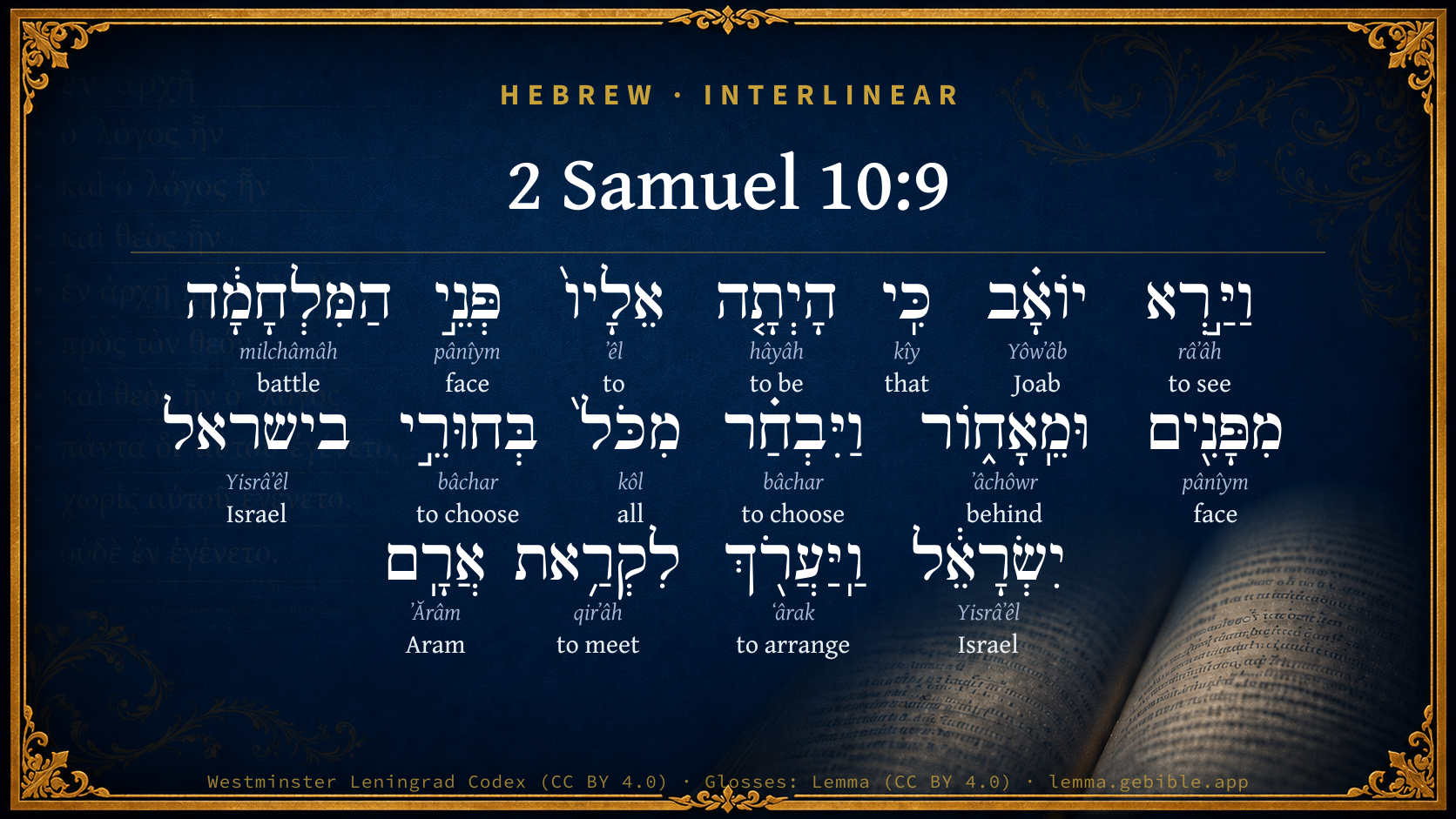
Hebrew (Westminster Leningrad Codex) 2 Samuel 10:9 appears in the Hebrew Old Testament. The text above is from the Westminster Leningrad Codex. Each word links to its Strong’s number, a concise gloss, and parsing drawn from the Open Scriptures Hebrew Bible morphology. Click any word for its full Brown-Driver-Briggs (BDB) entry.
Download image
Cite this verse

2 Samuel 10:9 (World English Bible). Public Domain. Lemma interlinear Bible study tool, https://lemma.gebible.app/v/2-samuel/10/9.

Show BibTeX & RIS
BibTeX
RIS
English Translation
Now when Joab saw that the battle was set against him before and behind, he chose of all the choice men of Israel, and put them in array against the Syrians:
World English Bible · Public Domain
Download a study sheet

One document with this verse’s original text, its word-by-word gloss line, the meaning frame, cross-references with their text, attributed commentary, and full source and license credits — printable, and it pastes into notes with its structure intact.

This verse Autodidact and up

Study sheet (.html) Plain text (.txt)

A passage Seminary Student

Up to 50 verses in one chapter. A passage sheet keeps up to 6 commentary sources and 12 cross-references per verse, in the order this page ranks them, and says so on the sheet whenever that leaves anything out. Ask for a single verse and you get the Autodidact verse sheet above.

Everything on this page stays free to read, with no account — the sheet is a download of what is already on screen, not access to it.

Want to remove ads? Support Godless Engineer
Compare translations 3

The same verse in 3 English versions, stacked beneath the original-language interlinear above. Click any original word for its lexicon entry.

Each is an independent rendering of the whole verse — the interlinear is not word-aligned to these translations.

Highlighted words mark where these versions differ — a whole-verse word diff, not a word-by-word alignment.

  • World English Bible Public Domain
    Now when Joab saw that the battle was set against him before and behind, he chose of all the choice men of Israel, and put them in array against the Syrians:
  • King James Version Public Domain
    When Joab saw that the front of the battle was against him before and behind, he chose of all the choice men of Israel, and put them in array against the Syrians:
  • unfoldingWord Literal Text CC BY-SA 4.0
    And Joab saw that the faces of the battle were against him from before and from behind, and he chose from all of the chosen of Israel, and he arrayed to meet Aram.

unfoldingWord Literal Text — © unfoldingWord, licensed CC BY-SA 4.0. Word-aligned USFM3 via Door43 (git.door43.org/unfoldingWord/en_ult).

Versions to compare (up to 4)

3 of 4 selected

Show all 18 translations

Every available English version of this verse, each an independent rendering of the whole verse.

  • World English Bible Public Domain
    Now when Joab saw that the battle was set against him before and behind, he chose of all the choice men of Israel, and put them in array against the Syrians:
  • Berean Standard Bible Public Domain
    When Joab saw the battle lines before him and behind him, he selected some of the best men of Israel and arrayed them against the Arameans.
  • Majority Standard Bible Public Domain
    When Joab saw the battle lines before him and behind him, he selected some of the best men of Israel and arrayed them against the Arameans.
  • King James Version Public Domain
    When Joab saw that the front of the battle was against him before and behind, he chose of all the choice men of Israel, and put them in array against the Syrians:
  • American Standard Version (1901) Public Domain
    Now when Joab saw that the battle was set against him before and behind, he chose of all the choice men of Israel, and put them in array against the Syrians:
  • Revised Version (1885) Public Domain
    Now when Joab saw that the battle was set against him before and behind, he chose of all the choice men of Israel, and put them in array against the Syrians:
  • Geneva Bible (1599) Public Domain
    When Ioab saw that the front of the battel was against him before and behinde, he chose of all the choyse of Israel, and put them in aray against the Aramites.
  • Douay-Rheims (1899) Public Domain
    Then Joab seeing that the battle was prepared against him, both before and behind, chose of all the choice men of Israel, and put them in array against the Syrians:
  • Young's Literal Translation Public Domain
    and Joab seeth that the front of the battle hath been unto him before and behind, and he chooseth of all the chosen in Israel, and setteth in array to meet Aram,
  • Literal Standard Version CC BY-SA 4.0
    and Joab sees that the front of the battle has been to him before and behind, and he chooses [out] of all the chosen in Israel, and sets in array to meet Aram,
  • Unlocked Literal Bible CC BY-SA 4.0
    When Joab saw the battle lines facing him both in front and behind, he chose some of Israel's best fighters and arranged them against the Arameans.
  • unfoldingWord Literal Text CC BY-SA 4.0
    And Joab saw that the faces of the battle were against him from before and from behind, and he chose from all of the chosen of Israel, and he arrayed to meet Aram.
  • Darby Bible Public Domain
    And Joab saw that the front of the battle was against him before and behind; and he chose out of all the choice men of Israel, and put them in array against the Syrians;
  • World Messianic Bible Public Domain
    Now when Joab saw that the battle was set against him before and behind, he chose of all the choice men of Israel and put them in array against the Syrians.
  • Webster's Bible Public Domain
    When Joab saw that the front of the battle was against him before and behind, he selected of all the choice men of Israel, and put them in array against the Syrians:
  • Free Bible Version CC BY-SA 4.0
    Joab realized he would have to fight both in front of him and behind him, so he chose some of Israel's best troops and he took charge of them to lead the attack against the Arameans.
  • Bible in Basic English Public Domain
    Now when Joab saw that their forces were in position against him in front and at his back, he took the best of the men of Israel and put them in line against the Aramaeans;
  • JPS Tanakh (1917) Public Domain
    Now when Joab saw that the battle was set against him before and behind, he chose of all the choice men of Israel, and put them in array against the Arameans;

Literal Standard Version (2020), Covenant Press — licensed CC BY-SA 4.0. Text via the HelloAO Bible API (eBible.org). Unlocked Literal Bible (unfoldingWord) — licensed CC BY-SA 4.0. Text via the HelloAO Bible API (eBible.org). unfoldingWord Literal Text — © unfoldingWord, licensed CC BY-SA 4.0. Word-aligned USFM3 via Door43 (git.door43.org/unfoldingWord/en_ult). Free Bible Version, Dr. Jonathan Gallagher — licensed CC BY-SA 4.0. Text via the HelloAO Bible API (eBible.org).

Word by word

More ways to search: Search by grammar → Find every occurrence → Compare this word →

Practice this passage: Drill this verse → Learn its vocabulary →

וּמֵֽאָח֑וֹר
ʼâchôwr
H268
“and · from · behind”
Conjunction + Preposition + Noun, Common, Masculine, Singular, Absolute
Part of Speech
Conjunction + Preposition + Noun
Type
Common
Gender
Masculine
Number
Singular
State
Absolute
Full BDB Definition

Origin: from H299

TWOT: 68d

the back side, the rear - backwards - hereafter (of time) - behind
  1. וַיַּ֣רְא râʼâh H7200 “and · to see” Conjunction + Verb, Qal, Sequential Imperfect, 3rd Person, Masculine, Singular
  2. יוֹאָ֗ב Yôwʼâb H3097 “Joab” Noun, Proper
  3. כִּֽי kîy H3588 “that” Conjunction
  4. הָיְתָ֤ה hâyâh H1961 “to be” Verb, Qal, Perfect, 3rd Person, Feminine, Singular
  5. אֵלָיו֙ ʼêl H413 “to · him” Preposition + Suffix, Personal, 3rd Person, Masculine, Singular
  6. פְּנֵ֣י pânîym H6440 “face(s) of” Noun, Common, Both, Plural, Construct
  7. הַמִּלְחָמָ֔ה milchâmâh H4421 “the · battle” Particle, Definite Article + Noun, Common, Feminine, Singular, Absolute
  8. מִפָּנִ֖ים pânîym H6440 “from · face(s)” Preposition + Noun, Common, Both, Plural, Absolute
  9. וַיִּבְחַ֗ר bâchar H977 “and · to choose” Conjunction + Verb, Qal, Sequential Imperfect, 3rd Person, Masculine, Singular
  10. מִכֹּל֙ kôl H3605 “from · all of” Preposition + Noun, Common, Masculine, Singular, Construct
  11. בְּחוּרֵ֣י bâchar H977 “chosen” Verb, Qal, Participle Passive, Masculine, Plural, Construct
  12. בישראל Yisrâʼêl H3478 “in/at · Israel” Preposition + Noun, Proper
  13. יִשְׂרָאֵ֔ל Yisrâʼêl H3478 “Israel” Noun, Proper
  14. וַֽיַּעֲרֹ֖ךְ ʻârak H6186 “and · to arrange” Conjunction + Verb, Qal, Sequential Imperfect, 3rd Person, Masculine, Singular
  15. לִקְרַ֥את qirʼâh H7125 “to meet” Preposition + Verb, Qal, Infinitive Construct
  16. אֲרָֽם ʼĂrâm H758 “Aram” Noun, Proper

About this verse

These counts appear in no published source. They are computed here, from the morphology-tagged text and Lemma’s own curated glosses. What Lemma adds →

17
words
14
distinct lemmas
Historical
section

Shared distinctive vocabulary

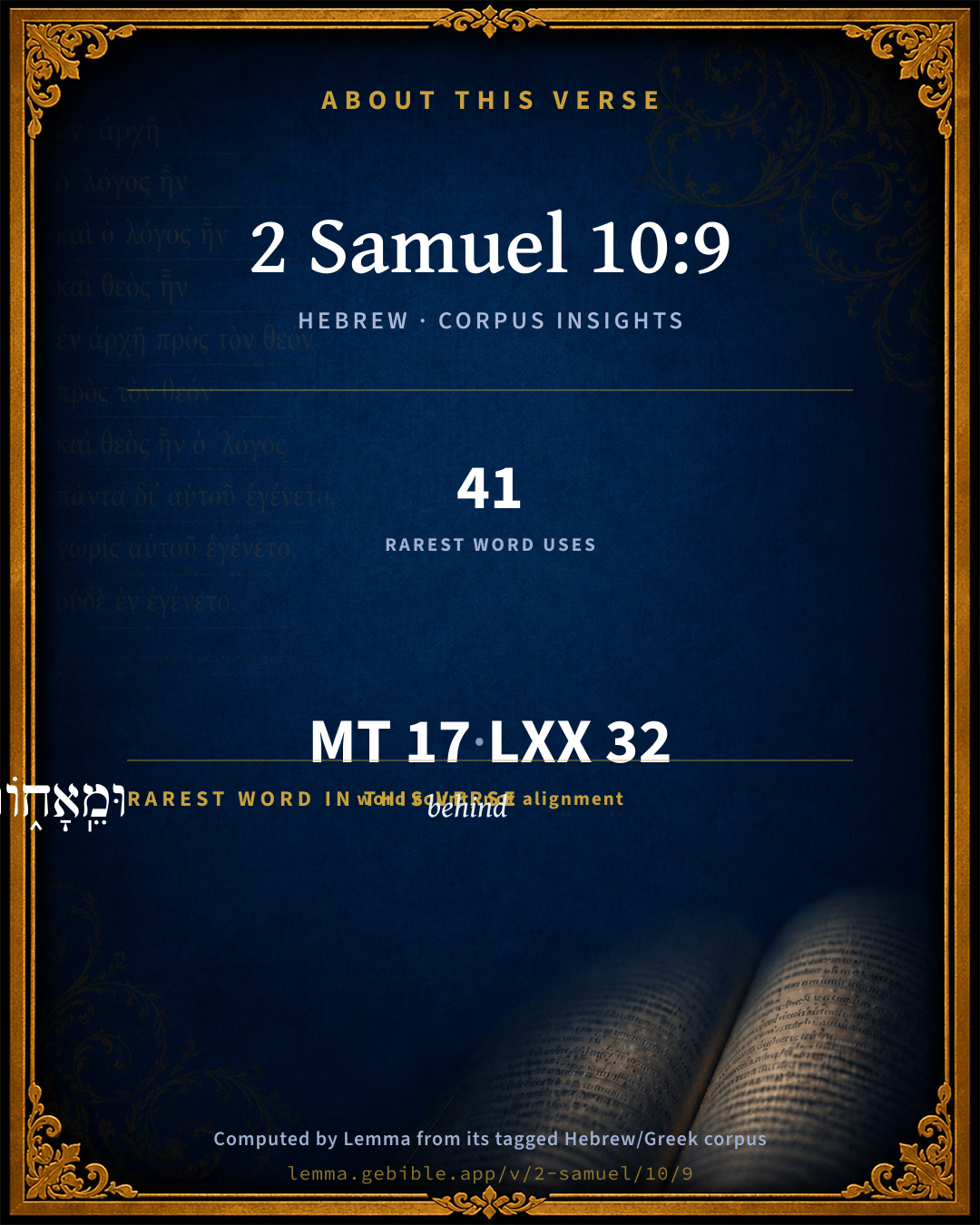
וּמֵֽאָח֑וֹר behind H268 occurs in 41 verses of the Hebrew Bible. Also found in:

Grammatical profile

  • 6 verbs
  • 9 nouns
  • 1 preposition
  • 1 conjunction

Verb forms

  • וַיַּ֣רְא Qal · Sequential Imperfect
  • הָיְתָ֤ה Qal · Perfect
  • וַיִּבְחַ֗ר Qal · Sequential Imperfect
  • בְּחוּרֵ֣י Qal · Participle Passive
  • וַֽיַּעֲרֹ֖ךְ Qal · Sequential Imperfect
  • לִקְרַ֥את Qal · Infinitive Construct

Repetition

Words recur within this verse — often emphatic in Hebrew:

  • פְּנֵ֣י face H6440 ×2
  • וַיִּבְחַ֗ר to choose H977 ×2
  • בישראל Israel H3478 ×2

Hebrew & Septuagint length

In English translation the verse runs 31 words from the Hebrew and 42 from the Septuagint (LXX English) — closely comparable.

A rough comparison of the two English renderings, which tokenize alike — not a word-level alignment.

Word counts can differ between the Hebrew and the Greek without any difference in meaning — e.g. the Hebrew direct-object marker אֵת has no separate Greek word, and Greek often adds the article ὁ.

In the original languages it is 17 Hebrew tokens and 32 Greek tokens — but the two are counted differently (Hebrew bundles its prefixes and suffixes into one token; the Greek is in lemma form), so that isn’t a like-for-like length.

Cross-references

2

Topical passages linked to 2 Samuel 10:9 in the Treasury of Scripture Knowledge — connected by theme and wording, ordered by reader-vote popularity; previews shown in the World English Bible.

  • Joshua 8:21–22 When Joshua and all Israel saw that the ambush had taken the city, and that the smoke of the city ascended, then they turned again, and killed the men of Ai.
  • Judges 20:42–43 Therefore they turned their backs before the men of Israel to the way of the wilderness; but the battle followed hard after them; and those who came out of the cities destroyed them in the midst of it.

Cross-references courtesy of OpenBible.info (CC BY 4.0).

Hebrew and Greek witnesses Masoretic Hebrew ↔ Greek Septuagint

The same verse in the two great witnesses to the Old Testament, shown verse-for-verse.

These are two independent witnesses, not word-aligned to each other, and the Septuagint is shown in lemma (dictionary) form.

Hebrew 2 Samuel 10:9 Masoretic · Westminster Leningrad Codex

וַיַּ֣רְא יוֹאָ֗ב כִּֽי הָיְתָ֤ה אֵלָיו֙ פְּנֵ֣י הַמִּלְחָמָ֔ה מִפָּנִ֖ים וּמֵֽאָח֑וֹר וַיִּבְחַ֗ר מִכֹּל֙ בְּחוּרֵ֣י בישראל יִשְׂרָאֵ֔ל וַֽיַּעֲרֹ֖ךְ לִקְרַ֥את אֲרָֽם

Now when Joab saw that the battle was set against him before and behind, he chose of all the choice men of Israel, and put them in array against the Syrians:

World English Bible · Public Domain

Greek LXX 2 Samuel 10:9 Septuagint · lemma form

καί ὁράω ιωαβ ὅτι γίγνομαι πρός αὐτός ἀντιπρόσωπος ὁ πόλεμος ἐκ ὁ κατά πρόσωπον ἐκ ἐναντίος καί ἐκ ὁ ὄπισθε καί ἐπιλέγω ἐκ πᾶς ὁ νεανίσκος ἰσραήλ καί παρατάσσω ἐκ ἐναντίος συρία

And Joab saw that the front of the battle was against him from that which was opposed in front and from behind, and he chose out some of all the young men of Israel, and they set themselves in array against Syria.

LXX2012 (modern English Septuagint) · Public Domain

Hebrew: Westminster Leningrad Codex (CC BY 4.0). Greek: Septuagint (public domain); English from LXX2012 (modern English Septuagint) (Public Domain). How the Septuagint differs from the Hebrew →

Targum (Aramaic paraphrase)

1

The Targum is the ancient Jewish Aramaic paraphrase of the Hebrew Scriptures — an interpretive translation, not the Hebrew text itself. Onkelos (literal) and Pseudo-Jonathan (expansive) render the Torah, and Jonathan the Prophets. Coverage is partial: where no permissively-licensed English translation exists for a verse, only the Aramaic is shown. This is verse-level text, not a word-by-word alignment to the Hebrew.

  1. Targum Jonathan Prophets (Joshua–Malachi)
    וַחֲזָא יוֹאָב אֲרֵי תַקִיפוּ עֲלוֹהִי עַבְדֵי קְרָבָא מֵאֲפּוֹהִי וּמֵאֲחוֹרוֹהִי וּבְחַר מִכֹּל בְּחוּרֵי יִשְׂרָאֵל וְסַדַר לָקֳדָמוּת אֱנַשׁ אֲרָם:

    (no public-domain English translation for this verse)

    Targum Jonathan — Aramaic: “Mikraot Gedolot” (public domain). English: “Sefaria Community Translation” (CC0 1.0 (public-domain dedication)); “London "Chaldee Paraphrase," 1871” (public domain). Text via Sefaria.

Commentary

Notes on 2 Samuel 10:9 from classic Christian and Jewish commentators (each source and its license shown beneath its notes). The classic Christian expositions comment on the surrounding passage and are grouped to its opening verse, so a note may address several verses; the Jewish commentaries on the Tanakh (Rashi and others) are per-verse, so they appear only where the commentator wrote on this verse.

Lemma curates 59 commentaries, every one of them public domain or Creative Commons licensed, each selected and text-cleaned for this edition rather than reprinted as found. About our sources →

Trapp's Complete Commentary

John Trapp

2Sa 10:9 When Joab saw that the front of the battle was against him before and behind, he chose of all the choice [men] of Israel, and put [them] in array against the Syrians:

Ver. 9. He chose of all the choice men of Israel.] This was a special piece of military prudence in Joab, who was an accomplished general, no whit inferior to Hannibal the Carthaginian, Decebalus the Dacian, Albert of Brandenburg, whom they commonly called Achilles Teutonicus, or any other famous for warlike skill and prowess.

John Trapp, A Commentary or Exposition upon All the Books of the Old and New Testament (1647–1656) — public domain. Text from a community e-Sword module.

Joseph Benson's Commentary

2Sa 10:9. The front of the battle — Hebrew, the face of the battle; was against him before, and behind — That is, they had divided their forces, the Syrians appearing before him, and the Ammonites behind him. He put them in array against the Syrians — He also, like an expert commander, presently divided his army into two bodies, and picked out the best soldiers to engage the Syrians, who, it seems, were the strongest, or the most valiant.

Joseph Benson's Commentary on the Old and New Testaments (1811–1818) — public domain. Text from a community e-Sword module.

Adam Clarke's Commentary

Verse 9. Before and behind] It is probable that one of the armies was in the field, and the other in the city, when Joab arrived. When he fronted this army, the other appears to have issued from the city, and to have taken him in the rear; he was therefore obliged to divide his army as here mentioned; one part to face the Syrians commanded by himself, and the other to face the Ammonites commanded by his brother Abishai.

Adam Clarke's Commentary on the Bible (1810–1826) — public domain. Text from a community e-Sword/MySword module.

Ellicott's Commentary for English Readers

(9) When Joab saw.—The keen eye of this experienced general at once took in both the advantages and the danger of this disposition of the enemy. He threw his whole force between their two divisions, organising his own army in two parts, one facing the Ammonites and the other the Syrians, but each capable of supporting the other in case of need. The enemy was thus cut in two, while the Israelites formed one compact body. He himself took command of the wing facing the Syrians with the choice troops of Israel, as having the stronger enemy to meet, while he gave the rest of the forces opposing the Ammonites into the hand of his brother Abishai.

A Bible Commentary for English Readers, edited by Charles John Ellicott (1878–1897) — public domain. Text from a community e-Sword module.

The Cambridge Bible for Schools and Colleges

gen. ed. J. J. S. Perowne

9. that the front of the battle was against him before and behind] The Ammonites were posted in front of the city, the Syrians on the plain opposite to them: if he attacked either force separately, his rear would be exposed to the other. His choice of the picked men to attack the Syrians, and his taking command of this division in person, indicate that the mercenary troops were the most formidable part of the Ammonite force.

The Cambridge Bible for Schools and Colleges (gen. ed. J. J. S. Perowne; Cambridge University Press, 1878–1918) — public domain. Text from a community e-Sword module.

John Gill's Exposition

When Joab saw that the front of the battle was against him before and behind,.... Or "the face" of it (w); armies appeared both before and behind, about to attack him both in front and rear; the Targum is,"and Joab saw that the warriors, or those that made war, were strong against him before and behind:"

he chose of all the choice men of Israel; the most eminent for strength, and valour, and military skill, who had been tried, and were famous for warlike exploits, the flower of the army:

and put them in array against the Syrians; who might be the strongest party, and the best soldiers; though being but mercenaries, if hard beset, would sooner give way, as he might suppose, upon which the Ammonites would do the same.

(w) "facies", Pagninus, Montanus.

John Gill's Exposition of the Whole Bible (1746–1763) — public domain (CC PDM 1.0). Text via the HelloAO Bible API.

Albert Barnes' Notes on the Bible

The two armies of the Ammonites and the Syrians were drawn up facing one another; the Ammonites supported by the city Rabbah behind them; the Syrians in great force, with numerous chariots able to manoeuvre in the plain in front of Medeba. If Joab advanced against either, he would have the other in his rear.

Albert Barnes' Notes on the Bible (1834–1885) — public domain. Text from a community e-Sword/MySword module.

Matthew Poole's English Annotations

Which were the most valuable valiant and expert soldiers.

Matthew Poole's English Annotations on the Holy Bible (1683–1685) — public domain. Text from a community e-Sword/MySword module.

Whedon's Commentary on the Bible

Daniel D. Whedon

9. Before and behind — Joab thus seems to have unwittingly taken a position between Rabbah and Medeba, so as to have the Ammonites in front and the Syrians behind. Hence he found it necessary to provide for fighting with both armies at the same time.

Daniel D. Whedon (gen. ed.), Commentary on the Old and New Testaments (1874–1909) — public domain. Text from a community e-Sword module.

The Pulpit Commentary

The front of the battle. The object of Joab was to prevent at all hazards the junction of the Syrians with the Ammonites, and he was only just in time to throw himself between them. This was resolute but dangerous policy, as, in case of defeat, he would have a powerful enemy in his rear. Apparently, however, he was aware that his real work lay with the Syrian mercenaries, who were dangerous enough by themselves, and would become more than a match for him if they were reinforced by the men of Rabbah. He therefore leaves Abishai with such troops as he could spare to watch the Ammonites, feeling sure that they would not hazard an attack unless they saw matters going ill with him; and, taking with him all his bravest men, "the choice man of Israel," he prepares with them to give battle to the Syrians.

The Pulpit Commentary (1880–1919), ed. H.D.M. Spence-Jones & Joseph S. Exell — public domain. Text from a community e-Sword module.

unfoldingWord translationNotes

Door43 World Missions Community

General Information:

The battle with the Arameans and Ammon continues.

The rest of his people he put into the hand of Abishai his brother

"He put Abishai his brother in charge of the rest of the army"

translationWords

Israel

Aram

command

Ammon

unfoldingWord translationNotes — © Distant Shores Media and the Door43 World Missions Community, licensed CC BY-SA 4.0. Source: git.door43.org/Door43/en_tn.

Lesson kit

Teaching starters — assembled from the data on this page, not authored interpretation. Every prompt links to the verse data it draws on. Edit before teaching.

2 Samuel, in the Historical, opens this verse with 17 words (14 distinct Hebrew lemmas). Its most distinctive word is ʼâchôwr (“behind”). A historical commentator’s framing appears above. Read the whole chapter for the surrounding context.

Discussion questions

  1. How does “behind” (ʼâchôwr) shape what this verse is saying?
  2. How does Genesis 49:17, which shares the word «behind», read alongside this verse?
  3. What does the repetition of “face” (2× in this one verse) do in this verse?
  4. These translations render this verse differently; the difference is in the English rendering, not the original. What questions does that raise?
  5. «וַיַּ֣רְא» is a Qal Sequential Imperfect verb. How does that grammatical form shape the action described?
  6. Compare how Trapp's Complete Commentary and Joseph Benson's Commentary read this verse. Where do they agree or differ?

Things to notice

Reading settings

Reading text

Shown beneath each verse's original-language words.

Old Testament
Old Testament edition

Read the OT as the Masoretic Hebrew (MT) or the Greek Septuagint (LXX).

English shown for the Greek Septuagint (in the Hebrew ↔ Greek comparison).

Comparing translations? Open the Compare panel on any verse page to stack up to four side by side.