Ezekiel 2:10

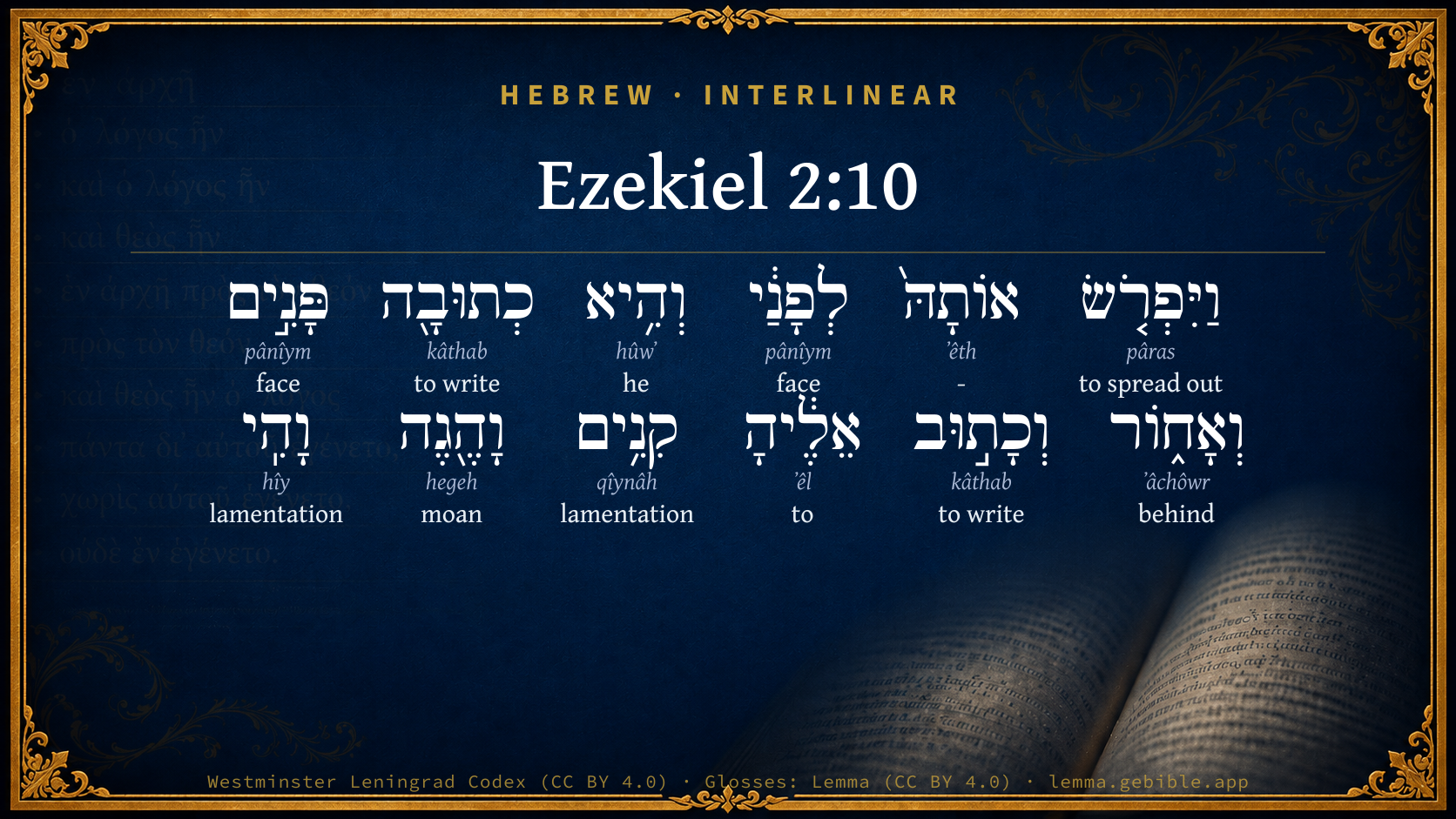
Hebrew (Westminster Leningrad Codex) Ezekiel 2:10 appears in the Hebrew Old Testament. The text above is from the Westminster Leningrad Codex. Each word links to its Strong’s number, a concise gloss, and parsing drawn from the Open Scriptures Hebrew Bible morphology. Click any word for its full Brown-Driver-Briggs (BDB) entry.
Download image
Cite this verse

Ezekiel 2:10 (World English Bible). Public Domain. Lemma interlinear Bible study tool, https://lemma.gebible.app/v/ezekiel/2/10.

Show BibTeX & RIS
BibTeX
RIS
English Translation
He spread it before me: and it was written within and without; and there were written therein lamentations, and mourning, and woe.
World English Bible · Public Domain
Highlights
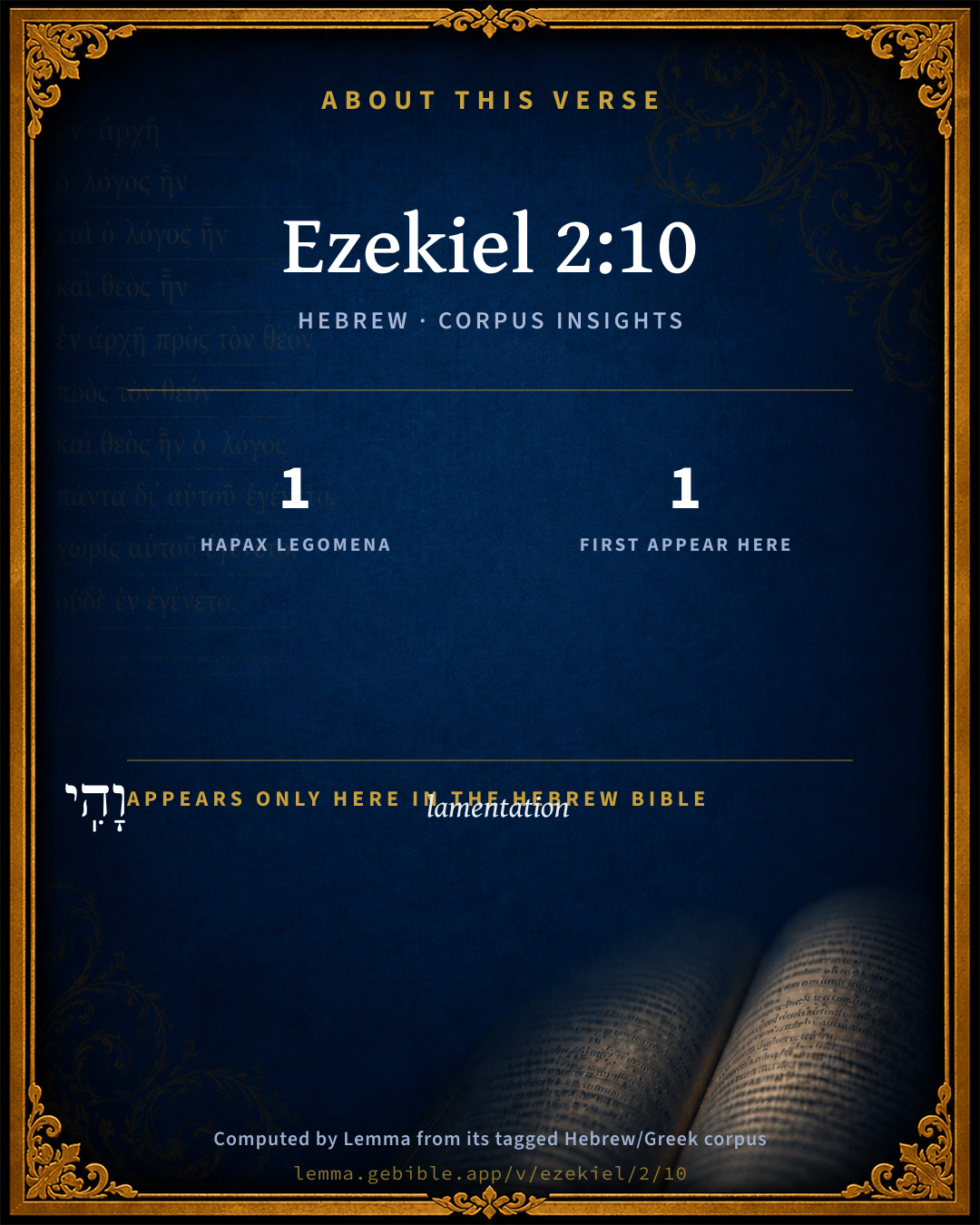
  • 1 hapax legomenon — only here in the Hebrew Bible
  • 1 first appearance in the Hebrew Bible
Full analysis ↓
Download a study sheet

One document with this verse’s original text, its word-by-word gloss line, the meaning frame, cross-references with their text, attributed commentary, and full source and license credits — printable, and it pastes into notes with its structure intact.

This verse Autodidact and up

Study sheet (.html) Plain text (.txt)

A passage Seminary Student

Up to 50 verses in one chapter. A passage sheet keeps up to 6 commentary sources and 12 cross-references per verse, in the order this page ranks them, and says so on the sheet whenever that leaves anything out. Ask for a single verse and you get the Autodidact verse sheet above.

Everything on this page stays free to read, with no account — the sheet is a download of what is already on screen, not access to it.

Want to remove ads? Support Godless Engineer
Compare translations 3

The same verse in 3 English versions, stacked beneath the original-language interlinear above. Click any original word for its lexicon entry.

Each is an independent rendering of the whole verse — the interlinear is not word-aligned to these translations.

Highlighted words mark where these versions differ — a whole-verse word diff, not a word-by-word alignment.

  • World English Bible Public Domain
    He spread it before me: and it was written within and without; and there were written therein lamentations, and mourning, and woe.
  • King James Version Public Domain
    And he spread it before me; and it was written within and without: and there was written therein lamentations, and mourning, and woe.
  • unfoldingWord Literal Text CC BY-SA 4.0
    He spread it out before me; it had been written on both its front and back, and written on it were lamentations, mourning, and woe.

unfoldingWord Literal Text — © unfoldingWord, licensed CC BY-SA 4.0. Word-aligned USFM3 via Door43 (git.door43.org/unfoldingWord/en_ult).

Versions to compare (up to 4)

3 of 4 selected

Show all 17 translations

Every available English version of this verse, each an independent rendering of the whole verse.

  • World English Bible Public Domain
    He spread it before me: and it was written within and without; and there were written therein lamentations, and mourning, and woe.
  • Berean Standard Bible Public Domain
    which He unrolled before me. And written on the front and back of it were words of lamentation, mourning, and woe.
  • Majority Standard Bible Public Domain
    which He unrolled before me. And written on the front and back of it were words of lamentation, mourning, and woe.
  • King James Version Public Domain
    And he spread it before me; and it was written within and without: and there was written therein lamentations, and mourning, and woe.
  • American Standard Version (1901) Public Domain
    And he spread it before me: and it was written within and without; and there were written therein lamentations, and mourning, and woe.
  • Revised Version (1885) Public Domain
    And he spread it before me; and it was written within and without: and there was written therein lamentations, and mourning, and woe.
  • Geneva Bible (1599) Public Domain
    And he spred it before me, and it was written within and without, and there was written therein, Lamentations, and mourning, and woe.
  • Young's Literal Translation Public Domain
    and He spreadeth it before me, and it is written in front and behind, and written on it `are' lamentations, and mourning, and wo!
  • Literal Standard Version CC BY-SA 4.0
    and He spreads it before me, and it is written in front and behind, and written on it [are] lamentations, and mourning, and woe!
  • Unlocked Literal Bible CC BY-SA 4.0
    He spread it out before me; it had been written on both its front and back, and written on it were lamentations, mourning, and woe.
  • unfoldingWord Literal Text CC BY-SA 4.0
    He spread it out before me; it had been written on both its front and back, and written on it were lamentations, mourning, and woe.
  • Darby Bible Public Domain
    And he spread it out before me; and it was written within and without; and there were written in it lamentations, and mourning, and woe.
  • World Messianic Bible Public Domain
    He spread it before me. It was written within and without; and lamentations, mourning, and woe were written in it.
  • Webster's Bible Public Domain
    And he spread it before me: and it was written within and without: and there was written in it lamentations, and mourning, and woe.
  • Free Bible Version CC BY-SA 4.0
    He spread it out in front of me, and there written on both the front and back were words of grief, mourning, and tragedy.
  • Bible in Basic English Public Domain
    And he put it open before me, and it had writing on the front and on the back; words of grief and sorrow and trouble were recorded in it.
  • JPS Tanakh (1917) Public Domain
    and He spread it before me, and it was written within and without; and there was written therein lamentations, and moaning, and woe.

Literal Standard Version (2020), Covenant Press — licensed CC BY-SA 4.0. Text via the HelloAO Bible API (eBible.org). Unlocked Literal Bible (unfoldingWord) — licensed CC BY-SA 4.0. Text via the HelloAO Bible API (eBible.org). unfoldingWord Literal Text — © unfoldingWord, licensed CC BY-SA 4.0. Word-aligned USFM3 via Door43 (git.door43.org/unfoldingWord/en_ult). Free Bible Version, Dr. Jonathan Gallagher — licensed CC BY-SA 4.0. Text via the HelloAO Bible API (eBible.org).

Word by word

More ways to search: Search by grammar → Find every occurrence → Compare this word →

Practice this passage: Drill this verse → Learn its vocabulary →

וָהִֽי
hîy
H1958
“and · lamentation”
Conjunction + Noun, Common, Masculine, Singular, Absolute
Part of Speech
Conjunction + Noun
Type
Common
Gender
Masculine
Number
Singular
State
Absolute
Full BDB Definition

Origin: for H5092

TWOT: 490

lamentation, wailing
  1. וַיִּפְרֹ֤שׂ pâras H6566 “and · to spread out” Conjunction + Verb, Qal, Sequential Imperfect, 3rd Person, Masculine, Singular
  2. אוֹתָהּ֙ ʼêth H853 “- · her” Particle, Direct Object + Suffix, Personal, 3rd Person, Feminine, Singular
  3. לְפָנַ֔י pânîym H6440 “to/for · face(s) · my” Preposition + Noun, Common, Both, Plural, Construct + Suffix, Personal, 1st Person, Common, Singular
  4. וְהִ֥יא hûwʼ H1931 “and · he” Conjunction + Pronoun, Personal, 3rd Person, Feminine, Singular
  5. כְתוּבָ֖ה kâthab H3789 “written” Verb, Qal, Participle Passive, Feminine, Singular, Absolute
  6. פָּנִ֣ים pânîym H6440 “face(s)” Noun, Common, Both, Plural, Absolute
  7. וְאָח֑וֹר ʼâchôwr H268 “and · behind” Conjunction + Noun, Common, Masculine, Singular, Absolute
  8. וְכָת֣וּב kâthab H3789 “and · written” Conjunction + Verb, Qal, Participle Passive, Masculine, Singular, Absolute
  9. אֵלֶ֔יהָ ʼêl H413 “to · her” Preposition + Suffix, Personal, 3rd Person, Feminine, Singular
  10. קִנִ֥ים qîynâh H7015 “lamentations” Noun, Common, Feminine, Plural, Absolute
  11. וָהֶ֖גֶה hegeh H1899 “and · moan” Conjunction + Noun, Common, Masculine, Singular, Absolute

About this verse

These counts appear in no published source. They are computed here, from the morphology-tagged text and Lemma’s own curated glosses. What Lemma adds →

12
words
10
distinct lemmas
Prophets
section

Notable vocabulary

1 hapax legomenon — a word that appears only here in the entire Hebrew Bible:

  • וָהִֽי lamentation H1958

First appearance in Scripture

This word makes its first canonical appearance in the Hebrew Bible here:

  • וָהִֽי lamentation H1958

Shared distinctive vocabulary

וָהֶ֖גֶה moan H1899 occurs in 3 verses of the Hebrew Bible. Also found in:

Grammatical profile

  • 3 verbs
  • 6 nouns
  • 1 pronoun
  • 1 preposition
  • 1 particle

Verb forms

  • וַיִּפְרֹ֤שׂ Qal · Sequential Imperfect
  • כְתוּבָ֖ה Qal · Participle Passive
  • וְכָת֣וּב Qal · Participle Passive

Repetition

Words recur within this verse — often emphatic in Hebrew:

  • לְפָנַ֔י face H6440 ×2
  • כְתוּבָ֖ה to write H3789 ×2

Hebrew & Septuagint length

In English translation the verse runs 22 words from the Hebrew and 29 from the Septuagint (LXX English) — closely comparable.

A rough comparison of the two English renderings, which tokenize alike — not a word-level alignment.

Word counts can differ between the Hebrew and the Greek without any difference in meaning — e.g. the Hebrew direct-object marker אֵת has no separate Greek word, and Greek often adds the article ὁ.

Cross-references

7

Topical passages linked to Ezekiel 2:10 in the Treasury of Scripture Knowledge — connected by theme and wording, ordered by reader-vote popularity; previews shown in the World English Bible.

  • Revelation 8:13 I saw, and I heard an eagle, flying in mid heaven, saying with a loud voice, "Woe! Woe! Woe for those who dwell on the earth, because of the other voices of the trumpets of the three angels, who are yet to sound!"
  • Isaiah 3:11 Woe to the wicked! Disaster is upon them; For the deeds of his hands will be paid back to him.
  • Isaiah 30:8–11 Now go, write it before them on a tablet, and inscribe it in a book, that it may be for the time to come forever and ever.
  • Jeremiah 36:29–32 Concerning Jehoiakim king of Judah you shall say, Thus says Yahweh: You have burned this scroll, saying, Why have you written therein, saying, The king of Babylon shall certainly come and destroy this land, and shall cause to cease from there man and animal?
  • Habakkuk 2:2 Yahweh answered me, "Write the vision, and make it plain on tablets, that he may run who reads it.
  • Revelation 9:12 The first woe is past. Behold, there are still two woes coming after this.
  • Revelation 11:14 The second woe is past. Behold, the third woe comes quickly.

Cross-references courtesy of OpenBible.info (CC BY 4.0).

Hebrew and Greek witnesses Masoretic Hebrew ↔ Greek Septuagint

The same verse in the two great witnesses to the Old Testament, shown verse-for-verse.

These are two independent witnesses, not word-aligned to each other, and the Septuagint is shown in lemma (dictionary) form.

Hebrew Ezekiel 2:10 Masoretic · Westminster Leningrad Codex

וַיִּפְרֹ֤שׂ אוֹתָהּ֙ לְפָנַ֔י וְהִ֥יא כְתוּבָ֖ה פָּנִ֣ים וְאָח֑וֹר וְכָת֣וּב אֵלֶ֔יהָ קִנִ֥ים וָהֶ֖גֶה וָהִֽי

He spread it before me: and it was written within and without; and there were written therein lamentations, and mourning, and woe.

World English Bible · Public Domain

Greek LXX Ezekiel 2:10 Septuagint · lemma form

καί ἀναεἰλέω αὐτός ἐνώπιον ἐγώ καί ἐν αὐτός γράφω εἰμί ὁ ὄπισθεν καί ὁ ἔμπροσθεν καί γράφω εἰς αὐτός θρῆνος καί μέλος καί οὐαί

And he unrolled it before me: and in it the front and the back were written upon: and there was written in it Lamentation, and mournful song, and woe.

LXX2012 (modern English Septuagint) · Public Domain

Hebrew: Westminster Leningrad Codex (CC BY 4.0). Greek: Septuagint (public domain); English from LXX2012 (modern English Septuagint) (Public Domain). How the Septuagint differs from the Hebrew →

Targum (Aramaic paraphrase)

1

The Targum is the ancient Jewish Aramaic paraphrase of the Hebrew Scriptures — an interpretive translation, not the Hebrew text itself. Onkelos (literal) and Pseudo-Jonathan (expansive) render the Torah, and Jonathan the Prophets. Coverage is partial: where no permissively-licensed English translation exists for a verse, only the Aramaic is shown. This is verse-level text, not a word-by-word alignment to the Hebrew.

  1. Targum Jonathan Prophets (Joshua–Malachi)
    וּפְרַס יָתָהּ קֳדָמַי וְהָא כְתִיבָא מֵאַפָּהָא וּמֵאֲחוֹרָהָא מַה דַהֲוָה מִן שְׁרוּיָא וּמַה דְעָתִיד לְמֶהֱוֵי בְּסוֹפָא וּכְתִיב בָּהּ דְאִם יֶעְבְּרוּן בֵּית יִשְׂרָאֵל עַל אוֹרַיְתָא יִשְׁלְטוּן בְהוֹן עַמְמַיָא וְאִם יַעַבְדוּן יַת אוֹרַיְתָא יְסוּף מִנְהוֹן אִלְיָא וּדְוָנָא וְתֵינַחְתָּא:

    (no public-domain English translation for this verse)

    Targum Jonathan — Aramaic: “Mikraot Gedolot” (public domain). English: “Sefaria Community Translation” (CC0 1.0 (public-domain dedication)); “London "Chaldee Paraphrase," 1871” (public domain). Text via Sefaria.

Commentary

Notes on Ezekiel 2:10 from classic Christian and Jewish commentators (each source and its license shown beneath its notes). The classic Christian expositions comment on the surrounding passage and are grouped to its opening verse, so a note may address several verses; the Jewish commentaries on the Tanakh (Rashi and others) are per-verse, so they appear only where the commentator wrote on this verse.

Lemma curates 59 commentaries, every one of them public domain or Creative Commons licensed, each selected and text-cleaned for this edition rather than reprinted as found. About our sources →

Trapp's Complete Commentary

John Trapp

Eze 2:10 And he spread it before me; and it [was] written within and without: and [there was] written therein lamentations, and mourning, and woe.

Ver. 10. And he spread it before me.] Till Christ unfold heavenly mysteries, men understand them not. {Rev 5:5 Mat 11:27 1Jn 1:8-9; 1Jn 5:15} He is the excellent interpreter.

And it was written within and without.] To show abundance of miseries coming on the Jews and others.

Lamentation, and mourning, and woe.] Foretold all along this volume till chapter 40; sad songs, doleful ditties. הזה, gemitus sicut columbae moaning like doves. {Isa 38:14}

John Trapp, A Commentary or Exposition upon All the Books of the Old and New Testament (1647–1656) — public domain. Text from a community e-Sword module.

Geneva Bible (1599)

Geneva Bible translators

He showeth what were the contents of this book: to wit, God’s judgments against the wicked.

Geneva Bible (1599) marginal notes — public domain. Text via Bolls.life.

Jamieson, Fausset & Brown

Robert Jamieson, A. R. Fausset & David Brown

within and without--on the face and the back. Usually the parchment was written only on its inside when rolled up; but so full was God's message of impending woes that it was written also on the back.

Next: Ezekiel Chapter 3

Jamieson, Fausset & Brown — Commentary Critical and Explanatory on the Whole Bible (1871) — public domain (CC PDM 1.0). Text via the HelloAO Bible API.

Adam Clarke's Commentary

Verse 10. It was written within and without] Contrary to the state of rolls in general, which are written on the inside only. The Hebrew rolls are generally written in this way. There are several of such Hebrew rolls before me, all written on the inside only, consisting of skins of vellum, or parchment, or basil, a sort of half-tanned sheep or goat skin, sewed together, extending to several yards in length. Other Asiatic books were written in the same way. A Sanscrit roll of sixty feet in length, also before me, is written all on the inside; and a Koran, written in exceedingly small characters, about two inches broad and twelve feet long, and weighing but about half an ounce. But the roll presented to the prophet was written on both sides, because the prophecy was long, and to the same effect; that they might see the mind of God wherever they looked.

There was written therein lamentations, and mourning, and wo.] What an awful assemblage! קינים והגה והי kinim, vahegeh, vehi, lamentations, and a groan, and alas! Lamentations on all hands; a groan from the dying; and alas, or Wo is me! from the survivors. It was the letter that killeth, and is the ministration of death. What a mercy to have that which is emphatically called Το Ευαγγελιον, The glad tidings, the good news! Christ Jesus is come into the world to save sinners; and he wills that all men should be saved and come to the knowledge of the truth. Here are rejoicings, thanksgivings, and exultation.

Adam Clarke's Commentary on the Bible (1810–1826) — public domain. Text from a community e-Sword/MySword module.

John Calvin's Commentaries

He adds, after the volume was unrolled, that he saw it written on each side: by which words he understands not that any brief command was given to him, but that a length of much time was imposed. For if he had only spoken concerning the roll, the Jews might have contemptuously rejected him after three or four days, as if he had come to an ends” A roll was indeed offered to thee, but now thou hast spoken three or four times, is not this sufficient?” Hence, as the Prophet might meet with neglect, he says, the roll was written before and behind He now says, for such was his argument, that lamentations only were written there הגה, hegeh, signifies sometimes meditation and speech simply, but here, because it is connected with lamentations, there is no doubt that it is to be taken for a mournful strain. At length the particle הי, hei, is added in the sense of grieving. On the whole then, the Prophet teaches, that the instruction contained in the book was not sweet or pleasant, but full of sorrow, since truly God here showed proofs of his anger, and this cannot be apprehended unless by its causing grief and lamentations. Now, therefore, we understand that the Israelites were more and more exasperated, when the Prophet said, that he came like a herald who denounced war in the name of God, and, at the same time, had no message of peace. As to the rest of the people, we shall see afterwards, in many places, that he was a messenger of God’s mercy, but his duty was to rouse up the Jews, that they might feel God their adversary: thus the Prophet was sent with no other object than that of going, as an armed man, into the midst,, and uttering threats in the name of God. I cannot now proceed further, although what follows is connected with this subject.

John Calvin's Commentaries (1540-1563) — public domain. Text from the Calvin Translation Society English edition (1840s-50s) via the Christian Classics Ethereal Library (ccel.org). Calvin's coverage is partial (roughly two-thirds of the Bible); uncommented books and verses are honest gaps, never fabricated. The 19th-century editor's footnotes and remarks are omitted so the notes are faithfully Calvin's own voice.

Ellicott's Commentary for English Readers

(10) He spread it before me.—The roll was given to the prophet open, as the book in Rev_10:8, that he might first see it all as a whole, before becoming thoroughly possessed with it in detail. What he saw was “lamentations, and mourning, and woe;” in other words, this was the whole character of the message he was commissioned to bear until the great judgment in the destruction of Jerusalem and the Temple should be fulfilled, when, after Ezekiel 33, his prophecies assume a consolatory character. (See Introduction, VI)

A Bible Commentary for English Readers, edited by Charles John Ellicott (1878–1897) — public domain. Text from a community e-Sword module.

John Gill's Exposition

And he spread it before me,.... Unrolled it, that what was written in it might he seen and read; that so, understanding it, he might deliver the contents of it to the people: thus the Gospel, and the mysteries of it, must be explained by Christ to his ministers; and their understandings must be opened before they will be capable of making them known to others: and

it was written within and without; on the back, of the vellum or parchment as well as inside; and such writings were called "opisthographa"; of this kind was the book John saw Rev 5:1. It was usual only to write on the inside; but when they had a great deal to write, then they wrote on the backside also (d); so that this roll being thus written denotes the largeness and abundance of the prophecies contained in this book; some respecting the Jews, and others the nations of the world. The Targum is,

"it was written before and behind, what was from the beginning, and what shall be in the end:''

and there were written therein lamentations, and mourning, and woe; afflictions, chastisements, and punishments, that should be inflicted upon the Jews, and other nations of the world; which, when made known to them, and especially when inflicted on them, would occasion sorrow and distress among them. In the Talmud, "lamentations" are interpreted of the punishments of the righteous in this world; "mourning" of the gift of reward to the righteous in the world to come; and "woe" of the punishments of the wicked in the world to come (e). The Targum is,

"if the house of Israel transgress the law, the people shall rule over them; but, if they keep the law, lamentation, and mourning, and sorrow, shall cease from them.''

(d) "----Aut summi plena tam margine libri Scriptus, et in tergo, nec dum finitus Orestes". Juvenal. Satyr. 1. (e) T. Bab. Erubin, fol. 21. 1.

Next: Ezekiel Chapter 3

John Gill's Exposition of the Whole Bible (1746–1763) — public domain (CC PDM 1.0). Text via the HelloAO Bible API.

Matthew Poole's English Annotations

He: Eze 2:9 it was the hand, here it is the person, he who held out his hand.

Spread it before me; unrolled it within that distance the prophet might read what was written therein.

Written within and without; on both sides, on that side which was inward when rolled upon its roundle, and on that side also that was outward, and as it were the back side: a long roll, and full on both sides; so would the sorrows of the Jews be.

Lamentations, and mourning, and woe; such things as would make the stoutest heart lament, inwardly grieve; and mourn, express it in visible tokens; and woe, sad thoughts and guesses at worse to come: so this prophet’s message would be a most heavy burden to the Jews and other nations against which he prophesied.

Matthew Poole's English Annotations on the Holy Bible (1683–1685) — public domain. Text from a community e-Sword/MySword module.

The Pulpit Commentary

It was written within and without. Commonly such rolls, whether of vellum or papyrus, were written on one side only. This, like the tables of stone, (Exo_32:15) was written, as a symbol of the fulness of its message, on both sides. And as he looked at the roll thus "spread before" him, he saw that it was no evangel, no glad tidings, that he had thus to identify with his work, but one from first to last of lamentations, and mourning, and woe. Jeremiah had been known as the prophet of weeping, and was about this time (probably a little later) writing his own Lamentations (the Hebrew title of the book, however, is simply its first words) over the fall of Jerusalem. Ezekiel"s work was to be of a like nature. The word meets us again (Eze_19:1, 14 26:17 27:2, 32 28:12 32:2, 16) as the keynote of his writings. Out of such a book, though the glad tidings were to come afterwards, his own prophetic work was to be evolved.

The Pulpit Commentary (1880–1919), ed. H.D.M. Spence-Jones & Joseph S. Exell — public domain. Text from a community e-Sword module.

John Wesley's Explanatory Notes

And - The person, who held out his hand. Spread - Unrolled it. Within &c. - On both sides, on that side which was inward when rolled, and on that side also that was outward.

John Wesley, Explanatory Notes Upon the Whole Bible (1754–1765) — public domain. Text via the GEBible commentary corpus.

The Annotated Bible

Arno C. Gaebelein

Eze 2:9-10; Eze 3:1-14. Compare the roll here with Zec 5:1-4; with the one of Rev 5:1-14, which the Lamb receives and opens, and the little roll in Rev 10:9-10. These rolls have the same meaning, namely, the Word itself, the message of tribulation and judgment, which is written therein.

The Word must be received and eaten, that is the spiritual lesson. Ezekiel obeyed. It was self surrender and though the message was a hard message, yet it was sweet unto him. Compare with Jer 15:16. Ezekiel was to speak the words of the Lord unto them; and the sender predicts failure. “The house of Israel will not hearken unto thee, for they will not hearken unto Me.” It was to make no difference to the prophet. His commission was to speak Jehovah’s words. Then cherubim and wheels are in motion. He is lifted up and Jehovah’s hand is strong upon him.

Arno C. Gaebelein, The Annotated Bible (1913–1922) — public domain. Text from a community e-Sword module.

Rashi

Rabbi Shlomo Yitzchaki (Rashi)

before and behind That which existed from the beginning and that which is destined to be in the end.

lamentations The retribution of the righteous in this world.

and murmuring Heb. וָהֶגֶה. The gift of their reward, over which they will sing in the future.

and woe The woe of the wicked in the world to come.

Rashi on the Tanakh — English translations: “The Judaica Press complete Tanach with Rashi, translated by A. J. Rosenberg” (CC BY 4.0); “Pentateuch with Rashi's commentary by M. Rosenbaum and A.M. Silbermann, 1929-1934” (public domain); “The Metsudah Tanach series, Lakewood, N.J” (CC BY 4.0); and “The Book of Joshua, Metsudah Publications, 1997” (CC BY 4.0). Text via Sefaria.

Lesson kit

Teaching starters — assembled from the data on this page, not authored interpretation. Every prompt links to the verse data it draws on. Edit before teaching.

Ezekiel, in the Prophets, opens this verse with 12 words (10 distinct Hebrew lemmas). Its most distinctive word is hîy (“lamentation”). A historical commentator’s framing appears above. Read the whole chapter for the surrounding context.

Discussion questions

  1. The word hîy carries the sense “lamentation.” How does it shape the verse?
  2. This verse holds 1 word here found nowhere else in the Hebrew Bible. What might the rare word draw attention to?
  3. The word “lamentation” first appears here in Scripture. What is being introduced at this debut?
  4. Job 37:2 shares the word «moan» with this verse. How do the two illuminate each other?
  5. “face” occurs 2× in this one verse. What is the effect of the repetition?
  6. These translations render this verse differently; the difference is in the English rendering, not the original. What questions does that raise?
  7. The verb «וַיִּפְרֹ֤שׂ» is Qal Sequential Imperfect. How does its form color the action?
  8. Reading how Trapp's Complete Commentary and Geneva Bible (1599) read this verse, where do the two commentators agree and where do they part?

Things to notice

  • 1 word in this verse appears nowhere else in the Hebrew Bible.
  • 1 word makes its first canonical appearance in Scripture here.
  • These translations choose different wording for 10 words in this verse.
  • “face” occurs 2× in this single verse.
  • 10 distinct Hebrew lemmas span 12 words in this verse.

Reading settings

Reading text

Shown beneath each verse's original-language words.

Old Testament
Old Testament edition

Read the OT as the Masoretic Hebrew (MT) or the Greek Septuagint (LXX).

English shown for the Greek Septuagint (in the Hebrew ↔ Greek comparison).

Comparing translations? Open the Compare panel on any verse page to stack up to four side by side.