
Exodus 10:29

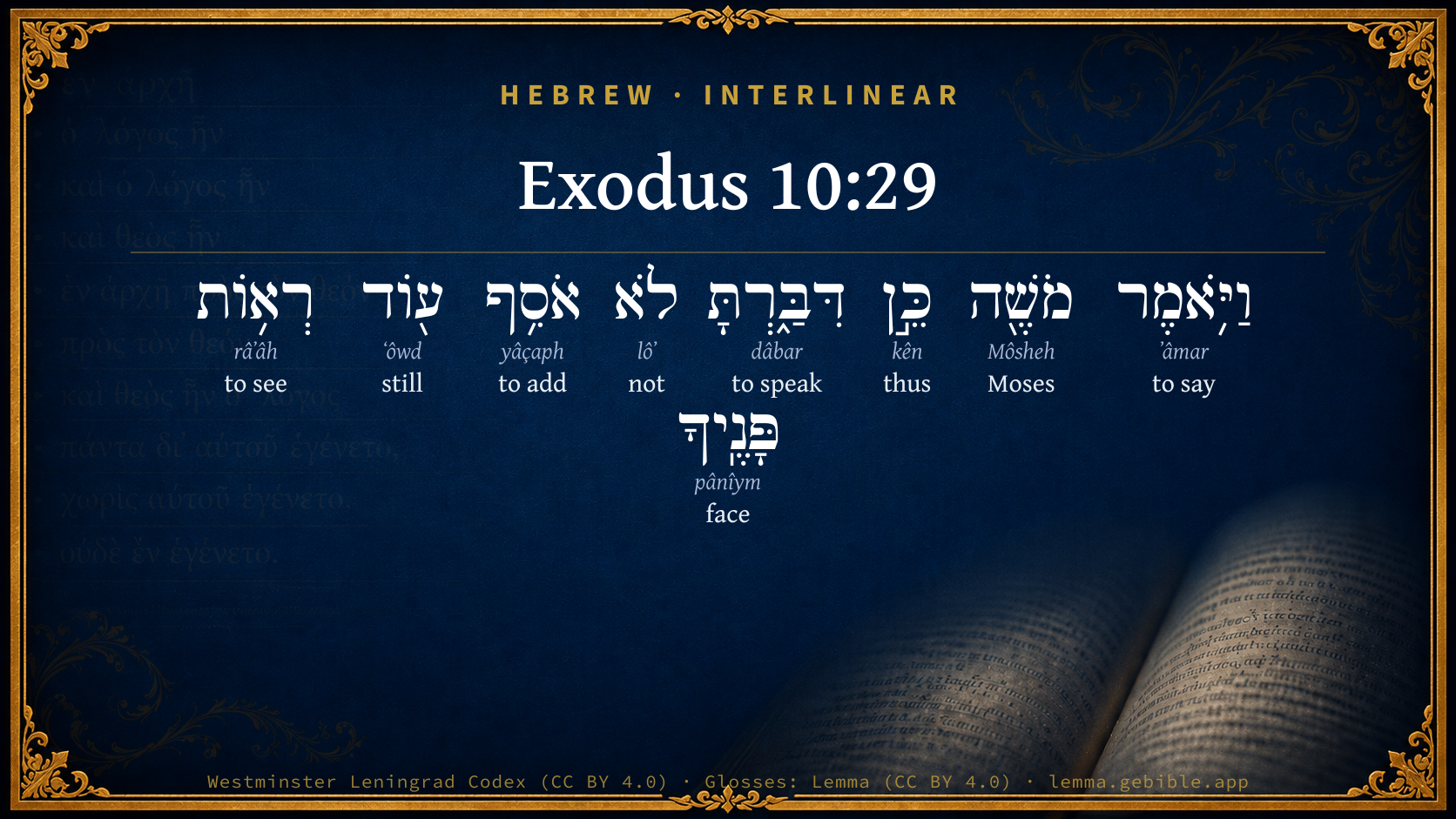
Hebrew (Westminster Leningrad Codex) Exodus 10:29 appears in the Hebrew Old Testament. The text above is from the Westminster Leningrad Codex. Each word links to its Strong’s number, a concise gloss, and parsing drawn from the Open Scriptures Hebrew Bible morphology. Click any word for its full Brown-Driver-Briggs (BDB) entry.
Download image
Cite this verse

Exodus 10:29 (World English Bible). Public Domain. Lemma interlinear Bible study tool, https://lemma.gebible.app/v/exodus/10/29.

Show BibTeX & RIS
BibTeX
RIS
English Translation
Moses said, "You have spoken well. I will see your face again no more."
World English Bible · Public Domain
Download a study sheet

One document with this verse’s original text, its word-by-word gloss line, the meaning frame, cross-references with their text, attributed commentary, and full source and license credits — printable, and it pastes into notes with its structure intact.

This verse Autodidact and up

Study sheet (.html) Plain text (.txt)

A passage Seminary Student

Up to 50 verses in one chapter. A passage sheet keeps up to 6 commentary sources and 12 cross-references per verse, in the order this page ranks them, and says so on the sheet whenever that leaves anything out. Ask for a single verse and you get the Autodidact verse sheet above.

Everything on this page stays free to read, with no account — the sheet is a download of what is already on screen, not access to it.

Want to remove ads? Support Godless Engineer
Compare translations 3

The same verse in 3 English versions, stacked beneath the original-language interlinear above. Click any original word for its lexicon entry.

Each is an independent rendering of the whole verse — the interlinear is not word-aligned to these translations.

Highlighted words mark where these versions differ — a whole-verse word diff, not a word-by-word alignment.

  • World English Bible Public Domain
    Moses said, "You have spoken well. I will see your face again no more."
  • King James Version Public Domain
    And Moses said, Thou hast spoken well, I will see thy face again no more.
  • unfoldingWord Literal Text CC BY-SA 4.0
    And Moses said, “Just as you say, I will not ever see your face again.”

unfoldingWord Literal Text — © unfoldingWord, licensed CC BY-SA 4.0. Word-aligned USFM3 via Door43 (git.door43.org/unfoldingWord/en_ult).

Versions to compare (up to 4)

3 of 4 selected

Show all 18 translations

Every available English version of this verse, each an independent rendering of the whole verse.

  • World English Bible Public Domain
    Moses said, "You have spoken well. I will see your face again no more."
  • Berean Standard Bible Public Domain
    “As you say,” Moses replied, “I will never see your face again.”
  • Majority Standard Bible Public Domain
    “As you say,” Moses replied, “I will never see your face again.”
  • King James Version Public Domain
    And Moses said, Thou hast spoken well, I will see thy face again no more.
  • American Standard Version (1901) Public Domain
    And Moses said, Thou hast spoken well. I will see thy face again no more.
  • Revised Version (1885) Public Domain
    And Moses said, Thou hast spoken well; I will see thy face again no more.
  • Geneva Bible (1599) Public Domain
    Then Moses said, Thou hast said well: from henceforth will I see thy face no more.
  • Douay-Rheims (1899) Public Domain
    Moses answered: So shall it be as thou hast spoken, I will not see thy face any more.
  • Young's Literal Translation Public Domain
    and Moses saith, `Rightly hast thou spoken, I add not any more to see thy face.'
  • Literal Standard Version CC BY-SA 4.0
    and Moses says, “You have spoken correctly, I do not add to see your face anymore.”
  • Unlocked Literal Bible CC BY-SA 4.0
    Moses said, “You yourself have spoken. I will not see your face again.”
  • unfoldingWord Literal Text CC BY-SA 4.0
    And Moses said, “Just as you say, I will not ever see your face again.”
  • Darby Bible Public Domain
    And Moses said, Thou hast spoken rightly: I will see thy face again no more!
  • World Messianic Bible Public Domain
    Moses said, “You have spoken well. I will see your face again no more.”
  • Webster's Bible Public Domain
    And Moses said, Thou hast spoken well, I will see thy face again no more.
  • Free Bible Version CC BY-SA 4.0
    “May it be as you say,” Moses replied. “I won't see you again.”
  • Bible in Basic English Public Domain
    And Moses said, You say truly; I will not see your face again.
  • JPS Tanakh (1917) Public Domain
    And Moses said: 'Thou hast spoken well; I will see thy face again no more.'

Literal Standard Version (2020), Covenant Press — licensed CC BY-SA 4.0. Text via the HelloAO Bible API (eBible.org). Unlocked Literal Bible (unfoldingWord) — licensed CC BY-SA 4.0. Text via the HelloAO Bible API (eBible.org). unfoldingWord Literal Text — © unfoldingWord, licensed CC BY-SA 4.0. Word-aligned USFM3 via Door43 (git.door43.org/unfoldingWord/en_ult). Free Bible Version, Dr. Jonathan Gallagher — licensed CC BY-SA 4.0. Text via the HelloAO Bible API (eBible.org).

Word by word

More ways to search: Search by grammar → Find every occurrence → Compare this word →

Practice this passage: Drill this verse → Learn its vocabulary →

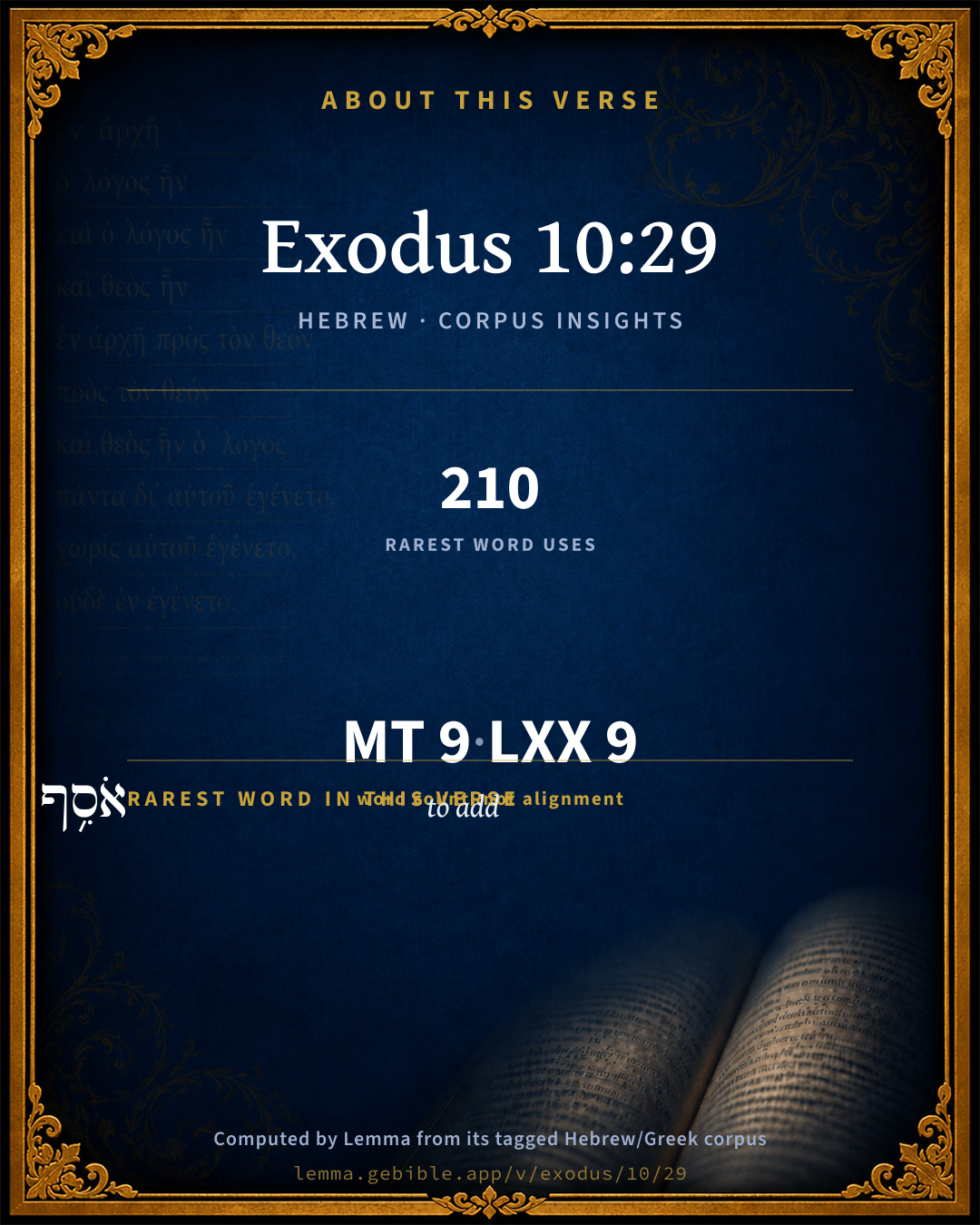
About this verse

These counts appear in no published source. They are computed here, from the morphology-tagged text and Lemma’s own curated glosses. What Lemma adds →

9
words
9
distinct lemmas
Pentateuch
section

Grammatical profile

  • 4 verbs
  • 2 nouns
  • 1 adverb
  • 2 particles

Verb forms

  • וַיֹּ֥אמֶר Qal · Sequential Imperfect
  • דִּבַּ֑רְתָּ Piel · Perfect
  • אֹסִ֥ף Hiphil · Imperfect
  • רְא֥וֹת Qal · Infinitive Construct

Hebrew & Septuagint length

In English translation the verse runs 14 words from the Hebrew and 14 from the Septuagint (LXX English) — the same length.

A rough comparison of the two English renderings, which tokenize alike — not a word-level alignment.

Word counts can differ between the Hebrew and the Greek without any difference in meaning — e.g. the Hebrew direct-object marker אֵת has no separate Greek word, and Greek often adds the article ὁ.

In the original languages it is 9 Hebrew tokens and 9 Greek tokens — but the two are counted differently (Hebrew bundles its prefixes and suffixes into one token; the Greek is in lemma form), so that isn’t a like-for-like length.

Cross-references

3

Topical passages linked to Exodus 10:29 in the Treasury of Scripture Knowledge — connected by theme and wording, ordered by reader-vote popularity; previews shown in the World English Bible.

  • Hebrews 11:27 By faith, he left Egypt, not fearing the wrath of the king; for he endured, as seeing him who is invisible.
  • Exodus 12:30–31 Pharaoh rose up in the night, he, and all his servants, and all the Egyptians; and there was a great cry in Egypt, for there was not a house where there was not one dead.
  • Exodus 11:4–8 Moses said, "This is what Yahweh says: 'About midnight I will go out into the midst of Egypt,

Cross-references courtesy of OpenBible.info (CC BY 4.0).

Hebrew and Greek witnesses Masoretic Hebrew ↔ Greek Septuagint

The same verse in the two great witnesses to the Old Testament, shown verse-for-verse.

These are two independent witnesses, not word-aligned to each other, and the Septuagint is shown in lemma (dictionary) form.

Hebrew Exodus 10:29 Masoretic · Westminster Leningrad Codex

וַיֹּ֥אמֶר מֹשֶׁ֖ה כֵּ֣ן דִּבַּ֑רְתָּ לֹא אֹסִ֥ף ע֖וֹד רְא֥וֹת פָּנֶֽיךָ

Moses said, "You have spoken well. I will see your face again no more."

World English Bible · Public Domain

Greek LXX Exodus 10:29 Septuagint · lemma form

λέγω δέ μωυσῆς εἶπον οὐκέτι ὁράω σύ εἰς πρόσωπον

And Moses says, You have said, I will not appear in your presence again.

LXX2012 (modern English Septuagint) · Public Domain

Hebrew: Westminster Leningrad Codex (CC BY 4.0). Greek: Septuagint (public domain); English from LXX2012 (modern English Septuagint) (Public Domain). How the Septuagint differs from the Hebrew →

Targum (Aramaic paraphrase)

2

The Targum is the ancient Jewish Aramaic paraphrase of the Hebrew Scriptures — an interpretive translation, not the Hebrew text itself. Onkelos (literal) and Pseudo-Jonathan (expansive) render the Torah, and Jonathan the Prophets. Coverage is partial: where no permissively-licensed English translation exists for a verse, only the Aramaic is shown. This is verse-level text, not a word-by-word alignment to the Hebrew.

  1. Targum Onkelos Torah (Genesis–Deuteronomy)
    וַאֲמַר משֶׁה יָאוּת מַלֵילְתָּא לָא אוֹסִיף עוֹד לְמֶחֱזֵי אַפָּיךְ:

    (no public-domain English translation for this verse)

    Targum Onkelos — Aramaic: “Onkelos Genesis” (public domain); “Onkelos Exodus” (public domain); “Onkelos Leviticus” (public domain); “Onkelos Numbers” (public domain); “Onkelos Deuteronomy” (public domain). English: “Sefaria Community Translation” (CC0 1.0 (public-domain dedication)); “J.W. Etheridge. The Targums of Onkelos and Jonathan Ben Uzziel on the Pentateuch. London: Longmans, Green, 1862” (public domain). Text via Sefaria.

  2. Targum Pseudo-Jonathan Torah (Genesis–Deuteronomy)
    וַאֲמַר משֶׁה יָאוּת מַלֵּילְתָּא אֲנָא עַד דַּהֲוֵינָא יָתִיב בְּמִדְיָן אִיתְאֲמַר לִי בְּמֵימַר מִן קֳדָם יְיָ דְגוּבְרַיָא דְבָעוּ לְמִקְטְלִי נַחֲתוּ מִנִּכְסֵיהוֹן וְהִינוּן חֲשִׁיבִין כְּמִיתַיָא וְלָא מִן סוּף דַּהֲוָה עֲלָךְ רַחֲמִין הֲוֵינָא מְצַלֵּי וּמַחְתָא הֲוָה מִתְכַּלְיָא מִינָךְ וּכְדוֹן לָא אוֹסִיף תּוּב לְמֶחֱמֵי סְבַר אַפָּךְ

    And Mosheh said, Thou hast spoken fairly. While I was dwelling in Midian, it was told me in a word from before the Lord, that the men who had sought to kill me had fallen from their means, and were reckoned with the dead. At the end there will be no mercy upon thee; but I will pray, and the plague shall be restrained from thee. And now I will see thy face no more.

    Targum Pseudo-Jonathan — Aramaic: “Targum Jonathan on Genesis” (public domain); “Targum Jonathan on Exodus” (public domain); “Targum Jonathan on Leviticus” (public domain); “Targum Jonathan on Numbers” (public domain); “Targum Jonathan on Deuteronomy” (public domain). English: “The Targum of Jonathan ben Uzziel, trans. J. W. Etheridge, London, 1862” (public domain). Text via Sefaria.

Commentary

Notes on Exodus 10:29 from classic Christian and Jewish commentators (each source and its license shown beneath its notes). The classic Christian expositions comment on the surrounding passage and are grouped to its opening verse, so a note may address several verses; the Jewish commentaries on the Tanakh (Rashi and others) are per-verse, so they appear only where the commentator wrote on this verse.

Lemma curates 59 commentaries, every one of them public domain or Creative Commons licensed, each selected and text-cleaned for this edition rather than reprinted as found. About our sources →

Trapp's Complete Commentary

John Trapp

Exo 10:29 And Moses said, Thou hast spoken well, I will see thy face again no more.

Ver. 29. Thou hast spoken well,] q.d., When I see thee next, do thy pleasure by me. {a} This was an act of faith in him, whereby he "feared not the wrath of the king." {Heb 11:27} So when Valens, the Arian Emperor, threatened Basil with bonds and banishment, Pueris illa terriculamenta proponat, said he; Let him threaten boys with those tortures. The emperor may take away my life, but not my faith; my head, but not my crown.

{a} εζθε γενοιτο μοι τουτο.

John Trapp, A Commentary or Exposition upon All the Books of the Old and New Testament (1647–1656) — public domain. Text from a community e-Sword module.

Joseph Benson's Commentary

Exo 10:29. I will see thy face no more — Namely, after this time, for this conference did not break off till Exo 11:8, when Moses went out in great anger, and told Pharaoh how soon his proud stomach would come down; which was fulfilled Exo 12:31, when Pharaoh became an humble supplicant to Moses to depart. So that after this interview Moses came no more till he was sent for.

Joseph Benson's Commentary on the Old and New Testaments (1811–1818) — public domain. Text from a community e-Sword module.

Jamieson, Fausset & Brown

Robert Jamieson, A. R. Fausset & David Brown

Moses said, Thou hast spoken well.

Next: Exodus Chapter 11

Jamieson, Fausset & Brown — Commentary Critical and Explanatory on the Whole Bible (1871) — public domain (CC PDM 1.0). Text via the HelloAO Bible API.

Adam Clarke's Commentary

Verse 29. I will see thy face again no more.] It is very likely that this was the last interview that Moses had with Pharaoh, for what is related, Ex 11:4-8, might have been spoken on this very occasion, as it is very possible that God gave Moses to understand his purpose to slay the first-born, while before Pharaoh at this time; so, in all probability, the interview mentioned here was the last which Moses had with the Egyptian king. It is true that in Ex 12:31 it is stated that Pharaoh called for Moses and Aaron by night, and ordered them to leave Egypt, and to take all their substance with them, which seems to imply that there was another interview, but the words may imply no more than that Moses and Aaron received such a message from Pharaoh. If, however, this mode of interpreting these passages should not seem satisfactory to any, he may understand the words of Moses thus: I will see thy face - seek thy favour, no more in behalf of my people, which was literally true; for if Moses did appear any more before Pharaoh, it was not as a supplicant, but merely as the ambassador of God, to denounce his judgments by giving him the final determination of Jehovah relative to the destruction of the first-born.

1. To the observations at the conclusion of the preceding chapter, we may add that at first view it seems exceedingly strange that, after all the proofs Pharaoh had of the power of God, he should have acted in the manner related in this and the preceding chapters, alternately sinning and repenting; but it is really a common case, and multitudes who condemn the conduct of this miserable Egyptian king, act in a similar manner. They relent when smarting under God's judgments, but harden their hearts when these judgments are removed. Of this kind I have witnessed numerous cases. To such God says by his prophet, Why should ye be stricken any more? ye will revolt more and more. Reader, are not the vows of God upon thee? Often when afflicted in thyself or family hast thou not said like Pharaoh, (Ex 10:17,) Now therefore forgive, I pray thee, my sin only THIS ONCE, and take away from me this death ONLY? And yet when thou hadst respite, didst thou not harden thy heart, and with returning health and strength didst thou not return unto iniquity? And art thou not still in the broad road of transgression? Be not deceived; God is not mocked; he warns thee, but he will not be mocked by thee. What thou sowest, that thou must reap. Think then what a most dreadful harvest thou mayest expect from the seeds of vice which thou hast already sown!

2. Even in the face of God's judgments the spirit of avarice will make its requisitions. Only let your flocks and your herds be stayed, says Pharaoh. The love of gain was the ruling principle of this man's soul, and he chooses desperately to contend with the justice of his Maker, rather than give up his bosom sin! Reader, is this not thy own case? And art thou not ready, with Pharaoh, to say to the messenger of God, who rebukes thee for thy worldly mindedness, &c., Get thee gone from me. Take heed to thyself, and see my face no more. Esau and Pharaoh have both got a very bad name, and many persons who are repeating their crimes are the foremost to cover them with obloquy! When shall we learn to look at home? to take warning by the miscarriages of others, and thus shun the pit into which we have seen so many fall? If God were to give the history of every man who hardens himself from his fear, how many Pharaoh-like cases should we have on record! But a day is coming in which the secrets of every heart shall be revealed, and the history of every man's life laid open to an assembled world.

Adam Clarke's Commentary on the Bible (1810–1826) — public domain. Text from a community e-Sword/MySword module.

Ellicott's Commentary for English Readers

(29) The division between Exodus 10 and Exodus 11 is unfortunate. The interview between Pharaoh and Moses was not yet over. It is continued in Exo_10:4-8 of the next chapter, and only terminates when the prophet “went out from Pharaoh in a great anger.” Exo_10:1-3 of Exodus 11 are parenthetic.

A Bible Commentary for English Readers, edited by Charles John Ellicott (1878–1897) — public domain. Text from a community e-Sword module.

Haydock's Catholic Bible Commentary

More. Of my own accord. (Menochius) --- Thou wilt send for me. (Calmet)

George Leo Haydock (1774–1849), Haydock's Catholic Family Bible and Commentary, 1859 edition — public domain. Excludes Psalms (Douay-Rheims chapter numbering differs from Protestant) and Deuterocanonical books (Catholic canon only).

Matthew Poole's English Annotations

Thou hast spoken well, Heb. right; not morally, for so it was very ill said; but logically, that which agrees, though not with thy duty, yet with the event and truth of the thing; for as thou hast warned me to see thee no more, so I in the name of God assure thee that thou shalt see me no more, to beg my prayers, or to be helped out of thy troubles by my means. And therefore that discourse of Moses to Pharaoh, which follows, Exo 11:4, &c., though it be put there out of its order and proper place, as many other passages are, yet was delivered at this time, and upon occasion of these words.

Matthew Poole's English Annotations on the Holy Bible (1683–1685) — public domain. Text from a community e-Sword/MySword module.

The Pulpit Commentary

And Moses said, etc. The reply of Moses, so far, is simple and dignified. Thou hast spoken well, he says hast made a right decision further interviews between me and thee are useless, can lead to no result, only waste time. This shall be our last interviewI will see thy face no more." It is generally agreed however that Moses did not quit the presence with these words; but continued to address Pharaoh for some little time, making his parting speech in the terms which are recorded in vers. 4-8 of the next chapter. Having announced the Tenth Plague, the coming destruction of the first-born, he turned and "went out from Pharaoh in a great anger". (Exo_11:8)

The Pulpit Commentary (1880–1919), ed. H.D.M. Spence-Jones & Joseph S. Exell — public domain. Text from a community e-Sword module.

John Wesley's Explanatory Notes

I will see thy face no more - Namely, after this time, for this conference did not break off till chap. xi, 8, when Moses went out in great anger and told Pharaoh how soon his proud stomach would come down; which was fulfilled chap. xii, 31, when Pharaoh became an humble supplicant to Moses to depart. So that after this interview Moses came no more till he was sent for.

John Wesley, Explanatory Notes Upon the Whole Bible (1754–1765) — public domain. Text via the GEBible commentary corpus.

Rashi

Rabbi Shlomo Yitzchaki (Rashi)

כן דברת signifies RIGHTLY HAST THOU SPOKEN, and in its proper time hast thou spoken; for it is true that I will not see thy face again (Mekhilta; Exodus Rabbah 18:1; cf. also Onkelos).

Rashi on the Tanakh — English translations: “The Judaica Press complete Tanach with Rashi, translated by A. J. Rosenberg” (CC BY 4.0); “Pentateuch with Rashi's commentary by M. Rosenbaum and A.M. Silbermann, 1929-1934” (public domain); “The Metsudah Tanach series, Lakewood, N.J” (CC BY 4.0); and “The Book of Joshua, Metsudah Publications, 1997” (CC BY 4.0). Text via Sefaria.

Ramban (Nachmanides)

Rabbi Moshe ben Nachman (Ramban / Nachmanides)

AND MOSES SAID: THOU HAST SPOKEN WELL; I WILL NOT SEE THY FACE AGAIN ANY MORE. That is, “I will not see you again after I leave you.” After the plague of the firstborn, Moses did not see Pharaoh. The meaning of the verse, And he called for Moses and Aaron, is [not that he called them to come to see him, but instead] that he himself went to the entrance of their home and shouted in the darkness, Rise up, get you forth from among my people. Perhaps he sent the message to them by Egyptians, of whom it is said, And the Egyptians were urgent upon the people to send them out of the land in haste., Verse 33.It is possible that the verse, I will not see thy face again any more, means “in your palace,” namely, “I will not come to you any more.” And so the Rabbis have said in Eileh Shemoth Rabbah: “You have spoken well in saying, See my face no more. I will not come to you again; you will come to me.”

Ramban (Nachmanides) on the Tanakh — English translation: “Commentary on the Torah by Ramban (Nachmanides). Translated and annotated by Charles B. Chavel. New York, Shilo Pub. House, 1971-1976” (CC BY 4.0). Text via Sefaria.

Lesson kit

Teaching starters — assembled from the data on this page, not authored interpretation. Every prompt links to the verse data it draws on. Edit before teaching.

Exodus, in the Pentateuch, opens this verse with 9 words (9 distinct Hebrew lemmas). Its most distinctive word is yâçaph (“to add”). A historical commentator’s framing appears above. Read the whole chapter for the surrounding context.

Discussion questions

  1. The word yâçaph carries the sense “to add.” How does it shape the verse?
  2. Hebrews 11:27 shares this passage’s theme. How do the two illuminate each other?
  3. The translations on this page render this verse differently — a whole-verse word diff, not a word-by-word alignment. What might account for the different wordings?
  4. The verb «וַיֹּ֥אמֶר» is Qal Sequential Imperfect. How does its form color the action?
  5. Reading how Trapp's Complete Commentary and Joseph Benson's Commentary read this verse, where do the two commentators agree and where do they part?

Things to notice

Reading settings

Reading text

Shown beneath each verse's original-language words.

Old Testament
Old Testament edition

Read the OT as the Masoretic Hebrew (MT) or the Greek Septuagint (LXX).

English shown for the Greek Septuagint (in the Hebrew ↔ Greek comparison).

Comparing translations? Open the Compare panel on any verse page to stack up to four side by side.