
Deuteronomy 9:19

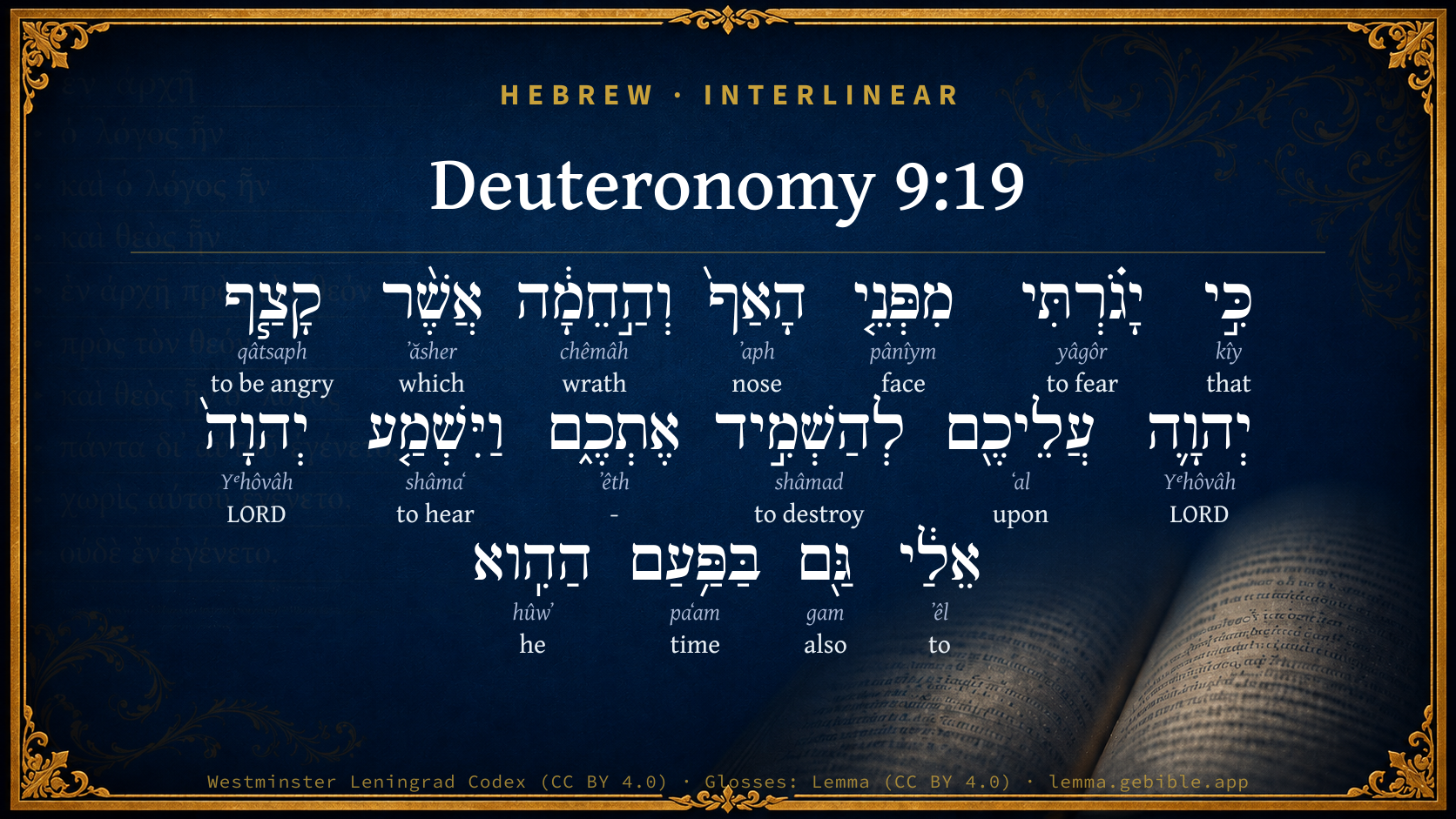
Hebrew (Westminster Leningrad Codex) Deuteronomy 9:19 appears in the Hebrew Old Testament. The text above is from the Westminster Leningrad Codex. Each word links to its Strong’s number, a concise gloss, and parsing drawn from the Open Scriptures Hebrew Bible morphology. Click any word for its full Brown-Driver-Briggs (BDB) entry.
Download image
Cite this verse

Deuteronomy 9:19 (World English Bible). Public Domain. Lemma interlinear Bible study tool, https://lemma.gebible.app/v/deuteronomy/9/19.

Show BibTeX & RIS
BibTeX
RIS
English Translation
For I was afraid of the anger and hot displeasure, with which Yahweh was angry against you to destroy you. But Yahweh listened to me that time also.
World English Bible · Public Domain
Highlights
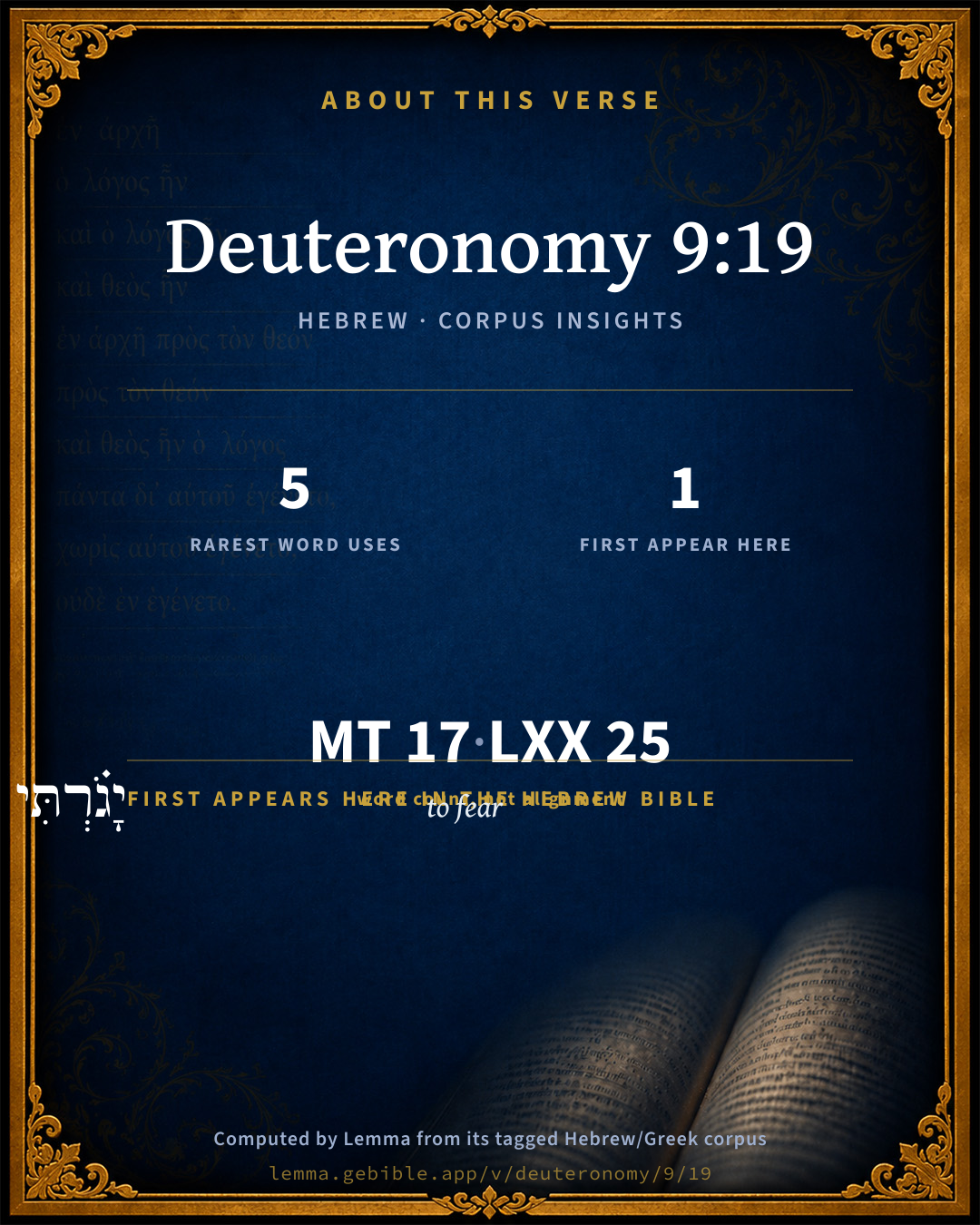
  • 1 first appearance in the Hebrew Bible
Full analysis ↓
Download a study sheet

One document with this verse’s original text, its word-by-word gloss line, the meaning frame, cross-references with their text, attributed commentary, and full source and license credits — printable, and it pastes into notes with its structure intact.

This verse Autodidact and up

Study sheet (.html) Plain text (.txt)

A passage Seminary Student

Up to 50 verses in one chapter. A passage sheet keeps up to 6 commentary sources and 12 cross-references per verse, in the order this page ranks them, and says so on the sheet whenever that leaves anything out. Ask for a single verse and you get the Autodidact verse sheet above.

Everything on this page stays free to read, with no account — the sheet is a download of what is already on screen, not access to it.

Want to remove ads? Support Godless Engineer
Compare translations 3

The same verse in 3 English versions, stacked beneath the original-language interlinear above. Click any original word for its lexicon entry.

Each is an independent rendering of the whole verse — the interlinear is not word-aligned to these translations.

Highlighted words mark where these versions differ — a whole-verse word diff, not a word-by-word alignment.

  • World English Bible Public Domain
    For I was afraid of the anger and hot displeasure, with which Yahweh was angry against you to destroy you. But Yahweh listened to me that time also.
  • King James Version Public Domain
    For I was afraid of the anger and hot displeasure, wherewith the LORD was wroth against you to destroy you. But the LORD hearkened unto me at that time also.
  • unfoldingWord Literal Text CC BY-SA 4.0
    For I was afraid from the face of the nose and the heat with which Yahweh was angry against you to destroy you. And Yahweh listened to me also that time.

unfoldingWord Literal Text — © unfoldingWord, licensed CC BY-SA 4.0. Word-aligned USFM3 via Door43 (git.door43.org/unfoldingWord/en_ult).

Versions to compare (up to 4)

3 of 4 selected

Show all 18 translations

Every available English version of this verse, each an independent rendering of the whole verse.

  • World English Bible Public Domain
    For I was afraid of the anger and hot displeasure, with which Yahweh was angry against you to destroy you. But Yahweh listened to me that time also.
  • Berean Standard Bible Public Domain
    For I was afraid of the anger and wrath that the LORD had directed against you, enough to destroy you. But the LORD listened to me this time as well.
  • Majority Standard Bible Public Domain
    For I was afraid of the anger and wrath that the LORD had directed against you, enough to destroy you. But the LORD listened to me this time as well.
  • King James Version Public Domain
    For I was afraid of the anger and hot displeasure, wherewith the LORD was wroth against you to destroy you. But the LORD hearkened unto me at that time also.
  • American Standard Version (1901) Public Domain
    For I was afraid of the anger and hot displeasure, wherewith Jehovah was wroth against you to destroy you. But Jehovah hearkened unto me that time also.
  • Revised Version (1885) Public Domain
    For I was afraid of the anger and hot displeasure, wherewith the LORD was wroth against you to destroy you. But the LORD hearkened unto me that time also.
  • Geneva Bible (1599) Public Domain
    (For I was afraide of the wrath and indignation, wherewith the Lord was mooued against you, euen to destroy you) yet the Lord heard me at that time also.
  • Douay-Rheims (1899) Public Domain
    For I feared his indignation and anger, wherewith being moved against you, he would have destroyed you. And the Lord heard me this time also.
  • Young's Literal Translation Public Domain
    `For I have been afraid because of the anger and the fury with which Jehovah hath been wroth against you, to destroy you; and Jehovah doth hearken unto me also at this time.
  • Literal Standard Version CC BY-SA 4.0
    For I have been afraid because of the anger and the fury with which YHWH has been angry against you, to destroy you; and YHWH also listens to me at this time.
  • Unlocked Literal Bible CC BY-SA 4.0
    For I was afraid of the anger and hot displeasure with which Yahweh was angry enough against you to destroy you. But Yahweh listened to me that time also.
  • unfoldingWord Literal Text CC BY-SA 4.0
    For I was afraid from the face of the nose and the heat with which Yahweh was angry against you to destroy you. And Yahweh listened to me also that time.
  • Darby Bible Public Domain
    For I was afraid of the anger and fury wherewith Jehovah was wroth against you to destroy you. And Jehovah listened unto me also at that time.
  • World Messianic Bible Public Domain
    For I was afraid of the anger and hot displeasure with which the LORD was angry against you to destroy you. But the LORD listened to me that time also.
  • Webster's Bible Public Domain
    (For I was afraid of the anger and hot displeasure with which the LORD was wroth against you to destroy you.) But the LORD hearkened to me at that time also.
  • Free Bible Version CC BY-SA 4.0
    I was terrified at how angry and furious the Lord was with you. He was ready to destroy you. But once again the Lord listened to me.
  • Bible in Basic English Public Domain
    For I was full of fear because of the wrath of the Lord which was burning against you, with your destruction in view. But again the Lord's ear was open to my prayer.
  • JPS Tanakh (1917) Public Domain
    For I was in dread of the anger and hot displeasure, wherewith the LORD was wroth against you to destroy you. But the LORD hearkened unto me that time also.

Literal Standard Version (2020), Covenant Press — licensed CC BY-SA 4.0. Text via the HelloAO Bible API (eBible.org). Unlocked Literal Bible (unfoldingWord) — licensed CC BY-SA 4.0. Text via the HelloAO Bible API (eBible.org). unfoldingWord Literal Text — © unfoldingWord, licensed CC BY-SA 4.0. Word-aligned USFM3 via Door43 (git.door43.org/unfoldingWord/en_ult). Free Bible Version, Dr. Jonathan Gallagher — licensed CC BY-SA 4.0. Text via the HelloAO Bible API (eBible.org).

Word by word

More ways to search: Search by grammar → Find every occurrence → Compare this word →

Practice this passage: Drill this verse → Learn its vocabulary →

יָגֹ֗רְתִּי
yâgôr
H3025
“to fear”
Verb, Qal, Perfect, 1st Person, Common, Singular
Part of Speech
Verb
Stem
Qal
Form
Perfect
Person
1st Person
Gender
Common
Number
Singular
Full BDB Definition

Origin: a primitive root

TWOT: 843

(Qal) to fear, dread, be afraid
  1. כִּ֣י kîy H3588 “that” Conjunction
  2. מִפְּנֵ֤י pânîym H6440 “from · face(s) of” Preposition + Noun, Common, Both, Plural, Construct
  3. הָאַף֙ ʼaph H639 “the · nose” Particle, Definite Article + Noun, Common, Masculine, Singular, Absolute
  4. וְהַ֣חֵמָ֔ה chêmâh H2534 “and · the · wrath” Conjunction + Particle, Definite Article + Noun, Common, Feminine, Singular, Absolute
  5. אֲשֶׁ֨ר ʼăsher H834 “which” Particle, Relative
  6. קָצַ֧ף qâtsaph H7107 “to be angry” Verb, Qal, Perfect, 3rd Person, Masculine, Singular
  7. יְהוָ֛ה Yᵉhôvâh H3068 “LORD” Noun, Proper
  8. עֲלֵיכֶ֖ם ʻal H5921 “upon · you” Preposition + Suffix, Personal, 2nd Person, Masculine, Plural
  9. לְהַשְׁמִ֣יד shâmad H8045 “to destroy” Preposition + Verb, Hiphil, Infinitive Construct
  10. אֶתְכֶ֑ם ʼêth H853 “- · you” Particle, Direct Object + Suffix, Personal, 2nd Person, Masculine, Plural
  11. וַיִּשְׁמַ֤ע shâmaʻ H8085 “and · to hear” Conjunction + Verb, Qal, Sequential Imperfect, 3rd Person, Masculine, Singular
  12. יְהוָה֙ Yᵉhôvâh H3068 “LORD” Noun, Proper
  13. אֵלַ֔י ʼêl H413 “to · me” Preposition + Suffix, Personal, 1st Person, Common, Singular
  14. גַּ֖ם gam H1571 “also” Particle, Accusative
  15. בַּפַּ֥עַם paʻam H6471 “in/at the · time” Preposition, Determined + Noun, Common, Feminine, Singular, Absolute
  16. הַהִֽוא hûwʼ H1931 “the · he” Particle, Definite Article + Pronoun, Personal, 3rd Person, Feminine, Singular

About this verse

These counts appear in no published source. They are computed here, from the morphology-tagged text and Lemma’s own curated glosses. What Lemma adds →

17
words
16
distinct lemmas
Pentateuch
section

Notable vocabulary

The rarest word here is יָגֹ֗רְתִּי to fear H3025 — appearing just 5 times in the whole Hebrew Bible.

First appearance in Scripture

This word makes its first canonical appearance in the Hebrew Bible here:

  • יָגֹ֗רְתִּי to fear H3025

Shared distinctive vocabulary

יָגֹ֗רְתִּי to fear H3025 occurs in 5 verses of the Hebrew Bible. Also found in:

Grammatical profile

  • 4 verbs
  • 6 nouns
  • 1 pronoun
  • 2 prepositions
  • 1 conjunction
  • 3 particles

Verb forms

  • יָגֹ֗רְתִּי Qal · Perfect
  • קָצַ֧ף Qal · Perfect
  • לְהַשְׁמִ֣יד Hiphil · Infinitive Construct
  • וַיִּשְׁמַ֤ע Qal · Sequential Imperfect

Repetition

A word recurs within this verse — often emphatic in Hebrew:

  • יְהוָ֛ה LORD H3068 ×2

Hebrew & Septuagint length

In English translation the verse runs 28 words from the Hebrew and 32 from the Septuagint (LXX English) — closely comparable.

A rough comparison of the two English renderings, which tokenize alike — not a word-level alignment.

Word counts can differ between the Hebrew and the Greek without any difference in meaning — e.g. the Hebrew direct-object marker אֵת has no separate Greek word, and Greek often adds the article ὁ.

In the original languages it is 17 Hebrew tokens and 25 Greek tokens — but the two are counted differently (Hebrew bundles its prefixes and suffixes into one token; the Greek is in lemma form), so that isn’t a like-for-like length.

Cross-references

12

Topical passages linked to Deuteronomy 9:19 in the Treasury of Scripture Knowledge — connected by theme and wording, ordered by reader-vote popularity; previews shown in the World English Bible.

  • Exodus 32:14 Yahweh repented of the evil which he said he would do to his people.
  • Deuteronomy 10:10 I stayed on the mountain, as at the first time, forty days and forty nights: and Yahweh listened to me that time also; Yahweh would not destroy you.
  • James 5:16–17 Confess your offenses to one another, and pray one for another, that you may be healed. The effective, earnest prayer of a righteous man is powerfully effective.
  • Exodus 32:10–11 Now therefore leave me alone, that my wrath may burn hot against them, and that I may consume them; and I will make of you a great nation."
  • Exodus 33:17 Yahweh said to Moses, "I will do this thing also that you have spoken; for you have found favor in my sight, and I know you by name."
  • Psalms 99:6 Moses and Aaron were among his priests, Samuel among those who call on his name; They called on Yahweh, and he answered them.
  • Nehemiah 1:2–7 that Hanani, one of my brothers, came, he and certain men out of Judah; and I asked them concerning the Jews who had escaped, who were left of the captivity, and concerning Jerusalem.
  • Amos 7:2–3 It happened that, when they made an end of eating the grass of the land, then I said, "Lord Yahweh, forgive, I beg you! How could Jacob stand? For he is small."
  • Luke 12:4–5 "I tell you, my friends, don't be afraid of those who kill the body, and after that have no more that they can do.
  • Deuteronomy 9:8 Also in Horeb you provoked Yahweh to wrath, and Yahweh was angry with you to destroy you.
  • Psalms 106:23 Therefore he said that he would destroy them, Had Moses, his chosen, not stood before him in the breach, To turn away his wrath, so that he wouldn't destroy them.
  • Amos 7:5–6 Then I said, "Lord Yahweh, stop, I beg you! How could Jacob stand? For he is small."

Cross-references courtesy of OpenBible.info (CC BY 4.0).

Hebrew and Greek witnesses Masoretic Hebrew ↔ Greek Septuagint

The same verse in the two great witnesses to the Old Testament, shown verse-for-verse.

These are two independent witnesses, not word-aligned to each other, and the Septuagint is shown in lemma (dictionary) form.

Hebrew Deuteronomy 9:19 Masoretic · Westminster Leningrad Codex

כִּ֣י יָגֹ֗רְתִּי מִפְּנֵ֤י הָאַף֙ וְהַ֣חֵמָ֔ה אֲשֶׁ֨ר קָצַ֧ף יְהוָ֛ה עֲלֵיכֶ֖ם לְהַשְׁמִ֣יד אֶתְכֶ֑ם וַיִּשְׁמַ֤ע יְהוָה֙ אֵלַ֔י גַּ֖ם בַּפַּ֥עַם הַהִֽוא

For I was afraid of the anger and hot displeasure, with which Yahweh was angry against you to destroy you. But Yahweh listened to me that time also.

World English Bible · Public Domain

Greek LXX Deuteronomy 9:19 Septuagint · lemma form

καί ἔκφοβος εἰμί διά ὁ ὀργή καί ὁ θυμός ὅτι παραὀξύνω κύριος ἐπί σύ ἐκὀλεθρεύω σύ καί εἰςἀκούω κύριος ἐγώ καί ἐν ὁ καιρός οὗτος

And I was greatly terrified because of the wrath and anger, because the Lord was provoked with you utterly to destroy you; yet the Lord listened to me at this time also.

LXX2012 (modern English Septuagint) · Public Domain

Hebrew: Westminster Leningrad Codex (CC BY 4.0). Greek: Septuagint (public domain); English from LXX2012 (modern English Septuagint) (Public Domain). How the Septuagint differs from the Hebrew →

Targum (Aramaic paraphrase)

2

The Targum is the ancient Jewish Aramaic paraphrase of the Hebrew Scriptures — an interpretive translation, not the Hebrew text itself. Onkelos (literal) and Pseudo-Jonathan (expansive) render the Torah, and Jonathan the Prophets. Coverage is partial: where no permissively-licensed English translation exists for a verse, only the Aramaic is shown. This is verse-level text, not a word-by-word alignment to the Hebrew.

  1. Targum Onkelos Torah (Genesis–Deuteronomy)
    אֲרֵי דְחֵלִית מִקָדָם רָגְזָא וְחֵמְתָא דִי רְגַז יְיָ עֲלֵיכוֹן לְשֵׁצָאָה יָתְכוֹן וְקַבִּיל יְיָ צְלוֹתִי אַף בְּזִמְנָא הַהִיא

    (no public-domain English translation for this verse)

    Targum Onkelos — Aramaic: “Onkelos Genesis” (public domain); “Onkelos Exodus” (public domain); “Onkelos Leviticus” (public domain); “Onkelos Numbers” (public domain); “Onkelos Deuteronomy” (public domain). English: “Sefaria Community Translation” (CC0 1.0 (public-domain dedication)); “J.W. Etheridge. The Targums of Onkelos and Jonathan Ben Uzziel on the Pentateuch. London: Longmans, Green, 1862” (public domain). Text via Sefaria.

  2. Targum Pseudo-Jonathan Torah (Genesis–Deuteronomy)
    בֵּי הִיא זִמְנָא אִשְׁתַּלְחוּן מִן קֳדָם יְיָ חֲמֵשְׁתֵּי מַלְאָכַיָא מְחַבְּלַיָא לְחַבָּלָא יַת יִשְרָאֵל אַף וְחֵמָה וְקֶצֶף וּמַשְׁחִית וַחֲרוֹן כֵּיוַן דִּי שְׁמַע משֶׁה רַבְּהוֹן דְּיִשְרָאֵל אָזַל וְאַדְכַּר שְׁמָא רַבָּא וְיַקִּירָא וְאוֹקֵים מִקִּבְרֵהוֹן אַבְרָהָם וְיִצְחָק וְיַעֲקב וְקָמוֹן בִּצְלוֹתָא קֳדָם יְיָ וּמִן יַד אִתְכְּלִיאוּ תְּלַת מִנְהוֹן וְאִשְׁתַּיְירוּן תְּרֵין אַף וְחֵימָא בָּעָא משֶׁה רַחֲמִין וְאִיתְכְּלִיאוּ אוּף תְּרֵיהוֹן וְחָפַר שִיַיח בְּאַרְעָא דְמוֹאָב וּטְמַרְנוּן בִּשְׁבוּעַת שְׁמָא רַבָּא וּדְחֵילָא דְּהָכִין כְּתִיב אֲרוּם דְּחֵילִית מִן קֳדָם רוּגְזָא וְחֵימְתָא דִרְגַז יְיָ עֲלֵיכוֹן לִמְשֵׁצְיָא יַתְכוֹן וְקַבֵּיל יְיָ צְלוֹתִי אוּף בְּזִמְנָא הַהוּא

    At that time five destroying angels were sent from the Lord to destroy Israel, Wrath, Burning, Relentlessness, Destruction, and Indignation; but when Mosheh the Rabban of Israel heard, he went and made memorial of the great and glorious Name, and called. And Abraham, Izhak, and Jakob arose from their tomb, and stood in prayer before the Lord; and forthwith three of them were restrained, and two of them, Wrath and Burning, remained. But Mosheh (yet) supplicated mercy, and were also restrained; and he digged a grave in the land of Moab and buried them, in swearing by the great and tremendous Name; for so it is written: For I was afraid before the anger with which the Lord was angry with you to destroy you, and the Lord received my prayer at that time also.

    Targum Pseudo-Jonathan — Aramaic: “Targum Jonathan on Genesis” (public domain); “Targum Jonathan on Exodus” (public domain); “Targum Jonathan on Leviticus” (public domain); “Targum Jonathan on Numbers” (public domain); “Targum Jonathan on Deuteronomy” (public domain). English: “The Targum of Jonathan ben Uzziel, trans. J. W. Etheridge, London, 1862” (public domain). Text via Sefaria.

Commentary

Notes on Deuteronomy 9:19 from classic Christian and Jewish commentators (each source and its license shown beneath its notes). The classic Christian expositions comment on the surrounding passage and are grouped to its opening verse, so a note may address several verses; the Jewish commentaries on the Tanakh (Rashi and others) are per-verse, so they appear only where the commentator wrote on this verse.

Lemma curates 59 commentaries, every one of them public domain or Creative Commons licensed, each selected and text-cleaned for this edition rather than reprinted as found. About our sources →

Trapp's Complete Commentary

John Trapp

Deu 9:19 For I was afraid of the anger and hot displeasure, wherewith the LORD was wroth against you to destroy you. But the LORD hearkened unto me at that time also.

Ver. 19. For I was afraid.] Moses was more troubled for the people than the people were for themselves; so was Daniel for Nebuchadnezzar, {Dan 4:10} and Nahum for the Chaldeans. {Nah 3:16}

John Trapp, A Commentary or Exposition upon All the Books of the Old and New Testament (1647–1656) — public domain. Text from a community e-Sword module.

Ellicott's Commentary for English Readers

(19) For I was afraid.—In Heb_12:21, the words “I exceedingly fear” are (in the Greek) identical with these.

A Bible Commentary for English Readers, edited by Charles John Ellicott (1878–1897) — public domain. Text from a community e-Sword module.

The Cambridge Bible for Schools and Colleges

gen. ed. J. J. S. Perowne

19. For I was afraid] or trembled Deu_28:60.

that time also] Obscure, and probably an editorial addition, unless the reference is to Deu_9:10 or to Exo_15:25; Exo_17:4 f. and other occasions. It is possible there was originally no mention of God’s answer here. It seems a little premature for the purpose of the discourse; and may have been added from Deu_10:10.

The Cambridge Bible for Schools and Colleges (gen. ed. J. J. S. Perowne; Cambridge University Press, 1878–1918) — public domain. Text from a community e-Sword module.

John Gill's Exposition

For I was afraid of the anger and hot displeasure wherewith the Lord was wroth against you,.... Which was exceeding vehement, as appeared by his words to Moses, forbidding to intercede for them, that he might consume them, and make of him a greater nation; wherefore he dreaded the issue of it, lest it should be

to destroy you; that that should be his full resolution and determination; however, he made use of means, and betook himself to fasting and prayer; so heartily affected was he to this people when his temptations lay another way:

but the Lord hearkened unto me at that time also; as he had at other times, when this people had sinned, and he entreated for them; in which he was a type of Christ, the Mediator and Advocate, whom the Father always hears.

John Gill's Exposition of the Whole Bible (1746–1763) — public domain (CC PDM 1.0). Text via the HelloAO Bible API.

unfoldingWord translationNotes

Door43 World Missions Community

General Information:

Moses continues reminding the people of Israel what happened in the past.

I was afraid of the anger and hot displeasure with which Yahweh was angry enough against you to destroy you

The words "anger and hot displeasure" are a metonym for what Yahweh would do because he was angry and displeased. AT: "Yahweh was angry at you—he was extremely displeased with you—he was angry enough to destroy you, and so I was afraid of what he would do"

translationWords

fear

Aaron

pray

unfoldingWord translationNotes — © Distant Shores Media and the Door43 World Missions Community, licensed CC BY-SA 4.0. Source: git.door43.org/Door43/en_tn.

Ramban (Nachmanides)

Rabbi Moshe ben Nachman (Ramban / Nachmanides)

FOR I WAS IN DREAD OF THE ANGER. He is stating that because of the anger and the fury wherewith the Eternal was angry with you at first [that He wanted] to destroy you, I stood in awe even now, for there was still [enough] of that great anger upon you to destroy you, even though G-d had already repented of the evil which He said He would do unto His people., Verse 14. The word “repented” here is an anthropomorphism (Ibn Ezra). Therefore I returned and threw myself down [in prayer] in your behalf for forty days and forty nights until He hearkened unto me that time also just as He hearkened the first time before I descended [from the mountain]. For Aaron, also, I prayed at that time when I returned there [to the mountain] because, until he had cleansed [the camp of] the calf, [Moses’ main] concern was but to turn back His wrath, lest He should destroy the [whole] people in a moment, [and hence he did not pray especially for Aaron until he returned to the mountain].

Ramban (Nachmanides) on the Tanakh — English translation: “Commentary on the Torah by Ramban (Nachmanides). Translated and annotated by Charles B. Chavel. New York, Shilo Pub. House, 1971-1976” (CC BY 4.0). Text via Sefaria.

Lesson kit

Teaching starters — assembled from the data on this page, not authored interpretation. Every prompt links to the verse data it draws on. Edit before teaching.

Deuteronomy, in the Pentateuch, opens this verse with 17 words (16 distinct Hebrew lemmas). Its most distinctive word is yâgôr (“to fear”). A historical commentator’s framing appears above. Read the whole chapter for the surrounding context.

Discussion questions

  1. What does “to fear” (yâgôr) contribute to the verse as a whole?
  2. The word “to fear” first appears here in Scripture. What is being introduced at this debut?
  3. Deuteronomy 28:60 shares the word «to fear» with this verse. How do the two illuminate each other?
  4. “LORD” occurs 2× in this one verse. What is the effect of the repetition?
  5. These translations render this verse differently; the difference is in the English rendering, not the original. What questions does that raise?
  6. The verb «יָגֹ֗רְתִּי» is Qal Perfect. How does its form color the action?
  7. Reading how Trapp's Complete Commentary and Ellicott's Commentary for English Readers read this verse, where do the two commentators agree and where do they part?

Things to notice

Reading settings

Reading text

Shown beneath each verse's original-language words.

Old Testament
Old Testament edition

Read the OT as the Masoretic Hebrew (MT) or the Greek Septuagint (LXX).

English shown for the Greek Septuagint (in the Hebrew ↔ Greek comparison).

Comparing translations? Open the Compare panel on any verse page to stack up to four side by side.