

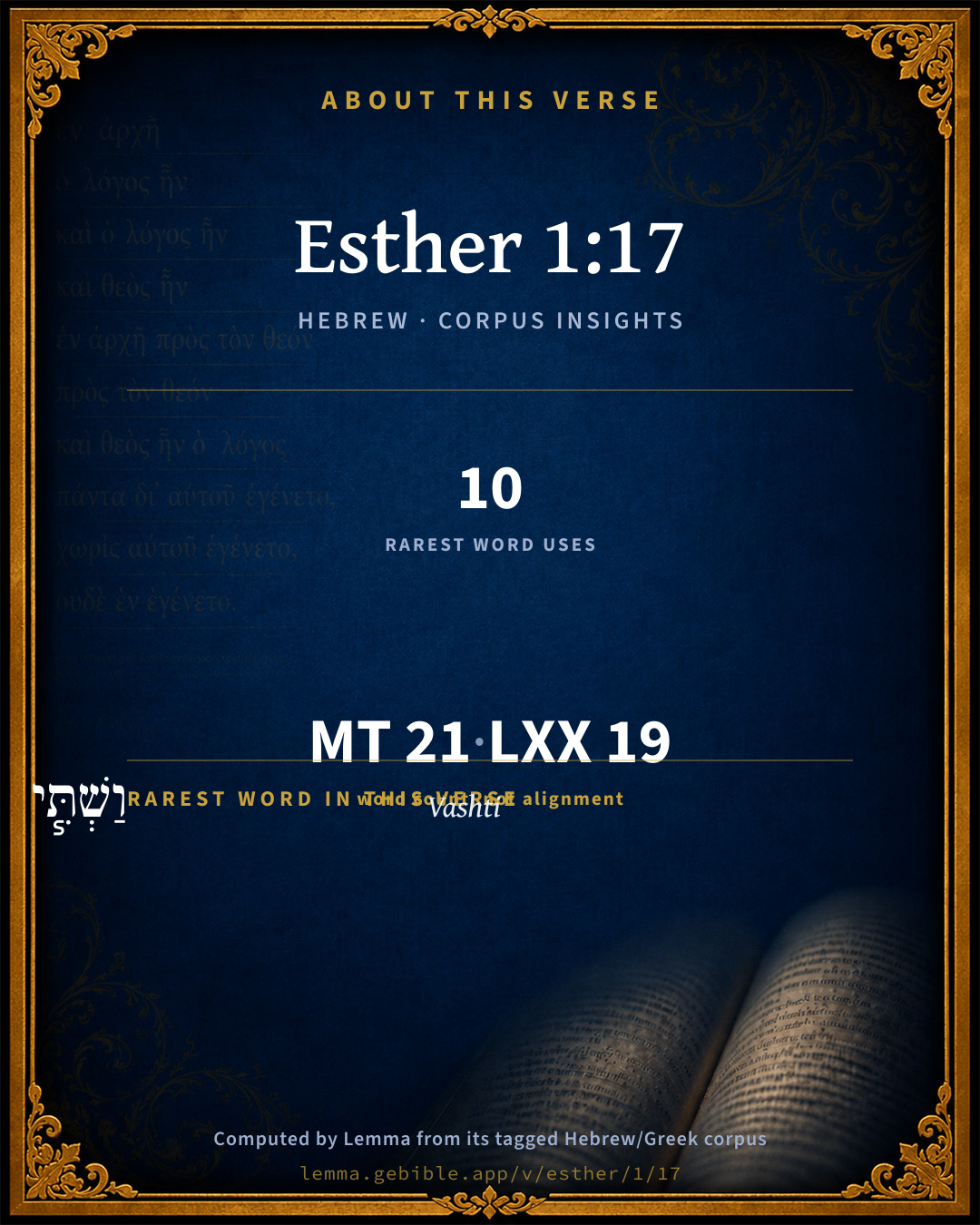
Esther 1:17

Hebrew (Westminster Leningrad Codex) Esther 1:17 appears in the Hebrew Old Testament. The text above is from the Westminster Leningrad Codex. Each word links to its Strong’s number, a concise gloss, and parsing drawn from the Open Scriptures Hebrew Bible morphology. Click any word for its full Brown-Driver-Briggs (BDB) entry.
Download image
Cite this verse

Esther 1:17 (World English Bible). Public Domain. Lemma interlinear Bible study tool, https://lemma.gebible.app/v/esther/1/17.

Show BibTeX & RIS
BibTeX
RIS
English Translation
For this deed of the queen will come abroad to all women, to make their husbands contemptible in their eyes, when it shall be reported, The king Ahasuerus commanded Vashti the queen to be brought in before him, but she didn't come.
World English Bible · Public Domain
Download a study sheet

One document with this verse’s original text, its word-by-word gloss line, the meaning frame, cross-references with their text, attributed commentary, and full source and license credits — printable, and it pastes into notes with its structure intact.

This verse Autodidact and up

Study sheet (.html) Plain text (.txt)

A passage Seminary Student

Up to 50 verses in one chapter. A passage sheet keeps up to 6 commentary sources and 12 cross-references per verse, in the order this page ranks them, and says so on the sheet whenever that leaves anything out. Ask for a single verse and you get the Autodidact verse sheet above.

Everything on this page stays free to read, with no account — the sheet is a download of what is already on screen, not access to it.

Want to remove ads? Support Godless Engineer
Compare translations 3

The same verse in 3 English versions, stacked beneath the original-language interlinear above. Click any original word for its lexicon entry.

Each is an independent rendering of the whole verse — the interlinear is not word-aligned to these translations.

Highlighted words mark where these versions differ — a whole-verse word diff, not a word-by-word alignment.

  • World English Bible Public Domain
    For this deed of the queen will come abroad to all women, to make their husbands contemptible in their eyes, when it shall be reported, The king Ahasuerus commanded Vashti the queen to be brought in before him, but she didn't come.
  • King James Version Public Domain
    For this deed of the queen shall come abroad unto all women, so that they shall despise their husbands in their eyes, when it shall be reported, The king Ahasuerus commanded Vashti the queen to be brought in before him, but she came not.
  • unfoldingWord Literal Text CC BY-SA 4.0
    For the matter of the queen will go out to all the women in order to make their husbands despised in their eyes when they say, ‘The king Ahasuerus said to bring Vashti the queen before his face, but she did not come.’

unfoldingWord Literal Text — © unfoldingWord, licensed CC BY-SA 4.0. Word-aligned USFM3 via Door43 (git.door43.org/unfoldingWord/en_ult).

Versions to compare (up to 4)

3 of 4 selected

Show all 18 translations

Every available English version of this verse, each an independent rendering of the whole verse.

  • World English Bible Public Domain
    For this deed of the queen will come abroad to all women, to make their husbands contemptible in their eyes, when it shall be reported, The king Ahasuerus commanded Vashti the queen to be brought in before him, but she didn't come.
  • Berean Standard Bible Public Domain
    For the conduct of the queen will become known to all women, causing them to despise their husbands and say, ‘King Xerxes ordered Queen Vashti to be brought before him, but she did not come.’
  • Majority Standard Bible Public Domain
    For the conduct of the queen will become known to all women, causing them to despise their husbands and say, ‘King Xerxes ordered Queen Vashti to be brought before him, but she did not come.’
  • King James Version Public Domain
    For this deed of the queen shall come abroad unto all women, so that they shall despise their husbands in their eyes, when it shall be reported, The king Ahasuerus commanded Vashti the queen to be brought in before him, but she came not.
  • American Standard Version (1901) Public Domain
    For this deed of the queen will come abroad unto all women, to make their husbands contemptible in their eyes, when it shall be reported, The king Ahasuerus commanded Vashti the queen to be brought in before him, but she came not.
  • Revised Version (1885) Public Domain
    For this deed of the queen shall come abroad unto all women, to make their husbands contemptible in their eyes, when it shall be reported, The king Ahasuerus commanded Vashti the queen to be brought in before him, but she came not.
  • Geneva Bible (1599) Public Domain
    For the acte of the Queene shall come abroade vnto all women, so that they shall despise their husbands in their owne eyes, and shall say, The King Ahashuerosh comanded Vashti the Queene to be brought in before him, but she came not.
  • Douay-Rheims (1899) Public Domain
    For this deed of the queen will go abroad to all women, so that they will despise their husbands, and will say: King Assuerus commanded that queen Vasthi should come in to him, and she would not.
  • Young's Literal Translation Public Domain
    for go forth doth the word of the queen unto all the women, to render their husbands contemptible in their eyes, in their saying, The king Ahasuerus said to bring in Vashti the queen before him, and she did not come;
  • Literal Standard Version CC BY-SA 4.0
    for the word of the queen goes forth to all the women, to render their husbands contemptible in their eyes, in their saying, King Ahasuerus commanded to bring in Vashti the queen before him, and she did not come;
  • Unlocked Literal Bible CC BY-SA 4.0
    For the matter of the queen will become known to all women. It will cause them to treat their husbands with contempt. They will say, 'King Ahasuerus commanded Vashti the queen to be brought before him, but she refused.'
  • unfoldingWord Literal Text CC BY-SA 4.0
    For the matter of the queen will go out to all the women in order to make their husbands despised in their eyes when they say, ‘The king Ahasuerus said to bring Vashti the queen before his face, but she did not come.’
  • Darby Bible Public Domain
    For the act of the queen will come abroad to all women, so as to render their husbands contemptible in their eyes, when they shall say, The king Ahasuerus commanded the queen Vashti to be brought in before him, and she came not!
  • World Messianic Bible Public Domain
    For this deed of the queen will become known to all women, causing them to show contempt for their husbands when it is reported, ‘King Ahasuerus commanded Vashti the queen to be brought in before him, but she didn’t come.’
  • Webster's Bible Public Domain
    For this deed of the queen will come abroad to all women, so that they will despise their husbands in their eyes, when it shall be reported, The king Ahasuerus commanded Vashti the queen to be brought in before him, but she came not.
  • Free Bible Version CC BY-SA 4.0
    Once it gets out what the queen has done, all wives will despise their husbands, looking down on them and telling them, ‘King Xerxes ordered Queen Vashti brought to him but she didn't come!’
  • Bible in Basic English Public Domain
    For news of what the queen has done will come to the ears of all women, and they will no longer give respect to their husbands when it is said to them, King Ahasuerus gave orders for Vashti the queen to come before him and she came not.
  • JPS Tanakh (1917) Public Domain
    For this deed of the queen will come abroad unto all women, to make their husbands contemptible in their eyes, when it will be said: The king Ahasuerus commanded Vashti the queen to be brought in before him, but she came not.

Literal Standard Version (2020), Covenant Press — licensed CC BY-SA 4.0. Text via the HelloAO Bible API (eBible.org). Unlocked Literal Bible (unfoldingWord) — licensed CC BY-SA 4.0. Text via the HelloAO Bible API (eBible.org). unfoldingWord Literal Text — © unfoldingWord, licensed CC BY-SA 4.0. Word-aligned USFM3 via Door43 (git.door43.org/unfoldingWord/en_ult). Free Bible Version, Dr. Jonathan Gallagher — licensed CC BY-SA 4.0. Text via the HelloAO Bible API (eBible.org).

Word by word

More ways to search: Search by grammar → Find every occurrence → Compare this word →

Practice this passage: Drill this verse → Learn its vocabulary →

וַשְׁתִּ֧י
Vashtîy
H2060
“Vashti”
Noun, Proper
Part of Speech
Noun
Type
Proper
Full BDB Definition

Origin: of Persian origin

TWOT: None

Vashti = "beautiful" - the queen, wife of Ahasuerus, whom he divorced for disobeying his orders
  1. כִּֽי kîy H3588 “that” Conjunction
  2. יֵצֵ֤א yâtsâʼ H3318 “to go out” Verb, Qal, Imperfect, 3rd Person, Masculine, Singular
  3. דְבַר dâbâr H1697 “word of” Noun, Common, Masculine, Singular, Construct
  4. הַמַּלְכָּה֙ malkâh H4436 “the · queen” Particle, Definite Article + Noun, Common, Feminine, Singular, Absolute
  5. עַל ʻal H5921 “upon” Preposition
  6. כָּל kôl H3605 “all of” Noun, Common, Masculine, Singular, Construct
  7. הַנָּשִׁ֔ים ʼishshâh H802 “the · women” Particle, Definite Article + Noun, Common, Feminine, Plural, Absolute
  8. לְהַבְז֥וֹת bâzâh H959 “to despise” Preposition + Verb, Hiphil, Infinitive Construct
  9. בַּעְלֵיהֶ֖ן baʻal H1167 “husbands · their” Noun, Common, Masculine, Plural, Construct + Suffix, Personal, 3rd Person, Feminine, Plural
  10. בְּעֵינֵיהֶ֑ן ʻayin H5869 “in/at · eyes · their” Preposition + Noun, Common, Both, Dual, Construct + Suffix, Personal, 3rd Person, Feminine, Plural
  11. בְּאָמְרָ֗ם ʼâmar H559 “in/at · to say · them” Preposition + Verb, Qal, Infinitive Construct + Suffix, Personal, 3rd Person, Masculine, Plural
  12. הַמֶּ֣לֶךְ melek H4428 “the · king” Particle, Definite Article + Noun, Common, Masculine, Singular, Absolute
  13. אֲחַשְׁוֵר֡וֹשׁ ʼĂchashvêrôwsh H325 “Ahasuerus” Noun, Proper
  14. אָמַ֞ר ʼâmar H559 “to say” Verb, Qal, Perfect, 3rd Person, Masculine, Singular
  15. לְהָבִ֨יא bôwʼ H935 “to enter” Preposition + Verb, Hiphil, Infinitive Construct
  16. אֶת ʼêth H853 “-” Particle, Direct Object
  17. הַמַּלְכָּ֛ה malkâh H4436 “the · queen” Particle, Definite Article + Noun, Common, Feminine, Singular, Absolute
  18. לְפָנָ֖יו pânîym H6440 “to/for · face(s) · his” Preposition + Noun, Common, Both, Plural, Construct + Suffix, Personal, 3rd Person, Masculine, Singular
  19. וְלֹא lôʼ H3808 “and · not” Conjunction + Particle, Negative
  20. בָֽאָה bôwʼ H935 “to enter” Verb, Qal, Perfect, 3rd Person, Feminine, Singular

About this verse

These counts appear in no published source. They are computed here, from the morphology-tagged text and Lemma’s own curated glosses. What Lemma adds →

21
words
18
distinct lemmas
Historical
section

Notable vocabulary

The rarest word here is וַשְׁתִּ֧י Vashti H2060 — appearing just 10 times in the whole Hebrew Bible.

Shared distinctive vocabulary

וַשְׁתִּ֧י Vashti H2060 occurs in 10 verses of the Hebrew Bible. Also found in:

Grammatical profile

  • 6 verbs
  • 11 nouns
  • 1 preposition
  • 1 conjunction
  • 2 particles

Verb forms

  • יֵצֵ֤א Qal · Imperfect
  • לְהַבְז֥וֹת Hiphil · Infinitive Construct
  • בְּאָמְרָ֗ם Qal · Infinitive Construct
  • אָמַ֞ר Qal · Perfect
  • לְהָבִ֨יא Hiphil · Infinitive Construct
  • בָֽאָה Qal · Perfect

Repetition

Words recur within this verse — often emphatic in Hebrew:

  • הַמַּלְכָּה֙ queen H4436 ×2
  • בְּאָמְרָ֗ם to say H559 ×2
  • לְהָבִ֨יא to enter H935 ×2

Hebrew & Septuagint length

In English translation the verse runs 42 words from the Hebrew and 26 from the Septuagint (LXX English) — the Septuagint runs noticeably shorter here. See the side-by-side →

A rough comparison of the two English renderings, which tokenize alike — not a word-level alignment.

Word counts can differ between the Hebrew and the Greek without any difference in meaning — e.g. the Hebrew direct-object marker אֵת has no separate Greek word, and Greek often adds the article ὁ.

In the original languages it is 21 Hebrew tokens and 19 Greek tokens — but the two are counted differently (Hebrew bundles its prefixes and suffixes into one token; the Greek is in lemma form), so that isn’t a like-for-like length.

Cross-references

2

Topical passages linked to Esther 1:17 in the Treasury of Scripture Knowledge — connected by theme and wording, ordered by reader-vote popularity; previews shown in the World English Bible.

  • Ephesians 5:33 Nevertheless each of you must also love his own wife even as himself; and let the wife see that she respects her husband.
  • 2 Samuel 6:16 It was so, as the ark of Yahweh came into the city of David, that Michal the daughter of Saul looked out at the window, and saw king David leaping and dancing before Yahweh; and she despised him in her heart.

Cross-references courtesy of OpenBible.info (CC BY 4.0).

Hebrew and Greek witnesses Masoretic Hebrew ↔ Greek Septuagint

The same verse in the two great witnesses to the Old Testament, shown verse-for-verse.

Here the Septuagint runs noticeably shorter than the Hebrew — LXX2012 (modern English Septuagint) 26 words vs World English Bible 42. A rough length comparison of the two English translations, not a word-level alignment — read both below.

These are two independent witnesses, not word-aligned to each other, and the Septuagint is shown in lemma (dictionary) form.

Hebrew Esther 1:17 Masoretic · Westminster Leningrad Codex

כִּֽי יֵצֵ֤א דְבַר הַמַּלְכָּה֙ עַל כָּל הַנָּשִׁ֔ים לְהַבְז֥וֹת בַּעְלֵיהֶ֖ן בְּעֵינֵיהֶ֑ן בְּאָמְרָ֗ם הַמֶּ֣לֶךְ אֲחַשְׁוֵר֡וֹשׁ אָמַ֞ר לְהָבִ֨יא אֶת וַשְׁתִּ֧י הַמַּלְכָּ֛ה לְפָנָ֖יו וְלֹא בָֽאָה

For this deed of the queen will come abroad to all women, to make their husbands contemptible in their eyes, when it shall be reported, The king Ahasuerus commanded Vashti the queen to be brought in before him, but she didn't come.

World English Bible · Public Domain

Greek LXX Esther 1:17 Septuagint · lemma form

καί γάρ διαἡγέομαι αὐτός ὁ ῥῆμα ὁ βασίλισσα καί ὡς ἀντιεἶπον ὁ βασιλεύς ὡς οὖν ἀντιεἶπον ὁ βασιλεύς ἀρταξέρξης

for he has told them the words of the queen, and how she disobeyed the king. As then, said he, she refused to obey king Artaxerxes,

LXX2012 (modern English Septuagint) · Public Domain

Hebrew: Westminster Leningrad Codex (CC BY 4.0). Greek: Septuagint (public domain); English from LXX2012 (modern English Septuagint) (Public Domain). How the Septuagint differs from the Hebrew →

Commentary

Notes on Esther 1:17 from classic Christian and Jewish commentators (each source and its license shown beneath its notes). The classic Christian expositions comment on the surrounding passage and are grouped to its opening verse, so a note may address several verses; the Jewish commentaries on the Tanakh (Rashi and others) are per-verse, so they appear only where the commentator wrote on this verse.

Lemma curates 59 commentaries, every one of them public domain or Creative Commons licensed, each selected and text-cleaned for this edition rather than reprinted as found. About our sources →

Trapp's Complete Commentary

John Trapp

Est 1:17 For [this] deed of the queen shall come abroad unto all women, so that they shall despise their husbands in their eyes, when it shall be reported, The king Ahasuerus commanded Vashti the queen to be brought in before him, but she came not.

Ver. 17. For this deed of the queen shall come abroad] The least aberration in a star is soon observed; so the miscarriages of great ones are quickly both noted and noticed. Public persons are by Plutarch compared to mirrors, according to which others dress themselves; to pictures in a glass window, wherein every blemish is soon seen; to common wells, which if they be poisoned, many are destroyed. The common people commonly are like a flock of cranes; as the first flies, all follow.

So that they shall despise their husbands] Which indeed ought not to be, no, not in their hearts. Let the wife see that she reverence her husband, Eph 5:33. God hath a barren womb for mocking Michel; when Sarah is crowned and chronicled for this, that she obeyed her husband, calling him Lord. It is here taken for confessed, that Vashti despised her husband; and that others would thereby take heart to do the like, is therehence inferred. But doth that necessarily follow? and must the queen therefore be presently deposed, yea, put to death, as the Jew doctors tell us she was? King Asa deposed his grandmother, Maacha; but that was for idolatry. Our Henry VIII beheaded his wife, Anne Bullen, but that was for (supposed, and but supposed) adultery. Queen Elizabeth narrowly escaped with her life, because she was accused (but falsely) of conspiracy against the queen, her sister. But what had Vashti done? Condemned she is without reprival; and the country must come in (but was never called) to give in evidence against her, that haply never saw her, nor heard of her offence. Is this fair dealing?

John Trapp, A Commentary or Exposition upon All the Books of the Old and New Testament (1647–1656) — public domain. Text from a community e-Sword module.

Tyndale Open Study Notes

Tyndale Open Resources

1:17 Women everywhere will begin to despise their husbands: Fear of consequences rather than facts or law motivated the council’s decision.

Tyndale Open Study Notes — © Tyndale Open Resources, licensed CC BY-SA 4.0. Text via the HelloAO Bible API.

Geneva Bible (1599)

Geneva Bible translators

That is, her disobedience.

Geneva Bible (1599) marginal notes — public domain. Text via Bolls.life.

The Cambridge Bible for Schools and Colleges

gen. ed. J. J. S. Perowne

17. to make their husbands contemptible in their eyes] As compared with A.V. (‘so that they shall despise their husbands in their eyes’) R.V. both improves the English, and furnishes a closer rendering of the Hebrew.

when it shall be reported] rather, while they say. The Vulgate accordingly has ut contemnant et dicant.

The Cambridge Bible for Schools and Colleges (gen. ed. J. J. S. Perowne; Cambridge University Press, 1878–1918) — public domain. Text from a community e-Sword module.

John Gill's Exposition

For this deed of the queen shall come abroad unto all women,.... It will soon be spread all over the king's dominions, and reach the ears of the wives of all his subjects, and become their general talk everywhere:

so that they shall despise their husbands in their eyes: make light of their authority, refuse subjection to them, slight their commands, and neglect to yield obedience to them, and so not give them the honour that is due unto them:

when it shall be reported, the King Ahasuerus commanded Vashti the queen to be brought in before him, and she came not; was disobedient to his commands, refused to go along with the chamberlains sent by the king to fetch her.

John Gill's Exposition of the Whole Bible (1746–1763) — public domain (CC PDM 1.0). Text via the HelloAO Bible API.

The Pulpit Commentary

They shall despise their husbands. Literally, "their lords," but the word is the one ordinarily used for "husband." When it shall be reported. Rather, "while they say," or "and shall say." (So the Vulgate contemnant et dicant. ")

Vers. 17, 18.

The influence of example.

Where can be found a more striking proof of the general belief in the force of example than in this passage? The counsellors of the king of Persia were not men likely to be led away by their feelings or fancies. Yet they supposed that the conduct of one woman might influence the domestic demeanour and spirit and habits of the women of an empire throughout its 127 provinces! And they proposed to counteract the evil influence of Vashti"s disobedience by. a most unusual proceeding, by a stringent law affecting every household throughout the realm! The conduct of the queen made the highest personages in the land uneasy, and was thought capable of affecting the meanest and the most distant.

I EXAMPLE IS ALWAYS INFLUENTIAL. This is owing to a principle in human nature. We are naturally social and imitative. The power of example over children is known to all. But no age is exempt from its action. Some persons live with the constant sense that their spirit and conduct will affect those of others. But if persons have no such sense, none the less is it true that their influence "tells." This is the explanation of fashion in manner, in speech, in social usages, even in beliefs. None of us can say how much he is what he is through the influence of others" example.

II EXAMPLE IS INFLUENTIAL BOTH FOR GOOD AND EVIL. That we should influence and be influenced by example is a Divine arrangement. It works both ways; and to the action of example the cause of virtue and religion is immensely indebted; whilst the same principle explains the prevalence of error, vice, and sin. Let every hearer call to mind the influences to which he has been exposed, and trace up to them the position he occupies, as well as the character which has been formed in him. This exercise will make him tremble to think of the responsibility under which he lies for his own influence over his fellow-creatures.

III THE POWER OF EXAMPLE IS ENHANCED BY HIGH STATION. Vashti was a queen, and what she did was known to multitudes, and was influential, more or less, over all who knew it. A queen sets fashions, gives social laws, even influences, to some extent, the morals of the community. A vicious court is a curse to the land. For a virtuous and benevolent sovereign, subjects cannot be too grateful. Others in high station, alike in the Church and in the world, will affect the habits of many by their good or evil example. Public persons, it has been said, are the looking-glasses before which others dress themselves. It is of highest importance that the springs should be sweetened, lest the streams be poisoned and deleterious.

Practical application:

1. Let us gratefully acknowledge God"s goodness in using the principle inquestion for our benefit. Scripture is full of good examples. The history of the Church teems with such. The Christian society around us contains many excellent and inspiring examples for our imitation.

2. Especially let as be thankful for the example of our Divine Saviour. Hewas not only our Redeemer, but our Exemplar also. He "left us an example that we should follow his steps." It is the one faultless, peerless example to humanity.

3. Let us be careful what examples we study, and what influences we placeourselves under.

4. Let us be very circumspect in the education of the young, that we havebrought to bear upon their hearts such influences as God may bless to their salvation.

5. Let us "watch and pray" that our influences purposed andunconscious alike may be for the highest good of all with whom we are associated.

Vers. 17, 18.

Example.

These verses speak of the force of example, and suggest some thoughts respecting it.

I THE INFLUENCE OF EXAMPLE IS PECULIARLY SUBTLE AND DEEP. This arises from the fact that it is not an abstract, but a living thing. It is the embodiment of principles, good or bad, in an active human life. It touches and lays hold of, more or less, the actuating spirit of those who come within its circle. Fine professions go for little when personal character and conduct belie them. Nor has precept much power when not conjoined with a harmonious example. "Example is better than precept," in the sense that it is the action of soul on soul, and will therefore tell on those who see it, when precept will only fall heedlessly on the ear.

II THE INFLUENCE OF EXAMPLE TRAVELS FAR AND WIDE. It is seen and felt beyond the knowledge or the immediate circle of the man who gives it. Men are observed and their actions weighed when they do not suspect it. When one life is impressed by the example of another, the impression does not stop there, but is conveyed to other lives, and is thus extended indefinitely. This is true of negative as well as of positive qualities, and of ordinary conduct as well as of particular acts.

III THE INFLUENCE OF EXAMPLE IS CONTINUOUS. Special conduct on special occasions is but a vivid expression of the spirit that animates the daily life. A man"s example continues with his life, and being continuous, its influence is accumulative. Even after his death it may long continue to exert power, either through the written record, or through descendants whose character has been affected by it.

IV THE INFLUENCE OF EXAMPLE IS INCREASED BY HIGH POSITION. The higher a man stands in social rank, the more widely will he be observed, and the more readily imitated. There is an instinctive reverence for rank in the human heart which should make royal, noble, or wealthy persons very careful as to the example they set. But all positions are relative. Thus a parent is as great in the eye of a child as a monarch is in view of the subject. The Christian minister in relation to his flock; the teacher to his pupil; the master to his servant; the cultivated to the ignorant all these also occupy a position of eminence, and their example exerts acorresponding influence.

V THE INFLUENCE AND TRUE QUALITY OF EXAMPLE ARE NOT ALWAYS TO BE JUDGED BY PREVAILING HABITS OR POPULAR NOTIONS. It may run counter to these and be condemned by them, and yet be good. Passing fashions of thought and life afford no fixed standard of example. Vashti"s disobedience was accounted bad as an example because it was a violation of the custom which laid on wives a slavish submission to their husbands. But judged by a higher law than that of custom, her example was good both to the king and to his subjects. Whatever conduct recognises the claims of truth, conscience, purity, and modest self-respect must be allowed to be good; whatever conduct tramples on or is indifferent to such things must be adjudged evil.

VI THE INFLUENCE AND TRUE QUALITY OF EXAMPLE CANNOT BE FAIRLY JUDGED BY THOSE WHOM IT HAS AFFRONTED and filled with malice or wrath How could the king in his burning anger, or his advisers under the flame of that anger, do justice to the conduct of Vashti? Wrath is a bad judge.

VII THE INFLUENCE AND TRUE QUALITY OF EXAMPLE ARE OFTEN MORE JUSTLY ESTIMATED IN AFTER TIMES THAN AT THE TIME IN WHICH THE EXAMPLE WAS GIVEN. As between the king and Vashti judgment now would go against the king. Many a character and many an action, when time has scattered the mists of passion, have appeared in a new light, and received a tardy justice by the reversal of contemporary verdicts.

VIII THE ONLY PERFECT EXAMPLE KNOWN AMONGST MEN IS THAT OF JESUS, THE SON OF GOD. The more fully we regulate our conduct by the spirit of his life, the more influential for good will be our own life-example. D. (see Mat_16:24; Joh_13:15 1Pe_2:21)

The Pulpit Commentary (1880–1919), ed. H.D.M. Spence-Jones & Joseph S. Exell — public domain. Text from a community e-Sword module.

Rashi

Rabbi Shlomo Yitzchaki (Rashi)

For the word of the queen will spread to all the women that she disgraced the king—[this will cause] all the women to despise their husbands as well.

Rashi on the Tanakh — English translations: “The Judaica Press complete Tanach with Rashi, translated by A. J. Rosenberg” (CC BY 4.0); “Pentateuch with Rashi's commentary by M. Rosenbaum and A.M. Silbermann, 1929-1934” (public domain); “The Metsudah Tanach series, Lakewood, N.J” (CC BY 4.0); and “The Book of Joshua, Metsudah Publications, 1997” (CC BY 4.0). Text via Sefaria.

Lesson kit

Teaching starters — assembled from the data on this page, not authored interpretation. Every prompt links to the verse data it draws on. Edit before teaching.

Esther, in the Historical, opens this verse with 21 words (18 distinct Hebrew lemmas). Its most distinctive word is Vashtîy (“Vashti”). The Greek Septuagint runs shorter here. A historical commentator’s framing appears above. Read the whole chapter for the surrounding context.

Discussion questions

  1. What does “Vashti” (Vashtîy) contribute to the verse as a whole?
  2. Esther 1:9 shares the word «Vashti» with this verse. How do the two illuminate each other?
  3. “queen” occurs 2× in this one verse. What is the effect of the repetition?
  4. Compared with the Hebrew, the Septuagint runs shorter here. What questions does that raise?
  5. The translations on this page render this verse differently — a whole-verse word diff, not a word-by-word alignment. What might account for the different wordings?
  6. The verb «יֵצֵ֤א» is Qal Imperfect. How does its form color the action?
  7. Reading how Trapp's Complete Commentary and Tyndale Open Study Notes read this verse, where do the two commentators agree and where do they part?

Things to notice

Reading settings

Reading text

Shown beneath each verse's original-language words.

Old Testament
Old Testament edition

Read the OT as the Masoretic Hebrew (MT) or the Greek Septuagint (LXX).

English shown for the Greek Septuagint (in the Hebrew ↔ Greek comparison).

Comparing translations? Open the Compare panel on any verse page to stack up to four side by side.