
Exodus 17:5

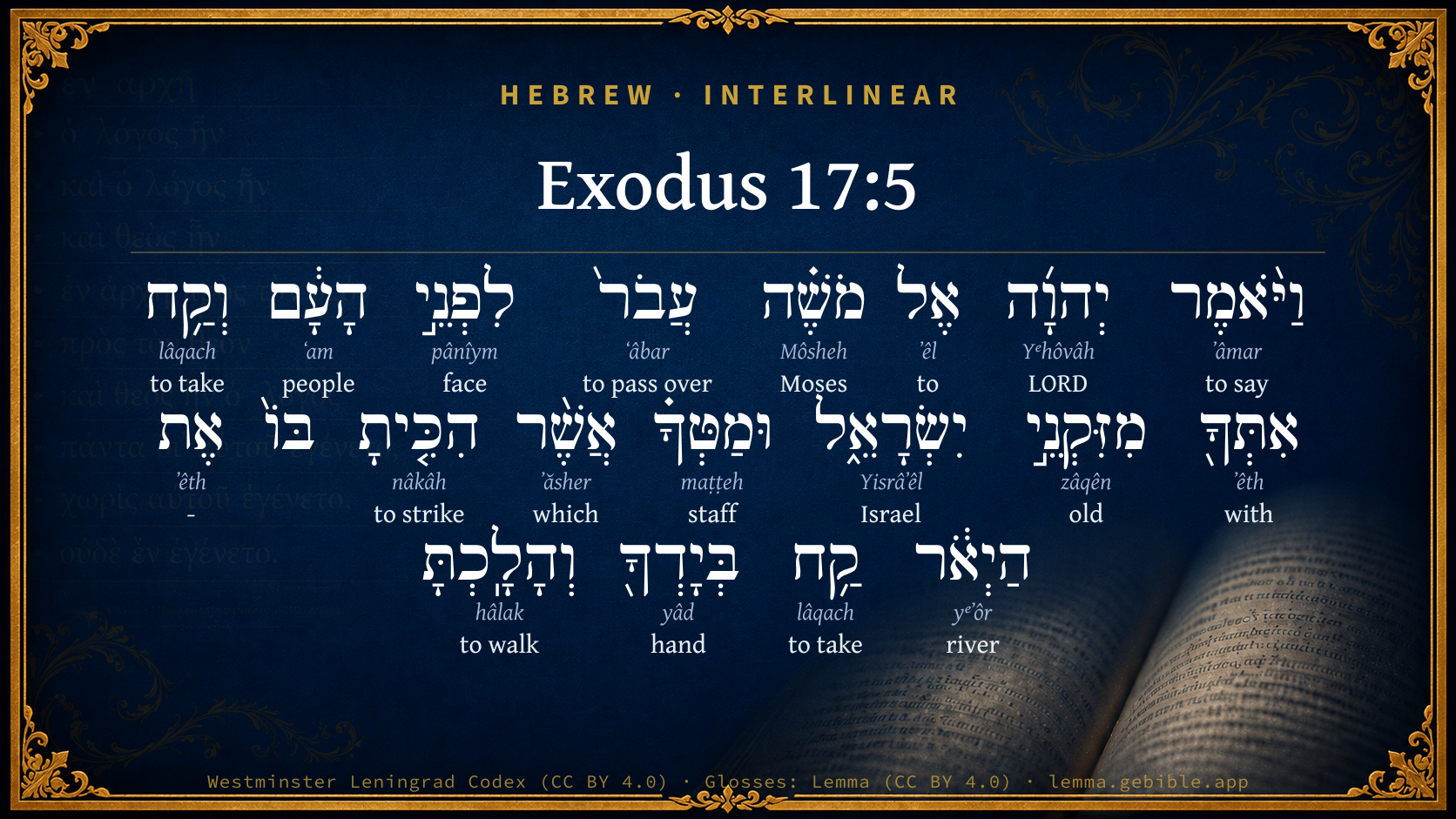
Hebrew (Westminster Leningrad Codex) Exodus 17:5 appears in the Hebrew Old Testament. The text above is from the Westminster Leningrad Codex. Each word links to its Strong’s number, a concise gloss, and parsing drawn from the Open Scriptures Hebrew Bible morphology. Click any word for its full Brown-Driver-Briggs (BDB) entry.
Download image
Cite this verse

Exodus 17:5 (World English Bible). Public Domain. Lemma interlinear Bible study tool, https://lemma.gebible.app/v/exodus/17/5.

Show BibTeX & RIS
BibTeX
RIS
English Translation
Yahweh said to Moses, "Walk on before the people, and take the elders of Israel with you, and take the rod in your hand with which you struck the Nile, and go.
World English Bible · Public Domain
Download a study sheet

One document with this verse’s original text, its word-by-word gloss line, the meaning frame, cross-references with their text, attributed commentary, and full source and license credits — printable, and it pastes into notes with its structure intact.

This verse Autodidact and up

Study sheet (.html) Plain text (.txt)

A passage Seminary Student

Up to 50 verses in one chapter. A passage sheet keeps up to 6 commentary sources and 12 cross-references per verse, in the order this page ranks them, and says so on the sheet whenever that leaves anything out. Ask for a single verse and you get the Autodidact verse sheet above.

Everything on this page stays free to read, with no account — the sheet is a download of what is already on screen, not access to it.

Want to remove ads? Support Godless Engineer
Compare translations 3

The same verse in 3 English versions, stacked beneath the original-language interlinear above. Click any original word for its lexicon entry.

Each is an independent rendering of the whole verse — the interlinear is not word-aligned to these translations.

Highlighted words mark where these versions differ — a whole-verse word diff, not a word-by-word alignment.

  • World English Bible Public Domain
    Yahweh said to Moses, "Walk on before the people, and take the elders of Israel with you, and take the rod in your hand with which you struck the Nile, and go.
  • King James Version Public Domain
    And the LORD said unto Moses, Go on before the people, and take with thee of the elders of Israel; and thy rod, wherewith thou smotest the river, take in thine hand, and go.
  • unfoldingWord Literal Text CC BY-SA 4.0
    And Yahweh said to Moses, “Pass before the face of the people, and take with you some of the elders of Israel, and your staff, the one with which you struck the river, take in your hand; and go.

unfoldingWord Literal Text — © unfoldingWord, licensed CC BY-SA 4.0. Word-aligned USFM3 via Door43 (git.door43.org/unfoldingWord/en_ult).

Versions to compare (up to 4)

3 of 4 selected

Show all 18 translations

Every available English version of this verse, each an independent rendering of the whole verse.

  • World English Bible Public Domain
    Yahweh said to Moses, "Walk on before the people, and take the elders of Israel with you, and take the rod in your hand with which you struck the Nile, and go.
  • Berean Standard Bible Public Domain
    And the LORD said to Moses, “Walk on ahead of the people and take some of the elders of Israel with you. Take along in your hand the staff with which you struck the Nile, and go.
  • Majority Standard Bible Public Domain
    And the LORD said to Moses, “Walk on ahead of the people and take some of the elders of Israel with you. Take along in your hand the staff with which you struck the Nile, and go.
  • King James Version Public Domain
    And the LORD said unto Moses, Go on before the people, and take with thee of the elders of Israel; and thy rod, wherewith thou smotest the river, take in thine hand, and go.
  • American Standard Version (1901) Public Domain
    And Jehovah said unto Moses, Pass on before the people, and take with thee of the elders of Israel; and they rod, wherewith thou smotest the river, take in thy hand, and go.
  • Revised Version (1885) Public Domain
    And the LORD said unto Moses, Pass on before the people, and take with thee of the elders of Israel; and thy rod, wherewith thou smotest the river, take in thine hand, and go.
  • Geneva Bible (1599) Public Domain
    And ye Lord answered to Moses, Goe before the people, and take with thee of the Elders of Israel: and thy rod, wherewith thou smotest the riuer, take in thine hand, and go:
  • Douay-Rheims (1899) Public Domain
    And the Lord said to Moses: God before the people, and take with thee of the ancients of Israel: and take in thy hand the rod wherewith thou didst strike the river, and go.
  • Young's Literal Translation Public Domain
    And Jehovah saith unto Moses, `Pass over before the people, and take with thee of the elders of Israel, and thy rod with which thou hast smitten the River take in thy hand, and thou hast gone:
  • Literal Standard Version CC BY-SA 4.0
    And YHWH says to Moses, “Pass over before the people, and take with you from [the] elderly of Israel, and take your rod in your hand, with which you have struck the River, and you have gone.
  • Unlocked Literal Bible CC BY-SA 4.0
    Yahweh said to Moses, “Go on ahead of the people, and take with you some elders of Israel. Take with you the staff with which you struck the river, and go.
  • unfoldingWord Literal Text CC BY-SA 4.0
    And Yahweh said to Moses, “Pass before the face of the people, and take with you some of the elders of Israel, and your staff, the one with which you struck the river, take in your hand; and go.
  • Darby Bible Public Domain
    And Jehovah said to Moses, Go on before the people, and take with thee of the elders of Israel, and thy staff with which thou didst smite the river, take in thy hand, and go.
  • World Messianic Bible Public Domain
    The LORD said to Moses, “Walk on before the people, and take the elders of Israel with you, and take the rod in your hand with which you struck the Nile, and go.
  • Webster's Bible Public Domain
    And the LORD said to Moses, Go on before the people, and take with thee of the elders of Israel: and thy rod, with which thou smotest the river, take in thy hand, and go.
  • Free Bible Version CC BY-SA 4.0
    The Lord told Moses, “Go ahead of the people, and take some of the elders of Israel with you. Take with you the walking stick you used to hit the Nile, and just go on ahead.
  • Bible in Basic English Public Domain
    And the Lord said to Moses, Go on before the people, and take some of the chiefs of Israel with you, and take in your hand the rod which was stretched out over the Nile, and go.
  • JPS Tanakh (1917) Public Domain
    And the LORD said unto Moses: 'Pass on before the people, and take with thee of the elders of Israel; and thy rod, wherewith thou smotest the river, take in thy hand, and go.

Literal Standard Version (2020), Covenant Press — licensed CC BY-SA 4.0. Text via the HelloAO Bible API (eBible.org). Unlocked Literal Bible (unfoldingWord) — licensed CC BY-SA 4.0. Text via the HelloAO Bible API (eBible.org). unfoldingWord Literal Text — © unfoldingWord, licensed CC BY-SA 4.0. Word-aligned USFM3 via Door43 (git.door43.org/unfoldingWord/en_ult). Free Bible Version, Dr. Jonathan Gallagher — licensed CC BY-SA 4.0. Text via the HelloAO Bible API (eBible.org).

Word by word

More ways to search: Search by grammar → Find every occurrence → Compare this word →

Practice this passage: Drill this verse → Learn its vocabulary →

הַיְאֹ֔ר
yᵉʼôr
H2975
“the · river”
Particle, Definite Article + Noun, Proper
Part of Speech
Particle + Noun
Type
Proper
Full BDB Definition

Origin: of Egyptian origin

TWOT: 832

river, stream, canal, Nile, Nile-canal - stream, river (Nile) - Nile-arms, Nile-canals - watercourses - shafts (mining) - river (in general)
  1. וַיֹּ֨אמֶר ʼâmar H559 “and · to say” Conjunction + Verb, Qal, Sequential Imperfect, 3rd Person, Masculine, Singular
  2. יְהוָ֜ה Yᵉhôvâh H3068 “LORD” Noun, Proper
  3. אֶל ʼêl H413 “to” Preposition
  4. מֹשֶׁ֗ה Môsheh H4872 “Moses” Noun, Proper
  5. עֲבֹר֙ ʻâbar H5674 “pass over” Verb, Qal, Imperative, 2nd Person, Masculine, Singular
  6. לִפְנֵ֣י pânîym H6440 “to/for · face(s) of” Preposition + Noun, Common, Both, Plural, Construct
  7. הָעָ֔ם ʻam H5971 “the · people” Particle, Definite Article + Noun, Common, Masculine, Singular, Absolute
  8. וְקַ֥ח lâqach H3947 “and · take” Conjunction + Verb, Qal, Imperative, 2nd Person, Masculine, Singular
  9. אִתְּךָ֖ ʼêth H854 “with · you” Preposition + Suffix, Personal, 2nd Person, Masculine, Singular
  10. מִזִּקְנֵ֣י zâqên H2205 “from · old of” Preposition + Adjective, Adjective, Masculine, Plural, Construct
  11. יִשְׂרָאֵ֑ל Yisrâʼêl H3478 “Israel” Noun, Proper
  12. וּמַטְּךָ֗ maṭṭeh H4294 “and · staff · your” Conjunction + Noun, Common, Masculine, Singular, Construct + Suffix, Personal, 2nd Person, Masculine, Singular
  13. אֲשֶׁ֨ר ʼăsher H834 “which” Particle, Relative
  14. הִכִּ֤יתָ nâkâh H5221 “to strike” Verb, Hiphil, Perfect, 2nd Person, Masculine, Singular
  15. אֶת ʼêth H853 “-” Particle, Direct Object
  16. קַ֥ח lâqach H3947 “take” Verb, Qal, Imperative, 2nd Person, Masculine, Singular
  17. בְּיָדְךָ֖ yâd H3027 “in/at · hand · your” Preposition + Noun, Common, Both, Singular, Construct + Suffix, Personal, 2nd Person, Masculine, Singular
  18. וְהָלָֽכְתָּ hâlak H1980 “and · to walk” Conjunction + Verb, Qal, Sequential Perfect, 2nd Person, Masculine, Singular

About this verse

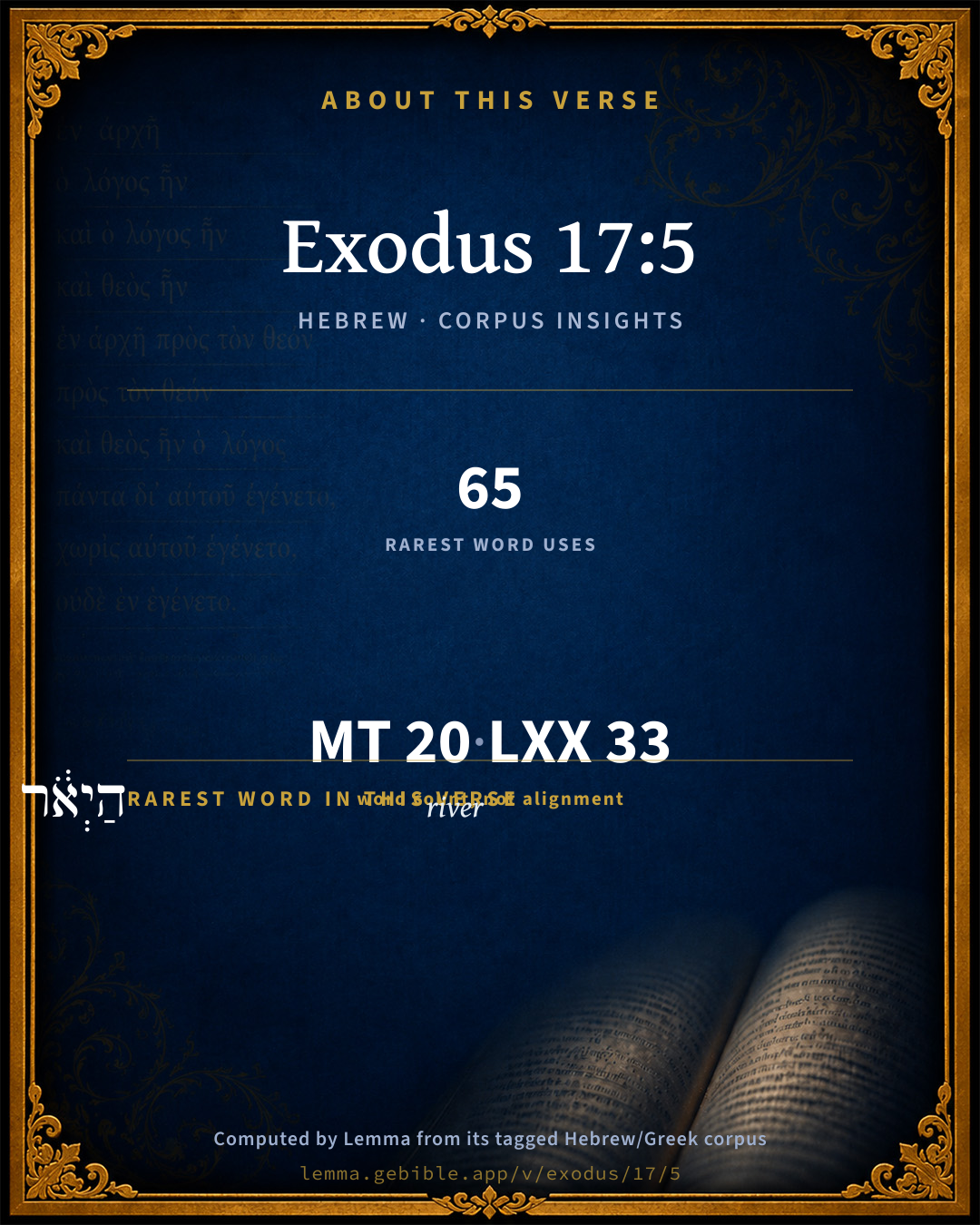
These counts appear in no published source. They are computed here, from the morphology-tagged text and Lemma’s own curated glosses. What Lemma adds →

20
words
18
distinct lemmas
Pentateuch
section

Grammatical profile

  • 6 verbs
  • 8 nouns
  • 1 adjective
  • 3 prepositions
  • 2 particles

Verb forms

  • וַיֹּ֨אמֶר Qal · Sequential Imperfect
  • עֲבֹר֙ Qal · Imperative
  • וְקַ֥ח Qal · Imperative
  • הִכִּ֤יתָ Hiphil · Perfect
  • קַ֥ח Qal · Imperative
  • וְהָלָֽכְתָּ Qal · Sequential Perfect

Repetition

A word recurs within this verse — often emphatic in Hebrew:

  • וְקַ֥ח to take H3947 ×2

Hebrew & Septuagint length

In English translation the verse runs 32 words from the Hebrew and 37 from the Septuagint (LXX English) — closely comparable.

A rough comparison of the two English renderings, which tokenize alike — not a word-level alignment.

Word counts can differ between the Hebrew and the Greek without any difference in meaning — e.g. the Hebrew direct-object marker אֵת has no separate Greek word, and Greek often adds the article ὁ.

In the original languages it is 20 Hebrew tokens and 33 Greek tokens — but the two are counted differently (Hebrew bundles its prefixes and suffixes into one token; the Greek is in lemma form), so that isn’t a like-for-like length.

Cross-references

4

Topical passages linked to Exodus 17:5 in the Treasury of Scripture Knowledge — connected by theme and wording, ordered by reader-vote popularity; previews shown in the World English Bible.

  • Exodus 7:19–20 Yahweh said to Moses, "Tell Aaron, 'Take your rod, and stretch out your hand over the waters of Egypt, over their rivers, over their streams, and over their pools, and over all their ponds of water, that they may become blood; and there shall be blood throughout all the land of Egypt, both in vessels of wood and in vessels of stone.'"
  • Numbers 20:8–11 Take the rod, and assemble the congregation, you, and Aaron your brother, and speak you to the rock before their eyes, that it give forth its water; and you shall bring forth to them water out of the rock; so you shall give the congregation and their cattle drink.
  • Ezekiel 2:6 You, son of man, don't be afraid of them, neither be afraid of their words, though briers and thorns are with you, and you do dwell among scorpions: don't be afraid of their words, nor be dismayed at their looks, though they are a rebellious house.
  • Acts 20:23–24 except that the Holy Spirit testifies in every city, saying that bonds and afflictions wait for me.

Cross-references courtesy of OpenBible.info (CC BY 4.0).

Hebrew and Greek witnesses Masoretic Hebrew ↔ Greek Septuagint

The same verse in the two great witnesses to the Old Testament, shown verse-for-verse.

These are two independent witnesses, not word-aligned to each other, and the Septuagint is shown in lemma (dictionary) form.

Hebrew Exodus 17:5 Masoretic · Westminster Leningrad Codex

וַיֹּ֨אמֶר יְהוָ֜ה אֶל מֹשֶׁ֗ה עֲבֹר֙ לִפְנֵ֣י הָעָ֔ם וְקַ֥ח אִתְּךָ֖ מִזִּקְנֵ֣י יִשְׂרָאֵ֑ל וּמַטְּךָ֗ אֲשֶׁ֨ר הִכִּ֤יתָ בּוֹ֙ אֶת הַיְאֹ֔ר קַ֥ח בְּיָדְךָ֖ וְהָלָֽכְתָּ

Yahweh said to Moses, "Walk on before the people, and take the elders of Israel with you, and take the rod in your hand with which you struck the Nile, and go.

World English Bible · Public Domain

Greek LXX Exodus 17:5 Septuagint · lemma form

καί εἶπον κύριος πρός μωυσῆς προπορεύομαι ὁ λαός οὗτος λαμβάνω δέ μετά σεαυτοῦ ἀπό ὁ πρεσβύτερος ὁ λαός καί ὁ ῥάβδος ἐν ὅς πατάσσω ὁ ποταμός λαμβάνω ἐν ὁ χείρ σύ καί πορεύομαι

And the Lord said to Moses, Go before this people, and take to yourself of the elders of the people; and the rod with which you struck the river, take in your hand, and you shall go.

LXX2012 (modern English Septuagint) · Public Domain

Hebrew: Westminster Leningrad Codex (CC BY 4.0). Greek: Septuagint (public domain); English from LXX2012 (modern English Septuagint) (Public Domain). How the Septuagint differs from the Hebrew →

Targum (Aramaic paraphrase)

2

The Targum is the ancient Jewish Aramaic paraphrase of the Hebrew Scriptures — an interpretive translation, not the Hebrew text itself. Onkelos (literal) and Pseudo-Jonathan (expansive) render the Torah, and Jonathan the Prophets. Coverage is partial: where no permissively-licensed English translation exists for a verse, only the Aramaic is shown. This is verse-level text, not a word-by-word alignment to the Hebrew.

  1. Targum Onkelos Torah (Genesis–Deuteronomy)
    וַאֲמַר יְיָ לְמשֶׁה עִבַּר קֳדָם עַמָא וּדְבַר עִמָךְ מִסָבֵי יִשְׂרָאֵל וְחֻטְרָךְ דִי מָחֵיתָא בֵהּ יָת נַהֲרָא סַב בִּידָךְ וְתֵיזִל:

    (no public-domain English translation for this verse)

    Targum Onkelos — Aramaic: “Onkelos Genesis” (public domain); “Onkelos Exodus” (public domain); “Onkelos Leviticus” (public domain); “Onkelos Numbers” (public domain); “Onkelos Deuteronomy” (public domain). English: “Sefaria Community Translation” (CC0 1.0 (public-domain dedication)); “J.W. Etheridge. The Targums of Onkelos and Jonathan Ben Uzziel on the Pentateuch. London: Longmans, Green, 1862” (public domain). Text via Sefaria.

  2. Targum Pseudo-Jonathan Torah (Genesis–Deuteronomy)
    וַאֲמַר יְיָ לְמשֶׁה עִיבַּר קֳדָם עַמָּא וּדְבַר עִמָּךְ מִסָּבֵי יִשְרָאֵל וְחוּטְרָךְ דְּמָחִית בֵּיהּ יַת נַהֲרָא דְּבַר בִּידָךְ וְאִיזֵיל לָךְ מִן קֳדָם תּוּרְעֲמַתְהוֹן

    And the Lord said to Mosheh, Pass over before the people, and take with thee some of the elders of Israel, and the rod with which thou didst smite the river take in thy hand, and go from the face of their murmuring.

    Targum Pseudo-Jonathan — Aramaic: “Targum Jonathan on Genesis” (public domain); “Targum Jonathan on Exodus” (public domain); “Targum Jonathan on Leviticus” (public domain); “Targum Jonathan on Numbers” (public domain); “Targum Jonathan on Deuteronomy” (public domain). English: “The Targum of Jonathan ben Uzziel, trans. J. W. Etheridge, London, 1862” (public domain). Text via Sefaria.

Commentary

Notes on Exodus 17:5 from classic Christian and Jewish commentators (each source and its license shown beneath its notes). The classic Christian expositions comment on the surrounding passage and are grouped to its opening verse, so a note may address several verses; the Jewish commentaries on the Tanakh (Rashi and others) are per-verse, so they appear only where the commentator wrote on this verse.

Lemma curates 59 commentaries, every one of them public domain or Creative Commons licensed, each selected and text-cleaned for this edition rather than reprinted as found. About our sources →

Trapp's Complete Commentary

John Trapp

Exo 17:5 And the LORD said unto Moses, Go on before the people, and take with thee of the elders of Israel; and thy rod, wherewith thou smotest the river, take in thine hand, and go.

Ver. 5. Take with thee of the elders.] As witnesses of this great work of God; which the people for their unbelief might not behold. God puts up with their rebellion, and satisfies their thirst: but yet intimates his just displeasure, by denying them this privilege of seeing the rock smitten.

John Trapp, A Commentary or Exposition upon All the Books of the Old and New Testament (1647–1656) — public domain. Text from a community e-Sword module.

Joseph Benson's Commentary

Exo 17:5-6. Go before the people — Though they spoke of stoning him. He must take his rod with him, not to summon some plague to chastise them, but to fetch water for their supply. O the wonderful patience and forbearance of God toward provoking sinners! He maintains those that are at war with him, and reaches out the hand of his bounty to those that lift up the heel against him. If God had only showed Moses a fountain of water in the wilderness, as he did to Hagar, not far from hence, (Gen 21:19,) that had been a great favour; but that he might show his power as well as his pity, and make it a miracle of mercy, he gave them water out of a rock. He directed Moses whither to go, appointed him to take of the elders of Israel with him, to be witnesses of what was done, ordered him to smite the rock, which he did, and immediately water came out of it in great abundance, which ran throughout the camp in streams and rivers, Psa 78:15-16. God showed his care of his people in giving them water when they wanted it; his own power in fetching it out of a rock, and put an honour upon Moses in appointing the water to flow out upon his smiting of the rock. This fair water that came out of the rock is called honey and oil, (Deu 32:13,) because the people’s thirst made it doubly pleasant; coming when they were in extreme want. It is probable that the people digged canals for the conveyance of it, and pools for the reception of it. Let this direct us to live in a dependance, 1st, Upon God’s providence, even in the greatest straits and difficulties; and, 2d, Upon Christ’s grace; that rock was Christ, 1Co 10:4. The graces and comforts of the Spirit are compared to rivers of living waters, Joh 7:38-39; Joh 4:14. These flow from Christ. And nothing will supply the needs and satisfy the desires of a soul but water out of this rock. A new name was, upon this occasion, given to the place, preserving the remembrance of their murmuring; Massah — Temptation, because they tempted God; Meribah — Strife, because they chid with Moses. Several commentators have here quoted the following passage from Shaw’s Travels, as a wonderful confirmation of this great miracle: “Here (in the plain of Rephidim) we still see that extraordinary antiquity, the rock of Meribah, which hath continued down to this day, without the least injury from time or accident. It is a block of granite marble, about six yards square, lying tottering as it were, and loose in the middle of the valley, and seems to have formerly belonged to mount Sinai, which hangs in a variety of precipices all over this plain. The waters which gushed out, and the stream which followed, (Psa 78:20,) have hollowed, across one corner of this rock, a channel about two inches deep and twenty wide, appearing to be incrustated all over, like the inside of a teakettle that had been long in use. Besides several mossy productions that are still preserved by the dew, we see all over the channel a great number of holes, some of them four or five inches deep, and one or two in diameter, the lively and demonstrative tokens of their having been formerly so many fountains. It likewise may be further observed, that art or chance could by no means be concerned in the contrivance; for every circumstance points out to us a miracle; and, in the same manner with the rent in the rock of mount Calvary, at Jerusalem, never fails to produce a religious surprise in all who see it. The Arabs, who were our guard, were ready to stone me for attempting to break off a corner of it.” — Shaw’s Travels, pp. 252, 253.

Joseph Benson's Commentary on the Old and New Testaments (1811–1818) — public domain. Text from a community e-Sword module.

Jamieson, Fausset & Brown

Robert Jamieson, A. R. Fausset & David Brown

the Lord said unto Moses, &c.--not to smite the rebels, but the rock; not to bring a stream of blood from the breast of the offenders, but a stream of water from the granite cliffs. The cloud rested on a particular rock, just as the star rested on the house where the infant Saviour was lodged [Mat 2:9]. And from the rod-smitten rock there forthwith gushed a current of pure and refreshing water. It was perhaps the greatest miracle performed by Moses, and in many respects bore a resemblance to the greatest of Christ's: being done without ostentation and in the presence of a few chosen witnesses (Co1 10:4).

Jamieson, Fausset & Brown — Commentary Critical and Explanatory on the Whole Bible (1871) — public domain (CC PDM 1.0). Text via the HelloAO Bible API.

Ellicott's Commentary for English Readers

(5) Go on before the people.—The people were probably in no condition to move. They were exhausted. with a long day’s march—weary, faint, nerveless. Moses and the elders, who probably journeyed on asses, would have more strength.

Take with thee of the elders—as witnesses. Each miracle had an educational value, and was designed to call forth, exercise, and so strengthen the faith of the people.

The rock in Horeb must necessarily designate some particular rock of the Horeb region already known to Moses during his previous stay in these parts. It cannot possibly, however, have been the traditional “rock of Moses” in the Seil Leja, under Ras Sufsafeh, since that rock is a long day’s journey from the site of Rephidim, near which the miracle must have been performed. (See Stanley, Sinai and Palestine, pp. 46-48.)

A Bible Commentary for English Readers, edited by Charles John Ellicott (1878–1897) — public domain. Text from a community e-Sword module.

The Cambridge Bible for Schools and Colleges

gen. ed. J. J. S. Perowne

5. the elders] to witness what takes place, and be able to certify it to the people.

thy rod, &c.] see Exo_7:17 b, 20b.

the river] the Nile: see on Exo_1:22.

The Cambridge Bible for Schools and Colleges (gen. ed. J. J. S. Perowne; Cambridge University Press, 1878–1918) — public domain. Text from a community e-Sword module.

John Gill's Exposition

And the Lord said unto Moses,.... Out of the pillar of cloud:

go on before the people, lead them on nearer to Mount Sinai or Horeb, within sight of which they now were. Jarchi adds, by way of explanation, "and see if they will stone thee"; fear not, go on boldly, no harm shall come to thee:

and take with thee of the elders of Israel; some of them for a witness, as the above writer observes, that they may see that by thine hand water comes out of the rock, and may not say there were fountains there from the days of old. These were taken, because they were the principal men among the people, who, as they were men of years, so of prudence and probity, and whose veracity might be depended upon; and since so great a multitude could not all of them see the miracle, the rock being smote, and the water only flowing in one part of it, and perhaps the road to it but narrow, it was proper some persons should be singled out as witnesses of it, and who so proper as the elders of the people?

and thy rod, wherewith thou smotest the river, take in thine hand and go; wherewith the river Nile was smitten, and the water became blood, when Moses and Aaron first went to Pharaoh; and which, though smitten by Aaron, yet being with the rod of Moses, and by his order, is attributed to him; or else with which the Red sea was smitten by Moses, and divided; which being but a narrow channel, or an arm of the sea, might be called a river: and this circumstance is observed, as the afore mentioned writer thinks, to let the Israelites know, that the rod was not, as they thought, only designed for inflicting punishment, as on Pharaoh and the Egyptians, but also for bringing good unto them; and when they saw this in his hand, by which so many miracles had been wrought, they might be encouraged to hope that something was going to be done in their favour, and that water would be produced for them to drink.

John Gill's Exposition of the Whole Bible (1746–1763) — public domain (CC PDM 1.0). Text via the HelloAO Bible API.

Matthew Poole's English Annotations

Take with thee of the elders of Israel, that they may be eye-witnesses of this glorious work, and may report it to the people.

The river; either the Red Sea, for an arm of the sea is sometimes called a river; or the river Nilus.

Matthew Poole's English Annotations on the Holy Bible (1683–1685) — public domain. Text from a community e-Sword/MySword module.

Whedon's Commentary on the Bible

Daniel D. Whedon

5. Thy rod — The rod which brought death to Egypt is to bring life to Israel; the power which made the life-giving Nile a channel of loathsome death is to bring from the dry rock waters of life. So, ever, the same truth is “to the one a savour of life, to the other a savour of death.”

Daniel D. Whedon (gen. ed.), Commentary on the Old and New Testaments (1874–1909) — public domain. Text from a community e-Sword module.

The Pulpit Commentary

Go on before the people. "Leave the people," i.e. , "where they are, in Rephidim, and go on in front of them, with some of the elders as witnesses, that the miracle may be sufficiently attested." On the other occasion, when water was brought forth out of the rock, (Num_20:8-11) it was done in the presence of the people. Perhaps now there was a real danger of their stoning Moses, had he not quitted them. Thy rod with which thou smotest the river. See above, Exo_7:20.

The Pulpit Commentary (1880–1919), ed. H.D.M. Spence-Jones & Joseph S. Exell — public domain. Text from a community e-Sword module.

John Wesley's Explanatory Notes

Go on before the people - Though they spake of stoning him. He must take his rod with him, not to summon some plague to chastise them, but to fetch water for their supply. O the wonderful patience and forbearance of God towards provoking sinners! He maintains those that are at war with him, and reaches out the hand of his bounty to those that lift up the heel against him. If God had only shewed Moses a fountain of water in the wilderness, as he did to Hagar, not far from hence, Gen. xxi, 19, that had been a great favour; but that he might shew his power as well as his pity, and make it a miracle of mercy, he gave them water out of a rock. He directed Moses whither to go, appointed him to take of the elders of Israel with him, to be witnesses of what was done, ordered him to smite the rock, which he did, and immediately water came out of it in great abundance, which ran throughout the camp in streams and rivers, Psalm lxxviii, 15, 16, and followed them wherever they went in that wilderness: God shewed his care of his people in giving them water when they wanted it; his own power in fetching it out of a rock, and put an honour upon Moses in appointing the water to flow out upon his smiting of the rock. This fair water that came out of the rock is called honey and oil, Deut. xxxii, 13, because the people's thirst made it doubly pleasant; coming when they were in extreme want. It is probable that the people digged canals for the conveyance of it, and pools for the reception of it. Let this direct us to live in a dependance,

1. Upon God's providence even in the greatest straits and difficulties;

2. And upon Christ's grace; that rock was Christ, 1 Cor. x, 4. The graces and comforts of the Spirit are compared to rivers of living waters, John vii, 38, 39; iv, 14. These flow from Christ. And nothing will supply the needs and satisfy the desires of a soul but water out of this rock. A new name was upon this occasion given to the place, preserving the remembrance of their murmuring, Massah - Temptation, because they tempted God, Meribah - Strife, because they chide with Moses.

John Wesley, Explanatory Notes Upon the Whole Bible (1754–1765) — public domain. Text via the GEBible commentary corpus.

Rashi

Rabbi Shlomo Yitzchaki (Rashi)

עבר לפני העם PASS BEFORE THE PEOPLE and see whether they will stone you! (Midrash Tanchuma, Beshalach 23) Why have you uttered a slander against My children?

וקח אתך מזקני ישראל AND TAKE WITH THEE OF THE ELDERS OF ISRAEL as witnesses — that they may see that it is by your agency that the water will come forth from the rock and that people may not say that there had been springs there from time immemorial (Mekhilta).

ומטך אשר הכית בו את היאר AND THY STAFF, WHEREWITH THOU SMOTEST THE RIVER — What is the force of the words “wherewith thou smotest the river” — they are apparently superfluous? But these are added because the Israelites had said of the staff that it was intended only for punishment: by it Pharaoh and the Egyptians had been stricken with many plagues in Egypt and at the Red Sea. On this account it is stated here: take the staff wherewith thou smotest the river — they shall see now that it is also intended for good (Mekhilta).

Rashi on the Tanakh — English translations: “The Judaica Press complete Tanach with Rashi, translated by A. J. Rosenberg” (CC BY 4.0); “Pentateuch with Rashi's commentary by M. Rosenbaum and A.M. Silbermann, 1929-1934” (public domain); “The Metsudah Tanach series, Lakewood, N.J” (CC BY 4.0); and “The Book of Joshua, Metsudah Publications, 1997” (CC BY 4.0). Text via Sefaria.

Ramban (Nachmanides)

Rabbi Moshe ben Nachman (Ramban / Nachmanides)

AND THE ETERNAL SAID UNTO MOSES: PASS ON BEFORE THE PEOPLE. This is similar in usage to the following expressions: he [Joseph] caused them to pass into cities; and I will make thee to pass with thine enemies into a land which thou knowest not. Thus the meaning thereof here is: “go away from them to another place,” [as will be explained further]. Perhaps this is similar to the expressions: and he [Ahimaaz] overran the Cushite; and he [Jacob] himself passed over before them, meaning that he [Jacob] went in the forefront of them.The purport of this verse is that the people were in Rephidim, and the rock from which the waters were to come was in Horeb,. this being Mount Sinai, according to the opinion of the former ones, or in my opinion, some city near the mountain, as I will yet explain. (18:1). Moses therefore had to go first before the people, to pass on from Rephidim to Horeb — a distance of one more parsah [a Persian mile] or more — from the camp before them. It was for this reason that G-d said to him, Pass on before the people, and take with thee of the elders of Israel… and go. That is to say, “Go until you will see Me stand before you upon the rock in Horeb.” Now Moses hit the rock, and water came out of it. Scripture however does not relate that the congregation and their cattle drank, as it does in the second incident [at the waters of Meribah], for it is self-understood that they did so. It is clear that the people did not go to Horeb to drink, since they did not arrive in front of Mount Sinai until afterwards in the third month. Instead, they sent their young men and their cattle there to draw water and bring it to them, as is customary in camps.It appears likely to me that the waters — cold flowing waters — came out from the rock in Horeb and flowed to Rephidim, and there the people drank them. This is Scripture’s intent in saying, He brought streams out of the rock, and caused waters to run down like rivers, and it is further written, He opened the rock, and waters gushed out; they ran, a river in the dry places., 105:41. The verse stating, Behold, He smote the rock, that waters gushed out, and streams overflowed, 78:20. also applies to the rock in Horeb, in line with the plain meaning of Scripture. The second rock in Kadesh, [instead of gushing forth water], became cleft with a sort of spring welling forth waters, and therefore Scripture states, That is ‘the well’ whereof the Eternal said unto Moses, etc., 21:16. and Israel said in the Song, ‘The well,’ which the princes digged, Verse 18. for it was like a well that was dug. It is for this reason that Scripture says there, and the congregation drank, and their cattle, 20:11. which means that there they drank from it at that place immediately, but here [in Horeb], overflowing rivers came from it and they drank of it in their homes at their will. Now although according to the tradition of our Rabbis, it was all Miriam’s Well, it is possible that on the first occasion [in Horeb] and during all their forty years’ wandering, the waters came gushing out from the rock like overflowing rivers. The second time, [in Kadesh], as a punishment for that which took place there, it became [only] like a dug well that was full of fresh water [not a gushing spring].

AND THY ROD, WHEREWITH THOU SMOTEST THE RIVER, TAKE IN THY HAND. This means “[the staff wherewith] you commanded Aaron [to strike the river].” He mentioned the striking of the river, but He did not say, “and the rod which was turned to a serpent”, Verse 15. or “the rod wherewith you did the signs.” This was in order to call attention to the wonder in it, for at that time, the rod turned the waters into blood, thus removing from them their particular nature, and now the rod brought water into a flinty rock, thus doing things of contrary effect.

Ramban (Nachmanides) on the Tanakh — English translation: “Commentary on the Torah by Ramban (Nachmanides). Translated and annotated by Charles B. Chavel. New York, Shilo Pub. House, 1971-1976” (CC BY 4.0). Text via Sefaria.

Lesson kit

Teaching starters — assembled from the data on this page, not authored interpretation. Every prompt links to the verse data it draws on. Edit before teaching.

Exodus, in the Pentateuch, opens this verse with 20 words (18 distinct Hebrew lemmas). Its most distinctive word is yᵉʼôr (“river”). A historical commentator’s framing appears above. Read the whole chapter for the surrounding context.

Discussion questions

  1. The word yᵉʼôr carries the sense “river.” How does it shape the verse?
  2. How does Exodus 7:19–20, which shares this passage’s theme, read alongside this verse?
  3. What does the repetition of “to take” (2× in this one verse) do in this verse?
  4. The translations on this page render this verse differently — a whole-verse word diff, not a word-by-word alignment. What might account for the different wordings?
  5. «וַיֹּ֨אמֶר» is a Qal Sequential Imperfect verb. How does that grammatical form shape the action described?
  6. Compare how Trapp's Complete Commentary and Joseph Benson's Commentary read this verse. Where do they agree or differ?

Things to notice

Reading settings

Reading text

Shown beneath each verse's original-language words.

Old Testament
Old Testament edition

Read the OT as the Masoretic Hebrew (MT) or the Greek Septuagint (LXX).

English shown for the Greek Septuagint (in the Hebrew ↔ Greek comparison).

Comparing translations? Open the Compare panel on any verse page to stack up to four side by side.