
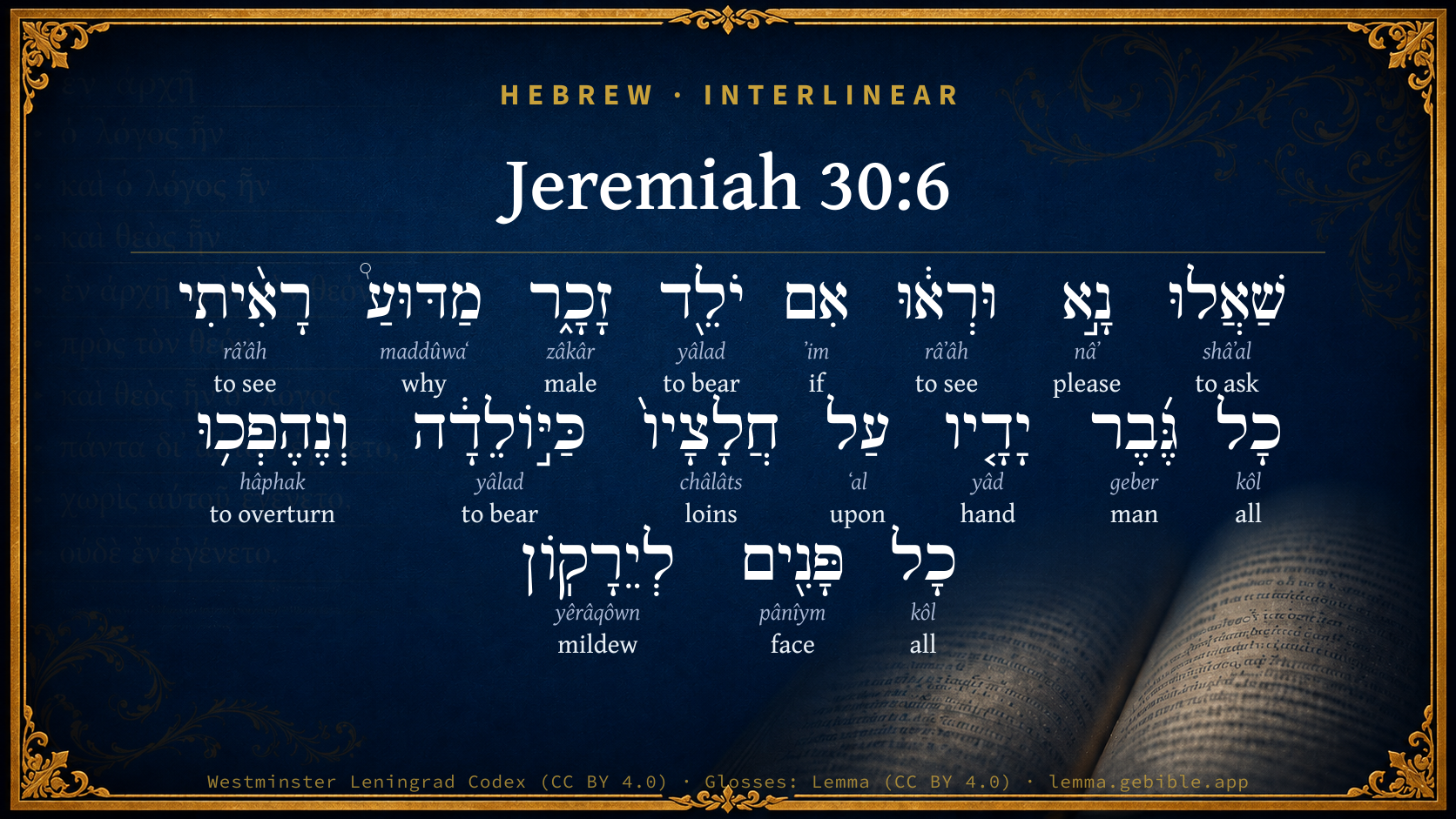
Jeremiah 30:6

Hebrew (Westminster Leningrad Codex) Jeremiah 30:6 appears in the Hebrew Old Testament. The text above is from the Westminster Leningrad Codex. Each word links to its Strong’s number, a concise gloss, and parsing drawn from the Open Scriptures Hebrew Bible morphology. Click any word for its full Brown-Driver-Briggs (BDB) entry.
Download image
Cite this verse

Jeremiah 30:6 (World English Bible). Public Domain. Lemma interlinear Bible study tool, https://lemma.gebible.app/v/jeremiah/30/6.

Show BibTeX & RIS
BibTeX
RIS
English Translation
Ask now, and see whether a man does travail with child: why do I see every man with his hands on his loins, as a woman in travail, and all faces are turned into paleness?
World English Bible · Public Domain
Download a study sheet

One document with this verse’s original text, its word-by-word gloss line, the meaning frame, cross-references with their text, attributed commentary, and full source and license credits — printable, and it pastes into notes with its structure intact.

This verse Autodidact and up

Study sheet (.html) Plain text (.txt)

A passage Seminary Student

Up to 50 verses in one chapter. A passage sheet keeps up to 6 commentary sources and 12 cross-references per verse, in the order this page ranks them, and says so on the sheet whenever that leaves anything out. Ask for a single verse and you get the Autodidact verse sheet above.

Everything on this page stays free to read, with no account — the sheet is a download of what is already on screen, not access to it.

Want to remove ads? Support Godless Engineer
Compare translations 3

The same verse in 3 English versions, stacked beneath the original-language interlinear above. Click any original word for its lexicon entry.

Each is an independent rendering of the whole verse — the interlinear is not word-aligned to these translations.

Highlighted words mark where these versions differ — a whole-verse word diff, not a word-by-word alignment.

  • World English Bible Public Domain
    Ask now, and see whether a man does travail with child: why do I see every man with his hands on his loins, as a woman in travail, and all faces are turned into paleness?
  • King James Version Public Domain
    Ask ye now, and see whether a man doth travail with child? wherefore do I see every man with his hands on his loins, as a woman in travail, and all faces are turned into paleness?
  • unfoldingWord Literal Text CC BY-SA 4.0
    Ask and see if a man bears a child. Why do I see every young man with his hand on his loins like a woman bearing a child? Why have all their faces become pale?

unfoldingWord Literal Text — © unfoldingWord, licensed CC BY-SA 4.0. Word-aligned USFM3 via Door43 (git.door43.org/unfoldingWord/en_ult).

Versions to compare (up to 4)

3 of 4 selected

Show all 18 translations

Every available English version of this verse, each an independent rendering of the whole verse.

  • World English Bible Public Domain
    Ask now, and see whether a man does travail with child: why do I see every man with his hands on his loins, as a woman in travail, and all faces are turned into paleness?
  • Berean Standard Bible Public Domain
    Ask now, and see: Can a male give birth? Why then do I see every man with his hands on his stomach like a woman in labor and every face turned pale?
  • Majority Standard Bible Public Domain
    Ask now, and see: Can a male give birth? Why then do I see every man with his hands on his stomach like a woman in labor and every face turned pale?
  • King James Version Public Domain
    Ask ye now, and see whether a man doth travail with child? wherefore do I see every man with his hands on his loins, as a woman in travail, and all faces are turned into paleness?
  • American Standard Version (1901) Public Domain
    Ask ye now, and see whether a man doth travail with child: wherefore do I see every man with his hands on his loins, as a woman in travail, and all faces are turned into paleness?
  • Revised Version (1885) Public Domain
    Ask ye now, and see whether a man doth travail with child: wherefore do I see every man with his hands on his loins, as a woman in travail, and all faces are turned into paleness?
  • Geneva Bible (1599) Public Domain
    Demand now and beholde, if man trauayle with childe? wherefore doe I beholde euery man with his hands on his loynes as a woman in trauaile, and all faces are turned into a palenesse?
  • Douay-Rheims (1899) Public Domain
    Ask ye, and see if a man bear children? why then have I seen every man with his hands on his loins, like a woman in labour, and all faces are turned yellow?
  • Young's Literal Translation Public Domain
    Ask, I pray you, and see, is a male bringing forth? Wherefore have I seen every man, His hands on his loins, as a travailing woman, And all faces have been turned to paleness?
  • Literal Standard Version CC BY-SA 4.0
    Now ask and see, is a male bringing forth? Why have I seen every man || [With] his hands on his loins, as a travailing woman, || And all faces have been turned to paleness?
  • Unlocked Literal Bible CC BY-SA 4.0
    Ask and see if a man bears a child. Why do I see every young man with his hand on his loins like a woman bearing a child? Why have all their faces become pale?
  • unfoldingWord Literal Text CC BY-SA 4.0
    Ask and see if a man bears a child. Why do I see every young man with his hand on his loins like a woman bearing a child? Why have all their faces become pale?
  • Darby Bible Public Domain
    Ask ye now, and see, whether a male doth travail with child? Wherefore do I see every man with his hands on his loins, as a woman in travail; and all faces are turned into paleness?
  • World Messianic Bible Public Domain
    Ask now, and see whether a man travails with child. Why do I see every man with his hands on his waist, as a woman in travail, and all faces are turned pale?
  • Webster's Bible Public Domain
    Ask ye now, and see whether a man doth travail with child? Why do I see every man with his hands on his loins, as a woman in travail, and all faces are turned into paleness?
  • Free Bible Version CC BY-SA 4.0
    Think about it! Can men give birth? No. So why do I see every man holding his stomach with his hands like a woman in labor. Why is every face white as a sheet?
  • Bible in Basic English Public Domain
    Put the question and see if it is possible for a man to have birth-pains: why do I see every man with his hands gripping his sides, as a woman does when the pains of birth are on her, and all faces are turned green?
  • JPS Tanakh (1917) Public Domain
    Ask ye now, and see whether a man doth travail with child; wherefore do I see every man with his hands on his loins, as a woman in travail, and all faces are turned into paleness?

Literal Standard Version (2020), Covenant Press — licensed CC BY-SA 4.0. Text via the HelloAO Bible API (eBible.org). Unlocked Literal Bible (unfoldingWord) — licensed CC BY-SA 4.0. Text via the HelloAO Bible API (eBible.org). unfoldingWord Literal Text — © unfoldingWord, licensed CC BY-SA 4.0. Word-aligned USFM3 via Door43 (git.door43.org/unfoldingWord/en_ult). Free Bible Version, Dr. Jonathan Gallagher — licensed CC BY-SA 4.0. Text via the HelloAO Bible API (eBible.org).

Word by word

More ways to search: Search by grammar → Find every occurrence → Compare this word →

Practice this passage: Drill this verse → Learn its vocabulary →

לְיֵרָקֽוֹן
yêrâqôwn
H3420
“to/for · mildew”
Preposition + Noun, Common, Masculine, Singular, Absolute
Part of Speech
Preposition + Noun
Type
Common
Gender
Masculine
Number
Singular
State
Absolute
Full BDB Definition

Origin: from H3418

TWOT: 918d

mildew, paleness, lividness - mildew, rust - paleness
  1. שַׁאֲלוּ shâʼal H7592 “ask” Verb, Qal, Imperative, 2nd Person, Masculine, Plural
  2. נָ֣א nâʼ H4994 “please” Particle, Exhortation
  3. וּרְא֔וּ râʼâh H7200 “and · see” Conjunction + Verb, Qal, Imperative, 2nd Person, Masculine, Plural
  4. אִם ʼim H518 “if” Conjunction
  5. יֹלֵ֖ד yâlad H3205 “bearing” Verb, Qal, Participle Active, Masculine, Singular, Absolute
  6. זָכָ֑ר zâkâr H2145 “male” Adjective, Adjective, Masculine, Singular, Absolute
  7. מַדּוּעַ֩ maddûwaʻ H4069 “why” Particle, Interrogative
  8. רָאִ֨יתִי râʼâh H7200 “to see” Verb, Qal, Perfect, 1st Person, Common, Singular
  9. כָל kôl H3605 “all of” Noun, Common, Masculine, Singular, Construct
  10. גֶּ֜בֶר geber H1397 “man” Noun, Common, Masculine, Singular, Absolute
  11. יָדָ֤יו yâd H3027 “hands · his” Noun, Common, Both, Dual, Construct + Suffix, Personal, 3rd Person, Masculine, Singular
  12. עַל ʻal H5921 “upon” Preposition
  13. חֲלָצָיו֙ châlâts H2504 “loins · his” Noun, Common, Both, Dual, Construct + Suffix, Personal, 3rd Person, Masculine, Singular
  14. כַּיּ֣וֹלֵדָ֔ה yâlad H3205 “like/as the · bearing” Preposition, Determined + Verb, Qal, Participle Active, Feminine, Singular, Absolute
  15. וְנֶהֶפְכ֥וּ hâphak H2015 “and · to overturn” Conjunction + Verb, Niphal, Sequential Perfect, 3rd Person, Common, Plural
  16. כָל kôl H3605 “all of” Noun, Common, Masculine, Singular, Construct
  17. פָּנִ֖ים pânîym H6440 “face(s)” Noun, Common, Both, Plural, Absolute

About this verse

These counts appear in no published source. They are computed here, from the morphology-tagged text and Lemma’s own curated glosses. What Lemma adds →

18
words
15
distinct lemmas
Prophets
section

Notable vocabulary

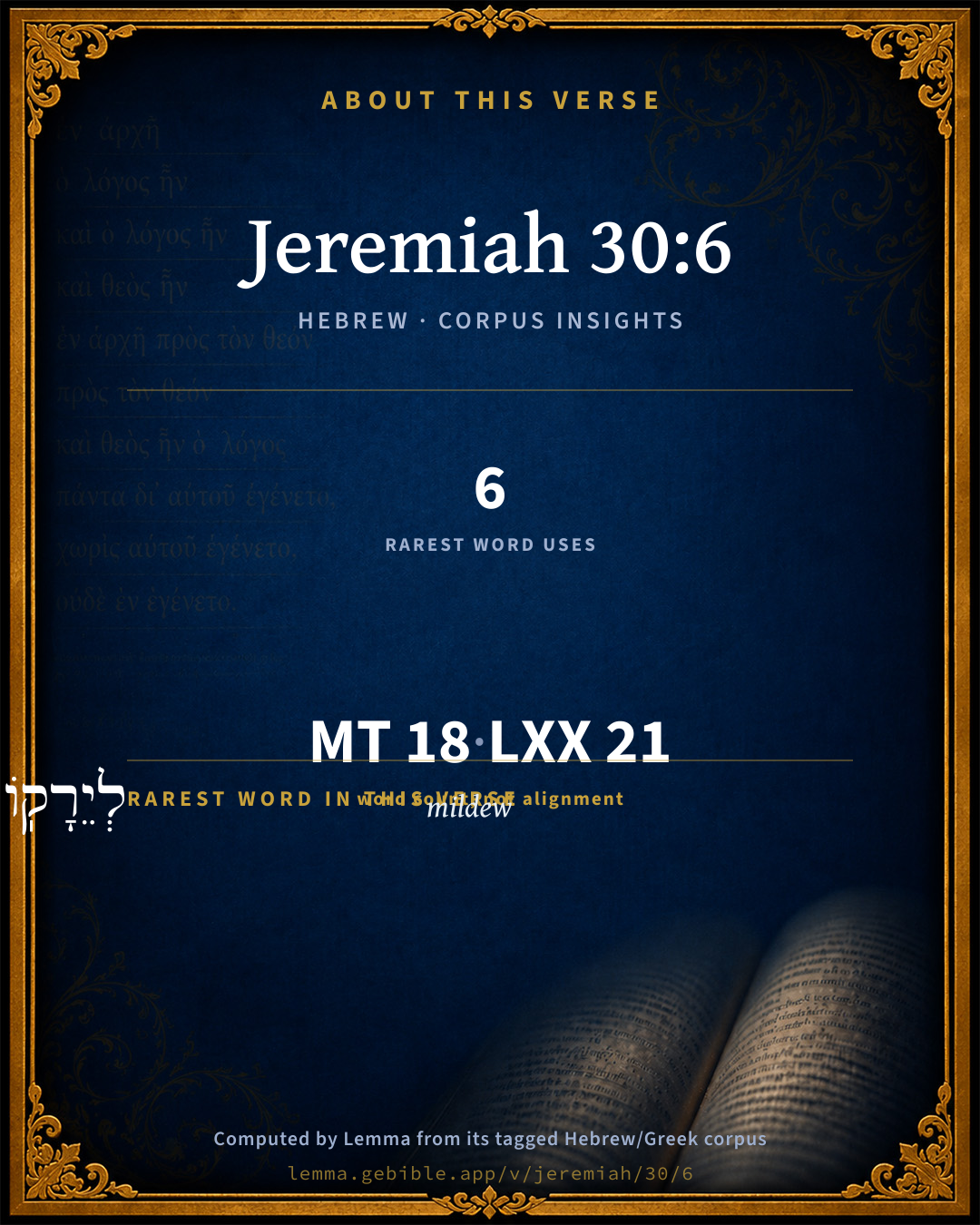
The rarest word here is לְיֵרָקֽוֹן mildew H3420 — appearing just 6 times in the whole Hebrew Bible.

Shared distinctive vocabulary

לְיֵרָקֽוֹן mildew H3420 occurs in 6 verses of the Hebrew Bible. Also found in:

Grammatical profile

  • 6 verbs
  • 7 nouns
  • 1 adjective
  • 1 preposition
  • 1 conjunction
  • 2 particles

Verb forms

  • שַׁאֲלוּ Qal · Imperative
  • וּרְא֔וּ Qal · Imperative
  • יֹלֵ֖ד Qal · Participle Active
  • רָאִ֨יתִי Qal · Perfect
  • כַּיּ֣וֹלֵדָ֔ה Qal · Participle Active
  • וְנֶהֶפְכ֥וּ Niphal · Sequential Perfect

Repetition

Words recur within this verse — often emphatic in Hebrew:

  • וּרְא֔וּ to see H7200 ×2
  • יֹלֵ֖ד to bear H3205 ×2
  • כָל all H3605 ×2

Hebrew & Septuagint length

In the original languages it is 18 Hebrew tokens and 21 Greek tokens — but the two are counted differently (Hebrew bundles its prefixes and suffixes into one token; the Greek is in lemma form), so that isn’t a like-for-like length.

Cross-references

17

Topical passages linked to Jeremiah 30:6 in the Treasury of Scripture Knowledge — connected by theme and wording, ordered by reader-vote popularity; previews shown in the World English Bible.

  • Jeremiah 4:31 For I have heard a voice as of a woman in travail, the anguish as of her who brings forth her first child, the voice of the daughter of Zion, who gasps for breath, who spreads her hands, [saying], Woe is me now! for my soul faints before the murderers.
  • Joel 2:6 At their presence the peoples are in anguish. All faces have grown pale.
  • Nahum 2:10 She is empty, void, and waste. The heart melts, the knees knock together, their bodies and faces have grown pale.
  • Isaiah 21:3 Therefore are my loins filled with anguish; pangs have taken hold on me, as the pangs of a woman in travail: I am pained so that I can't hear; I am dismayed so that I can't see.
  • Psalms 48:6 Trembling took hold of them there, Pain, as of a woman in travail.
  • Jeremiah 6:24 We have heard the report of it; our hands wax feeble: anguish has taken hold of us, [and] pangs as of a woman in travail.
  • Jeremiah 22:23 Inhabitant of Lebanon, who makes your nest in the cedars, how greatly to be pitied shall you be when pangs come on you, the pain as of a woman in travail!
  • Hosea 13:13 The sorrows of a travailing woman will come on him. He is an unwise son; For when it is time, he doesn't come to the opening of the womb.
  • 1 Thessalonians 5:3 For when they are saying, "Peace and safety," then sudden destruction will come on them, like birth pains on a pregnant woman; and they will in no way escape.
  • Isaiah 13:6–9 Wail; for the day of Yahweh is at hand; as destruction from the Almighty shall it come.
  • Isaiah 29:22 Therefore thus says Yahweh, who redeemed Abraham, concerning the house of Jacob: Jacob shall not now be ashamed, neither shall his face now wax pale.
  • Jeremiah 49:24 Damascus has grown feeble, she turns herself to flee, and trembling has seized on her: anguish and sorrows have taken hold of her, as of a woman in travail.
  • Jeremiah 50:43 The king of Babylon has heard the news of them, and his hands wax feeble: anguish has taken hold of him, [and] pangs as of a woman in travail.
  • Daniel 5:6 Then the king's face was changed in him, and his thoughts troubled him; and the joints of his loins were loosened, and his knees struck one against another.
  • Micah 4:9–10 Now why do you cry out aloud? Is there no king in you? Has your counselor perished, That pains have taken hold of you as of a woman in travail?
  • John 16:21–22 A woman, when she gives birth, has sorrow, because her time has come. But when she has delivered the child, she doesn't remember the anguish any more, for the joy that a human being is born into the world.
  • Jeremiah 13:21 What will you say, when he shall set over you as head those whom you have yourself taught to be friends to you? shall not sorrows take hold of you, as of a woman in travail?

Cross-references courtesy of OpenBible.info (CC BY 4.0).

Hebrew and Greek witnesses Masoretic Hebrew ↔ Greek Septuagint

The same verse in the two great witnesses to the Old Testament, shown verse-for-verse.

These are two independent witnesses, not word-aligned to each other, and the Septuagint is shown in lemma (dictionary) form.

Hebrew Jeremiah 30:6 Masoretic · Westminster Leningrad Codex

שַׁאֲלוּ נָ֣א וּרְא֔וּ אִם יֹלֵ֖ד זָכָ֑ר מַדּוּעַ֩ רָאִ֨יתִי כָל גֶּ֜בֶר יָדָ֤יו עַל חֲלָצָיו֙ כַּיּ֣וֹלֵדָ֔ה וְנֶהֶפְכ֥וּ כָל פָּנִ֖ים לְיֵרָקֽוֹן

Ask now, and see whether a man does travail with child: why do I see every man with his hands on his loins, as a woman in travail, and all faces are turned into paleness?

World English Bible · Public Domain

Greek LXX Structure differs

In the Septuagint, Jeremiah is about an eighth shorter than the Hebrew and arranges its material differently — the Oracles Against the Nations (Hebrew chapters 46–51) appear in the middle of the Greek book, after 25:13. Because the chapter and verse boundaries do not line up, a verse-for-verse comparison with the Hebrew is not shown.

A verse-for-verse comparison isn’t shown here because the chapters and verses don’t line up. Switch to the LXX edition with the MT / LXX toggle above to read the Greek directly.

On this verse, Trapp's Complete Commentary discusses the Septuagint’s reading. Read the note in Commentary ↓

Hebrew: Westminster Leningrad Codex (CC BY 4.0). Greek: Septuagint (public domain); English from a public-domain English Septuagint. How the Septuagint differs from the Hebrew →

Targum (Aramaic paraphrase)

1

The Targum is the ancient Jewish Aramaic paraphrase of the Hebrew Scriptures — an interpretive translation, not the Hebrew text itself. Onkelos (literal) and Pseudo-Jonathan (expansive) render the Torah, and Jonathan the Prophets. Coverage is partial: where no permissively-licensed English translation exists for a verse, only the Aramaic is shown. This is verse-level text, not a word-by-word alignment to the Hebrew.

  1. Targum Jonathan Prophets (Joshua–Malachi)
    שְׁאִילוּ כְּעַן וַחֲזוֹ אִם יְלִיד דְבַר מָדֵין חֲזֵיתִי כָּל גְבַר יְדוֹהִי מַחְתָן עַל חַרְצֵיהּ כְּיָלֵידְתָּא וּמִשְׁתַּנִין כָּל אַפַּיָא לְמֶהֱוֵי כְּיַרְקְנָא:

    (no public-domain English translation for this verse)

    Targum Jonathan — Aramaic: “Mikraot Gedolot” (public domain). English: “Sefaria Community Translation” (CC0 1.0 (public-domain dedication)); “London "Chaldee Paraphrase," 1871” (public domain). Text via Sefaria.

Commentary

Notes on Jeremiah 30:6 from classic Christian and Jewish commentators (each source and its license shown beneath its notes). The classic Christian expositions comment on the surrounding passage and are grouped to its opening verse, so a note may address several verses; the Jewish commentaries on the Tanakh (Rashi and others) are per-verse, so they appear only where the commentator wrote on this verse.

Lemma curates 59 commentaries, every one of them public domain or Creative Commons licensed, each selected and text-cleaned for this edition rather than reprinted as found. About our sources →

Trapp's Complete Commentary

John Trapp

Jer 30:6 Ask ye now, and see whether a man doth travail with child? wherefore do I see every man with his hands on his loins, as a woman in travail, and all faces are turned into paleness?

Ver. 6. Ask ye now, and see, &c.] Was it ever heard of in this world that a male did bear? The poets indeed fable that Minerva was born of Jupiter’s brain:

“ Pictoribus atque poetis,

Quidlibet audendi fas est. ”

Wherefore do I see every man.] Heb., Every strong or mighty man.

With their hands on their loins.] And not on their weapons.

And all faces turned into paleness.] Through extreme fear, the blood running to the heart, and the heart fallen into the heels. The Septuagint, for "paleness," have the yellow jaundice; the Vulgate, gold yellowness; Piscator, morbus regius; the royal sickness, the Hebrew properly implieth the colour of blasted corn. {Deu 28:22} It importeth that the most stout-hearted warriors should be enervati et exangues, more parturientium, bloodless and spiritless, as travailing women.

John Trapp, A Commentary or Exposition upon All the Books of the Old and New Testament (1647–1656) — public domain. Text from a community e-Sword module.

Jamieson, Fausset & Brown

Robert Jamieson, A. R. Fausset & David Brown

Ask--Consult all the authorities, men or books, you can, you will not find an instance. Yet in that coming day men will be seen with their hands pressed on their loins, as women do to repress their pangs. God will drive men through pain to gestures more fitting a woman than a man (Jer 4:31; Jer 6:24). The metaphor is often used to express the previous pain followed by the sudden deliverance of Israel, as in the case of a woman in childbirth (Isa 66:7-9).

paleness--properly the color of herbs blasted and fading: the green paleness of one in jaundice: the sickly paleness of terror.

Jamieson, Fausset & Brown — Commentary Critical and Explanatory on the Whole Bible (1871) — public domain (CC PDM 1.0). Text via the HelloAO Bible API.

John Calvin's Commentaries

He then adds, and not of peace This is emphatically subjoined, that the Prophet might shake off from the people those foolish delusions with which they were imbued by the false prophets. He then says, that they in vain hoped for peace, for they could not flee from terror and fear. He enhances this fear by saying, Inquire and see whether a man is in labor? Some one renders this absurdly, “Whether a man begets?” by which mistake he has betrayed a defect of judgment as well as ignorance; he was indeed learned in Hebrew, but ignorant of Latin, and also void of judgment. For the Prophet here speaks of something monstrous; but it is natural for a man to beget. he asks here ironically, “Can a man be in labor?” because God would put all men in such pains and agonies, as though they were women travailing with child. As, then, women exert every nerve and writhe in anguish when bringing forth draws nigh, so also men, all the men, would have their hands laid on their loins, on account of their terror and dread. Then he says, and all faces are turned into paleness; that is, God would terrify them all.

We now understand the meaning of the Prophet; for as the Jews did not believe God’s judgment, it was necessary, as the Prophet does here, to storm their hardness. If he had used a common mode of speaking, they would not have been moved. Hence he had respect to their perverseness; and it was on this account that he was so vehement. Inquire, then, he says, and see whether a man is in labor? God would bring all the men to a condition not manly, such as that of a woman in labor, when in her last effort to bring forth, when her pain is the greatest and the most bitter. Men would then be driven into a state the most unbecoming, strange, and monstrous. It follows: —

John Calvin's Commentaries (1540-1563) — public domain. Text from the Calvin Translation Society English edition (1840s-50s) via the Christian Classics Ethereal Library (ccel.org). Calvin's coverage is partial (roughly two-thirds of the Bible); uncommented books and verses are honest gaps, never fabricated. The 19th-century editor's footnotes and remarks are omitted so the notes are faithfully Calvin's own voice.

The Cambridge Bible for Schools and Colleges

gen. ed. J. J. S. Perowne

6. Men do not suffer the pangs of child-bearing. Why then do all shew signs of pain and terror? Cp. Isa_13:8.

The Cambridge Bible for Schools and Colleges (gen. ed. J. J. S. Perowne; Cambridge University Press, 1878–1918) — public domain. Text from a community e-Sword module.

John Gill's Exposition

Ask ye now, and see whether a man doth travail with child?.... Look into the histories of former times, inquire of those most versed in them, whether ever there was such a thing in the world as that a man should travail with child; ask one and, another you see in distress, whether that is their case or not, which looks so much like it; and since there never was such an instance, nor is it possible that there should:

wherefore do I see every man with his hands his loins, as a woman in travail; the usual posture of women in such a condition, trying hereby to abate their pain, and ease themselves. This metaphor is made use of, both to express the sharpness and shortness of this distress; as the pains of a woman in travail are very sharp, yet short, and, when over, quickly forgotten; and so it wilt be at this time; it will be a sharp trial of the church and people of God; but it will last but for a short time; and the joy and happy times that will follow will soon cause it to be forgotten:

and all faces are turned into paleness? at the departure of the blood, through fear and trembling. The Septuagint and Vulgate Latin versions render it "the yellow jaundice"; their faces were of the colour of such persons that have that disease upon them; or, as others, the green sickness. Some render it, "the king's evil" (q).

(q) "in speciem morbi regii", Junius & Tremellius; "in morbum regium", Piscator.

John Gill's Exposition of the Whole Bible (1746–1763) — public domain (CC PDM 1.0). Text via the HelloAO Bible API.

Haydock's Catholic Bible Commentary

Bear. Literally, "beet," generat. But it has here the former signification, (Haydock) pariat. (Vatable) --- Yellow. The Babylonians are in great anxiety. (Calmet)

George Leo Haydock (1774–1849), Haydock's Catholic Family Bible and Commentary, 1859 edition — public domain. Excludes Psalms (Douay-Rheims chapter numbering differs from Protestant) and Deuterocanonical books (Catholic canon only).

Matthew Poole's English Annotations

The voice which I hear is not the voice of women, but of men, and those the strongest and stoutest men, yet it is a voice like the voice of women in travail, roaring out through their pains; and the posture I see the generality of men are in is like the posture of women in travail, who hold their hands upon their loins, hoping thereby to abate their pain. Was it ever heard that males had the pains that use to attend child-bearing women?

And all faces are turned into paleness; and all men’s faces look as if they had the yellow jaundice; or are of the colour of blasted corn, as the word signifieth, Deu 28:22.

Matthew Poole's English Annotations on the Holy Bible (1683–1685) — public domain. Text from a community e-Sword/MySword module.

Whedon's Commentary on the Bible

Daniel D. Whedon

6. Every man with his hands on his loins — As if in extreme pain, like unto a woman in the pangs of childbirth.

Daniel D. Whedon (gen. ed.), Commentary on the Old and New Testaments (1874–1909) — public domain. Text from a community e-Sword module.

The Pulpit Commentary

Whether a man doth travail with child. Great, indeed, must be the terror when no adequate figure suggests itself but that of a woman in her pangs. (comp. Jer_6:24 Jer_13:21 Jer_22:23 Isa_13:8) All faces are turned into paleness. So Joel (Joe_2:6) and Nahum, (Nah_2:10) "All faces withdraw their colour." For "paleness" the Septuagint has "jaundice a possible meaning of the Hebrew; comp. clwrov , "pale, bilious looking" in medical writings, but properly "greenish-yellow," like the Hebrew noun.

The Pulpit Commentary (1880–1919), ed. H.D.M. Spence-Jones & Joseph S. Exell — public domain. Text from a community e-Sword module.

Scofield Reference Notes

C. I. Scofield

travail

(See Scofield "Mic 5:1").

The Scofield Reference Bible (1917 edition), notes by C. I. Scofield — public domain. Text from a community e-Sword module.

unfoldingWord translationNotes

Door43 World Missions Community

Ask and see if a man bears a child

"You know that no man has ever given birth to a child"

Why do I see every young man with his hand on his loins like a woman bearing a child? Why have all their faces become pale?

A woman about to give birth is in great pain and unable to do anything. The young men are so frightened that their bodies hurt, and they are unable to fight. AT: "The young men are holding their bellies like a woman giving birth; they all look sick because they are so afraid." (See: Simile and Rhetorical Question)

for Jacob, but he will be rescued from it

The name Jacob is a metonym for the man's descendants. This can be translated in active form. AT: "for the descendants of Jacob, but I will rescue them from it" (See: Metonymy and Active or Passive)

translationWords

children

woe

Jacob

unfoldingWord translationNotes — © Distant Shores Media and the Door43 World Missions Community, licensed CC BY-SA 4.0. Source: git.door43.org/Door43/en_tn.

Rashi

Rabbi Shlomo Yitzchaki (Rashi)

whether a male gives birth Whether it is customary for males to give birth, so that labor pains should seize them like a woman in confinement.

his loins like מָתְנָיו.

Rashi on the Tanakh — English translations: “The Judaica Press complete Tanach with Rashi, translated by A. J. Rosenberg” (CC BY 4.0); “Pentateuch with Rashi's commentary by M. Rosenbaum and A.M. Silbermann, 1929-1934” (public domain); “The Metsudah Tanach series, Lakewood, N.J” (CC BY 4.0); and “The Book of Joshua, Metsudah Publications, 1997” (CC BY 4.0). Text via Sefaria.

Lesson kit

Teaching starters — assembled from the data on this page, not authored interpretation. Every prompt links to the verse data it draws on. Edit before teaching.

Jeremiah, in the Prophets, opens this verse with 18 words (15 distinct Hebrew lemmas). Its most distinctive word is yêrâqôwn (“mildew”). A historical commentator’s framing appears above. Read the whole chapter for the surrounding context.

Discussion questions

  1. How does “mildew” (yêrâqôwn) shape what this verse is saying?
  2. Deuteronomy 28:22 shares the word «mildew» with this verse. How do the two illuminate each other?
  3. “to see” occurs 2× in this one verse. What is the effect of the repetition?
  4. The translations on this page render this verse differently — a whole-verse word diff, not a word-by-word alignment. What might account for the different wordings?
  5. The verb «שַׁאֲלוּ» is Qal Imperative. How does its form color the action?
  6. Reading how Trapp's Complete Commentary and Jamieson, Fausset & Brown read this verse, where do the two commentators agree and where do they part?

Things to notice

Reading settings

Reading text

Shown beneath each verse's original-language words.

Old Testament
Old Testament edition

Read the OT as the Masoretic Hebrew (MT) or the Greek Septuagint (LXX).

English shown for the Greek Septuagint (in the Hebrew ↔ Greek comparison).

Comparing translations? Open the Compare panel on any verse page to stack up to four side by side.