Exodus 28:37

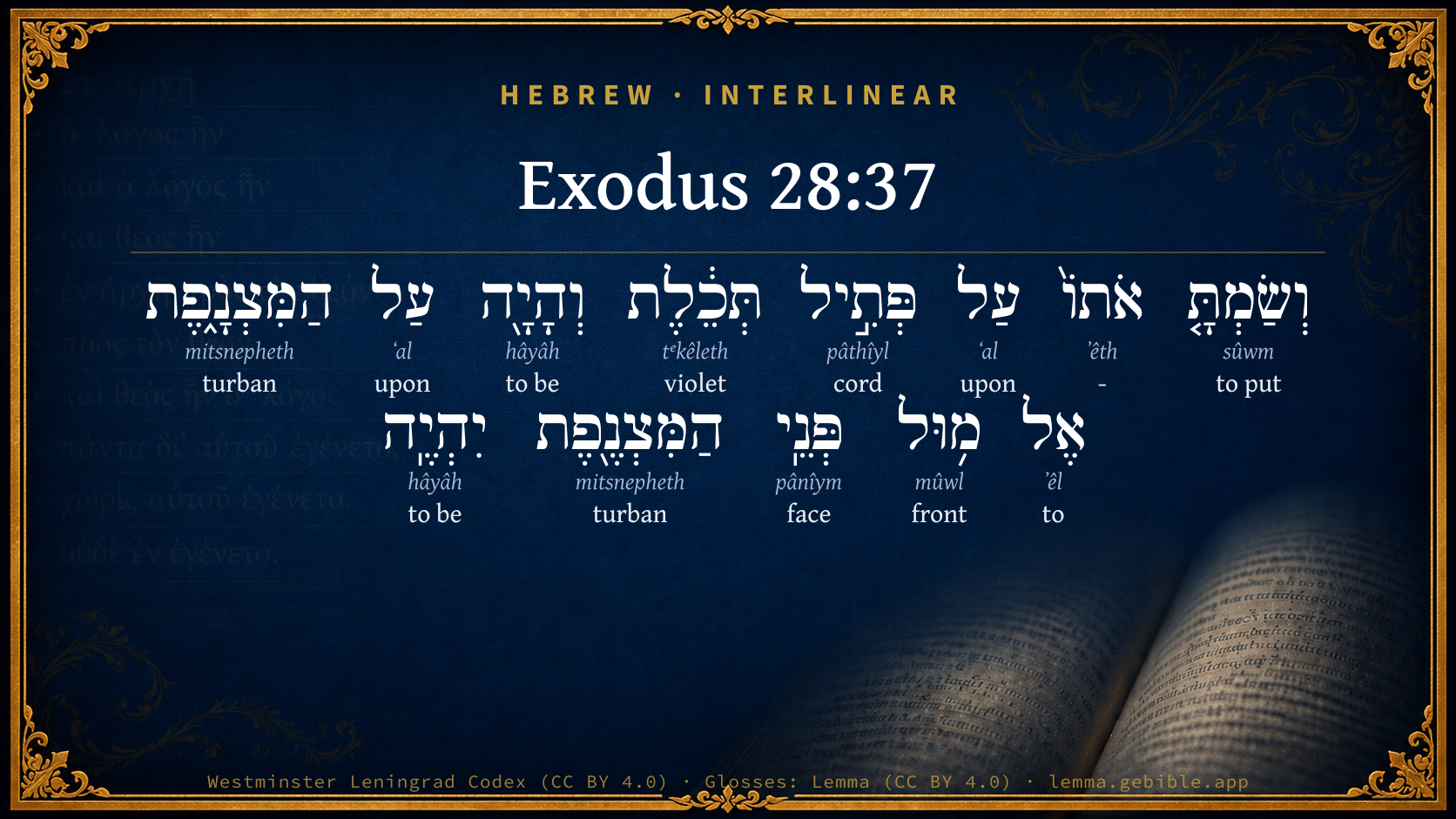
Hebrew (Westminster Leningrad Codex) Exodus 28:37 appears in the Hebrew Old Testament. The text above is from the Westminster Leningrad Codex. Each word links to its Strong’s number, a concise gloss, and parsing drawn from the Open Scriptures Hebrew Bible morphology. Click any word for its full Brown-Driver-Briggs (BDB) entry.
Download image
Cite this verse

Exodus 28:37 (World English Bible). Public Domain. Lemma interlinear Bible study tool, https://lemma.gebible.app/v/exodus/28/37.

Show BibTeX & RIS
BibTeX
RIS
English Translation
You shall put it on a lace of blue, and it shall be on the sash; on the front of the sash it shall be.
World English Bible · Public Domain
Download a study sheet

One document with this verse’s original text, its word-by-word gloss line, the meaning frame, cross-references with their text, attributed commentary, and full source and license credits — printable, and it pastes into notes with its structure intact.

This verse Autodidact and up

Study sheet (.html) Plain text (.txt)

A passage Seminary Student

Up to 50 verses in one chapter. A passage sheet keeps up to 6 commentary sources and 12 cross-references per verse, in the order this page ranks them, and says so on the sheet whenever that leaves anything out. Ask for a single verse and you get the Autodidact verse sheet above.

Everything on this page stays free to read, with no account — the sheet is a download of what is already on screen, not access to it.

Want to remove ads? Support Godless Engineer
Compare translations 3

The same verse in 3 English versions, stacked beneath the original-language interlinear above. Click any original word for its lexicon entry.

Each is an independent rendering of the whole verse — the interlinear is not word-aligned to these translations.

Highlighted words mark where these versions differ — a whole-verse word diff, not a word-by-word alignment.

  • World English Bible Public Domain
    You shall put it on a lace of blue, and it shall be on the sash; on the front of the sash it shall be.
  • King James Version Public Domain
    And thou shalt put it on a blue lace, that it may be upon the mitre; upon the forefront of the mitre it shall be.
  • unfoldingWord Literal Text CC BY-SA 4.0
    And you shall attach it by a cord of blue, and it shall be on the turban. It shall be toward the front of the face of the turban.

unfoldingWord Literal Text — © unfoldingWord, licensed CC BY-SA 4.0. Word-aligned USFM3 via Door43 (git.door43.org/unfoldingWord/en_ult).

Versions to compare (up to 4)

3 of 4 selected

Show all 18 translations

Every available English version of this verse, each an independent rendering of the whole verse.

  • World English Bible Public Domain
    You shall put it on a lace of blue, and it shall be on the sash; on the front of the sash it shall be.
  • Berean Standard Bible Public Domain
    Fasten to it a blue cord to mount it on the turban; it shall be on the front of the turban.
  • Majority Standard Bible Public Domain
    Fasten to it a blue cord to mount it on the turban; it shall be on the front of the turban.
  • King James Version Public Domain
    And thou shalt put it on a blue lace, that it may be upon the mitre; upon the forefront of the mitre it shall be.
  • American Standard Version (1901) Public Domain
    And thou shalt put it on a lace of blue, and it shall be upon the mitre; upon the forefront of the mitre it shall be.
  • Revised Version (1885) Public Domain
    And thou shalt put it on a lace of blue, and it shall be upon the mitre; upon the forefront of the mitre it shall be.
  • Geneva Bible (1599) Public Domain
    And thou shalt put it on a blew silke lace, and it shalbe vpon the miter: euen vpon the fore front of the miter shall it be.
  • Douay-Rheims (1899) Public Domain
    And thou shalt tie it with a violet fillet, and it shall be upon the mitre,
  • Young's Literal Translation Public Domain
    and thou hast put it on a blue ribbon, and it hath been on the mitre -- over-against the front of the mitre it is;
  • Literal Standard Version CC BY-SA 4.0
    and you have put it on a blue ribbon, and it has been on the turban—it is toward the front of the face of the turban;
  • Unlocked Literal Bible CC BY-SA 4.0
    You must attach this plate by a blue cord to the front of the turban.
  • unfoldingWord Literal Text CC BY-SA 4.0
    And you shall attach it by a cord of blue, and it shall be on the turban. It shall be toward the front of the face of the turban.
  • Darby Bible Public Domain
    And thou shalt put it on a lace of blue, and it shall be upon the turban -- upon the front of the turban shall it be.
  • World Messianic Bible Public Domain
    You shall put it on a lace of blue, and it shall be on the sash. It shall be on the front of the sash.
  • Webster's Bible Public Domain
    And thou shalt put it on a blue lace, that it may be upon the miter; upon the front of the miter it shall be.
  • Free Bible Version CC BY-SA 4.0
    Attach it to the front of the turban using a blue cord.
  • Bible in Basic English Public Domain
    Put a blue cord on it and put it on the front of the twisted head-dress:
  • JPS Tanakh (1917) Public Domain
    And thou shalt put it on a thread of blue, and it shall be upon the mitre; upon the forefront of the mitre it shall be.

Literal Standard Version (2020), Covenant Press — licensed CC BY-SA 4.0. Text via the HelloAO Bible API (eBible.org). Unlocked Literal Bible (unfoldingWord) — licensed CC BY-SA 4.0. Text via the HelloAO Bible API (eBible.org). unfoldingWord Literal Text — © unfoldingWord, licensed CC BY-SA 4.0. Word-aligned USFM3 via Door43 (git.door43.org/unfoldingWord/en_ult). Free Bible Version, Dr. Jonathan Gallagher — licensed CC BY-SA 4.0. Text via the HelloAO Bible API (eBible.org).

Word by word

More ways to search: Search by grammar → Find every occurrence → Compare this word →

Practice this passage: Drill this verse → Learn its vocabulary →

פְּתִ֣יל
pâthîyl
H6616
“cord of”
Noun, Common, Masculine, Singular, Construct
Part of Speech
Noun
Type
Common
Gender
Masculine
Number
Singular
State
Construct
Full BDB Definition

Origin: from H6617

TWOT: 1857a

cord, thread (twisted)
  1. וְשַׂמְתָּ֤ sûwm H7760 “and · to put” Conjunction + Verb, Qal, Sequential Perfect, 2nd Person, Masculine, Singular
  2. אֹתוֹ֙ ʼêth H853 “- · him” Particle, Direct Object + Suffix, Personal, 3rd Person, Masculine, Singular
  3. עַל ʻal H5921 “upon” Preposition
  4. תְּכֵ֔לֶת tᵉkêleth H8504 “violet” Noun, Common, Feminine, Singular, Absolute
  5. וְהָיָ֖ה hâyâh H1961 “and · to be” Conjunction + Verb, Qal, Sequential Perfect, 3rd Person, Masculine, Singular
  6. עַל ʻal H5921 “upon” Preposition
  7. הַמִּצְנָ֑פֶת mitsnepheth H4701 “the · turban” Particle, Definite Article + Noun, Common, Feminine, Singular, Absolute
  8. אֶל ʼêl H413 “to” Preposition
  9. מ֥וּל mûwl H4136 “front” Preposition
  10. פְּנֵֽי pânîym H6440 “face(s) of” Noun, Common, Both, Plural, Construct
  11. הַמִּצְנֶ֖פֶת mitsnepheth H4701 “the · turban” Particle, Definite Article + Noun, Common, Feminine, Singular, Absolute
  12. יִהְיֶֽה hâyâh H1961 “to be” Verb, Qal, Imperfect, 3rd Person, Masculine, Singular

About this verse

These counts appear in no published source. They are computed here, from the morphology-tagged text and Lemma’s own curated glosses. What Lemma adds →

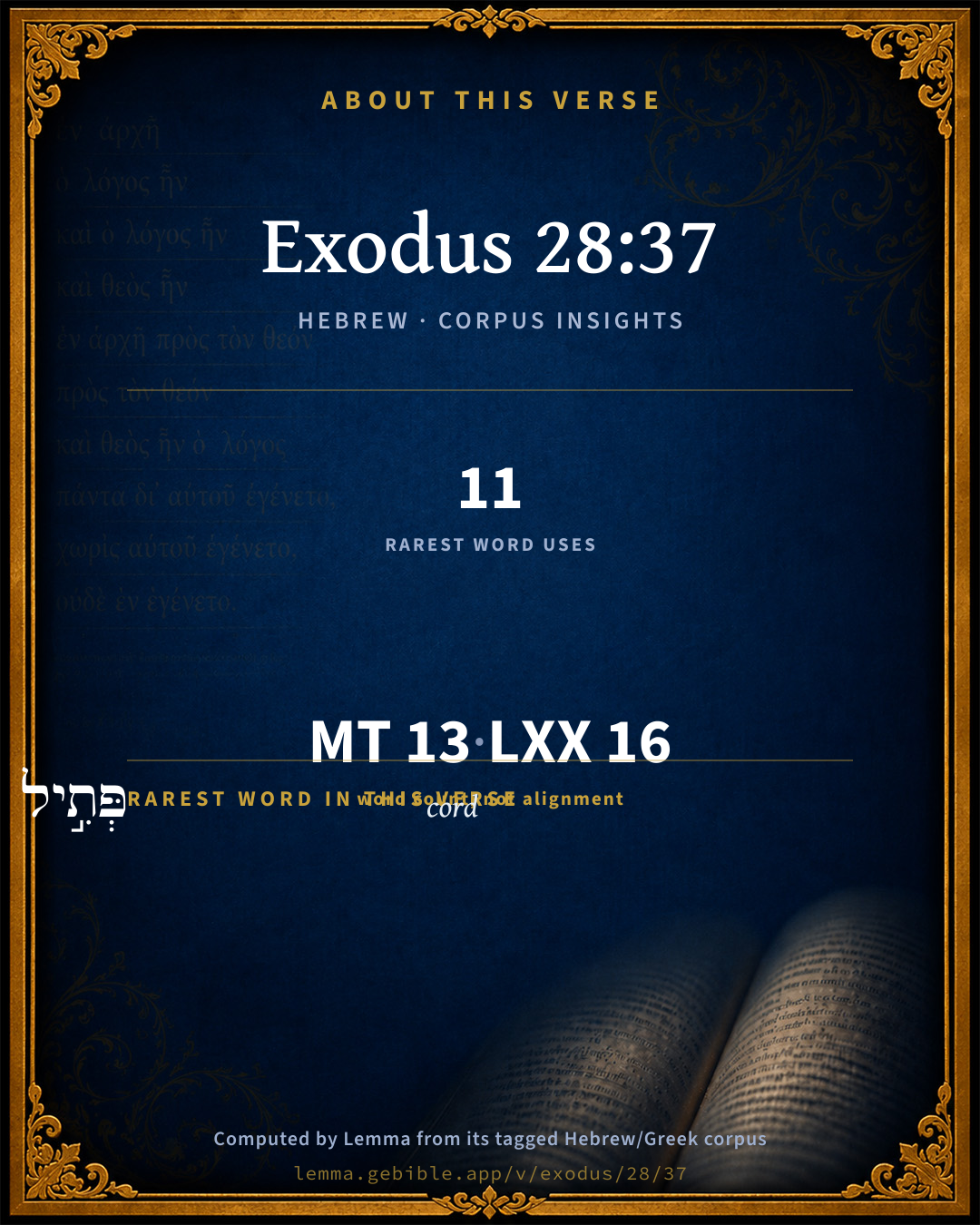
13
words
10
distinct lemmas
Pentateuch
section

Notable vocabulary

The rarest word here is פְּתִ֣יל cord H6616 — appearing just 11 times in the whole Hebrew Bible.

Shared distinctive vocabulary

פְּתִ֣יל cord H6616 occurs in 11 verses of the Hebrew Bible. Also found in:

Grammatical profile

  • 3 verbs
  • 5 nouns
  • 4 prepositions
  • 1 particle

Verb forms

  • וְשַׂמְתָּ֤ Qal · Sequential Perfect
  • וְהָיָ֖ה Qal · Sequential Perfect
  • יִהְיֶֽה Qal · Imperfect

Repetition

Words recur within this verse — often emphatic in Hebrew:

  • עַל upon H5921 ×2
  • וְהָיָ֖ה to be H1961 ×2
  • הַמִּצְנָ֑פֶת turban H4701 ×2

Hebrew & Septuagint length

In English translation the verse runs 25 words from the Hebrew and 38 from the Septuagint (LXX English) — the Septuagint runs noticeably longer here. See the side-by-side →

A rough comparison of the two English renderings, which tokenize alike — not a word-level alignment.

Word counts can differ between the Hebrew and the Greek without any difference in meaning — e.g. the Hebrew direct-object marker אֵת has no separate Greek word, and Greek often adds the article ὁ.

In the original languages it is 13 Hebrew tokens and 16 Greek tokens — but the two are counted differently (Hebrew bundles its prefixes and suffixes into one token; the Greek is in lemma form), so that isn’t a like-for-like length.

Cross-references

8

Topical passages linked to Exodus 28:37 in the Treasury of Scripture Knowledge — connected by theme and wording, ordered by reader-vote popularity; previews shown in the World English Bible.

  • Exodus 28:4 These are the garments which they shall make: a breastplate, and an ephod, and a robe, and a coat of checker work, a turban, and a sash: and they shall make holy garments for Aaron your brother, and his sons, that he may minister to me in the priest's office.
  • Exodus 28:28 They shall bind the breastplate by the rings of it to the rings of the ephod with a lace of blue, that it may be on the skillfully woven band of the ephod, and that the breastplate may not swing out from the ephod.
  • Exodus 28:31 "You shall make the robe of the ephod all of blue.
  • Exodus 29:6 and you shall set the turban on his head, and put the holy crown on the turban.
  • Exodus 39:30–31 They made the plate of the holy crown of pure gold, and wrote on it a writing, like the engravings of a signet: "HOLY TO YAHWEH."
  • Leviticus 8:9 He set the turban on his head; and on the turban, in front, he set the golden plate, the holy crown; as Yahweh commanded Moses.
  • Numbers 15:38 Speak to the children of Israel, and bid those who they make them fringes in the borders of their garments throughout their generations, and that they put on the fringe of each border a cord of blue:
  • Zechariah 3:5 I said, "Let them set a clean turban on his head." So they set a clean turban on his head, and clothed him; and the angel of Yahweh was standing by.

Cross-references courtesy of OpenBible.info (CC BY 4.0).

Hebrew and Greek witnesses Masoretic Hebrew ↔ Greek Septuagint

The same verse in the two great witnesses to the Old Testament, shown verse-for-verse.

Here the Septuagint runs noticeably longer than the Hebrew — LXX2012 (modern English Septuagint) 38 words vs World English Bible 25. A rough length comparison of the two English translations, not a word-level alignment — read both below.

These are two independent witnesses, not word-aligned to each other, and the Septuagint is shown in lemma (dictionary) form.

Hebrew Exodus 28:37 Masoretic · Westminster Leningrad Codex

וְשַׂמְתָּ֤ אֹתוֹ֙ עַל פְּתִ֣יל תְּכֵ֔לֶת וְהָיָ֖ה עַל הַמִּצְנָ֑פֶת אֶל מ֥וּל פְּנֵֽי הַמִּצְנֶ֖פֶת יִהְיֶֽה

You shall put it on a lace of blue, and it shall be on the sash; on the front of the sash it shall be.

World English Bible · Public Domain

Greek LXX Exodus 28:37 Septuagint · lemma form

καί ἐπιτίθημι αὐτός ἐπί ὑάκινθος κλώθω καί εἰμί ἐπί ὁ μίτρα κατά πρόσωπον ὁ μίτρα εἰμί

And you shall put them on Aaron your brother, and his sons with him, and you shall anoint them and fill their hands: and you shall sanctify them, that they may minister to me in the priest's office.

LXX2012 (modern English Septuagint) · Public Domain

Hebrew: Westminster Leningrad Codex (CC BY 4.0). Greek: Septuagint (public domain); English from LXX2012 (modern English Septuagint) (Public Domain). How the Septuagint differs from the Hebrew →

Targum (Aramaic paraphrase)

2

The Targum is the ancient Jewish Aramaic paraphrase of the Hebrew Scriptures — an interpretive translation, not the Hebrew text itself. Onkelos (literal) and Pseudo-Jonathan (expansive) render the Torah, and Jonathan the Prophets. Coverage is partial: where no permissively-licensed English translation exists for a verse, only the Aramaic is shown. This is verse-level text, not a word-by-word alignment to the Hebrew.

  1. Targum Onkelos Torah (Genesis–Deuteronomy)
    וּתְשַׁוִי יָתֵהּ עַל חוּטָא דִתְכֶלְתָּא וִיהֵי עַל מִצְנֶפְתָּא לָקֳבֵל אַפֵּי מִצְנֶפְתָּא יְהֵי:

    (no public-domain English translation for this verse)

    Targum Onkelos — Aramaic: “Onkelos Genesis” (public domain); “Onkelos Exodus” (public domain); “Onkelos Leviticus” (public domain); “Onkelos Numbers” (public domain); “Onkelos Deuteronomy” (public domain). English: “Sefaria Community Translation” (CC0 1.0 (public-domain dedication)); “J.W. Etheridge. The Targums of Onkelos and Jonathan Ben Uzziel on the Pentateuch. London: Longmans, Green, 1862” (public domain). Text via Sefaria.

  2. Targum Pseudo-Jonathan Torah (Genesis–Deuteronomy)
    וּתְשַׁוֵּי יָתֵיהּ עַל שְׁזִיר חוּטָא דִתְכֶלְתָּא לִמְכַפְּרָא עַל חֲצִיפֵי אַפַּיָא וִיהֵי עַל מַצְנַפְתָּא מֵעִילַוֵי תְּפִילַת רֵישָׁא כָּל קְבֵיל אַפֵּי מִצְנַפְתָּא יְהֵי

    And thou shalt put it on a twined ribbon of hyacinth, to make amends for boldness of face; and it shall be on the mitre above the tephillin of the head in front of the mitre shall it be.

    Targum Pseudo-Jonathan — Aramaic: “Targum Jonathan on Genesis” (public domain); “Targum Jonathan on Exodus” (public domain); “Targum Jonathan on Leviticus” (public domain); “Targum Jonathan on Numbers” (public domain); “Targum Jonathan on Deuteronomy” (public domain). English: “The Targum of Jonathan ben Uzziel, trans. J. W. Etheridge, London, 1862” (public domain). Text via Sefaria.

Commentary

Notes on Exodus 28:37 from classic Christian and Jewish commentators (each source and its license shown beneath its notes). The classic Christian expositions comment on the surrounding passage and are grouped to its opening verse, so a note may address several verses; the Jewish commentaries on the Tanakh (Rashi and others) are per-verse, so they appear only where the commentator wrote on this verse.

Lemma curates 59 commentaries, every one of them public domain or Creative Commons licensed, each selected and text-cleaned for this edition rather than reprinted as found. About our sources →

Trapp's Complete Commentary

John Trapp

Exo 28:37 And thou shalt put it on a blue lace, that it may be upon the mitre; upon the forefront of the mitre it shall be.

Ver. 37. Upon the mitre.] Which had a holy crown with it, {Exo 29:6} signifying the deity and dignity of Christ.

John Trapp, A Commentary or Exposition upon All the Books of the Old and New Testament (1647–1656) — public domain. Text from a community e-Sword module.

Jamieson, Fausset & Brown

Robert Jamieson, A. R. Fausset & David Brown

mitre--crown-like cap for the head, not covering the entire head, but adhering closely to it, composed of fine linen. The Scripture has not described its form, but from JOSEPHUS we may gather that it was conical in shape, as he distinguishes the mitres of the common priests by saying that they were not conical--that it was encircled with swathes of blue embroidered, and that it was covered by one piece of fine linen to hide the seams.

Jamieson, Fausset & Brown — Commentary Critical and Explanatory on the Whole Bible (1871) — public domain (CC PDM 1.0). Text via the HelloAO Bible API.

Ellicott's Commentary for English Readers

(37) Thou shalt put it on a blue lace.—Compare Exo_39:31, where we read “they tied unto it a lace of blue.” Probably the two ends of the plate were perforated, and a blue lace or cord passed through the holes and tied to the plate, which was then put in front of the turban and kept in place by the two cords being tied together at the back of the head.

A Bible Commentary for English Readers, edited by Charles John Ellicott (1878–1897) — public domain. Text from a community e-Sword module.

The Cambridge Bible for Schools and Colleges

gen. ed. J. J. S. Perowne

37. a lace of blue] a lace, or band, of the violet material mentioned in Exo_25:4. This was apparently tied round the turban, somewhat ‘above’ its lower edge (cf. Exo_39:31), in the manner of a ‘diadem’ (Exo_29:6 n.),—in the proper sense of the word, something bound round1[209],—so that the plate attached to it might appear conspicuously in front.

[209] The ‘diadem’ was properly a blue silk band, spotted with white, 2 in. wide, tied round the lower part of the tall stiff cap worn by the Persian kings, and fastened in a knot behind, with the ends hanging down (see ill. in Rawl. Anc. Mon. iii. 204, n. 17; and cf. Xen. Cyr. viii. 3, 13).

the mitre] the turban (RVm.): see on v. 39.

The Cambridge Bible for Schools and Colleges (gen. ed. J. J. S. Perowne; Cambridge University Press, 1878–1918) — public domain. Text from a community e-Sword module.

John Gill's Exposition

And it shall be upon Aaron's forehead,.... That is, the plate of gold, with the inscription on it, holiness to the Lord, and so was very visible and legible. The Targum of Jonathan adds, from temple to temple, that is, from the furthermost end of the one, to the furthermost end of the other, the same as from ear to ear; see Gill on Exo 28:36 the use of it follows:

that Aaron may bear the iniquity of the holy things, which the children of Israel shall hallow in all their holy gifts; this supposes that the sacrifices of the children of Israel, which they brought to the priests to offer for them, or the gifts they devoted to sacred use, might be attended with sin and blame, either in the matter of their offerings and gifts, or in the manner in which they brought them; and which through the high priest having this plate of gold, with the above inscription on it, were expiated; they were bore away from them, and were not placed to their account, but they were cleared and discharged of them: and so it is that there is sin in the best performances of the saints; there is not a just man that does good, but he sins in doing that good; the best righteousness of men is imperfect, and attended with sin; and this cannot be borne, or taken away by themselves; if God should mark such sins as these, they could not stand before him; now Christ, their High Priest, bears and takes away these, along with all others, which are laid upon him, and borne by him:

and it shall be always upon his forehead, that they may be accepted before the Lord; not that he had always this plate of gold on his forehead, only in time of service; but then it was continually for the acceptance of them, though it was not upon his forehead, as Jarchi observes; at Maimonides (h) says, there was great necessity that the high priest should be always in the sanctuary, as it is said, "it shall be always upon his forehead", and therefore must be always there, for he might not wear it outside of it. This with respect to the antitype may signify, that the persons and services of the people of God are accepted with him through the holiness and righteousness of Christ, who is always in the presence of the Lord, ever appears in heaven for them, and is the Lamb of God, to whose person, blood, righteousness, and sacrifice, they are directed to look for the removal of their sins of every sort.

(h) Moreh Nevochim, par. 3. c. 47.

John Gill's Exposition of the Whole Bible (1746–1763) — public domain (CC PDM 1.0). Text via the HelloAO Bible API.

Matthew Poole's English Annotations

The words may be rendered, thou shalt put it on, or, bind it, as the Vulgate renders it, with a blue lace, to wit, upon the mitre, as it follows.

Matthew Poole's English Annotations on the Holy Bible (1683–1685) — public domain. Text from a community e-Sword/MySword module.

The Pulpit Commentary

Thou shalt put it on a blue lace. In Exo_39:31, it is explained that the blue lace, or ribbon, was "tied to it," probably at either end. That it may be upon the mitrei.e. , "that it may be kept in place, and not slip from its position on the mitre."

The Pulpit Commentary (1880–1919), ed. H.D.M. Spence-Jones & Joseph S. Exell — public domain. Text from a community e-Sword module.

Rashi

Rabbi Shlomo Yitzchaki (Rashi)

על פתיל תכלת [AND THOU SHALT PUT IT] ON A BLUE PURPLE STRING — but in another passage (Exodus 39:31) is states, “And they put upon it (upon the Plate) a string of blue purple (so that the Plate was beneath the string, not upon it as is here commanded)! Then again, it is written here, “and it (the Plate) shall be upon the mitre”, whilst further on (v. 38) it says, “And it shall be upon Aaron’s forehead”! And in the Treatise on the Slaughter of the Sacrifices (Zevachim 19a) we learn: “His (the High Priest’s) hair was visible between the Plate and the mitre, whereon he placed the Tephillin”, thus informing us that the mitre was above on the crown of the head and was not so deep that the entire head went into it right down to the forehead, and that the Plate was beneath it with a space between them. Consequently the Plate was not on the mitre as seems to be stated in this verse! But I say that (cf. Rashi on Exodus 39:31 ואומר אני וגו׳) the strings were in holes and hung from it (from the Plate) at its two ends and at its middle point, six in these three places (i. e. one string in each hole, the centre of each string resting on the bottom point of the hole, the three thus forming six). Thus, at each hole, there was one string on top of the Plate — outside it, and one inside (between the Plate and the forehead). He tied the ends of the strings, the three of them, behind the neck; it follows therefore that the length of the Plate and the strings that were at its ends together encompassed his skull. The middle string which was on its top edge bound together with the ends of the two which were at the extremities of the Plate, passed over the breadth of the head above (over the crown). Consequently it (the Plate, together with the strings) formed a kind of helmet. It is with reference to the middle string that it states, “And it (the string just mentioned in the verse; not the Plate as was assumed) shall be upon the mitre”, for he placed the Plate, with the strings already tied in this manner, upon his head as a kind of helmet passing it over the mitre, and the middle string held it (the Plate) firm so that it could not fall, and thus the Plate hung in front of his forehead and did not fall lower down. In this way all these verses find their explanation — the string being on the Plate, the Plate on the string, and the string on the mitre above (cf. Chullin 138a).

Rashi on the Tanakh — English translations: “The Judaica Press complete Tanach with Rashi, translated by A. J. Rosenberg” (CC BY 4.0); “Pentateuch with Rashi's commentary by M. Rosenbaum and A.M. Silbermann, 1929-1934” (public domain); “The Metsudah Tanach series, Lakewood, N.J” (CC BY 4.0); and “The Book of Joshua, Metsudah Publications, 1997” (CC BY 4.0). Text via Sefaria.

Ramban (Nachmanides)

Rabbi Moshe ben Nachman (Ramban / Nachmanides)

AND THOU SHALT PUT IT ON A BLUE-PURPLE STRING. “But in another place in Scripture it states, And they put upon it a string of blue-purple [which indicates that the frontplate was beneath the string, not upon it as is here commanded]! Moreover, here it is written, and it shall be upon the mitre, and further on it says, And it shall be upon Aaron’s forehead! In the Tractate on the Slaughtering of Sacrifices we have been taught: ‘The High Priest’s hair was visible between the frontplate and the mitre, whereon he placed the phylacteries.’ From this we learn that the mitre was above on the crown of the head [and was not so large that it covered the entire head right down to the forehead], and the frontplate was beneath it [with a space between them], and the strings were in holes and hung from the frontplate at its two ends and in its middle — six in these three places: one string on top [of the frontplate], one outside and one inside [between the frontplate and the forehead]. He tied the ends of the three strings behind the neck, and thus it came to be that the length of the frontplate and the strings at its ends encompassed his whole skull. The middle string which was on top was tied together to the ends of the two strings [at the extremities of the frontplate], and passed over above the breadth of the head. Thus it came to be that [the frontplate with the strings] formed a kind of helmet. Now it is with reference to the middle string that Scripture states, and it shall be upon the mitre, for he placed the frontplate [together with the strings tied in the above manner] upon his head [as a kind of helmet, passing it over the mitre], and tightened it through the middle string so that it would not fall. Thus the frontplate hung in front of his forehead. All these verses are thus reconciled: the string was on the frontplate, and the frontplate upon the string, and the string on the mitre above.” All this is Rashi’s language.But I wonder concerning Rashi’s words, for Scripture commands the making of only one blue-purple string, and he makes six! Moreover, Rashi combined the verses which tell of the command to make [the frontplate] with those which tell of the making thereof, ] is found further (39:31) in connection with the actual making thereof. So how can the string mentioned in that verse be added to the one that is stated in the verse commanding the making of the frontplate? increasing the strings with the number of verses! One could count in such manner in the case of the ark, the table, and the candelabrum [two of each, since they are mentioned once in the command to make, and again in the narrative when they were actually made]! Furthermore, if Scripture commanded that they put the frontplate on a blue-purple string, how did they [do the opposite and] put a blue-purple string on it? Where were they commanded to do so? And why did they need the strings in the middle, since the frontplate was tied behind the neck, as are all frontplates which are worn by men and women?Indeed, the matter is not as the Rabbi [Rashi] said. For there was only one string there; the plate reached from ear to ear and was pierced at its two ends and the blue-purple string was put through the two holes, the plate being thus tied behind the neck. Thus he wound the mitznepheth (mitre) around the head, not at all upon the forehead, but on the head where the hair grows. And according to the opinion of our Rabbis that he also left [uncovered] part of the hair of his head towards his face for the phylacteries, he wound [the mitznepheth] high above on the crown of the head, opposite the middle of the brain, covering the whole head at the back. Thus the mitznepheth lay above on the slope of the head opposite the brain, and the frontplate rested opposite his forehead from ear to ear, there being nothing intervening between his forehead and the frontplate. Thus the mitznepheth lay on the back of his head from ear to ear, opposite the whole neck, and the string which was tied to the frontplate was upon the mitznepheth. It is with reference to this that Scripture says, And thou shalt put it on a blue-purple string, meaning that he should put the string through the holes of the frontplate; and the string shall be upon the mitre behind his ears opposite the neck; towards the front of the mitre it shall be — that is, the frontplate, which shall be upon the forehead opposite the front part of the mitre. This is Scripture’s intent in stating, And thou shalt set the mitre upon his head, that is to say, above on the crown of the head, unlike the migba’oth of which it is said, and thou shalt bind head-tires upon them, Verse 9. binding the head like one whose head hurts and he binds it for the purpose of strengthening the head. It further states, and thou shalt put the holy crown upon the mitre, for it was upon the mitre that [the frontplate] was tied at the back. This is so stated: And they put upon it a string of blue-purple, to fasten it upon the mitre above, for there upon [the mitre] the string [of the frontplate] was tied. Similarly, and upon the mitre, in front, did he set the golden plate, means that he tied upon the front of the mitre the golden frontplate. Thus the term “placing” in all the verses refers to putting [the string of the frontplate] upon the mitre, for it was there that it was tied; the frontplate itself, however, was on the forehead opposite the mitre. There is then no difference between the expression And they put upon it a string of blue-purple, and [in the verse before us] and thou shalt put it on a blue-purple string [unlike Rashi who distinguished between them], for in both cases it is as if it said, “and thou shalt place it with a blue-purple string,” “and thou shalt put a blue-purple string,” similar in usage to the expression, and thou shalt put them ‘on’ one basket, which means “in” the basket. Likewise, escape ‘on’ thy life [which means “with your life,” as long as your life is in you, or “escape for your life”]. Or it may be that the word al (‘on’ — on a blue-purple string) here serves as el (to), thus stating: “and you shall put it to a blue-purple string,” “and they put a blue-purple string to it,” for the string was put [to the frontplate, and the frontplate was put] to it, for it rested on it for support. In essence, the meaning of the verses is only that they should place a string in the holes of the frontplate, and in that way it also came about that the frontplate was upon the string and the string upon the frontplate. Similarly, And they shall bind the breastplate by the rings thereof to the rings of the ephod with a string of blue-purple, from which Rashi brought a proof of blue-purple,’ for we find the same thing in the case of the breastplate and the ephod, of which it is said, And they shall bind the breastplate by the rings thereof with a string of blue-purple (above, Verse 28), and you must admit that there could not have been less than two strings, for at the two ends of the breastplate were the two rings of the breastplate, and on the two shoulder pieces of the ephod were two rings opposite them. Now according to the way the breastplate was tied on, there were four threads, and under any circumstance it could not have been less than two [and yet Scripture speaks only of ‘a string’ of blue-purple]!” — To this proof of Rashi, Ramban answers that reference is only to one string, as explained in the text. [that there were three double strings in the frontplate], also refers to only one string, which they put through the rings of the breastplate and the rings of the ephod opposite them; so also on the other side there was one string, for these were two [separate] places, and in each place they tied [the breastplate by the rings thereof] with one string [of blue-purple to the rings of the ephod].

Ramban (Nachmanides) on the Tanakh — English translation: “Commentary on the Torah by Ramban (Nachmanides). Translated and annotated by Charles B. Chavel. New York, Shilo Pub. House, 1971-1976” (CC BY 4.0). Text via Sefaria.

Lesson kit

Teaching starters — assembled from the data on this page, not authored interpretation. Every prompt links to the verse data it draws on. Edit before teaching.

Exodus, in the Pentateuch, opens this verse with 13 words (10 distinct Hebrew lemmas). Its most distinctive word is pâthîyl (“cord”). The Greek Septuagint runs longer here. A historical commentator’s framing appears above. Read the whole chapter for the surrounding context.

Discussion questions

  1. What does “cord” (pâthîyl) contribute to the verse as a whole?
  2. Genesis 38:18 shares the word «cord» with this verse. How do the two illuminate each other?
  3. “upon” occurs 2× in this one verse. What is the effect of the repetition?
  4. Compared with the Hebrew, the Septuagint runs longer here. What questions does that raise?
  5. The translations on this page render this verse differently — a whole-verse word diff, not a word-by-word alignment. What might account for the different wordings?
  6. The verb «וְשַׂמְתָּ֤» is Qal Sequential Perfect. How does its form color the action?
  7. Reading how Trapp's Complete Commentary and Jamieson, Fausset & Brown read this verse, where do the two commentators agree and where do they part?

Things to notice

Reading settings

Reading text

Shown beneath each verse's original-language words.

Old Testament
Old Testament edition

Read the OT as the Masoretic Hebrew (MT) or the Greek Septuagint (LXX).

English shown for the Greek Septuagint (in the Hebrew ↔ Greek comparison).

Comparing translations? Open the Compare panel on any verse page to stack up to four side by side.