Deuteronomy 7:10

Hebrew (Westminster Leningrad Codex) Deuteronomy 7:10 appears in the Hebrew Old Testament. The text above is from the Westminster Leningrad Codex. Each word links to its Strong’s number, a concise gloss, and parsing drawn from the Open Scriptures Hebrew Bible morphology. Click any word for its full Brown-Driver-Briggs (BDB) entry.
Download image
Cite this verse

Deuteronomy 7:10 (World English Bible). Public Domain. Lemma interlinear Bible study tool, https://lemma.gebible.app/v/deuteronomy/7/10.

Show BibTeX & RIS
BibTeX
RIS
English Translation
and repays those who hate him to their face, to destroy them: he will not be slack to him who hates him, he will repay him to his face.
World English Bible · Public Domain
Download a study sheet

One document with this verse’s original text, its word-by-word gloss line, the meaning frame, cross-references with their text, attributed commentary, and full source and license credits — printable, and it pastes into notes with its structure intact.

This verse Autodidact and up

Study sheet (.html) Plain text (.txt)

A passage Seminary Student

Up to 50 verses in one chapter. A passage sheet keeps up to 6 commentary sources and 12 cross-references per verse, in the order this page ranks them, and says so on the sheet whenever that leaves anything out. Ask for a single verse and you get the Autodidact verse sheet above.

Everything on this page stays free to read, with no account — the sheet is a download of what is already on screen, not access to it.

Want to remove ads? Support Godless Engineer
Compare translations 3

The same verse in 3 English versions, stacked beneath the original-language interlinear above. Click any original word for its lexicon entry.

Each is an independent rendering of the whole verse — the interlinear is not word-aligned to these translations.

Highlighted words mark where these versions differ — a whole-verse word diff, not a word-by-word alignment.

  • World English Bible Public Domain
    and repays those who hate him to their face, to destroy them: he will not be slack to him who hates him, he will repay him to his face.
  • King James Version Public Domain
    And repayeth them that hate him to their face, to destroy them: he will not be slack to him that hateth him, he will repay him to his face.
  • unfoldingWord Literal Text CC BY-SA 4.0
    and he repays those who hate him to his face, to destroy him. He will not delay with him who hates him; he will repay him to his face.

unfoldingWord Literal Text — © unfoldingWord, licensed CC BY-SA 4.0. Word-aligned USFM3 via Door43 (git.door43.org/unfoldingWord/en_ult).

Versions to compare (up to 4)

3 of 4 selected

Show all 18 translations

Every available English version of this verse, each an independent rendering of the whole verse.

  • World English Bible Public Domain
    and repays those who hate him to their face, to destroy them: he will not be slack to him who hates him, he will repay him to his face.
  • Berean Standard Bible Public Domain
    But those who hate Him He repays to their faces with destruction; He will not hesitate to repay to his face the one who hates Him.
  • Majority Standard Bible Public Domain
    But those who hate Him He repays to their faces with destruction; He will not hesitate to repay to his face the one who hates Him.
  • King James Version Public Domain
    And repayeth them that hate him to their face, to destroy them: he will not be slack to him that hateth him, he will repay him to his face.
  • American Standard Version (1901) Public Domain
    and repayeth them that hate him to their face, to destroy them: he will not be slack to him that hateth him, he will repay him to his face.
  • Revised Version (1885) Public Domain
    and repayeth them that hate him to their face, to destroy them: he will not be slack to him that hateth him, he will repay him to his face.
  • Geneva Bible (1599) Public Domain
    And rewardeth them to their face that hate him, to bring them to destruction: he wil not deferre to reward him that hateth him, to his face.
  • Douay-Rheims (1899) Public Domain
    And repaying forthwith them that hate him, so as to destroy them, without further delay immediately rendering to them what they deserve.
  • Young's Literal Translation Public Domain
    and repaying to those hating Him, unto their face, to destroy them; He delayeth not to him who is hating Him -- unto his face, He repayeth to him --
  • Literal Standard Version CC BY-SA 4.0
    and repaying to those hating Him to their face, to destroy them; He does not delay to him who is hating Him, He repays [it] to him to his face.
  • Unlocked Literal Bible CC BY-SA 4.0
    but repays those who hate him to their face, to destroy them; he will not be lenient on whoever hates him; he will repay him to his face.
  • unfoldingWord Literal Text CC BY-SA 4.0
    and he repays those who hate him to his face, to destroy him. He will not delay with him who hates him; he will repay him to his face.
  • Darby Bible Public Domain
    and repayeth them that hate him [each] to his face, to cause them to perish: he delayeth not with him that hateth him, he will repay him to his face.
  • World Messianic Bible Public Domain
    and repays those who hate him to their face, to destroy them. He will not be slack to him who hates him. He will repay him to his face.
  • Webster's Bible Public Domain
    And repayeth them that hate him to their face, to destroy them: he will not be slack to him that hateth him, he will repay him to his face.
  • Free Bible Version CC BY-SA 4.0
    But he doesn't hesitate to pay back those who hate him by destroying them.
  • Bible in Basic English Public Domain
    Rewarding his haters to their face with destruction; he will have no mercy on his hater, but will give him open punishment.
  • JPS Tanakh (1917) Public Domain
    and repayeth them that hate Him to their face, to destroy them; He will not be slack to him that hateth Him, He will repay him to his face.

Literal Standard Version (2020), Covenant Press — licensed CC BY-SA 4.0. Text via the HelloAO Bible API (eBible.org). Unlocked Literal Bible (unfoldingWord) — licensed CC BY-SA 4.0. Text via the HelloAO Bible API (eBible.org). unfoldingWord Literal Text — © unfoldingWord, licensed CC BY-SA 4.0. Word-aligned USFM3 via Door43 (git.door43.org/unfoldingWord/en_ult). Free Bible Version, Dr. Jonathan Gallagher — licensed CC BY-SA 4.0. Text via the HelloAO Bible API (eBible.org).

Word by word

More ways to search: Search by grammar → Find every occurrence → Compare this word →

Practice this passage: Drill this verse → Learn its vocabulary →

יְאַחֵר֙
ʼâchar
H309
“to delay”
Verb, Piel, Imperfect, 3rd Person, Masculine, Singular
Part of Speech
Verb
Stem
Piel
Form
Imperfect
Person
3rd Person
Gender
Masculine
Number
Singular
Full BDB Definition

Origin: a primitive root

TWOT: 68

to delay, hesitate, tarry, defer, remain behind - (Qal) - to delay, tarry (intensive) - to cause one to delay, hinder, keep back - (Piel) to delay, wait, stay behind (but not in hope)
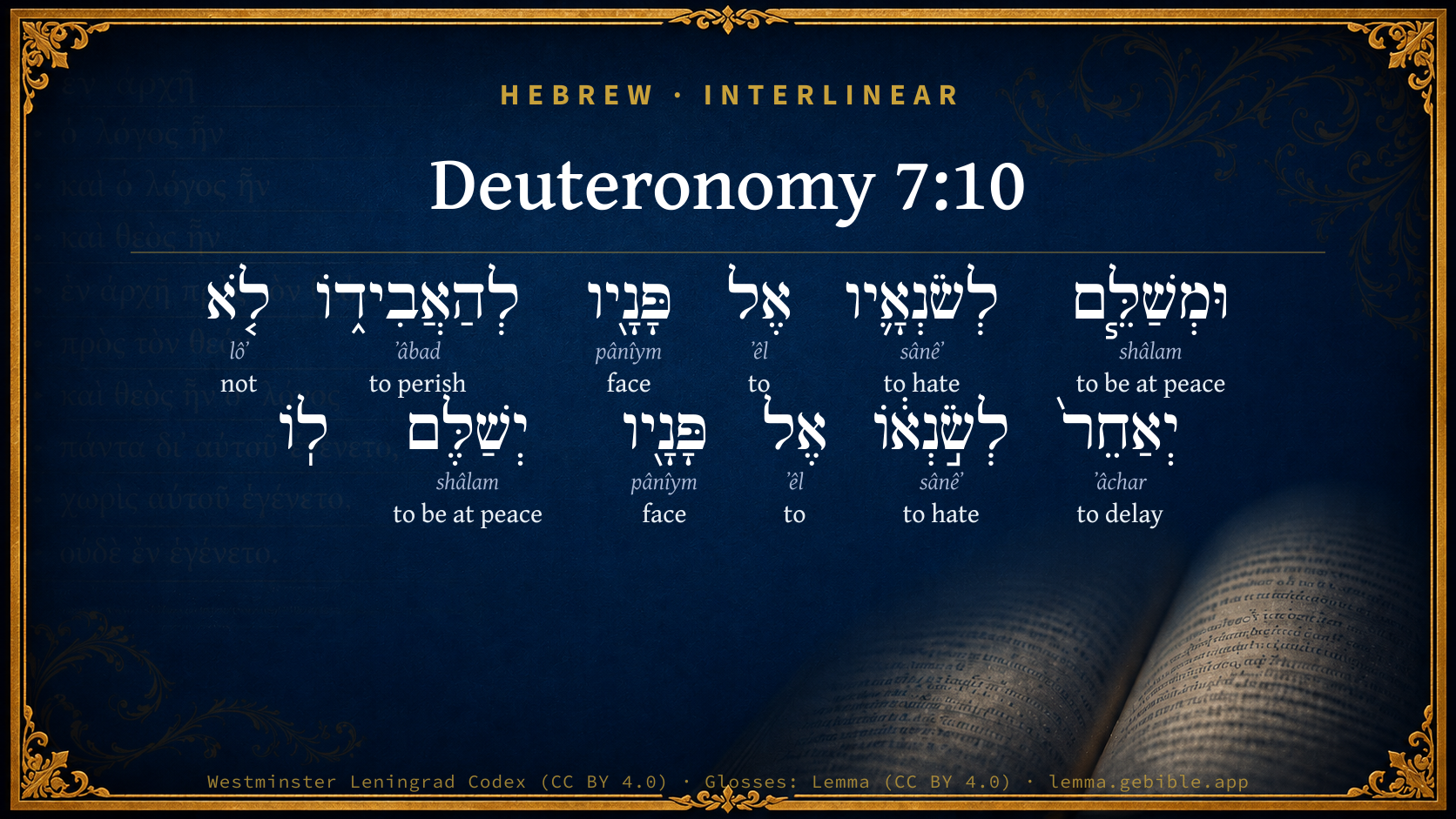
  1. וּמְשַׁלֵּ֧ם shâlam H7999 “and · being at peace” Conjunction + Verb, Piel, Participle Active, Masculine, Singular, Absolute
  2. לְשֹׂנְאָ֛יו sânêʼ H8130 “to/for · hating · him” Preposition + Verb, Qal, Participle Active, Masculine, Plural, Construct + Suffix, Personal, 3rd Person, Masculine, Singular
  3. אֶל ʼêl H413 “to” Preposition
  4. פָּנָ֖יו pânîym H6440 “face(s) · his” Noun, Common, Both, Plural, Construct + Suffix, Personal, 3rd Person, Masculine, Singular
  5. לְהַאֲבִיד֑וֹ ʼâbad H6 “to perish · him” Preposition + Verb, Hiphil, Infinitive Construct + Suffix, Personal, 3rd Person, Masculine, Singular
  6. לֹ֤א lôʼ H3808 “not” Particle, Negative
  7. לְשֹׂ֣נְא֔וֹ sânêʼ H8130 “to/for · hating · him” Preposition + Verb, Qal, Participle Active, Masculine, Singular, Construct + Suffix, Personal, 3rd Person, Masculine, Singular
  8. אֶל ʼêl H413 “to” Preposition
  9. פָּנָ֖יו pânîym H6440 “face(s) · his” Noun, Common, Both, Plural, Construct + Suffix, Personal, 3rd Person, Masculine, Singular
  10. יְשַׁלֶּם shâlam H7999 “to be at peace” Verb, Piel, Imperfect, 3rd Person, Masculine, Singular

About this verse

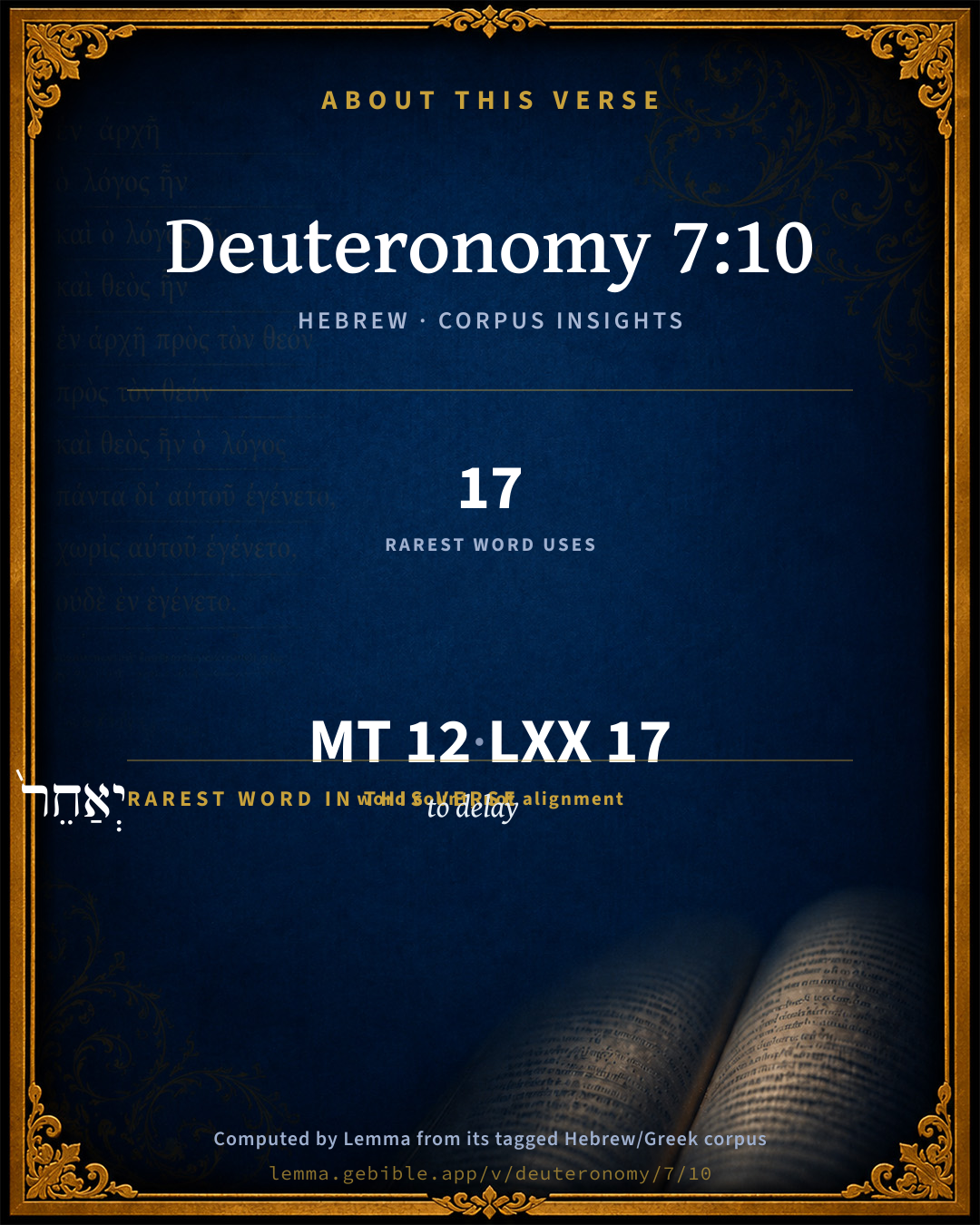
These counts appear in no published source. They are computed here, from the morphology-tagged text and Lemma’s own curated glosses. What Lemma adds →

12
words
7
distinct lemmas
Pentateuch
section

Notable vocabulary

The rarest word here is יְאַחֵר֙ to delay H309 — appearing just 17 times in the whole Hebrew Bible.

Shared distinctive vocabulary

יְאַחֵר֙ to delay H309 occurs in 17 verses of the Hebrew Bible. Also found in:

Grammatical profile

  • 6 verbs
  • 2 nouns
  • 3 prepositions
  • 1 particle

Verb forms

  • וּמְשַׁלֵּ֧ם Piel · Participle Active
  • לְשֹׂנְאָ֛יו Qal · Participle Active
  • לְהַאֲבִיד֑וֹ Hiphil · Infinitive Construct
  • יְאַחֵר֙ Piel · Imperfect
  • לְשֹׂ֣נְא֔וֹ Qal · Participle Active
  • יְשַׁלֶּם Piel · Imperfect

Repetition

Words recur within this verse — often emphatic in Hebrew:

  • וּמְשַׁלֵּ֧ם to be at peace H7999 ×2
  • לְשֹׂנְאָ֛יו to hate H8130 ×2
  • פָּנָ֖יו face H6440 ×2
  • אֶל to H413 ×2

Hebrew & Septuagint length

In English translation the verse runs 29 words from the Hebrew and 31 from the Septuagint (LXX English) — closely comparable.

A rough comparison of the two English renderings, which tokenize alike — not a word-level alignment.

Word counts can differ between the Hebrew and the Greek without any difference in meaning — e.g. the Hebrew direct-object marker אֵת has no separate Greek word, and Greek often adds the article ὁ.

In the original languages it is 12 Hebrew tokens and 17 Greek tokens — but the two are counted differently (Hebrew bundles its prefixes and suffixes into one token; the Greek is in lemma form), so that isn’t a like-for-like length.

Cross-references

12

Topical passages linked to Deuteronomy 7:10 in the Treasury of Scripture Knowledge — connected by theme and wording, ordered by reader-vote popularity; previews shown in the World English Bible.

  • Isaiah 59:18 According to their deeds, accordingly he will repay, wrath to his adversaries, recompense to his enemies; to the islands he will repay recompense.
  • Nahum 1:2 Yahweh is a jealous God and avenges. Yahweh avenges and is full of wrath. Yahweh takes vengeance on his adversaries, and he maintains wrath against his enemies.
  • Romans 12:19 Don't seek revenge yourselves, beloved, but give place to God's wrath. For it is written, "Vengeance belongs to me; I will repay, says the Lord."
  • Exodus 20:5 you shall not bow yourself down to them, nor serve them, for I, Yahweh your God, am a jealous God, visiting the iniquity of the fathers on the children, on the third and on the fourth generation of those who hate me,
  • Deuteronomy 7:9 Know therefore that Yahweh your God, he is God, the faithful God, who keeps covenant and loving kindness with them who love him and keep his commandments to a thousand generations,
  • Deuteronomy 32:25 Outside shall the sword bereave, In the chambers terror; [It shall destroy] both young man and virgin, The suckling with the man of gray hairs.
  • Deuteronomy 32:35 Vengeance is mine, and recompense, At the time when their foot shall slide: For the day of their calamity is at hand, The things that are to come on them shall make haste.
  • Psalms 21:8–9 Your hand will find out all of your enemies. Your right hand will find out those who hate you.
  • Proverbs 11:31 Behold, the righteous shall be repaid in the earth; How much more the wicked and the sinner!
  • John 15:23–24 He who hates me, hates my Father also.
  • 2 Peter 3:9–10 The Lord is not slow concerning his promise, as some count slowness; but is patient with us, not wishing that any should perish, but that all should come to repentance.
  • Deuteronomy 32:41 If I whet my glittering sword, My hand take hold on judgment; I will render vengeance to my adversaries, Will recompense those who hate me.

Cross-references courtesy of OpenBible.info (CC BY 4.0).

Hebrew and Greek witnesses Masoretic Hebrew ↔ Greek Septuagint

The same verse in the two great witnesses to the Old Testament, shown verse-for-verse.

These are two independent witnesses, not word-aligned to each other, and the Septuagint is shown in lemma (dictionary) form.

Hebrew Deuteronomy 7:10 Masoretic · Westminster Leningrad Codex

וּמְשַׁלֵּ֧ם לְשֹׂנְאָ֛יו אֶל פָּנָ֖יו לְהַאֲבִיד֑וֹ לֹ֤א יְאַחֵר֙ לְשֹׂ֣נְא֔וֹ אֶל פָּנָ֖יו יְשַׁלֶּם לֽוֹ

and repays those who hate him to their face, to destroy them: he will not be slack to him who hates him, he will repay him to his face.

World English Bible · Public Domain

Greek LXX Deuteronomy 7:10 Septuagint · lemma form

καί ἀποδίδωμι ὁ μισέω κατά πρόσωπον ἐκὀλεθρεύω αὐτός καί οὐ βραδύνω ὁ μισέω κατά πρόσωπον ἀποδίδωμι αὐτός

and who recompenses them that hate him to their face, to destroy them utterly; and will not be slack with them that hate him: he will recompense them to their face.

LXX2012 (modern English Septuagint) · Public Domain

On this verse, The Pulpit Commentary discusses the Septuagint’s reading. Read the note in Commentary ↓

Hebrew: Westminster Leningrad Codex (CC BY 4.0). Greek: Septuagint (public domain); English from LXX2012 (modern English Septuagint) (Public Domain). How the Septuagint differs from the Hebrew →

Targum (Aramaic paraphrase)

2

The Targum is the ancient Jewish Aramaic paraphrase of the Hebrew Scriptures — an interpretive translation, not the Hebrew text itself. Onkelos (literal) and Pseudo-Jonathan (expansive) render the Torah, and Jonathan the Prophets. Coverage is partial: where no permissively-licensed English translation exists for a verse, only the Aramaic is shown. This is verse-level text, not a word-by-word alignment to the Hebrew.

  1. Targum Onkelos Torah (Genesis–Deuteronomy)
    וּמְשַׁלֵם לְסָנְאוֹהִי טָבָן דִי אִנוּן עָבְדִין קֳדָמוֹהִי בְּחַיֵיהוֹן לְאוֹבָדֵיהוֹן לָא מְאַחַר עֹבַד טָב לְסָנְאוֹהִי טַבְוָן דִי אִנוּן עָבְדִין קָדָמוֹהִי בְּחַיֵיהוֹן מְשַׁלֵם לְהוֹן

    (no public-domain English translation for this verse)

    Targum Onkelos — Aramaic: “Onkelos Genesis” (public domain); “Onkelos Exodus” (public domain); “Onkelos Leviticus” (public domain); “Onkelos Numbers” (public domain); “Onkelos Deuteronomy” (public domain). English: “Sefaria Community Translation” (CC0 1.0 (public-domain dedication)); “J.W. Etheridge. The Targums of Onkelos and Jonathan Ben Uzziel on the Pentateuch. London: Longmans, Green, 1862” (public domain). Text via Sefaria.

  2. Targum Pseudo-Jonathan Torah (Genesis–Deuteronomy)
    וּמְשַׁלֵּם לְסַנְאוֹי אֲגַר עוֹבָדֵיהוֹן טַבְיָא בְּעַלְמָא הָדֵין מִן בִּגְלַל דִּמְשֵׁיצְיָא יַתְהוֹן בְּעַלְמָא דְּאָתֵי וְלָא מַשְׁהֵי לְסַנְאוֹי אֶלָא עַד דְּהִינוּן בְּחַיִּין בְּעַלְמָא הָדֵין מְשַׁלֵּם לְהוֹן גּוּמְלֵיהוֹן

    and who repayeth to them who hate Him the reward of their good works in this world, to destroy them (for their evil works) in the world to come; neither delayeth He (to reward) His enemies, but while they are alive in this world He payeth them their recompense.

    Targum Pseudo-Jonathan — Aramaic: “Targum Jonathan on Genesis” (public domain); “Targum Jonathan on Exodus” (public domain); “Targum Jonathan on Leviticus” (public domain); “Targum Jonathan on Numbers” (public domain); “Targum Jonathan on Deuteronomy” (public domain). English: “The Targum of Jonathan ben Uzziel, trans. J. W. Etheridge, London, 1862” (public domain). Text via Sefaria.

Commentary

Notes on Deuteronomy 7:10 from classic Christian and Jewish commentators (each source and its license shown beneath its notes). The classic Christian expositions comment on the surrounding passage and are grouped to its opening verse, so a note may address several verses; the Jewish commentaries on the Tanakh (Rashi and others) are per-verse, so they appear only where the commentator wrote on this verse.

Lemma curates 59 commentaries, every one of them public domain or Creative Commons licensed, each selected and text-cleaned for this edition rather than reprinted as found. About our sources →

Trapp's Complete Commentary

John Trapp

Deu 7:10 And repayeth them that hate him to their face, to destroy them: he will not be slack to him that hateth him, he will repay him to his face.

Ver. 10. He will not be slack.] Slow he may be, but sure he will be. Supplicii tarditatem gravitate compensat; { a} The higher he holds his hand, the heavier he will strike. Aries quo altius erigitur, hoc figit fortius. Arcus quo retrahitur longius, hoc iaculatar ulterius. Aqua quae aegre calefit, aegre denus frigescit, &c.

{a} Val, Max.

John Trapp, A Commentary or Exposition upon All the Books of the Old and New Testament (1647–1656) — public domain. Text from a community e-Sword module.

Joseph Benson's Commentary

Deu 7:10. Them that hate him — Not only those who hate him directly and properly, (for so did few or none of the Israelites to whom he here speaks,) but those who hate him by implication and consequence; those who hate and oppose his people and word; those who wilfully persist in the breach of his commandments. To their face — That is, openly, and so as they shall see it, and not be able to avoid it. Slack — So as to delay it beyond the fit time or season for vengeance, yet withal he is long-suffering, and slow to anger.

Joseph Benson's Commentary on the Old and New Testaments (1811–1818) — public domain. Text from a community e-Sword module.

Geneva Bible (1599)

Geneva Bible translators

Meaning, manifestly, or in this life.

Geneva Bible (1599) marginal notes — public domain. Text via Bolls.life.

The Cambridge Bible for Schools and Colleges

gen. ed. J. J. S. Perowne

10. to their face] i.e. in their own persons; inserted lest the sinner might flatter himself that the punishment of his sin would be deferred to a later generation (Deu_7:11).

he will not be slack] Rather, he will not delay (it).

The Cambridge Bible for Schools and Colleges (gen. ed. J. J. S. Perowne; Cambridge University Press, 1878–1918) — public domain. Text from a community e-Sword module.

John Gill's Exposition

And repayeth them that hate him to their face, to destroy them,.... Openly, publicly, and at once, they not being able to make any resistance. Onkelos interprets it in their lifetime, and so Jarchi which agrees with the Targums of Jonathan and Jerusalem: "or to his face"; (f) the face of God; that is, he will punish them that hate him to his face, who are audacious, bold, impudent sinners; sinners before the Lord, as the men of Sodom were, Gen 13:13,

he will not be slack to him that hateth him, he will repay him to his face; not defer the execution of his judgment and vengeance, which may seem to slumber and linger, but will quickly and openly bring it upon the sinner; this also the Chaldee paraphrases explain as before.

(f) "in faciem ejus", Junius & Tremellius, Piscator, Vatablus, Fagius; so Ainsworth.

John Gill's Exposition of the Whole Bible (1746–1763) — public domain (CC PDM 1.0). Text via the HelloAO Bible API.

Haydock's Catholic Bible Commentary

Deserve. Hebrew, "he will repay to his face," or "he will punish immediately the person who hateth him to his face." God does not always defer the correction of the wicked till their death. (Calmet) --- But this seems to be spoken principally of those who have engaged in the covenant, 2 Machabees vi. 12. (Du Hamel) --- Thus he immediately chastised those who adored the calf, Core, Mary [Miriam], &c., (Menochius) and he does not dissemble the faults even of his chosen servants. (Tirinus) --- The Chaldean and some Rabbins give another interpretation. "The Lord rewards his enemies for the good works which they perform in this life, reserving their judgment till the life to come. He does not delay to reward was good they do, but he will punish them (for their crimes) in another world." (Calmet)

George Leo Haydock (1774–1849), Haydock's Catholic Family Bible and Commentary, 1859 edition — public domain. Excludes Psalms (Douay-Rheims chapter numbering differs from Protestant) and Deuterocanonical books (Catholic canon only).

Matthew Poole's English Annotations

Them that hate him; not only those who hate him directly and properly, (for so did few or none of the Israelites, to whom he here speaks,) but those who hate him by construction and consequence; those who hate and oppose his people, and word, and image, those who presumptuously and wilfully persist in the breach of God’s commandments, as appears from Deu 7:9, where the love of God, to which this hatred is opposite, is described and expressed by the keeping of his commandments. To their face, i.e. openly, and so as they shall see it, and not be able to avoid it.

He will not be slack, to wit, so as some men count slackness, 2Pe 3:9, so as to delay it beyond the fit time or season for vengeance; yet withal he is long-suffering, and slow to anger, as that and other places inform us.

Matthew Poole's English Annotations on the Holy Bible (1683–1685) — public domain. Text from a community e-Sword/MySword module.

Whedon's Commentary on the Bible

Daniel D. Whedon

10. Repayeth them that hate him — This passage is variously interpreted. It probably means he punishes each one that hates him, so that each may feel he is smitten of God: and Moses adds, to make it more impressive, “He delays not in respect to his hater; he will repay him to his face.”

Daniel D. Whedon (gen. ed.), Commentary on the Old and New Testaments (1874–1909) — public domain. Text from a community e-Sword module.

The Pulpit Commentary

And repayeth them that hate him to their face. The phrase, "to their face" (wynp la, to their faces), has been variously explained. It has been taken as meaning, instantly, statim, hand cunctanter (Vulgate, Gesenius); openly, manifestly, palam (Grotius, Calvin, Michaelis); during life, in hac vita (Targum, Vatab.); in their presence, in their own sight (LXX, kataswpon: Rosenm The last seems the best. Hn,p; signifies properly, front, and la, to the front, before, in presence (cf. Lev_9:5; Exo_23:17) The hater of God should be repaid, so that the man should himself see and feel that he had been smitten of God. (Isa_65:6; Job_34:11; Psa_62:1-3) And this retribution should come speedily: He will not be slack to him that hateth him; i.e. he will not delay to repay him.

The Pulpit Commentary (1880–1919), ed. H.D.M. Spence-Jones & Joseph S. Exell — public domain. Text from a community e-Sword module.

John Wesley's Explanatory Notes

Them that hate him - Not only those who hate him directly and properly, (for so did few or none of the Israelites to whom he here speaks,) but those who hate him by construction and consequence; those who hate and oppose his people, and word, those who wilfully persist in the breach of God's commandments. To their face - That is, openly, and so as they shall see it, and not be able to avoid it. Slack - So as to delay it beyond the fit time or season for vengeance, yet withal he is long-suffering, and slow to anger.

John Wesley, Explanatory Notes Upon the Whole Bible (1754–1765) — public domain. Text via the GEBible commentary corpus.

Rashi

Rabbi Shlomo Yitzchaki (Rashi)

ומשלם לשנאיו אל פניו AND HE REPAYETH THEM THAT HATE HIM TO THEIR FACE [IN ORDER TO MAKE THEM PERISH] — i.e. during their lifetime (cf. Rashi on Genesis 11:28 s. v. על פני) he repayeth them their good recompense, in order to banish them from the future world (cf. Onkelos).

Rashi on the Tanakh — English translations: “The Judaica Press complete Tanach with Rashi, translated by A. J. Rosenberg” (CC BY 4.0); “Pentateuch with Rashi's commentary by M. Rosenbaum and A.M. Silbermann, 1929-1934” (public domain); “The Metsudah Tanach series, Lakewood, N.J” (CC BY 4.0); and “The Book of Joshua, Metsudah Publications, 1997” (CC BY 4.0). Text via Sefaria.

Lesson kit

Teaching starters — assembled from the data on this page, not authored interpretation. Every prompt links to the verse data it draws on. Edit before teaching.

Deuteronomy, in the Pentateuch, opens this verse with 12 words (7 distinct Hebrew lemmas). Its most distinctive word is ʼâchar (“to delay”). A historical commentator’s framing appears above. Read the whole chapter for the surrounding context.

Discussion questions

  1. What does “to delay” (ʼâchar) contribute to the verse as a whole?
  2. How does Genesis 24:56, which shares the word «to delay», read alongside this verse?
  3. What does the repetition of “to be at peace” (2× in this one verse) do in this verse?
  4. These translations render this verse differently; the difference is in the English rendering, not the original. What questions does that raise?
  5. «וּמְשַׁלֵּ֧ם» is a Piel Participle Active verb. How does that grammatical form shape the action described?
  6. Compare how Trapp's Complete Commentary and Joseph Benson's Commentary read this verse. Where do they agree or differ?

Things to notice

Reading settings

Reading text

Shown beneath each verse's original-language words.

Old Testament
Old Testament edition

Read the OT as the Masoretic Hebrew (MT) or the Greek Septuagint (LXX).

English shown for the Greek Septuagint (in the Hebrew ↔ Greek comparison).

Comparing translations? Open the Compare panel on any verse page to stack up to four side by side.