
Exodus 8:24

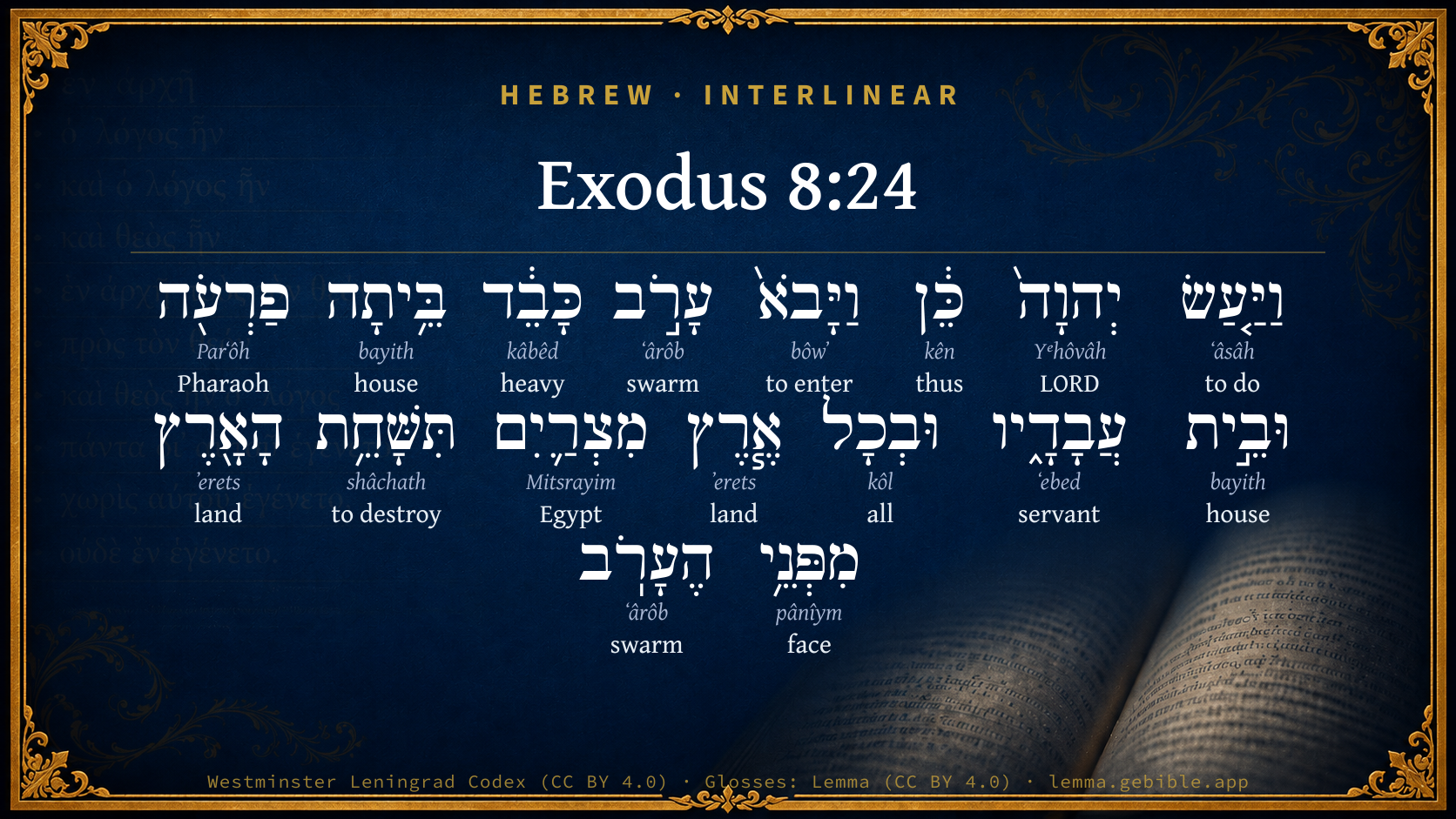
Hebrew (Westminster Leningrad Codex) Exodus 8:24 appears in the Hebrew Old Testament. The text above is from the Westminster Leningrad Codex. Each word links to its Strong’s number, a concise gloss, and parsing drawn from the Open Scriptures Hebrew Bible morphology. Click any word for its full Brown-Driver-Briggs (BDB) entry.
Download image
Cite this verse

Exodus 8:24 (World English Bible). Public Domain. Lemma interlinear Bible study tool, https://lemma.gebible.app/v/exodus/8/24.

Show BibTeX & RIS
BibTeX
RIS
English Translation
Yahweh did so; and there came grievous swarms of flies into the house of Pharaoh, and into his servants' houses: and in all the land of Egypt the land was corrupted by reason of the swarms of flies.
World English Bible · Public Domain
Download a study sheet

One document with this verse’s original text, its word-by-word gloss line, the meaning frame, cross-references with their text, attributed commentary, and full source and license credits — printable, and it pastes into notes with its structure intact.

This verse Autodidact and up

Study sheet (.html) Plain text (.txt)

A passage Seminary Student

Up to 50 verses in one chapter. A passage sheet keeps up to 6 commentary sources and 12 cross-references per verse, in the order this page ranks them, and says so on the sheet whenever that leaves anything out. Ask for a single verse and you get the Autodidact verse sheet above.

Everything on this page stays free to read, with no account — the sheet is a download of what is already on screen, not access to it.

Want to remove ads? Support Godless Engineer
Compare translations 3

The same verse in 3 English versions, stacked beneath the original-language interlinear above. Click any original word for its lexicon entry.

Each is an independent rendering of the whole verse — the interlinear is not word-aligned to these translations.

Highlighted words mark where these versions differ — a whole-verse word diff, not a word-by-word alignment.

  • World English Bible Public Domain
    Yahweh did so; and there came grievous swarms of flies into the house of Pharaoh, and into his servants' houses: and in all the land of Egypt the land was corrupted by reason of the swarms of flies.
  • King James Version Public Domain
    And the LORD did so; and there came a grievous swarm of flies into the house of Pharaoh, and into his servants' houses, and into all the land of Egypt: the land was corrupted by reason of the swarm of flies.
  • unfoldingWord Literal Text CC BY-SA 4.0
    And Yahweh did so, and a heavy swarm came to the house of Pharaoh and the houses of his servants and all the land of Egypt. The land was ruined from the face of the swarm.

unfoldingWord Literal Text — © unfoldingWord, licensed CC BY-SA 4.0. Word-aligned USFM3 via Door43 (git.door43.org/unfoldingWord/en_ult).

Versions to compare (up to 4)

3 of 4 selected

Show all 18 translations

Every available English version of this verse, each an independent rendering of the whole verse.

  • World English Bible Public Domain
    Yahweh did so; and there came grievous swarms of flies into the house of Pharaoh, and into his servants' houses: and in all the land of Egypt the land was corrupted by reason of the swarms of flies.
  • Berean Standard Bible Public Domain
    And the LORD did so. Thick swarms of flies poured into Pharaoh’s palace and into the houses of his officials. Throughout Egypt the land was ruined by swarms of flies.
  • Majority Standard Bible Public Domain
    And the LORD did so. Thick swarms of flies poured into Pharaoh’s palace and into the houses of his officials. Throughout Egypt the land was ruined by swarms of flies.
  • King James Version Public Domain
    And the LORD did so; and there came a grievous swarm of flies into the house of Pharaoh, and into his servants' houses, and into all the land of Egypt: the land was corrupted by reason of the swarm of flies.
  • American Standard Version (1901) Public Domain
    And Jehovah did so; and there came grievous swarms of flies into the house of Pharaoh, and into his servants' houses: and in all the land of Egypt the land was corrupted by reason of the swarms of flies.
  • Revised Version (1885) Public Domain
    And the LORD did so; and there came grievous swarms of flies into the house of Pharaoh, and into his servants’ houses: and in all the land of Egypt the land was corrupted by reason of the swarms of flies.
  • Geneva Bible (1599) Public Domain
    And the Lord did so: for there came great swarmes of flies into the house of Pharaoh, and into his seruants houses, so that through all the lande of Egypt, the earth was corrupt by the swarmes of flies.
  • Douay-Rheims (1899) Public Domain
    And the Lord did so. And there came a very grievous swarm of flies into he houses of Pharao and of his servants, and into all the land of Egypt: and the land was corrupted by this kind of flies.
  • Young's Literal Translation Public Domain
    And Jehovah doth so, and the grievous beetle entereth the house of Pharaoh, and the house of his servants, and in all the land of Egypt the land is corrupted from the presence of the beetle.
  • Literal Standard Version CC BY-SA 4.0
    And YHWH does so, and the grievous beetle enters the house of Pharaoh, and the house of his servants, and in all the land of Egypt the land is corrupted from the presence of the beetle.
  • Unlocked Literal Bible CC BY-SA 4.0
    Yahweh did so, and thick swarms of flies came into Pharaoh's house and into his servants' houses. Throughout the whole land of Egypt, the land was ruined because of the swarms of flies.
  • unfoldingWord Literal Text CC BY-SA 4.0
    And Yahweh did so, and a heavy swarm came to the house of Pharaoh and the houses of his servants and all the land of Egypt. The land was ruined from the face of the swarm.
  • Darby Bible Public Domain
    And Jehovah did so; and there came dog-flies in a multitude into the house of Pharaoh, and [into] the houses of his bondmen; and throughout the land of Egypt, the land was corrupted by the dog-flies.
  • World Messianic Bible Public Domain
    The LORD did so; and there came grievous swarms of flies into the house of Pharaoh, and into his servants’ houses. In all the land of Egypt the land was corrupted by reason of the swarms of flies.
  • Webster's Bible Public Domain
    And the LORD did so: and there came a grievous swarm of flies into the house of Pharaoh, and into his servants' houses, and into all the land of Egypt: the land was corrupted by reason of the swarm of flies.
  • Free Bible Version CC BY-SA 4.0
    The Lord did what he had said. Huge swarms of flies swept into Pharaoh's palace and into the houses of his officials. The whole of Egypt was devastated because of these swarms of flies.
  • Bible in Basic English Public Domain
    And the Lord did so; and great clouds of flies came into the house of Pharaoh and into his servants' houses, and all the land of Egypt was made waste because of the flies.
  • JPS Tanakh (1917) Public Domain
    (8-20) And the LORD did so; and there came grievous swarms of flies into the house of Pharaoh, and into his servants' houses; and in all the land of Egypt the land was ruined by reason of the swarms of flies.

Literal Standard Version (2020), Covenant Press — licensed CC BY-SA 4.0. Text via the HelloAO Bible API (eBible.org). Unlocked Literal Bible (unfoldingWord) — licensed CC BY-SA 4.0. Text via the HelloAO Bible API (eBible.org). unfoldingWord Literal Text — © unfoldingWord, licensed CC BY-SA 4.0. Word-aligned USFM3 via Door43 (git.door43.org/unfoldingWord/en_ult). Free Bible Version, Dr. Jonathan Gallagher — licensed CC BY-SA 4.0. Text via the HelloAO Bible API (eBible.org).

Word by word

More ways to search: Search by grammar → Find every occurrence → Compare this word →

Practice this passage: Drill this verse → Learn its vocabulary →

עָרֹ֣ב
ʻârôb
H6157
“swarm”
Noun, Common, Masculine, Singular, Absolute
Part of Speech
Noun
Type
Common
Gender
Masculine
Number
Singular
State
Absolute
Full BDB Definition

Origin: from H6148

TWOT: 1685c

swarm - probable meaning from 'mixture' and 'incessant or involved motion'
  1. וַיַּ֤עַשׂ ʻâsâh H6213 “and · to do” Conjunction + Verb, Qal, Sequential Imperfect, 3rd Person, Masculine, Singular
  2. יְהוָה֙ Yᵉhôvâh H3068 “LORD” Noun, Proper
  3. כֵּ֔ן kên H3651 “thus” Particle, Demonstrative
  4. וַיָּבֹא֙ bôwʼ H935 “and · to enter” Conjunction + Verb, Qal, Sequential Imperfect, 3rd Person, Masculine, Singular
  5. כָּבֵ֔ד kâbêd H3515 “heavy” Adjective, Adjective, Masculine, Singular, Absolute
  6. בֵּ֥יתָה bayith H1004 “house · toward” Noun, Common, Masculine, Singular, Construct + Suffix, Demonstrative
  7. פַרְעֹ֖ה Parʻôh H6547 “Pharaoh” Noun, Proper
  8. וּבֵ֣ית bayith H1004 “and · house of” Conjunction + Noun, Common, Masculine, Singular, Construct
  9. עֲבָדָ֑יו ʻebed H5650 “servants · his” Noun, Common, Masculine, Plural, Construct + Suffix, Personal, 3rd Person, Masculine, Singular
  10. וּבְכָל kôl H3605 “and · in/at · all of” Conjunction + Preposition + Noun, Common, Masculine, Singular, Construct
  11. אֶ֧רֶץ ʼerets H776 “land of” Noun, Common, Both, Singular, Construct
  12. מִצְרַ֛יִם Mitsrayim H4714 “Egypt” Noun, Proper
  13. תִּשָּׁחֵ֥ת shâchath H7843 “to destroy” Verb, Niphal, Imperfect, 3rd Person, Feminine, Singular
  14. הָאָ֖רֶץ ʼerets H776 “the · land” Particle, Definite Article + Noun, Common, Both, Singular, Absolute
  15. מִפְּנֵ֥י pânîym H6440 “from · face(s) of” Preposition + Noun, Common, Both, Plural, Construct
  16. הֶעָרֹֽב ʻârôb H6157 “the · swarm” Particle, Definite Article + Noun, Common, Masculine, Singular, Absolute

About this verse

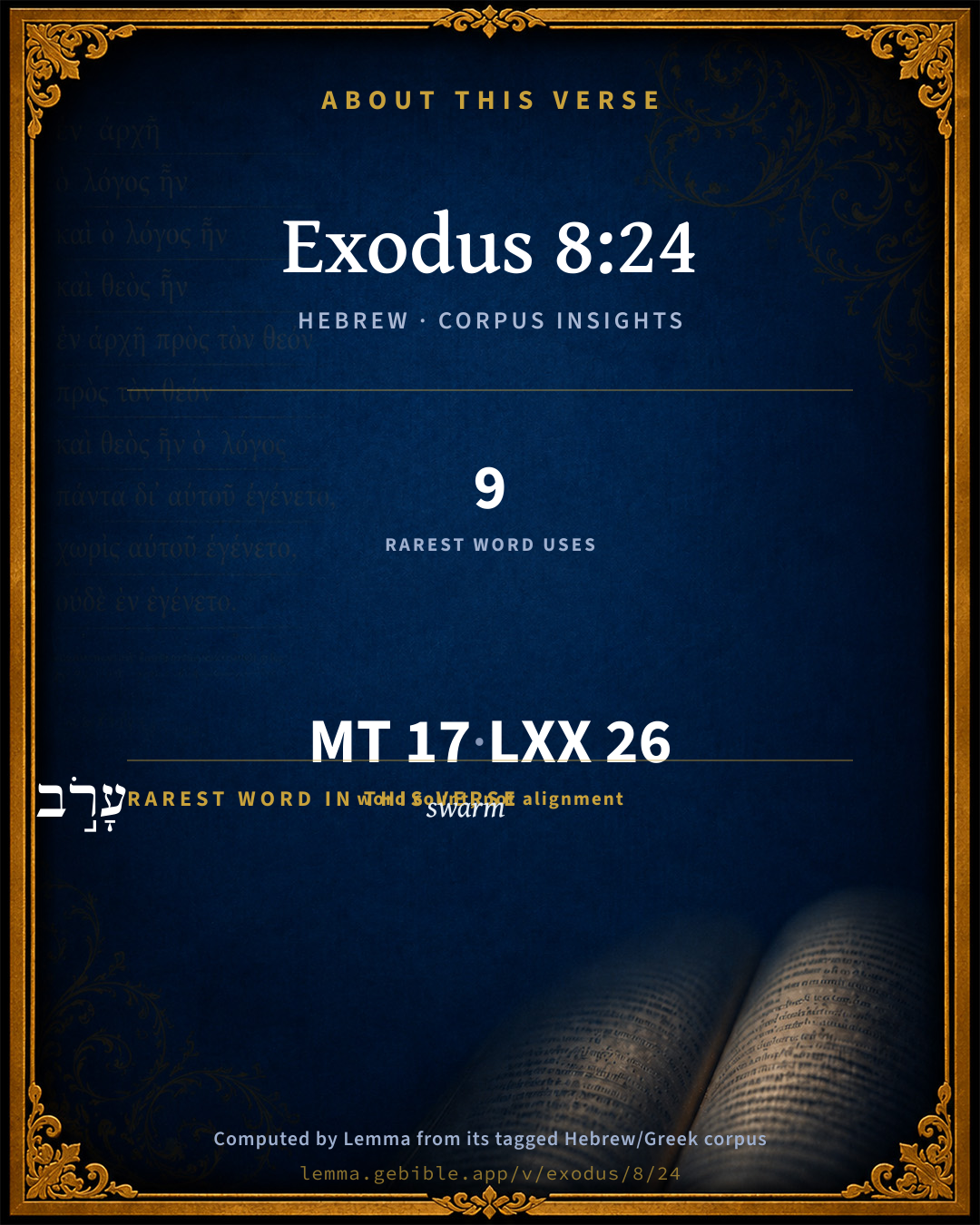
These counts appear in no published source. They are computed here, from the morphology-tagged text and Lemma’s own curated glosses. What Lemma adds →

17
words
14
distinct lemmas
Pentateuch
section

Notable vocabulary

The rarest word here is עָרֹ֣ב swarm H6157 — appearing just 9 times in the whole Hebrew Bible.

Shared distinctive vocabulary

עָרֹ֣ב swarm H6157 occurs in 7 verses of the Hebrew Bible. Also found in:

Grammatical profile

  • 3 verbs
  • 12 nouns
  • 1 adjective
  • 1 particle

Verb forms

  • וַיַּ֤עַשׂ Qal · Sequential Imperfect
  • וַיָּבֹא֙ Qal · Sequential Imperfect
  • תִּשָּׁחֵ֥ת Niphal · Imperfect

Repetition

Words recur within this verse — often emphatic in Hebrew:

  • עָרֹ֣ב swarm H6157 ×2
  • בֵּ֥יתָה house H1004 ×2
  • אֶ֧רֶץ land H776 ×2

Hebrew & Septuagint length

In English translation the verse runs 38 words from the Hebrew and 33 from the Septuagint (LXX English) — closely comparable.

A rough comparison of the two English renderings, which tokenize alike — not a word-level alignment.

Word counts can differ between the Hebrew and the Greek without any difference in meaning — e.g. the Hebrew direct-object marker אֵת has no separate Greek word, and Greek often adds the article ὁ.

In the original languages it is 17 Hebrew tokens and 26 Greek tokens — but the two are counted differently (Hebrew bundles its prefixes and suffixes into one token; the Greek is in lemma form), so that isn’t a like-for-like length.

Cross-references

3

Topical passages linked to Exodus 8:24 in the Treasury of Scripture Knowledge — connected by theme and wording, ordered by reader-vote popularity; previews shown in the World English Bible.

  • Psalms 78:45 He sent among them swarms of flies, which devoured them; And frogs, which destroyed them.
  • Psalms 105:31 He spoke, and swarms of flies came, And lice in all their borders.
  • Exodus 8:21 Else, if you will not let my people go, behold, I will send swarms of flies on you, and on your servants, and on your people, and into your houses: and the houses of the Egyptians shall be full of swarms of flies, and also the ground whereon they are.

Cross-references courtesy of OpenBible.info (CC BY 4.0).

Hebrew and Greek witnesses Masoretic Hebrew ↔ Greek Septuagint

The same verse in the two great witnesses to the Old Testament, shown verse-for-verse.

These are two independent witnesses, not word-aligned to each other, and the Septuagint is shown in lemma (dictionary) form.

Hebrew Exodus 8:24 Masoretic · Westminster Leningrad Codex

וַיַּ֤עַשׂ יְהוָה֙ כֵּ֔ן וַיָּבֹא֙ עָרֹ֣ב כָּבֵ֔ד בֵּ֥יתָה פַרְעֹ֖ה וּבֵ֣ית עֲבָדָ֑יו וּבְכָל אֶ֧רֶץ מִצְרַ֛יִם תִּשָּׁחֵ֥ת הָאָ֖רֶץ מִפְּנֵ֥י הֶעָרֹֽב

Yahweh did so; and there came grievous swarms of flies into the house of Pharaoh, and into his servants' houses: and in all the land of Egypt the land was corrupted by reason of the swarms of flies.

World English Bible · Public Domain

Greek LXX Exodus 8:24 Septuagint · lemma form

καί εἶπον φαραώ ἐγώ ἀποστέλλω σύ καί θύω κύριος ὁ θεός σύ ἐν ὁ ἔρημος ἀλλά οὐ μακράν ἀποτείνω πορεύομαι εὔχομαι οὖν περί ἐγώ πρός κύριος

And the dog-fly came in abundance into the houses of Pharao, and into the houses of his servants, and into all the land of Egypt; and the land was destroyed by the dog-fly.

LXX2012 (modern English Septuagint) · Public Domain

On this verse, The Cambridge Bible for Schools and Colleges discusses the Septuagint’s reading. Read the note in Commentary ↓

Hebrew: Westminster Leningrad Codex (CC BY 4.0). Greek: Septuagint (public domain); English from LXX2012 (modern English Septuagint) (Public Domain). How the Septuagint differs from the Hebrew →

Targum (Aramaic paraphrase)

2

The Targum is the ancient Jewish Aramaic paraphrase of the Hebrew Scriptures — an interpretive translation, not the Hebrew text itself. Onkelos (literal) and Pseudo-Jonathan (expansive) render the Torah, and Jonathan the Prophets. Coverage is partial: where no permissively-licensed English translation exists for a verse, only the Aramaic is shown. This is verse-level text, not a word-by-word alignment to the Hebrew.

  1. Targum Onkelos Torah (Genesis–Deuteronomy)
    וַאֲמַר פַּרְעֹה אֲנָא אֲשַׁלַח יָתְכוֹן וְתִדְבְּחוּן קֳדָם יְיָ אֱלָהָכוֹן בְּמַדְבְּרָא לְחוֹד אַרְחָקָא לָא תְרַחֲקוּן לְמֵיזַל צַלוֹ אַף עָלָי:

    (no public-domain English translation for this verse)

    Targum Onkelos — Aramaic: “Onkelos Genesis” (public domain); “Onkelos Exodus” (public domain); “Onkelos Leviticus” (public domain); “Onkelos Numbers” (public domain); “Onkelos Deuteronomy” (public domain). English: “Sefaria Community Translation” (CC0 1.0 (public-domain dedication)); “J.W. Etheridge. The Targums of Onkelos and Jonathan Ben Uzziel on the Pentateuch. London: Longmans, Green, 1862” (public domain). Text via Sefaria.

  2. Targum Pseudo-Jonathan Torah (Genesis–Deuteronomy)
    וַאֲמַר פַּרְעה אֲנָא אֶפְטוֹר יַתְכוֹן וְתִדְבְּחוּן קֳדָם יְיָ אֱלָהָכוֹן בְּמַדְבְּרָא לְחוֹד אַרְחָקָא לָא תַרְחִיקוּן לְטַיְילָא צְלוֹ עָלָי

    And Pharoh said, I will release you to sacrifice before the Lord your God in the wilderness, only you shall not go to a greater distance. Pray, (too,) for me.

    Targum Pseudo-Jonathan — Aramaic: “Targum Jonathan on Genesis” (public domain); “Targum Jonathan on Exodus” (public domain); “Targum Jonathan on Leviticus” (public domain); “Targum Jonathan on Numbers” (public domain); “Targum Jonathan on Deuteronomy” (public domain). English: “The Targum of Jonathan ben Uzziel, trans. J. W. Etheridge, London, 1862” (public domain). Text via Sefaria.

Commentary

Notes on Exodus 8:24 from classic Christian and Jewish commentators (each source and its license shown beneath its notes). The classic Christian expositions comment on the surrounding passage and are grouped to its opening verse, so a note may address several verses; the Jewish commentaries on the Tanakh (Rashi and others) are per-verse, so they appear only where the commentator wrote on this verse.

Lemma curates 59 commentaries, every one of them public domain or Creative Commons licensed, each selected and text-cleaned for this edition rather than reprinted as found. About our sources →

Trapp's Complete Commentary

John Trapp

Exo 8:24 And the LORD did so; and there came a grievous swarm [of flies] into the house of Pharaoh, and [into] his servants’ houses, and into all the land of Egypt: the land was corrupted by reason of the swarm [of flies].

Ver. 24. A grievous swarm of flies,] i.e., Numerous and pernicious; yet not so bad as those many noisome thoughts that swarm daily in men’s hearts. There is that Leviathan; there are also creeping things innumerable. And these many times mar and corrupt our prayers, so as that they stink in the nostrils of God.

John Trapp, A Commentary or Exposition upon All the Books of the Old and New Testament (1647–1656) — public domain. Text from a community e-Sword module.

Geneva Bible (1599)

Geneva Bible translators

The fourth plague.

Geneva Bible (1599) marginal notes — public domain. Text via Bolls.life.

Adam Clarke's Commentary

Verse 24. The land was corrupted] Every thing was spoiled, and many of the inhabitants destroyed, being probably stung to death by these venomous insects. This seems to be intimated by the psalmist, "He sent divers sorts of flies among them, which DEVOURED them," Ps 78:45.

In ancient times, when political, domestic, and personal cleanliness was but little attended to, and offal of different kinds permitted to corrupt in the streets and breed vermin, flies multiplied exceedingly, so that we read in ancient authors of whole districts being laid waste by them; hence different people had deities, whose office it was to defend them against flies. Among these we may reckon Baalzebub, the fly-god of Ekron; Hercules, muscarum abactor, Hercules, the expeller of flies, of the Romans; the Muagrus of the Eleans, whom they invoked against pestilential swarms of flies; and hence Jupiter, the supreme god of the heathens, had the epithets of Απομυιος and Μυωδης, because he was supposed to expel flies, and defend his worshippers against them. See Dodd.

Adam Clarke's Commentary on the Bible (1810–1826) — public domain. Text from a community e-Sword/MySword module.

Ellicott's Commentary for English Readers

(24) The land was corrupted.—Rather, as in the margin, destroyed. Kalisch observes, “These insects”—i.e., the kakerlaque (Blatta Orientalis), “really fill the land, and molest men and beasts; they consume all sorts of materials, devastate the country, and are in so far more detrimental than the gnats, as they destroy also the property of the Egyptians.”

A Bible Commentary for English Readers, edited by Charles John Ellicott (1878–1897) — public domain. Text from a community e-Sword module.

The Cambridge Bible for Schools and Colleges

gen. ed. J. J. S. Perowne

24. grievous] lit. heavy, combining, as Exo_10:14, the ideas of both numerous (Exo_12:38, Gen_50:9, Heb.), and severe (Exo_9:3; Exo_9:18; Exo_9:24). ‘Grievous’ is an archaism, meaning burdensome (ultimately from Lat. gravis1[124]): see DB. s.v.; and cf. Gen_12:10 (AV.), Gen_50:11, 2Co_12:14 AV. (RV. ‘be a burden to’)2[125].

[124] Cf. to grieve, i.e. originally to be a burden or trouble to, to harass (Gen_49:23) from gravare.

[125] Murray quotes from a writer of 1548, ‘Ye shall be grievous to no man with begging’ (cf. the Glossary in the writer’s Jeremiah, p. 373).

and into, &c.] read probably, with LXX. Sam. Pesh., adding only one letter, but improving the sentence, and into his servants’ houses, and into all the land of Egypt; and the land was, &c.

corrupted] rather, ruined,—by the suffering inflicted on men and cattle, and the interruption caused to daily occupations, &c. (v. 21).

The Cambridge Bible for Schools and Colleges (gen. ed. J. J. S. Perowne; Cambridge University Press, 1878–1918) — public domain. Text from a community e-Sword module.

John Gill's Exposition

He and his people not being able to endure this plague of flies any longer; and we read in profane history of such creatures being so troublesome, that people have been obliged to quit their habitations, and seek for new ones; so Pausanias (t) relates of the inhabitants of Myus, that such a number of flies rose out of the lake, that the men were obliged to leave the city, and go to Miletus; so Aelian (u) reports, that the inhabitants of Megara were driven from thence by a multitude of flies, as were the inhabitants of Phaselis by wasps, which creatures also might be in this mixture of insects:

and said, go ye, sacrifice to your God in the land; that is, in the land of Goshen, in the place where they were; he was willing to allow them the liberty of sacrificing to their God, which it seems they had before; but then he would not consent they should go out of the land to do it.

(t) Achaica, sive l. 7. p. 400. (u) De Animal. l. 11. c. 28.

John Gill's Exposition of the Whole Bible (1746–1763) — public domain (CC PDM 1.0). Text via the HelloAO Bible API.

Haydock's Catholic Bible Commentary

The Lord, without the intervention of the rod, lest any inherent power might be supposed to rest in it. (Menochius) --- Corrupted, ravaged; men and beasts being destroyed by their bite or sting. (Psalm lxxvii. 45; Wisdom xvi. 9.)

George Leo Haydock (1774–1849), Haydock's Catholic Family Bible and Commentary, 1859 edition — public domain. Excludes Psalms (Douay-Rheims chapter numbering differs from Protestant) and Deuterocanonical books (Catholic canon only).

Matthew Poole's English Annotations

The Lord did so, immediately by his own word, and not by Moses’s rod, lest the Egyptians should think it was a magician’s wand, and. that all Moses’s works were done by the power of the devil.

A grievous swarm of flies; Heb. a heavy mixture of flies. Heavy, i.e. either great, as this Hebrew word is used, Gen 41:31; Isa 32:2, or mischievous and troublesome; or rather, numerous, as it is taken, Gen 1:9; Num 11:14; 1Ki 3:9, compared with 2Ch 1:10.

The land, i.e. either the fruits or products of the land; or rather, the inhabitants of the land, as the word land is taken, Gen 41:36; 1Sa 27:9 many of the people were poisoned or stung to death by them, as appears from Psa 78:45. See also Wis 16:9.

Matthew Poole's English Annotations on the Holy Bible (1683–1685) — public domain. Text from a community e-Sword/MySword module.

The Pulpit Commentary

A grievous swarm of flies. Rather "a multitude of beetles." As with the frogs, so with the beetles, it aggravated the infliction, that, being sacred animals, they might not be destroyed or injured. Beetles were sacred to Ra, the sun-god; and one form of Ra, Chepra, was ordinarily represented under the form of a beetle, or as a man with a beetle for his heath The land was corrupted. Rather "destroyed;" i.e. grievously injured, or "devastated"(as Kalisch renders). The beetles seriously damaged the growing crops.

The Pulpit Commentary (1880–1919), ed. H.D.M. Spence-Jones & Joseph S. Exell — public domain. Text from a community e-Sword module.

John Wesley's Explanatory Notes

There came a grievous swarm of flies - The prince of the power of the air has gloried in being Beel-zebub, the God of flies; but here it is proved that even in that he is a pretender, and an usurper; for even with swarms of flies God fights against his kingdom and prevails.

John Wesley, Explanatory Notes Upon the Whole Bible (1754–1765) — public domain. Text via the GEBible commentary corpus.

Lesson kit

Teaching starters — assembled from the data on this page, not authored interpretation. Every prompt links to the verse data it draws on. Edit before teaching.

Exodus, in the Pentateuch, opens this verse with 17 words (14 distinct Hebrew lemmas). Its most distinctive word is ʻârôb (“swarm”). A historical commentator’s framing appears above. Read the whole chapter for the surrounding context.

Discussion questions

  1. How does “swarm” (ʻârôb) shape what this verse is saying?
  2. Exodus 8:21 shares the word «swarm» with this verse. How do the two illuminate each other?
  3. “swarm” occurs 2× in this one verse. What is the effect of the repetition?
  4. These translations render this verse differently. What is at stake in choosing one wording over another?
  5. The verb «וַיַּ֤עַשׂ» is Qal Sequential Imperfect. How does its form color the action?
  6. Reading how Trapp's Complete Commentary and Geneva Bible (1599) read this verse, where do the two commentators agree and where do they part?

Things to notice

Reading settings

Reading text

Shown beneath each verse's original-language words.

Old Testament
Old Testament edition

Read the OT as the Masoretic Hebrew (MT) or the Greek Septuagint (LXX).

English shown for the Greek Septuagint (in the Hebrew ↔ Greek comparison).

Comparing translations? Open the Compare panel on any verse page to stack up to four side by side.