Leviticus 6:7

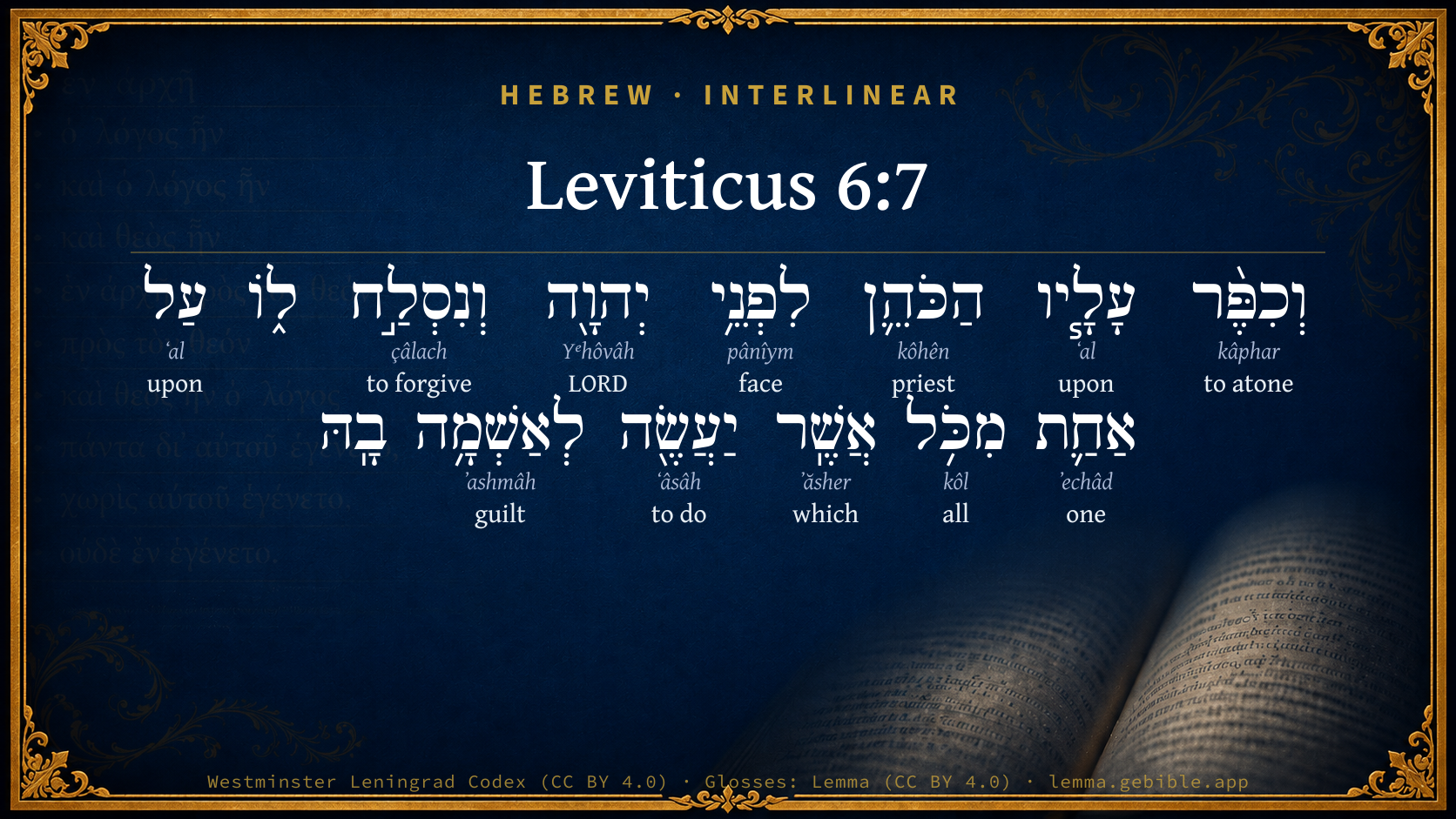
Hebrew (Westminster Leningrad Codex) Leviticus 6:7 appears in the Hebrew Old Testament. The text above is from the Westminster Leningrad Codex. Each word links to its Strong’s number, a concise gloss, and parsing drawn from the Open Scriptures Hebrew Bible morphology. Click any word for its full Brown-Driver-Briggs (BDB) entry.
Download image
Cite this verse

Leviticus 6:7 (World English Bible). Public Domain. Lemma interlinear Bible study tool, https://lemma.gebible.app/v/leviticus/6/7.

Show BibTeX & RIS
BibTeX
RIS
English Translation
The priest shall make atonement for him before Yahweh, and he will be forgiven concerning whatever he does to become guilty."
World English Bible · Public Domain
Download a study sheet

One document with this verse’s original text, its word-by-word gloss line, the meaning frame, cross-references with their text, attributed commentary, and full source and license credits — printable, and it pastes into notes with its structure intact.

This verse Autodidact and up

Study sheet (.html) Plain text (.txt)

A passage Seminary Student

Up to 50 verses in one chapter. A passage sheet keeps up to 6 commentary sources and 12 cross-references per verse, in the order this page ranks them, and says so on the sheet whenever that leaves anything out. Ask for a single verse and you get the Autodidact verse sheet above.

Everything on this page stays free to read, with no account — the sheet is a download of what is already on screen, not access to it.

Want to remove ads? Support Godless Engineer
Compare translations 3

The same verse in 3 English versions, stacked beneath the original-language interlinear above. Click any original word for its lexicon entry.

Each is an independent rendering of the whole verse — the interlinear is not word-aligned to these translations.

Highlighted words mark where these versions differ — a whole-verse word diff, not a word-by-word alignment.

  • World English Bible Public Domain
    The priest shall make atonement for him before Yahweh, and he will be forgiven concerning whatever he does to become guilty."
  • King James Version Public Domain
    And the priest shall make an atonement for him before the LORD: and it shall be forgiven him for any thing of all that he hath done in trespassing therein.
  • unfoldingWord Literal Text CC BY-SA 4.0
    And the priest shall make atonement for him to the face of Yahweh, and it will be forgiven to him, concerning one from all that he does to guilt with it.”

unfoldingWord Literal Text — © unfoldingWord, licensed CC BY-SA 4.0. Word-aligned USFM3 via Door43 (git.door43.org/unfoldingWord/en_ult).

Versions to compare (up to 4)

3 of 4 selected

Show all 18 translations

Every available English version of this verse, each an independent rendering of the whole verse.

  • World English Bible Public Domain
    The priest shall make atonement for him before Yahweh, and he will be forgiven concerning whatever he does to become guilty."
  • Berean Standard Bible Public Domain
    In this way the priest will make atonement for him before the LORD, and he will be forgiven for anything he may have done to incur guilt.”
  • Majority Standard Bible Public Domain
    In this way the priest will make atonement for him before the LORD, and he will be forgiven for anything he may have done to incur guilt.”
  • King James Version Public Domain
    And the priest shall make an atonement for him before the LORD: and it shall be forgiven him for any thing of all that he hath done in trespassing therein.
  • American Standard Version (1901) Public Domain
    and the priest shall make atonement for him before Jehovah; and he shall be forgiven concerning whatsoever he doeth so as to be guilty thereby.
  • Revised Version (1885) Public Domain
    and the priest shall make atonement for him before the LORD, and he shall be forgiven; concerning whatsoever he doeth so as to be guilty thereby.
  • Geneva Bible (1599) Public Domain
    And the Priest shall make an atonement for him before the Lord, and it shall be forgiuen him, whatsoeuer thing he hath done, and trespassed therein.
  • Douay-Rheims (1899) Public Domain
    And he shall pray for him before the Lord, and he shall have forgiveness for every thing in doing of which he hath sinned.
  • Young's Literal Translation Public Domain
    and the priest hath made atonement for him before Jehovah, and it hath been forgiven him, concerning one thing of all that he doth, by being guilty therein.'
  • Literal Standard Version CC BY-SA 4.0
    and the priest has made atonement for him before YHWH, and it has been forgiven him, concerning one thing of all that he does, by being guilty therein.”
  • Unlocked Literal Bible CC BY-SA 4.0
    The priest will make atonement for him before Yahweh, and he will be forgiven concerning whatever he has become guilty of doing.”
  • unfoldingWord Literal Text CC BY-SA 4.0
    And the priest shall make atonement for him to the face of Yahweh, and it will be forgiven to him, concerning one from all that he does to guilt with it.”
  • Darby Bible Public Domain
    And the priest shall make atonement for him before Jehovah, and it shall be forgiven him concerning anything of all that he hath done so as to trespass therein.
  • World Messianic Bible Public Domain
    The priest shall make atonement for him before the LORD, and he will be forgiven concerning whatever he does to become guilty.”
  • Webster's Bible Public Domain
    \\6:14\\And this is the law of the meat-offering: the sons of Aaron shall offer it before the LORD, before the altar.
  • Free Bible Version CC BY-SA 4.0
    This is how the priest will make you right before the Lord, and you will be forgiven whatever sins you may have done that you are guilty of.”
  • Bible in Basic English Public Domain
    And this is the law for the meal offering: it is to be offered to the Lord before the altar by the sons of Aaron.
  • JPS Tanakh (1917) Public Domain
    (5-26) And the priest shall make atonement for him before the LORD, and he shall be forgiven, concerning whatsoever he doeth so as to be guilty thereby.

Literal Standard Version (2020), Covenant Press — licensed CC BY-SA 4.0. Text via the HelloAO Bible API (eBible.org). Unlocked Literal Bible (unfoldingWord) — licensed CC BY-SA 4.0. Text via the HelloAO Bible API (eBible.org). unfoldingWord Literal Text — © unfoldingWord, licensed CC BY-SA 4.0. Word-aligned USFM3 via Door43 (git.door43.org/unfoldingWord/en_ult). Free Bible Version, Dr. Jonathan Gallagher — licensed CC BY-SA 4.0. Text via the HelloAO Bible API (eBible.org).

Word by word

More ways to search: Search by grammar → Find every occurrence → Compare this word →

Practice this passage: Drill this verse → Learn its vocabulary →

לְאַשְׁמָ֥ה
ʼashmâh
H819
“to/for · guilt”
Preposition + Noun, Common, Feminine, Singular, Absolute
Part of Speech
Preposition + Noun
Type
Common
Gender
Feminine
Number
Singular
State
Absolute
Full BDB Definition

Origin: from H817

TWOT: 180c

guiltiness, guilt, offense, sin, wrong-doing - doing wrong, committing a trespass or offense - becoming guilty, guilt - bringing a guilt-offering
  1. וְכִפֶּ֨ר kâphar H3722 “and · to atone” Conjunction + Verb, Piel, Sequential Perfect, 3rd Person, Masculine, Singular
  2. עָלָ֧יו ʻal H5921 “upon · him” Preposition + Suffix, Personal, 3rd Person, Masculine, Singular
  3. הַכֹּהֵ֛ן kôhên H3548 “the · priest” Particle, Definite Article + Noun, Common, Masculine, Singular, Absolute
  4. לִפְנֵ֥י pânîym H6440 “to/for · face(s) of” Preposition + Noun, Common, Both, Plural, Construct
  5. יְהוָ֖ה Yᵉhôvâh H3068 “LORD” Noun, Proper
  6. וְנִסְלַ֣ח çâlach H5545 “and · to forgive” Conjunction + Verb, Niphal, Sequential Perfect, 3rd Person, Masculine, Singular
  7. עַל ʻal H5921 “upon” Preposition
  8. אַחַ֛ת ʼechâd H259 “one” Adjective, Cardinal number, Feminine, Singular, Absolute
  9. מִכֹּ֥ל kôl H3605 “from · all” Preposition + Noun, Common, Masculine, Singular, Absolute
  10. אֲשֶֽׁר ʼăsher H834 “which” Particle, Relative
  11. יַעֲשֶׂ֖ה ʻâsâh H6213 “to do” Verb, Qal, Imperfect, 3rd Person, Masculine, Singular

About this verse

These counts appear in no published source. They are computed here, from the morphology-tagged text and Lemma’s own curated glosses. What Lemma adds →

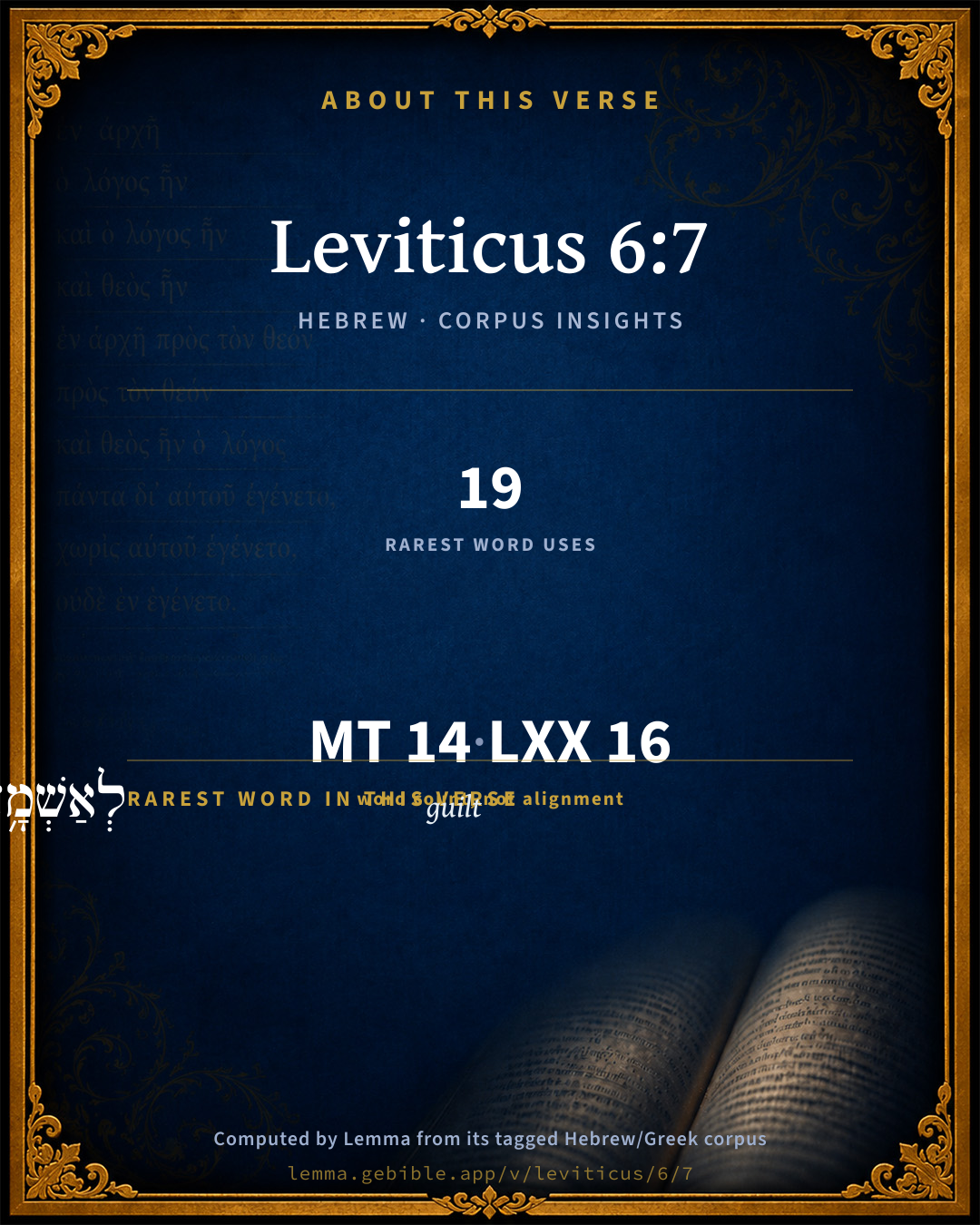
14
words
11
distinct lemmas
Pentateuch
section

Notable vocabulary

The rarest word here is לְאַשְׁמָ֥ה guilt H819 — appearing just 19 times in the whole Hebrew Bible.

Shared distinctive vocabulary

לְאַשְׁמָ֥ה guilt H819 occurs in 17 verses of the Hebrew Bible. Also found in:

Grammatical profile

  • 3 verbs
  • 5 nouns
  • 1 adjective
  • 4 prepositions
  • 1 particle

Verb forms

  • וְכִפֶּ֨ר Piel · Sequential Perfect
  • וְנִסְלַ֣ח Niphal · Sequential Perfect
  • יַעֲשֶׂ֖ה Qal · Imperfect

Repetition

A word recurs within this verse — often emphatic in Hebrew:

  • עָלָ֧יו upon H5921 ×2

Hebrew & Septuagint length

In English translation the verse runs 21 words from the Hebrew and 7 from the Septuagint (LXX English) — the Septuagint runs noticeably shorter here. See the side-by-side →

A rough comparison of the two English renderings, which tokenize alike — not a word-level alignment.

Word counts can differ between the Hebrew and the Greek without any difference in meaning — e.g. the Hebrew direct-object marker אֵת has no separate Greek word, and Greek often adds the article ὁ.

In the original languages it is 14 Hebrew tokens and 16 Greek tokens — but the two are counted differently (Hebrew bundles its prefixes and suffixes into one token; the Greek is in lemma form), so that isn’t a like-for-like length.

Cross-references

19

Topical passages linked to Leviticus 6:7 in the Treasury of Scripture Knowledge — connected by theme and wording, ordered by reader-vote popularity; previews shown in the World English Bible.

  • Leviticus 4:26 All its fat he shall burn on the altar, like the fat of the sacrifice of peace offerings; and the priest shall make atonement for him concerning his sin, and he will be forgiven.
  • 1 John 1:9 If we confess our sins, he is faithful and righteous to forgive us the sins, and to cleanse us from all unrighteousness.
  • 1 John 2:1–2 My little children, I write these things to you so that you may not sin. If anyone sins, we have a Counselor with the Father, Jesus Christ, the righteous.
  • Exodus 34:7 keeping loving kindness for thousands, forgiving iniquity and disobedience and sin; and that will by no means clear the guilty, visiting the iniquity of the fathers on the children, and on the children's children, on the third and on the fourth generation."
  • Leviticus 4:20 Thus shall he do with the bull; as he did with the bull of the sin offering, so shall he do with this; and the priest shall make atonement for them, and they shall be forgiven.
  • Leviticus 4:31 All its fat he shall take away, like the fat is taken away from off of the sacrifice of peace offerings; and the priest shall burn it on the altar for a sweet savor to Yahweh; and the priest shall make atonement for him, and he will be forgiven.
  • Leviticus 5:10 He shall offer the second for a burnt offering, according to the ordinance; and the priest shall make atonement for him concerning his sin which he has sinned, and he shall be forgiven.
  • Leviticus 5:13 The priest shall make atonement for him concerning his sin that he has sinned in any of these things, and he will be forgiven; and the rest shall be the priest's, as the meal offering.'"
  • Leviticus 5:15–16 "If anyone commits a trespass, and sins unwittingly, in the holy things of Yahweh; then he shall bring his trespass offering to Yahweh, a ram without blemish from the flock, according to your estimation in silver by shekels, after the shekel of the sanctuary, for a trespass offering.
  • Leviticus 5:18 He shall bring a ram without blemish from of the flock, according to your estimation, for a trespass offering, to the priest; and the priest shall make atonement for him concerning the thing in which he sinned and didn't know it, and he will be forgiven.
  • Isaiah 1:18 "Come now, and let us reason together," says Yahweh: "Though your sins be as scarlet, they shall be as white as snow. Though they be red like crimson, they shall be as wool.
  • Ezekiel 18:21–23 But if the wicked turn from all his sins that he has committed, and keep all my statutes, and do that which is lawful and right, he shall surely live, he shall not die.
  • Ezekiel 18:26–27 When the righteous man turns away from his righteousness, and commits iniquity, and dies therein; in his iniquity that he has done shall he die.
  • Ezekiel 33:14–16 Again, when I say to the wicked, You shall surely die; if he turn from his sin, and do that which is lawful and right;
  • Ezekiel 33:19 When the wicked turns from his wickedness, and does that which is lawful and right, he shall live thereby.
  • Micah 7:18 Who is a God like you, who pardons iniquity, And passes over the disobedience of the remnant of his heritage? He doesn't retain his anger forever, Because he delights in loving kindness.
  • Matthew 12:31 Therefore I tell you, every sin and blasphemy will be forgiven men, but the blasphemy against the Spirit will not be forgiven men.
  • 1 Corinthians 6:9–11 Or don't you know that the unrighteous will not inherit the Kingdom of God? Don't be deceived. Neither the sexually immoral, nor idolaters, nor adulterers, nor male prostitutes, nor homosexuals,
  • 1 John 1:7 But if we walk in the light, as he is in the light, we have fellowship with one another, and the blood of Jesus Christ, his Son, cleanses us from all sin.

Cross-references courtesy of OpenBible.info (CC BY 4.0).

Hebrew and Greek witnesses Masoretic Hebrew ↔ Greek Septuagint

The same verse in the two great witnesses to the Old Testament, shown verse-for-verse.

Here the Septuagint runs noticeably shorter than the Hebrew — LXX2012 (modern English Septuagint) 7 words vs World English Bible 21. A rough length comparison of the two English translations, not a word-level alignment — read both below.

These are two independent witnesses, not word-aligned to each other, and the Septuagint is shown in lemma (dictionary) form.

Hebrew Leviticus 6:7 Masoretic · Westminster Leningrad Codex

וְכִפֶּ֨ר עָלָ֧יו הַכֹּהֵ֛ן לִפְנֵ֥י יְהוָ֖ה וְנִסְלַ֣ח ל֑וֹ עַל אַחַ֛ת מִכֹּ֥ל אֲשֶֽׁר יַעֲשֶׂ֖ה לְאַשְׁמָ֥ה בָֽהּ

The priest shall make atonement for him before Yahweh, and he will be forgiven concerning whatever he does to become guilty."

World English Bible · Public Domain

Greek LXX Leviticus 6:7 Septuagint · lemma form

οὗτος ὁ νόμος ὁ θυσία ὅς προςἄγω αὐτός ὁ υἱός ἀαρών ἔναντι κύριος ἀπέναντι ὁ θυσιαστήριον

And the Lord spoke to Moses, saying,

LXX2012 (modern English Septuagint) · Public Domain

Hebrew: Westminster Leningrad Codex (CC BY 4.0). Greek: Septuagint (public domain); English from LXX2012 (modern English Septuagint) (Public Domain). How the Septuagint differs from the Hebrew →

Targum (Aramaic paraphrase)

2

The Targum is the ancient Jewish Aramaic paraphrase of the Hebrew Scriptures — an interpretive translation, not the Hebrew text itself. Onkelos (literal) and Pseudo-Jonathan (expansive) render the Torah, and Jonathan the Prophets. Coverage is partial: where no permissively-licensed English translation exists for a verse, only the Aramaic is shown. This is verse-level text, not a word-by-word alignment to the Hebrew.

  1. Targum Onkelos Torah (Genesis–Deuteronomy)
    וְדָא אוֹרַיְתָא דְמִנְחָתָא דִיקָרְבוּן יָתַהּ בְּנֵי אַהֲרֹן קֳדָם יְיָ לָקֳדָם מַדְבְּחָא

    (no public-domain English translation for this verse)

    Targum Onkelos — Aramaic: “Onkelos Genesis” (public domain); “Onkelos Exodus” (public domain); “Onkelos Leviticus” (public domain); “Onkelos Numbers” (public domain); “Onkelos Deuteronomy” (public domain). English: “Sefaria Community Translation” (CC0 1.0 (public-domain dedication)); “J.W. Etheridge. The Targums of Onkelos and Jonathan Ben Uzziel on the Pentateuch. London: Longmans, Green, 1862” (public domain). Text via Sefaria.

  2. Targum Pseudo-Jonathan Torah (Genesis–Deuteronomy)
    וְדָא אוֹרַיְיתָא דְמִנְחָתָא דְיִקְרְבוּן יָתָהּ בְּנֵי אַהֲרן כַּהֲנָא קֳדָם יְיָ לִקְדָם מַדְבְּחָא

    And this is the law of the Mincha, which the priests, the sons of Aharon, shall offer in the presence of the Lord before the altar.

    Targum Pseudo-Jonathan — Aramaic: “Targum Jonathan on Genesis” (public domain); “Targum Jonathan on Exodus” (public domain); “Targum Jonathan on Leviticus” (public domain); “Targum Jonathan on Numbers” (public domain); “Targum Jonathan on Deuteronomy” (public domain). English: “The Targum of Jonathan ben Uzziel, trans. J. W. Etheridge, London, 1862” (public domain). Text via Sefaria.

Commentary

Notes on Leviticus 6:7 from classic Christian and Jewish commentators (each source and its license shown beneath its notes). The classic Christian expositions comment on the surrounding passage and are grouped to its opening verse, so a note may address several verses; the Jewish commentaries on the Tanakh (Rashi and others) are per-verse, so they appear only where the commentator wrote on this verse.

Lemma curates 59 commentaries, every one of them public domain or Creative Commons licensed, each selected and text-cleaned for this edition rather than reprinted as found. About our sources →

Trapp's Complete Commentary

John Trapp

Lev 6:7 And the priest shall make an atonement for him before the LORD: and it shall be forgiven him for any thing of all that he hath done in trespassing therein.

Ver. 7. Shall make an atonement.] Through the sacrifice of Christ. {Heb 10:1; Heb 10:4; Heb 10:10; Heb 10:14}

John Trapp, A Commentary or Exposition upon All the Books of the Old and New Testament (1647–1656) — public domain. Text from a community e-Sword module.

Tyndale Open Study Notes

Tyndale Open Resources

6:7 will purify you before the Lord, making you right with him: God graciously gave his people a way to atone for their sins. See also study notes on 1:4; 4:20.

Tyndale Open Study Notes — © Tyndale Open Resources, licensed CC BY-SA 4.0. Text via the HelloAO Bible API.

John Gill's Exposition

And the priest shall make an atonement for him before the Lord,.... By offering the ram he brought, by which a typical, but not real atonement was made; for the blood of bulls and goats, of sheep and rams, could not take away sin; but as they were types of Christ, and led to him, the Lamb of God that takes away the sin of the world:

and it shall be forgiven him, for anything of all that he hath done, in trespassing therein; any and everyone of the above sins, with all the aggravations of them, were forgiven, upon the atonement made, though they were so enormous; and, indeed, all manner of sin is forgiven for Christ's sake, except the sin against the Holy Ghost: and L'Empereur (o) rightly observes, against the Socinians, who deny that sacrifices were offered for crimes very grievous, that these were of such a nature; for what more vile than unfaithfulness in a trust, than cheating and defrauding, stealing, lying, and perjury?

(o) In Misn. Bava Kama, c. 9. sect. 5.

John Gill's Exposition of the Whole Bible (1746–1763) — public domain (CC PDM 1.0). Text via the HelloAO Bible API.

Whedon's Commentary on the Bible

Daniel D. Whedon

7. It shall be forgiven him — After voluntary confession, restitution, compensation, and presentation of his trespass offering for a propitiation for his sin, he might trust in the mercy of God for forgiveness. For the nature of this forgiveness, see Introduction, (7.)

Daniel D. Whedon (gen. ed.), Commentary on the Old and New Testaments (1874–1909) — public domain. Text from a community e-Sword module.

Rashi

Rabbi Shlomo Yitzchaki (Rashi)

וזאת תורת המנחה AND THIS IS THE LAW OF THE MEAL OFFERING — one law for all meal-offerings (cf. Rashi on v. 2) — making requisite for them “oil” and “frankincense” which are prescribed in the previous section (Leviticus 2:1). This had to be intimated in some way here because I might think that there I have the law that meal offerings require oil and frankincense only if they belong to an ordinary Israelite since it is that alone of which a fistful (קומץ) had to be taken, (for the command to take the קומץ is preceded by the words ויצק עליה שמן ונתן עליה לבונה cf. Leviticus 2:1 and 2)! Whence can I know that the same applies to the meal-offering of priests which was entirely burnt (and of which therefore no קומץ was taken; cf. Rashi on v. 15)? Because Scripture states, תורת — “this is the general law of the meal-offering” (Sifra, Tzav, Section 2 3).

הקרב אתה [AARON AND HIS SONS SHALL] BRING IT — This means bringing near (not offering, i. e. burning, for this is mentioned later in v. 8) to the south-west corner of the altar.

לפני ה׳ BEFORE THE LORD — This is the west side of the altar which faced the direction of the “tent of meeting” in which the Lord revealed himself.

אל פני המזבח — This again implies the south side of the altar, because that was the ‎‎‎ אל פני המזבח, the front of the altar, since the ascent leading up to it was situated on that side (the combination therefore of both locations:'לפני ה and אל פני המזבח describes the south-west corner of the altar, as stated above) (Sotah 14b; Sifra, Tzav, Section 2 4).

Rashi on the Tanakh — English translations: “The Judaica Press complete Tanach with Rashi, translated by A. J. Rosenberg” (CC BY 4.0); “Pentateuch with Rashi's commentary by M. Rosenbaum and A.M. Silbermann, 1929-1934” (public domain); “The Metsudah Tanach series, Lakewood, N.J” (CC BY 4.0); and “The Book of Joshua, Metsudah Publications, 1997” (CC BY 4.0). Text via Sefaria.

Ramban (Nachmanides)

Rabbi Moshe ben Nachman (Ramban / Nachmanides)

AND THIS IS THE LAW OF THE MEAL-OFFERING. This section, according to the plain meaning of Scripture, adds [to Chapter 2 above where the law of the meal-offering was discussed] four commandments about the meal-offering: that [the residue be] eaten unleavened, that it be eaten in the Court of the Tent of Meeting, that every male among the children of Aaron may eat of it, and that whatever touches it becomes holy. Now according to the Rabbinical interpretation thereof, there are many new teachings added [in this section, among them being the following]: that even of a meal-offering brought by priests the handful is taken out [and burnt on the altar, in the same way as the residue which must be burnt on the altar]; burnt (further, Verse 16). The question appears: is it necessary that a handful thereof be taken by a priest and be burnt separately on the altar, or that the whole meal-offering should be burnt at the same time as a unit? According to the text in Ramban before us, the answer is clearly in the affirmative. Scholars, however, have pointed to the Talmud (in Menachoth 72 b) where the conclusion is contrary to this text. The suggestion has therefore been made that the text here is faulty, and should be emended to read: “that even a meal-offering of priests requires ‘oil and frankincense’” (mentioned in Verse 8). See my Hebrew commentary, p. 29. that the priest must bring it near before the Eternal which means to the western corner [of the altar, since the Tent of Meeting where the ark of the covenant stood, was to the west of the altar, and therefore nearest to it], and in front of the altar which means to the southern corner [since the ramp of the altar which is its “front,” was on the south side thereof]. Thus you find that it had to be “presented” [i.e., brought near] to the southwestern corner of the altar. [And this section further teaches:] And he shall take up from it a handful — “from it” as one joined mass, meaning that he is not to bring one tenth of an ephah of flour [which is the amount brought for a meal-offering] in two receptacles [but it must be a full tenth of an ephah in one receptacle], nor is he to make a fixed measure that holds as much as his handful [to remove the amount of flour for the altar, but he must do it with his hand]. He also states, It shall not be baked as anything leavened. This is to liken all the stages of work [in the preparation of the meal-offering] to baking, thus teaching that one is also liable for kneading and rolling it if it be leavened, and that for each and every such act he transgresses a negative commandment and is liable to whipping on each count.

Ramban (Nachmanides) on the Tanakh — English translation: “Commentary on the Torah by Ramban (Nachmanides). Translated and annotated by Charles B. Chavel. New York, Shilo Pub. House, 1971-1976” (CC BY 4.0). Text via Sefaria.

Lesson kit

Teaching starters — assembled from the data on this page, not authored interpretation. Every prompt links to the verse data it draws on. Edit before teaching.

Leviticus, in the Pentateuch, opens this verse with 14 words (11 distinct Hebrew lemmas). Its most distinctive word is ʼashmâh (“guilt”). The Greek Septuagint runs shorter here. A historical commentator’s framing appears above. Read the whole chapter for the surrounding context.

Discussion questions

  1. How does “guilt” (ʼashmâh) shape what this verse is saying?
  2. How does Leviticus 4:3, which shares the word «guilt», read alongside this verse?
  3. What does the repetition of “upon” (2× in this one verse) do in this verse?
  4. The Septuagint runs shorter here than the Hebrew. What might account for the difference?
  5. The translations on this page render this verse differently — a whole-verse word diff, not a word-by-word alignment. What might account for the different wordings?
  6. «וְכִפֶּ֨ר» is a Piel Sequential Perfect verb. How does that grammatical form shape the action described?
  7. Compare how Trapp's Complete Commentary and Tyndale Open Study Notes read this verse. Where do they agree or differ?

Things to notice

Reading settings

Reading text

Shown beneath each verse's original-language words.

Old Testament
Old Testament edition

Read the OT as the Masoretic Hebrew (MT) or the Greek Septuagint (LXX).

English shown for the Greek Septuagint (in the Hebrew ↔ Greek comparison).

Comparing translations? Open the Compare panel on any verse page to stack up to four side by side.