Daniel 1:13

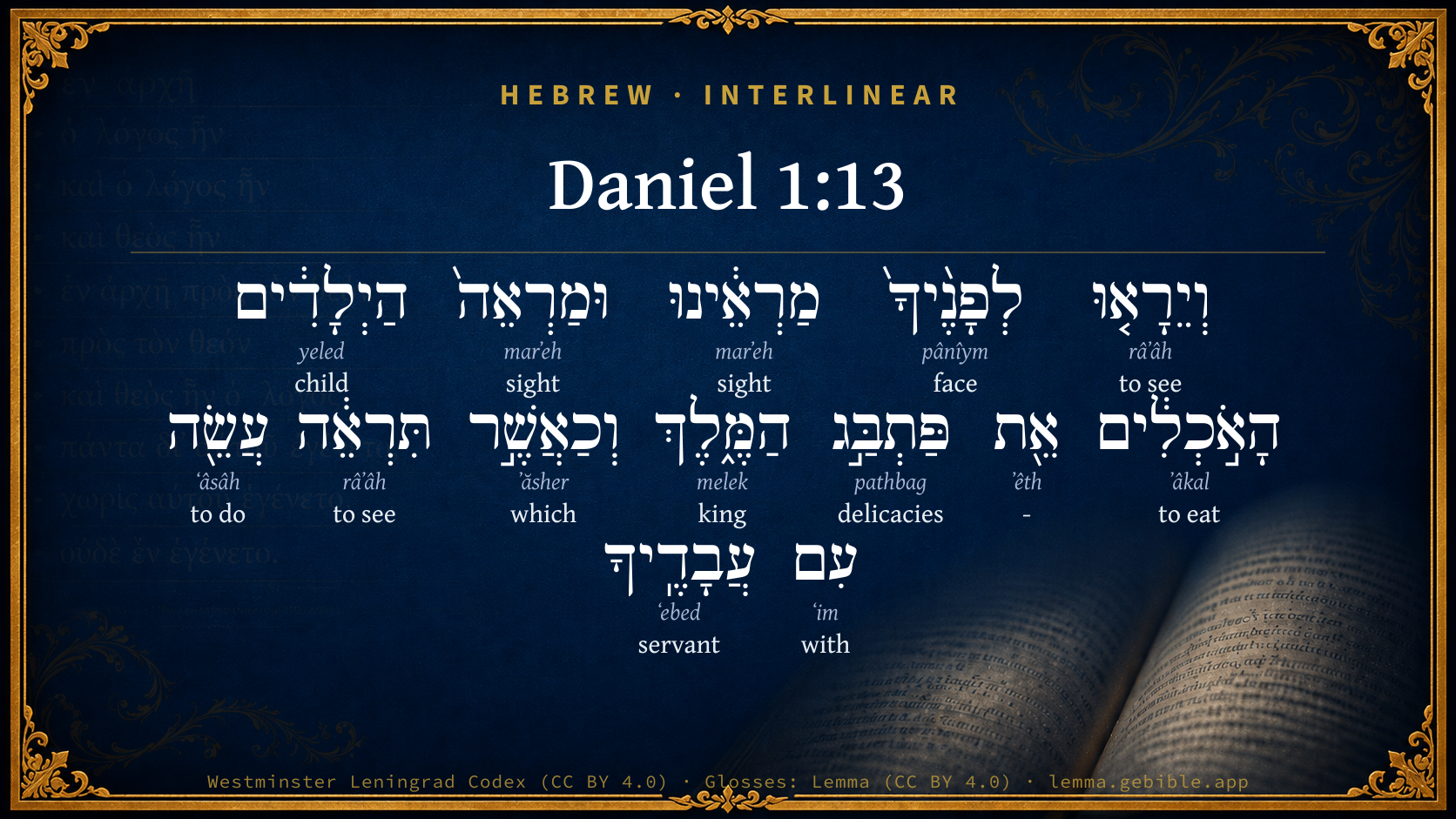
Hebrew (Westminster Leningrad Codex) Daniel 1:13 appears in the Hebrew Old Testament. The text above is from the Westminster Leningrad Codex. Each word links to its Strong’s number, a concise gloss, and parsing drawn from the Open Scriptures Hebrew Bible morphology. Click any word for its full Brown-Driver-Briggs (BDB) entry.
Download image
Cite this verse

Daniel 1:13 (World English Bible). Public Domain. Lemma interlinear Bible study tool, https://lemma.gebible.app/v/daniel/1/13.

Show BibTeX & RIS
BibTeX
RIS
English Translation
Then let our faces be looked on before you, and the face of the youths who eat of the king's dainties; and as you see, deal with your servants.
World English Bible · Public Domain
Download a study sheet

One document with this verse’s original text, its word-by-word gloss line, the meaning frame, cross-references with their text, attributed commentary, and full source and license credits — printable, and it pastes into notes with its structure intact.

This verse Autodidact and up

Study sheet (.html) Plain text (.txt)

A passage Seminary Student

Up to 50 verses in one chapter. A passage sheet keeps up to 6 commentary sources and 12 cross-references per verse, in the order this page ranks them, and says so on the sheet whenever that leaves anything out. Ask for a single verse and you get the Autodidact verse sheet above.

Everything on this page stays free to read, with no account — the sheet is a download of what is already on screen, not access to it.

Want to remove ads? Support Godless Engineer
Compare translations 3

The same verse in 3 English versions, stacked beneath the original-language interlinear above. Click any original word for its lexicon entry.

Each is an independent rendering of the whole verse — the interlinear is not word-aligned to these translations.

Highlighted words mark where these versions differ — a whole-verse word diff, not a word-by-word alignment.

  • World English Bible Public Domain
    Then let our faces be looked on before you, and the face of the youths who eat of the king's dainties; and as you see, deal with your servants.
  • King James Version Public Domain
    Then let our countenances be looked upon before thee, and the countenance of the children that eat of the portion of the king's meat: and as thou seest, deal with thy servants.
  • unfoldingWord Literal Text CC BY-SA 4.0
    Then let our appearance be observed in your presence and the appearance of the youths who eat the choice food of the king, and deal with your servants according to what you see.”

unfoldingWord Literal Text — © unfoldingWord, licensed CC BY-SA 4.0. Word-aligned USFM3 via Door43 (git.door43.org/unfoldingWord/en_ult).

Versions to compare (up to 4)

3 of 4 selected

Show all 18 translations

Every available English version of this verse, each an independent rendering of the whole verse.

  • World English Bible Public Domain
    Then let our faces be looked on before you, and the face of the youths who eat of the king's dainties; and as you see, deal with your servants.
  • Berean Standard Bible Public Domain
    Then compare our appearances with those of the young men who are eating the royal food, and deal with your servants according to what you see.”
  • Majority Standard Bible Public Domain
    Then compare our appearances with those of the young men who are eating the royal food, and deal with your servants according to what you see.”
  • King James Version Public Domain
    Then let our countenances be looked upon before thee, and the countenance of the children that eat of the portion of the king's meat: and as thou seest, deal with thy servants.
  • American Standard Version (1901) Public Domain
    Then let our countenances be looked upon before thee, and the countenance of the youths that eat of the king's dainties; and as thou seest, deal with thy servants.
  • Revised Version (1885) Public Domain
    Then let our countenances be looked upon before thee, and the countenance of the youths that eat of the king’s meat; and as thou seest, deal with thy servants.
  • Geneva Bible (1599) Public Domain
    Then let our countenances bee looked vpon before thee, and the countenances of the children that eate of the portion of the Kings meate: and as thou seest, deale with thy seruantes.
  • Douay-Rheims (1899) Public Domain
    And look upon our faces, and the faces of the children that eat of the king's meat: and as thou shalt see, deal with thy servants.
  • Young's Literal Translation Public Domain
    and our appearance is seen before thee, and the appearance of the lads who are eating the king's portion of food, and as thou seest -- deal with thy servants.'
  • Literal Standard Version CC BY-SA 4.0
    and our appearance is seen before you, and the appearance of the boys who are eating the king’s portion of food, and as you see—deal with your servants.”
  • Unlocked Literal Bible CC BY-SA 4.0
    Then compare our appearance with the appearance of the young men who eat the king's delicacies, and treat us, your servants, based on what you see.”
  • unfoldingWord Literal Text CC BY-SA 4.0
    Then let our appearance be observed in your presence and the appearance of the youths who eat the choice food of the king, and deal with your servants according to what you see.”
  • Darby Bible Public Domain
    then let our countenances be looked upon before thee, and the countenance of the youths that eat of the king's delicate food: and as thou shalt see, deal with thy servants.
  • World Messianic Bible Public Domain
    Then let our faces be examined before you, and the face of the youths who eat of the king’s delicacies; and as you see, deal with your servants.”
  • Webster's Bible Public Domain
    Then let our countenances be looked upon before thee, and the countenances of the children that eat of the portion of the king's provision: and as thou seest, deal with thy servants.
  • Free Bible Version CC BY-SA 4.0
    “After that, compare us with those young men who ate the king's rich food. Then decide on the basis of what you see.”
  • Bible in Basic English Public Domain
    Then take a look at our faces and the faces of the young men who have food from the king's table; and, having seen them, do to your servants as it seems right to you.
  • JPS Tanakh (1917) Public Domain
    Then let our countenances be looked upon before thee, and the countenance of the youths that eat of the king's food; and as thou seest, deal with thy servants.'

Literal Standard Version (2020), Covenant Press — licensed CC BY-SA 4.0. Text via the HelloAO Bible API (eBible.org). Unlocked Literal Bible (unfoldingWord) — licensed CC BY-SA 4.0. Text via the HelloAO Bible API (eBible.org). unfoldingWord Literal Text — © unfoldingWord, licensed CC BY-SA 4.0. Word-aligned USFM3 via Door43 (git.door43.org/unfoldingWord/en_ult). Free Bible Version, Dr. Jonathan Gallagher — licensed CC BY-SA 4.0. Text via the HelloAO Bible API (eBible.org).

Word by word

More ways to search: Search by grammar → Find every occurrence → Compare this word →

Practice this passage: Drill this verse → Learn its vocabulary →

פַּתְבַּ֣ג
pathbag
H6598
“delicacies of”
Noun, Common, Masculine, Singular, Construct
Part of Speech
Noun
Type
Common
Gender
Masculine
Number
Singular
State
Construct
Full BDB Definition

Origin: of Persian origin

TWOT: 1851

portion of food for king, delicacies
  1. וְיֵרָא֤וּ râʼâh H7200 “and · to see” Conjunction + Verb, Niphal, Jussive, 3rd Person, Masculine, Plural
  2. לְפָנֶ֨יךָ֙ pânîym H6440 “to/for · face(s) · your” Preposition + Noun, Common, Both, Plural, Construct + Suffix, Personal, 2nd Person, Masculine, Singular
  3. מַרְאֵ֔ינוּ marʼeh H4758 “sight · our” Noun, Common, Masculine, Singular, Construct + Suffix, Personal, 1st Person, Common, Plural
  4. וּמַרְאֵה֙ marʼeh H4758 “and · sight of” Conjunction + Noun, Common, Masculine, Singular, Construct
  5. הַיְלָדִ֔ים yeled H3206 “the · children” Particle, Definite Article + Noun, Common, Masculine, Plural, Absolute
  6. הָאֹ֣כְלִ֔ים ʼâkal H398 “the · eating” Particle, Definite Article + Verb, Qal, Participle Active, Masculine, Plural, Absolute
  7. אֵ֖ת ʼêth H853 “-” Particle, Direct Object
  8. הַמֶּ֑לֶךְ melek H4428 “the · king” Particle, Definite Article + Noun, Common, Masculine, Singular, Absolute
  9. וְכַאֲשֶׁ֣ר ʼăsher H834 “and · like/as · which” Conjunction + Preposition + Particle, Relative
  10. תִּרְאֵ֔ה râʼâh H7200 “to see” Verb, Qal, Imperfect, 2nd Person, Masculine, Singular
  11. עֲשֵׂ֖ה ʻâsâh H6213 “do” Verb, Qal, Imperative, 2nd Person, Masculine, Singular
  12. עִם ʻim H5973 “with” Preposition
  13. עֲבָדֶֽיךָ ʻebed H5650 “servants · your” Noun, Common, Masculine, Plural, Construct + Suffix, Personal, 2nd Person, Masculine, Singular

About this verse

These counts appear in no published source. They are computed here, from the morphology-tagged text and Lemma’s own curated glosses. What Lemma adds →

14
words
12
distinct lemmas
Prophets
section

Notable vocabulary

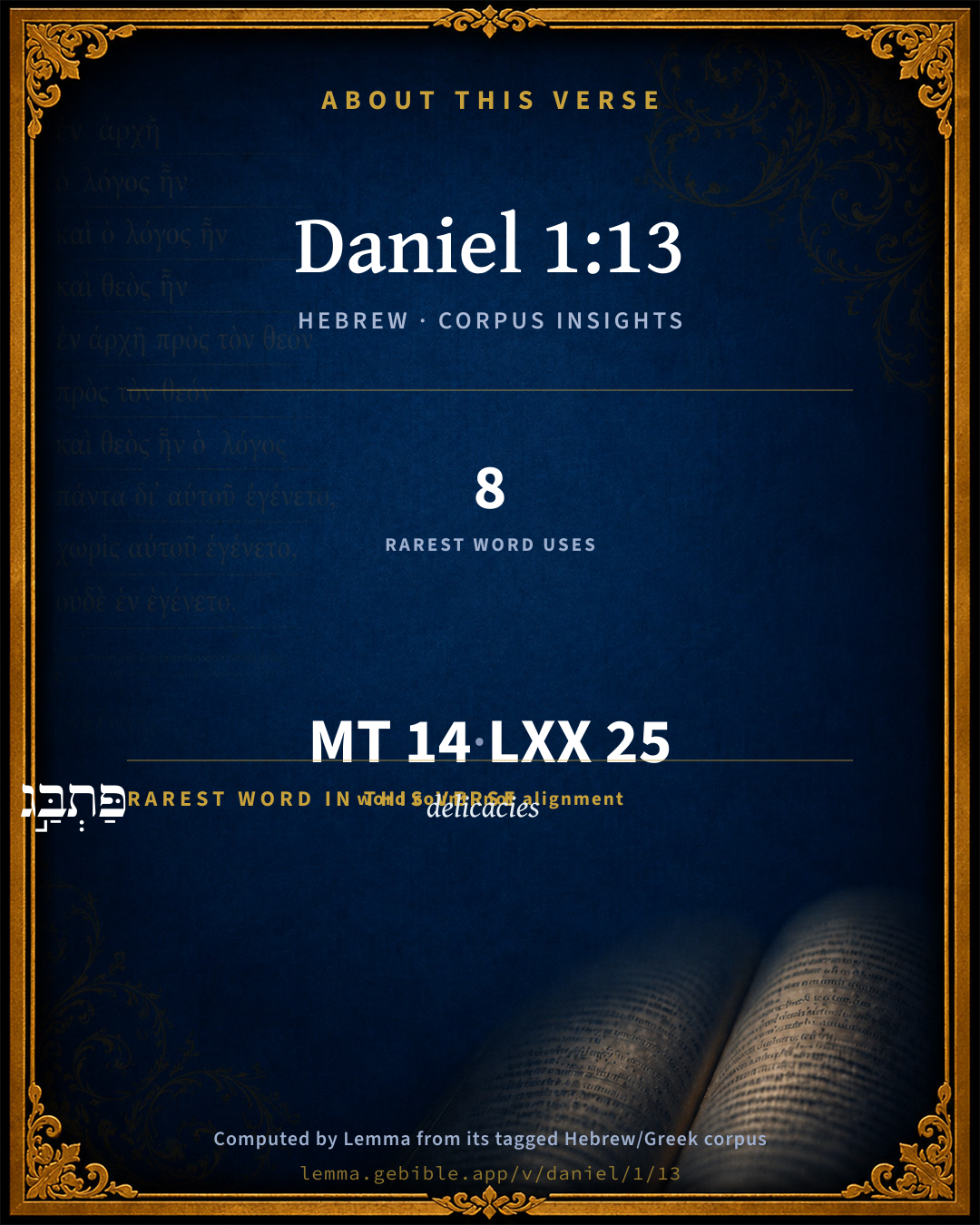
The rarest word here is פַּתְבַּ֣ג delicacies H6598 — appearing just 8 times in the whole Hebrew Bible.

Shared distinctive vocabulary

פַּתְבַּ֣ג delicacies H6598 occurs in 6 verses of the Hebrew Bible. Also found in:

Grammatical profile

  • 4 verbs
  • 7 nouns
  • 1 preposition
  • 2 particles

Verb forms

  • וְיֵרָא֤וּ Niphal · Jussive
  • הָאֹ֣כְלִ֔ים Qal · Participle Active
  • תִּרְאֵ֔ה Qal · Imperfect
  • עֲשֵׂ֖ה Qal · Imperative

Repetition

Words recur within this verse — often emphatic in Hebrew:

  • וְיֵרָא֤וּ to see H7200 ×2
  • מַרְאֵ֔ינוּ sight H4758 ×2

Hebrew & Septuagint length

In English translation the verse runs 29 words from the Hebrew and 30 from the Septuagint (LXX English) — closely comparable.

A rough comparison of the two English renderings, which tokenize alike — not a word-level alignment.

Word counts can differ between the Hebrew and the Greek without any difference in meaning — e.g. the Hebrew direct-object marker אֵת has no separate Greek word, and Greek often adds the article ὁ.

In the original languages it is 14 Hebrew tokens and 25 Greek tokens — but the two are counted differently (Hebrew bundles its prefixes and suffixes into one token; the Greek is in lemma form), so that isn’t a like-for-like length.

Hebrew and Greek witnesses Masoretic Hebrew ↔ Greek Septuagint

The same verse in the two great witnesses to the Old Testament, shown verse-for-verse.

These are two independent witnesses, not word-aligned to each other, and the Septuagint is shown in lemma (dictionary) form.

Hebrew Daniel 1:13 Masoretic · Westminster Leningrad Codex

וְיֵרָא֤וּ לְפָנֶ֨יךָ֙ מַרְאֵ֔ינוּ וּמַרְאֵה֙ הַיְלָדִ֔ים הָאֹ֣כְלִ֔ים אֵ֖ת פַּתְבַּ֣ג הַמֶּ֑לֶךְ וְכַאֲשֶׁ֣ר תִּרְאֵ֔ה עֲשֵׂ֖ה עִם עֲבָדֶֽיךָ

Then let our faces be looked on before you, and the face of the youths who eat of the king's dainties; and as you see, deal with your servants.

World English Bible · Public Domain

Greek LXX Daniel 1:13 Septuagint · lemma form

καί ἐάν φαίνω ὁ ὄψις ἐγώ διατρέπω παρά ὁ ἄλλος νεανίσκος ὁ ἐσθίω ἀπό ὁ βασιλικός δεῖπνον καθώς ἐάν θέλω οὕτως χράω ὁ παῖς σύ

And let our countenances be seen by you, and the countenances of the children that eat at the king's table; and deal with your servants according as you shall see.

LXX2012 (modern English Septuagint) · Public Domain

On this verse, The Pulpit Commentary discusses the Septuagint’s reading. Read the note in Commentary ↓

Hebrew: Westminster Leningrad Codex (CC BY 4.0). Greek: Septuagint (public domain); English from LXX2012 (modern English Septuagint) (Public Domain). How the Septuagint differs from the Hebrew →

Commentary

Notes on Daniel 1:13 from classic Christian and Jewish commentators (each source and its license shown beneath its notes). The classic Christian expositions comment on the surrounding passage and are grouped to its opening verse, so a note may address several verses; the Jewish commentaries on the Tanakh (Rashi and others) are per-verse, so they appear only where the commentator wrote on this verse.

Lemma curates 59 commentaries, every one of them public domain or Creative Commons licensed, each selected and text-cleaned for this edition rather than reprinted as found. About our sources →

Trapp's Complete Commentary

John Trapp

Dan 1:13 Then let our countenances be looked upon before thee, and the countenance of the children that eat of the portion of the king’s meat: and as thou seest, deal with thy servants.

Ver. 13. Then let our countenances be looked upon.] {See Trapp on "Dan 1:12"}

And as thou seest, deal with thy servants.] Thus humbly they bespeak the butler, or purveyor, though themselves were nobly descended. God had made them captives, and they now carry their sails accordingly.

John Trapp, A Commentary or Exposition upon All the Books of the Old and New Testament (1647–1656) — public domain. Text from a community e-Sword module.

Tyndale Open Study Notes

Tyndale Open Resources

1:13-14 make your decision: Daniel’s exemplary wisdom, prudence, and courtesy are seen in his respectful stance toward his attendant, who responded favorably.

Tyndale Open Study Notes — © Tyndale Open Resources, licensed CC BY-SA 4.0. Text via the HelloAO Bible API.

Ibn Ezra

Rabbi Abraham ibn Ezra

[Daniel 1:13] Ve-yera’u (וְיֵרָא֤וּ - And let [our appearance] be seen): [Meaning:] At the end of the ten [days, let] our appearance [be seen and compared]. And he [Daniel] mentioned “the king’s pat-bag [food]” and adopted a concise manner of speaking (derech ketzarah - דֶּרֶךְ קְצָרָה) in that he did not mention the wine [even though they were also abstaining from it].

Ibn Ezra on the Tanakh — English translations: “Sefaria Community Translation” (CC0 1.0 (public-domain dedication)); “Yalkut, Sifsei Chachomim Chumash, Metsudah Publications, 2009” (CC BY 4.0); and “Commentary of Ibn Ezra on Isaiah - trans. by M. Friedlander, 1873” (public domain). Text via Sefaria.

Jamieson, Fausset & Brown

Robert Jamieson, A. R. Fausset & David Brown

Illustrating Deu 8:3, "Man doth not live by bread only, but by every word that proceedeth out of the mouth of the Lord."

Jamieson, Fausset & Brown — Commentary Critical and Explanatory on the Whole Bible (1871) — public domain (CC PDM 1.0). Text via the HelloAO Bible API.

The Cambridge Bible for Schools and Colleges

gen. ed. J. J. S. Perowne

13. of the youths that eat the king’s delicacies] as Dan_1:5; Dan_1:8.

The Cambridge Bible for Schools and Colleges (gen. ed. J. J. S. Perowne; Cambridge University Press, 1878–1918) — public domain. Text from a community e-Sword module.

John Gill's Exposition

Then let our countenances be looked upon before thee,.... And be thoroughly examined, whether any alteration is made therein for the worse:

and the countenance of the children that eat of the portion of the king's meat; who were either Chaldean youths brought up in this manner; or rather young men of the Jews, who were not so scrupulous as Daniel and his companions, and made no objection to eating the king's food; let their countenances and ours be compared together:

and as thou seest deal with thy servants: if there is no difference, or we are not the worse for abstaining from the king's meat, then grant us our request, and continue to indulge us in this manner; but, if otherwise, do as thou wilt. Daniel, no doubt, in putting the matter on this issue, as it should turn out at the end of ten days, had a revelation or assurance from God how it would be, or he would never have ventured to put it to such a trial.

John Gill's Exposition of the Whole Bible (1746–1763) — public domain (CC PDM 1.0). Text via the HelloAO Bible API.

Albert Barnes' Notes on the Bible

Then let our countenances be looked upon - One of the “objects” to be secured by this whole trial was to promote their personal beauty, and their healthful appearance Dan 1:4-5, and Daniel was willing that the trial should be made with reference to that, and that a judgment should be formed from the observed effect of their temperate mode of life. The Hebrew word rendered countenance (מראה mar'eh) is not limited to the “face,” as the word countenance is with us. It refers to the whole appearance, the form, the “looks;” and the expression here is equivalent to, “Then look on us, and see what the result has been, and deal with us accordingly” The Greek is, αἱ ἰδέαι ἡμῶν hai ideai hēmōn - our appearance.

Of the children - Youths; young men. Notes, Dan 1:4. The reference is, probably, to the Chaldean youths who were trained up amidst the luxuries of the court. It is possible, however, that the reference is to Hebrew youths who were less scrupulous than Daniel and his companions.

And as thou seest, deal with thy servants - As the result shall be. That is, let us be presented at court, and promoted or not, as the result of our mode of living shall be. What the effect would have been if there had been a failure, we are not informed. Whether it would have endangered their lives, or whether it would have been merely a forfeiture of the proffered honors and advantages, we have no means of determining. It is evident that Daniel had no apprehension as to the issue.

Albert Barnes' Notes on the Bible (1834–1885) — public domain. Text from a community e-Sword/MySword module.

Matthew Poole's English Annotations

By these words Daniel secures Melzar against fear and danger, only by ten days’ trial; which was a fair and reasonable proffer. Thus the servants of God must carefully do, when they have good offices done them by the servants of princes, as Elijah was careful of good Obadiah, 1Ki 18:11,12, to secure him from death.

Matthew Poole's English Annotations on the Holy Bible (1683–1685) — public domain. Text from a community e-Sword/MySword module.

The Pulpit Commentary

Then let our countenances be looked upon before thee, and the countenance of the children that eat of the portion of the king"s meat: and as thou seest, deal with thy servants. The Septuagint Version here differs considerably from the Massoretic text; it is as follows: "And should our countenance appear more downcast than (diatetrammenh para) those other youths who eat of the royal feast, according as thou seest good (qelhv), so deal with thy servants." In the text before the Septuagint translator (l"phaneka), "before thee," is omitted, and instead of haerm (mareh)," appearance," is read (zoaphim), and after is inserted mi (min), "from," the sign of the comparative, equivalent to than. " Theodotion, Jerome, and the Peshitta represent accurately the Massoretic text. Against the Septuagint reading is the fact that in the Massoretic, marayeeaen is construed a singular, but in Eze 15 it is plural. The vocalization of tirayh, "thou shalt see," is Aramaean, and therefore confirms the idea that this chapter is a translation in which the original shines through. The reading of the Septuagint implies that a different meaning must be put on the last clause from that in the English Version. It means that, should the experiment prove a failure, they were willing to suffer any punishment that the official in question saw good. Such an interference with the arrangements of.the king would be a crime to be punished with stripes. Although a perfectly consistent sense can be brought from the text behind the Septuagint, yet, from the fact that the phrase, (zo"apheem min- hay"ladeem), occurs in the tenth verse, and therefore may be repeated here by accident, we would not definitely prefer it. Further, the Massoretic text follows more naturally from the context. Let the steward see the result of the experiment after ten days, and, as he sees, so let him judge and act. Daniel and his companions leave the matter thus really in the hands of Providence.

The Pulpit Commentary (1880–1919), ed. H.D.M. Spence-Jones & Joseph S. Exell — public domain. Text from a community e-Sword module.

Rashi

Rabbi Shlomo Yitzchaki (Rashi)

and as you will see According to what you see, do.

Rashi on the Tanakh — English translations: “The Judaica Press complete Tanach with Rashi, translated by A. J. Rosenberg” (CC BY 4.0); “Pentateuch with Rashi's commentary by M. Rosenbaum and A.M. Silbermann, 1929-1934” (public domain); “The Metsudah Tanach series, Lakewood, N.J” (CC BY 4.0); and “The Book of Joshua, Metsudah Publications, 1997” (CC BY 4.0). Text via Sefaria.

Lesson kit

Teaching starters — assembled from the data on this page, not authored interpretation. Every prompt links to the verse data it draws on. Edit before teaching.

Daniel, in the Prophets, opens this verse with 14 words (12 distinct Hebrew lemmas). Its most distinctive word is pathbag (“delicacies”). A historical commentator’s framing appears above. Read the whole chapter for the surrounding context.

Discussion questions

  1. The word pathbag carries the sense “delicacies.” How does it shape the verse?
  2. Daniel 1:5 shares the word «delicacies» with this verse. How do the two illuminate each other?
  3. “to see” occurs 2× in this one verse. What is the effect of the repetition?
  4. These translations render this verse differently. What is at stake in choosing one wording over another?
  5. The verb «וְיֵרָא֤וּ» is Niphal Jussive. How does its form color the action?
  6. Reading how Trapp's Complete Commentary and Tyndale Open Study Notes read this verse, where do the two commentators agree and where do they part?

Things to notice

Reading settings

Reading text

Shown beneath each verse's original-language words.

Old Testament
Old Testament edition

Read the OT as the Masoretic Hebrew (MT) or the Greek Septuagint (LXX).

English shown for the Greek Septuagint (in the Hebrew ↔ Greek comparison).

Comparing translations? Open the Compare panel on any verse page to stack up to four side by side.