
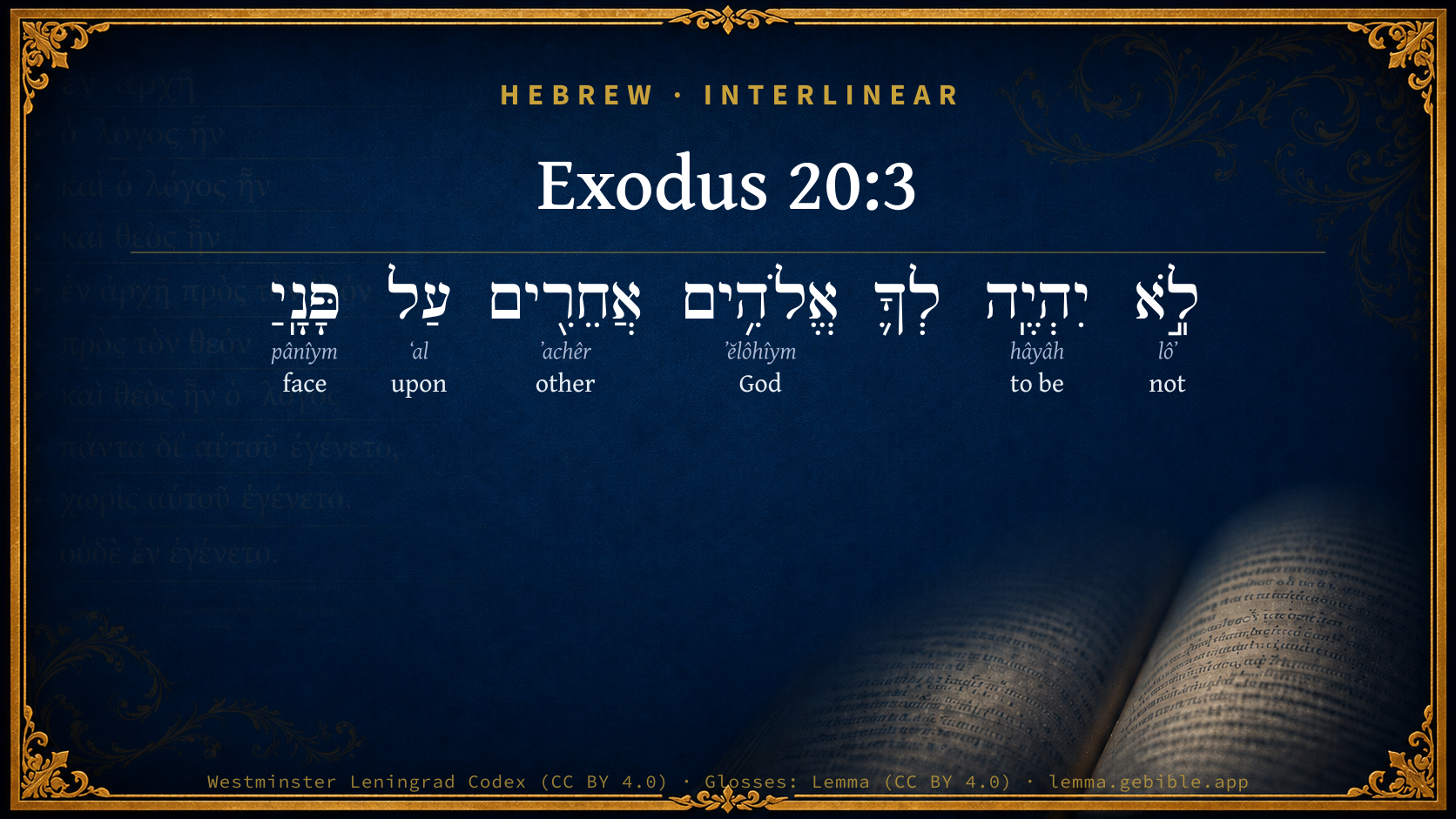
Exodus 20:3

Hebrew (Westminster Leningrad Codex) Exodus 20:3 appears in the Hebrew Old Testament. The text above is from the Westminster Leningrad Codex. Each word links to its Strong’s number, a concise gloss, and parsing drawn from the Open Scriptures Hebrew Bible morphology. Click any word for its full Brown-Driver-Briggs (BDB) entry.
Download image
Cite this verse

Exodus 20:3 (World English Bible). Public Domain. Lemma interlinear Bible study tool, https://lemma.gebible.app/v/exodus/20/3.

Show BibTeX & RIS
BibTeX
RIS
English Translation
You shall have no other gods before me.
World English Bible · Public Domain
Download a study sheet

One document with this verse’s original text, its word-by-word gloss line, the meaning frame, cross-references with their text, attributed commentary, and full source and license credits — printable, and it pastes into notes with its structure intact.

This verse Autodidact and up

Study sheet (.html) Plain text (.txt)

A passage Seminary Student

Up to 50 verses in one chapter. A passage sheet keeps up to 6 commentary sources and 12 cross-references per verse, in the order this page ranks them, and says so on the sheet whenever that leaves anything out. Ask for a single verse and you get the Autodidact verse sheet above.

Everything on this page stays free to read, with no account — the sheet is a download of what is already on screen, not access to it.

Want to remove ads? Support Godless Engineer
Compare translations 3

The same verse in 3 English versions, stacked beneath the original-language interlinear above. Click any original word for its lexicon entry.

Each is an independent rendering of the whole verse — the interlinear is not word-aligned to these translations.

Highlighted words mark where these versions differ — a whole-verse word diff, not a word-by-word alignment.

  • World English Bible Public Domain
    You shall have no other gods before me.
  • King James Version Public Domain
    Thou shalt have no other gods before me.
  • unfoldingWord Literal Text CC BY-SA 4.0
    There shall not be to you other gods above my face.

unfoldingWord Literal Text — © unfoldingWord, licensed CC BY-SA 4.0. Word-aligned USFM3 via Door43 (git.door43.org/unfoldingWord/en_ult).

Versions to compare (up to 4)

3 of 4 selected

Show all 18 translations

Every available English version of this verse, each an independent rendering of the whole verse.

  • World English Bible Public Domain
    You shall have no other gods before me.
  • Berean Standard Bible Public Domain
    You shall have no other gods before Me.
  • Majority Standard Bible Public Domain
    You shall have no other gods before Me.
  • King James Version Public Domain
    Thou shalt have no other gods before me.
  • American Standard Version (1901) Public Domain
    Thou shalt have no other gods before me.
  • Revised Version (1885) Public Domain
    Thou shalt have none other gods before me.
  • Geneva Bible (1599) Public Domain
    Thou shalt haue none other Gods before me.
  • Douay-Rheims (1899) Public Domain
    Thou shalt not have strange gods before me.
  • Young's Literal Translation Public Domain
    `Thou hast no other Gods before Me.
  • Literal Standard Version CC BY-SA 4.0
    You have no other Gods before Me.
  • Unlocked Literal Bible CC BY-SA 4.0
    You must have no other gods before me.
  • unfoldingWord Literal Text CC BY-SA 4.0
    There shall not be to you other gods above my face.
  • Darby Bible Public Domain
    Thou shalt have no other gods before me.
  • World Messianic Bible Public Domain
    “You shall have no other gods before me.
  • Webster's Bible Public Domain
    Thou shalt have no other gods before me.
  • Free Bible Version CC BY-SA 4.0
    You must not have any other gods except me.
  • Bible in Basic English Public Domain
    You are to have no other gods but me.
  • JPS Tanakh (1917) Public Domain
    Thou shalt have no other gods before Me.

Literal Standard Version (2020), Covenant Press — licensed CC BY-SA 4.0. Text via the HelloAO Bible API (eBible.org). Unlocked Literal Bible (unfoldingWord) — licensed CC BY-SA 4.0. Text via the HelloAO Bible API (eBible.org). unfoldingWord Literal Text — © unfoldingWord, licensed CC BY-SA 4.0. Word-aligned USFM3 via Door43 (git.door43.org/unfoldingWord/en_ult). Free Bible Version, Dr. Jonathan Gallagher — licensed CC BY-SA 4.0. Text via the HelloAO Bible API (eBible.org).

Word by word

More ways to search: Search by grammar → Find every occurrence → Compare this word →

Practice this passage: Drill this verse → Learn its vocabulary →

About this verse

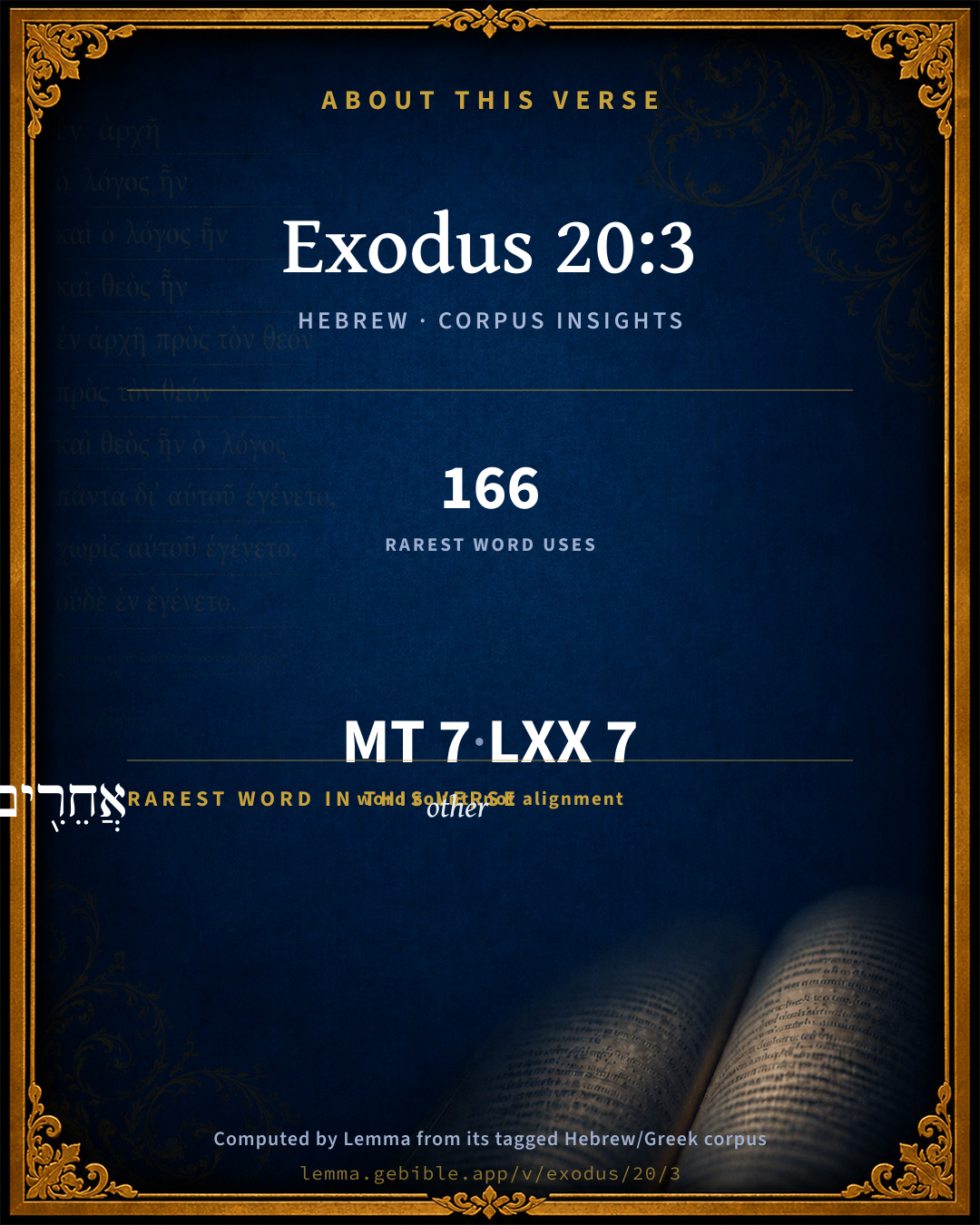
These counts appear in no published source. They are computed here, from the morphology-tagged text and Lemma’s own curated glosses. What Lemma adds →

7
words
6
distinct lemmas
Pentateuch
section

Grammatical profile

  • 1 verb
  • 2 nouns
  • 1 adjective
  • 2 prepositions
  • 1 particle

Verb forms

  • יִהְיֶֽה Qal · Imperfect

Hebrew & Septuagint length

In English translation the verse runs 8 words from the Hebrew and 8 from the Septuagint (LXX English) — the same length.

A rough comparison of the two English renderings, which tokenize alike — not a word-level alignment.

Word counts can differ between the Hebrew and the Greek without any difference in meaning — e.g. the Hebrew direct-object marker אֵת has no separate Greek word, and Greek often adds the article ὁ.

In the original languages it is 7 Hebrew tokens and 7 Greek tokens — but the two are counted differently (Hebrew bundles its prefixes and suffixes into one token; the Greek is in lemma form), so that isn’t a like-for-like length.

Cross-references

26

Topical passages linked to Exodus 20:3 in the Treasury of Scripture Knowledge — connected by theme and wording, ordered by reader-vote popularity; previews shown in the World English Bible.

  • Deuteronomy 5:7 You shall have no other gods before me.
  • Matthew 4:10 Then Jesus said to him, "Get behind me, Satan! For it is written, 'You shall worship the Lord your God, and him only shall you serve.'"
  • Psalms 81:9 There shall be no strange god in you, Neither shall you worship any foreign god.
  • Isaiah 46:9 Remember the former things of old: for I am God, and there is none else; [I am] God, and there is none like me;
  • Deuteronomy 6:5 and you shall love Yahweh your God with all your heart, and with all your soul, and with all your might.
  • Deuteronomy 6:14 You shall not go after other gods, of the gods of the peoples who are round about you;
  • Jeremiah 25:6 and don't go after other gods to serve them or worship them, and don't provoke me to anger with the work of your hands; and I will do you no harm.
  • Joshua 24:18–24 and Yahweh drove out from before us all the peoples, even the Amorites who lived in the land: therefore we also will serve Yahweh; for he is our God.
  • Jeremiah 35:15 I have sent also to you all my servants the prophets, rising up early and sending them, saying, Return you now every man from his evil way, and amend your doings, and don't go after other gods to serve them, and you shall dwell in the land which I have given to you and to your fathers: but you have not inclined your ear, nor listened to me.
  • 1 John 5:20–21 We know that the Son of God has come, and has given us an understanding, that we know him who is true, and we are in him who is true, in his Son Jesus Christ. This is the true God, and eternal life.
  • 1 Corinthians 8:6 yet to us there is one God, the Father, of whom are all things, and we for him; and one Lord, Jesus Christ, through whom are all things, and we live through him.
  • Exodus 15:11 Who is like you, Yahweh, among the gods? Who is like you, glorious in holiness, Fearful in praises, doing wonders?
  • Isaiah 26:4 Trust in Yahweh forever; for in Yah, Yahweh, is an everlasting Rock.
  • Ephesians 5:5 Know this for sure, that no sexually immoral person, nor unclean person, nor covetous man, who is an idolater, has any inheritance in the Kingdom of Christ and God.
  • Philippians 3:19 whose end is destruction, whose god is the belly, and whose glory is in their shame, who think about earthly things.
  • Colossians 2:18 Let no one rob you of your prize by a voluntary humility and worshipping of the angels, dwelling in the things which he has not seen, vainly puffed up by his fleshly mind,
  • Revelation 19:10 I fell down before his feet to worship him. He said to me, "Look! Don't do it! I am a fellow bondservant with you and with your brothers who hold the testimony of Jesus. Worship God, for the testimony of Jesus is the Spirit of Prophecy."
  • Exodus 20:23 You shall most certainly not make alongside of me gods of silver, or gods of gold for yourselves.
  • Psalms 29:2 Ascribe to Yahweh the glory due to his name. Worship Yahweh in holy array.
  • Psalms 73:25 Who do I have in heaven? There is no one on earth who I desire besides you.
  • Isaiah 43:10 You are my witnesses, says Yahweh, and my servant whom I have chosen; that you may know and believe me, and understand that I am he: before me there was no God formed, neither shall there be after me.
  • Isaiah 44:8 Don't fear, neither be afraid: haven't I declared to you of old, and shown it? You are my witnesses. Is there a God besides me? Indeed, there is not. I don't know any Rock.
  • 2 Kings 17:29–35 However every nation made gods of their own, and put them in the houses of the high places which the Samaritans had made, every nation in their cities in which they lived.
  • Revelation 22:9 He said to me, "See you don't do it! I am a fellow bondservant with you and with your brothers, the prophets, and with those who keep the words of this book. Worship God."
  • 1 Corinthians 8:4 Therefore concerning the eating of things sacrificed to idols, we know that no idol is anything in the world, and that there is no other God but one.
  • Isaiah 45:21–22 Declare you, and bring [it] forth; yes, let them take counsel together: who has shown this from ancient time? who has declared it of old? Haven't I, Yahweh? and there is no God else besides me, a just God and a Savior; there is no one besides me.

Cross-references courtesy of OpenBible.info (CC BY 4.0).

Hebrew and Greek witnesses Masoretic Hebrew ↔ Greek Septuagint

The same verse in the two great witnesses to the Old Testament, shown verse-for-verse.

These are two independent witnesses, not word-aligned to each other, and the Septuagint is shown in lemma (dictionary) form.

Hebrew Exodus 20:3 Masoretic · Westminster Leningrad Codex

לֹֽ֣א יִהְיֶֽה לְךָ֛ אֱלֹהִ֥ים אֲחֵרִ֖ים עַל פָּנָֽיַ

You shall have no other gods before me.

World English Bible · Public Domain

Greek LXX Exodus 20:3 Septuagint · lemma form

οὐ εἰμί σύ θεός ἕτερος πλήν ἐγώ

You shall have no other gods beside me.

LXX2012 (modern English Septuagint) · Public Domain

On this verse, Whedon's Commentary on the Bible discusses the Septuagint’s reading. Read the note in Commentary ↓

Hebrew: Westminster Leningrad Codex (CC BY 4.0). Greek: Septuagint (public domain); English from LXX2012 (modern English Septuagint) (Public Domain). How the Septuagint differs from the Hebrew →

Targum (Aramaic paraphrase)

2

The Targum is the ancient Jewish Aramaic paraphrase of the Hebrew Scriptures — an interpretive translation, not the Hebrew text itself. Onkelos (literal) and Pseudo-Jonathan (expansive) render the Torah, and Jonathan the Prophets. Coverage is partial: where no permissively-licensed English translation exists for a verse, only the Aramaic is shown. This is verse-level text, not a word-by-word alignment to the Hebrew.

  1. Targum Onkelos Torah (Genesis–Deuteronomy)
    לָא יְהֵי לָךְ אֱלָהּ אָחֳרָן בַּר מִנִי:

    (no public-domain English translation for this verse)

    Targum Onkelos — Aramaic: “Onkelos Genesis” (public domain); “Onkelos Exodus” (public domain); “Onkelos Leviticus” (public domain); “Onkelos Numbers” (public domain); “Onkelos Deuteronomy” (public domain). English: “Sefaria Community Translation” (CC0 1.0 (public-domain dedication)); “J.W. Etheridge. The Targums of Onkelos and Jonathan Ben Uzziel on the Pentateuch. London: Longmans, Green, 1862” (public domain). Text via Sefaria.

  2. Targum Pseudo-Jonathan Torah (Genesis–Deuteronomy)
    דְּבִירָא תִּנְיָנָא כַּד הֲוָה נָפִיק מִן פּוּם קוּדְשָׁא יְהֵי שְׁמֵיהּ מְבָרֵךְ הֵי כְּזִיקִין וְהֵי כְבַרְקִין וְהֵי כְּשַׁלְהוֹבִין דִּינוּר לַמְפַּד דִּינוּר מִן יְמִינֵיהּ וְלַמְפַּד דְּאֵישָׁא מִן שְמָאלֵיהּ פָּרַח וְטַיֵּיס בְּאַוִיר שְׁמַיָא חָזַר וּמִתְחַמֵּי עַל מַשִׁירְיַתְהוֹן דְּיִשְרָאֵל וְחָזַר וּמִתְחַקֵּק עַל לוּחֵי קְיָימָא וּמִתְהַפִּיךְ בְּהוֹן מִן סְטַר לִסְטַר וּבְכֵן הֲוָה צָוַוח וְאָמַר עַמִּי בֵּית יִשְרָאֵל לָא יֶהֱוֵי לָךְ אֱלָהָא אוֹחֲרָן בַּר מִינִי

    The second word which came forth from the mouth of the Holy One, whose name be blessed, was like storms, and lightnings, and flames of fire. A burning light was on His right hand and on His left and was borne through the air of the heavens, returned, and was made manifest unto the camp of Israel; it returned, and was engraven on the tables of the covenant, and was turned in them from side to side. Then called He, and said, House of Israel, My people, Thou shalt have no other God beside Me.

    Targum Pseudo-Jonathan — Aramaic: “Targum Jonathan on Genesis” (public domain); “Targum Jonathan on Exodus” (public domain); “Targum Jonathan on Leviticus” (public domain); “Targum Jonathan on Numbers” (public domain); “Targum Jonathan on Deuteronomy” (public domain). English: “The Targum of Jonathan ben Uzziel, trans. J. W. Etheridge, London, 1862” (public domain). Text via Sefaria.

Commentary

Notes on Exodus 20:3 from classic Christian and Jewish commentators (each source and its license shown beneath its notes). The classic Christian expositions comment on the surrounding passage and are grouped to its opening verse, so a note may address several verses; the Jewish commentaries on the Tanakh (Rashi and others) are per-verse, so they appear only where the commentator wrote on this verse.

Lemma curates 59 commentaries, every one of them public domain or Creative Commons licensed, each selected and text-cleaned for this edition rather than reprinted as found. About our sources →

Trapp's Complete Commentary

John Trapp

Exo 20:3 Thou shalt have no other gods before me.

Ver. 3. Thou shalt have.] This "thou" reacheth every man. Xenophon saith of Cyrus, that when he gave anything in command, he never said, Let some one do this; but, Do thou this. {a}

No other gods before me.] But "know" and "serve" me alone "with a perfect heart, and with a willing mind." {1Ch 28:9} Hoc primo praecepto reliquorum omnium observantia praecipitur, saith Luther. In this first commandment the keeping of all the other nine is commanded. {See Trapp (for summary of Law) on "Exo 20:17"}

{a} Hoc tu facias. - Xenophon’s Cyropaed.

John Trapp, A Commentary or Exposition upon All the Books of the Old and New Testament (1647–1656) — public domain. Text from a community e-Sword module.

The Biblical Illustrator

Joseph S. Exell

Exo_20:3

Thou shalt have no other gods before Me.

The First Commandment

I. This Commandment does not tell the Jews that the gods worshipped by other nations have no existence; it tells him that he must offer them no homage, and that from him they must receive no recognition of their authority and power. The Jew must serve Jehovah, and Jehovah alone. This was the truest method of securing the ultimate triumph of monotheism. A religious dogma, true or false, perishes if it is not rooted in the religious affections and sustained by religious observances. But although the First Commandment does not declare that there is one God, the whole system of Judaism rests on that sublime truth, and what the Jews had witnessed in Egypt and since their escape from slavery must have done more to destroy their reverence for the gods of their old masters than could have been effected by any dogmatic declaration that the gods of the nations were idols.

II. The First Commandment may appear to have no direct practical value for ourselves. It would be a perversion of its obvious intention to denounce covetousness, social ambition, or excessive love of children. These are not the sins which this Commandment was meant to forbid. It must be admitted that there is no reason why God should say to any of us, Thou shalt have no other gods before Me. If He were to speak to many of us, it would be necessary to condemn us for having no god at all. The appalling truth is, that many of us have sunk into atheism. We all shrink from contact with God. And yet He loves us. But even His love would be unavailing if He did not inspire those who are filled with shame and sorrow by the discovery of their estrangement from Him, with a new and supernatural life. (R. W. Dale, D. D.)

The First Commandment

I. All want of a positive allegiance to Jehovah is a positive allegiance to another Elohim or supreme God. A self-reliant man, in the strict sense of the word, never yet existed. Mans nature is such that he looks without him for support, as the ivy feels for the tree or the wall. If he has not the true and living God as his stay, then he is an idolater.

II. All allegiance to God that does not recognize Him as He has revealed Himself is allegiance to a false god. So a view of God as careless of personal holiness in His creatures, or as too exalted to notice all their minute acts and thoughts, or as tyrannical and arbitrary in His dealings with them, or as appeasable by self-denials and penances, is a view of a false god, and not a view of Jehovah, the only living and true God. And the man who, despising or neglecting the Holy Scriptures, and trusting to his reason or his dreams, or to nature, or to nothing, holds such a god before his mind, is an idolater; he has put another Elohim before Jehovah Elohim. Because the thought of the Divine Being which he thus introduces into his heart becomes the substitute for the true motion that should guide his life, he puts the helm into as false hands as if he had delivered it to Mammon. Several subordinate thoughts naturally follow.

1. The help of the true God, Jehovah Jesus, should be sought by us to overthrow our false gods. By that very act we should offer rightful allegiance, and, in so doing, consecrate our life to the rightful service of Him who is our rightful King.

2. How watchful we should be in this earth, where the false gods are not only plenty, but exactly after the fashion of our own depraved hearts! It was said of Athens that at each corner there was a new god, and some have even said that in population Athens had more gods than men. It is so with our unseen gods of the unregenerate heart. They abound with different names and different characters, according to the tastes and characters of different men.

3. The Word of God ought to be in our hands all the while. This is the only offensive weapon against our false gods. (H. Crosby, D. D.)

The First Commandment

This Commandment, as all the rest, hath a positive part requiring something, and a negative part prohibiting something.

I. We shall, in the first place, speak to what is required here, and we take it up in these three things.

1. And first, it requireth the right knowledge of God; for there can be no true worship given to Him, there can be no right thought or conception of Him, or faith in Him, till He be known.

2. It requireth from us a suitable acknowledging of God in all these His properties. As--

(1) That He be highly esteemed above all

(2) Loved.

(3) Feared.

(4) Believed and trusted in.

(5) Hoped in.

(6) Adored.

(7) Honoured.

(8) Served and obeyed. And so--

(9) He must be the supreme end in all our actions that should mainly be aimed at by us.

3. It requireth such duties as result from His excellency, and our acknowledging Him to be such a one. As--

(1) Dependence upon Him.

(2) Submission to Him, and patience under cross dispensations from Him.

(3) Faith resting on Him.

(4) Prayers put up to Him.

(5) Repentance for wronging Him.

(6) Communion, and a constant walking with Him.

(7) Delighting in Him.

(8) Meditating on Him; and such other as necessarily may be inferred as duties incumbent on creatures in such a relation to such a God, whose excellency and worth calleth and inviteth men to all suitable duties.

4. Next, it is necessary that we add some advertisements to these generals.

(1) That the Commandment requireth all these, and in the highest and most perfect degree.

(2) That it not only requireth them in ourselves, but obligeth us to further them in all others, according to our places and callings.

(3) That it requireth the diligent use of all means that may help and further us in these; as reading and meditation, study, etc.

(4) That these things, which in some respect may be given to creatures, as love, fear, etc., yet, when they are required as duties to God, they are required in a far more imminent way.

II. In the next place, we should consider the negative part of this Commandment, for the extent thereof will be best discerned by considering what is forbidden therein, and how it may be broken. This idolatry is either:--

1. Doctrinal, or idolatry in the judgment, when one professedly believeth such a thing besides God to have some divinity in it; as heathens do of their Mars and Jupiter; or--

2. Practical, when men believe no such thing, and will not own any such opinion, yet are guilty of the same thing, as covetous men, etc.

3. It may be distinguished into idolatry that hath something for its object, as the Egyptians worshipped beasts, and the Persians the sun or fire, and that which has nothing but mens imaginations for its object, as these who worship feigned gods; in which respect the apostle saith, an idol is nothing (1Co_8:4).

4. We would distinguish betwixt the objects of idolatry; and they are either such as are in themselves simply sinful, as devils, profane men; or they are such as are good in themselves, but abused and wronged, when they are made objects of idolatry, as angels, saints, sun, moon, etc.

5. Distinguish betwixt idolatry that is more gross and professed, and that which is more latent, subtle, and denied. This distinction is like that before mentioned, in opinion and practice, and much coincideth with it.

6. Distinguish betwixt heart-idolatry (Eze_14:1-23.; Exo_14:11-12; Exo_16:2-3), and external idolatry. The former consisteth in an inward heart-respect to some idol, as this tumultuous people were enslaved to their ease and bellies in the last two fore-cited places; the other in some external idolatrous gesture or action. (James Durham.)

The First Commandment

First, there is the positive declaration of a personal God; and secondly, His claim to be worshipped as the one True and living God. The most obvious errors requiring our attention are four in number--Atheism, Polytheism, Pantheism, and Deism.

1. Except as a cloke for immorality and sinful indulgence, I am inclined to doubt the existence of Atheism, and the study of history confirms me in the doubt.

2. But what of the Polytheist, the worshipper, that is, of many gods; in this respect, at least, the very opposite to the last? It is not difficult to trace his origin. When time was young, men lived together in families, tribes, or small communities; beyond the circle of these they very rarely travelled. Before they were able to realize the idea of the oneness of the human race, each family would not unnaturally aim at being complete in itself; and as tending, especially to this, they would place themselves under the protection of some one particular god, and then gods multiplied, as a necessary consequence, upon the increase of people and subdivision of tribes. This was one cause. We might discover, without difficulty, others of a different nature. To take one instance, in times of ignorance, when the mind was unable to grasp the Infinite, men seized upon what was best in themselves, or what was noblest in nature, and deified this; and so at one time we find Earth, Air, Fire, and Water, receiving the homage of men; and at another we see temples arising to Faith, or Modesty, or Constancy, or Hope. But all this, whatever its origin, was openly denounced by the simple declaration standing at the head of the first table: I am, etc.

3. Of the Pantheist I shall only speak briefly. The meaning of the term is: one who believes that everything is God, and God is everything. He deifies all that is best in nature, especially the intellect or mind, and His Supreme Being is a combination of the united intelligences of the world. But if all that is intelligent, all that is best in created things, is God, then that which is best in myself is God, and demands my worship and adoration. And what is this but to give to the creature what belongs and is due to the Creator alone?

4. The Deist believes in a God, as his name implies, but does not believe that that God has ever revealed Himself to man; and this is to deny the Bible, to deny Christianity, to deny Christ. He holds that when the Supreme Being finished the creation of the world, He assigned to nature Laws that should never be broken, and then withdrew Himself from the government of the universe. Again, besides the fact that the Deist will not allow to God any superintendence or control over the works of His hands, thereby cutting off from man his most consoling faith in an all-wise and merciful Providence, He casts him adrift on the wide ocean of life, with no compass to steer by, and no chart to preserve his vessel from shoals and rocks, and all the countless perils of the deep. If God has not revealed Himself to man, then what can he know of a future life, what of the immortality of his soul? And with this unknown, it matters not what be his life and conduct on earth, for death is the close of all things, and there is nothing but darkness beyond the grave! (H. M. Luckock, D. D.)

On going after other gods

Going after other gods is a snare of the spiritual life into which we are liable to drift before suspecting any danger, for it does not necessarily mean the pursuit of things evil in their nature, but of things, innocent enough perhaps in themselves, which, by impressing us with an exaggerated idea of their importance or blessing, absorb that devotion which we owe to God, and demand from us a service which is due to Him alone.

I. There is the God of public opinion. There is such a thing as healthy public opinion; but there are times when its tone becomes lowered, and a very imperfect standard of conduct is all that is needed to satisfy its requirements. It involves a moral effort to which many are unequal to retain, in its integrity, the sense of sinfulness attached to any course of conduct which God forbids when public opinion gives its sanction.

II. There is the god of pleasure. This is a deity which, when once installed in the heart of a man, is insatiable in its demands. Instead of remaining the handmaid of duty, it becomes its sworn foe; instead of being the solace and refreshment of toil, it harasses and interferes with our work. The man who is a slave to pleasure looks upon all work as a grievance more or less; to be shirked altogether, if possible, or to be got through as quickly as may be. His main interest in life is not centred in duty, but in amusement. But this exacting deity not only grudges every moment of our time which is not given up to its service, it grudges, too, every penny of our money which is not spent for its gratification.

III. There is the god of success. The dangers of the spiritual life attached to the worship of this god are very real. The man who worships success, who in his innermost heart values it more than anything else, and looks upon it as the one object to set before himself, by a natural law of his being, is prepared, if the need arises, to make any sacrifice for it, including even the incurring of Gods displeasure. There is no more dangerous rival deity which we can admit into our hearts than success. It blinds us to all that is by the way. It makes us inconsiderate and unscrupulous in the struggle of life; and as the competition of life increases, and the chances of getting on become fewer, we are tempted to subordinate all higher considerations to the one idea of personal advancement. Another and by no means the least mischievous effect of putting too great store by success in any shape, is that it leads us to look to it for our sole encouragement and reward in the efforts both of spiritual and secular life. As it is not in man to command success, it follows that those who make success their god can have nothing to fall back upon in the hour of failure. (M. Tweddell, M. A.)

The First Commandment

How shall we conceive of God? Who is He? What is His name? The First Commandment answers these questions. The language is local, but the meaning is universal.

I. The meaning of the First Commandment for the ancient Jew.

II. The meaning of the First Commandment for ourselves.

1. The Divine declaration.

(1) The name Jehovah. Jesus of Nazareth is Deity in exposition--the Word of God. See how the I AM of the burning bush reappears in the I am of the Nazarene (Mat_18:20; Mat_28:20; Joh_8:58; Joh_14:3; Joh_17:24; Rev_1:8).

(2) The Divine relation. Who is Jehovahs Israel in our day and land? It is the Church of the Living God (see Rom_2:28-29; 1Co_12:27). If we really belong to Christ, truly loving Him and obeying Him and sharing His character, we are, in spite of all our diversities, one Christian personality; for in Christ Jesus there can be neither Jew nor Gentile, neither Greek nor Scythian, neither male nor female; for all in Christ are one, and Christ is all and in all.

(3) The Divine deliverance. As it is the Church that is the true Israel, so it is Diabolus who is the true Pharaoh, and Sin which is the true Egypt, and Jesus who is the true Deliverer.

2. The Divine prohibition. We ourselves need this prohibition no less than did ancient Israel. For, although Christendom, theoretically speaking, is monotheistic, yet Christendom, practically speaking, is largely polytheistic. Recall, for example, the practical tritheism of many Trinitarians, conceiving the three Persons in the Trinity as three distinct Gods; or the practical dualism of many Christians, conceiving the Father as the God of wrath, and the Son as the God of love: or, again, conceiving the Creator as the God of nature, and the Redeemer as the God of Scripture. Behold in the Pantheon of our Christendom how many niches there are for various gods--the god of the deist, the god of the materialist, the god of the fatalist, the god of the sentimentalist, the god of the churchman, the god of the pantheist. Concluding lessons:

1. Our indebtedness to the Jew for monotheism.

2. Jehovah is to be worshipped.

3. Jehovah alone is to be worshipped. (G. D. Boardman.)

The First Commandment

I. What is it to make God to be a God to us?

1. To acknowledge Him for a God. Deity is a jewel that belongs only to His crown.

2. To choose Him. An act of mature deliberation and self-dedication.

3. To enter into a solemn covenant with Him.

4. To give Him adoration.

(1) Reverence.

(2) Worship.

5. To fear Him. This fearing of God is

(1)--To have God always in our eye, I have set the Lord always before me; mine eyes are ever towards the Lord. He who fears God, imagines that whatever he is doing God looks on, and, as a Judge, weighs all his actions.

(2) To fear God, is when we have such a holy awe of God upon our hearts that we dare not sin; Stand in awe and sin not. It is a saying of Anselm, If hell were on one side and sin on the other, I would rather leap into hell than willingly sin against my God.

6. To love Him. In the godly, fear and love kiss each other.

7. To obey Him.

II. That we must have no other God.

1. There is really no other God.

(1) There is but one First Cause.

(2) There is but one Omnipotent Power.

2. We must have no other God. This forbids--

(1) Serving a false God.

(2) Joining a false God with a true.

III. What is it to have other gods besides the true God

1. To trust in anything more than God.

(1) Riches.

(2) Arm of flesh.

(3) Wisdom.

(4) Civility.

(5) Grace.

2. To love anything more than God.

(1) Our estate.

(2) Our pleasures.

(3) Our belly.

(4) A child.

If we love the jewel more than Him that gave it, God will take away the jewel, that our love may return Him again.

Use 1. It reproves such as have other gods, and so renounce the true God.

(1) Such as set up idols; According to the number of thy cities are thy gods, O Judah; Their altars are as heaps in the furrows of the field.

(2) Such as seek to familiar spirits (see 2Ki_1:6).

Use 2. It sounds a retreat in our ears. Let it call us off from the idolizing any creature; and renouncing other gods, let us cleave to the true God and His service. If we go away from God, we know not where to mend ourselves.

(1) It is honourable serving of the true God; it is more honour to serve God than to have kings serve us.

(2) Serving the true God is delightful, I will make them joyful in My house of prayer.

(3) Serving the true God is beneficial; they have great gain here--the hidden manna, inward peace, and a great reward to come.

(4) You have covenanted to serve the true Jehovah, renouncing all others. You cannot go back from God without the highest perjury.

(5) None had ever cause to repent of cleaving to God and His service. (T. Watson.)

The First Commandment

I. Four things are here required.

1. That we must have a God--against atheism.

2. That we must have the Lord Jehovah for our God--which forbids idolatry.

3. That we must have the only true God the Lord Jehovah alone for our God.

4. It requires that all these services and acts of worship, which we tender unto the true and only God, be performed with sincerity and true devotion. This is implied in that expression before Me, or in My sight. And this forbids both profaneness on the one hand and hypocrisy on the other.

II. It forbids us four things.

1. Atheism, or the belief and acknowledgment of no God.

2. Ignorance of the true God.

3. Profaneness, or the wretched neglect of the worship and service of God.

4. Idolatry, or the setting up and worshipping of false gods. (Bp. E. Hopkins.)

The First Commandment

The object of religious devotion has to be defined, and it has to be set into some ascertained relationship with ourselves.

I. What we have first to look at, therefore, is the self-disclosure of God, upon which He grounds His claim to Israels devotion. God is a Person; a personal Spirit like our own; a self-existent, eternal Spirit, apart from and above His world; a Person capable of entering into converse with men, and acting towards them as Deliverer and Saviour from evil. What follows? This follows--This God shalt thou have for thy God; and thou shalt have no other! A tie on both its sides solitary and unique must bind the human person with the Divine; saved with Saviour; Jehovahs people with Jehovahs self.

II. We are now, you perceive, in a position to examine our fundamental law, or First Commandment, defining the object of worship. It has resolved itself into this--a mutual relationship exists betwixt God and His human people, absolutely unique and exclusive. Besides Jehovah, Israel has no other Saviour; Israel, therefore, ought to know no other God. Jehovah is not simply first; He is first without a second. He is not the highest of a class of beings, but in His class He stands alone. Other Helper have we nowhere; beneath the covert of His everlasting wings must we run to hide. If we are not to people the heavens with shadowy powers, half Divine, or parcel earth among forces of nature, as the provinces of an empire are parcelled among satraps, or elevate human aid into the remotest competition with the Almightys; if to us there is but one seat of power, source of help, well-head of blessing, Author and Finisher of deliverance from every species and form of evil: then, what undivided dependence upon God results! what absoluteness of trust! what singleness of loyalty! what unstinted gratitude! what perfect love! More is shut out than polytheistic rites. Superstition is shut out, which trusts in mechanical aids and not in the free, living, and righteous Will. Magic is shut out, which seeks to extort deliverance by spells from unholy spirits. Luck is shut out, and the vague hope in what will turn up. Spiritual tyranny is shut out, which makes one man the lord of anothers faith and conscience. Policy is shut out, or godless state-craft, with its trust in human foresight, but none in the justice of Providence. Irreligion is shut out, which doubts if prayer avail or God can help, and puts its confidence only in the strongest battalions. Everything, in short, which divides the deep trust and hope of the heart between God and that which is not God, becomes a breach of loyalty to the unique, the solitary Deliverer. (J. O. Dykes, D. D.)

The First Commandment

1. It is quite evident that this Commandment prescribes a general fitness of things, the proper relation of man to God; aims to promote the highest happiness, directing man to seek his good in the highest source--God Himself; and describes the nature of man, setting forth a great principle of his being, that he is capable of giving allegiance to God, has faculties and powers capable of knowing and loving God. Our power of knowing and loving Him in the distinguishing power of man, separating him from the brutes with whom he is in many other respects allied, Not to exercise this power is to cast away the crown of our manhood. Of course, we cannot know God fully. Our weak, limited minds cannot comprehend the Infinite One. If we could comprehend God, we would be greater than He. The unknowable in God leads us to worship the God we know. This command calls us to a constant advance in the knowledge of God, so securing the activity and development of our power of knowing, and making it our duty to carefully attend to the revelation He has made of Himself. This certainly commends the study of nature; not only the poetic listening to its subtle teaching, but the scientific research for its great truths. This certainly commends the study of the Scriptures. Every neglected Bible should thrill the conscience with the charge, You have not yet taken the first step towards obeying this commandment. Gods revelation of Himself in the Bible is progressive. It had reached a certain stage at the time the Law was given at Sinai, sufficiently clear and full to make mans duty plain. But it did not stop there. It unfolded through succeeding ages until it culminated in the Lord Jesus Christ. So this first commandment makes it our duty to believe in the Lord Jesus Christ. To reject Him is not merely to reject an offer of mercy; it is to refuse to receive the complete revelation of God made in His Son.

2. The prohibitory form of the Commandment shows that there are tendencies in our nature to break this law of our being. We are prone to give supreme allegiance to and find our highest good in some person or thing other than God.

3. But even if we had full and accurate knowledge of the one true God, and were free from all debasing superstitions, we would still have tendencies drawing us away from entire consecration to Him. Whatever we value more than God, is our god. Wherever a man makes the gratification of himself his chief aim, he takes the crown belonging to God and crowns himself.

(1) There is a strong tendency to make the gratification of even the lowest portion of our nature our chief aim and greatest delight. He only can have the highest animal enjoyment who remembers that he is more than an animal, and honouring God, seeks to discover and obey His laws of healthful living.

(2) One would think that the exercise of our reasoning powers would lead the soul to God, yet there is a very strong tendency to make this exercise end in itself. Many of the great thinkers of the world have been worshippers of their own powers of thinking, and we who can with difficulty follow their great thoughts are prone to worship our own intellectual culture and acquirements, and to claim a considerable amount of incense from our fellow-men.

(3) How prone we are to make our loved ones idols! Now the idolatry of loved ones does not consist in loving them too much, but in not loving them enough. The father who allows his child to so absorb his love that he has no thought of or love for God, does not love his child as an immortal spiritual being, nor does he regard himself as such.

(4) Above the animal, the intellectual, and the social nature in man, is the spiritual. To ignore this nature, or dwarf it, is to degrade man. To have this nature in healthful control, and giving supreme allegiance to God, is to bring the whole man into obedience to this Commandment; it is to ennoble his social, inspire his intellectual, and elevate his animal natures; it is to reach the noble manhood God designs for us. (F. S. Schenck.)

The First Commandment

I. The question we are now to try and answer is, what is it to have a God? I mean by this a true God, such as the Lord Jesus Christ is to us.

1. To have a God is to have one who can do three things for us.

(1) The first thing we want our God to be able to do is, always to help. The little child always needs the help of its mother. The blind man always needs the help of some one to guide him. The sick man always needs the help of a physician. We need some one who can always help us. Then it must be some one who is present in every place, whose eye never slumbers, and whose arm never grows weary. Is there such a one to be found? Yes, God our Saviour is just such a one.

(2) The second thing we want our God to be able to do is, always to save us. Our bodies are often in danger as well as our souls, and we want a God who can save them both. We cant preserve ourselves; and our best friends cant preserve us. Jesus says, Look unto Me, all ye ends of the earth; for I am God, and there is none else. Besides Me there is no Saviour. We need a God who can always save.

(3) But, then, there is a third thing that we expect God to be able to do for us, and that is, always to make us happy. When we are in health, and have affectionate parents and kind friends, and many comforts and enjoyments around us, we do not feel so much our need of God.

2. But, then, there are three things that He who is our God has a right to expect from us.

(1) He has aright to expect our highest love. He is good; He is holy. God is love. He expects, and He deserves, our highest love. It is right to love Him better than any one else; but it is neither right nor possible to love any one else in this way.

(2) The second thing He has a right to expect from us is, our unquestioning obedience. It may not be always right to obey, without questioning, all that others command us; but it is always right to obey, without questioning, everything that God commands. He never does wrong Himself, and never commands others to do wrong.

(3) Then there is a third thing God expects from us, and that is, sincere worship. Sincere means that which is true or pure. Worship. Let us see what this means. Worship is a word made up of two other words, viz., worth, and ship or shape. It means, then, that we should put ourselves in the position or shape that is worthy of God. Or, it means that we should render to Him the service that is worthy of Him. And what is the proper shape or position for sinners such as we are to put ourselves in before God? David tells us, when he says, O come, let us worship and fall down; and kneel before the Lord our Maker. Yes, a position of humble reverence is what we should put ourselves in when we would worship God. This is the shape or condition worthy of God for sinful creatures to appear in. But the shape of a thing denotes its use or service. If you see iron put in the shape of a bright, sharp blade, you know it is designed to cut. If you see it put into a round shape, like a ball, you know it is designed to roll. If you see a pile of wood broken up into the shape of kindling, you know it is designed to burn. And if you see a man in the form of a servant, with an apron on, and his sleeves rolled up, you know he is designed for work. And so when we appear before God as His worshippers--in the form or shape worthy of Him--we mean to say that we are ready to offer Him our prayers and praises, and that we desire to serve Him. And when we do this honestly and earnestly, with all our hearts, that is sincere worship. This is the service God deserves. He is worthy of it.

II. The reason why we should have no other gods than the Lord. I wish to speak of three reasons.

1. The first reason is, because it is very foolish to do so.

(1) God is too rich for any one to take His place. All the gold and silver, all the gems and jewels and precious things in the world, and in all other worlds, belong to Him. He has need of them to supply the wants of His creatures. It is very foolish to have any one else than the Lord for our God, because no one else is rich enough to be our God.

(2) God is too great for any one to take His place. He is the greatest of all beings. How foolish it would be to blot out the sun from the sky, and then try to light up the world with candles! Yet it would be easier to do this than to put anything in the place of God.

(3) And then God is too wise for any one to take His place. How strange it is that anybody should ever think of putting stupid idols of wood or stone in the place of God!

2. The second reason why we ought to have no other gods than the Lord is, because it is very injurious.

(1) To have any other God than the Lord is injurious in two ways: one way in which it is so is, that it leaves us without help. Wouldnt it be very injurious to a sick man to leave him in a place where he could get no physician, no medicine, and no nurse? Wouldnt it be very injurious to a hungry man to leave him in a position where he could get no food?

(2) The other way is this: it exposes us to many troubles. We are told in the Bible, Their sorrows shall be greatly multiplied who go after other gods. All who are not Christians have some other god but the Lord. And all who do this will be made to feel how very injurious it is. When trouble and sorrow come upon them, they will have none to comfort them. When their sins press upon them as a heavy burden, they will have none who can give them pardon, and so lift off that burden. When they come to die, they will have no one to lean on as they go through the dark valley. At the judgment seat they will have no one to be their friend. In eternity they will have nothing to make them happy.

3. The third and last reason is, that it is very wicked. There are two things about this which show how wicked it is.

(1) There is robbery in it. And it is not robbing our friends, or our relations, or our fellow-creatures, or the angels of heaven. Any of these would be bad enough; but this is worse than all of them put together. It is robbing God!

(2) There is treason in it. (R. Newton, D. D.)

God supplemented

No other gods before Me. That is, No other gods in My presence; in sight of Me. God will not share His sovereignty with any being. And this is the commonest way of breaking this Commandment in our day. There is no danger of breaking it through over-loving a fellow-creature, through loving a child, or a wife, or a parent, or a friend, too dearly. It is a frightful error to suppose that. But it is possible for us to think that Gods power must be supplemented by mans power, by mans influence, by mans wealth, by mans work. A pastor may lean on God:--and a rich member of his congregation; but not without breaking the First Commandment. A politician may think that, besides Gods favour, he must have popular favour, to give him success. A business man may have it in his mind that public sentiment--even against strict right--must be yielded to in his business, although he believes in God as above all. A parent may feel that fashion and wealth have a power that cannot be dispensed with in giving his child a desirable place in life. A professed Christian may feel that Jesus Christ will save him, if only he does enough for his own salvation. All these are ways of breaking the First Commandment; not very uncommon ways, either! (H. C. Trumbull.)

The Biblical Illustrator, edited by Joseph S. Exell (c. 1880s–1900s) — public domain. Text from a community e-Sword module.

Joseph Benson's Commentary

Exo 20:3-6. The first commandment is concerning the object of our worship, Jehovah, and him only: Thou shalt have no other gods before me — The Egyptians, and other neighbouring nations, had many gods, creatures of their own fancy. This law was prefixed because of that transgression; and Jehovah being the God of Israel, they must entirely cleave to him and no other, either of their own invention, or borrowed from their neighbours. The sin against this commandment which we are most in danger of, is giving that glory to any creature which is due to God only. Pride makes a god of ourselves, covetousness makes a god of money, sensuality makes a god of the belly. Whatever is loved, feared, delighted in, or depended on, more than God, that we make a god of. This prohibition includes a precept, which is the foundation of the whole law, that we take the Lord for our God, accept him for ours, adore him with humble reverence, and set our affections entirely upon him. There is a reason intimated in the last words, before me. It intimates, 1st, That we cannot have any other god but he will know it; 2d, That it is a sin that dares him to his face, which he cannot, will not overlook.

The second commandment is concerning the ordinances of worship, or the way in which God will be worshipped, which it is fit himself should appoint. Here Isaiah , 1 st, The prohibition; we are forbidden to worship even the true God by images, Exo 20:4-5. First, The Jews (at least after the captivity) thought themselves forbidden by this to make any image or picture whatsoever. It is certain it forbids making any image of God, for to whom can we liken him? Isa 40:18; Isa 40:25. It also forbids us to make images of God in our fancies, as if he were a man as we are. Our religious worship must be governed by the power of faith, not by the power of imagination. Secondly, They must not bow down to them — Show any sign of honour to them, much less serve them by sacrifice, or any other act of religious worship. When they paid their devotion to the true God, they must not have any image before them for the directing, exciting, or assisting their devotion. Though the worship was designed to terminate in God, it would not please him if it came to him through an image. The best and most ancient lawgivers among the heathen forbade the setting up of images in their temples. It was forbidden in Rome by Numa, a Pagan prince, yet commanded in Rome by the pope, a Christian bishop! The use of images in the Church of Rome, at this day, is so plainly contrary to the letter of this command, that in all their catechisms, which they put into the hands of the people, they leave out this commandment, joining the reason of it to the first, and so the third commandment they call the second, the fourth, the third, &c.; only to make up the number ten, they divide the tenth into two. For I the Lord, Jehovah, thy God, am a jealous God — Especially in things of this nature. It intimates the care he has of his own institutions, his displeasure against idolaters, and that he resents every thing in his worship that looks like, or leads to, idolatry; visiting the iniquities of the fathers upon the children unto the third and fourth generation — Severely punishing. Nor is it an unrighteous thing with God, if the parents die in their iniquity, and the children tread in their steps, when God comes, by his judgments, to reckon with them, to bring into the account the idolatries their fathers were guilty of. Keeping mercy for thousands of persons, thousands of generations; of them that love me, and keep my commandments — This intimates that the second commandment, though in the letter it is only a prohibition of false worship, yet includes a precept of worshipping God in all those ordinances which he hath instituted. As the first commandment requires the inward worship of love, desire, joy, hope, so this is the outward worship of prayer and praise, and solemn attendance on his word. This mercy shall extend to thousands, much further than the wrath threatened to those that hate him, for that reaches but to the third or fourth generation.

Joseph Benson's Commentary on the Old and New Testaments (1811–1818) — public domain. Text from a community e-Sword module.

Whedon's Commentary on the Bible

Daniel D. Whedon

THE FIRST COMMANDMENT, Exo_20:3.

3. Thou shalt have no other gods before me — The rendering before me follows the Vulgate. The Septuagint has πλην εμου, besides me. But the Hebrew words על פני mean rather over against me; in front of me; and the commandment prohibits all recognition and worship of any deity that could be conceived as a rival of Jehovah. A proper conception of the unity of God, and of his omnipresence and other attributes of infinity, necessarily excludes the existence of other gods. Hence, a correct knowledge of divine things shows, as the apostle says, 1Co_8:4, “that no idol is any thing in the world, and that there is no God but one.” A proper concept of God lies at the foundation of all pure worship. “Gods many and lords many” produce confusion of thought and consequent darkness of soul; for the acknowledging of such changes the truth of God into a lie, and leads logically to a worship of the creature rather than the Creator. Comp. Rom_1:21-25. Hence it is that the recognition and worship of the one true God is the basis of pure morality as well as of religion. Vainly will men seek to divorce these from one another. This commandment stands against all doctrines and forms of heathen idolatry and polytheism. It strikes at the root of all degrading superstitions. Atheism and infidelity, as well as polytheism, are herein condemned. Pantheism cannot stand the test of these words of a personal God. The commandment is holy and uplifting, and, applied to the inner life, condemns also every species of spiritual idolatry — the setting of the affections on earthly rather than on heavenly things. So he who claimed to have observed all the commandments from his youth had in reality failed to know fully the import of the first one, and loved and clung to his “great possessions” when they stood between him and eternal life. Mar_10:17-22.

Daniel D. Whedon (gen. ed.), Commentary on the Old and New Testaments (1874–1909) — public domain. Text from a community e-Sword module.

Tyndale Open Study Notes

Tyndale Open Resources

20:3-17 The terms of the covenant specify the behavior the people were expected to manifest if they were to be in a covenant with God. Only the first four instructions (20:2-11) relate directly to God, while the remaining six (20:12-17) have to do with human-to-human relationships. A covenant with God stipulates how we are to treat each other because God is profoundly ethical, and he expects us to manifest his character in all our relationships. Other law codes in the ancient Near East did not incorporate such absolute prohibitions, probably because polytheism mitigated against absolute principles. In contrast, covenants with a king did include absolute prohibitions because a single king could demand whatever he wished of his subjects. Here the single king is the sole Creator of the universe, who truly has authority to state absolute principles, demands, and prohibitions.

20:3-11 The first four commandments relate to one’s relationship with God. Observing them would foster a correct understanding of God in contrast to the idolatrous notions of deity that the Israelites had encountered in Egypt and would yet encounter in Canaan.

20:3 Not recognizing any other god is the first step toward learning the truth that there are no other gods besides the Lord (see Deut 4:35; 6:4; Isa 43:10-11; 45:21-22).

Tyndale Open Study Notes — © Tyndale Open Resources, licensed CC BY-SA 4.0. Text via the HelloAO Bible API.

Geneva Bible (1599)

Geneva Bible translators

To whose eyes all things are open.

Geneva Bible (1599) marginal notes — public domain. Text via Bolls.life.

Jamieson, Fausset & Brown

Robert Jamieson, A. R. Fausset & David Brown

Thou shalt have no other gods before me--in My presence, beside, or except Me.

Jamieson, Fausset & Brown — Commentary Critical and Explanatory on the Whole Bible (1871) — public domain (CC PDM 1.0). Text via the HelloAO Bible API.

Adam Clarke's Commentary

Verse 3. Thou shalt have no other gods before me.] אלהים אחרים elohim acherim, no strange gods - none that thou art not acquainted with, none who has not given thee such proofs of his power and godhead as I have done in delivering thee from the Egyptians, dividing the Red Sea, bringing water out of the rock, quails into the desert, manna from heaven to feed thee, and the pillar of cloud to direct, enlighten, and shield thee. By these miracles God had rendered himself familiar to them, they were intimately acquainted with the operation of his hands; and therefore with great propriety he says, Thou shalt have no strange gods before me; על פני al panai, before or in the place of those manifestations which I have made of myself.

This commandment prohibits every species of mental idolatry, and all inordinate attachment to earthly and sensible things. As God is the fountain of happiness, and no intelligent creature can be happy but through him, whoever seeks happiness in the creature is necessarily an idolater; as he puts the creature in the place of the Creator, expecting that from the gratification of his passions, in the use or abuse of earthly things, which is to be found in God alone. The very first commandment of the whole series is divinely calculated to prevent man's misery and promote his happiness, by taking him off from all false dependence, and leading him to God himself, the fountain of all good.

Adam Clarke's Commentary on the Bible (1810–1826) — public domain. Text from a community e-Sword/MySword module.

Ellicott's Commentary for English Readers

(3) Thou shalt have no other gods before me.—Heb., There shalt be to thee no other god before me. The result is the same, whether we translate Elohim by “god” or “gods;” but the singular verb shows that the plural form of the name is a mere plural of dignity.

Before me—literally, before my face—means strictly, “side by side with me”—i.e., “in addition to me.” God does not suppose that the Israelites, after all that He had done for them, would discard Him, and substitute other gods in His place, but fears the syncretism which would unite His worship with that of other deities. All polytheisms were syncretic, and readily enlarged their pantheons, since, when once the principle of unity is departed from, whether the plurality be a little greater or a little less cannot much signify. The Egyptian religion seems to have adopted Ammon at a comparatively late period from Arabia; it took Bar, or Baal, Anta, or Anaïtis, Astaret, or Astarte, Reshpu, or Reseph, &c., from Syria, and it admitted Totuu from Ethiopia. Israel, in after-times, fell into the same error, and, without intending to apostatise from Jehovah, added on the worship of Baal, Ashtoreth, Moloch, Chemosh, Remphan, &c. It is this form of polytheism against which the first commandment is directed. It asserts the sole claim of Jehovah to our religious regards.

A Bible Commentary for English Readers, edited by Charles John Ellicott (1878–1897) — public domain. Text from a community e-Sword module.

The Cambridge Bible for Schools and Colleges

gen. ed. J. J. S. Perowne

3. The Covenant: esp., and probably first, in Dt. and Deuteronomic writers (cf. above, p. 175): Exo_34:28 (?; see the note); Deu_4:13 ‘his covenant’ (cf. 23, Exo_5:2-3); and in the expressions, ‘the tables of the covenant,’ Deu_9:9; Deu_9:11; Deu_9:15, 1Ki_8:9 LXX. (see Skinner); and ‘the ark of the covenant (of Jehovah),’ Deu_10:8; Deu_31:9; Deu_31:25-26; Jos_3:3; Jos_3:6; Jos_3:8; Jos_3:11; Jos_3:14; Jos_3:17; Jos_4:7; Jos_4:9; Jos_4:18; Jos_6:6; Jos_6:8; Jos_8:33 (all JE or D2[173]); Num_10:33; Num_14:44 (both JE); Jdg_20:27; 1Sa_4:3-5, 2Sa_15:14; 1Ki_3:15; 1Ki_6:19; 1Ki_8:1; 1Ki_8:6; and several times in Chr. (In the occurrences in JE and other pre-Deuteronomic writers, ‘the covenant of’ is probably the addition of a redactor or scribe familiar with the Deut. expression1[174].)

[173] Deuteronomic passages in Josh., Jud., Kings.

[174] This supposition is not arbitrary: because—at least as far as we know—until Dt. was written, the conditions for calling the ark the ‘ark of the Covenant’ did not exist: no covenant is concluded on the basis of the Decalogue in Ex.; this is first and to have been done in Dt. (cf. Chapman, Introd. to the Pent. p. 113 f.).

3. The first commandment, against polytheism. The fundamental principle of Israel’s faith, presupposed throughout the OT., but specially insisted on when there is any danger of other gods, esp. Canaanite gods, being preferred to Jehovah, or worshipped equally with Him.

other gods] so Exo_23:13; cf. in the singular Exo_34:14 (אל אתר). Very frequent in Dt. and Deuteronomic writers (compilers of Judges and Kings; and Jer.), as Deu_6:14; Deu_7:4; Deu_8:19 al.; Jdg_2:12; Jdg_2:17; Jdg_2:19; 1Ki_9:6; 1Ki_9:9; 1Ki_11:4; 1Ki_11:10; Jer_1:16; Jer_7:6; Jer_7:9; Jer_7:18 al. Otherwise first in E (Jos_24:2; Jos_24:16), 1Sa_26:19, 2Ki_5:17, Hos_3:1 (not in other prophets, except Jer., and never in P).

before me] or, more distinctly, in front of me,—obliging Me (un-willingly) to behold them, and also giving them a prominence above Me.

The Cambridge Bible for Schools and Colleges (gen. ed. J. J. S. Perowne; Cambridge University Press, 1878–1918) — public domain. Text from a community e-Sword module.

John Gill's Exposition

Thou shalt have no other gods before me. This is the first command, and is opposed to the polytheism of the Gentiles, the Egyptians, from whom Israel was just come, and whose gods some of them might have had a favourable opinion of and liking to, and had committed idolatry with; and the Canaanites, into whose land they were going; and to prevent their joining with them in the worship of other gods, this law was given, as well as to be of standing us to them in all generations; for there is but one only living and true God, the former and maker of all things, who only is to be had, owned, acknowledged, served, and worshipped as such; all others have only the name, and are not by nature gods; they are other gods than the true God is; they are not real, but fictitious deities; they are other or strange gods to the worshippers of them, that cry unto them, for they do not answer them, as Jarchi observes: and now for Israel, who knew the true God, who had appeared unto them, and made himself known to them by his name Jehovah, both by his word and works, whom he had espoused to himself as a choice virgin, to commit idolatry, which is spiritual adultery with other gods, with strange gods, that are no gods, and this before God, in the presence of him, who had took them by the hand when he brought them out of Egypt, and had been a husband to them, must be shocking impiety, monstrous ingratitude, and extremely displeasing to God, and resented by him; and is, as many observe, as if a woman should commit adultery in the presence of her husband, and so the phrase may denote the audaciousness of the action, as well as the wickedness of it; though, as Ben Melech from others observes, if it was done in secret it would be before the Lord, who is the omniscient God, and nothing can be hid from him: several Jewish commentators, as Jarchi, Kimchi, and Aben Ezra, interpret the phrase "before me", all the time I endure, while I have a being, as long as I live, or am the living God, no others are to be had; that is, they are never to be had; since the true God will always exist: the Septuagint version is, "besides me", no other were to be worshipped with him; God will have no rivals and competitors; though he was worshipped, yet if others were worshipped with him, if others were set before him and worshipped along with him, or it was pretended he was worshipped in them, and even he with a superior and they with an inferior kind of worship; yet this was what he could by no means admit of: the phrase may be rendered "against me" (c); other gods opposition to him, against his will, contrary to obedience due to him and his precepts: this law, though it supposes and strongly inculcates the unity of the divine Being, the only object of religious adoration, yet does not oppose the doctrine of the trinity of persons in the Godhead; nor is that any contradiction to it, since though the Father is God, the Son is God, and the Holy Spirit is God, there are not three Gods, but three Persons, and these three are one God, Jo1 5:7.

(c) "contra me", Noldius, No. 1801. p. 731.

John Gill's Exposition of the Whole Bible (1746–1763) — public domain (CC PDM 1.0). Text via the HelloAO Bible API.

Haydock's Catholic Bible Commentary

Before me, or in my presence. I shall not be content to be adored with idols. (Calmet)

George Leo Haydock (1774–1849), Haydock's Catholic Family Bible and Commentary, 1859 edition — public domain. Excludes Psalms (Douay-Rheims chapter numbering differs from Protestant) and Deuterocanonical books (Catholic canon only).

Matthew Poole's English Annotations

Heb.

There shall not be to thee another god, or other gods, to wit, idols, which others have, esteem, and worship as gods, and therefore Scripture so calls them by way of supposition, Deu 32:21; 1Sa 12:21; 1Co 8:4,5; but thou shalt not have them in any such reputation or veneration, but shalt forsake and abhor them, and cleave unto me alone.

Before me, i.e. in my presence, in my house or Church, which you are, where I am especially present; and therefore for you to worship any other god is most impudent idolatry, even as when a woman commits adultery before her husband’s face. He may also intimate, that all the idolatry which any of them shall hereafter commit, though never so cunningly and secretly managed, is manifest to his eyes, Psa 44:20,21. Others translate it with me, or besides me, as it is rendered Mat 12:30. He forbids the worship of all others, not only in opposition to him, but also in conjunction with him, or subordination to him. See 2Ki 17:33; Exo 32; Ac 7:41; Rev 19:10; 22:8,9.

Matthew Poole's English Annotations on the Holy Bible (1683–1685) — public domain. Text from a community e-Sword/MySword module.

The Pulpit Commentary

Thou shalt have. The use of the second person singular is remarkable when a covenant was being made with the people. (Exo_19:5) The form indicated that each individual of the nation was addressed severally, and was required himself to obey the law, a mere general national obedience being insufficient. No one can fail to see how much the commands gain in force, through all time, by being thus addressed to the individual conscience. No other gods before me. "Before me" literally, "before my face," is a Hebrew idiom, and equivalent to "beside me," "in addition to me." The commandment requires the worship of one God alone, Jehovah the God who had in so ninny ways manifested himself to the Israelites, and implies that there is, in point of fact, no other God. A belief in the unity of God is said to lie at the root of the esoteric Egyptian religion; but Moses can scarcely have derived his belief from this source, since the Egyptian notions on the subject were tinged with pantheism and materialism, from which the religion of Moses is entirely free. Outwardly the Egyptian religion, like that of the nations of Western Asia generally, was a gross polytheism; and it is against polytheistic notions that the first commandment raises a protest.

Vers. 3-6. The first and seceded commandments: against polytheism and image-worship.

These two commandments seem to be bound together naturally by the reason given in ver. 5. There Jehovah says, "I am a jealous God;" obviously such a feeling of jealousy applies with as much force to the worship of other gods as to the making of graven images. Consider

I THE POSSIBLE TRANSGRESSION HERE INDICATED. The having of other gods than Jehovah, and the representation of them by images of created things. The declaration here is not against more gods than one. Such a declaration would have been incomprehensible to the Israelite at this time, even to Moses himself. The utter emptiness of all idolatry, the non-existence, except as the imagination of a superstitious and darkened mind, of any other Deity than Jehovah was a truth not yet appreciable by those to whom Jehovah spoke. He had to take his people as they stood, believers in the existence and power of other gods, and proclaim to them with all the impressiveness that came from the demonstrations of Sinai, that none of these gods was to be in the smallest degree recognised. An idolater in the midst of his idolatries, and not yet laid hold of by Jehovah"s hand, might as well have a thousand gods as one. Jehovah speaks here to those who are already bound to himself. Have they not made their promise? Did not the people answer and say, "All that the Lord hath spoken we will do"? It was the right and dutiful course of every Israelite to worship him, serve him, and depend upon him. The great and pressing peril was that, side by side with Jehovah, the people should try to put other gods. And to have other gods meant, practically, to have images of them. How necessary and appropriate these two commandments were to come at this particular time and in this particular order, is seen when we consider the image-making into which Israel fell during the seclusion of Moses in the mount. This seems to have been the accordant act of the whole people; Aaron, who was soon to be the chief official in Jehovah"s ritual, being the eager instrument to gratify their desires. Nor was this a mere passing danger to the Israelites, a something which in due time they would outgrow. The peril lies deep in the infirmities of human nature. Those whom Jehovah has brought in any measure to himself, need to be reminded that he is master. Jesus has put the thing as plain as it can be put, "No man can serve two masters." We canner serve God and Mammon. Dependence on something else than God, even though there be nothing of religious form in the dependence, is a peril into which we are all liable to come. It is hard to fight harder than we imagine till we are fairly put to the struggle against the allurements of the seen and temporal. Even when we admit that there is an invisible God whose claims are supreme, and whose gifts, present and future, are beyond anything that the seen in its pride and beauty can afford even then we have the utmost difficulty in carrying our admission into practice.

II CONSIDER IN PARTICULAR HOW THE COMMANDMENT AGAINST IMAGE-WORSHIP MAY APPLY TO US. Those who go in the way of right worship are in the way to a profitable knowledge of God. They come to be recognised by him, accepted by him, and blessed by him. Having graven images inevitably led away from Jehovah. There was no possibility of keeping the first commandment, even in the least degree, if the second even in the least degree was broken. Certainly we are under no temptation to make images, but it comes to the same thing if we have images ready made. It is conceivable that the day may come when not an image shall be left in the world, except on museum shelves, and the trade of Demetrius thus come to an end. But what of that? The change may simply be one of form. Why men should first have made images and called them gods is an impenetrable mystery. We cannot but wonder who was the first man to make an image and why he made it. But that image-making, once established, should continue and return into practice again and again in spite of all attempts to destroy it, is easy enough to understand. Habit, tradition, training, will account for everything in this way. Yet the practice of image-worship, at all events in its grossest forms, can only exist together with dense intellectual darkness. When men begin to think and question as to the foundation of things, when they get away from their mother"s knee, then the simple faith in what they have been taught deserts them. There is a frequent and natural enough lamentation that those who have been taught concerning Christ in childhood, oftentimes in manhood depart from him by the way of scepticism, into utter disbelief and denial. Yet we must remember that it is exactly by this kind of process thousands in still image-worshipping lands have broken away from their image-worship. It has not satisfied the awakened and expanding intellect. There is this difference, however, that whereas the awakened intellect forsaking Christ may come back to him, and indeed actually does so oftener than we think, the awakened intellect forsaking image-worship cannot go back to it. But to something as a dependent creature he must go. A man leaving his old idolatries and not finding Christ, must needs turn to some new idolatry, none the less real as an idolatry, none the less injurious to his best interests because the image-form is absent. We must not make to ourselves anything whatever to take the place of God, intercept the sight of him, or deaden his voice. We may contradict the spirit of the second commandment, in doing things which we think profitable to the religious life and glorifying to God. A great deal that is reckoned beneficial and even indispensable in the Church of Christ, that has grown with its growth and strengthened with its strength, might come to look very questionable, if only the spirit of this commandment were exactly appreciated. How many splendid buildings, how many triumphs of the architect, how many combined results of many arts would then be utterly swept away! Men delude themselves with the notion that these things bring them nearer to God, whereas they simply take his place. In worshipping him we should regard with the utmost jealousy all mere indulgence of the senses and even of the intellect.

III THE DIVINE REASON GIVEN FOR ATTENDING TO THESE COMMANDMENTS, Many reasons might have been given, as for instance, the vanity of graven images, their uselessness in the hour of need, the degradation in which they involved the worshippers. But God brings forward a reason which needed to be brought forward, and put in the very front place, where human thought might continually be directed to it. Polytheism and image-worship are indeed degrading and mischievous to man but what is of far greater moment, they are also dishonouring to the glory of Deity. Those who were sliding away into the service of other gods were showing that they had no truly reverent appreciation of Jehovah; and in order to intimate the severity of his requirements with respect to exclusive and devoted service, Jehovah speaks of himself as possessing a feeling which, when found among men is like a devouring and unquenchable fire. A jealous man does well to be jealous, if he has sufficient ground for the feeling at all, if the affection, service, and sympathies that should be reserved for him are turned elsewhere. Think then of such a feeling, exalted into the pure intensity of a holy anger and bursting into action from God himself, and then you have the measure of his wrath with those who think that the glory of the incorruptible God can be changed into an image made like to corruptible man. He makes his jealousy apparent in unquestionable, deeply penetrating action. It is the action of the great I AM, who controls thousands of generations. God does, as a matter of fact, visit the iniquities of the fathers on the children, and the magnitude of what he does is accounted for by the intensity of his feelings with respect to those who give his glory to another. His almighty hand comes down with a blow the afflictive energies of which cannot be exhausted in one or even two generations. Say not that there is something unjust about this. That each generation must take something in the way of suffering from preceding generations is a fact only too plain, altogether apart from the Scriptures. The mercy of God is that he here gives us something in explanation of the fact, and of how to distinguish its working and at last destroy it. To serve idols, to depend upon anything else than God, anything less than him, anything more easily reached and more easily satisfied this, when stripped of all disguise, amounts to hating God . And a man living in this way is preparing, not only punishments for himself, but miseries for those who come after him. Many times we have advice given us to think of posterity. Depend upon it, he thinks most of posterity who serves the will of God most humbly and lovingly, with the utmost concentration and assiduity, in his own generation. Note here also the unmistakable revelation of God"s merciful disposition. He visits iniquity to the third and fourth generation of them that hate him. But those who love him are blessed to thousands of generations. Not that the blessing will be actually operative, for, alas, there may come in many things to hinder. But the expressed disposition of God remains. If the posterity of the faithful to God are unblessed, it is because they themselves are utterly careless as to the peculiar privileges into which they have been introduced. Y.

HOMILIES BY J. URQUHART Vers. 3-11. The soul for God only.

I GOD"S DEMAND. "Thou shalt have no other," etc. All else is emptiness and falsehood. There must be nothing even of our holy things put between the soul and God. His presence must be the soul"s life, the very air it breathes.

II How THE DEMAND MAY BE FULFILLED.

1. By keeping ourselves from idols. Our daily avocations, our interests,affections, pleasures, may lead to our esteeming something our chief good and making it to be instead of God to us. God must be seen behind his gifts, and be more to us than all besides.

2. By watchful fear and hope. We bring evil not upon ourselves only, andthe blessings which rest upon obedience are an everlasting heritage. We sow seeds of evil or of blessing which yield many harvests (vers. 5, 6).

3. By reverence (ver. 7). God"s name must not be emptied of its power totouch the heart by our lightness or hypocrisy.

4. By keeping sacred the sabbath rest (vers. 8-11).

(1) It will be a day of self-revelation, of rebuke for the evil in us, of strengthening to the good.

(2) It will be a day for the remembrance of God; and

(3) of participation in his rest. U. Vers. 3-6. These two commandments are complementary: one God only to be worshipped, one way only in which to worship him. Consider:

I THE FIRST COMMANDMENT.

1. How Israel would understand it. "No foreign god in opposition to me." The natural idea would be that Jehovah was one amongst many deities; that possibly, away from Egypt, some other god might have higher authority. (2Ki_18:33-35) In any case it would be hard to realise that he was more than God of gods; others might be inferior to him, but surely they might claim an inferior worship. All such notions are set aside at once. Whether there are other gods or no, all such must be Jehovah"s enemies; to offer them worship of any kind was to be disloyal to Jehovah, and to break the covenant.

2. How it applies to ourselves. Polytheism, a thing of the past! In theory perhaps, but how about our practice? Obedience is the best evidence of worship; our God is he by reference to whom we govern our conduct, and regulate our actions. Illustrate from the case of the man whose life is given to the pursuit of wealth wealth is practically his deity; or the case of one whose conduct is regulated by constant reference to public opinion; wealth, public opinion, and the like may be nothing more than personified abstractions, none the less we may serve them far more consistently than we serve God. Such service is worship, worship of an alien deity; it involves disloyalty to Jehovah, and enrols us amongst the forces of his foes. Quite as easy for us to break this commandment as it was for Israel; it needs to be reiterated in our ears no less persistently than it was in their ears.

II THE SECOND COMMANDMENT. As the first has to do with the object of worship, so this has to do with the manner of worship. An image degrades the ideal, it can only present God, and that imperfectly, under one out of many aspects. One image of God alone is adequate. (Col_1:15) To the Jew, this second commandment was a fence to guard the empty shrine, which shrine could only receive its occupant when "the Word was made flesh" at the incarnation of our Lord. Notice:

1. The effect of braking the commandment. Degrading the God worshipped, it led on naturally to the degradation of the worshipper, and through the worshipper his posterity was affected, so as to become yet more degraded. Who could have a better excuse than Jeroboam, the son of Nebat, for breaking the commandment? Who could have broken it more carefully? Considerations of utility seemed to justify him. He might have argued that the first commandment was all-important, and that to ensure respect for it he must tamper with the second. None the less the effect was manifest. (2Ki_17:22, 2Ki_17:23) The sin of Jeroboam was the ruin of his people.

2. The bearing of the commandment on ourselves. Christ has come. The empty shrine is filled. We possess the true image, and can worship God in Christ. "But Christ, you say, is unseen; thoughts wander in prayer, I need some object by which to fix them, some symbol upon which they may stay themselves and rest." The excuse is plausible; but it is the same excuse as a Jew in old times might have offered. A man may use, as good men have used, the crucifix, e.g. , as an aid to devotion. But the crucifix, or any other symbol, is utterly inadequate; it shows Christ only under one aspect: we must worship him in all his fulness if we take him as the image of the invisible Jehovah. To confine our thoughts to Calvary is to limit, and by limiting to degrade the ideal. The crucifix has much to answer for in narrowing men"s views, and making their religion one-sided and incomplete. For a Christian to obey the second commandment, he must worship Christ in all his fulness. Only so can he worship God with that pure worship which is alone acceptable.

Show me not only Jesus dying, As on the cross he bled, Nor in the tomb a captive lying, For he has left the dead.

Not only in that form suspended, My Saviour bid me see; For to the highest heavens ascended, He reigns in majesty! G.

The Pulpit Commentary (1880–1919), ed. H.D.M. Spence-Jones & Joseph S. Exell — public domain. Text from a community e-Sword module.

John Wesley's Explanatory Notes

The first commandment is concerning the object of our worship, Jehovah, and him only, Thou shalt have no other gods before me - The Egyptians, and other neighbouring nations, had many gods, creatures of their own fancy. This law was pre-fixed because of that transgression; and Jehovah being the God of Israel, they must entirely cleave to him, and no other, either of their own invention, or borrowed from their neighbours. The sin against this commandment, which we are most in danger of, is giving that glory to any creature which is due to God only. Pride makes a God of ourselves, covetousness makes a God of money, sensuality makes a God of the belly. Whatever is loved, feared, delighted in, or depended on, more than God, that we make a God of. This prohibition includes a precept which is the foundation of the whole law, that we take the Lord for our God, accept him for ours, adore him with humble reverence, and set our affections entirely upon him. There is a reason intimated in the last words before me. It intimates,

1. That we cannot have any other God but he will know it.

2. That it is a sin that dares him to his face, which he cannot, will not, overlook. The second commandment is concerning the ordinances of worship, or the way in which God will be worshipped, which it is fit himself should appoint. Here is,

1. The prohibition; we are forbidden to worship even the true God by images, ver. 4, 5. First, The Jews (at least after the captivity) thought themselves forbidden by this to make any image or picture whatsoever. It is certain it forbids making any image of God, for to whom can we liken him? Isaiah xl, 18, 25. It also forbids us to make images of God in our fancies, as if he were a man as we are. Our religious worship must be governed by the power of faith, not by the power of imagination. Secondly, They must not bow down to them - Shew any sign of honour to them, much less serve them by sacrifice, or any other act of religious worship. When they paid their devotion to the true God, they must not have any image before them for the directing, exciting, or assisting their devotion. Though the worship was designed to terminate in God, it would not please him if it came to him through an image. The best and most ancient lawgivers among the Heathen forbad the setting up of images in their temples. It was forbidden in Rome by Numa a Pagan prince, yet commanded in Rome by the Pope, a Christian bishop. The use of images in the church of Rome, at this day, is so plainly contrary to the letter of this command, that in all their catechisms, which they put into the hand of the people, they leave out this commandment, joining the reason of it to the first, and so the third commandment they call the second, the fourth the third, &c. only to make up the number ten, they divide the tenth into two. For I the Lord Jehovah, thy God, am a jealous God, especially in things of this nature. It intimates the care he has of his own institutions, his displeasure against idolaters, and that he resents every thing in his worship that looks like, or leads to, idolatry: visiting the iniquity of the fathers upon the children unto the third and fourth generation - Severely punishing. Nor is it an unrighteous thing with God if the parents died in their iniquity, and the children tread in their steps, when God comes, by his judgments, to reckon with them, to bring into the account the idolatries their fathers were guilty of. Keeping mercy for thousands of persons, thousands of generations, of them that love me and keep my commandments - This intimates, that the second commandment, though in the letter of it is only a prohibition of false worship, yet includes a precept of worshipping God in all those ordinances which he hath instituted. As the first commandment requires the inward worship of love, desire, joy, hope, so this the outward worship of prayer and praise, and solemn attendance on his word. This mercy shall extend to thousands, much further than the wrath threatened to those that hate him, for that reaches but to the third or fourth generation.

John Wesley, Explanatory Notes Upon the Whole Bible (1754–1765) — public domain. Text via the GEBible commentary corpus.

Keil & Delitzsch

C. F. Keil & F. Delitzsch

The First Word. - "Let there not be to thee (thou shalt have no) other gods פּני על פּן," lit., beyond Me (על as in Gen 48:22; Psa 16:2), or in addition to Me (על as in Gen 31:50; Deu 19:9), equivalent to πλὴν ἐμοῦ (lxx), "by the side of Me" (Luther). "Before Me," coram me (Vulg., etc.), is incorrect; also against Me, in opposition to Me. (On פּני see Exo 33:14.) The singular יהיה does not require that we should regard Elohim as an abstract noun in the sense of Deity; and the plural אחרים would not suit this rendering (see Gen 1:14). The sentence is quite a general one, and not only prohibits polytheism and idolatry, the worship of idols in thought, word, and deed (cf. Deu 8:11, Deu 8:17, Deu 8:19), but also commands the fear, love, and worship of God the Lord (cf. Deu 6:5, Deu 6:13, Deu 6:17; Deu 10:12, Deu 10:20). Nearly all the commandments are couched in the negative form of prohibition, because they presuppose the existence of sin and evil desires in the human heart.

Keil & Delitzsch — Biblical Commentary on the Old Testament (1861–1891) — public domain (CC PDM 1.0). Text via the HelloAO Bible API. (Old Testament only.)

Rashi

Rabbi Shlomo Yitzchaki (Rashi)

לא יהיה לך THERE SHALL NOT BE UNTO THEE [OTHER GODS] — Why is this said? Does not the preceding verse state: I — and no other — shall be thy God? But since it states immediately after this, “Thou shalt not make unto thee [any graven image etc.]” I might say that I have only a prohibition that one may not make such gods; whence could I know that one may not retain an idol that has already been made? Perhaps there is no such law! Therefore it states here: “there shall not be unto thee” (thou shalt not have other gods) (Mekhilta.)

אלהים אחרים OTHER GODS — which are not gods, but others have made them gods over themselves. It would not be correct to explain this to mean “gods other than Me”, for it would be blasphemy of the Most High God to term them gods together with Him (cf. Mekhilta). Another explanation of אלהים אחרים: they are so called because they are other (i. e. strange) to those who worship them; these cry to them but they do not answer them, and it is just as though it (the god) is another (a stranger) to him (to the worshipper), one who has never known him at all (Mekhilta).

על פני BEFORE ME — i. e. so long as I exist; and these apparently superfluous words are added in order that you may not say that no one received any command against idolatry except that generation which went forth from Egypt (Mekhilta).

Rashi on the Tanakh — English translations: “The Judaica Press complete Tanach with Rashi, translated by A. J. Rosenberg” (CC BY 4.0); “Pentateuch with Rashi's commentary by M. Rosenbaum and A.M. Silbermann, 1929-1934” (public domain); “The Metsudah Tanach series, Lakewood, N.J” (CC BY 4.0); and “The Book of Joshua, Metsudah Publications, 1997” (CC BY 4.0). Text via Sefaria.

Ramban (Nachmanides)

Rabbi Moshe ben Nachman (Ramban / Nachmanides)

THOU SHALT HAVE NO OTHER GODS BEFORE MY FACE. Rashi wrote: “Thou shalt have no other gods. Why is this said?, etc., it already means, “I, am not another.” Why then does He state again, Thou shalt not have other gods before Me? It is because it says, Thou shalt not make unto thee a graven image. From this I would only know that it is forbidden to make an idol. Whence do I know that one may not keep an idol that has already been made? Scripture therefore says, Thou shalt have no other gods.” This is indeed a Beraitha, Note 209. taught in the Mechilta. But if this is so, this verse would constitute a negative commandment in itself, being a prohibition against a person who retains an idol on his premises. [The violation thereof] does not make one liable to the death-penalty by the court. So [the question arises]: Why did He state the prohibition against keeping an idol, which makes one liable to whipping, before [He stated] the prohibition against bowing down to idols or worshipping them, which makes one liable to extinction [if done intentionally but with no witnesses present], or death by the court [if there were witnesses]?In my opinion, the final decision of the Law is not in accordance with this Beraitha, Note 209. for it represents the opinion of a single Sage [against the opinion of the majority]. Thus we find it taught in the Sifra: (Leviticus, Chapter 19). On “Sifra,” See above, Note 52. “Nor make ye to yourselves molten gods. I might think that others may make it for you. Scripture therefore says, Nor… to yourselves. From this I know only that [others may not make it] for you, but I might think that you may make it for others. Scripture therefore says, Nor make ye: not for you by others, and not by you for others. It is from here that the Rabbis have derived the principle that he who makes an idol for himself, transgresses two negative commandments: Nor make ye, and Nor… to yourselves. Rabbi Yosei says, ‘He transgresses three negative commandments: Nor make ye, Nor… to yourselves, and also Thou shalt have no other gods.’” Thus you see that Rabbi Yosei’s opinion is that of one against a majority, for it is he who says that the verse Thou shalt have no other gods constitutes a prohibition against retaining an idol [in one’s house]. However, according to the opinion of the first Sage, [which is that of the majority of the Rabbis], it is not so.The correct interpretation even according to the literal meaning of Scripture is that the usage of the language of the verse here is similar to the expressions: and the Eternal shall be my G-d; to be your G-d. The verse here thus states that excepting the Eternal only, we are not to have others as gods, neither from all the angels above nor from all the host of heaven who are called elohim. This is something like that which is said, he that sacrificeth ‘la’elohim’ (unto the gods) save unto the Eternal only, shall be utterly destroyed. It is thus a prohibition against believing in any of these beings, accepting them as gods, or saying to them, “thou art my god.” This is also the opinion of Onkelos, who translated: “[thou shalt have no] other gods excepting Me.” as ta’avath am’maya (the deceptions of the nations) — see e.g., further, 23:13 — and here he translated, ela acharan (other gods), it shows that he referred to the angels of above, etc.Know that wherever Scripture says elohim acheirim, the meaning is “others besides the Glorious Name.” It uses this expression with reference to accepting G-d or worshipping Him, thus saying: “Do not accept them upon yourselves as G-d, with the exception only of the Eternal.” But when Scripture speaks of making idols, it will never say acheirim (others) — [“other gods”] — Heaven forbid! Instead it says, Nor make to yourselves molten gods; Molten gods do not make unto thee. They are called [gods] because they were made with the intent of serving their makers as gods, but in reference to them, Scripture says, For they were no gods, but the works of men’s hands, wood and stone; therefore they have destroyed them. Thus in the second commandment, He admonished us firstly that we should not accept upon ourselves a master from among all gods excepting the Eternal. He then said that we should not make a graven image or any manner of likeness, [and we are not] to bow down to them or worship them in any manner whatsoever. It is for this reason that He said, Thou shalt not bow down unto them, and it does not say ‘other gods,’ because the purport of that verse is to be understood in connection with the preceding verse: “do not make a graven image, etc., to bow down ‘unto them.’” But according to Rashi, who interpreted Thou shalt have no other gods (Verse 3) as being a prohibition against keeping an idol, and Thou shalt not make unto thee, etc., (Verse 4) as being a prohibition against making idols, Verse 5 should have said, “Thou shalt not bow down ‘to other gods,’” since the subject of worshipping the idols as gods is here mentioned for the first time. since it is connected with the making [of idols — mentioned in the preceding verse] — which He prohibited the people from bowing down to them. Thus all [of the first three verses in this second commandment] constitute prohibitions against worshipping idols, and their violations all entail death by the court. This verse, [i.e., Thou shalt not make unto thee a graven image, etc. (Verse 4)], is thus not a prohibition against making idols which one does not worship oneself, [as Rashi would have it]. Further on [in Verse 20], He indeed warns against this, as it is said, gods of silver, or gods of gold, ye shall not make unto thee. Similarly, Thou shalt not make unto thee molten gods, Ye shall not make unto thee idols.

AL PANAI’ (BEFORE MY FACE). This is similar in meaning to these expressions: Surely ‘al panecha’ (to Thy face) he will blaspheme Thee; Now therefore be pleased to look upon me; for surely I shall not lie ‘al p’neichem’ (to your face)., 6:28. He thus admonishes here: “Do not make unto yourselves other gods, for they are before My face, as I look and gaze at all times and in all places at those who make them.” A thing which is done in the face of a person when he is aware thereof is called al panav (before his face). Thus: So the present passed over ‘al panav’ (before him). So also: And Nadab and Abihu died… and Eleazar and Ithamar ministered in the priest’s office ‘al p’nei’ (in the presence of) Aaron their father, meaning that Aaron their father saw it and was aware thereof. In the Book of Chronicles it is written: And Nadab and Abihu died ‘liphnei’ (before) their father, and had no children., Ramban therefore also quotes the verse from Chronicles, where it is stated that they died before their father. Hence the significance of the statement that he saw the remaining two sons performing the Divine Service in his presence. Thus the purport of the verse here is: “Do not make other gods unto yourselves, for I am present with you always and see you in private and in public.”By way of the Truth, [the mystic lore of the Cabala], you will understand the secret of panim (face) from that which we have written that Scripture warned concerning the Revelation: ‘Panim b’phanim’ (face to face) did the Eternal speak with you. And you will know the secret of the word acheirim (others), and then the entire verse will come [to light] in its plain meaning and purport. And so did Onkelos say it. as bar mini (outside of Me). Thus the sense of the verse is as follows: “Do not worship elohim acheirim, since they were all created, excepting G-d, Who is eternal and has not been created by any being.” See also Note 285 above. It is this which is said, Ye shall not make with Me. “For I the Eternal thy G-d am a jealous G-d, i.e., to be worshipped alone, and it is not fitting that you join others to Me. And I am E-il,. the Mighty One, Who has the power in My hand;, 31:29. and I am, furthermore, kana, avenging from the one who gives My glory to another and My praise to graven images.” Now in no place in Scripture is an expression of ‘jealousy’ found in reference to the Glorious Name except in the matter of idol-worship. Thus the Rabbi [Moshe ben Maimon] wrote in the Moreh Nebuchim that in the entire Torah and in all the books of the Prophets, you will not find the term burning anger, wrath, or jealousy [applied to G-d] except in reference to idolatry. But of the holy ones of the Supreme One it is written: And the anger of the Eternal was kindled against Moses; And the anger of the Eternal was kindled against them [i.e., Aaron and Miriam] and He departed! And it is further written, My wrath is kindled against thee [i.e., Eliphaz the Temanite] and against thy two friends, for ye have not spoken of Me the thing that is right, as My servant Job has. However, as far as the term ‘jealousy’ is concerned, [Rambam] is correct [in maintaining that it is not applied to G-d except in reference to idolatry]. And so did the Rabbis say in the Mechilta: “I zealously exact punishment for idolatry, but in other matters, I am gracious and merciful.”In my opinion, jealousy is mentioned only with reference to idolatry in Israel. The reason for the jealousy is that Israel is the treasured possession of the Glorious Name, which He has separated to Himself, as I have explained above. Now if His people, His servants, turn to other gods, G-d is ‘jealous’ of them even as a man is jealous of his wife when she goes to other men, and of a servant who makes another master for himself. But Scripture uses no such term of jealousy with reference to other peoples to whom He has allotted the hosts of heaven. At this point, I make mention of what Scripture teaches concerning idolatry. There were three kinds of idol-worship. The first [group of idol-worshippers] began to worship the angels, who are the Separate Intelligences, because it is known that some of them have rulership over the peoples, something like it is written, the prince of the kingdom of Greece, the prince of the kingdom of Persia., Verse 13. They thought that [these angels] have power over them to do good or to do evil, and so each people began to worship the prince appointed over them, as the first [peoples] knew how to identify them. Now these are referred to in the Torah and in all the Writings as other gods, the gods of the peoples, for angels are called elohim, as it is said, He is G-d of gods;, 10:17. Bow down to Him, all ye gods; For the Eternal is greater than all gods. They worshipped the angels even though they admitted that supreme strength and infinite power belonged only to G-d the Most High. Thus did the Rabbis say, [with reference to the peoples of the world], that they call G-d the Most High “G-d of gods.” Regarding this kind of idol-worship, Scripture has said, He that sacrificeth ‘la’elohim’ (to the gods) shall be utterly destroyed. It thus mentioned them by the name with which they were known.The second kind of idolatry appeared when people began worshipping the visible hosts of heaven, some worshipping the sun or the moon, and others worshipping one of the constellations. Each of the nations knew the power of the constellation according to the dominion thereof in their land, and they thought that by worshipping them, the constellation would be strengthened and it would help them, something like it is written, or the sun, or the moon, or any of the host of heaven, etc. And it is further written, And they shall spread them before the sun, and the moon, and all the host of heaven, whom they have loved, and whom they have served, and after whom they have walked, and whom they have sought, and to whom they have bowed, and as it is said in the Torah with reference to the prohibition of idolatry: And lest thou lift up thine eyes unto heaven, and when thou seest the sun and the moon and the stars, even all the host of heaven, thou be drawn away and worship them and serve them, which the Eternal thy G-d hath allotted unto all the peoples under the whole heaven. That is to say, because G-d allotted them to all the peoples and gave each people a star or constellation, you should not let yourself be allured to worshipping them. Now these are the people who began making the many forms of graven images, Asheirim and the sun-images. They would make the forms of the constellations in the hours of their strength according to their rank, and in the opinion of the people, it bestowed power and success upon them. It appears likely to me that this [form of idolatry] began in the Generation of the Dispersion, when G-d scattered the nations to various countries and the stars and the constellations began holding sway over them according to their divisions. The builders of the Tower had declared their intention to make themselves a name and not be scattered, as I have hinted in its place. Now all these groups had false prophets who foretold them future events and informed them through the arts of sorcery and divination some of the things that were to come upon them. The constellations also have lords who abide in the atmosphere as the angels do in the heavens, and know the things that are to come.Closely related to this kind of idolatry was the worship of human beings. When people of a country saw that a certain individual — such as Nebuchadnezzar — had great power and that his star was very much in the ascendancy, they thought that by accepting his worship upon themselves and directing their thought towards him, their star would also ascend together with his. He would also think that by their attaching their thoughts to him, his success would be augmented on account of the power of their souls directed towards him. This was the opinion of Pharaoh, who, according to the words of our Rabbis, [looked upon himself as a god], and of Sennacherib, concerning whose ideas Scripture says, I will ascend above the heights of the clouds; I will be like the Most High, Verses 4, and 22). Accordingly, it is difficult to understand why Ramban here mentions Sennacherib who was king of Assyria, and not Nebuchadnezzar, king of Babylon. See however, in Sefer Hage’ulah (Kithvei Haramban I, p. 274) where Ramban writes that Scripture sometimes “interchanges from the name of the king of Babylon to the king of Assyria” and he quotes various verses to prove it. In this sense it may be understood here that Ramban mentioned “Sennacherib” when his intent was really to the king of Babylon. and of Hiram and his companions who made themselves gods. They were wicked, but they were not absolute fools.The third kind of idolatry appeared afterwards when people began worshipping the demons which are spirits, as I will explain with G-d’s help. (Leviticus 17:6). Some of them too are appointed over the peoples to be masters in their lands and to harm their beleagured ones and those who have stumbled, as is known of their activity through the art of necromancy, as well as through the words of our Rabbis. It is with reference to this [third kind of idolatry] that Scripture says, They sacrificed unto demons, no-gods, gods that they knew not, new gods that came up of late, which your fathers dreaded not. Scripture ridicules them, [i.e., the Israelites], saying they sacrifice also to the demons who are no gods at all. That is to say, they are not like the angels who are called eloha. Instead, they are gods that they knew not, meaning that they found in them no trace of might or power of rulership. Furthermore, they are new to them, having learned only lately to worship them from the Egyptian sorcerers, and even their wicked forefathers such as Terach and Nimrod did not dread them at all. Of this [kind of idolatry] Scripture warns, And they shall no more sacrifice their sacrifices unto the demons, after whom they go astray. Thus in this second commandment, the Torah prohibited all [kinds of] worship, save unto the Eternal only. It is for this reason that He first admonished, Thou shalt have no other gods ‘al panai’ (before My face), which is a reference to the first kind of idolatry, namely, the worship of the angels. This is the intent of al panai, whose secret I have alluded to. Then He further admonished against graven images and any manner of likeness of any thing that is in heaven above, which also alludes to mental images of spiritual phenomena, something like it is written, It stood still, but I could not discern the appearance thereof; a form was before mine eyes. And so have the Rabbis said: “That is in heaven. This includes the sun, moon, stars, and constellations. Above. This includes the ministering angels.” Of them, too, [the worshippers] would make figures representing the Separate Intelligences which are the souls of the constellations, as happened in the case of the [golden calf], as I am prepared to explain there with the help of G-d.

Ramban (Nachmanides) on the Tanakh — English translation: “Commentary on the Torah by Ramban (Nachmanides). Translated and annotated by Charles B. Chavel. New York, Shilo Pub. House, 1971-1976” (CC BY 4.0). Text via Sefaria.

Lesson kit

Teaching starters — assembled from the data on this page, not authored interpretation. Every prompt links to the verse data it draws on. Edit before teaching.

Exodus, in the Pentateuch, opens this verse with 7 words (6 distinct Hebrew lemmas). Its most distinctive word is ʼachêr (“other”). A historical commentator’s framing appears above. Read the whole chapter for the surrounding context.

Discussion questions

  1. How does “other” (ʼachêr) shape what this verse is saying?
  2. How does Deuteronomy 5:7, which shares this passage’s theme, read alongside this verse?
  3. These translations render this verse differently; the difference is in the English rendering, not the original. What questions does that raise?
  4. «יִהְיֶֽה» is a Qal Imperfect verb. How does that grammatical form shape the action described?
  5. Compare how Trapp's Complete Commentary and The Biblical Illustrator read this verse. Where do they agree or differ?

Things to notice

Reading settings

Reading text

Shown beneath each verse's original-language words.

Old Testament
Old Testament edition

Read the OT as the Masoretic Hebrew (MT) or the Greek Septuagint (LXX).

English shown for the Greek Septuagint (in the Hebrew ↔ Greek comparison).

Comparing translations? Open the Compare panel on any verse page to stack up to four side by side.