
Exodus 10:3

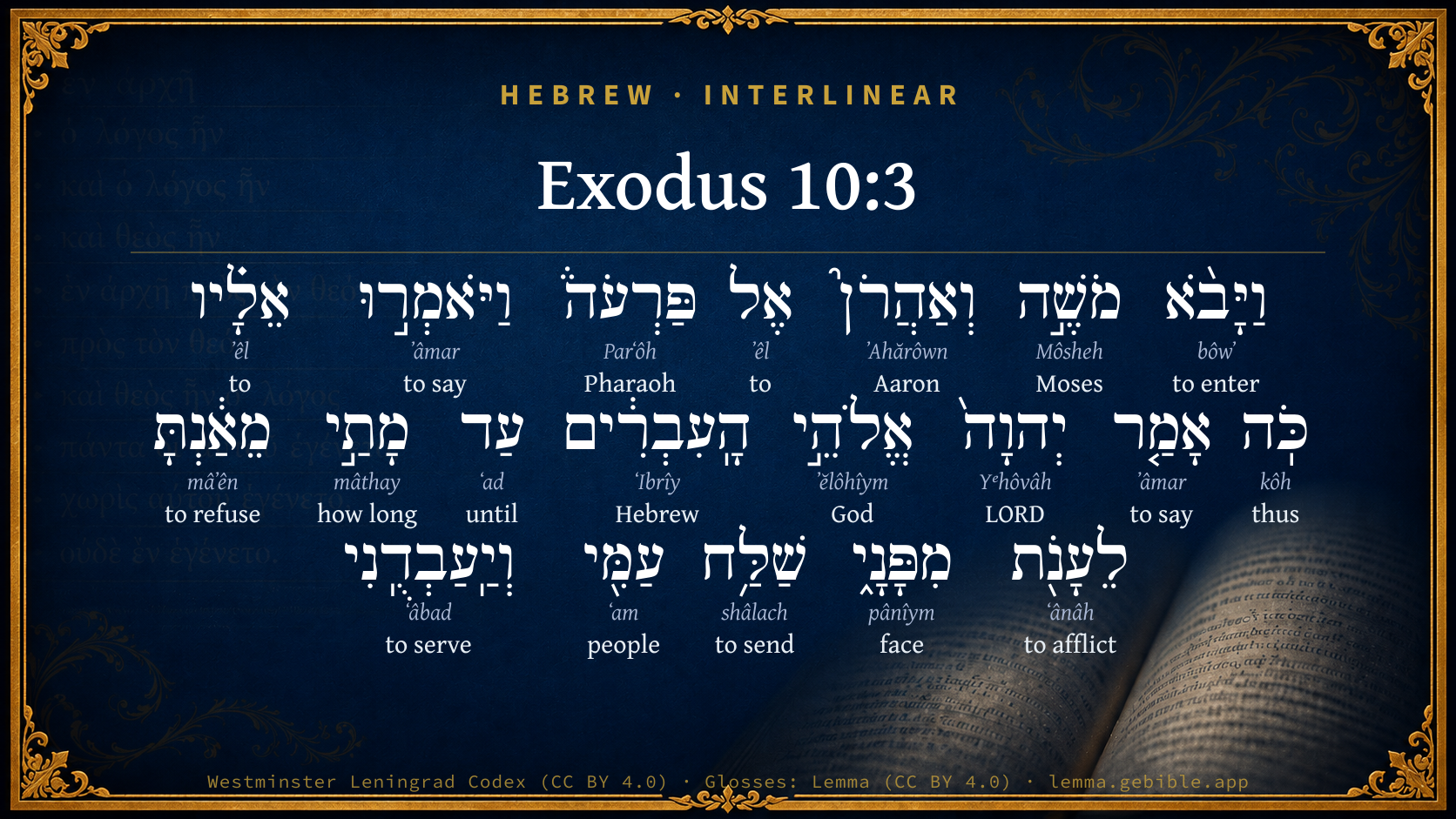
Hebrew (Westminster Leningrad Codex) Exodus 10:3 appears in the Hebrew Old Testament. The text above is from the Westminster Leningrad Codex. Each word links to its Strong’s number, a concise gloss, and parsing drawn from the Open Scriptures Hebrew Bible morphology. Click any word for its full Brown-Driver-Briggs (BDB) entry.
Download image
Cite this verse

Exodus 10:3 (World English Bible). Public Domain. Lemma interlinear Bible study tool, https://lemma.gebible.app/v/exodus/10/3.

Show BibTeX & RIS
BibTeX
RIS
English Translation
Moses and Aaron went in to Pharaoh, and said to him, "This is what Yahweh, the God of the Hebrews, says: 'How long will you refuse to humble yourself before me? Let my people go, that they may serve me.
World English Bible · Public Domain
Download a study sheet

One document with this verse’s original text, its word-by-word gloss line, the meaning frame, cross-references with their text, attributed commentary, and full source and license credits — printable, and it pastes into notes with its structure intact.

This verse Autodidact and up

Study sheet (.html) Plain text (.txt)

A passage Seminary Student

Up to 50 verses in one chapter. A passage sheet keeps up to 6 commentary sources and 12 cross-references per verse, in the order this page ranks them, and says so on the sheet whenever that leaves anything out. Ask for a single verse and you get the Autodidact verse sheet above.

Everything on this page stays free to read, with no account — the sheet is a download of what is already on screen, not access to it.

Want to remove ads? Support Godless Engineer
Compare translations 3

The same verse in 3 English versions, stacked beneath the original-language interlinear above. Click any original word for its lexicon entry.

Each is an independent rendering of the whole verse — the interlinear is not word-aligned to these translations.

Highlighted words mark where these versions differ — a whole-verse word diff, not a word-by-word alignment.

  • World English Bible Public Domain
    Moses and Aaron went in to Pharaoh, and said to him, "This is what Yahweh, the God of the Hebrews, says: 'How long will you refuse to humble yourself before me? Let my people go, that they may serve me.
  • King James Version Public Domain
    And Moses and Aaron came in unto Pharaoh, and said unto him, Thus saith the LORD God of the Hebrews, How long wilt thou refuse to humble thyself before me? let my people go, that they may serve me.
  • unfoldingWord Literal Text CC BY-SA 4.0
    And Moses and Aaron went in to Pharaoh and said to him, “Thus says Yahweh, God of the Hebrews: ‘Until when will you refuse to be humble from my face? Let my people go, and they will serve me.

unfoldingWord Literal Text — © unfoldingWord, licensed CC BY-SA 4.0. Word-aligned USFM3 via Door43 (git.door43.org/unfoldingWord/en_ult).

Versions to compare (up to 4)

3 of 4 selected

Show all 18 translations

Every available English version of this verse, each an independent rendering of the whole verse.

  • World English Bible Public Domain
    Moses and Aaron went in to Pharaoh, and said to him, "This is what Yahweh, the God of the Hebrews, says: 'How long will you refuse to humble yourself before me? Let my people go, that they may serve me.
  • Berean Standard Bible Public Domain
    So Moses and Aaron went to Pharaoh and told him, “This is what the LORD, the God of the Hebrews, says: ‘How long will you refuse to humble yourself before Me? Let My people go, so that they may worship Me.
  • Majority Standard Bible Public Domain
    So Moses and Aaron went to Pharaoh and told him, “This is what the LORD, the God of the Hebrews, says: ‘How long will you refuse to humble yourself before Me? Let My people go, so that they may worship Me.
  • King James Version Public Domain
    And Moses and Aaron came in unto Pharaoh, and said unto him, Thus saith the LORD God of the Hebrews, How long wilt thou refuse to humble thyself before me? let my people go, that they may serve me.
  • American Standard Version (1901) Public Domain
    And Moses and Aaron went in unto Pharaoh, and said unto him, Thus saith Jehovah, the God of the Hebrews, How long wilt thou refuse to humble thyself before me? let my people go, that they may serve me.
  • Revised Version (1885) Public Domain
    And Moses and Aaron went in unto Pharaoh, and said unto him, Thus saith the LORD, the God of the Hebrews, How long wilt thou refuse to humble thyself before me? let my people go, that they may serve me.
  • Geneva Bible (1599) Public Domain
    Then came Moses and Aaron vnto Pharaoh, and they said vnto him, Thus saith the Lord God of the Ebrewes, Howe long wilt thou refuse to humble thy selfe before me? Let my people goe, that they may serue me.
  • Douay-Rheims (1899) Public Domain
    Therefore Moses and Aaron went in to Pharao, and said to him: Thus saith the Lord God of the Hebrews: How long refusest thou to submit to me? let my people go, to sacrifice to me.
  • Young's Literal Translation Public Domain
    And Moses cometh in -- Aaron also -- unto Pharaoh, and they say unto him, `Thus said Jehovah, God of the Hebrews, Until when hast thou refused to be humbled at My presence? send My people away, and they serve Me,
  • Literal Standard Version CC BY-SA 4.0
    And Moses comes in—Aaron also—to Pharaoh, and they say to him, “Thus said YHWH, God of the Hebrews: Until when have you refused to be humbled at My presence? Send My people away, and they serve Me,
  • Unlocked Literal Bible CC BY-SA 4.0
    So Moses and Aaron went to Pharaoh and said to him, “Yahweh, the God of the Hebrews, says this: 'How long will you refuse to humble yourself before me? Let my people go so that they may worship me.
  • unfoldingWord Literal Text CC BY-SA 4.0
    And Moses and Aaron went in to Pharaoh and said to him, “Thus says Yahweh, God of the Hebrews: ‘Until when will you refuse to be humble from my face? Let my people go, and they will serve me.
  • Darby Bible Public Domain
    And Moses and Aaron came to Pharaoh, and said to him, Thus saith Jehovah the God of the Hebrews: How long dost thou refuse to humble thyself before me? let my people go, that they may serve me.
  • World Messianic Bible Public Domain
    Moses and Aaron went in to Pharaoh, and said to him, “This is what the LORD, the God of the Hebrews, says: ‘How long will you refuse to humble yourself before me? Let my people go, that they may serve me.
  • Webster's Bible Public Domain
    And Moses and Aaron came in to Pharaoh, and said to him, Thus saith the LORD God of the Hebrews, How long wilt thou refuse to humble thyself before me? Let my people go, that they may serve me.
  • Free Bible Version CC BY-SA 4.0
    Moses and Aaron went to Pharaoh and told him, “This is what the Lord, the God of the Hebrews, says: ‘How long are you going to refuse to humble yourself before me? Let my people go, so that they can worship me.
  • Bible in Basic English Public Domain
    Then Moses and Aaron went in to Pharaoh, and said to him, This is what the Lord, the God of the Hebrews, says: How long will you be lifted up in your pride before me? let my people go so that they may give me worship.
  • JPS Tanakh (1917) Public Domain
    And Moses and Aaron went in unto Pharaoh, and said unto him: 'Thus saith the LORD, the God of the Hebrews: How long wilt thou refuse to humble thyself before Me? let My people go, that they may serve Me.

Literal Standard Version (2020), Covenant Press — licensed CC BY-SA 4.0. Text via the HelloAO Bible API (eBible.org). Unlocked Literal Bible (unfoldingWord) — licensed CC BY-SA 4.0. Text via the HelloAO Bible API (eBible.org). unfoldingWord Literal Text — © unfoldingWord, licensed CC BY-SA 4.0. Word-aligned USFM3 via Door43 (git.door43.org/unfoldingWord/en_ult). Free Bible Version, Dr. Jonathan Gallagher — licensed CC BY-SA 4.0. Text via the HelloAO Bible API (eBible.org).

Word by word

More ways to search: Search by grammar → Find every occurrence → Compare this word →

Practice this passage: Drill this verse → Learn its vocabulary →

הָֽעִבְרִ֔ים
ʻIbrîy
H5680
“the · Hebrews”
Particle, Definite Article + Noun, Gentilic, Masculine, Plural, Absolute
Part of Speech
Particle + Noun
Type
Gentilic
Gender
Masculine
Number
Plural
State
Absolute
Full BDB Definition

Origin: patronymic from H5677

TWOT: None

Hebrew = "one from beyond" - a designation of the patriarchs and the Israelites (noun proper) - a designation of the patriarchs and the Israelites (adjective)
  1. וַיָּבֹ֨א bôwʼ H935 “and · to enter” Conjunction + Verb, Qal, Sequential Imperfect, 3rd Person, Masculine, Singular
  2. מֹשֶׁ֣ה Môsheh H4872 “Moses” Noun, Proper
  3. וְאַהֲרֹן֮ ʼAhărôwn H175 “and · Aaron” Conjunction + Noun, Proper
  4. אֶל ʼêl H413 “to” Preposition
  5. פַּרְעֹה֒ Parʻôh H6547 “Pharaoh” Noun, Proper
  6. וַיֹּאמְר֣וּ ʼâmar H559 “and · to say” Conjunction + Verb, Qal, Sequential Imperfect, 3rd Person, Masculine, Plural
  7. אֵלָ֗יו ʼêl H413 “to · him” Preposition + Suffix, Personal, 3rd Person, Masculine, Singular
  8. כֹּֽה kôh H3541 “thus” Adverb
  9. אָמַ֤ר ʼâmar H559 “to say” Verb, Qal, Perfect, 3rd Person, Masculine, Singular
  10. יְהוָה֙ Yᵉhôvâh H3068 “LORD” Noun, Proper
  11. אֱלֹהֵ֣י ʼĕlôhîym H430 “God(s) of” Noun, Common, Masculine, Plural, Construct
  12. עַד ʻad H5704 “until” Preposition
  13. מָתַ֣י mâthay H4970 “how long” Particle, Interrogative
  14. מֵאַ֔נְתָּ mâʼên H3985 “to refuse” Verb, Piel, Perfect, 2nd Person, Masculine, Singular
  15. לֵעָנֹ֖ת ʻânâh H6031 “to afflict” Preposition + Verb, Niphal, Infinitive Construct
  16. מִפָּנָ֑י pânîym H6440 “from · face(s) · my” Preposition + Noun, Common, Both, Plural, Construct + Suffix, Personal, 1st Person, Common, Singular
  17. שַׁלַּ֥ח shâlach H7971 “send” Verb, Piel, Imperative, 2nd Person, Masculine, Singular
  18. עַמִּ֖י ʻam H5971 “people · my” Noun, Common, Masculine, Singular, Construct + Suffix, Personal, 1st Person, Common, Singular
  19. וְיַֽעַבְדֻֽנִי ʻâbad H5647 “and · to serve · me” Conjunction + Verb, Qal, Imperfect, 3rd Person, Masculine, Plural + Suffix, Personal, 1st Person, Common, Singular

About this verse

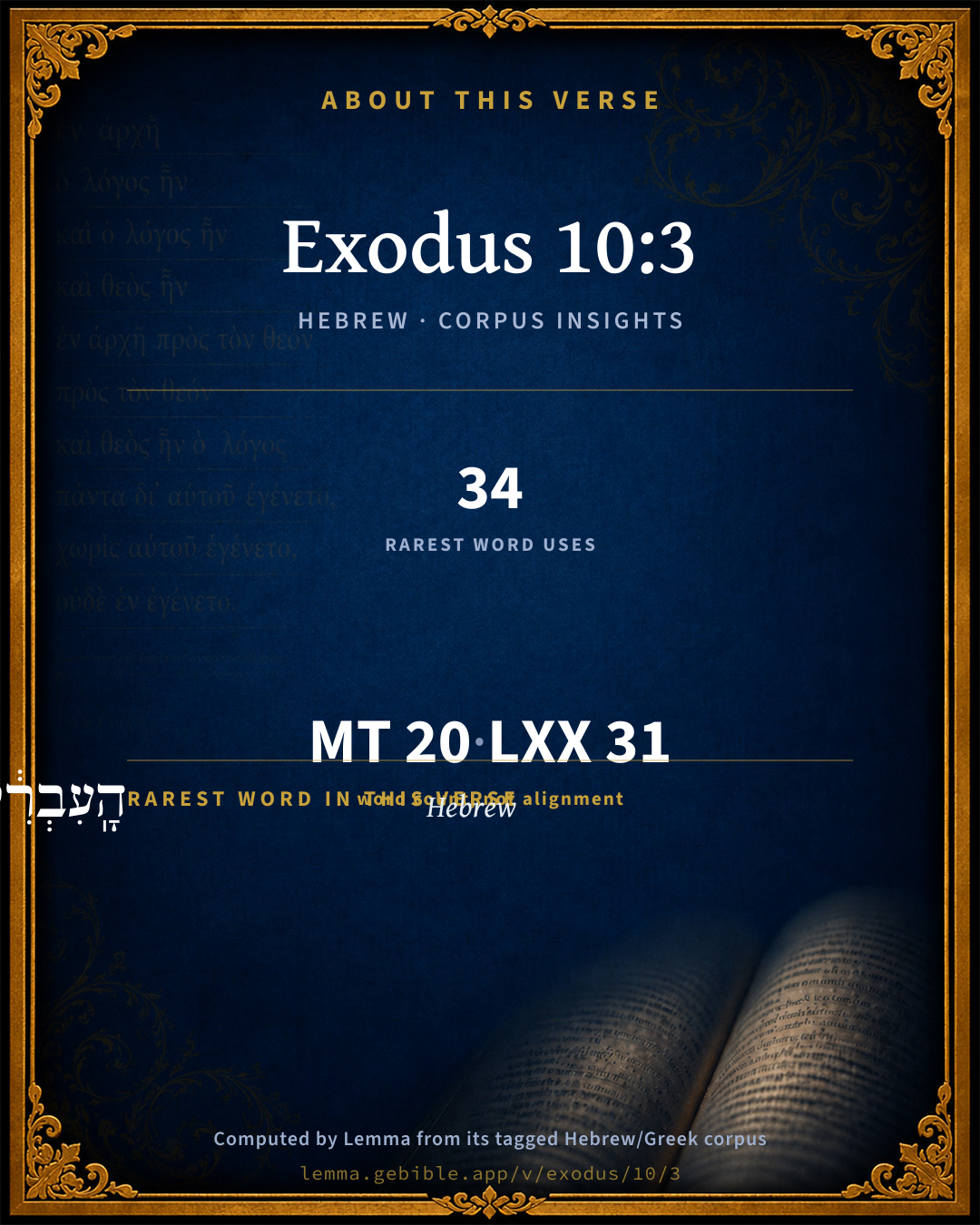
These counts appear in no published source. They are computed here, from the morphology-tagged text and Lemma’s own curated glosses. What Lemma adds →

20
words
18
distinct lemmas
Pentateuch
section

Shared distinctive vocabulary

הָֽעִבְרִ֔ים Hebrew H5680 occurs in 32 verses of the Hebrew Bible. Also found in:

Grammatical profile

  • 7 verbs
  • 8 nouns
  • 3 prepositions
  • 1 adverb
  • 1 particle

Verb forms

  • וַיָּבֹ֨א Qal · Sequential Imperfect
  • וַיֹּאמְר֣וּ Qal · Sequential Imperfect
  • אָמַ֤ר Qal · Perfect
  • מֵאַ֔נְתָּ Piel · Perfect
  • לֵעָנֹ֖ת Niphal · Infinitive Construct
  • שַׁלַּ֥ח Piel · Imperative
  • וְיַֽעַבְדֻֽנִי Qal · Imperfect

Repetition

Words recur within this verse — often emphatic in Hebrew:

  • וַיֹּאמְר֣וּ to say H559 ×2
  • אֶל to H413 ×2

Hebrew & Septuagint length

In English translation the verse runs 40 words from the Hebrew and 39 from the Septuagint (LXX English) — closely comparable.

A rough comparison of the two English renderings, which tokenize alike — not a word-level alignment.

Word counts can differ between the Hebrew and the Greek without any difference in meaning — e.g. the Hebrew direct-object marker אֵת has no separate Greek word, and Greek often adds the article ὁ.

In the original languages it is 20 Hebrew tokens and 31 Greek tokens — but the two are counted differently (Hebrew bundles its prefixes and suffixes into one token; the Greek is in lemma form), so that isn’t a like-for-like length.

Cross-references

22

Topical passages linked to Exodus 10:3 in the Treasury of Scripture Knowledge — connected by theme and wording, ordered by reader-vote popularity; previews shown in the World English Bible.

  • 1 Peter 5:6 Humble yourselves therefore under the mighty hand of God, that he may exalt you in due time;
  • 1 Kings 21:29 See you how Ahab humbles himself before me? because he humbles himself before me, I will not bring the evil in his days; but in his son's days will I bring the evil on his house.
  • James 4:10 Humble yourselves in the sight of the Lord, and he will exalt you.
  • Jeremiah 13:18 Say you to the king and to the queen-mother, Humble yourselves, sit down; for your headdresses are come down, even the crown of your glory.
  • Romans 2:4 Or do you despise the riches of his goodness, forbearance, and patience, not knowing that the goodness of God leads you to repentance?
  • Hebrews 12:25 See that you don't refuse him who speaks. For if they didn't escape when they refused him who warned on the Earth, how much more will we not escape who turn away from him who warns from heaven,
  • Exodus 9:17 as you still exalt yourself against my people, that you won't let them go.
  • Exodus 16:28 Yahweh said to Moses, "How long do you refuse to keep my commandments and my laws?
  • Numbers 14:27 How long [shall I bear] with this evil congregation, that murmur against me? I have heard the murmurings of the children of Israel, which they murmur against me.
  • 1 Kings 18:21 Elijah came near to all the people, and said, "How long will you waver between the two sides? If Yahweh is God, follow him; but if Baal, then follow him." The people answered him not a word.
  • 2 Chronicles 33:12 When he was in distress, he begged Yahweh his God, and humbled himself greatly before the God of his fathers.
  • 2 Chronicles 33:19 His prayer also, and how [God] was entreated of him, and all his sin and his trespass, and the places in which he built high places, and set up the Asherim and the engraved images, before he humbled himself: behold, they are written in the history of Hozai.
  • 2 Chronicles 34:27 because your heart was tender, and you did humble yourself before God, when you heard his words against this place, and against the inhabitants of it, and have humbled yourself before me, and have torn your clothes, and wept before me; I also have heard you, says Yahweh.
  • Job 42:6 Therefore I abhor myself, And repent in dust and ashes."
  • Proverbs 1:22 "How long, you simple ones, will you love simplicity? How long will mockers delight themselves in mockery, And fools hate knowledge?
  • Proverbs 1:24 Because I have called, and you have refused; I have stretched out my hand, and no one has paid attention;
  • Proverbs 18:12 Before destruction the heart of man is proud, But before honor is humility.
  • Isaiah 1:5 Why should you be beaten more, That you revolt more and more? The whole head is sick, And the whole heart faint.
  • Isaiah 2:11 The lofty looks of man will be brought low, The haughtiness of men will be bowed down, And Yahweh alone will be exalted in that day.
  • Jeremiah 13:10 This evil people, who refuse to hear my words, who walk in the stubbornness of their heart, and are gone after other gods to serve them, and to worship them, shall even be as this belt, which is profitable for nothing.
  • Ezekiel 5:6 She has rebelled against my ordinances in doing wickedness more than the nations, and against my statutes more than the countries that are round about her; for they have rejected my ordinances, and as for my statutes, they have not walked in them.
  • 2 Chronicles 7:14 if my people, who are called by my name, shall humble themselves, and pray, and seek my face, and turn from their wicked ways; then will I hear from heaven, and will forgive their sin, and will heal their land.

Cross-references courtesy of OpenBible.info (CC BY 4.0).

Hebrew and Greek witnesses Masoretic Hebrew ↔ Greek Septuagint

The same verse in the two great witnesses to the Old Testament, shown verse-for-verse.

These are two independent witnesses, not word-aligned to each other, and the Septuagint is shown in lemma (dictionary) form.

Hebrew Exodus 10:3 Masoretic · Westminster Leningrad Codex

וַיָּבֹ֨א מֹשֶׁ֣ה וְאַהֲרֹן֮ אֶל פַּרְעֹה֒ וַיֹּאמְר֣וּ אֵלָ֗יו כֹּֽה אָמַ֤ר יְהוָה֙ אֱלֹהֵ֣י הָֽעִבְרִ֔ים עַד מָתַ֣י מֵאַ֔נְתָּ לֵעָנֹ֖ת מִפָּנָ֑י שַׁלַּ֥ח עַמִּ֖י וְיַֽעַבְדֻֽנִי

Moses and Aaron went in to Pharaoh, and said to him, "This is what Yahweh, the God of the Hebrews, says: 'How long will you refuse to humble yourself before me? Let my people go, that they may serve me.

World English Bible · Public Domain

Greek LXX Exodus 10:3 Septuagint · lemma form

εἰςἔρχομαι δέ μωυσῆς καί ααρων ἐναντίον φαραώ καί εἶπον αὐτός ὅδε λέγω κύριος ὁ θεός ὁ εβραῖος ἕως τίς οὐ βούλομαι ἐντρέπω ἐγώ ἐκ ἀποστέλλω ὁ λαός ἐγώ ἵνα λατρεύω ἐγώ

And Moses and Aaron went in before Pharao, and they said to him, These things says the Lord God of the Hebrews, How long do you refuse to reverence me? Send my people away, that they may serve me.

LXX2012 (modern English Septuagint) · Public Domain

Hebrew: Westminster Leningrad Codex (CC BY 4.0). Greek: Septuagint (public domain); English from LXX2012 (modern English Septuagint) (Public Domain). How the Septuagint differs from the Hebrew →

Targum (Aramaic paraphrase)

2

The Targum is the ancient Jewish Aramaic paraphrase of the Hebrew Scriptures — an interpretive translation, not the Hebrew text itself. Onkelos (literal) and Pseudo-Jonathan (expansive) render the Torah, and Jonathan the Prophets. Coverage is partial: where no permissively-licensed English translation exists for a verse, only the Aramaic is shown. This is verse-level text, not a word-by-word alignment to the Hebrew.

  1. Targum Onkelos Torah (Genesis–Deuteronomy)
    וַאֲתָא משֶׁה וְאַהֲרֹן לְוָת פַּרְעֹה וַאֲמָרוּ לֵהּ כִּדְנַן אֲמַר יְיָ אֱלָהָא דִיהוּדָאֵי עַד אִמָתַי מְסָרֵב אַתְּ לְאִתְכְּנָעָא מִן קֳדָמָי שַׁלַח עַמִי וְיִפְלְחוּן קֳדָמָי:

    (no public-domain English translation for this verse)

    Targum Onkelos — Aramaic: “Onkelos Genesis” (public domain); “Onkelos Exodus” (public domain); “Onkelos Leviticus” (public domain); “Onkelos Numbers” (public domain); “Onkelos Deuteronomy” (public domain). English: “Sefaria Community Translation” (CC0 1.0 (public-domain dedication)); “J.W. Etheridge. The Targums of Onkelos and Jonathan Ben Uzziel on the Pentateuch. London: Longmans, Green, 1862” (public domain). Text via Sefaria.

  2. Targum Pseudo-Jonathan Torah (Genesis–Deuteronomy)
    וְאָעַל משֶׁה וְאַהֲרן לְוַת פַּרְעה וַאֲמָרוּ לֵיהּ כִּדְנָא אָמַר יְיָ אֱלָהָא דְיִשְרָאֵל עַד אֵימַת מְסָרֵב אַנְתְּ (מִן) לְמִתְכְּנָעָא מִן קֳדָמַי פְּטוֹר יַת עַמִּי וְיִפְלְחוּן קֳדָמַי

    And Mosheh and Aharon went in unto Pharoh, and said to him, Thus saith the Lord, the God of Israel, How long wilt thou refuse to humble thyself before Me? Let My people go, that they may worship before Me.

    Targum Pseudo-Jonathan — Aramaic: “Targum Jonathan on Genesis” (public domain); “Targum Jonathan on Exodus” (public domain); “Targum Jonathan on Leviticus” (public domain); “Targum Jonathan on Numbers” (public domain); “Targum Jonathan on Deuteronomy” (public domain). English: “The Targum of Jonathan ben Uzziel, trans. J. W. Etheridge, London, 1862” (public domain). Text via Sefaria.

Commentary

Notes on Exodus 10:3 from classic Christian and Jewish commentators (each source and its license shown beneath its notes). The classic Christian expositions comment on the surrounding passage and are grouped to its opening verse, so a note may address several verses; the Jewish commentaries on the Tanakh (Rashi and others) are per-verse, so they appear only where the commentator wrote on this verse.

Lemma curates 59 commentaries, every one of them public domain or Creative Commons licensed, each selected and text-cleaned for this edition rather than reprinted as found. About our sources →

Trapp's Complete Commentary

John Trapp

Exo 10:3 And Moses and Aaron came in unto Pharaoh, and said unto him, Thus saith the LORD God of the Hebrews, How long wilt thou refuse to humble thyself before me? let my people go, that they may serve me.

Ver 3. How long wilt thou refuse?] God thinks long of the time that men misspend and waste in wicked courses. {Jer 4:14; Jer 13:27} It is a savoury saying of Bernard, Totum vitae meae tempus perdidi, quia perdite vixi: the time of my looseness I have utterly lost.

John Trapp, A Commentary or Exposition upon All the Books of the Old and New Testament (1647–1656) — public domain. Text from a community e-Sword module.

The Biblical Illustrator

Joseph S. Exell

Exo_10:3-6

To-morrow will I bring the locusts.

Humiliation before God

How long wilt thou refuse to humble thyself before Me?

I. I shall show our need of humiliation before God.

1. Let us inquire how we have acted toward God. As our Creator, our Governor, our Benefactor.

2. Let us inquire how we have acted toward our Lord Jesus Christ. Was made flesh. Died for us.

3. Let us inquire how we have acted toward the Holy Spirit. Rebelled, vexed, grieved, quenched.

II. I shall show wherein true humiliation consists.

1. In confession of our sin before God. Fully and unreservedly. With deep and ingenuous sorrow.

2. In believing application to God through Christ for pardon of our sin.

3. In renouncing our sins and commencing a course of obedience to God.

III. I shall show the evils of delaying true humiliation before God.

1. The guilt (Rom_2:4-5).

2. The folly. Stronger than He?

3. The danger. Pharaoh. Manasseh.

(1) Repentance is never too late.

(2) Repentance is never too soon. (G. Brooks.)

The delay of soul humility

I. In what does soul-humility consist?

1. It does not consist in mournful verbal utterances, k humble word may conceal a proud spirit.

2. Nor in outward manifestations of repentance.

3. It is rather evinced in calm resignation to the will of God as revealed in His Word, and as made known in the conscience by the Holy Spirit.

II. How is soul-humility to be obtained?

1. By having a clear conception of the will of God and of the beauty of truth.

2. By allowing the varied discipline of life its due effect upon the soul. Pain ought to humble a man, reminding him of his mortality.

3. By submitting to the gentle influences of the Holy Spirit.

III. Why is soul-humility so long delayed?

1. Because men will not give up their sins. Humility is the outcome of purity.

2. Because men will not yield to the claims of God.

3. Because men are rendered proud by exalted social position.

4. Men can give no reason for the delay of soul-humility.

Humility is the richest and best ornament of the soul, and no good excuse can be assigned for neglecting to wear it. This ornament is but seldom seen in this vaunting age. It is welcome to the eye of heaven.

Lessons:

1. Soul-humility should be manifested by man.

2. Gods ministers should enforce it.

3. Gods people should cultivate it.

4. Its absence cannot be excused. (J. S. Exell, M. A.)

The plague of locusts threatened

I. It was threatened in case that Pharaoh would not give the Israelites the freedom demanded by God (verse 4). The good have in God a stern Defender.

II. That some men are much more sensitive to the threatenings of God than others (verse 7).

III. That Divine threatenings must make ministers faithful in the discharge of their duty (verse 9). Denounce all attempts at moral compromise. (J. S. Exell, M. A.)

To-morrow

1. A judgment.

2. A mystery.

3. A crisis.

4. An anxiety.

5. A hope. (J. S. Exell, M. A.)

If thou refuse

1. Then man can refuse to obey God.

2. Then man can dare the judgments of God.

3. Then man takes a great responsibility upon himself. (J. S. Exell, M. A.)

The locusts

1. Very grievous.

2. Darkening the light.

3. Devouring the fruit.

4. Entering the houses. (J. S. Exell, M. A.)

Good men should leave sinners u, hen they have declared the message of God

1. As a reproof.

2. As a contempt.

3. As a prophecy.

4. As a relief. (J. S. Exell, M. A.)

Locust-scaring gods

The Egyptians, in common with other nations whose ideas of religion were derived originally from Egypt, had particular deities to whom they appealed for help in times of particular necessity. There is reason to believe that they had gods to whom they looked for protection against locusts as well as against flies and vermin. Strabo, speaking of certain gods whose titles were derived from insignificant objects, says: The inhabitants of Mount Åta worshipped Hercules under the title of Hercules Cornopion, because he had delivered them from locusts. So the Erythraeans, who live near Melius, worship Hercules Ipoctonus, because he destroyed the ipes, or worms, which are destructive to vines: for this pest is found everywhere except in the country of the Erythraeans. The Rhodians have in their island a temple of Apollo Erythibius, so called from erysibe (mildew), which they call erythibe. Among the AEolians in Asia one of their months is called Pornopion, for this name the Boeotians give to parnopes (locusts), and sacrifices are performed to Apollo Pornopion. The locust was esteemed sacred in Greece, and the Athenians wore golden cicadae, or grasshoppers, in their hair, to denote the antiquity of their race, as αὐτόχθονες, of the land itself, or aborigines. Early historians tell us that the Greeks came originally from Egypt; Cecrops, the first king of Attica, was from Sais; Cadmus, from Thebes; and Danaus and Lynceus, with their colonies, from Chemnis. The locust-scarers of Greece and Asia were, therefore, in all probability, gods of the Egyptians in time of Pharaoh, and were put to shame, with the rest of their deities, by this unprecedented and miraculous visitation. Thus the winds from the four corners of heaven obey the command of Jehovah. As far as man is concerned, nothing is more uncertain, nothing more absolutely beyond control: the wind bloweth were it listeth, and thou hearest the sound thereof, but canst not tell whence it cometh or whither it goeth (Joh_3:8). But God directeth it under the whole heaven; He calleth it, Awake, O north wind, and come thou south (Son_4:16); He gathereth the wind in His fists (Pro_30:4); He bringeth it out of His treasuries (Psa_135:7). At Gods command the east wind brought the locusts, in twenty-four hours, from the uttermost parts of the east, collecting them, it may be, from the far-off deserts of Arabia and Persia; and at Gods command the west wind carried them away again, as far as the Red Sea. There they all fell down and perished. I am tossed up and down as the locust (Psa_109:23), says David. These creatures were tossed up and down by the wind wherever God would send them. He had used them as His scourge, an instrument of punishment, in which He could have no pleasure; and when their ungrateful task was done, He drowned them in the sea. To those same depths the infatuated king who refused to be warned by the chastisement was presently to follow them, and with his miserable people, in their turn, to perish. (T. S. Millington.)

The Biblical Illustrator, edited by Joseph S. Exell (c. 1880s–1900s) — public domain. Text from a community e-Sword module.

Joseph Benson's Commentary

Exo 10:3. How long wilt thou refuse to humble thyself? — By this it appears that God’s design was not to harden Pharaoh, but to humble him by these extraordinary judgments. It is justly expected from the greatest of men that they should humble themselves before the great God, and it is at their peril if they refuse to do it. Those that will not humble themselves, God will humble.

Joseph Benson's Commentary on the Old and New Testaments (1811–1818) — public domain. Text from a community e-Sword module.

The Preacher's Complete Homiletical Commentary

Joseph S. Exell (gen. ed.)

MAIN HOMILETICS OF THE PARAGRAPH.—Exo_10:3

THE DELAY OF SOUL-HUMILITY

I. In what does soul-humility consist?

1. Soul-humility does not consist in mournful verbal utterances. Pharaoh had given utterance to sad and mournful words. He had spoken in doleful language of his afflictions and of his sin. But he was at the same time far from being humble in soul. His pride was not subdued. Nor was he willing to yield to the demands of heaven. And so we cannot judge the temper of the soul from the utterance of the lips. A humble word may conceal a proud spirit. And it often happens that those who talk the most about humility have the least of it.

2. Soul-humility does not consist in the outward manifestations of repentance. Pharaoh had, to all outward appearance, been a true penitent. But humility of soul does not consist in loud confessions of evil, or in sending for the minister of God in the hour of peril. It is rather evinced in calm resignation to the will of God as revealed in His Word, and as made known in the conscience by the Holy Spirit. True humility of soul is unpretentious. It is modest. It seldom speaks of self. It does not parade its religion. It yields implicitly to the will of heaven.

II. How is soul-humility to be obtained?

1. By having a clear conception of the will of God and of the beauty of truth. Those who see clearly the will of God in reference to their life and being will have a real incentive to humility. They will view the power of God as contrasted with their own weakness; the wisdom of God as contrasted with their own ignorance; and the littleness of their life will indeed beget a proper spirit of humility. And let men get but a clear vision of the unveiled Truth, and they must be humble. A proud soul cannot have beheld the inner glory of truth, or it would pay immediate homage.

2. By allowing the varied discipline of life its due effect upon the soul. If Pharaoh had allowed the sad discipline to which he had been subjected its proper influence upon him, he would indeed have been humble before God. The plagues were sent to humble the proud Monarch. But in vain. And so, the discipline of life is intended and calculated to humble the soul; and if men would reverently submit to it, and co-operate with its holy purpose, they would attain this glorious issue. Pain ought to humble a man. It should remind him of his mortality, and of his return to the dust.

3. By submitting to the gentle influences of the Holy Spirit. A man who has the Divine Spirit within him, will be humble in all his dispositions and activities. Spiritual influences produce humility; they permeate the discipline of life, and render it effective and remedial; they lead the soul to the cross, where humility is the condition of all good. Are we clothed with humility?

III. Why is soul-humility so long delayed?

1. Because men will not give up their sins. Sin as a dominant influence cannot co-exist with true humility. If sin is in the soul humility will be absent. Pharaoh was covetous; he did not wish to give up his profitable slaves. He was self-willed, and did not like to be defeated in any of his national plans. Unless sin is given up, humility will never be put on. Humility is the outcome of purity.

2. Because men will not yield to the claims of God. God has claims upon men. They are unheeded. They are rejected. They are rejected in a spirit of defiance and self-sufficiency. They are the most humble who accept the claims of God and obey them. They give proof of their humility.

3. Because men are rendered proud by exalted social position. Kings are in danger of pride from the fact of their elevated position, and from the servile flattery to which they are exposed. Hence social position may delay the advent of humility to the soul.

4. Men can give no satisfactory reason for the delay of soul-humility. Humility is the richest and best ornament of the soul, and no good excuse can be assigned for neglecting to wear it. This ornament is but seldom seen in this vaunting age. It is welcome to the eye of heaven.

LESSONS:—

1. Soul-humility should be manifested by man.

2. God’s ministers should enforce it.

3. God’s people should cultivate it.

4. Its absence cannot be excused.

SUGGESTIVE COMMENTS ON THE VERSES

Exo_10:3. God’s true servants make no delay in keeping His commandments.

God’s servants use His name in their message, which the wicked make a reproach.

God by His ministers expostulates bitterly with sinners for their delay of humbling themselves under judgments.

God will never cease demanding His Church from the wicked world, till it be freed.

How long wilt thou refuse to humble thyself?

1. Till I plague thee more?

2. Till thou are destroyed?

3. Till thou hast no opportunity to do so?

4. Have you not delayed long enough?

5. Can you gain any advantage by delay?

The Preacher's Complete Homiletical Commentary (gen. ed. Joseph S. Exell; Funk & Wagnalls, c. 1892) — public domain (pre-1929). A full-Bible homiletical/sermon-outline anthology covering 65 of 66 books (2 John is absent from the source module). Text from a community e-Sword module.

Geneva Bible (1599)

Geneva Bible translators

The end of affliction is, to humble ourselves with true repentance under the hand of God.

Geneva Bible (1599) marginal notes — public domain. Text via Bolls.life.

Adam Clarke's Commentary

Verse 3. How long wilt thou refuse to humble thyself] Had it been impossible for Pharaoh, in all the preceding plagues, to have humbled himself and repented can we suppose that God could have addressed him in such language as the preceding? We may rest assured that there was always a time in which he might have relented, and that it was because he hardened his heart at such times that God is said to harden him, i.e., to give him up to his own stubborn and obstinate heart; in consequence of which he refused to let the people go, so that God had a fresh opportunity to work another miracle, for the very gracious purposes mentioned in Ex 10:2. Had Pharaoh relented before, the same gracious ends would have been accomplished by other means.

Adam Clarke's Commentary on the Bible (1810–1826) — public domain. Text from a community e-Sword/MySword module.

The Cambridge Bible for Schools and Colleges

gen. ed. J. J. S. Perowne

3–6. The announcement of the plague to Pharaoh.

The Cambridge Bible for Schools and Colleges (gen. ed. J. J. S. Perowne; Cambridge University Press, 1878–1918) — public domain. Text from a community e-Sword module.

John Gill's Exposition

And Moses and Aaron came in unto Pharaoh,.... As the Lord commanded them, for what is before said to Moses was designed for Aaron also, his prophet and spokesman:

and said unto him, thus saith the Lord God of the Hebrews; as the ambassadors of the God of Israel, and in his name said:

how long wilt thou refuse to humble thyself before me? to acknowledge his offence, lie low before God, and be subject to his will; he had humbled himself for a moment, but then this did not continue; what God expected of him, and complains of the want of, was such a continued humiliation before him, and such a subjection to him, as would issue in complying with what he had so often demanded of him, and is as follows:

let my people go, that they may serve me; see Exo 9:1.

John Gill's Exposition of the Whole Bible (1746–1763) — public domain (CC PDM 1.0). Text via the HelloAO Bible API.

The Pulpit Commentary

How long wilt thou refuse to humble thyself! The confession recorded in Exo_9:27 had been a distinct act of self-humiliation; but it had been cancelled by subsequent self-assertion (ib. 34, 35). And, moreover, humility of speech was not what God had been for months requiring of Pharaoh, but submission in act. He would not really "humble himself" until he gave the oft- demanded permission to the Israelites, that they might depart from Egypt.

Vers. 3-6. God"s long-suffering towards the wicked has a limit.

long wilt thou refuse to humble thyself?" (ver. 3). "The goodness of God endureth yet daily." His forbearance and long-suffering are wonderful. Yet they have a limit. God will not proceed to judgment

I UNTIL THE SINNER HAS HAD FULL OPPORTUNITY FOR REPENTANCE. Pharaoh had been first warned, (Exo_5:3) then shown a sign; (Exo_7:10-12) after this, punished by seven distinct plagues, each of which was well calculated to strike terror into the soul, and thereby to stir it to repentance. He had been told by his own magicians that one of them, at any rate, could be ascribed to nothing but "the finger of God". (Exo_8:19) He had been impressed, alarmed, humbled so far as to make confession of sin (Exo_9:27) and to promise three several times that he would let the Israelites depart from Egypt. (Exo_8:8, Exo_8:28; Exo_9:28) But all had been of no avail. No sooner was a plague removed at his humble entreaty than he resumed all his old pride and arrogance, retracted his promise, and showed himself as stiff-necked as at the first. The time during which his trim had lasted, and God"s patience endured, must have been more than a year surely ample opportunity!

II UNTIL IT IS MANIFEST THAT THERE IS NO HOPE THAT HE WILL REPENT. "What could have been done more in my vineyard, that I have not done to it?" God asks in Isaiah. (Isa_5:4) And what morecould he have done to turn Pharaoh from his evil ways, that he had not done on this occasion? Exhortations, warnings, miracles, light plagues, heavy plagues, had all been tried, and no real, permanent impression made. The worst of all was, that when some kind of impression was made, no good result ensued. Fear abject, servile, cowardly fear was the dominant feeling aroused; and even this did not last, but disappeared the moment that the plague was removed. Pharaoh was thus constantly "sinning yet more". (Exo_9:34) Instead of improving under the chastening hand of God, he was continually growing worse. His heart was becoming harder. His reformation was more hopeless.

III UNTIL GOD"S PURPOSES IN ALLOWING THE RESISTANCE OF HIS WILL BY THE SINNER ARE ACCOMPLISHED. God intended that through Pharaoh"s resistance to his will, and the final failure of his resistance, his own name should be glorified and "declared throughout all the earth". (Exo_9:16) It required a period of some length a tolerably prolonged contest to rivet the attention both of the Egyptians generally, and of the surrounding nations. After somewhat more than a year this result had been attained. There was, consequently, no need of further delay; and the last three plagues, which followed rapidly the one upon the other, were of the nature of judgments.

The Pulpit Commentary (1880–1919), ed. H.D.M. Spence-Jones & Joseph S. Exell — public domain. Text from a community e-Sword module.

John Wesley's Explanatory Notes

Thus saith the Lord God of the Hebrews, How long wilt thou refuse to humble thyself before me? - It is justly expected from the greatest of men, that they humble themselves before the great God, and it is at their peril if they refuse to do it. Those that will not humble themselves, God will humble.

John Wesley, Explanatory Notes Upon the Whole Bible (1754–1765) — public domain. Text via the GEBible commentary corpus.

Keil & Delitzsch

C. F. Keil & F. Delitzsch

As Pharaoh had acknowledged, when the previous plague was sent, that Jehovah was righteous (Exo 9:27), his crime was placed still more strongly before him: "How long wilt thou refuse to humble thyself before Me?" (לענת for להענת, as in Exo 34:24).

Keil & Delitzsch — Biblical Commentary on the Old Testament (1861–1891) — public domain (CC PDM 1.0). Text via the HelloAO Bible API. (Old Testament only.)

unfoldingWord translationNotes

Door43 World Missions Community

listen

This word adds emphasis to what is said next. AT: "Pay attention to what I am about to tell you" (See: Imperatives - Other Uses)

translationWords

Aaron

God

Hebrew

humble

people of God

worship

locust

unfoldingWord translationNotes — © Distant Shores Media and the Door43 World Missions Community, licensed CC BY-SA 4.0. Source: git.door43.org/Door43/en_tn.

Rashi

Rabbi Shlomo Yitzchaki (Rashi)

לענת Translate as the Targum: TO BE HUMBLED. It is of the same derivation as עני poor, so that the passage signifies, “thou refusest to be poor and lowly before Me”.

Rashi on the Tanakh — English translations: “The Judaica Press complete Tanach with Rashi, translated by A. J. Rosenberg” (CC BY 4.0); “Pentateuch with Rashi's commentary by M. Rosenbaum and A.M. Silbermann, 1929-1934” (public domain); “The Metsudah Tanach series, Lakewood, N.J” (CC BY 4.0); and “The Book of Joshua, Metsudah Publications, 1997” (CC BY 4.0). Text via Sefaria.

Ramban (Nachmanides)

Rabbi Moshe ben Nachman (Ramban / Nachmanides)

AND MOSES AND AARON CAME IN UNTO PHARAOH. Rabbi Abraham ibn Ezra commented: “We know that Moses never came to Pharaoh without being accompanied by Aaron, who was the interpreter. Scripture here makes a point of mentioning Moses and Aaron in order [to make clear] that Pharaoh’s command that both of them be brought again before him and his final act of driving them out, Verse 11. — something he had not done previously — [applied to the two brothers alike].”

Ramban (Nachmanides) on the Tanakh — English translation: “Commentary on the Torah by Ramban (Nachmanides). Translated and annotated by Charles B. Chavel. New York, Shilo Pub. House, 1971-1976” (CC BY 4.0). Text via Sefaria.

Lesson kit

Teaching starters — assembled from the data on this page, not authored interpretation. Every prompt links to the verse data it draws on. Edit before teaching.

Exodus, in the Pentateuch, opens this verse with 20 words (18 distinct Hebrew lemmas). Its most distinctive word is ʻIbrîy (“Hebrew”). A historical commentator’s framing appears above. Read the whole chapter for the surrounding context.

Discussion questions

  1. What does “Hebrew” (ʻIbrîy) contribute to the verse as a whole?
  2. Genesis 14:13 shares the word «Hebrew» with this verse. How do the two illuminate each other?
  3. “to say” occurs 2× in this one verse. What is the effect of the repetition?
  4. These translations render this verse differently. What is at stake in choosing one wording over another?
  5. The verb «וַיָּבֹ֨א» is Qal Sequential Imperfect. How does its form color the action?
  6. Reading how Trapp's Complete Commentary and The Biblical Illustrator read this verse, where do the two commentators agree and where do they part?

Things to notice

Reading settings

Reading text

Shown beneath each verse's original-language words.

Old Testament
Old Testament edition

Read the OT as the Masoretic Hebrew (MT) or the Greek Septuagint (LXX).

English shown for the Greek Septuagint (in the Hebrew ↔ Greek comparison).

Comparing translations? Open the Compare panel on any verse page to stack up to four side by side.