
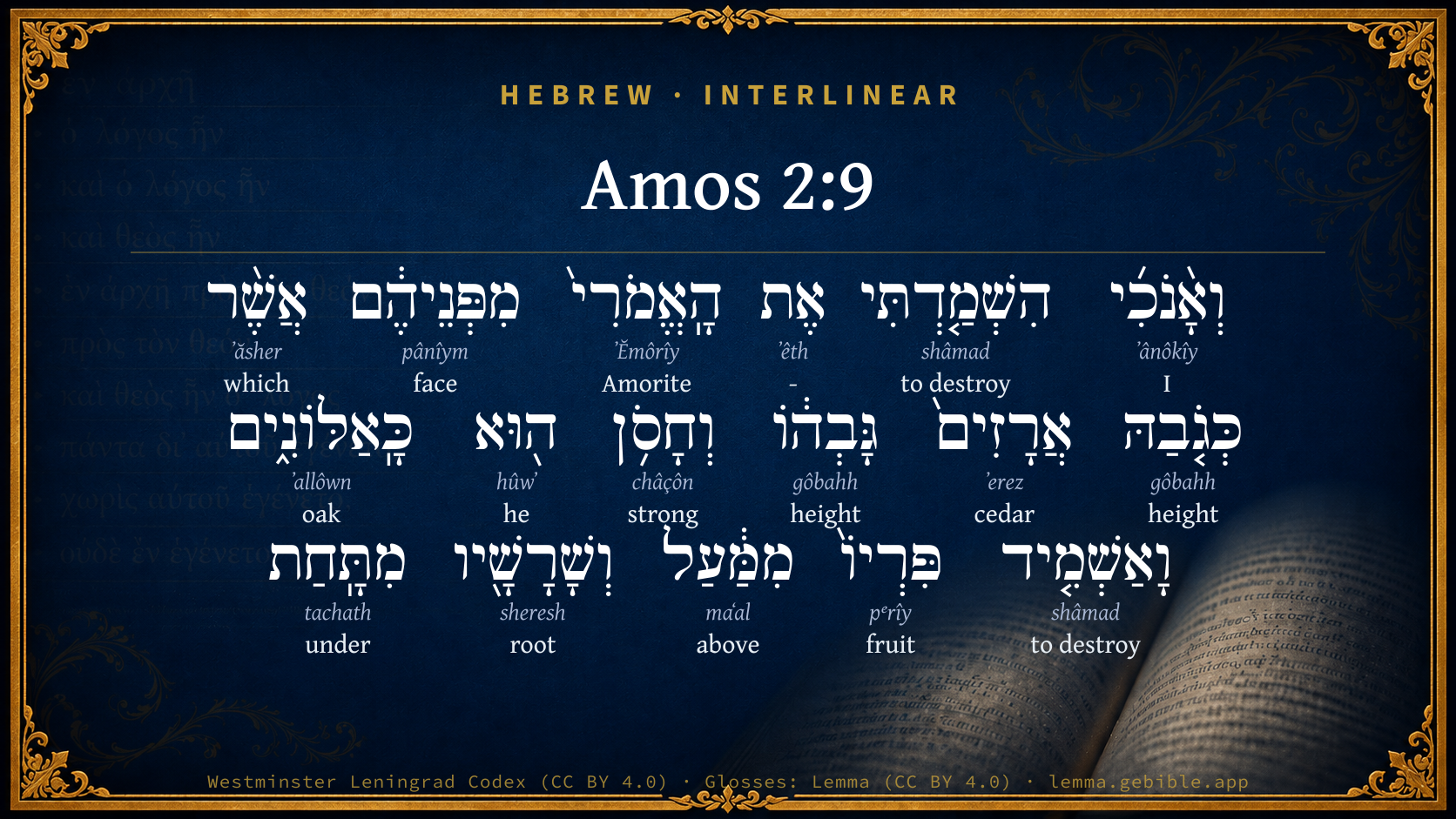
Amos 2:9

Hebrew (Westminster Leningrad Codex) Amos 2:9 appears in the Hebrew Old Testament. The text above is from the Westminster Leningrad Codex. Each word links to its Strong’s number, a concise gloss, and parsing drawn from the Open Scriptures Hebrew Bible morphology. Click any word for its full Brown-Driver-Briggs (BDB) entry.
Download image
Cite this verse

Amos 2:9 (World English Bible). Public Domain. Lemma interlinear Bible study tool, https://lemma.gebible.app/v/amos/2/9.

Show BibTeX & RIS
BibTeX
RIS
English Translation
Yet I destroyed the Amorite before them, Whose height was like the height of the cedars, And he was strong as the oaks; Yet I destroyed his fruit from above, and his roots from beneath.
World English Bible · Public Domain
Download a study sheet

One document with this verse’s original text, its word-by-word gloss line, the meaning frame, cross-references with their text, attributed commentary, and full source and license credits — printable, and it pastes into notes with its structure intact.

This verse Autodidact and up

Study sheet (.html) Plain text (.txt)

A passage Seminary Student

Up to 50 verses in one chapter. A passage sheet keeps up to 6 commentary sources and 12 cross-references per verse, in the order this page ranks them, and says so on the sheet whenever that leaves anything out. Ask for a single verse and you get the Autodidact verse sheet above.

Everything on this page stays free to read, with no account — the sheet is a download of what is already on screen, not access to it.

Want to remove ads? Support Godless Engineer
Compare translations 3

The same verse in 3 English versions, stacked beneath the original-language interlinear above. Click any original word for its lexicon entry.

Each is an independent rendering of the whole verse — the interlinear is not word-aligned to these translations.

Highlighted words mark where these versions differ — a whole-verse word diff, not a word-by-word alignment.

  • World English Bible Public Domain
    Yet I destroyed the Amorite before them, Whose height was like the height of the cedars, And he was strong as the oaks; Yet I destroyed his fruit from above, and his roots from beneath.
  • King James Version Public Domain
    Yet destroyed I the Amorite before them, whose height was like the height of the cedars, and he was strong as the oaks; yet I destroyed his fruit from above, and his roots from beneath.
  • unfoldingWord Literal Text CC BY-SA 4.0
    Yet I destroyed the Amorites before them, whose height was like the height of cedars; he was strong as the oaks. Yet I destroyed his fruit above and his roots below.

unfoldingWord Literal Text — © unfoldingWord, licensed CC BY-SA 4.0. Word-aligned USFM3 via Door43 (git.door43.org/unfoldingWord/en_ult).

Versions to compare (up to 4)

3 of 4 selected

Show all 18 translations

Every available English version of this verse, each an independent rendering of the whole verse.

  • World English Bible Public Domain
    Yet I destroyed the Amorite before them, Whose height was like the height of the cedars, And he was strong as the oaks; Yet I destroyed his fruit from above, and his roots from beneath.
  • Berean Standard Bible Public Domain
    Yet it was I who destroyed the Amorite before them, though his height was like that of the cedars, and he was as strong as the oaks. Yet I destroyed his fruit above and his roots below.
  • Majority Standard Bible Public Domain
    Yet it was I who destroyed the Amorite before them, though his height was like that of the cedars, and he was as strong as the oaks. Yet I destroyed his fruit above and his roots below.
  • King James Version Public Domain
    Yet destroyed I the Amorite before them, whose height was like the height of the cedars, and he was strong as the oaks; yet I destroyed his fruit from above, and his roots from beneath.
  • American Standard Version (1901) Public Domain
    Yet destroyed I the Amorite before them, whose height was like the height of the cedars, and he was strong as the oaks; yet I destroyed his fruit from above, and his roots from beneath.
  • Revised Version (1885) Public Domain
    Yet destroyed I the Amorite before them, whose height was like the height of the cedars, and he was strong as the oaks; yet I destroyed his fruit from above, and his roots from beneath.
  • Geneva Bible (1599) Public Domain
    Yet destroyed I the Amorite before the, whose height was like the height of the cedars, and he was strong as the okes: notwithstanding I destroyed his fruite from aboue, and his roote from beneath.
  • Douay-Rheims (1899) Public Domain
    Yet I cast out the Amorrhite before their face: whose height was like the height of cedars, and who was strong as an oak: and I destroyed his fruit from above, and his roots beneath.
  • Young's Literal Translation Public Domain
    And I -- I have destroyed the Amorite from before them, Whose height `is' as the height of cedars, And strong he `is' as the oaks, And I destroy his fruit from above, And his roots from beneath.
  • Literal Standard Version CC BY-SA 4.0
    And I have destroyed the Amorite from before them, || Whose height [is] as the height of cedars, || And he [is] strong as the oaks, || And I destroy his fruit from above, || And his roots from beneath.
  • Unlocked Literal Bible CC BY-SA 4.0
    Yet I destroyed the Amorite before them, whose height was like the height of cedars; he was strong as the oaks. Yet I destroyed his fruit above and his roots below.
  • unfoldingWord Literal Text CC BY-SA 4.0
    Yet I destroyed the Amorites before them, whose height was like the height of cedars; he was strong as the oaks. Yet I destroyed his fruit above and his roots below.
  • Darby Bible Public Domain
    But I destroyed the Amorite before them, whose height was as the height of the cedars, and he was strong as the oaks; but I destroyed his fruit from above, and his roots from beneath.
  • World Messianic Bible Public Domain
    Yet I destroyed the Amorite before them, whose height was like the height of the cedars, and he was strong as the oaks; yet I destroyed his fruit from above, and his roots from beneath.
  • Webster's Bible Public Domain
    Yet I destroyed the Amorite before them, whose hight was like the hight of the cedars, and he was strong as the oaks; yet I destroyed his fruit from above, and his roots from beneath.
  • Free Bible Version CC BY-SA 4.0
    Yet it was I who was the one who destroyed the Amorites before you, even though they were as tall as cedars and as strong as oaks. I destroyed them root and branch.
  • Bible in Basic English Public Domain
    Though I sent destruction on the Amorite before them, who was tall as the cedar and strong as the oak-tree, cutting off his fruit from on high and his roots from under the earth.
  • JPS Tanakh (1917) Public Domain
    Yet destroyed I the Amorite before them, whose height was like the height of the cedars, and he was strong as the oaks; yet I destroyed his fruit from above, and his roots from beneath.

Literal Standard Version (2020), Covenant Press — licensed CC BY-SA 4.0. Text via the HelloAO Bible API (eBible.org). Unlocked Literal Bible (unfoldingWord) — licensed CC BY-SA 4.0. Text via the HelloAO Bible API (eBible.org). unfoldingWord Literal Text — © unfoldingWord, licensed CC BY-SA 4.0. Word-aligned USFM3 via Door43 (git.door43.org/unfoldingWord/en_ult). Free Bible Version, Dr. Jonathan Gallagher — licensed CC BY-SA 4.0. Text via the HelloAO Bible API (eBible.org).

Word by word

More ways to search: Search by grammar → Find every occurrence → Compare this word →

Practice this passage: Drill this verse → Learn its vocabulary →

וְחָסֹ֥ן
châçôn
H2634
“and · strong”
Conjunction + Adjective, Adjective, Masculine, Singular, Absolute
Part of Speech
Conjunction + Adjective
Type
Adjective
Gender
Masculine
Number
Singular
State
Absolute
Full BDB Definition

Origin: from H2630

TWOT: 703b

strong
  1. וְאָ֨נֹכִ֜י ʼânôkîy H595 “and · I” Conjunction + Pronoun, Personal, 1st Person, Common, Singular
  2. הִשְׁמַ֤דְתִּי shâmad H8045 “to destroy” Verb, Hiphil, Perfect, 1st Person, Common, Singular
  3. אֶת ʼêth H853 “-” Particle, Direct Object
  4. הָֽאֱמֹרִי֙ ʼĔmôrîy H567 “the · Amorite” Particle, Definite Article + Noun, Gentilic, Masculine, Singular, Absolute
  5. מִפְּנֵיהֶ֔ם pânîym H6440 “from · face(s) · their” Preposition + Noun, Common, Both, Plural, Construct + Suffix, Personal, 3rd Person, Masculine, Plural
  6. אֲשֶׁ֨ר ʼăsher H834 “which” Particle, Relative
  7. כְּגֹ֤בַהּ gôbahh H1363 “like/as · height of” Preposition + Noun, Common, Masculine, Singular, Construct
  8. אֲרָזִים֙ ʼerez H730 “cedars” Noun, Common, Masculine, Plural, Absolute
  9. גָּבְה֔וֹ gôbahh H1363 “height · his” Noun, Common, Masculine, Singular, Construct + Suffix, Personal, 3rd Person, Masculine, Singular
  10. ה֖וּא hûwʼ H1931 “he” Pronoun, Personal, 3rd Person, Masculine, Singular
  11. כָּֽאַלּוֹנִ֑ים ʼallôwn H437 “like/as the · oaks” Preposition, Determined + Noun, Common, Masculine, Plural, Absolute
  12. וָאַשְׁמִ֤יד shâmad H8045 “and · to destroy” Conjunction + Verb, Hiphil, Sequential Imperfect, 1st Person, Common, Singular
  13. פִּרְיוֹ֙ pᵉrîy H6529 “fruit · his” Noun, Common, Masculine, Singular, Construct + Suffix, Personal, 3rd Person, Masculine, Singular
  14. מִמַּ֔עַל maʻal H4605 “from · above” Preposition + Adverb
  15. וְשָׁרָשָׁ֖יו sheresh H8328 “and · roots · his” Conjunction + Noun, Common, Masculine, Plural, Construct + Suffix, Personal, 3rd Person, Masculine, Singular
  16. מִתָּֽחַת tachath H8478 “from · under” Preposition + Preposition

About this verse

These counts appear in no published source. They are computed here, from the morphology-tagged text and Lemma’s own curated glosses. What Lemma adds →

17
words
15
distinct lemmas
Prophets
section

Notable vocabulary

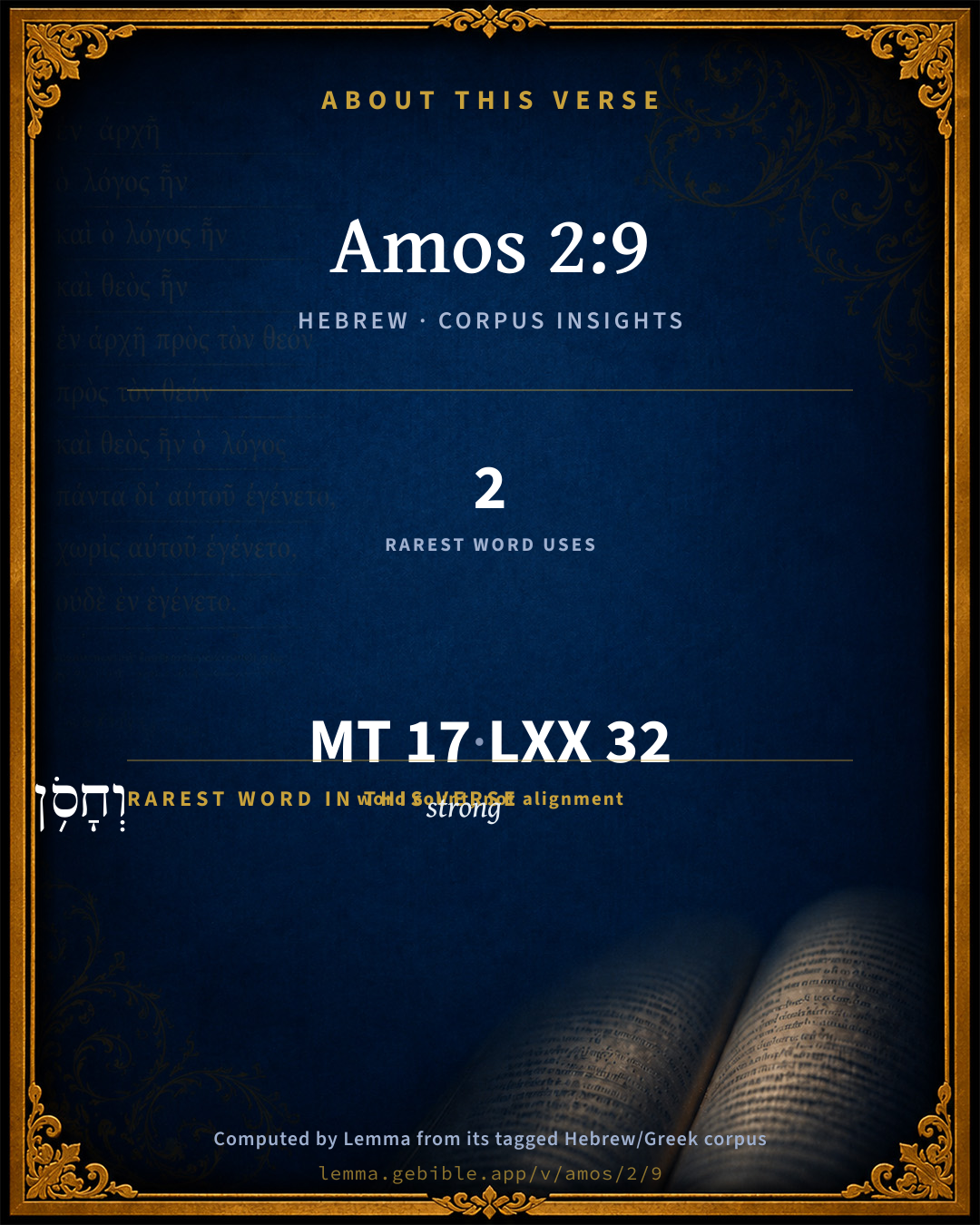
The rarest word here is וְחָסֹ֥ן strong H2634 — appearing just 2 times in the whole Hebrew Bible.

Shared distinctive vocabulary

וְחָסֹ֥ן strong H2634 occurs in 2 verses of the Hebrew Bible. Also found in:

Grammatical profile

  • 2 verbs
  • 8 nouns
  • 1 adjective
  • 2 pronouns
  • 1 preposition
  • 1 adverb
  • 2 particles

Verb forms

  • הִשְׁמַ֤דְתִּי Hiphil · Perfect
  • וָאַשְׁמִ֤יד Hiphil · Sequential Imperfect

Repetition

Words recur within this verse — often emphatic in Hebrew:

  • הִשְׁמַ֤דְתִּי to destroy H8045 ×2
  • כְּגֹ֤בַהּ height H1363 ×2

Hebrew & Septuagint length

In English translation the verse runs 35 words from the Hebrew and 38 from the Septuagint (LXX English) — closely comparable.

A rough comparison of the two English renderings, which tokenize alike — not a word-level alignment.

Word counts can differ between the Hebrew and the Greek without any difference in meaning — e.g. the Hebrew direct-object marker אֵת has no separate Greek word, and Greek often adds the article ὁ.

In the original languages it is 17 Hebrew tokens and 32 Greek tokens — but the two are counted differently (Hebrew bundles its prefixes and suffixes into one token; the Greek is in lemma form), so that isn’t a like-for-like length.

Cross-references

23

Topical passages linked to Amos 2:9 in the Treasury of Scripture Knowledge — connected by theme and wording, ordered by reader-vote popularity; previews shown in the World English Bible.

  • Job 18:16 His roots shall be dried up beneath, Above shall his branch be cut off.
  • Malachi 4:1 "For, behold, the day comes, it burns as a furnace; and all the proud, and all who work wickedness, will be stubble; and the day that comes will burn them up," says Yahweh of Hosts, "that it shall leave them neither root nor branch.
  • Genesis 15:16 In the fourth generation they will come here again, for the iniquity of the Amorite is not yet full."
  • Exodus 34:11 Observe that which I command you this day. Behold, I drive out before you the Amorite, the Canaanite, the Hittite, the Perizzite, the Hivite, and the Jebusite.
  • Numbers 13:28–29 However the people who dwell in the land are strong, and the cities are fortified, [and] very great: and moreover we saw the children of Anak there.
  • Numbers 13:32–33 They brought up an evil report of the land which they had spied out to the children of Israel, saying, The land, through which we have gone to spy it out, is a land that eats up the inhabitants of it; and all the people who we saw in it are men of great stature.
  • Numbers 21:23–25 Sihon would not allow Israel to pass through his border: but Sihon gathered all his people together, and went out against Israel into the wilderness, and came to Jahaz; and he fought against Israel.
  • Deuteronomy 2:24–33 Rise up, take your journey, and pass over the valley of the Arnon: behold, I have given into your hand Sihon the Amorite, king of Heshbon, and his land; begin to possess it, and contend with him in battle.
  • Deuteronomy 3:11 (For only Og king of Bashan remained of the remnant of the Rephaim; behold, his bedstead was a bedstead of iron; isn't it in Rabbah of the children of Ammon? nine cubits was the length of it, and four cubits the breadth of it, after the cubit of a man.)
  • Deuteronomy 9:1–3 Hear, Israel: you are to pass over the Jordan this day, to go in to dispossess nations greater and mightier than yourself, cities great and fortified up to the sky,
  • Exodus 3:8 I have come down to deliver them out of the hand of the Egyptians, and to bring them up out of that land to a good and large land, to a land flowing with milk and honey; to the place of the Canaanite, the Hittite, the Amorite, the Perizzite, the Hivite, and the Jebusite.
  • Deuteronomy 1:28 Where are we going up? our brothers have made our heart to melt, saying, The people are greater and taller than we; the cities are great and fortified up to the sky; and moreover we have seen the sons of the Anakim there.
  • Deuteronomy 2:10–11 (The Emim lived therein before, a people great, and many, and tall, as the Anakim:
  • Joshua 3:10 Joshua said, Hereby you shall know that the living God is among you, and that he will without fail drive out from before you the Canaanite, and the Hittite, and the Hivite, and the Perizzite, and the Girgashite, and the Amorite, and the Jebusite.
  • Joshua 10:12 Then spoke Joshua to Yahweh in the day when Yahweh delivered up the Amorites before the children of Israel; and he said in the sight of Israel, Sun, stand you still on Gibeon; You, Moon, in the valley of Aijalon.
  • Joshua 11:21–22 Joshua came at that time, and cut off the Anakim from the hill-country, from Hebron, from Debir, from Anab, and from all the hill-country of Judah, and from all the hill-country of Israel: Joshua utterly destroyed them with their cities.
  • Joshua 24:8–12 I brought you into the land of the Amorites, that lived beyond the Jordan: and they fought with you; and I gave them into your hand, and you possessed their land; and I destroyed them from before you.
  • Judges 11:21–23 Yahweh, the God of Israel, delivered Sihon and all his people into the hand of Israel, and they struck them: so Israel possessed all the land of the Amorites, the inhabitants of that country.
  • 2 Samuel 23:16–22 The three mighty men broke through the host of the Philistines, and drew water out of the well of Bethlehem, that was by the gate, and took it, and brought it to David: but he would not drink of it, but poured it out to Yahweh.
  • Nehemiah 9:22–24 Moreover you gave them kingdoms and peoples, which you did allot after their portions: so they possessed the land of Sihon, even the land of the king of Heshbon, and the land of Og king of Bashan.
  • Psalms 135:10–12 Who struck many nations, And killed mighty kings,
  • Psalms 136:17–22 To him who struck great kings; For his loving kindness endures forever;
  • Ezekiel 17:9 Say you, Thus says the Lord Yahweh: Shall it prosper? shall he not pull up the roots of it, and cut off the fruit of it, that it may wither; that all its fresh springing leaves may wither? and not by a strong arm or much people can it be raised from the roots of it.

Cross-references courtesy of OpenBible.info (CC BY 4.0).

Hebrew and Greek witnesses Masoretic Hebrew ↔ Greek Septuagint

The same verse in the two great witnesses to the Old Testament, shown verse-for-verse.

These are two independent witnesses, not word-aligned to each other, and the Septuagint is shown in lemma (dictionary) form.

Hebrew Amos 2:9 Masoretic · Westminster Leningrad Codex

וְאָ֨נֹכִ֜י הִשְׁמַ֤דְתִּי אֶת הָֽאֱמֹרִי֙ מִפְּנֵיהֶ֔ם אֲשֶׁ֨ר כְּגֹ֤בַהּ אֲרָזִים֙ גָּבְה֔וֹ וְחָסֹ֥ן ה֖וּא כָּֽאַלּוֹנִ֑ים וָאַשְׁמִ֤יד פִּרְיוֹ֙ מִמַּ֔עַל וְשָׁרָשָׁ֖יו מִתָּֽחַת

Yet I destroyed the Amorite before them, Whose height was like the height of the cedars, And he was strong as the oaks; Yet I destroyed his fruit from above, and his roots from beneath.

World English Bible · Public Domain

Greek LXX Amos 2:9 Septuagint · lemma form

ἐγώ δέ ἐκαἴρω ὁ ἀμορραῖος ἐκ πρόσωπον αὐτός ὅς εἰμί καθώς ὕψος κέδρος ὁ ὕψος αὐτός καί ἰσχυρός εἰμί ὡς δρῦς καί ἐκαἴρω ὁ καρπός αὐτός ἐπάνωθεν καί ὁ ῥίζα αὐτός ὑποκάτωθεν

Nevertheless I cut off the Amorite from before them, whose height was as the height of a cedar, and he was strong as an oak; and I dried up his fruit from above, and his roots from beneath.

LXX2012 (modern English Septuagint) · Public Domain

Hebrew: Westminster Leningrad Codex (CC BY 4.0). Greek: Septuagint (public domain); English from LXX2012 (modern English Septuagint) (Public Domain). How the Septuagint differs from the Hebrew →

Targum (Aramaic paraphrase)

1

The Targum is the ancient Jewish Aramaic paraphrase of the Hebrew Scriptures — an interpretive translation, not the Hebrew text itself. Onkelos (literal) and Pseudo-Jonathan (expansive) render the Torah, and Jonathan the Prophets. Coverage is partial: where no permissively-licensed English translation exists for a verse, only the Aramaic is shown. This is verse-level text, not a word-by-word alignment to the Hebrew.

  1. Targum Jonathan Prophets (Joshua–Malachi)
    וַאֲנָא שֵׁיצֵיתִי יַת אֱמוֹרָהָא מִן קֳדָמֵיהוֹן דִכְרוּם אֲרָזִין רוֹמֵיהּ וַחֲסִין הוּא כִּבְלוּטִין וְשֵׁיצֵיתִי אִבֵּיהּ מִלְעֵילָא וְשָׁרָשׁוֹהִי מִלְרָע:

    (no public-domain English translation for this verse)

    Targum Jonathan — Aramaic: “Mikraot Gedolot” (public domain). English: “Sefaria Community Translation” (CC0 1.0 (public-domain dedication)); “London "Chaldee Paraphrase," 1871” (public domain). Text via Sefaria.

Commentary

Notes on Amos 2:9 from classic Christian and Jewish commentators (each source and its license shown beneath its notes). The classic Christian expositions comment on the surrounding passage and are grouped to its opening verse, so a note may address several verses; the Jewish commentaries on the Tanakh (Rashi and others) are per-verse, so they appear only where the commentator wrote on this verse.

Lemma curates 59 commentaries, every one of them public domain or Creative Commons licensed, each selected and text-cleaned for this edition rather than reprinted as found. About our sources →

Matthew Henry's Commentary

Here, I. God puts his people Israel in mind of the great things he has done for them, in putting them into possession of the land of Canaan, the greatest part of which these ten tribes now enjoyed, Amo 2:9, Amo 2:10. Note, We need often to be reminded of the mercies we have received, which are the heaviest aggravations of the sins we have committed. God gives liberally, and upbraids us not with our meanness and unworthiness, and the disproportion between his gifts and our merits; but he justly upbraids us with our ingratitude, and ill requital of his favours, and tells us what he has done for us, to shame us for not rendering again according to the benefit done to us. "Son, remember; Israel, remember, 1. That God brought thee out of a house of bondage, rescued thee out of the land of Egypt, where thou wouldst otherwise have perished in slavery." 2. That he led thee forty years through a desert land, and fed thee in a wilderness, where thou wouldst otherwise have perished with hunger. Mercies to our ancestors were mercies to us, for, if they had been cut off, we should not have been. 3. That he made room for them in Canaan, by extirpating the natives by a series of wonders little inferior to those by which they were redeemed out of Egypt: I destroyed the Amorite before them, here put for all the devoted nations. Observe the magnificence of the enemies that stood in their way, which is taken notice of, that God may be the more magnified in the subduing of them. They were of great stature (whose height was like the height of the cedars) and the people of Israel were as shrubs to them; and they were also of great strength, not only tall, but well-set: He was strong as the oaks. Their kingdom was eminent among the nations, and over-topped all its neighbours. The supports and defences of it seemed impregnable; it was as fine as the stately cedar; it was as firm as the sturdy oak; yet, when God had a vine to plant there (Psa 80:8, Psa 80:9), this Amorite was not only cut down, but plucked up: I destroyed his fruit from above and his roots from beneath, so that the Amorites were no more a nation, nor ever read of any more. Thus highly did God value Israel. He gave men for them and people for their life, Isa 43:4. How ungrateful then were those who put such contempt upon him! 4. That he made them possess the land of the Amorite, not only put it into their hands, so that they became masters of it jure belli - by right of conquest, but gave them a better title to it, so that it became theirs by promise.

II. He likewise upbraids them with the spiritual privileges and advantages they enjoyed as a holy nation, Amo 2:11. They had helps for their souls, which taught them how to make good use of their temporal enjoyments and were therefore more valuable. It is true the ten tribes had not God's temple, altar, and priesthood, and it was their own fault that they deserted them, and for that they might justly have been left in utter darkness; but God left not himself without witness, nor them without guides to show them the way. 1. They had prophets that were powerful instructors in piety, divinely inspired, and commissioned to make known the mind of God to them, to show them what is pleasing to God and what displeasing, to reprove them for their faults and warn them of their dangers, to direct them in their difficulties and comfort them in their troubles. God raised them up prophets, animated them for that work and employed them in it. He raised them up of their sons, from among themselves, as Moses and Christ were raised up from among their brethren, Deu 18:15. It was an honour put upon their nation, and upon their families, that they had children of their own to be God's messengers to them, of their own language, not strangers sent from another country, whom they might suspect to be prejudiced against them and their land, but those who, they knew, wished well to them. Note, Faithful ministers are great blessings to any people, and it is God that raises them up to be so, that they may justly be reckoned an honour to the families they are of. 2. They had Nazarites that were bright examples of piety: I raised up of your young men for Nazarites, men that bound themselves by a vow to God and his service, and, in pursuance of that, denied themselves many of the lawful delights of sense, as drinking wine and eating grapes. There were some of their young men that were in their prime for the enjoyment of the pleasures of this life and yet voluntarily abridged themselves of them; these God raised up by the power of his grace, to be monuments of his grace, to his glory, and to be his witnesses against the impieties of that degenerate age. Note, It is as great a blessing to any place to have eminent good Christians in it as to have eminent good ministers in it; for so they have examples to their rules. We must acknowledge that it bodes well to any people when God raises up numbers of hopeful young people among them, when he makes their young men Nazarites, devout, and conscientious, and mortified to the pleasures of sense; and those that are such Nazarites are purer than snow, whiter than milk; they are indeed the polite young men, for their polishing is of sapphires, Lam 4:7. Those that have such men, such young men, among them, have therein such an advantage, both for direction and encouragement, to be religious, as they will be called to an account for another day if they do not improve. Israel is here reckoned with, not only for the prophets, but for the Nazarites, raised up among them. Concerning the truth of this, he appeals to themselves: "Is it not even thus, O you children of Israel? Can you deny it? Have not you yourselves been sensible of the advantage you had by the prophets and Nazarites raised up among you?" Note, Sinners' own consciences will be witnesses for God that he has not been wanting to them in the means of grace, so that, if they perish, it is because they have been wanting to themselves in not improving those means. The men of Judah shall themselves judge between God and his vineyard, whether he could have done more for it, Isa 5:3, Isa 5:4.

III. He charges them with the abuse of the means of grace they enjoyed, and the opposition they gave to God's designs in affording them those means, Amo 2:12. They were so far from walking in the light that they rebelled against it, and did what they could to extinguish it, that it might not shine in their faces, to their conviction. 1. They did what they could to debauch good people, to draw them off from their seriousness in devotion and their strictness in conversation: You gave the Nazarites wine to drink, contrary to their vow, that, having broken it in that instance, they might not pretend to keep it in any other. Some they surprised, or allured into it, and with their much fair speech caused them to yield; others they forced and frightened into it, reproached and threatened them if they were more precise than their neighbours; and, by drawing them in to drink wine, they spoiled them for Nazarites. Note, Satan and his agents are very busy to corrupt the minds of young people that look heavenward; and many that we thought would have been Nazarites they have overcome by giving them wine to drink, by drawing them in to the love of mirth and pleasure, and drinking company. Multitudes of young men that bade fair for eminent professors of religion have erred through wine, and been undone for ever. And how do the factors for hell triumph in the debauching of a Nazarite! 2. They did what they could to silence good ministers, and to stop their mouths: "You commanded the prophets, saying, Prophesy not, and threatened them if they did prophesy (Amo 7:12), as if God's messengers were bound to observe your orders, and might not deliver their errand unless you gave them leave, and so you not only received the grace of God, in raising up those prophets, in vain, but put the highest affront imaginable upon that God in whose name the prophets spoke." Note, Those have a great deal to answer for that cannot bear faithful preaching, and those much more that suppress it.

IV. He complains of the wrong they did him by their sins (Amo 2:13): "I am pressed under you, I am straitened by you, and can no longer bear it, and therefore I will ease myself of my adversaries, Isa 1:24. I am pressed under you and the load of your sins as a cart is pressed that is full of sheaves, is loaded with corn, in the midst of the joy of harvest, as long as any will lie on." Note, The great God complains of sin, especially the sins of his professing people, as a burden to him. He is grieved with this generation (Psa 95:10), is broken with their whorish heart (Eze 6:9), a consideration which, if it make not the sinner's repentance very deep, will make his ruin very great. The great God that upholds the world, and never complains that his is pressed under the weight of it (he fainteth not, neither is weary), yet complains of the sins of Israel, yea, and of their hypocritical services too, that he is weary of bearing them, Isa 1:14. No wonder the creature groans being burdened (Rom 8:22), when the Creator says, I am pressed under them.

V. He threatens them with unavoidable ruin. And so some read, Amo 2:13, "Behold I will press, or straiten, your place, as a cart full of sheaves presses; they shall be loaded with judgments till they shall sink under them, and shall make a noise, as a cart overloaded does." Those that will not submit to the convictions of the word, that will neither be won by that nor by the conversation of those about them, shall be made to sink under the weight of God's judgments. If God load us daily with his benefits, and we, notwithstanding that, load him with our sins, how can we expect any other than that he should load us with his judgments? And it is here threatened in the last three verses that, when God comes forth to contend with this provoking people, they shall not be able to stand before him, to flee from him, nor to make their part good with him; for when God judges he will overcome. Though his patience be tired out, his power is not, and so the sinner shall find, to his cost. When the Assyrian army comes to lay the country waste by sword and captivity none shall escape, but every one shall have his share in the common desolation. 1. It will be in vain to think of fleeing from the enemy that comes armed with a commission to make all desolate: The flight shall perish from the swift; those that have been famed for happy escapes and happy retreats shall now find their arts fail them; they shall have no time to flee, or shall find no way to take, or they shall have no strength or spirit to attempt it; they shall be at their wits' end, and then they are soon at their flight's end. Are they, as Asahel, as swift of foot as a wild roe? (Sa2 2:18), yet, like him, they shall run the faster upon their own destruction: He that is swift of foot shall not deliver himself, Amo 2:15. Or do they say (as those, Isa 30:16), We will flee upon horses, and we will ride upon the swift? Yet they shall be overtaken: Neither shall he that rides the horse deliver himself from his pursuers. A horse is a vain thing for safety. 2. It will be in vain to think of fighting it out. God is at war with them; and are they stronger than he? Is there any military force that can pretend to be a match for Omnipotence? No: The strong shall not strengthen his force. He that has a habit of strength shall not be able to exert it when he has occasion for it. And the mighty, whose should protect and deliver others, shall not be able to deliver himself, to deliver his soul (so the word is), shall not save his life. Let not the strong man then glory in his strength, nor trust in it, but strengthen himself in the Lord his God, for in him is everlasting strength. And, as the bodily strength shall fail, so shall the weapons of war. The armour as well as the arm shall become insufficient: Neither shall he stand that handles the bow, though he stand at a distance, but shall betake himself to flight, and not trust to his own bow to save him. Though the arm be ever so strong, and the armour ever so well fixed, neither will avail when the spirit fails (Amo 2:16): He that is courageous among the mighty, that used to look danger in the face, and not be dismayed at it, shall flee away naked in that day, not only disarmed, having thrown away his weapons both offensive and defensive, but plundered of his treasure, which he thought to carry away with him, and he shall think it as much as he could expect that he has his life for a prey. Thus when God pleases he takes away the heart of the chief of the people of the earth, and causes those who used to boast of their courage, and their daring enterprises in the field, to wander and sneak in a wilderness where there is no way, Job 12:24.

Matthew Henry's Commentary on the Whole Bible (1708–1710) — public domain (CC PDM 1.0). Text via the HelloAO Bible API.

Adam Clarke's Commentary

Verse 9. Yet destroyed I the Amorite] Here follow general heads of God's mercies to them, and the great things he had done for them.

1. Bringing them out of Egypt.

2. Miraculously sustaining them in the wilderness forty years.

3. Driving out the Canaanites before them, and giving them possession of the promised land.

4. Raising up prophets among them to declare the Divine will.

5. And forming the holy institution of the Nazarites among them, to show the spiritual nature of his holy religion, Am 2:9-11.

Adam Clarke's Commentary on the Bible (1810–1826) — public domain. Text from a community e-Sword/MySword module.

Trapp's Complete Commentary

John Trapp

Amo 2:9 Yet destroyed I the Amorite before them, whose height [was] like the height of the cedars, and he [was] strong as the oaks; yet I destroyed his fruit from above, and his roots from beneath.

Ver. 9. Yet destroyed I the Amorite before them] It is not usual with God to hit men in the teeth with what he hath done for them, Jas 1:5, unless in case of unthankfulness, as here. Then, indeed, people shall hear of what they have had, and be taught the worth of good turns by the want of them. Good turns aggravate unkindnesses; and our offences are not a little increased by our obligations. Hence this approbation; and it is as if God should say, This people hath not only done the evils before mentioned, but also after the receipt of mercies without measure, and many miraculous deliverances; as if I had even hired them to be wicked; and as if that were to pass for truth which the snake in the fable said to the countryman that had showed it kindness, Summum praemium pro summo beneficio est ingratitudo. In the year 1245 the Pope was denied entrance into England; it being said that the Pope was but like a mouse in a satchel, or a snake in one’s bosom, who did but ill repay their hostess for their lodging. God had done exceeding much for this perverse people; and this they now hear of with stomach enough, as well they deserved. At Athens, if a servant proved ungrateful for his manumission, his master had an action, αποστασιου, against him; and might recover him again into bondage. Lycurgus, the Lacedemonian lawgiver, would not make a law against ingratitude; as holding it monstrous not to requite a kindness, not to acknowledge a good turn. The old Romans decreed that such as were found guilty of this fault should be cast alive to the cormorant, {a} to be pulled in pieces and devoured. Our Saviour fitly yokes together the evil and the unthankful, Luk 6:35; and God here sums up all his people’s sins in this one, as the epitome of all the rest.

Yet I destroyed the Amorite] When once his iniquity was full, Gen 15:16, when he had filled the land from corner to corner with his uncleanness, Ezr 9:11, then sent I my hornets before them, which drove them out before them. But not with their sword nor with their bow, Jos 24:12. See this thankfully acknowledged by this Church after she had prayed for her learning, Psa 44:2-3; Psa 44:9-10.

Whose height was like the height of the cedars, &c.] For stature and strength they seemed insuperable, Num 13:28, &c. But God soon topt them and tamed them, he took them a link lower, and made them know themselves to be but men, Psa 9:20; or if trees, cedars, oaks (as Plato saith of man, that he is but arbor inversa), yet,

I destroyed his fruit from above, and his roots from beneath] I left him little enough to be proud of; less than Nebuchadnezzar, who had a stump left, and was reserved for royal state again, Dan 4:15. God cut off these Amorites; that is, all the seven nations, head and tail, root and branch, old and young together, Deu 7:2 Jos 6:21 (behold the severity of God), as if he had forgotten that forepart of his back parts, Jehovah, Jehovah, gracious, merciful, &c., and had taken up that emperor’s motto, Fiat iustitia, pereat mundus, Let justice be done, though never so many be undone.

{a} A large and voracious sea bird ( Phalacrocorax carbo), about 3 feet in length, and of a lustrous black colour, widely diffused over the northern hemisphere and both sides of the Atlantic. ŒD

John Trapp, A Commentary or Exposition upon All the Books of the Old and New Testament (1647–1656) — public domain. Text from a community e-Sword module.

The Biblical Illustrator

Joseph S. Exell

Amo_2:9-11

Yet destroyed I the Amorite before them, whose height was like the height of the cedars, and he was strong as the oaks.

Sin as ingratitude

These verses form a graphic resume of the great benefits which God had bestowed on His people. Amos was master of all arts by which a nation might be roused to penitence. Hence the two pictures of mans sin (verses 6-8) and Gods goodness are set side by side as a means of awakening the slumbering conscience of the nation, and winning them back again to the service of their almighty and changeless Friend. Only the most hardened hearts can resist the appeal which Divine mercy makes! How great the sin of Israel. It blinded them to the mercies of heaven, made them cling to vices which God had raised them up to subdue, and forget the truth and holiness which were to be exemplified in their lives. The mercies are summed up under three heads.

I. The victories which made them masters of their inheritance. Yet destroyed I the Amorite (verse 9). The Amorites, strongest of all Canaanite nations, are taken as the representatives of all. The greatness of the victories is measured here--

(1) By the might of the enemies. The two noblest trees of Palestine represent the prowess of the foe: Whose height was like the height of the cedars, and he was strong as the oaks. The Anakim were of this race, combining what are not always united, vast stature and gigantic strength. The terror of the spies (Num_13:1-33.) is the best witness to the power of these mighty foemen. These enemies are a type of all foes whom God subdues before His people. Passion and pride are the Anakim whom He subdues before us. Alone we were powerless, dismayed by thoughts of the encounter; yet God girded Himself as a mighty man of war, and won for us the victory.

(2) The victory is measured by the completeness of the deliverance. Yet destroyed I his fruit from above, and his roots from beneath. The fruit might have been borne by the breeze to some spot where it would grow again, the root, left in the earth, might have put forth new branches. Both were destroyed. Our own experience has its parallel here. God not only subdues our foes, but lays them low at our feet, where they need never rise again to harass and annoy us: rooting out the seeds of bitterness. What a claim on our devotion!

II. Deliverances which opened the way for this career of conquest. I brought you up from the land of Egypt (verse 10). Nothing seemed more improbable than that they should escape from their captivity. All religious life begins with such proofs of Gods power and mercy.

III. Gods mercy also provided spiritual blessings (verse 11). The Nazarites and prophets were men who withered for truth and purity. The prophet taught by his words, the Nazarite by his life. Representatives of God, they walked among His people to bind all hearts to Himself. They were to preserve the nation from the sins which had brought ruin on the old inhabitants of Canaan, to keep alive that truth and purity which secured to them the possession of their land. How rich the mercy of God! The Amorite subdued, that the people might inherit their land; the yoke of Egypt broken, that they might go up and possess their inheritance; spiritual guides raised up to keep the people from the sin, which would spoil them of their new-found treasure. Such is Gods dealing with all His people. Their path is strewn with tokens of His guardian grace. He is preparing them for a great future. Application--Gods appeal, Is it not even thus? (verse 11) sets the sin of Israel before us in all its baseness. The mercies were so evident that none could doubt or deny them. All sin in Gods people is base ingratitude. Remember the gifts of heaven when tempted to wander. (J. Telford, B. A.)

The Biblical Illustrator, edited by Joseph S. Exell (c. 1880s–1900s) — public domain. Text from a community e-Sword module.

Joseph Benson's Commentary

Amo 2:9. Yet destroyed I the Amorite before them — Namely, when they came out of Egypt. The Amorites include the rest of the Canaanites, and are here mentioned rather than the others, as being the mightiest nation of them all. Here the benefits which God had bestowed upon the Israelites are mentioned that it might appear how great their ingratitude was toward him. Whose height was like that of the cedars — Who were men of a vast stature, and remarkable strength. The image is a grand and natural one. Virgil makes the same comparison, speaking of the Titans, Æneid, lib. 3. ver. 677.

“Concilium horrendum, quales cum vertice celso, Aeriæ quercus, aut coniferæ Cyparissi Constiterunt, sylva alta Jovis, lucusve Dianæ.”

“A dreadful council, with their heads on high, Not yielding to the tow’ring tree of Jove, Or tallest cypress of Diana’s grove.” DRYDEN.

Yet I destroyed his fruit from above, and his roots from beneath — The prophet diversifies and continues the image with great beauty. See similar ones, Homer’s Il., 13:389, and Hor. Od., 50. Amo 4:6. So Virgil compares the destruction of Troy to the cutting down a mountain ash; and the fall of Entellus to that of a pine. Æn., 2:626; 5:447.

Joseph Benson's Commentary on the Old and New Testaments (1811–1818) — public domain. Text from a community e-Sword module.

Whedon's Commentary on the Bible

Daniel D. Whedon

9-12. What contrast between the actual conduct of the people and the conduct that might be expected of them in view of Jehovah’s loving care for them throughout their entire history! He brought them out of Egypt and led them in the wilderness (Amo_2:10); he destroyed the Amorites (Amo_2:9); he raised up religious teachers (Amo_2:11-12). In the present Hebrew text the chronological order of events is not observed; chronologically the verses should be arranged Amo_2:10 - Amo_2:9, - Amo_2:11, - Amo_2:12, and this Harper thinks to have been the original order.

Yet destroyed I — The contrast is brought out more emphatically in the Hebrew, “But I (on my part), I destroyed.”

Amorite — In Amo_2:10 Palestine is called “the land of the Amorite,” an expression found also in early Babylonian inscriptions. In the Old Testament Amorite is used (1) as synonymous with Canaanite, to designate the inhabitants of the whole of Palestine (Jos_24:8; Jos_24:15; Jos_24:18; Deu_1:7; Deu_1:19, etc.); (2) to designate the peoples ruled by Sihon and Og, east of the Jordan (Num_21:21-25). As Amo_2:10 makes plain, here the reference is to the inhabitants of the entire land.

Cedars — Among the Hebrews the “type of loftiness and grandeur” (Isa_2:13; compare Isa_1:30-31).

Oaks — The type of strength and endurance (Isa_2:13; compare Isa_1:30-31; Zec_11:2). For the belief that the inhabitants of Palestine were of giant stature see Deu_1:28; Num_13:32-33.

Fruit… roots — The highest and the lowest parts, equivalent to root and branch — completely. A similar expression is read on the sarcophagus of Eshmunazar (see on Amo_2:1; compare Hos_9:16; Isa_5:24).

Also I — The pronoun is again emphatic.

Brought you up — Up, because of the mountainous character of Palestine as compared with Egypt.

From the land of Egypt — The Exodus from Egypt was the supreme manifestation of Jehovah’s love and power in Hebrew history; hence it is frequently made the basis of prophetic appeals (Amo_3:1; Hos_12:9; Hos_13:4, etc.).

Forty years through the wilderness — Lovingly and tenderly he cared for them and supplied their wants (Amo_5:25; Deu_2:7; Deu_8:2; Deu_29:5); his ultimate purpose being to bring them into the promised land.

Jehovah raised up among them religious and moral teachers, which was a special mark of divine favor, enjoyed by Israel exclusively.

Prophets,… Nazarites [“Nazirites”] — Two classes of religious teachers and workers; the former taught principally, though not exclusively, by word of mouth, the latter by example. Both played important parts. From the beginning of Hebrew history to its close no serious crisis arose without God raising up a prophet to lead the people through it. The Nazirites (separated, or, consecrated) tried to stem by example the tide of worldliness and self-indulgence, which threatened to sweep away the simplicity of ancient Hebrew life. (See articles “Prophecy and Prophets” and “Nazirites,” in Hastings’s Dictionary of the Bible.) The law regulating the conduct of Nazirites is found in Num_6:1-21 (compare Jeremiah 35).

Is it not even thus — An appeal to confirm or deny the preceding statements. Denial was impossible.

Saith Jehovah — This particular expression is very common in prophetic writings; it is a solemn asseverative interjection (see on Joe_2:12); and by calling attention to the fact that the prophet is delivering the word of Jehovah it sets a seal of truthfulness upon the message.

The Israelites failed to appreciate the divine goodness; not only did they refuse to listen, they even sought to silence the prophets and compel the Nazirites to become unfaithful to their vows; by these acts they insulted Jehovah himself.

Gave… wine to drink — One of the principal obligations of the Nazirites was to abstain from intoxicating drinks (Num_6:3).

Prophesy not — Such prohibitions are not infrequent (1Ki_13:4; 1Ki_18:4; 1Ki_19:2; 1Ki_22:8; 1Ki_22:26-27; 2Ki_1:9 ff; 2Ki_6:31); for the time of Amos and later see Amo_7:13; Amo_7:16; Hos_9:8; Isa_30:10-11; Mic_2:6; Jer_20:7-10.

Daniel D. Whedon (gen. ed.), Commentary on the Old and New Testaments (1874–1909) — public domain. Text from a community e-Sword module.

Keil & Delitzsch

C. F. Keil & F. Delitzsch

And if this daring contempt of the commandments of God was highly reprehensible even in itself, it became perfectly inexcusable if we bear in mind that Israel was indebted to the Lord its God for its elevation into an independent nation, and also for its sacred calling. For this reason, the prophet reminds the people of the manifestations of grace which it had received from its God (Amo 2:9-11). Amo 2:9. "And yet I destroyed the Amorite before them, whose height was like the height of the cedars, and who was strong as the oaks; and I destroyed his fruit from above, and his roots from beneath. Amo 2:10. And yet I brought you up from the land of Egypt, and led you forty years in the desert, to take possession of the land of the Amorite." The repeated ואנכי is used with peculiar emphasis, and serves to bring out the contrast between the conduct of the Israelites towards the Lord, and the fidelity of the Lord towards Israel. Of the two manifestations of divine grace to which Israel owed its existence as an independent nation, Amos mentions first of all the destruction of the former inhabitants of Canaan (Exo 23:27., Exo 34:11); and secondly, what was earlier in point of time, namely, the deliverance out of Egypt and guidance through the Arabian desert; not because the former act of God was greater than the latter, but in order to place first what the Lord had done for the nation, that he may be able to append to this what He still continues to do (Amo 2:11). The nations destroyed before Israel are called Amorites, from the most powerful of the Canaanitish tribes, as in Gen 15:16; Jos 24:15, etc. To show, however, that Israel was not able to destroy this people by its own strength, but that Jehovah the Almighty God alone could accomplish this, he proceeds to transfer to the whole nation what the Israelitish spies reported as to their size, more especially as to the size of particular giants (Num 13:32-33), and describes the Amorites as giants as lofty as trees and as strong as trees, and, continuing the same figure, depicts their utter destruction or extermination as the destruction of their fruit and of their roots. For this figure of speech, in which the posterity of a nation is regarded as its fruit, and the kernel of the nation out of which it springs as the root, see Eze 17:9; Hos 9:16; Job 18:16. These two manifestations of divine mercy Moses impressed more than once upon the hearts of the people in his last addresses, to urge them in consequence to hold fast to the divine commandments and to the love of God (cf. Deu 8:2., Deu 9:1-6; Deu 29:1-8).

Keil & Delitzsch — Biblical Commentary on the Old Testament (1861–1891) — public domain (CC PDM 1.0). Text via the HelloAO Bible API. (Old Testament only.)

Tyndale Open Study Notes

Tyndale Open Resources

2:9 Amorites is used here as a general term to denote the inhabitants of Canaan (see Gen 15:16; Judg 6:10).

Tyndale Open Study Notes — © Tyndale Open Resources, licensed CC BY-SA 4.0. Text via the HelloAO Bible API.

Geneva Bible (1599)

Geneva Bible translators

The destruction of their enemies and his mercy toward them, should have caused their hearts to melt for love toward him.

Geneva Bible (1599) marginal notes — public domain. Text via Bolls.life.

Jamieson, Fausset & Brown

Robert Jamieson, A. R. Fausset & David Brown

Yet--My former benefits to you heighten your ingratitude.

the Amorite--the most powerful of all the Canaanite nations, and therefore put for them all (Gen 15:16; Gen 48:22; Deu 1:20; Jos 7:7).

height . . . like . . . cedars-- (Num 13:32-33).

destroyed his fruit . . . above . . . roots . . . beneath--that is, destroyed him utterly (Job 18:16; Eze 17:9; Mal 4:1).

Jamieson, Fausset & Brown — Commentary Critical and Explanatory on the Whole Bible (1871) — public domain (CC PDM 1.0). Text via the HelloAO Bible API.

John Calvin's Commentaries

God expostulates here with the Israelites for their ingratitude. He records the benefits he had before conferred on that people; and then shows how unworthily and disgracefully they had conducted themselves; for they forgot their many blessings and proudly despised God, and acted as if they were like other nations, and not bound to God for the singular benefit of adoption. The sum then is that God here complains that he had ill bestowed his blessings; and he reproves the people for their impiety, inasmuch as they did not lead a holier life after having been freely redeemed.

He says first, I have exterminated the Amorite before their face. God shows here that he was disgracefully defrauded by the Israelites, for whose sake he had previously destroyed the Amorites. For why were the Amorites exterminated, but that God would cleanse the land, and also, that he might give there a dwelling to his own people, that he might be purely worshipped? Then the people of Israel ought to have given up themselves wholly to the service of God; but as they neglected to do this, they frustrated the purpose of God, who had expelled the Amorites from that land, yea, and entirely destroyed them. The first complaint then is, that the children of Israel were nothing better than the Amorites, though God had given them the land, which was taken from its natives, that they might dwell in it, and on the condition, that his name should be there worshipped. Hence the Prophets say elsewhere, that they were Amorites. They ought to have been a new people; but as they followed the examples of others, in what did they differ from them? They are therefore called their posterity. But the Prophet speaks not here so severely; he only reproves the Israelites, because they differed in nothing from the Amorites, whom they knew to have been destroyed that they might be introduced into their place, and succeed to their inheritance.

It is then added, that the Amorites were tall in stature, and also that they were strong men. By these words the Prophet intimates that the Amorites were not conquered by the people’s valor, but by the wonderful power of God. We indeed know that they were dreaded by the people of Israel, for they were like giants. Then the Prophet speaks here of their height and strength, that the Israelites might consider that they overcame them not by their own valor, but that the land was given them by a miracle, for they had to do with giants, on whom they could hardly dare to look. It was then God who prostrated the cedars and the oaks before his people. We hence learn, that the Israelites could not boast of their own strengths as though they took possession of the land, because by means of war they ejected their enemies; for this was done by the singular kindness of God. They could not indeed have contended with their enemies, had not that been fulfilled which the Lord had so often foretold, ‘For you, while still, I will fight,’ (Exodus 14:14) We now perceive the Prophet’s intention. But we may hence farther learn, that the Israelites had not possessed the land, because they were more excellent than the Amorites, its ancient inhabitants; but because it so pleased God. There was therefore no reason for the people of Israel to be proud on account of any excellency. It hence appears that they, who did not consider this remarkable kindness done to them, were more than doubly ungrateful to God.

He says that their fruit above and root below were destroyed. By this metaphor God enlarges on what he said before, that the Amorites had been exterminated, so that none of them remained. “I have demolished,” he says, or, “I have entirely destroyed the root beneath and the fruit above; I have extinguished the very name of the nation.” And yet the Israelites were not better, though the Amorites were thus destroyed; but having succeeded in their place, they became like them: this was utterly inexcusable. The more severe God’s vengeance had been towards the Amorites, the more ought the Israelites to have extolled his favor: but when with closed eyes they passed by so remarkable a testimony of God’s paternal love, it appears that they were extremely wicked and ungrateful.

John Calvin's Commentaries (1540-1563) — public domain. Text from the Calvin Translation Society English edition (1840s-50s) via the Christian Classics Ethereal Library (ccel.org). Calvin's coverage is partial (roughly two-thirds of the Bible); uncommented books and verses are honest gaps, never fabricated. The 19th-century editor's footnotes and remarks are omitted so the notes are faithfully Calvin's own voice.

Ellicott's Commentary for English Readers

(9) Destroyed I.—Emphasis belongs to the pronoun “I.” The Amorites proper occupied the S.W. coast of the Dead Sea. Their formidable stature and power were attributed occasionally to all the inhabitants of the land. (Jos_24:18; Jdg_6:10.) They were absorbed before the time of Amos.

A Bible Commentary for English Readers, edited by Charles John Ellicott (1878–1897) — public domain. Text from a community e-Sword module.

The Cambridge Bible for Schools and Colleges

gen. ed. J. J. S. Perowne

9. Yet destroyed I] The pron. is emphatic: ‘Yet I (whom you thus requite) destroyed the Amorites, that mighty and seemingly invincible nation, from before you, and settled you in their land.’ Destroyed before (lit. from before) you: the same expression in Jos_24:8—a passage belonging to the Hexateuchal narrator, commonly designated by the letter E: “And I brought you into the land of the Amorite, who dwelt beyond Jordan, and they fought with you; and I gave them into your hand, and ye possessed their land, and I destroyed them from before you”; cf. also Deu_2:21-22. Amorite is the term used (1) in the passage just quoted, and frequently, of the peoples ruled by Sihon and Og, east of Jordan, conquered by the Israelites; (2) as a general designation of the pre-Israelitish population of the territory W. of Jordan, especially in the Hexateuchal writer ‘E,’ and in Deuteronomy (as Gen_48:22; Deu_1:7; Deu_1:19-20; Jos_24:15; Jos_24:18, and occasionally besides (as Jdg_1:34-35; Jdg_6:10; 2Sa_21:2): see, more fully, the writer’s Commentary on Deuteronomy, pp. 11–12. It is used here, evidently, in the second sense.

like the height of the cedars &c.] A hyperbolical description of the stature and strength of the Amorites: cf. Num_13:32; Deu_1:28 (“a people greater and taller than we; cities great and fenced up to heaven”). The cedar was, among the Hebrews, the type of loftiness and grandeur (Isa_2:13; Eze_17:23; Eze_31:3).

his fruit from above, and his roots from beneath] i.e. completely, or, as we might say, root and branch: not only was the fruit which existed destroyed, but the stock from which fresh fruit might have been put forth afterwards was destroyed likewise. For the figure comp. Hos_9:16, Eze_17:9; and especially Job_18:16, Isa_37:31, and the Inscription on the tomb of Eshmunazar, king of Sidon (Corp. Inscr. Sem. I. i. p. 19), Isa_50:11-11 (an imprecation uttered against any one who violates the tomb): “may he have no root beneath, or fruit above, or any beauty among the living under the sun.”

9–12. The ingratitude shewn by Israel, in thus dishonouring its Lord and Benefactor.

The Cambridge Bible for Schools and Colleges (gen. ed. J. J. S. Perowne; Cambridge University Press, 1878–1918) — public domain. Text from a community e-Sword module.

John Gill's Exposition

Yet destroyed I the Amorite before them,.... Here the Lord by the prophet reckons up the many favours and blessings he had bestowed upon Israel, which was an aggravation of their sins, and showed them to be guilty of great ingratitude, and a justification of him in his punishment of them he drove out the seven nations of Canaanites from before them, to make way for them, and destroyed them, of which the Amorite was a principal, and is here put for all the rest:

whose height was like the height of the cedars; being both tall of stature, and in great honour and dignity with the other nations, and in very opulent and flourishing circumstances:

and he was strong as the oaks: not only like the tall cedars of Lebanon for their height and largeness of stature, but like the sturdy oaks for the strength of their bodies, being of the race of the giants, Num 13:28;

yet I destroyed his fruit from above, and his roots from beneath; that is, utterly destroyed him, root and branch, so that nothing of him remained; still persisting in the metaphor of a tree. Jarchi interprets it of their superior and inferior princes; but it seems best to understand it of children with their parents, the one being the fruit, the other the root; and, both being destroyed, there must be utter ruin.

John Gill's Exposition of the Whole Bible (1746–1763) — public domain (CC PDM 1.0). Text via the HelloAO Bible API.

Albert Barnes' Notes on the Bible

Yet - (and I) I (Emphatic) destroyed Such were “their” doings; such their worship of “their God.” And what had “God” done? what was it, which they thus requited?

The Amorite - These, as one of the mightiest of the Canaanite tribes, stand in Moses for all. Moses, in rehearsing to them the goodness of God and their backsliding, reminds them, how he had said, “Ye have come to the mountain of the Amorites, which the Lord your God giveth you” Deu 1:20; and that they, using this same word, said, “Because the Lord hateth us, He hath brought us forth out of the land of Egypt, to give us into the hand of the Amorite to destroy us” Deu 1:27. The aged Joshua, in rehearsing God’s great deeds for Israel, places first by itself the destruction of the Amorite before them, with the use of this same idiom , “I brought you into the land of the Amorites which dwelt on the other side of Jordan - and I destroyed them before you.” The Amorites were descended from the 4th son of Canaan Gen 10:16.

At the invasion of Chedorlaomer, a portion of them dwelt at Hazezon-Tamar or Engedi, half way on the west side of the Dead Sea, and at Hebron near it (Gen 14:7, Gen 14:13; compare Gen 13:18; 2Ch 20:2). Their corruption had not yet reached its height, and the return of Israel was delayed to the four hundredth year, “because the iniquity of the Amorite was not yet full” Gen 15:16. When Israel returned, the Amorites, (together with the Hittites and the Jebusites) held the hill country Num 13:29; Deu 1:7, Deu 1:44, Jerusalem, Hebron, Gibeon 2Sa 21:2, and, on the skirts of the mountains westward Jarmuth, Lachish, and Eglon Jos 10:3, Jos 10:5. They dwelt on the side of the Jordan westward Jos 5:1, besides the two kingdoms which they had formed east of Jordan, reaching to Mount Hermon Deu 3:8 and Bashan up to the territory of Damascus. Afterward a small remnant remained only in the portion of Dan, and in the outskirts of Judah, from the south of the Dead Sea, Maaleh Akrabbim (Scorpion-pass) and Petra Jdg 1:35-36. Those near Idumea were probably absorbed in Edom; and the remnant in Dan, after becoming tributary to Ephraim Jdg 1:35-36, lost their national existence perhaps among the Philistines, since we have thenceforth only the single notice in the days of Samuel after the defeat of the Philistines, “there was peace between Israel and the Amorites” 1Sa 7:14.

Whose height was like the height of the cedars - The giant sons of Anak were among the Amorites at “Hebron” Num 13:22 (called for a time Kiriath Arba Jos 14:15; Jos 15:13-14 from their giant father) “Debir, Ahab, and the mountains of Judah and Israel Jos 11:21. The valley of Rephaim” 2Sa 5:18, southwest of Jerusalem, connects this giant race with the Amorites, as does the fact that Og, king of the Amorites in Basan, was “of the remnant of the Rephaim” Deu 3:11; Jos 12:4; Jos 13:19. Basan and Argob were, in Moses’ time, still called “the land of Rephaim” Deu 3:13. The Rephaim, with the Perizzites, dwelt still in woody mountains near Ephraim; from where, on the complaint that the lot of the sons of Joseph was too narrow, Joshua bade his tribe to expel them Jos 17:15, Jos 17:18. The Rephaim are mentioned between the Perizzites and the Amorites Gen 15:20-21, in God’s first promise of the land to Abraham’s seed, and perhaps some intermixture of race gave the giant stature to the Amorites. It is clear from Amos that the report of the spies, “all the people that we saw in it were men of stature” Num 13:32, was no exaggeration, nor did Joshua and Caleb deny “this.” The name of the Amorite is probably connected with “commanding,” describing some quality of their forefather, which descended to his race.

Whose height was like the height of cedars - Giant height is sometimes a cause of weakness. Amos, in a degree like Hosea combines distinct images to make up the idea of stateliness and strength. The cedar is the ideal of eastern trees for height Isa 2:13; Eze 17:22; Eze 31:3; 1Ki 4:33; 2Ki 14:9, stretching forth its arms as for protection , “It groweth to an exceeding height, and with increasing time ever riseth higher.” The oak has its Hebrew name from strength. The more majestic the tall strength of the Amorite, the more manifest that Israel “got not the land in possession by their own sword” Psa 44:3, who had counted themselves, in sight of the Amorite, “as grasshoppers” Num 13:33. God, who gave him that strength, took it away, as we say, “root and branch,” leaving him no show above, no hope of recovered life below (see Hos 9:16; Job 18:16; Eze 17:9). Having compared each Amorite to a majestic tree, he compares the excision of the whole nation to the cutting down of that one tree , so swift, so entire, so irrecoverable. Yet the destruction of the Amorite, a mercy to Israel in the purpose of God, was a warning to israel when it became as they. God’s terrors are mercies to the repentant; God’s mercies are terrors to the impenitent. “Ye shall keep My statutes and My judgments and shall not commit any of these abominations,” was the tenure upon which they held the Lord’s land, “that the land spue not you out also, when ye defile it, as it spued out the nations that were before you” Lev 18:26, 38.

Albert Barnes' Notes on the Bible (1834–1885) — public domain. Text from a community e-Sword/MySword module.

Haydock's Catholic Bible Commentary

Beneath. The Israelites seemed like locusts in comparison, Numbers xiii. 34.

George Leo Haydock (1774–1849), Haydock's Catholic Family Bible and Commentary, 1859 edition — public domain. Excludes Psalms (Douay-Rheims chapter numbering differs from Protestant) and Deuterocanonical books (Catholic canon only).

Matthew Poole's English Annotations

Yet destroyed I, whom they have ungratefully forgotten and forsaken, and set up idol’s in competition with me; nay, cast off my law and worship, and embraced idolatry, worshipped idols that never could do them good, nor destroy their enemies; this they did after I had destroyed their enemies.

The Amorite; the mightiest nation of all the Canaanites, and therefore expressly mentioned as an instance of God’s great mercy, and Israel’s great ingratitude: by this nation mentioned all the rest of the Canaanitish nations are to be understood. These Amorites dwelt beyond Jordan, between that and Moab, and their land fell by lot unto Reuben, Gad, and the half tribe of Manasseh. Before them, the children of Israel under the conduct of Moses, Deu 2:24, &c.; Deu 3:1-14, at the very sight of whom these mighty men fled, for God had struck them with terror that they might not stand before Israel.

Whose height was like the height of the cedars: the Amorites were men of largest size, they were of the race of the giants, Num 13:32,33. This is a proverbial speech, and sets out the Amorites, exceeding ordinary men in stature as much as the cedar exceeds ordinary trees in height.

Strong as the oaks; another proverbial speech, denoting their great strength above the strength of other men.

I destroyed; utterly rooted them out.

His fruit from above: trees propagated by fruit are diminished by destroying the fruit which is the seed of them; so God cut off the children of the Amorites, and thereby prevented all succession.

His roots from beneath: this refers to the destroying the old standards, that present generation: this last clause refers to the command God gave, Deu 7:2.

Matthew Poole's English Annotations on the Holy Bible (1683–1685) — public domain. Text from a community e-Sword/MySword module.

The Pulpit Commentary

God complains of Israel"s ingratitude for the favour which he had shown them. And yet I The personal pronoun has a prominent position, and is continually repeated, to contrast God"s faithfulness and the people"s unthankfulness. The Amorite. (Jos_24:8, Jos_24:18) The representative of the seven nations of Canaan who were dispossessed by the Israelites (Gen_15:16; Exo_23:27 Exo_34:11) The hyperbolical description of this people is taken from Num_13:32, Deu_1:28. Thus is shown Israel"s inability to cope with such an enemy, and their entire dependence on the help of the Lord. Fruit roots. Keil explains that the posterity of a nation is regarded as its fruit, and the kernel of the nation out of which it springs as the root, comparing Job_18:16; Eze_17:9; Hos_9:16. The expression is equivalent to our "root and branch". (Mal_4:1)

Vers. 9-11.

The manifold mercies of the covenant people.

In striking contrast to Israel"s treatment of God stands out his treatment of them. Mercy rises above mercy, tier on tier, in a mighty pyramid of blessing. Of these there was

I NATIONAL ADOPTION. This is not mentioned, but it is implied, as underlying all the other favours. God"s first step was to make them his people. He loved and chose them. (Deu_10:15 Deu_7:7, Deu_7:8) He separated them from the peoples, and took them into covenant with himself (Exo_33:16; Gen_17:7, Gen_17:19) That covenant he sealed, (Gen_17:13) and all who observed the seal he styled his own people, (Isa_43:1) lavishing on them in addition many a title ofaffection. This national adoption is the fact that subtends the whole line of Israel"s national favours.

II NATIONAL DELIVERANCE. "Brought you up," etc. (ver. 10). This was a stupendous providence; stupendous in its measures and stupendous in its results, and therefore of immense moral significance and weight. The mighty forces of nature are utilized. A haughty heathen nation is brought to its bended knees before the God of the down-trodden Israel. A rabble becomes an army. Crouching slaves become the fearless free. And, out of the chaos of despair and death emerges the young world of fresh national life. This astounding work was Jehovah"s rod to conjure with in the after centuries. He makes it the fulcrum on which to rest the lever of resistless motive. His Law, in its moral, (Exo_20:2) judicial, (Deu_24:18-22 Deu_15:15) and ceremonial aspects, (Deu_16:12) is bespoken a ready and glad obedience in the word, "I am the Lord thy God, which brought thee out of the land of Egypt," etc.

III NATIONAL PRESERVATION. "And led you forty years." The sustained but quiet miracles of the desert pilgrimage were a worthy sequence to the prodigies of the Exodus. Divine energies were not exhausted in the thunder bursts under which Egypt was made to reel. They were but the stormy prelude to the sunshine and soft showers and gentle wooing winds of a long spiritual husbandry. In the manna falling silently, and the mystic guiding pillar, and the Shechinah glory lighting up the most holy place, Jehovah by a perpetual miracle kept himself before the nation"s eye in all providential and saving relations. The resistless Deliverer was the jealous Protector, the bounteous Provider, and the solicitous and tender Friend.

IV NATIONAL TRIUMPH. "I destroyed the Amorite," etc. The Hebrews had fierce and powerful enemies in all the neighbouring nations. These were generally their superiors in physical strength and courage and the warlike arts. Apart from miraculous help, it is doubtful whether Israel would not have been overmatched by almost any one of them. (1Sa_17:42) Yet the giant races were subdued before them and wasted off the earth. When the grasshopper (Num_13:33) seizes on the lion"s domain there are forces at work that invert the natural order of things. To make the minnows of unwarlike, timid, plodding Israel victorious over the tritons of Anak, the colossal warriors of Hebron, (Jos_11:21) was a moral miracle, sufficient in itself to carry a nation"s faith and a nation"s gratitude till the end of time.

V NATIONAL ENFEOFFMENT. "To possess the land of the Amorite." An earthly inheritance was included in the earliest promise to Israel. (Gen_17:8) The tradition of this ideal provided home was never lost. In the stubble fields and by the brick kilns, where, "like dumb, driven cattle," they toiled throughout the years of their Egyptian bondage, the vision of it came as a ray of comfort lighting the darkest hours. When they marched from Egypt they consciously went to possess their own land, and the long detention in the desert was taken as a tedious but appropriate schooling to prepare them for the coming of age. Palestine, when at last they settled in it, was the very garden of the world, and a home so perfect of its kind as to be made an emblem of the eternal home above. God"s standing monument, written over with the story of his goodness, was to every Israelite the teeming, smiling land in which he lived.

VI NATIONAL EVANGELIZATION. "And I raised up of your sons," etc. The prophet was a characteristic national institution among the Jews. He was a man to whom God made revelations of his will, (Num_12:6) and through whom he communicated that will to the people. (Heb_1:1) Of this communication more or less was generally, although not invariably, committed to writing, and embodied in the Scriptures. The prophet did not regularly instruct the people; that was rather the business of the priest. But he did so often, and was besides God"s mouthpiece for the communication of new truth, speaking it always according to the analogy of faith. (Deu_13:1-5) The permanent establishment thus of a Divine oracle in their midst, giving constant access to the fountainhead of truth, was a notable privilege to Israel. The institution of Nazarites was little less so in another direction. They were consecrated ones, separated from common men and common uses, and devoted in a special manner to God. (Num_6:1-21) Such consecration was the ideal human life. (Joh_17:19) Therefore what the prophet did for truth in the abstract the Nazarite did for it in the concrete. The one revealed God"s will, the other embodied it, or at least its great central principle. Their respective functions were complementary of each other, and between the two the Israelitish nation was "throughly furnished unto good works.

Vers. 9-11.

A nation"s privileges.

The transgressions of Israel were all the more reprehensible because of the peculiar favour which had been shown, to the people who were descendants of the father of the faithful and the friend of God. Upon these special privileges the prophet here dwells and expatiates, with a view to bring home to the offenders the magnitude of their sin.

I A NATION SHOULD TRACE THE HAND OF GOD IN THE DELIVERANCES WROUGHT ON ITS BEHALF. Israel was established in the land of the Canaanites, of whom the Amorites are in this passage taken as the representatives. These foes of the chosen nation are pictured majestic as the cedar and mighty as the oak. Yet Jehovah had smitten them in the lofty branches, and had extirpated them from the roots, and had planted in their stead the vine brought out of Egypt. It was not by Israel"s sword or bow, but by the right hand of the Lord, that the Amorites had been vanquished. A devout mind will trace the presence and the action of Divine Providence, in a nation"s history. In great crises England has been succoured by the interposition of Omnipotence from the assaults of powerful and unpitying foes. The "good hand of our God" has been upon us to protect and to deliver.

II A NATION SHOULD REMARK THE GUIDANCE OF THE ALLWISE GOD APPARENT IN THE EVENTS OF ITS POLITICAL LIFE. "I led you:" such is the language in which Jehovah reminded the forgetful and unfaithful Hebrews of his treatment of his chosen. The epoch of wilderness wandering was the critical epoch of Israel"s life; it was then that the nation was consolidated and disciplined. A marvellous story it remains to this day, the story of the forty years in the Peninsula of Sinai. Fraught, too, with encouragement for all who trust God. What Christian nation has not reason to give thanks to "him who led his people through the wilderness" for his mercy endureth forever"? The eye must be dull which cannot see, the heart must be cold winch ages not confess, the directing hand of the Eternal in the career of such a nation as our own.

III A NATION SHOULD GRATEFULLY HONOUR GOD FOR RAISING UP WISE AND HOLY MEN AS NATIONAL TEACHERS AND EXAMPLES. The prophets and Nazarites of the Jews may represent men of sanctified genius and insight, and mental and moral force, whom Providence appoints to be the inspiration of the community towards all that is beautiful and good. A people"s greatest strength and most valuable possession must be sought in its finest, purest, ablest men. God did much for Israel in the way of outward guidance and interposition; but all his mercies were transcended by the gift of heroes and saints, judges and seers, valiant, true-hearted kings, fearless prophets, faithful priests. Rich as our own country is in many other respects, its true wealth must be sought in its noblest, most unselfish sons. God give us grace to appreciate and to profit by his goodness in this respect! T.

HOMILIES BY D. THOMAS Vers. 9-13.

God and nations.

destroyed I the Amorite before them, whose height was like the height of the cedars, and he was strong as the oaks; yet I destroyed his fruit from above, and his roots from beneath," etc. These verses suggest a few remarks in relation to God and nations.

I He reminds nations of the GREATNESS OF HIS KINDNESS TOWARDS THEM. In these verses he reminds Israel of two great merciful interpositions of his on their behalf.

(1) The destruction of the Amorite the original inhabitant of Canaan. Amorite hero stands for all the old Canaanites. He drove out the Canaanites that Israel might possess and enjoy the goodly land in which they then lived. (Exo_23:27)

(2) Their emancipation from Egypt and their guidance into the Holy Land. "Also I brought you up from Egypt, and led you into the promised land." These two great acts of kindness are mentioned only as specimens of millions of others. The language in which these acts are represented suggest three great truths in relation to God"s conduct toward the world.

1. He often sacrifices one people in order to advance the interests of another. The old Canaanites he sacrificed for the good of Israel. in the history of the world this is often done; one country ruined for the advantage of another. This is marvellous; it clashes with our primitive ideas of justice and Divine goodness. But we cease to murmur when we remember that there is a great explaining day, and that the peoples that have been ruined for the interests of others have never suffered more from the hands of God than they have justly deserved.

2. That the mightiest human powers cannot obstruct him in his procedure. The Amorites, the original inhabitants of Canaan, were a great people. It is said their "height was like the height of cedars," and they were "strong as oaks" They were in the great field of mankind not like the tender sapling or the stunted shrub; they were tall as the cedars and mighty as the oak. (Num_13:32, Num_13:33) Then Egypt, too, from which he delivered them, was a mighty power. Pharaoh was the greatest despot of the old world. But what was all this human power before the march of Omnipotence? The mighty Canaanite and the powerful Egyptian were as mere stubble under his feet. God will not be hindered.

3. That he fulfils his great purposes with nations by the agency of men. He crushed the Canaanites and he crushed the Egyptians, not by hurling directly from his hand the thunderbolts, No; but by the agency of Joshua and Moses. God works with men by men. By men he blesses and by men he punishes, He allows man to be the devil of man, and he makes man the saviour of man.

II He reminds nations of THE ABUSE OF THE MERCIES HE HAD CONFERRED ON THEM.

He specifies here two special mercies which he had bestowed upon Israel.

1. A spiritual ministry. "And I raised up of your sons for prophets." He gave them men whom he duly qualified to indoctrinate and inspire them with the highest truths of duty and of destiny. The greatest blessing which God bestows upon a people is a true ministry.

2. Virtuous young men. "Your young men for Nazarites." "These were young men who," to use the language of another, "bound themselves by a vow to God and his service, and, in pursuance of that, denied themselves many of the lawful delights of sense, as drinking wine and eating grapes. There were some of their young men that were in their prime for the enjoyment of the pleasures of this life, and yet voluntarily abridged themselves of them; these God raised up by the power of his grace to be monuments of his grace, to his glory, and to be his witnesses against the impieties of that degenerate age." Virtuous and high-minded young men are amongst the chief ornaments and brightest hopes of a people. But how did Israel treat these Divine mercies? "They commanded the prophets, saying, Prophesy not." They did not wish to hear their voices; they closed their ears to their ministry. To a great extent this is the case with our own country now. The great bulk of our people say to the pulpits of England, by their conduct, "Prophesy not;" we do not want your ministry. Sad state this a state of sin and the precursor of ruin. How did Israel treat these virtuous young men? "They gave the Nazarites wine to drink," They caused them to break their vow. This they did, it may be, by seductive promises, or frightening threats, or abashing ridicule and reproach. A greater crime than the crime of a people endeavouring to make young men drunkards can scarcely be imagined, and this crime England is on all hands earnestly promoting. The multiplication in our midst of beer houses and gin palaces, all under the sanction of law, is an insult to Heaven, an outrage on decency, a curse to the country. It behoves every philanthropist to take his stand against this abomination, and to sweep from the earth such huge establishments of the devil as the Burton breweries and the infernal spirit distilleries, whence streams of poison flow through every grade of social life. "Every inordinate cup is unbless"d, and the ingredient is a devil;" "O thou invisible spirit of wine, if thou hast no name to be known by, let us call thee devil!" (Shakespeare). D.T.

The Pulpit Commentary (1880–1919), ed. H.D.M. Spence-Jones & Joseph S. Exell — public domain. Text from a community e-Sword module.

John Wesley's Explanatory Notes

The Ammorite - The mightiest nation of all the Canaanites. As the oaks - Another proverbial speech denoting their great strength. His fruit - Their children. His roots - The old standards; that present generation.

John Wesley, Explanatory Notes Upon the Whole Bible (1754–1765) — public domain. Text via the GEBible commentary corpus.

unfoldingWord translationNotes

Door43 World Missions Community

Connecting Statement:

Yahweh continues his message of judgment on the people of Israel.

General Information:

The words "them" and "you" in these verses both refer to the people of Israel.

whose height was like the height of cedars; he was strong as the oaks

This is an exaggeration. It describes how tall and strong the Amorite people were and compares them to the tallest and strongest trees in that region. AT: "who were tall and strong like great trees" (See: Hyperbole and Generalization and Simile)

cedars

cedar trees

oaks

oak trees

Yet I destroyed his fruit above and his roots below

How Yahweh completely destroyed the Amorites is pictured as a tree being destroyed from top to bottom. AT: "Yet I destroyed them completely" (See: Idiom and Merism)

translationWords

Amorite

cedar

oak

Egypt

desert

possess

unfoldingWord translationNotes — © Distant Shores Media and the Door43 World Missions Community, licensed CC BY-SA 4.0. Source: git.door43.org/Door43/en_tn.

Rashi

Rabbi Shlomo Yitzchaki (Rashi)

as oaks Heb. אַלוֹנִים, kesnes (chenes) in French.

his fruit from above—I.e, the celestial princes. [from Midrash Tanchuma, Devarim 4; Tanchuma Buber, Addendum to Devarim 8]

and his roots from below—I. e, the earthly princes. Another explanation: the wasp would blind their eyes from above and castrate them from below. [from Sotah 36a]

Rashi on the Tanakh — English translations: “The Judaica Press complete Tanach with Rashi, translated by A. J. Rosenberg” (CC BY 4.0); “Pentateuch with Rashi's commentary by M. Rosenbaum and A.M. Silbermann, 1929-1934” (public domain); “The Metsudah Tanach series, Lakewood, N.J” (CC BY 4.0); and “The Book of Joshua, Metsudah Publications, 1997” (CC BY 4.0). Text via Sefaria.

Lesson kit

Teaching starters — assembled from the data on this page, not authored interpretation. Every prompt links to the verse data it draws on. Edit before teaching.

Amos, in the Prophets, opens this verse with 17 words (15 distinct Hebrew lemmas). Its most distinctive word is châçôn (“strong”). A historical commentator’s framing appears above. Read the whole chapter for the surrounding context.

Discussion questions

  1. What does “strong” (châçôn) contribute to the verse as a whole?
  2. How does Isaiah 1:31, which shares the word «strong», read alongside this verse?
  3. What does the repetition of “to destroy” (2× in this one verse) do in this verse?
  4. These translations render this verse differently. What is at stake in choosing one wording over another?
  5. «הִשְׁמַ֤דְתִּי» is a Hiphil Perfect verb. How does that grammatical form shape the action described?
  6. Compare how Matthew Henry's Commentary and Adam Clarke's Commentary read this verse. Where do they agree or differ?

Things to notice

Reading settings

Reading text

Shown beneath each verse's original-language words.

Old Testament
Old Testament edition

Read the OT as the Masoretic Hebrew (MT) or the Greek Septuagint (LXX).

English shown for the Greek Septuagint (in the Hebrew ↔ Greek comparison).

Comparing translations? Open the Compare panel on any verse page to stack up to four side by side.