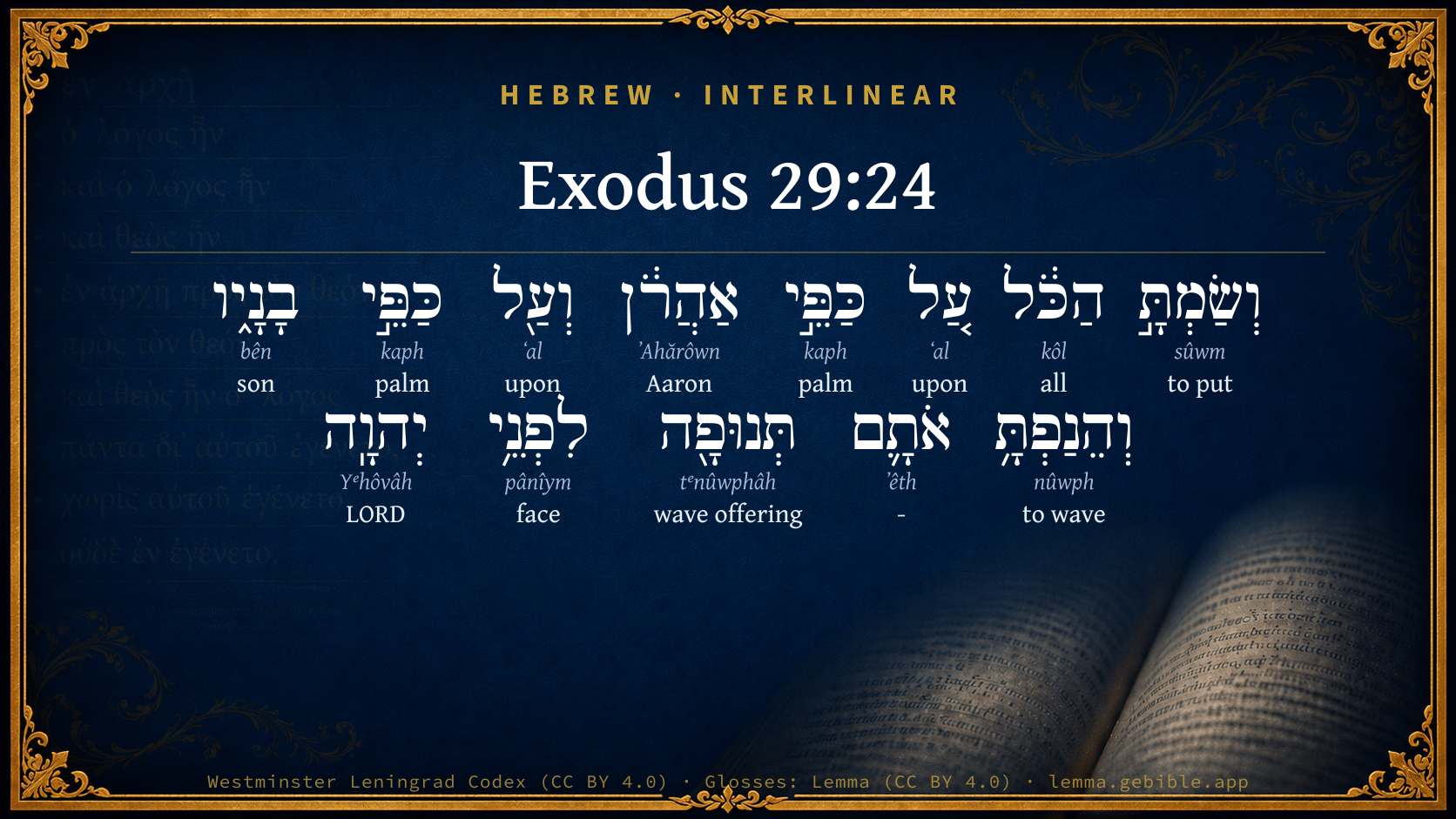
Exodus 29:24

Hebrew (Westminster Leningrad Codex) Exodus 29:24 appears in the Hebrew Old Testament. The text above is from the Westminster Leningrad Codex. Each word links to its Strong’s number, a concise gloss, and parsing drawn from the Open Scriptures Hebrew Bible morphology. Click any word for its full Brown-Driver-Briggs (BDB) entry.
Download image
Cite this verse

Exodus 29:24 (World English Bible). Public Domain. Lemma interlinear Bible study tool, https://lemma.gebible.app/v/exodus/29/24.

Show BibTeX & RIS
BibTeX
RIS
English Translation
You shall put all of this in Aaron's hands, and in his sons' hands, and shall wave them for a wave-offering before Yahweh.
World English Bible · Public Domain
Highlights
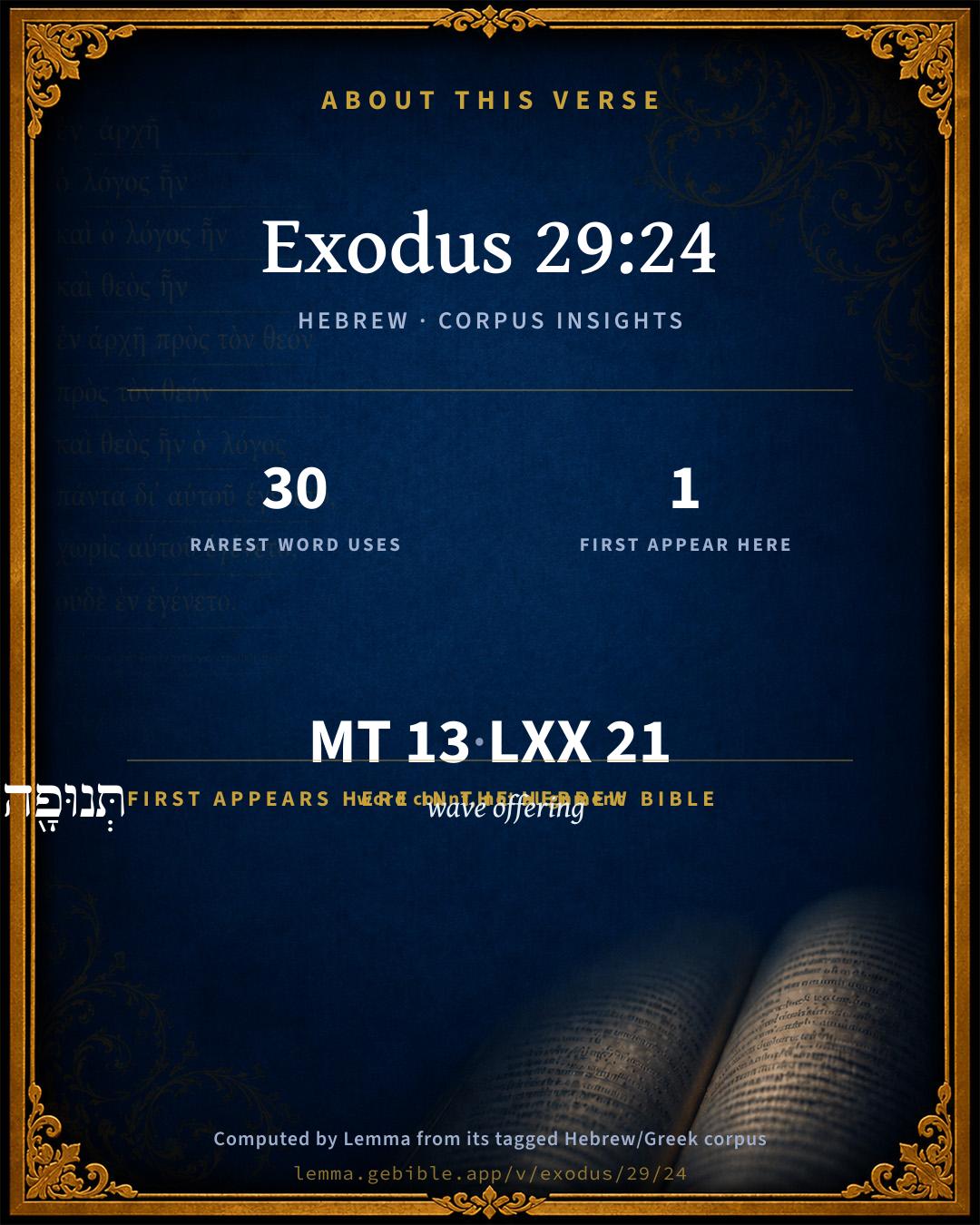
  • 1 first appearance in the Hebrew Bible
Full analysis ↓
Download a study sheet

One document with this verse’s original text, its word-by-word gloss line, the meaning frame, cross-references with their text, attributed commentary, and full source and license credits — printable, and it pastes into notes with its structure intact.

This verse Autodidact and up

Study sheet (.html) Plain text (.txt)

A passage Seminary Student

Up to 50 verses in one chapter. A passage sheet keeps up to 6 commentary sources and 12 cross-references per verse, in the order this page ranks them, and says so on the sheet whenever that leaves anything out. Ask for a single verse and you get the Autodidact verse sheet above.

Everything on this page stays free to read, with no account — the sheet is a download of what is already on screen, not access to it.

Want to remove ads? Support Godless Engineer
Compare translations 3

The same verse in 3 English versions, stacked beneath the original-language interlinear above. Click any original word for its lexicon entry.

Each is an independent rendering of the whole verse — the interlinear is not word-aligned to these translations.

Highlighted words mark where these versions differ — a whole-verse word diff, not a word-by-word alignment.

  • World English Bible Public Domain
    You shall put all of this in Aaron's hands, and in his sons' hands, and shall wave them for a wave-offering before Yahweh.
  • King James Version Public Domain
    And thou shalt put all in the hands of Aaron, and in the hands of his sons; and shalt wave them for a wave offering before the LORD.
  • unfoldingWord Literal Text CC BY-SA 4.0
    And you shall put all these on the palms of Aaron and on the palms of his sons, and you shall raise them as a raised offering before the face of Yahweh.

unfoldingWord Literal Text — © unfoldingWord, licensed CC BY-SA 4.0. Word-aligned USFM3 via Door43 (git.door43.org/unfoldingWord/en_ult).

Versions to compare (up to 4)

3 of 4 selected

Show all 18 translations

Every available English version of this verse, each an independent rendering of the whole verse.

  • World English Bible Public Domain
    You shall put all of this in Aaron's hands, and in his sons' hands, and shall wave them for a wave-offering before Yahweh.
  • Berean Standard Bible Public Domain
    Put all these in the hands of Aaron and his sons and wave them before the LORD as a wave offering.
  • Majority Standard Bible Public Domain
    Put all these in the hands of Aaron and his sons and wave them before the LORD as a wave offering.
  • King James Version Public Domain
    And thou shalt put all in the hands of Aaron, and in the hands of his sons; and shalt wave them for a wave offering before the LORD.
  • American Standard Version (1901) Public Domain
    And thou shalt put the whole upon the hands of Aaron, and upon the hands of his sons, and shalt wave them for a wave-offering before Jehovah.
  • Revised Version (1885) Public Domain
    and thou shalt put the whole upon the hands of Aaron, and upon the hands of his sons; and shalt wave them for a wave offering before the LORD.
  • Geneva Bible (1599) Public Domain
    And thou shalt put al this in the handes of Aaron, and in the handes of his sonnes, and shalt shake them to and from before the Lord.
  • Douay-Rheims (1899) Public Domain
    And thou shalt put all upon the hands of Aaron and of his sons, and shalt sanctify them elevating before the Lord.
  • Young's Literal Translation Public Domain
    `And thou hast set the whole on the hands of Aaron, and on the hands of his sons, and hast waved them -- a wave-offering before Jehovah;
  • Literal Standard Version CC BY-SA 4.0
    and you have set the whole on the hands of Aaron, and on the hands of his sons, and have waved them [for] a wave-offering before YHWH;
  • Unlocked Literal Bible CC BY-SA 4.0
    You must put these in Aaron's hands and in the hands of his sons and wave them before me for a wave offering before Yahweh.
  • unfoldingWord Literal Text CC BY-SA 4.0
    And you shall put all these on the palms of Aaron and on the palms of his sons, and you shall raise them as a raised offering before the face of Yahweh.
  • Darby Bible Public Domain
    and thou shalt put all this in the hands of Aaron, and in the hands of his sons, and shalt wave them as a wave-offering before Jehovah.
  • World Messianic Bible Public Domain
    You shall put all of this in Aaron’s hands, and in his sons’ hands, and shall wave them for a wave offering before the LORD.
  • Webster's Bible Public Domain
    And thou shalt put all in the hands of Aaron, and in the hands of his sons; and shalt wave them for a wave-offering before the LORD.
  • Free Bible Version CC BY-SA 4.0
    Give all of them to Aaron and his sons to wave before the Lord as a wave offering.
  • Bible in Basic English Public Domain
    And put them all on the hands of Aaron and of his sons, to be waved for a wave offering before the Lord.
  • JPS Tanakh (1917) Public Domain
    And thou shalt put the whole upon the hands of Aaron, and upon the hands of his sons; and shalt wave them for a wave-offering before the LORD.

Literal Standard Version (2020), Covenant Press — licensed CC BY-SA 4.0. Text via the HelloAO Bible API (eBible.org). Unlocked Literal Bible (unfoldingWord) — licensed CC BY-SA 4.0. Text via the HelloAO Bible API (eBible.org). unfoldingWord Literal Text — © unfoldingWord, licensed CC BY-SA 4.0. Word-aligned USFM3 via Door43 (git.door43.org/unfoldingWord/en_ult). Free Bible Version, Dr. Jonathan Gallagher — licensed CC BY-SA 4.0. Text via the HelloAO Bible API (eBible.org).

Word by word

More ways to search: Search by grammar → Find every occurrence → Compare this word →

Practice this passage: Drill this verse → Learn its vocabulary →

תְּנוּפָ֖ה
tᵉnûwphâh
H8573
“wave offering”
Noun, Common, Feminine, Singular, Absolute
Part of Speech
Noun
Type
Common
Gender
Feminine
Number
Singular
State
Absolute
Full BDB Definition

Origin: from H5130

TWOT: 1330b

swinging, waving, wave offering, offering - a swinging, brandishing - of God's hand, weapons - waving, wave-offering (technical term of sacrifice) - offering (of gold or brass)
  1. וְשַׂמְתָּ֣ sûwm H7760 “and · to put” Conjunction + Verb, Qal, Sequential Perfect, 2nd Person, Masculine, Singular
  2. הַכֹּ֔ל kôl H3605 “the · all” Particle, Definite Article + Noun, Common, Masculine, Singular, Absolute
  3. עַ֚ל ʻal H5921 “upon” Preposition
  4. כַּפֵּ֣י kaph H3709 “palms of” Noun, Common, Feminine, Dual, Construct
  5. אַהֲרֹ֔ן ʼAhărôwn H175 “Aaron” Noun, Proper
  6. וְעַ֖ל ʻal H5921 “and · upon” Conjunction + Preposition
  7. כַּפֵּ֣י kaph H3709 “palms of” Noun, Common, Feminine, Dual, Construct
  8. בָנָ֑יו bên H1121 “sons · his” Noun, Common, Masculine, Plural, Construct + Suffix, Personal, 3rd Person, Masculine, Singular
  9. וְהֵנַפְתָּ֥ nûwph H5130 “and · to wave” Conjunction + Verb, Hiphil, Sequential Perfect, 2nd Person, Masculine, Singular
  10. אֹתָ֛ם ʼêth H853 “- · them” Particle, Direct Object + Suffix, Personal, 3rd Person, Masculine, Plural
  11. לִפְנֵ֥י pânîym H6440 “to/for · face(s) of” Preposition + Noun, Common, Both, Plural, Construct
  12. יְהוָֽה Yᵉhôvâh H3068 “LORD” Noun, Proper

About this verse

These counts appear in no published source. They are computed here, from the morphology-tagged text and Lemma’s own curated glosses. What Lemma adds →

13
words
11
distinct lemmas
Pentateuch
section

First appearance in Scripture

This word makes its first canonical appearance in the Hebrew Bible here:

  • תְּנוּפָ֖ה wave offering H8573

Shared distinctive vocabulary

תְּנוּפָ֖ה wave offering H8573 occurs in 28 verses of the Hebrew Bible. Also found in:

Grammatical profile

  • 2 verbs
  • 8 nouns
  • 2 prepositions
  • 1 particle

Verb forms

  • וְשַׂמְתָּ֣ Qal · Sequential Perfect
  • וְהֵנַפְתָּ֥ Hiphil · Sequential Perfect

Repetition

Words recur within this verse — often emphatic in Hebrew:

  • עַ֚ל upon H5921 ×2
  • כַּפֵּ֣י palm H3709 ×2

Hebrew & Septuagint length

In English translation the verse runs 23 words from the Hebrew and 30 from the Septuagint (LXX English) — closely comparable.

A rough comparison of the two English renderings, which tokenize alike — not a word-level alignment.

Word counts can differ between the Hebrew and the Greek without any difference in meaning — e.g. the Hebrew direct-object marker אֵת has no separate Greek word, and Greek often adds the article ὁ.

In the original languages it is 13 Hebrew tokens and 21 Greek tokens — but the two are counted differently (Hebrew bundles its prefixes and suffixes into one token; the Greek is in lemma form), so that isn’t a like-for-like length.

Cross-references

5

Topical passages linked to Exodus 29:24 in the Treasury of Scripture Knowledge — connected by theme and wording, ordered by reader-vote popularity; previews shown in the World English Bible.

  • Leviticus 7:30 With his own hands he shall bring the offerings of Yahweh made by fire. He shall bring the fat with the breast, that the breast may be waved for a wave offering before Yahweh.
  • Leviticus 8:27 He put all these in Aaron's hands and in his sons' hands, and waved them for a wave offering before Yahweh.
  • Exodus 29:26–27 "You shall take the breast of Aaron's ram of consecration, and wave it for a wave-offering before Yahweh: and it shall be your portion.
  • Leviticus 9:21 and the breasts and the right thigh Aaron waved for a wave offering before Yahweh, as Moses commanded.
  • Leviticus 10:14 The waved breast and the heaved thigh you shall eat in a clean place, you, and your sons, and your daughters with you: for they are given as your portion, and your sons' portion, out of the sacrifices of the peace offerings of the children of Israel.

Cross-references courtesy of OpenBible.info (CC BY 4.0).

Hebrew and Greek witnesses Masoretic Hebrew ↔ Greek Septuagint

The same verse in the two great witnesses to the Old Testament, shown verse-for-verse.

These are two independent witnesses, not word-aligned to each other, and the Septuagint is shown in lemma (dictionary) form.

Hebrew Exodus 29:24 Masoretic · Westminster Leningrad Codex

וְשַׂמְתָּ֣ הַכֹּ֔ל עַ֚ל כַּפֵּ֣י אַהֲרֹ֔ן וְעַ֖ל כַּפֵּ֣י בָנָ֑יו וְהֵנַפְתָּ֥ אֹתָ֛ם תְּנוּפָ֖ה לִפְנֵ֥י יְהוָֽה

You shall put all of this in Aaron's hands, and in his sons' hands, and shall wave them for a wave-offering before Yahweh.

World English Bible · Public Domain

Greek LXX Exodus 29:24 Septuagint · lemma form

καί ἐπιτίθημι ὁ πᾶς ἐπί ὁ χείρ ααρων καί ἐπί ὁ χείρ ὁ υἱός αὐτός καί ἀποὁρίζω αὐτός ἀφόρισμα ἔναντι κύριος

And you shall put them all on the hands of Aaron, and on the hands of his sons, and you shall separate them as a separate offering before the Lord.

LXX2012 (modern English Septuagint) · Public Domain

Hebrew: Westminster Leningrad Codex (CC BY 4.0). Greek: Septuagint (public domain); English from LXX2012 (modern English Septuagint) (Public Domain). How the Septuagint differs from the Hebrew →

Targum (Aramaic paraphrase)

2

The Targum is the ancient Jewish Aramaic paraphrase of the Hebrew Scriptures — an interpretive translation, not the Hebrew text itself. Onkelos (literal) and Pseudo-Jonathan (expansive) render the Torah, and Jonathan the Prophets. Coverage is partial: where no permissively-licensed English translation exists for a verse, only the Aramaic is shown. This is verse-level text, not a word-by-word alignment to the Hebrew.

  1. Targum Onkelos Torah (Genesis–Deuteronomy)
    וּתְשַׁוֵי כֹלָא עַל יְדָא דְאַהֲרֹן וְעַל יְדָא דִבְנוֹהִי וּתְרִים יָתְהוֹן אֲרָמוּתָא קֳדָם יְיָ:

    (no public-domain English translation for this verse)

    Targum Onkelos — Aramaic: “Onkelos Genesis” (public domain); “Onkelos Exodus” (public domain); “Onkelos Leviticus” (public domain); “Onkelos Numbers” (public domain); “Onkelos Deuteronomy” (public domain). English: “Sefaria Community Translation” (CC0 1.0 (public-domain dedication)); “J.W. Etheridge. The Targums of Onkelos and Jonathan Ben Uzziel on the Pentateuch. London: Longmans, Green, 1862” (public domain). Text via Sefaria.

  2. Targum Pseudo-Jonathan Torah (Genesis–Deuteronomy)
    וּתְשַׁוֵּי כוֹלָא עַל יְדֵי אַהֲרן וְעַל יְדֵי בְנוֹי וְתָרִים יַתְהוֹן אֲרָמָא קֳדָם יְיָ

    and thou shalt put all upon the hands of Aharon and upon the hands of his sons, and shalt uplift them for an elevation before the Lord.

    Targum Pseudo-Jonathan — Aramaic: “Targum Jonathan on Genesis” (public domain); “Targum Jonathan on Exodus” (public domain); “Targum Jonathan on Leviticus” (public domain); “Targum Jonathan on Numbers” (public domain); “Targum Jonathan on Deuteronomy” (public domain). English: “The Targum of Jonathan ben Uzziel, trans. J. W. Etheridge, London, 1862” (public domain). Text via Sefaria.

Commentary

Notes on Exodus 29:24 from classic Christian and Jewish commentators (each source and its license shown beneath its notes). The classic Christian expositions comment on the surrounding passage and are grouped to its opening verse, so a note may address several verses; the Jewish commentaries on the Tanakh (Rashi and others) are per-verse, so they appear only where the commentator wrote on this verse.

Lemma curates 59 commentaries, every one of them public domain or Creative Commons licensed, each selected and text-cleaned for this edition rather than reprinted as found. About our sources →

Trapp's Complete Commentary

John Trapp

Exo 29:24 And thou shalt put all in the hands of Aaron, and in the hands of his sons; and shalt wave them [for] a wave offering before the LORD.

Ver. 24. And shalt wave them.] As acknowledging God’s omnipresence: and that many should come from east, west, north, and south, to partake of the merits and benefits of Christ, our true Sacrifice.

John Trapp, A Commentary or Exposition upon All the Books of the Old and New Testament (1647–1656) — public domain. Text from a community e-Sword module.

Adam Clarke's Commentary

Verse 24. For a wave-offering] See Clarke on Le 7:1 &c., where an ample account of all the offerings, sacrifices, &c., under the Mosaic dispensation, and the reference they bore to the great sacrifice offered by Christ, is given in detail.

Adam Clarke's Commentary on the Bible (1810–1826) — public domain. Text from a community e-Sword/MySword module.

Ellicott's Commentary for English Readers

(24) Thou shalt put all in the hands of Aaron, and in the hands of his sons.—Rather, on the hands. Having placed the offerings on the hands of his brother and his brother’s sons, Moses was to put his own hands beneath theirs, and to make a waving motion towards the four quarters of the sky, thus presenting the offerings to the ubiquitous God. Aaron and his sons thus performed their first priestly act, as passive instruments in Moses’ hands, by his muscular energy. Their priestly character was by these means made complete. (On “wave offerings,” see Note upon Lev_7:30.)

A Bible Commentary for English Readers, edited by Charles John Ellicott (1878–1897) — public domain. Text from a community e-Sword module.

The Cambridge Bible for Schools and Colleges

gen. ed. J. J. S. Perowne

24. hands] lit. palms; hence ‘upon,’ i.e. upon the open palms.

wave them] Moses is to ‘wave’ the offerings enumerated in vv. 22, 23, as they lie upon the priests’ hands, before Jehovah—i.e. to wave them not from right to left, but towards the altar and back. The ceremony of ‘waving’—first in H, Lev_23:11; Lev_23:20—is prescribed mostly for offerings which become ultimately the perquisite of the priests: and it seems to be intended as a symbolical expression of the fact that such offerings are first given to God, and then given back by Him to the priest for his own use (Di. on Lev_7:30, Now. ii. 239, Bä.): cf. Num_5:25; and see further on Lev_7:30. Here, as the offerings were afterwards, not given to the priests, but burned upon the altar (v. 25), the symbolism of the ceremony must be different; perhaps it is meant as a symbolical induction of the priests by Moses into their office of presenting sacrifices upon the altar (Bä.).

The Cambridge Bible for Schools and Colleges (gen. ed. J. J. S. Perowne; Cambridge University Press, 1878–1918) — public domain. Text from a community e-Sword module.

John Gill's Exposition

And thou shalt put all in the hands of Aaron, and in the hands of his sons,.... Which accounts for the use of the phrase, filling the hand for consecration, Exo 29:9 for all the above things of the ram, bread, cakes, and wafers, were put into their hands when consecrated, denoting their investiture with their office: all things are in the hands of Christ, relative to the glory of God and the good of his people; their persons are in his hands, and all grace and blessings of it for them; a commission to execute his office as a priest is given to him; and as it was proper that he also should have somewhat to offer, his hands are filled, and he has a sufficiency for that purpose, as Aaron and his sons had, Heb 8:3.

and shalt wave them for a wave offering before the Lord: which was waved or shook to and fro, from east to west, and from north to south, to or before him, as Jarchi observes, whose are the four winds of the world (g); and this was done by Moses and Aaron also; for, according to the same writer,"both were employed in waving, both the owners and the priest, how? the priest put his hand under the hand of the owner and waved, and in this Aaron and his sons were the owners and Moses the priest.''

(g) Vid. T. Bab. Menachot, fol. 62. 1.

John Gill's Exposition of the Whole Bible (1746–1763) — public domain (CC PDM 1.0). Text via the HelloAO Bible API.

Haydock's Catholic Bible Commentary

Elevating, and then letting them descend towards the earth. After which, Moses lifted the victims towards the east and west, and from north to south, to shew that God is the Sovereign of the world. (R. Solomon) --- Cato (Rustic. 34,) mentions a similar custom, of agitating or waving bread, in honour of Janus and of Jupiter. (Calmet)

George Leo Haydock (1774–1849), Haydock's Catholic Family Bible and Commentary, 1859 edition — public domain. Excludes Psalms (Douay-Rheims chapter numbering differs from Protestant) and Deuterocanonical books (Catholic canon only).

Matthew Poole's English Annotations

Either toss them from one hand to another, as giving all from themselves to God; or shake them to and fro, towards the several parts of the world, to note God’s dominion over all places and people, and the extent of that true and great sacrifice, represented in these types to all.

Matthew Poole's English Annotations on the Holy Bible (1683–1685) — public domain. Text from a community e-Sword/MySword module.

The Pulpit Commentary

Thou shalt put all in the hands, or on the hands." The offerings were to be laid first, on the hands of Aaron, and then on those of his sons, which were to support them; while Moses, putting his hands under theirs, made a waving motion with them towards the four corners of the heavens, to indicate that the gifts were offered to the omnipresent God. This process was that "filling of the hand," by which the actual installation in office took place. Moses, by the act, transferred the priestly functions, which he had hitherto exercised, to his brother and his brother"s descendants. He made them by his muscular energy perform their first priestly act.

The Pulpit Commentary (1880–1919), ed. H.D.M. Spence-Jones & Joseph S. Exell — public domain. Text from a community e-Sword module.

unfoldingWord translationNotes

Door43 World Missions Community

General Information:

God continues speaking to Moses.

You must put these

Here "these" refers to the parts of the sacrifice mentioned in the previous verses.

it will be an offering made to me by fire

This can be stated in active form. AT: "burn it as an offering to me" (See: Active or Passive)

translationWords

Aaron

Yahweh

sacrifice

altar

burnt offering

unfoldingWord translationNotes — © Distant Shores Media and the Door43 World Missions Community, licensed CC BY-SA 4.0. Source: git.door43.org/Door43/en_tn.

Rashi

Rabbi Shlomo Yitzchaki (Rashi)

על כפי אהרן … והנפת [AND THOU SHALT PUT ALL] IN THE HANDS OF AARON … AND THOU SHALT WAVE THEM — The rule is that both of them take part in the waving ceremony, the “owner” and the priest. How is this done? The priest places his hand beneath the “owner’s” hand, and thus does the waving (Menachot 61b) — and in case of this offering Aaron and his sons were the “owners” and Moses the priest, and therefore Scripture enacts as stated here.

תנופה A WAVE OFFERING — He moved it about horizontally in all directions to the glory of Him to Whom belong the four quarters of the world. This waving was symbolical of preventing and making of none effect misfortune and destructive winds. Then he moved it upwards and downward to the glory of Him to Whom belong heaven and earth and this was symbolical of keeping away injurious dews (Menachot 62a).

Rashi on the Tanakh — English translations: “The Judaica Press complete Tanach with Rashi, translated by A. J. Rosenberg” (CC BY 4.0); “Pentateuch with Rashi's commentary by M. Rosenbaum and A.M. Silbermann, 1929-1934” (public domain); “The Metsudah Tanach series, Lakewood, N.J” (CC BY 4.0); and “The Book of Joshua, Metsudah Publications, 1997” (CC BY 4.0). Text via Sefaria.

Lesson kit

Teaching starters — assembled from the data on this page, not authored interpretation. Every prompt links to the verse data it draws on. Edit before teaching.

Exodus, in the Pentateuch, opens this verse with 13 words (11 distinct Hebrew lemmas). Its most distinctive word is tᵉnûwphâh (“wave offering”). A historical commentator’s framing appears above. Read the whole chapter for the surrounding context.

Discussion questions

  1. The word tᵉnûwphâh carries the sense “wave offering.” How does it shape the verse?
  2. This is the first place “wave offering” appears in Scripture (first appears here). What does its debut here establish?
  3. How does Exodus 29:26, which shares the word «wave offering», read alongside this verse?
  4. What does the repetition of “upon” (2× in this one verse) do in this verse?
  5. These translations render this verse differently. What is at stake in choosing one wording over another?
  6. «וְשַׂמְתָּ֣» is a Qal Sequential Perfect verb. How does that grammatical form shape the action described?
  7. Compare how Trapp's Complete Commentary and Adam Clarke's Commentary read this verse. Where do they agree or differ?

Things to notice

Reading settings

Reading text

Shown beneath each verse's original-language words.

Old Testament
Old Testament edition

Read the OT as the Masoretic Hebrew (MT) or the Greek Septuagint (LXX).

English shown for the Greek Septuagint (in the Hebrew ↔ Greek comparison).

Comparing translations? Open the Compare panel on any verse page to stack up to four side by side.