
Ezekiel 6:2

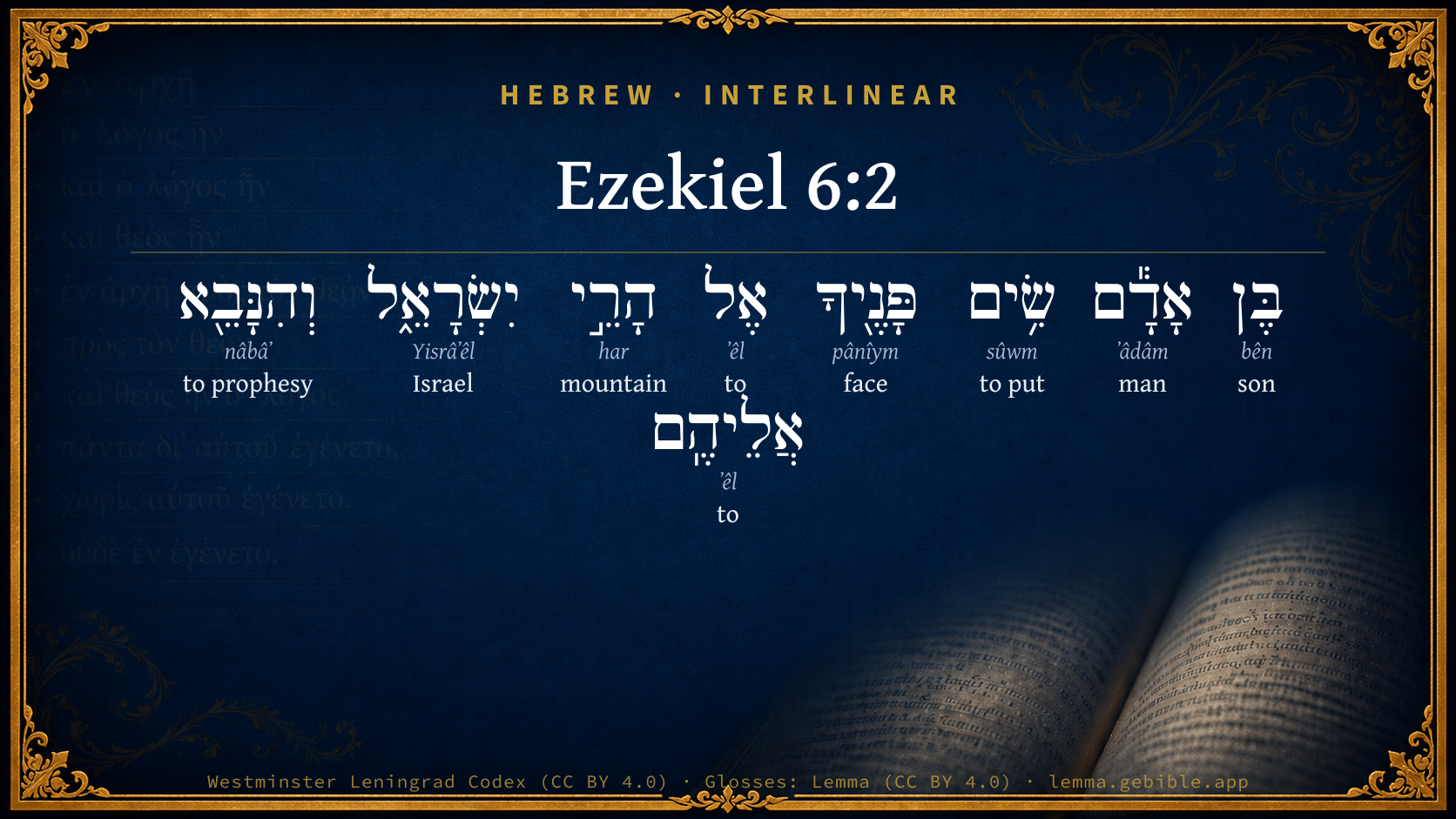
Hebrew (Westminster Leningrad Codex) Ezekiel 6:2 appears in the Hebrew Old Testament. The text above is from the Westminster Leningrad Codex. Each word links to its Strong’s number, a concise gloss, and parsing drawn from the Open Scriptures Hebrew Bible morphology. Click any word for its full Brown-Driver-Briggs (BDB) entry.
Download image
Cite this verse

Ezekiel 6:2 (World English Bible). Public Domain. Lemma interlinear Bible study tool, https://lemma.gebible.app/v/ezekiel/6/2.

Show BibTeX & RIS
BibTeX
RIS
English Translation
Son of man, set your face toward the mountains of Israel, and prophesy to them,
World English Bible · Public Domain
Download a study sheet

One document with this verse’s original text, its word-by-word gloss line, the meaning frame, cross-references with their text, attributed commentary, and full source and license credits — printable, and it pastes into notes with its structure intact.

This verse Autodidact and up

Study sheet (.html) Plain text (.txt)

A passage Seminary Student

Up to 50 verses in one chapter. A passage sheet keeps up to 6 commentary sources and 12 cross-references per verse, in the order this page ranks them, and says so on the sheet whenever that leaves anything out. Ask for a single verse and you get the Autodidact verse sheet above.

Everything on this page stays free to read, with no account — the sheet is a download of what is already on screen, not access to it.

Want to remove ads? Support Godless Engineer
Compare translations 3

The same verse in 3 English versions, stacked beneath the original-language interlinear above. Click any original word for its lexicon entry.

Each is an independent rendering of the whole verse — the interlinear is not word-aligned to these translations.

Highlighted words mark where these versions differ — a whole-verse word diff, not a word-by-word alignment.

  • World English Bible Public Domain
    Son of man, set your face toward the mountains of Israel, and prophesy to them,
  • King James Version Public Domain
    Son of man, set thy face toward the mountains of Israel, and prophesy against them,
  • unfoldingWord Literal Text CC BY-SA 4.0
    “Son of man, set your face against the mountains of Israel and prophesy to them.

unfoldingWord Literal Text — © unfoldingWord, licensed CC BY-SA 4.0. Word-aligned USFM3 via Door43 (git.door43.org/unfoldingWord/en_ult).

Versions to compare (up to 4)

3 of 4 selected

Show all 18 translations

Every available English version of this verse, each an independent rendering of the whole verse.

  • World English Bible Public Domain
    Son of man, set your face toward the mountains of Israel, and prophesy to them,
  • Berean Standard Bible Public Domain
    “Son of man, set your face against the mountains of Israel and prophesy against them.
  • Majority Standard Bible Public Domain
    “Son of man, set your face against the mountains of Israel and prophesy against them.
  • King James Version Public Domain
    Son of man, set thy face toward the mountains of Israel, and prophesy against them,
  • American Standard Version (1901) Public Domain
    Son of man, set thy face toward the mountains of Israel, and prophesy unto them,
  • Revised Version (1885) Public Domain
    Son of man, set thy face toward the mountains of Israel, and prophesy unto them,
  • Geneva Bible (1599) Public Domain
    Sonne of man, Set thy face towardes the mountaines of Israel, and prophecie against them,
  • Douay-Rheims (1899) Public Domain
    Son of man, set thy face towards the mountains of Israel, and prophesy against them.
  • Young's Literal Translation Public Domain
    `Son of man, set thy face unto mountains of Israel, and prophesy concerning them:
  • Literal Standard Version CC BY-SA 4.0
    “Son of man, set your face toward mountains of Israel, and prophesy concerning them:
  • Unlocked Literal Bible CC BY-SA 4.0
    “Son of man, set your face against the mountains of Israel and prophesy to them.
  • unfoldingWord Literal Text CC BY-SA 4.0
    “Son of man, set your face against the mountains of Israel and prophesy to them.
  • Darby Bible Public Domain
    Son of man, set thy face toward the mountains of Israel, and prophesy against them,
  • World Messianic Bible Public Domain
    “Son of man, set your face toward the mountains of Israel, and prophesy to them,
  • Webster's Bible Public Domain
    Son of man, set thy face towards the mountains of Israel, and prophesy against them,
  • Free Bible Version CC BY-SA 4.0
    “Son of man, face towards Israel's mountains and prophesy against them.
  • Bible in Basic English Public Domain
    Son of man, let your face be turned to the mountains of Israel, and be a prophet to them, and say,
  • JPS Tanakh (1917) Public Domain
    'Son of man, set thy face toward the mountains of Israel, and prophesy against them,

Literal Standard Version (2020), Covenant Press — licensed CC BY-SA 4.0. Text via the HelloAO Bible API (eBible.org). Unlocked Literal Bible (unfoldingWord) — licensed CC BY-SA 4.0. Text via the HelloAO Bible API (eBible.org). unfoldingWord Literal Text — © unfoldingWord, licensed CC BY-SA 4.0. Word-aligned USFM3 via Door43 (git.door43.org/unfoldingWord/en_ult). Free Bible Version, Dr. Jonathan Gallagher — licensed CC BY-SA 4.0. Text via the HelloAO Bible API (eBible.org).

Word by word

More ways to search: Search by grammar → Find every occurrence → Compare this word →

Practice this passage: Drill this verse → Learn its vocabulary →

וְהִנָּבֵ֖א
nâbâʼ
H5012
“and · prophesy”
Conjunction + Verb, Niphal, Imperative, 2nd Person, Masculine, Singular
Part of Speech
Conjunction + Verb
Stem
Niphal
Form
Imperative
Person
2nd Person
Gender
Masculine
Number
Singular
Full BDB Definition

Origin: a primitive root

TWOT: 1277

to prophesy - (Niphal) - to prophesy - under influence of divine spirit - of false prophets - (Hithpael) - to prophesy - under influence of divine spirit - of false prophets
  1. בֶּן bên H1121 “son of” Noun, Common, Masculine, Singular, Construct
  2. אָדָ֕ם ʼâdâm H120 “man” Noun, Common, Masculine, Singular, Absolute
  3. שִׂ֥ים sûwm H7760 “put” Verb, Qal, Imperative, 2nd Person, Masculine, Singular
  4. פָּנֶ֖יךָ pânîym H6440 “face(s) · your” Noun, Common, Both, Plural, Construct + Suffix, Personal, 2nd Person, Masculine, Singular
  5. אֶל ʼêl H413 “to” Preposition
  6. הָרֵ֣י har H2022 “mountains of” Noun, Common, Masculine, Plural, Construct
  7. יִשְׂרָאֵ֑ל Yisrâʼêl H3478 “Israel” Noun, Proper
  8. אֲלֵיהֶֽם ʼêl H413 “to · them” Preposition + Suffix, Personal, 3rd Person, Masculine, Plural

About this verse

These counts appear in no published source. They are computed here, from the morphology-tagged text and Lemma’s own curated glosses. What Lemma adds →

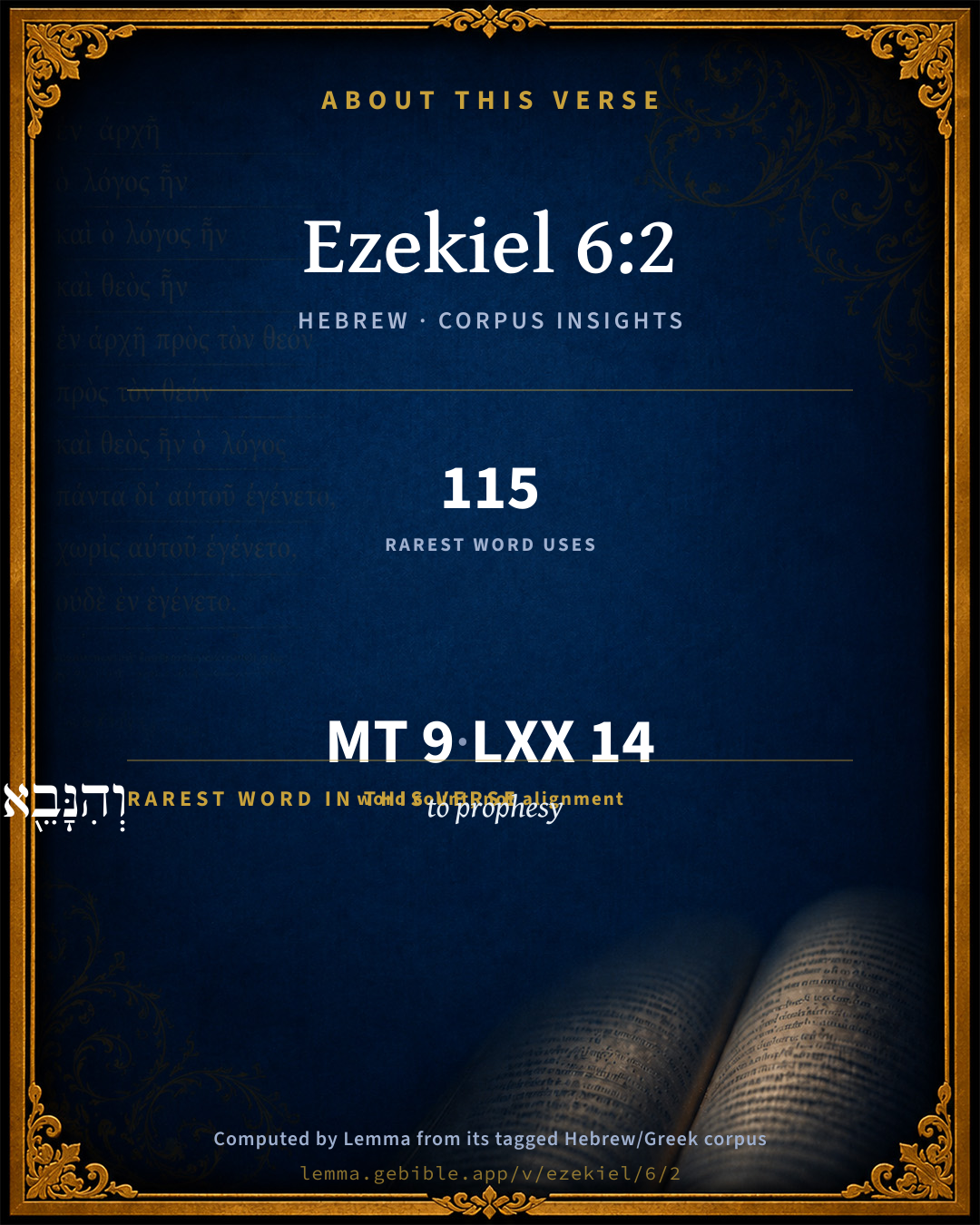
9
words
8
distinct lemmas
Prophets
section

Grammatical profile

  • 2 verbs
  • 5 nouns
  • 2 prepositions

Verb forms

  • שִׂ֥ים Qal · Imperative
  • וְהִנָּבֵ֖א Niphal · Imperative

Repetition

A word recurs within this verse — often emphatic in Hebrew:

  • אֶל to H413 ×2

Hebrew & Septuagint length

In English translation the verse runs 15 words from the Hebrew and 15 from the Septuagint (LXX English) — the same length.

A rough comparison of the two English renderings, which tokenize alike — not a word-level alignment.

Word counts can differ between the Hebrew and the Greek without any difference in meaning — e.g. the Hebrew direct-object marker אֵת has no separate Greek word, and Greek often adds the article ὁ.

In the original languages it is 9 Hebrew tokens and 14 Greek tokens — but the two are counted differently (Hebrew bundles its prefixes and suffixes into one token; the Greek is in lemma form), so that isn’t a like-for-like length.

Cross-references

14

Topical passages linked to Ezekiel 6:2 in the Treasury of Scripture Knowledge — connected by theme and wording, ordered by reader-vote popularity; previews shown in the World English Bible.

  • Ezekiel 19:9 They put him in a cage with hooks, and brought him to the king of Babylon; they brought him into strongholds, that his voice should no more be heard on the mountains of Israel.
  • Ezekiel 13:17 You, son of man, set your face against the daughters of your people, who prophesy out of their own heart; and prophesy you against them,
  • Ezekiel 20:46 Son of man, set your face toward the south, and drop [your word] toward the south, and prophesy against the forest of the field in the South;
  • Ezekiel 21:2 Son of man, set your face toward Jerusalem, and drop [your word] toward the sanctuaries, and prophesy against the land of Israel;
  • Ezekiel 25:2 Son of man, set your face toward the children of Ammon, and prophesy against them:
  • Ezekiel 33:28 I will make the land a desolation and an astonishment; and the pride of her power shall cease; and the mountains of Israel shall be desolate, so that none shall pass through.
  • Ezekiel 34:14 I will feed them with good pasture; and on the mountains of the height of Israel shall their fold be: there shall they lie down in a good fold; and on fat pasture shall they feed on the mountains of Israel.
  • Ezekiel 35:12 You shall know that I, Yahweh, have heard all your insults which you have spoken against the mountains of Israel, saying, They are laid desolate, they are given us to devour.
  • Ezekiel 36:1 You, son of man, prophesy to the mountains of Israel, and say, You mountains of Israel, hear the word of Yahweh.
  • Ezekiel 37:22 and I will make them one nation in the land, on the mountains of Israel; and one king shall be king to them all; and they shall be no more two nations, neither shall they be divided into two kingdoms any more at all;
  • Joshua 11:21 Joshua came at that time, and cut off the Anakim from the hill-country, from Hebron, from Debir, from Anab, and from all the hill-country of Judah, and from all the hill-country of Israel: Joshua utterly destroyed them with their cities.
  • Ezekiel 4:7 You shall set your face toward the siege of Jerusalem, with your arm uncovered; and you shall prophesy against it.
  • Ezekiel 38:2–3 Son of man, set your face toward Gog, of the land of Magog, the prince of Rosh, Meshech, and Tubal, and prophesy against him,
  • Micah 6:1–2 Listen now to what Yahweh says: "Arise, plead your case before the mountains, And let the hills hear what you have to say.

Cross-references courtesy of OpenBible.info (CC BY 4.0).

Hebrew and Greek witnesses Masoretic Hebrew ↔ Greek Septuagint

The same verse in the two great witnesses to the Old Testament, shown verse-for-verse.

These are two independent witnesses, not word-aligned to each other, and the Septuagint is shown in lemma (dictionary) form.

Hebrew Ezekiel 6:2 Masoretic · Westminster Leningrad Codex

בֶּן אָדָ֕ם שִׂ֥ים פָּנֶ֖יךָ אֶל הָרֵ֣י יִשְׂרָאֵ֑ל וְהִנָּבֵ֖א אֲלֵיהֶֽם

Son of man, set your face toward the mountains of Israel, and prophesy to them,

World English Bible · Public Domain

Greek LXX Ezekiel 6:2 Septuagint · lemma form

υἱός ἄνθρωπος στηρίζω ὁ πρόσωπον σύ ἐπί ὁ ὄρος ἰσραήλ καί προφητεύω ἐπί αὐτός

Son of man, set your face against the mountains of Israel, and prophesy against them;

LXX2012 (modern English Septuagint) · Public Domain

Hebrew: Westminster Leningrad Codex (CC BY 4.0). Greek: Septuagint (public domain); English from LXX2012 (modern English Septuagint) (Public Domain). How the Septuagint differs from the Hebrew →

Targum (Aramaic paraphrase)

1

The Targum is the ancient Jewish Aramaic paraphrase of the Hebrew Scriptures — an interpretive translation, not the Hebrew text itself. Onkelos (literal) and Pseudo-Jonathan (expansive) render the Torah, and Jonathan the Prophets. Coverage is partial: where no permissively-licensed English translation exists for a verse, only the Aramaic is shown. This is verse-level text, not a word-by-word alignment to the Hebrew.

  1. Targum Jonathan Prophets (Joshua–Malachi)
    בַּר אָדָם קַבֵּל נְבוּאָה עַל טוּרֵי יִשְׂרָאֵל וְאִתְנַבֵּי עֲלֵיהוֹן:

    (no public-domain English translation for this verse)

    Targum Jonathan — Aramaic: “Mikraot Gedolot” (public domain). English: “Sefaria Community Translation” (CC0 1.0 (public-domain dedication)); “London "Chaldee Paraphrase," 1871” (public domain). Text via Sefaria.

Commentary

Notes on Ezekiel 6:2 from classic Christian and Jewish commentators (each source and its license shown beneath its notes). The classic Christian expositions comment on the surrounding passage and are grouped to its opening verse, so a note may address several verses; the Jewish commentaries on the Tanakh (Rashi and others) are per-verse, so they appear only where the commentator wrote on this verse.

Lemma curates 59 commentaries, every one of them public domain or Creative Commons licensed, each selected and text-cleaned for this edition rather than reprinted as found. About our sources →

Ellicott's Commentary for English Readers

(2) Toward the mountains of Israel.—It is not uncommon to address prophetic utterances to inanimate objects as a poetic way of representing the people. (Comp. Eze_36:1; Mic_6:2, &c.) The mountains are especially mentioned as being the chosen places of idolatrous worship. (See Deu_12:2; 2Ki_17:10-11; Jer_2:20; Jer_3:6; Hos_4:13.) Baal, the sun-god, was the idol especially worshipped upon the hills.

A Bible Commentary for English Readers, edited by Charles John Ellicott (1878–1897) — public domain. Text from a community e-Sword module.

Trapp's Complete Commentary

John Trapp

Eze 6:2 Son of man, set thy face toward the mountains of Israel, and prophesy against them,

Ver. 2. Set thy face toward the mountains of Israel,] i.e., The Jews, who are haughty, and hard as mountains, who are asperi et inculti, rough and rude, as mountaineers use to be. In Mount Olivet itself, besides other mountains, they boldly set up their idols, even in the sight of the Lord; so that he never looked out of the sanctuary but he beheld that vile hill of abominations; called therefore, by an elegant alliteration, the Hill of Corruption. {2Ki 23:13}

John Trapp, A Commentary or Exposition upon All the Books of the Old and New Testament (1647–1656) — public domain. Text from a community e-Sword module.

Joseph Benson's Commentary

Eze 6:2-7. Set thy face toward the mountains of Israel — Turn thy face to that part where Judea is situated. Judea was a hilly country; therefore that whole land is expressed here and elsewhere by the mountains of Israel, Judah being called Israel, because the ten tribes, generally distinguished by that name, had been long since carried captive into Assyria, and Judah possessed a great part of their country. And prophesy against them — Direct thy discourse to them. The prophets sometimes directed their discourse to the inanimate parts of the creation, thereby to upbraid the stupidity of men. Thus saith the Lord to the mountains and to the hills — Every part of the country had been defiled with idolatry. The altars built for idol-worship were commonly placed upon mountains and hills; the shady valleys and river-sides were likewise made use of for the same purpose, particularly for the sacrificing of children to Moloch: see Isa 57:5; Jer 7:31. So by this the prophet denounces a general judgment upon the whole country. And your altars shall be desolate — See note on Lev 26:30, where Moses denounces against the Israelites the same judgments upon their provocations. I will cast down your slain men before your idols, &c. — So that their sin shall be read in the manner of their punishment; and while the idols are upbraided with their inability to help their worshippers, the idolaters are reproached with the folly of trusting in them. And ye shall know that I am the Lord — “An epiphonema, or conclusion of a severe denunciation often repeated by this prophet, importing that the judgments which God intended to bring on the Jews, would make the most hardened and stupid sinners sensible that this was God’s hand.” — Lowth.

Joseph Benson's Commentary on the Old and New Testaments (1811–1818) — public domain. Text from a community e-Sword module.

The Pulpit Commentary

Vers. 2, 3. Set thy face toward the mountains, etc. The formula is eminently characteristic of Ezekiel. We have had it with a different verb in the Hebrew, in Eze_4:3. It will meet us again in Eze_20:46 Eze_21:2 Eze_25:2 Eze_28:21 Eze_29:2 Eze_35:2 Eze_38:2. In this case it probably implied an outward act, like that of Daniel, when he, with a very different purpose, looked towards Jerusalem. (Dan_6:10) In contrast with the widespread plains of Mesopotamia in which Ezekiel found himself, this was the chief characteristic of the land which he had left. The mountains represent the whole country, including the rivers (Revised Version, here and throughout, renders the Hebrew "water courses," to distinguish it from the "river" (nahar) of Eze_1:1, Eze_1:3, et al., and the "river" (nachal) of Eze_47:5. Its strict meaning is that of a "ravine" or "gorge," the wady of modern Arabic, through which a stream rushes in the winter, but is dried up in the summer. All the localities are named as having been alike polluted by the worship of idols For mountains and hills as the scenes of such worship, see Deu_12:2; 2Ki_17:10, 2Ki_17:11; Jer_2:20 Jer_3:6; Hos_4:13; for the ravines and valleys, 2Ki_23:10 and; Jer_7:31 (the Valley of Hinnom) and more generally, Isa_57:5, Isa_57:6. The same combination meets us in Eze_35:8; Eze_36:5, Eze_36:6. In his address to the mountains, Ezekiel follows in the footsteps of Mic_6:2. I will destroy your high places. The words point to the most persistent, though not the worst, of all the idolatries by which the worship of Jehovah as the God of Israel had been overshadowed. The words of Ezekiel are identical with those of Leo, 26:30. The Bamoth, or high places, of Baal, are mentioned in Num_22:41 and Jos_13:17, and are probably identical with the high places of Arnon in Num_21:28. There they are named only incidentally, not in the way of prohibition or condemnation. So, in like manner, in Deu_32:13 and Deu_33:29, if the technical sense exists at all, it is referred to only asincluded in the triumph of the worship of Jehovah over the hill fortresses as the sanctuaries of other gods. The absence of the word from the Book of Judges is difficult to explain, as it was precisely in that period of the history of Israel, irregular and unsettled, that we should have expected to find the people adopting the cultus of their neighbours. A probable solution of the problem is that, so long as the tabernacle and the ark were at Shiloh, that was so pre-eminently the centre of the worship of Jehovah, that the people were not tempted to forsake it, or to set up the worship upon the high places side by side with it. When, after the capture of the ark, Shiloh was a deserted sanctuary, we meet for the first time with the worship of the high places, not as a thing forbidden, but as sanctioned by the presence of Samuel, as the judge and prophet of the people, (1Sa_9:12-14 1Sa_10:5) the "high place" in the last passage being, apparently, the same as "the hill of God." in 2Sa_1:19, possibly from the Book of Jashar, we have the elder, less technical sense of Deu_32:12 and Deu_33:19. It would seem, accordingly, as if Samuel had acted on a policy likethat of the counsel which Gregory I gave Augustine. He found the worship of the high places adopted by the Israelites from the neighbouring nations. He sought to turn them to the worship of Jehovah. So the writer of 1Ki_3:2 records the fact that "the people sacrificed in high places," because as yet, though the ark had been brought to Jerusalem, "there was no house built unto the Name of Jehovah until those days," and that Solomon himself also "sacrificed and burnt incense in the high places." At the chief of these, the great high place of Gibeon, Solomon offered a thousand burnt offerings, and had the memorable vision in which he made choice of wisdom rather than length of days, or riches and honour, returning from it, as though the cultus of the two places stood nearly on an equal footing, to offer other burnt offerings before the ark of God at Jerusalem. (1Ki_3:3-15) With the erection of the temple the state of things was, in some measure, altered, and the temple was the one legitimate sanctuary. When the ten tribes revolted under Jeroboam, they were, of course, cut off from the temple services, and the king accordingly, besides the calves at Bethel and Dan, set up high places, with priests not of the sons of Aaron, in the cities of Samaria. (1Ki_12:31 1Ki_13:32) From that time forward the high places are always mentioned by both historians and prophets in a tone of condemnation, whether they were in Israel or Judah, (1Ki_14:4) but they had become so deeply rooted in the reverence of the people that even the better kings of Judah, who warred against open idolatry, like Asa, (1Ki_15:14) Jehoshaphat, (1Ki_22:43) Jehoash, (2Ki_12:3) Amaziah, (2Ki_14:4) Azariah, (2Ki_15:4) left them undisturbed; while in the history of the northern kingdom the cultus of the Bamoth reigned paramount. (2Ki 17, passim) It was not till Hezekiah, presumably under Isaiah"s influence, removed the "high places (2Ki_18:4) that we find any serious attempt to put them down. They had been tolerated, apparently, because, as in Rabshakeh"s taunt, (2Ki_18:22) they were nominally connected with the worship of Jehovah. Under the confluent polytheism of Manasseh they naturally reappeared. (2Ch_33:3) The reformation of Josiah was more thorough (2Ki 23, passim; , 2Ch_34:3) and was probably stimulated by Hilkiah and Huldah. The discovery of the book of the Law (probably Deuteronomy), with its condemnations of mountain sanctuaries, though, as we have seen, the Bamoth were not prohibited by name, roused the zeal of the prophets, especially of the priest prophets Jeremiah and Ezekiel, and when the Bamoth-cultus revived, after the death of Josiah, the former was strong in his protests, (Jer_7:31, et al.) all the more so because now, as in the earlier stages of their history, they had become high places of Baal, (Jer_19:5 Jer_32:5) and were associated with abominations like those of the worship of Moloch in the Valley of Hinnom. So it was that Ezekiel, writing on the banks of the Chebar, is now led to place them in the forefront of the sins of his people.

The Pulpit Commentary (1880–1919), ed. H.D.M. Spence-Jones & Joseph S. Exell — public domain. Text from a community e-Sword module.

Adam Clarke's Commentary

Verse 2. Set thy face toward the mountains of Israel] This is a new prophecy, and was most probably given after the four hundred and thirty days of his lying on his left and right side were accomplished. By Israel here, Judea is simply meant; not the ten tribes, who had long before been carried into captivity. Ezekiel uses this term in reference to the Jews only.

The mountains may be addressed here particularly, because it was on them the chief scenes of idolatry were exhibited.

Adam Clarke's Commentary on the Bible (1810–1826) — public domain. Text from a community e-Sword/MySword module.

The Cambridge Bible for Schools and Colleges

gen. ed. J. J. S. Perowne

2. Son of man] See on ch. Eze_2:1.

mountains of Israel] i.e. the mountain-land of Israel, but with special reference to the mountains as the seats of idolatrous worship.

The Cambridge Bible for Schools and Colleges (gen. ed. J. J. S. Perowne; Cambridge University Press, 1878–1918) — public domain. Text from a community e-Sword module.

John Gill's Exposition

And say, ye mountains of Israel, hear the word of the Lord God,.... Since the people of the Jews would not hear the word of the Lord, the mountains are called upon to hear it; unless the inhabitants of the mountains are meant:

thus saith the Lord God to the mountains and to the hills, to the rivers and to the valleys: these are addressed, because idols were worshipped here; as upon the mountains and hills, so by rivers of water, and also in valleys, as in the valley of Hinnom idols were worshipped; upon mountains and hills, because they thought themselves nearer to heaven; by rivers, because of purity; and in valleys, because shady and obscure, and had something solemn and venerable in them:

behold I, even I, will bring a sword upon you; that is, upon the idolaters, which worshipped in these places; otherwise different instruments, as pick axes, &c. would have been more proper. The Targum paraphrases it,

"them that kill with the sword;''

meaning the Chaldeans, who doubtless are intended:

and I will destroy your high places; the temples and altars, built on high places, and devoted to idolatrous worship, as follows:

John Gill's Exposition of the Whole Bible (1746–1763) — public domain (CC PDM 1.0). Text via the HelloAO Bible API.

Haydock's Catholic Bible Commentary

Mountains, where idols were chiefly adored. Here their votaries find death. (Worthington) --- Israel, including all God’s people, as the sacred writers make no distinction (Calmet) after the destruction of Samaria.

George Leo Haydock (1774–1849), Haydock's Catholic Family Bible and Commentary, 1859 edition — public domain. Excludes Psalms (Douay-Rheims chapter numbering differs from Protestant) and Deuterocanonical books (Catholic canon only).

Matthew Poole's English Annotations

Son of man; see Eze 2:1; put thyself towards the mountains, in a posture of one who is going to speak, look toward them; hereby (as Isaiah did, Isa 12) upbraiding the deafness of the Jews, whom he now left to speak to mountains. Or rather, to the inhabitants of the mountains, who were secure in their fastnesses; and great idolaters, who chose the high hills, &c. for places of idolatrous worship. Israel; the common name to all that now remained since the ten tribes were captivated by Shalmaneser.

Prophesy against them; declare my judgments against them.

Matthew Poole's English Annotations on the Holy Bible (1683–1685) — public domain. Text from a community e-Sword/MySword module.

John Wesley's Explanatory Notes

The mountains - The inhabitants of the mountains, who were secure in their fastnesses.

John Wesley, Explanatory Notes Upon the Whole Bible (1754–1765) — public domain. Text via the GEBible commentary corpus.

Lesson kit

Teaching starters — assembled from the data on this page, not authored interpretation. Every prompt links to the verse data it draws on. Edit before teaching.

Ezekiel, in the Prophets, opens this verse with 9 words (8 distinct Hebrew lemmas). Its most distinctive word is nâbâʼ (“to prophesy”). A historical commentator’s framing appears above. Read the whole chapter for the surrounding context.

Discussion questions

  1. What does “to prophesy” (nâbâʼ) contribute to the verse as a whole?
  2. How does Ezekiel 19:9, which shares this passage’s theme, read alongside this verse?
  3. What does the repetition of “to” (2× in this one verse) do in this verse?
  4. These translations render this verse differently. What is at stake in choosing one wording over another?
  5. «שִׂ֥ים» is a Qal Imperative verb. How does that grammatical form shape the action described?
  6. Compare how Ellicott's Commentary for English Readers and Trapp's Complete Commentary read this verse. Where do they agree or differ?

Things to notice

Reading settings

Reading text

Shown beneath each verse's original-language words.

Old Testament
Old Testament edition

Read the OT as the Masoretic Hebrew (MT) or the Greek Septuagint (LXX).

English shown for the Greek Septuagint (in the Hebrew ↔ Greek comparison).

Comparing translations? Open the Compare panel on any verse page to stack up to four side by side.